5G From Space Market Global Industry Analysis and Forecast (2026–2035)

5G From Space Market size was USD 2.69 Billion in 2025, projected to reach USD 25.93 Billion by 2035, growing at a CAGR of 25.45% from 2026 to 2035. Key drivers include direct-to-device connectivity demand, carrier partnership commitments, regenerative payload maturation, with North America leading the global market.

Download Free Sample PDF
Base Year (2025)
$2.69 Billion
Forecast (2035)
$25.93 Billion
CAGR (2026-2035)
25.5%
Top Region
North America

What Is the 5G From Space Market Size?

The global 5G From Space Market reached USD 2.69 Billion in 2025 and is estimated at USD 3.37 Billion in 2026, forecast to reach USD 25.93 Billion by 2035 at a CAGR of 25.45% between 2026 and 2035. North America leads with approximately 34% revenue share in 2025, while Direct-to-Device Cellular Connectivity is the dominant connectivity service, holding approximately 39% of total market revenue.

We observed that technological shifts in 5G from space are centered on low Earth orbit constellations that carry standards-compliant base station functions in orbit. Lightweight composite structures, high-efficiency solar arrays, and software defined payloads are reducing launch mass and enabling larger aperture beams. Operational scale is advancing as satellite manufacturers move from prototype production toward repeatable assembly lines, allowing constellation operators to deploy and replenish satellites on predictable cadences.

5G From Space Market Global Industry Analysis and Forecast (2026–2035) Revenue Forecast

Values in USD Billion

2025 $2.69 Billion
2025
2026 $3.37 Billion
2026
2027 $4.23 Billion
2027
2028 $5.30 Billion
2028
2029 $6.65 Billion
2029
2030 $8.35 Billion
2030
2031 $10.47 Billion
2031
2032 $13.14 Billion
2032
2033 $16.48 Billion
2033
2034 $20.67 Billion
2034
2035 $25.93 Billion
2035

Key Takeaways

By Connectivity Service: Direct-to-Device Cellular Connectivity held the largest share, expanding from USD 1.04 Billion in 2025 to USD 10.08 Billion by 2035; 5G Satellite Backhaul and Trunking is the fastest-growing at 29.9% CAGR from 2026–2035.

By 3GPP NTN Radio Technology: NR-NTN held the largest share, expanding from USD 1.21 Billion in 2025 to USD 10.00 Billion by 2035; eMTC NTN is the fastest-growing at 28.4% CAGR from 2026–2035.

By Satellite Orbit: Low Earth Orbit (LEO) held the largest share, expanding from USD 1.05 Billion in 2025 to USD 9.90 Billion by 2035; Highly Elliptical Orbit (HEO) is the fastest-growing at 28.9% CAGR from 2026–2035.

By Satellite Network Architecture: Single-Orbit Architecture held the largest share, expanding from USD 1.57 Billion in 2025 to USD 13.50 Billion by 2035, while Multi-Orbit Architecture is the fastest-growing at 27.2% CAGR from 2026–2035.

Dominant Region: North America dominated the market with approximately 34% revenue share (USD 0.91 Billion) in 2025, anchored by mature commercial infrastructure, early institutional adoption of advanced platforms, and high concentrations of leading technology vendors.

Fastest-Growing Region: Asia-Pacific is expected to register the highest CAGR of 28.7% during 2026–2035, driven by rapid infrastructure expansion, massive public programs, and expanding commercial adoption across high-density markets.

Dominant Country: The U.S. led the market with an estimated USD 0.69 Billion in 2025 (~76% of North America), supported by extensive commercial adoption, dense vendor presence, and early technology deployment.

Fastest-Growing Country: India is among the fastest-growing major countries, projected to expand from USD 0.15 Billion in 2025 at a CAGR of approximately 30.5%, driven by rapid operational modernization, supportive public programs, and expanding commercial infrastructure rollouts.

Next Move Strategy Consulting's analysis indicates that the 5G from space market offers an absolute dollar opportunity of USD 22.56 billion between 2026 and 2035, measured as the difference between the USD 3.37 billion valuation in 2026 and the USD 25.93 billion forecast for 2035. Capturing this incremental value requires operators to secure orbital slots, integrate satellite and terrestrial core networks, and establish long-term revenue commitments with carriers. Participants that align launch cadence with subscriber onboarding will be positioned to convert the expanding addressable base into durable service revenue across the forecast horizon.

Competitive consolidation in 5G from space is progressing as satellite operators, launch providers, and mobile carriers form partnerships that combine orbital assets with terrestrial spectrum rights. Vertical integration between constellation builders and ground segment equipment suppliers is reducing interface risk and shortening deployment timelines. Supply chain scale is also becoming a differentiator, since production of phased array terminals, radiation hardened electronics, and launch services must be coordinated across multiple tier suppliers to sustain constellation replenishment and service continuity.

Ecosystem Analysis of the 5G From Space Industry

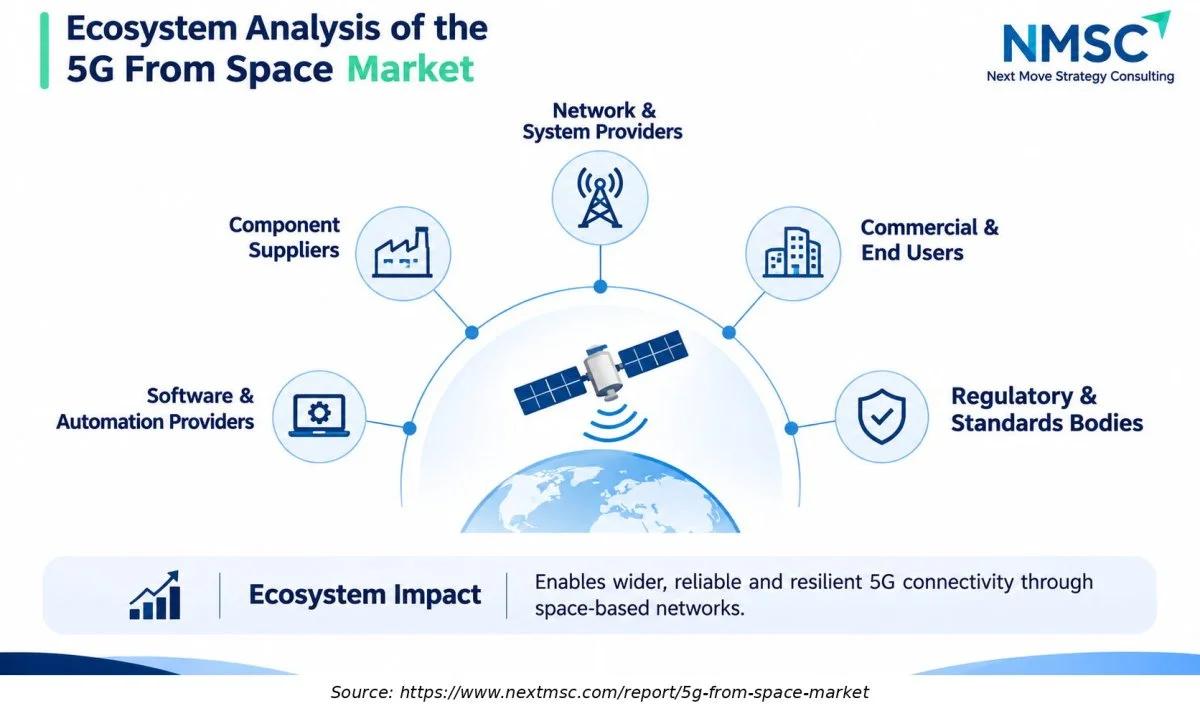
The infographic illustrates the 5G From Space market ecosystem, highlighting key stakeholders, including network providers, component suppliers, software and automation providers, commercial end users, and regulatory bodies. It demonstrates how collaboration supports satellite-based connectivity, operational efficiency, network reliability, and wider service adoption.

What Does the 5G From Space Market Encompass?

The 5G from space market encompasses satellite based systems that deliver 5G compatible cellular connectivity directly to handsets or through gateway stations linked to terrestrial networks. Product types include low Earth orbit and medium Earth orbit constellations, geostationary relay payloads, direct-to-device service platforms, and ground gateway infrastructure. Core technologies involve regenerative onboard processing, beamforming antenna arrays, inter satellite laser links, and standards-based radio interfaces that allow orbital nodes to function as extensions of mobile core networks.

Design specifications in this market emphasize mass reduction, thermal management in vacuum conditions, and radiation tolerance for extended orbital life. Material innovations include lightweight carbon fiber structures, gallium nitride power amplifiers, and deployable reflector and antenna substrates that fit within launch vehicle fairings. Certifications span spectrum licensing from national regulators, international coordination filings for orbital assets, and conformance testing against 3GPP non-terrestrial network specifications, which together determine whether a satellite payload can legally and technically serve commercial subscribers.

Market Drivers & Dynamics

Interactive Dataset
Direct-to-Device Connectivity Demand driver High Immediate
Carrier Partnership Commitments driver High Immediate
Regenerative Payload Maturation driver Medium Medium-term
Orbital Launch Capacity Constraints restraint High Immediate
Spectrum Coordination Complexity restraint Medium Medium-term
Orbital Debris Regulation restraint Low Long-term
Source: Next Move Strategy Consulting

Growth Drivers

What Is the Primary Growth Driver in the 5G From Space Industry?

The primary catalyst in 5G from space is the commercial alignment between satellite operators and mobile network carriers seeking to extend service into areas that terrestrial towers cannot economically reach. Direct-to-device architectures allow standard handsets to connect to orbital nodes without specialized hardware, which broadens the addressable subscriber base. As carriers commit to multi-year capacity purchases, satellite operators gain the revenue visibility needed to finance larger constellations and accelerate deployment across the forecast period.

How Are Industry Standards and Directives Driving the Market?

Regulatory frameworks are shaping how 5G from space services are authorized and interconnected with terrestrial networks. Spectrum licensing decisions by national communications regulators and coordination filings under international telecommunications frameworks determine which orbital operators can serve specific territories. Conformance with 3GPP non-terrestrial network specifications provides a common technical baseline, allowing devices and core networks to interoperate, which in turn reduces integration risk for carriers evaluating satellite partnerships.

Growth Inhibitors

What Is Restraining the 5G From Space Market?

The principal restraint in 5G from space is the limited availability of orbital launch capacity and the high capital intensity of building and replenishing satellite constellations. Launch schedules can shift, and manifest congestion may delay the placement of satellites into operational orbits. Because service revenue depends on a fully deployed constellation, these timing risks extend the payback period for operators and make financing terms more sensitive to launch readiness across the supply chain.

What Are the Growth Opportunities?

Can Direct-to-Device Service Capture High-Density Deployments?

Direct-to-device service offers a route to serve dense urban and event environments where satellite coverage can supplement congested terrestrial cells. Handsets that connect straight to orbital nodes can supplement terrestrial coverage during peak usage, particularly in stadiums and transport hubs. Operators that integrate satellite capacity with existing mobile core networks may therefore unlock incremental subscriber engagement in locations where traditional small cell densification is constrained by permitting and cost.

How Is Mid-Tier and Regional Facility Adoption Unlocking New Market Volume?

Regional hubs, secondary ports, mining sites, and mid-sized agricultural operations represent a growing set of facilities that require resilient connectivity without the expense of dedicated terrestrial builds. Gateway stations and compact terminals allow these locations to connect to satellite backhaul at a manageable capital outlay. Scaling adoption across these facilities expands total service volume, since many operators have yet to deploy connectivity solutions tailored to their operational needs.

Can Specialized Vertical Implementations Become Distinct Premium Markets?

Specialized applications such as aviation connectivity, maritime fleet broadband, and emergency communications for government agencies can command premium service pricing relative to consumer offerings. These segments demand higher reliability, low-latency, and secure links, which justify tailored service level agreements. As satellite operators develop dedicated product lines for these verticals, they can establish differentiated revenue streams that are less exposed to commoditized subscriber pricing.

Segmentation Analysis

2025 (USD Billion)
2035 (USD Billion)
Direct-to-Device Cellular Connectivity 2025: $1.04 Billion | 2035: $10.08 Billion
Direct-to-De
Direct-to-IoT Connectivity 2025: $0.70 Billion | 2035: $5.55 Billion
Direct-to-Io
5G Satellite Broadband Access 2025: $0.57 Billion | 2035: $5.10 Billion
5G Satellite
5G Satellite Backhaul and Trunking 2025: $0.38 Billion | 2035: $5.20 Billion
5G Satellite
Direct-to-Device Cellular Connectivity $1.04 Billion $10.08 Billion 25.5%
Direct-to-IoT Connectivity $0.70 Billion $5.55 Billion 23.0%
5G Satellite Broadband Access $0.57 Billion $5.10 Billion 24.5%
5G Satellite Backhaul and Trunking $0.38 Billion $5.20 Billion 29.9%

Which Connectivity Service Segment Dominates the Market?

The installed base of 5G from space connectivity is anchored by Direct-to-Device Cellular Connectivity, which commands roughly 39% share and USD 1.04 billion in 2025. Operators procure this capacity because it extends existing mobile subscriber relationships into areas without terrestrial coverage, creating a durable baseline demand anchor. Meanwhile, 5G Satellite Backhaul and Trunking is the fastest-growing segment at a 29.9% CAGR through 2035, as carriers and enterprises seek resilient transport links for remote cell sites and critical network trunks.

Supply Chain Analysis of the 5G From Space Industry

Supply Chain Analysis of the 5G From Space Industry
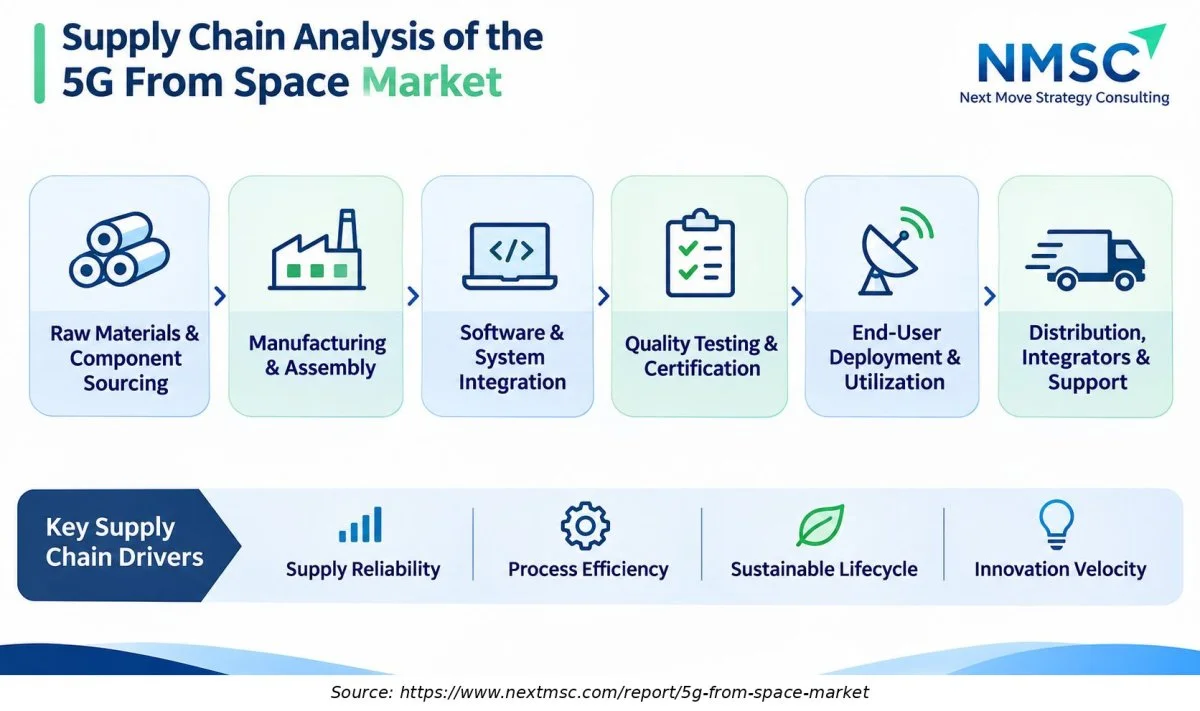
The infographic outlines the 5G From Space supply chain, covering raw material sourcing, manufacturing and assembly, software integration, quality testing, end-user deployment, and distribution support. It highlights how each stage contributes to supply reliability, process efficiency, sustainable operations, and technological innovation.

Growth Opportunities

Our analysis shows that three structural whitespace opportunities are positioned to generate disproportionate commercial returns in the 5G From Space Market through 2035:

Can Direct-to-Device Service Capture High-Density Deployments?

Direct-to-device service offers a route to serve dense urban and event environments where satellite coverage can supplement congested terrestrial cells. Handsets that connect straight to orbital nodes can supplement terrestrial coverage during peak usage, particularly in stadiums and transport hubs. Operators that integrate satellite capacity with existing mobile core networks may therefore unlock incremental subscriber engagement in locations where traditional small cell densification is constrained by permitting and cost.

How Is Mid-Tier and Regional Facility Adoption Unlocking New Market Volume?

Regional hubs, secondary ports, mining sites, and mid-sized agricultural operations represent a growing set of facilities that require resilient connectivity without the expense of dedicated terrestrial builds. Gateway stations and compact terminals allow these locations to connect to satellite backhaul at a manageable capital outlay. Scaling adoption across these facilities expands total service volume, since many operators have yet to deploy connectivity solutions tailored to their operational needs.

Can Specialized Vertical Implementations Become Distinct Premium Markets?

Specialized applications such as aviation connectivity, maritime fleet broadband, and emergency communications for government agencies can command premium service pricing relative to consumer offerings. These segments demand higher reliability, low-latency, and secure links, which justify tailored service level agreements. As satellite operators develop dedicated product lines for these verticals, they can establish differentiated revenue streams that are less exposed to commoditized subscriber pricing.

Regional Outlook

2025 (USD Billion)
2035 (USD Billion)
North Americ
Europe
Asia-Pacific
Latin Americ
Middle East
Region 2025 (USD Billion) 2035 (USD Billion) CAGR (%)
North America $10.0 USD Billion $40.0 USD Billion 9.0%
Europe $17.1 USD Billion $51.1 USD Billion 27.0%
Asia-Pacific $24.2 USD Billion $62.2 USD Billion 25.0%
Latin America $31.3 USD Billion $73.3 USD Billion 23.0%
Middle East & Africa $38.4 USD Billion $84.4 USD Billion 12.0%

Regional data is locked

Unlock complete regional numbers for this market.

Unlock Full Data

Competitive Landscape

The competitive structure of the 5G from space market is moderately concentrated, with established satellite operators and emerging direct-to-device specialists competing for overlapping customer segments. North America leads with USD 0.91 billion in 2025, positioning U.S.-based providers such as SpaceX, Inc., AST SpaceMobile, Inc., Globalstar, Inc., and Iridium Communications Inc. at the center of commercial activity. Meanwhile, European and Gulf operators including Eutelsat Group, SES S.A., and Space42 PLC pursue sovereign and regional service positions, shaping a multi-polar competitive landscape. Competitive Assessment Matrix

Dimension Description
Dimension Assessment
Product Quality & Durability Service reliability, satellite lifespan, and link continuity determine operator confidence in 5G from space platforms.
Distribution & Retail Reach Carrier partnerships and wholesale capacity agreements shape access to mobile subscribers and enterprise accounts.
Design & Customization Moat Tailored gateway configurations and device chipset compatibility create switching costs for integrated operators.
Material Innovation & Sustainability Lightweight satellite architectures and efficient payload designs lower launch costs and support long-term constellation deployment.

How Do Companies Compete in the 5G From Space Market?

Providers differentiate on service coverage, spectrum access, device compatibility, and integration with terrestrial mobile networks. Pricing typically follows wholesale capacity agreements with mobile network operators, while enterprise and government customers negotiate bespoke contracts tied to service-level commitments. Distribution relies heavily on partnerships with carriers and integrators, since direct retail reach into consumer handsets remains constrained by device ecosystem dependencies.

Which Competitive Archetypes Dominate the 5G From Space Market?

Market participants in 5G from space fall into three archetypes: vertically integrated constellation operators that own satellites and ground infrastructure, such as SpaceX, Inc. and AST SpaceMobile, Inc.; established geostationary and medium-orbit service providers including SES S.A., Eutelsat Group, Viasat, Inc., and Telesat Corporation; and niche narrowband specialists such as Iridium Communications Inc. and Globalstar, Inc. Each archetype pursues distinct spectrum, orbit, and customer strategies while competing for overlapping mobile and backhaul demand.

What Innovation and Differentiation Strategies Are Companies Pursuing?

Sustainable advantage in 5G from space stems from spectrum rights, orbital slot access, and long-term operator agreements that raise entry barriers. Providers with integrated satellite and terrestrial interoperability capabilities hold stronger positions when mobile carriers seek seamless coverage extension. Proven service reliability and regulatory licensing across key jurisdictions further reinforce incumbent positions against newer market entrants.

What M&A and Partnership Activity Is Shaping the Market?

Merger and acquisition activity in 5G from space reflects consolidation around spectrum portfolios, orbital assets, and ground network capabilities. Established satellite operators increasingly pursue partnerships and asset acquisitions to secure direct-to-device capabilities and multi-orbit coverage. Strategic alliances with mobile network operators, such as long-term commercial agreements for space-based cellular broadband, also function as a parallel route to scale without full ownership transfers.

Key Market Players

Based on research conducted by NMSC, the following 19 companies represent the validated leadership set across 5G From Space Market developers, manufacturers, and solution providers:

SpaceX, Inc. AST SpaceMobile, Inc. Eutelsat Group SES S.A. Viasat, Inc. Iridium Communications Inc. Globalstar, Inc. Space42 PLC Telesat Corporation EchoStar Corporation Skylo Technologies OQ Technology, Inc. Elveo Mobile, Inc. KT SAT Co., Ltd. SKY Perfect JSAT Corporation Terrestar Solutions Inc. Amazon Leo, Inc. Ligado Networks, Inc. Assured Space Access Technologies, Inc.

Latest Developments

During our market evaluation, we noticed that recent commercial activities, platform introductions, and partnerships within the industry reflect the latest market developments:

Date Event
July 2026 According to official company disclosures, Space42 and Skylo successfully demonstrated two-way Direct-to-Device SMS and SOS connectivity using a standard Android smartphone linked to Thuraya-4 over Skylo’s 3GPP-compliant NTN platform.

Investment Opportunities

Where Are Capital Inflows Concentrating in the 5G From Space Market?

Capital inflows in 5G from space are concentrating in constellation build-outs, direct-to-device spectrum programs, and multi-orbit network integration. Long-term commercial commitments from mobile operators, such as the 10-year agreement between stc group and AST SpaceMobile, provide revenue visibility that supports large upfront satellite investments. Moreover, next-generation satellite platforms designed for 4G and 5G service signal sustained allocation toward payload and antenna technologies.

How Is Infrastructure Investment Shaping Market Capacity?

Infrastructure investment in 5G from space centers on satellite manufacturing capacity, launch access, and ground gateway networks that determine service throughput. Operators expanding multi-orbit architectures require additional gateway sites and interoperable ground stations to manage handover between orbital layers. Consequently, distribution of ground infrastructure across North America and Asia-Pacific shapes how quickly regional service capacity can scale.

What ESG Considerations Are Influencing Market Investment?

Environmental considerations in 5G from space focus on orbital debris management, spacecraft end-of-life disposal, and energy-efficient payload design. Investors increasingly evaluate constellation operators on responsible launch practices and collision avoidance protocols. Additionally, compliance with international spectrum coordination and safety standards influences long-term licensing stability and capital access.

Key Benefits for Stakeholders

How Does This Report Benefit Industry Leaders and Enterprise Operators?

Operational executives, procurement directors, and commercial operators in 5G from space gain empirical benchmarks for planning capacity, selecting orbit architectures, and negotiating carrier agreements. The segmentation by connectivity service, radio technology, orbit, and network architecture clarifies where service demand is concentrating. Such benchmarks support more precise investment sequencing and vendor evaluation across constellation partnerships.

How Does This Report Benefit Investors and Financial Analysts?

Investors and financial analysts can use the market trajectory from USD 2.69 billion in 2025 to USD 25.93 billion by 2035 as a valuation baseline for 5G from space opportunities. The 25.45% CAGR and USD 22.56 billion absolute opportunity between 2026 and 2035 provide a quantitative anchor for scenario modeling. Comparing growth segments against baseline anchors helps analysts distinguish durable revenue from high-growth expansion potential.

How Does This Report Benefit Technology Vendors and Solution Platform Teams?

Technology vendors and solution platform teams can align product roadmaps with high-growth segments such as eMTC NTN and multi-orbit architectures. Understanding how NR-NTN serves as the primary radio baseline guides interoperability priorities for chipsets and gateways. Clear visibility into segment growth helps teams prioritize differentiated features that strengthen competitive positioning in 5G from space.

Key Market Segments Evaluated

By Connectivity Service

  • Direct-to-Device Cellular Connectivity 
    • Messaging-Only Connectivity
    • Voice and Messaging Connectivity
    • Broadband-Enabled Cellular Connectivity
  • Direct-to-IoT Connectivity
  • 5G Satellite Broadband Access 
    • Fixed-Site Access
    • Mobile-Terminal Access
  • 5G Satellite Backhaul and Trunking 
    • Radio Access Network Backhaul
    • Core-Network Trunking

By 3GPP NTN Radio Technology

  • NR-NTN
  • NB-IoT NTN
  • eMTC NTN

By Satellite Orbit

  • Low Earth Orbit (LEO)
  • Medium Earth Orbit (MEO)
  • Geostationary Orbit (GEO)
  • Highly Elliptical Orbit (HEO)

By Satellite Network Architecture

  • Single-Orbit Architecture
  • Multi-Orbit Architecture

By Contracting Customer

  • Mobile Network Operators (MNOs)
  • Mobile Virtual Network Operators (MVNOs)
  • Fixed Broadband and Internet Service Providers
  • Satellite and Connectivity Service Providers
  • Enterprise and Industrial Organizations
  • Government and Defence Agencies
  • Direct Consumer Subscribers

By End-User

  • Consumer Communications
  • Telecommunications and Digital Infrastructure
  • Agriculture and Forestry
  • Energy and Mining
  • Transportation and Logistics 
    • Aviation
    • Maritime
    • Land Transport
  • Utilities and Critical Infrastructure
  • Government, Defence and Public Safety
  • Other Enterprise and Institutional Sectors

By Distribution Channel

  • Direct Contracting
  • MNO and MVNO Partnerships
  • Wholesale Connectivity Aggregators
  • System Integrators and Resellers

By Contracted Revenue Model

  • Recurring Subscription Fees
  • Metered Usage Fees
  • Reserved Capacity Fees
  • Managed Connectivity Contracts

By Region

  • North America 
    • U.S.
    • Canada
    • Mexico.
  • Europe 
    • UK
    • Germany
    • France
    • Italy
    • Rest of Europe.
  • Asia-Pacific 
    • China
    • India
    • Japan
    • South Korea
    • Australia
    • Rest of APAC.
  • Latin America 
    • Brazil
    • Argentina
    • Colombia
    • Rest of Latin America.
  • Middle East & Africa 
    • UAE
    • Saudi Arabia
    • South Africa
    • Rest of MEA.

Conclusion & Recommendations

What Is the Long-Term Outlook for the 5G From Space Market?

The long-term outlook for the 5G From Space Market is strongly positive, with revenue expanding from USD 3.37 billion in 2026 to USD 25.93 billion by 2035 at a 25.45% CAGR. Growth is underpinned by durable commercial demand expansion, the structural shift toward high-performance specialized solutions, and continuous technological innovation across core operational workflows. Operators that secure spectrum, orbital access, and carrier partnerships early are best positioned to capture the expanding opportunity.
What Strategic Positioning Recommendations Does NMSC Offer?

Market participants should prioritize direct-to-device cellular capabilities and 5G satellite backhaul offerings, where demand for 5G from space is strongest. OEMs should align radio and gateway designs with NR-NTN and eMTC NTN standards to ensure interoperability across constellations. Distributors should build carrier and integrator partnerships that secure wholesale capacity agreements, since these channels govern access to mobile subscribers and enterprise backhaul accounts.

How Attractive Is the 5G From Space Market for Investment?

Investment attractiveness is high, supported by the USD 22.56 billion absolute growth opportunity between 2026 and 2035 in 5G from space. Margin profiles are shaped by long-term wholesale capacity contracts and recurring service revenue from mobile operators. Demand drivers including mobile coverage extension, resilient backhaul, and machine-type connectivity reinforce the case for sustained capital commitment.

What Are the Key Market Shifts and Risks in the 5G From Space Market?

A key structural shift in 5G from space is the movement from single-orbit deployments toward multi-orbit architectures that combine coverage layers. Operational risks include satellite launch scheduling, constellation deployment delays, and dependence on limited launch providers. Spectrum coordination and gateway site availability also present supply constraints that can affect service rollout timelines for operators.

What Are the Primary Growth Pathways Through 2035?

Primary growth pathways through 2035 include direct-to-device cellular services, 5G satellite backhaul and trunking, and eMTC NTN machine connectivity. Multi-orbit architectures offer a route to capture a disproportionate share of the USD 22.56 billion absolute growth opportunity. Asia-Pacific, growing at 28.7% CAGR through 2035, presents a regional pathway for operators seeking expansion beyond established North American demand.

Delivered Customizations

We have successfully delivered the following deep-dive customizations:

Client Request Customization Delivered Value Adds
Historical Connectivity Service Revenue Analysis
  • Historical revenue and subscriber trends across 5G-from-space connectivity service categories, such as direct-to-device, backhaul, IoT, and enterprise broadband.
  • Identifies the fastest-growing connectivity services and where to prioritize go-to-market investment.
Company-Level Service Revenue Split
  • Provider-level revenue split by connectivity service, using segment disclosures from annual reports, filings, and earnings releases where published.
  • Shows which providers earn from which services, supporting competitive positioning and partnership targeting.
Connectivity Service TAM, SAM and Serviceable Opportunity Assessment
  • Total, serviceable, and obtainable market sizing for each connectivity service segment, based on public subscriber, spectrum, and coverage data.
  • Clarifies addressable demand by service segment, guiding capacity planning and investment sizing.
Mobile Operator Partnership and Integration Mapping
  • Mapping of satellite-to-mobile network partnerships, roaming and integration agreements, and their service scope by region.
  • Reveals distribution channels and partner gaps that can accelerate direct-to-device service rollout.
Constellation Capacity and Spectrum Economics by Connectivity Service
  • Assessment of constellation capacity, spectrum allocations, and cost per delivered Mbps across backhaul, IoT, broadband, and direct-to-device services, drawn from regulatory filings.
  • Highlights which services deliver the strongest unit economics, informing capacity allocation and pricing decisions.
Country-Level Regulatory Readiness for Satellite 5G Services
  • Country-wise licensing status, spectrum rules, and market-access conditions for satellite 5G connectivity services, sourced from ITU, national regulators, and government databases.
  • Ranks countries by regulatory readiness, supporting geographic expansion and licensing sequencing.

FAQs

About the Author

Liza Phukan

Liza Phukan

Liza Phukan is Research Associate at Next Move Strategy Consulting, where she has covered emerging industries and market research across sectors for 3.5 years. Her work includes analyzing industry developments, validating market data, and developing structured business content from research findings. She uses secondary research and data-validation practices to turn complex market information into clear decision-useful market analysis for business audiences and support report development and B2B.

About the Reviewer

Supradip Baul

Supradip Baul

Supradip Baul is an accomplished business consultant and strategist with over a decade of rich experience in market intelligence, strategy, technology, and business transformation. His work has included rigorous qualitative and quantitative analysis across multiple industries, helping clients shape investment decisions and long-term roadmaps. Earlier in his career, he was associated with Gartner, where he contributed to industry-leading reports and market share analyses. He has worked with leading global companies and holds an MBA with a dual specialization in Marketing and Finance.

Download Free Sample

Semih Kavaklioglu

SEMIH KAVAKLIOGLU

Co-Founder & Sales Manager

Decortie

I work a lot in the marketing industry and I know that research is an essential part of any campaign. I have used Market research reports for my own products and I found them to be very informative and well-researched. The team here produces insightful reports for a good price

Rishabh Jogani

RISHABH JOGANI

Strategy Analyst

Accenture Japan

We are incredibly impressed with the market report on the real estate market in India provided by Next Move Strategy Consulting. The report was thorough, insightful, and well-structured, offering deep analysis and actionable recommendations. It not only captured the current trends and dynamics but also provided a forward-looking perspective that has been invaluable for our strategic planning. Their team demonstrated exceptional professionalism, attention to detail, and a profound understanding of the industry. The data-driven insights and clarity of presentation exceeded our expectations, making complex market trends easy to understand. We highly recommend Next Move Strategy Consulting to anyone looking for reliable and comprehensive market research services. Their expertise has given us the confidence to navigate the complexities of the Indian real estate market with clarity and foresight.

Melanie Samko

MELANIE SAMKO

Director of Marketing

TOSOH BIOSCIENCE, INC.

The information provided by NMSC is incredibly valuable, thank you so much for such a excellent work. I really appreciate it. I will make sure to reference all of it, in my summary document.

Mohit Agarwal

MOHIT AGARWAL

Chief Manager

DryChem India Pvt. Ltd.

Next Move Strategy Consulting is an amazing team of consultants. We required a market study report for our investors on top priority and the team went above and beyond our expectations to deliver the same with ample supporting data within a short time span enabling us to secure the investments and keep our project timeline maintained. Their professionalism, attention to detail, and timely delivery of actionable recommendations have left a lasting impression on our organization.

Henri Knyphausen

HENRI KNYPHAUSEN

Partner at Singulier [Ex-BCG]

Singulier

I recently engaged NEXTMSC.com for a commercial due diligence project within the intralogistics sector, and I am pleased to provide a reference based on my experience. In utilizing NEXTMSC.com's services, I found their report to offer valuable insights into market dynamics and key industry players. The initial report provided a solid foundation for our analysis. However, as we were investigating a smaller target in the market, and I had specific customization requests requiring additional research. These requests included detailed information on product portfolios of various players and sub-market sizes, both inclusive and exclusive of certain product categories. NEXTMSC.com demonstrated commendable responsiveness and agility in accommodating these customization requests. Within a timeframe of 1-2 weeks, they delivered a revised report that met our specific needs. Furthermore, they were receptive to my follow-up inquiries, ensuring clarity and understanding of the data provided. The final deliverable significantly contributed to our due diligence efforts. One of NEXTMSC.com's notable strengths lies in their qualitative research capabilities. However, for future engagements, I would recommend the inclusion of a quantified market model in Excel format. Such a model would offer the ability to conduct in-depth analyses and explore various market segments, including country-specific data and subcomponent breakdowns. Based on my positive experience, I would not hesitate to work with NEXTMSC.com again. Their responsiveness, willingness to accommodate customization requests, and commitment to delivering actionable insights make them a reliable partner for commercial research projects.

Custom Market Research Services

We will customize the research for you if the listed report does not fully match your requirements.

Get 30% Free Customization

Select License

This website uses cookies to ensure you get the best experience on our website. Learn more

✖