Sun-Powered Chemistry Market: Breakthroughs & Growth

Northwestern University's "Dark Photocatalysis" Breakthrough and EU's €1.09 Billion Hydrogen Commitment Signal a Structural Inflection Point for the Global Sun-Powered Chemistry Market
In a development that fundamentally challenges the conventional architecture of solar-driven chemical systems, scientists at Northwestern University published a landmark study on June 11, 2026 in the peer-reviewed journal Chem, announcing the creation of a liquid material capable of harvesting, storing, and releasing solar energy on demand — without metals, plastics, or continuous light exposure.
The material, designated ANI-MV, combines an amino naphthalene aromatic unit (ANI) that responds to light with a methyl viologen (MV) component that stores electrons. When the ANI portion absorbs energy from sunlight, electricity, X-rays, or other sources, it donates electrons to the MV portion. As the MV unit becomes electron-rich, neighboring molecules attract one another, forming semiconducting nanoscale ribbons that entangle into a black gel capable of storing electrons throughout its molecular network for months.
The gel can then transfer its stored energy to oxygen, creating highly reactive molecules that power chemical reactions in complete darkness — a phenomenon the researchers term "dark photocatalysis." Exposure to open air reverses the process, returning the material to a yellow liquid that can be recharged and reused indefinitely. The study marks the first report of a material that stores energy by physically rebuilding itself, drawing inspiration from the cytoskeleton — a cell's dynamic internal scaffold.
"The world generates enormous amounts of solar energy, but it's challenging to store it until it's needed," said Samuel I. Stupp, the study's senior author and Board of Trustees Professor at Northwestern. "For energy storage, our material performs the same function as a battery. However, it runs entirely in water, requires no metal or plastics and can be recharged repeatedly. This kind of clean, flexible platform could open new doors for renewable energy."
The research was supported by the Center for Bio-inspired Energy Science, an Energy Frontier Research Center funded by the US Department of Energy — underscoring the strategic importance that federal science agencies are placing on solar-to-chemical conversion technologies. This breakthrough arrives at a moment of accelerating institutional investment and policy commitment across the global Sun-Powered Chemistry Market, reinforcing the sector's transition from laboratory curiosity to commercially viable industrial platform.
For More Information – Download FREE Sample on Sun-Powered Chemistry Market Report
European Commission Awards €1.09 Billion to Nine Green Hydrogen Projects Under Third Hydrogen Bank Auction
Concurrent with the Northwestern breakthrough, the European Commission announced in May 2026 the selection of nine hydrogen production projects under the third auction of the European Hydrogen Bank. The selected projects are expected to provide approximately 1.1 gigawatts of electrolyser capacity and produce over 1.3 million tonnes of hydrogen over their first ten years of operation, receiving a total of approximately €1.09 billion in funding from the EU Innovation Fund.
This announcement represents the third consecutive large-scale hydrogen auction under the European Hydrogen Bank framework, following the first auction's award of nearly €720 million to seven projects in April 2024 and the second auction's allocation of approximately €992 million to 15 projects in May 2025. In July 2026, the European Commission further announced its intention to launch a fourth auction under the European Hydrogen Bank by the end of 2026, with a proposed budget of up to €500 million.
The EU's hydrogen investment trajectory is embedded within a broader regulatory architecture that directly stimulates demand for sun-powered chemical technologies. The EU's Renewable Energy Directive mandates that 42% of hydrogen used in industry must come from renewable fuels of non-biological origin (RFNBOs) by 2030, rising to 60% by 2035. In March 2026, the European Commission additionally proposed the Industrial Accelerator Act, a legislative framework designed to increase demand for low-carbon European-made technologies including electrolysers and solar systems through public procurement preferences.
The Solar Energy Foundation: A Market of Unprecedented Scale
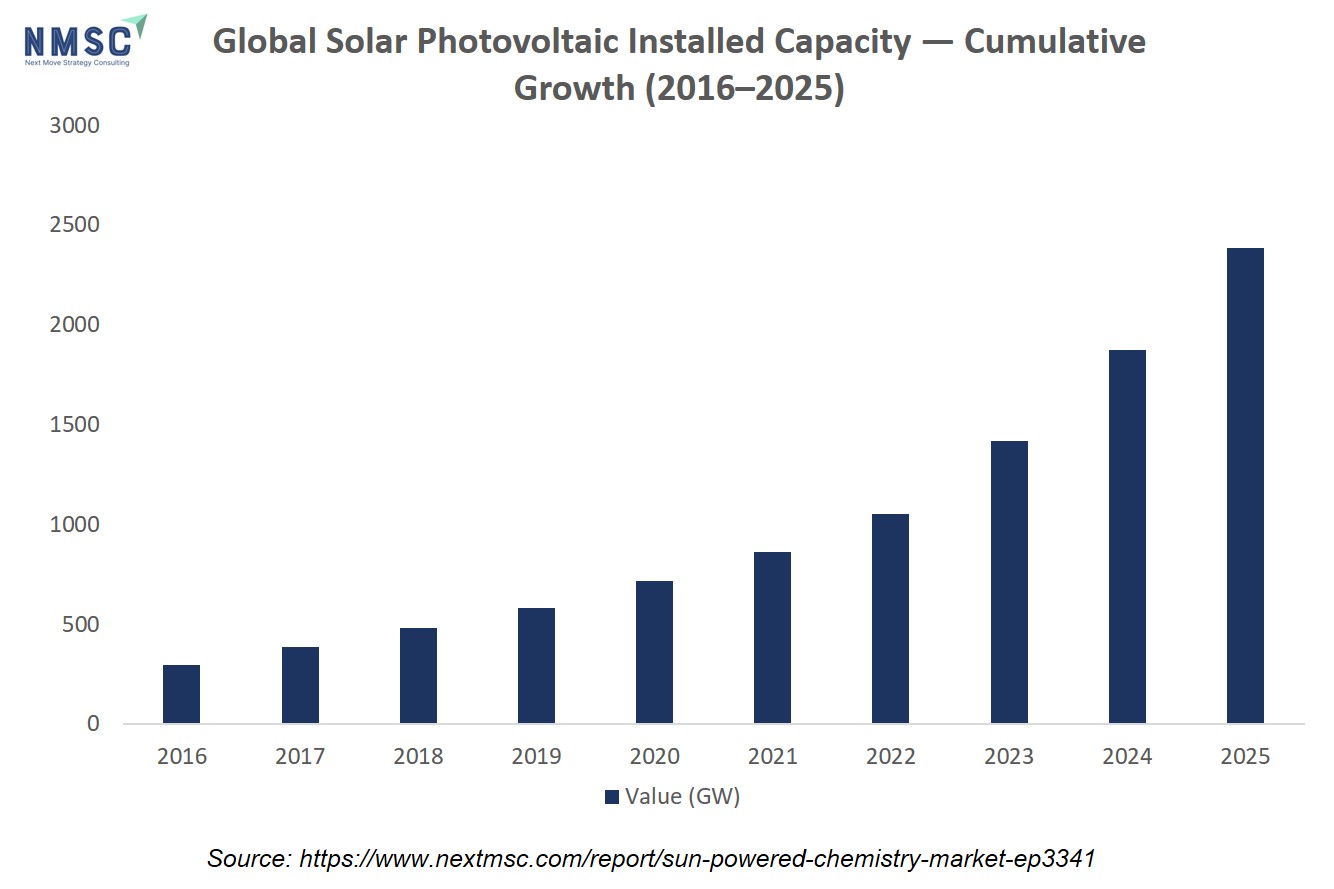
The Northwestern and EU developments are occurring against a backdrop of solar energy deployment that has reached historic proportions. According to the International Renewable Energy Agency's Renewable Capacity Statistics 2026, published in March 2026, global solar photovoltaic installed capacity reached 2,383.2 GW by the end of 2025 — making solar PV the technology with the largest installed power generation capacity globally for the first time in history.
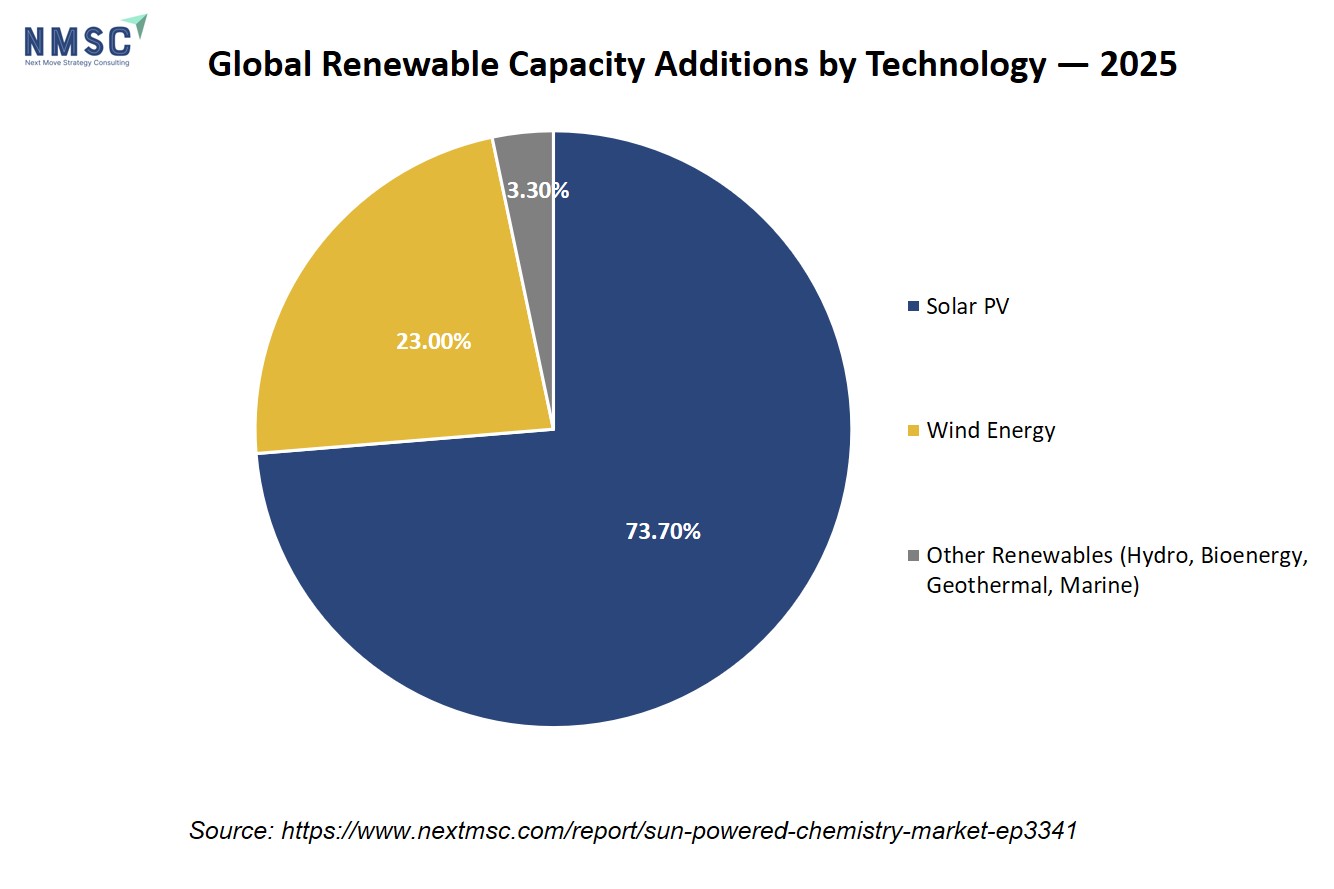
In 2025 alone, 510 GW of new solar PV capacity was added worldwide — a single-year record — representing approximately 73.7% of total global renewable capacity additions of 692 GW. The IEA's Global Energy Review 2026 corroborates this trajectory, reporting that global annual renewable capacity additions increased by 16% in 2025, reaching 800 GW — the 23rd consecutive year that renewables set new expansion records.
This exponential growth in solar infrastructure is the foundational enabler of the sun-powered chemistry sector. As solar electricity costs decline and solar irradiance becomes an increasingly abundant and economically accessible energy input, the economic case for solar-driven chemical synthesis — producing hydrogen, methanol, syngas, fertilizers, and specialty chemicals using sunlight rather than fossil fuels — strengthens commensurately. IRENA's Renewable Power Generation Costs in 2025 report, published in July 2026, confirmed that solar PV maintained a global weighted-average levelised cost of electricity (LCOE) of USD 44/MWh in 2025, while renewables collectively helped avoid an estimated USD 480 billion in fossil-fuel costs and approximately 8.4 gigatonnes of CO₂ emissions during the year.
Photocatalyst Science Advances: HZDR Breakthrough Accelerates Material Discovery
The Northwestern University announcement was preceded in March 2026 by a complementary scientific advance from the Helmholtz-Zentrum Dresden-Rossendorf (HZDR) in Germany. Researchers at the Center for Advanced Systems Understanding (CASUS) published a study in the Journal of the American Chemical Society introducing a reproducible computational framework for designing polyheptazine imide photocatalysts — a class of carbon nitride materials that absorb visible light and drive reactions including hydrogen production, carbon dioxide conversion, and hydrogen peroxide synthesis.
The HZDR team systematically analyzed how 53 different metal ions influence the structure and electronic behavior of polyheptazine imide materials, creating a predictive framework that identifies which combinations will perform best for specific photocatalytic applications. Experimental validation confirmed a high degree of agreement between theoretical predictions and measured performance.
"If there was some doubt about polyheptazine imides being one of the most promising platforms for next-generation photocatalytic technologies, I believe this work put them to rest," said Professor Thomas D. Kühne, Director of CASUS and senior author of the study. "The path toward the targeted design of efficient polyheptazine imide photocatalysts for sustainable reactions is clearer now."
Taken together, the Northwestern and HZDR breakthroughs represent a material science convergence that is directly addressing the efficiency and scalability constraints that have historically limited the commercial deployment of photocatalytic systems — the primary technology segment within the sun-powered chemistry market.
Market Intelligence: Technology Segmentation and Strategic Landscape
According to analysis by Next Move Strategy Consulting, the global sun-powered chemistry market is segmented across five technology categories: photocatalysis, photovoltaics, solar thermal, photoelectrochemical cells (PECs), and other emerging platforms. The photocatalysis segment is experiencing the most dynamic innovation activity, driven by the material science advances described above, while the photovoltaics-coupled electrolysis pathway — using solar electricity to drive electrochemical hydrogen production — represents the most commercially mature large-scale deployment route.
Application segments span solar fuels production, chemical synthesis, wastewater treatment, desalination, hydrogen production, and other industrial processes. The hydrogen production application is the largest and fastest-growing segment by investment volume, directly linked to the EU Hydrogen Bank auctions, the US Department of Energy's hydrogen programs, and Japan's and South Korea's national hydrogen strategies. The chemical synthesis application — encompassing the production of methanol, syngas, ammonia, and specialty chemicals using solar-driven processes — represents the highest-value long-term opportunity, as it targets the decarbonization of the global chemical industry, which accounts for approximately 6% of global energy consumption and 7% of global greenhouse gas emissions.
End-user industries served by the market include energy, pharmaceutical, agriculture, water management, and food and beverage sectors. The energy sector dominates current demand, while the pharmaceutical and agricultural sectors represent high-growth emerging applications — particularly for solar-driven synthesis of active pharmaceutical ingredients and solar-powered fertilizer production in regions with high solar irradiance and limited fossil fuel access.
Global Solar Photovoltaic Installed Capacity by Major Region (2021–2025)
|
Region |
2021 (GW) |
2022 (GW) |
2023 (GW) |
2024 (GW) |
2025 (GW) |
2021–2025 Growth (%) |
|
World |
859.7 |
1,051.5 |
1,415.2 |
1,872.8 |
2,383.2 |
+177.2% |
|
Asia |
488.1 |
599.7 |
841.2 |
1,157.9 |
1,528.2 |
+213.0% |
|
Europe |
187.7 |
222.4 |
281.1 |
344.1 |
405.4 |
+116.0% |
|
North America |
106.1 |
125.0 |
154.7 |
193.9 |
229.0 |
+115.8% |
|
Middle East |
9.8 |
13.8 |
19.9 |
25.2 |
37.8 |
+285.7% |
|
Africa |
8.4 |
10.9 |
14.5 |
17.2 |
21.0 |
+150.0% |
|
South America |
21.1 |
34.3 |
49.3 |
68.5 |
83.0 |
+293.4% |
|
Oceania |
24.9 |
29.6 |
31.5 |
37.1 |
42.4 |
+70.3% |
Units: Gigawatts (GW); Growth calculated from 2021 to 2025 Notes: Asia's dominance reflects China's extraordinary solar deployment — China alone commissioned approximately 370 GW of solar PV in 2025, accounting for over 60% of global solar additions. The Middle East and South America recorded the highest percentage growth rates over the five-year period, reflecting accelerating deployment from a lower base. These regional solar capacity figures represent the primary energy input infrastructure for sun-powered chemistry applications.
Regional Analysis: North America, Europe, and Asia-Pacific Drive Distinct Growth Pathways
North America remains a pivotal region for the sun-powered chemistry market, propelled by strong federal backing, academic research excellence, and a growing focus on decarbonization. The US Department of Energy has prioritized solar-driven chemical processes, funding projects that convert CO₂ into fuels and materials using sunlight — as evidenced by the DOE's support for the Northwestern University ANI-MV research. Research hubs including MIT, Stanford, and Argonne National Laboratory are advancing AI-enhanced solar catalytic systems, while the US solar PV installed capacity reached 467.9 GW by end-2025, up from 427.9 GW in 2024, according to IRENA data.
Europe is leading the institutionalization of the sun-powered chemistry market through ambitious green policies and public-private partnerships. The EU's SunCoChem initiative supports using sunlight for synthesizing platform chemicals from CO₂, while the Horizon Europe framework actively funds solar chemical technologies. Germany added 17 GW of solar PV in 2025 — one-quarter of total EU solar additions — and Spain set a record 14 GW of solar PV additions, up 50% from 2024. The EU's total solar PV installed capacity reached 405.4 GW by end-2025, according to IRENA.
Asia-Pacific is emerging as the most consequential growth region for sun-powered chemistry, driven by China's extraordinary solar deployment scale, Japan's Sekisui Chemical's perovskite solar-chemical integration, and South Korea's investments in solar-based hydrogen and CO₂ utilization. India's annual renewable capacity additions increased by almost 60% in 2025 — the fastest growth among major markets — driven by the commissioning of almost 50 GW of solar PV. China alone commissioned approximately 370 GW of solar PV in 2025, accounting for over 60% of global solar additions.
Rest of World markets — including Saudi Arabia, the UAE, Chile, and Brazil — are at earlier stages of adoption but are rapidly recognizing the strategic value of solar chemical pathways. Saudi Arabia's solar PV additions quadrupled to nearly 7 GW in 2025, while the Middle East's total renewable capacity increased by 28.9% during the year.
EU European Hydrogen Bank — Auction History and Funding Commitments (2024–2026)
|
Auction Round |
Announcement Date |
EU Innovation Fund Allocation |
Projects Selected |
Projected H₂ Production (10-Year) |
Electrolyser Capacity |
|
First Auction (Pilot) |
April 2024 |
~€720 million |
7 projects |
1.58 million tonnes |
Not disclosed |
|
Second Auction (IF24) |
May 2025 |
~€992 million (EU) + up to €836M national |
15 projects |
~2.2 million tonnes |
Not disclosed |
|
Third Auction (IF25) |
May 2026 |
~€1.09 billion |
9 projects |
>1.3 million tonnes |
~1.1 GW |
|
Fourth Auction (IF26) |
Planned end-2026 |
Up to €500 million |
TBD |
TBD |
TBD |
Units: EUR (€); Hydrogen production in metric tonnes; Electrolyser capacity in Gigawatts (GW)Notes: National co-funding from Member States (Germany, Spain, Lithuania, Austria) supplements EU Innovation Fund allocations. The third auction's nine selected projects represent the most recent publicly confirmed commitment as of August 7, 2026. The fourth auction terms and conditions were published July 2026. Total EU public funding committed across the first three auctions exceeds €2.8 billion, with additional national co-funding bringing total mobilized capital to approximately €4+ billion.
Key Players and Strategic Positioning
The global sun-powered chemistry market features a diverse competitive landscape spanning multinational chemical conglomerates, specialized clean energy companies, and research-commercialization partnerships. Key players identified in the NMSC analysis include BASF, Sun Chemical, L'Oréal, Dow, Wacker Chemie AG, Linde, Solar Chemferts Pvt. Ltd., Solar Organics, Solar Chemical, Chemtex Speciality Limited, Heliogen, Hanergy, Adarsha Specialty Chemicals Pvt. Ltd., Shiseido Company Limited, and Covestro AG.
Strategic differentiation is increasingly centered on three axes. First, solar-to-chemical conversion efficiency — EPFL's solar water-splitting device, launched in 2025, set a new benchmark in green hydrogen output, while BASF and Fraunhofer are co-developing solar-powered CO₂-to-methanol systems under EU funding frameworks. Second, AI-driven process optimization — Honeywell's AI-powered Hydrogen Plant Optimization Suite, launched in 2025, is designed to boost performance across green hydrogen facilities through predictive analytics and autonomous control systems. Third, material platform innovation — Sekisui Chemical's deployment of perovskite solar modules in industrial settings exemplifies the move toward real-world integration targeting both cost efficiency and emissions reduction.
The primary competitive challenge facing all market participants remains the gap between laboratory-scale efficiency and industrial-scale economics. Scaling solar chemical technologies to industrial levels while maintaining cost-effectiveness and operational reliability — particularly given the intermittency of solar input — continues to constrain widespread deployment. The absence of standardized performance metrics and long-term investment models further limits broader commercial adoption, though the EU's Hydrogen Bank auction framework is beginning to address the latter constraint through long-term fixed premium subsidy structures.
AI Integration: The Emerging Efficiency Multiplier
Artificial intelligence is emerging as a critical enabler of sun-powered chemistry's commercial viability. Machine learning algorithms are being deployed to optimize catalyst design, predict reaction pathways, and dynamically adjust operational parameters based on real-time solar irradiance and atmospheric conditions. AI models developed by teams at MIT and the University of Cambridge have been used to fine-tune photocatalytic reactions, increasing hydrogen output while minimizing energy loss.
The fusion of AI with solar chemistry is accelerating R&D cycles and enabling scalable, autonomous hydrogen systems. This convergence is particularly significant given the intermittency challenge inherent in solar-driven processes: AI-powered predictive systems can anticipate solar irradiance fluctuations and pre-position chemical reaction parameters to maximize yield during peak solar availability, while the Northwestern University ANI-MV material's energy storage capability addresses the intermittency problem at the material level by decoupling energy capture from energy use.
Bottom Line
The global sun-powered chemistry market is at a structural inflection point, defined by the simultaneous convergence of three reinforcing forces: breakthrough material science that resolves the fundamental intermittency constraint of solar-driven chemistry; unprecedented institutional capital commitment from governments and supranational bodies; and a solar energy infrastructure that has reached a scale — 2,383 GW of installed capacity globally — that makes solar irradiance an economically competitive industrial feedstock across an expanding range of geographies. The Northwestern University ANI-MV breakthrough, published June 11, 2026, represents the most significant advance in solar energy storage chemistry in years, enabling "dark photocatalysis" that could transform the economics of solar-driven chemical manufacturing. The EU's concurrent commitment of €1.09 billion to nine green hydrogen projects under its third Hydrogen Bank auction confirms that institutional capital is following the science at scale.
For investors and strategic decision-makers, the primary opportunities lie in photocatalytic platform technologies, AI-optimized solar hydrogen production systems, and the emerging solar-to-specialty-chemicals segment targeting pharmaceutical and agricultural applications. Key risks include the persistent gap between laboratory efficiency and industrial-scale economics, the capital intensity of solar reactor infrastructure, and the regulatory complexity of multi-jurisdictional compliance for novel chemical processes. Companies that combine advanced material science capabilities with AI-driven process optimization and access to policy-backed funding frameworks — particularly in Europe and North America — are best positioned to capture disproportionate value as the sun-powered chemistry market transitions from demonstration-scale to commercial-scale deployment over the 2025–2030 forecast period.
About Next Move Strategy Consulting
Next Move Strategy Consulting is a premier market research and management consulting firm that has been committed to provide strategically analysed well documented latest research reports to its clients. The research industry is flooded with many firms to choose from, what makes NMSC different from the rest is its top-quality research and the obsession of turning data into knowledge by dissecting every bit of it and providing fact-based research recommendation that is supported by information collected from over 500 million websites, paid databases, industry journals and one on one consultations with industry experts across a diverse range of industry sectors. The high-quality customized research reports with actionable insights and excellent end-to-end customer service help our clients to take critical business decisions that enables them to move beyond time and have competitive edge in the industry.
We have been servicing over 1000 customers globally that includes 90% of the Fortune 500 companies over a decade. Our analysts are constantly tracking various high growth markets and identifying hidden opportunities in each sector or the industry. We provide one of the industry's best quality syndicate as well as custom research reports across 10 different industry verticals. We are committed to deliver high quality research solutions in accordance to your business needs. Our industry standard delivery solutions that ranges from the pre consultation to after-sales services, provide an excellent client experience and ensure right strategic decision making for businesses.
For more information, please contact:
Next Move Strategy Consulting
5th Floor 867
Boylston St, STE 500,
Boston, MA 02116, U.S.
E-Mail: [email protected]
Direct: +1-217-650-7991
Website: www.nextmsc.com
About the Author
 Sanyukta Deb
— Sanyukta Deb is Digital Marketing Team Lead at Next Move Strategy Consulting, where she has led content strategy and technical SEO for the firm's B2B market research publications for over 2 years. Her editorial process translates NextMSC's primary and secondary research — spanning technology, industrial, and consumer sectors — into commercial narratives, backed by search-intent, keyword, and competitive analysis. She brings 5 years of overall experience in digital marketing and content strategy.
Sanyukta Deb
— Sanyukta Deb is Digital Marketing Team Lead at Next Move Strategy Consulting, where she has led content strategy and technical SEO for the firm's B2B market research publications for over 2 years. Her editorial process translates NextMSC's primary and secondary research — spanning technology, industrial, and consumer sectors — into commercial narratives, backed by search-intent, keyword, and competitive analysis. She brings 5 years of overall experience in digital marketing and content strategy.
About the Reviewer
 Debashree Dey
— Debashree Dey is Assistant Manager at Next Move Strategy Consulting, where she supports cross-vertical market content and communications across diverse industries for 6 years. Her professional background includes senior content writing, communications, and published manuscript authorship, with experience developing audience-focused business narratives and maintaining clear, consistent messaging. Her role supports research-led content development and editorial quality across NextMSC publications.
Debashree Dey
— Debashree Dey is Assistant Manager at Next Move Strategy Consulting, where she supports cross-vertical market content and communications across diverse industries for 6 years. Her professional background includes senior content writing, communications, and published manuscript authorship, with experience developing audience-focused business narratives and maintaining clear, consistent messaging. Her role supports research-led content development and editorial quality across NextMSC publications.















Add Comment