Tariff Shift Reshapes Global Two-Wheeler Trade Outlook

Revised U.S. Section 232 Tariffs and Record Electric Adoption Redraw the Global Two-Wheeler Map in 2026
The U.S. administration's revised Section 232 proclamation, which took effect on April 6, 2026, removed certain finished motorcycles from the derivative-product list tied to tariffs on steel, aluminum, and copper, exempting those units from Section 232 duties. The adjustment, welcomed by the Motorcycle Industry Council after months of concern over a broader tariff expansion, stops short of a full rollback: duties remain on many core metal imports, and aftermarket and replacement parts are still likely to be captured at 25%. The U.S. Department of Commerce and the Office of the United States Trade Representative retain authority to add derivative products on a rolling basis and were directed to report on the program's effectiveness within 90 days.
This recalibration of trade policy arrives at an inflection point for the global Two-Wheelers Market, where electrification is simultaneously redrawing competitive boundaries across the world's largest manufacturing and consumption hubs.
For More Information – Download FREE Sample on Two-Wheelers Market Report
According to Next Move Strategy Consulting, the global two-wheelers market is projected to reach USD 455.32 billion by 2030, advancing at a compound annual growth rate of 3.7% over the 2025–2030 forecast period. For manufacturers, dealers, and component suppliers, the dual pressures of trade-cost uncertainty and accelerating electric adoption are reshaping sourcing strategies, pricing architecture, and capital allocation.
According to the International Energy Agency, the two- and three-wheeler segment remains the most electrified road-transport category globally. While combined electric two-wheeler sales in China and India—the world's two largest markets—grew only slightly in 2025 to a total of 8.4 million units, sales doubled in Viet Nam, underpinning global growth, and rose markedly across Africa to approximately 70,000 units in 2025, more than 80 times the level recorded at the start of the decade.
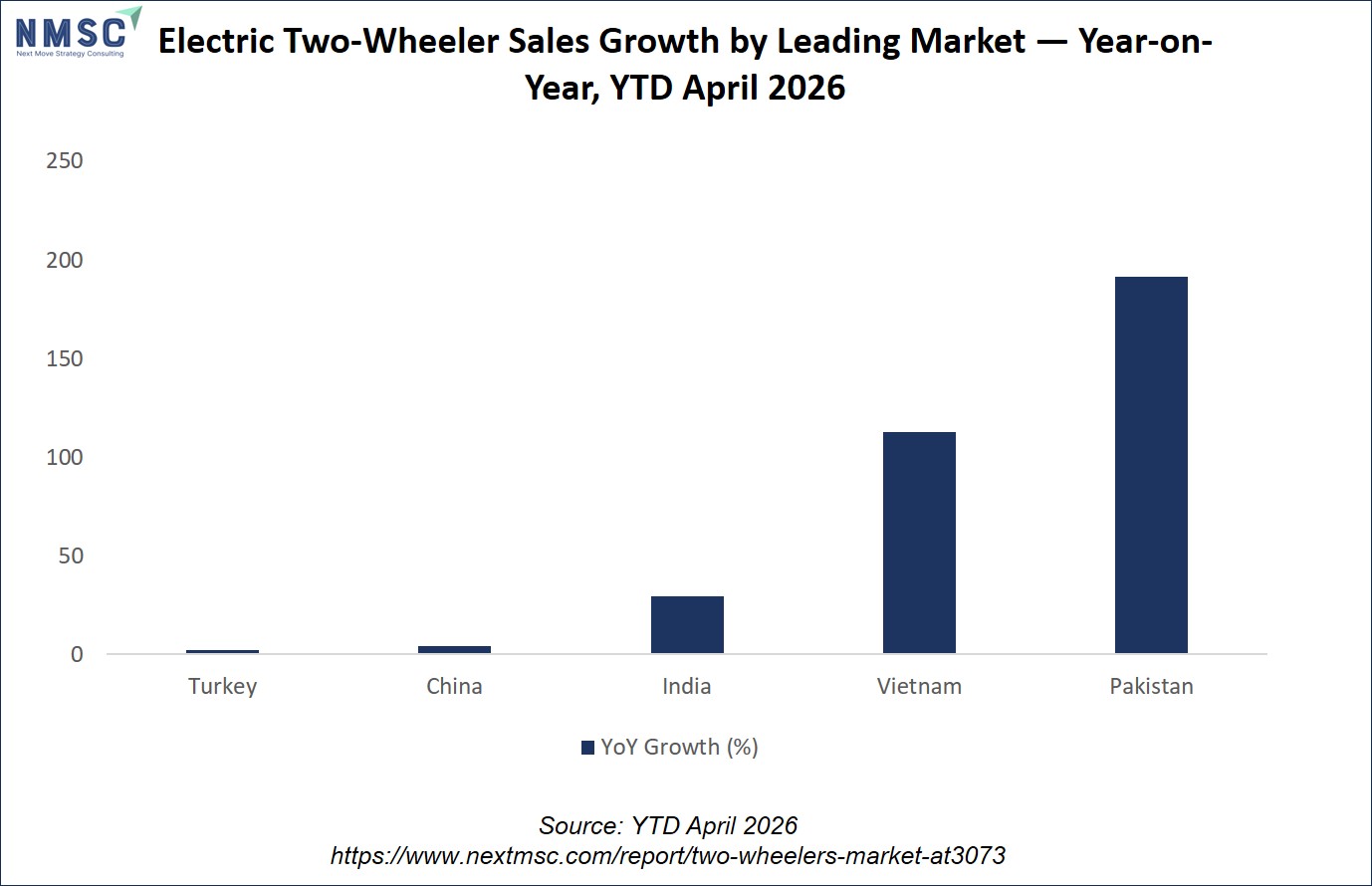
The IEA further notes that, for consumers in emerging economies with low motorisation rates and high fuel-price sensitivity, electric two- and three-wheelers are an increasingly attractive option, with sales more than doubling year-on-year in the first quarter of 2026 in Southeast Asia and growing more than 30% in India.
Demand Drivers: Urbanization, Income Growth, and E-Commerce
NMSC attributes the market's structural growth to three reinforcing macro drivers. Rising urbanization underpins demand for cost-effective mobility, with the World Bank Group reporting in 2024 that approximately 56% of the global population—around 4.4 billion people—currently resides in cities, a figure projected to approach 70% by 2050. Concurrently, rising disposable incomes are expanding consumer purchasing power, while the rapid growth of e-commerce is fueling demand for last-mile delivery fleets; the International Trade Administration projects worldwide B2B e-commerce to reach USD 36 trillion by 2026, reinforcing the role of two-wheelers in logistics. The principal restraint identified by NMSC is rising raw-material costs—steel, aluminum, and lithium for electric models—which pressure affordability and accessibility.
India Emerges as the Demand Engine
India has solidified its position as the second-largest electric two-wheeler market globally. According to Vahan registration data, a record 1.4 million electric scooters and motorcycles were registered in India in fiscal year 2026, a 22% increase from the approximately 1.2 million units registered the prior year, with electric two-wheelers accounting for nearly six in ten of all EV registrations in FY2026. Penetration reached 6.5% in FY2025-26.
The competitive hierarchy has shifted decisively. TVS Motor Company led the segment with 341,513 units, followed by Bajaj Auto with 289,349 units and Ather Energy with 239,178 units in FY2026. A strong March was partly driven by the extension of the PM E-Drive Scheme, which now offers a reduced subsidy until July 31, 2026, while elevated fuel prices have further supported demand.
India Electric Two-Wheeler Registrations by Leading Manufacturer, FY2026
|
Rank |
Manufacturer |
Registrations (Units) |
|
1 |
TVS Motor Company |
341,513 |
|
2 |
Bajaj Auto |
289,349 |
|
3 |
Ather Energy |
239,178 |
A Globally Concentrated, Rapidly Diversifying Market
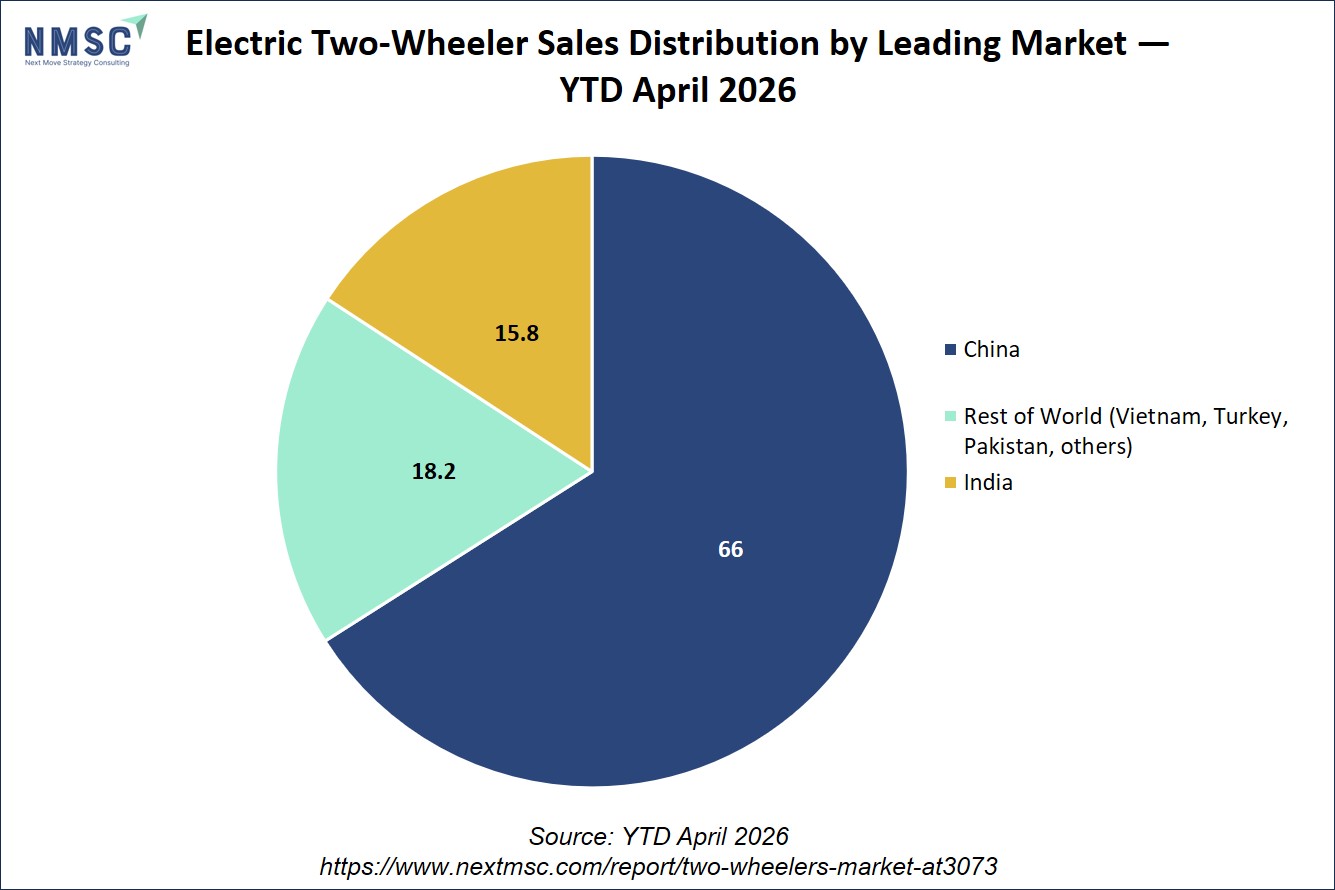
Global electric two-wheeler sales reached 2.3 million units in the first four months of 2026, a 16.1% increase that positions the market for a new all-time record. China remains dominant, accounting for 66% of total sales, while India holds 15.8% of the global industry. The global electric two-wheeler fleet now exceeds 80 million units, representing 8.8% of the total two-wheeler fleet introduced over the past decade.
These dynamics align with NMSC's regional assessment that the Asia-Pacific region dominates the two-wheelers market and is expected to retain that leadership throughout the forecast period, propelled by e-commerce expansion, green-mobility policy support, and a large existing electric two-wheeler fleet.
Selected National Electric Two-Wheeler Market Indicators, 2025–2026
|
Market |
Key Indicator |
Value |
|
Global |
Sales, YTD April 2026 |
2.3 million units (+16.1%) |
|
Global |
Full-year 2025 registrations |
9.8 million units |
|
China |
Share of global sales (YTD April 2026) |
66% |
|
India |
YTD April 2026 sales growth |
+29.7% |
|
Vietnam |
YTD April 2026 sales growth |
+112.6% |
|
Pakistan |
YTD April 2026 sales growth |
+191.7% |
Competitive Landscape and Technology Shift
NMSC identifies a broad competitive field led by Honda Motor Co., Ltd., Hero MotoCorp Ltd., Yamaha Motor Co., Ltd., Yadea Group Holdings Ltd., TVS Motor Company Ltd., Bajaj Auto Ltd., and Suzuki Motor Corporation, among others. Recent strategic activity underscores a pronounced shift toward premiumization and connected mobility: in May 2025, Honda expanded its premium portfolio in India with the CB750 Hornet and CB1000 Hornet SP, while Yamaha advanced connected riding technologies and fuel-efficient platforms across international markets. NMSC further highlights the integration of artificial intelligence—including AI-based navigation, IoT sensors, collision detection, and predictive maintenance—as a significant future growth opportunity, exemplified by the February 2025 development of an AI-based Advanced Driver Assistance System for two-wheelers.
Macro Drivers and Regulatory Cross-Currents
The convergence of elevated fuel prices and supportive government policy is intensifying the electric transition. The IEA observes that high oil prices have increased the running-cost advantage of electric mobility, while emerging-market policymakers have moved to expand or extend incentive frameworks. In parallel, U.S. trade policy remains a material variable: the revised Section 232 framework leaves room for further changes, introducing new full-value assessments and material-content thresholds for downstream goods that could affect cost structures across the supply chain.
Bottom Line
The global two-wheeler market is entering a phase defined by electrification momentum and trade-policy volatility, with NMSC projecting expansion from USD 365.32 billion in 2024 to USD 455.32 billion by 2030 at a 3.7% CAGR. Demand is being driven by record electric adoption in Asia—where India's FY2026 registrations reached 1.4 million units and global electric two-wheeler sales hit 2.3 million in the first four months of 2026—supported by urbanization, rising incomes, e-commerce logistics, and government incentives. China retains structural dominance at 66% of global electric sales, while high-growth corridors in Vietnam and Pakistan signal accelerating geographic diversification. The principal near-term risk is the unresolved U.S. Section 232 tariff regime, which continues to capture aftermarket parts at 25%, alongside rising raw-material costs. For investors and strategists, opportunity lies in localized electric manufacturing, AI-enabled connected mobility, and exposure to high-penetration emerging markets, while monitoring policy timelines—including India's PM E-Drive extension to July 31, 2026—as decisive variables for capital deployment.
About Next Move Strategy Consulting
Next Move Strategy Consulting is a premier market research and management consulting firm that has been committed to provide strategically analysed well documented latest research reports to its clients. The research industry is flooded with many firms to choose from, what makes NMSC different from the rest is its top-quality research and the obsession of turning data into knowledge by dissecting every bit of it and providing fact-based research recommendation that is supported by information collected from over 500 million websites, paid databases, industry journals and one on one consultations with industry experts across a diverse range of industry sectors. The high-quality customized research reports with actionable insights and excellent end-to-end customer service help our clients to take critical business decisions that enables them to move beyond time and have competitive edge in the industry.
We have been servicing over 1000 customers globally that includes 90% of the Fortune 500 companies over a decade. Our analysts are constantly tracking various high growth markets and identifying hidden opportunities in each sector or the industry. We provide one of the industry's best quality syndicate as well as custom research reports across 10 different industry verticals. We are committed to deliver high quality research solutions in accordance to your business needs. Our industry standard delivery solutions that ranges from the pre consultation to after-sales services, provide an excellent client experience and ensure right strategic decision making for businesses.
For more information, please contact:
Next Move Strategy Consulting
5th Floor 867
Boylston St, STE 500,
Boston, MA 02116, U.S.
E-Mail: [email protected]
Direct: +1-217-650-7991
Website: www.nextmsc.com
About the Author
 Sanyukta Deb
— Sanyukta Deb is Digital Marketing Team Lead at Next Move Strategy Consulting, where she has led content strategy and technical SEO for the firm's B2B market research publications for over 2 years. Her editorial process translates NextMSC's primary and secondary research — spanning technology, industrial, and consumer sectors — into commercial narratives, backed by search-intent, keyword, and competitive analysis. She brings 5 years of overall experience in digital marketing and content strategy.
Sanyukta Deb
— Sanyukta Deb is Digital Marketing Team Lead at Next Move Strategy Consulting, where she has led content strategy and technical SEO for the firm's B2B market research publications for over 2 years. Her editorial process translates NextMSC's primary and secondary research — spanning technology, industrial, and consumer sectors — into commercial narratives, backed by search-intent, keyword, and competitive analysis. She brings 5 years of overall experience in digital marketing and content strategy.
About the Reviewer
 Debashree Dey
— Debashree Dey is Assistant Manager at Next Move Strategy Consulting, where she supports cross-vertical market content and communications across diverse industries for 6 years. Her professional background includes senior content writing, communications, and published manuscript authorship, with experience developing audience-focused business narratives and maintaining clear, consistent messaging. Her role supports research-led content development and editorial quality across NextMSC publications.
Debashree Dey
— Debashree Dey is Assistant Manager at Next Move Strategy Consulting, where she supports cross-vertical market content and communications across diverse industries for 6 years. Her professional background includes senior content writing, communications, and published manuscript authorship, with experience developing audience-focused business narratives and maintaining clear, consistent messaging. Her role supports research-led content development and editorial quality across NextMSC publications.















Add Comment