Tesla's Fremont Optimus Line Tests Whether Humanoid Robots Can Reach Volume
Tesla's October 21 Optimus Production Start, Agility's $2.5 Billion Listing Plan and IFR's Count of About 7,000 Humanoid Sales Show Capital Moving Ahead of Deployments
On October 21, 2026, Tesla said on its third-quarter earnings call that it has begun early production of its Optimus humanoid robot on a high-volume line at its Fremont, California, factory, and Chief Executive Elon Musk said it will take at least a year to reach a rate of 20,000 robots a week. Tesla also said it expects to resolve the remaining AI, electromechanical, reliability and durability issues around the end of 2027, at which point it plans to begin supplying Optimus to outside companies. The announcement came three weeks after the International Federation of Robotics (IFR) reported on September 30, 2026 that about 7,000 full-size humanoid robots were sold worldwide in 2025, a count that frames how large the gap still is between the production targets now being set and the deployments actually delivered.
According to Next Move Strategy Consulting's Humanoid Robot Market report, the global humanoid robot market was valued at USD 9.89 billion in 2025 and is projected to reach USD 271.51 billion by 2035, growing at a CAGR of 25.15% from 2026 to 2035. NextMSC primary research and analysis identifies falling actuator, sensor and battery costs, embodied-AI foundation models for manipulation, labor shortages in manufacturing and logistics, and public industrial-policy funding as the forces supporting that trajectory, with safety certification and standards gaps, battery runtime and reliability limits, and trade restrictions on a concentrated component supply base as the principal restraints.
For More Information: Download FREE Sample on Humanoid Robot Market Report
From Demonstration to Production Line: What Capital Markets Are Pricing
Capital markets moved first. On August 19, 2026, Unitree Robotics debuted on Shanghai's STAR Market at an offer price of 150.80 yuan and closed its first session up 460% at 845 yuan, after reaching 1,100 yuan at the open, according to Agence France-Presse (AFP) reporting that day. On June 24, 2026, Agility Robotics and Churchill Capital Corp XI announced a business combination at a $2.5 billion pre-money equity value, with expected gross proceeds of more than $620 million, comprising $420 million held in Churchill XI's trust account (assuming no redemptions) and about $200 million from a private placement led by Foxconn, according to the exhibit the companies filed with the U.S. Securities and Exchange Commission.
Agility said its Digit robot has logged more than 65,000 hours of operation, has deployment commitments across nine customer facilities, and carries more than $300 million of multi-year orders for Digit v5 that remain subject to contractual milestones; its named customers include Schaeffler, GXO, Toyota Motor Manufacturing Canada and Mercado Libre. Delivered volumes can be read from UBTECH Robotics' 2026 interim results, published on September 1, 2026: the company reported selling 921 full-size humanoid robots in the first half of 2026, up 1,946.7%, which generated 590 million yuan of revenue, or 46.5% of group revenue of 1.269 billion yuan. Across all humanoid categories, UBTECH reported 16,123 units sold, up 268.3%.
Four 2026 Disclosures That Define Humanoid Robots' Move Toward Volume
|
Disclosure |
Date |
Reported Detail |
|
Tesla, Optimus production at Fremont |
October 21, 2026 |
Early production started on a high-volume line; 20,000 robots a week is at least a year away; outside supply planned from around the end of 2027 |
|
Unitree Robotics, STAR Market debut |
August 19, 2026 |
Offer price 150.80 yuan; first-day close 845 yuan, up 460%; 1,100 yuan at the open |
|
Agility Robotics and Churchill Capital Corp XI |
June 24, 2026 |
$2.5 billion pre-money equity value; more than $620 million expected gross proceeds; more than $300 million of Digit v5 orders subject to milestones |
|
UBTECH Robotics, interim results |
September 1, 2026 |
921 full-size humanoids sold in the first half of 2026; 590 million yuan humanoid revenue; 16,123 humanoid units in total |
What the IFR Count Says About Deployment Reality
The IFR's World Robotics 2026 service-robot data, released on September 30, 2026, count about 7,000 full-size humanoids, defined as robots taller than 140 centimeters, sold worldwide in 2025. IFR describes this as a new market aimed at commercial and professional use beyond research and entertainment, and states that current applications are mostly specialized and often require human teleoperation. It lists safety standards, high training and maintenance costs, and a weak business case, especially in industrial settings, as the barriers to wider use. In the IFR World Robotics 2026 Press Conference Presentation of September 24, 2026, the federation also reported 174 humanoid manufacturers worldwide, more than half of them in China, and characterized humanoids as still on the verge of moving from laboratories to pilot projects.
IFR notes that its service-robot figures are drawn from a sample of 238 suppliers and are not projected to the whole industry, and it advises against comparing data across different World Robotics reports. Placed beside that count, the 20,000 robots a week that Tesla is targeting would, on a weekly basis, reach nearly three times IFR's full-year 2025 global humanoid sales; the target, however, is at least a year from being reached, and the production line is only now starting.
How Humanoids Compare With Other Robot Categories in IFR's 2025 Data
|
Category |
2025 Figure |
Change or Status |
|
Industrial robots installed worldwide |
603,307 units |
Up 11% |
|
Professional service robots sold |
Almost 250,000 units |
Up 24% |
|
Transportation and logistics service robots |
117,500 units |
Up 21%; 47% share |
|
Surgical robots (medical category) |
8,400 units |
Up 57% |
|
Full-size humanoid robots (above 140 cm) |
About 7,000 units |
Described as a new market |
|
Consumer service robots |
Almost 34.2 million units |
Up 37% |
“We believe cooperative safety is the critical unlock for scaled humanoid adoption”
- Jonathan Hurst, Co-Founder and Chief Robot Officer, Agility Robotics, Agility Robotics and Churchill Capital Corp XI business combination announcement (Form 8-K, Exhibit 99.1), June 24, 2026.
Hurst's argument lines up with the barriers IFR names: safety standards and a weak business case are the constraints the federation highlights, and Agility's own order book is subject to contractual milestones, which means a share of the more than $300 million in Digit v5 orders converts to revenue only as those milestones are met.
Asia's Industrial Base Sets the Supply Terms
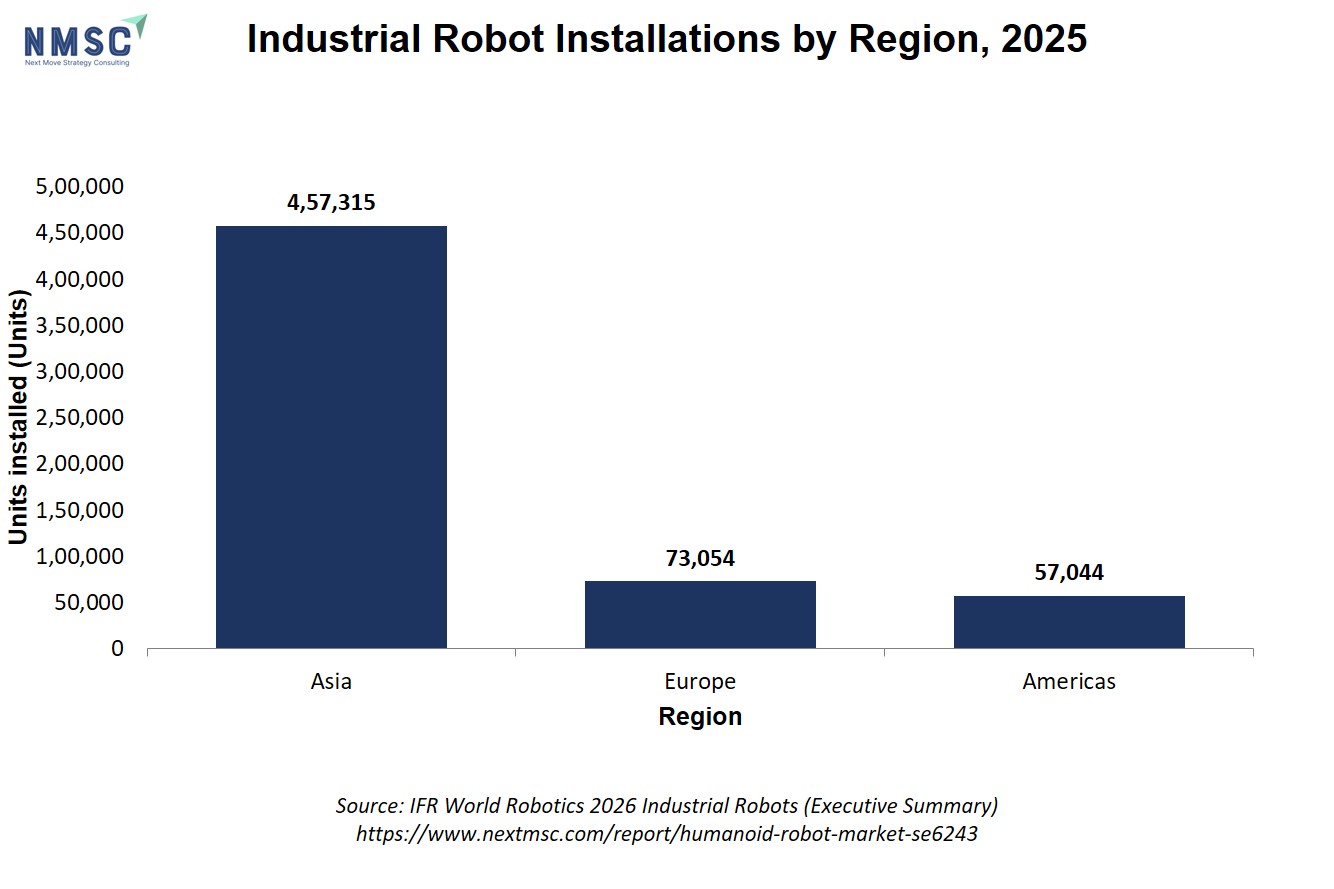
The supply base that humanoid makers draw on is concentrated in Asia. IFR's World Robotics 2026 report, released in Frankfurt on September 24, 2026, recorded 603,307 industrial robots installed worldwide in 2025, up 11%, of which Asia accounted for 457,315 units (up 14%), Europe 73,054 (down 14%) and the Americas 57,044 (up 14%). China alone installed 354,226 units, up 20% and 59% of the global total, while the United States installed 38,428 units, up 12%.
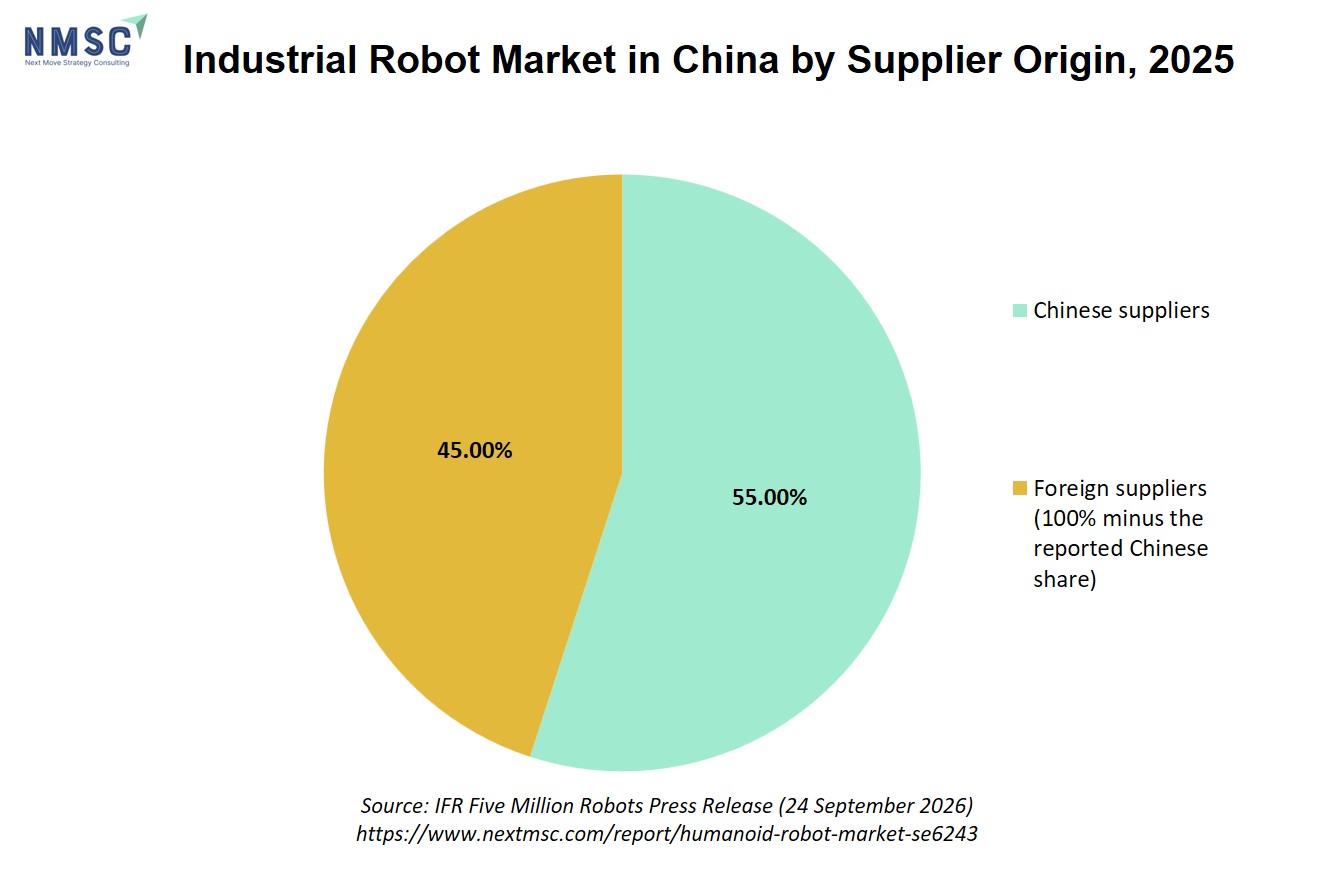
Chinese suppliers remain the largest group inside that base. The IFR Five Million Robots Press Release of September 24, 2026 reports that Chinese suppliers held 55% of China's industrial robot market in 2025, down from 57% in 2024, with their installations rising 15% to 195,000 units.
NextMSC primary research and analysis shows the same geographic tilt in humanoid revenue: Asia-Pacific accounted for USD 6.33 billion, about 64%, of the USD 9.89 billion humanoid robot market in 2025, which is consistent with the concentration of humanoid manufacturers that IFR counts in China.
Segment Dynamics: Where Value Is Moving
NextMSC primary research and analysis segments the humanoid robot market by offering, locomotion and application. By offering, robot hardware is the largest segment at USD 8.51 billion in 2025, projected to reach USD 168.34 billion by 2035 at a CAGR of 20.84%, while software and AI platforms are projected to rise from USD 0.79 billion to USD 59.73 billion at 38.24%, and services and subscriptions from USD 0.59 billion to USD 43.44 billion at 39.51%, the fastest rate of the three.
By locomotion, bipedal designs are both the largest and the fastest-growing category, at USD 6.92 billion in 2025 and a 25.54% CAGR to USD 195.49 billion by 2035, with wheeled bases growing at 24.19%. By application, industrial manufacturing is the largest at USD 3.96 billion in 2025, projected to reach USD 94.30 billion by 2035, while household and personal assistance is the fastest-growing application at a 32.50% CAGR.
Growth Drivers and Restraints
The evidence below is drawn from company filings, earnings-call disclosures and IFR data published since June 2026.
Humanoid Robots: Evidence Matrix of Drivers and Restraints
|
Factor |
Type |
Evidence |
Named Source |
|
Production line capacity |
Driver |
Early production has begun on a high-volume Optimus line at Fremont; the 20,000-a-week rate is at least a year away |
Tesla Q3 2026 Earnings Call |
|
Access to capital |
Driver |
Unitree closed its first trading day at 845 yuan against a 150.80 yuan offer price; Agility's merger carries more than $620 million of expected gross proceeds |
Agence France-Presse; Agility Robotics and Churchill Capital Corp XI |
|
Delivered volumes |
Driver |
UBTECH sold 921 full-size humanoids in the first half of 2026; Agility's Digit has logged more than 65,000 operating hours |
UBTECH Robotics; Agility Robotics and Churchill Capital Corp XI |
|
Safety standards |
Restraint |
IFR lists safety standards among the barriers to wider commercial use; Agility's co-founder calls cooperative safety the critical unlock |
IFR World Robotics 2026 Service Robots Press Release; Agility Robotics and Churchill Capital Corp XI |
|
Weak business case |
Restraint |
IFR cites high training and maintenance costs and a weak business case, especially in industrial settings |
IFR World Robotics 2026 Service Robots Press Release |
|
Teleoperation dependence |
Restraint |
IFR states that current applications are mostly specialized and often require human teleoperation |
IFR World Robotics 2026 Service Robots Press Release |
|
Reliability and durability |
Restraint |
Tesla expects to resolve remaining AI, electromechanical, reliability and durability issues around the end of 2027 before supplying outside companies |
Tesla Q3 2026 Earnings Call |
NMSC Strategic Perspective: The Production Line Arrives Before the Revenue Line
NextMSC primary research and analysis reads the second half of 2026 as the point at which humanoid robots moved from a technology question to a manufacturing and financing question. Tesla's Fremont line, Unitree's listing, Agility's merger and UBTECH's first-half deliveries all show capacity and capital being assembled ahead of proven, repeatable demand, which is the pattern that IFR's count of about 7,000 units, its teleoperation finding and its business-case warning describe from the deployment side.
On the NextMSC report's segmentation, that sequencing has a clear implication for revenue pools. Robot hardware is the largest offering at USD 8.51 billion in 2025, but software and AI platforms (38.24% CAGR) and services and subscriptions (39.51% CAGR) are projected to grow nearly twice as fast as hardware (20.84%). The conditions that limit deployments today, namely teleoperation, milestone-based orders and safety certification, are addressed largely through software, validation and service contracts rather than additional chassis volume. NextMSC primary research and analysis therefore expects early hardware output at Fremont and in China to serve as the entry ticket, while recurring revenue accrues to vendors that convert deployments into software and service relationships.
For investors, NextMSC primary research and analysis suggests tracking three conversion points rather than headline valuations: whether Tesla's early Fremont output reaches the 20,000-a-week rate it has put at least a year away, whether Agility's more than $300 million of milestone-based Digit v5 orders become recognized revenue, and whether IFR's next count shows humanoid applications moving beyond specialized, teleoperated tasks. For industrial buyers, the same analysis points to Asia-Pacific supply, about 64% of 2025 humanoid revenue in the NextMSC report, as the nearest source of volume, with trade restrictions on a concentrated component supply base the principal procurement risk the report identifies.
Competitive Landscape
NextMSC primary research and analysis profiles AGIBOT, Unitree Robotics, UBTECH Robotics, Figure AI, Agility Robotics, Boston Dynamics, Tesla, Apptronik, 1X Technologies and XPeng as the key players in the humanoid robot market. The 2026 disclosures show those players taking different routes to scale: Tesla is building an in-house production line at Fremont; Unitree has raised public equity on Shanghai's STAR Market; UBTECH, listed in Hong Kong under the code 09880, reports humanoid unit and revenue figures each half-year; and Agility is pursuing a listing through a special purpose acquisition company.
Capital structure now shapes disclosure. Public vendors such as UBTECH publish half-year unit and revenue figures, while privately held players disclose pipelines and order values that depend on contractual milestones. NextMSC primary research and analysis indicates that buyers and investors comparing vendors should separate delivered units from conditional orders, a distinction that Agility's own filing makes explicit.
Bottom Line
Tesla's October 21, 2026 start of Optimus production at Fremont, Unitree's 460% first-day gain on August 19 and Agility's $2.5 billion pre-money merger valuation announced June 24 show capital and capacity assembling ahead of proven demand. IFR counted about 7,000 full-size humanoids sold worldwide in 2025 and says most applications remain specialized and often teleoperated, with safety standards, training and maintenance costs, and a weak business case as barriers. UBTECH's 921 full-size units in the first half of 2026 show deliveries scaling from a small base. According to NextMSC primary research and analysis, the global humanoid robot market will grow from USD 9.89 billion in 2025 to USD 271.51 billion by 2035 at a 25.15% CAGR, with Asia-Pacific holding about 64% of 2025 revenue and software, AI platforms and services growing nearly twice as fast as hardware. The decisive test is conversion: Tesla reaching 20,000 robots a week, Agility turning milestone-based orders into revenue, and IFR recording humanoids beyond teleoperated tasks.
About Next Move Strategy Consulting
Next Move Strategy Consulting is a premier market research and management consulting firm that has been committed to provide strategically analysed well documented latest research reports to its clients. The research industry is flooded with many firms to choose from, what makes NMSC different from the rest is its top-quality research and the obsession of turning data into knowledge by dissecting every bit of it and providing fact-based research recommendation that is supported by information collected from over 500 million websites, paid databases, industry journals and one on one consultations with industry experts across a diverse range of industry sectors. The high-quality customized research reports with actionable insights and excellent end-to-end customer service help our clients to take critical business decisions that enables them to move beyond time and have competitive edge in the industry.
We have been servicing over 1000 customers globally that includes 90% of the Fortune 500 companies over a decade. Our analysts are constantly tracking various high growth markets and identifying hidden opportunities in each sector or the industry. We provide one of the industry’s best quality syndicate as well as custom research reports across 10 different industry verticals. We are committed to deliver high quality research solutions in accordance to your business needs. Our industry standard delivery solutions that ranges from the pre consultation to after-sales services, provide an excellent client experience and ensure right strategic decision making for businesses.
For more information, please contact:
Next Move Strategy Consulting
5th Floor 867 Boylston St, STE 500,
Boston, MA 02116, U.S.
E-Mail: [email protected]
Direct: +1-217-650-7991
Website: www.nextmsc.com
About the Author
 Sanyukta Deb
— Sanyukta Deb is Digital Marketing Team Lead at Next Move Strategy Consulting, where she has led content strategy and technical SEO for the firm's B2B market research publications for over 2 years. Her editorial process translates NextMSC's primary and secondary research — spanning technology, industrial, and consumer sectors — into commercial narratives, backed by search-intent, keyword, and competitive analysis. She brings 5 years of overall experience in digital marketing and content strategy.
About the Reviewer
 Debashree Dey
— Debashree Dey is Assistant Manager at Next Move Strategy Consulting, where she supports cross-vertical market content and communications across diverse industries for 6 years. Her professional background includes senior content writing, communications, and published manuscript authorship, with experience developing audience-focused business narratives and maintaining clear, consistent messaging. Her role supports research-led content development and editorial quality across NextMSC publications.














Add Comment