Humanoid Robot Market Global Industry Analysis and Forecast (2026–2035)

Humanoid Robot Market size stood at USD 9.89 Billion in 2025 and is set to reach USD 271.51 Billion by 2035, a 25.15% CAGR over 2026–2035, as embodied AI models, falling hardware costs, and factory deployments scale, with Asia-Pacific leading the global industry.

Download Free Sample PDF
Base Year (2025)
$9.89 Billion
Forecast (2035)
$271.51 Billion
CAGR (2026-2035)
25.2%
Top Region
Asia-Pacific

What Is the Humanoid Robot Market Size?
The global Humanoid Robot Market reached USD 9.89 Billion in 2025 and is estimated at USD 36.06 Billion in 2026, forecast to reach USD 271.51 Billion by 2035 at a CAGR of 25.15% between 2026 and 2035. Asia-Pacific leads with approximately 64% revenue share in 2025, while Robot hardware is the dominant offering, holding approximately 86% of total market revenue.

Based on market observations, we identified that enterprise buyers now evaluate humanoid platforms on delivered units and paid deployments rather than laboratory demonstrations.

Humanoid Robot Market Global Industry Analysis and Forecast (2026–2035) Revenue Forecast

Values in USD Billion

2025 $9.89 Billion
2025
2026 $36.06 Billion
2026
2027 $45.13 Billion
2027
2028 $56.48 Billion
2028
2029 $70.68 Billion
2029
2030 $88.46 Billion
2030
2031 $110.71 Billion
2031
2032 $138.55 Billion
2032
2033 $173.40 Billion
2033
2034 $217.01 Billion
2034
2035 $271.51 Billion
2035

Key Takeaways

By Offering: Robot hardware held the largest share, expanding from USD 8.51 Billion in 2025 to USD 168.34 Billion by 2035; Services and subscriptions is the fastest growing at 39.51% CAGR from 2026–2035.

By Locomotion: Bipedal held the largest share, expanding from USD 6.92 Billion in 2025 to USD 195.49 Billion by 2035, and is also the fastest growing at 25.54% CAGR from 2026–2035, ahead of Wheeled base at 24.19%.

By Application: Industrial manufacturing held the largest share, expanding from USD 3.96 Billion in 2025 to USD 94.30 Billion by 2035; Household and personal assistance is the fastest growing at 32.50% CAGR from 2026–2035.

Dominant Region: Asia-Pacific dominated with approximately 64% revenue share in 2025, anchored by Chinese volume production of bipedal and wheeled humanoids.

Fastest-Growing Region: Middle East & Africa is expected to register the highest CAGR of 31.95% during 2026–2035, driven by sovereign funded smart city and industrial programs.

Dominant Country: China led the market with an estimated USD 4.35 Billion in 2025, supported by the largest base of humanoid producers.

Fastest-Growing Country: Saudi Arabia is projected to expand from USD 0.04 Billion in 2025 at a CAGR of 35.11%, driven by giga project and localization programs.

Market Opportunity: Between 2026 and 2035, the Humanoid Robot Market adds approximately USD 235.45 billion in absolute revenue opportunity for investors.

Services and subscriptions are projected to outgrow hardware sales. This growth is driven by recurring demand for fleet software updates, continuous data pipelines, remote supervision, and ongoing maintenance contracts. Vendors bundling these software layers with hardware can lock in recurring revenue and deepen customer relationships. Consequently, this model mitigates exposure to hardware price erosion as market competition intensifies.

What Does the Humanoid Robot Market Encompass?

The Humanoid Robot Market covers general purpose robots with a humanlike torso, two arms, and either legs or a wheeled base, sold with the embodied AI software, data services, and support contracts needed to perform physical work. The scope includes industrial, logistics, commercial, educational, and household units. It excludes fixed industrial arms, quadruped robots, exoskeletons, and humanoid style toys that lack autonomous manipulation capability.

Based on our market analysis, we found that the humanoid robot category transitioned from early prototypes to paid commercial fleets during 2025 and 2026. AGIBOT announced its 10,000th humanoid on March 30, 2026, and UBTECH reported 921 full size units sold in the first half of 2026. Safety standards, conformity rules in Europe, and industrial policy in China and South Korea now shape product design and market entry timing.

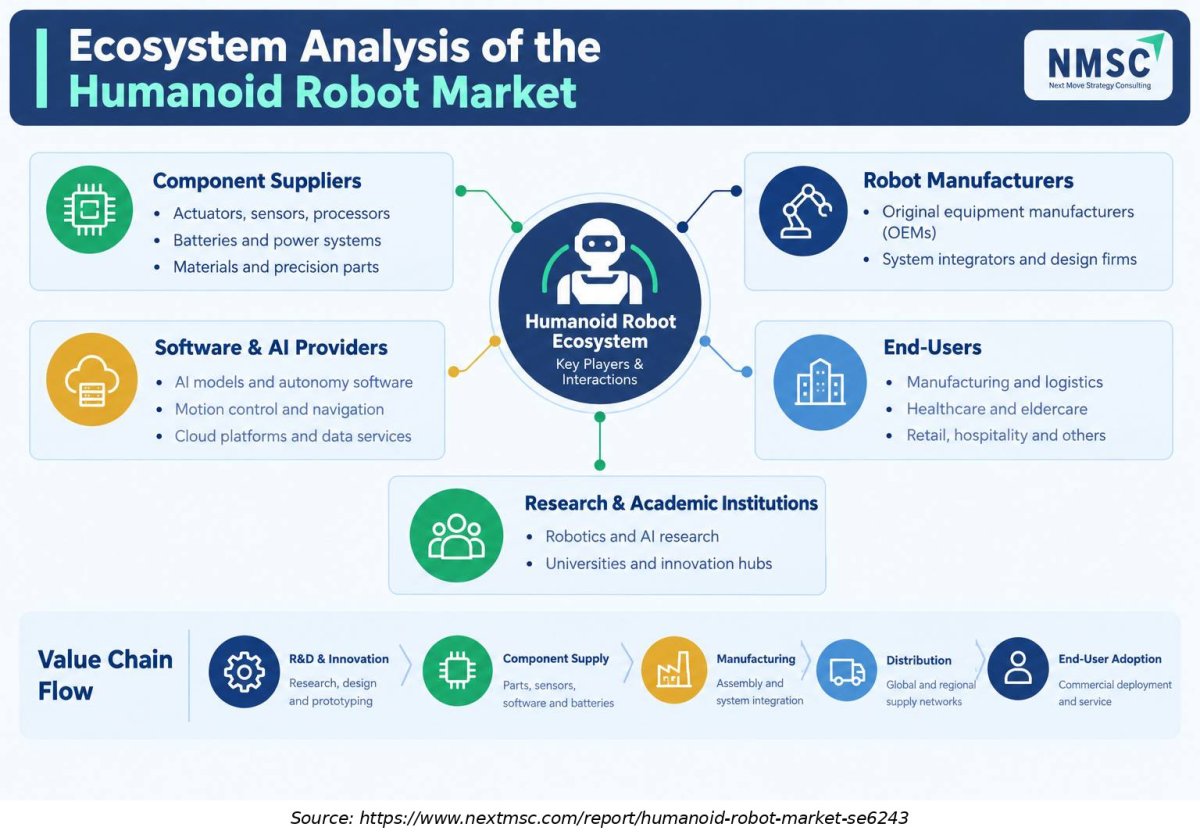
Ecosystem Analysis of the Humanoid Robot Market

The infographic illustrates the humanoid robot market ecosystem, encompassing component suppliers, robot manufacturers, software and AI providers, end-users, and research institutions. It highlights the interdependencies among hardware development, AI capabilities, robot assembly, and commercial deployment. The value chain progresses from research and innovation through component supply, manufacturing, distribution, and end-user adoption, supporting the market’s expansion across industrial and service applications.

Market Drivers & Dynamics

Interactive Dataset
Falling actuator, sensor, and battery costs driver +4.1% Global, led by Asia-Pacific 2026–2032
Embodied AI foundation models for manipulation driver +3.6% North America, Asia-Pacific 2026–2035
Labor shortages in manufacturing and logistics driver +2.8% Japan, South Korea, Europe, U.S. 2026–2035
Industrial policy and public funding programs driver +2.4% China, South Korea, Middle East 2026–2030
Safety certification and standards gaps restraint −2.7% North America, Europe 2026–2029
Battery runtime and reliability limits restraint −2.1% Global 2026–2030
Trade restrictions and concentrated component supply restraint −1.9% U.S., China, Europe 2026–2031
Source: Next Move Strategy Consulting

Growth Drivers

What Is the Primary Growth Driver?

Falling hardware cost combined with embodied AI is the primary driver of the Humanoid Robot Market. Unitree disclosed in its STAR Market prospectus that humanoid robots generated RMB 868 million of revenue in 2025, 51.78% of its total, after shipping more than 5,500 humanoid units. Cheaper platforms now reach universities, factories, and consumers at the same time. We found that every price reduction opens a new buyer tier without displacing earlier ones.

How Is Industrial Labor Demand Driving the Market Growth?

The International Federation of Robotics reported 542,000 industrial robot installations in 2024 and an operational stock of 4,664,000 units, with China taking 54% of installations. Factories already invest heavily in automation but still rely on people for tasks fixed arms cannot handle. Humanoids fit existing workstations, stairs, and tools without rebuilding the plant, which supports adoption in automotive and electronics assembly.

Growth Inhibitors

What Is Restraining the Humanoid Robot Market?

Safety certification and reliability are the main restraints. Agility Robotics states that Digit v4 passed field evaluations by an OSHA recognized national testing laboratory. Battery runtime, fall risk near people, and the Machinery Regulation in Europe, which applies from January 2027, slow approvals. Tesla's July 2026 shareholder update said Optimus lines were still being installed, and a collaborative robot arm often remains cheaper for fixed tasks.

What Are the Growth Opportunities?

How Can Logistics Deployments Scale Humanoid Revenue?

Warehouses offer repetitive tote moving, depalletizing, and sorting tasks with clear return calculations. Agility Robotics reports Digit v4 across nine customer facilities, including GXO and Amazon sites. Linking robots to a warehouse management system lets operators assign work automatically. Logistics and warehousing is the main beneficiary segment, growing at 26.36% CAGR from 2026 to 2035.

Where Do Household Humanoids Create New Demand?

Consumer products open the largest long run volume pool in the Humanoid Robot Market. 1X priced NEO at a purchase price or a monthly plan, and Figure positions its third generation robot as home help. Household and personal assistance grows from USD 5.16 Billion in 2026 to USD 64.94 Billion in 2035, so early brands can secure installed bases before incumbents react.

What Role Can Services and Data Platforms Play?

Every robot deployed in the Humanoid Robot Market generates training data, and vendors that capture it improve their models faster. UBTECH builds data collection centers, and Tesla plans an Optimus Academy for training data. A cloud robotics layer lets customers update skills across fleets remotely. Services and subscriptions is the beneficiary segment, expanding at 39.51% CAGR from 2026 to 2035.

Segmentation Analysis

2025 (USD Billion)
2035 (USD Billion)
Robot hardware 2025: $8.51 Billion | 2035: $168.34 Billion
Robot hardwa
Software and AI platforms 2025: $0.79 Billion | 2035: $59.73 Billion
Software and
Services and subscriptions 2025: $0.59 Billion | 2035: $43.44 Billion
Services and
Robot hardware $8.51 Billion $168.34 Billion 20.84%
Software and AI platforms $0.79 Billion $59.73 Billion 38.24%
Services and subscriptions $0.59 Billion $43.44 Billion 39.51%

Which Offering Leads the Humanoid Robot Market?

Robot hardware dominates with USD 8.51 Billion in 2025 because buyers pay mainly for the machine today. Services and subscriptions is the fastest growing offering at 39.51% CAGR from 2026 to 2035, ahead of Software and AI platforms at 38.24%. We observed that fleet management, data collection, and maintenance contracts are becoming mandatory as customers move from pilots to production. UBTECH already runs data collection centers that sell scenario based data services.

2025 (USD Billion)
2035 (USD Billion)
Bipedal
Wheeled base
Segment Item 2025 (USD Billion) 2035 (USD Billion) CAGR
Bipedal $10.0 USD Billion $40.0 USD Billion 25.0%
Wheeled base $17.1 USD Billion $51.1 USD Billion 11.0%

Segment-wise data is locked

Unlock complete segment-wise numbers for By Locomotion.

Unlock Full Data
2025 (USD Billion)
2035 (USD Billion)
Industrial m
Logistics an
Commercial a
Education
research and
Segment Item 2025 (USD Billion) 2035 (USD Billion) CAGR
Industrial manufacturing $10.0 USD Billion $40.0 USD Billion 27.0%
Logistics and warehousing $17.1 USD Billion $51.1 USD Billion 9.0%
Commercial and retail services $24.2 USD Billion $62.2 USD Billion 19.0%
Education $31.3 USD Billion $73.3 USD Billion 17.0%
research and entertainment $38.4 USD Billion $84.4 USD Billion 18.0%

Segment-wise data is locked

Unlock complete segment-wise numbers for By Application.

Unlock Full Data

Growth Opportunities

Our assessment indicates that three opportunities will shape revenue allocation through 2035.

How Can Logistics Deployments Scale Humanoid Revenue?

Warehouses offer repetitive tote moving, depalletizing, and sorting tasks with clear return calculations. Agility Robotics reports Digit v4 across nine customer facilities, including GXO and Amazon sites. Linking robots to a warehouse management system lets operators assign work automatically. Logistics and warehousing is the main beneficiary segment, growing at 26.36% CAGR from 2026 to 2035.

Where Do Household Humanoids Create New Demand?

Consumer products open the largest long run volume pool in the Humanoid Robot Market. 1X priced NEO at a purchase price or a monthly plan, and Figure positions its third generation robot as home help. Household and personal assistance grows from USD 5.16 Billion in 2026 to USD 64.94 Billion in 2035, so early brands can secure installed bases before incumbents react.

What Role Can Services and Data Platforms Play?

Every robot deployed in the Humanoid Robot Market generates training data, and vendors that capture it improve their models faster. UBTECH builds data collection centers, and Tesla plans an Optimus Academy for training data. A cloud robotics layer lets customers update skills across fleets remotely. Services and subscriptions is the beneficiary segment, expanding at 39.51% CAGR from 2026 to 2035.

Regional Outlook

2025 (USD Billion)
2035 (USD Billion)
North Americ
Europe
Asia-Pacific
Middle East
Latin Americ
Region 2025 (USD Billion) 2035 (USD Billion) CAGR (%)
North America $10.0 USD Billion $40.0 USD Billion 9.0%
Europe $17.1 USD Billion $51.1 USD Billion 27.0%
Asia-Pacific $24.2 USD Billion $62.2 USD Billion 25.0%
Middle East & Africa $31.3 USD Billion $73.3 USD Billion 23.0%
Latin America $38.4 USD Billion $84.4 USD Billion 12.0%

Regional data is locked

Unlock complete regional numbers for this market.

Unlock Full Data

Competitive Landscape

Based on research conducted by NMSC, we found that scale and software depth now separate leaders from followers.

Dimension Description
Market Structure Fragmented and consolidating, with Chinese volume leaders, U.S. venture backed developers, and automaker owned programs.
Innovation Focus Embodied AI models, dexterous hands, battery swapping, and automated robot assembly lines.
M&A Activity Active funding, listings, and strategic stakes, including Apptronik's Series A extension and UBTECH's control of Fenglong Electric.

How Do Companies Compete in the Humanoid Robot Market?

Competition in this industry runs on price, volume, and proof of useful work, and the Humanoid Robot Market rewards vendors that deliver all three. Chinese firms sell thousands of units at falling prices, while U.S. firms emphasize autonomy and customer pilots. Vendors also expand geographically through distributors in Europe, Japan, and the Middle East. We found that bundled pricing, including software and service, is replacing hardware only quotes in larger tenders.

Which Company Archetypes Dominate?

Three archetypes lead the Humanoid Robot Market. Volume manufacturers such as AGIBOT and Unitree win on scale, AI native developers such as Figure AI and Apptronik win on software and funding, and industrial groups such as Tesla, Hyundai, and XPENG win on manufacturing capacity and captive demand. Differentiation themes include price, safety documentation, and ecosystem openness.

How Do Innovation and Differentiation Strategies Differ?

UBTECH emphasizes swarm coordination and battery swapping in two minutes, and Boston Dynamics emphasizes industrial connectivity through its Orbit software. Agility Robotics focuses on narrow tote handling with certified safety, while 1X pursues quiet home robots. Our analysis shows that each strategy targets a different buyer and price tier, which limits direct rivalry for now.

What Is the Level of M&A and Capital Activity?

UBTECH completed its acquisition of 43.01% of Zhejiang Fenglong Electric in 2026 to secure components. Apptronik raised a Series A extension of USD 0.52 Billion in February 2026, and Agility Robotics appears in a Form S-4 filed by Churchill Capital Corp XI for a proposed business combination. Unitree opened its STAR Market offering in August 2026, so public markets now fund the category.

Key Market Players

Based on NMSC research, the following ten companies represent key participants in the global humanoid robot market, selected on the basis of their confirmed humanoid robot portfolios and commercial activity.

AGIBOT Unitree Robotics UBTECH Robotics Corp Ltd Figure AI, Inc. Agility Robotics, Inc. Boston Dynamics, Inc. Tesla, Inc. Apptronik, Inc. 1X Technologies AS XPeng Inc.

Latest Developments

NMSC's analysis indicates that recent announcements point to production scale and public market funding.

Date Event
Oct 2026 Agility selected Nyobolt to supply high-power, ultra-fast-charging battery technology for Digit 5. The system is designed to provide 90 minutes of runtime from a nine-minute charge, improving the run-to-charge ratio to 10:1 from Digit 4’s 2:1 and supporting more than 20 productive hours daily.
Sep 2026 AGIBOT and cookware retailer ASD deployed 100 X2 humanoid robots across 100 stores in China. Robots greet shoppers, assess needs, explain products, recommend cookware, and guide customers, while handing promotions, stock questions, and transactions to human staff. The companies showcased operation through extended in-store livestreams.
Sep 2026 Boston Dynamics opened the Robotics Metaplant Application Center at Hyundai Motor Group Metaplant America, where Atlas is training on automotive logistics and parts sequencing. Hyundai plans to expand Atlas deployment across its global plants, citing 25,000 units over the next few years, and a U.S. facility targeting 30,000 robots annually.

Expert Insights

Jensen Huang

Founder and Chief Executive Officer (CEO) | NVIDIA

"Humanoid robots extend physical AI into the world designed for people—opening a major new industry."

Analyst Interpretation

The statement highlights the growing convergence of artificial intelligence, high-performance computing, and humanoid robotics. As robots become increasingly capable of operating in human-designed environments, demand is expected to expand for AI-powered robotic systems across manufacturing, logistics, and potentially household applications. The integration of model training, simulation, and deployment infrastructure could accelerate technological development; however, widespread commercialization will depend on reliability, affordability, safety, and demonstrable productivity gains.

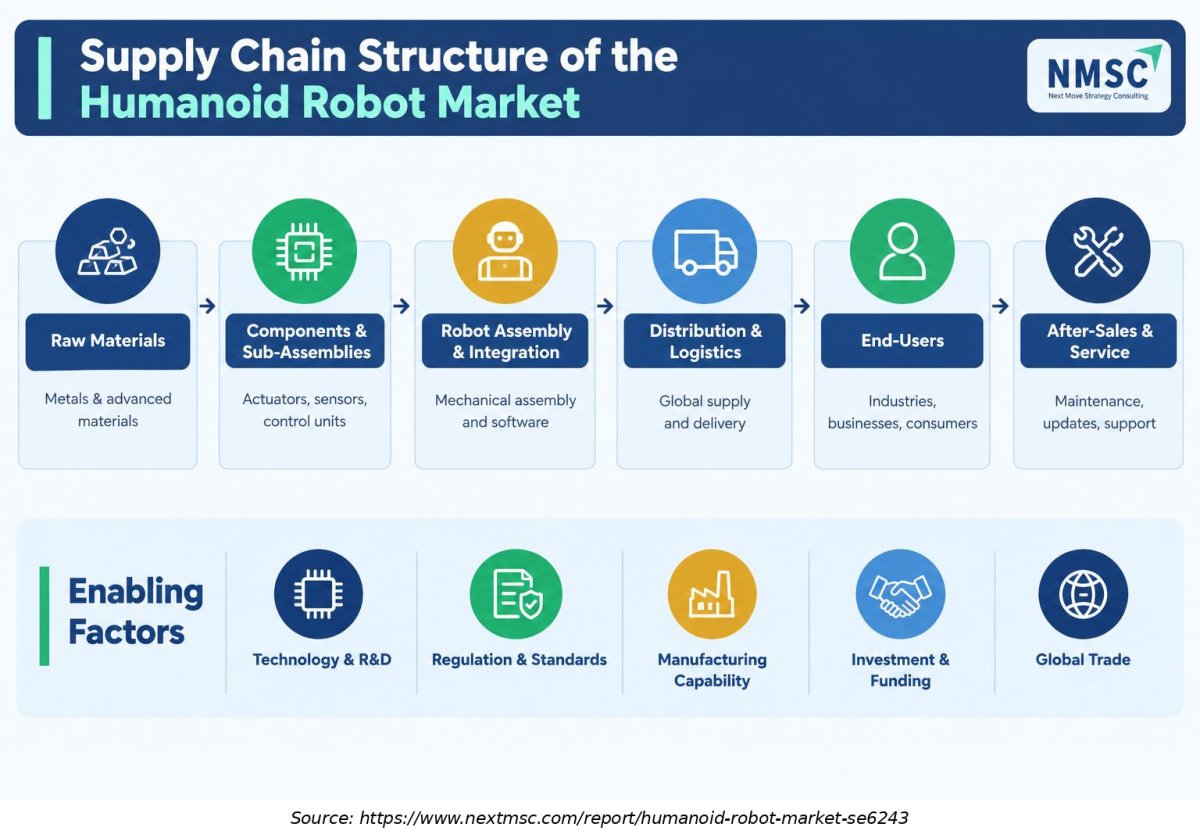
Supply Chain Structure of the Humanoid Robot Market

Supply Chain Structure of the Humanoid Robot Market
The infographic outlines the humanoid robot market supply chain, from raw material sourcing and component manufacturing to robot assembly, integration, distribution, end-user adoption, and after-sales service. It highlights the importance of actuators, sensors, control units, software integration, and logistics in delivering functional humanoid robots. Technology and R&D, regulatory standards, manufacturing capabilities, investment, and global trade serve as key enabling factors influencing supply chain efficiency and market scalability.

Investment Opportunities

Where Is Capital Flowing in the Humanoid Robot Market?

Capital in the Humanoid Robot Market concentrates in a few platforms. Apptronik raised a Series A extension in February 2026, Unitree sought about RMB 6.10 billion on the STAR Market, and UBTECH's cash balance funded its Fenglong Electric purchase. Investors favor companies with documented deliveries and recurring revenue. We observed that valuations now track unit shipments and software attach rates more than prototype performance.

Which Infrastructure Investments Matter Most?

Production capacity, actuator supply, AI compute, and data collection centers decide who scales. Boston Dynamics began Atlas production in Boston, XPENG built automated humanoid lines, and Tesla is converting its Fremont factory. Integration with supply chain management platforms and plant software also needs funding. Suppliers of harmonic drives, sensors, and batteries gain from this infrastructure build out.

What ESG Considerations Apply?

Human safety, worker transition, and data privacy lead the agenda. Robots working beside people need certified safety systems, and home robots collect video and audio inside private spaces. Employers must plan retraining for roles that change. Energy use is modest per unit, but battery sourcing and recycling require attention as fleets grow.

Key Benefits for Stakeholders

How Does the Report Help Enterprise and Industry Leaders?

Operators gain a view of which applications reach payback first, how offerings split between hardware and services, and which regions carry the most risk. The analysis helps plant managers plan pilots, integrate robots with intralogistics software, and compare vendor archetypes. Procurement teams can benchmark suppliers against delivered units and safety evidence.

How Does the Report Help Investors and Financial Analysts?

Investors receive a reconciled forecast from USD 9.89 Billion in 2025 to USD 271.51 Billion in 2035, segment and regional growth rates, and a ranked company set based on official disclosures. The data supports screening of listed and private candidates, scenario work on margins, and judgments about which layers of the stack capture durable profit.

How Does the Report Help Technology Vendors and Product Teams?

Vendors can map product roadmaps to the fastest growing applications, locomotion types, and offerings. The report highlights buyer demands on safety documentation, battery life, and fleet software. Product teams can also identify regional entry priorities and partner types, from distributors in the Middle East to integrators in Germany and Japan.

Key Market Segments Evaluated

By Offering

  • Robot hardware
  • Software and AI platforms
  • Services and subscriptions

By Locomotion

  • Bipedal
  • Wheeled base

By Application

  • Industrial manufacturing
  • Logistics and warehousing
  • Commercial and retail services
  • Education, research and entertainment
  • Household and personal assistance

By Region

  • North America 
    • U.S.
    • Canada
    • Mexico
  • Europe 
    • UK
    • Germany
    • France
    • Italy
    • Spain
    • Sweden
    • Denmark
    • Finland
    • Netherlands
    • Rest of Europe
  • Asia-Pacific 
    • China
    • India
    • Japan
    • South Korea
    • Taiwan
    • Indonesia
    • Vietnam
    • Australia
    • Philippines
    • Malaysia
    • Rest of APAC
  • Middle East & Africa 
    • Saudi Arabia
    • UAE
    • Egypt
    • Israel
    • Turkey
    • Nigeria
    • South Africa
    • Rest of MEA
  • Latin America 
    • Brazil
    • Argentina
    • Chile
    • Colombia
    • Rest of LATAM

Conclusion & Recommendations

We observed that the market should grow from USD 36.06 Billion in 2026 to USD 271.51 Billion in 2035 as costs fall and software improves. Growth starts in industrial and logistics fleets and then broadens into households and commercial services. The path is not linear, since safety rules and production ramps can delay timelines for individual vendors.

What Strategic Positioning Recommendations Does NMSC Offer?

Vendors should pair hardware with software and recurring services, and secure certified safety documentation early. Chinese volume leaders should widen export channels, while Western developers should prove deployments at named customers. Buyers should start with narrow tasks, require uptime guarantees, and negotiate data rights and update terms in every contract before scaling to larger fleets.

What Is the Investment Attractiveness of the Humanoid Robot Market?

Our assessment indicates that attractiveness is high but selective. Services and subscriptions grow fastest, and listings in Hong Kong and Shanghai give investors liquid exposure. Private rounds carry higher risk because valuations rose quickly, and revenue still depends on a handful of customers for several vendors. Investors should therefore prefer firms with disclosed deliveries, audited accounts, and diversified buyers.

What Are the Market Shifts and Key Risks in the Humanoid Robot Market?

Shifts include price competition from China, rising software shares, and household launches. Risks include safety incidents, production ramps that arrive later than guided, battery limits, and trade measures that restrict robots or components. NMSC's analysis indicates that regulation in Europe from 2027 will decide how quickly new entrants gain access.

What Are the Primary Growth Pathways Through 2035?

Four pathways stand out: industrial manufacturing cells, warehouse fleets, home assistance, and software or data services. Each depends on lower cost per task and verified safety. Together they lift the market by approximately USD 235.45 Billion between 2026 and 2035, with Asia-Pacific still the largest region and the Middle East & Africa growing fastest.

Delivered Customizations

We have successfully delivered the following deep-dive customizations:

Client Request Customization Delivered Value Adds
Global Import-Export Trade Assessment
  • Country-wise import and export analysis for humanoid robots and key components such as actuators, reducers, sensors, and compute modules, drawn from UN Comtrade and WITS.
  • Identifies sourcing concentration risks and export-led manufacturing hubs to guide supply chain and localization decisions.
Historical Shipment and Revenue Analysis
  • Historical humanoid robot shipments and revenue across offering, locomotion, and application segments, based on company disclosures and IFR and government data.
  • Shows which segments are scaling fastest and where early commercial traction is building for investment prioritization.
Market Size Estimation by Segment
  • TAM, SAM, and VAM estimates for humanoid robots by offering, locomotion type, and application, built from public deployment and cost data.
  • Quantifies the serviceable and obtainable opportunity in each segment to support market entry and capacity planning.
Locomotion Architecture Adoption Mapping
  • Adoption mapping of bipedal, wheeled, and other locomotion designs by application, payload, and operating environment.
  • Shows which locomotion designs fit specific tasks, guiding product roadmap and application-focused R&D priorities.
Hardware Cost Stack and Supplier Concentration Assessment
  • Component-level cost breakdown of actuators, sensors, compute, and batteries, with supplier concentration and cost-trend analysis across the offering stack.
  • Pinpoints cost-reduction levers and single-source dependencies to support sourcing, pricing, and partnership decisions.
Application Deployment Pipeline Tracking
  • Tracking of pilots, paid trials, and commercial deployments by application (manufacturing, logistics, healthcare, retail, and research) using public announcements and filings.
  • Separates validated commercial demand from pilot activity, helping prioritize customer targets and application go-to-market plans.

FAQs

About the Author

Mihul Sharma

Mihul Sharma

Mihul Sharma is Research Associate at Next Move Strategy Consulting, where he has covered technology, industrial, and healthcare markets for 3 years. His work applies structured business research, market analysis, and secondary-source review to assess market trends, competitive developments, and growth opportunities. He supports report development by fully synthesizing industry data, company information, and market signals into concise findings for strategy and investment-focused research teams.

About the Reviewer

Supradip Baul

Supradip Baul

Supradip Baul is an accomplished business consultant and strategist with over a decade of rich experience in market intelligence, strategy, technology, and business transformation. His work has included rigorous qualitative and quantitative analysis across multiple industries, helping clients shape investment decisions and long-term roadmaps. Earlier in his career, he was associated with Gartner, where he contributed to industry-leading reports and market share analyses. He has worked with leading global companies and holds an MBA with a dual specialization in Marketing and Finance.

Download Free Sample

Kevin Coker

KEVIN COKER

Founder, CEO and Board Diector

Proxima Clinical Research

I have been using Next MSC reports for product positioning in a new geography for a long time. They have by far the best reports I have found and the price is reasonable too!

Nishant Awate

NISHANT AWATE

Business Development Global Sales

Zehnder Group Deutschland GmbH

Our experience working with Next Move Strategy Consulting was positive. The team was responsive, professional, and open to incorporating our specific requirements throughout the project. The India AHU market study was comprehensive and well structured, covering market value and volume forecasts, product and application segments, and key industry trends. The inclusion of both AHU and residential MVHR market insights made the study particularly relevant for our strategic market assessment. Overall, the report provides a solid foundation for evaluating market potential, identifying priority segments, and supporting business-development decisions in India.

Kishu Kanda

KISHU KANDA

Strategy Analyst

Accenture

We purchased the AI Consumer Market Report from this company. Not only did they customize the report to meet our specific requirements, but they also showed great flexibility in accommodating our budget. The report we received fully met our expectations. Additionally, they provided prompt and thorough responses to both our pre-purchase and follow-up questions. We look forward to working with this company again in the future.

Robert Sean Trevino

ROBERT SEAN TREVINO

Sr. Director, Head of Strategic Insights & Analytics

Foundation Medicine

I realized that it was a reliable source of information. These days, there are many people who are looking for authentic data, and this is one of the only sources that can offer them with what they need;

Gaurav Jaiswal

GAURAV JAISWAL

Founder & CEO

Yano Charge Private Limited

The EV Charging market research report provided by the NextMSC was exceptionally detailed and insightful. It offered a comprehensive analysis that proved to be a game-changer for our strategic planning. Truly a testament to the NextMSC’s expertise and thoroughness in EV market landscape & analysis.

Custom Market Research Services

We will customize the research for you if the listed report does not fully match your requirements.

Get 30% Free Customization

Select License

This website uses cookies to ensure you get the best experience on our website. Learn more

✖