Trump’s EO 14414 and USDA Rule Reshape Sustainable Agriculture Market

Trump's Executive Order 14414 and USDA's Landmark Feedstock Rule Redirect Billions Toward Regenerative Farming, Reshaping the Global Sustainable Agriculture Market
On June 25, 2026, President Donald J. Trump signed Executive Order 14414, "Advancing Regenerative Agriculture and Strengthening American Farm Resilience," directing the U.S. Department of Agriculture (USDA), the Environmental Protection Agency (EPA), and the Department of Health and Human Services (HHS) to accelerate the adoption of regenerative farming practices across the United States. Simultaneously, USDA Secretary Brooke L. Rollins announced a final Regenerative Feedstock Rule — a landmark regulatory action that formally connects regenerative agriculture practices to premium biofuel markets for corn, soybeans, sorghum, and spring canola, creating a direct financial incentive for the approximately 68% of U.S. corn farmers and 70% of U.S. soybean farmers who already implement at least one regenerative practice. Together, the Executive Order and the Feedstock Rule represent the most consequential federal market-creation mechanism for sustainable agriculture in the United States to date, arriving as global food companies and institutional investors simultaneously scale their own regenerative commitments across three continents.
According to Next Move Strategy Consulting's Sustainable Agriculture Market report, the global sustainable agriculture market is projected to reach USD 28.36 billion by 2030, growing at a compound annual growth rate (CAGR) of 10.8% from 2025 to 2030. NextMSC primary research and analysis identifies the convergence of government-mandated regenerative frameworks, surging organic food demand, and corporate supply-chain decarbonization commitments as the structural forces compressing the timeline between pilot-scale adoption and commercial-scale deployment of sustainable farming inputs and practices.
For More Information: Download FREE Sample on Sustainable Agriculture Market Report
White House Executive Order 14414: A Market-Creation Mechanism, Not a Mandate
Executive Order 14414 is notable for what it does not do as much as for what it does. Rather than imposing regulatory mandates on farmers, the order instructs the USDA to expand the reach of its existing Regenerative Pilot Program through public-private partnerships, directs the EPA to expedite registration of alternative crop protection substances as replacements for older active ingredients, and tasks HHS, USDA, and EPA jointly with developing a research and evaluation framework for cumulative chemical exposure across food-supply-regulated chemical classes.
The accompanying USDA Regenerative Feedstock Rule establishes field-level quantification of crop-specific carbon intensity, mass-balance chain-of-custody standards, and auditing and verification requirements that allow farmers to market eligible feedstocks to participating biofuel producers at premium prices. "Today's USDA's Regenerative Feedstock Rule put farmers, not Washington bureaucrats, in the driver's seat. Instead of mandates, we're creating market opportunities. Farmers who choose to implement regenerative practices will have new opportunities to earn premium prices, lower their input costs, improve soil health, and strengthen the long-term profitability of their operations," said U.S. Secretary of Agriculture Brooke L. Rollins, in a USDA press release dated June 25, 2026.
The rule's practical scope is substantial: American farmers currently produce approximately 6 billion bushels of corn used annually for ethanol production, and approximately 1.8 billion bushels of soybeans for biofuel production. By attaching a carbon-intensity premium to regenerative feedstocks within these existing commodity flows, the Feedstock Rule creates a revenue pathway that does not require farmers to exit conventional commodity markets — a structural distinction from earlier climate-smart agriculture programs that required dedicated acreage set-asides.
USDA's $700 Million Regenerative Pilot Program: 49 Million Acres and Counting
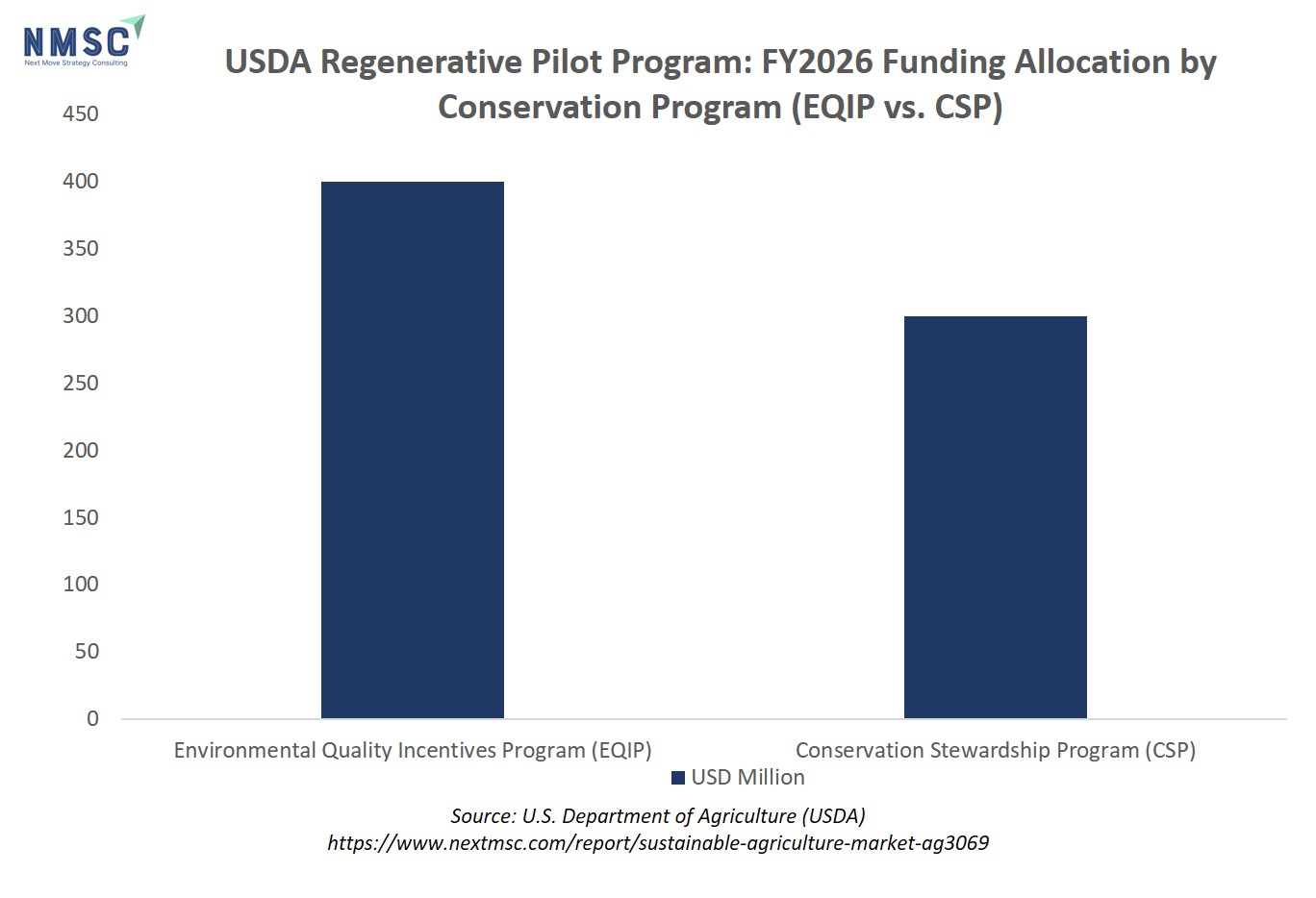
The Executive Order builds directly on the USDA Natural Resources Conservation Service (NRCS) Regenerative Pilot Program, launched on December 10, 2025, with a total investment of USD 700 million — USD 400 million channeled through the Environmental Quality Incentives Program (EQIP) and USD 300 million through the Conservation Stewardship Program (CSP). The program requires participating producers to complete a whole-farm assessment, adopt at least one primary regenerative management practice — including cover crops, no-till or reduced-till management, conservation crop rotation, or nutrient management — and conduct soil health testing at the start and end of each contract period.
By June 2026, USDA reported that the program had already completed over 67,000 whole-farm conservation plans, covering more than 49 million acres, with over 1,500 conservation contracts worth more than USD 200 million already executed. The program's bundled single-application structure — integrating EQIP and CSP applications into one process — directly addresses the administrative fragmentation that had historically suppressed farmer participation in conservation programs by forcing producers to navigate separate funding pools for individual practices rather than holistic farm management.
The Agricultural Act of 2026: Legislative Architecture for Long-Term Market Stability
The policy momentum extends beyond executive action. On June 23, 2026, the U.S. Senate Committee on Agriculture, chaired by Senator John Boozman (R-Ark.), released the draft Agricultural Act of 2026 — the Senate's version of the Farm Bill. The House had already passed its version, the Farm, Food, and National Security Act of 2026, in April 2026, a USD 390 billion budget-neutral package.
The Senate draft reauthorizes the Conservation Reserve Program (CRP) through 2031 with a 27-million-acre cap and raises the CRP payment limitation for the first time in the program's history to USD 125,000. The National Organic Program receives a funding increase to USD 26 million in fiscal year 2027, escalating to USD 34 million by fiscal year 2031, with new technical assistance authority for farmers transitioning to organic production. The draft also formally includes sustainable aviation fuel (SAF) within the definition of advanced biofuels — a provision that directly expands the addressable bioenergy market for sustainable feedstock producers. On June 24, 2026, President Trump submitted a supplemental budget request to Congress that included USD 11.1 billion in farm aid, adding further fiscal weight to the legislative cycle.
Global Food Companies Accelerate Regenerative Supply-Chain Commitments
The regulatory push in Washington is mirrored by accelerating corporate commitments across global food supply chains. In May 2026, PepsiCo launched the second edition of its VivaOliva program, extending regenerative agriculture practices to an additional 35 smallholder olive farmers in Jaén, Spain. In April 2026, Nestlé signed a four-year agreement with agricultural consultancy Soil Capital to scale regenerative practices across 230 farms in France, Belgium, and the United Kingdom, covering 13,000 hectares. McCain Foods announced that a 200-hectare farm in North Yorkshire, England, would become its third Farm of the Future — joining existing sites in Canada and South Africa — as part of the company's commitment to source 100% of its potatoes from farms using sustainable methods by 2030, having invested over £35 million in the United Kingdom alone to support farmer transitions.
The industry-level coordination challenge — competing definitions of "regenerative agriculture" that create administrative burdens for farmers and reduce the scalability of corporate programs — is being addressed by the SAI Platform, a non-profit network for the food and beverage industry. The SAI Platform launched its Regenerating Together Programme framework in June 2026, based on a three-year pilot conducted across 25 countries involving members including Nestlé, Louis Dreyfus Company (LDC), and McCain. The framework defines regenerative agriculture as an outcome-based farming approach and is designed to allow food companies to verify supply-chain improvements without imposing practice-specific mandates on individual farms.
"[The framework is] a way to move away from every company having their own initiatives," said Axelle Bodoy, Global Head of Regenerative Agriculture at Louis Dreyfus Company, in a Reuters interview published May 18, 2026, noting that competing definitions had previously caused confusion, increased administrative burdens on farmers and LDC staff, and "ultimately reduced the chances of programmes scaling."
However, investor confidence remains a structural constraint. "Regenerative agriculture lacks a clear, widely understood definition, which makes it harder to justify sustained capital allocation," said María Montosa Ródenas, Technical Specialist at FAIRR — a network of food system investors — in an email cited by Reuters on May 18, 2026, adding that investors need to understand "whether these strategies are credible, measurable and capable of delivering outcomes, compared with more established approaches such as organic farming or agroecology."
Organic Food Sales Exceed USD 148 Billion, Anchoring Upstream Demand for Sustainable Inputs
The demand-side foundation for sustainable agriculture inputs is anchored by the continued expansion of the global organic food sector. According to the Research Institute of Organic Agriculture (FiBL) 2025 report, total global sales of organic food and beverages exceeded USD 148.48 billion in 2023 — a figure that reflects the consumer-level demand creating a direct commercial incentive for farmers to adopt certified organic and sustainable production methods, expanding the addressable market for biopesticides, biostimulants, and certified seeds.
The net-zero policy dimension reinforces this demand signal. According to the International Atomic Energy Agency (IAEA), agricultural activity contributes approximately 30% of global carbon emissions, making the sector a primary target for decarbonization policy across both developed and emerging economies. The International Institute for Sustainable Development (IISD) estimates that there is an annual investment gap of approximately USD 260 billion that must be bridged to meet sustainable agriculture financing needs globally, underscoring the scale of capital deployment required and the commercial opportunity for solution providers across the sustainable agriculture value chain.
Market Segmentation Analysis
NMSC Sustainable Agriculture Market Segmentation Overview
|
Segment Category |
Key Sub-Segments |
Strategic Significance |
|
Product Type |
Seeds & Traits, Biopesticides, Biostimulants, Others |
Biopesticides and biostimulants are the fastest-growing product categories, driven by regulatory pressure on synthetic agrochemicals and the USDA Feedstock Rule's practice standards |
|
Farming System |
Organic Farming, Agroecology, Regenerative Agriculture, Conservation Agriculture, Precision Agriculture |
Regenerative agriculture is the fastest-scaling system, supported by USDA's USD 700M pilot program and EO 14414's public-private partnership mandate |
|
Crop Type |
Cereals & Grains, Oilseeds & Pulses, Fruits & Vegetables, Others |
Oilseeds gaining structural share via USDA Feedstock Rule biofuel linkage for soybeans and spring canola |
|
Formulation |
Liquid, Dry |
Liquid formulations lead in precision application compatibility with IoT-enabled irrigation and spray systems |
|
Application |
Food Production, Bioenergy, Environmental Services, Water Management |
Bioenergy application expanding rapidly following USDA Regenerative Feedstock Rule's corn and soybean market linkage |
Regional Market Dynamics
Regional Sustainable Agriculture Market Dynamics
|
Region |
Market Position |
Key Policy/Market Driver |
Notable 2025–2026 Development |
|
North America |
Leading region |
Federal regenerative agriculture policy and net-zero commitments |
EO 14414 (June 2026); USDA USD 700M Regenerative Pilot Program; USD 11.1B farm aid supplemental request; 49M+ acres under whole-farm conservation plans |
|
Europe |
Established, high-value market |
EU sustainability mandates and corporate supply-chain commitments |
Nestlé-Soil Capital 4-year deal covering 13,000 hectares (April 2026); SAI Platform Regenerating Together Programme across 25 countries (June 2026); UK Defra Sustainable Farming Incentive 2026 (SFI26) |
|
Asia-Pacific |
Fastest-growing region |
Expanding organic farming sector and government-backed sustainable agriculture programs |
India organic exports: USD 494.80M in 2023-24 (Indian Ministry of Commerce and Industry); Japan-UNDP climate-resilient agriculture support in the Aral Sea Region |
|
Rest of World |
Emerging opportunity |
Climate resilience investment and food security imperatives |
Latin America, Middle East, and Africa receiving increasing multilateral sustainable agriculture financing; PepsiCo VivaOliva extending to smallholder olive farmers in Spain (May 2026) |
NMSC Strategic Perspective: The Feedstock Rule as a Market-Structuring Event
NextMSC primary research and analysis identifies the USDA Regenerative Feedstock Rule as a structurally significant market event that goes beyond conventional conservation program mechanics. By establishing a formal carbon-intensity quantification framework for corn, soybean, sorghum, and spring canola feedstocks — and linking that quantification to premium pricing within the existing biofuel supply chain — the rule creates a monetizable output for regenerative practices that does not depend on consumer willingness to pay a premium for certified organic or sustainably labeled products. This is a fundamentally different demand architecture from the one that has historically driven sustainable agriculture market growth, and it materially expands the total addressable market for sustainable input suppliers by embedding regenerative practice adoption into commodity-scale agricultural economics.
NextMSC primary research and analysis identifies three structural implications for market participants:
1. Input Suppliers Face an Accelerated Adoption Curve. The Feedstock Rule's requirement for soil health testing at the start and end of each contract period creates a measurable, auditable baseline for regenerative practice outcomes. This shifts the competitive dynamic for biopesticide, biostimulant, and precision agriculture technology suppliers from a market driven by farmer willingness to experiment toward one driven by contractual performance obligations — compressing the sales cycle and increasing the defensibility of premium-priced sustainable inputs against conventional agrochemical alternatives.
2. The Definition Problem Is Being Resolved at the Institutional Level. The simultaneous emergence of the SAI Platform's Regenerating Together Programme framework (June 2026) and the USDA Feedstock Rule's practice standards represents a convergence of private-sector and public-sector definitional frameworks. NextMSC primary research and analysis indicates that this convergence will reduce the investor confidence gap identified by FAIRR's María Montosa Ródenas, as standardized definitions enable credible, comparable measurement of regenerative outcomes across geographies and supply chains — a prerequisite for the sustained capital allocation that the USD 260 billion annual investment gap (IISD) demands.
3. Asia-Pacific Represents the Highest-Velocity Growth Opportunity. India's organic export volume of 0.26 million MT and USD 494.80 million in 2023-24, as reported by the Indian Ministry of Commerce and Industry, reflects a domestic organic production base that is structurally under-served by sustainable input suppliers relative to North America and Europe. As government-backed programs in India, Japan, and Southeast Asia expand, NextMSC primary research and analysis projects Asia-Pacific to sustain its position as the fastest-growing regional market through 2030, with precision agriculture and biostimulant adoption rates accelerating as smallholder farm consolidation and digital connectivity improve.
Competitive Landscape: Key Players Advancing Market Position
The sustainable agriculture market features a diverse competitive landscape spanning agrochemical majors, food and beverage conglomerates, and specialized sustainable input providers. According to NextMSC primary research and analysis, key players include BASF SE, Bayer AG, Syngenta Corporation, Archer Daniels Midland Company (ADM), Cargill, Incorporated, PepsiCo Inc., Walmart Inc., The Coca-Cola Company, The Kraft Heinz Company, Mondelēz International Inc., Indigo Ag, Inc., Ecocert SA, Tradin Organic Agriculture B.V., Global Organics, Ltd., and Sus Agri Development Pvt Ltd.
In November 2024, Archer Daniels Midland Company expanded its regenerative agriculture program in the United States and globally through grower meetings focused on promoting sustainable agriculture practices, according to NextMSC primary research and analysis. In July 2024, BASF SE launched Tinuvin NOR 211 AR, an innovative stabilizer for sustainable farming applications, according to NextMSC primary research and analysis. In September 2024, Bayer AG introduced its 'Bayer Forward Farming' initiative in India, showcasing innovative farming techniques aimed at eco-friendly rice cultivation, according to NextMSC primary research and analysis. In July 2024, Syngenta Corporation entered into a partnership with Ginkgo Bioworks to co-develop sustainable agriculture solutions, according to NextMSC primary research and analysis.
Bottom Line
The global sustainable agriculture market is undergoing a structural transition from a niche, certification-driven segment to a mainstream agricultural operating model, accelerated by the convergence of U.S. federal policy, corporate supply-chain commitments, and institutional investment frameworks. President Trump's Executive Order 14414 and the USDA announced the final Regenerative Feedstock Rule on June 25, 2026; the final rule was published in the Federal Register on June 29, 2026, represent the most significant market-creation mechanism for regenerative agriculture in U.S. history, connecting regenerative practices to premium biofuel markets across corn, soybean, sorghum, and spring canola supply chains. The USDA's USD 700 million Regenerative Pilot Program, already covering more than 49 million acres through over 67,000 whole-farm conservation plans, provides the operational infrastructure for this transition. Simultaneously, the SAI Platform's Regenerating Together Programme framework — piloted across 25 countries — is resolving the definitional fragmentation that has historically constrained investor confidence. According to NextMSC primary research and analysis, the global sustainable agriculture market is projected to grow from USD 15.36 billion in 2024 to USD 28.36 billion by 2030 at a CAGR of 10.8%, with North America leading and Asia-Pacific sustaining the fastest growth trajectory through the forecast period.
About Next Move Strategy Consulting
Next Move Strategy Consulting is a premier market research and management consulting firm that has been committed to provide strategically analysed well documented latest research reports to its clients. The research industry is flooded with many firms to choose from, what makes NMSC different from the rest is its top-quality research and the obsession of turning data into knowledge by dissecting every bit of it and providing fact-based research recommendation that is supported by information collected from over 500 million websites, paid databases, industry journals and one on one consultations with industry experts across a diverse range of industry sectors. The high-quality customized research reports with actionable insights and excellent end-to-end customer service help our clients to take critical business decisions that enables them to move beyond time and have competitive edge in the industry.
We have been servicing over 1000 customers globally that includes 90% of the Fortune 500 companies over a decade. Our analysts are constantly tracking various high growth markets and identifying hidden opportunities in each sector or the industry. We provide one of the industry's best quality syndicate as well as custom research reports across 10 different industry verticals. We are committed to deliver high quality research solutions in accordance to your business needs. Our industry standard delivery solutions that ranges from the pre consultation to after-sales services, provide an excellent client experience and ensure right strategic decision making for businesses.
For more information, please contact:
Next Move Strategy Consulting
5th Floor 867
Boylston St, STE 500,
Boston, MA 02116, U.S.
E-Mail: [email protected]
Direct: +1-217-650-7991
Website: www.nextmsc.com
About the Author
 Sanyukta Deb
— Sanyukta Deb is Digital Marketing Team Lead at Next Move Strategy Consulting, where she has led content strategy and technical SEO for the firm's B2B market research publications for over 2 years. Her editorial process translates NextMSC's primary and secondary research — spanning technology, industrial, and consumer sectors — into commercial narratives, backed by search-intent, keyword, and competitive analysis. She brings 5 years of overall experience in digital marketing and content strategy.
Sanyukta Deb
— Sanyukta Deb is Digital Marketing Team Lead at Next Move Strategy Consulting, where she has led content strategy and technical SEO for the firm's B2B market research publications for over 2 years. Her editorial process translates NextMSC's primary and secondary research — spanning technology, industrial, and consumer sectors — into commercial narratives, backed by search-intent, keyword, and competitive analysis. She brings 5 years of overall experience in digital marketing and content strategy.
About the Reviewer
 Debashree Dey
— Debashree Dey is Assistant Manager at Next Move Strategy Consulting, where she supports cross-vertical market content and communications across diverse industries for 6 years. Her professional background includes senior content writing, communications, and published manuscript authorship, with experience developing audience-focused business narratives and maintaining clear, consistent messaging. Her role supports research-led content development and editorial quality across NextMSC publications.
Debashree Dey
— Debashree Dey is Assistant Manager at Next Move Strategy Consulting, where she supports cross-vertical market content and communications across diverse industries for 6 years. Her professional background includes senior content writing, communications, and published manuscript authorship, with experience developing audience-focused business narratives and maintaining clear, consistent messaging. Her role supports research-led content development and editorial quality across NextMSC publications.

















Add Comment