U.S. Army Sets Record with 32-Helicopter Formation
Industry Insights from Next Move Strategy Consulting
A stunning aerial display by the U.S. Army has set a new global record, highlighting both technical mastery and strategic significance in military aviation.
A Record-Breaking Flyover
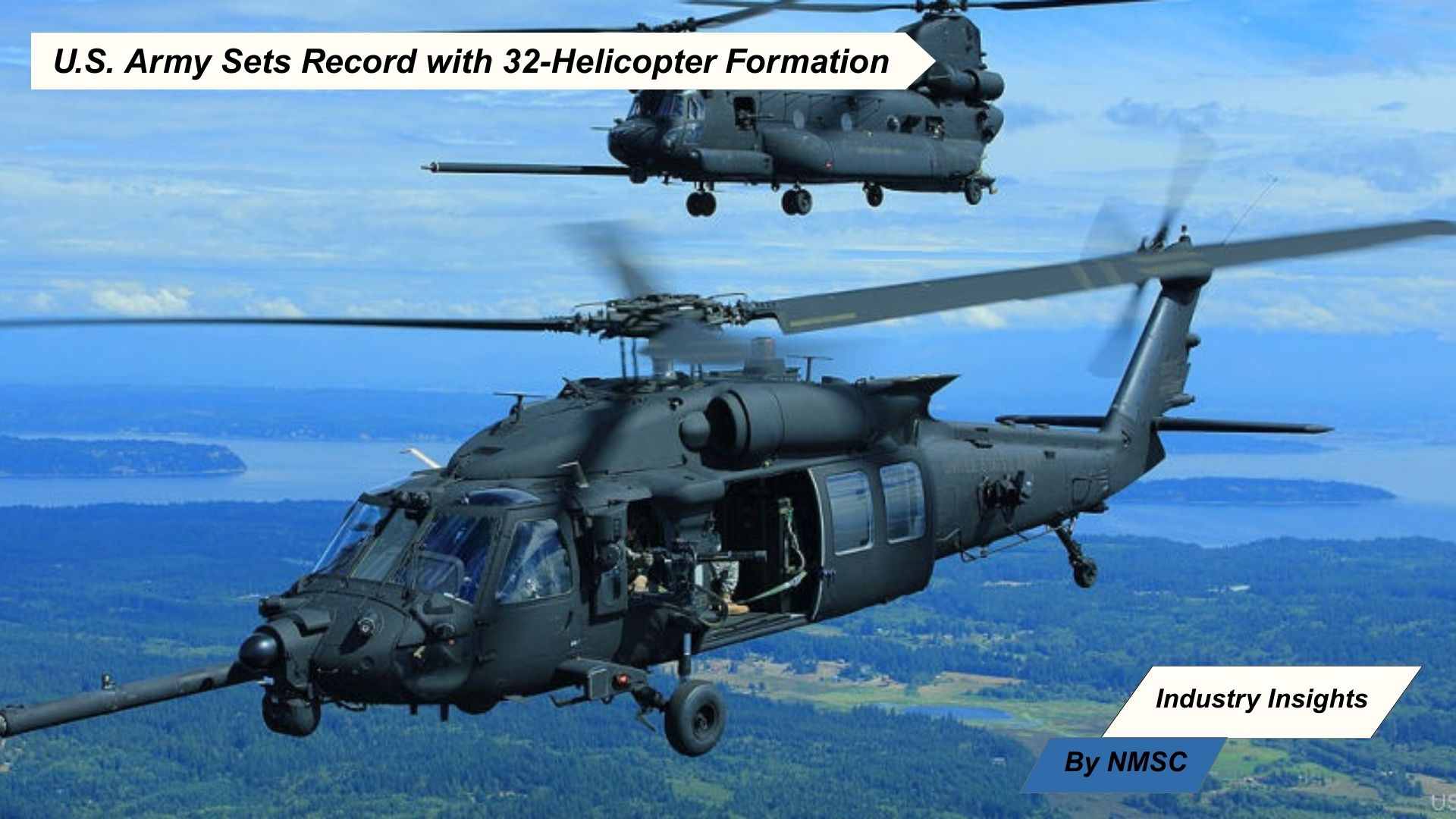
On April 15, 2016, 32 OH-58D Kiowa Warrior helicopters from the 1st Squadron, 17th Cavalry Regiment, operating under the 82nd Combat Aviation Brigade, lifted off from Simmons Army Airfield for a formation flight over Fort Bragg and Fayetteville, North Carolina. Guinness World Records later verified this as the largest helicopter formation ever officially recorded.
The mission required precise coordination, with each aircraft maintaining exact spacing, altitude, and timing while navigating military and civilian airspace. The operation combined hundreds of personnel, pre-flight simulations, and comprehensive air traffic management to ensure flawless execution.
While initially presented as a public farewell for the Kiowa Warrior fleet, defense analysts now view the maneuver as a landmark in large-scale helicopter coordination, fleet readiness, and tactical air mobility.
Skill, Risk, and Tactical Precision
Flying 32 helicopters in close formation posed unique challenges. The OH-58D is highly sensitive to wind shifts, turbulence, and rotor wash, demanding constant adjustments by pilots relying on training, instinct, and real-time communication. As a reconnaissance platform, the Kiowa Warrior delivered visual confirmation, laser guidance, and light strike capability in contested environments, where agility and altitude control were critical.
Under the Army Aviation Restructure Initiative, the Kiowa Warrior was retired to consolidate resources and modernize the fleet with Apache helicopters and unmanned aerial systems. However, neither fully replicated the Kiowa’s versatility, agility, or low-altitude reconnaissance capabilities.
Delays in Replacement Programs
The Future Attack Reconnaissance Aircraft (FARA) program, intended to field a successor, has experienced delays, leaving the Army reliant on interim platforms. Bell 360 Invictus and Sikorsky Raider X remain in testing, with operational readiness projected beyond fiscal year 2028. This gap has prompted concerns over situational awareness, target acquisition speed, and maintenance burdens.
Meanwhile, international partners including Australia, South Korea, and Poland have continued investing in light scout helicopters to maintain tactical flexibility in low-altitude operations.
Enduring Legacy and Strategic Implications
Nearly a decade later, the 32-helicopter formation remains the most ambitious rotary-wing operation conducted by the U.S. Army. It is now studied in aviation manuals and leadership courses as a benchmark of tightly integrated air operations.
“Coordination of this scale demonstrates not only operational skill but also the enduring value of manned reconnaissance platforms,”. “The Kiowa Warrior exemplified reliability, adaptability, and tactical effectiveness qualities that current and future programs continue to strive for.”
Next Move Strategy Consulting’s Viewpoint
According to the Next Move Strategy Consulting’s view, the record-setting 32 helicopters market formation underscores the operational depth and coordination capabilities that defined the U.S. Army’s rotary-wing aviation at its peak. Beyond its ceremonial framing, the flight stands as a practical demonstration of how disciplined planning, pilot proficiency, and fleet readiness can converge to execute complex, large-scale air maneuvers within constrained airspace.
The event also highlights a broader strategic lesson. The continued reference to this formation nearly a decade later reflects the lasting impact of retiring a proven reconnaissance platform without a fully fielded successor. The OH-58D Kiowa Warrior fulfilled a distinct role through agility, responsiveness, and low-altitude effectiveness capabilities that interim solutions have struggled to fully replicate.
Source: Indian Defence Review
Prepared by: Next Move Strategy Consulting
About the Author
 Sanyukta Deb
— Sanyukta Deb is Digital Marketing Team Lead at Next Move Strategy Consulting, where she has led content strategy and technical SEO for the firm's B2B market research publications for over 2 years. Her editorial process translates NextMSC's primary and secondary research — spanning technology, industrial, and consumer sectors — into commercial narratives, backed by search-intent, keyword, and competitive analysis. She brings 5 years of overall experience in digital marketing and content strategy.
Sanyukta Deb
— Sanyukta Deb is Digital Marketing Team Lead at Next Move Strategy Consulting, where she has led content strategy and technical SEO for the firm's B2B market research publications for over 2 years. Her editorial process translates NextMSC's primary and secondary research — spanning technology, industrial, and consumer sectors — into commercial narratives, backed by search-intent, keyword, and competitive analysis. She brings 5 years of overall experience in digital marketing and content strategy.
About the Reviewer
 Debashree Dey
— Debashree Dey is Assistant Manager at Next Move Strategy Consulting, where she supports cross-vertical market content and communications across diverse industries for 6 years. Her professional background includes senior content writing, communications, and published manuscript authorship, with experience developing audience-focused business narratives and maintaining clear, consistent messaging. Her role supports research-led content development and editorial quality across NextMSC publications.
Debashree Dey
— Debashree Dey is Assistant Manager at Next Move Strategy Consulting, where she supports cross-vertical market content and communications across diverse industries for 6 years. Her professional background includes senior content writing, communications, and published manuscript authorship, with experience developing audience-focused business narratives and maintaining clear, consistent messaging. Her role supports research-led content development and editorial quality across NextMSC publications.

















Add Comment