U.S. Organic Sales Surge as USDA Reworks Rules as Global Farmland Expands
U.S. Organic Sales Cross $76.6 Billion as USDA Rewrites Substance Rules and Global Farmland Reaches 98.9 Million Hectares
The Organic Trade Association's 2026 Organic Market Report, published on March 4, 2026, confirmed that U.S. certified organic product sales reached a record USD 76.6 billion in 2025 — a 6.8% year-over-year increase that effectively doubled the 3.4% growth rate of the comparable conventional marketplace. Organic food sales alone accounted for USD 70.1 billion of that total, expanding at 6.9% — three times faster than the overall food market's 2.3% growth — marking the third consecutive year in which organic outpaced the broader U.S. food sector.
According to Next Move Strategy Consulting's Organic Food Market report, the global Organic Food Market was valued at USD 323.52 billion in 2025 and is projected to reach USD 1,330.27 billion by 2035, growing at a CAGR of 13.5% from 2026 to 2035. NMSC's proprietary research and analysis positions this as one of the highest sustained growth trajectories among all major food and beverage categories globally, underpinned by structural shifts in consumer health priorities, expanding direct-to-consumer distribution infrastructure, and accelerating institutional procurement mandates across North America and Europe.
For More Information: Download FREE Sample on Organic Food Market Report
Global Organic Market Reaches All-Time High at €145 Billion
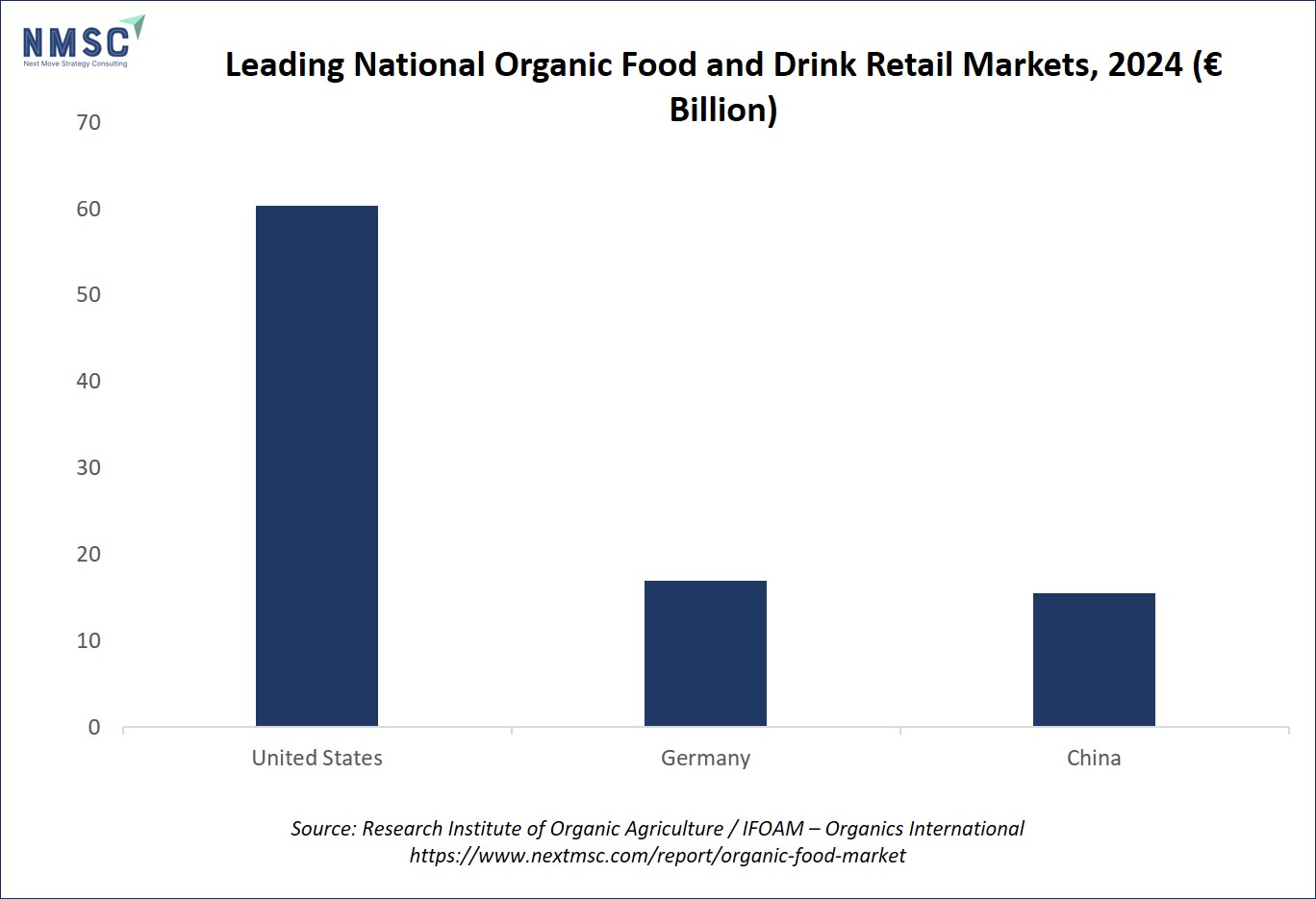
The global dimension of this momentum was confirmed at BIOFACH in Nuremberg on February 10, 2026, where the Research Institute of Organic Agriculture (FiBL) and IFOAM – Organics International presented The World of Organic Agriculture: Statistics and Emerging Trends 2026. The publication reported that global retail sales of organic food and drink rose to €145.0 billion in 2024 — an increase of €6.9 billion year-over-year — representing an all-time high for the sector.
The United States remained the world's largest single organic market at €60.4 billion, followed by Germany at €17.0 billion and China at €15.5 billion. Switzerland recorded the highest per capita organic consumption globally at €481 per person and the highest organic market share at 12.3% of total food sales in 2024.
On the supply side, global organic farmland remained broadly stable at 98.9 million hectares — representing 2.1% of the world's total agricultural land — while the number of certified organic producers reached 4.8 million worldwide. India reported the highest number of organic producers globally, with 2,363,607 certified farmers.
USDA Proposes National List Amendments, Reshaping Organic Certification Standards
Simultaneously, the regulatory architecture governing the U.S. organic sector underwent a significant proposed revision. On March 23, 2026, the USDA Agricultural Marketing Service (AMS) National Organic Program (NOP) published a proposed rule in the Federal Register — Docket Number AMS-NOP-22-0029 — to amend the National List of Allowed and Prohibited Substances.
The proposed amendments, implementing recommendations from the National Organic Standards Board from public meetings held in October 2021, October 2022, and October 2024, include four substantive changes: allowing carbon dioxide in organic crop production; permitting meloxicam as a pain treatment in organic livestock; removing restrictions on the use of methionine in organic poultry feed; and affirming that natural sodium nitrate is allowed in organic crop production under conditions designed to protect soil quality. The public comment period closed on May 22, 2026.
These proposed amendments carry direct commercial implications. The removal of methionine restrictions in organic poultry feed addresses a longstanding input cost constraint for organic poultry producers, while the meloxicam allowance for livestock pain management aligns U.S. organic standards more closely with animal welfare expectations that European institutional buyers increasingly require in procurement specifications.
Farm Bill Advances with Mixed Outcomes for Organic Sector
On March 5, 2026, the House Agriculture Committee advanced the Farm, Food, and National Security Act of 2026 (H.R.7567) in a 34-17 vote, moving the legislation toward a House floor vote. The bill includes language from the Organic Dairy Data Collection Act — a provision the Organic Farmers Association described as a vital step toward providing the transparency and data infrastructure necessary to support the unique economic needs of organic dairy producers — and an amendment that would allow USDA to develop risk-based organic certification procedures aimed at reducing compliance burdens for low-risk producers.
However, the bill maintains flat funding for organic research, certification cost-share, and technical assistance programs, and the Environmental Quality Incentives Program (EQIP) faces a budget authority reduction of approximately USD 1 billion over the next four fiscal years according to Congressional Budget Office calculations — a cut that the Organic Farmers Association warned would restrict farmers' ability to transition to or maintain organic certification during a period of increasing environmental volatility.
Tariff Volatility Exposes Structural Import Dependency
A compounding risk factor for the U.S. organic sector emerged from trade policy turbulence in early 2026. The U.S. tracked USD 5.7 billion in organic imports in 2024, with import volumes reaching 3.25 million metric tons — an increase of 17.7% compared to the prior year — as domestic organic acreage remains below 1% of total U.S. farmland, leaving the sector structurally dependent on international supply chains.
According to FiBL and IFOAM – Organics International's The World of Organic Agriculture 2026, the top exporters supplying the EU and U.S. markets were Mexico (865,076 metric tons), Ecuador (765,605 metric tons), and Canada (378,820 metric tons), with bananas (1,365,512 metric tons), oilcakes (593,753 metric tons), and sugar (535,699 metric tons) representing the highest-volume imported organic commodities. The administration's invocation of Section 122 of the Trade Act of 1974 to impose a 10% across-the-board global tariff — following the Supreme Court's ruling that IEEPA-based tariffs were unauthorized — means elevated input costs for organic importers remain in effect, with the temporary nature of the Section 122 measures creating ongoing pricing and procurement uncertainty for organic businesses.
U.S. Category Performance: Protein and Beverages Emerge as Growth Frontiers
Within the U.S. market, the OTA's 2026 data revealed category-level dynamics that signal a structural broadening of organic consumption beyond its traditional fresh produce base. Organic beef surged 44.3% in 2025, reflecting a pronounced shift in consumer willingness to pay premiums for protein products aligned with ethical, environmental, and health values. Organic dairy and eggs grew 12.8% to reach USD 9.6 billion, with eggs alone posting a 22.4% increase and yogurt growing 16.6%.
Organic produce remained the largest single category at USD 22.7 billion — approximately 30% of total organic food sales — with berries up 10.5%, citrus climbing 18.1%, and bananas posting a 12.6% gain. The organic beverage category reached USD 10.2 billion, up 7.2%, driven by functional benefit claims and clean-ingredient positioning.
These category-level results align precisely with NMSC's proprietary research and analysis, which identifies Beverages as the fastest-growing product category in the global Organic Food Market at a 17.6% CAGR from 2026 to 2035, and Direct-to-Consumer as the fastest-growing sales channel at an 18.3% CAGR over the same period.
UK Organic Market: 83% Household Penetration Signals Mainstream Transition
The United Kingdom's organic sector provided further evidence of the structural mainstreaming of organic consumption. According to the Soil Association's Organic Market Report 2026, published in March 2026, 83% of U.K. households now purchase organic products, and the U.K. organic market's growth rate outpaced the non-organic sector despite a sustained cost-of-living crisis and elevated food inflation. NMSC's proprietary research and analysis values the U.K. organic food market at approximately USD 13.59 billion in 2025, projected to reach USD 49.96 billion by 2035 at a 13.7% CAGR.
Key Player Developments: Product Innovation Accelerates Across Segments
Recent product launches by established organic brands reflect the category-level growth dynamics identified in both the OTA data and NMSC's proprietary research and analysis.
In May 2026, Nature's Path launched Love Crunch Dubai Style Chocolate and Dark Chocolate & Blueberry Cream granolas, extending its premium organic portfolio with products using organic whole grains and Fair Trade chocolate — a direct response to the premiumization trend in organic packaged foods. In the same month, Earth's Best launched its first organic snack portfolio specifically designed for children aged four to eight, featuring Organic Crispy Sticks and Organic Veggie Waves, targeting the institutional and household end-user segments simultaneously. In March 2026, Organic Valley introduced Protein Plus, a line of pasture-raised organic ultra-filtered milk containing 50% more protein and 50% less sugar than regular milk — a product architecture that directly addresses the functional nutrition positioning driving organic beverage and dairy premiumization.
In June 2025, ITC completed its acquisition of 100% of Sresta Natural Bioproducts, owner of the 24 Mantra Organic brand, which operates across more than 100 organic products including staples, spices, edible oils, and beverages, with a farmer network spanning approximately 27,500 farmers and roughly 140,000 acres — a transaction that materially expanded ITC's certified organic supply chain infrastructure in India, the fastest-growing country in the global Organic Food Market at a 20.5% CAGR from 2026 to 2035 per NMSC's proprietary research and analysis.
NMSC Market Segmentation & Regional Outlook
|
Segment |
2025 Value (USD Bn) |
CAGR 2026–2035 |
Key Driver |
|
Fresh Produce |
90.59 |
11.0% |
First-step organic adoption; strong consumer preference for certified fruits and vegetables |
|
Beverages |
Fastest-growing category |
17.6% |
Functional organic drinks, plant-based milks, organic coffee and tea premiumization |
|
Dairy & Eggs |
Part of USD 323.52Bn total |
12.8% (U.S. 2025 growth) |
Protein demand, animal welfare premiums, yogurt and egg category expansion |
|
Direct-to-Consumer Channel |
Fastest-growing channel |
18.3% |
Subscription commerce, brand websites, online marketplaces improving margin capture |
|
Grocery Retail Channel |
168.23 |
11.5% (North America) |
Supermarket and hypermarket distribution depth across North America and Europe |
|
Institutional End User |
Fastest-growing end user |
16.7% |
School, hospital, and corporate cafeteria organic procurement mandates |
NMSC Strategic Perspective: Three Structural Inflection Points Defining the Market Through 2035
NextMSC primary research and analysis identifies three structural inflection points that will determine competitive positioning in the global Organic Food Market through 2035.
1. The Protein Premium Shift Is Permanent, Not Cyclical
The 44.3% surge in U.S. organic beef sales in 2025 is not a single-year anomaly — it reflects a durable consumer revaluation of protein sourcing that NMSC's analysis indicates will sustain above-average category growth through the forecast period. Organic meat, poultry, and seafood producers that invest in certified supply chain traceability and direct-to-consumer distribution infrastructure now will capture disproportionate margin as the protein premium becomes a baseline consumer expectation rather than a niche preference. The USDA NOP's proposed allowance of meloxicam for organic livestock pain management, if finalized, will reduce a key operational cost barrier for organic livestock producers, potentially accelerating certified herd expansion and narrowing the price gap that currently constrains mass-market penetration.
2. Tariff Volatility Has Made Domestic Organic Farmland Expansion a Strategic Imperative
The U.S. organic sector's structural import dependency — with domestic organic acreage below 1% of total U.S. farmland and import volumes growing 17.7% in 2024 — creates a supply chain vulnerability that trade policy turbulence has now made commercially urgent. NMSC's analysis indicates that brands and retailers that proactively fund farmer transition programs, offer long-term supply contracts, and invest in domestic cold chain infrastructure will secure a structural cost and reliability advantage over competitors reliant on imported organic raw materials. The Farm Bill's proposed EQIP funding reduction of approximately USD 1 billion over four fiscal years runs directly counter to this strategic imperative, and NMSC's assessment is that the funding gap will accelerate private-sector investment in farmer transition financing as a competitive differentiator.
3. Asia-Pacific's Overtaking of North America by 2035 Requires Immediate Channel Investment
NMSC's proprietary research and analysis projects Asia-Pacific will become the largest regional organic food market by 2035 at USD 439.00 billion, surpassing North America's USD 399.08 billion. This transition is already underway: India's 20.5% CAGR is supported by its position as the country with the highest number of certified organic producers globally (2,363,607 farmers per FiBL/IFOAM 2026 data), while China's 18.5% CAGR is driven by food safety-motivated consumer demand and government investment in certified organic farmland programs. Brands that establish direct-to-consumer and subscription commerce infrastructure in Asia-Pacific markets now — before competitive intensity reaches North American levels — will capture the highest-return window of the forecast period.
Bottom Line
The global Organic Food Market has entered a phase of structural acceleration that extends well beyond consumer trend dynamics. The Organic Trade Association's confirmation that U.S. organic sales crossed USD 76.6 billion in 2025 — growing at three times the rate of the conventional food market — combined with FiBL and IFOAM's documentation of a global all-time high of €145.0 billion in retail sales, establishes that organic has transitioned from a premium niche into a primary economic force within the global food system. According to NextMSC proprietary research and analysis, the global Organic Food Market is projected to expand from USD 323.52 billion in 2025 to USD 1,330.27 billion by 2035 at a 13.5% CAGR, with Asia-Pacific emerging as the dominant growth region and Direct-to-Consumer channels posting the fastest channel-level expansion at 18.3% CAGR. Regulatory developments — including the USDA NOP's proposed National List amendments and the Farm Bill's mixed organic provisions — will shape input cost structures and certification accessibility through the forecast period. Brands, retailers, and investors that align capital allocation with the protein premium shift, domestic supply chain resilience, and Asia-Pacific channel infrastructure will be best positioned to capture the USD 906.07 billion absolute dollar opportunity between 2026 and 2035.
About Next Move Strategy Consulting
Next Move Strategy Consulting is a premier market research and management consulting firm that has been committed to provide strategically analysed well documented latest research reports to its clients. The research industry is flooded with many firms to choose from, what makes NMSC different from the rest is its top-quality research and the obsession of turning data into knowledge by dissecting every bit of it and providing fact-based research recommendation that is supported by information collected from over 500 million websites, paid databases, industry journals and one on one consultations with industry experts across a diverse range of industry sectors. The high-quality customized research reports with actionable insights and excellent end-to-end customer service help our clients to take critical business decisions that enables them to move beyond time and have competitive edge in the industry.
We have been servicing over 1000 customers globally that includes 90% of the Fortune 500 companies over a decade. Our analysts are constantly tracking various high growth markets and identifying hidden opportunities in each sector or the industry. We provide one of the industry's best quality syndicate as well as custom research reports across 10 different industry verticals. We are committed to deliver high quality research solutions in accordance to your business needs. Our industry standard delivery solutions that ranges from the pre consultation to after-sales services, provide an excellent client experience and ensure right strategic decision making for businesses.
For more information, please contact:
Next Move Strategy Consulting
5th Floor 867 Boylston St, STE 500,
Boston, MA 02116, U.S.
E-Mail: [email protected]
Direct: +1-217-650-7991
Website: www.nextmsc.com
About the Author
 Sanyukta Deb
— Sanyukta Deb is Digital Marketing Team Lead at Next Move Strategy Consulting, where she has led content strategy and technical SEO for the firm's B2B market research publications for over 2 years. Her editorial process translates NextMSC's primary and secondary research — spanning technology, industrial, and consumer sectors — into commercial narratives, backed by search-intent, keyword, and competitive analysis. She brings 5 years of overall experience in digital marketing and content strategy.
Sanyukta Deb
— Sanyukta Deb is Digital Marketing Team Lead at Next Move Strategy Consulting, where she has led content strategy and technical SEO for the firm's B2B market research publications for over 2 years. Her editorial process translates NextMSC's primary and secondary research — spanning technology, industrial, and consumer sectors — into commercial narratives, backed by search-intent, keyword, and competitive analysis. She brings 5 years of overall experience in digital marketing and content strategy.
About the Reviewer
 Debashree Dey
— Debashree Dey is Assistant Manager at Next Move Strategy Consulting, where she supports cross-vertical market content and communications across diverse industries for 6 years. Her professional background includes senior content writing, communications, and published manuscript authorship, with experience developing audience-focused business narratives and maintaining clear, consistent messaging. Her role supports research-led content development and editorial quality across NextMSC publications.
Debashree Dey
— Debashree Dey is Assistant Manager at Next Move Strategy Consulting, where she supports cross-vertical market content and communications across diverse industries for 6 years. Her professional background includes senior content writing, communications, and published manuscript authorship, with experience developing audience-focused business narratives and maintaining clear, consistent messaging. Her role supports research-led content development and editorial quality across NextMSC publications.

















Add Comment