Vertiv’s 1,200-Amp Remote Power Panel Shows AI Racks Outgrew Old Designs
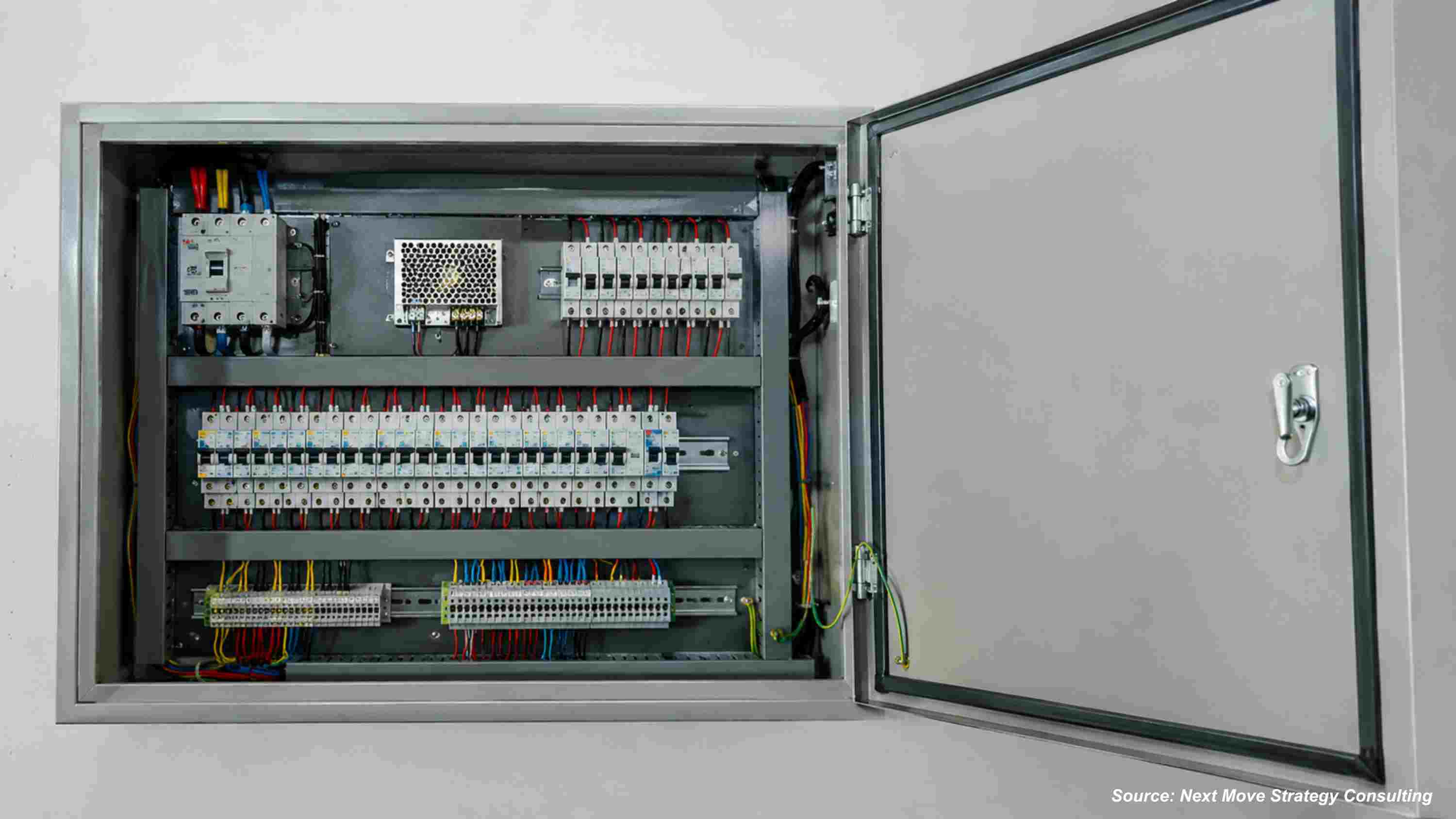
Vertiv’s PowerStation 3100 puts 600 A to 1,200 A on a single UL-listed platform as 100 kW racks, liquid-cooling leak isolation and DC roadmaps rewrite the last stage of data center power
On November 13, 2026, Vertiv Holdings Co. introduced the Vertiv PowerStation 3100 RPP from Columbus, Ohio, a high-density remote power panel built for AI and high-performance computing racks with power densities above 100 kW, available now in North America. According to Vertiv’s press release, the unit delivers 600 A to 1,200 A on a single UL-891 listed platform, which the company describes as three to five times the capacity of traditional panelboard-based remote power panels. The launch moves the final distribution stage before the rack, long treated as standard electrical hardware, into the centre of AI infrastructure design.
According to Next Move Strategy Consulting’s Remote Power Panel (RPP) Market report, the global remote power panel market was valued at USD 2.1 billion in 2025 and is projected to reach USD 3.1 billion by 2035, growing at a CAGR of 4.1% from 2026 to 2035. NextMSC primary research and analysis identifies hyperscale data center construction, edge computing rollouts and the migration toward metered and monitored panels as the structural forces behind that trajectory, and the Vertiv launch is a direct commercial expression of the third.
For More Information: Download FREE Sample on Remote Power Panel (RPP) Market Report
The Engineering Problem Behind the Launch: Fault Current, Liquid Cooling and 100 kW Racks
Vertiv’s release explains why the product category had to change. Delivering 415 V or 480 V power to the rack through four-wire designs can increase available fault current, which raises short-circuit withstand requirements at the rack level. Separately, the adoption of direct liquid cooling has created a need to isolate power to a single rack when a coolant leak is detected. Vertiv states that traditional remote power panels were not designed for either demand.
The PowerStation 3100 answers both with specific hardware choices. Its circuit breakers carry higher short-circuit withstand and interrupting ratings. Each branch breaker includes an integrated remote shunt trip, so a facility’s leak detection system can cut power to one rack without shutting down adjacent racks or the whole pod. Adjustable trip units let operators switch between 60 A, 100 A and 150 A ratings inside the same breaker frame, and integrated metering reports the position and trip status of every circuit in real time.
“…customers need distribution infrastructure that supports both current deployments and evolving architectures.”
— Kyle Keeper, Senior Vice President, Power Business Unit, Vertiv Holdings Co, Vertiv press release, Vertiv Introduces High-Density Remote Power Panel for Next-Generation AI Data Centers, November 13, 2026.
The International Energy Agency’s Key Questions on Energy and AI, published on April 16, 2026, quantifies the load that is forcing the redesign. The agency reports that Nvidia’s Ampere architecture from 2020 produced a rack power density of around 13 kW, that the current Blackwell architecture reaches 130 kW per rack, and that the announced Rubin architecture will reach 600 kW per rack.
Rack Power Density by Nvidia Architecture
|
Architecture |
Configuration cited by IEA |
Power density per rack |
|
Ampere |
2020 design; around 400 W per chip, 32 chips per rack |
Around 13 kW |
|
Blackwell |
Current design; 1,000 W per chip, 72 chips per rack |
130 kW |
|
Rubin |
Announced design |
600 kW |
The IEA adds that by 2027 a single advanced rack could have a peak power demand equivalent to that of 65 households, and that the power density of AI servers rose 11 times between 2020 and 2025, with a further fourfold increase expected by 2027. The agency also states that transitional architectures built around 400-volt AC delivery will continue to be used even as 800-volt and direct-current designs are evaluated. Vertiv’s release positions the PowerStation 3100 for both, stating that it supports fully AC power distribution and DC rack architectures on one platform.
The Financial Logic: Load Growth Is Outrunning the Grid and the Supply Chain
The IEA reports that global data centre electricity demand grew 17% in 2025 to 485 TWh, while consumption by AI-focused data centres rose 50%. Its updated Base Case projects demand reaching 950 TWh by 2030, around 3% of global electricity demand, with AI-focused facilities tripling to around 465 TWh. In the United States, the Lawrence Berkeley National Laboratory’s United States Data Center Energy Usage Report: 2025 Update, published in June 2026, estimates that data centers used 192 TWh in 2024, or 4.7% of national electricity consumption, and that the Reference Case reaches 649 TWh by 2030, equal to 11.8% of forecast U.S. electricity use.
U.S. Data Center Electricity Use in 2030 by Modeled Scenario
|
Scenario |
Data center electricity (TWh) |
Share of 2030 U.S. electricity |
|
Compounded Uncertainty, low |
521 |
9.5% |
|
Consolidated Deployment |
578 |
10.5% |
|
Low Accelerator Lifetime |
590 |
10.7% |
|
Reference Case |
649 |
11.8% |
|
High ASIC |
664 |
12.1% |
|
High Inference Energy |
782 |
14.2% |
|
Compounded Uncertainty, high |
843 |
15.3% |
The laboratory’s Reference Case also shows where the electrical load concentrates. In 2030, AI servers account for 84% of total server energy use and 55% of total data center energy use, which means the majority of the distribution equipment inside a new facility is sized around accelerated racks rather than conventional servers.
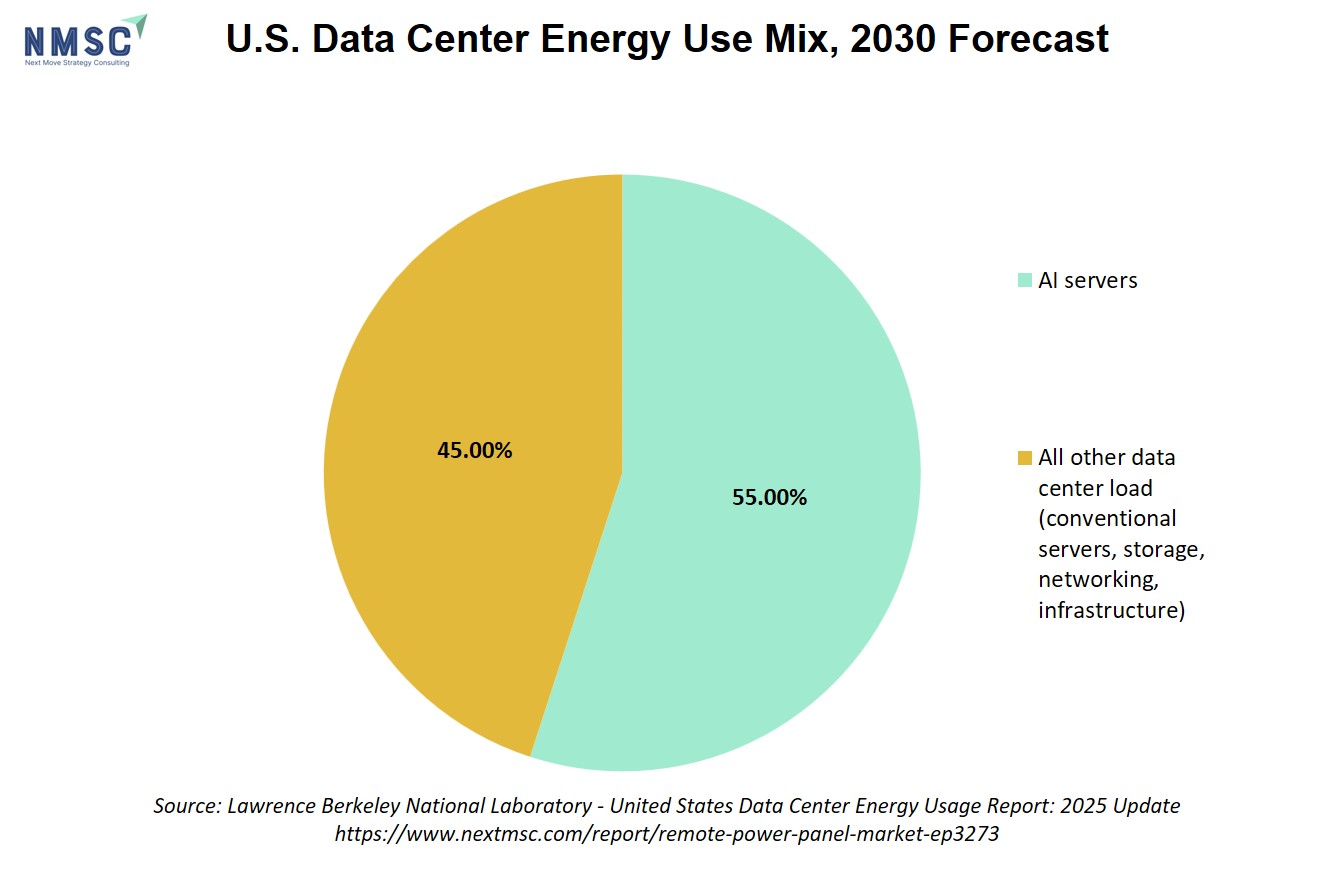
The 45% remainder is calculated as 100% minus the 55% share the laboratory reports for AI servers.
Three physical constraints sit between that demand and delivered capacity. The IEA reports average transformer lead times of two to three years, gas turbine deliveries of around five years, and grid connection waits of five to ten years in many jurisdictions. In Texas, the grid operator’s connection queue for large loads, about three-quarters of which were data centres, rose from around 63 GW in December 2024 to over 230 GW by January 2026, against an all-time peak demand of 85 GW. Capital is also tightening at the margin: the IEA notes that leading hyperscalers and neo-clouds have announced a 75% increase in 2026 capital expenditure to USD 715 billion, yet investor sentiment turned more cautious in the second half of 2025 and market capitalisation growth across much of the AI value chain has stalled. For suppliers, those delays reward products that arrive pre-certified and standardised, the approach Vertiv describes for the PowerStation 3100.
Key Industry Developments: Suppliers Report Orders Running Ahead of Sales
The Vertiv Q3 2026 earnings release, issued on October 28, 2026, reported net sales of USD 4,313 million, up 61% from the third quarter of 2025, including 55% organic growth, and organic orders growth of more than 100%. Growth was broad-based across regions, with the Americas up 75%, Asia-Pacific up 50% and EMEA up 23%. The company raised its full-year 2026 net sales guidance by USD 650 million to a range of USD 14,450 million to USD 14,850 million.
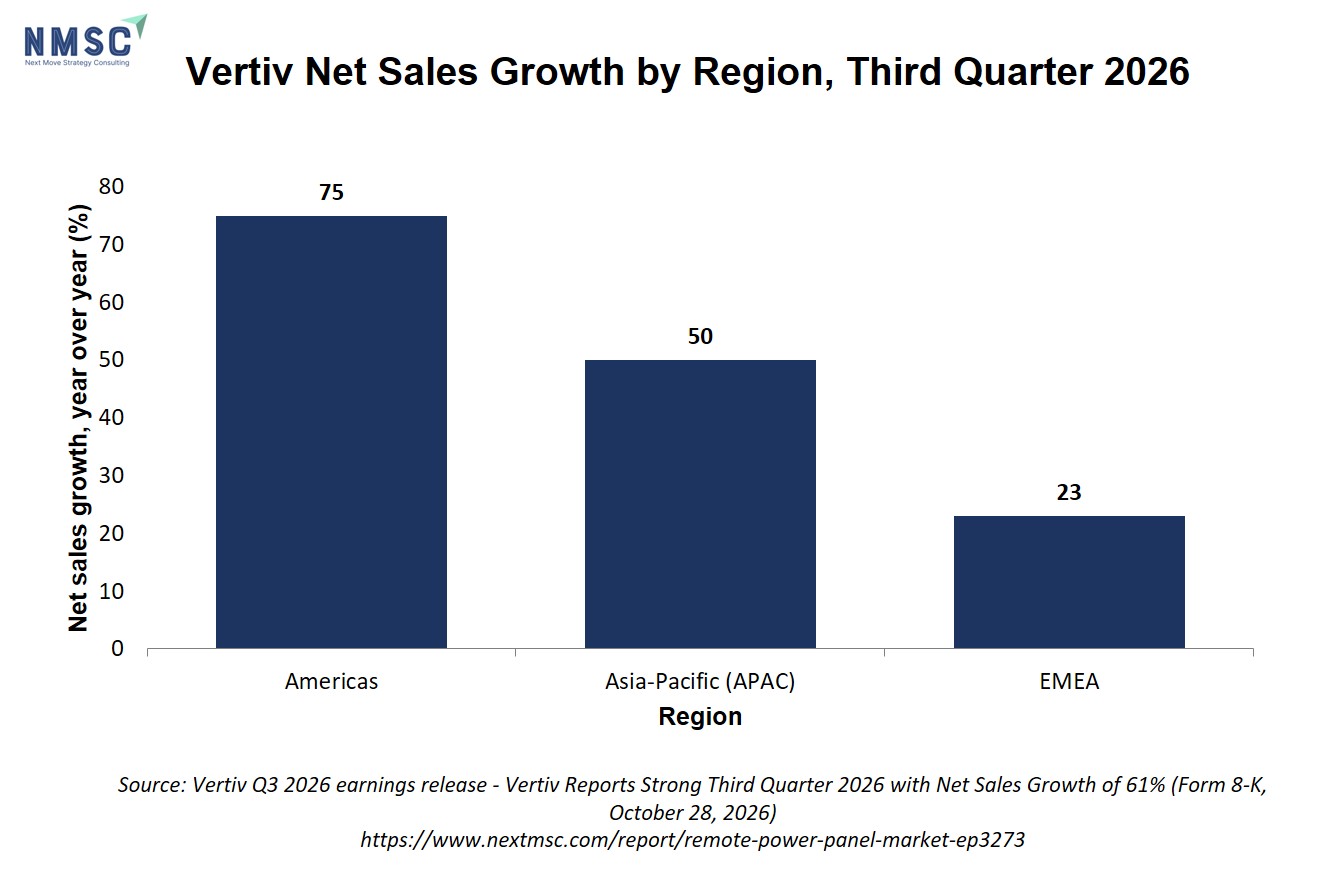
The reported growth rates are year-over-year changes in total company net sales for each reporting region and are not a measure of remote power panel revenue alone.
Eaton’s Form 8-K for the third quarter of 2026, filed on November 3, 2026, reported sales growth of 28%, organic sales growth of 19% and Electrical backlog growth of 46%. The company also announced an agreement to acquire COL Group, a deal it said would expand manufacturing capacity and power distribution capabilities for data center and utility markets in Europe.
ABB Ltd took a different architectural route on September 21, 2026, when it announced Infinitus, an integrated direct current portfolio for AI data centers. ABB estimates that roughly 25% to 40% of new data center capacity installed in 2030 could use DC distribution, citing the IEA’s projection that global data center electricity demand will more than double by 2030.
Third-Quarter 2026 Demand Signals Reported by Power Equipment Suppliers
|
Company |
Reported measure |
Figure |
|
Vertiv Holdings Co |
Net sales growth, year over year |
61% |
|
Vertiv Holdings Co |
Organic net sales growth |
55% |
|
Vertiv Holdings Co |
Organic orders growth, year over year |
Over 100% |
|
Eaton Corporation plc |
Sales growth, year over year |
28% |
|
Eaton Corporation plc |
Organic sales growth |
19% |
|
Eaton Corporation plc |
Electrical backlog growth, year over year |
46% |
Segment Dynamics: Where NMSC Sees Intelligence Concentrating
NextMSC primary research and analysis shows that value within the remote power panel market is migrating toward configurable, rack-level and monitored products. By product architecture, Standard RPPs remain the largest segment at USD 1.05 billion in 2025 but are projected to grow at a CAGR of 3.1% from 2026 to 2035, while Configurable RPPs are projected to expand from USD 0.71 billion to USD 1.24 billion at a CAGR of 5.2%. By form factor, Rack Mounted units are the fastest-growing category at a CAGR of 5.8%, rising from USD 0.42 billion in 2025 to USD 0.79 billion by 2035.
Within monitoring tiers, NextMSC primary research and analysis projects Switched RPPs at a CAGR of 5.5% and Revenue Grade RPPs at 6.4%, the latter rising from USD 0.22 billion in 2025 to USD 0.41 billion by 2035, against 1.0% for Basic units. By end user, Edge Data Centers lead at a CAGR of 7.2%, from USD 0.21 billion to USD 0.47 billion, ahead of Colocation at 5.5% and Hyperscale at 5.4%. The PowerStation 3100’s per-circuit status reporting, integrated metering and rack-level isolation fall squarely within the monitored and switched tiers that NMSC projects to outgrow basic panels.
Regional Outlook: North America Leads, Asia-Pacific Accelerates
NextMSC primary research and analysis places North America as the largest regional market at USD 0.84 billion in 2025, rising to USD 1.22 billion by 2035 at a CAGR of 3.8%. Asia-Pacific is projected to grow fastest among the major regions, from USD 0.52 billion to USD 0.87 billion at a CAGR of 5.3%, ahead of Middle East & Africa at 5.1%, Latin America at 4.4% and Europe at 3.7%. Vertiv’s reported regional growth of 75% in the Americas and 50% in Asia-Pacific is consistent with that ordering of regions, although a diversified supplier’s company-wide sales growth is not a like-for-like measure of a single product market.
Growth Drivers and Restraints: The Evidence Matrix
-
Driver, rack density: the IEA reports AI server power density rose 11 times between 2020 and 2025 and could rise a further fourfold by 2027, directly raising the amperage each distribution panel must carry.
-
Driver, load growth: the Lawrence Berkeley National Laboratory’s Reference Case lifts U.S. data center electricity use from 192 TWh in 2024 to 649 TWh in 2030.
-
Driver, supplier order books: Vertiv reported organic orders growth above 100% and Eaton reported Electrical backlog growth of 46% for the third quarter of 2026.
-
Restraint, equipment and grid lead times: the IEA cites transformer lead times of two to three years and grid connection waits of five to ten years in many jurisdictions.
-
Restraint, supply concentration: the IEA reports that China provides 99% of refined gallium and controls around 50% of silicon carbide supply and around 60% of the ferrite core market used in emerging data center power electronics.
-
Restraint, financing sentiment: the IEA notes that market capitalisation growth across the AI value chain has largely stalled since late 2025, even as 2026 hyperscaler and neo-cloud capital expenditure is set to rise 75% to USD 715 billion.
NMSC Strategic Perspective: The Panel Is Becoming a Protection Product
NextMSC primary research and analysis draws three conclusions from the Vertiv launch and the data around it. First, the value of a remote power panel is shifting from the enclosure and busbar to the protection and intelligence inside it. Fault-current ratings, shunt-trip isolation and branch-level metering are the features Vertiv highlights, and each addresses a failure mode that did not exist at 13 kW per rack but is material at 130 kW. That shift supports NMSC’s projection of faster growth for configurable, switched and revenue-grade variants than for standard and basic panels.
Second, standardisation is a timing weapon. With transformer lead times of two to three years and grid connection waits of up to ten years, as reported by the IEA, operators that cannot compress the electrical build behind the transformer lose capacity-months that cannot be recovered. A pre-configured, UL-891 listed assembly that can be replicated across sites addresses the part of the schedule the operator controls.
Third, the gap between NMSC’s 4.1% market CAGR and the 61% sales growth reported by Vertiv should be read correctly. Vertiv’s figure covers its full portfolio of power, thermal and integrated infrastructure, while NMSC’s forecast measures remote power panels alone. The practical implication is that the panel captures a modest, steady share of each data center budget, so the principal risk to the forecast is a slowdown in new-hall construction, a risk the IEA’s observation on cautious capital markets keeps in view.
Competitive Landscape: Three Routes to the Same Power Path
NextMSC primary research and analysis profiles 20 companies in the remote power panel market, led by Schneider Electric, Eaton, ABB, Vertiv and Legrand. The events of the past three months show three distinct strategies. Vertiv is selling an integrated path from grid to rack, with the PowerStation 3100 positioned as the last distribution stage before the rack and deployable standalone or inside its SmartRun and OneCore systems. Eaton is buying manufacturing capacity, through the COL Group agreement, for European power distribution. ABB is positioning for an architectural change, with a DC portfolio aimed at the share of new capacity it estimates could adopt DC distribution by 2030. Each strategy is traceable to a company announcement or filing dated within the past three months.
Bottom Line
Vertiv’s November 13, 2026 launch of the PowerStation 3100 RPP is a clear signal that the remote power panel is being redesigned around AI racks rather than adapted to them. The International Energy Agency reports rack densities rising from around 13 kW to 130 kW within a hardware generation, and the Lawrence Berkeley National Laboratory’s Reference Case places U.S. data center electricity use at 649 TWh by 2030, 11.8% of national demand. NextMSC primary research and analysis values the global remote power panel market at USD 2.1 billion in 2025, projects USD 3.1 billion by 2035 at a 4.1% CAGR, and expects growth to concentrate in configurable, rack-mounted, switched, revenue-grade and edge-oriented products. The principal constraints are equipment lead times, grid connection delays and financing sentiment, all documented by the IEA. Buyers should specify short-circuit ratings and leak isolation now, and suppliers should compete on protection and monitoring rather than amperage alone.
About Next Move Strategy Consulting
Next Move Strategy Consulting is a premier market research and management consulting firm that has been committed to provide strategically analysed well documented latest research reports to its clients. The research industry is flooded with many firms to choose from, what makes NMSC different from the rest is its top-quality research and the obsession of turning data into knowledge by dissecting every bit of it and providing fact-based research recommendation that is supported by information collected from over 500 million websites, paid databases, industry journals and one on one consultations with industry experts across a diverse range of industry sectors. The high-quality customized research reports with actionable insights and excellent end-to-end customer service help our clients to take critical business decisions that enables them to move beyond time and have competitive edge in the industry.
We have been servicing over 1000 customers globally that includes 90% of the Fortune 500 companies over a decade. Our analysts are constantly tracking various high growth markets and identifying hidden opportunities in each sector or the industry. We provide one of the industry’s best quality syndicate as well as custom research reports across 10 different industry verticals. We are committed to deliver high quality research solutions in accordance to your business needs. Our industry standard delivery solutions that ranges from the pre consultation to after-sales services, provide an excellent client experience and ensure right strategic decision making for businesses.
For more information, please contact:
Next Move Strategy Consulting
5th Floor 867 Boylston St, STE 500,
Boston, MA 02116, U.S.
E-Mail: [email protected]
Direct: +1-217-650-7991
Website: www.nextmsc.com
About the Author
 Priyanshu Das
— Priyanshu Das is SEO Executive at Next Move Strategy Consulting, where he has led on-page and off-page SEO, keyword research, and SEO audits for the firm's B2B market research publications for 2 years. His audit process combines technical crawl analysis, backlink profile review, and competitor keyword gap mapping — using tools including Screaming Frog and Google Search Console — to prioritize fixes by organic search-visibility impact, informed by his own prior in-house and agency SEO experience.
About the Reviewer
 Sanyukta Deb
— Sanyukta Deb is Digital Marketing Team Lead at Next Move Strategy Consulting, where she has led content strategy and technical SEO for the firm's B2B market research publications for over 2 years. Her editorial process translates NextMSC's primary and secondary research — spanning technology, industrial, and consumer sectors — into commercial narratives, backed by search-intent, keyword, and competitive analysis. She brings 5 years of overall experience in digital marketing and content strategy.















Add Comment