Warehouse and Logistics Demand Help U.S. Pass Japan in Robot Installations
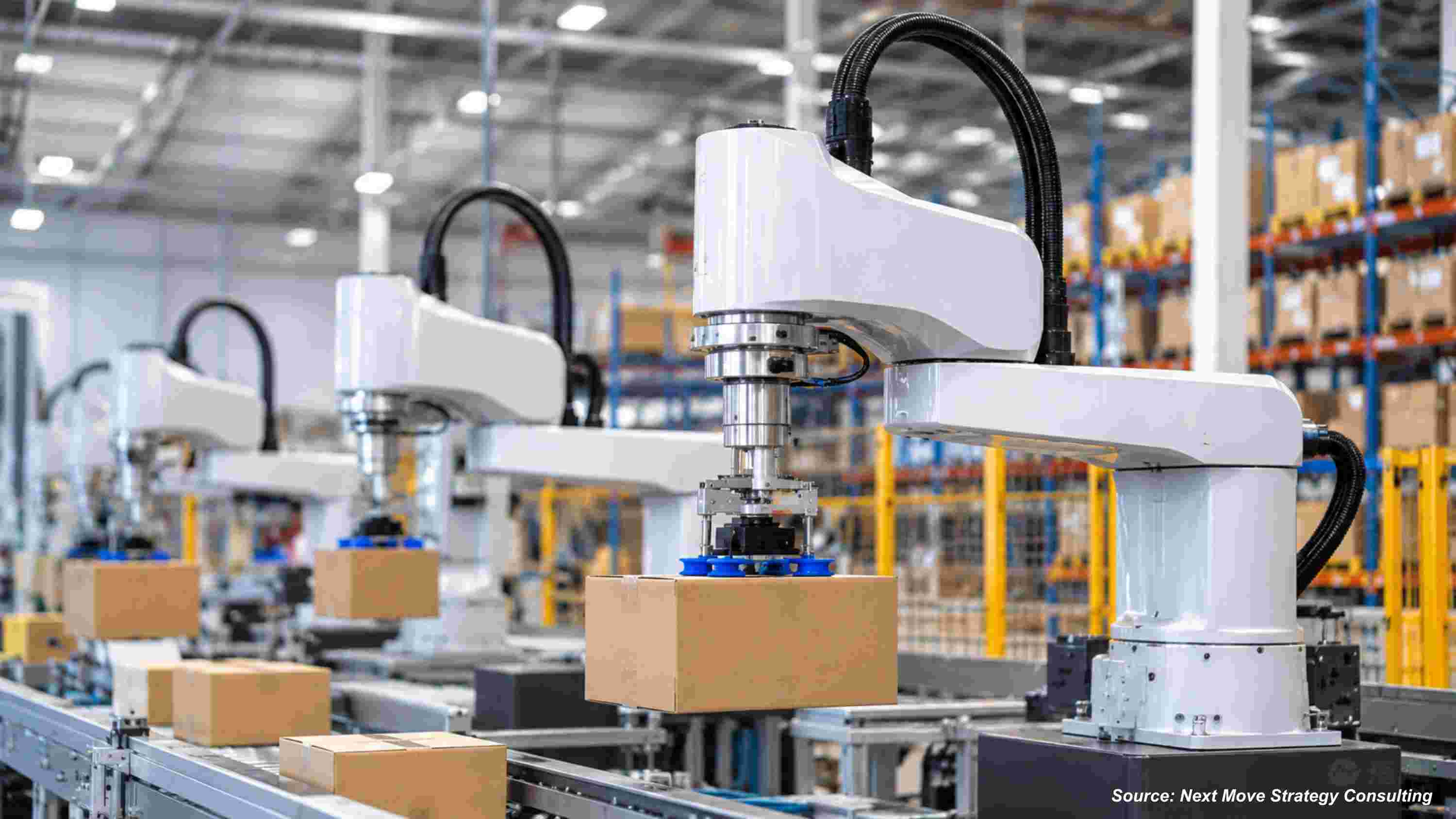
IFR credits warehousing and logistics, among other sectors, for a 12% rise in U.S. robot installations as online sales reach 17.1% of retail, the demand backdrop for SCARA picking arms
On September 24, 2026, the International Federation of Robotics published its World Robotics 2026 report in Frankfurt, showing that factories worldwide installed more than 600,000 industrial robots in 2025, an 11% increase, and that the global operational stock rose 9% to a record 5 million units. The report named the United States as the world’s second-largest market for industrial robots, ahead of Japan, after U.S. installations climbed 12% to almost 38,500 units. The World Robotics 2026 U.S. Press Release credited that growth in part to the food industry and to sectors such as warehousing, logistics and medical, at a time when online sales are absorbing a rising share of U.S. retail spending.
According to Next Move Strategy Consulting’s Warehouse SCARA Robots Market report, the global warehouse SCARA robots market was valued at USD 566.8 million in 2024 and is projected to reach USD 1,692.4 million by 2030, growing at a CAGR of 20% from 2025 to 2030. NextMSC primary research and analysis places the 2025 value at USD 680.1 million and names e-commerce growth, labour shortages with rising labour costs, and advances in robotics technology as the report’s three growth factors.
For More Information: Download FREE Sample on Warehouse SCARA Robots Market Report
What the IFR Data Show: Record Installations, Uneven Regions
China installed 354,000 industrial robots in 2025, up 20% and equal to 59% of global deployments, while Japan fell 19% to 36,219 units and Germany declined 8% to fewer than 25,000 units, according to the World Robotics 2026 report. The International Federation of Robotics forecasts global installations of 655,000 units in 2026, a 9% rise, and 806,000 units in 2029. Its statistics cover industrial robots of every type in every customer industry; they are not a count of warehouse SCARA units, and this article uses them as an indicator of automation appetite rather than as warehouse-specific volume.
Industrial Robot Installations in Leading Markets, 2025
|
Market |
2025 installations (units) |
Change on 2024 |
Position noted by the IFR |
|
China |
354,000 |
+20% |
Largest market; 59% of global installations |
|
United States |
Almost 38,500 |
+12% |
Second-largest, ahead of Japan |
|
Japan |
36,219 |
−19% |
Third-largest |
|
South Korea |
30,000 |
−1% |
Fourth-largest |
|
Germany |
Fewer than 25,000 |
−8% |
Fifth-largest; 41% of EU installations |
|
India |
Almost 10,500 |
+15% |
Sixth-largest, behind Germany |
“Growth came from the food industry and sectors like warehousing, logistics or medical.”
— Jane Heffner, President, International Federation of Robotics, World Robotics 2026 U.S. Press Release, September 24, 2026.
The World Robotics 2026 U.S. Press Release added that automotive remained the largest U.S. customer with 13,500 installations, down 1%, while food and beverage installations rose 30% to 2,900 units and metal and machinery fell 15% to 3,000 units. The IFR expects U.S. installations to keep growing in 2026 and beyond, noting that uncertainty and trade tensions will weigh on demand in the short term while reshoring policy and labour scarcity open the way for robotics over the longer run.
The Financial Logic: Online Sales Growth Meets a Mixed Warehouse Labour Picture
The U.S. Census Bureau reported in its Quarterly Retail E-Commerce Sales release for the second quarter of 2026 (CB26-133, published August 18, 2026) that seasonally adjusted e-commerce sales reached USD 340.2 billion, up 3.8% from the first quarter and 12.2% from the second quarter of 2025, while total retail sales rose 6.7% over the same twelve months. E-commerce accounted for 17.1% of total retail sales. The Census Bureau has flagged that this report no longer holds the most up-to-date estimates and that revised figures will appear in its third-quarter 2026 release, scheduled for November 19, 2026; the numbers above are the latest published at the time of writing.
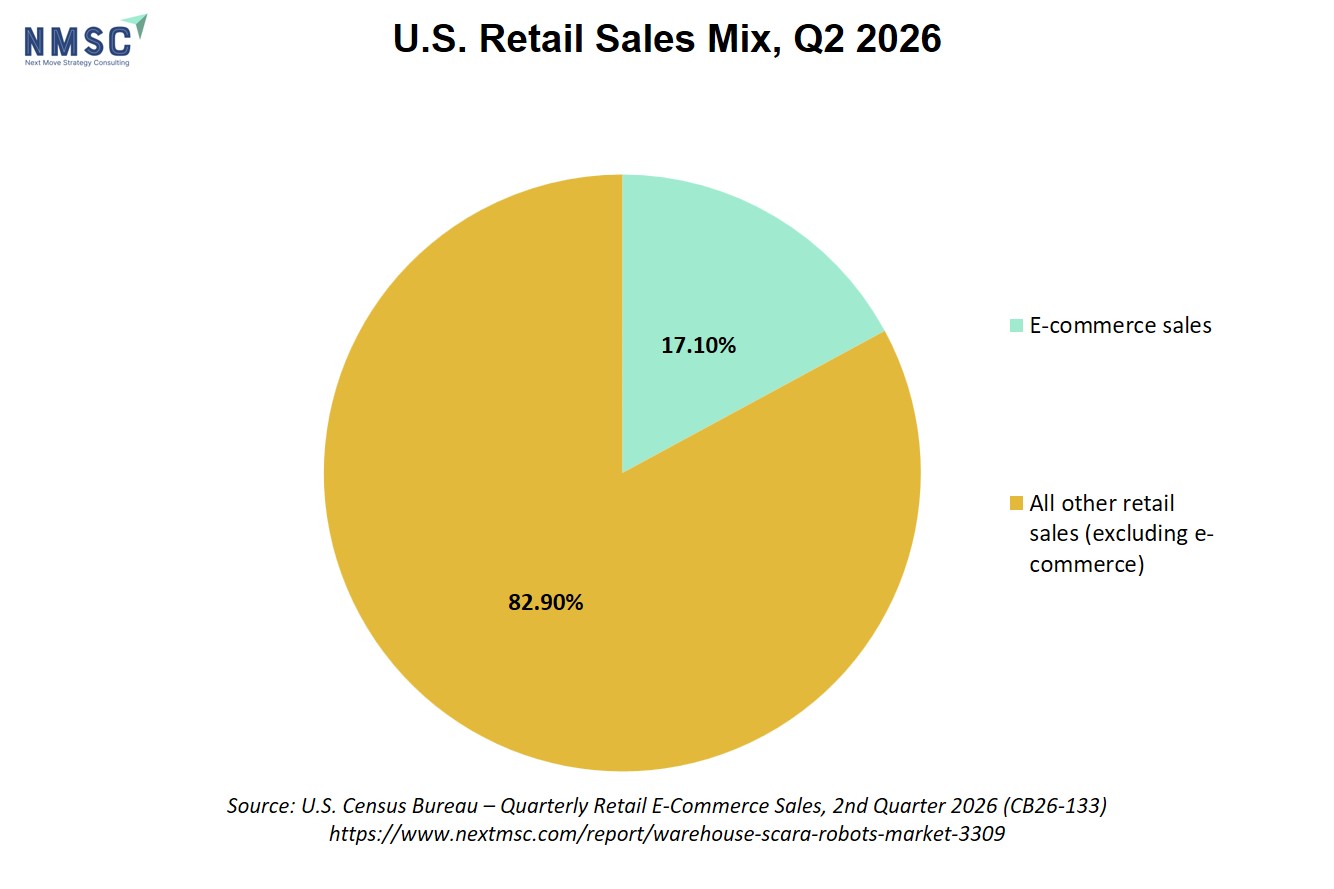
The Census Bureau’s release puts e-commerce at 17.1% of seasonally adjusted U.S. retail sales in the second quarter of 2026, with all other retail sales making up the remaining 82.9%.
U.S. E-Commerce and Total Retail Sales, Second Quarter 2026
|
Indicator |
E-commerce |
Total retail |
|
Sales, seasonally adjusted (USD billion) |
340.2 |
1,986.5 |
|
Change from first quarter 2026 |
+3.8% |
+2.9% |
|
Change from second quarter 2025 |
+12.2% |
+6.7% |
|
Share of total retail sales |
17.1% |
Not applicable |
The labour data are mixed. The U.S. Bureau of Labor Statistics reported a seasonally adjusted job openings rate of 4.8% for transportation, warehousing, and utilities in September 2026, above the 4.5% rate across all industries, 4.4% in manufacturing, 4.3% in retail trade and 3.6% in wholesale trade. Yet the U.S. Bureau of Transportation Statistics, drawing on Bureau of Labor Statistics data, reported on October 2, 2026 that warehousing and storage employment fell to 1,831,800 in September 2026, down 1.2% from September 2025 and below the March 2022 peak of 1,939,300. It also reported a transportation-sector unemployment rate of 4.7% (not seasonally adjusted) against 4.0% for the whole economy.
Key Industry Developments: Amazon’s European Build-Out and an Epson SCARA Refresh
Reuters reported on June 4, 2026 that Amazon unveiled an upgraded AI-powered mobile robot at its Dartford fulfilment centre in England as part of a EUR 10 billion (USD 11.6 billion) investment in its European fulfilment network. Scott Dresser, vice president of Amazon Robotics, described the machine as taking instructions in plain language and working out priority, route and timing itself. The robot is a cart-moving mobile platform rather than a SCARA arm, but the commitment shows the scale of capital that a single large operator is directing at warehouse automation in one region.
On June 2, 2026, Epson Europe announced its LS-C series of SCARA robots, with the LS4-C and LS8-C replacing the LS3-B and LS6-B and the LS20-C replacing the LS20-B, according to the company’s press release. The range runs on the RC800-A controller, offers force sensing, conveyor tracking and safety limited speed and position options, includes cleanroom variants, and has European availability from May 2026 through authorised distributors and system integrators. Volker Spanier, Head of Manufacturing Solutions at Epson Europe, said the models respond to rising cost pressures and more complex automation needs. The release is addressed to manufacturers; NextMSC’s report notes that SCARA capabilities proven in manufacturing and assembly are now being applied to warehouse operations.
Segment and Regional Dynamics: Scope of the NextMSC Report
NextMSC’s report segments the market by components (hardware covering controller, arm, end effector, drive and sensor, plus software and services), payload capacity (up to 5.00 kg, 5.01 kg to 15.00 kg and above 15.00 kg), axis type (3-axis, 4-axis, 5-axis and others), application and industry vertical, with regional coverage of North America, Europe, Asia-Pacific and the Rest of the World across 28 countries. NextMSC primary research and analysis identifies Asia-Pacific as the adoption frontrunner on the back of industrialisation in China and India, ties North American demand to the e-commerce boom, and links European demand to precision and collaborative robotics in Germany and the United Kingdom.
The International Federation of Robotics’ November 12, 2026 release on robot density adds a manufacturing-sector view of automation intensity. South Korea leads with 1,066 industrial robots per 10,000 employees, ahead of Singapore at 873 and Germany at 469, while Japan stands at 452, the United States at 323 and China at 193, against a global average of 152. China’s density rose 147% between 2020 and 2025, yet it ranks 19th worldwide. Density is measured against manufacturing employees, so it does not capture warehouse penetration and is cited here for regional context only.
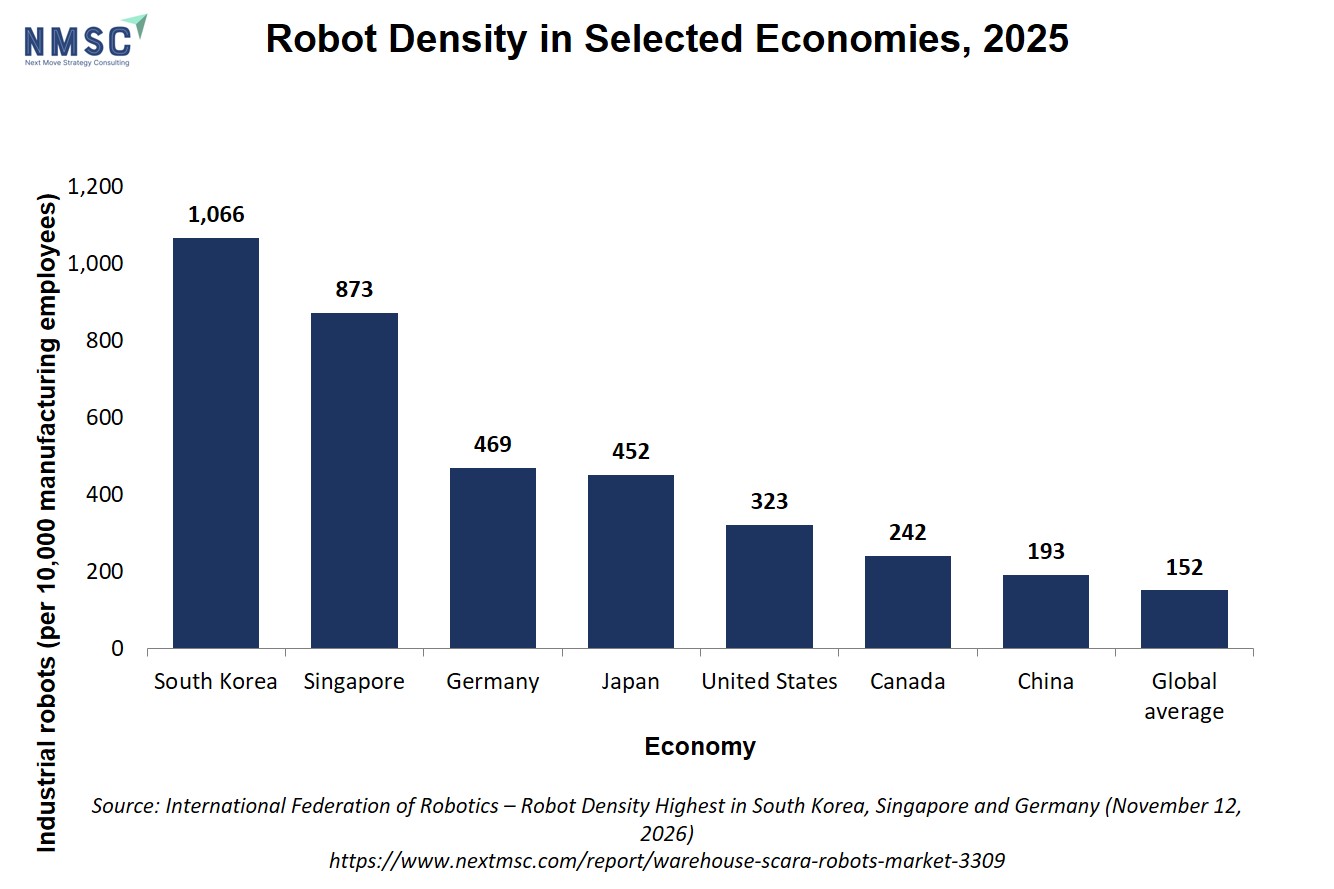
South Korea’s 1,066 robots per 10,000 manufacturing employees compares with 323 in the United States and 193 in China, against a global average of 152, according to the International Federation of Robotics.
Growth Drivers and Restraints: Externally Sourced Evidence
The matrix below lists the independently sourced evidence behind each demand factor. NextMSC’s own estimates are kept out of it.
Demand Factors and Their Independent Evidence
|
Factor |
Type |
Evidence |
Source |
|
Online sales volume |
Driver |
U.S. e-commerce sales of USD 340.2 billion in the second quarter of 2026, up 12.2% year on year; 17.1% of retail |
U.S. Census Bureau |
|
Warehouse job openings |
Driver |
Openings rate of 4.8% in transportation, warehousing, and utilities in September 2026 against 4.5% for all industries |
U.S. Bureau of Labor Statistics |
|
Warehouse headcount |
Driver |
Warehousing and storage employment of 1,831,800 in September 2026, down 1.2% on September 2025 |
U.S. Bureau of Transportation Statistics |
|
Reshoring and labour scarcity |
Driver |
IFR expects U.S. robot installations to keep growing in 2026 and beyond |
World Robotics 2026 U.S. Press Release |
|
Trade tensions |
Restraint |
IFR says uncertainty and trade tensions will weigh on U.S. demand in the short term |
World Robotics 2026 U.S. Press Release |
NMSC Strategic Perspective: Volume Growth Without Matching Headcount
NextMSC primary research and analysis reads the combined evidence as a shift in how warehouse capacity is being added rather than as a general labour shortage. U.S. online sales grew 12.2% year on year in the second quarter of 2026, while warehousing and storage employment in September 2026 stood 1.2% below its level a year earlier. The two series cover different months and do not measure productivity, but the gap indicates that new order volume is being absorbed without matching hiring. SCARA arms address one part of that gap: the fast, repetitive pick-and-place, sorting, packaging and light assembly motions on a horizontal plane that NextMSC’s report identifies as their warehouse strength.
That reasoning supports NextMSC’s 20% CAGR, which lifts the market from USD 680.1 million in 2025 to USD 1,692.4 million in 2030, roughly two and a half times the 2025 level.
Two constraints temper the outlook. NextMSC identifies high initial investment and integration cost as the main restraint, particularly for smaller enterprises, and the IFR says trade uncertainty will weigh on U.S. demand in the short term. On the opportunity side, NextMSC points to the integration of AI and vision systems, which would extend SCARA arms from basic pick-and-place into object recognition and the handling of a wider range of items. Vendor releases such as Epson Europe’s LS-C announcement show suppliers widening configuration options, though that release does not present them as warehouse-specific.
Competitive Landscape
NextMSC’s report profiles 15 companies and provides market share for 10 of them: Fanuc Corporation, ABB Group, Kawasaki Heavy Industries, Stäubli International, DENSO Corporation, Mitsubishi Electric Corporation, OMRON Corporation, Seiko Epson Corporation, Mecademic Corporation, KUKA AG, YASKAWA, Yamaha Motor, Comau, Nachi-Fujikoshi and Delta Electronics. The traceable 2026 supplier event in this article is the Epson Europe LS-C announcement of June 2; the Amazon deployments reported by Reuters involve a large end user rather than a SCARA supplier.
Bottom Line
The International Federation of Robotics’ World Robotics 2026 report confirms that industrial automation is still expanding, with more than 600,000 robots installed in 2025, a 12% rise in U.S. installations and a forecast of 655,000 units in 2026. Warehousing and logistics were named among the sectors behind U.S. growth, while Census Bureau data show online sales at 17.1% of U.S. retail and 12.2% higher than a year earlier. Warehousing and storage employment, by contrast, was 1.2% lower in September 2026 than a year earlier. NextMSC’s forecast of USD 566.8 million in 2024 rising to USD 1,692.4 million by 2030, a 20% CAGR, rests on that divergence, tempered by integration cost and trade uncertainty. None of the external datasets isolates warehouse SCARA units, so the forecast remains NextMSC’s model rather than a measured count. The Census Bureau’s third-quarter e-commerce release on November 19, 2026 is the next datapoint to test the demand side.
About Next Move Strategy Consulting
Next Move Strategy Consulting is a premier market research and management consulting firm that has been committed to provide strategically analysed well documented latest research reports to its clients. The research industry is flooded with many firms to choose from, what makes NMSC different from the rest is its top-quality research and the obsession of turning data into knowledge by dissecting every bit of it and providing fact-based research recommendation that is supported by information collected from over 500 million websites, paid databases, industry journals and one on one consultations with industry experts across a diverse range of industry sectors. The high-quality customized research reports with actionable insights and excellent end-to-end customer service help our clients to take critical business decisions that enables them to move beyond time and have competitive edge in the industry.
We have been servicing over 1000 customers globally that includes 90% of the Fortune 500 companies over a decade. Our analysts are constantly tracking various high growth markets and identifying hidden opportunities in each sector or the industry. We provide one of the industry’s best quality syndicate as well as custom research reports across 10 different industry verticals. We are committed to deliver high quality research solutions in accordance to your business needs. Our industry standard delivery solutions that ranges from the pre consultation to after-sales services, provide an excellent client experience and ensure right strategic decision making for businesses.
For more information, please contact:
Next Move Strategy Consulting
5th Floor 867 Boylston St, STE 500,
Boston, MA 02116, U.S.
E-Mail: [email protected]
Direct: +1-217-650-7991
Website: www.nextmsc.com
About the Author
 Priyanshu Das
— Priyanshu Das is SEO Executive at Next Move Strategy Consulting, where he has led on-page and off-page SEO, keyword research, and SEO audits for the firm's B2B market research publications for 2 years. His audit process combines technical crawl analysis, backlink profile review, and competitor keyword gap mapping — using tools including Screaming Frog and Google Search Console — to prioritize fixes by organic search-visibility impact, informed by his own prior in-house and agency SEO experience.
About the Reviewer
 Sanyukta Deb
— Sanyukta Deb is Digital Marketing Team Lead at Next Move Strategy Consulting, where she has led content strategy and technical SEO for the firm's B2B market research publications for over 2 years. Her editorial process translates NextMSC's primary and secondary research — spanning technology, industrial, and consumer sectors — into commercial narratives, backed by search-intent, keyword, and competitive analysis. She brings 5 years of overall experience in digital marketing and content strategy.

















Add Comment