ISO 21423 Sets a Shared Language for Robot Fleet Software Across Vendors
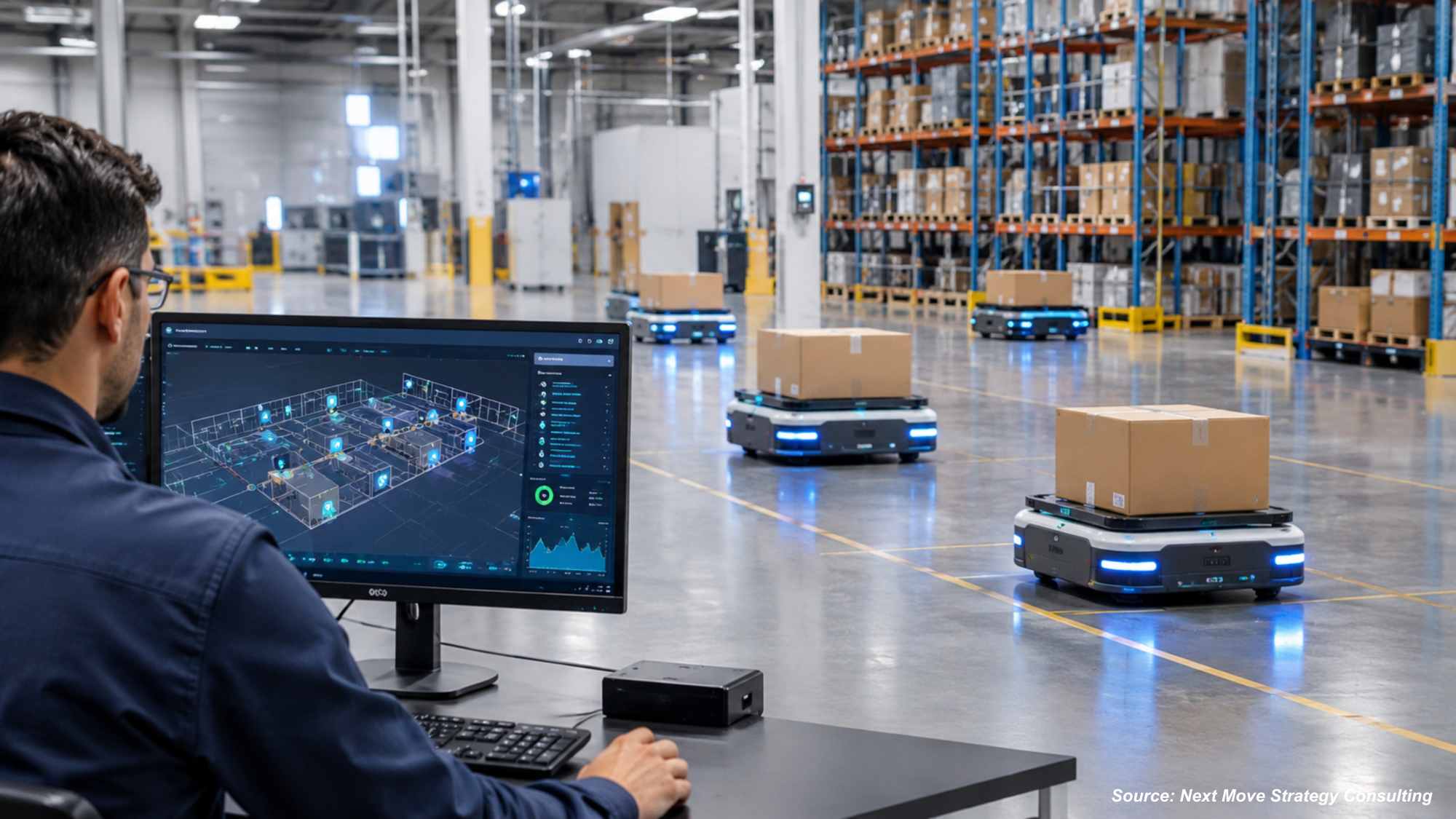
A3’s November 2 Release of ISO 21423 Turns Multivendor Robot Coordination From a Buyer Request Into a Written Standard, and Fleet Software Vendors Now Face a Conformance Question
On November 2, 2026, the Association for Advancing Automation (A3) announced the publication of ISO 21423:2026, a new international standard for communication and interoperability among industrial mobile robots, regardless of vendor or model. The International Organization for Standardization (ISO) lists the document as Edition 1, published in October 2026 by ISO Technical Committee 299. It specifies how industrial mobile robots, the fleet managers that direct them and other equipment exchange information and request actions, and it extends to enterprise resource planning tools and building systems such as lifts, alarm systems and automated doors. For operators that run robots from several makers under one operations team, the standard converts a long-running procurement request into a written reference that a buyer can cite in a tender.
According to Next Move Strategy Consulting’s Robot Fleet Management Software Market report, the global robot fleet management software market was valued at USD 2.55 billion in 2025 and is projected to reach USD 15.45 billion by 2035, growing at a CAGR of 16.73% from 2026 to 2035. NextMSC primary research and analysis places 2026 revenue at USD 3.84 billion, with autonomous mobile robots accounting for approximately 70% of that figure and North America approximately 34%. The same research finds that orchestration software able to federate several vendors’ fleet managers is becoming a procurement requirement, because buyers now run robots from different makers under one operations team and expect a single control plane across every site.
For More Information: Download FREE Sample on Robot Fleet Management Software Market Report
What ISO 21423 Changes for Mixed-Vendor Fleets
A3 states that the standard lets robots share their location, speed, direction, condition, tasking and availability. Those are the inputs a fleet manager needs to sequence robots through shared aisles, and A3 links their exchange to fewer cases of robots interfering with one another’s paths or path planning, which in turn raises robot availability and system efficiency. A3 also expects a common protocol to increase competition among suppliers and support innovation, because a buyer that can mix brands under one protocol is less tied to a single vendor’s fleet manager.
The standard was not written from a blank page. In its September 2025 editorial, A3 stated that ISO 21423 builds on the MassRobotics Interoperability Standard and VDA 5050. In the same editorial, Florian Pestoni of InOrbit.AI said cross-vendor operation is already possible but that fragmentation still adds friction, and Steven DuMont, advanced automation development manager at General Motors, said the company runs industrial mobile robots from several brands at sites worldwide and expects a global standard to help solve the interoperability problem.
“Companies want to choose the robots that fit their applications…”
— Carole Franklin, Director of Standards Development, Robotics, Association for Advancing Automation (A3), A3 announcement, New ISO Interoperability Standard Helps Mobile Robots from Different Vendors Work Together, November 2, 2026.
ISO states that the document is not safety-related, contains no safety requirements and excludes navigation requirements, and that its scope excludes entertainment, consumer, military, medical and public-road applications. ISO lists the standard at CHF 227, while A3 sells it for USD 373, or USD 320 for A3 members. The navigation exclusion leaves path planning as an area where fleet software vendors can still differentiate, while the messages that connect fleet managers to robots and facility systems now sit inside a common specification.
The Demand Base: Logistics Robot Sales Keep Climbing
The case for a shared protocol rests on fleet growth. The International Federation of Robotics (IFR) reported in its World Robotics 2026 Service Robots report, released on September 30, 2026, that global shipments of professional service robots rose 24% to almost 250,000 units in 2025. Transportation and logistics remained the largest application, with 117,500 units sold, up 21%, a 47% share of professional service robots. IFR added that robotics-as-a-service is gaining popularity and is already the dominant business model for these robots in the United States. Each added robot enlarges the number of vehicles a fleet manager must dispatch, charge and route, and each additional vendor on the same floor adds another native manager that must exchange data with the rest.
IFR notes that its service robot figures rest on a sample of 238 producers out of 1,001 manufacturers and are not projected to the whole industry, so the numbers below describe reported shipments rather than the full installed base.
Professional, Medical and Consumer Service Robots: 2025 Global Unit Sales
|
Segment |
2025 unit sales |
Change from 2024 |
Detail |
|
Professional service robots, all applications |
Almost 250,000 |
+24% |
Includes autonomous mobile robots |
|
Transportation and logistics |
117,500 |
+21% |
47% share of professional service robots |
|
Medical robots |
15,300 |
+19% |
Surgical robots: 8,400 units, +57% |
|
Consumer service robots |
34.2 million |
+37% |
Mainly domestic robots |
|
Full-size humanoids (above 140 cm) |
About 7,000 |
Not stated |
Commercial and professional use beyond research and entertainment |
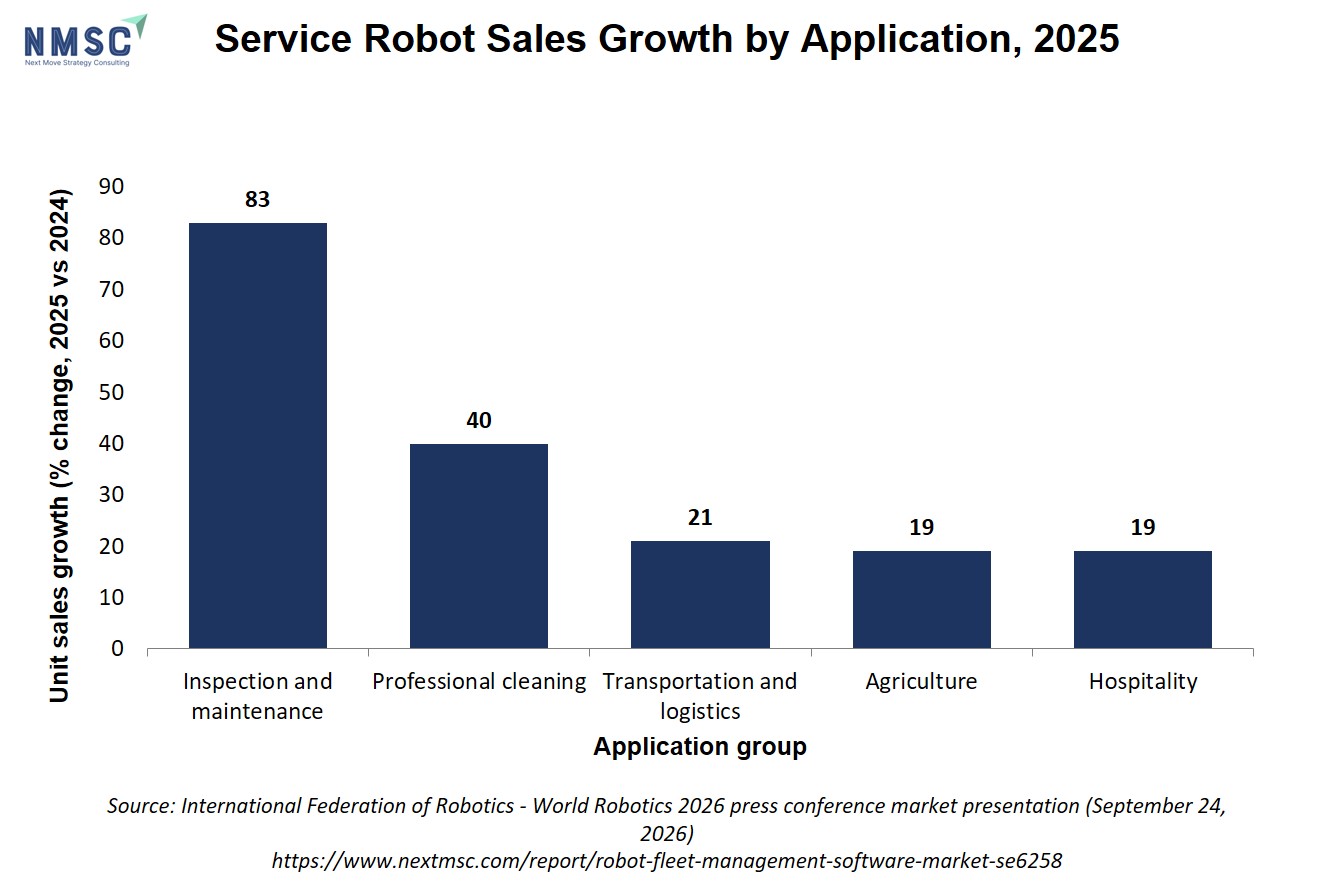
Growth was faster outside logistics. IFR’s World Robotics 2026 press conference presentation of September 24, 2026 shows inspection and maintenance robot sales up 83% and professional cleaning up 40%, ahead of transportation and logistics at 21%, while agriculture and hospitality each grew 19%. The faster-growing applications widen the range of robot types that fleet software may be asked to coordinate.
“Service robots are expanding into everyday operations”
— Jane Heffner, President, International Federation of Robotics, IFR press release, Global Sales of Professional Service Robots Surge 24%, September 30, 2026.
Key Industry Developments: Where Vendor Revenue Is Forming
Beijing Geekplus Technology Co., Ltd. reported on March 30, 2026, in its annual results announcement to the Hong Kong stock exchange, that 2025 revenue reached RMB 3,171.0 million, up 31.6%, of which RMB 2,387.1 million, or 75.3%, came from outside the Chinese Mainland. New orders reached RMB 4,137 million, up 31.7%, and the company said orders from subscription-based services grew by more than 90.0%, faster than total orders. Geekplus linked the surge in subscription orders to AI-assisted upgrades of its robot scheduling and warehouse execution software and to its data intelligence service platform. The company had shipped more than 72,000 robots to over 40 countries and regions by December 31, 2025, serving approximately 950 end customers.
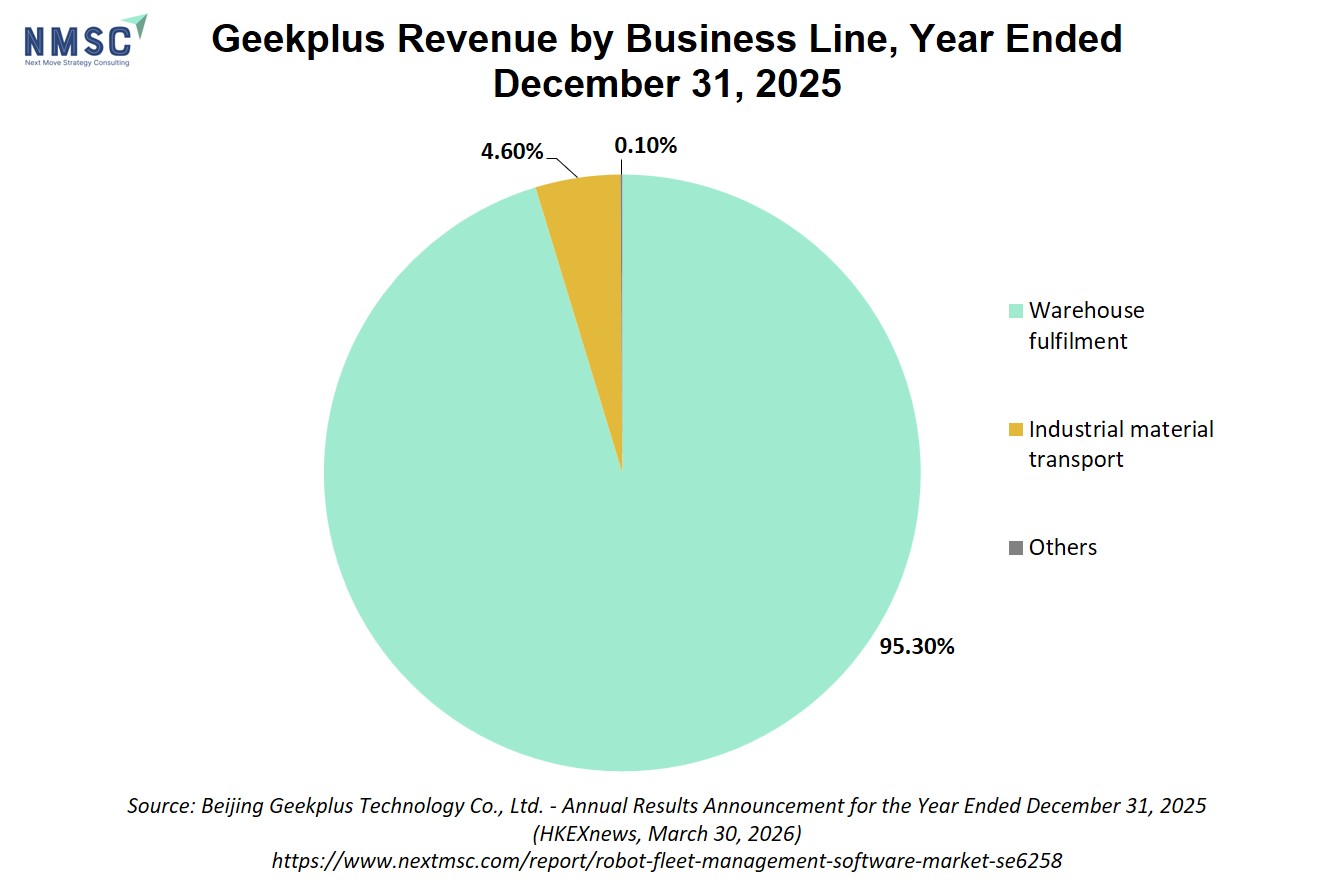
The revenue mix shows where that demand originates. Warehouse fulfilment accounted for 95.3% of Geekplus’s 2025 revenue, up from 90.3% in 2024, while industrial material transport fell to 4.6% from 9.4%. Warehousing and logistics is also the largest end-use industry in NextMSC primary research and analysis, at USD 1.35 billion in 2025, which places fleet software demand at the same sites where Geekplus now earns 95.3% of its revenue.
Geography is balanced. The filing allocates 2025 revenue of RMB 839.2 million to the U.S. market, RMB 783.9 million to the Chinese Mainland, RMB 782.0 million to Europe and RMB 765.9 million to Asia-Pacific. Europe grew fastest, rising 81.0% from RMB 432.1 million in 2024, a change calculated from the filed figures.
Geekplus Revenue by Customer Geography, FY2024 and FY2025
|
Customer geography |
FY2024 (RMB thousand) |
FY2025 (RMB thousand) |
Change (calculated) |
|
Chinese Mainland |
671,522 |
783,925 |
+16.7% |
|
U.S. market |
629,120 |
839,187 |
+33.4% |
|
Europe market |
432,089 |
781,988 |
+81.0% |
|
Asia-Pacific market |
676,280 |
765,913 |
+13.3% |
|
Total |
2,409,011 |
3,171,013 |
+31.6% |
Robotics 24/7 reported on November 3, 2026 that InOrbit.AI ran robot interoperability demonstrations at Automate 2026 in Chicago that served as a practical reference for ISO 21423. For orchestration vendors that sell a neutral layer above native fleet managers, the standard gives a published specification to build against instead of a vendor-by-vendor integration list.
Rules and Standards Shaping Fleet Software Procurement
The regulatory calendar adds urgency in Europe. The European Agency for Safety and Health at Work states that Regulation (EU) 2023/1230 on machinery applies from January 20, 2027, replaces Directive 2006/42/EC and is intended to cover new technologies, including autonomous mobile machinery. A3 describes VDA 5050 and ISO 21423 as complementary, so European buyers hold two interoperability references alongside the new machinery rules. NextMSC primary research and analysis finds that the regulation favours vendors that can certify software alongside hardware.
Standards and Rules Shaping Mixed-Vendor Fleet Procurement
|
Instrument |
Status and date |
What it covers |
|
ISO 21423:2026 |
Edition 1, published October 2026 by ISO Technical Committee 299; announced by A3 on November 2, 2026 |
Communication between industrial mobile robots, fleet managers and other equipment, including ERP tools, lifts, alarm systems and automated doors; no safety requirements; navigation requirements excluded |
|
VDA 5050 |
Existing framework on which ISO 21423 builds, per A3 |
A3 says it complements ISO 21423 |
|
MassRobotics Interoperability Standard |
Existing framework on which ISO 21423 builds, per A3 |
Second framework named by A3 as a basis for ISO 21423 |
|
Regulation (EU) 2023/1230 |
Applies from January 20, 2027; replaces Directive 2006/42/EC |
EU machinery rules intended to cover new technologies, including autonomous mobile machinery |
Segment Dynamics: Autonomous Mobile Robots Lead, Mixed Fleets Grow Fastest
NextMSC primary research and analysis sizes autonomous mobile robot fleet software at USD 1.80 billion in 2025, rising to USD 9.60 billion by 2035 at a 15.14% CAGR, while automated guided vehicles grow from USD 0.45 billion to USD 1.85 billion at 12.92%. The other robots category, which covers humanoids, legged platforms and autonomous mobile manipulators, grows from USD 0.30 billion to USD 4.00 billion at 25.44%, the fastest rate of the three robot types. IFR’s data point in the same direction: it counts about 7,000 full-size humanoids sold worldwide in 2025 and 174 humanoid manufacturers, more than 50% of them in China. NextMSC research notes that, as fleets mix robot types, fleet software must schedule tasks across mobile bases, arms and humanoids, which widens the scope of every orchestration vendor.
By deployment mode, NextMSC research shows on-premises systems holding the largest share, growing from USD 1.43 billion in 2025 to USD 6.10 billion by 2035, while cloud-based deployment expands fastest at 20.09% CAGR. Among end-use industries, warehousing and logistics grows from USD 1.35 billion in 2025 to USD 7.20 billion by 2035, and healthcare is the fastest at 22.45% CAGR.
Regional Outlook: North America Leads While Middle East and Africa Compounds Fastest
North America holds approximately 34% of 2026 revenue, or USD 1.32 billion, and is projected by NextMSC primary research and analysis to grow from USD 0.88 billion in 2025 to USD 5.35 billion by 2035. Asia-Pacific accounts for approximately 31% of 2026 revenue and is projected to reach USD 5.00 billion by 2035 at a 17.40% CAGR, while Europe grows at 16.19% from USD 0.60 billion in 2025 to USD 3.55 billion in 2035. Middle East and Africa is the fastest-growing region at 18.19% CAGR, rising from USD 0.13 billion to USD 0.90 billion, and India is the fastest-growing country at 23.89%, from USD 0.05 billion in 2025 to USD 0.55 billion by 2035. The Geekplus revenue split, in which the U.S., Europe and Asia-Pacific each contributed between RMB 765.9 million and RMB 839.2 million in 2025, shows that Geekplus already sells into all three regions at comparable scale.
Growth Drivers and Restraints: What the Independent Evidence Shows
The evidence matrix below uses only independently published figures. It separates the forces that expand the fleet software base from the constraints that the standard and the regulatory calendar leave in place.
Evidence Matrix: Growth Drivers and Restraints
|
Factor |
Type |
Evidence |
|
Larger logistics robot fleets |
Driver |
117,500 transportation and logistics service robots sold in 2025, up 21% (IFR) |
|
Cross-vendor communication standard |
Driver |
ISO 21423:2026 defines message exchange between robots, fleet managers, ERP tools and building systems (ISO) |
|
Subscription delivery |
Driver |
Geekplus subscription-based service orders grew by more than 90.0% in 2025, and IFR reports robotics-as-a-service is the dominant model for these robots in the United States |
|
Safety and navigation outside the standard |
Restraint |
ISO 21423 contains no safety requirements and excludes navigation requirements, so those functions are still integrated separately (ISO) |
|
Machinery rules from January 2027 |
Restraint |
Regulation (EU) 2023/1230 applies from January 20, 2027 and replaces Directive 2006/42/EC (EU-OSHA) |
|
Customer concentration at vendors |
Restraint |
Two Geekplus customers each exceeded 10% of 2025 revenue, at RMB 335,661 thousand and RMB 336,002 thousand |
NMSC Strategic Perspective: Conformance Becomes a Tender Line Item
NextMSC primary research and analysis reads ISO 21423 as a shift in where fleet software vendors compete. Cross-vendor operation was already achievable, as A3’s editorial recorded, but with friction from fragmentation. A published specification covering robots, fleet managers, enterprise systems and building systems lets buyers write interoperability requirements into a tender and test vendors against a common reference. NextMSC research finds that vendors unable to connect to third-party robots or enterprise systems risk losing tenders to platforms that can, which is why federated orchestration is one of three whitespace opportunities identified in the report.
Three consequences follow. NextMSC recommends that hardware makers open their fleet managers through VDA 5050 and emerging ISO interfaces, which the standard now turns into a written request rather than a negotiating position. NextMSC also recommends that neutral platforms deepen enterprise connectors to warehouse and plant systems, a priority that the standard’s reach into ERP tools, lifts and automated doors reinforces. For buyers, NextMSC advises demanding multivendor support and clear exit terms in every contract, and the standard gives buyers a published reference against which to test the first of those requests.
The limits are equally clear. ISO 21423 is not a safety standard and leaves navigation requirements outside its scope, so vendors continue to compete on functions outside it, which NextMSC research lists as AI-assisted operations, simulation and support for humanoid and mixed fleets. NextMSC primary research and analysis therefore treats adoption speed, not the standard’s existence, as the variable to monitor: conformance claims on vendor specification sheets, and the share of tenders that cite the standard, will show whether the interoperability premium moves into software revenue.
Competitive Landscape
The NextMSC report profiles nine vendors: Beijing Geekplus Technology Co., Ltd., Locus Robotics, Brain Corporation, Rockwell Automation, Teradyne, KUKA, OMRON, InOrbit.AI and Ati Motors. NextMSC research describes the structure as moderately fragmented, split between hardware makers that bundle a fleet manager with their robots and neutral platforms that orchestrate many brands. Geekplus’s audited results and InOrbit.AI’s ISO 21423 reference demonstrations, both described above, mark the two ends of that split: a scaled hardware-led vendor adding subscription software, and an orchestration specialist positioned around open interfaces.
Bottom Line
ISO 21423:2026, announced by A3 on November 2, 2026, gives mixed-vendor robot fleets a written communication standard that reaches fleet managers, enterprise tools and building systems. The demand behind it is visible in independent data: IFR counts 117,500 transportation and logistics robots sold in 2025, up 21%, and Geekplus reports subscription orders growing by more than 90.0% against total order growth of 31.7%. NextMSC primary research and analysis values the robot fleet management software market at USD 2.55 billion in 2025 and projects USD 15.45 billion by 2035 at a 16.73% CAGR, with autonomous mobile robots leading and other robots, including humanoids, growing fastest. The standard excludes safety and navigation, so vendors will still compete on AI-assisted operations, simulation and support for mixed fleets. The metric to watch is adoption: conformance statements on vendor specification sheets, and tender documents that cite ISO 21423, will show whether open interfaces turn into software revenue.
About Next Move Strategy Consulting
Next Move Strategy Consulting is a premier market research and management consulting firm that has been committed to provide strategically analysed well documented latest research reports to its clients. The research industry is flooded with many firms to choose from, what makes NMSC different from the rest is its top-quality research and the obsession of turning data into knowledge by dissecting every bit of it and providing fact-based research recommendation that is supported by information collected from over 500 million websites, paid databases, industry journals and one on one consultations with industry experts across a diverse range of industry sectors. The high-quality customized research reports with actionable insights and excellent end-to-end customer service help our clients to take critical business decisions that enables them to move beyond time and have competitive edge in the industry.
We have been servicing over 1000 customers globally that includes 90% of the Fortune 500 companies over a decade. Our analysts are constantly tracking various high growth markets and identifying hidden opportunities in each sector or the industry. We provide one of the industry’s best quality syndicate as well as custom research reports across 10 different industry verticals. We are committed to deliver high quality research solutions in accordance to your business needs. Our industry standard delivery solutions that ranges from the pre consultation to after-sales services, provide an excellent client experience and ensure right strategic decision making for businesses.
For more information, please contact:
Next Move Strategy Consulting
5th Floor 867 Boylston St, STE 500,
Boston, MA 02116, U.S.
E-Mail: [email protected]
Direct: +1-217-650-7991
Website: www.nextmsc.com
About the Author
 Priyanshu Das
— Priyanshu Das is SEO Executive at Next Move Strategy Consulting, where he has led on-page and off-page SEO, keyword research, and SEO audits for the firm's B2B market research publications for 2 years. His audit process combines technical crawl analysis, backlink profile review, and competitor keyword gap mapping — using tools including Screaming Frog and Google Search Console — to prioritize fixes by organic search-visibility impact, informed by his own prior in-house and agency SEO experience.
About the Reviewer
 Sanyukta Deb
— Sanyukta Deb is Digital Marketing Team Lead at Next Move Strategy Consulting, where she has led content strategy and technical SEO for the firm's B2B market research publications for over 2 years. Her editorial process translates NextMSC's primary and secondary research — spanning technology, industrial, and consumer sectors — into commercial narratives, backed by search-intent, keyword, and competitive analysis. She brings 5 years of overall experience in digital marketing and content strategy.














Add Comment