White Cement Market: Capacity, Carbon Reduction, and Regional Growth

Lede
Three recent developments — the start-up of a new white cement plant in the UAE by Asian Paints, the launch of Syria’s first-ever white cement facility, and the introduction of low-carbon white cement for the Asia-Pacific region — together point to a White Cement Market entering a new phase of geographic expansion, product differentiation, and sustainability-driven competition. Collectively, these moves highlight not only rising demand for high-purity and architectural-grade cement, but also changing priorities around supply security, decarbonisation, and regional self-sufficiency.
1. New White Cement Capacity Strengthens Middle East Supply Chains
Asian Paints has begun commercial production at its white cement plant in Fujairah, UAE, marking a strategic entry into upstream materials critical for decorative construction and surface finishing. The facility, operated through its subsidiary Asian White Inc. FZE, is designed to supply both white cement and clinker, strengthening the regional availability of a product traditionally dependent on imports and limited producers.
White cement plays a central role in architectural finishes, tile adhesives, wall putties, terrazzo flooring, and premium precast elements — applications that are expanding rapidly across the Gulf region due to sustained investment in real estate, hospitality, and infrastructure. By establishing production in the UAE, Asian Paints is positioning itself closer to end markets while improving control over quality consistency and supply reliability.
From an industry perspective, the project reflects a broader trend of vertical integration and localisation, as downstream construction and building-material companies seek greater resilience against logistics volatility and input cost fluctuations.
2. Syria’s First White Cement Plant Signals Reconstruction-Led Demand
In a separate but equally significant development, Northern Region Cement Company has launched Syria’s first white cement plant, marking a milestone for the country’s construction materials sector. Until now, white cement demand in Syria was largely met through imports or limited grey cement substitution, restricting its use in higher-end construction and restoration projects.
The new facility is expected to support reconstruction efforts, urban renewal, and heritage restoration, where white cement is preferred for its brightness, durability, and compatibility with architectural detailing. Beyond immediate demand, the plant establishes foundational capability for value-added cement products within the country, reducing reliance on external suppliers.
This development also signals a gradual re-entry of Syria into regional cement trade flows, with white cement offering higher margins and more specialised applications compared to conventional grey cement.
3. Low-Carbon White Cement Expands Sustainability Play in Asia-Pacific
Adding a product-innovation dimension to recent capacity expansions, Cementir Group has introduced a low-carbon white cement offering for the Asia-Pacific market. The product targets construction projects increasingly governed by emissions benchmarks, green building certifications, and sustainability-linked procurement policies.
White cement is traditionally more energy-intensive than grey cement due to raw material purity requirements and higher kiln temperatures. The introduction of lower-carbon alternatives therefore represents a meaningful shift, aligning premium construction materials with climate targets without compromising performance or aesthetics.
This launch reflects growing acceptance that environmental credentials are becoming decisive purchasing factors, particularly in commercial real estate, infrastructure, and large-scale urban developments across Asia-Pacific.
4. Next Move Strategy Consulting – Opinion, Impact, and Near-Term Prospects
Next Move Strategy Consulting views these developments as indicators of a White Cement Market transitioning from a niche, capacity-constrained segment into a more strategically structured industry.
-
Regionalisation of supply as a priority: New plants in the Middle East and Syria highlight a move away from long-distance imports toward local and regional production hubs, improving cost stability and delivery timelines.
-
White cement moving beyond aesthetics: While architectural finishes remain central, white cement is increasingly valued for engineered mortars, precast systems, and high-performance construction solutions.
-
Sustainability becoming a differentiator: Low-carbon white cement is no longer experimental — it is emerging as a competitive lever for producers targeting premium and regulation-sensitive projects.
-
Higher barriers to entry: Quality consistency, energy efficiency, and environmental compliance are raising capital and technical requirements, favouring established players with scale and process expertise.
-
Strategic rather than cyclical growth: Demand growth is increasingly tied to urban design standards, restoration projects, and sustainability mandates, rather than purely cyclical construction activity.
5. Practical Suggestions for Stakeholders
-
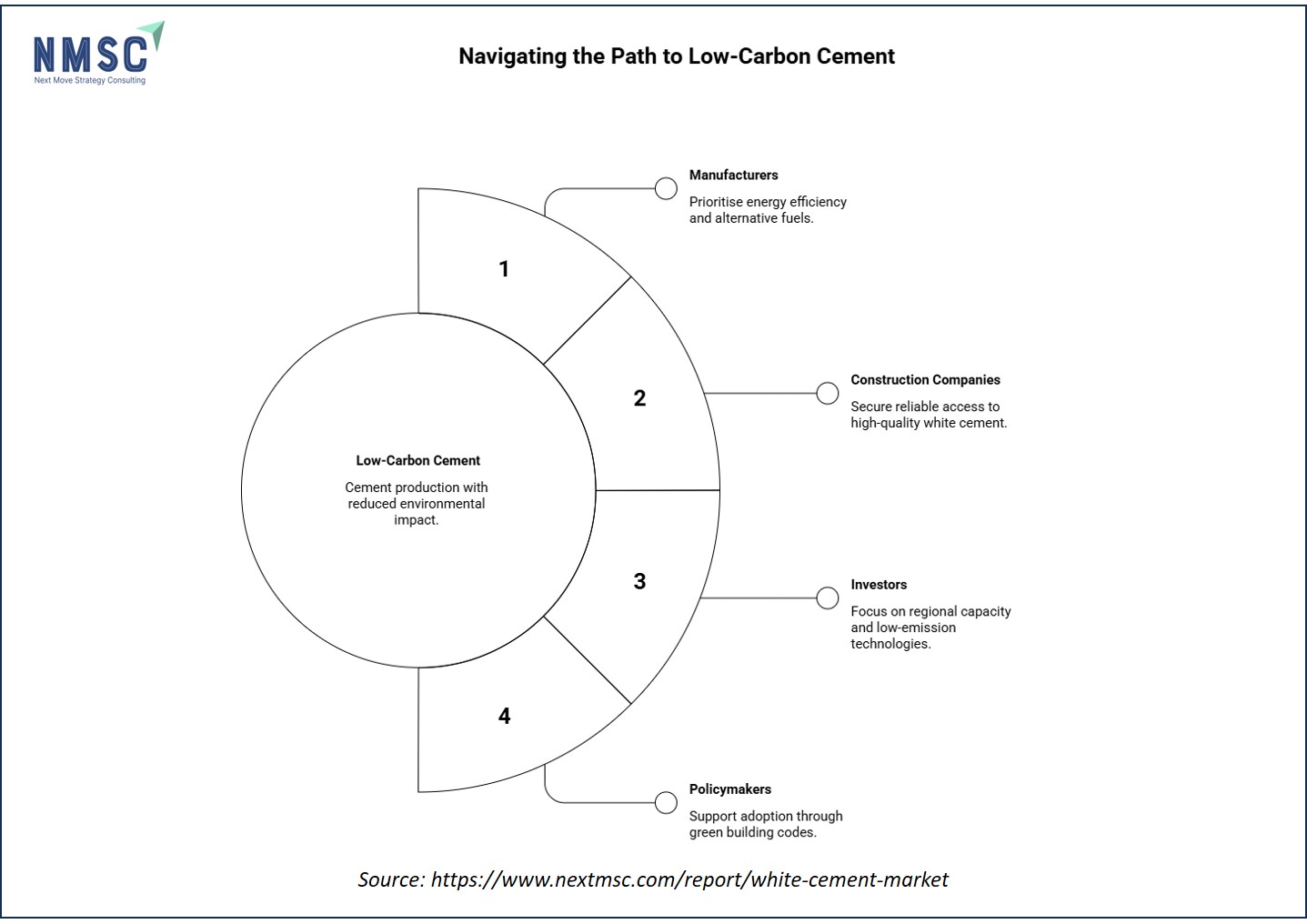
Manufacturers should prioritise energy-efficient kilns, alternative fuels, and clinker optimisation to remain competitive in a decarbonising market.
-
Construction companies and developers should reassess supplier strategies to secure reliable access to high-quality white cement for premium and green-certified projects.
-
Investors should focus on producers expanding regional capacity or developing low-emission white cement technologies.
-
Policymakers can support adoption by recognising low-carbon cement products within green building codes and public procurement frameworks.
Conclusion
Recent capacity additions, regional market entries, and low-carbon innovations underline a structural evolution in the White Cement Market. What was once a specialised, supply-limited product category is now becoming a strategically important material aligned with architectural quality, sustainability goals, and regional manufacturing resilience. Companies that combine production scale, environmental performance, and proximity to demand centres are best positioned to capture long-term value as white cement gains prominence in modern construction ecosystems.
About Next Move Strategy Consulting:
Next Move Strategy Consulting is a premier market research and management consulting firm that has been committed to providing strategically analysed well documented latest research reports to its clients. The research industry is flooded with many firms to choose from, what makes Next Move different from the rest is its top-quality research and the obsession of turning data into knowledge by dissecting every bit of it and providing fact-based research recommendation that is supported by information collected from over 500 million websites, paid databases, industry journals and one on one consultations with industry experts across a diverse range of industry sectors. The high-quality customized research reports with actionable insights and excellent end-to-end customer service help our clients to take critical business decisions that enables them to move beyond time and have competitive edge in the industry.
We have been servicing over 1000 customers globally that includes 90% of the Fortune 500 companies over a decade. Our analysts are constantly tracking various high growth markets and identifying hidden opportunities in each sector or the industry. We provide one of the industry’s best quality syndicate as well as custom research reports across 10 different industry verticals. We are committed to deliver high quality research solutions in accordance to your business needs. Our industry standard delivery solutions that ranges from the pre consultation to after-sales services, provide an excellent client experience and ensure right strategic decision making for businesses.
For more information please contact:
Next Move Strategy Consulting
5th Floor 867
Boylston St, STE 500,
Boston, MA 02116, U.S.
E-Mail: [email protected]
Direct: +1-857-758-5017
Website: www.nextmsc.com
About the Author
 Sanyukta Deb
— Sanyukta Deb is Digital Marketing Team Lead at Next Move Strategy Consulting, where she has led content strategy and technical SEO for the firm's B2B market research publications for over 2 years. Her editorial process translates NextMSC's primary and secondary research — spanning technology, industrial, and consumer sectors — into commercial narratives, backed by search-intent, keyword, and competitive analysis. She brings 5 years of overall experience in digital marketing and content strategy.
Sanyukta Deb
— Sanyukta Deb is Digital Marketing Team Lead at Next Move Strategy Consulting, where she has led content strategy and technical SEO for the firm's B2B market research publications for over 2 years. Her editorial process translates NextMSC's primary and secondary research — spanning technology, industrial, and consumer sectors — into commercial narratives, backed by search-intent, keyword, and competitive analysis. She brings 5 years of overall experience in digital marketing and content strategy.
About the Reviewer
 Debashree Dey
— Debashree Dey is Assistant Manager at Next Move Strategy Consulting, where she supports cross-vertical market content and communications across diverse industries for 6 years. Her professional background includes senior content writing, communications, and published manuscript authorship, with experience developing audience-focused business narratives and maintaining clear, consistent messaging. Her role supports research-led content development and editorial quality across NextMSC publications.
Debashree Dey
— Debashree Dey is Assistant Manager at Next Move Strategy Consulting, where she supports cross-vertical market content and communications across diverse industries for 6 years. Her professional background includes senior content writing, communications, and published manuscript authorship, with experience developing audience-focused business narratives and maintaining clear, consistent messaging. Her role supports research-led content development and editorial quality across NextMSC publications.

















Add Comment