Wireless Charging Market Grows with Qi2 and NFC Adoption
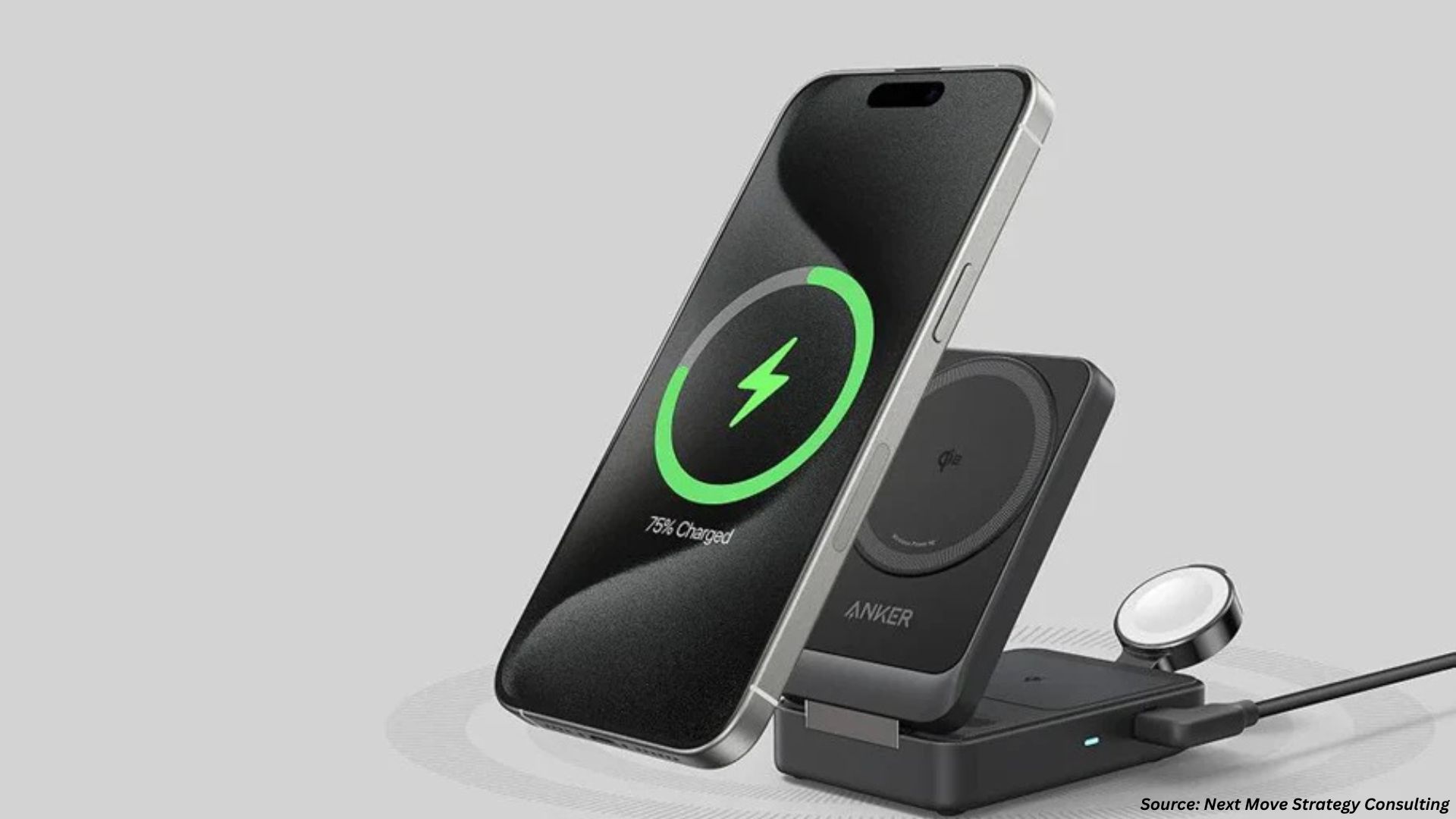
The global Wireless Charging Market is entering a new growth phase after ROHM Semiconductor launched an ultra-compact NFC wireless charging chipset for smart rings, while Astronics Corporation unveiled a Qi2 wireless charging module for commercial aircraft cabins. The back-to-back technology announcements are intensifying competition across wearable electronics, mobility infrastructure, and next-generation consumer charging ecosystems.
According to the latest proprietary analysis from Next Move Strategy Consulting, the global wireless charging market was valued at USD 21.44 billion in 2023 and is projected to reach USD 71.47 billion by 2030, expanding at a CAGR of 15.8% from 2024 to 2030. Analysts say the recent launches reflect a broader industry transition toward compact, interoperable, and infrastructure-ready charging systems.
The developments come as manufacturers increasingly move beyond traditional smartphone charging use cases and focus on embedded wireless power solutions for smart wearables, transportation systems, healthcare devices, and enterprise environments.
ROHM Expands NFC Wireless Charging for Smart Rings
This week, ROHM Semiconductor introduced its ML7670 receiver and ML7671 transmitter chipset family, engineered specifically for ultra-small devices including smart rings, stylus pens, fitness bands, and medical wearables.
According to coverage published by BISinfotech, the new receiver chip measures only 2.28 mm × 2.56 mm × 0.48 mm, enabling integration into highly constrained device architectures where traditional Qi charging coils remain impractical.
ROHM’s solution uses NFC wireless charging operating at 13.56 MHz, allowing manufacturers to deploy significantly smaller antennas compared to standard inductive charging systems. The chipset delivers up to 45% power transfer efficiency within the 250-mW range and integrates firmware directly into the IC, eliminating the need for external host microcontrollers.

Industry analysts believe the launch could accelerate commercialization of smart jewelry and next-generation health monitoring devices, particularly as demand grows for discreet wearable technology with continuous biometric sensing capabilities.
“Miniaturized power delivery has become one of the most critical engineering priorities for wearable manufacturers,” said Sikha Haritwal, Lead Analyst at Next Move Strategy Consulting. “According to NMSC proprietary datasets, wearable charging component demand increased substantially over the last two quarters as OEMs accelerated smart ring and AI-powered wellness device production.”
The technology has already moved into commercial deployment. Japanese health-tech company SOXAI integrated ROHM’s charging chipset into its SOXAI RING 2 platform, which includes biometric monitoring sensors, temperature tracking, Bluetooth Low Energy connectivity, and NFC-based charging.
Astronics Targets Aviation Infrastructure with Qi2 Deployment
In a separate industry development, Astronics Corporation announced the debut of its EmPower® Qi2 Wireless Charging Module for commercial aircraft cabins, according to an official release published via Business Wire.
The new system supports Qi2-enabled smartphones, tablets, and portable electronic devices while delivering up to 25W wireless charging output. The module also incorporates MagSafe-compatible magnetic alignment technology designed to improve charging precision and reduce energy loss caused by coil misalignment.
Astronics stated that the module is specifically engineered for next-generation aircraft seating systems, crew rest areas, and galley integration. The company also emphasized rapid maintenance capabilities and compliance with major aerospace environmental standards.
Industry experts say aviation is emerging as a high-value commercial deployment segment for wireless charging infrastructure due to rising passenger expectations for seamless device connectivity during travel.
“The aviation sector is becoming an important proving ground for enterprise-scale wireless charging infrastructure,” Haritwal noted. “NMSC researchers identified increased deployment planning across transportation and hospitality environments during the first quarter of 2026.”
Market Analysis: What Changed in the Last Six Months
The wireless charging industry has undergone significant structural changes since late 2025 as companies increasingly adopt Qi2 magnetic charging architectures and NFC-based ultra-compact charging systems.
Over the past six months, several major trends have emerged:
-
Rapid migration toward Qi2-certified ecosystems
-
Increased integration of magnetic alignment technologies
-
Expansion of wireless charging into aviation and mobility infrastructure
-
Rising adoption of NFC charging for miniature wearables
-
Greater emphasis on thermal efficiency and interoperability

Industry researchers note that the competitive landscape is shifting from standalone charging hardware toward fully integrated charging ecosystems spanning smartphones, wearables, vehicles, and smart environments.
Global Wireless Charging Market Forecast
|
Metric |
Value |
|
Market Size 2023 |
USD 21.44 Billion |
|
Forecast Value 2030 |
USD 71.47 Billion |
|
CAGR (2024–2030) |
15.8% |
|
Leading Technology Trend |
Qi2 & NFC Charging |
|
Fastest Growth Segment |
Wearables & Smart Devices |
|
Emerging Enterprise Segment |
Aviation Infrastructure |
Key Wireless Charging Growth Drivers
|
Segment |
Primary Driver |
|
Smart Rings |
Compact NFC charging ICs |
|
Aircraft Cabins |
Passenger convenience systems |
|
Consumer Electronics |
Multi-device ecosystems |
|
Healthcare Wearables |
Continuous biometric tracking |
|
Automotive Integration |
Embedded wireless charging |
Regional Dynamics Reshape Industry Competition
Asia-Pacific continues to dominate global wireless charging manufacturing due to strong semiconductor production capabilities and high smartphone adoption across China, Japan, South Korea, and India.
Japan remains a key innovation hub for compact charging technologies, while North America is emerging as a leader in enterprise-scale infrastructure deployment, particularly in aviation and smart mobility applications.
Meanwhile, European regulators are increasingly emphasizing interoperability and energy-efficient charging standards, creating favorable conditions for standardized wireless power ecosystems.

Strategic Recommendations for CEOs and Investors
-
Increase investment in Qi2-compatible charging ecosystems and magnetic alignment technologies.
-
Expand R&D for ultra-compact NFC charging ICs targeting wearable healthcare devices.
-
Pursue partnerships with aviation, automotive, and hospitality infrastructure providers.
-
Prioritize interoperability and thermal management optimization for enterprise deployments.
-
Monitor regulatory developments surrounding universal charging standards and energy efficiency compliance.
Analysts believe the next competitive stage of the wireless charging industry will center on ecosystem integration, with companies competing on efficiency, embedded intelligence, and cross-device compatibility rather than charging speed alone.
About Next Move Strategy Consulting:
Next Move Strategy Consulting is a premier market research and management consulting firm that has been committed to provide strategically analysed well documented latest research reports to its clients. The research industry is flooded with many firms to choose from, what makes NMSC different from the rest is its top-quality research and the obsession of turning data into knowledge by dissecting every bit of it and providing fact-based research recommendation that is supported by information collected from over 500 million websites, paid databases, industry journals and one on one consultations with industry experts across a diverse range of industry sectors. The high-quality customized research reports with actionable insights and excellent end-to-end customer service help our clients to take critical business decisions that enables them to move beyond time and have competitive edge in the industry.
We have been servicing over 1000 customers globally that includes 90% of the Fortune 500 companies over a decade. Our analysts are constantly tracking various high growth markets and identifying hidden opportunities in each sector or the industry. We provide one of the industry’s best quality syndicate as well as custom research reports across 10 different industry verticals. We are committed to deliver high quality research solutions in accordance to your business needs. Our industry standard delivery solutions that ranges from the pre consultation to after-sales services, provide an excellent client experience and ensure right strategic decision making for businesses.
For more information, please contact:
Next Move Strategy Consulting
5th Floor 867
Boylston St, STE 500,
Boston, MA 02116, U.S.
E-Mail: [email protected]
Direct: +1-217-650-7991
Website: www.nextmsc.com
About the Author
 Sanyukta Deb
— Sanyukta Deb is Digital Marketing Team Lead at Next Move Strategy Consulting, where she has led content strategy and technical SEO for the firm's B2B market research publications for over 2 years. Her editorial process translates NextMSC's primary and secondary research — spanning technology, industrial, and consumer sectors — into commercial narratives, backed by search-intent, keyword, and competitive analysis. She brings 5 years of overall experience in digital marketing and content strategy.
Sanyukta Deb
— Sanyukta Deb is Digital Marketing Team Lead at Next Move Strategy Consulting, where she has led content strategy and technical SEO for the firm's B2B market research publications for over 2 years. Her editorial process translates NextMSC's primary and secondary research — spanning technology, industrial, and consumer sectors — into commercial narratives, backed by search-intent, keyword, and competitive analysis. She brings 5 years of overall experience in digital marketing and content strategy.
About the Reviewer
 Debashree Dey
— Debashree Dey is Assistant Manager at Next Move Strategy Consulting, where she supports cross-vertical market content and communications across diverse industries for 6 years. Her professional background includes senior content writing, communications, and published manuscript authorship, with experience developing audience-focused business narratives and maintaining clear, consistent messaging. Her role supports research-led content development and editorial quality across NextMSC publications.
Debashree Dey
— Debashree Dey is Assistant Manager at Next Move Strategy Consulting, where she supports cross-vertical market content and communications across diverse industries for 6 years. Her professional background includes senior content writing, communications, and published manuscript authorship, with experience developing audience-focused business narratives and maintaining clear, consistent messaging. Her role supports research-led content development and editorial quality across NextMSC publications.
















Add Comment