Acrylic Resins Market Global Industry Analysis and Forecast (2026-2035)

Acrylic Resins Market size was USD 17.62 billion in 2026, projected to reach USD 26.40 billion by 2035, growing at a CAGR of 4.6% from 2026 to 2035. Key drivers include rising construction and infrastructure investment in Asia-Pacific, expanding waterborne and low-VOC coatings adoption, and growing UV-curable resin adoption in electronics and specialty coatings, with Asia-Pacific leading the market.

Download Free Sample PDF
Base Year (2025)
$16.85 Billion
Forecast (2035)
$26.40 Billion
CAGR (2026-2035)
4.6%
Top Region
Asia-Pacific

What Is the Acrylic Resins Market Size?

The global acrylic resins market size was valued at USD 16.85 Billion in 2025 and is estimated at USD 17.62 Billion in 2026, forecast to reach USD 26.40 Billion by 2035, expanding at a 4.6% CAGR between 2026 and 2035. Asia-Pacific leads with approximately a 48% share, while Acrylic Emulsions dominates all other product types with approximately a 42% share.

We observed that growth is broadest in UV-curable and electronics-oriented categories, with sustainability-driven waterborne formulation shifts and Asia-Pacific capacity expansion recording the strongest structural gains through 2035.

Acrylic Resins Market Global Industry Analysis and Forecast (2026-2035) Revenue Forecast

Values in USD Billion

2025 $16.85 Billion
2025
2026 $17.62 Billion
2026
2027 $18.43 Billion
2027
2028 $19.28 Billion
2028
2029 $20.17 Billion
2029
2030 $21.09 Billion
2030
2031 $22.06 Billion
2031
2032 $23.08 Billion
2032
2033 $24.14 Billion
2033
2034 $25.25 Billion
2034
2035 $26.40 Billion
2035

Key Takeaways

By Product Type: Acrylic Emulsions held the largest share of approximately 42% (USD 7.08 billion) in 2025; UV-Curable Acrylic Resins is the fastest-growing sub-segment at 7.4% CAGR from 2026-2035.

By Application: Paints and Coatings held the largest share of approximately 38% (USD 6.40 billion) in 2025; Construction Chemicals is the fastest-growing sub-segment at 5.9% CAGR from 2026-2035.

By End-Use Industry: Building and Construction held the largest share of approximately 34% (USD 5.73 billion) in 2025; Electronics is the fastest-growing sub-segment at 6.8% CAGR from 2026-2035.

By Monomer Type: Methyl Methacrylate held the largest share of approximately 32% (USD 5.39 billion) in 2025; 2-Ethylhexyl Acrylate is the fastest-growing sub-segment at 5.7% CAGR from 2026-2035.

Dominant Region: Asia-Pacific dominated with approximately 48% revenue share (USD 8.09 billion) in 2025.

Fastest-Growing Region: Asia-Pacific is also expected to register the highest CAGR of 5.8% during 2026-2035.

Dominant Country: China led with approximately USD 3.72 billion in 2025.

Fastest-Growing Country: India is the fastest-growing country at approximately 6.8% CAGR from 2026-2035.

Market Opportunity: The acrylic resins market is expected to create an absolute dollar opportunity of USD 8.78 billion between 2026 and 2035, presenting significant investment potential across UV-curable formulations and electronics-grade acrylic resin platforms.

According to NMSC analysis, Chinese acrylic monomer producers are expanding integrated acrylic acid and ester capacity faster than global demand growth, a shift that favors downstream formulators capable of securing stable, cost-competitive monomer supply relative to import-dependent regional competitors through 2035.

What Does the Acrylic Resins Market Encompass?

The acrylic resins market encompasses the polymer formulations derived from acrylic and methacrylic acid esters used across paints, coatings, adhesives, textiles, and plastics applications. Our assessment indicates that scope spans waterborne emulsions, solvent-borne resins, UV-curable formulations, and powder resins, supplied to building and construction, automotive, packaging, and electronics end users through direct sales and distributor channels worldwide.

Regulatory frameworks including the European Chemicals Agency's REACH regulation and U.S. Environmental Protection Agency volatile organic compound standards continue to push formulators toward waterborne and low-VOC acrylic chemistries. We observed that technology adoption is shifting toward UV-curable systems that reduce energy consumption during the curing process, as demand for acrylic acid feedstock continues to expand alongside integrated Asia-Pacific monomer capacity across the market.

Market Drivers & Dynamics

Interactive Dataset
Rising construction and infrastructure investment in Asia-Pacific driver +1.4% Asia-Pacific 2026-2035
Expanding waterborne and low-VOC coatings adoption driver +1.1% North America, Europe 2026-2035
Growing UV-curable resin adoption in electronics and specialty coatings driver +0.9% Global 2026-2035
Increasing bio-based acrylic monomer feedstock investment driver +0.7% Europe, North America 2026-2035
Integrated Asia-Pacific acrylic acid and ester capacity expansion driver +0.6% Asia-Pacific 2026-2032
Rising demand for pressure-sensitive adhesives in packaging driver +0.5% Global 2026-2035
Volatility in propylene and petrochemical feedstock pricing restraint -0.8% Global 2026-2035
Tightening REACH and VOC emission compliance requirements restraint -0.5% Europe, North America 2026-2035
Overcapacity risk from rapid Chinese monomer expansion restraint -0.4% Asia-Pacific 2026-2032
Source: Next Move Strategy Consulting

Growth Drivers

What Is the Primary Growth Driver of the Acrylic Resins Market?

Rising construction and infrastructure investment in Asia-Pacific is the primary driver of the market. The China Petroleum and Chemical Industry Federation continues to document expanding domestic chemical production capacity supporting construction and industrial demand. We observed that this construction investment, reinforced by growing automotive and packaging consumption, sustains baseline demand for acrylic emulsions and solvent-borne resins across building and construction and automotive end-use industries.

How Is Waterborne Coatings Adoption Driving the Market Growth?

Expanding waterborne and low-VOC coatings adoption is accelerating market growth as regulatory and consumer preference shifts favor environmentally compliant formulations. The U.S. Environmental Protection Agency's volatile organic compound emission standards continue to shape coatings reformulation timelines. Our assessment indicates that this regulatory shift is accelerating adoption of waterborne coatings formulations based on acrylic emulsions across North American and European paints and coatings applications.

Growth Inhibitors

What Is Restraining Acrylic Resins Market Expansion?

Volatility in propylene and petrochemical feedstock pricing restrains margin stability and cost predictability across the industry. The U.S. Securities and Exchange Commission's public filings from major chemical producers continue to document input cost pressure affecting specialty and commodity chemical segments. We found that smaller regional formulators face particular exposure, as limited feedstock integration constrains their ability to pass through raw material cost increases relative to larger, vertically integrated producers.

Segmentation Analysis

2025 (USD Billion)
2035 (USD Billion)
Acrylic Emulsions 2025: $7.08 Billion | 2035: $11.32 Billion
Acrylic Emul
Solvent-Borne Acrylic Resins 2025: $4.72 Billion | 2035: $6.57 Billion
Solvent-Born
UV-Curable Acrylic Resins 2025: $2.36 Billion | 2035: $4.47 Billion
UV-Curable A
Acrylic Powder Resins 2025: $1.69 Billion | 2035: $2.56 Billion
Acrylic Powd
Other Acrylic Resin Types 2025: $1.01 Billion | 2035: $1.48 Billion
Other Acryli
Acrylic Emulsions $7.08 Billion $11.32 Billion 5.4%
Solvent-Borne Acrylic Resins $4.72 Billion $6.57 Billion 3.7%
UV-Curable Acrylic Resins $2.36 Billion $4.47 Billion 7.4%
Acrylic Powder Resins $1.69 Billion $2.56 Billion 4.8%
Other Acrylic Resin Types $1.01 Billion $1.48 Billion 4.3%

Which Product Type Segment Dominates the Market?

Acrylic Emulsions led the market with USD 7.08 billion in 2025, supported by sustained waterborne formulation adoption across architectural coatings, adhesives, and textile applications. We observed that UV-Curable Acrylic Resins are the fastest-growing product type, expanding at a 7.4% CAGR from 2026 to 2035, as electronics and specialty coatings manufacturers increasingly specify faster-curing, lower-energy formulation systems.

2025 (USD Billion)
2035 (USD Billion)
Paints and C
Adhesives an
Plastics and
Construction
Textiles and
Segment Item 2025 (USD Billion) 2035 (USD Billion) CAGR
Paints and Coatings $10.0 USD Billion $40.0 USD Billion 18.0%
Adhesives and Sealants $17.1 USD Billion $51.1 USD Billion 16.0%
Plastics and Sheets $24.2 USD Billion $62.2 USD Billion 22.0%
Construction Chemicals $31.3 USD Billion $73.3 USD Billion 12.0%
Textiles and Nonwovens $38.4 USD Billion $84.4 USD Billion 19.0%

Segment-wise data is locked

Unlock complete segment-wise numbers for By Application.

Unlock Full Data

Which Application Segment Leads Market Demand?

Paints and Coatings remained the dominant application, valued at USD 6.40 billion in 2025 on its established role as the largest consumption category for both waterborne and solvent-borne acrylic resins. Our findings suggest that Construction Chemicals is the fastest-growing application, registering a 5.9% CAGR from 2026 to 2035, as acrylic-based concrete admixtures and surface treatments gain share in infrastructure rehabilitation and new-build projects.

2025 (USD Billion)
2035 (USD Billion)
Building and
Automotive a
Packaging
Textile
Electronics
Segment Item 2025 (USD Billion) 2035 (USD Billion) CAGR
Building and Construction $10.0 USD Billion $40.0 USD Billion 20.0%
Automotive and Transportation $17.1 USD Billion $51.1 USD Billion 18.0%
Packaging $24.2 USD Billion $62.2 USD Billion 12.0%
Textile $31.3 USD Billion $73.3 USD Billion 22.0%
Electronics $38.4 USD Billion $84.4 USD Billion 25.0%

Segment-wise data is locked

Unlock complete segment-wise numbers for By End-Use Industry.

Unlock Full Data

Which End-Use Industry Segment Is Most Widely Served in the Market?

Building and Construction remained the dominant end-use industry, reaching USD 5.73 billion in 2025 due to sustained architectural coatings and construction chemical consumption across residential and commercial projects. Based on research conducted by NMSC, we found that Electronics is the fastest-growing end-use industry at a 6.8% CAGR from 2026 to 2035, reflecting rising UV-curable acrylic resin adoption in display, encapsulation, and protective coating applications.

2025 (USD Billion)
2035 (USD Billion)
Methyl Metha
Butyl Acryla
Ethyl Acryla
2-Ethylhexyl
Other Acryla
Segment Item 2025 (USD Billion) 2035 (USD Billion) CAGR
Methyl Methacrylate $10.0 USD Billion $40.0 USD Billion 20.0%
Butyl Acrylate $17.1 USD Billion $51.1 USD Billion 22.0%
Ethyl Acrylate $24.2 USD Billion $62.2 USD Billion 24.0%
2-Ethylhexyl Acrylate $31.3 USD Billion $73.3 USD Billion 18.0%
Other Acrylate Monomers $38.4 USD Billion $84.4 USD Billion 9.0%

Segment-wise data is locked

Unlock complete segment-wise numbers for By Monomer Type.

Unlock Full Data

Growth Opportunities

Our analysis shows that three forward-looking opportunities stand out for stakeholders positioning within the acrylic resins market over the 2026-2035 forecast period.

How Can Bio-Based Monomers Unlock Value for Sustainability-Focused Coatings Brands?

Bio-based acrylic monomer formulations present a whitespace opportunity for producers serving coatings brands pursuing verifiable carbon reduction claims. Vendors that commercialize renewable-feedstock acrylic acid and esters stand to capture premium pricing as coatings formulators standardize sustainability specifications across new product launches.

Where Does UV-Curable Technology Create New Demand Among Electronics Manufacturers?

Electronics manufacturers represent an underpenetrated opportunity for UV-curable acrylic resin systems supporting high-speed, automated production lines. Providers that develop application-specific formulations compatible with specialty coatings processes can secure long-term supply contracts with electronics OEMs seeking faster cure times and reduced solvent emissions.

How Can Integrated Monomer Capacity Benefit Regional Formulators in Emerging Markets?

Regional formulators in emerging markets managing feedstock cost volatility create an opportunity for producers offering integrated, locally sourced acrylic monomer supply. Early movers that establish regional production partnerships can differentiate with formulators pursuing stable, cost-competitive input supply across expanding Asia-Pacific and Middle Eastern construction chemical markets.

PESTEL Analysis of the Acrylic Resins Industry

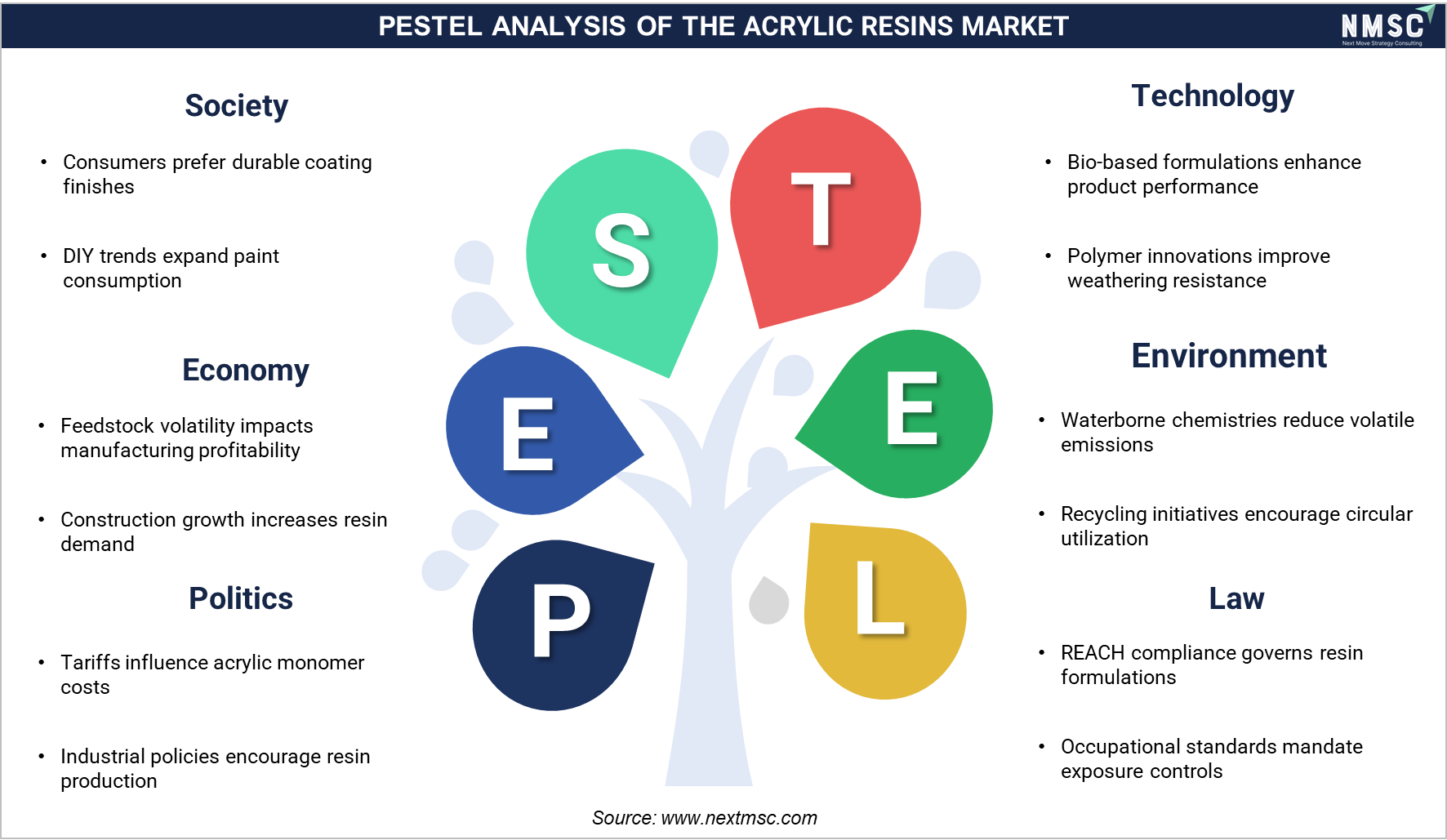
PESTEL Analysis of the Acrylic Resins Industry
The above infographic presents a PESTEL analysis of the acrylic resins market, where industrial policies are encouraging production, while tariffs and raw material costs are influencing profitability and monomer pricing. At the same time, construction and manufacturing growth are driving demand for acrylic-based products, while consumer preference for high-performance materials is shaping social acceptance. Technological advancements in polymerization and eco-friendly resin formulations are improving product efficiency and sustainability. Environmental regulations and waste management practices are further shaping production processes, while legal frameworks such as REACH compliance and occupational safety standards govern formulations and workplace practices. Looking ahead, we observed that these interconnected factors collectively shape the market's evolution across the coatings, adhesives, and manufacturing sectors.

Regional Outlook

2025 (USD Billion)
2035 (USD Billion)
Asia-Pacific
North Americ
Europe
Middle East
Latin Americ
Region 2025 (USD Billion) 2035 (USD Billion) CAGR (%)
Asia-Pacific $10.0 USD Billion $40.0 USD Billion 9.0%
North America $17.1 USD Billion $51.1 USD Billion 27.0%
Europe $24.2 USD Billion $62.2 USD Billion 25.0%
Middle East & Africa $31.3 USD Billion $73.3 USD Billion 23.0%
Latin America $38.4 USD Billion $84.4 USD Billion 12.0%

Regional data is locked

Unlock complete regional numbers for this market.

Unlock Full Data

Supply Chain Analysis of the Acrylic Resins Industry

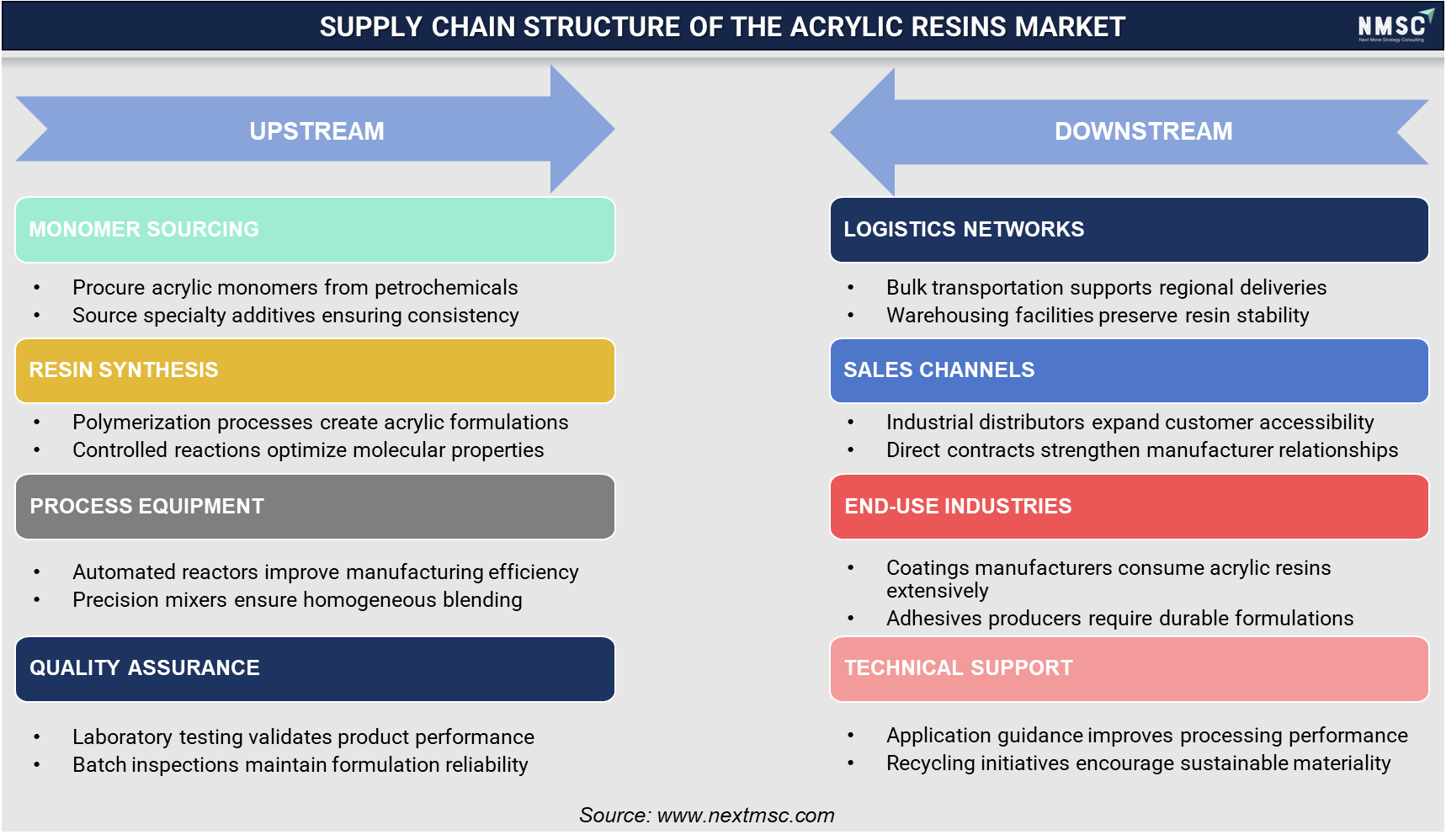
Supply Chain Analysis of the Acrylic Resins Industry
The above infographic presents the supply chain structure of the acrylic resins market, segmented into upstream and downstream activities. Upstream begins with acrylic monomer sourcing from petrochemicals, moving into polymerization and controlled reactions for resin synthesis. Automated reactors and precision mixers enhance efficiency, while laboratory testing and batch inspections ensure quality and formulation reliability. Moving downstream, bulk logistics and warehousing support regional distribution through industrial distributors and direct contracts to coatings and adhesives manufacturers. Looking ahead, we observed that application guidance and recycling initiatives help improve processing performance and promote sustainable material use across the market.

Competitive Landscape

We observed that the acrylic resins market features a moderately consolidated competitive landscape, with global chemical majors competing alongside integrated Asian monomer producers on feedstock integration, formulation breadth, and regional distribution scale. Key Takeaways

Dimension Description
Market Structure Moderately consolidated; the top companies profiled in this report collectively account for a majority of global acrylic resins revenue, while numerous regional formulators serve niche coatings, adhesives, and construction chemical demand.
Innovation Focus Bio-based monomer development, UV-curable formulation innovation, and integrated Asia-Pacific capacity expansion dominate current innovation pipelines across leading producers.
Capacity Expansion Activity Selective capacity expansion and feedstock integration investment, exemplified by Wanhua Chemical Group's Penglai acrylic acid and ester project and continued butyl acrylate capacity additions.

How Do Companies Compete in the Acrylic Resins Market?

Companies compete primarily on feedstock integration, formulation breadth, and regional distribution scale across the industry. Global chemical majors such as BASF SE and Dow Inc. leverage vertically integrated production to serve multinational coatings and adhesives customers, while Asian producers such as Wanhua Chemical Group Co., Ltd. and Satellite Chemical Co., Ltd. compete on cost-competitive monomer capacity for regional formulator demand.

Which Competitive Archetypes Dominate the Market?

Two archetypes dominate the market: vertically integrated global chemical majors offering broad monomer-to-resin portfolios, and regionally focused Asian producers competing on integrated capacity and cost position. BASF SE and Arkema S.A. exemplify the diversified global archetype through combined feedstock and formulation capabilities, while Wanhua Chemical Group Co., Ltd. and Satellite Chemical Co., Ltd. exemplify the regional scale archetype serving China's expanding domestic demand.

How Are Companies Differentiating Through Innovation in the Market?

Innovation and differentiation strategy increasingly center on bio-based feedstock development and UV-curable formulation breadth. Arkema's bio-based acrylic acid launch and expanding UV-curable product portfolios across major producers illustrate how sustainability credentials are becoming a primary competitive differentiator. Our analysis shows that producers unable to demonstrate low-carbon formulation options risk exclusion from European and North American accounts where compliance-driven procurement increasingly shapes vendor selection.

What M&A and Expansion Activity Is Shaping the Market?

Capacity expansion and feedstock integration investment continue to shape competitive positioning within the industry more than large-scale acquisitions at this stage of market maturity. Wanhua Chemical Group's Penglai project completion and new butyl acrylate plant commissioning illustrate how Chinese producers pursue integrated scale to compete with established global majors. These moves illustrate how producers pursue geographic expansion and capacity breadth across coatings, adhesives, and construction chemical customer segments.

Key Market Players

Our assessment indicates that the following 20 companies are actively shaping formulation innovation, capacity expansion, and go-to-market strategy within the global acrylic resins market.

BASF SE Dow Inc. Arkema S.A. Mitsubishi Chemical Group Corporation Wanhua Chemical Group Co., Ltd. LG Chem Ltd. Nippon Shokubai Co., Ltd. Röhm GmbH Sumitomo Chemical Co., Ltd. Celanese Corporation Formosa Plastics Corporation Satellite Chemical Co., Ltd. Synthomer plc Allnex Chi Mei Corporation Wacker Chemie AG Trinseo PLC DIC Corporation Toagosei Co., Ltd. Company 20

Latest Developments

We found that recent capacity and product announcements within the acrylic resins market are concentrated on bio-based feedstock development and integrated Asia-Pacific monomer capacity expansion, reflecting the industry's dual focus on sustainability and scale.

Date Event
March 2026 BASF launched Butyl Acrylate RE and 2-Ethylhexyl Acrylate RE, manufactured using renewable electricity at its Freeport, Texas facility.
July 2025 BASF announced the mechanical completion of the glacial acrylic acid and butyl acrylate plants at its Zhanjiang Verbund site in China.
July 2025 Arkema completed ISCC PLUS certification across all of its acrylic monomer production facilities worldwide, enabling the supply of bio-attributed acrylic monomers through a mass-balance approach.

Investment Opportunities

What Capital Inflows Are Targeting the Market?

Capital inflows into the acrylic resins market are increasingly directed toward integrated monomer capacity expansion and bio-based feedstock development. Producer investment continues to expand production scale, as seen in Wanhua Chemical Group's Penglai project and new butyl acrylate plant. We observed that investors favor producers demonstrating feedstock integration and sustainability credentials, viewing vertical integration as a proxy for long-term margin resilience.

How Is Infrastructure Investment Supporting Market Delivery?

Infrastructure investment is expanding production capacity across Asia-Pacific, particularly in China and India, to serve rising construction and coatings demand. Our findings suggest that producers are investing in construction chemicals manufacturing capacity to improve supply consistency across acrylic emulsion and construction admixture product lines, supporting growing regional customer volumes.

What ESG Considerations Are Shaping Acrylic Resins Investment Decisions?

Environmental, social, and governance considerations increasingly factor into investment decisions, with bio-based feedstock content and volatile organic compound reduction as key criteria. We found that investors increasingly favor producers with documented low-VOC and renewable-feedstock product roadmaps, treating REACH and EPA compliance readiness as a governance indicator alongside supply chain transparency for petrochemical raw materials.

Key Benefits for Stakeholders

How Does This Report Benefit Enterprise and Industry Leaders?

Enterprise and industry leaders gain access to validated segmentation, competitive benchmarking, and regional demand forecasts that support sourcing and technology-investment decisions across the acrylic resins industry. Our analysis shows that detailed product type, application, and end-use industry breakdowns help procurement and formulation teams align vendor selection with performance and compliance requirements.

How Does This Report Benefit Investors and Financial Analysts?

Investors and financial analysts benefit from consistent, single-point market size and CAGR estimates that support valuation and capital-allocation decisions across the acrylic resins supply chain. We observed that the report's regional and segment-level growth differentials help identify which producers are best positioned to capture above-market growth in UV-curable and Asia-Pacific categories through 2035.

How Does This Report Benefit Technology Vendors and Product Teams?

Technology vendors and product teams gain insight into emerging formulation requirements, including bio-based monomers, UV-curable systems, and low-VOC chemistries, that are reshaping the industry. Our findings suggest that this analysis helps R&D teams prioritize development roadmaps around sustainability credentials and integrated capacity strategies increasingly required in coatings and adhesives customer procurement.

Key Market Segments Evaluated

By Product Type

  • Acrylic Emulsions
  • Solvent-Borne Acrylic Resins
  • UV-Curable Acrylic Resins
  • Acrylic Powder Resins
  • Other Acrylic Resin Types

By Application

  • Paints and Coatings
  • Adhesives and Sealants
  • Plastics and Sheets
  • Construction Chemicals
  • Textiles and Nonwovens
  • Paper and Paperboard Coating
  • Leather Finishing
  • Other Applications

By End-Use Industry

  • Building and Construction
  • Automotive and Transportation
  • Packaging
  • Textile
  • Electronics
  • Furniture
  • Other End-Use Industries

By Monomer Type

  • Methyl Methacrylate
  • Butyl Acrylate
  • Ethyl Acrylate
  • 2-Ethylhexyl Acrylate
  • Other Acrylate Monomers

Conclusion & Recommendations

The long-term outlook for the market remains steadily positive, with global revenue projected to grow from USD 16.85 Billion in 2025 to USD 26.40 Billion by 2035 at a 4.6% CAGR. We observed that sustained construction investment, expanding UV-curable and bio-based product adoption, and integrated Asia-Pacific capacity growth will continue underpinning growth across coatings, adhesives, and construction chemical customer segments through the forecast period.

What Strategic Positioning Should Acrylic Resins Producers Pursue?

Producers should prioritize bio-based feedstock development and integrated monomer capacity while pursuing UV-curable formulation expansion to secure long-term customer contracts. Our assessment indicates that producers investing early in sustainability credentials and cost-competitive integrated capacity will be best positioned to capture premium pricing within the acrylic resins market.

How Attractive Is the Market for New Investment?

The acrylic resins industry presents a steady, defensible investment case, supported by a USD 8.78 billion absolute dollar opportunity between 2026 and 2035 and above-average growth in Asia-Pacific and UV-curable categories. We found that investment attractiveness is highest for producers combining feedstock integration with sustainability-aligned product development, positioning them to serve both cost-sensitive and premium formulator customer segments simultaneously.

What Market Shifts and Key Risks Should Stakeholders Monitor?

Stakeholders should monitor propylene and petrochemical feedstock price volatility, tightening REACH and VOC compliance requirements, and overcapacity risk from rapid Chinese monomer expansion as key risks to the acrylic resins market. Our analysis shows that producers unable to adapt to low-VOC formulation specifications risk losing accounts to competitors with certified compliant chemistries, particularly within Europe's increasingly regulated coatings environment.

What Are the Key Growth Pathways for the Acrylic Resins Market?

Key growth pathways include expanding bio-based and UV-curable product portfolios, scaling integrated Asia-Pacific monomer capacity, and deepening penetration into electronics and construction chemical customer segments. NMSC's analysis indicates that producers pursuing these pathways while maintaining cost competitiveness in traditional emulsion and solvent-borne categories will be best positioned to capture the market's projected growth through 2035.

FAQs

About the Author

Mayurima Roy

Mayurima Roy

Mayurima Roy is Research Analyst at Next Move Strategy Consulting, where she has spent 4 years working across the firm's full industry coverage rather than a single fixed vertical. Her work centers on structured research, ongoing trend tracking, competitive assessment, and insight-led content development, translating complex market data into clear, decision-ready narratives that support informed client decision-making across diverse global industries, market sectors, and world regions every day.

About the Reviewer

Supradip Baul

Supradip Baul

Supradip Baul is an accomplished business consultant and strategist with over a decade of rich experience in market intelligence, strategy, technology, and business transformation. His work has included rigorous qualitative and quantitative analysis across multiple industries, helping clients shape investment decisions and long-term roadmaps. Earlier in his career, he was associated with Gartner, where he contributed to industry-leading reports and market share analyses. He has worked with leading global companies and holds an MBA with a dual specialization in Marketing and Finance.

Download Free Sample

Nishant Awate

NISHANT AWATE

Business Development Global Sales

Zehnder Group Deutschland GmbH

Our experience working with Next Move Strategy Consulting was positive. The team was responsive, professional, and open to incorporating our specific requirements throughout the project. The India AHU market study was comprehensive and well structured, covering market value and volume forecasts, product and application segments, and key industry trends. The inclusion of both AHU and residential MVHR market insights made the study particularly relevant for our strategic market assessment. Overall, the report provides a solid foundation for evaluating market potential, identifying priority segments, and supporting business-development decisions in India.

Gaurav Jaiswal

GAURAV JAISWAL

Founder & CEO

Yano Charge Private Limited

The EV Charging market research report provided by the NextMSC was exceptionally detailed and insightful. It offered a comprehensive analysis that proved to be a game-changer for our strategic planning. Truly a testament to the NextMSC’s expertise and thoroughness in EV market landscape & analysis.

Ross J Mckenzie

ROSS J MCKENZIE

Business Insight Manager

Staysure Group

“Next MSC have been incredibly helpful in providing detailed & robust information on our market, alongside quantifying growth by different segments. The process to procure was simple and easy, with sample reports and regular contact to ensure we had what we needed. Succinct detail on their sources & methodologies is also greatly received, allowing transparency in this respect helps build trust in the detail you pay for. Joseph in particular was fantastic, and helped ensure efficient provision of the insight pack – thank you NMSC!”.

Mohit Agarwal

MOHIT AGARWAL

Chief Manager

DryChem India Pvt. Ltd.

Next Move Strategy Consulting is an amazing team of consultants. We required a market study report for our investors on top priority and the team went above and beyond our expectations to deliver the same with ample supporting data within a short time span enabling us to secure the investments and keep our project timeline maintained. Their professionalism, attention to detail, and timely delivery of actionable recommendations have left a lasting impression on our organization.

Henri Knyphausen

HENRI KNYPHAUSEN

Partner at Singulier [Ex-BCG]

Singulier

I recently engaged NEXTMSC.com for a commercial due diligence project within the intralogistics sector, and I am pleased to provide a reference based on my experience. In utilizing NEXTMSC.com's services, I found their report to offer valuable insights into market dynamics and key industry players. The initial report provided a solid foundation for our analysis. However, as we were investigating a smaller target in the market, and I had specific customization requests requiring additional research. These requests included detailed information on product portfolios of various players and sub-market sizes, both inclusive and exclusive of certain product categories. NEXTMSC.com demonstrated commendable responsiveness and agility in accommodating these customization requests. Within a timeframe of 1-2 weeks, they delivered a revised report that met our specific needs. Furthermore, they were receptive to my follow-up inquiries, ensuring clarity and understanding of the data provided. The final deliverable significantly contributed to our due diligence efforts. One of NEXTMSC.com's notable strengths lies in their qualitative research capabilities. However, for future engagements, I would recommend the inclusion of a quantified market model in Excel format. Such a model would offer the ability to conduct in-depth analyses and explore various market segments, including country-specific data and subcomponent breakdowns. Based on my positive experience, I would not hesitate to work with NEXTMSC.com again. Their responsiveness, willingness to accommodate customization requests, and commitment to delivering actionable insights make them a reliable partner for commercial research projects.

Custom Market Research Services

We will customize the research for you if the listed report does not fully match your requirements.

Get 30% Free Customization

Select License

This website uses cookies to ensure you get the best experience on our website. Learn more

✖