Coatings Additives Market Global Industry Analysis and Forecast (2026-2035)

Coatings Additives Market size was USD 11.6 Billion in 2026, projected to reach USD 21.4 Billion by 2035, growing at a CAGR of 7.05% from 2026 to 2035. Key drivers include rising Asian coatings production capacity, tightening VOC emission regulations, and growing waterborne and low-VOC coating reformulation, with Asia-Pacific leading the market.

Download Free Sample PDF
Base Year (2025)
$10.80 Billion
Forecast (2035)
$21.40 Billion
CAGR (2026-2035)
7.1%
Top Region
Asia-Pacific

What Is the Coatings Additives Market Size?

The Coatings Additives sector size was valued at USD 10.8 Billion in 2025 and is estimated at USD 11.6 Billion in 2026, forecast to reach USD 21.4 Billion by 2035, expanding at a 7.05% CAGR between 2026 and 2035. Asia-Pacific leads with approximately a 38% share, while Rheology Modifiers dominate all product types with approximately a 28% share.

We observed that growth is concentrated in waterborne formulation additives, with silicone-based surface additives gaining disproportionate share against conventional acrylic chemistries as regulatory pressure accelerates the shift toward low-VOC coatings through 2035.

Coatings Additives Market Global Industry Analysis and Forecast (2026-2035) Revenue Forecast

Values in USD Billion

2025 $10.80 Billion
2025
2026 $11.60 Billion
2026
2027 $12.42 Billion
2027
2028 $13.29 Billion
2028
2029 $14.23 Billion
2029
2030 $15.23 Billion
2030
2031 $16.31 Billion
2031
2032 $17.46 Billion
2032
2033 $18.69 Billion
2033
2034 $20.01 Billion
2034
2035 $21.40 Billion
2035

Key Takeaways

By Product Type: Rheology modifiers held the largest share of approximately 28% (USD 3.02 Billion) in 2025; Surface additives is the fastest-growing sub-segment at 8.23% CAGR from 2026–2035.

By Application: Architectural and decorative coatings held the largest share of approximately 36% (USD 3.89 Billion) in 2025; Automotive coatings is the fastest-growing sub-segment at 8.26% CAGR from 2026–2035.

By Formulation: Waterborne held the largest share of approximately 54% (USD 5.83 Billion) in 2025 and is also the fastest-growing sub-segment at 8.9% CAGR from 2026–2035.

By Chemistry: Acrylic-based held the largest share of approximately 41% (USD 4.43 Billion) in 2025; Silicone-based is the fastest-growing sub-segment at 9.75% CAGR from 2026–2035.

Dominant Region: Asia-Pacific dominated with approximately 38% revenue share (USD 4.10 Billion) in 2025.

Fastest-Growing Region: Asia-Pacific is also expected to register the highest CAGR of 9.39% during 2026–2035.

Dominant Country: China led the market with approximately USD 1.72 Billion in 2025.

Fastest-Growing Country: India is expected to register the highest CAGR of approximately 11.28% during 2026–2035.

Market Opportunity: The Coatings Additives sector is expected to create an absolute dollar opportunity of USD 9.8 Billion between 2026 and 2035, presenting significant investment potential across waterborne formulation and silicone-based surface additive technologies.

According to NMSC analysis, coatings formulators are increasingly consolidating additive purchasing with fewer, technically capable suppliers offering integrated rheology, dispersion, and surface performance packages rather than sourcing single-function additives separately, a shift that favors diversified specialty chemical suppliers over narrow single-product manufacturers as formulation complexity rises through 2035.

What Does the Coatings Additives Market Encompass?

The Coatings Additives Sector encompasses specialty chemical substances incorporated into paint and coating formulations in small quantities to control rheology, dispersion, surface behavior, and biological stability. Our assessment indicates that the scope covers rheology modifiers, wetting and dispersing agents, defoamers and deaerators, surface additives, and biocides supplied to architectural, industrial, automotive, and printing ink formulators across waterborne, solvent-borne, and powder coating systems. This specialty chemicals category is distinct from bulk resin and pigment inputs.

Regulatory frameworks including the European Union's REACH regulation and the U.S. Environmental Protection Agency's volatile organic compound emission standards increasingly shape additive formulation and raw material selection. We observed that technology adoption is shifting toward silicone-based and bio-based additive chemistries that support waterborne and low-VOC coating systems. NMSC's analysis indicates that this structural shift, combined with rising Asian coatings production capacity, is redefining supplier qualification criteria across the coatings additives value chain.

Market Drivers & Dynamics

Interactive Dataset
Rising Asian coatings production capacity driver +2.4% Asia-Pacific 2026-2035
Tightening volatile organic compound emission regulations driver +1.9% Europe, North America 2026-2032
Growing waterborne and low-VOC coating reformulation driver +1.5% Global 2026-2035
Expanding automotive OEM and refinish coating demand driver +1.1% Asia-Pacific, North America 2026-2035
Rising infrastructure and construction-linked architectural coating demand driver +0.8% Global 2026-2035
Growing bio-based and sustainable additive innovation driver +0.5% Europe, Asia-Pacific 2028-2035
Volatility in petrochemical raw material input costs restraint -1.3% Global 2026-2032
Regulatory reformulation compliance costs across multiple jurisdictions restraint -0.7% Europe, North America 2026-2032
Price competition from lower-cost regional additive producers restraint -0.5% Asia-Pacific 2026-2030
Source: Next Move Strategy Consulting

Growth Drivers

What Is the Primary Growth Driver of the Coatings Additives Market?

Rising Asian coatings production capacity is the primary driver of the market. Sustained construction and automotive manufacturing growth across China, India, and Southeast Asia continues to expand regional coatings production volume. We observed that this capacity expansion, reinforced by rising infrastructure investment, continues to anchor baseline demand for rheology modifiers and dispersing agents across the region's expanding coatings manufacturing base.

How Is Regulatory Pressure Driving Waterborne Additive Demand?

Tightening volatile organic compound emission regulations are accelerating demand for waterborne-compatible additive chemistries. The U.S. Environmental Protection Agency continues to enforce national volatile organic compound emission standards for architectural coatings, while the European Union's REACH regulation shapes additive raw material qualification. Our assessment indicates that this regulatory pressure is compressing reformulation timelines for manufacturers serving architectural coatings producers across North America and Europe.

Growth Inhibitors

What Is Restraining Coatings Additives Market Expansion?

Volatility in petrochemical raw material input costs restrains margin stability across additive manufacturers. Evonik reported that the Middle East conflict caused price spikes in energy and important raw materials during the first quarter of 2026, increasing cost pressure across chemical operations. We found that this input cost pressure disproportionately affects smaller regional manufacturers with limited ability to pass through pricing increases compared with large, diversified specialty chemical producers.

What Are the Growth Opportunities?

How Can Suppliers Capture Demand From Waterborne Reformulation?

Expanding regulatory pressure to reformulate solvent-borne coatings creates a mechanism for additive suppliers to secure long-term technical partnership contracts with coatings formulators. Suppliers offering integrated waterborne rheology and defoamer packages stand to benefit most, as formulators increasingly seek single-source technical support for complex reformulation projects.

What Opportunity Does Automotive Coating Innovation Present for Surface Additive Suppliers?

Rising demand for premium automotive finish quality creates a mechanism for surface additive suppliers to capture higher-margin specialty contracts with OEM coating formulators. Suppliers with advanced silicone-based slip and leveling technology stand to benefit most, capturing share as automakers increasingly specify enhanced surface appearance standards for premium vehicle segments.

How Can Bio-Based Additive Producers Unlock Sustainability-Linked Contracts?

Growing customer demand for lower-carbon coating formulations creates a mechanism for bio-based additive producers to secure sustainability-linked supply agreements with major coatings manufacturers. Producers with documented renewable feedstock sourcing stand to benefit most, capturing contracts as formulators increasingly prioritize supply chain sustainability credentials alongside technical performance.

Segmentation Analysis

2025 (USD Billion)
2035 (USD Billion)
Rheology modifiers 2025: $3.02 Billion | 2035: $5.78 Billion
Rheology mod
Wetting and dispersing agents 2025: $2.38 Billion | 2035: $4.92 Billion
Wetting and
Defoamers and deaerators 2025: $1.73 Billion | 2035: $3.21 Billion
Defoamers an
Surface additives 2025: $1.94 Billion | 2035: $4.28 Billion
Surface addi
Biocides and preservatives 2025: $0.86 Billion | 2035: $1.50 Billion
Biocides and
Other additives 2025: $0.87 Billion | 2035: $1.71 Billion
Other additi
Rheology modifiers $3.02 Billion $5.78 Billion 6.71%
Wetting and dispersing agents $2.38 Billion $4.92 Billion 7.53%
Defoamers and deaerators $1.73 Billion $3.21 Billion 6.38%
Surface additives $1.94 Billion $4.28 Billion 8.23%
Biocides and preservatives $0.86 Billion $1.50 Billion 5.72%
Other additives $0.87 Billion $1.71 Billion 6.99%

Which Product Type Segment Dominates the Market?

Rheology modifiers led the market with USD 3.02 Billion in 2025, supported by their essential role in controlling flow, sag resistance, and application properties across nearly all coating formulations. We observed that Surface additives is the fastest-growing product type, expanding at an 8.23% CAGR from 2026 to 2035, as formulators increasingly specify silicone-based slip and leveling additives to meet rising surface performance expectations in premium coating systems.

2025 (USD Billion)
2035 (USD Billion)
Architectura
Industrial c
Automotive c
Printing ink
Other applic
Segment Item 2025 (USD Billion) 2035 (USD Billion) CAGR
Architectural and decorative coatings $10.0 USD Billion $40.0 USD Billion 18.0%
Industrial coatings $17.1 USD Billion $51.1 USD Billion 16.0%
Automotive coatings $24.2 USD Billion $62.2 USD Billion 22.0%
Printing inks $31.3 USD Billion $73.3 USD Billion 12.0%
Other applications $38.4 USD Billion $84.4 USD Billion 19.0%

Segment-wise data is locked

Unlock complete segment-wise numbers for By Application.

Unlock Full Data

Which Application Segment Leads the Coatings Additives Market?

Architectural and decorative coatings led the market with USD 3.89 Billion in 2025, supported by sustained residential and commercial construction volume worldwide. Automotive coatings is the fastest-growing application, expanding at an 8.26% CAGR from 2026 to 2035, as OEM and refinish coating formulators increasingly specify advanced surface and industrial coatings-grade additive packages to meet rising performance and appearance standards.

2025 (USD Billion)
2035 (USD Billion)
Waterborne
Solvent-born
Powder and U
Other formul
Segment Item 2025 (USD Billion) 2035 (USD Billion) CAGR
Waterborne $10.0 USD Billion $40.0 USD Billion 17.0%
Solvent-borne $17.1 USD Billion $51.1 USD Billion 11.0%
Powder and UV-cured $24.2 USD Billion $62.2 USD Billion 25.0%
Other formulations $31.3 USD Billion $73.3 USD Billion 11.0%

Segment-wise data is locked

Unlock complete segment-wise numbers for By Formulation.

Unlock Full Data
2025 (USD Billion)
2035 (USD Billion)
Acrylic-base
Silicone-bas
Fluorosurfac
Other chemis
Segment Item 2025 (USD Billion) 2035 (USD Billion) CAGR
Acrylic-based $10.0 USD Billion $40.0 USD Billion 11.0%
Silicone-based $17.1 USD Billion $51.1 USD Billion 13.0%
Fluorosurfactant-based $24.2 USD Billion $62.2 USD Billion 27.0%
Other chemistries $31.3 USD Billion $73.3 USD Billion 17.0%

Segment-wise data is locked

Unlock complete segment-wise numbers for By Chemistry.

Unlock Full Data

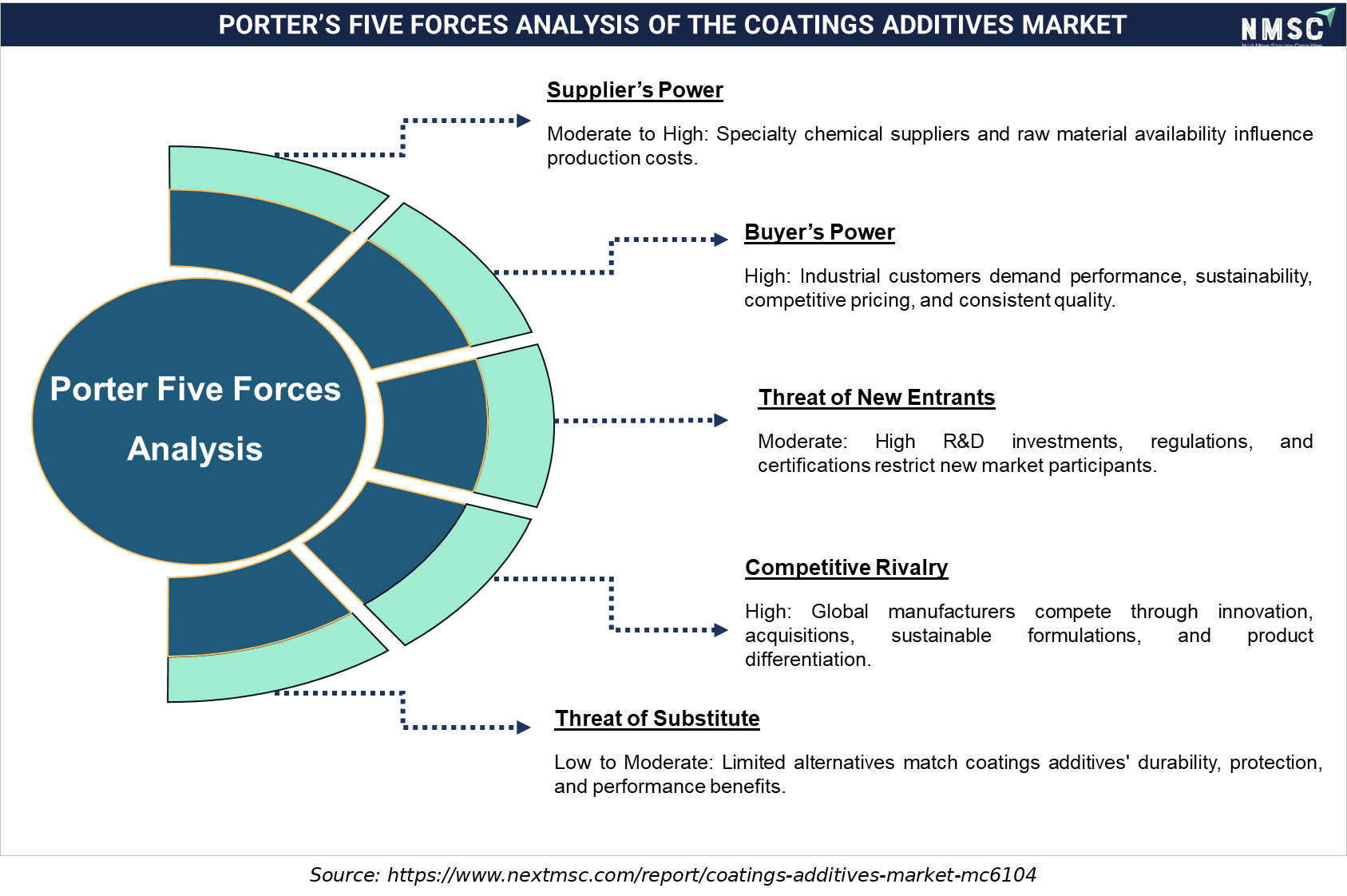
Porter’s Five Forces Analysis of the Coatings Additives Industry

The above infographic presents a Porter's Five Forces analysis of the coatings additives market, wherein supplier power remains moderate to high due to reliance on specialty chemicals and raw material availability. Buyer power is significant as industrial customers demand performance, sustainability, and consistent quality. The threat of new entrants is moderate, constrained by R&D investments and regulatory requirements, while competitive rivalry is intense among global manufacturers competing through innovation and acquisitions. Looking ahead, we observed that the threat of substitutes remains low to moderate, as few alternatives can match the durability and protective benefits offered by advanced coating additives.

Growth Opportunities

We found that three forward-looking whitespace opportunities stand out for stakeholders positioning within the Coatings Additives Sector over the coming decade.

How Can Suppliers Capture Demand From Waterborne Reformulation?

Expanding regulatory pressure to reformulate solvent-borne coatings creates a mechanism for additive suppliers to secure long-term technical partnership contracts with coatings formulators. Suppliers offering integrated waterborne rheology and defoamer packages stand to benefit most, as formulators increasingly seek single-source technical support for complex reformulation projects.

What Opportunity Does Automotive Coating Innovation Present for Surface Additive Suppliers?

Rising demand for premium automotive finish quality creates a mechanism for surface additive suppliers to capture higher-margin specialty contracts with OEM coating formulators. Suppliers with advanced silicone-based slip and leveling technology stand to benefit most, capturing share as automakers increasingly specify enhanced surface appearance standards for premium vehicle segments.

How Can Bio-Based Additive Producers Unlock Sustainability-Linked Contracts?

Growing customer demand for lower-carbon coating formulations creates a mechanism for bio-based additive producers to secure sustainability-linked supply agreements with major coatings manufacturers. Producers with documented renewable feedstock sourcing stand to benefit most, capturing contracts as formulators increasingly prioritize supply chain sustainability credentials alongside technical performance.

Regional Outlook

2025 (USD Billion)
2035 (USD Billion)
North Americ
Europe
Asia-Pacific
Middle East
Latin Americ
Region 2025 (USD Billion) 2035 (USD Billion) CAGR (%)
North America $10.0 USD Billion $40.0 USD Billion 9.0%
Europe $17.1 USD Billion $51.1 USD Billion 27.0%
Asia-Pacific $24.2 USD Billion $62.2 USD Billion 25.0%
Middle East & Africa $31.3 USD Billion $73.3 USD Billion 23.0%
Latin America $38.4 USD Billion $84.4 USD Billion 12.0%

Regional data is locked

Unlock complete regional numbers for this market.

Unlock Full Data

Competitive Landscape

We observed that the Coatings Additives market features a moderately concentrated competitive landscape, with diversified specialty chemical groups competing alongside focused additive specialists on chemistry breadth, technical service capability, and regional manufacturing footprint. Key Takeaways

Dimension Description
Market Structure Moderately concentrated; leading diversified specialty chemical groups profiled in this report collectively account for a significant share of branded additive revenue, while focused specialists serve niche chemistry and regional demand.
Innovation Focus Waterborne-compatible rheology and defoamer chemistry, silicone-based surface additives, and bio-based formulation innovation dominate current innovation pipelines across leading suppliers.
M&A Activity Selective technology partnerships and product launches, exemplified by Evonik's collaboration with Nippon Paint China and its continued new product introductions across defoamer chemistry.

How Do Companies Compete in the Coatings Additives Market?

Companies compete primarily on chemistry breadth, technical formulation support, and global manufacturing reach across the industry. Diversified specialty chemical groups such as BASF SE and Dow Inc. leverage broad product portfolios and integrated raw material access to serve multinational coatings formulators, while focused specialists such as Elementis plc and ALTANA AG's BYK division compete on deep technical expertise in specific additive chemistries.

Which Competitive Archetypes Dominate the Coatings Additives Market?

Two archetypes dominate the market: diversified specialty chemical groups offering integrated additive, resin, and raw material portfolios, and focused additive specialists building deep chemistry-specific technical expertise. BASF SE and Evonik Industries exemplify the diversified archetype through broad multi-chemistry portfolios, while ALTANA AG's BYK division and Elementis plc exemplify the focused specialist archetype concentrated on rheology and surface additive technology.

How Are Companies Differentiating Through Innovation in Coatings Additives?

Innovation and differentiation strategy increasingly center on waterborne-compatible chemistry and technical partnership depth. Evonik's collaboration with Nippon Paint China and its TEGO Foamex 8420 waterborne defoamer launch both reflect efforts to secure differentiated positioning among formulators pursuing sustainability-linked reformulation. Our analysis shows that suppliers unable to demonstrate waterborne technical capability risk losing share to more specialized competitors.

What M&A and Expansion Activity Is Shaping the Coatings Additives Market?

Technology partnerships and product innovation continue to reshape competitive positioning within the industry. Evonik's collaboration with Nippon Paint China and ALTANA AG's sustained BYK division sales growth illustrate how established suppliers pursue deepened customer partnerships and organic product innovation rather than large-scale acquisitions to expand market presence.

Key Market Players

Our assessment indicates that the following 20 companies are actively shaping chemistry innovation, technical service capability, and manufacturing capacity within the Coatings Additives market.

BASF SE ALTANA AG Evonik Industries AG Dow Inc. Arkema S.A. Eastman Chemical Company Ashland Inc. Clariant AG Allnex Netherlands B.V. Elementis plc The Lubrizol Corporation Momentive Performance Materials Inc. Nouryon Chemicals Holding B.V. Solvay S.A. Cabot Corporation DIC Corporation MÜNZING Corporation King Industries, Inc. Kusumoto Chemicals, Ltd. ICL Group Ltd.

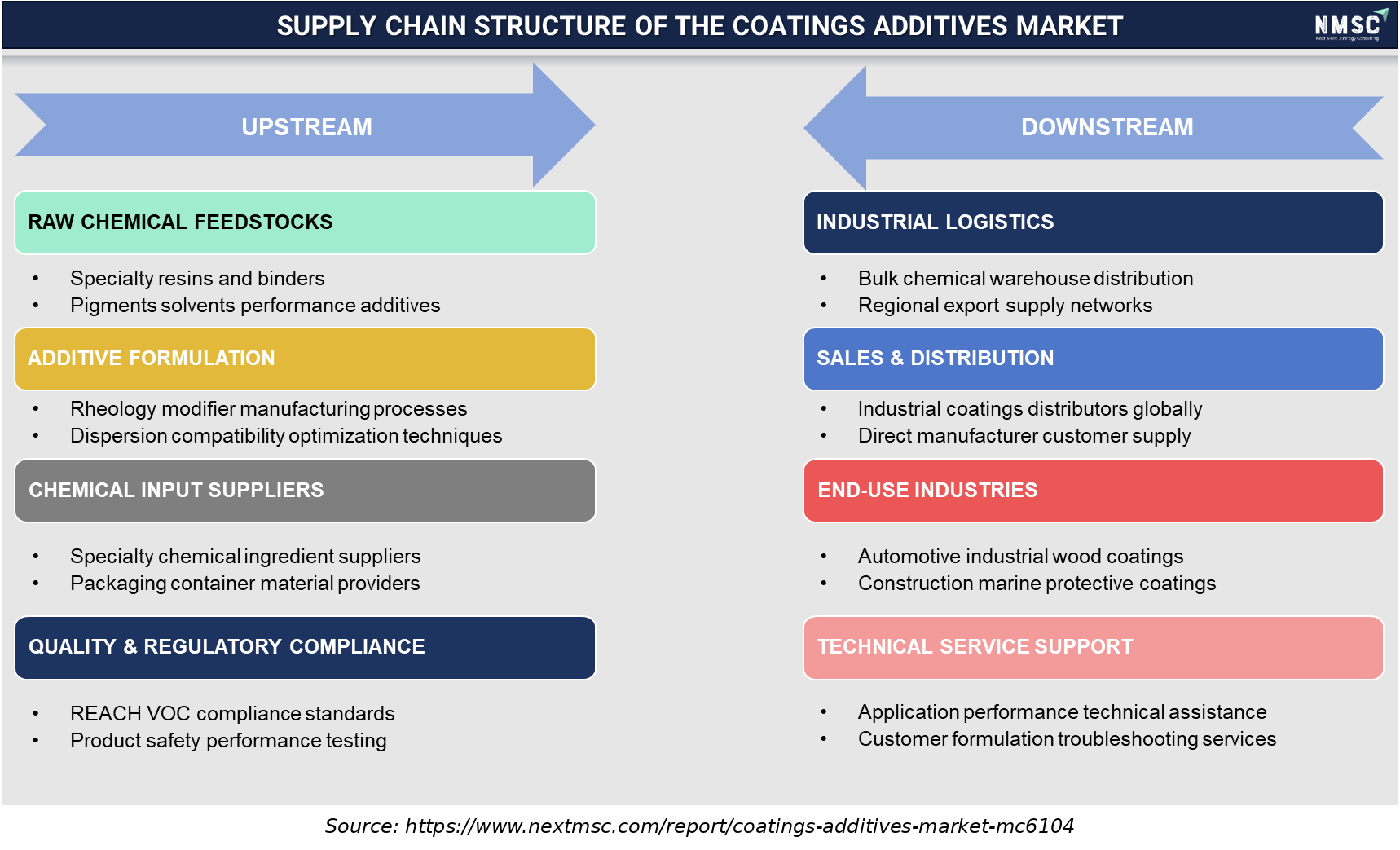
Supply Chain Structure of the Coatings Additives Market

Supply Chain Structure of the Coatings Additives Market
The above infographic presents the supply chain structure of the coatings additives market, segmented into upstream and downstream activities. Specialty resins, pigments, solvents, and performance additives are formulated through rheology modification and dispersion optimization, with suppliers providing chemical inputs and packaging materials. Compliance with REACH and VOC standards ensures quality and safety. Downstream, bulk logistics and distribution networks serve automotive, industrial, construction, and marine coating sectors. Looking ahead, we observed that technical support and application assistance remain essential for optimizing performance and customer satisfaction across the value chain.

How Do Companies Compete in the Coatings Additives Market?

Companies compete primarily on chemistry breadth, technical formulation support, and global manufacturing reach across the industry. Diversified specialty chemical groups such as BASF SE and Dow Inc. leverage broad product portfolios and integrated raw material access to serve multinational coatings formulators, while focused specialists such as Elementis plc and ALTANA AG's BYK division compete on deep technical expertise in specific additive chemistries.

Which Competitive Archetypes Dominate the Coatings Additives Market?

Two archetypes dominate the market: diversified specialty chemical groups offering integrated additive, resin, and raw material portfolios, and focused additive specialists building deep chemistry-specific technical expertise. BASF SE and Evonik Industries exemplify the diversified archetype through broad multi-chemistry portfolios, while ALTANA AG's BYK division and Elementis plc exemplify the focused specialist archetype concentrated on rheology and surface additive technology.

How Are Companies Differentiating Through Innovation in Coatings Additives?

Innovation and differentiation strategy increasingly center on waterborne-compatible chemistry and technical partnership depth. Evonik's collaboration with Nippon Paint China and its TEGO Foamex 8420 waterborne defoamer launch both reflect efforts to secure differentiated positioning among formulators pursuing sustainability-linked reformulation. Our analysis shows that suppliers unable to demonstrate waterborne technical capability risk losing share to more specialized competitors.

What M&A and Expansion Activity Is Shaping the Coatings Additives Market?

Technology partnerships and product innovation continue to reshape competitive positioning within the industry. Evonik's collaboration with Nippon Paint China and ALTANA AG's sustained BYK division sales growth illustrate how established suppliers pursue deepened customer partnerships and organic product innovation rather than large-scale acquisitions to expand market presence.

Latest Developments

We found that recent product innovation and technology partnerships within the coatings additives supply chain are concentrated on waterborne reformulation and defoamer chemistry.

Date Event
June 2026 Lanco 8020 SF is a 100% bio-based, micronized, microplastic-free surface modifier developed for water-based wood coatings, including UV water-based coatings. It is therefore a direct coating surface-modifier development.
May 2026 BASF launched Efka PX 4720, a high-performance dispersing agent based on Controlled Free Radical Polymerization technology. It is specifically designed for solvent-free UV coating formulations and enables ultra-matte coatings with low viscosity and low gloss, making it directly relevant to coatings additives.
June 2025 Evonik introduced TEGO Foamex 8051, a highly efficient siloxane-based defoamer specifically designed for waterborne decorative coatings. It directly improves foam control in coating formulations and therefore clearly falls within the coatings additives market.

Expert Insights

Dago Caceres

Dago Caceres

Senior Vice President and General Manager | Ashland

"Close collaboration is what drives meaningful innovation in coatings. By combining customer insight with our exceptional additives expertise, we’re developing solutions that improve application performance while aligning with sustainability expectations."

Analyst Interpretation

The statement reflects the increasing emphasis on performance-driven and sustainability-oriented innovation in the Coating Additives Market. NMSC's analysis indicates that additive manufacturers are increasingly working with coating formulators to develop solutions that improve application performance while meeting evolving environmental and formulation requirements. Our findings suggest that demand for multifunctional, high-performance, and sustainable coating additives is strengthening as manufacturers seek to balance coating quality, application efficiency, regulatory expectations, and sustainability objectives.

Investment Opportunities

What Capital Inflows Are Supporting the Coatings Additives Market?

Specialty chemical suppliers are directing capital toward waterborne chemistry research and technical partnership development. Evonik's collaboration with Nippon Paint China and ALTANA AG's sustained BYK division sales growth illustrate sustained capital and resource commitments supporting additive innovation across major coatings-producing regions.

How Is Infrastructure Investment Shaping Coatings Additives Demand?

Government and private infrastructure investment continues to expand the addressable base for architectural and industrial coating production, and by extension, additive demand. Our assessment indicates that sustained construction and automotive manufacturing investment across Asia-Pacific is creating multi-year procurement pipelines for additive suppliers serving regional coatings formulators.

What ESG Considerations Are Influencing Coatings Additives Investment Decisions?

Environmental, social, and governance considerations are increasingly influencing capital allocation toward bio-based and low-VOC additive chemistries. The European Union's REACH regulation and expanding national volatile organic compound standards are encouraging suppliers to prioritize sustainable raw material sourcing. We observed that investors are favoring additive manufacturers with documented sustainability credentials as environmentally linked procurement criteria gain traction across the coatings value chain.

Key Benefits for Stakeholders

How Does This Report Benefit Industry Leaders and Formulation Chemists?

Industry leaders and formulation chemists gain granular segmentation data across product type, application, and regional axes, enabling informed additive selection decisions for new coating formulation projects. Our analysis, data, and forecasts help formulators benchmark reformulation strategy against verified 2025–2035 market trajectories and evolving regulatory compliance trends.

How Does This Report Benefit Investors and Financial Analysts?

Investors and financial analysts gain a validated 2025 base-year market size, a fundamentals-supported 2026–2035 CAGR, and segment-level growth trajectories that support capital allocation and competitive benchmarking decisions. The report's strategic insights into supplier innovation and technical partnership trends help analysts assess relative positioning across the coatings additives value chain.

How Does This Report Benefit Technology Vendors and Product Teams?

Technology vendors and product teams gain visibility into the fastest-growing sub-segments, including Surface additives and Automotive coatings applications, informing product roadmap and go-to-market prioritization aligned with documented buyer and chemistry demand shifts through 2035.

Key Market Segments Evaluated

By Product Type

  • Rheology modifiers
  • Wetting and dispersing agents
  • Defoamers and deaerators
  • Surface additives
  • Biocides and preservatives
  • Other additives

By Application

  • Architectural and decorative coatings
  • Industrial coatings
  • Automotive coatings
  • Printing inks
  • Other applications

By Formulation

  • Waterborne
  • Solvent-borne
  • Powder and UV-cured
  • Other formulations

By Chemistry

  • Acrylic-based
  • Silicone-based
  • Fluorosurfactant-based
  • Other chemistries

Conclusion & Recommendations

The Coatings Additives market is positioned for sustained growth through 2035, underpinned by regulatory-driven waterborne reformulation and expanding Asian coatings production capacity. We expect Surface additives and Automotive coatings demand to gain structural share as premium chemistry adoption accelerates, while Rheology modifiers and Architectural and decorative coatings retain their position as the largest revenue contributors across the forecast period.

What Strategic Positioning Should Manufacturers Pursue?

Suppliers should prioritize waterborne-compatible chemistry innovation and deep technical partnership capability to align with formulator reformulation priorities. Our assessment indicates that suppliers investing in sustainability-linked product development, following the pattern established by Evonik and ALTANA AG's BYK division, are best positioned to capture automotive and bio-based additive opportunities through 2035.

How Attractive Is the Coatings Additives Market for Investment?

The market presents an attractive investment case, supported by a validated USD 9.8 Billion absolute dollar opportunity between 2026 and 2035 and a fundamentals-backed 7.05% CAGR. ALTANA's BYK division generated about USD 1.50 billion in sales in 2025, demonstrating the scale of the specialty additives business despite a challenging market environment.

What Market Shifts and Key Risks Should Stakeholders Monitor?

Stakeholders should monitor volatility in petrochemical raw material input costs, which restrains margin stability across additive manufacturers. We found that regulatory reformulation compliance costs across multiple jurisdictions also pose a risk to near-term profitability, particularly for smaller manufacturers with limited multi-region regulatory compliance capability.

What Are the Key Growth Pathways Through 2035?

Key growth pathways include expanding waterborne reformulation contracts, scaling silicone-based surface additive innovation for automotive coatings, and deepening bio-based additive development for sustainability-linked supply agreements. Our findings suggest that suppliers combining chemistry breadth with strong technical partnership capability are best-positioned to capture a disproportionate share of the market's projected USD 21.4 Billion 2035 revenue base.

FAQs

About the Author

Mayurima Roy

Mayurima Roy

Mayurima Roy is Research Analyst at Next Move Strategy Consulting, where she has spent 4 years working across the firm's full industry coverage rather than a single fixed vertical. Her work centers on structured research, ongoing trend tracking, competitive assessment, and insight-led content development, translating complex market data into clear, decision-ready narratives that support informed client decision-making across diverse global industries, market sectors, and world regions every day.

About the Reviewer

Supradip Baul

Supradip Baul

Supradip Baul is an accomplished business consultant and strategist with over a decade of rich experience in market intelligence, strategy, technology, and business transformation. His work has included rigorous qualitative and quantitative analysis across multiple industries, helping clients shape investment decisions and long-term roadmaps. Earlier in his career, he was associated with Gartner, where he contributed to industry-leading reports and market share analyses. He has worked with leading global companies and holds an MBA with a dual specialization in Marketing and Finance.

Download Free Sample

Pratyush Kumar Das

PRATYUSH KUMAR DAS

Assistant Manager

Polycab India Limited

We would like to express our appreciation for the data and insights provided by nextmsc. We are very pleased with the quality and depth of the information, which has proven to be highly valuable and beneficial for our business decision-making.

Gaurav Jaiswal

GAURAV JAISWAL

Founder & CEO

Yano Charge Private Limited

The EV Charging market research report provided by the NextMSC was exceptionally detailed and insightful. It offered a comprehensive analysis that proved to be a game-changer for our strategic planning. Truly a testament to the NextMSC’s expertise and thoroughness in EV market landscape & analysis.

Kishu Kanda

KISHU KANDA

Strategy Analyst

Accenture

We purchased the AI Consumer Market Report from this company. Not only did they customize the report to meet our specific requirements, but they also showed great flexibility in accommodating our budget. The report we received fully met our expectations. Additionally, they provided prompt and thorough responses to both our pre-purchase and follow-up questions. We look forward to working with this company again in the future.

Rishabh Jogani

RISHABH JOGANI

Strategy Analyst

Accenture Japan

We are incredibly impressed with the market report on the real estate market in India provided by Next Move Strategy Consulting. The report was thorough, insightful, and well-structured, offering deep analysis and actionable recommendations. It not only captured the current trends and dynamics but also provided a forward-looking perspective that has been invaluable for our strategic planning. Their team demonstrated exceptional professionalism, attention to detail, and a profound understanding of the industry. The data-driven insights and clarity of presentation exceeded our expectations, making complex market trends easy to understand. We highly recommend Next Move Strategy Consulting to anyone looking for reliable and comprehensive market research services. Their expertise has given us the confidence to navigate the complexities of the Indian real estate market with clarity and foresight.

Henri Knyphausen

HENRI KNYPHAUSEN

Partner at Singulier [Ex-BCG]

Singulier

I recently engaged NEXTMSC.com for a commercial due diligence project within the intralogistics sector, and I am pleased to provide a reference based on my experience. In utilizing NEXTMSC.com's services, I found their report to offer valuable insights into market dynamics and key industry players. The initial report provided a solid foundation for our analysis. However, as we were investigating a smaller target in the market, and I had specific customization requests requiring additional research. These requests included detailed information on product portfolios of various players and sub-market sizes, both inclusive and exclusive of certain product categories. NEXTMSC.com demonstrated commendable responsiveness and agility in accommodating these customization requests. Within a timeframe of 1-2 weeks, they delivered a revised report that met our specific needs. Furthermore, they were receptive to my follow-up inquiries, ensuring clarity and understanding of the data provided. The final deliverable significantly contributed to our due diligence efforts. One of NEXTMSC.com's notable strengths lies in their qualitative research capabilities. However, for future engagements, I would recommend the inclusion of a quantified market model in Excel format. Such a model would offer the ability to conduct in-depth analyses and explore various market segments, including country-specific data and subcomponent breakdowns. Based on my positive experience, I would not hesitate to work with NEXTMSC.com again. Their responsiveness, willingness to accommodate customization requests, and commitment to delivering actionable insights make them a reliable partner for commercial research projects.

Custom Market Research Services

We will customize the research for you if the listed report does not fully match your requirements.

Get 30% Free Customization

Select License

This website uses cookies to ensure you get the best experience on our website. Learn more

✖