ADAS Calibration Market Size, Share, Trends and Growth Analysis, By Offering Type (Calibration Hardware (Static Calibration Systems (Fixtures and Frames, Targets and Pattern Kits, Measurement Sensors), Dynamic Calibration Systems (Drive Cycle Recalibration Kits, Handheld Tester Modules)), Calibration Software, and Calibration Services (Manufacturer Delivered)), By Vehicle Class, By Distribution Channel, By Customer Type, and Region — Global Industry Report and Forecast, 2026–2035
Industry: Automotive & Transportation | Publishing Date: July 23, 2026 | Last Updated: September 30, 2026 | No of Pages: N/A | No. of Tables: N/A | No. of Figures: N/A | Format: PDF | Report Code: AT5369
What Is the ADAS Calibration Market Size?
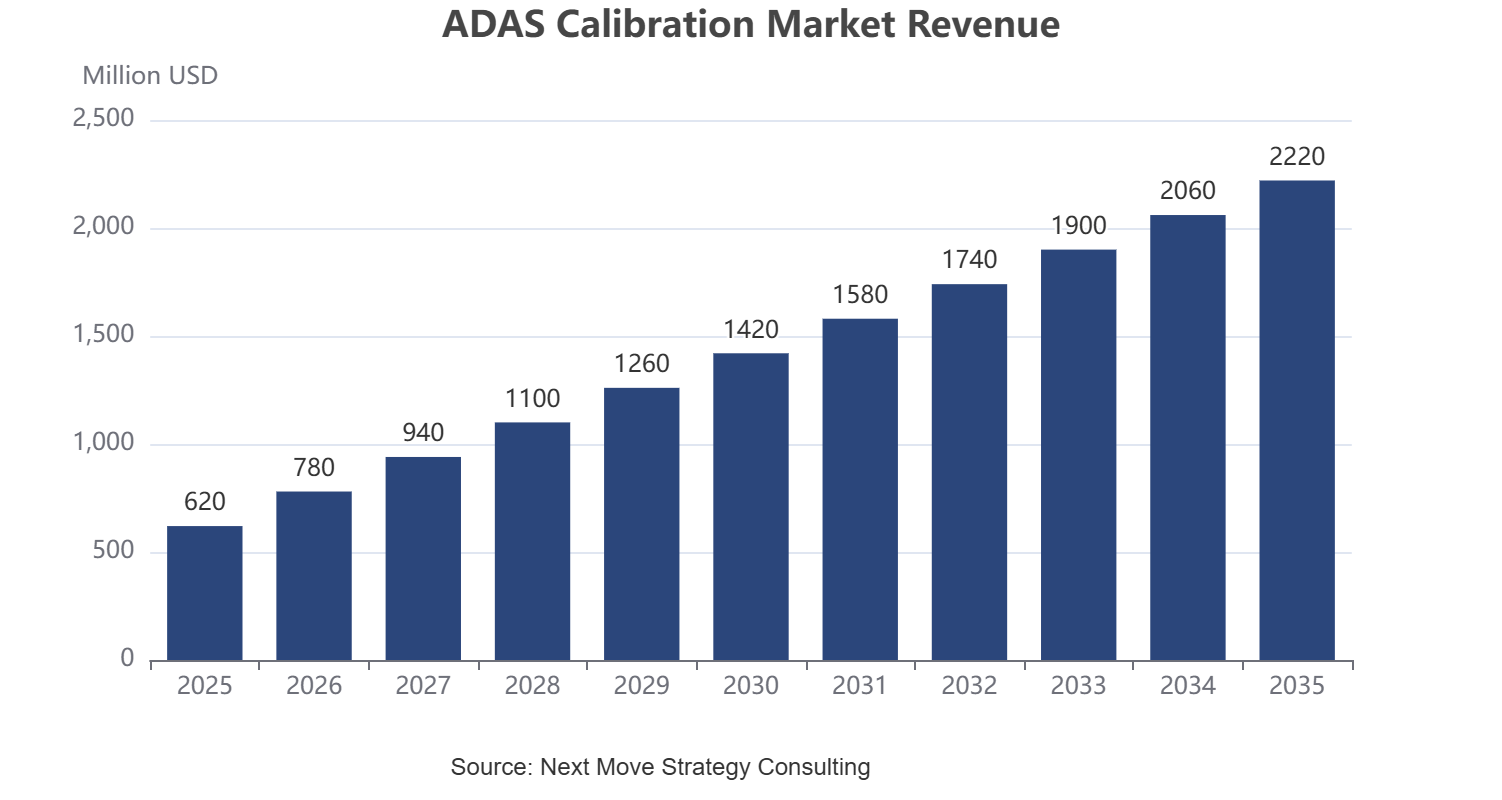
The global ADAS Calibration Market size was valued at USD 0.62 billion in 2025 and is estimated at USD 0.70 billion in 2026, forecast to reach USD 2.22 billion by 2035, expanding at a 13.7% CAGR between 2026 and 2035. North America leads with approximately 36% share, while calibration hardware dominates all other offering types with approximately 46% share.
We observed that growth is broad-based across every segmentation axis, with calibration software subscriptions and mobile calibration service adoption driving the dominant structural shifts through 2035.
|
Key Takeaways |
|
By Offering Type: Calibration Hardware held the largest share of approximately 46.1% (USD 0.29 Billion) in 2025; Calibration Software is the fastest-growing sub-segment at 17.8% CAGR from 2026–2035. |
|
By Vehicle Class: Passenger Vehicles and Light Trucks held the largest share of approximately 61% (USD 0.38 Billion) in 2025; Heavy Commercial Vehicles is the fastest-growing sub-segment at 16.1% CAGR from 2026–2035. |
|
By Distribution Channel: Direct Sales held the largest share of approximately 46.9% (USD 0.29 Billion) in 2025; Online and E Commerce is the fastest-growing sub-segment at 20.1% CAGR from 2026–2035. |
|
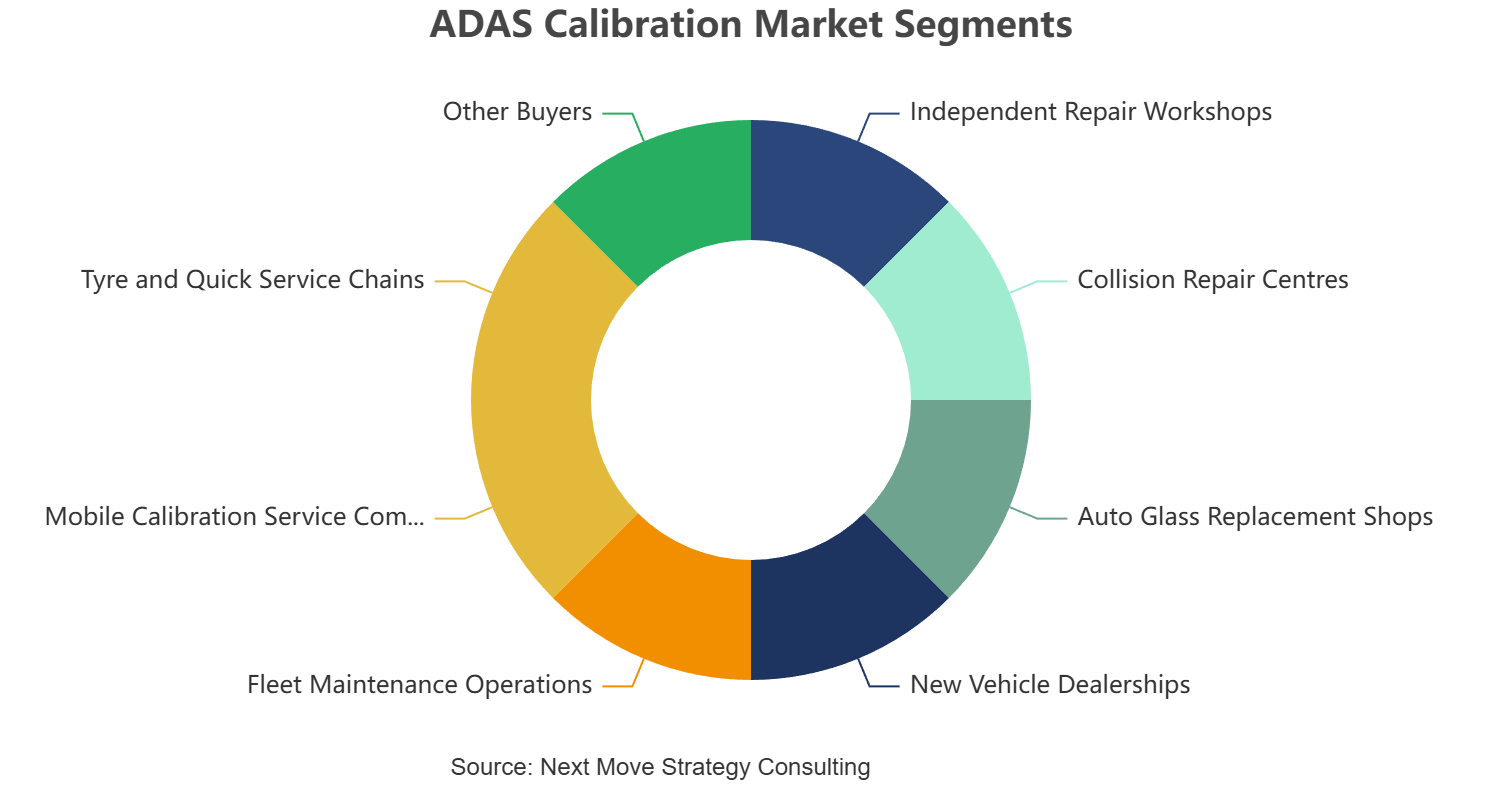
By Customer Type: Independent Repair Workshops held the largest share of approximately 26.9% (USD 0.17 Billion) in 2025; Mobile Calibration Service Companies is the fastest-growing sub-segment at 19.8% CAGR from 2026–2035. |
|
Dominant Region: North America dominated with approximately 36% revenue share (USD 0.22 billion) in 2025. |
|
Fastest-Growing Region: Asia-Pacific is expected to register the highest CAGR of 17.0% during 2026–2035. |
|
Dominant Country: U.S. led with approximately USD 0.17 billion in 2025. |
|
Fastest-Growing Country: India is the fastest-growing country at approximately 22.9% CAGR from 2026–2035. |
Market Opportunity: The ADAS calibration market is expected to create an absolute dollar opportunity of USD 1.52 billion between 2026 and 2035, presenting significant investment potential across the collision repair and vehicle safety calibration value chain.
According to Next Move Strategy Consulting analysis, collision repair centres and mobile calibration providers are increasingly consolidating tool and software subscriptions to reduce per-vehicle calibration cycle time, a shift that favors diversified hardware-software providers over single-product vendors as OEM procedure complexity rises through 2035.
What Does the ADAS Calibration Market Encompass?
The market encompasses the hardware fixtures, targets, software subscriptions, and manufacturer-delivered services required to align and verify advanced driver assistance system sensors after a collision, windshield replacement, suspension repair, or wheel alignment. Our assessment indicates that the scope spans static and dynamic calibration systems, vehicle communication software, and installation, training, and remote assistance services supplied to independent repair workshops, collision repair centres, auto glass replacement shops, dealerships, and mobile calibration companies worldwide.
Regulatory frameworks such as the U.S. National Highway Traffic Safety Administration's crash avoidance standards and Euro NCAP's safety assist protocols shape calibration procedure requirements, while insurer documentation mandates increasingly influence shop-level compliance. We observed that technology adoption is shifting toward cloud-connected calibration software and mobile service models that reduce shop downtime. Next Move Strategy Consulting's analysis indicates that this structural shift, combined with rising ADAS sensor penetration, is redefining procurement criteria across the market.
|
Field |
Details |
|
Market Size in 2025 |
USD 620 Million |
|
Market Size in 2026 |
USD 700 Million |
|
Revenue Forecast in 2035 |
USD 2,220 Million |
|
Growth Rate |
CAGR of 13.7% from 2026 to 2035 |
|
Analysis Period |
2025–2035 |
|
Base Year Considered |
2025 |
|
Forecast Period |
2026–2035 |
|
Market Size Estimation |
USD Million |
|
Companies Profiled |
20 |
|
Countries Covered |
33 |
|
Market Share |
Available for Top 10 Companies |
Key Emerging Trends
Based on research conducted by Next Move Strategy Consulting, we found that four structural trends are reshaping equipment design, procurement, and stakeholder engagement across the industry.
How Is Cloud Connected Calibration Software Transforming Shop Workflows?
Cloud-connected calibration software is replacing static, single-workstation tools as shops manage growing OEM procedure libraries. We observed that Bosch Diagnostics' ADS X scan tool software updates now add thousands of new special tests and system applications with each monthly release, expanding static and dynamic calibration coverage. Independent workshops and dealerships are adopting subscription-based platforms to keep pace with expanding vehicle coverage, while shop management software increasingly bundles calibration scheduling with diagnostic reporting.
Why Are Mobile Calibration Service Companies Gaining Market Share?
Mobile calibration service companies are gaining share as collision repair centres and auto glass replacement shops seek to outsource calibration without in-house capital investment. Our findings suggest that AirPro Diagnostics' remote Brand Specialist model and similar mobile platforms are reducing shop cycle time by delivering calibration expertise on demand. Providers such as Repairify are expanding remote and mobile service footprints, positioning outsourced calibration as a preferred model for smaller repair operations.
How Is Remote Diagnostic Integration Reshaping Collision Repair Workflows?
Remote diagnostic integration is streamlining how shops identify and document required calibrations within existing estimating platforms. We observed that Repairify's adasThink platform integrated with CCC Intelligent Solutions' CCC ONE estimating software during 2025, embedding calibration recommendations directly into repair estimates. This trend is elevating demand for fleet and shop management software among collision repair centres seeking to reduce missed calibrations and improve insurer documentation accuracy.
What Role Does Forward-Facing Camera Technology Play in Calibration Innovation?
Forward-facing camera calibration tools are emerging as a critical category as camera-based advanced driver assistance systems proliferate across new vehicle platforms. Our analysis shows that AirPro Diagnostics' Auggie tool applies augmented reality techniques to digitize calibration targets for forward-facing camera systems. Equipment manufacturers are engineering increasingly compact, portable static calibration frames to address space-constrained independent workshop environments.
PAIN POINT ANALYSIS OF THE ADAS CALIBRATION MARKET
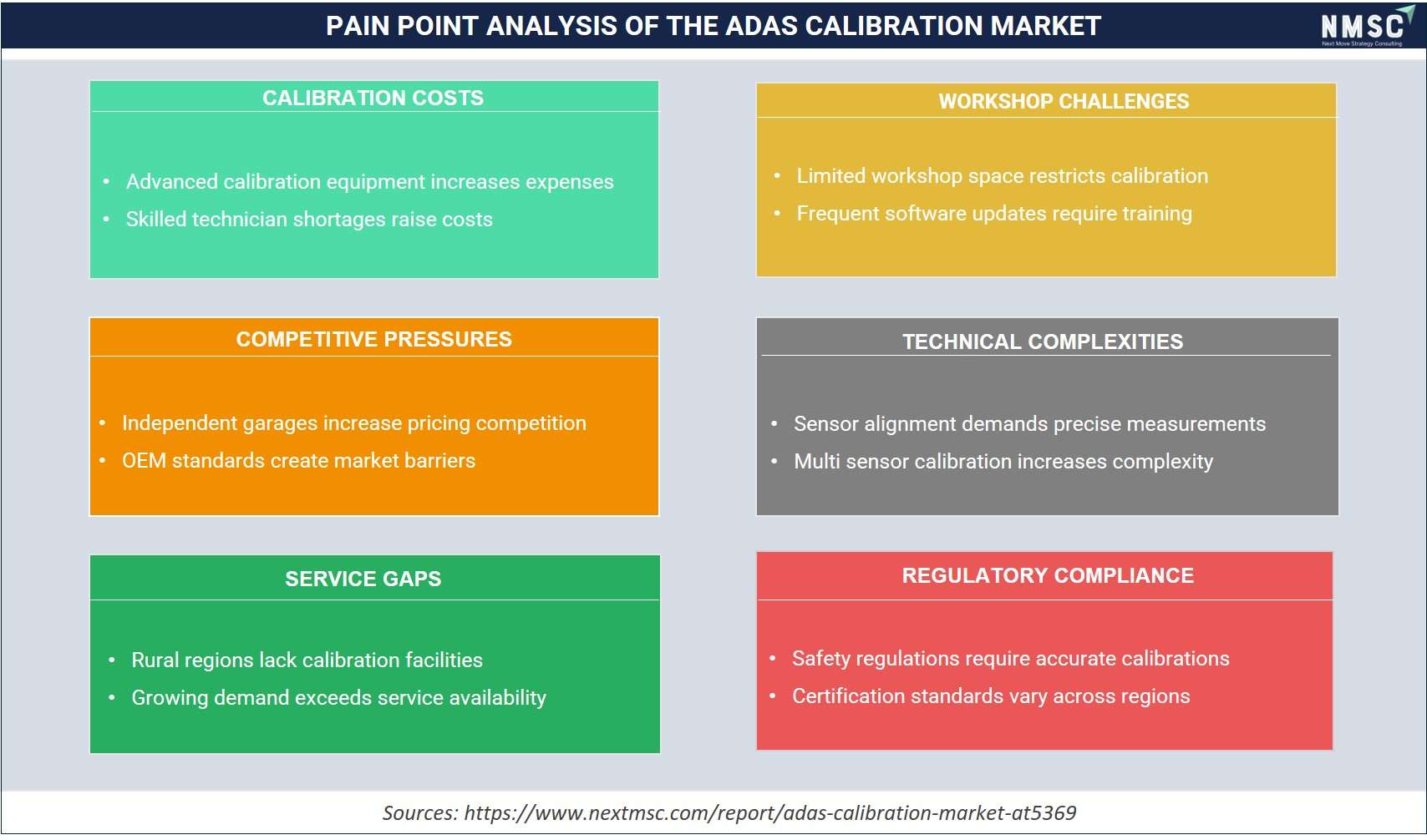
The infographic highlights the major pain points influencing the ADAS calibration market. High equipment costs, technician shortages, and workshop space constraints increase operational expenses, while frequent software updates demand continuous training. Technical complexities in multi-sensor calibration, regulatory compliance requirements, pricing pressure from independent garages, and limited service availability in rural regions collectively create significant challenges for market participants and service providers.
Growth Drivers and Restraints
Growth Catalyst and Risk Assessment Matrix
|
Factors |
Type |
(+/−) % Impact on CAGR |
Geographic Relevance |
Impact Timeline |
|
Rising ADAS sensor penetration across new vehicle production |
Driver |
+2.6% |
Global |
2026–2035 |
|
Growing collision and windshield replacement recalibration volume |
Driver |
+2.0% |
North America, Europe |
2026–2035 |
|
Expanding insurer documentation and safety compliance requirements |
Driver |
+1.6% |
North America, Europe |
2026–2035 |
|
Rising adoption of mobile and remote calibration service models |
Driver |
+1.3% |
Global |
2026–2032 |
|
Growing independent workshop investment in in-house calibration capability |
Driver |
+1.1% |
Asia-Pacific, Latin America |
2026–2035 |
|
Government vehicle safety mandates expanding ADAS feature requirements |
Driver |
+0.8% |
Global |
2026–2035 |
|
High equipment cost for static calibration fixtures and targets |
Restraint |
−1.2% |
Global |
2026–2035 |
|
Shortage of OEM-certified calibration technicians |
Restraint |
−0.8% |
North America, Europe |
2026–2032 |
|
Fragmented OEM procedure standards across vehicle brands |
Restraint |
−0.6% |
Global |
2028–2035 |
What Is the Primary Growth Driver of the ADAS Calibration Market?
Rising ADAS sensor penetration across new vehicle production is the primary driver of the market. Industry documentation cited in recent collision repair trade filings estimates that ADAS features were present in roughly 11% of vehicles in 2020, a share expected to rise to approximately 75% by 2030. We observed that this expanding installed base, reinforced by mandatory post-repair recalibration, continues to anchor baseline demand for static and dynamic calibration systems across developed and emerging economies alike.
How Is Insurer Documentation Demand Driving ADAS Calibration Market Growth?
Expanding insurer documentation requirements are accelerating market growth toward verified, reportable calibration workflows. The U.S. National Highway Traffic Safety Administration continues to track crash avoidance technology adoption that informs post-collision repair standards. Our assessment indicates that this compliance pressure, combined with subletting liability concerns highlighted by industry repair associations, is compressing adoption timelines for cloud-connected calibration software and remote verification platforms across North America and Europe.
What Is Restraining ADAS Calibration Market Expansion?
High equipment costs for static calibration fixtures, targets, and measurement sensors restrain adoption among small independent repair workshops without capital flexibility. Industry trade publications tracking collision repair mergers and acquisitions document rising consolidation as smaller shops seek scale to justify equipment investment. We found that mobile and remote calibration service models are beginning to offset this restraint, though full in-house adoption remains gradual across cost-sensitive workshop segments.
Segmentation Analysis
Segment Sizing: By Offering Type
|
Segment |
2025 (USD) |
2035 (USD) |
CAGR% (2026–2035) |
|
Calibration Hardware |
USD 0.29 Billion |
USD 0.75 Billion |
9.8% |
|
Calibration Software |
USD 0.14 Billion |
USD 0.67 Billion |
17.8% |
|
Calibration Services (Manufacturer Delivered) |
USD 0.20 Billion |
USD 0.80 Billion |
15.2% |
|
Total |
USD 0.62 Billion |
USD 2.22 Billion |
13.7% |
Which Offering Type Segment Dominates the ADAS Calibration Market?
Calibration Hardware, encompassing static fixtures, target and pattern kits, measurement sensors, and dynamic recalibration kits, led the market with USD 0.29 billion in 2025, supported by mandatory in-shop equipment for OEM-compliant static procedures. We observed that Calibration Software is the fastest-growing offering type, expanding at a 17.8% CAGR from 2026 to 2035, as shops increasingly subscribe to vehicle communication and OEM target data platforms to keep pace with expanding model coverage.
Segment Sizing: By Customer Type
|
Segment |
2025 (USD) |
2035 (USD) |
CAGR% (2026–2035) |
|
Independent Repair Workshops |
USD 0.17 Billion |
USD 0.53 Billion |
12.2% |
|
Collision Repair Centres |
USD 0.14 Billion |
USD 0.46 Billion |
12.9% |
|
Auto Glass Replacement Shops |
USD 0.09 Billion |
USD 0.32 Billion |
14.1% |
|
New Vehicle Dealerships |
USD 0.08 Billion |
USD 0.23 Billion |
10.9% |
|
Fleet Maintenance Operations |
USD 0.06 Billion |
USD 0.23 Billion |
15.2% |
|
Mobile Calibration Service Companies |
USD 0.05 Billion |
USD 0.28 Billion |
19.8% |
|
Tyre and Quick Service Chains |
USD 0.03 Billion |
USD 0.14 Billion |
16.3% |
|
Other Buyers |
USD 0.01 Billion |
USD 0.03 Billion |
9.2% |
|
Total |
USD 0.62 Billion |
USD 2.22 Billion |
13.7% |
Which Customer Type Segment Leads ADAS Calibration Market Demand?
Independent Repair Workshops remained the leading customer segment, valued at USD 0.17 billion in 2025 as the largest population of service points investing in calibration capability to retain collision and maintenance business. Based on research conducted by Next Move Strategy Consulting, we found that Mobile Calibration Service Companies are the fastest-growing customer segment at a 19.8% CAGR from 2026 to 2035, reflecting rising outsourcing of calibration work by smaller collision repair and glass replacement shops.
Segment Sizing: By Vehicle Class
|
Segment |
2025 (USD) |
2035 (USD) |
CAGR% (2026–2035) |
|
Passenger Vehicles and Light Trucks |
USD 0.38 Billion |
USD 1.27 Billion |
12.9% |
|
Light Commercial Vehicles |
USD 0.12 Billion |
USD 0.46 Billion |
14.9% |
|
Heavy Commercial Vehicles |
USD 0.09 Billion |
USD 0.40 Billion |
16.1% |
|
Other Vehicle Types |
USD 0.03 Billion |
USD 0.08 Billion |
9.8% |
|
Total |
USD 0.62 Billion |
USD 2.22 Billion |
13.7% |
Which Vehicle Class Leads ADAS Calibration Equipment Demand?
Passenger Vehicles and Light Trucks remained the dominant vehicle class, reaching USD 0.38 billion in 2025 due to their high production volume and dense advanced driver assistance system feature penetration. Our findings suggest that Heavy Commercial Vehicles represent the fastest-growing vehicle class at a 16.1% CAGR from 2026 to 2035, reflecting expanding fleet safety mandates and rising camera and radar system adoption across commercial trucking fleets.
Growth Opportunities
Our analysis shows that three forward-looking opportunities stand out for stakeholders positioning within the market over the 2026–2035 forecast period.
How Can Mobile Calibration Platforms Unlock Value for Collision Repair Networks?
Mobile calibration platforms present a whitespace opportunity for collision repair networks seeking to standardize calibration quality across multi-location operations without equipping every bay. Providers that scale remote Brand Specialist and mobile unit capacity stand to capture recurring service revenue as collision repair centres shift toward outsourced calibration models, benefiting the mobile calibration service segment through recurring per-vehicle service contracts.
Where Does OEM Data Subscription Software Create New Demand?
Independent workshops and dealerships represent an underpenetrated opportunity for OEM calibration data and target subscription software vendors. Suppliers that develop consolidated, multi-brand subscription platforms can secure long-term recurring software revenue from workshops navigating fragmented OEM procedure requirements, benefiting from subscription renewal cycles tied to expanding vehicle model coverage.
How Can Fleet Calibration Contracts Benefit Equipment Manufacturers?
Commercial fleet operators seeking standardized safety compliance create an opportunity for equipment manufacturers offering fleet-oriented dynamic calibration kits and maintenance contracts. Early movers that structure recurring fleet maintenance and technical support agreements can differentiate with fleet maintenance operations and tyre and quick service chains pursuing scheduled, multi-vehicle calibration programmes.
CONSUMER BEHAVIOR ANALYSIS OF THE ADAS CALIBRATION MARKET
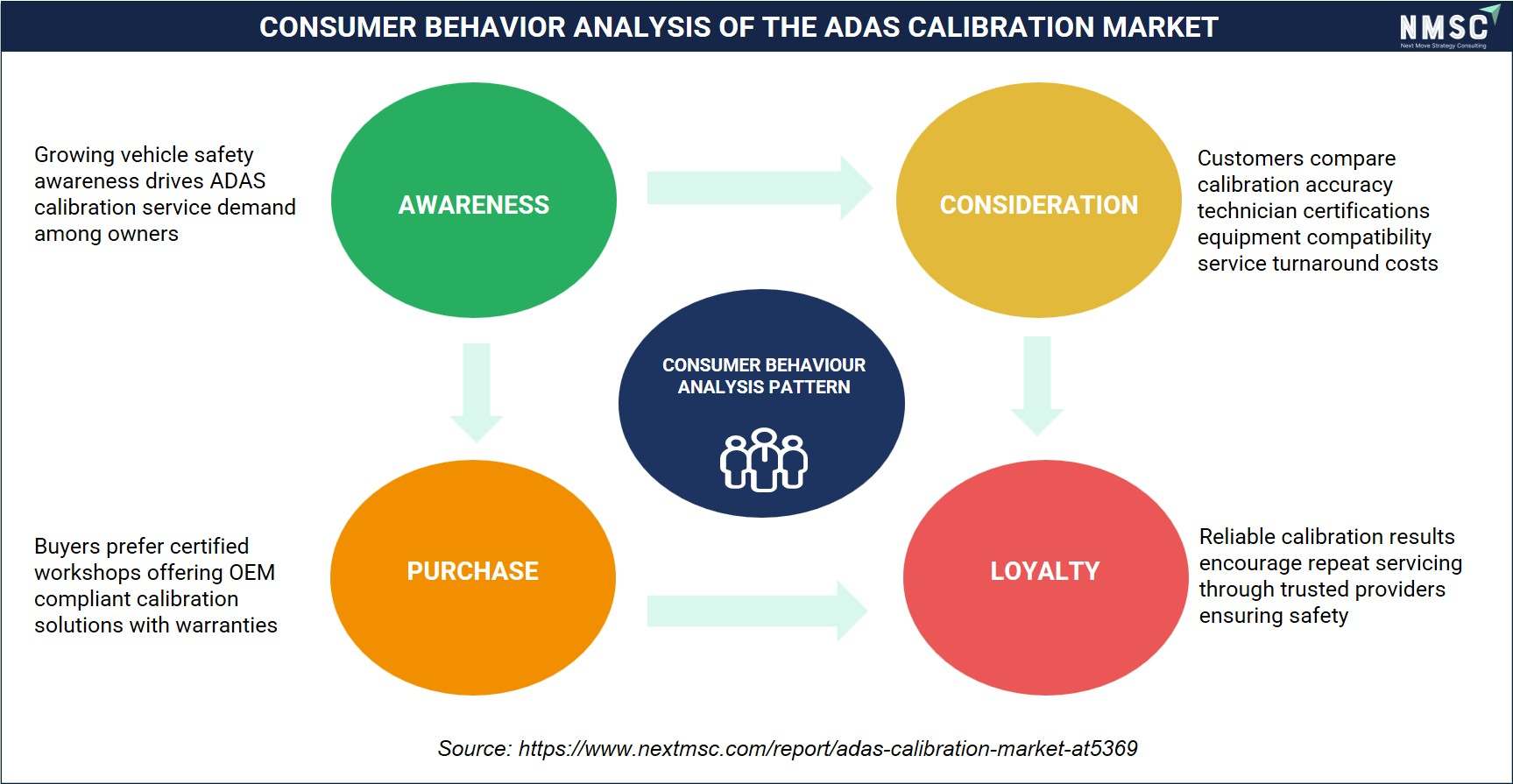
The infographic illustrates the consumer behavior journey in the ADAS calibration market, progressing from awareness to loyalty. Vehicle safety awareness drives demand, while customers evaluate calibration accuracy, technician expertise, equipment compatibility, service turnaround time, and costs before selecting providers. Buyers prefer certified, OEM-compliant workshops with warranties, and reliable calibration outcomes foster customer satisfaction, repeat servicing, and long-term loyalty.
Regional Outlook
Geographic Performance Snapshot
|
Region |
2025 (USD) |
2035 (USD) |
CAGR% (2026–2035) |
Key Driver |
|
North America |
USD 0.22 Billion |
USD 0.69 Billion |
11.8% |
High collision repair volume and NHTSA crash avoidance technology adoption |
|
Europe |
USD 0.17 Billion |
USD 0.53 Billion |
12.1% |
Euro NCAP safety assist protocols and dense ADAS-equipped vehicle parc |
|
Asia-Pacific |
USD 0.15 Billion |
USD 0.69 Billion |
17.0% |
Expanding new vehicle production and rising ADAS feature penetration |
|
Middle East & Africa |
USD 0.05 Billion |
USD 0.20 Billion |
15.2% |
Growing new vehicle dealership network expansion and fleet modernization |
|
Latin America |
USD 0.03 Billion |
USD 0.11 Billion |
13.9% |
Rising collision repair formalization and expanding vehicle safety adoption |
|
Total |
USD 0.62 Billion |
USD 2.22 Billion |
13.7% |
— |
North America ADAS Calibration Market Outlook
North America leads the market with a high collision repair volume and an established network of certified calibration equipment providers. We observed that National Highway Traffic Safety Administration crash avoidance technology tracking sustains demand for insurer-compliant, documented calibration procedures. Technology adoption remains advanced, with cloud-connected software and mobile calibration services expanding rapidly across the region's collision repair and auto glass replacement sectors.
Europe ADAS Calibration Market Outlook
Europe's market reflects a mature, regulation-intensive landscape shaped by Euro NCAP safety assist protocols and dense advanced driver assistance system penetration across new vehicles. Our findings suggest that workshops across Germany, France, and the UK are accelerating adoption of static calibration systems to satisfy manufacturer warranty and insurer documentation requirements. Technology adoption favors OEM-certified software platforms, supported by regional distributors investing in multi-brand coverage.
Asia-Pacific ADAS Calibration Market Outlook
Asia-Pacific is the fastest-growing ADAS calibration market region, propelled by expanding new vehicle production in China and India and rising advanced driver assistance system feature penetration. We found that regulatory frameworks remain less harmonized than in Europe, giving equipment distributors flexibility to scale standard hardware deployments rapidly. Technology adoption is accelerating as regional dealerships and workshops, including several China-based service networks, expand calibration capability.
Middle East & Africa ADAS Calibration Market Outlook
The ADAS calibration market in Middle East & Africa is expanding as new vehicle dealership networks grow and fleet operators modernize safety compliance programmes. Our analysis shows that Saudi Arabia and the UAE are attracting calibration equipment investment tied to dealership network expansion. Regulatory influence remains moderate, while technology adoption is gradually shifting toward dealership-based static calibration systems as regional distributors align with global OEM standards.
Latin America ADAS Calibration Market Outlook
Latin America's ADAS calibration market is supported by growing collision repair formalization in Brazil and Argentina and expanding new vehicle safety feature adoption. We observed that regulatory frameworks are less stringent than in North America or Europe, though multinational dealership networks operating locally are introducing OEM-compliant calibration specifications. Technology adoption remains centered on direct sales channels, with competitive intensity increasing as regional distributors partner with global equipment manufacturers.
U.S. ADAS Calibration Market
Based on our estimates, the U.S. market was valued at approximately USD 0.17 billion in 2025, projected to reach USD 0.48 billion by 2035 at a 11.1% CAGR. Demand structure is anchored by a high collision repair volume, strong insurer documentation requirements, and dense advanced driver assistance system vehicle penetration. Technology penetration favors cloud-connected calibration software and mobile service models, and competitive intensity remains high among established equipment providers serving national collision repair networks.
Canada ADAS Calibration Market
The market in Canada was valued at approximately USD 0.03 billion in 2025 and is projected to reach USD 0.09 billion by 2035, growing at a 12.2% CAGR. Demand is reflecting collision repair demand patterns similar to the U.S. market, while provincial insurer requirements shape documentation standards. Technology penetration is rising as workshops request multi-brand OEM subscription software, with competitive intensity moderate given reliance on cross-border equipment supply from U.S.-based distributors.
UK ADAS Calibration Market
As per our estimate, the UK market was valued at approximately USD 0.03 billion in 2025, projected to reach USD 0.09 billion by 2035 at a 10.8% CAGR. Demand structure is driven by Euro NCAP-aligned safety requirements and a mature collision repair and auto glass replacement network. Regulatory influence is significant, technology penetration favors OEM-certified static calibration systems, and competitive intensity remains steady among domestic and European distributors serving UK workshops.
Germany ADAS Calibration Market
According to our analysis, the Germany market was valued at approximately USD 0.04 billion in 2025, projected to reach USD 0.13 billion by 2035 at a 11.5% CAGR. Demand structure is benefiting from a strong domestic vehicle manufacturing base and dense advanced driver assistance system feature penetration among new vehicles. Germany's vehicle type approval framework drives regulatory influence, while technology penetration favors precision static calibration systems among leading dealership networks.
France ADAS Calibration Market
Based on our estimates, the France market was valued at approximately USD 0.02 billion in 2025, projected to reach USD 0.06 billion by 2035 at a 10.2% CAGR. Demand structure is supported by France's established collision repair sector and growing insurer-mandated calibration documentation requirements. Regulatory influence from French vehicle safety standards is notable, and competitive intensity remains high given the concentration of certified equipment distributors serving domestic workshops.
China ADAS Calibration Market
The market in China was valued at approximately USD 0.05 billion in 2025 and is projected to reach USD 0.25 billion by 2035, growing at a 16.9% CAGR. Demand is fueled by expanding domestic new vehicle production and a dense base of regional calibration equipment suppliers. Regulatory influence is increasing gradually, technology penetration is accelerating through dealership network expansion, and competitive intensity remains elevated among numerous China-based distributors.
India ADAS Calibration Market
As per our estimate, the India market was valued at approximately USD 0.03 billion in 2025, projected to reach USD 0.22 billion by 2035 at a 22.9% CAGR. Demand structure is the fastest among covered countries, reflecting rapid new vehicle production growth and expanding advanced driver assistance system feature adoption. Regulatory influence remains developing, while technology penetration is rising quickly as multinational equipment providers localize calibration sourcing to serve India's growing dealership network.
Japan ADAS Calibration Market
According to our analysis, the Japan market was valued at approximately USD 0.02 billion in 2025, projected to reach USD 0.08 billion by 2035 at a 14.1% CAGR. Demand structure is supported by Japan's precision-engineered vehicle manufacturing heritage and established dealership calibration infrastructure. Regulatory influence is well established, technology penetration is advanced, and competitive intensity remains high among long-standing domestic equipment distributors.
South Korea ADAS Calibration Market
Based on our estimates, the South Korea market was valued at approximately USD 0.02 billion in 2025, projected to reach USD 0.07 billion by 2035 at a 16.2% CAGR. Demand structure is benefiting from the country's globally influential vehicle manufacturing base and rising advanced driver assistance system feature adoption. Technology penetration is high, with domestic distributors supplying precision static calibration systems, and competitive intensity remains pronounced amid rapid product innovation cycles.
Australia ADAS Calibration Market
The market in Australia was valued at approximately USD 0.01 billion in 2025 and is projected to reach USD 0.04 billion by 2035, growing at a 15.1% CAGR. Demand is supported by a well-established collision repair sector and growing consumer preference for advanced safety-equipped vehicles. Regulatory influence stems from Australia's vehicle safety standards, while technology penetration favors imported static calibration systems amid moderate competitive intensity.
UAE ADAS Calibration Market
As per our estimate, the UAE market was valued at approximately USD 0.01 billion in 2025, projected to reach USD 0.06 billion by 2035 at a 16.0% CAGR. Demand structure is shaped by the UAE's role as a regional new vehicle dealership and collision repair hub. Regulatory influence remains moderate, technology penetration is improving through imported OEM-certified calibration formats, and competitive intensity is rising as distributors expand product portfolios to serve Gulf dealership networks.
Saudi Arabia ADAS Calibration Market
According to our analysis, the Saudi Arabia market was valued at approximately USD 0.01 billion in 2025, projected to reach USD 0.06 billion by 2035 at a 16.8% CAGR. Demand structure is driven by Vision 2030-linked dealership network expansion and rising fleet modernization investment. Regulatory influence is developing under national vehicle safety guidelines, and technology penetration is advancing as domestic distributors scale calibration equipment availability.
South Africa ADAS Calibration Market
Based on our estimates, the South Africa market was valued at approximately USD 0.01 billion in 2025, projected to reach USD 0.03 billion by 2035 at a 13.4% CAGR. Demand structure is reflecting a growing formal collision repair sector that continues to drive dealership investment in static calibration equipment. Regulatory influence is moderate, technology penetration favors imported hardware-software bundles, and competitive intensity is increasing as regional distributors expand product breadth.
Brazil ADAS Calibration Market
The market in Brazil was valued at approximately USD 0.01 billion in 2025 and is projected to reach USD 0.05 billion by 2035, growing at a 14.6% CAGR. Demand is supported by growing collision repair formalization and expanding new vehicle safety feature adoption. We observed that regulatory frameworks are less stringent than in North America or Europe, though multinational dealership networks are introducing OEM-compliant calibration specifications across major metropolitan markets.
Argentina ADAS Calibration Market
As per our estimate, the Argentina market was valued at approximately USD 0.01 billion in 2025, projected to reach USD 0.02 billion by 2035 at a 13.0% CAGR. Demand structure is reflecting rising collision repair sector formalization amid gradual advanced driver assistance system vehicle penetration. Regulatory influence remains developing, technology penetration is gradually increasing through imported static calibration systems, and competitive intensity is moderate among regional distributors serving dealership networks.
Competitive Landscape
We observed that the ADAS calibration market remains moderately fragmented among diversified global diagnostic equipment groups, with specialized calibration and mobile service providers competing for collision repair and independent workshop accounts.
|
Field |
Details |
|
Market Structure |
Moderately fragmented, led by diversified global diagnostic and calibration equipment manufacturers |
|
Innovation Focus |
Cloud-connected calibration software, mobile service platforms, and forward-facing camera targeting |
|
M&A Activity |
Active, concentrated in remote diagnostics integration and mobile calibration service consolidation |
How Do Companies Compete in the ADAS Calibration Market?
Companies compete primarily on OEM procedure coverage, calibration accuracy, and service delivery speed across the industry. Global players such as Robert Bosch GmbH and Autel Intelligent Technology Corp., Ltd. leverage broad multi-brand software subscriptions to serve dealerships and large workshop networks, while regional and mobile-focused providers compete on rapid response times and cost efficiency for independent repair workshops and auto glass replacement shops.
Which Competitive Archetypes Dominate the ADAS Calibration Market?
Two archetypes dominate the market: diversified global diagnostic equipment groups offering integrated hardware, software, and training support, and specialized remote or mobile calibration service providers focused on outsourced delivery. Robert Bosch GmbH and Hunter Engineering Company exemplify the diversified archetype through integrated static and dynamic calibration platforms, while AirPro Diagnostics LLC and Repairify, Inc. exemplify the mobile service archetype through remote Brand Specialist-delivered calibration.
How Are Companies Differentiating Through Innovation in ADAS Calibration?
Innovation and differentiation strategy increasingly center on cloud-connected software coverage and augmented reality-assisted targeting. Bosch Diagnostics' monthly ADS X software releases and AirPro Diagnostics' Auggie forward-facing camera tool both expand OEM procedure coverage to reduce technician error. Our analysis shows that suppliers unable to demonstrate broad, continuously updated vehicle coverage risk exclusion from collision repair network procurement shortlists.
What M&A and Expansion Activity Is Shaping the ADAS Calibration Market?
Partnerships and platform integrations continue to consolidate calibration capabilities within the industry. Repairify's asTech and NAPA preferred partnership to release a combined original equipment tool access device, alongside AirPro Diagnostics' agreement with Fix Network to supply franchise locations, illustrates how providers pursue distribution expansion. Trade publications tracking the sector confirm rising merger and acquisition activity as the ADAS calibration market grows.
Key Market Players
Our assessment indicates that the following 20 companies are actively shaping product innovation, service expansion, and software strategy within the global ADAS calibration market.
-
Robert Bosch GmbH
-
Hunter Engineering Company
-
Autel Intelligent Technology Corp., Ltd.
-
TEXA S.p.A.
-
Launch Tech Co., Ltd.
-
TOPDON Technology Co., Ltd.
-
Cojali S.L.
-
MAHA SE and Co. KG
-
WABCOWÜRTH Workshop Services GmbH
-
Chief Automotive Technologies, Inc.
-
CEMB S.p.A.
-
Ravaglioli S.p.A.
-
Corghi S.p.A.
-
AirPro Diagnostics LLC
-
Repairify, Inc.
-
ATH ADAS Target and Tools GmbH
-
Butler Products, LLC
Latest Developments
We found that recent activity within the ADAS calibration market is concentrated on software coverage expansion, remote diagnostics integration, and distribution partnerships, reflecting the industry's broader technology and service convergence.
|
Date |
Event |
|
July 2025 |
Bosch Diagnostics released ADS X Software Version 6.10, introducing expanded ADAS calibration coverage for 2025 model-year vehicles along with more than 200 new special tests and diagnostic functions. |
|
June 2025 |
Bosch Diagnostics launched ADS Software Version 6.9, adding over 6,500 new special tests, expanded ADAS calibration coverage, and new vehicle applications for 2025 models |
Expert Insights
 “The software-defined vehicle is at the core of this transformation, offering automakers a significant opportunity to deliver enhanced connectivity, improved safety and security features, increased levels of autonomy, as well as new business models and revenue streams.”
— Cristiano Amon, President & CEO, Qualcomm Incorporated
Statement made in: Qualcomm's 2024 Annual Meeting of Stockholders – CEO Vision & Growth Opportunities, held in March 2024, where Cristiano Amon discussed the automotive industry's transition toward software-defined vehicles and the growing role of digital technologies in enabling connectivity, vehicle safety, and autonomous driving.
Market Interpretation
The statement emphasizes the automotive industry's shift toward software-defined vehicles, where advanced digital technologies are reshaping vehicle functionality and safety. As automakers increasingly integrate AI-powered computing, connectivity, centralized vehicle architectures, and autonomous driving capabilities, the adoption of Advanced Driver Assistance Systems (ADAS) is expected to accelerate. This transformation is driving demand for high-performance processors, sensor fusion technologies, perception software, and intelligent safety solutions, thereby creating significant long-term growth opportunities for ADAS technology providers, semiconductor companies, and vehicle manufacturers.
Investment Opportunities
What Capital Inflows Are Targeting the ADAS Calibration Market?
Capital inflows into the ADAS calibration market are increasingly directed toward mobile service platform expansion and remote diagnostics software integration. Strategic partnerships, such as Repairify's preferred alliance with NAPA and AirPro Diagnostics' franchise supply agreement with Fix Network, continue to fund distribution network growth. We observed that investors favor providers demonstrating broad OEM procedure coverage, viewing continuous software update cadence as a proxy for long-term workshop contract retention.
How Is Infrastructure Investment Supporting ADAS Calibration Service Delivery?
Infrastructure investment is expanding mobile calibration fleets and remote Brand Specialist capacity across North America and Europe to serve rising collision repair demand. Our findings suggest that AirPro Diagnostics' ten-minute response pledge model illustrates how providers are investing in rapid-response infrastructure to reduce vehicle downtime, supporting the precision required for static and dynamic calibration procedures delivered on demand.
What ESG Considerations Are Shaping ADAS Calibration Investment Decisions?
Environmental, social, and governance considerations are increasingly relevant to investment decisions across the industry, with vehicle safety outcomes and reduced repeat-repair emissions as key criteria. The U.S. National Highway Traffic Safety Administration's crash avoidance data continues to inform safety-outcome disclosures. We found that investors increasingly favor providers with verified calibration accuracy documentation, treating safety compliance as a governance indicator alongside technician training standards.
Key Benefits for Stakeholders
How Does This Report Benefit Enterprise and Industry Leaders?
Enterprise and industry leaders gain access to validated segmentation, competitive benchmarking, and regional demand forecasts that support sourcing and service-expansion decisions across the ADAS calibration industry. Our analysis shows that detailed offering type, vehicle class, and customer type breakdowns help operations teams align equipment investment with OEM compliance and insurer documentation requirements while identifying underserved customer segments for expansion.
How Does This Report Benefit Investors and Financial Analysts?
Investors and financial analysts benefit from consistent, single-point market size and CAGR estimates that support valuation and capital-allocation decisions across the ADAS calibration market supply chain. We observed that the report's regional and segment-level growth differentials help identify which equipment manufacturers and service providers are best positioned to capture above-market growth in software and mobile service categories through 2035.
How Does This Report Benefit Technology Vendors and Product Teams?
Technology vendors and product teams gain insight into emerging design requirements, including cloud-connected software, mobile service delivery, and augmented reality-assisted targeting, that are reshaping the industry. Our findings suggest that this analysis helps R&D teams prioritize development roadmaps around expanding OEM procedure coverage and remote diagnostics integration that are increasingly required by collision repair and independent workshop procurement processes.
Key Market Segments
By Offering Type
-
Calibration Hardware
-
Static Calibration Systems
-
Fixtures and Frames
-
Targets and Pattern Kits
-
Measurement Sensors
-
-
Dynamic Calibration Systems
-
Drive - Cycle Recalibration Kits
-
Handheld Tester Modules
-
-
-
Calibration Software
-
Vehicle Communication and Diagnostic Software
-
OEM Calibration Data and Target Subscriptions
-
Fleet and Shop Management Software
-
-
Calibration Services (Manufacturer - Delivered)
-
Installation and Commissioning
-
Training and Certification Programmes
-
Maintenance and Technical Support Contracts
-
Remote Calibration Assistance Platforms
-
By Vehicle Class
-
Passenger Vehicles and Light Trucks
-
Light Commercial Vehicles
-
Heavy Commercial Vehicles
-
Other Vehicle Types
By Distribution Channel
-
Direct Sales
-
Authorised Distributors and Resellers
-
Online and E - Commerce
By Customer Type
-
Independent Repair Workshops
-
Collision Repair Centres
-
Auto Glass Replacement Shops
-
New Vehicle Dealerships
-
Fleet Maintenance Operations
-
Mobile Calibration Service Companies
-
Tyre and Quick - Service Chains
-
Other Buyers
By Region
-
North America: U.S., Canada, Mexico
-
Europe: UK, Germany, France, Italy, Spain, Sweden, Denmark, Finland, Netherlands, Rest of Europe
-
Asia-Pacific: China, India, Japan, South Korea, Taiwan, Indonesia, Indonesia, Vietnam, Australia, Philippines, Malaysia, Rest of APAC
-
Middle East & Africa: Saudi Arabia, UAE, Egypt, Israel, Turkey, Nigeria, South Africa, Rest of MEA
-
Latin America: Brazil, Argentina, Chile, Colombia, Rest of LATAM
Conclusion and Recommendations
What Is the Long-Term Outlook for the ADAS Calibration Market?
The long-term outlook for the market remains positive, with global revenue projected to more than triple from USD 0.62 billion in 2025 to USD 2.22 billion by 2035 at a 13.7% CAGR. We observed that sustained ADAS sensor penetration, insurer documentation requirements, and mobile service adoption will continue underpinning demand across collision repair, dealership, and independent workshop applications through the forecast period.
What Strategic Positioning Should ADAS Calibration Suppliers Pursue?
Suppliers should prioritize cloud-connected software platforms and mobile service capability while pursuing broad OEM procedure coverage to secure long-term collision repair and dealership contracts. Our assessment indicates that providers investing early in remote diagnostics integration and augmented reality-assisted targeting will be best positioned to capture premium pricing within the ADAS calibration market.
How Attractive Is the ADAS Calibration Market for New Investment?
The ADAS calibration industry presents an attractive investment case, supported by a USD 1.52 billion absolute dollar opportunity between 2026 and 2035 and above-average growth in Asia-Pacific and calibration software categories. We found that investment attractiveness is highest for providers combining broad software subscription coverage with scaled mobile service capacity, positioning them to serve both independent and enterprise collision repair customers simultaneously.
What Market Shifts and Key Risks Should Stakeholders Monitor?
Stakeholders should monitor equipment cost pressure, technician shortage constraints, and fragmented OEM procedure standards as key risks to the ADAS calibration market. Our analysis shows that suppliers unable to adapt to expanding, continuously updated vehicle coverage risk losing shop contracts to competitors with validated multi-brand software platforms, particularly within North America's increasingly compliance-driven collision repair environment.
What Are the Key Growth Pathways for the ADAS Calibration Market?
Key growth pathways include expanding cloud-connected software subscriptions, scaling mobile and remote calibration service networks, and deepening penetration into fleet maintenance and tyre and quick service channels. Next Move Strategy Consulting's analysis indicates that suppliers pursuing these pathways while maintaining cost competitiveness in standard hardware categories will be best positioned to capture the ADAS calibration market's projected growth through 2035.
About the Author
 Liza Phukan
— Liza Phukan is Research Associate at Next Move Strategy Consulting, where she has covered emerging industries and market research across sectors for 3.5 years. Her work includes analyzing industry developments, validating market data, and developing structured business content from research findings. She uses secondary research and data-validation practices to turn complex market information into clear decision-useful market analysis for business audiences and support report development and B2B.
Liza Phukan
— Liza Phukan is Research Associate at Next Move Strategy Consulting, where she has covered emerging industries and market research across sectors for 3.5 years. Her work includes analyzing industry developments, validating market data, and developing structured business content from research findings. She uses secondary research and data-validation practices to turn complex market information into clear decision-useful market analysis for business audiences and support report development and B2B.
About the Reviewer
 Supradip Baul
— Supradip Baul is an accomplished business consultant and strategist with over a decade of rich experience in market intelligence, strategy, technology, and business transformation. His work has included rigorous qualitative and quantitative analysis across multiple industries, helping clients shape investment decisions and long-term roadmaps. Earlier in his career, he was associated with Gartner, where he contributed to industry-leading reports and market share analyses. He has worked with leading global companies and holds an MBA with a dual specialization in Marketing and Finance.
Supradip Baul
— Supradip Baul is an accomplished business consultant and strategist with over a decade of rich experience in market intelligence, strategy, technology, and business transformation. His work has included rigorous qualitative and quantitative analysis across multiple industries, helping clients shape investment decisions and long-term roadmaps. Earlier in his career, he was associated with Gartner, where he contributed to industry-leading reports and market share analyses. He has worked with leading global companies and holds an MBA with a dual specialization in Marketing and Finance.
At Next Move Strategy Consulting, we understand that insightful market research is the cornerstone of successful business decisions. That's why we employ a robust and multifaceted approach, combining various methodologies to deliver the most accurate and actionable data for our clients.

Research Landscape
We navigate the world of research with two primary approaches:
Qualitative Approach
Our qualitative research methodologies involve immersive techniques such as in-depth interviews, focus groups, and observational studies. By engaging directly with individuals and stakeholders, we uncover valuable insights that quantitative data alone may overlook.

Quantitative Research
In tandem with qualitative methodologies, NMSC leverages the power of Quantitative Research to provide a robust foundation of numerical insights. Through systematic data collection and analysis, we quantify patterns, preferences, and market trends, offering a comprehensive view of the business landscape.
Our quantitative research approach employs diverse tools, including surveys, experiments, and statistical modelling. These methodologies enable us to gather data from a large and representative sample, ensuring the statistical significance of our findings. By employing structured questionnaires and standardized data collection methods, we guarantee the reliability and validity of the information we present to our clients.
Quantitative research is particularly effective in measuring the prevalence of trends, assessing market size, and gauging the impact of various factors on consumer behavior. The numerical precision attained through this approach equips our clients with actionable insights, facilitating data-driven decision-making and strategy formulation.


Our Specialized Toolbox for Industry-Specific Market Research
We deploy a specialized arsenal of techniques tailored to meet your unique requirements. Here's a glimpse into our comprehensive toolbox:

Information Procurement
The stage entails acquiring market data or relevant information through various sources and methodologies.


Market Research Approach
We utilize both top-down and bottom-up approaches in market research analysis to achieve a comprehensive understanding of the market dynamics, leveraging the broad perspective of industry trends and macroeconomic factors alongside detailed insights from specific segments and individual companies.

Porters Five Forces Analysis
We conduct Porter's Five Forces analysis to evaluate the competitive landscape of an industry, providing us with insights into factors that affect profitability and strategic positioning.

SWOT Analysis

Forecasting
We utilize a forecasting model to predict future consumption by considering parameters like population, economics, regulations, market competition, drivers, constraints, technology, and pricing. We also employ statistical techniques such as multilinear regression, exponential smoothing, moving average, ARIMA, and Monte Carlo simulations for accurate predictions. In econometric forecasting, we analyzed short-term and long-term event impacts, attributing values based on regulatory frameworks, economic factors, and market events.





 Speak to Our Analyst