AI-Powered Personal Finance Management Market Size, Share, Trends and Growth Analysis, By Provider Type (Subscription-Led App, Banking-Led App, Wealth-Led App, Marketplace-Led App, B2B Platform, and Other Provider Type), By AI Function (Categorization, Prediction, Recommendation, Automation, Conversation, and Agentic Action), By Core Use Case, By Revenue Model, By Channel, By Customer Type, and Region — Global Industry Report and Forecast, 2026–2035
Industry: BFSI | Publishing Date: July 27, 2026 | Last Updated: September 30, 2026 | No of Pages: N/A | No. of Tables: N/A | No. of Figures: N/A | Format: PDF | Report Code: BF5419
What Is the AI-Powered Personal Finance Management Market Size?
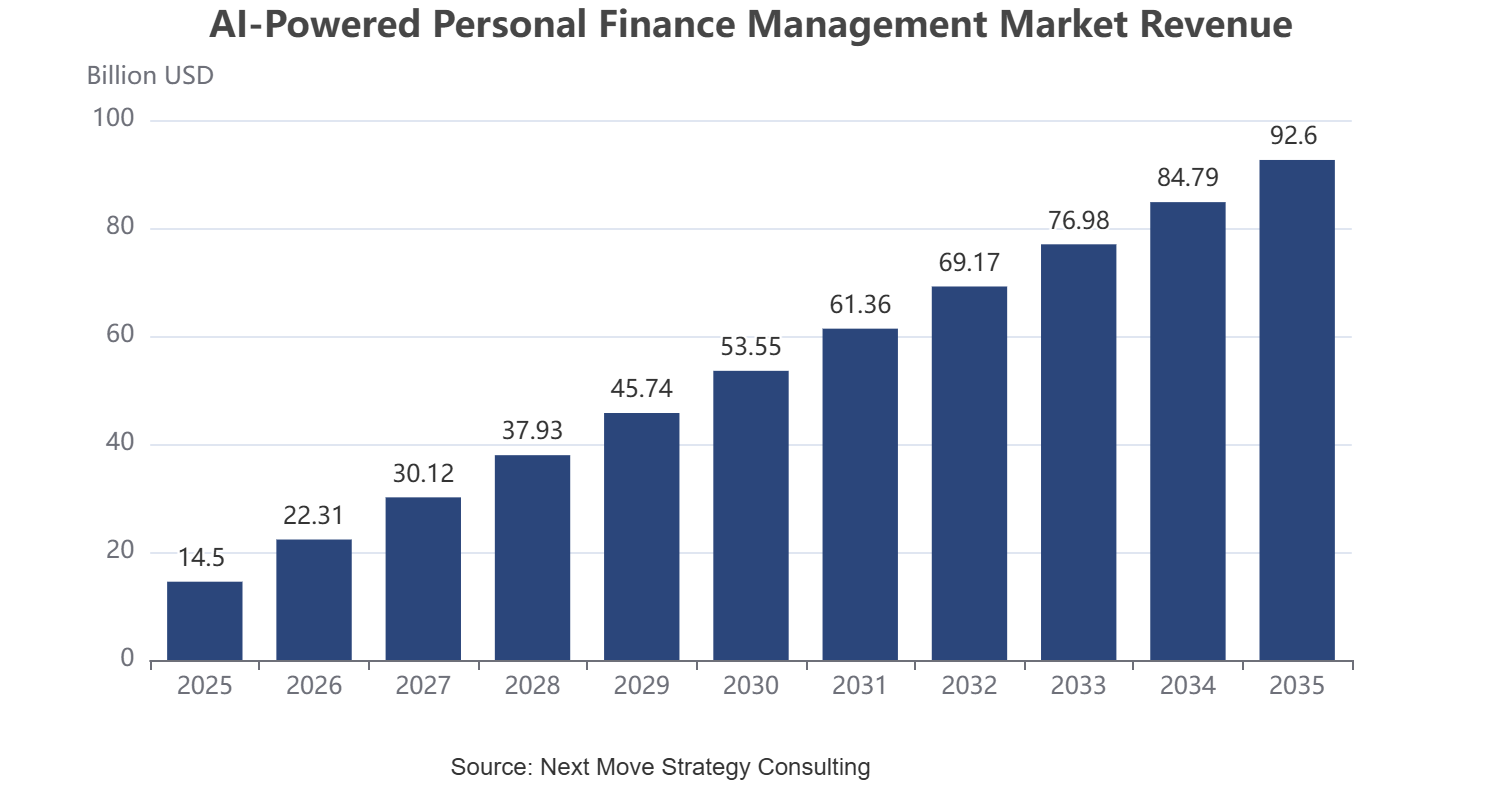
The global AI-powered personal finance management market size was valued at USD 14.5 Billion in 2025 and is estimated at USD 17.2 Billion in 2026, forecast to reach USD 92.6 Billion by 2035, expanding at a 20.6% CAGR between 2026 and 2035. North America leads with approximately 38% share, while subscription-led apps dominate all other provider types with approximately 34% share.
We observed that growth is broad-based across every segmentation axis, with agentic AI capabilities and wealth-led platforms driving the dominant structural shifts through 2035.
|
Key Takeaways |
|
By Provider Type: Subscription-Led App held the largest share of approximately 34% (USD 4.90 Billion) in 2025; Wealth-Led App is the fastest-growing sub-segment at 25.0% CAGR from 2026–2035. |
|
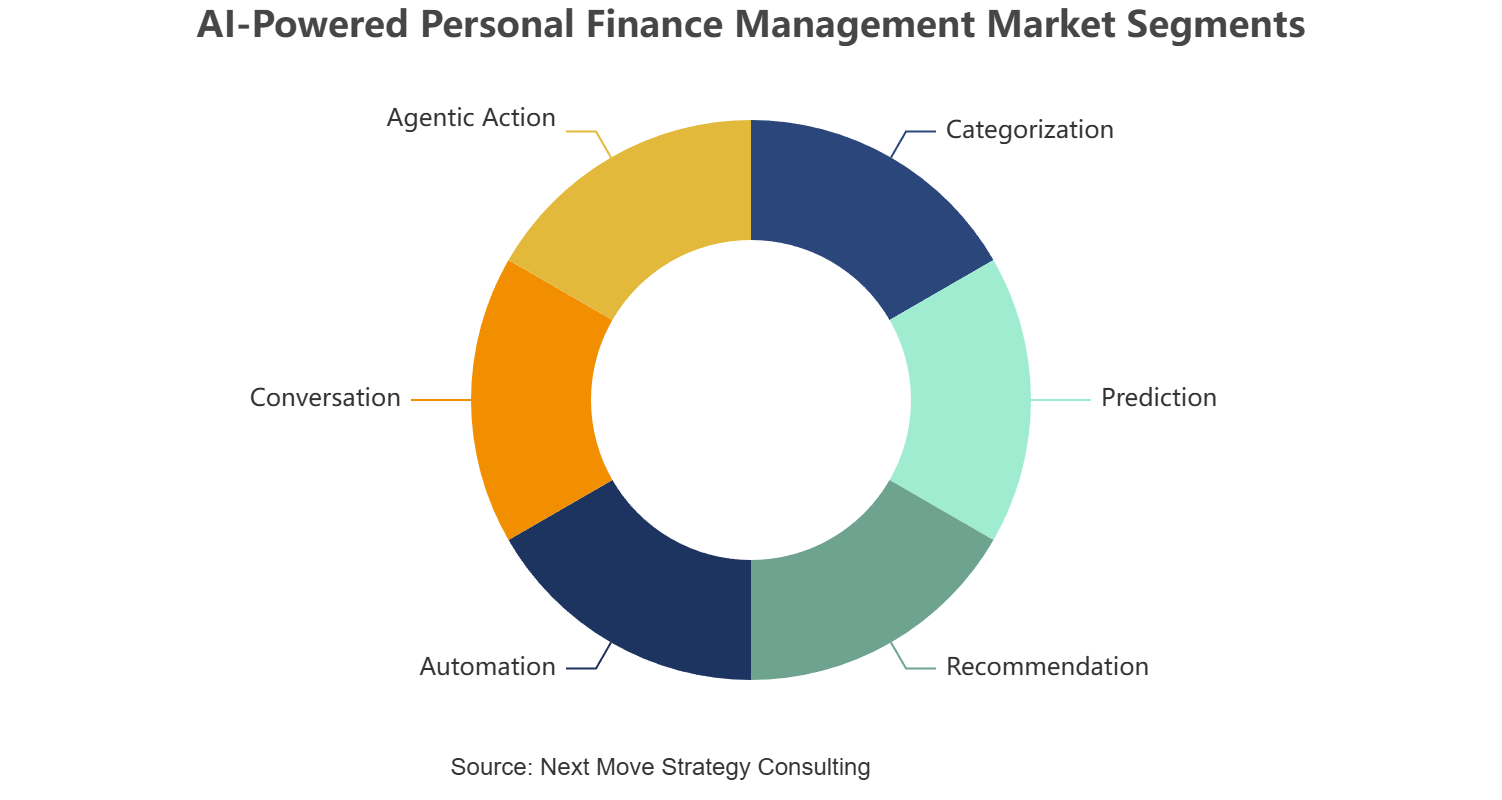
By AI Function: Categorization held the largest share of approximately 22% (USD 3.20 Billion) in 2025; Agentic Action is the fastest-growing sub-segment at 31.5% CAGR from 2026–2035. |
|
By Core Use Case: Budgeting held the largest share of approximately 18% (USD 2.60 Billion) in 2025; Product Matching is the fastest-growing sub-segment at 34.6% CAGR from 2026–2035. |
|
By Revenue Model: Subscription held the largest share of approximately 34% (USD 4.90 Billion) in 2025; AUM Fees is the fastest-growing sub-segment at 26.0% CAGR from 2026–2035. |
|
By Channel: Mobile App held the largest share of approximately 58% (USD 8.40 Billion) in 2025; Embedded is the fastest-growing sub-segment at 27.0% CAGR from 2026–2035. |
|
By Customer Type: Mass Market held the largest share of approximately 40% (USD 5.80 Billion) in 2025; Mass Affluent is the fastest-growing sub-segment at 26.0% CAGR from 2026–2035. |
|
Dominant Region: North America dominated with approximately 38% revenue share (USD 5.51 Billion) in 2025. |
|
Fastest-Growing Region: Asia-Pacific is expected to register the highest CAGR of 25.3% during 2026–2035. |
|
Dominant Country: U.S. led with approximately USD 4.35 billion in 2025. |
|
Fastest-Growing Country: India is the fastest-growing country at approximately 30.3% CAGR from 2026–2035 |
Market Opportunity: The AI-powered personal finance management market is expected to create an absolute dollar opportunity of USD 75.4 billion between 2026 and 2035, presenting significant investment potential across the retail banking, wealth management, and consumer fintech value chain.
According to Next Move Strategy Consulting analysis, agentic AI capabilities that move beyond passive tracking into autonomous bill negotiation and savings reallocation are becoming the primary differentiator banks and standalone applications use to defend subscription revenue against free banking-led alternatives.
What Does the AI-Powered Personal Finance Management Market Encompass?
The AI-powered personal finance management market encompasses software applications and embedded banking tools that apply machine learning, natural language processing, and increasingly agentic automation to help individuals track spending, forecast cash flow, build credit, invest, and plan for retirement. Our assessment indicates that the scope spans standalone subscription apps, bank-embedded dashboards, robo-advisory platforms, and B2B white-label toolkits supplied to retail banks, neobanks, brokerages, and employers across mass-market, mass-affluent, and household customer segments worldwide.
Regulatory frameworks such as the U.S. Consumer Financial Protection Bureau's open banking data-sharing rule and the European Union's PSD2/PSD3 payment services directives shape how these platforms access and aggregate account data, while Financial Conduct Authority guidance increasingly governs algorithmic advice disclosures. We observed that technology adoption is shifting toward agentic architectures capable of executing bill negotiation and subscription cancellation on a user's behalf. Next Move Strategy Consulting's analysis indicates that this structural shift, combined with growing embedded-finance demand, is redefining competitive positioning across the AI-Powered Personal Finance Management Market.
|
Parameter |
Details |
|
Market Size in 2025 |
USD 14.5 Billion |
|
Market Size in 2026 |
USD 17.2 Billion |
|
Revenue Forecast in 2035 |
USD 92.6 Billion |
|
Growth Rate |
CAGR of 20.6% from 2026 to 2035 |
|
Analysis Period |
2025–2035 |
|
Base Year Considered |
2025 |
|
Forecast Period |
2026–2035 |
|
Market Size Estimation |
Revenue (USD Billion) |
|
Companies Profiled |
20 |
|
Countries Covered |
33 |
|
Market Share |
Available for Top 10 Companies |
Key Emerging Trends
Based on research conducted by Next Move Strategy Consulting, we found that four structural trends are reshaping product development, monetization, and stakeholder engagement across the industry.
How Is Agentic AI Transforming Personal Finance Automation?
Agentic AI capabilities that autonomously negotiate bills, reallocate idle cash into savings, and cancel unused subscriptions are moving personal finance apps from passive dashboards to active money managers. We observed that Intuit's Credit Karma has expanded automated recommendation features that act on a member's behalf within permissioned limits. Banks and standalone apps alike are racing to embed similar agentic workflows to justify premium subscription tiers against free banking-led alternatives.
Why Are Banks Embedding AI Coaching Directly Into Core Apps?
Retail banks are embedding AI-driven budgeting and savings coaching directly into their core mobile apps rather than ceding the relationship to standalone fintech tools. Bank of America's Erica virtual assistant now surfaces proactive cash-flow alerts to tens of millions of active users. This shift compresses the addressable market for subscription-led apps while creating new licensing opportunities for AI technology vendors supplying banking-led platforms.
How Is Open Banking Data Access Reshaping Aggregation Models?
Expanding open banking frameworks are enabling more reliable, standardized account aggregation, reducing the screen-scraping dependencies that previously limited AI model accuracy. The U.S. Consumer Financial Protection Bureau's Section 1033 data-sharing rule is prompting platforms to renegotiate data-access agreements with card issuers and retail banks. This trend is improving categorization accuracy and lowering onboarding friction across subscription-led and marketplace-led applications.
What Role Is Conversational AI Playing in Financial Coaching?
Conversational AI interfaces are replacing static dashboards as the primary engagement layer for budgeting and investment guidance. Wealthfront and Betterment have both expanded natural-language query capabilities that let users ask plain-language questions about portfolio performance and goal progress. This trend is deepening user engagement and creating cross-sell pathways into advisory-fee and AUM-fee revenue models.
Price Point Analysis of the AI-Powered Personal Finance Management Market
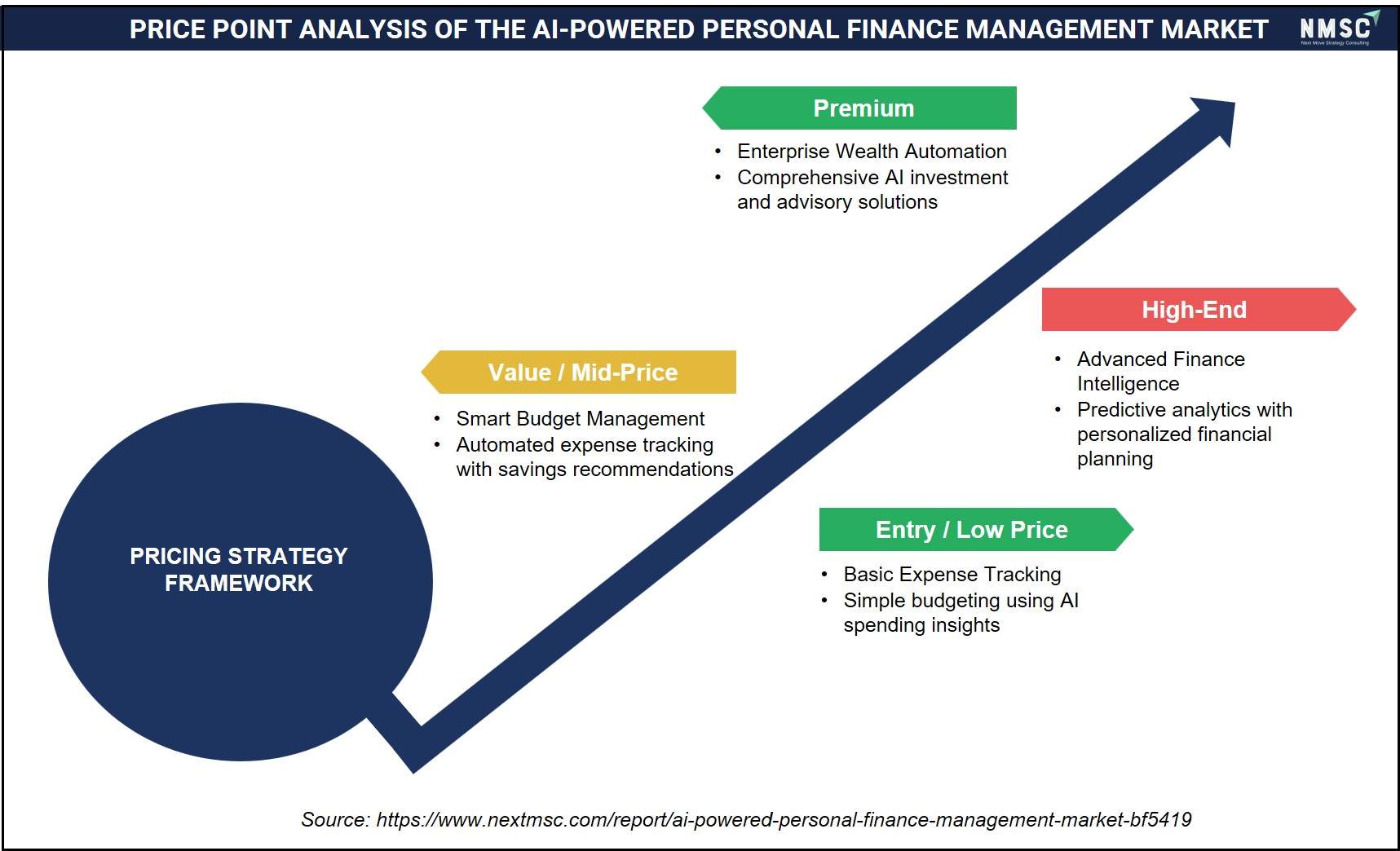
Our analysis indicates that the AI-Powered Personal Finance Management Market follows a tiered pricing strategy based on functionality, personalization, and service integration. Entry-level offerings provide essential budgeting and expense tracking at competitive prices, while mid-tier solutions add AI-driven financial insights and planning features. Premium and high-end platforms differentiate themselves through advanced wealth management, investment optimization, predictive analytics, enhanced security, and personalized advisory capabilities, enabling vendors to address diverse consumer needs and maximize customer lifetime value.
Growth Drivers & Restraints
Growth Catalyst and Risk Assessment Matrix
|
Factors |
Type |
(+/−) % Impact on CAGR |
Geographic Relevance |
Impact Timeline |
|
Open banking data-access expansion |
Driver |
+3.2% |
North America, Europe |
2026–2030 |
|
Rising embedded finance adoption by banks |
Driver |
+2.8% |
Global |
2026–2032 |
|
Growth of agentic AI automation capability |
Driver |
+3.5% |
North America, Asia-Pacific |
2027–2035 |
|
Household debt and credit-building demand |
Driver |
+2.1% |
North America, Latin America |
2026–2030 |
|
Financial-inclusion mandates in emerging markets |
Driver |
+2.4% |
Asia-Pacific, Middle East & Africa |
2026–2035 |
|
Data-privacy and consent-management complexity |
Restraint |
−1.8% |
Europe, North America |
2026–2030 |
|
Free banking-led alternatives compressing subscriptions |
Restraint |
−2.2% |
North America |
2026–2032 |
|
Algorithmic advice disclosure requirements |
Restraint |
−1.4% |
Europe |
2027–2033 |
What Is the Primary Growth Driver of the AI-Powered Personal Finance Management Market?
The expansion of open banking data-access rules is the primary growth driver, enabling more accurate account aggregation and AI-driven categorization. The U.S. Consumer Financial Protection Bureau finalized its personal financial data rights rule under Section 1033, requiring covered institutions to make consumer data available through standardized interfaces. This regulatory shift is lowering integration costs for budgeting management software providers and accelerating onboarding across subscription-led and banking-led platforms alike.
How Is Agentic AI Automation Driving Market Growth?
Agentic AI automation that autonomously executes savings transfers, bill negotiation, and subscription cancellation is expanding average revenue per user and justifying premium subscription pricing. Our analysis shows that platforms offering autonomous action features report materially higher retention than those limited to passive tracking. This capability is projected to contribute the largest single share of incremental CAGR through 2035 as agentic architectures mature from recommendation to execution.
What Is Restraining AI-Powered Personal Finance Management Market Growth?
Data-privacy and consent-management complexity restrains growth, as fragmented state and national frameworks raise compliance costs for cross-border operators. The European Union's General Data Protection Regulation and evolving U.S. state privacy statutes require granular consent tracking for financial data aggregation. We found that smaller marketplace-led and B2B platform vendors face disproportionate compliance burden relative to larger banking-led incumbents with dedicated legal infrastructure.
Segmentation Analysis
Segment Sizing: By Provider Type
|
Segment |
2025 (USD) |
2035 (USD) |
CAGR% (2026–2035) |
|
Subscription-Led App |
USD 4.90 Billion |
USD 27.00 Billion |
20.9% |
|
Banking-Led App |
USD 3.80 Billion |
USD 26.50 Billion |
24.1% |
|
Wealth-Led App |
USD 2.55 Billion |
USD 19.00 Billion |
25.0% |
|
Marketplace-Led App |
USD 1.65 Billion |
USD 10.90 Billion |
23.3% |
|
B2B Platform |
USD 1.20 Billion |
USD 7.80 Billion |
23.1% |
|
Other Provider Type |
USD 0.40 Billion |
USD 1.40 Billion |
14.9% |
|
Total |
USD 14.50 Billion |
USD 92.60 Billion |
— |
Which Provider Type Dominates the AI-Powered Personal Finance Management Market?
Subscription-Led App dominated the provider-type segment with USD 4.90 billion in 2025, reflecting entrenched standalone budgeting and coaching apps with direct consumer billing relationships. We found that Wealth-Led App is the fastest-growing sub-segment at a 25.0% CAGR from 2026 to 2035, driven by robo-advisors expanding into everyday budgeting features to capture a larger share of household financial activity beyond investment accounts alone.
Segment Sizing: By AI Function
|
Segment |
2025 (USD) |
2035 (USD) |
CAGR% (2026–2035) |
|
Categorization |
USD 3.20 Billion |
USD 15.20 Billion |
18.9% |
|
Prediction |
USD 2.90 Billion |
USD 16.00 Billion |
20.9% |
|
Recommendation |
USD 2.70 Billion |
USD 15.60 Billion |
21.5% |
|
Automation |
USD 2.60 Billion |
USD 17.40 Billion |
23.5% |
|
Conversation |
USD 1.90 Billion |
USD 14.30 Billion |
25.1% |
|
Agentic Action |
USD 1.20 Billion |
USD 14.10 Billion |
31.5% |
|
Total |
USD 14.50 Billion |
USD 92.60 Billion |
— |
Which AI Function Leads the AI-Powered Personal Finance Management Market?
Categorization led the AI-function segment with USD 3.20 billion in 2025, as automated transaction tagging remains the foundational capability underlying nearly every personal finance application. Our findings suggest that Agentic Action is the fastest-growing function at a 31.5% CAGR from 2026 to 2035, as platforms move from descriptive categorization toward autonomous execution of savings transfers and bill negotiation on the user's behalf.
Segment Sizing: By Core Use Case
|
Segment |
2025 (USD) |
2035 (USD) |
CAGR% (2026–2035) |
|
Budgeting |
USD 2.60 Billion |
USD 12.90 Billion |
19.5% |
|
Cash Flow |
USD 1.55 Billion |
USD 8.90 Billion |
21.4% |
|
Savings |
USD 1.65 Billion |
USD 9.50 Billion |
21.5% |
|
Net Worth |
USD 0.95 Billion |
USD 5.70 Billion |
22.0% |
|
Credit Monitoring |
USD 1.35 Billion |
USD 8.00 Billion |
21.9% |
|
Credit Building |
USD 1.05 Billion |
USD 7.20 Billion |
23.9% |
|
Debt Paydown |
USD 0.90 Billion |
USD 5.60 Billion |
22.5% |
|
Subscription Control |
USD 0.60 Billion |
USD 3.60 Billion |
22.0% |
|
Bill Negotiation |
USD 0.55 Billion |
USD 3.50 Billion |
22.8% |
|
Investing |
USD 1.65 Billion |
USD 11.60 Billion |
24.2% |
|
Retirement |
USD 1.05 Billion |
USD 7.40 Billion |
24.2% |
|
Product Matching |
USD 0.60 Billion |
USD 8.70 Billion |
34.6% |
|
Total |
USD 14.50 Billion |
USD 92.60 Billion |
— |
Which Core Use Case Generates the Most Revenue in the AI-Powered Personal Finance Management Market?
Budgeting generated the highest core-use-case revenue at USD 2.60 billion in 2025, reflecting its position as the entry-point feature for most personal finance platforms. We observed that Product Matching is the fastest-growing use case at a 34.6% CAGR from 2026 to 2035, as marketplace-led platforms increasingly monetize AI-driven recommendations for credit cards, loans, and insurance products.
Growth Opportunities
Next Move Strategy Consulting's analysis identifies three forward-looking whitespace opportunities positioned to shape competitive advantage through 2035.
How Can Agentic Bill Negotiation Unlock New Subscription Revenue?
Platforms that scale autonomous bill negotiation and subscription-cancellation features can unlock premium subscription tiers among mass-market and young-adult customers seeking active money management rather than passive tracking, directly benefiting subscription-led app providers.
Where Does Embedded Finance Create Opportunity for B2B Platform Vendors?
Employers and financial institutions seeking white-label financial-wellness benefits create expansion opportunity for B2B platform and API SaaS vendors, whose licensing revenue benefits directly as employer-sponsored financial coaching becomes a competitive workplace benefit.
How Can Emerging-Market Financial Inclusion Expand Marketplace-Led Platforms?
Financial-inclusion mandates across Asia-Pacific and Middle East & Africa create opportunity for marketplace-led credit and loan platforms to serve underbanked mass-market and credit-rebuild customers, benefiting vendors that combine local regulatory compliance with AI-driven credit-risk assessment.
Regional Outlook
|
Region |
2025 (USD) |
2035 (USD) |
CAGR% (2026–2035) |
Key Driver |
|
North America |
USD 5.51 Billion |
USD 32.90 Billion |
22.0% |
Deep neobank and robo-advisor penetration |
|
Europe |
USD 3.63 Billion |
USD 21.70 Billion |
22.0% |
Open banking regulation (PSD2/PSD3) |
|
Asia-Pacific |
USD 3.77 Billion |
USD 28.70 Billion |
25.3% |
Mobile-first banking and super-app adoption |
|
Middle East & Africa |
USD 0.92 Billion |
USD 5.40 Billion |
21.7% |
Sovereign digital-economy initiatives |
|
Latin America |
USD 0.67 Billion |
USD 3.90 Billion |
21.6% |
Financial-inclusion-driven neobank growth |
|
Total |
USD 14.50 Billion |
USD 92.60 Billion |
— |
— |
North America AI-Powered Personal Finance Management Market
North America's AI-powered personal finance management market remains the most mature globally, anchored by high smartphone penetration, entrenched neobank adoption, and dense competition among subscription-led incumbents. The U.S. Consumer Financial Protection Bureau's open banking rule is accelerating data-access standardization. We observed that regulatory clarity and high consumer trust in digital banking support continued premium subscription monetization, with the region's strategic outlook favoring agentic feature differentiation over pure user-acquisition growth.
Europe AI-Powered Personal Finance Management Market
Europe's AI-Powered Personal Finance Management Market is shaped decisively by PSD2 and PSD3 open banking directives, which standardize account-data access across member states and lower integration barriers for new entrants. Technology adoption is concentrated among banking-led and wealth-led providers navigating Financial Conduct Authority and European Banking Authority guidance on algorithmic advice. Our assessment indicates the region's strategic outlook favors compliance-first platforms capable of scaling across fragmented national regulatory regimes.
Asia-Pacific AI-Powered Personal Finance Management Market
Asia-Pacific combines the highest regional growth rate with rapidly expanding mobile-first banking infrastructure across China, India, and Southeast Asia. Regulatory bodies including the Reserve Bank of India and Monetary Authority of Singapore are actively promoting digital financial-inclusion frameworks. We found that intense competitive intensity among super-app ecosystems and standalone fintechs is driving rapid feature innovation, positioning the region as the primary engine of incremental AI-Powered Personal Finance Management Market value through 2035.
Middle East & Africa AI-Powered Personal Finance Management Market
The Middle East & Africa AI-Powered Personal Finance Management Market remains earlier-stage but is expanding on the back of sovereign digital-economy initiatives in the Gulf states and mobile-money-driven financial inclusion across Sub-Saharan Africa. Regulatory support from central banks is improving technology adoption among mass-market and credit-rebuild customer segments. Our analysis shows the region's strategic outlook favors marketplace-led and B2B platform models suited to underbanked populations.
Latin America AI-Powered Personal Finance Management Market
Latin America's AI-Powered Personal Finance Management Market is expanding as neobanks and marketplace-led credit platforms address historically underbanked mass-market segments across Brazil and Argentina. Regulatory modernization of open finance frameworks is improving data portability and competitive intensity among domestic and multinational providers. We observed that technology adoption is concentrated in mobile-app channels, with strategic outlook favoring platforms combining credit-building tools with low-cost customer acquisition.
U.S. AI-Powered Personal Finance Management Market
Based on our estimates, U.S.'s AI-powered personal finance management market was valued at approximately USD 4.35 billion in 2025 and is projected to reach USD 24.90 billion by 2035, expanding at a 21.4% CAGR from 2026 to 2035. Demand is anchored by mature banking-led and subscription-led platforms, with high technology penetration, intense competitive intensity, and a strategic outlook favoring agentic feature differentiation under active CFPB oversight.
Canada AI-Powered Personal Finance Management Market
The market in Canada was valued at approximately USD 0.68 billion in 2025 and is projected to reach USD 4.30 billion by 2035, expanding at a 22.7% CAGR from 2026 to 2035. Demand structure mirrors the U.S. market with strong bank-embedded adoption, moderate competitive intensity, and a strategic outlook shaped by Open Banking Canada's phased regulatory rollout.
UK AI-Powered Personal Finance Management Market
As per our estimate, UK's AI-powered personal finance management market was valued at approximately USD 1.15 billion in 2025 and is projected to reach USD 6.60 billion by 2035, expanding at a 21.4% CAGR from 2026 to 2035. Adoption is led by wealth-led and banking-led platforms operating under Financial Conduct Authority guidance, with strong open banking infrastructure supporting high technology penetration and a strategic outlook favoring compliance-first scaling.
Germany AI-Powered Personal Finance Management Market
According to our analysis, Germany's AI-powered personal finance management market was valued at approximately USD 0.85 billion in 2025 and is projected to reach USD 5.10 billion by 2035, expanding at a 22.0% CAGR from 2026 to 2035. Demand is concentrated among banking-led providers navigating BaFin oversight and PSD2 requirements, with moderate competitive intensity and a strategic outlook favoring partnerships between banks and specialist AI vendors.
France AI-Powered Personal Finance Management Market
Based on our estimates, France's AI-powered personal finance management market was valued at approximately USD 0.72 billion in 2025 and is projected to reach USD 4.20 billion by 2035, expanding at a 21.6% CAGR from 2026 to 2035. Adoption reflects steady banking-led penetration under Autorité de Contrôle Prudentiel et de Résolution supervision, with technology adoption accelerating through open banking API standardization and a strategic outlook favoring embedded-finance partnerships.
China AI-Powered Personal Finance Management Market
The market in China was valued at approximately USD 1.55 billion in 2025 and is projected to reach USD 12.90 billion by 2035, expanding at a 26.5% CAGR from 2026 to 2035. Demand is driven by super-app ecosystems integrating AI-powered budgeting into broader payment platforms, with high technology penetration, intense competitive intensity, and a strategic outlook favoring domestic platform consolidation.
India AI-Powered Personal Finance Management Market
As per our estimate, India's AI-powered personal finance management market was valued at approximately USD 0.62 billion in 2025 and is projected to reach USD 6.70 billion by 2035, expanding at a 30.3% CAGR from 2026 to 2035. Demand structure benefits from Reserve Bank of India-backed financial-inclusion initiatives and rapid smartphone penetration, with rising competitive intensity among domestic fintechs and a strategic outlook favoring marketplace-led credit platforms.
Japan AI-Powered Personal Finance Management Market
According to our analysis, Japan's AI-powered personal finance management market was valued at approximately USD 0.68 billion in 2025 and is projected to reach USD 3.60 billion by 2035, expanding at a 20.3% CAGR from 2026 to 2035. Adoption is more gradual, reflecting conservative banking-led preferences and Financial Services Agency oversight, with moderate technology penetration and a strategic outlook favoring incumbent bank partnerships over standalone app growth.
South Korea AI-Powered Personal Finance Management Market
Based on our estimates, South Korea's AI-powered personal finance management market was valued at approximately USD 0.42 billion in 2025 and is projected to reach USD 2.90 billion by 2035, expanding at a 23.9% CAGR from 2026 to 2035. Demand is supported by high smartphone penetration and Financial Services Commission-backed open banking infrastructure, with strong competitive intensity among domestic neobanks and a strategic outlook favoring AI-driven credit-building tools.
Australia AI-Powered Personal Finance Management Market
The market in Australia was valued at approximately USD 0.32 billion in 2025 and is projected to reach USD 2.00 billion by 2035, expanding at a 22.6% CAGR from 2026 to 2035. Adoption is shaped by the Consumer Data Right framework administered by the Australian Competition and Consumer Commission, with moderate technology penetration and a strategic outlook favoring wealth-led platform expansion.
UAE AI-Powered Personal Finance Management Market
As per our estimate, UAE's AI-powered personal finance management market was valued at approximately USD 0.19 billion in 2025 and is projected to reach USD 1.20 billion by 2035, expanding at a 22.7% CAGR from 2026 to 2035. Demand structure is supported by Dubai and Abu Dhabi digital-economy initiatives, with rising technology penetration among mass-affluent customers and a strategic outlook favoring B2B platform partnerships with regional banks.
Saudi Arabia AI-Powered Personal Finance Management Market
According to our analysis, Saudi Arabia's AI-powered personal finance management market was valued at approximately USD 0.21 billion in 2025 and is projected to reach USD 1.40 billion by 2035, expanding at a 23.5% CAGR from 2026 to 2035. Adoption benefits from Vision 2030-aligned fintech regulatory sandboxes administered by the Saudi Central Bank, with growing competitive intensity and a strategic outlook favoring banking-led and marketplace-led platform models.
South Africa AI-Powered Personal Finance Management Market
Based on our estimates, South Africa's AI-powered personal finance management market was valued at approximately USD 0.09 billion in 2025 and is projected to reach USD 0.50 billion by 2035, expanding at a 21.0% CAGR from 2026 to 2035. Demand structure reflects earlier-stage financial-inclusion-driven adoption, with moderate technology penetration and a strategic outlook favoring mobile-money-integrated, marketplace-led platforms suited to credit-rebuild customer segments.
Brazil AI-Powered Personal Finance Management Market
The market in Brazil was valued at approximately USD 0.38 billion in 2025 and is projected to reach USD 2.30 billion by 2035, expanding at a 22.1% CAGR from 2026 to 2035. Adoption is accelerating under the Central Bank of Brazil's open finance framework, with strong competitive intensity among domestic neobanks and a strategic outlook favoring credit-building and marketplace-led product matching.
Argentina AI-Powered Personal Finance Management Market
As per our estimate, Argentina's AI-powered personal finance management market was valued at approximately USD 0.11 billion in 2025 and is projected to reach USD 0.60 billion by 2035, expanding at a 20.7% CAGR from 2026 to 2035. Demand structure reflects growing neobank adoption amid currency volatility, with moderate technology penetration and a strategic outlook favoring low-cost, mobile-app-channel platforms serving mass-market customers.
Competitive Landscape
Next Move Strategy Consulting's analysis indicates that the competitive landscape spans large diversified banks, standalone subscription fintechs, and specialist wealth-management platforms competing across overlapping customer segments.
|
Key Takeaways |
|
Market Structure: Moderately fragmented, with banking-led incumbents and subscription-led specialists competing for wallet share. |
|
Innovation Focus: Agentic automation, conversational interfaces, and embedded-finance partnerships. |
|
M&A Activity: Concentrated around banks acquiring AI capability and consolidation among mid-tier subscription apps. |
How Do Companies Compete in the AI-Powered Personal Finance Management Industry?
Companies compete primarily on AI feature depth, data-aggregation reliability, and pricing structure, with banking-led providers leveraging free embedded access against subscription-led vendors relying on premium coaching and automation capability. Our analysis shows that geographic expansion and cross-selling into investing and lending products increasingly determine long-term competitive positioning across this Industry.
Which Competitive Archetypes Dominate the Market?
Banking-led incumbents dominate through embedded distribution and zero-cost access, while wealth-led robo-advisors differentiate through AUM-fee-aligned personalization. Subscription-led specialists compete on rapid feature innovation, including early agentic automation rollouts, positioning them as acquisition targets for banks seeking to accelerate AI capability rather than build it internally.
What Innovation and Differentiation Strategies Are Companies Pursuing?
Companies are pursuing conversational AI interfaces, autonomous bill-negotiation features, and personalized credit-building tools as core differentiation strategies. We found that vendors investing early in agentic execution capability are commanding premium subscription pricing relative to competitors still limited to descriptive budgeting dashboards.
What M&A Activity Is Shaping the Competitive Landscape?
M&A activity is concentrated around large banks and card issuers acquiring AI-native personal finance startups to accelerate embedded-finance capability, alongside consolidation among mid-tier subscription apps seeking scale. This pattern is expected to continue as agentic AI capability becomes a defining competitive requirement through 2035.
Key Market Players
Next Move Strategy Consulting's analysis indicates that the following companies represent the leading validated participants shaping competitive dynamics in the AI-powered personal finance management market.
-
JPMorgan Chase & Co.
-
Bank of America Corporation
-
SoFi Technologies, Inc.
-
Capital One Financial Corporation
-
Chime Financial, Inc.
-
NerdWallet, Inc.
-
Morgan Stanley
-
Rocket Companies, Inc.
-
Banco Bilbao Vizcaya Argentaria, S.A.
-
U.S. Bancorp
-
The Goldman Sachs Group, Inc.
-
Wealthfront Corporation
-
Betterment LLC
-
Acorns Advisers LLC
-
MoneyLion Inc.
-
Stash Financial, Inc.
-
Cleo AI Inc.
-
Quicken Inc.
Latest Developments in the AI-Powered Personal Finance Management Market
We observed the following recent developments reflecting active product expansion and strategic positioning among leading AI-Powered Personal Finance Management Market participants.
|
Date |
Event |
|
July 2026 |
Chime Financial, Inc. launched Chime Invest, an in-app wealth-building platform that enables users to execute commission-free stock and exchange-traded fund (ETF) trades or choose expert-managed portfolios via Atomic Invest with zero account minimums. |
|
May 2026 |
Robinhood Markets, Inc. launched Agentic Trading and the Agentic Credit Card, enabling customers to connect independent AI agents directly to Robinhood via Model Context Protocol (MCP) servers to automate portfolio management, analyze concentration risks, and execute consumer purchases. |
|
November 2025 |
Intuit Inc. introduced an all-in-one agentic AI consumer platform update integrating Credit Karma and TurboTax data, featuring automated tax categorization and an AI-driven Refund Assistant designed to deliver personalized debt-crushing and emergency savings recommendations. |
Expert Insights
 “We know consumers are hungry for information and resources to improve credit scores and overall financial health. As we look ahead, we believe the responsible use of AI can help create new opportunities for consumers looking to improve their financial literacy and overall financial health.”
— Christina Roman, Consumer Education and Advocacy Manager, Experian
Statement made while discussing Experian's nationwide research on consumer adoption of generative AI for personal finance and financial literacy.
Market Interpretation
The statement highlights the growing role of artificial intelligence in empowering consumers to make more informed financial decisions through personalized guidance, credit education, and financial wellness tools. As consumer trust in AI-powered financial assistance continues to increase, financial institutions and fintech companies are accelerating investments in AI-driven personal finance management platforms that deliver customized budgeting, spending insights, savings recommendations, and credit improvement strategies. Consequently, the adoption of AI-powered personal finance solutions is expected to expand significantly as users increasingly seek intelligent, accessible, and proactive financial management experiences.
Investment Opportunities
Where Are Capital Inflows Concentrated in the Market?
Capital inflows remain concentrated in wealth-led and B2B platform vendors, reflecting investor preference for AUM-fee and licensing revenue models with clearer monetization paths than subscription-led standalone apps. We observed continued venture and strategic investment activity targeting agentic AI capability providers.
What Infrastructure Investment Is Required to Scale the Market?
Scaling the AI-Powered Personal Finance Management Market requires sustained investment in secure data-aggregation infrastructure, model governance, and compliance tooling capable of supporting open banking data-sharing rules. Vendors offering artificial intelligence as a service infrastructure to B2B platform and API SaaS providers are positioned to capture disproportionate value from this build-out.
How Do ESG Considerations Shape Investment Decisions?
Environmental, Social, and Governance considerations increasingly shape investment decisions through a financial-inclusion lens, with investors favoring platforms demonstrably expanding access for underbanked mass-market and credit-rebuild customers. Governance scrutiny of algorithmic advice transparency, particularly under European Banking Authority guidance, is also becoming a differentiating investment criterion.
Key Benefits for Stakeholders
How Does This Report Benefit Industry Leaders?
Industry leaders gain access to reconciled market-sizing data, segmentation analysis, and competitive benchmarking that inform product roadmap and pricing decisions. Our analysis shows the report's regional and country-level forecasts help executives prioritize market-entry sequencing and resource allocation across the AI-powered personal finance management landscape.
How Does This Report Benefit Investors and Financial Analysts?
Investors and financial analysts benefit from reconciled 2025–2035 forecasts, CAGR analysis by segment, and a validated competitive-landscape assessment that support investment thesis development. The report's Consolidated Source Table enables analysts to trace every reconciled figure back to a verifiable primary source.
How Does This Report Benefit Technology Vendors and Product Teams?
Technology vendors and product teams gain visibility into emerging trends such as agentic automation and conversational AI adoption, alongside growth-opportunity analysis that informs feature prioritization. Our findings suggest this data supports go-to-market strategy for vendors serving subscription-led, banking-led, and B2B platform customer segments.
Key Market Segments
By Provider Type
-
Subscription-Led App
-
Budgeting App
-
Savings App
-
Subscription App
-
Financial Coach App
-
-
Banking-Led App
-
Retail Bank
-
Neobank
-
Card Issuer
-
Private Bank
-
-
Wealth-Led App
-
Robo Advisor
-
Brokerage App
-
Retirement Planner
-
-
Marketplace-Led App
-
Credit Marketplace
-
Loan Marketplace
-
Insurance Marketplace
-
-
B2B Platform
-
White Label
-
API SaaS
-
Employer Portal
-
-
Other Provider Type
-
Niche App
-
Legacy Tool
-
By AI Function
-
Categorization
-
Prediction
-
Recommendation
-
Automation
-
Conversation
-
Agentic Action
By Core Use Case
-
Budgeting
-
Cash Flow
-
Savings
-
Net Worth
-
Credit Monitoring
-
Credit Building
-
Debt Paydown
-
Subscription Control
-
Bill Negotiation
-
Investing
-
Retirement
-
Product Matching
By Revenue Model
-
Subscription
-
Referral Fees
-
Lead Gen
-
Interchange
-
Interest Spread
-
Advisory Fees
-
AUM Fees
-
Licensing
-
Advertising
-
Other Revenue Model
By Channel
-
Mobile App
-
Web App
-
Embedded
-
API
-
White Label
By Customer Type
-
Mass Market
-
Young Adult
-
Household
-
Credit Rebuild
-
Mass Affluent
-
HNW
-
Employer
-
Financial Institution
By Region
-
North America: U.S., Canada, Mexico
-
Europe: UK, Germany, France, Italy, Spain, Sweden, Denmark, Finland, Netherlands, Rest of Europe
-
Asia-Pacific: China, India, Japan, South Korea, Taiwan, Indonesia, Vietnam, Australia, Philippines, Malaysia, Rest of APAC
-
Middle East & Africa: Saudi Arabia, UAE, Egypt, Israel, Turkey, Nigeria, South Africa, Rest of MEA
-
Latin America: Brazil, Argentina, Chile, Colombia, Rest of LATAM
Conclusion & Recommendations
What Is the Long-Term Outlook for the AI-Powered Personal Finance Management Market?
The long-term outlook remains strongly positive, with the AI-Powered Personal Finance Management Market projected to expand from USD 17.2 billion in 2026 to USD 92.6 billion by 2035 at a 20.6% CAGR. Our assessment indicates that agentic AI capability will increasingly determine which providers capture the largest share of this growth, as autonomous execution features become the primary basis for premium monetization.
What Strategic Positioning Should Providers Pursue?
Providers should prioritize agentic automation and embedded-finance partnerships while pursuing regulatory-compliant open banking data-access agreements to secure long-term customer relationships. Our assessment indicates that vendors combining subscription monetization with bank-embedded distribution will be best positioned to capture premium pricing within the AI-Powered Personal Finance Management Market.
How Attractive Is the Market for New Investment?
The AI-powered personal finance management industry presents an attractive investment case, supported by a USD 75.4 billion absolute dollar opportunity between 2026 and 2035 and above-average growth in Asia-Pacific and agentic AI-function categories. We found that investment attractiveness is highest for platforms combining data-aggregation reliability with scaled distribution, positioning them to serve both mass-market and mass-affluent segments simultaneously.
What Market Shifts and Key Risks Should Stakeholders Monitor?
Stakeholders should monitor data-privacy regulatory tightening, competitive pressure from free banking-led alternatives, and algorithmic advice disclosure requirements as key risks to the AI-Powered Personal Finance Management Market. Our analysis shows that subscription-led vendors unable to differentiate through agentic capability risk losing share to banking-led incumbents offering comparable features at no direct cost.
What Are the Key Growth Pathways for the Market?
Key growth pathways include scaling agentic bill-negotiation features, expanding B2B employer-portal licensing, and deepening penetration into underbanked mass-market segments across Asia-Pacific and Latin America. Next Move Strategy Consulting's analysis indicates that providers pursuing these pathways while maintaining compliance-first data practices will be best positioned to capture the AI-Powered Personal Finance Management Market's projected growth through 2035.
About the Author
 Saista Faiyaz
— Saista Faiyaz is Research Associate at Next Move Strategy Consulting, where she has covered consumer markets and healthcare technologies for 3 years. Her work includes primary interview review, secondary-source validation, market sizing, and structured analysis of company and industry data. She supports research by comparing evidence across sources, organizing findings into market narratives, and documenting assumptions used in analysis. Her scope includes cross-market benchmarking, and reports.
Saista Faiyaz
— Saista Faiyaz is Research Associate at Next Move Strategy Consulting, where she has covered consumer markets and healthcare technologies for 3 years. Her work includes primary interview review, secondary-source validation, market sizing, and structured analysis of company and industry data. She supports research by comparing evidence across sources, organizing findings into market narratives, and documenting assumptions used in analysis. Her scope includes cross-market benchmarking, and reports.
About the Reviewer
 Supradip Baul
— Supradip Baul is an accomplished business consultant and strategist with over a decade of rich experience in market intelligence, strategy, technology, and business transformation. His work has included rigorous qualitative and quantitative analysis across multiple industries, helping clients shape investment decisions and long-term roadmaps. Earlier in his career, he was associated with Gartner, where he contributed to industry-leading reports and market share analyses. He has worked with leading global companies and holds an MBA with a dual specialization in Marketing and Finance.
Supradip Baul
— Supradip Baul is an accomplished business consultant and strategist with over a decade of rich experience in market intelligence, strategy, technology, and business transformation. His work has included rigorous qualitative and quantitative analysis across multiple industries, helping clients shape investment decisions and long-term roadmaps. Earlier in his career, he was associated with Gartner, where he contributed to industry-leading reports and market share analyses. He has worked with leading global companies and holds an MBA with a dual specialization in Marketing and Finance.
At Next Move Strategy Consulting, we understand that insightful market research is the cornerstone of successful business decisions. That's why we employ a robust and multifaceted approach, combining various methodologies to deliver the most accurate and actionable data for our clients.

Research Landscape
We navigate the world of research with two primary approaches:
Qualitative Approach
Our qualitative research methodologies involve immersive techniques such as in-depth interviews, focus groups, and observational studies. By engaging directly with individuals and stakeholders, we uncover valuable insights that quantitative data alone may overlook.

Quantitative Research
In tandem with qualitative methodologies, NMSC leverages the power of Quantitative Research to provide a robust foundation of numerical insights. Through systematic data collection and analysis, we quantify patterns, preferences, and market trends, offering a comprehensive view of the business landscape.
Our quantitative research approach employs diverse tools, including surveys, experiments, and statistical modelling. These methodologies enable us to gather data from a large and representative sample, ensuring the statistical significance of our findings. By employing structured questionnaires and standardized data collection methods, we guarantee the reliability and validity of the information we present to our clients.
Quantitative research is particularly effective in measuring the prevalence of trends, assessing market size, and gauging the impact of various factors on consumer behavior. The numerical precision attained through this approach equips our clients with actionable insights, facilitating data-driven decision-making and strategy formulation.


Our Specialized Toolbox for Industry-Specific Market Research
We deploy a specialized arsenal of techniques tailored to meet your unique requirements. Here's a glimpse into our comprehensive toolbox:

Information Procurement
The stage entails acquiring market data or relevant information through various sources and methodologies.


Market Research Approach
We utilize both top-down and bottom-up approaches in market research analysis to achieve a comprehensive understanding of the market dynamics, leveraging the broad perspective of industry trends and macroeconomic factors alongside detailed insights from specific segments and individual companies.

Porters Five Forces Analysis
We conduct Porter's Five Forces analysis to evaluate the competitive landscape of an industry, providing us with insights into factors that affect profitability and strategic positioning.

SWOT Analysis

Forecasting
We utilize a forecasting model to predict future consumption by considering parameters like population, economics, regulations, market competition, drivers, constraints, technology, and pricing. We also employ statistical techniques such as multilinear regression, exponential smoothing, moving average, ARIMA, and Monte Carlo simulations for accurate predictions. In econometric forecasting, we analyzed short-term and long-term event impacts, attributing values based on regulatory frameworks, economic factors, and market events.





 Speak to Our Analyst