Digital Lending Platforms Market Size, Share, Trends and Growth Analysis, By Component (Solutions, and Services), By Deployment Mode (Cloud, and On-Premise), By Loan Type (Personal Loans, SME and Business Loans, Mortgage and Home Loans, Auto Loans, Buy Now Pay Later, and Other Loan Types), By End User (Banks, Non-Banking Financial Companies, Credit Unions, Fintech and Alternative Lenders, and Other End Users), By Enterprise Size, and Region — Global Industry Report and Forecast, 2026–2035
Industry: BFSI | Publishing Date: August 10, 2026 | Last Updated: August 10, 2026 | No of Pages: N/A | No. of Tables: N/A | No. of Figures: N/A | Format: PDF | Report Code: BF5655
What Is the Digital Lending Platforms Market Size?
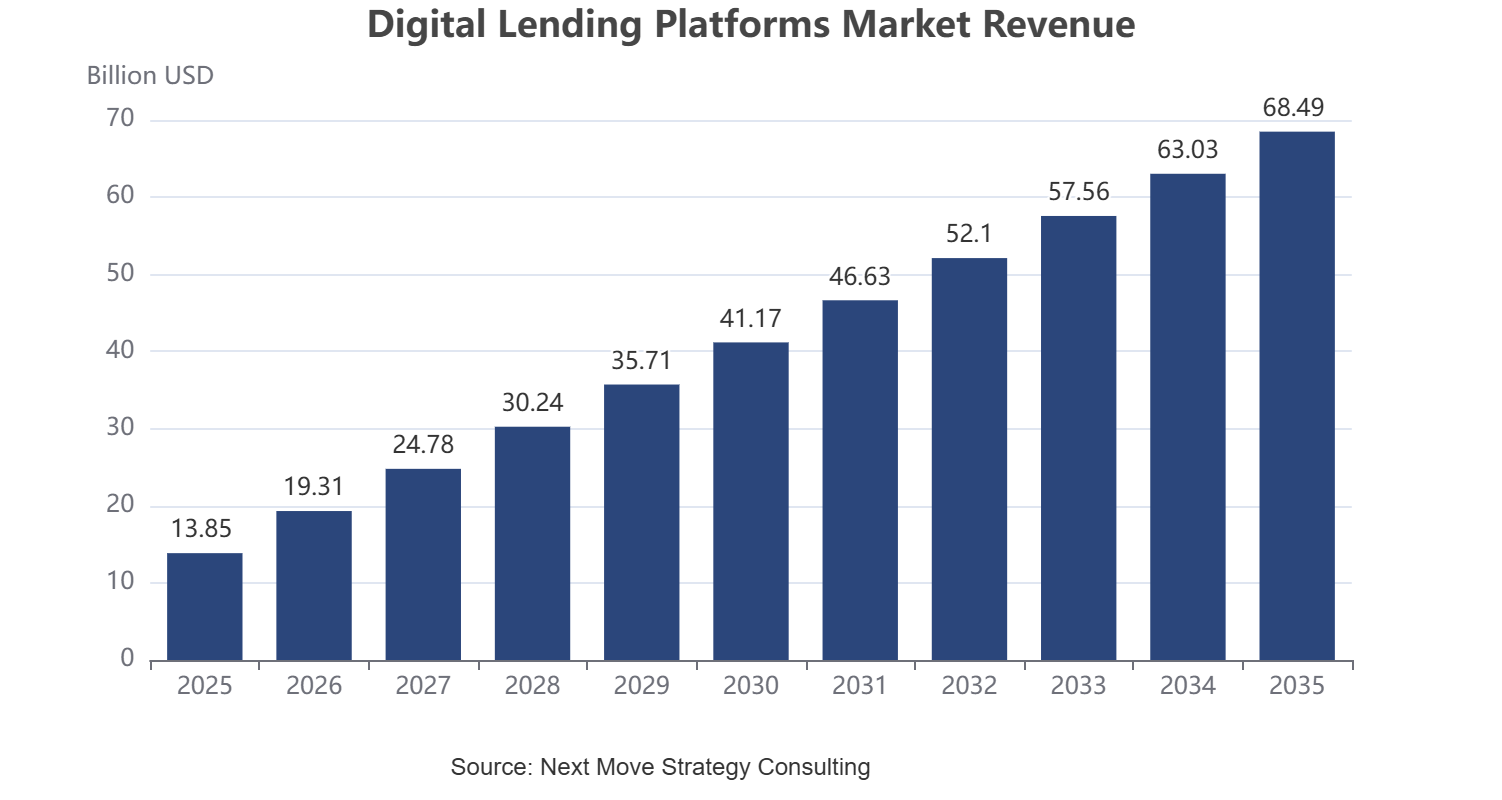
The global Digital Lending Platforms Market size was valued at USD 13.85 billion in 2025 and is estimated at USD 16.28 billion in 2026, forecast to reach USD 68.49 billion by 2035, expanding at a 17.3% CAGR between 2026 and 2035. North America leads with approximately a 32% share, while solutions dominate all other component types with approximately a 68% share.
We observed that growth is broad-based across every segmentation axis, with cloud-native deployment and embedded, AI-enabled underwriting workflows driving the dominant structural shifts through 2035.
|
Key Takeaways |
|
By Component: Solutions held the largest share of approximately 68% (USD 9.42 billion) in 2025; Services is the fastest-growing sub-segment at 18.3% CAGR from 2026–2035. |
|
By Deployment Mode: Cloud held the largest share of approximately 61% (USD 8.45 billion) in 2025 and also registered the fastest growth at 20.4% CAGR from 2026–2035. |
|
By Loan Type: Personal Loans held the largest share of approximately 29% (USD 4.02 billion) in 2025; Buy Now Pay Later is the fastest-growing sub-segment at 25.6% CAGR from 2026–2035. |
|
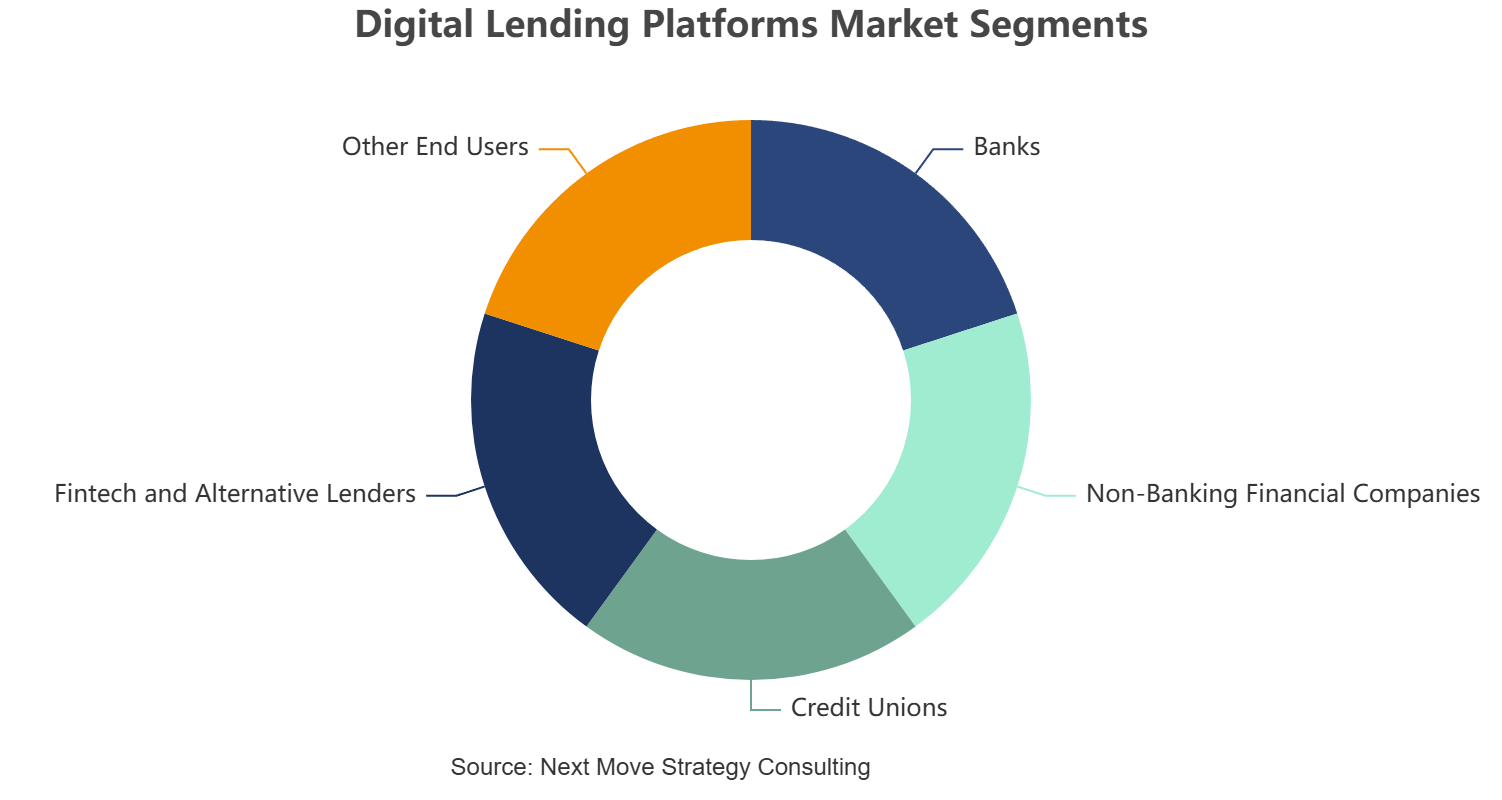
By End User: Banks held the largest share of approximately 42% (USD 5.82 billion) in 2025; Fintech and Alternative Lenders is the fastest-growing sub-segment at 22.0% CAGR from 2026–2035. |
|
By Enterprise Size: Large Enterprises held the largest share of approximately 64% (USD 8.86 billion) in 2025; Small and Medium Enterprises is the fastest-growing sub-segment at 19.2% CAGR from 2026–2035. |
|
Dominant Region: North America dominated with approximately 32% revenue share (USD 4.43 billion) in 2025. |
|
Fastest-Growing Region: Asia-Pacific is expected to register the highest CAGR of 21.2% during 2026–2035. |
|
Dominant Country: U.S. led with approximately USD 3.68 billion in 2025. |
|
Fastest-Growing Country: India is the fastest-growing country at approximately 25.6% CAGR from 2026–2035. |
Market Opportunity: The digital lending platforms market is expected to create an absolute dollar opportunity of USD 52.21 billion between 2026 and 2035, presenting significant investment potential across the cloud-native origination, underwriting, and servicing technology value chain.
According to NMSC analysis, banks and fintech lenders are increasingly consolidating platform sourcing with fewer, agentic AI-ready vendors to simplify multi-product loan origination, a shift that favors diversified platform providers over single-product specialists as underwriting automation expectations intensify through 2035.
What Does the Digital Lending Platforms Market Encompass?
The digital lending platforms market encompasses software solutions and associated services that automate loan origination, underwriting, decisioning, servicing, and collections across consumer and commercial lending. Our assessment indicates that the scope spans cloud-native and on-premise architectures supplied to banks, non-banking financial companies, credit unions, and fintech lenders across personal, SME, mortgage, auto, and buy now pay later loan categories. The category has evolved from siloed, paper-intensive origination systems into unified, API-first platforms, driven by rising borrower expectations for instant decisioning and the premiumization of embedded, agentic AI-enabled lending experiences worldwide.
Regulatory frameworks such as the Reserve Bank of India's Guidelines on Digital Lending and the U.S. Consumer Financial Protection Bureau's oversight of automated underwriting shape disclosure, fair-lending, and data-consent requirements, while the European Banking Authority's guidelines on ICT and outsourcing increasingly influence cloud deployment decisions. We observed that technology adoption is shifting toward agentic AI copilots and embedded finance connectivity that replace manual underwriting steps with automated, explainable decisioning. NMSC's analysis indicates that this structural shift, combined with open banking data-sharing mandates, is redefining vendor selection criteria across the digital lending platforms market.
|
Parameters |
Details |
|
Market Size in 2025 |
USD 13.85 Billion |
|
Market Size in 2026 |
USD 16.28 Billion |
|
Revenue Forecast in 2035 |
USD 68.49 Billion |
|
Growth Rate |
CAGR of 17.3% from 2026 to 2035 |
|
Analysis Period |
2025–2035 |
|
Base Year Considered |
2025 |
|
Forecast Period |
2026–2035 |
|
Market Size Estimation |
USD Billion |
|
Companies Profiled |
20 |
|
Countries Covered |
38 |
|
Market Share |
Available for Top 10 Companies |
Key Emerging Trends
Based on research conducted by NMSC, we found that four structural trends are reshaping product development, sourcing, and stakeholder engagement across the industry.
How Is Agentic AI Transforming Loan Underwriting and Decisioning?
Agentic AI copilots are replacing rules-based decisioning engines to compress underwriting cycle times across commercial and retail lending. We observed that nCino's Banking Advisor and Agentic Operating System, deployed in production by banks including ConnectOne Bank in July 2026, cut document-search time from twenty minutes to roughly thirty seconds. Lenders are adopting these architectures to reduce administrative burden on relationship managers, while credit teams retool underwriting workflows to accommodate autonomous, explainable decisioning agents across personal and SME loan categories.
How Is Embedded Finance Expanding Digital Lending Distribution?
Embedded lending and buy now pay later integration are extending loan origination beyond traditional bank channels into e-commerce checkouts and software platforms. Our findings suggest that non-bank point-of-sale financing increasingly relies on API-first origination engines to approve credit within seconds at checkout. Platform vendors are expanding merchant-facing integration layers, positioning embedded distribution as a premium, higher-growth channel within the broader digital lending platforms market segmentation structure.
How Is Open Banking Data Sharing Reshaping Credit Risk Assessment?
Open banking application programming interfaces are pushing suppliers toward real-time, cash-flow-based underwriting models that supplement traditional credit bureau data. We observed that regulators including the Reserve Bank of India and the European Banking Authority continue to formalize consent-based data-sharing frameworks. This trend is elevating demand for risk assessment and decisioning modules among banks and non-banking financial companies, while integrators redesign application programming interface layers to minimize borrower friction during onboarding.
How Are Cloud-Native Core Modernization Programs Redefining Loan Servicing?
Cloud-native core modernization is emerging as a structural response to legacy servicing-system constraints. Our analysis shows that Temenos expanded its Software-as-a-Service offering on Amazon Web Services in May 2026, adding digital banking and lending capability to its core banking cloud stack. Temenos' composable retail lending launch exemplifies this direction with configurable, natural-language-driven journey design engineered for repeat deployment across retail and commercial lending applications.
Consumer Behavior Analysis of the Digital Lending Platforms Industry
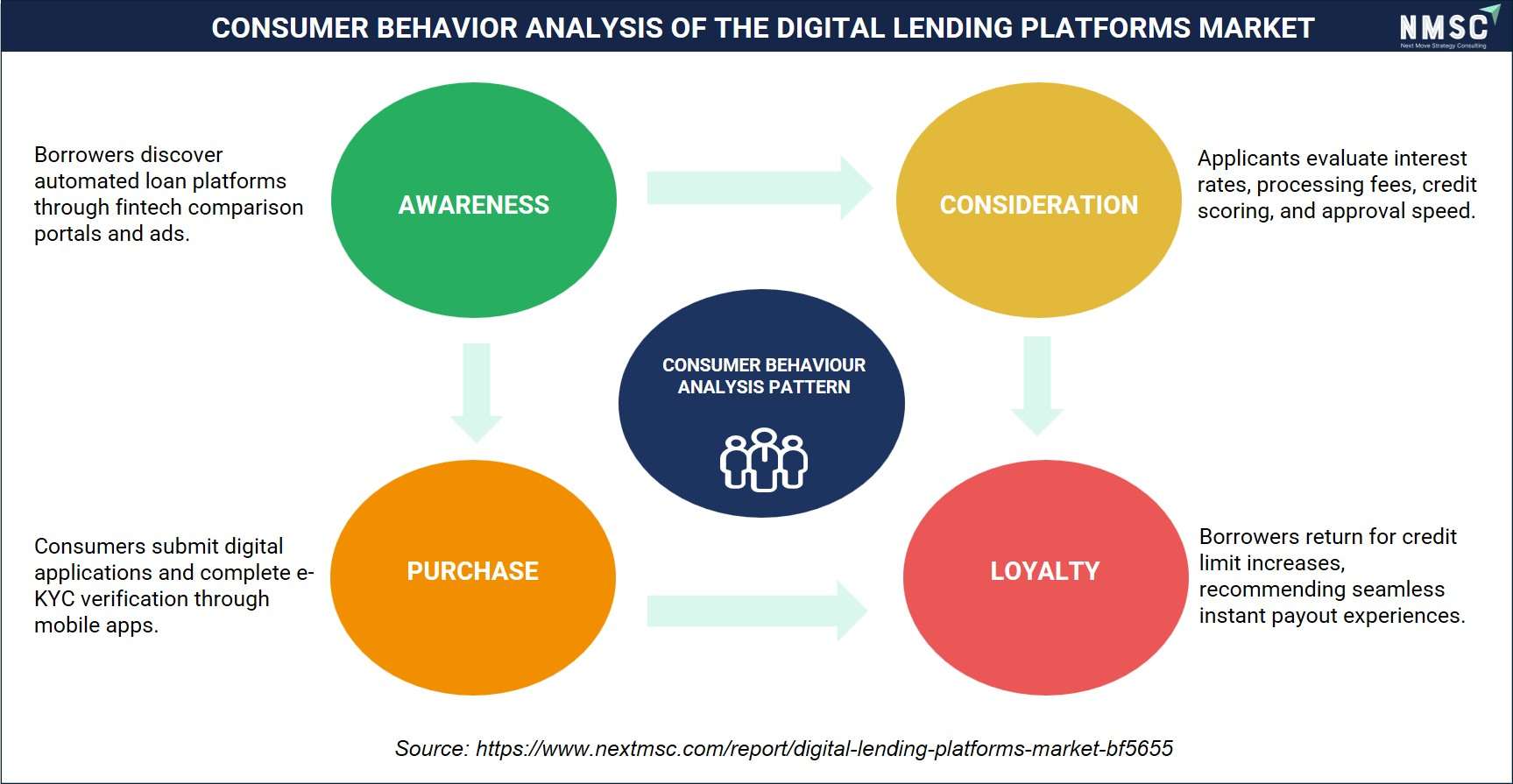
In our observation, the borrowing journey in the Digital Lending Platforms Market begins as users discover platforms via fintech portals and ads. Consequently, applicants compare interest rates, processing fees, credit scoring, and approval speed during consideration. Further, we observed that applications and e-KYC verifications are submitted through mobile apps, while long-term loyalty is sustained as borrowers return for credit limit increases and recommend seamless, instant payout experiences.
Growth Drivers and Restraints
Growth Catalyst and Risk Assessment Matrix
|
Factors |
Type |
(+/-) % Impact on CAGR |
Geographic Relevance |
Impact Timeline |
|
Rising fintech and alternative lender adoption of cloud-native origination platforms |
Driver |
+2.4% |
Global |
2026–2035 |
|
Expansion of embedded finance and buy now pay later integration in e-commerce |
Driver |
+2.0% |
Global |
2026–2035 |
|
Increasing use of artificial intelligence for automated credit decisioning |
Driver |
+1.9% |
Global |
2026–2035 |
|
Regulatory push toward open banking and API-based data sharing |
Driver |
+1.5% |
North America, Europe |
2026–2035 |
|
Growing SME credit demand and government-backed digital lending initiatives |
Driver |
+1.7% |
Asia-Pacific |
2026–2035 |
|
Rising smartphone penetration and digital financial inclusion programs |
Driver |
+1.2% |
Asia-Pacific, MEA, LATAM |
2026–2032 |
|
Data privacy and cross-border data residency compliance costs |
Restraint |
-0.9% |
Europe, North America |
2026–2035 |
|
Legacy core banking system integration complexity |
Restraint |
-0.7% |
Global |
2026–2032 |
|
Cybersecurity exposure and algorithmic credit bias risk |
Restraint |
-0.6% |
Global |
2028–2035 |
What Is the Primary Growth Driver of the Digital Lending Platforms Market?
Rising fintech and alternative lender adoption of cloud-native origination platforms is the primary driver of the Digital Lending Platforms Market. The Board of Governors of the Federal Reserve System continues to track expanding non-bank participation in consumer and small business credit, sustaining demand for configurable, multi-tenant origination software. We observed that this structural shift, reinforced by banks' own digital transformation programs, continues to anchor baseline consumption of solutions and cloud deployment across developed and emerging economies alike.
How Is Artificial Intelligence Driving Digital Lending Platforms Market Growth?
Automated, artificial intelligence-enabled underwriting is accelerating market growth toward agentic decisioning platforms. The Reserve Bank of India's Guidelines on Digital Lending formalize disclosure and algorithmic-accountability requirements that push lenders toward auditable artificial intelligence decisioning systems. Our assessment indicates that this regulatory pressure, combined with borrower demand for instant approval, is compressing adoption timelines for cloud-native risk assessment modules across Asia-Pacific and North America.
What Is Restraining Digital Lending Platforms Market Expansion?
Data privacy and cross-border data residency compliance costs restrain margin stability across the vendor supply chain. The U.S. Consumer Financial Protection Bureau continues to enforce disclosure and fair-lending obligations that raise compliance overhead for automated decisioning deployments. We found that smaller regional vendors face particular exposure, as limited scale reduces their ability to absorb recurring compliance and security-certification costs compared with larger, diversified platform providers.
Segmentation Analysis
Segment Sizing: By Component
|
Segment |
2025 (USD) |
2035 (USD) |
CAGR% (2026–2035) |
|
Solutions |
USD 9.42 Billion |
USD 44.86 Billion |
16.8% |
|
Services |
USD 4.43 Billion |
USD 23.63 Billion |
18.3% |
|
Total |
USD 13.85 Billion |
USD 68.49 Billion |
17.3% |
Which Component Segment Dominates the Digital Lending Platforms Market?
Solutions, encompassing loan origination, loan management, servicing, and risk assessment software, led the market with USD 9.42 billion in 2025, supported by cost efficiency and near-universal applicability across consumer and commercial lending. We observed that Services is the fastest-growing component, expanding at an 18.3% CAGR from 2026 to 2035, as banks and fintech lenders increasingly engage implementation, integration, and managed-service partners to accelerate agentic AI deployment.
Segment Sizing: By Loan Type
|
Segment |
2025 (USD) |
2035 (USD) |
CAGR% (2026–2035) |
|
Personal Loans |
USD 4.02 Billion |
USD 17.46 Billion |
15.6% |
|
SME and Business Loans |
USD 3.32 Billion |
USD 16.10 Billion |
17.1% |
|
Mortgage and Home Loans |
USD 2.63 Billion |
USD 11.30 Billion |
15.5% |
|
Auto Loans |
USD 1.66 Billion |
USD 6.85 Billion |
15.0% |
|
Buy Now Pay Later |
USD 1.39 Billion |
USD 12.67 Billion |
25.6% |
|
Other Loan Types |
USD 0.83 Billion |
USD 4.11 Billion |
17.3% |
|
Total |
USD 13.85 Billion |
USD 68.49 Billion |
17.3% |
Which Loan Type Segment Leads Digital Lending Platforms Market Demand?
Personal Loans remained the leading loan type within the Digital Lending Platforms Market, valued at USD 4.02 billion in 2025 on sustained consumer credit, installment lending, and short-term financing platform demand. Our findings suggest that Buy Now Pay Later is the fastest-growing loan type, registering a 25.6% CAGR from 2026 to 2035, as e-commerce checkout financing increasingly specifies real-time origination engines to approve credit without disrupting the purchase journey across retail and marketplace channels.
Segment Sizing: By End User
|
Segment |
2025 (USD) |
2035 (USD) |
CAGR% (2026–2035) |
|
Banks |
USD 5.82 Billion |
USD 25.00 Billion |
15.5% |
|
Non-Banking Financial Companies |
USD 3.19 Billion |
USD 15.41 Billion |
17.0% |
|
Credit Unions |
USD 1.52 Billion |
USD 6.51 Billion |
15.4% |
|
Fintech and Alternative Lenders |
USD 2.49 Billion |
USD 17.46 Billion |
22.0% |
|
Other End Users |
USD 0.83 Billion |
USD 4.11 Billion |
17.3% |
|
Total |
USD 13.85 Billion |
USD 68.49 Billion |
17.3% |
Which End User Segment Leads the Digital Lending Platforms Market?
Banks remained the leading end user within the market, reaching USD 5.82 billion in 2025 due to their scale, regulatory maturity, and multi-product lending requirements. Based on research conducted by NMSC, we found that Fintech and Alternative Lenders represent the fastest-growing category at a 22.0% CAGR from 2026 to 2035, reflecting rapid non-bank credit expansion and embedded finance partnerships across Asia-Pacific and North America.
Growth Opportunities
Our analysis shows that three forward-looking opportunities stand out for stakeholders positioning within the digital lending platforms market over the 2026–2035 forecast period.
How Can Embedded BNPL Integration Unlock Value for E-Commerce Platforms?
Embedded buy now pay later integration presents a whitespace opportunity for e-commerce and marketplace platforms seeking to lift conversion without building proprietary credit infrastructure. Vendors that commercialize checkout-ready origination application programming interfaces stand to capture recurring transaction-based revenue as merchants shift toward embedded financing partnerships across retail, travel, and subscription commerce.
Where Does AI-Driven Underwriting Create New Demand Among Community Lenders?
Community banks and credit unions represent an underpenetrated opportunity for artificial intelligence-enabled underwriting engineered for smaller-scale, high-touch lending operations. Vendors that develop configurable, cost-efficient decisioning modules for these institutions can secure long-term subscription contracts, benefiting from recurring platform-fee revenue tied to modernization mandates among regional and community-focused lenders.
How Can Open Banking API Connectivity Benefit SME Lending Fintechs?
SME lending fintechs seeking faster cash-flow-based underwriting create an opportunity for vendors offering certified open banking connectivity layers. Early movers that secure regulatory-grade data-sharing integrations can differentiate from non-banking financial companies and alternative lenders pursuing real-time credit decisioning across underserved small business segments.
Regional Outlook
Geographic Performance Snapshot
|
Region |
2025 (USD) |
2035 (USD) |
CAGR% (2026–2035) |
Key Driver |
|
North America |
USD 4.43 Billion |
USD 17.46 Billion |
14.4% |
Advanced fintech adoption and CFPB-driven compliance automation |
|
Europe |
USD 3.19 Billion |
USD 12.67 Billion |
14.5% |
Open banking mandates and EBA ICT outsourcing guidelines |
|
Asia-Pacific |
USD 3.88 Billion |
USD 25.68 Billion |
21.2% |
Expanding fintech lender base and government digital-credit programs |
|
Middle East & Africa |
USD 1.25 Billion |
USD 6.51 Billion |
18.0% |
Vision 2030-linked fintech diversification and mobile-first credit demand |
|
Latin America |
USD 1.10 Billion |
USD 6.17 Billion |
19.0% |
Rising SME credit gaps and expanding neobank lending infrastructure |
|
Total |
USD 13.85 Billion |
USD 68.49 Billion |
17.3% |
— |
North America Digital Lending Platforms Market Outlook
North America leads the digital lending platforms market with an established fintech ecosystem and mature bank technology-modernization budgets. We observed that Consumer Financial Protection Bureau disclosure requirements sustain demand for auditable decisioning modules, while banks increasingly specify cloud-native platforms to meet digital transformation mandates. Technology adoption remains advanced, with agentic AI copilots driving demand for explainable, compliance-ready underwriting workflows across the region's competitive lending sector.
Europe Digital Lending Platforms Market Outlook
Europe's digital lending platforms market reflects a mature but regulation-intensive landscape shaped by the European Banking Authority's ICT and outsourcing guidelines and open banking data-sharing rules. Our findings suggest that banks across Germany, France, and the UK are accelerating adoption of cloud-native and API-first origination systems to satisfy regulatory reporting obligations. Technology adoption favors composable lending architectures, supported by regional vendors investing in regulator-aligned deployment models.
Asia-Pacific Digital Lending Platforms Market Outlook
Asia-Pacific is the fastest-growing digital lending platforms market region, propelled by expanding fintech lender activity in China and India and government-backed digital credit initiatives. We found that regulatory frameworks such as the Reserve Bank of India's digital lending guidelines are formalizing rapidly, giving vendors clear compliance parameters to scale platform deployment. Technology adoption is accelerating as regional providers expand cloud infrastructure to serve fast-growing non-banking financial company and neobank segments.
Middle East & Africa Digital Lending Platforms Market Outlook
The digital lending platforms market in Middle East & Africa is expanding as Gulf Cooperation Council economies diversify into fintech-enabled financial services and mobile-first credit demand rises. Our analysis shows that Saudi Arabia and the UAE are attracting platform investment tied to national digital-economy strategies. Regulatory influence remains moderate, while technology adoption is gradually shifting toward cloud-hosted origination systems as regional banks align with global compliance expectations.
Latin America Digital Lending Platforms Market Outlook
Latin America's digital lending platforms market is supported by persistent SME credit gaps in Brazil and Argentina and expanding neobank lending infrastructure. We observed that regulatory frameworks are less stringent than in North America or Europe, though multinational platform vendors operating locally are introducing compliance-ready origination modules. Technology adoption remains centered on cloud deployment, with competitive intensity increasing as regional fintech lenders partner with global platform integrators.
U.S. Digital Lending Platforms Market
Based on our estimates, the U.S. market was valued at approximately USD 3.68 billion in 2025 and is projected to reach USD 14.49 billion by 2035, growing at a 14.4% CAGR. Demand is anchored by mature bank technology budgets, high fintech lender activity, and Consumer Financial Protection Bureau disclosure requirements. Technology penetration favors cloud-native platforms, and competitive intensity remains high among established vendors serving national and regional banking chains.
Canada Digital Lending Platforms Market
The market in Canada reached roughly USD 0.53 billion in 2025 and is forecast to hit USD 2.10 billion by 2035 at a 14.5% CAGR. Demand structure mirrors U.S. bank and credit union modernization patterns, while federal financial-conduct guidance shapes disclosure specifications. Technology penetration is rising as national lenders request agentic AI-enabled underwriting, with competitive intensity moderate given reliance on cross-border vendor supply from U.S.-based providers.
UK Digital Lending Platforms Market
As per our estimate, the UK market stood at about USD 0.61 billion in 2025, advancing toward USD 2.28 billion by 2035 at a 13.7% CAGR. Demand is driven by established banks navigating open banking data-sharing rules under the UK's Financial Conduct Authority. Regulatory influence is significant, technology penetration favors cloud-native adoption, and competitive intensity remains steady among domestic and pan-European vendors serving UK lenders.
Germany Digital Lending Platforms Market
According to our analysis, Germany's market was valued near USD 0.54 billion in 2025 and is set to reach USD 2.15 billion by 2035, expanding at a 14.5% CAGR. Demand structure benefits from a strong domestic Mittelstand SME lending base. Germany's alignment with European Banking Authority ICT outsourcing guidance drives regulatory influence, while technology penetration favors cloud-native and composable lending architectures among leading vendors.
France Digital Lending Platforms Market
Based on our estimates, France's market reached approximately USD 0.41 billion in 2025, projected to climb to USD 1.65 billion by 2035 at a 14.7% CAGR. Demand is supported by France's expanding consumer credit and SME lending sector, which shapes origination and risk-assessment module adoption. Regulatory influence from European data-protection legislation is notable, and competitive intensity remains high given the concentration of established vendors headquartered domestically.
China Digital Lending Platforms Market
The market in China, stood at roughly USD 1.09 billion in 2025 and is forecast to reach USD 7.45 billion by 2035, registering a 21.6% CAGR. Demand is fueled by expanding non-banking financial company activity and a dense base of regional platform vendors. Regulatory influence is increasing gradually, technology penetration is accelerating through cloud infrastructure upgrades, and competitive intensity remains elevated among numerous China-based providers.
India Digital Lending Platforms Market
As per our estimate, India's market was valued at about USD 0.62 billion in 2025, projected to reach USD 5.65 billion by 2035 at a 25.6% CAGR, the fastest among covered countries. Demand structure reflects rapid fintech lender expansion and the Reserve Bank of India's formalized digital lending guidelines. Regulatory influence is well established, while technology penetration is rising quickly as banks and non-banking financial companies localize platform sourcing.
Japan Digital Lending Platforms Market
According to our analysis, Japan's market reached close to USD 0.54 billion in 2025 and is expected to hit USD 2.82 billion by 2035, growing at an 18.0% CAGR. Demand is supported by Japan's cautious but steady bank digitalization programs. Regulatory influence is well established, technology penetration is advancing gradually, and competitive intensity remains moderate among long-standing domestic and multinational vendors.
South Korea Digital Lending Platforms Market
Based on our estimates, South Korea's market stood at approximately USD 0.35 billion in 2025, forecast to reach USD 2.05 billion by 2035 at a 19.5% CAGR. Demand structure benefits from the country's advanced mobile banking infrastructure and active neobank sector. Technology penetration is high, with domestic and multinational vendors supplying cloud-native origination platforms, and competitive intensity remains pronounced amid rapid product innovation cycles.
Australia Digital Lending Platforms Market
The digital lending platforms market in Australia, reached about USD 0.27 billion in 2025 and is projected to reach USD 1.54 billion by 2035, expanding at a 19.2% CAGR. Demand is supported by a well-established banking sector and growing non-banking financial company activity. Regulatory influence stems from national open banking rules, while technology penetration favors cloud-native origination systems amid moderate competitive intensity.
UAE Digital Lending Platforms Market
As per our estimate, the UAE market was valued near USD 0.24 billion in 2025, projected to reach USD 1.24 billion by 2035 at a 17.9% CAGR. Demand structure is shaped by the UAE's role as a regional fintech hub. Regulatory influence remains moderate, technology penetration is improving through cloud-hosted platform adoption, and competitive intensity is rising as vendors expand product portfolios to serve Gulf lenders.
Saudi Arabia Digital Lending Platforms Market
According to our analysis, Saudi Arabia's market reached roughly USD 0.28 billion in 2025 and is expected to hit USD 1.50 billion by 2035, growing at an 18.4% CAGR. Demand is driven by Vision 2030-linked fintech diversification and rising SME credit demand. Regulatory influence is developing under national financial-sector guidelines, and technology penetration is advancing as domestic banks scale digital lending deployment.
South Africa Digital Lending Platforms Market
Based on our estimates, South Africa's market stood at about USD 0.15 billion in 2025, forecast to reach USD 0.72 billion by 2035 at a 16.9% CAGR. Demand structure reflects a developing fintech lending base serving regional Southern African markets. Regulatory influence remains moderate, technology penetration is gradually improving, and competitive intensity is limited given reliance on imported platform components from Europe and North America.
Brazil Digital Lending Platforms Market
The market in Brazil reached approximately USD 0.46 billion in 2025 and is projected to reach USD 2.53 billion by 2035, registering an 18.7% CAGR. Demand is underpinned by Brazil's large SME credit gap and expanding neobank sector. Regulatory influence stems from national open finance initiatives, technology penetration favors cloud-native platforms, and competitive intensity remains moderate among regional and multinational vendors.
Argentina Digital Lending Platforms Market
As per our estimate, Argentina's market was valued at near USD 0.15 billion in 2025, projected to reach USD 0.80 billion by 2035 at an 18.3% CAGR. Demand structure is supported by steady fintech lending consumption despite macroeconomic volatility. Regulatory influence remains limited, technology penetration is modest, and competitive intensity is centered on a small number of regional vendors serving domestic banks and lenders.
Regulatory Framework Impacting the Digital Lending Platforms Industry
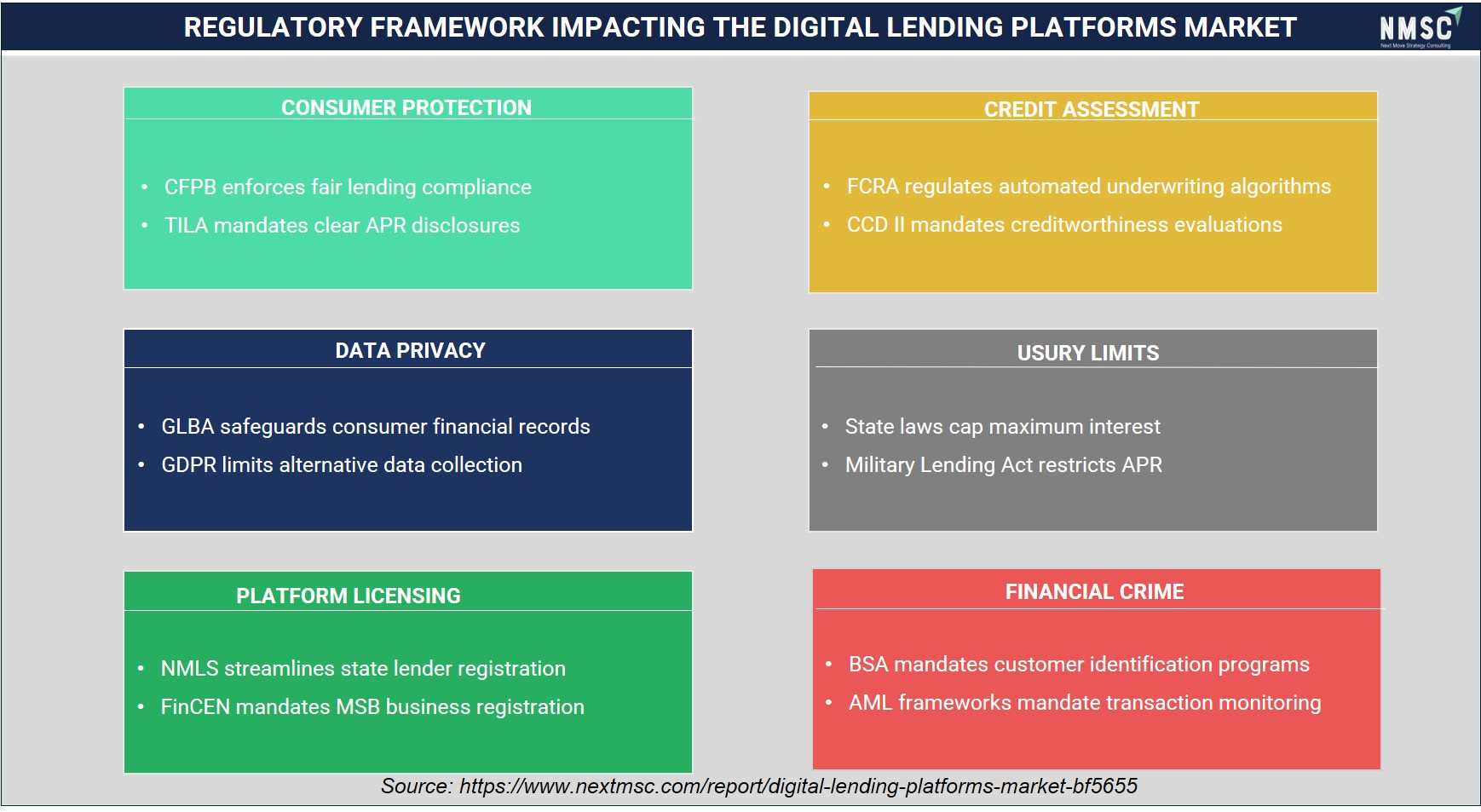
NMSC's analysis indicates that navigating strict regulatory standards shapes the Digital Lending Platforms Market. Specifically, consumer protection laws like CFPB and TILA mandate fair lending and clear APR disclosures, while FCRA and CCD II govern credit assessments. Furthermore, GLBA and GDPR safeguard data privacy, state laws and the Military Lending Act enforce usury limits, while NMLS, FinCEN, BSA, and AML frameworks mandate continuous transaction monitoring.
Competitive Landscape
We observed that the digital lending platforms market features a moderately consolidated competitive landscape, with global banking-technology specialists competing alongside focused fintech vendors on innovation, deployment flexibility, and compliance credentials.
|
Dimension |
Description |
|
Market Structure |
Moderately consolidated; the top companies profiled in this report collectively account for a majority of global digital lending platforms market revenue, while numerous focused fintech vendors serve niche loan-type and regional demand. |
|
Innovation Focus |
Agentic AI underwriting, cloud-native and composable architecture, and embedded finance connectivity dominate current innovation pipelines across leading vendors. |
|
M&A Activity |
Selective consolidation through platform and portfolio acquisitions, exemplified by FIS's completed acquisition of Global Payments' Issuer Solutions business to broaden its digital banking and lending technology portfolio. |
How Do Companies Compete in the Digital Lending Platforms Market?
Companies compete primarily on artificial intelligence decisioning depth, integration flexibility, and deployment scale across the industry. Global players such as Temenos AG and Finastra Group Holdings Limited leverage broad loan-type and regulatory-compliance portfolios to serve multinational banks, while focused fintech vendors compete on rapid configuration and lower total cost of ownership for community banks, credit unions, and non-banking financial companies.
Which Competitive Archetypes Dominate the Digital Lending Platforms Market?
Two archetypes dominate the market, which are diversified banking-technology groups offering full-suite core, digital, and lending capability, and specialized lending-platform vendors focused on origination, underwriting, or servicing point solutions. Oracle Corporation and Fiserv, Inc. exemplify the diversified archetype through integrated core-to-lending technology stacks, while TurnKey Lender, Inc. and Roostify, Inc. exemplify the specialized archetype serving targeted decisioning and mortgage origination use cases.
How Are Companies Differentiating Through Innovation in Digital Lending?
Innovation and differentiation strategy increasingly center on agentic AI and explainable decisioning. nCino's Agentic Operating System and Temenos' embedded AI Agents and Copilots, both expanded in 2026, integrate autonomous underwriting assistants directly into lending workflows. Our analysis shows that vendors unable to demonstrate credible, auditable AI decisioning risk exclusion from bank and non-banking financial company request-for-proposal shortlists across North America and Europe.
What M&A and Expansion Activity Is Shaping the Digital Lending Platforms Market?
Mergers, acquisitions, and geographic expansion continue to consolidate lending-technology capability within the industry. FIS's completed acquisition of Global Payments' Issuer Solutions business broadened its digital banking and lending portfolio, while Finastra Group Holdings Limited's continued expansion of its U.S. and India offices illustrates how diversified vendors pursue geographic reach and delivery-capacity growth across commercial and retail lending end markets.
Key Market Players
Our assessment indicates that the following 20 companies are actively shaping product innovation, platform expansion, and compliance strategy within the global digital lending platforms market.
-
Fiserv, Inc.
-
Fidelity National Information Services, Inc. (FIS)
-
Temenos AG
-
Finastra Group Holdings Limited
-
nCino, Inc.
-
Oracle Corporation
-
Intercontinental Exchange, Inc. (ICE Mortgage Technology)
-
Jack Henry & Associates, Inc.
-
Pegasystems Inc.
-
Sopra Steria Group (Sopra Banking Software)
-
Newgen Software Technologies Limited
-
Intellect Design Arena Ltd.
-
MeridianLink, Inc.
-
Blend Labs, Inc.
-
Wipro Limited (Wipro Gallagher Solutions)
-
Tavant Technologies, Inc.
-
Mambu B.V.
-
TurnKey Lender, Inc.
-
Roostify, Inc.
-
Abrigo
Latest Developments
We found that recent product launches within the digital lending platforms market are concentrated on agentic AI underwriting and cloud-native modernization, reflecting the industry's broader transition toward autonomous, compliance-ready lending workflows.
|
Date |
Event |
|
August 2026 |
Temenos announced that Saudi Arabia-based GO Telecom launched new digital lending services under the GO Money brand. Powered by the scalable Temenos Core and Digital platform, the strategic deployment features advanced modules for seamless loan origination, servicing, collections, and Sharia-compliant Islamic finance. |
|
August 2026 |
MeridianLink launched summer enhancements across its MeridianLink One digital lending platform. The comprehensive update introduced advanced AI, automation, and data capabilities, including custom URL parameters and email personalization. The update introduced AI, automation, and data capabilities, including custom URL parameters and email personalization, designed to streamline borrower acquisition and lending application processes. |
|
February 2026 |
Finastra launched LaserPro Evaluate, a cloud-native commercial lending solution designed to replace spreadsheet-based and legacy loan evaluation processes. The platform streamlines commercial loan origination, improves workflow efficiency, and supports digital-first lending operations for banks and credit unions. |
Expert Insights
 “As banks and credit unions race to meet digital-first expectations, cloud-native origination and processing platforms have become essential for streamlining complex workflows, reducing operational risk, and delivering faster, more transparent lending experiences."
— Craig Focardi, Principal Analyst, Celent
Statement made during Finastra's launch of the cloud-native LaserPro Evaluate commercial loan origination platform.
Market Interpretation
The statement reflects the accelerating transition of financial institutions toward cloud-native digital lending platforms that improve operational efficiency, transparency, and risk management. NMSC's analysis indicates that lenders are increasingly replacing manual and legacy loan origination processes with integrated digital platforms that automate financial analysis, document management, and decisioning workflows. Our findings suggest that cloud-native architectures, AI-enabled analytics, and end-to-end workflow automation are becoming key competitive differentiators as banks and credit unions modernize lending operations to deliver faster, more accurate, and customer-centric borrowing experiences.
Investment Opportunities
What Capital Inflows Are Targeting the Digital Lending Platforms Market?
Capital inflows into the digital lending platforms market are increasingly directed toward agentic AI decisioning and cloud infrastructure scaling. Private equity sponsors, including Vista Equity Partners' continued backing of Finastra Group Holdings Limited, continue to fund platform consolidation and product investment. We observed that investors favor vendors demonstrating validated compliance credentials, viewing regulatory alignment as a proxy for long-term contract retention with regulated financial institutions.
How Is Infrastructure Investment Supporting Digital Lending Platform Deployment?
Infrastructure investment is expanding cloud hosting and data-processing capacity across Asia-Pacific, particularly in India and China, to serve rising fintech lender and non-banking financial company demand. Our findings suggest that vendors are investing in regionally hosted cloud environments to satisfy data-residency requirements, supporting the compliance posture required for banks and credit unions operating across multiple regulatory jurisdictions.
What ESG Considerations Are Shaping Digital Lending Platforms Investment Decisions?
Environmental, social, and governance considerations are increasingly central to investment decisions across the industry, with algorithmic fairness and financial-inclusion outcomes as key governance criteria. The Consumer Financial Protection Bureau's continued fair-lending oversight informs vendor compliance disclosures. We found that investors increasingly favor platform providers with third-party bias-auditing capability, treating it as a governance indicator alongside data-security and labor practices.
Key Market Segments
By Component
-
Solutions
-
Loan Origination Software
-
Loan Management Software
-
Loan Servicing Software
-
Risk Assessment and Decision Analytics Software
-
Collections and Recovery Software
-
-
Services
-
Consulting and Advisory Services
-
Implementation and Integration Services
-
Support and Maintenance Services
-
By Deployment Mode
-
Cloud
-
On-Premise
By Loan Type
-
Personal Loans
-
SME and Business Loans
-
Mortgage and Home Loans
-
Auto Loans
-
Buy Now Pay Later
-
Other Loan Types
By End User
-
Banks
-
Non-Banking Financial Companies
-
Credit Unions
-
Fintech and Alternative Lenders
-
Other End Users
By Enterprise Size
-
Large Enterprises
-
Small and Medium Enterprises
By Region
-
North America: U.S., Canada, Mexico.
-
Europe: UK, Germany, France, Italy, Spain, Sweden, Denmark, Finland, Netherlands, Rest of Europe.
-
Asia-Pacific: China, India, Japan, South Korea, Taiwan, Indonesia, Vietnam, Australia, Philippines, Malaysia, Rest of APAC.
-
Middle East & Africa: Saudi Arabia, UAE, Egypt, Israel, Turkey, Nigeria, South Africa, Rest of MEA.
-
Latin America: Brazil, Argentina, Chile, Colombia, Rest of LATAM.
Conclusion and Recommendations
What Is the Long-Term Outlook for the Digital Lending Platforms Market?
The long-term outlook for the market remains strongly positive, with global revenue projected to expand nearly fivefold from USD 13.85 billion in 2025 to USD 68.49 billion by 2035 at a 17.3% CAGR. We observed that sustained fintech lender growth, agentic AI adoption, and embedded finance expansion will continue underpinning demand across banks, non-banking financial companies, and credit unions through the forecast period.
What Strategic Positioning Should Digital Lending Platform Vendors Pursue?
Vendors should prioritize cloud-native, agentic AI-enabled product platforms while pursuing regulatory-grade compliance certification to secure long-term bank and non-banking financial company contracts. Our assessment indicates that vendors investing early in explainable decisioning capability and embedded finance connectivity will be best positioned to capture premium pricing within the digital lending platforms market.
How Attractive Is the Digital Lending Platforms Market for New Investment?
The digital lending platforms industry presents an attractive investment case, supported by a USD 52.21 billion absolute dollar opportunity between 2026 and 2035 and above-average growth in Asia-Pacific and buy now pay later categories. We found that investment attractiveness is highest for vendors combining compliance credentials with scaled cloud infrastructure, positioning them to serve both cost-sensitive and premium bank segments simultaneously.
What Market Shifts and Key Risks Should Stakeholders Monitor?
Stakeholders should monitor data-privacy regulation, legacy system integration complexity, and algorithmic credit-bias scrutiny as key risks to the digital lending platforms market. Our analysis shows that vendors unable to adapt to explainability and fair-lending specifications risk losing procurement shortlists to competitors with certified, auditable decisioning platforms, particularly within North America's increasingly regulated compliance environment.
What Are the Key Growth Pathways for the Digital Lending Platforms Market?
Key growth pathways include expanding agentic AI underwriting portfolios, scaling embedded finance connectivity, and deepening penetration into credit union and community bank channels. NMSC's analysis indicates that vendors pursuing these pathways while maintaining cost competitiveness in core solutions categories will be best positioned to capture the digital lending platforms market's projected growth through 2035.
About the Author
 Mayurima Roy
— Mayurima Roy is Research Analyst at Next Move Strategy Consulting, where she has spent 4 years working across the firm's full industry coverage rather than a single fixed vertical. Her work centers on structured research, ongoing trend tracking, competitive assessment, and insight-led content development, translating complex market data into clear, decision-ready narratives that support informed client decision-making across diverse global industries, market sectors, and world regions every day.
Mayurima Roy
— Mayurima Roy is Research Analyst at Next Move Strategy Consulting, where she has spent 4 years working across the firm's full industry coverage rather than a single fixed vertical. Her work centers on structured research, ongoing trend tracking, competitive assessment, and insight-led content development, translating complex market data into clear, decision-ready narratives that support informed client decision-making across diverse global industries, market sectors, and world regions every day.
About the Reviewer
 Supradip Baul
— Supradip Baul is an accomplished business consultant and strategist with over a decade of rich experience in market intelligence, strategy, technology, and business transformation. His work has included rigorous qualitative and quantitative analysis across multiple industries, helping clients shape investment decisions and long-term roadmaps. Earlier in his career, he was associated with Gartner, where he contributed to industry-leading reports and market share analyses. He has worked with leading global companies and holds an MBA with a dual specialization in Marketing and Finance.
Supradip Baul
— Supradip Baul is an accomplished business consultant and strategist with over a decade of rich experience in market intelligence, strategy, technology, and business transformation. His work has included rigorous qualitative and quantitative analysis across multiple industries, helping clients shape investment decisions and long-term roadmaps. Earlier in his career, he was associated with Gartner, where he contributed to industry-leading reports and market share analyses. He has worked with leading global companies and holds an MBA with a dual specialization in Marketing and Finance.
At Next Move Strategy Consulting, we understand that insightful market research is the cornerstone of successful business decisions. That's why we employ a robust and multifaceted approach, combining various methodologies to deliver the most accurate and actionable data for our clients.

Research Landscape
We navigate the world of research with two primary approaches:
Qualitative Approach
Our qualitative research methodologies involve immersive techniques such as in-depth interviews, focus groups, and observational studies. By engaging directly with individuals and stakeholders, we uncover valuable insights that quantitative data alone may overlook.

Quantitative Research
In tandem with qualitative methodologies, NMSC leverages the power of Quantitative Research to provide a robust foundation of numerical insights. Through systematic data collection and analysis, we quantify patterns, preferences, and market trends, offering a comprehensive view of the business landscape.
Our quantitative research approach employs diverse tools, including surveys, experiments, and statistical modelling. These methodologies enable us to gather data from a large and representative sample, ensuring the statistical significance of our findings. By employing structured questionnaires and standardized data collection methods, we guarantee the reliability and validity of the information we present to our clients.
Quantitative research is particularly effective in measuring the prevalence of trends, assessing market size, and gauging the impact of various factors on consumer behavior. The numerical precision attained through this approach equips our clients with actionable insights, facilitating data-driven decision-making and strategy formulation.


Our Specialized Toolbox for Industry-Specific Market Research
We deploy a specialized arsenal of techniques tailored to meet your unique requirements. Here's a glimpse into our comprehensive toolbox:

Information Procurement
The stage entails acquiring market data or relevant information through various sources and methodologies.


Market Research Approach
We utilize both top-down and bottom-up approaches in market research analysis to achieve a comprehensive understanding of the market dynamics, leveraging the broad perspective of industry trends and macroeconomic factors alongside detailed insights from specific segments and individual companies.

Porters Five Forces Analysis
We conduct Porter's Five Forces analysis to evaluate the competitive landscape of an industry, providing us with insights into factors that affect profitability and strategic positioning.

SWOT Analysis

Forecasting
We utilize a forecasting model to predict future consumption by considering parameters like population, economics, regulations, market competition, drivers, constraints, technology, and pricing. We also employ statistical techniques such as multilinear regression, exponential smoothing, moving average, ARIMA, and Monte Carlo simulations for accurate predictions. In econometric forecasting, we analyzed short-term and long-term event impacts, attributing values based on regulatory frameworks, economic factors, and market events.





 Speak to Our Analyst