AI Trade Compliance Market Size, Share, Trends and Growth Analysis, By Offering (Software and Services), By Compliance Function (Customs Compliance, Tariff Duty Management, FTA Management, Export Control Management, Restricted Party Screening, Product Classification Management, Trade Documentation Management, Trade Risk Management), By AI Technology, By Deployment Mode, By Enterprise Size, By End User Industry, and Region — Global Industry Report and Forecast, 2026–2035
Industry: BFSI | Publishing Date: July 22, 2026 | Last Updated: September 30, 2026 | No of Pages: N/A | No. of Tables: N/A | No. of Figures: N/A | Format: PDF | Report Code: BF5315
What Is the AI Trade Compliance Market Size?
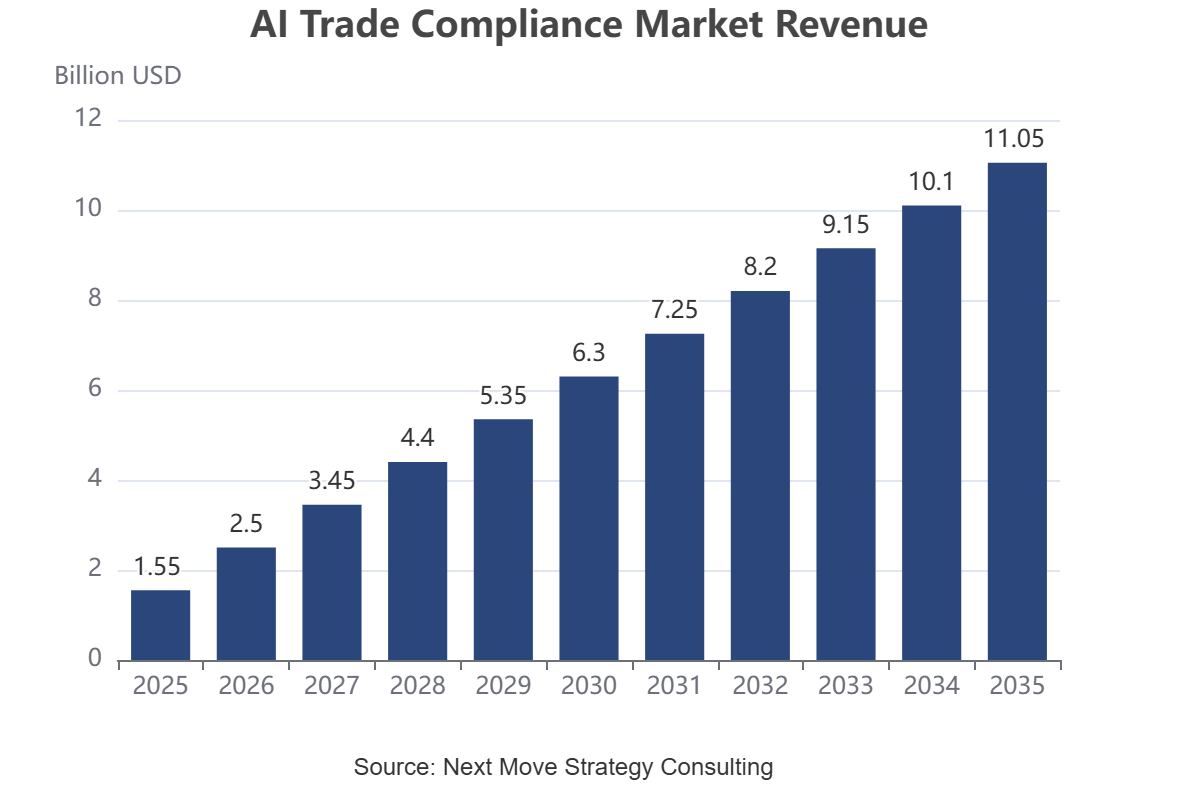
The global AI trade compliance market size was valued at USD 1.55 Billion in 2025 and is estimated at USD 1.89 Billion in 2026, forecast to reach USD 11.05 Billion by 2035, expanding at a 21.7% CAGR between 2026 and 2035. North America leads with approximately 40% share, while Software dominates all other offering categories with approximately 68% share.
We observed that growth is broad-based across every segmentation axis, with agentic AI adoption and tariff volatility-driven demand for automated customs classification and export control screening driving the dominant structural shifts through 2035.
|
Key Takeaways |
|
By Offering: Software held the largest share of approximately 68% (USD 1.05 billion) in 2025, and is also the fastest-growing offering at 22.9% CAGR from 2026–2035. |
|
By Compliance Function: Customs Compliance held the largest share of approximately 22% (USD 0.34 billion) in 2025; Export Control Management is the fastest-growing sub-segment at 25.5% CAGR from 2026–2035. |
|
By AI Technology: Machine Learning held the largest share of approximately 30% (USD 0.47 billion) in 2025; Agentic AI is the fastest-growing sub-segment at 31.9% CAGR from 2026–2035. |
|
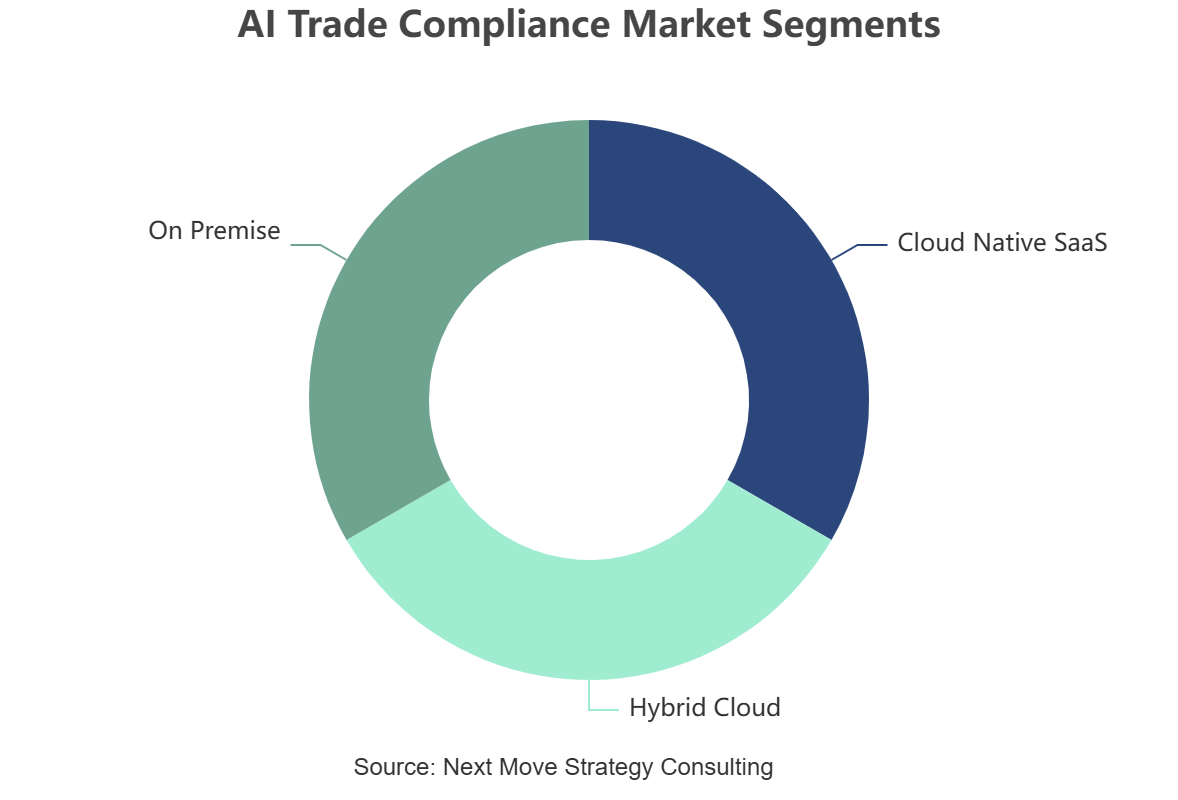
By Deployment Mode: Cloud Native SaaS held the largest share of approximately 62% (USD 0.96 billion) in 2025; Hybrid Cloud is the fastest-growing sub-segment at approximately 24.0% CAGR from 2026–2035. |
|
By Enterprise Size: Large Enterprises held the largest share of approximately 54% (USD 0.84 billion) in 2025; Small Enterprises is the fastest-growing sub-segment at approximately 25.0% CAGR from 2026–2035. |
|
By End User Industry: High Technology Electronics held the largest share of approximately 19% (USD 0.29 billion) in 2025; Retail Cross Border E-Commerce is the fastest-growing sub-segment at approximately 26.0% CAGR from 2026–2035. |
|
Dominant Region: North America dominated with approximately 40% revenue share (USD 0.62 billion) in 2025. |
|
Fastest-Growing Region: Asia-Pacific is expected to register the highest CAGR of 25.6% during 2026–2035. |
|
Dominant Country: U.S. led with approximately USD 0.53 billion in 2025. |
|
Fastest-Growing Country: India is the fastest-growing country at approximately 28.0% CAGR from 2026–2035. |
Market Opportunity: The AI trade compliance market is expected to create an absolute dollar opportunity of USD 9.16 Billion between 2026 and 2035, presenting significant investment potential across customs automation, export control, and restricted party screening software.
According to NMSC analysis, buyers across mid-market and enterprise segments are increasingly favoring vendors offering agentic AI compliance agents over traditional rules-based screening tools, a shift that rewards platform providers able to demonstrate auditable, explainable decision trails as regulatory scrutiny of automated compliance systems intensifies through 2035.
What Does the AI Trade Compliance Market Encompass?
The AI trade compliance market encompasses software and services that apply machine learning, natural language processing, generative AI, and agentic AI to automate customs declarations, tariff classification, export control screening, restricted party screening, and regulatory intelligence for cross-border trade. Our assessment indicates that the scope spans global trade management platforms, trade compliance modules, AI compliance agents, and supporting implementation and managed services procured by high technology, aerospace, automotive, pharmaceutical, retail, logistics, and government customs buyers navigating increasingly volatile tariff and sanctions regimes.
Regulatory frameworks such as U.S. Customs and Border Protection's ACE 2.0 modernization program and the U.S. Department of the Treasury's Office of Foreign Assets Control ten-year recordkeeping mandate are reshaping documentation and audit requirements, while the U.S. Bureau of Industry and Security's tightened export controls on advanced technologies are expanding screening obligations. We observed that technology adoption is shifting rapidly toward agentic AI compliance agents capable of robotic process automation into end-to-end classification and license determination. NMSC's analysis indicates that this structural shift, combined with rising tariff volatility, is redefining sourcing criteria across the AI trade compliance market.
|
Parameters |
Details |
|
Market Size in 2025 |
USD 1.55 Billion |
|
Market Size in 2026 |
USD 1.89 Billion |
|
Revenue Forecast in 2035 |
USD 11.05 Billion |
|
Growth Rate |
CAGR of 21.7% from 2026 to 2035 |
|
Analysis Period |
2025–2035 |
|
Base Year Considered |
2025 |
|
Forecast Period |
2026–2035 |
|
Market Size Estimation |
USD Billion |
|
Companies Profiled |
20 |
|
Countries Covered |
38 |
|
Market Share |
Available for Top 10 Companies |
Key Emerging Trends
Based on research conducted by NMSC, we found that four structural trends are reshaping product architecture, sourcing, and stakeholder engagement across the industry.
How Is Agentic AI Transforming Trade Compliance Workflows?
Agentic AI is transforming trade compliance from rules-based automation into autonomous, decision-capable workflows. We observed that Thomson Reuters launched ONESOURCE+ in November 2025, an intelligent compliance network powered by agentic AI that unifies tax, trade, legal, and risk functions into coordinated workflows for enterprise customers. SAP separately moved its International Trade Classification Agent into beta release in December 2025, applying agentic reasoning to recommend customs tariff numbers with transparent, audit-ready rationale.
Why Is Generative AI Content Gaining Adoption in Regulatory Intelligence?
Generative AI-powered regulatory content engines are gaining adoption as trade teams seek faster, cited answers to complex classification questions. Our findings suggest that Thomson Reuters' Global Trade Research tool passed all six publicly available U.S. Customs Broker License Exams administered over three years, with a mean score above 84%, validating generative AI's accuracy on CBP regulations, directives, and rulings. Manufacturers are positioning cited, traceable AI outputs as the standard response to accelerating regulatory change.
How Is AI Reshaping Restricted Party Screening Accuracy?
AI-enabled restricted party screening is gaining adoption as compliance teams seek to reduce false-positive alert volumes without increasing violation risk. We observed that Descartes Systems Group released Visual Compliance AI Assist in August 2025, an enhancement that uses machine learning to automatically filter low-risk screening results while preserving rigorous oversight of true matches. Vendors are positioning risk-aware automation as essential for scaling screening operations amid rising watchlist volumes.
What Role Does M&A Play in AI Trade Compliance Platform Consolidation?
Mergers and acquisitions are consolidating fragmented trade compliance capabilities into unified, AI-enabled platforms. Our analysis shows that WiseTech Global completed its acquisition of E2open Parent Holdings for an enterprise value of approximately USD 2.1 billion in August 2025, extending its CargoWise logistics execution platform into broader trade and supply chain compliance software. This trend reflects growing demand for end-to-end platforms spanning classification, screening, and documentation rather than point solutions.
Growth Drivers and Restraints
|
Factors |
Type |
(+/−) % Impact on CAGR |
Geographic Relevance |
Impact Timeline |
|
Rising tariff volatility and trade policy uncertainty |
Driver |
+4.2% |
Global |
2026-2035 |
|
Agentic AI adoption for autonomous compliance decisions |
Driver |
+3.6% |
North America, Europe |
2026-2035 |
|
CBP ACE 2.0 and global customs modernization programs |
Driver |
+2.4% |
North America, Asia-Pacific |
2026-2032 |
|
Tightening export control regimes on advanced technologies |
Driver |
+2.1% |
North America, Europe |
2026-2035 |
|
Growth of cross-border e-commerce transaction volumes |
Driver |
+1.8% |
Asia-Pacific, North America |
2026-2035 |
|
Extended regulatory recordkeeping and audit requirements |
Driver |
+1.3% |
Global |
2026-2032 |
|
Data privacy and cross-border AI governance restrictions |
Restraint |
-1.4% |
Europe, Asia-Pacific |
2026-2035 |
|
High implementation cost limiting small enterprise adoption |
Restraint |
-1.1% |
Global |
2026-2032 |
|
Legacy ERP integration complexity |
Restraint |
-0.9% |
Global |
2026-2032 |
|
Fragmented multi-jurisdictional regulatory requirements |
Restraint |
-0.7% |
Global |
2026-2035 |
What Is the Primary Growth Driver of the AI Trade Compliance Market?
Rising tariff volatility and trade policy uncertainty are the primary drivers of the market. Thomson Reuters' 2026 Global Trade Report found that 72% of trade professionals cited tariff volatility as the most impactful regulatory change, nearly double the 41% who said the same a year earlier. We observed that this volatility is pushing enterprises toward AI-based classification and duty optimization tools capable of adapting to frequent regulatory change faster than manual compliance teams.
How Is Agentic AI Adoption Driving AI Trade Compliance Market Growth?
Agentic AI adoption is accelerating market growth as vendors move beyond rules-based automation toward autonomous, decision-capable compliance agents. Thomson Reuters' ONESOURCE+ intelligent compliance network and SAP's International Trade Classification Agent both launched agentic capabilities in late 2025, reflecting the shift toward AI that executes classification and screening decisions with auditable rationale. Our assessment indicates that this transition is compressing enterprise adoption timelines as compliance teams face growing transaction volumes.
What Is Restraining AI Trade Compliance Market Expansion?
Data privacy requirements and cross-border AI governance restrictions constrain the pace of AI trade compliance adoption, particularly for multinational deployments spanning jurisdictions with divergent data residency rules. The U.S. Department of the Treasury's Office of Foreign Assets Control doubled its recordkeeping requirement to ten years in 2024, raising data retention and fraud detection governance costs for compliance platforms. We found that smaller enterprises face particular exposure to these compliance overheads, limiting adoption relative to large enterprises with dedicated governance resources.
Regulatory Framework Impacting the AI Trade Compliance Industry
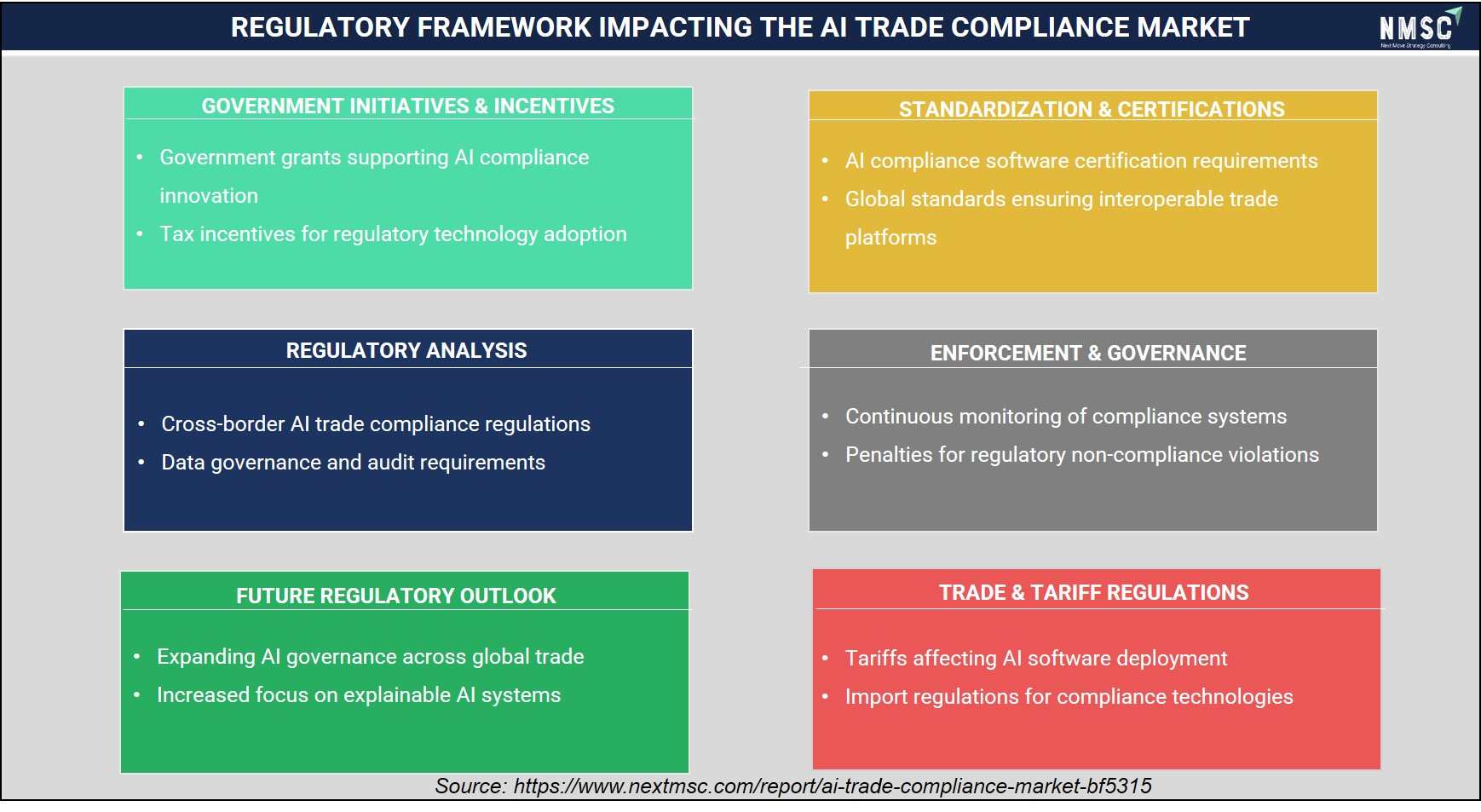
The above infographic presents a regulatory framework impacting the AI trade compliance market, where government grants and tax incentives are actively encouraging technology adoption. At the same time, cross-border regulations and data governance requirements are shaping system deployment, while future rules are increasingly focusing on explainable AI and global governance. Standardization through certification and global standards ensures interoperability, and enforcement is reinforced by continuous monitoring and penalties for non-compliance. Looking ahead, we observed that tariffs and import regulations continue to influence deployment costs and market accessibility across the sector.
Segmentation Analysis
Segment Sizing: By Offering
|
Segment |
2025 (USD) |
2035 (USD) |
CAGR% (2026–2035) |
|
Software |
USD 1.05 Billion |
USD 8.26 Billion |
22.9% |
|
Services |
USD 0.50 Billion |
USD 2.79 Billion |
18.9% |
|
Total |
USD 1.55 Billion |
USD 11.05 Billion |
21.7% |
Which Offering Segment Dominates the AI Trade Compliance Market?
Software, spanning global trade management platforms, trade compliance modules, trade content engines, and AI compliance agents, led the market with USD 1.05 billion in 2025, reflecting enterprise preference for embedded, continuously updated compliance intelligence over periodic consulting engagements. We observed that Software is also the fastest-growing offering, expanding at a 22.9% CAGR from 2026 to 2035, as vendors including Thomson Reuters and SAP embed agentic AI directly into core platform releases rather than as standalone service add-ons.
Segment Sizing: By Compliance Function
|
Segment |
2025 (USD) |
2035 (USD) |
CAGR% (2026–2035) |
|
Customs Compliance |
USD 0.34 Billion |
USD 2.03 Billion |
19.5% |
|
Tariff Duty Management |
USD 0.25 Billion |
USD 1.74 Billion |
21.5% |
|
Restricted Party Screening |
USD 0.22 Billion |
USD 1.65 Billion |
22.5% |
|
Export Control Management |
USD 0.19 Billion |
USD 1.80 Billion |
25.5% |
|
Product Classification Management |
USD 0.17 Billion |
USD 1.10 Billion |
20.5% |
|
Trade Documentation Management |
USD 0.14 Billion |
USD 0.98 Billion |
21.5% |
|
Trade Risk Management |
USD 0.11 Billion |
USD 0.90 Billion |
23.5% |
|
Regulatory Intelligence |
USD 0.09 Billion |
USD 0.60 Billion |
20.5% |
|
FTA Management |
USD 0.05 Billion |
USD 0.25 Billion |
18.5% |
|
Total |
USD 1.55 Billion |
USD 11.05 Billion |
21.7% |
Which Compliance Function Leads AI Trade Compliance Market Demand?
Customs Compliance remained the leading compliance function within the market, valued at USD 0.34 billion in 2025 as CBP's ACE 2.0 modernization and equivalent global customs programs drive demand for AI-ready declaration automation. Our findings suggest that Export Control Management is the fastest-growing function, registering a 25.5% CAGR from 2026 to 2035, as tightening BIS controls on advanced technologies expand natural language processing-based licensing and controlled technology tracking requirements across aerospace and high technology buyers.
Segment Sizing: By AI Technology
|
Segment |
2025 (USD) |
2035 (USD) |
CAGR% (2026–2035) |
|
Machine Learning |
USD 0.47 Billion |
USD 2.42 Billion |
17.9% |
|
Intelligent Automation |
USD 0.28 Billion |
USD 1.58 Billion |
18.9% |
|
NLP |
USD 0.22 Billion |
USD 1.04 Billion |
16.9% |
|
Predictive Analytics |
USD 0.20 Billion |
USD 1.24 Billion |
19.9% |
|
Generative AI |
USD 0.19 Billion |
USD 2.19 Billion |
27.9% |
|
LLM |
USD 0.12 Billion |
USD 1.35 Billion |
26.9% |
|
Agentic AI |
USD 0.08 Billion |
USD 1.24 Billion |
31.9% |
|
Total |
USD 1.55 Billion |
USD 11.05 Billion |
21.7% |
Which AI Technology Segment Is Most Widely Used in Trade Compliance?
Machine Learning remained the dominant technology across the market, reaching USD 0.47 billion in 2025 due to its established role in classification pattern recognition and risk scoring. Based on research conducted by NMSC, we found that Agentic AI is the fastest-growing technology at a 31.9% CAGR from 2026 to 2035, reflecting demand for generative AI-enabled compliance agents that can autonomously execute classification and screening decisions with auditable rationale across defence, retail, and pharmaceutical buyers.
Growth Opportunities
Our analysis shows that three forward-looking opportunities stand out for stakeholders positioning within the AI trade compliance market over the 2026-2035 forecast period.
How Can SaaS Compliance Agents Unlock Value for Small Enterprises?
Cloud-native, subscription-priced AI compliance agents present a whitespace opportunity to bring automated classification and screening within reach of small enterprises previously priced out of enterprise trade management platforms. Vendors that package agentic AI capabilities into modular, usage-based pricing tiers stand to capture recurring revenue across the Small Enterprises segment as compliance obligations extend beyond large multinational buyers into smaller cross-border sellers.
Where Does Cross-Border E-Commerce Create New Compliance Demand?
Retailers navigating expanding cross-border e-commerce volumes represent an underpenetrated opportunity for AI-driven duty calculation and landed-cost automation tuned to high-frequency, low-value shipment patterns. Vendors that combine real-time tariff classification with de minimis threshold monitoring can capture long-term contracts with the Retail Cross Border E-Commerce buyer segment as shipment volumes and regulatory complexity both rise.
How Can Export Control Automation Benefit Aerospace and Defense Buyers?
Aerospace and defense manufacturers navigating tightening BIS controls on advanced technologies represent an opportunity for suppliers offering automated export license management and controlled technology tracking. Early movers that secure validated accuracy for AI-driven Export Control Screening can differentiate with Aerospace Defense and High Technology Electronics buyers pursuing audit-ready, autonomous license determination through the forecast period.
Regional Outlook
|
Region |
2025 (USD) |
2035 (USD) |
CAGR% (2026–2035) |
Key Driver |
|
North America |
USD 0.62 Billion |
USD 4.02 Billion |
20.6% |
CBP ACE 2.0 modernization and BIS export control tightening |
|
Europe |
USD 0.42 Billion |
USD 2.50 Billion |
19.6% |
EU customs union digitization and sanctions enforcement |
|
Asia-Pacific |
USD 0.34 Billion |
USD 3.32 Billion |
25.6% |
Manufacturing export growth and indigenous SaaS adoption |
|
Middle East & Africa |
USD 0.09 Billion |
USD 0.71 Billion |
22.5% |
Free trade zone expansion and customs digitization |
|
Latin America |
USD 0.08 Billion |
USD 0.50 Billion |
20.5% |
Rising cross-border e-commerce and customs modernization |
|
Total |
USD 1.55 Billion |
USD 11.05 Billion |
21.7% |
— |
North America
North America leads the AI trade compliance market, anchored by CBP's ACE 2.0 modernization program and a concentration of leading platform vendors headquartered domestically. We observed that BIS export control tightening on advanced technologies and OFAC's extended ten-year recordkeeping mandate are driving enterprise demand for AI-based audit trails. Technology adoption remains advanced, with agentic AI and generative AI compliance agents seeing rapid uptake among large enterprise buyers across technology, aerospace, and pharmaceutical sectors.
Europe
Europe's market reflects a mature, regulation-driven landscape shaped by the European Commission's customs union digitization initiatives and evolving sanctions enforcement following geopolitical developments. Our findings suggest that Germany, the UK, and France are accelerating adoption of AI-based restricted party screening to manage complex, multi-jurisdictional sanctions regimes. Technology adoption favors natural language processing and machine learning-based classification tools, supported by regional vendors including AEB and MIC Datenverarbeitung.
Asia-Pacific
Asia-Pacific is the fastest-growing region, propelled by expanding manufacturing export volumes from China and India and rising adoption of cloud ERP-integrated trade compliance modules. We found that regulatory frameworks remain less harmonized than in Europe, giving domestic manufacturers flexibility to adopt cloud-native compliance tools rapidly. Technology adoption is accelerating as regional exporters scale AI-based classification to manage growing cross-border transaction volumes.
Middle East & Africa
The AI trade compliance market in the Middle East & Africa is expanding as free trade zone operators and customs authorities in the UAE and Saudi Arabia digitize declaration and screening processes. Our analysis shows that Gulf Cooperation Council economies are investing in AI-based customs infrastructure as part of broader trade diversification strategies. Regulatory influence remains moderate, while technology adoption is gradually shifting toward cloud-native compliance platforms as regional trade volumes rise.
Latin America
Latin America's AI trade compliance market is supported by growing cross-border e-commerce volumes and customs modernization initiatives in Brazil and Argentina. We observed that regulatory frameworks are less stringent than in North America or Europe, though multinational software vendors operating locally are introducing AI-based classification tools. Technology adoption remains centered on customs compliance and duty management, with competitive intensity increasing as regional distributors partner with global platform vendors.
U.S.
Based on our estimates, the U.S. market was valued at approximately USD 0.53 billion in 2025 and is projected to reach USD 3.40 billion by 2035, growing at a 20.5% CAGR. Demand is anchored by CBP's ACE 2.0 modernization and expanding BIS export control obligations on advanced technologies. Technology penetration favors agentic AI and generative AI compliance agents, and competitive intensity remains high among enterprise software vendors serving large multinational compliance teams.
Canada
The market in Canada reached roughly USD 0.07 billion in 2025 and is forecast to hit USD 0.42 billion by 2035 at a 20.0% CAGR. Demand structure mirrors U.S. customs and export control consumption patterns, reinforced by the presence of Descartes Systems Group's global headquarters in Ontario. Technology penetration is rising as national programs digitize customs declarations, with competitive intensity moderate given close integration with U.S.-based trade flows.
UK
As per our estimate, the UK market stood at about USD 0.15 billion in 2025, advancing toward USD 0.86 billion by 2035 at a 19.5% CAGR. Demand is driven by post-Brexit customs complexity requiring independent classification and origin management outside EU frameworks. Regulatory influence is significant, technology penetration favors AI-based restricted party screening, and competitive intensity remains steady among domestic and multinational vendors serving UK importers and exporters.
Germany
According to our analysis, Germany's market was valued near USD 0.13 billion in 2025 and is set to reach USD 0.77 billion by 2035, expanding at a 19.5% CAGR. Demand structure benefits from Germany's role as Europe's largest exporter and home to established trade compliance vendor AEB SE. Regulatory influence from EU customs union rules is notable, while technology penetration favors machine learning-based tariff classification among manufacturing exporters.
France
Based on our estimates, France's market reached approximately USD 0.09 billion in 2025, projected to climb to USD 0.54 billion by 2035 at a 19.5% CAGR. Demand is supported by France's aerospace and pharmaceutical export base, which requires stringent export control and product classification management. Regulatory influence from French and EU trade policy is notable, and competitive intensity remains moderate given reliance on both domestic and multinational compliance platform vendors.
China
The market in China stood at roughly USD 0.12 billion in 2025 and is forecast to reach USD 0.99 billion by 2035, registering a 24.0% CAGR. Demand is fueled by expanding manufacturing export volumes and rising exposure to foreign export control regimes affecting high technology shipments. Regulatory influence is increasing gradually, technology penetration is accelerating through domestic AI classification tool adoption, and competitive intensity remains elevated among regional software providers.
India
As per our estimate, India's market was valued at about USD 0.06 billion in 2025, projected to reach USD 0.73 billion by 2035 at a 28.0% CAGR, the fastest among covered countries. Demand structure reflects India's expanding export manufacturing base and Trademo Technologies' domestic presence in AI-based trade intelligence. Regulatory influence remains developing, while technology penetration is rising quickly as exporters adopt cloud-native compliance platforms to manage growing shipment volumes.
Japan
According to our analysis, Japan's market reached close to USD 0.06 billion in 2025 and is expected to hit USD 0.30 billion by 2035, growing at a 17.9% CAGR. Demand is supported by Japan's precision manufacturing export base requiring accurate tariff classification. Regulatory influence is well established, technology penetration is advanced among large enterprises, and competitive intensity remains moderate among established enterprise software vendors serving domestic exporters.
South Korea
Based on our estimates, South Korea's market stood at approximately USD 0.04 billion in 2025, forecast to reach USD 0.26 billion by 2035 at a 20.6% CAGR. Demand structure benefits from South Korea's globally significant semiconductor and automotive export industry, which faces stringent export control screening requirements. Technology penetration is high, with enterprise buyers favoring AI-based license management, and competitive intensity remains pronounced amid rapid compliance technology innovation.
Australia
The AI trade compliance market in Australia reached about USD 0.03 billion in 2025 and is projected to reach USD 0.14 billion by 2035, expanding at an 18.9% CAGR. Demand is supported by Australia's resource export sector and alliance-linked export control obligations. Regulatory influence stems from Australia's trade partnership frameworks, while technology penetration favors imported AI classification and screening platforms amid moderate competitive intensity.
UAE
As per our estimate, the UAE market was valued near USD 0.03 billion in 2025, projected to reach USD 0.23 billion by 2035 at a 22.0% CAGR. Demand structure is shaped by the UAE's free trade zone strategy and growing re-export volumes requiring automated origin and duty management. Regulatory influence remains moderate, technology penetration is improving through cloud-based platform adoption, and competitive intensity is rising as distributors expand product portfolios to serve Gulf markets.
Saudi Arabia
According to our analysis, Saudi Arabia's market reached roughly USD 0.04 billion in 2025 and is expected to hit USD 0.28 billion by 2035, growing at a 22.0% CAGR. Demand is driven by Vision 2030-linked trade diversification and rising import volumes requiring automated customs declaration. Regulatory influence is developing under national customs modernization guidelines, and technology penetration is advancing as domestic integrators scale AI-based compliance adoption.
South Africa
Based on our estimates, South Africa's market stood at about USD 0.01 billion in 2025, forecast to reach USD 0.07 billion by 2035 at a 17.9% CAGR. Demand structure reflects a developing trade compliance software base serving regional Southern African markets. Regulatory influence remains moderate, technology penetration is gradually improving, and competitive intensity is limited given reliance on imported compliance platforms from Europe and North America.
Brazil
The market in Brazil reached approximately USD 0.04 billion in 2025 and is projected to reach USD 0.27 billion by 2035, registering a 20.5% CAGR. Demand is underpinned by Brazil's expanding cross-border e-commerce volumes and ongoing customs modernization initiatives. Regulatory influence stems from national customs policy, technology penetration favors duty calculation and classification tools, and competitive intensity remains moderate among regional and multinational vendors.
Argentina
As per our estimate, Argentina's market was valued near USD 0.01 billion in 2025, projected to reach USD 0.09 billion by 2035 at a 20.0% CAGR. Demand structure is supported by steady import and export compliance consumption despite macroeconomic volatility. Regulatory influence remains limited, technology penetration is modest, and competitive intensity is centered on a small number of regional distributors serving national importers and exporters.
PESTEL Analysis of the AI Trade Compliance Industry
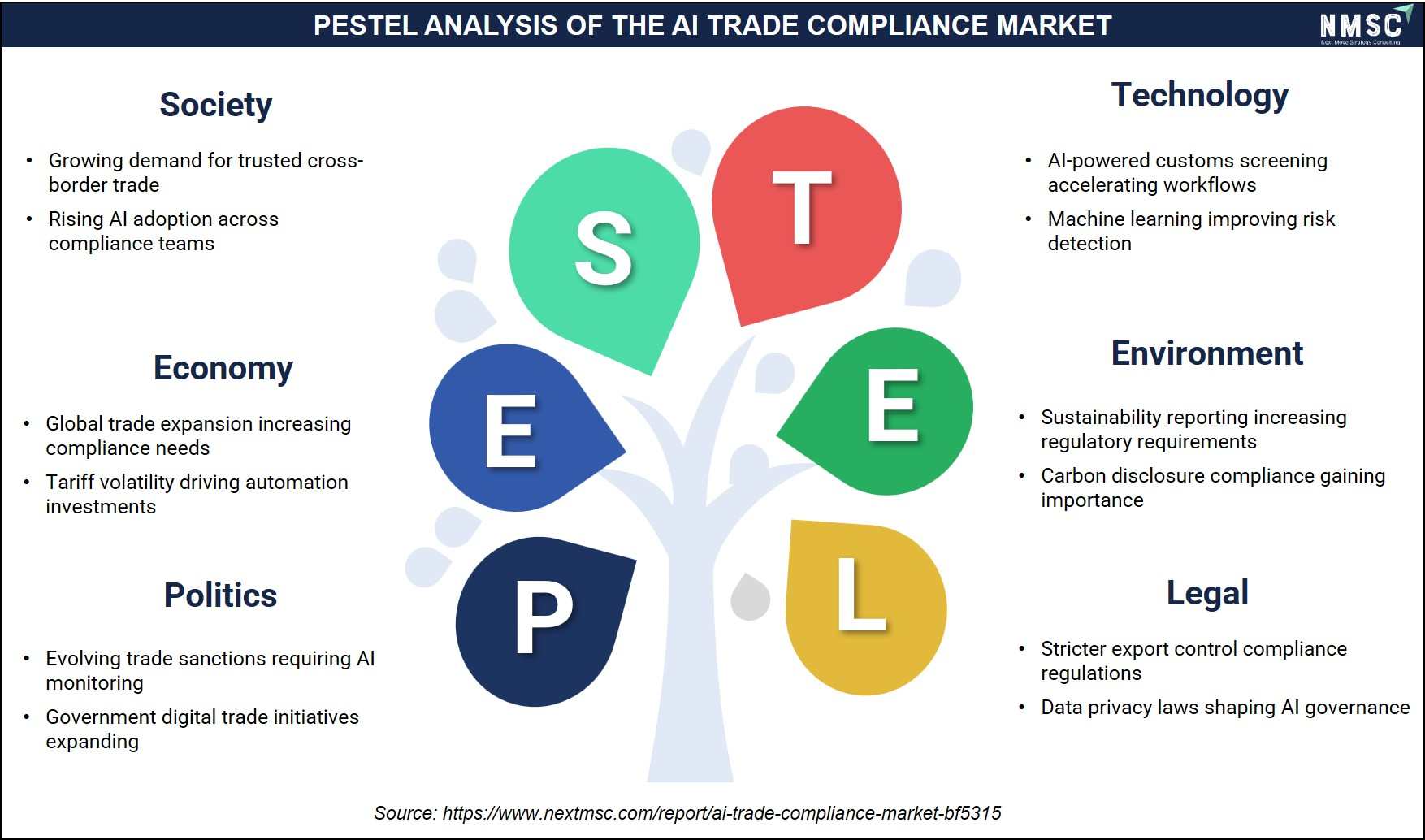
The above infographic presents a PESTEL analysis of the AI trade compliance market, where evolving trade sanctions, digital trade initiatives, and tariff volatility are driving investments in automation and AI-powered screening. Growing demand for trusted cross-border trade and AI adoption across compliance teams are shaping social and technological acceptance, supported by machine learning that improves risk detection. Further, environmental factors such as sustainability reporting and carbon disclosure are gaining importance, within a legal framework of stricter export controls and data privacy laws. Looking ahead, we observed that these interconnected factors collectively shape the market's evolution across the sector.
Competitive Landscape
We observed that the AI trade compliance industry features a moderately consolidated competitive landscape, with global ERP and content providers competing alongside specialized trade software vendors on breadth of regulatory content and depth of AI automation.
|
Key Takeaways |
|
Market Structure: Moderately consolidated; large ERP and content providers such as SAP, Oracle, and Thomson Reuters compete alongside specialized trade compliance vendors including Descartes, WiseTech, and AEB, while numerous regional providers serve indigenization-driven customs digitization. |
|
Innovation Focus: Agentic AI compliance agents, generative AI-powered classification content, and AI-enabled restricted party screening dominate current innovation pipelines across leading suppliers. |
|
M&A Activity: Active consolidation, exemplified by WiseTech Global's approximately USD 2.1 billion acquisition of E2open Parent Holdings in August 2025 to broaden its trade and supply chain compliance software portfolio. |
How Do Companies Compete in the AI Trade Compliance Market?
Companies compete primarily on breadth of regulatory content, AI automation depth, and integration flexibility with existing ERP systems across the industry. Global providers such as SAP and Oracle leverage native ERP integration to serve large enterprise buyers, while specialized vendors including Thomson Reuters and Descartes compete on continuously updated, validated regulatory content spanning global watchlists and classification codes.
Which Competitive Archetypes Dominate the Market?
Two archetypes dominate the market: ERP-embedded compliance modules offered by diversified enterprise software providers, and standalone, content-rich trade intelligence platforms offered by specialized vendors. SAP and Oracle exemplify the ERP-embedded archetype through native trade classification agents, while Thomson Reuters and Descartes exemplify the content-rich archetype through continuously validated global regulatory databases and dedicated screening solutions.
How Are Companies Differentiating Through Innovation in AI Trade Compliance?
Innovation and differentiation strategy increasingly center on agentic AI and generative AI content accuracy. Thomson Reuters' Global Trade Research tool, validated against U.S. Customs Broker License Exams with a mean score above 84%, and SAP's International Trade Classification Agent both demonstrate how suppliers use auditable, cited AI outputs to secure enterprise buyer trust. Our analysis shows that suppliers unable to demonstrate transparent, explainable AI decision trails risk exclusion from regulated buyer shortlists.
What M&A and Expansion Activity Is Shaping the AI Trade Compliance Market?
Partnerships and acquisitions continue to consolidate compliance capabilities within the industry. WiseTech Global's acquisition of E2open broadened its reach beyond logistics service providers into importers, exporters, and manufacturers, while Thomson Reuters' partnership program enabling integrations with SAP S/4HANA, Oracle, and NetSuite illustrates how diversified vendors pursue ecosystem expansion across enterprise resource planning environments.
Key Market Players
Our assessment indicates that the following 20 companies are actively shaping product innovation, capacity expansion, and platform strategy within the global AI trade compliance market.
-
Thomson Reuters Corporation
-
Descartes Systems Group Inc.
-
WiseTech Global Limited
-
AEB SE
-
MIC Datenverarbeitung GmbH
-
QAD Inc.
-
Infor Inc.
-
Aptean Inc.
-
Körber AG
-
CrimsonLogic Pte. Ltd.
-
Webb Fontaine Group FZ-LLC
-
Magaya Corporation
-
Customs4trade NV
-
Bamboo Rose LLC
-
Trademo Technologies Pvt. Ltd.
-
Zonos Inc.
-
iCustoms Ltd.
-
Livingston International Inc.
Latest Developments
We found that recent product launches and program milestones within the AI trade compliance market are concentrated on agentic AI deployment and platform consolidation, reflecting the industry's broader modernization transition.
|
Date |
Event |
|
November 2025 |
Thomson Reuters launched ONESOURCE+, an AI-powered Intelligent Compliance Network built on agentic AI to unify tax, trade, legal, and risk workflows for corporate compliance teams. |
|
October 2025 |
Thomson Reuters introduced three generative AI innovations in its ONESOURCE platform, including Global Classification AI for trade customers and AI-powered Indirect Tax Product Classification. |
|
January 2025 |
Oracle introduced new AI-powered capabilities within Oracle Cloud SCM, including updates to Oracle Global Trade Management. The enhancements support global trade operations by helping organizations manage tariffs, duty-drawback programs, customs-related reporting, and regulatory changes |
Expert Insights

“In today's dynamic business environment, corporations face increasing pressure to manage vast and intricate tax and trade compliance obligations while simultaneously seeking avenues for growth. Our latest solutions are designed to transform compliance from a challenging necessity into a strategic advantage, enabling our customers to operate with greater accuracy, efficiency, and confidence.”
— Laura Clayton McDonnell, President of Corporates at Thomson Reuters
Statement made following Thomson Reuters' launch of enhanced AI solutions for corporate tax and trade.
Market Interpretation
The statement highlights the increasing complexity of global trade compliance and the need for technology-enabled solutions that can improve accuracy, efficiency, and decision-making. NMSC's analysis indicates that the AI Trade Compliance Market is increasingly focused on using AI to simplify complex regulatory obligations, automate classification and compliance processes, and help organizations manage evolving trade requirements. Our findings suggest that the integration of AI with trusted trade content can transform compliance activities from resource-intensive processes into more scalable and strategically valuable operations.
Investment Opportunities
What Capital Inflows Are Targeting the AI Trade Compliance Market?
Capital inflows into the market are increasingly directed toward agentic AI development and regulatory content validation infrastructure. Strategic acquirers continue to fund platform consolidation, as seen in WiseTech Global's debt-funded, approximately USD 2.1 billion acquisition of E2open in August 2025. We observed that investors favor vendors demonstrating validated AI accuracy credentials, viewing independently verifiable classification performance as a proxy for long-term enterprise contract retention.
How Is Infrastructure Investment Supporting AI Trade Compliance Platforms?
Infrastructure investment is expanding regulatory content monitoring and validation capacity across leading vendors. Our findings suggest that Thomson Reuters made more than 155 million content updates in 2025 alone, supported by global monitoring teams that integrate regulatory changes in under one business day on average. This scale of content infrastructure investment is increasingly viewed as a competitive moat that smaller vendors struggle to replicate independently.
What ESG Considerations Are Shaping AI Trade Compliance Investment Decisions?
Environmental, social, and governance considerations are increasingly relevant to investment decisions across the industry, with responsible AI governance and data privacy compliance as key criteria. Extended recordkeeping mandates from regulators such as OFAC continue to inform data retention and audit-trail scoring in vendor selection. We found that investors increasingly favor vendors demonstrating transparent AI explainability governance, treating it as a risk indicator alongside data residency and algorithmic bias mitigation standards.
Key Benefits for Stakeholders
How Does This Report Benefit Enterprise and Industry Leaders?
Enterprise and industry leaders gain access to validated segmentation, competitive benchmarking, and regional demand forecasts that support sourcing and technology-adoption decisions across the AI trade compliance industry. Our analysis shows that detailed offering, compliance function, and AI technology breakdowns help procurement teams align platform selection with regulatory and automation requirements while identifying underserved buyer segments for portfolio expansion.
How Does This Report Benefit Investors and Financial Analysts?
Investors and financial analysts benefit from consistent, single-point market size and CAGR estimates that support valuation and capital-allocation decisions across the AI trade compliance market supply chain. We observed that the report's regional and segment-level growth differentials help identify which vendors and technology categories are best positioned to capture above-market growth in agentic AI and export control categories through 2035.
How Does This Report Benefit Technology Vendors and Product Teams?
Technology vendors and product teams gain insight into emerging design requirements, including agentic AI architecture, generative AI content validation, and intelligent document processing integration, that are reshaping the industry. Our findings suggest that this analysis helps R&D teams prioritize development roadmaps around auditable AI decision trails increasingly required by regulated buyer procurement processes.
Key Market Segments
By Offering
-
Software
-
Global Trade Management Platforms
-
Trade Compliance Modules
-
Trade Content Engines
-
AI Compliance Agents
-
-
Services
-
Regulatory Consulting
-
Implementation Integration
-
Managed Compliance Services
-
Support Training
-
By Compliance Function
-
Customs Compliance
-
Customs Declaration Automation
-
Customs Filing Management
-
Import Compliance Management
-
-
Tariff Duty Management
-
Tariff Classification Support
-
Duty Calculation
-
Duty Optimization
-
-
FTA Management
-
FTA Qualification
-
Origin Management
-
Supplier Declaration Management
-
-
Export Control Management
-
Export Control Screening
-
Export License Management
-
Controlled Technology Tracking
-
-
Restricted Party Screening
-
Sanctions Screening
-
Denied Party Screening
-
Watchlist Screening
-
-
Product Classification Management
-
HS Classification
-
ECCN Classification
-
Product Compliance Classification
-
-
Trade Documentation Management
-
Document Generation
-
Document Validation
-
Intelligent Document Processing
-
-
Trade Risk Management
-
Compliance Monitoring
-
Audit Management
-
Risk Assessment
-
-
Regulatory Intelligence
-
Regulatory Monitoring
-
Regulatory Updates
-
Trade Content Management
-
By AI Technology
-
Machine Learning
-
NLP
-
Generative AI
-
LLM
-
Agentic AI
-
Predictive Analytics
-
Intelligent Automation
By Deployment Mode
-
Cloud Native SaaS
-
Hybrid Cloud
-
On Premise
By Enterprise Size
-
Large Enterprises
-
Medium Enterprises
-
Small Enterprises
By End User Industry
-
High Technology Electronics
-
Aerospace Defense
-
Automotive Industrial Manufacturing
-
Pharmaceuticals Life Sciences
-
Retail Cross Border E Commerce
-
Logistics Freight Forwarding
-
Energy Chemicals
-
Government Customs Authorities
-
Other Industries
By Region
-
North America: U.S., Canada, Mexico
-
Europe: UK, Germany, France, Italy, Spain, Sweden, Denmark, Finland, Netherlands, Rest of Europe
-
Asia-Pacific: China, India, Japan, South Korea, Taiwan, Indonesia, Vietnam, Australia, Philippines, Malaysia, Rest of APAC
-
Middle East & Africa: Saudi Arabia, UAE, Egypt, Israel, Turkey, Nigeria, South Africa, Rest of MEA
-
Latin America: Brazil, Argentina, Chile, Colombia, Rest of LATAM
Conclusion and Recommendations
What Is the Long-Term Outlook for the AI Trade Compliance Market?
The long-term outlook for the market remains strongly positive, with global revenue projected to expand more than sevenfold from USD 1.55 Billion in 2025 to USD 11.05 Billion by 2035 at a 21.7% CAGR. We observed that sustained tariff volatility, agentic AI adoption, and tightening export control regimes will continue underpinning demand across customs compliance, restricted party screening, and export control categories through the forecast period.
What Strategic Positioning Should AI Trade Compliance Vendors Pursue?
Vendors should prioritize agentic AI and generative AI product platforms while pursuing independently validated accuracy credentials to secure long-term enterprise buyer contracts. Our assessment indicates that integrators investing early in auditable, explainable AI decision trails and export control automation will be best positioned to capture premium pricing within the AI trade compliance market.
How Attractive Is the AI Trade Compliance Market for New Investment?
The AI trade compliance industry presents a highly attractive investment case, supported by a USD 9.16 Billion absolute dollar opportunity between 2026 and 2035 and above-average growth in Asia-Pacific and Agentic AI categories. We found that investment attractiveness is highest for vendors combining validated regulatory content depth with scaled agentic AI capabilities, positioning them to serve both cost-sensitive small enterprise and premium large enterprise buyer segments simultaneously.
What Market Shifts and Key Risks Should Stakeholders Monitor?
Stakeholders should monitor data privacy governance restrictions, high implementation costs limiting small enterprise adoption, and fragmented multi-jurisdictional regulation as key risks to the AI trade compliance market. Our analysis shows that vendors unable to adapt to auditable, explainable AI specifications risk losing contract share to competitors with validated interoperable platforms, particularly within Europe's increasingly stringent data governance environment.
What Are the Key Growth Pathways for the AI Trade Compliance Market?
Key growth pathways include expanding agentic AI compliance agent portfolios, scaling validated regulatory content infrastructure, and deepening penetration into cross-border e-commerce and export control automation channels. NMSC's analysis indicates that vendors pursuing these pathways while maintaining cost competitiveness for small and medium enterprise buyers will be best positioned to capture the AI trade compliance market's projected growth through 2035.
About the Author
 Mayurima Roy
— Mayurima Roy is Research Analyst at Next Move Strategy Consulting, where she has spent 4 years working across the firm's full industry coverage rather than a single fixed vertical. Her work centers on structured research, ongoing trend tracking, competitive assessment, and insight-led content development, translating complex market data into clear, decision-ready narratives that support informed client decision-making across diverse global industries, market sectors, and world regions every day.
Mayurima Roy
— Mayurima Roy is Research Analyst at Next Move Strategy Consulting, where she has spent 4 years working across the firm's full industry coverage rather than a single fixed vertical. Her work centers on structured research, ongoing trend tracking, competitive assessment, and insight-led content development, translating complex market data into clear, decision-ready narratives that support informed client decision-making across diverse global industries, market sectors, and world regions every day.
About the Reviewer
 Supradip Baul
— Supradip Baul is an accomplished business consultant and strategist with over a decade of rich experience in market intelligence, strategy, technology, and business transformation. His work has included rigorous qualitative and quantitative analysis across multiple industries, helping clients shape investment decisions and long-term roadmaps. Earlier in his career, he was associated with Gartner, where he contributed to industry-leading reports and market share analyses. He has worked with leading global companies and holds an MBA with a dual specialization in Marketing and Finance.
Supradip Baul
— Supradip Baul is an accomplished business consultant and strategist with over a decade of rich experience in market intelligence, strategy, technology, and business transformation. His work has included rigorous qualitative and quantitative analysis across multiple industries, helping clients shape investment decisions and long-term roadmaps. Earlier in his career, he was associated with Gartner, where he contributed to industry-leading reports and market share analyses. He has worked with leading global companies and holds an MBA with a dual specialization in Marketing and Finance.
At Next Move Strategy Consulting, we understand that insightful market research is the cornerstone of successful business decisions. That's why we employ a robust and multifaceted approach, combining various methodologies to deliver the most accurate and actionable data for our clients.

Research Landscape
We navigate the world of research with two primary approaches:
Qualitative Approach
Our qualitative research methodologies involve immersive techniques such as in-depth interviews, focus groups, and observational studies. By engaging directly with individuals and stakeholders, we uncover valuable insights that quantitative data alone may overlook.

Quantitative Research
In tandem with qualitative methodologies, NMSC leverages the power of Quantitative Research to provide a robust foundation of numerical insights. Through systematic data collection and analysis, we quantify patterns, preferences, and market trends, offering a comprehensive view of the business landscape.
Our quantitative research approach employs diverse tools, including surveys, experiments, and statistical modelling. These methodologies enable us to gather data from a large and representative sample, ensuring the statistical significance of our findings. By employing structured questionnaires and standardized data collection methods, we guarantee the reliability and validity of the information we present to our clients.
Quantitative research is particularly effective in measuring the prevalence of trends, assessing market size, and gauging the impact of various factors on consumer behavior. The numerical precision attained through this approach equips our clients with actionable insights, facilitating data-driven decision-making and strategy formulation.


Our Specialized Toolbox for Industry-Specific Market Research
We deploy a specialized arsenal of techniques tailored to meet your unique requirements. Here's a glimpse into our comprehensive toolbox:

Information Procurement
The stage entails acquiring market data or relevant information through various sources and methodologies.


Market Research Approach
We utilize both top-down and bottom-up approaches in market research analysis to achieve a comprehensive understanding of the market dynamics, leveraging the broad perspective of industry trends and macroeconomic factors alongside detailed insights from specific segments and individual companies.

Porters Five Forces Analysis
We conduct Porter's Five Forces analysis to evaluate the competitive landscape of an industry, providing us with insights into factors that affect profitability and strategic positioning.

SWOT Analysis

Forecasting
We utilize a forecasting model to predict future consumption by considering parameters like population, economics, regulations, market competition, drivers, constraints, technology, and pricing. We also employ statistical techniques such as multilinear regression, exponential smoothing, moving average, ARIMA, and Monte Carlo simulations for accurate predictions. In econometric forecasting, we analyzed short-term and long-term event impacts, attributing values based on regulatory frameworks, economic factors, and market events.





 Speak to Our Analyst