Air Spring Market Global Industry Analysis and Forecast (2026-2035)

The global Air Spring Market is valued at USD 8.82 Billion in 2026 and is projected to reach USD 13.81 Billion by 2035, growing at a CAGR of 5.12% from 2026 to 2035. Key growth factors include heavy-truck and trailer suspension upgrades, rising aftermarket replacement demand, and expanding rail and off-highway adoption, with Asia-Pacific leading the market and Road Vehicles accounting for approximately 68% share.

Download Free Sample PDF
Base Year (2025)
$8.26 Billion
Forecast (2035)
$13.81 Billion
CAGR (2026-2035)
5.1%
Top Country
Asia-Pacific

What Is the Air Spring Market Size?

This report defines the air spring market as OEM and aftermarket sales of convoluted, rolling lobe, sleeve, diaphragm, and belted air springs used for pneumatic suspension and vibration isolation in road vehicles, off-highway vehicles, railway rolling stock, industrial equipment, and aerospace and defense equipment. It excludes coil and leaf spring suspension components, air compressors and valves sold as standalone products, and full suspension system integration services. This scope stays constant across every section below.

The global air spring market size was valued at USD 8.26 billion in 2025 and USD 8.82 billion in 2026. NMSC projects the market will reach USD 13.81 billion by 2035, a 5.12% CAGR from 2026 to 2035. Road Vehicles is the largest application, at roughly 68% of 2025 revenue, and Asia-Pacific leads regionally with approximately 38% share. Growth to 2035 is driven mainly by heavy-truck and trailer suspension upgrades, rising aftermarket replacement demand, and expanding rail and off-highway adoption.

The table below summarizes the largest and fastest-growing segment in each category, based on the segmentation and regional data presented in this report.

Air Spring Market Global Industry Analysis and Forecast (2026-2035) Revenue Forecast

Values in USD Billion

2025 $8.26 Billion
2025
2026 $8.68 Billion
2026
2027 $9.13 Billion
2027
2028 $9.59 Billion
2028
2029 $10.09 Billion
2029
2030 $10.60 Billion
2030
2031 $11.15 Billion
2031
2032 $11.72 Billion
2032
2033 $12.32 Billion
2033
2034 $12.95 Billion
2034
2035 $13.81 Billion
2035

Key Takeaways

By Product Type: Convoluted Air Springs held the largest share of approximately 44% (USD 3.63 billion) in 2025; Belted Air Springs are the fastest-growing type at 7.75% CAGR from 2026–2035.

By Application: Road Vehicles held the largest share of approximately 68% (USD 5.62 billion) in 2025; Industrial Equipment is the fastest-growing application at 7.75% CAGR from 2026–2035.

By Sales Channel: OEM held the largest share of approximately 72% (USD 5.95 billion) in 2025; Aftermarket is the fastest-growing channel at 6.30% CAGR from 2026–2035.

Dominant Region: Asia-Pacific dominated with approximately 38% revenue share (USD 3.14 billion) in 2025.

Fastest-Growing Region: Middle East & Africa is expected to register the highest CAGR of 7.75% during 2026–2035.

Dominant Country: China led with approximately USD 1.32 billion in 2025.

Fastest-Growing Country: India is the fastest-growing country at approximately 9.8% CAGR from 2026–2035.

Market Opportunity: The air spring market will add USD 4.99 billion in revenue between 2026 and 2035. Aftermarket replacement demand and Asia-Pacific truck production will capture a disproportionate share of that growth, based on their above-average segment and regional CAGRs.

NMSC's analysis indicates that OEM suppliers are extending their brand into the aftermarket rather than ceding replacement sales to independent manufacturers. Firestone Airide and Continental both sell OEM-grade air springs directly to the aftermarket under their primary brand name, a strategy that captures the recurring replacement revenue that a single truck generates over its service life.

What Does the Air Spring Market Encompass?

An air spring replaces steel coil or leaf springs with a rubber bellow filled with compressed air, letting a vehicle adjust ride height and stiffness under varying load. Heavy trucks and trailers use them most, since load weight on a commercial vehicle varies far more than on a passenger car. This variability is why commercial vehicles, not passenger cars, account for most global air spring demand.

Regulatory pressure on this market centers on vehicle emissions and axle-load rules rather than air spring-specific standards. Stricter axle-load limits push fleet operators toward multi-axle trailers with independent air suspension on each axle, directly increasing the number of air springs per vehicle. NMSC's analysis indicates that rising commercial vehicle production in Asia-Pacific, combined with these axle-load rules, is the main reason regional air spring demand is outpacing the global average.

Market Drivers & Dynamics

Interactive Dataset
Rising heavy-truck and multi-axle trailer production in Asia-Pacific driver +1.4% Asia-Pacific 2026–2035
Stricter axle-load and vehicle stability regulations increasing air springs per vehicle driver +1.1% Europe, North America 2026–2035
Growing aftermarket replacement demand from an aging global commercial vehicle fleet driver +0.9% Global 2026–2032
Expanding rail transit investment requiring passenger and freight car air suspension driver +0.6% Asia-Pacific, Europe 2026–2035
Rising off-highway equipment production for construction and mining applications driver +0.5% Global 2027–2035
Extended-temperature and electric-vehicle-specific air spring product development driver +0.4% Europe, North America 2026–2033
Volatility in natural and synthetic rubber input costs restraint −0.7% Global 2026–2030
Competition from lower-cost steel and hydro-pneumatic suspension in price-sensitive vehicle segments restraint −0.5% Asia-Pacific, Latin America 2026–2032
Long OEM qualification cycles limiting new-entrant supplier access to truck-maker contracts restraint −0.3% Global 2026–2030
Source: Next Move Strategy Consulting

Growth Drivers

What Is the Primary Growth Driver of the Air Spring Market?

Rising heavy-truck and trailer production in Asia-Pacific is the primary driver. China's Ministry of Industry and Information Technology reported that national commercial vehicle output remained a core pillar of the country's automotive manufacturing base through 2025, with heavy trucks and trailers accounting for a growing share of multi-axle configurations that require independent air suspension on each axle. More axles per vehicle means more air springs sold per unit produced, which is why regional air spring demand is growing faster than regional vehicle unit sales alone would suggest.

How Are Axle-Load Regulations Driving Market Growth?

Stricter axle-load limits force fleet operators to distribute weight across more axles rather than overloading fewer ones, and each added axle typically carries its own independent air spring suspension. This regulatory mechanism directly increases the number of air springs required per heavy vehicle, independent of any change in total vehicle production volume. Our assessment indicates that this per-vehicle content increase, not unit growth alone, explains why European and North American revenue is holding up despite comparatively flat commercial vehicle production.

Growth Inhibitors

What Is Restraining Air Spring Market Growth?

Volatility in natural and synthetic rubber input costs restrains margin expansion, since the rubber bellow is the air spring's primary raw material. When rubber prices spike, suppliers face a choice between absorbing the cost or raising prices on OEM contracts already fixed under multi-year agreements. We found that this cost exposure disproportionately affects smaller regional manufacturers without the purchasing scale to hedge rubber procurement, compared with globally diversified suppliers like Continental and Trelleborg.

Segmentation Analysis

2025 (USD Billion)
2035 (USD Billion)
Convoluted A
Single-Convo
Double-Convo
Triple-Convo
Multi-Convol
Segment Item 2025 (USD Billion) 2035 (USD Billion) CAGR
Convoluted Air Springs $10.0 USD Billion $40.0 USD Billion 23.0%
Single-Convolution Air Springs $17.1 USD Billion $51.1 USD Billion 25.0%
Double-Convolution Air Springs $24.2 USD Billion $62.2 USD Billion 19.0%
Triple-Convolution Air Springs $31.3 USD Billion $73.3 USD Billion 17.0%
Multi-Convolution Air Springs $38.4 USD Billion $84.4 USD Billion 22.0%

Segment-wise data is locked

Unlock complete segment-wise numbers for By Product Type.

Unlock Full Data

Which Product Type Is Largest, and Which Is Growing Fastest?

Convoluted Air Springs are the largest type at USD 3.63 billion in 2025, about 44% of total revenue. Its folded-bellow design gives the widest deflection range of any air spring type, which is why it remains the default choice for heavy-truck and trailer axles that see the largest load swings. Belted Air Springs are the fastest-growing type, at a 7.75% CAGR through 2035. Its internal cord reinforcement suits high-pressure industrial and off-highway applications, a smaller but faster-expanding base than the mature heavy-truck segment that Convoluted Air Springs already dominates.

2025 (USD Billion)
2035 (USD Billion)
Road Vehicle
Passenger Ve
Commercial V
Light Commer
Heavy Trucks
Segment Item 2025 (USD Billion) 2035 (USD Billion) CAGR
Road Vehicles $10.0 USD Billion $40.0 USD Billion 18.0%
Passenger Vehicles $17.1 USD Billion $51.1 USD Billion 16.0%
Commercial Vehicles $24.2 USD Billion $62.2 USD Billion 22.0%
Light Commercial Vehicles $31.3 USD Billion $73.3 USD Billion 12.0%
Heavy Trucks $38.4 USD Billion $84.4 USD Billion 19.0%

Segment-wise data is locked

Unlock complete segment-wise numbers for By Application.

Unlock Full Data

Which Application Is Largest, and Which Is Growing Fastest?

Road Vehicles is the largest application at USD 5.62 billion in 2025, roughly 68% of the market, led by heavy trucks, buses, and trailers rather than passenger cars, which mostly retain coil-spring suspension outside premium air-ride trims. railway equipment demand adds a smaller but steady contribution as metro and urban rail operators specify air suspension for ride comfort. Industrial Equipment is the fastest-growing application, at a 7.75% CAGR, as manufacturing and material-handling equipment makers adopt air springs for vibration isolation on precision machinery. For suppliers, this signals that industrial accounts, historically a minor category, now justify dedicated product development rather than adapted truck components.

2025 (USD Billion)
2035 (USD Billion)
OEM
Aftermarket
Segment Item 2025 (USD Billion) 2035 (USD Billion) CAGR
OEM $10.0 USD Billion $40.0 USD Billion 24.0%
Aftermarket $17.1 USD Billion $51.1 USD Billion 10.0%

Segment-wise data is locked

Unlock complete segment-wise numbers for By Sales Channel.

Unlock Full Data

Which Sales Channel Is Largest, and Which Is Growing Fastest?

OEM is the largest channel at USD 5.95 billion in 2025, about 72% of revenue, because every new truck, trailer, or railcar leaves the factory with a full set of factory-fitted air springs before any replacement need arises. Aftermarket is the fastest-growing channel, at a 6.30% CAGR, as the global commercial vehicle fleet ages and factory-fitted air springs reach their replacement cycle. This is the channel where OEM brand extension into aftermarket sales, as Firestone Airide and Continental have done, becomes commercially decisive.

Growth Opportunities

Our analysis shows that three forward-looking opportunities stand out for stakeholders positioning within the air spring market over the 2026-2035 forecast period.

Where Is the Clearest Opportunity in Cold-Climate and EV-Specific Air Springs?

Continental's HiTemp line shows that temperature-rated air springs command standard-fit status on cold-climate fleets once proven in service. Suppliers that extend this approach to electric truck platforms, which carry heavier battery packs and different load distributions than diesel trucks, can secure early design-in positions before EV truck platforms standardize on a single suspension architecture.

Where Is Aftermarket Brand Extension Still Underexploited?

Firestone Airide and Continental have proven that OEM brand extension into aftermarket sales captures replacement-cycle revenue that would otherwise go to independent manufacturers. Suppliers without a recognized aftermarket-facing brand, particularly in the automotive trailer segment, are leaving this recurring revenue on the table each time a factory-fitted air spring reaches replacement age.

Why Is Localized Manufacturing Capacity a Growing Requirement for OEM Contracts?

Firestone's multi-continent manufacturing footprint illustrates how truck makers increasingly require regional or near-shore production as a condition of OEM supply agreements. Suppliers that build or partner for local manufacturing capacity in Asia-Pacific and Latin America, rather than exporting from a single hub, can qualify for OEM contracts that a centralized manufacturer cannot bid on.

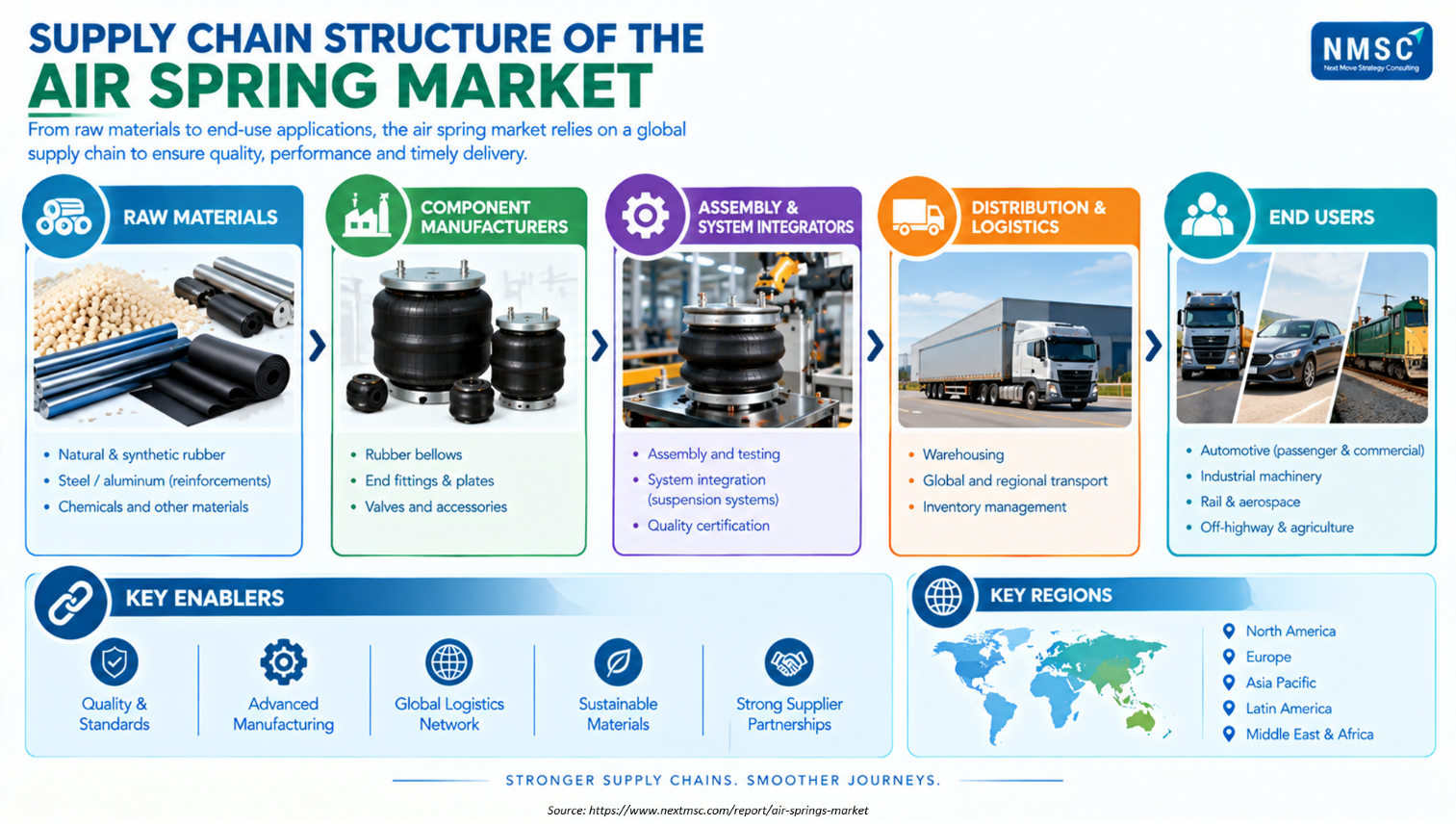
Supply Chain Structure of the Air Spring Market
The air spring market operates through an interconnected supply chain spanning raw material suppliers, component manufacturers, system integrators, distributors, and end users. Rubber compounds, reinforcements, valves, and related components support production, while advanced manufacturing, quality standards, logistics networks, and supplier partnerships enable reliable delivery across automotive, industrial, rail, aerospace, and off-highway applications.

Ecosystem Analysis

Regional Outlook

2025 (USD Billion)
2035 (USD Billion)
Asia-Pacific
Europe
North Americ
Latin Americ
Middle East
Region 2025 (USD Billion) 2035 (USD Billion) CAGR (%)
Asia-Pacific $10.0 USD Billion $40.0 USD Billion 9.0%
Europe $17.1 USD Billion $51.1 USD Billion 27.0%
North America $24.2 USD Billion $62.2 USD Billion 25.0%
Latin America $31.3 USD Billion $73.3 USD Billion 23.0%
Middle East & Africa $38.4 USD Billion $84.4 USD Billion 12.0%

Regional data is locked

Unlock complete regional numbers for this market.

Unlock Full Data

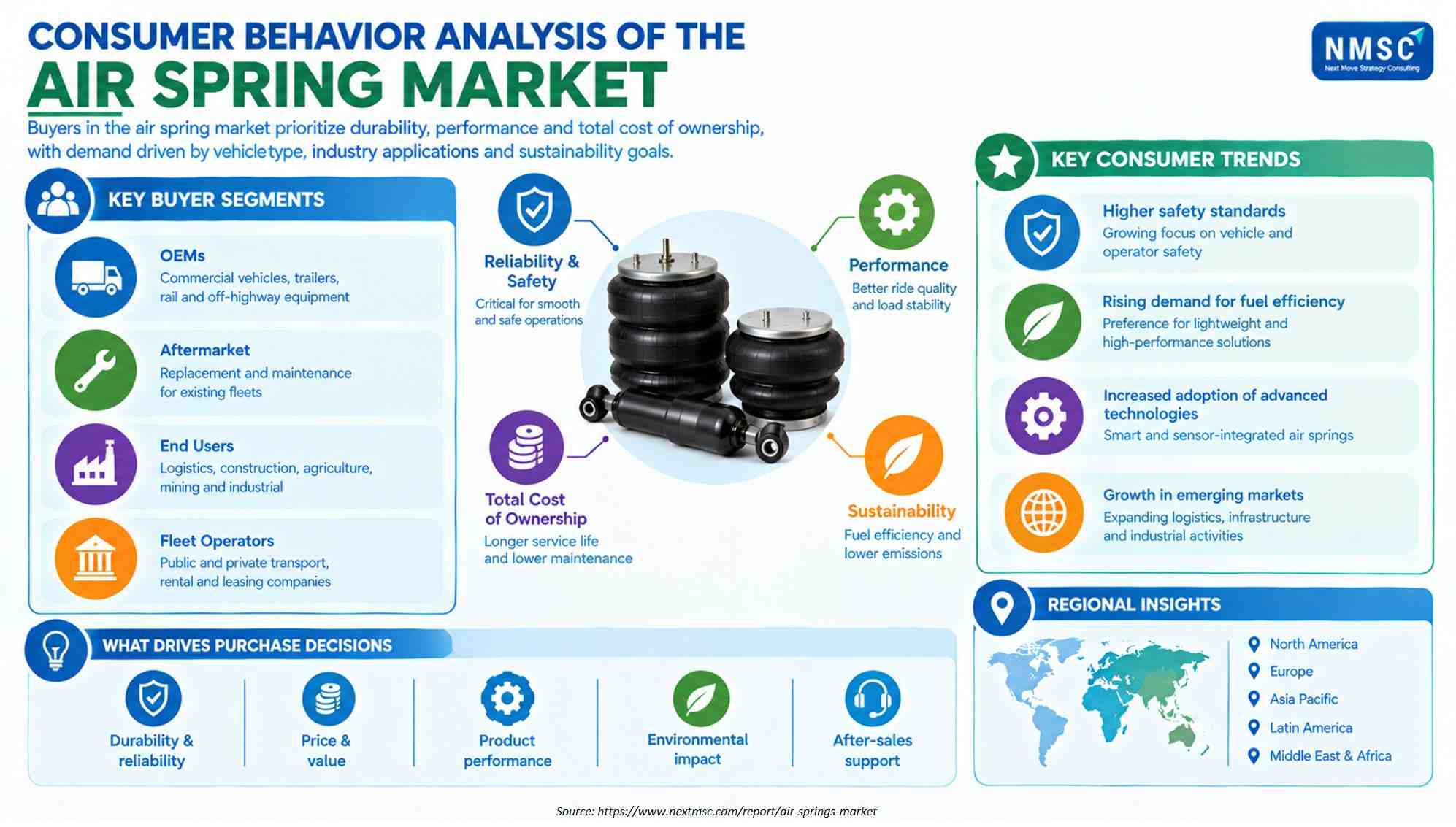
Consumer Behavior Analysis of the Air Spring Market

Consumer Behavior Analysis of the Air Spring Market

Purchasing decisions in the air spring market are shaped by durability, reliability, performance, total cost of ownership, and after-sales support. OEMs, fleet operators, aftermarket buyers, and industrial users increasingly consider safety, fuel efficiency, advanced sensor-integrated technologies, and environmental impact. Regional demand is also influenced by transportation, infrastructure, and industrial activity.

Competitive Landscape

This market splits into two competitive groups: diversified automotive and industrial conglomerates that treat air springs as one product line among many, and specialist manufacturers that compete purely on air spring engineering depth.

Dimension Description
Market Structure Moderately concentrated. Firestone Industrial Products, Continental, and ZF Friedrichshafen hold the broadest OEM relationships; specialist manufacturers such as Air Lift Company and Arnott LLC compete on aftermarket and niche application depth.
Innovation Focus Extended-temperature material compounds, EV-specific load ratings, and digital ride-height accessory systems, not new base air spring designs, are where competitive investment is concentrated.
M&A Activity Limited large-scale M&A in the near term; competitive activity centers on new OEM supply agreements and manufacturing capacity expansion rather than acquisitions.

How Do Conglomerates and Specialists Compete Differently in This Market?

Continental and ZF Friedrichshafen sell air springs as one line within a broader vehicle-systems portfolio, letting them bundle air suspension into larger OEM contracts covering brakes, tires, or electronics. Air Lift Company and Arnott LLC instead compete purely on air spring engineering and aftermarket brand recognition. This means a truck maker choosing a full-systems supplier weighs different criteria than an individual fleet owner choosing a replacement part.

Which Companies Hold the Broadest OEM Relationships, and Why Does That Matter?

Firestone Industrial Products supplies MAN Truck & Bus across multiple truck series and operates manufacturing on four continents, giving it OEM reach that a single-region competitor cannot match. Broad OEM reach compounds over time, since each new-vehicle design win generates years of matched-part aftermarket replacement demand for the same supplier. This is why incumbent OEM suppliers hold a structural advantage that new entrants find difficult to overcome even with a technically comparable product.

What Specific Innovations Are Driving Competitive Differentiation Right Now?

Continental's N7 material compound and HiTemp product line target a specific, measurable weakness in commercial vehicle air springs: performance degradation in extreme cold. Firestone's Digital Air Command accessory systems target a different differentiator: driver-facing ride-height control rather than the air spring itself. Both approaches show that competitive advantage in this market increasingly comes from application-specific engineering, not from a generic, one-size-fits-all air spring design.

Why Has M&A Activity Been Limited Compared With Other Automotive Component Markets?

Air spring manufacturing requires deep, application-specific engineering relationships with truck and railcar makers built over years of OEM qualification testing. This makes acquiring a competitor's customer relationships harder than in component categories with more standardized specifications. As a result, most competitive activity in this market takes the form of new OEM supply agreements and capacity expansion, illustrated by Firestone's China and Poland manufacturing investments, rather than consolidation through acquisition.

Key Market Players

Our assessment indicates that the following 20 companies are actively shaping product innovation, capacity expansion, and go-to-market strategy within the global air spring market.

Firestone Industrial Products Company, LLC Continental AG Vibracoustic SE ZF Friedrichshafen AG Hendrickson USA, L.L.C. Trelleborg AB Tenneco Inc. Cummins Inc. Wabtec Corporation SAF-HOLLAND SE Infinity Engineered Products LLC Shanghai Baolong Automotive Corporation Aktas Holding Dunlop Systems and Components Limited SI Air Springs Private Limited Toyo Tire Corporation Air Lift Company Arnott LLC Rubena, s.r.o. Weforma Dämpfungstechnik GmbH

Latest Developments

We found that recent product launches and air-suspension portfolio expansions within the air spring market are focused on improving load support, durability, performance, and application coverage.

Date Event
Jun 2026 Hendrickson highlighted its ULTRAA-K, VANTRAAX, and INTRAAX trailer air-suspension solutions for modern commercial fleets. The company emphasized integrated designs supporting ride quality, lower maintenance, uptime, and asset value, while noting that air suspension is already widely adopted across U.S. trailer fleets for vibration and load-control benefits.
Feb 2026 Air Lift launched availability of its ProSeries LoadLifter 5000 for the 2025 Toyota 4Runner. The professionally installed air-spring system provides up to 5,000 pounds of load- leveling capacity and is designed to restore ride height, stability, braking balance, and towing performance when the vehicle carries additional loads.
Oct 2025 Tenneco’s Monroe brand introduced a comprehensive commercial-vehicle air-spring range featuring multiple engineering enhancements aimed at safety, productivity, performance, and durability. The range covers applications from Mercedes-Benz, IVECO, DAF, Renault Trucks, MAN, Volvo, and other manufacturers, extending Monroe’s replacement-suspension offering across major vehicle platforms.

Investment Opportunities

Where Is Capital Flowing in the Air Spring Market Right Now?

Capital is flowing into manufacturing capacity expansion and material R&D rather than acquisitions. Firestone's multi-continent plant footprint and Continental's N7 and HiTemp product development both represent direct capital investment in production and engineering capability rather than in buying competitors.

What Infrastructure Investment Is Supporting This Growth?

Suppliers are investing in regional manufacturing plants to meet localized-sourcing requirements now attached to OEM truck-maker contracts. Firestone's plants in China and Poland illustrate this shift toward production capacity placed near the customer's assembly lines rather than centralized, export-based manufacturing.

How Do ESG Considerations Factor Into This Market?

Rubber sourcing and end-of-life disposal are the primary ESG considerations for air spring manufacturers, since the rubber bellow is the product's main material and its largest environmental footprint. Suppliers disclosing sustainable rubber sourcing practices and recycling programs for worn air springs are better positioned to meet the sustainability procurement criteria increasingly attached to large fleet and government contracts.

Key Benefits for Stakeholders

What Does This Report Give Enterprise and Industry Leaders?

Procurement and product teams get segment-level revenue splits by product type, application, and sales channel, tied to a specific 2025-2035 forecast rather than general market commentary. This lets a supplier justify a specific R&D investment, such as EV-rated air springs, with a growth-rate figure rather than a hunch.

What Does This Report Give Investors and Financial Analysts?

Analysts get consistent, single-point size and CAGR estimates by region and segment, supporting valuation models without reconciling conflicting figures from multiple sources. The regional growth gap, a 7.75% CAGR in Middle East & Africa versus 3.56% in North America, is the clearest single data point for identifying where above-market growth is available.

What Does This Report Give Technology Vendors and Product Teams?

Suppliers building next-generation air springs get evidence for which product attributes actually win OEM contracts: extended temperature range and EV-specific load ratings, based on the products Continental and Firestone are actually bringing to market. This should focus R&D roadmaps on application-specific engineering rather than incremental improvements to existing designs.

Key Market Segments Evaluated

By Product Type

  • Convoluted Air Springs 
    • Single-Convolution Air Springs
    • Double-Convolution Air Springs
    • Triple-Convolution Air Springs
    • Multi-Convolution Air Springs
  • Rolling Lobe Air Springs
  • Sleeve Air Springs
  • Diaphragm Air Springs
  • Belted Air Springs

By Application

  • Road Vehicles 
    • Passenger Vehicles
    • Commercial Vehicles
  • Light Commercial Vehicles
  • Heavy Trucks
  • Buses and Coaches
  • Trailers
  • Off-Highway Vehicles 
    • Construction Equipment
    • Agricultural Equipment
    • Mining Equipment
    • Forestry Equipment
  • Railway 
    • Passenger Rail
    • Freight Rail
    • Urban and Metro Rail
  • Industrial Equipment 
    • Material Handling Equipment
    • Manufacturing and Automation Equipment
    • Machine Tools
    • Packaging and Processing Equipment
    • Precision and Metrology Equipment
    • Power and Energy Equipment
    • Medical and Laboratory Equipment
    • Other Industrial Equipment
  • Aerospace and Defense Equipment

By Sales Channel

  • OEM
  • Aftermarket

By Region

  • North America 
    • U.S.
    • Canada
    • Mexico
  • Europe 
    • UK
    • Germany
    • France
    • Italy
    • Spain
    • Sweden
    • Denmark
    • Finland
    • Netherlands
    • Rest of Europe
  • Asia-Pacific 
    • China
    • India
    • Japan
    • South Korea
    • Taiwan
    • Indonesia
    • Vietnam
    • Australia
    • Philippines
    • Malaysia
    • Rest of APAC
  • Middle East & Africa 
    • Saudi Arabia
    • UAE
    • Egypt
    • Israel
    • Turkey
    • Nigeria
    • South Africa
    • Rest of MEA
  • Latin America 
    • Brazil
    • Argentina
    • Chile
    • Colombia
    • Rest of LATAM

Conclusion & Recommendations

The market will grow from USD 8.26 billion in 2025 to USD 13.81 billion by 2035. The market is projected to grow at a CAGR of 5.12% from 2026 to 2035. Growth will not be evenly distributed: Middle East & Africa (7.75% CAGR) and Asia-Pacific (6.28% CAGR) will grow roughly twice as fast as North America (3.56% CAGR), which remains a large but mature aftermarket-driven market.

How Should Suppliers Position Themselves Strategically?

Suppliers should prioritize winning new OEM design contracts over competing on aftermarket price alone, since each OEM win generates years of matched-part replacement demand. Extending a recognized OEM brand into the aftermarket, as Firestone Airide and Continental have done, is the clearest way to defend replacement-cycle revenue against independent aftermarket competitors.

Is This Market Attractive for New Investment?

Yes, selectively. The USD 4.99 billion revenue opportunity between 2026 and 2035 is concentrated in Asia-Pacific truck production and global aftermarket replacement demand, not the market broadly. Investment attractiveness is highest for suppliers that already hold OEM relationships, since new-entrant qualification cycles with truck and railcar makers take years to complete.

What Are the Key Risks to This Outlook?

The clearest risk is rubber input-cost volatility, which compresses margins for suppliers locked into multi-year fixed-price OEM contracts. A secondary risk is competition from lower-cost steel and hydro-pneumatic suspension in price-sensitive vehicle segments, particularly in Asia-Pacific and Latin America markets where air suspension has not yet become the default choice.

What Are the Clearest Growth Pathways to 2035?

Three pathways stand out based on this report's segment data: winning EV-specific OEM design contracts, extending OEM brands into aftermarket replacement sales, and building regional manufacturing capacity to qualify for localized-sourcing contracts. Suppliers pursuing multiple pathways simultaneously, as Firestone and Continental are currently doing, are best positioned to capture above-market growth through 2035.

FAQs

About the Author

Mihul Sharma

Mihul Sharma

Mihul Sharma is Research Associate at Next Move Strategy Consulting, where he has covered technology, industrial, and healthcare markets for 3 years. His work applies structured business research, market analysis, and secondary-source review to assess market trends, competitive developments, and growth opportunities. He supports report development by fully synthesizing industry data, company information, and market signals into concise findings for strategy and investment-focused research teams.

About the Reviewer

Supradip Baul

Supradip Baul

Supradip Baul is an accomplished business consultant and strategist with over a decade of rich experience in market intelligence, strategy, technology, and business transformation. His work has included rigorous qualitative and quantitative analysis across multiple industries, helping clients shape investment decisions and long-term roadmaps. Earlier in his career, he was associated with Gartner, where he contributed to industry-leading reports and market share analyses. He has worked with leading global companies and holds an MBA with a dual specialization in Marketing and Finance.

Nishant Awate

NISHANT AWATE

Business Development Global Sales

Zehnder Group Deutschland GmbH

Our experience working with Next Move Strategy Consulting was positive. The team was responsive, professional, and open to incorporating our specific requirements throughout the project. The India AHU market study was comprehensive and well structured, covering market value and volume forecasts, product and application segments, and key industry trends. The inclusion of both AHU and residential MVHR market insights made the study particularly relevant for our strategic market assessment. Overall, the report provides a solid foundation for evaluating market potential, identifying priority segments, and supporting business-development decisions in India.

Ross J Mckenzie

ROSS J MCKENZIE

Business Insight Manager

Staysure Group

“Next MSC have been incredibly helpful in providing detailed & robust information on our market, alongside quantifying growth by different segments. The process to procure was simple and easy, with sample reports and regular contact to ensure we had what we needed. Succinct detail on their sources & methodologies is also greatly received, allowing transparency in this respect helps build trust in the detail you pay for. Joseph in particular was fantastic, and helped ensure efficient provision of the insight pack – thank you NMSC!”.

Gaurav Jaiswal

GAURAV JAISWAL

Founder & CEO

Yano Charge Private Limited

The EV Charging market research report provided by the NextMSC was exceptionally detailed and insightful. It offered a comprehensive analysis that proved to be a game-changer for our strategic planning. Truly a testament to the NextMSC’s expertise and thoroughness in EV market landscape & analysis.

Mohit Agarwal

MOHIT AGARWAL

Chief Manager

DryChem India Pvt. Ltd.

Next Move Strategy Consulting is an amazing team of consultants. We required a market study report for our investors on top priority and the team went above and beyond our expectations to deliver the same with ample supporting data within a short time span enabling us to secure the investments and keep our project timeline maintained. Their professionalism, attention to detail, and timely delivery of actionable recommendations have left a lasting impression on our organization.

Kevin Coker

KEVIN COKER

Founder, CEO and Board Diector

Proxima Clinical Research

I have been using Next MSC reports for product positioning in a new geography for a long time. They have by far the best reports I have found and the price is reasonable too!

Custom Market Research Services

We will customize the research for you if the listed report does not fully match your requirements.

Get 30% Free Customization

Select License

This website uses cookies to ensure you get the best experience on our website. Learn more

✖