Bluetooth 5.0 Market Global Industry Analysis and Forecast (2025-2035)

The global Bluetooth 5.0 Market was valued at USD 7.8 billion in 2025 and is projected to reach USD 22.6 billion by 2035, growing at a CAGR of 11.2%. Key drivers include IoT expansion, wireless wearables, and smart home devices, with North America leading the market.
Download Free Sample PDF
Base Year (2025)
USD 7.8 billion
Forecast (2026-2035)
USD 22.6 billion
CAGR
11.2%
Top Region
North America

Market Size & Forecast - Bluetooth 5.0 Market
Global Revenue Forecast

Values in USD Billion

$7.8B 2025
2025
$8.7B 2026
2026
$9.6B 2027
2027
$10.7B 2028
2028
$11.9B 2029
2029
$13.3B 2030
2030
$14.7B 2031
2031
$16.4B 2032
2032
$18.2B 2033
2033
$20.3B 2034
2034
$22.5B 2035
2035

Market Overview - Bluetooth 5.0 Market

The Bluetooth 5.0 Market encompasses the global ecosystem of semiconductor components, software tools, and managed services that enable the design, deployment, and operation of Bluetooth 5.0-based wireless connectivity solutions. Bluetooth 5.0, released by the Bluetooth Special Interest Group (Bluetooth SIG) in 2016 and ratified in 2017, delivers up to four times the range, two times the speed, and eight times the broadcast message capacity relative to Bluetooth 4.2. The market supports a broad continuum of applications spanning consumer electronics, smart home, automotive, healthcare, industrial automation, and location-based services.

The Bluetooth 5.0 Market has evolved through distinct phases of adoption. The initial phase focused on consumer electronics integration, primarily smartphones, earbuds, and smartwatches. The second phase saw broader industrial and automotive uptake driven by Bluetooth Low Energy (BLE) profiles and mesh networking capabilities introduced alongside Bluetooth 5.0. The current phase is characterized by convergence with IoT platforms, AI-enabled edge devices, and location services infrastructure, where Bluetooth 5.0's enhanced advertising extensions and direction-finding capabilities unlock high-value enterprise and healthcare use cases at scale.

Regulatory frameworks significantly shape adoption patterns in the Bluetooth 5.0 Market. The U.S. Federal Communications Commission (FCC) and European Telecommunications Standards Institute (ETSI) govern radio frequency emissions and interoperability requirements. Medical-grade Bluetooth deployments are subject to FDA clearance pathways and CE marking, while automotive integration is influenced by UNECE Regulation No. 155 on cybersecurity. These requirements raise the compliance bar for manufacturers but reinforce long-term demand for certified Bluetooth 5.0 solutions.

Technology adoption across the Bluetooth 5.0 Market is accelerating as device manufacturers, system integrators, and enterprise technology buyers increasingly standardize on Bluetooth 5.0 as the default short-range wireless protocol. The proliferation of ultra-wideband (UWB) and Bluetooth 5.0 combination chipsets, advanced System-on-Chip integration, and protocol stack optimization for battery-constrained devices are collectively lowering power consumption and bill-of-material costs. This convergence is enabling mass adoption across mid-tier consumer devices, industrial sensors, retail asset tracking, and healthcare monitoring ecosystems.

Key Takeaways

The global Bluetooth 5.0 Market was valued at USD 7.8 billion in 2025 and is projected to reach USD 22.6 billion by 2035, growing at a CAGR of 11.2%.

Continuous expansion in IoT deployments, surging adoption of wireless wearables, and the rapid proliferation of smart home devices are key market drivers.

Bluetooth 5.0 offers superior range, throughput, and broadcast capacity compared to earlier Bluetooth standards, making it ideal for diverse applications.

The market has evolved from consumer electronics focus to broader industrial, automotive, and IoT integration, leveraging BLE and mesh networking.

Regulatory bodies like FCC, ETSI, and FDA play a crucial role in shaping adoption and ensuring compliance for Bluetooth 5.0 devices.

Convergence with AI-enabled edge devices and location services infrastructure is unlocking high-value enterprise and healthcare use cases.

Advances in ultra-low-power Bluetooth 5.0 designs are enabling new categories of disposable and implantable medical devices.

Radio frequency interference and regulatory fragmentation in emerging markets pose significant constraints on market expansion.

The automotive industry, AR/VR, gaming, and large-scale indoor positioning networks represent significant growth opportunities.

Hardware, particularly System-On-Chip solutions, dominates the component segment, while Software Development Kits are the fastest-growing sub-segment.

North America is the largest regional market, driven by leading SoC developers and advanced healthcare IoT adoption.

Asia-Pacific is the fastest-growing region, fueled by consumer electronics manufacturing and IoT scale.

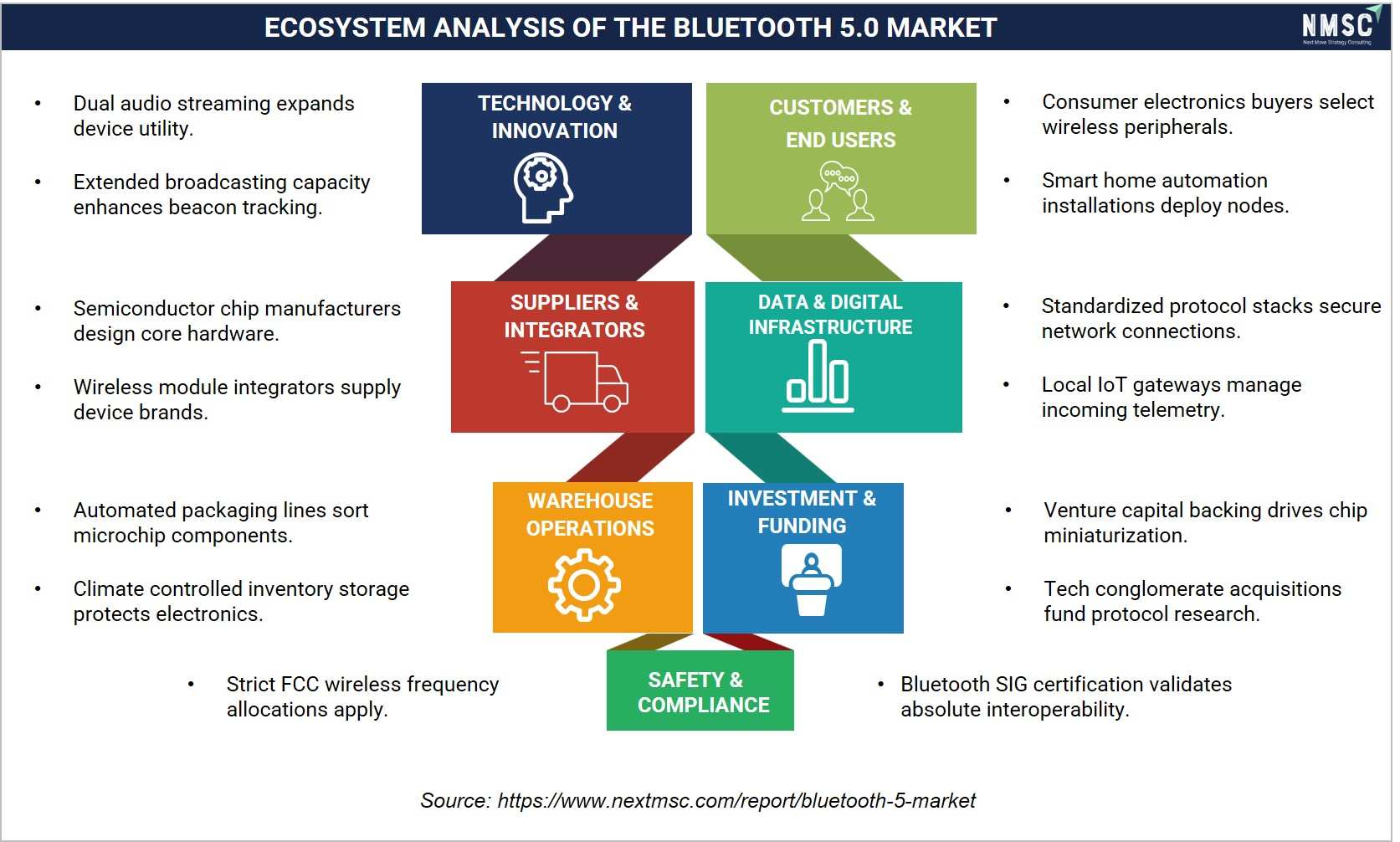
Ecosystem Analysis of the Bluetooth 5.0 Market

The Bluetooth 5.0 Market ecosystem is built on coordinated value chains across technology developers, component manufacturers, software integrators, investors, and end users to scale commercial adoption.

Technology Developers

  • Bluetooth Special Interest Group (Bluetooth SIG)
  • Qualcomm Technologies, Inc.
  • Nordic Semiconductor ASA
  • Broadcom Inc.
  • Silicon Laboratories Inc.
  • Texas Instruments Incorporated
  • Microchip Technology Incorporated
  • MediaTek Inc.
  • Renesas Electronics Corporation
  • STMicroelectronics N.V.
  • Infineon Technologies AG
  • Realtek Semiconductor Corp.
  • Shenzhen Goodix Technology Co., Ltd.
  • Espressif Systems (Shanghai) Co., Ltd.
  • Qorvo, Inc.
  • Synopsys, Inc.
  • CEVA, Inc.
  • NXP Semiconductors N.V.

Semiconductor Manufacturers

  • TSMC
  • GlobalFoundries
  • Qualcomm Technologies, Inc.
  • Nordic Semiconductor ASA
  • Broadcom Inc.
  • Silicon Laboratories Inc.
  • Texas Instruments Incorporated
  • Microchip Technology Incorporated
  • MediaTek Inc.
  • Renesas Electronics Corporation
  • STMicroelectronics N.V.
  • Infineon Technologies AG
  • Realtek Semiconductor Corp.
  • Shenzhen Goodix Technology Co., Ltd.
  • Espressif Systems (Shanghai) Co., Ltd.
  • Qorvo, Inc.
  • NXP Semiconductors N.V.

Device OEMs

  • Samsung
  • Apple
  • Sony
  • Sharp
  • Panasonic
  • BMW
  • Mercedes-Benz
  • Volkswagen
  • Toyota
  • Honda
  • Signify
  • Acuity Brands
  • Medical Device Manufacturers
  • Smart Home Device Manufacturers
  • Industrial Sensor Manufacturers

Software Integrators

  • System Integrators
  • IoT Platform Providers
  • Cloud Service Providers
  • SDK Developers
  • Protocol Stack Developers
  • Managed Service Providers

Infrastructure Providers

  • Real Estate Operators
  • Logistics Companies
  • Airport Authorities
  • Retail Chains
  • Healthcare Systems
  • Telecommunications Providers

Investors

  • Venture Capital Firms
  • Private Equity Firms
  • Institutional Investors
  • Strategic Corporate Investors

End Users

  • Consumers (Smartphones, Wearables, Audio Devices)
  • Automotive Industry
  • Healthcare Providers
  • Industrial Automation Companies
  • Retailers
  • Logistics Operators
  • Smart Home Owners
  • AR/VR and Gaming Enthusiasts

Standards Bodies

  • Bluetooth Special Interest Group (Bluetooth SIG)
  • U.S. Federal Communications Commission (FCC)
  • European Telecommunications Standards Institute (ETSI)
  • U.S. Food and Drug Administration (FDA)
  • International Telecommunication Union (ITU)
  • U.S. National Highway Traffic Safety Administration (NHTSA)
  • U.S. Centers for Disease Control and Prevention (CDC)
  • National Telecommunications Commission (NTC) - Philippines
  • Malaysian Communications and Multimedia Commission (MCMC)
  • Australian Communications and Media Authority (ACMA)
  • Ministry of Internal Affairs and Communications (MIC) - Japan
  • National Radio Research Agency (RRA) - South Korea
  • National Communications Commission (NCC) - Taiwan
  • Ministry of Communication and Information Technology (Kominfo) - Indonesia
  • Ministry of Information and Communications (MIC) - Vietnam
  • Communications, Space and Technology Commission (CST) - Saudi Arabia
  • Telecommunications and Digital Government Regulatory Authority (TDRA) - UAE
  • National Telecommunications Regulatory Authority (NTRA) - Egypt
  • Ministry of Communications - Israel
  • Information and Communication Technologies Authority (BTK) - Turkey
  • Nigerian Communications Commission (NCC)
  • Independent Communications Authority of South Africa (ICASA)
  • ANATEL - Brazil
  • ENACOM - Argentina
  • SUBTEL - Chile
  • MinTIC and CRC - Colombia

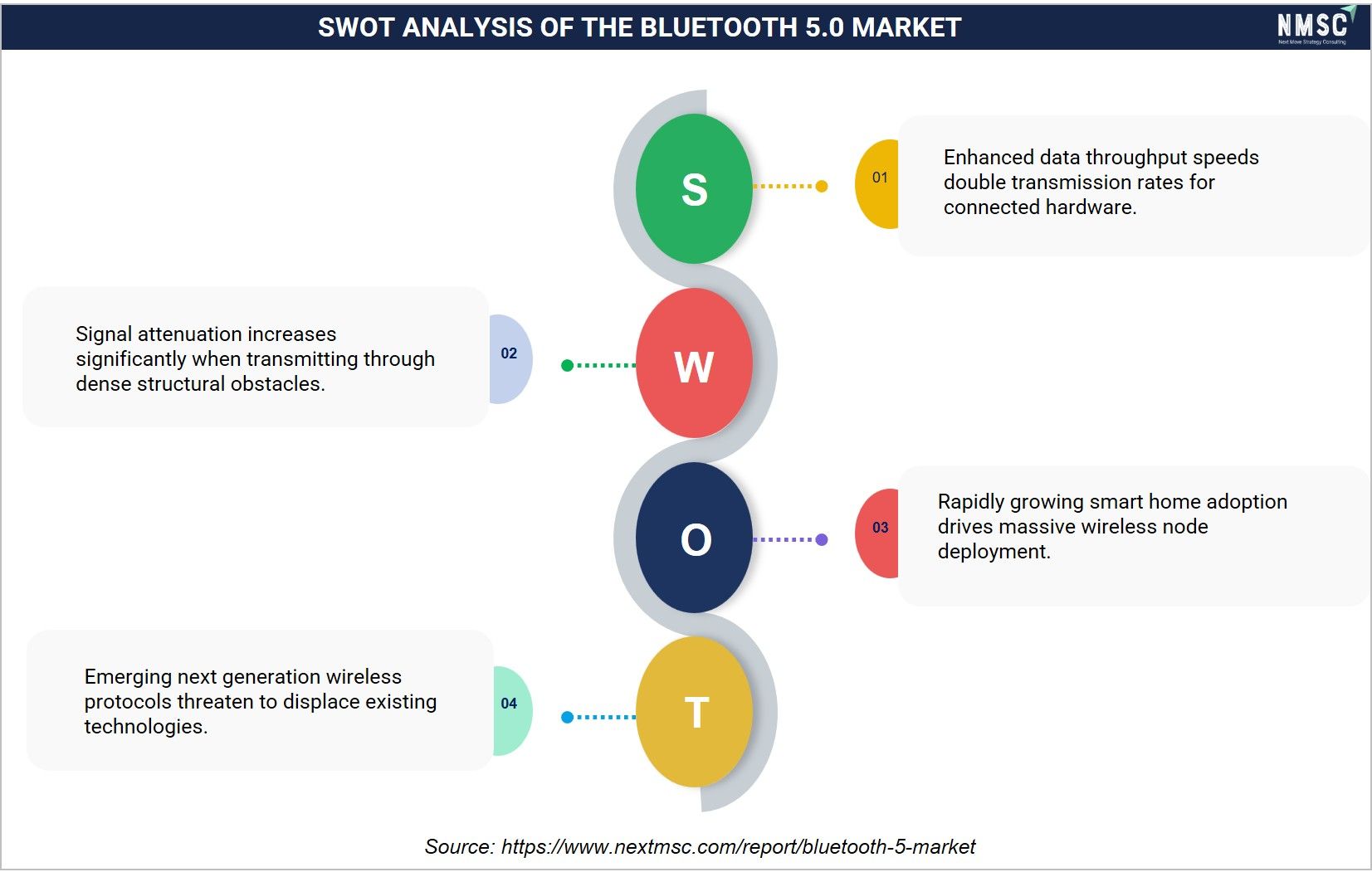
SWOT Analysis - Bluetooth 5.0 Market
This SWOT view highlights structural strengths, strategic gaps, expansion headroom, and external risks shaping outcomes in the Bluetooth 5.0 Market.

Strengths

Bluetooth 5.0 benefits from enhanced data throughput, extended range, and improved energy efficiency, supporting widespread adoption across consumer electronics and IoT applications. Its robust ecosystem, continuous innovation (e.g., BLE, Mesh, Direction Finding, LE Audio), and strong industry support from the Bluetooth SIG are significant advantages.

Weaknesses

Signal attenuation in complex environments can affect performance, leading to increased packet loss and latency in high-density deployments. Coexistence management in multi-protocol environments requires sophisticated engineering resources, increasing deployment complexity and total cost of ownership. The 2.4 GHz ISM band is shared, leading to potential radio frequency interference.

Opportunities

Expanding smart home, wearable, and industrial IoT deployments create significant growth opportunities. The automotive industry's integration of Bluetooth 5.0 for infotainment and digital keys, the growth of AR/VR and gaming peripherals, and the deployment of large-scale indoor positioning networks (enabled by Bluetooth 5.1 direction finding) present high-value market segments. The rapid digitization of healthcare also offers substantial growth.

Threats

Emerging wireless communication technologies (e.g., Wi-Fi 6E for short-range data transfer) and evolving connectivity standards (e.g., Thread and Matter potentially displacing Bluetooth Mesh in smart home IoT) present competitive challenges. Regulatory fragmentation across emerging markets can constrain geographic expansion velocity and increase certification costs. Supply chain concentration in East Asian semiconductor manufacturing poses a geopolitical risk.

Market Drivers & Dynamics - Bluetooth 5.0 Market

Interactive Dataset
Rapid Proliferation of IoT Devices driver Driving sustained Bluetooth 5.0 chipset demand due to extended range, enhanced broadcast capacity, and BLE energy efficiency for sensors, actuators, and gateways. Global
Digitization of Healthcare Delivery driver Creating strong structural demand for certified Bluetooth 5.0 connectivity in clinical and home health environments, including continuous glucose monitors, cardiac rhythm monitors, and RTLS. Global
Explosive Growth in Consumer Electronics driver Maintaining the consumer electronics sector as the highest-volume end market, driven by TWS earphone shipments, smartwatch adoption, and dual-audio capability. Global
Radio Frequency Interference and Spectrum Congestion restraint Posing a persistent operational constraint in high-density environments, leading to increased packet loss, latency variability, and throughput degradation, inhibiting enterprise-scale deployments. Global
Regulatory Fragmentation Across Emerging Markets restraint Creating compliance complexity for device manufacturers due to varying transmit power limits, frequency band assignments, and certification processes, slowing market expansion. Emerging Markets (Africa, Southeast Asia, Latin America)
Expansion of Automotive Bluetooth Integration opportunity Representing a significant and expanding opportunity for hands-free calling, audio streaming, vehicle diagnostics, and digital key functions, with premium-priced software-defined features. Global
Expanding AR/VR and Gaming Peripheral Market opportunity Creating new high-throughput, low-latency demand vectors for Bluetooth 5.0 chipsets, as gaming headsets, VR controllers, and AR glasses require reliable high-bandwidth data transfer. Global
Deployment of Large-Scale Indoor Positioning Networks opportunity Presenting a structurally attractive growth opportunity, enabled by Bluetooth 5.1 direction-finding capabilities and LE Audio broadcast, for dynamic wayfinding, asset utilization, and customer engagement. Global
Integration of AI-Enabled Edge Processing opportunity Transforming Bluetooth 5.0 from a data transport layer into an intelligent sensing and decision platform, unlocking new capabilities in wearables, healthcare, and smart home automation. Global
Growth of Bluetooth Mesh Networking opportunity Enabling large-scale, many-to-many device communication in smart buildings and industrial IoT, displacing more expensive alternatives and driving new deployments. Global
Source: Next Move Strategy Consulting

Growth Drivers

Rapid Proliferation of IoT Devices

The exponential growth of Internet of Things deployments is a powerful tailwind for the Bluetooth 5.0 Market. Its extended range (up to 400 meters), enhanced broadcast message capacity, and BLE energy efficiency make it the preferred short-range wireless standard for IoT sensors, actuators, and gateways. High-volume IoT categories like smart meters, environmental sensors, agricultural monitoring systems, and asset trackers are driving sustained Bluetooth 5.0 chipset demand globally.

Digitization of Healthcare Delivery

The rapid digitization of healthcare is creating strong structural demand for certified Bluetooth 5.0 connectivity. FDA-cleared Bluetooth-enabled devices, including continuous glucose monitors and remote patient monitoring kits, rely on BLE protocols. Hospitals are deploying Bluetooth 5.0 real-time location systems to track medical equipment and improve asset utilization, driving significant incremental demand for SoCs and integration services.

Explosive Growth in Consumer Electronics

The consumer electronics sector remains the highest-volume end market, fueled by the explosive growth in true wireless stereo (TWS) earphone shipments and smartwatch adoption. Bluetooth 5.0's dual-audio capability is a key differentiator for premium TWS earphone brands. The Bluetooth LE Audio standard further extends its relevance in audio applications with enhanced codec efficiency and hearing aid support, reinforcing chipset replacement cycles.

Growth Inhibitors

Radio Frequency Interference and Spectrum Congestion

Radio frequency interference in the 2.4 GHz ISM band, shared by Bluetooth 5.0, Wi-Fi, and ZigBee, poses a persistent operational constraint. In high-density environments, Bluetooth 5.0 networks experience increased packet loss, latency variability, and throughput degradation. This interference is a significant inhibitor for enterprise-scale deployments requiring deterministic performance, increasing deployment complexity and total cost of ownership.

Regulatory Fragmentation Across Emerging Markets

Radio frequency regulatory requirements vary substantially across national jurisdictions, creating compliance complexity for Bluetooth 5.0 device manufacturers. Emerging markets often have differing transmit power limits, frequency band assignments, and certification processes, requiring product variants and additional expenditure. This can extend product launch cycles by six to eighteen months, slowing revenue recognition and discouraging investment in customization for smaller markets.

What Are the Growth Opportunities?

Expansion of Automotive Bluetooth Integration

The automotive industry represents a significant and expanding opportunity, with Bluetooth 5.0 increasingly specified for hands-free calling, audio streaming, vehicle diagnostics, and digital key functions. Electric vehicle manufacturers are integrating Bluetooth 5.0 into battery management systems and OTA update notifications. Premium automotive OEMs are exploring BLE-based passive entry and digital key use cases, representing premium-priced software-defined feature opportunities.

Expanding AR/VR and Gaming Peripheral Market

The expanding AR/VR and gaming peripheral market is creating new high-throughput, low-latency demand vectors for Bluetooth 5.0 chipsets. Gaming headset manufacturers, VR controller makers, and AR glass producers require sub-10-millisecond audio latency and reliable high-bandwidth data transfer, which Bluetooth 5.0's 2 Mbps PHY mode can deliver. The projected growth of this hardware market represents a durable incremental demand driver for premium Bluetooth 5.0 SoC and RF component suppliers.

Deployment of Large-Scale Indoor Positioning Networks

Large-scale indoor positioning and real-time location system (RTLS) deployments are a structurally attractive growth opportunity, enabled by Bluetooth 5.1 direction-finding capabilities and LE Audio broadcast. Logistics operators, airport authorities, and large-format retail chains are investing in Bluetooth 5.0 beacon infrastructure for dynamic wayfinding, asset utilization analytics, and proximity-triggered customer engagement. Each deployment requires thousands of Bluetooth 5.0 beacon nodes, creating high-unit-volume hardware procurement opportunities.

Integration of AI-Enabled Edge Processing

Innovation leadership is increasingly defined by the ability to integrate AI processing alongside Bluetooth radio capabilities within power-constrained SoC architectures. Vendors embedding machine learning inference engines and efficient sensor fusion algorithms are capturing design wins in premium wearable, healthcare, and smart home platforms, transforming Bluetooth 5.0 into an intelligent sensing and decision platform.

Growth of Bluetooth Mesh Networking

Bluetooth Mesh, operating on Bluetooth 5.0 hardware, enables many-to-many device communication architectures previously infeasible at scale. This is reshaping smart building and industrial IoT deployments, with commercial lighting and industrial applications adopting Bluetooth Mesh for energy management, occupancy analytics, and real-time location services, displacing more expensive Wi-Fi and proprietary RF solutions.

Segmentation Analysis - Bluetooth 5.0 Market

Which Component Categories Drive the Bluetooth 5.0 Market?

2025 (USD Bn)
2035 (USD Bn)
Hardware 2025: $4.7B | 2035: $12.5B
Hardware
Software 2025: $2.0B | 2035: $7.0B
Software
Services 2025: $1.1B | 2035: $3.1B
Services
Hardware $4.7B $12.5B 10.3%
Software $2.0B $7.0B 13.3%
Services $1.1B $3.1B 10.9%

Hardware Dominance and Innovation

The Hardware segment dominates the Bluetooth 5.0 Market, primarily driven by System-On-Chip (SoC) solutions that integrate Bluetooth radio, processor, memory, and power management into a single package. RF Components and Development Boards support design prototyping, while Sensors and Controls cater to IoT-specific hardware needs. Continuous innovation in SoC design for power efficiency and integration breadth remains a key competitive factor.

Software as the Fastest-Growing Segment

The Software segment is experiencing the fastest growth, with Software Development Kits (SDKs) leading the charge. As platform ecosystems mature, demand for SDKs accelerates, enabling developers across healthcare, smart home, industrial, and location services verticals to rapidly bring products to market. Protocol Stacks also contribute significantly, providing the foundational communication layers for Bluetooth 5.0 devices.

Expanding Role of Services

The Services segment is expanding as enterprises increasingly outsource Bluetooth 5.0 network operations and device management. Professional Services, Training and Consulting, and Development and Integration services are crucial for complex deployments, ensuring optimal performance, compliance, and seamless integration into existing IT infrastructures. Managed Services are particularly growing as companies seek to offload operational burdens.

How Does Organisation Size Impact Bluetooth 5.0 Adoption?

2025 (USD Bn)
2035 (USD Bn)
Large Enterprises 2025: $4.8B | 2035: $12.6B
Large Enterp
SMEs 2025: $3.0B | 2035: $10.0B
SMEs
Large Enterprises $4.8B $12.6B 10.1%
SMEs $3.0B $10.0B 12.8%

Large Enterprises: Dominant but Mature

Large Enterprises currently dominate the Bluetooth 5.0 Market due to their extensive IoT rollouts, complex managed connectivity requirements, and stringent enterprise security mandates. These organizations typically necessitate premium-grade Bluetooth 5.0 hardware and professional integration services for their large-scale deployments across various sectors like industrial automation, healthcare, and automotive.

SMEs: The Fastest-Growing Segment

Small and Medium-sized Enterprises (SMEs) represent the fastest-growing category in the Bluetooth 5.0 Market. This growth is fueled by the increasing availability of low-cost, turnkey Bluetooth 5.0 modules, cloud-managed device platforms, and simplified SDK environments. These factors significantly lower the barrier to adoption for small businesses in retail, hospitality, and light industrial applications, enabling them to leverage advanced wireless connectivity.

Which Applications Drive the Bluetooth 5.0 Market's Revenue Growth?

2025 (USD Bn)
2035 (USD Bn)
Smart Home & IoT 2025: $2.1B | 2035: $6.0B
Smart Home &
Audio & Entertainment 2025: $2.0B | 2035: $5.2B
Audio & Ente
Wearables & Personal Devices 2025: $1.4B | 2035: $4.3B
Wearables &
Data Transfer 2025: $1.0B | 2035: $2.5B
Data Transfe
Location-based Services 2025: $0.7B | 2035: $2.8B
Location-bas
Wireless Device Networks 2025: $0.5B | 2035: $1.6B
Wireless Dev
Others 2025: $0.1B | 2035: $0.3B
Others
Smart Home & IoT $2.1B $6.0B 11.1%
Audio & Entertainment $2.0B $5.2B 10.0%
Wearables & Personal Devices $1.4B $4.3B 11.9%
Data Transfer $1.0B $2.5B 9.6%
Location-based Services $0.7B $2.8B 14.9%
Wireless Device Networks $0.5B $1.6B 12.3%
Others $0.1B $0.3B 11.6%

Smart Home & IoT Dominance

The Smart Home & IoT segment leads the Bluetooth 5.0 Market, driven by the mass adoption of Bluetooth Mesh-enabled smart speakers, lighting control systems, thermostats, door locks, and home security devices. Bluetooth 5.0's enhanced broadcast capacity and extended range provide reliable whole-home coverage, making it a preferred protocol for interconnected smart ecosystems.

Location-based Services: Fastest Growth

Location-based Services is the fastest-growing application segment, enabled by Bluetooth 5.1 direction finding capabilities. This technology allows for precise indoor navigation, proximity-based promotions, inventory management, and real-time asset tracking in retail, healthcare, and logistics, significantly expanding the market beyond traditional data transfer applications.

Audio & Entertainment: High Volume and Continued Relevance

Audio & Entertainment remains the highest-volume application by device count, with true wireless stereo (TWS) earphones and other audio peripherals driving significant adoption. Bluetooth 5.0's dual-audio capability and the evolution of LE Audio ensure its continued relevance and drive chipset replacement cycles in this mature but high-volume segment.

Growth in Wearables and Wireless Device Networks

Wearables & Personal Devices and Wireless Device Networks are recording strong growth. Wearables benefit from ultra-low-power Bluetooth 5.0 designs for health monitoring and fitness tracking. Wireless Device Networks, particularly in industrial settings, leverage Bluetooth Mesh for equipment health monitoring and real-time location services, displacing more expensive alternatives.

Which End-User Verticals Drive the Bluetooth 5.0 Market?

2025 (USD Bn)
2035 (USD Bn)
Consumer Electronics 2025: $2.8B | 2035: $6.6B
Consumer Ele
Healthcare 2025: $0.9B | 2035: $3.7B
Healthcare
AR/VR and Gaming 2025: $0.6B | 2035: $2.4B
AR/VR and Ga
Automotive 2025: $1.0B | 2035: $2.7B
Automotive
Retail 2025: $0.7B | 2035: $2.0B
Retail
Logistics 2025: $0.6B | 2035: $2.0B
Logistics
Industrial Measurements and Diagnostics 2025: $0.9B | 2035: $2.5B
Industrial M
Others 2025: $0.3B | 2035: $0.8B
Others
Consumer Electronics $2.8B $6.6B 9.0%
Healthcare $0.9B $3.7B 15.2%
AR/VR and Gaming $0.6B $2.4B 14.9%
Automotive $1.0B $2.7B 10.4%
Retail $0.7B $2.0B 11.1%
Logistics $0.6B $2.0B 12.8%
Industrial Measurements and Diagnostics $0.9B $2.5B 10.8%
Others $0.3B $0.8B 10.3%

Consumer Electronics: The Revenue Leader

Consumer Electronics dominates the Bluetooth 5.0 Market by revenue volume, reflecting the enormous global scale of smartphone, TWS earphone, and wearable device shipments. Bluetooth 5.0's enhanced audio capabilities, power efficiency, and connectivity features make it indispensable for modern personal electronic devices, driving consistent demand and replacement cycles.

Healthcare: The Fastest-Growing Vertical

Healthcare is the fastest-growing end-user segment, propelled by the proliferation of connected medical devices and hospital Real-Time Location System (RTLS) deployments. FDA-cleared BLE-enabled continuous glucose monitors, cardiac rhythm monitors, and remote patient monitoring kits are driving significant adoption, transforming clinical and home health environments.

AR/VR and Gaming: Second Fastest Growth

The AR/VR and Gaming sector is the second-fastest growing vertical, benefiting from the migration of major gaming peripherals to Bluetooth 5.0 connectivity. The demand for high-throughput, low-latency wireless communication in gaming headsets, VR controllers, and AR glasses positions Bluetooth 5.0 as a critical enabler for immersive digital experiences.

Logistics and Retail: Rapid Expansion

Logistics and Retail sectors are expanding rapidly, driven by the adoption of Bluetooth 5.0 for asset tracking, inventory management, and indoor navigation. Bluetooth beacons and RTLS solutions enhance operational efficiency, optimize supply chains, and improve customer engagement in large-format retail and warehouse environments.

Competitive Landscape - Bluetooth 5.0 Market

How Do Companies Compete in the Bluetooth 5.0 Market?

The Bluetooth 5.0 Market is characterized by multi-tiered competition across semiconductor majors, specialized wireless SoC vendors, and module-level systems integrators. Global semiconductor leaders including Qualcomm, Broadcom, and Texas Instruments compete on integration breadth, multi-protocol capability, and ecosystem scale across mobile, automotive, and industrial application segments. Specialized Bluetooth SoC vendors including Nordic Semiconductor and Silicon Laboratories differentiate on ultra-low-power design excellence, development tool quality, and dedicated wireless expertise for IoT and healthcare applications. Module and connectivity platform vendors including Murata, u-blox, and Telit compete on integration simplicity, certifications breadth, and supply chain reliability for OEM customers requiring fast time-to-market.

Which Kind of Companies Dominate the Bluetooth 5.0 Market?

Three distinct categories of companies dominate the Bluetooth 5.0 Market. First, global semiconductor conglomerates including Qualcomm, Broadcom, Texas Instruments, MediaTek, Infineon, Renesas, and STMicroelectronics leverage multi-protocol integration, extensive reference design libraries, and large enterprise sales infrastructure to serve high-volume consumer electronics and automotive customers. Second, pure-play or dedicated wireless connectivity specialists including Nordic Semiconductor, Silicon Laboratories, Microchip Technology, and Goodix compete on best-in-class BLE performance, advanced SDK ecosystems, and deep developer community engagement. Third, connectivity module and solution providers including Murata, u-blox, Ezurio, and Telit serve OEM customers requiring pre-certified, integration-ready Bluetooth 5.0 hardware platforms.

AI-Native Differentiation and Open Standards

Innovation leadership in the Bluetooth 5.0 Market is increasingly defined by the ability to integrate artificial intelligence processing alongside Bluetooth radio capabilities within power-constrained SoC architectures. Vendors that successfully embed machine learning inference engines, neural accelerators, and efficient sensor fusion algorithms alongside Bluetooth 5.0 radios are capturing design wins in premium wearable, healthcare, and smart home platforms. Open development ecosystems including Zephyr RTOS, supported by the Linux Foundation, and the Bluetooth SIG's Qualification Program are becoming strategic differentiation tools that influence developer platform selection across the global Bluetooth 5.0 design community.

Mergers and Acquisitions Reshaping the Landscape

Mergers and acquisitions are actively reshaping the competitive structure of the Bluetooth 5.0 Market. Renesas Electronics' acquisition of Dialog Semiconductor significantly enhanced its ultra-low-power BLE SoC portfolio. Infineon's acquisition of Cypress Semiconductor added multi-protocol Bluetooth 5.0 and PSoC integrated platform capabilities. Ongoing consolidation in the wireless SoC and module sector is expected, with large semiconductor companies seeking to acquire specialized protocol stack developers, AI-edge integration capabilities, and healthcare-grade BLE certification portfolios.

Competitive Dynamics and M&A Landscape

Recent strategic moves, partnerships, and acquisitions shaping the Bluetooth 5.0 Market.

2020 Renesas Electronics Acquisition Enhanced ultra-low-power BLE SoC portfolio and expanded wireless connectivity platform.
2020 Infineon Technologies Acquisition Added multi-protocol Bluetooth 5.0 and PSoC integrated platform capabilities.
Ongoing Semiconductor Conglomerates M&A Strategy Seeking to expand vertical market reach and serve premium application segments through strategic acquisitions.
Ongoing Nordic Semiconductor R&D Investment Maintaining substantial R&D programs targeting advanced ultra-low-power Bluetooth solutions.
Ongoing Silicon Laboratories R&D Investment Maintaining substantial R&D programs targeting advanced ultra-low-power Bluetooth solutions.

Key Market Players

Qualcomm Technologies, Inc. Nordic Semiconductor ASA Broadcom Inc. Silicon Laboratories Inc. Texas Instruments Incorporated Microchip Technology Incorporated MediaTek Inc. Renesas Electronics Corporation STMicroelectronics N.V. Infineon Technologies AG Realtek Semiconductor Corp. Murata Manufacturing Co., Ltd. Shenzhen Goodix Technology Co., Ltd. Espressif Systems (Shanghai) Co., Ltd. Qorvo, Inc. Telit Cinterion Deutschland GmbH Ezurio LLC Synopsys, Inc. CEVA, Inc. NXP Semiconductors N.V.

Conclusion & Recommendations - Bluetooth 5.0 Market

SoC vendors should prioritize multi-protocol integration combining Bluetooth 5.0 with Wi-Fi 6E and UWB to capture premium smart home, automotive, and enterprise IoT design wins that require co-existence management. This strategy addresses the increasing demand for versatile connectivity solutions in complex environments.

Invest in Healthcare-Grade BLE Certification

Healthcare-grade BLE certification investment is non-negotiable for vendors targeting the fastest-growing end-user segment through 2035. Meeting stringent regulatory requirements like FDA clearance and CE marking will unlock significant revenue opportunities in connected medical devices and remote patient monitoring.

Enhance SDK and Developer Ecosystem Quality

SDK and developer ecosystem quality is increasingly a primary differentiation factor as platform-level competition intensifies across Zephyr RTOS, Mbed OS, and proprietary development environments. Investing in robust, user-friendly development tools and strong community support will attract developers and accelerate market adoption.

Expand Pre-Certification Portfolios for Modules

Module-level vendors should invest in pre-certification portfolios across FCC, ETSI, MIC Japan, and emerging market regulatory frameworks to accelerate customer time-to-market. This reduces compliance complexity and costs for OEMs, making their Bluetooth 5.0 solutions more attractive for global deployment.

Focus on AI-Edge Integration in SoCs

In the mid-term (2027-2031), invest in AI-edge integration within Bluetooth SoC platforms and multi-protocol combo chip development. This will capture the highest-growth application segments by enabling intelligent, power-efficient edge devices for advanced analytics and decision-making without cloud dependency.

Position for Ubiquitous Ambient Sensing

In the long term (2031-2035), position for ubiquitous ambient sensing and positioning infrastructure where Bluetooth 5.0 and its successors serve as foundational connectivity layers across smart cities, precision medicine, and autonomous logistics environments. This involves anticipating future needs for pervasive, low-power wireless networks.

Expert Insights - Bluetooth 5.0 Market

Bjørnar Hernes

Senior Product Director of Short-Range | Nordic Semiconductor

"Bluetooth Low Energy is becoming a critical component alongside complementary wireless technologies such as UWB and Thread for next-generation smart access and digital key applications."

Analyst Interpretation

The comment highlights the increasing importance of Bluetooth Low Energy as a foundational connectivity technology in next-generation smart access and digital key applications. As demand grows for secure, interoperable, and low-power access control systems, Bluetooth LE is becoming a critical component alongside complementary wireless technologies such as UWB and Thread. The statement also reflects a broader market trend toward multi-protocol connectivity platforms that enable seamless integration across smart home, IoT, and building automation ecosystems, creating new growth opportunities for Bluetooth-enabled devices and solutions.

About the Author

Author

Tushmi Dutta is a focused researcher specializing in detailed analysis and insight-driven research across diverse business landscapes. She supports strategic initiatives through structured data interpretation, thorough validation, and clear communication of findings that aid informed decision-making. With a strong interest in writing, she enjoys presenting research insights in an engaging and accessible manner. Beyond work, she enjoys traveling, reading, painting, and continuously learning new skills that contribute to her creative and professional growth.

About the Reviewer

Reviewer

Supradip Baul is an accomplished business consultant and strategist with over a decade of rich experience in market intelligence, strategy, technology, and business transformation. His work has included rigorous qualitative and quantitative analysis across multiple industries, helping clients shape investment decisions and long-term roadmaps. Earlier in his career, he was associated with Gartner, where he contributed to industry-leading reports and market share analyses. He has worked with leading global companies and holds an MBA with a dual specialization in Marketing and Finance.

Download Free Sample

FAQs - Bluetooth 5.0 Market

Testimonials

KE

KEVIN COKER

Founder, CEO and Board Diector

Proxima Clinical Research

I have been using Next MSC reports for product positioning in a new geography for a long time. They have by far the best reports I have found and the price is reasonable too!

Summarize This Report:

Custom Market Research Services - Bluetooth 5.0 Market

We will customize the research for you if the listed report does not fully match your requirements.

Get 30% Free Customization

Select License

This website uses cookies to ensure you get the best experience on our website. Learn more