Airport Baggage Handling System Market Size, Share & Forecast by Component (Hardware: Conveyors, Sorters, Screening Systems, Self-Bag Drop, Identification, Storage & Buffers, ULD & Cart Handling, Weighing & Dimensioning; Software: Control & Management, Tracking & Reconciliation, Analytics & Integration; Services), System Type, Technology, Airport Class, Application, Service Mode, Project Type, Customer, Throughput Tier — Global Analysis 2025–2035
Industry: Semiconductor & Electronics | Publishing Date: July 8, 2026 | Last Updated: October 12, 2026 | No of Pages: N/A | No. of Tables: N/A | No. of Figures: N/A | Format: PDF | Report Code: SE293
What Is the Airport Baggage Handling System Market Size?
The global Airport Baggage Handling System Market was valued at USD 8.4 billion in 2025 and is projected to reach USD 9.35 billion in 2026. Driven by a global wave of airport expansion, ICAO-aligned security screening mandates, rising passenger volumes, and accelerating adoption of RFID-based baggage tracking and automated self-bag-drop infrastructure, the market is forecast to reach USD 24.51 billion by 2035 at a CAGR of 11.3% from 2026 to 2035. Increasing demand for contactless, AI-assisted, and energy-efficient handling systems is reshaping capital expenditure priorities across airport operators worldwide.
|
Parameters |
Details |
|
Market Size in 2025 |
USD 8.4 Billion |
|
Market Size in 2026 |
USD 9.35 Billion |
|
Revenue Forecast in 2035 |
USD 24.51 Billion |
|
Growth Rate |
CAGR of 11.3% from 2026 to 2035 |
|
Analysis Period |
2025–2035 |
|
Base Year Considered |
2025 |
|
Forecast Period |
2026–2035 |
|
Market Size Estimation |
USD Billion |
|
Companies Profiled |
20 |
|
Countries Covered |
33 |
|
Market Share |
Top 10 |
Airport Baggage Handling System Market Overview
What Is an Airport Baggage Handling System and What Does the Market Cover?
An Airport Baggage Handling System (BHS) is an integrated network of mechanical, electronic, and software-driven subsystems that transports passenger baggage from check-in counters through automated screening, sortation, and make-up areas to the correct departure gate or reclaim belt. The market encompasses hardware components such as conveyors, sorters, screening systems, self-bag drop units, identification systems, storage and buffer equipment, ULD and cart handling gear, and weighing and dimensioning units, alongside software platforms and professional services. NMSC's analysis confirms the scope spans greenfield builds, brownfield retrofits, and full system replacements across civil airports of all sizes globally.
How Has the Airport Baggage Handling System Market Structurally Evolved?
The structural evolution of the Airport Baggage Handling System Market reflects three distinct generations. The first generation relied on manual sorting with basic belt conveyors. The second introduced destination-coded vehicles (DCV) and tilt-tray sorters to handle growing terminal volumes. The current third generation integrates RFID 100% baggage tracking, computed tomography (CT) explosive detection, AI-based predictive maintenance, and cloud-connected monitoring dashboards. From our research, we found that airports commissioned between 2018 and 2025 are largely third-generation facilities, while pre-2010 infrastructure represents the largest brownfield upgrade pipeline driving services revenue through the forecast period.
What Regulatory Environment Shapes the Airport Baggage Handling System Market?
Regulation is a structural demand driver for the Airport Baggage Handling System Market. ICAO Annex 17 on aviation security requires all contracting states to subject hold baggage to security controls before loading. The U.S. Transportation Security Administration mandates 100% explosive detection system (EDS) screening at all U.S. airports under the Aviation and Transportation Security Act. The European Commission's EU Regulation 300/2008 and its implementing acts prescribe specific screening standards across EU member state airports. NMSC's assessment indicates that regulatory compliance upgrade cycles, particularly the transition from X-ray to CT screening, are the single largest near-term capex trigger across the market.
How Is Technology Adoption Progressing Across the Airport Baggage Handling System Market?
Technology adoption within the Airport Baggage Handling System Market is accelerating across three fronts. First, RFID-based 100% baggage tracking is being mandated or actively encouraged by IATA Resolution 753, compelling airlines and airport operators to invest in tag readers and reconciliation software. Second, CT screening is replacing conventional X-ray and EDS at major hubs in response to higher detection performance requirements. Third, autonomous mobile robots (AMRs) and automated guided vehicles (AGVs) are beginning to supplement traditional conveyor-based systems in apron and pier environments. Our assessment indicates that software and services are gaining relative revenue share as recurring contracts overtake one-time hardware sales.
|
Key Takeaways |
|
Hardware commanded USD 4.91 billion in 2025 (58.5% of global revenue), anchored by conveyor networks and sorter installations at large hub airports. |
|
Software is the fastest-growing component segment at a CAGR of 15.2% (2026–2035), rising from USD 1.51 billion in 2025 to USD 5.40 billion in 2035, driven by RFID tracking, AI-based analytics, and cloud management platforms. |
|
Conveyor and Sortation systems held the largest share in 2025, valued at USD 2.35 billion, reflecting their universal deployment across all airport classes. |
|
Automated Vehicle Systems are the fastest-growing system type, supported by rising interest in AGV and AMR-based apron and pier logistics at greenfield airports in the Middle East and Asia-Pacific. |
|
RFID-based identification is the leading technology sub-segment, accelerated by IATA Resolution 753 adoption requiring airlines to track baggage at every transfer point globally. |
|
CT Screening is the fastest-growing screening technology, replacing legacy EDS and X-ray equipment under TSA mandates in the U.S. and advancing EU detection-standard timelines. |
|
Large Hubs accounted for USD 4.20 billion in 2025 (50% share), reflecting their disproportionate capex scale and complex multi-terminal BHS architectures. |
|
Medium Hubs are the fastest-growing airport class segment, driven by airport modernisation programs across Tier-2 cities in India, Southeast Asia, and the Gulf. |
|
Greenfield projects dominate capex by value, led by new airport builds in Saudi Arabia (King Salman International), the UAE (Al Maktoum expansion), and India (Navi Mumbai, Jewar). |
|
Retrofit is the fastest-growing project type by volume of contracts as pre-2010 BHS infrastructure at European and North American airports reaches end of technical life. |
|
North America held USD 2.86 billion in 2025 (34.0% share), driven by TSA-mandated CT screening upgrades and FAA-compliant capacity expansion programs at major hub airports. |
|
Asia-Pacific is the fastest-growing region, advancing from USD 1.93 billion in 2025 to USD 7.88 billion in 2035 at a CAGR of 16.9%, propelled by greenfield airport construction across China, India, Indonesia, and Vietnam. |
|
The United States is the single largest country market, representing approximately 73% of North American Airport Baggage Handling System Market revenue in 2025. |
|
India is the fastest-growing individual country market within the Airport Baggage Handling System Market, supported by AAI's UDAN scheme, five new greenfield airport commissions, and mandatory security screening upgrades under BCAS guidelines. |
Ecosystem Analysis of the Airport Baggage Handling System Market
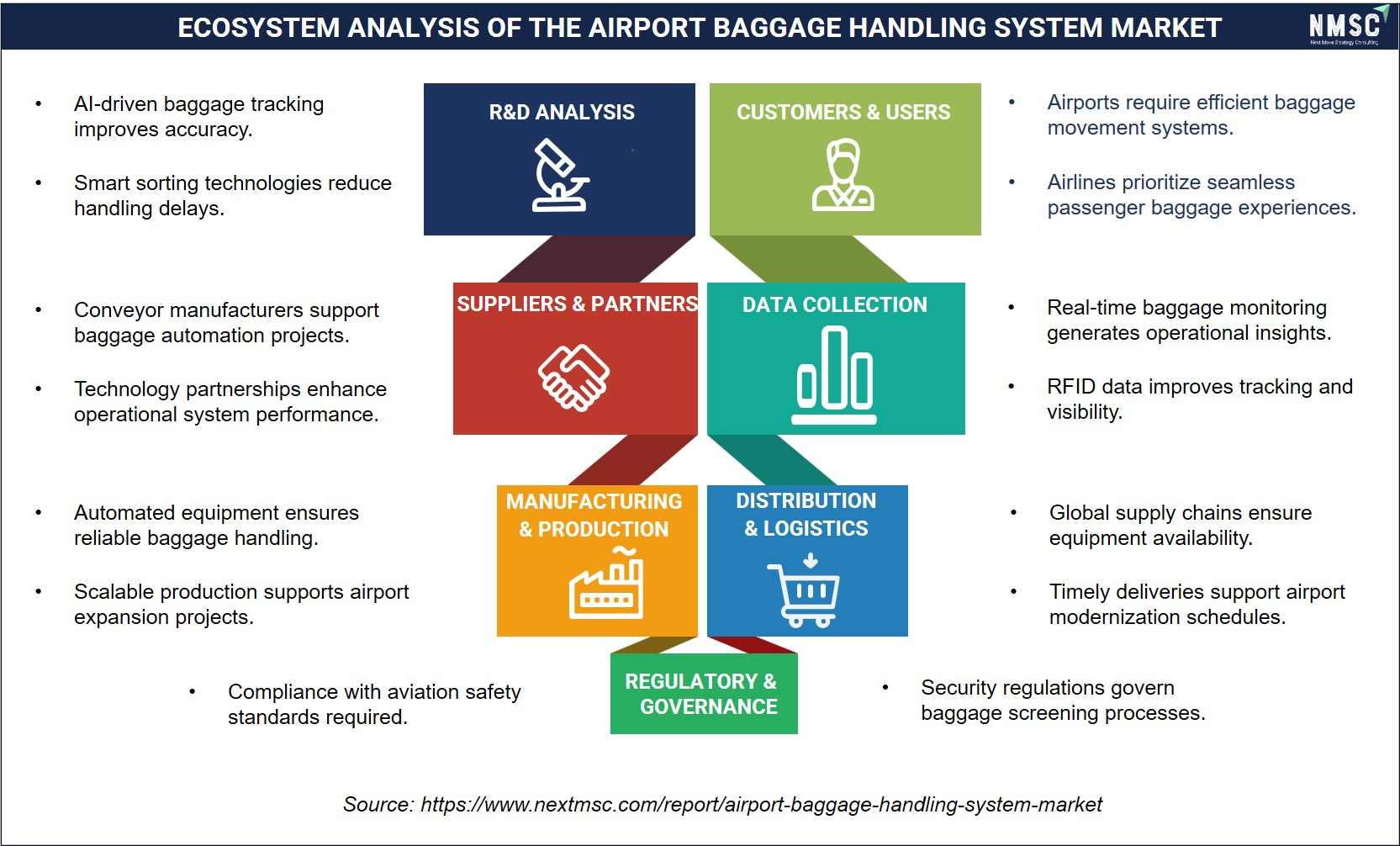
The above framework presents an ecosystem analysis of the Airport Baggage Handling System Market across R&D, manufacturing, distribution, data collection, regulatory governance, and end-user segments. We observed that airports require efficient baggage movement systems while airlines prioritize seamless passenger experiences, shaping customer and user dynamics. Suppliers and partners support manufacturing and production, with distribution and logistics enabling global delivery to aviation hubs. Data collection facilitates real-time tracking and performance monitoring, while regulatory governance enforces safety standards, energy efficiency, and operational compliance, collectively driving innovation and operational reliability in this evolving market.
Key Emerging Trends in the Airport Baggage Handling System Market
How Is CT Screening Technology Reshaping the Airport Baggage Handling System Market?
Computed tomography (CT) screening is the most consequential near-term technology transition in the Airport Baggage Handling System Market. Unlike conventional EDS systems that produce 2D images, CT scanners generate 3D volumetric data that enables automated detection of liquids, gels, and explosives without requiring passengers to remove laptops or liquids. The TSA in the United States has mandated CT deployment at Category X and Category I airports under its checkpoint evolution programme, and the European Civil Aviation Conference (ECAC) is advancing parallel detection standard timelines. Vendors including Smiths Detection and Analogic are primary technology suppliers driving adoption across hub airports globally.
How Is IATA Resolution 753 Accelerating RFID Investment in the Airport Baggage Handling System Market?
IATA Resolution 753, which obligates member airlines to track baggage at every transfer point in the journey, is a structural demand accelerator for the RFID segment of the Airport Baggage Handling System Market. Airlines that cannot demonstrate end-to-end tracking face rising mishandling liability costs, which IATA quantified at approximately USD 2.4 billion annually in its 2023 Baggage IT Insights report. Delta Air Lines reported in its 2023 sustainability disclosures that RFID implementation reduced mishandled bags by over 99% at equipped stations. Through our market assessment, we observed that airport operators are co-investing in RFID read-point infrastructure to meet airline partner mandates.
How Are Autonomous and Robotic Systems Beginning to Transform the Airport Baggage Handling System Market?
Autonomous mobile robots and automated guided vehicles are transitioning from trials to early commercial deployments within the Airport Baggage Handling System Market, particularly for apron-level ULD positioning and baggage cart movement between terminal make-up areas and aircraft stands. Vanderlande has publicly showcased robotic loading systems; Daifuku has deployed AGVs in Japanese airport pier environments. The adoption is currently concentrated at greenfield airports in the Middle East and Asia-Pacific where labour costs are elevated and infrastructure design can accommodate autonomous pathway requirements from inception. Our findings suggest full-scale robotic BHS deployment at brownfield airports remains a 2028 to 2032 horizon opportunity.
How Is the Shift Toward Self-Service Baggage Drop Influencing the Airport Baggage Handling System Market?
Self-service baggage drop (SSBD) is the fastest-growing application sub-segment in the Airport Baggage Handling System Market, driven by airline cost pressure to reduce check-in agent headcount and airport operator ambitions to increase terminal throughput without proportionate floor-space expansion. IATA's 2023 Global Passenger Survey documented that 73% of passengers prefer self-service check-in options. Airports including London Heathrow, Dubai International, and Singapore Changi have deployed multi-airline common-use SSBD units with integrated baggage acceptance, weighing, and tag activation in a single passenger-facing module. BEUMER Group, Materna IPS, and Glidepath are active suppliers in this segment.
What Are the Key Market Drivers, Breakthroughs, and Investment Opportunities That Will Shape the Airport Baggage Handling System Industry in the Next Decade?
|
Driver / Trend / Restraint |
(+/–) % CAGR Impact |
Geographic Relevance |
Impact Timeline |
|
Global Airport Capacity Expansion (IATA) |
+ 2.1% |
Asia-Pacific, Middle East |
2025–2032 |
|
CT Screening Mandate (TSA, ECAC) |
+ 1.8% |
North America, Europe |
2025–2030 |
|
IATA Resolution 753 RFID Compliance |
+ 1.4% |
Global |
2025–2028 |
|
Self-Bag Drop Adoption by Airlines |
+ 0.9% |
Global |
2025–2035 |
|
Greenfield Airport Builds (Gulf, India) |
+ 1.6% |
MEA, Asia-Pacific |
2025–2033 |
|
AI-Predictive Maintenance Platforms |
+ 0.7% |
North America, Europe |
2026–2035 |
|
High Capital Expenditure and Long Payback Periods |
– 0.8% |
Global (SME Airports) |
Ongoing |
|
Interoperability and Integration Complexity |
– 0.5% |
Global |
Ongoing |
|
Supply Chain Constraints (Chips, Steel) |
– 0.4% |
Global |
2025–2027 |
What Are the Growth Drivers of the Airport Baggage Handling System Market?
How Is Accelerating Global Airport Expansion Fuelling Demand in the Airport Baggage Handling System Market?
Global airport capacity expansion is the primary structural driver of Airport Baggage Handling System Market growth. IATA's 2024 Global Outlook projects world air passenger traffic to reach 7.8 billion by 2036, more than double 2023 levels. New airport projects of direct relevance to BHS demand include Saudi Arabia's King Salman International Airport in Riyadh, designed for 120 million passengers annually; India's Navi Mumbai International Airport; and Indonesia's Kualanamu expansion. The U.S. FAA's Airport Improvement Program (AIP) disbursed USD 3.5 billion in grants in fiscal year 2023 alone, with a portion directed toward terminal and ground-handling infrastructure upgrades that encompass BHS components.
How Are TSA and ECAC Screening Mandates Creating a Structural Upgrade Cycle in the Airport Baggage Handling System Market?
The TSA's mandate for 100% CT screening at Category X airports, covering the largest U.S. hubs, is creating a multi-billion-dollar replacement cycle within the Airport Baggage Handling System Market. The TSA's FY2024 budget justification documented over USD 400 million in detection technology investments, underscoring the federal commitment to phased CT deployment. In parallel, the European Commission's Commission Implementing Regulation (EU) 2015/1998, as amended, establishes detection standard timelines that are accelerating replacement of legacy EDS equipment across EU member state airports. Our analysis shows that every CT scanner deployment requires accompanying conveyor integration, software interface development, and operator training services.
How Is IATA Resolution 753 Driving RFID Infrastructure Demand in the Airport Baggage Handling System Market?
IATA Resolution 753, effective since June 2018 and with compliance enforcement strengthening through 2025, requires all IATA member airlines to track baggage at check-in, loading, transfer, and arrival. This four-point tracking obligation is converting from a voluntary best-practice to a contractual airline service-level requirement, compelling airport operators to invest in RFID reader networks, middleware platforms, and reconciliation software. According to IATA's Baggage IT Insights 2023, airlines that have achieved full RFID implementation report baggage mishandling rates below 0.5 per thousand passengers. The Airport Baggage Handling System Market benefits directly through demand for identification systems, tracking software, and associated integration services.
What Are the Growth Inhibitors of the Airport Baggage Handling System Market?
How Do High Capital Costs and Long Payback Periods Constrain Airport Baggage Handling System Market Adoption?
The Airport Baggage Handling System Market faces a structural adoption constraint in the form of very high upfront capital requirements and payback periods that typically extend between 12 and 20 years for full BHS installations. Smaller airports with annual throughputs below five million passengers frequently lack the capital budget or financing access to undertake full system replacements, leaving them on aging infrastructure. The Airports Council International (ACI World) 2024 Global Airport Finance Report documented that 47% of airports globally generate insufficient aeronautical revenue to fund major capital programs without access to government grants, development bank loans, or concession model financing. This creates a procurement gap that constrains near-term market penetration at small and medium airports.
How Does Integration Complexity Limit Faster Adoption in the Airport Baggage Handling System Market?
Airport Baggage Handling System Market growth is structurally constrained by the complexity of integrating new BHS components with legacy departure control systems (DCS), airline host systems, and airport operational databases that may date to the 1990s. Brownfield integration projects routinely experience 20% to 30% cost overruns attributable to undocumented legacy interfaces, according to project disclosures from major European airport operators. The lack of universal open standards across DCS, BHS control software, and baggage reconciliation platforms forces vendors to invest in proprietary middleware adaptors, increasing project risk and extending implementation timelines. Our assessment indicates this integration burden is the leading cause of deferred upgrade decisions at medium-sized airports.
What Are the Growth Opportunities in the Airport Baggage Handling System Market?
How Is the Gulf Region's Airport Megaproject Pipeline Creating a Generational Opportunity in the Airport Baggage Handling System Market?
The Gulf Cooperation Council's airport construction pipeline represents the largest concentrated greenfield BHS opportunity in the Airport Baggage Handling System Market through 2035. Saudi Arabia's General Authority of Civil Aviation (GACA) has publicly committed to increasing passenger capacity to 330 million annually by 2030 under Vision 2030, requiring new BHS installations at Riyadh's new King Salman International Airport, alongside capacity expansions at Jeddah and Dammam. The UAE's Al Maktoum International Airport expansion targets 260 million passengers annually, requiring one of the most complex BHS architectures ever designed. These two countries alone represent an estimated USD 1.8 billion in BHS-related capital commitments through 2030, an industry-derived estimate given the absence of publicly itemised BHS contract values.
How Does AI-Driven Predictive Maintenance Open a New Services Revenue Layer in the Airport Baggage Handling System Market?
AI-based predictive maintenance platforms represent one of the highest-margin growth opportunities in the Airport Baggage Handling System Market's services segment. Vendors including Vanderlande, through its VIBES platform, and BEUMER Group, through its Optimus suite, are deploying IoT sensor networks across conveyor motors, sorter components, and screening conveyor belts to generate real-time health data fed into machine learning models that predict component failure up to 14 days in advance. Based on NMSC's research, we found that airports adopting predictive maintenance frameworks report a 20% to 35% reduction in unplanned downtime, converting reactive maintenance contracts into higher-value proactive service level agreements that improve recurring revenue quality for vendors.
How Is the Rise of Common-Use and Multi-Airline Terminals Creating New BHS Contract Structures in the Airport Baggage Handling System Market?
Common-use terminal environments (CUTE and CUSS) are reshaping the procurement model for the Airport Baggage Handling System Market by shifting baggage system ownership and operation from individual airlines to airport operators or third-party system integrators under long-term managed service contracts. SITA's Common Use Passenger Processing Systems are deployed at over 1,000 airports globally, and airports including Amsterdam Schiphol, Singapore Changi, and Hong Kong International have adopted shared BHS infrastructure with centralised control and airline-agnostic baggage acceptance. This structural shift increases the serviceable contract value per airport by consolidating what were previously fragmented airline-specific investments into single integrated airport operator contracts.
How Is the Airport Baggage Handling System Market Segmented in This Report, and What Are the Key Insights from the Segmentation Analysis?
Which Component Segment Generates the Largest Share of Airport Baggage Handling System Market Revenue?
|
Segments |
2025 (USD Bn) |
2035 (USD Bn) |
CAGR (%) |
|
Hardware |
4.91 |
12.48 |
10.9% |
|
Software |
1.51 |
5.40 |
15.2% |
|
Services |
1.98 |
6.63 |
14.4% |
The Airport Baggage Handling System Market's By Component segmentation covers Hardware, Software, and Services, and each sub-segment reflects a distinct stage of the BHS value chain. Hardware, the largest segment at USD 4.91 billion in 2025, encompasses conveyors, sorters, screening systems, self-bag drop units, identification systems, storage and buffer infrastructure, ULD and cart handling equipment, and weighing and dimensioning hardware; conveyors and sorters collectively account for the dominant hardware revenue share due to their universal deployment across all airport classes. Software, at USD 1.51 billion in 2025, is the fastest-growing component segment, led by control and management platforms, tracking and reconciliation tools compliant with IATA Resolution 753, and analytics and integration suites. Services at USD 1.98 billion in 2025 are growing at 14.4% CAGR as ageing installed bases at North American and European airports expand the maintenance, modernisation, and managed operations revenue pool.
How Do Different System Types Compete for Revenue in the Airport Baggage Handling System Market?
|
Segments |
2025 (USD Bn) |
2035 (USD Bn) |
CAGR (%) |
|
Conveyor and Sortation |
2.35 |
6.13 |
11.2% |
|
Automated Vehicle Systems |
1.18 |
3.92 |
14.3% |
|
Self-Service Solutions |
1.09 |
3.68 |
14.5% |
|
Integrated Screening |
1.51 |
3.92 |
11.2% |
|
Software and Tracking Platforms |
1.18 |
3.92 |
14.3% |
|
End-to-End Turn-key BHS |
1.09 |
2.94 |
11.6% |
Conveyor and Sortation systems remain the dominant system type in the Airport Baggage Handling System Market at USD 2.35 billion in 2025, reflecting their foundational role in every airport BHS regardless of size or automation level; tilt-tray sorters and destination-coded vehicles represent the highest-value sub-categories within this type. Self-Service Solutions and Automated Vehicle Systems are the two fastest-growing system types at CAGRs exceeding 14%, driven by self-bag drop deployments expanding across European and Middle Eastern hubs and AGV adoption at new Asian and Gulf airport builds. Integrated Screening systems are seeing investment driven by CT mandate compliance, while End-to-End Turn-key BHS contracts, awarded typically for new terminals, offer vendors the largest single-contract values and long-term maintenance upsell opportunities.
How Does Airport Class Influence Procurement Patterns in the Airport Baggage Handling System Market?
|
Segments |
2025 (USD Bn) |
2035 (USD Bn) |
CAGR (%) |
|
Large Hubs |
4.20 |
11.28 |
11.6% |
|
Medium Hubs |
2.94 |
8.82 |
13.0% |
|
Small Airports |
1.26 |
4.41 |
15.1% |
Large Hubs dominate the Airport Baggage Handling System Market at USD 4.20 billion in 2025, driven by the scale and complexity of multi-terminal BHS architectures at airports such as Dubai International, London Heathrow, Frankfurt, Singapore Changi, and Chicago O'Hare. These hubs require full-system integrations combining conveyors, high-speed sorters, CT screening, RFID tracking, and real-time analytics platforms, generating the highest per-project contract values. Medium Hubs are the fastest-growing premium airport class at a CAGR of 13.0%, as Tier-2 city airports in India, Southeast Asia, and the Gulf modernise in response to passenger traffic growth. Small Airport BHS investment is accelerating at 15.1% CAGR due to the proliferation of regional airport openings under national connectivity schemes, particularly India's UDAN program and Saudi Arabia's Vision 2030 regional airport development.
How Do Application Areas Define Value Distribution in the Airport Baggage Handling System Market?
|
Segments |
2025 (USD Bn) |
2035 (USD Bn) |
CAGR (%) |
|
Check-in and Bag-Drop |
1.76 |
5.88 |
14.4% |
|
Screening |
2.10 |
5.51 |
11.3% |
|
Sortation and Make-up |
2.27 |
5.88 |
11.2% |
|
Transfer |
1.09 |
3.43 |
13.6% |
|
Reclaim |
1.18 |
3.81 |
13.9% |
Sortation and Make-up is the largest application segment in the Airport Baggage Handling System Market at USD 2.27 billion in 2025, as it represents the most mechanically complex and hardware-intensive phase of the baggage journey. Screening is the second-largest application, its absolute value inflated by CT system capital costs. Check-in and Bag-Drop is the fastest-growing application at a CAGR of 14.4%, directly driven by self-bag drop adoption globally. Reclaim and Transfer are growing above the market average at CAGRs of 13.9% and 13.6% respectively, as airports invest in dual-belt reclaim carousels with RFID read-points and automated transfer routing to reduce connection time and baggage mishandling incidents at hub airports.
How Are Self-Service and Assisted Modes Reshaping Baggage Check-In in the Airport Baggage Handling System Market?
|
Segments |
2025 (USD Bn) |
2035 (USD Bn) |
CAGR (%) |
|
Self-Service |
2.44 |
8.09 |
14.3% |
|
Semi-Assisted |
3.36 |
9.31 |
11.9% |
|
Assisted |
2.60 |
7.11 |
11.8% |
The Airport Baggage Handling System Market's Service Mode segmentation illustrates the fundamental shift in how airports and airlines are structuring passenger and baggage interactions. Self-Service is the fastest-growing mode at a CAGR of 14.3%, driven by airline strategies to reduce staffing costs and IATA data documenting strong passenger preference for automated check-in experiences. Semi-Assisted, where staff oversee multiple self-service units simultaneously, is the current dominant mode at USD 3.36 billion in 2025, representing the transitional configuration most commonly adopted by European and North American airports during SSBD rollouts. Fully Assisted check-in retains relevance for premium and first-class cabins, oversized baggage handling, and airports with lower passenger digital adoption rates.
How Do Project Types Influence BHS Vendor Selection and Contract Structures in the Airport Baggage Handling System Market?
|
Segments |
2025 (USD Bn) |
2035 (USD Bn) |
CAGR (%) |
|
Greenfield |
2.77 |
8.74 |
13.6% |
|
Brownfield |
2.44 |
7.11 |
11.9% |
|
Retrofit |
2.10 |
5.88 |
11.3% |
|
Replacement |
1.09 |
2.78 |
11.0% |
Greenfield projects hold the highest absolute contract values in the Airport Baggage Handling System Market and are the fastest-growing project type by capital expenditure at a CAGR of 13.6%, anchored by mega-airport builds in Saudi Arabia, the UAE, India, and Indonesia. Brownfield projects, involving expansion of existing operational airports, represent the largest volume segment by number of contracts, particularly across European airports managing capacity growth within constrained footprints. Retrofit encompasses technology upgrades to specific BHS sub-systems such as CT scanner integration or RFID overlay without full system replacement and is the most active segment in the North American market as airports comply with TSA mandates without triggering full BHS replacement capex. Replacement contracts arise when aging infrastructure reaches end of technical life, primarily at airports constructed before 2000.
Which Customer Types Are the Primary Buyers in the Airport Baggage Handling System Market?
|
Segments |
2025 (USD Bn) |
2035 (USD Bn) |
CAGR (%) |
|
Airport Operators |
4.62 |
13.48 |
11.3% |
|
Airlines |
1.34 |
3.92 |
11.4% |
|
Ground Handlers |
1.68 |
4.41 |
11.3% |
|
Systems Integrators |
0.76 |
2.70 |
15.2% |
Airport Operators are the dominant customer segment in the Airport Baggage Handling System Market at USD 4.62 billion in 2025, as they own and are responsible for the fixed BHS infrastructure in terminal buildings. Airlines purchase BHS components and self-bag drop units at airports where they control their own terminals, particularly in the United States and at international carrier hubs in Asia. Ground Handlers represent a distinct and growing customer segment as outsourced ground handling contracts increasingly include responsibility for pier-side baggage and ULD management systems. Systems Integrators are the fastest-growing customer category at a CAGR of 15.2%, as airports increasingly appoint prime integrators responsible for full BHS delivery rather than contracting individual sub-system suppliers directly.
How Does Throughput Tier Determine BHS Architecture and Investment Scale in the Airport Baggage Handling System Market?
|
Segments |
2025 (USD Bn) |
2035 (USD Bn) |
CAGR (%) |
|
High Throughput (>20M PAX/year) |
4.03 |
10.79 |
11.6% |
|
Medium Throughput (5–20M PAX/year) |
2.77 |
8.25 |
12.9% |
|
Low Throughput (<5M PAX/year) |
1.60 |
5.47 |
14.7% |
Throughput tier is a key determinant of BHS architecture complexity and per-system investment value in the Airport Baggage Handling System Market. High-throughput airports exceeding 20 million passengers annually require multi-line tilt-tray or cross-belt sortation systems, multi-zone CT screening integration, and high-availability redundant conveyor routing, commanding the largest average contract values. Medium-throughput airports are the fastest-growing commercially significant tier, driven by rising traffic at Tier-2 city airports in India, Southeast Asia, and the Middle East where new passenger volumes are activating BHS procurement for the first time. Low-throughput airports are growing fastest by number of systems deployed as national connectivity schemes multiply the number of operational airports requiring basic BHS infrastructure globally.
Regional Outlook
Geographic Performance Snapshot
|
Region |
2025 (USD Bn) |
2035 (USD Bn) |
CAGR (%) |
Primary Driver |
|
North America |
2.86 |
7.49 |
11.3% |
TSA CT mandate, FAA AIP grants, hub capacity upgrades |
|
Europe |
1.93 |
5.37 |
12.0% |
EU screening regulation, SSBD rollouts, brownfield modernisation |
|
Asia-Pacific |
1.93 |
7.88 |
16.9% |
Greenfield airport builds, IATA 753, rapid traffic growth |
|
Middle East and Africa |
0.92 |
2.26 |
10.6% |
Vision 2030 airports, Gulf megaprojects, new African hubs |
|
Latin America |
0.76 |
1.51 |
7.9% |
Airport concession programmes, regional modernisation |
North America Airport Baggage Handling System Market
North America is the largest regional segment of the Airport Baggage Handling System Market at USD 2.86 billion in 2025, forecast to reach USD 7.49 billion by 2035 at a CAGR of 11.3%. The region's BHS expenditure is driven by the TSA's phased CT screening mandate, FAA Airport Improvement Program capital grants, and the need to upgrade pre-2000 BHS infrastructure at ageing major hubs. RFID adoption under IATA Resolution 753 is progressing among major U.S. and Canadian carriers. Vanderlande, BEUMER Group, and Siemens Logistics are dominant vendor presences across the region, competing on long-term service contracts alongside system capability.
United States Airport Baggage Handling System Market
Based on our engagements, the United States Airport Baggage Handling System Market is the single largest national market globally, representing approximately 73% of North American revenue in 2025. The TSA's CT scanning mandate under ATSA is the primary upgrade catalyst, compelling Category X and Category I airports to replace legacy EDS installations. The FAA's AIP provides annual capital grants that fund qualifying BHS components at federally obligated airports. Technology penetration is high for RFID and automated sortation at major carriers' hub airports. Competitive intensity is elevated, with Vanderlande, BEUMER, and Siemens Logistics competing against regional integrators on large hub contracts.
Canada Airport Baggage Handling System Market
Through our analysis, Canada's Airport Baggage Handling System Market benefits from Transport Canada's civil aviation security regulations aligned with TSA standards, driving parallel screening upgrade requirements at CATSA-operated airports. Pearson International, Vancouver, and Montreal-Trudeau represent the largest BHS investment nodes. CATSA's published budget disclosures indicate ongoing checkpoint and hold-baggage screening infrastructure investment. Technology adoption of RFID and automated sortation is advancing at major airports. Ground handler consolidation, dominated by Swissport and Menzies, is reshaping service contract structures for pier-side BHS maintenance across Canadian international airports.
Mexico Airport Baggage Handling System Market
From our assessment, Mexico's Airport Baggage Handling System Market is at an inflection point following the 2022 inauguration of Felipe Ángeles International Airport (NAICM) near Mexico City, which required a full new BHS installation. ASUR, OMA, and GAP, the three airport concession operators, are the primary institutional buyers. Government regulatory influence is exercised through the DGAC and SCT. Technology penetration is moderate, with RFID and automated sortation concentrated at Benito Juárez International and Cancún International. The concession model creates long-term maintenance contract opportunities for international vendors entering through partnership with local systems integrators.
Europe Airport Baggage Handling System Market
Europe is the second-largest region in the Airport Baggage Handling System Market at USD 1.93 billion in 2025, projected to reach USD 5.37 billion by 2035 at a CAGR of 12.0%. The region's growth is driven by European Commission security regulation upgrades, aggressive self-bag drop rollouts at major carriers, and a very large brownfield modernisation pipeline across airports built during the 1980s and 1990s expansion. Vanderlande, BEUMER Group, and Alstef Automation hold leading positions across European ANSP and airport operator procurement frameworks. ESG considerations are increasingly influencing BHS procurement criteria, with energy-efficient conveyor drives and regenerative braking systems gaining specification weight.
United Kingdom Airport Baggage Handling System Market
Based on our engagements, the United Kingdom Airport Baggage Handling System Market is shaped by the CAA's aviation security framework and DfT oversight of BHS compliance at designated airports. Heathrow Airport's Terminal 5 and planned Terminal 6 projects represent the largest single BHS investment opportunities in the UK market. Manchester Airport Group's transformation programme includes BHS modernisation across Manchester and London Stansted. RFID adoption among British Airways and easyJet is advancing. Competitive intensity is high, with Vanderlande and BEUMER Group competing with Glidepath and BCS Group for UK airport contracts of varying scales.
Germany Airport Baggage Handling System Market
Through our analysis, Germany's Airport Baggage Handling System Market is driven by Fraport AG at Frankfurt, Flughafen München GmbH, and Berlin Brandenburg Airport, three of Europe's largest BHS installations. The Federal Aviation Office (Luftfahrt-Bundesamt) enforces EU Regulation 300/2008 screening standards, creating compliance-driven upgrade cycles. Technology penetration is among the highest in Europe, with Frankfurt operating one of the most automated BHS systems globally incorporating DCV technology and real-time RFID tracking. Siemens Logistics GmbH maintains a strong home-market position, competing with Vanderlande and BEUMER Group on major German hub contracts.
France Airport Baggage Handling System Market
From our assessment, France's Airport Baggage Handling System Market is centred on Aéroports de Paris (ADP), which operates Charles de Gaulle and Orly airports, two of Europe's busiest passenger hubs. DSAC (Direction de la Sécurité de l'Aviation Civile) enforces EU security regulations nationally. Charles de Gaulle's BHS is one of the most complex in Europe, with ongoing modernisation programs across multiple terminals. Alstef Automation S.A.S., headquartered in France, benefits from home-market relationships with ADP. RFID and self-bag drop adoption are advancing in line with Air France's customer experience strategy. NMSC's analysis indicates France represents the third-largest European BHS market by revenue.
Italy Airport Baggage Handling System Market
According to our evaluation, Italy's Airport Baggage Handling System Market is driven by ADR (Aeroporti di Roma) and SEA (Società Esercizi Aeroportuali) at Rome Fiumicino and Milan Malpensa respectively, the two largest BHS procurement nodes. ENAC enforces EU security regulations and national aviation safety requirements. Technology adoption is progressing at a moderate pace, with RFID and automated sortation investments concentrated at the two major hubs while regional airports managed by smaller operators lag in modernisation investment. Cassioli S.r.l. holds a domestic presence as a BHS sub-system supplier. International vendors including Vanderlande and BEUMER Group compete for major Italian airport contracts.
Spain Airport Baggage Handling System Market
Based on our engagements, Spain's Airport Baggage Handling System Market is concentrated within AENA's network, which operates 46 airports and heliports including the two largest in Barajas (Madrid) and El Prat (Barcelona). AENA's long-term infrastructure investment plan includes BHS modernisation as a capital priority. DGAC (Dirección General de Aviación Civil) enforces EU screening and security standards. Technology penetration is advancing at major hubs, with RFID and automated sortation well established. ULMA Handling Systems S. Coop., headquartered in the Basque Country, holds a strategically important domestic position within Spanish airport BHS supply chains.
Sweden Airport Baggage Handling System Market
Through our analysis, Sweden's Airport Baggage Handling System Market is shaped by Swedavia, the state-owned airport operator managing Stockholm Arlanda, Göteborg Landvetter, and seven other Swedish airports. Transportstyrelsen enforces ECAC and EU security standards. Technology adoption is high — Arlanda has deployed RFID, automated sortation, and early-stage predictive maintenance across its BHS infrastructure. Automatic Handling International AB (AHI) holds an established domestic supplier position. Sweden's sustainability commitments are influencing BHS procurement criteria, with energy-efficient conveyor systems and regenerative motor technologies becoming standard specification requirements at Swedavia-operated airports.
Denmark Airport Baggage Handling System Market
From our assessment, Denmark's Airport Baggage Handling System Market is primarily driven by Copenhagen Airport (CPH), Scandinavia's busiest hub, managed by Copenhagen Airports A/S. The Danish Civil Aviation and Railway Authority (Trafikstyrelsen) enforces EU aviation security regulations. CPH has a well-established, technologically advanced BHS with RFID, high-speed conveyor sortation, and real-time baggage tracking integrated with SAS and Star Alliance partner systems. Market maturity is high, with the primary near-term investment driver being screening technology upgrades from EDS to CT systems. Vanderlande and BEUMER Group are the dominant vendor presences in the Danish market.
Finland Airport Baggage Handling System Market
According to evaluation, Finland's Airport Baggage Handling System Market is centred on Helsinki-Vantaa Airport, operated by Finavia Corporation, which is investing in terminal expansion and BHS modernisation as part of its Helsinki Airport Development Programme. Traficom (Finnish Transport and Communications Agency) enforces aviation security compliance. Technology adoption at Helsinki-Vantaa is above the EU average, with automated sortation, RFID, and advanced screening deployed. Finnair's home-hub status at Helsinki drives airline-side investment in RFID baggage tracking infrastructure. The BHS market outside Helsinki is limited, with regional Finnish airports at comparatively low investment intensity.
Netherlands Airport Baggage Handling System Market
Based on our engagements, the Netherlands Airport Baggage Handling System Market is dominated by Amsterdam Airport Schiphol, one of Europe's four largest hub airports, managed by Royal Schiphol Group. The ILT (Inspectie Leefomgeving en Transport) enforces EU security regulations. Schiphol's BHS is among the most technologically sophisticated in the world, with high-speed cross-belt sorters, full RFID coverage, and an advanced baggage information management system. A BHS sustainability modernisation program is underway targeting energy reduction across conveyor networks. Vanderlande, headquartered in the Netherlands, holds a dominant installed base position at Schiphol and benefits from proximity-driven service contract advantages.
Rest of Europe Airport Baggage Handling System Market
The Rest of Europe segment in the Airport Baggage Handling System Market encompasses Poland, Belgium, Switzerland, Austria, Portugal, Greece, Norway, Czech Republic, Turkey, and other European nations not individually profiled. Warsaw Chopin, Brussels, Zurich, Vienna, Lisbon, Athens, and Oslo airports represent the largest BHS procurement nodes within this sub-region. EU screening regulation compliance is the consistent demand driver across all markets. Technology adoption varies significantly, with western European airports at high penetration and eastern European airports representing strong upgrade opportunities through 2035. Vendors including BEUMER Group, Siemens Logistics, and Fives SAS hold established positions across multiple rest-of-Europe markets.
Asia-Pacific Airport Baggage Handling System Market
Asia-Pacific is the fastest-growing major region in the Airport Baggage Handling System Market, advancing from USD 1.93 billion in 2025 to USD 7.88 billion by 2035 at a CAGR of 16.9%. The region's growth is driven by an unprecedented pipeline of greenfield airport construction across China, India, Indonesia, and Vietnam, combined with major capacity expansion projects at Singapore Changi, Sydney, and Kansai. IATA projects Asia-Pacific to account for over 50% of global passenger growth through 2040. RFID adoption is progressing in line with IATA Resolution 753 compliance across regional carriers. Daifuku, Mitsubishi Heavy Industries Machinery Systems, and NEC are strong regional incumbents competing with European vendors at premium hub contracts.
China Airport Baggage Handling System Market
Based on our engagements, China's Airport Baggage Handling System Market is one of the most dynamic in the world, driven by CAAC's (Civil Aviation Administration of China) active airport construction programme under the 14th Five-Year Plan, which committed to building over 150 new general aviation airports and expanding 30 existing hub airports. Beijing Capital, Beijing Daxing, Shanghai Pudong, and Guangzhou Baiyun represent the largest installed BHS nodes. Technology penetration of automated sortation and RFID is advancing at Tier-1 airports. CIMC Pteris Global, a Chinese BHS vendor, competes alongside Daifuku and Vanderlande on domestic contracts. Government-led airport development ensures BHS investment consistency through the forecast period.
India Airport Baggage Handling System Market
Through our analysis, India represents the fastest-growing individual country market in the Airport Baggage Handling System Market. The Airports Authority of India (AAI) is simultaneously upgrading existing airports and commissioning new greenfield facilities, including Navi Mumbai, Jewar (Noida), and Bhogapuram, under a national aviation expansion programme that targets 220 airports in operation by 2025. BCAS (Bureau of Civil Aviation Security) mandates EDS screening at all commercial airports. RFID adoption is accelerating, supported by Air India and IndiGo investment in IATA 753 compliance. Government policy through UDAN is the strongest structural demand driver, creating BHS requirements at previously unserved Tier-2 and Tier-3 cities.
Japan Airport Baggage Handling System Market
From our assessment, Japan's Airport Baggage Handling System Market benefits from MLIT (Ministry of Land, Infrastructure, Transport and Tourism) aviation infrastructure investment programs targeting capacity expansion at Haneda, Narita, and Kansai airports ahead of projected inbound tourism growth. Japan Civil Aviation Bureau (JCAB) enforces aviation security standards. Technology penetration is very high at major Japanese airports, with Daifuku and Mitsubishi Heavy Industries Machinery Systems holding dominant domestic installed-base positions. RFID tracking and automated sortation are mature at Tier-1 airports. The primary near-term investment focus is CT screening integration and capacity expansion at Haneda to support increased international slot allocations.
South Korea Airport Baggage Handling System Market
According to evaluation, South Korea's Airport Baggage Handling System Market is centred on Incheon International Airport Corporation (IIAC), which operates Incheon International, one of the world's highest-rated hub airports, and Gimpo International. The Ministry of Land, Infrastructure, and Transport oversees civil aviation regulation. Incheon's BHS is a globally benchmarked reference installation for automated sortation, RFID tracking, and baggage monitoring. IIAC's Third Terminal expansion project creates the primary near-term BHS investment opportunity in the Korean market. Technology adoption is among the highest in Asia-Pacific. Korean Air and Asiana Airlines represent airline-buyer demand for RFID compliance investment.
Taiwan Airport Baggage Handling System Market
Based on our engagements, Taiwan's Airport Baggage Handling System Market is driven by Taoyuan International Airport Corporation's terminal expansion and modernisation programs at Taiwan Taoyuan International Airport, the region's primary hub. The Civil Aeronautics Administration (CAA) of Taiwan enforces aviation security standards aligned with ICAO Annex 17. Technology adoption is above the regional average at Taoyuan, with automated sortation and RFID tracking deployed across major airline handling zones. China Airlines and EVA Air represent the primary airline-side BHS demand. NMSC's assessment indicates Taiwan's BHS market is strategically positioned to grow in line with recovered cross-Strait and international travel volumes through 2035.
Indonesia Airport Baggage Handling System Market
Through our analysis, Indonesia's Airport Baggage Handling System Market is experiencing growth driven by Angkasa Pura Airports and Angkasa Pura II's combined airport expansion programs across 25 airports, including capacity expansion at Soekarno-Hatta International Airport in Jakarta and the new Kualanamu International Airport expansion in Medan. The Ministry of Transportation's DGCA enforces aviation security regulations. Technology penetration at secondary airports is low, creating a significant BHS infrastructure build-out opportunity. Lion Air and Garuda Indonesia, as the country's largest carriers, are investing in RFID compliance infrastructure. Greenfield airport development in eastern Indonesia adds further new BHS contract opportunities.
Vietnam Airport Baggage Handling System Market
From our assessment, Vietnam's Airport Baggage Handling System Market is being driven by Airports Corporation of Vietnam (ACV), which is implementing a major airport expansion programme including the new Long Thanh International Airport, Vietnam's largest civil infrastructure project, which will require a complete, purpose-designed BHS installation at its planned capacity of 100 million passengers annually. CAAV (Civil Aviation Authority of Vietnam) enforces security screening requirements. Technology adoption at Noi Bai and Tan Son Nhat airports is progressing. Long Thanh's BHS procurement represents one of the single largest greenfield BHS contract opportunities globally in the 2026 to 2030 window, attracting competitive bids from Vanderlande, BEUMER Group, and Daifuku.
Australia Airport Baggage Handling System Market
According to evaluation, Australia's Airport Baggage Handling System Market is driven by Sydney Airport, Melbourne Airport, Brisbane Airport, and Perth Airport, all operating as privately managed entities under long-term government leases. CASA (Civil Aviation Safety Authority) and the Office of Transport Security enforce aviation security standards that include hold-baggage screening requirements. Technology penetration is high at major Australian airports, with automated sortation, RFID, and EDS widely deployed. Brisbane Airport's ongoing expansion project creates near-term BHS investment demand. Glidepath Limited and BCS Group hold established domestic positions, competing with Vanderlande and BEUMER Group for major terminal contracts.
Philippines Airport Baggage Handling System Market
Based on our engagements, the Philippines Airport Baggage Handling System Market is driven by MIAA (Manila International Airport Authority) at Ninoy Aquino International Airport and CAAP (Civil Aviation Authority of the Philippines) oversight of security standards. The Bulacan New International Airport project represents the largest single BHS investment opportunity in the Philippines market through 2030, with a planned capacity of 100 million passengers annually. Technology penetration at NAIA is below the regional average due to ageing infrastructure. Government's PPP (Public-Private Partnership) framework is the primary procurement mechanism for airport development and BHS installation. International vendors are actively positioning for Bulacan BHS contracts.
Malaysia Airport Baggage Handling System Market
Through our analysis, Malaysia's Airport Baggage Handling System Market is anchored by Malaysia Airports Holdings Berhad (MAHB), which manages Kuala Lumpur International Airport (KLIA), the country's primary hub, and 38 other airports nationwide. The Civil Aviation Authority of Malaysia (CAAM) enforces aviation security requirements. KLIA's BHS is a well-established automated installation with conveyor sortation and early RFID deployment. MAHB's runway and pier expansion programs create incremental BHS investment demand. Technology adoption is above Southeast Asian average at KLIA but below premium-hub benchmarks. Regional airports under MAHB's portfolio represent a secondary upgrade opportunity as passenger traffic growth extends beyond KLIA.
Malaysia Airport Baggage Handling System Market
Through our analysis, Malaysia's Airport Baggage Handling System Market is anchored by Malaysia Airports Holdings Berhad (MAHB), which manages Kuala Lumpur International Airport (KLIA), the country's primary hub, and 38 other airports nationwide. The Civil Aviation Authority of Malaysia (CAAM) enforces aviation security requirements. KLIA's BHS is a well-established automated installation with conveyor sortation and early RFID deployment. MAHB's runway and pier expansion programs create incremental BHS investment demand. Technology adoption is above Southeast Asian average at KLIA but below premium-hub benchmarks. Regional airports under MAHB's portfolio represent a secondary upgrade opportunity as passenger traffic growth extends beyond KLIA.
Rest of Asia-Pacific Airport Baggage Handling System Market
The Rest of Asia-Pacific segment in the Airport Baggage Handling System Market encompasses Singapore, Thailand, New Zealand, Bangladesh, Sri Lanka, Pakistan, and smaller Pacific nations. Singapore Changi Airport, despite its small geographic scale, is a globally benchmarked BHS reference site with Terminal 4's fully automated baggage check-in and T5 under development as one of the largest terminal projects globally. Bangkok Suvarnabhumi and Don Mueang represent Thailand's primary BHS nodes. New Zealand's Auckland Airport is investing in terminal modernisation. Collectively, these markets contribute meaningful BHS expenditure, particularly Singapore given its status as a premium hub and technology showcase.
Middle East and Africa Airport Baggage Handling System Market
The Middle East and Africa Airport Baggage Handling System Market is valued at USD 0.92 billion in 2025 and is forecast to reach USD 2.26 billion by 2035 at a CAGR of 10.6%. The region's growth is primarily driven by Saudi Arabia's Vision 2030 airport development programme, the UAE's Al Maktoum International Airport expansion, and new airport investments across sub-Saharan Africa. Gulf airports demand premium, high-throughput BHS architectures with multi-language passenger interfaces. African airport BHS investment is concentrated at hub airports in Nairobi, Addis Ababa, Lagos, Cape Town, and Casablanca, where growing passenger volumes are straining legacy handling infrastructure.
Saudi Arabia Airport Baggage Handling System Market
Based on our engagements, Saudi Arabia's Airport Baggage Handling System Market is experiencing its most consequential transformation in history under GACA's Vision 2030 aviation strategy, targeting 330 million passengers annually by 2030. King Salman International Airport's BHS requirements, covering multiple terminals designed for combined capacity above 120 million passengers, represent the largest single-country greenfield BHS opportunity globally through 2030. GACA's regulatory framework enforces ICAO Annex 17 security requirements. Technology adoption at new builds will be at the global state of the art, incorporating CT screening, 100% RFID tracking, automated sortation, and AI-based predictive maintenance from day one of operations.
UAE Airport Baggage Handling System Market
Through our analysis, the UAE's Airport Baggage Handling System Market is anchored by two of the world's busiest airports, Dubai International (DXB) and Abu Dhabi International (AUH), alongside the transformational expansion of Al Maktoum International Airport (DWC). The GCAA enforces UAE aviation security regulations. DXB operates one of the most complex and high-throughput BHS installations in the world. DWC's planned expansion to serve 260 million passengers annually will require a BHS architecture of unprecedented scale. Technology penetration is at the global frontier, with Vanderlande holding a significant installed base position. The UAE represents the second-largest MEA BHS market by revenue.
Egypt Airport Baggage Handling System Market
From our assessment, Egypt's Airport Baggage Handling System Market is driven by the Egyptian Airports Company and Holding Company for Airports and Air Navigation, overseeing Cairo International Airport and 23 other airports. ECAA (Egyptian Civil Aviation Authority) enforces security standards. Cairo International is undergoing terminal modernisation, and the new El Alamein International Airport creates an incremental BHS demand node. Technology adoption is advancing but below Gulf and European standards. Government regulatory influence is high, with BHS procurement managed through public tender processes. International vendors including Siemens Logistics and Vanderlande have established project references in the Egyptian market.Israel Airport Baggage Handling System Market
According to evaluation, Israel's Airport Baggage Handling System Market is centred on Ben Gurion International Airport, operated by the Israel Airports Authority (IAA). Israel applies some of the world's most stringent aviation security protocols, including comprehensive hold-baggage screening standards that set a premium on advanced detection technology investment. The IAA's capital programs include BHS modernisation aligned with capacity expansion at Ben Gurion. Technology adoption is at the global frontier for screening, Israel's security requirements drive demand for the most advanced CT and EDS detection systems available. Competitive intensity is moderate, with international vendors winning BHS contracts through specialised security technology credentials.
Turkey Airport Baggage Handling System Market
Based on our engagements, Turkey's Airport Baggage Handling System Market is dominated by Istanbul Airport (IST), one of the world's largest airports by capacity, operated by IGA Havalimanı İşletmesi. DGCA (Directorate General of Civil Aviation) enforces Turkish aviation security standards. Istanbul Airport's BHS, installed during the 2018 to 2019 construction and opening phase, is one of the most modern high-throughput systems globally. The primary near-term BHS demand in Turkey centres on Istanbul Airport expansion phases and modernisation at Ankara Esenboğa and Antalya airports. Siemens Logistics and Vanderlande hold established positions in the Turkish market.
Nigeria Airport Baggage Handling System Market
Through our analysis, Nigeria's Airport Baggage Handling System Market is managed under FAAN (Federal Airports Authority of Nigeria), which oversees Murtala Muhammed International in Lagos, Nnamdi Azikiwe International in Abuja, and 20 other airports. NCAA (Nigerian Civil Aviation Authority) enforces security regulations. Technology adoption is below sub-Saharan average, with manual handling and basic conveyor systems common at most airports. Government capital constraints and foreign exchange challenges have historically limited large BHS procurement. Nigeria's growing passenger market, the largest in sub-Saharan Africa, represents a meaningful long-term BHS upgrade opportunity as government PPP programmes attract private airport investment.
South Africa Airport Baggage Handling System Market
From our assessment, South Africa's Airport Baggage Handling System Market is driven by ACSA (Airports Company South Africa), which manages O.R. Tambo International, Cape Town International, and King Shaka International. SACAA (South African Civil Aviation Authority) enforces security screening requirements. O.R. Tambo's BHS is the most sophisticated on the African continent, with automated sortation and EDS screening. Technology adoption is above African average but below Gulf and European peers. ACSA's capital infrastructure program includes ongoing BHS modernisation at its three major hub airports. International vendors including Vanderlande and BEUMER Group hold established positions in the South African market.
Rest of Middle East and Africa Airport Baggage Handling System Market
The Rest of MEA Airport Baggage Handling System Market encompasses Qatar, Kuwait, Bahrain, Oman, Jordan, Kenya, Ethiopia, Tanzania, Morocco, and other African nations. Hamad International Airport in Doha, operated by Qatar Airways Group, is a globally benchmarked BHS reference site with one of the most advanced automated handling systems in the world. Addis Ababa Bole International Airport, as Ethiopian Airlines' hub, is a major sub-Saharan BHS investment node. JKIA in Nairobi and Mohammed V in Casablanca are primary East and North African upgrade markets. Development bank financing from the African Development Bank is an enabling mechanism for airport modernisation across lower-income African member states.
Latin America Airport Baggage Handling System Market
Latin America is the smallest regional segment in the Airport Baggage Handling System Market at USD 0.76 billion in 2025, forecast to grow to USD 1.51 billion by 2035 at a CAGR of 7.9%. The region's growth is driven by airport concession programmes in Brazil, Colombia, and Chile that are attracting private investment into terminal modernisation, and by growing passenger volumes at major hub airports in São Paulo, Bogotá, and Lima. RFID adoption is at an early stage across most Latin American markets. European vendors including Vanderlande and BEUMER Group are competing for concession airport BHS contracts alongside regional systems integrators.
Brazil Airport Baggage Handling System Market
Based on our engagements, Brazil's Airport Baggage Handling System Market is shaped by INFRAERO and the growing network of privately concessed airports including São Paulo Guarulhos, Campinas Viracopos, Rio de Janeiro Galeão, and the newly opened São Paulo Viracopos. ANAC (Agência Nacional de Aviação Civil) enforces aviation security requirements. Technology penetration is moderate at major concessed airports, with automated sortation and EDS deployed at Guarulhos. The airport concession programme is the primary demand catalyst, as private operators invest in BHS modernisation to meet service level agreements and passenger experience targets embedded in concession contracts. Brazil represents approximately 42% of Latin American BHS revenue.
Argentina Airport Baggage Handling System Market
Through our analysis, Argentina's Airport Baggage Handling System Market is driven by AA2000, the concession operator managing Ezeiza Ministro Pistarini International Airport and 35 other airports. ANAC Argentina enforces aviation security regulations. Ezeiza is the primary BHS investment node, with ongoing modernisation of baggage sortation and screening infrastructure. Economic volatility in Argentina has historically constrained capital expenditure timing and vendor payment risk, creating procurement cycles that are less predictable than in other Latin American markets. Technology adoption is below regional peers at secondary airports. Aerolíneas Argentinas represents the primary airline-side BHS demand node given its dominant hub position at Ezeiza.
Chile Airport Baggage Handling System Market
From our assessment, Chile's Airport Baggage Handling System Market is centred on Arturo Merino Benítez International Airport in Santiago, operated by Nuevo Pudahuel following its 2015 concession award. The DGAC (Dirección General de Aeronáutica Civil) enforces aviation security standards. Nuevo Pudahuel's terminal expansion project, completed in 2021, included a modernised BHS with automated sortation and enhanced screening. Technology adoption is above Latin American average at Santiago. The LATAM Airlines Group hub presence at Santiago creates airline-side RFID compliance investment demand. Chile's stable regulatory and economic environment makes it one of the lower-risk Latin American markets for international BHS vendors.
Colombia Airport Baggage Handling System Market
According to evaluation, Colombia's Airport Baggage Handling System Market is driven by OPAIN, the concession operator of El Dorado International Airport in Bogotá, the largest airport in Latin America by operations count. Aerocivil (Unidad Administrativa Especial de Aeronáutica Civil) enforces security standards. El Dorado has undergone significant BHS modernisation as part of OPAIN's terminal transformation programme, deploying automated sortation and expanded screening capacity. Avianca's hub status at El Dorado drives airline-side RFID and baggage tracking investment. Secondary Colombian airports managed by AEROCIVIL concessions represent an emerging upgrade market as traffic grows outside Bogotá.
Rest of Latin America Airport Baggage Handling System Market
The Rest of Latin America Airport Baggage Handling System Market encompasses Peru, Ecuador, Panama, Mexico (profiled under North America), Costa Rica, Dominican Republic, Uruguay, and other Central American and Caribbean nations. Lima's Jorge Chávez International Airport, undergoing a major terminal expansion under Lima Airport Partners, is the primary BHS investment opportunity in the sub-region. Panama's Tocumen International, as a Copa Airlines hub, represents Caribbean BHS investment activity. Ecuador's Quito Mariscal Sucre and Guayaquil airports are under DGAC-regulated concession operation. Development bank financing from the Inter-American Development Bank enables BHS investment across smaller Latin American markets.
Supply Chain Analysis of the Airport Baggage Handling System Market
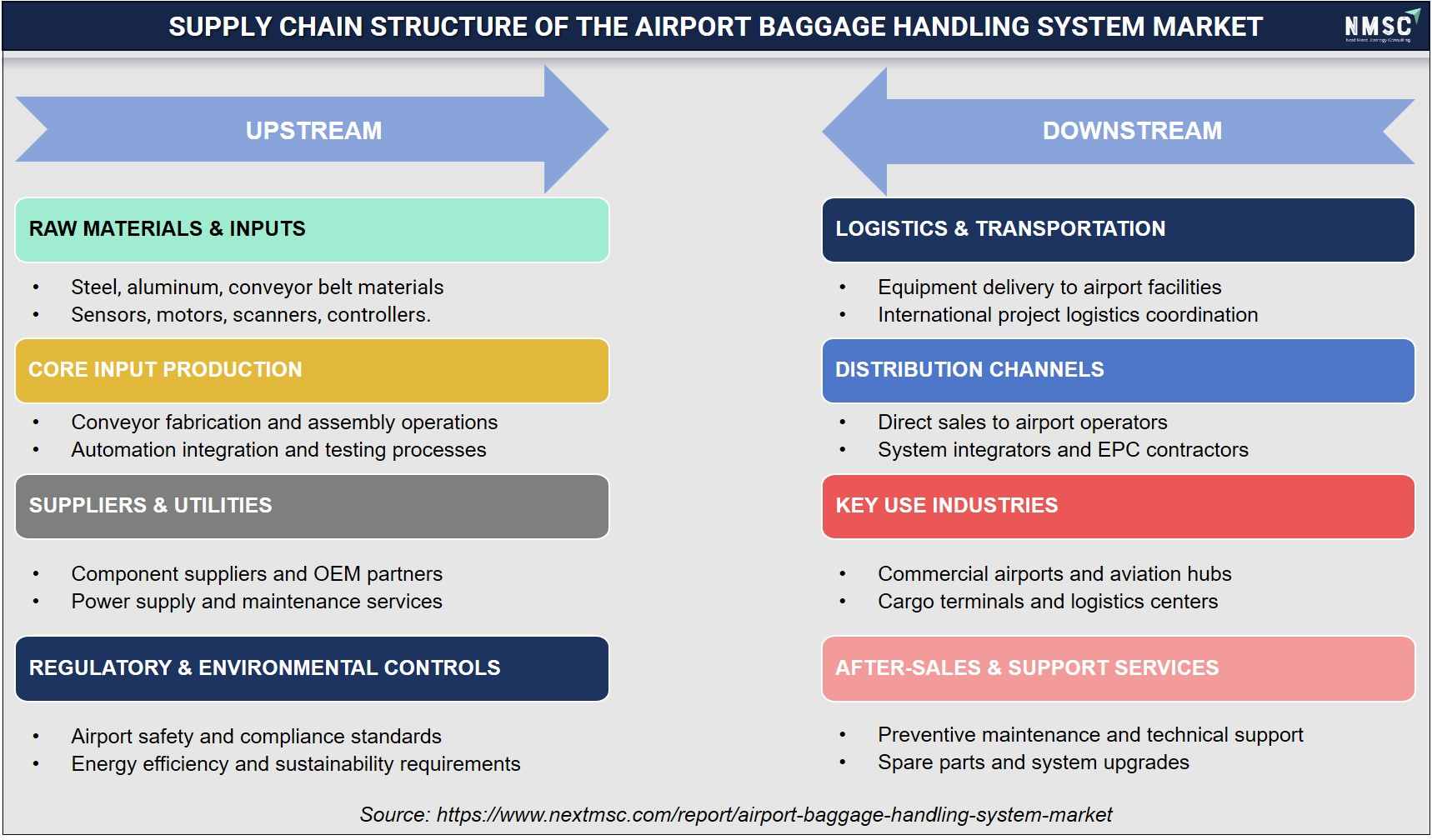
The above framework outlines the supply chain structure of the Airport Baggage Handling System Market across upstream inputs, production, and downstream distribution. We observed that steel, aluminum, conveyor materials, sensors, and controllers form the core raw material base, while conveyor fabrication, assembly, and automation testing define production operations, supported by component suppliers and OEM partners. Regulatory compliance, airport safety standards, and energy efficiency requirements govern upstream processes, whereas downstream activities include logistics coordination, direct sales to airport operators, and system integrators serving commercial airports and cargo terminals, with after-sales maintenance, spare parts, and upgrades reinforcing long-term operational reliability.
Competitive Landscape
Competitive Dynamics and M&A Landscape in the Airport Baggage Handling System Market
|
Parameter |
Details |
|
Market Structure |
The Airport Baggage Handling System Market is moderately consolidated, with Vanderlande, Daifuku, BEUMER Group, and Siemens Logistics collectively holding an estimated 55% to 60% of global revenue. A second tier of specialist vendors including Alstef, Fives, Glidepath, and ULMA competes for regional and segment-specific contracts. The market is characterised by high barriers to entry due to the certification complexity, long reference site requirements, and safety-critical integration standards required to win major hub airport contracts. |
|
Innovation Focus |
Leading companies are investing in AI-powered predictive maintenance platforms, CT screening integration capabilities, RFID middleware development, autonomous vehicle integration, and cloud-native BHS management software. Vanderlande's VIBES IoT platform and BEUMER Group's Optimus analytics suite are representative next-generation product investments. Innovation in self-bag drop hardware, particularly biometric identity verification integration, is a competitive differentiator emerging across European and Middle Eastern airport tender specifications. |
|
M&A Activity |
The Airport Baggage Handling System industry has seen targeted consolidation: Daifuku acquired Jervis B. Webb Company to expand North American presence; Toyota Industries acquired Vanderlande in 2017, providing manufacturing scale and balance-sheet depth; Körber AG operates a logistics automation portfolio that competes in adjacent BHS software segments. NMSC's assessment indicates further M&A is likely as software platform specialists become acquisition targets for prime hardware integrators seeking to close the recurring-revenue gap. |
How Do Companies Compete in the Airport Baggage Handling System Market?
The Airport Baggage Handling System Market competitive environment is characterised by a multi-dimensional rivalry across technical capability, reference site credibility, long-term service relationship depth, and geographic footprint. Market structure is moderately concentrated at the premium hub end, but fragmented across small and medium airport segments where regional integrators compete aggressively on price. Competitive strategies among the top five vendors centre on leveraging installed-base reference sites; a Heathrow or Dubai contract functions as a global sales credential, to win subsequent international tenders. Innovation focus has shifted markedly toward software platforms and IoT-enabled maintenance services that generate recurring revenue streams less vulnerable to capital expenditure cycle volatility than hardware-only contracts.
Which Kind of Companies Dominate the Airport Baggage Handling System Market?
Large industrial conglomerates with dedicated Airport Baggage Handling System divisions dominate the premium end of the market. Vanderlande, wholly owned by Toyota Industries, commands the broadest geographic footprint and the largest installed base. Daifuku, a Tokyo-listed material handling specialist, is the second-largest player globally with dominant positions in Japan and a growing presence in Asian BHS markets. BEUMER Group, a privately held German family business, competes across all market tiers with a strong European installed base and growing Middle Eastern and Asian footprint. Siemens Logistics, a carve-out from the broader Siemens group, maintains strong positions at German and European hub airports. Regional specialists including ULMA, Alstef, and Glidepath compete effectively in specific geographies and airport tiers.
AI-Native Differentiation and Open Standards Drive Market Success in the Airport Baggage Handling System Market
NMSC's analysis indicates that the competitive gap between leaders and followers in the Airport Baggage Handling System Market is increasingly determined by software and analytics capability rather than hardware performance alone. Vendors embedding AI-driven baggage flow prediction, automated maintenance alerting, and real-time energy management into their BHS control platforms are achieving differentiated win rates in competitive tenders at large hub airports where lifecycle operating cost is now weighted alongside initial capital cost. Open-standard software architectures compatible with IATA AIDX data exchange formats are becoming tender prerequisites at airports mandating multi-vendor interoperability. Vendors without credible cloud-compatible BHS management platforms face a growing strategic disadvantage in premium-market competitions.
Market Players to Opt for Merger and Acquisition Strategies to Expand Their Presence in the Airport Baggage Handling System Market
Our findings suggest that M&A activity in the Airport Baggage Handling System Market will accelerate through 2030 as established hardware integrators seek to close the software and services capability gap through acquisition rather than organic development. The primary acquisition targets are BHS software platform specialists with established IATA AIDX-compatible middleware, AI predictive maintenance application vendors with airport reference sites, and regional BHS integrators in high-growth Asia-Pacific and MEA markets that provide local procurement relationships and technical workforce access. Toyota Industries' ownership of Vanderlande provides a strategic precedent; the financial strength of a tier-one automotive component manufacturer enables BHS R&D investment at a scale unavailable to standalone competitors.
Who Are the Key Market Players in the Airport Baggage Handling System Market?
-
Vanderlande Industries B.V.
-
Daifuku Co., Ltd.
-
BEUMER Group GmbH and Co. KG
-
Siemens Logistics GmbH
-
Alstef Automation S.A.S.
-
Fives SAS
-
Oshkosh AeroTech, LLC
-
CIMC Pteris Global Limited
-
Körber AG
-
ULMA Handling Systems S. Coop.
-
Brock Solutions Inc.
-
MATREX SAS
-
Cassioli S.r.l.
-
Mitsubishi Heavy Industries Machinery Systems, Ltd.
-
Robson Handling Technology Limited
-
BCS Group Limited
-
Automatic Handling International AB
-
Glidepath Limited
-
MHS Global, LLC
-
SASIB S.p.A.
What Are the Latest Developments in the Airport Baggage Handling System Industry?
|
Date |
Event |
|
November 2025 |
Melbourne Airport began testing a new BEUMER baggage handling system equipped with real-time baggage tracking and enhanced processing capabilities. The project aims to improve operational efficiency and passenger experience while increasing handling capacity for future traffic growth. |
|
October 2025 |
Vanderlande secured the contract to deliver, install, operate, and maintain the baggage handling system for Poland's new Centralny Port Komunikacyjny (CPK) Airport. The project incorporates advanced track-and-trace capabilities and represents a major investment in next-generation baggage automation infrastructure. |
Expert Insights
 "Airports are under pressure to make the passenger experience as efficient and stress-free as possible, but to achieve this they need to address multiple logistical, operational and staffing challenges."
— Gernot Pöchgraber, System Expert, BEUMER Group
Statement made during BEUMER Group's introduction of SECTRO, an automated airport security screening solution, at the Airports Council International (ACI) Conference Europe.
Market Interpretation
The statement highlights the increasing pressure on airports to manage rising passenger volumes while maintaining service quality amid labor shortages and operational complexities. These challenges are accelerating investments in advanced Airport Baggage Handling Systems incorporating automation, intelligent sorting, and integrated security screening technologies. Consequently, airports are increasingly adopting next-generation baggage handling solutions to improve throughput, reduce manual intervention, and enhance the overall passenger experience.
What Are the Investment Opportunities in the Airport Baggage Handling System Market?
Capital Inflows and Institutional Investment Activity
Capital inflows into the Airport Baggage Handling System Market are accelerating through multiple channels. Government infrastructure investment remains the primary driver, with the U.S. FAA AIP program disbursing USD 3.5 billion in FY2023 grants, GACA's Vision 2030 aviation budget exceeding USD 100 billion in total commitments, and the EU's Connecting Europe Facility co-funding airport capacity investments across member states. Private equity investment is building positions in airport concession operators, Airports Capital Group and Global Infrastructure Partners hold stakes in multiple airport concession operators globally, creating indirect demand pools for BHS capital expenditure across their managed airport portfolios.
Infrastructure Investment Opportunities
Infrastructure investment opportunity in the Airport Baggage Handling System Market is concentrated in three geography-project type combinations: Gulf greenfield airports requiring complete BHS ecosystems from day one; North American hub airports requiring CT screening overlay installations within existing terminal footprints; and Asian medium-hub airports requiring full BHS installations for the first time as passenger volumes cross viability thresholds. Long Thanh International Airport in Vietnam, King Salman International Airport in Saudi Arabia, and Navi Mumbai International Airport in India collectively represent an estimated USD 2.5 billion in BHS-related infrastructure investment over the 2025 to 2032 period, an industry-derived estimate given the absence of publicly itemised BHS contract values for these projects.
ESG Considerations in BHS Investment
Environmental, Social, and Governance factors are becoming material considerations in Airport Baggage Handling System Market investment decisions at European and North American airports. Energy consumption from conveyor belt motors, sorter drives, and screening equipment represents a measurable operational carbon contribution. Airports including Amsterdam Schiphol and Copenhagen have incorporated BHS energy efficiency specifications into procurement criteria, favouring regenerative braking systems, variable-speed conveyor drives, and sleep-mode automation for off-peak periods. IATA's 2050 net-zero commitment creates downstream pressure on airport operators, including BHS operations, to decarbonise. Vendors demonstrating quantified lifecycle carbon reduction are achieving competitive differentiation in sustainability-sensitive European and Australasian tender processes.
Digital Transformation and Technology Investment
Digital transformation is opening a multi-billion-dollar supplementary investment layer in the Airport Baggage Handling System Market beyond traditional hardware capex. The transition from hardware-centric BHS procurement to software-led, data-enabled BHS management creates investment opportunities in cloud-based BHS management platforms, AI baggage flow simulation tools, digital twin BHS models for capacity planning, and cybersecurity frameworks for safety-critical airport control systems. SITA's airport IT investment surveys document that digital transformation and automation are consistently ranked as the top two capital priorities by airport IT executives globally. Vendors building scalable Software-as-a-Service BHS management platforms stand to capture recurring revenue streams independent of hardware replacement cycles.
Private Equity and Venture Capital Activity
Private equity and venture capital activity in the Airport Baggage Handling System Market's ecosystem is concentrated in three areas. First, PE consolidation of regional BHS integrators, particularly in Southeast Asia and Latin America, creates platform businesses positioned to capture greenfield and brownfield contract growth. Second, VC investment in BHS-adjacent software companies focused on AI predictive maintenance, baggage reconciliation platforms, and digital twin simulation is creating a pipeline of strategic acquisition targets for prime BHS integrators. Third, infrastructure fund investment in airport concession operators indirectly capitalises on BHS market growth by creating institutional buyers with longer investment horizons and larger capital commitments than typical public-sector airport procurement cycles.
Key Benefits for Stakeholders
For Airport Operators
Airport operators gain access to a comprehensive and vendor-neutral assessment of the Airport Baggage Handling System (BHS) Market, including investment benchmarking, technology adoption trends, and competitive intelligence across all major system types and regions. The analysis provides visibility into automation roadmaps, regulatory compliance requirements, and evolving passenger throughput demands, enabling operators to prioritize capital expenditure and optimize long-term terminal infrastructure strategies.
For BHS Vendors and Equipment Manufacturers
BHS vendors and manufacturers obtain detailed segment-level revenue forecasts, competitive landscape assessments, and geographic opportunity analysis to support market expansion strategies. The study highlights acquisition opportunities, technology transition trends, and regional investment patterns, enabling suppliers to optimize product portfolios, strengthen channel partnerships, and enhance their positioning in both greenfield and retrofit airport projects.
For Airlines
Airlines gain structured insights into IATA Resolution 753 compliance requirements, RFID infrastructure deployment trends, and shared investment models adopted by airport operators. The analysis provides cost benchmarking and technology adoption intelligence that support negotiations related to self-service bag drop systems, baggage tracking capabilities, and collaborative investments aimed at improving baggage handling efficiency and passenger experience.
For Ground Handling Service Providers
Ground handlers gain visibility into emerging opportunities in apron-side baggage automation, autonomous guided vehicles (AGVs), and autonomous mobile robot (AMR) integration. Market insights into common-use terminal operating models and evolving service contract structures help operators prioritize investments and adapt their operational capabilities to increasingly automated baggage ecosystems.
For Systems Integrators
Systems integrators gain actionable intelligence on subsystem vendor ecosystems, interoperability requirements, and technology compatibility considerations across conveyor systems, sortation technologies, screening equipment, and software platforms. The analysis provides end-to-end project visibility across greenfield developments, brownfield expansions, retrofits, and replacement programs, enabling integrators to strengthen solution offerings and improve project execution capabilities.
For Financial Investors and Private Equity Firms
Financial investors and private equity firms access a data-driven evaluation of the Airport Baggage Handling System Market's growth outlook, competitive dynamics, and segment-level opportunities through 2035. CAGR analysis, sub-segment growth differentials, and M&A activity assessments provide a robust framework for infrastructure fund allocation, portfolio strategy development, and deal sourcing across the airport automation and aviation infrastructure sectors.
For Government Agencies and Regulatory Bodies
Government agencies and regulatory bodies gain a structured analysis of how aviation security mandates, ICAO compliance requirements, and national airport modernisation programs are influencing investment in baggage handling infrastructure. Country- and region-level insights provide policymakers with evidence-based perspectives on how regulatory frameworks and aviation development strategies are shaping airport capacity expansion, security enhancement, and operational efficiency across member states.
By Component
-
Hardware
-
Conveyors
-
Sorters
-
Screening Systems
-
Self-Bag Drop Units
-
Identification Systems
-
Storage and Buffers
-
ULD and Cart Handling
-
Weighing and Dimensioning
-
-
Software
-
Control and Management
-
Tracking and Reconciliation
-
Analytics and Integration
-
-
Services
-
Implementation
-
Maintenance and Support
-
Modernization
-
By System Type
-
Conveyor and Sortation
-
Automated Vehicle Systems
-
Self-Service Solutions
-
Integrated Screening
-
Software and Tracking Platforms
-
End-to-End Turn-key BHS
By Technology
-
Identification
-
Barcode
-
RFID
-
OCR
-
-
Screening
-
X-Ray
-
EDS
-
CT
-
-
Ancillary
-
Weighing and Dimensioning
-
IoT
-
AI and Analytics
-
By Airport Class
-
Large Hubs
-
Medium Hubs
-
Small Airports
By Application
-
Check-in and Bag-Drop
-
Screening
-
Sortation and Make-up
-
Transfer
-
Reclaim
By Service Mode
-
Self-Service
-
Semi-Assisted
-
Assisted
By Project Type
-
Greenfield
-
Brownfield
-
Retrofit
-
Replacement
By Customer
-
Airport Operators
-
Airlines
-
Ground Handlers
-
Systems Integrators
By Throughput Tier
-
Low Throughput
-
Medium Throughput
-
High Throughput
Conclusion and Recommendations
Long-Term Outlook for the Airport Baggage Handling System Market
The Airport Baggage Handling System Market is positioned for durable, above-average industrial growth through 2035, underpinned by structural demand drivers that are largely independent of short-term economic cycles. IATA's air traffic forecasts, ICAO security compliance mandates, and Gulf and Asian airport construction pipelines collectively assure a multi-year capex environment for BHS vendors. The market's expansion from USD 8.4 billion in 2025 to USD 24.51 billion by 2035 at a CAGR of 11.3% reflects both the scale of new airport infrastructure requirements and the accelerating technology refresh cycle at ageing mid-20th-century installations in North America and Europe.
Strategic Positioning Recommendations
NMSC's analysis recommends that BHS vendors prioritise four strategic investments: first, building credible CT scanning integration capability certified to TSA and ECAC detection standards to access the largest near-term North American and European upgrade cycle; second, developing RFID middleware platforms compatible with IATA AIDX data exchange to win airline-side co-investment in Resolution 753 compliance; third, establishing Gulf and India regional offices with local engineering talent to compete effectively for the concentrated greenfield contract pipeline through 2032; and fourth, investing in cloud-native BHS management platforms with AI predictive maintenance modules to shift revenue mix toward higher-margin, recurring services contracts.
Investment Attractiveness
The Airport Baggage Handling System Market presents an attractive investment profile for long-duration infrastructure investors, defined by government-backed demand certainty, high barriers to entry that protect incumbent returns, and an accelerating shift toward recurring software and services revenue that improves earnings quality. The fastest-growing sub-segments, CT screening (CAGR 25.3%), IoT platforms (CAGR 26.5%), and AI analytics (CAGR 32.4%), offer superior growth profiles relative to the broader market CAGR of 11.3%. Mid-size BHS software specialists and regional integrators in Asia-Pacific and MEA represent the most attractive M&A targets for strategic acquirers and growth-oriented PE funds.
Key Market Shifts Underway
Four market shifts are actively reshaping the Airport Baggage Handling System Market's competitive and commercial structure through 2035. First, the hardware-to-software revenue shift is altering vendor business models from one-time capital project revenue to recurring software and maintenance income. Second, the project ownership shift from airline-specific to common-use airport operator BHS is consolidating procurement into fewer, higher-value contracts. Third, the geography shift from mature North American and European markets to high-growth Asian and Middle Eastern greenfield markets is redistributing vendor revenue concentration. Fourth, the technology shift from barcode and X-ray to RFID and CT is forcing all vendors to either develop or acquire detection and tracking technology capabilities beyond mechanical handling engineering.
Key Risks to the Market Outlook
The primary risk to the Airport Baggage Handling System Market's forecast CAGR of 11.3% is a sustained reduction in global air passenger traffic growth driven by macroeconomic contraction, pandemic recurrence, or accelerated shift to high-speed rail in short-haul corridors. Secondary risks include delays to Gulf greenfield airport projects if oil price cycles reduce government capital budgets, US-China trade tensions limiting market access for Chinese BHS vendors at US airports (and vice versa), and cybersecurity incidents affecting safety-critical BHS control systems that trigger new regulatory compliance cost burdens across the installed base.
Growth Pathways for Market Participants
The clearest growth pathways for participants in the Airport Baggage Handling System Market through 2035 are: expanding into managed services and outcome-based BHS contracts that generate annuity revenue streams; developing certified AI predictive maintenance platforms that convert existing installed-base relationships into software subscriptions; pursuing strategic acquisitions of regional integrators in India, Vietnam, Indonesia, and Saudi Arabia to capture greenfield airport contract share; and building RFID middleware and IATA 753 compliance toolkits that position vendors as essential technology partners to both airport operators and airlines simultaneously, thereby doubling the addressable buyer audience per airport deployment.
Final Recommendations
In conclusion, the Airport Baggage Handling System Market offers one of the most compelling combinations of regulatory demand certainty, technology-driven upgrade cycles, and greenfield capital pipeline visibility of any global industrial market through 2035. Our assessment indicates that vendors that combine mechanical handling engineering excellence with certified CT screening integration, RFID middleware capability, and cloud-native BHS management software will be the structural winners of the coming decade. Investors seeking exposure should prioritise companies with established Gulf and Asian regional presences, recurring services revenue above 30% of total revenue, and active R&D investment in AI-driven baggage flow optimisation platforms.


About the Author
 Mayurima Roy
— Mayurima Roy is Research Analyst at Next Move Strategy Consulting, where she has spent 4 years working across the firm's full industry coverage rather than a single fixed vertical. Her work centers on structured research, ongoing trend tracking, competitive assessment, and insight-led content development, translating complex market data into clear, decision-ready narratives that support informed client decision-making across diverse global industries, market sectors, and world regions every day.
Mayurima Roy
— Mayurima Roy is Research Analyst at Next Move Strategy Consulting, where she has spent 4 years working across the firm's full industry coverage rather than a single fixed vertical. Her work centers on structured research, ongoing trend tracking, competitive assessment, and insight-led content development, translating complex market data into clear, decision-ready narratives that support informed client decision-making across diverse global industries, market sectors, and world regions every day.
About the Reviewer
 Supradip Baul
— Supradip Baul is an accomplished business consultant and strategist with over a decade of rich experience in market intelligence, strategy, technology, and business transformation. His work has included rigorous qualitative and quantitative analysis across multiple industries, helping clients shape investment decisions and long-term roadmaps. Earlier in his career, he was associated with Gartner, where he contributed to industry-leading reports and market share analyses. He has worked with leading global companies and holds an MBA with a dual specialization in Marketing and Finance.
Supradip Baul
— Supradip Baul is an accomplished business consultant and strategist with over a decade of rich experience in market intelligence, strategy, technology, and business transformation. His work has included rigorous qualitative and quantitative analysis across multiple industries, helping clients shape investment decisions and long-term roadmaps. Earlier in his career, he was associated with Gartner, where he contributed to industry-leading reports and market share analyses. He has worked with leading global companies and holds an MBA with a dual specialization in Marketing and Finance.
At Next Move Strategy Consulting, we understand that insightful market research is the cornerstone of successful business decisions. That's why we employ a robust and multifaceted approach, combining various methodologies to deliver the most accurate and actionable data for our clients.

Research Landscape
We navigate the world of research with two primary approaches:
Qualitative Approach
Our qualitative research methodologies involve immersive techniques such as in-depth interviews, focus groups, and observational studies. By engaging directly with individuals and stakeholders, we uncover valuable insights that quantitative data alone may overlook.

Quantitative Research
In tandem with qualitative methodologies, NMSC leverages the power of Quantitative Research to provide a robust foundation of numerical insights. Through systematic data collection and analysis, we quantify patterns, preferences, and market trends, offering a comprehensive view of the business landscape.
Our quantitative research approach employs diverse tools, including surveys, experiments, and statistical modelling. These methodologies enable us to gather data from a large and representative sample, ensuring the statistical significance of our findings. By employing structured questionnaires and standardized data collection methods, we guarantee the reliability and validity of the information we present to our clients.
Quantitative research is particularly effective in measuring the prevalence of trends, assessing market size, and gauging the impact of various factors on consumer behavior. The numerical precision attained through this approach equips our clients with actionable insights, facilitating data-driven decision-making and strategy formulation.


Our Specialized Toolbox for Industry-Specific Market Research
We deploy a specialized arsenal of techniques tailored to meet your unique requirements. Here's a glimpse into our comprehensive toolbox:

Information Procurement
The stage entails acquiring market data or relevant information through various sources and methodologies.


Market Research Approach
We utilize both top-down and bottom-up approaches in market research analysis to achieve a comprehensive understanding of the market dynamics, leveraging the broad perspective of industry trends and macroeconomic factors alongside detailed insights from specific segments and individual companies.

Porters Five Forces Analysis
We conduct Porter's Five Forces analysis to evaluate the competitive landscape of an industry, providing us with insights into factors that affect profitability and strategic positioning.

SWOT Analysis

Forecasting
We utilize a forecasting model to predict future consumption by considering parameters like population, economics, regulations, market competition, drivers, constraints, technology, and pricing. We also employ statistical techniques such as multilinear regression, exponential smoothing, moving average, ARIMA, and Monte Carlo simulations for accurate predictions. In econometric forecasting, we analyzed short-term and long-term event impacts, attributing values based on regulatory frameworks, economic factors, and market events.





 Speak to Our Analyst