Automotive Teen Driver Technology Market Analysis and Forecast (2026–2035)

Valued at USD 1.12 Billion in 2025, teen driver safety tools are on course for USD 4.10 Billion by 2035 at a 13.8% CAGR across 2026 to 2035, led by North America as speed limiting, parental alerts and crash detection move into everyday family vehicles.

Download Free Sample PDF
Base Year (2025)
$1.12 Billion
Forecast (2035)
$4.10 Billion
CAGR (2026-2035)
13.8%
Top Region
North America

What Is the Automotive Teen Driver Technology Market Size?

The Automotive Teen Driver Technology Market was valued at USD 1.12 Billion in 2025 and is estimated at USD 1.28 Billion in 2026. It is forecast to reach USD 4.10 Billion by 2035, expanding at a 13.8% CAGR from 2026 to 2035. In 2026, North America is estimated to account for approximately 56% of global market revenue, while factory-fitted systems are estimated to contribute approximately 60%.

Our findings suggest that factory fitted suites anchor revenue today, while smartphone applications and battery electric platforms are expanding fastest through 2035.

Automotive Teen Driver Technology Market Analysis and Forecast (2026–2035) Revenue Forecast

Values in USD Billion

2025 $1.12 Billion
2025
2026 $1.28 Billion
2026
2027 $1.46 Billion
2027
2028 $1.66 Billion
2028
2029 $1.89 Billion
2029
2030 $2.15 Billion
2030
2031 $2.44 Billion
2031
2032 $2.78 Billion
2032
2033 $3.16 Billion
2033
2034 $3.60 Billion
2034
2035 $4.10 Billion
2035

Key Takeaways

By Deployment Mode: Factory fitted systems held the largest share, expanding from USD 0.68 Billion in 2025 to USD 2.31 Billion by 2035; Smartphone applications are the fastest growing at 15.4% CAGR from 2026–2035.

By Safety Function: Speed management and limiting held the largest share, expanding from USD 0.31 Billion in 2025 to USD 1.04 Billion by 2035; Crash detection and emergency response is the fastest growing at 16.0% CAGR from 2026–2035.

By Propulsion Type: Internal-combustion engine vehicles are estimated to remain the largest segment, with revenue projected to increase from USD 0.76 Billion in 2025 to USD 2.05 Billion by 2035, while battery-electric vehicles are forecast to grow fastest at a 21.0% CAGR from 2026 to 2035.

Dominant Region: North America accounted for about 56% of 2026 revenue, growing from USD 0.64 Billion in 2025 to USD 1.92 Billion by 2035.

Fastest-Growing Region: Asia-Pacific is the fastest growing at 18.9% CAGR from 2026–2035, rising to USD 1.00 Billion by 2035.

Dominant Country: The U.S. leads with USD 0.57 Billion in 2025 and a projected USD 1.67 Billion by 2035.

Fastest-Growing Country: India is the fastest growing at 25.1% CAGR from 2026–2035, reaching USD 0.15 Billion by 2035.

Based on NMSC estimates, annual Automotive Teen Driver Technology Market revenue is projected to increase by USD 2.82 billion between 2026 and 2035, from USD 1.28 billion to USD 4.10 billion, creating potential opportunities for software-led teen-driver safety products.

IIHS research indicates that limited parental awareness and non-use can constrain adoption of factory-installed teen-driver technologies, although their relative importance across the global market requires further validation. An IIHS survey published in 2018 found that 57% of surveyed owners of Ford vehicles equipped with MyKey knew the feature was available. This finding suggests that feature awareness and effective onboarding may influence adoption.

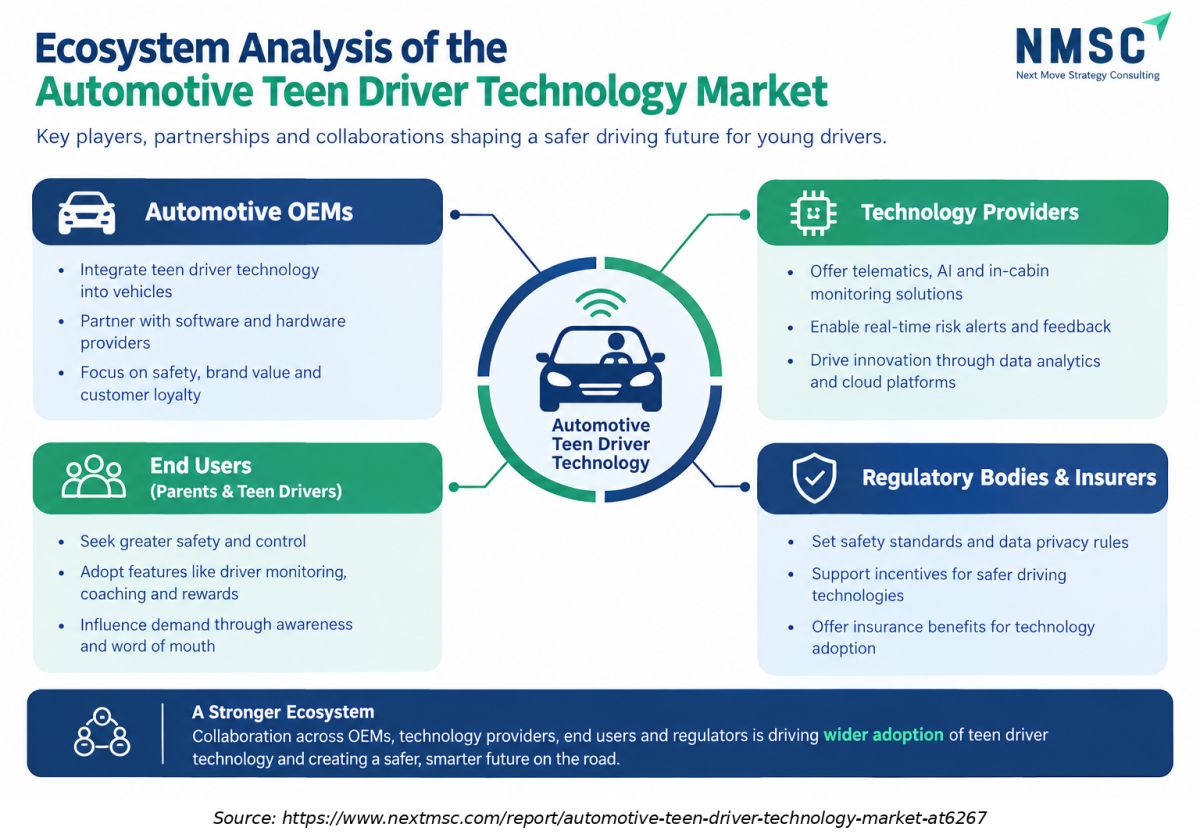
Ecosystem Analysis of the Automotive Teen Driver Technology Market

The ecosystem of the Automotive Teen Driver Technology Market consists of automotive original equipment manufacturers (OEMs), technology providers, end users, regulatory bodies, and insurers. Automakers integrate safety features into vehicles, while technology providers deliver telematics, driver monitoring, and real-time risk alerts. Parents and teen drivers influence adoption through their safety needs and preferences, while regulators establish safety and data privacy requirements. Insurers can further encourage adoption through incentives for eligible safety technologies. Together, these stakeholders are helping advance connected, safety-focused solutions for young drivers.

What Does the Automotive Teen Driver Technology Market Encompass?

The Automotive Teen Driver Technology Market covers hardware, embedded software and cloud services that let parents restrict, coach and monitor novice drivers. Offerings include factory fitted suites such as GM Teen Driver and Ford MyKey, smartphone applications from providers such as Life360 and Verizon, and aftermarket devices that plug into the vehicle diagnostic port. The market estimate includes only revenue attributable to teen-specific functions and excludes general advanced driver-assistance revenue. The methodology should document how revenue from multi-purpose products and services is allocated.

During our Automotive Teen Driver Technology Market evaluation, we noticed that regulation shapes demand indirectly rather than through mandates. Many young drivers are subject to graduated driver licensing requirements. According to the National Safety Council's analysis of NHTSA data, 2,162 young drivers aged 15–20 died in traffic crashes in 2024, highlighting the continuing importance of young-driver safety. Market offerings include traditional key-based restrictions, PIN-protected in-vehicle controls, smartphone applications and connected services that provide parents with driving information and alerts.

Market Drivers & Dynamics

Interactive Dataset
Teen crash burden persists driver +1.6% North America, Europe 2026–2030
Parental demand for coaching and alerts driver +1.9% Global 2026–2035
Software defined vehicles and over the air profiles driver +1.4% Global 2027–2035
Insurer and safety program support driver +0.9% North America 2026–2031
Low parental awareness and non-use restraint −1.3% North America 2026–2030
Teen acceptance and privacy concerns restraint −1.1% Global 2026–2032
Teens drive older, less equipped vehicles restraint −1.5% North America, Europe 2026–2033
Fragmented automaker platforms restraint −0.8% Global 2026–2031
Source: Next Move Strategy Consulting

Growth Drivers

What Is the Primary Growth Driver of the Automotive Teen Driver Technology Market?

The primary driver is the persistent crash burden among novice drivers. NHTSA reports that 2,162 young drivers died in 2024, and the Insurance Institute for Highway Safety estimates that speeding contributed to almost 40% of teen driver deaths. IIHS estimated that selected teen-specific technologies combined with crash-avoidance features could prevent or mitigate up to 78% of teen-driver deaths under a theoretical scenario of universal use and perfect effectiveness. That evidence gives parents, insurers and automakers a concrete reason to fund and promote these tools.

How Is Parental Demand for Coaching Tools Driving Automotive Teen Driver Technology Market Growth?

Consumer pull in the Automotive Teen Driver Technology Market is visible in vendor disclosures. Life360 reported approximately 95.8 million monthly active users and 2.8 million Paying Circles at the end of 2025, representing year-over-year growth of 20% and 26%, respectively. These company-wide figures demonstrate the scale of its family-safety platform but do not directly measure teen-driver technology adoption or revenue. Verizon added real time speed alerts to Verizon Family Plus in 2026. Our analysis shows that parents prefer coaching style tools that preserve trust over pure tracking, which favors vendors with clear driver reports.

Growth Inhibitors

What Is Restraining the Automotive Teen Driver Technology Market?

Awareness and acceptance remain the main restraint. The Insurance Institute for Highway Safety found that only a little over half of parents with MyKey equipped Ford vehicles knew the feature existed, and about a third of those who knew did not use it. Embedded features also depend on each automaker's electronic control unit design, which limits portability across brands. Teens who see the tools as surveillance may also resist them.

Segmentation Analysis

2025 (USD Billion)
2035 (USD Billion)
Factory fitted systems 2025: $0.68 Billion | 2035: $2.31 Billion
Factory fitt
Smartphone applications 2025: $0.28 Billion | 2035: $1.20 Billion
Smartphone a
Aftermarket plug in devices 2025: $0.16 Billion | 2035: $0.59 Billion
Aftermarket
Factory fitted systems $0.68 Billion $2.31 Billion 13.0%
Smartphone applications $0.28 Billion $1.20 Billion 15.4%
Aftermarket plug in devices $0.16 Billion $0.59 Billion 14.1%

Which Deployment Mode Leads the Automotive Teen Driver Technology Market?

Factory-fitted systems lead the Automotive Teen Driver Technology Market because their features are integrated into supported vehicles and may be less easily bypassed than independent applications. Actual restrictions and availability vary by manufacturer and model. GM's report card stores up to 1,000 events and 40,000 miles of coaching data, which shows the depth of embedded tools. Smartphone applications grow fastest at 15.4% because Life360 and Verizon reach used vehicles and add features through simple software updates.

2025 (USD Billion)
2035 (USD Billion)
Speed manage
Seat belt an
Driving beha
Location
geofence and
Segment Item 2025 (USD Billion) 2035 (USD Billion) CAGR
Speed management and limiting $10.0 USD Billion $40.0 USD Billion 18.0%
Seat belt and distraction interlocks $17.1 USD Billion $51.1 USD Billion 24.0%
Driving behaviour monitoring and reporting $24.2 USD Billion $62.2 USD Billion 14.0%
Location $31.3 USD Billion $73.3 USD Billion 8.0%
geofence and curfew alerts $38.4 USD Billion $84.4 USD Billion 23.0%

Segment-wise data is locked

Unlock complete segment-wise numbers for By Safety Function.

Unlock Full Data

Which Safety Function Generates the Most Revenue and Which Is Growing Fastest?

Speed management and limiting is the largest function, since GM offers a speed limiter with a maximum of 85 mph, Ford MyKey caps speed at 80 mph and Tesla enforces a parent set limit. Crash detection and emergency response grows fastest at 16.0% as Life360, Cambridge Mobile Telematics and Miles bundle it with coaching. Tesla's Parental Controls can require selected safety features, including Automatic Emergency Braking on equipped vehicles, illustrating how teen-oriented controls can incorporate general crash-avoidance functionality.

2025 (USD Billion)
2035 (USD Billion)
Internal com
Hybrid elect
Battery elec
Segment Item 2025 (USD Billion) 2035 (USD Billion) CAGR
Internal combustion engine vehicles $10.0 USD Billion $40.0 USD Billion 12.0%
Hybrid electric vehicles $17.1 USD Billion $51.1 USD Billion 18.0%
Battery electric vehicles $24.2 USD Billion $62.2 USD Billion 20.0%

Segment-wise data is locked

Unlock complete segment-wise numbers for By Propulsion Type.

Unlock Full Data

Regional Outlook

2025 (USD Billion)
2035 (USD Billion)
North Americ
Europe
Asia-Pacific
Middle East
Latin Americ
Region 2025 (USD Billion) 2035 (USD Billion) CAGR (%)
North America $10.0 USD Billion $40.0 USD Billion 9.0%
Europe $17.1 USD Billion $51.1 USD Billion 27.0%
Asia-Pacific $24.2 USD Billion $62.2 USD Billion 25.0%
Middle East & Africa $31.3 USD Billion $73.3 USD Billion 23.0%
Latin America $38.4 USD Billion $84.4 USD Billion 12.0%

Regional data is locked

Unlock complete regional numbers for this market.

Unlock Full Data

Strategic Framework Impacting the Automotive Teen Driver Technology Market

Strategic Framework Impacting the Automotive Teen Driver Technology Market
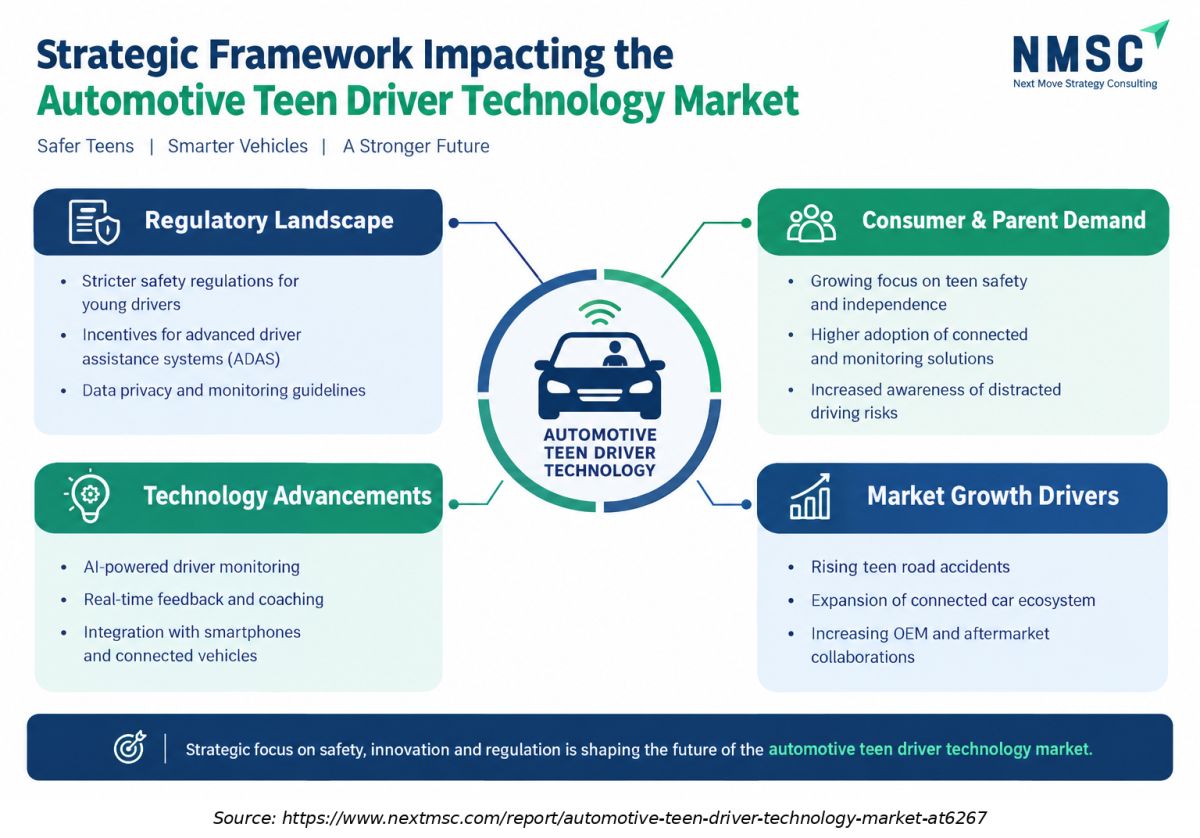
The strategic framework of the Automotive Teen Driver Technology Market is shaped by safety regulations, parental concerns, technological advancements, and growing demand for connected vehicle solutions. AI-powered driver monitoring, real-time feedback, and smartphone integration are helping improve driving awareness and encourage safer habits among young drivers. Collaboration between automakers, technology providers, and regulators is also supporting innovation and the wider adoption of teen driver safety technologies

Competitive Landscape

Our findings suggest that competition spans automakers, carriers and software vendors that pursue the same parents through different channels.

How Do Companies Compete in the Automotive Teen Driver Technology Market?

Automakers in the Automotive Teen Driver Technology Market compete by including teen tools in new vehicles at no extra cost, while app providers and carriers compete through subscriptions and bundles. GM and Ford rely on installed base reach, Life360 relies on family network effects, and Verizon relies on its wireless customer base. Competition is therefore about distribution and trust more than raw feature count.

Which Company Archetypes Dominate the Market?

Three company archetypes are prominent in the Automotive Teen Driver Technology Market: automaker-integrated systems, family-safety platforms and specialist telematics providers. Automaker suites such as Teen Driver, MyKey and Parental Controls differentiate on enforcement that a teen cannot easily bypass. Family safety platforms such as Life360 differentiate on location sharing and reach. Telematics specialists such as Cambridge Mobile Telematics differentiate on scoring accuracy and crash detection quality, often through partners.

How Are Companies Differentiating Through Innovation?

Differentiation now centers on coaching rather than restriction. GM provides an in-vehicle report card, Tesla adds profile-based limits and curfews, Verizon adds real time speed alerts, and Miles pairs trip insights with roadside help. We found that vendors also differ on geographic expansion and pricing, with embedded tools free to owners and app tools sold as monthly tiers.

Key Market Players

During our market evaluation, we validated the following companies against official company websites, regulatory filings and press releases, ranked qualitatively by market specific reach.

General Motors Company Ford Motor Company Tesla, Inc. Hyundai Motor Company Life360, Inc. Verizon Communications Inc. Cambridge Mobile Telematics Miles Labs

Expert Insights

Elizabeth A. Walshe, PhD

Elizabeth A. Walshe, PhD

Children’s Hospital of Philadelphia / University of Pennsylvania

"“Beyond traditional ADAS alerts, next-generation vehicles may incorporate real-time monitoring and feedback systems that provide direct coaching on performance.”"

Analyst Interpretation

The expert statement highlights the potential evolution of automotive safety technology from conventional warnings toward real-time monitoring and driver coaching. It should be treated as a forward-looking observation rather than evidence of widespread commercial adoption. Such systems can provide feedback on driving behaviour and help reinforce safer practices. This creates opportunities for integrated driver-monitoring systems, intelligent alerts, performance-feedback tools, and ADAS features tailored to the needs of novice drivers.

Investment Opportunities

Where Is Capital Flowing in the Teen Driver Technology Market?

Capital is flowing toward software and data platforms rather than hardware. Cambridge Mobile Telematics has described new investors that will fund AI models for driving risk and crash detection, and Life360 reports growth in Paying Circles that supports continued product spending. We found that investors favor recurring subscription revenue, so vendors with clear retention data attract the most capital.

What Infrastructure Investment Is Required?

Infrastructure needs center on cloud platforms, mobile apps and vehicle connectivity. Automakers must maintain backend services for alerts, profiles and over the air updates, and aftermarket vendors need device supply chains and roadside partners. Cellular connectivity and phone sensor accuracy determine alert quality. Investment in reliable, low latency notification systems is therefore a prerequisite for scale.

How Do ESG Considerations Affect Investment?

Teen-driver safety technologies may contribute to the social pillar of ESG by supporting safer driving among young people. Their impact depends on adoption, appropriate use and demonstrated safety outcomes. The National Safety Council counted 2,565 teen motor vehicle occupant deaths in 2024. Governance matters as well, since vendors handle location data about minors. Investors will reward clear consent practices, data minimization and transparent reporting that treats teens as participants rather than targets.

Key Benefits for Stakeholders

How Does the Report Benefit Automakers and Enterprise Leaders?

Automakers gain a view of which functions parents value, how fast app-based profiles are replacing key-based controls, and where propulsion types differ. The segment forecasts and regional outlook help product leaders decide which features to include as standard, which to monetize, and which markets to prioritize for connected service launches over the next decade.

How Does the Report Benefit Investors and Financial Analysts?

Investors receive a reconciled view of revenue by deployment mode, safety function, propulsion type and region, together with growth rates from 2026 to 2035. The competitive assessment and development timeline show which business models, from embedded software to subscriptions and retrofit hardware, are gaining traction, and where awareness and regulation could change returns.

How Does the Report Benefit Technology Vendors and Product Teams?

Vendors can benchmark features against GM, Ford, Tesla, Hyundai, Life360, Verizon and others, and identify gaps in crash detection, coaching and retrofit coverage. The analysis of restraints, including awareness and teen acceptance, guides onboarding and privacy design. Product teams can use the regional sizing to sequence launches and partnerships with insurers and carriers.

Key Market Segments Evaluated

By Deployment Mode

  • Factory fitted systems
  • Smartphone applications
  • Aftermarket plug-in devices

By Safety Function

  • Speed management and limiting
  • Seat belt and distraction interlocks
  • Driving behaviour monitoring and reporting
  • Location, geofence and curfew alerts
  • Crash detection and emergency response

By Propulsion Type

  • Internal combustion engine vehicles
  • Hybrid electric vehicles
  • Battery electric vehicles

By Region

  • North America 
    • U.S.
    • Canada
    • Mexico
  • Europe 
    • UK
    • Germany
    • France
    • Italy
    • Spain
    • Sweden
    • Denmark
    • Finland
    • Netherlands
    • Rest of Europe
  • Asia-Pacific 
    • China
    • India
    • Japan
    • South Korea
    • Taiwan
    • Indonesia
    • Vietnam
    • Australia
    • Philippines
    • Malaysia
    • Rest of APAC
  • Middle East & Africa 
    • Saudi Arabia
    • UAE
    • Egypt
    • Israel
    • Turkey
    • Nigeria
    • South Africa
    • Rest of MEA
  • Latin America 
    • Brazil
    • Argentina
    • Chile
    • Colombia
    • Rest of LATAM

Conclusion & Recommendations

We expect revenue in the Automotive Teen Driver Technology Market to rise from USD 1.28 Billion in 2026 to USD 4.10 Billion by 2035, a 13.8% CAGR, as parental oversight becomes a normal part of vehicle ownership. Growth will broaden from North America to Asia-Pacific, where connectivity is expanding quickly. Smartphone applications and battery electric platforms will expand their share, yet factory fitted suites will remain the largest deployment mode.

What Strategic Positioning Recommendations Does NMSC Offer?

Automakers should make teen tools easy to find and set up, because awareness limits use. App vendors should position products as coaching tools that teens accept, and carriers should bundle them with family plans. Aftermarket vendors should target used vehicles and add roadside services. Partnerships with insurers can subsidize adoption and improve retention for all vendors.

What Is the Investment Attractiveness of the Automotive Teen Driver Technology Market?

Attractiveness is moderate to high. Recurring subscription revenue, a clear safety rationale and rising connected vehicle penetration support returns, while low awareness and privacy sensitivity add risk. We see the strongest prospects in smartphone applications and retrofit devices, where distribution is quick, and in software defined electric platforms that can monetize updates.

What Are the Market Shifts and Key Risks in the Automotive Teen Driver Technology Market?

Shifts include movement from physical keys to account profiles, from restriction to coaching, and from standalone devices to bundled services. Risks include weak parental awareness, teen workarounds, data privacy enforcement and fragmented automaker platforms. Vendors that protect minors' data and make features simple to configure will reduce regulatory and reputational exposure.

What Are the Primary Growth Pathways Through 2035?

Three pathways stand out. First, insurer and carrier partnerships that fund subscriptions for families. Second, retrofit devices that bring controls to older vehicles. Third, over the air upgrades on electric and connected platforms that add curfews, limits and crash alerts after purchase. Together they should lift revenue by USD 2.82 Billion between 2026 and 2035.

Delivered Customizations

We have successfully delivered the following deep-dive customizations:

Client Request Customization Delivered Value Adds
Historical Market Growth Analysis
  • Historical revenue and unit shipment analysis of teen driver technology by deployment mode, safety function, and propulsion type.
  • Establishes a credible baseline for growth rates and shows which deployment modes and safety functions are scaling fastest.
Addressable Market Sizing Assessment
  • TAM, SAM, and VAM sizing based on licensed teen drivers, teen-driven vehicles, and vehicles equipped with teen-driver features.
  • Prioritizes the regions and vehicle segments where adoption can be most readily converted into revenue.
Country-Level Component Trade Assessment
  • Country-wise import and export analysis of telematics modules, in-cabin cameras, and driver-monitoring sensors using UN Comtrade data.
  • Identifies sourcing hubs, supply dependencies, and trade-exposed markets for hardware procurement and localization planning.
Safety Function Fitment by Propulsion Type
  • Mapping of teen-driver safety functions such as speed alerts, geofencing, and collision warning across ICE, hybrid, and battery-electric models.
  • Reveals feature gaps in each propulsion segment and where OEM-embedded functions can replace aftermarket devices.
Regulatory and Insurance Incentive Mapping
  • Assessment of graduated licensing rules, safety regulations, and insurer telematics discount programs that drive teen-driver technology adoption.
  • Pinpoints the jurisdictions and safety functions with the strongest mandate or incentive pull, guiding market entry and product compliance priorities.
Deployment Mode Pricing Benchmarking
  • Pricing and subscription-model benchmarking across OEM-embedded, aftermarket device, smartphone app, and insurer-provided teen-driver solutions.
  • Supports pricing strategy and business model selection by showing how willingness to pay differs by deployment mode and propulsion type.

FAQs

Sources & References

1.

NHTSA, Traffic Safety Facts: Young Drivers, 2023 Data

crashstats.nhtsa.dot.gov
2.

NHTSA, Traffic Safety Facts: Young Drivers, 2024 Data

crashstats.nhtsa.dot.gov
3.

FHWA, Highway Statistics 2023, Table DL-20

fhwa.dot.gov
4.

FHWA, Our Nation's Highways 2026, Drivers

fhwa.dot.gov
5.

National Safety Council, Injury Facts: Teen Drivers

injuryfacts.nsc.org
6.

IIHS, driving technology promises large safety benefits for teens

iihs.org
7.

IIHS, Parents use Ford system to place limits on teen drivers

iihs.org
8.

Chevrolet, Teen Driver Technology

chevrolet.com/safety/teen-driver
9.

Chevrolet, how to use Teen Driver

chevrolet.com
10.

Ford Middle East, MyKey

me.ford.com
11.

Hyundai Australia, Introducing Hyundai Blue link

hyundai.com
12.

Hyundai Middle East, Blue link Geo Fence and Valet Mode

hyundai.com
13.

Life360, Inc., Form 10-K for fiscal year 2025 (SEC)

sec.gov
14.

Life360, Record Q1 2025 Results

life360.com
15.

Verizon, how to use real time speed alerts to help teen drivers

verizon.com
16.

Cambridge Mobile Telematics and Verizon partnership release

businesswire.com
17.

Miles Labs, launch release of October 19, 2026

financialcontent.com
18.

Tesla software update 2024.26 release notes

notateslaapp.com

About the Author

Mayurima Roy

Mayurima Roy

Mayurima Roy is Research Analyst at Next Move Strategy Consulting, where she has spent 4 years working across the firm's full industry coverage rather than a single fixed vertical. Her work centers on structured research, ongoing trend tracking, competitive assessment, and insight-led content development, translating complex market data into clear, decision-ready narratives that support informed client decision-making across diverse global industries, market sectors, and world regions every day.

About the Reviewer

Supradip Baul

Supradip Baul

Supradip Baul is an accomplished business consultant and strategist with over a decade of rich experience in market intelligence, strategy, technology, and business transformation. His work has included rigorous qualitative and quantitative analysis across multiple industries, helping clients shape investment decisions and long-term roadmaps. Earlier in his career, he was associated with Gartner, where he contributed to industry-leading reports and market share analyses. He has worked with leading global companies and holds an MBA with a dual specialization in Marketing and Finance.

Download Free Sample

Kishu Kanda

KISHU KANDA

Strategy Analyst

Accenture

We purchased the AI Consumer Market Report from this company. Not only did they customize the report to meet our specific requirements, but they also showed great flexibility in accommodating our budget. The report we received fully met our expectations. Additionally, they provided prompt and thorough responses to both our pre-purchase and follow-up questions. We look forward to working with this company again in the future.

Melanie Samko

MELANIE SAMKO

Director of Marketing

TOSOH BIOSCIENCE, INC.

The information provided by NMSC is incredibly valuable, thank you so much for such a excellent work. I really appreciate it. I will make sure to reference all of it, in my summary document.

Amos Chang

AMOS CHANG

Strategy Consultant

Kardex Group

I have bought the intralogistics market reports from NMSC two times so far. Joseph and his team are always very helpful and flexible in responding to any customization requirements on the report. Their expertise in market reports really helps us steer the day-to-day business. I will definitely recommend and come back myself whenever there is a need.

Ross J Mckenzie

ROSS J MCKENZIE

Business Insight Manager

Staysure Group

“Next MSC have been incredibly helpful in providing detailed & robust information on our market, alongside quantifying growth by different segments. The process to procure was simple and easy, with sample reports and regular contact to ensure we had what we needed. Succinct detail on their sources & methodologies is also greatly received, allowing transparency in this respect helps build trust in the detail you pay for. Joseph in particular was fantastic, and helped ensure efficient provision of the insight pack – thank you NMSC!”.

Robert Sean Trevino

ROBERT SEAN TREVINO

Sr. Director, Head of Strategic Insights & Analytics

Foundation Medicine

I realized that it was a reliable source of information. These days, there are many people who are looking for authentic data, and this is one of the only sources that can offer them with what they need;

Custom Market Research Services

We will customize the research for you if the listed report does not fully match your requirements.

Get 30% Free Customization

Select License

This website uses cookies to ensure you get the best experience on our website. Learn more

✖