AI Driver Behaviour Market Size, Share, Growth & Forecast by Offering (Embedded Factory-Fit Systems, Aftermarket Retrofit Systems, Others), Deployment (Factory-Fit, Hardwired Retrofit, Plug-and-Play Retrofit, Mobile Application), Vehicle Class (Passenger Car, Light Commercial Vehicle, Heavy Commercial Vehicle, Bus and Coach, Off-Highway Vehicle), By Sales Channel (OEM Direct, Tier 1 Integration, Direct Enterprise Sales, and Others),and End User — Global Analysis 2025-2035
Industry: Automotive & Transportation | Publishing Date: July 14, 2026 | Last Updated: September 30, 2026 | No of Pages: N/A | No. of Tables: N/A | No. of Figures: N/A | Format: PDF | Report Code: AT5131
What Is the AI Driver Behaviour Market Size?
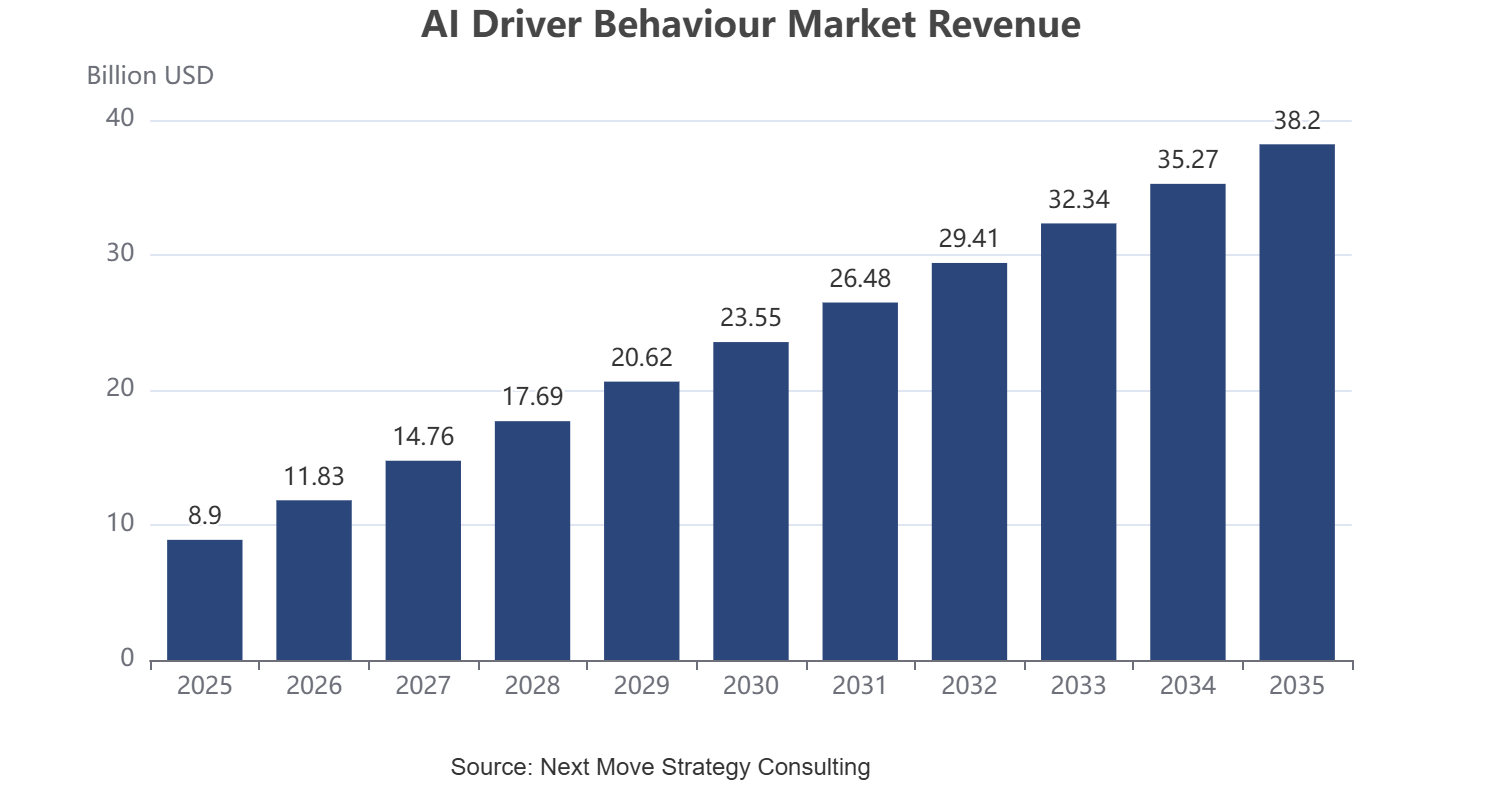
The global AI Driver Behaviour Market was valued at USD 8.9 billion in 2025 and is estimated to reach USD 10.2 billion in 2026. Rising regulatory mandates for in-cabin monitoring, expanding fleet adoption of AI video telematics, and growing insurer demand for behavior-linked underwriting data are projected to propel the market to USD 38.2 billion by 2035, at a CAGR of 15.8% from 2026 to 2035. Key growth drivers include the European Union's mandatory fitment of driver drowsiness and distraction warning systems, expanding commercial fleet deployment of AI-powered dashcams and driver scoring platforms, rising insurer adoption of telematics-based underwriting, and accelerating integration of driver monitoring within ADAS and autonomy-readiness architectures across passenger, commercial, and off-highway vehicles.
|
Parameters |
Details |
|
Market Size in 2025 |
USD 8.9 Billion |
|
Market Size in 2026 |
USD 10.2 Billion |
|
Revenue Forecast in 2035 |
USD 38.2 Billion |
|
Growth Rate |
CAGR of 15.8% from 2026 to 2035 |
|
Analysis Period |
2025-2035 |
|
Base Year Considered |
2025 |
|
Forecast Period |
2026-2035 |
|
Market Size Estimation |
Billion USD |
|
Companies Profiled |
20 |
|
Countries Covered |
38 |
|
Market Share |
Top 10 |
AI Driver Behaviour Market Overview
What Is the AI Driver Behaviour Market?
The AI Driver Behaviour Market encompasses hardware, software, and cloud analytics platforms that use computer vision, sensor fusion, and machine learning to monitor, score, and respond to driver attentiveness, fatigue, and risk behavior in real time. The market spans embedded factory-fit systems integrated by automotive manufacturers and Tier 1 suppliers, alongside aftermarket retrofit systems including AI video telematics, driver scoring, and coaching platforms deployed by commercial, public, and industrial fleets. Applications extend across driver monitoring, occupant monitoring, cabin monitoring, claims evidence generation, and consumer dashcam analytics.
How Has the AI Driver Behaviour Market Evolved?
The AI Driver Behaviour Market has progressed from basic seatbelt and steering-pattern alerts toward camera-based, AI-native systems capable of granular gaze, eyelid, and head-pose analysis. Early deployments were concentrated in premium passenger vehicles and long-haul commercial fleets seeking to reduce fatigue-related incidents. NMSC's analysis indicates that the current phase is defined by convergence between embedded driver monitoring systems and cloud-connected aftermarket video telematics, with edge AI processors enabling real-time behavior scoring without continuous video transmission, reducing bandwidth cost and privacy exposure for fleet operators.
How Do Regulations Influence the AI Driver Behaviour Market?
Regulatory frameworks are the single most influential structural force shaping the AI Driver Behaviour Market. The European Union's General Safety Regulation (EU) 2019/2144 mandates Driver Drowsiness and Attention Warning systems on all new vehicles since July 2024 and Advanced Driver Distraction Warning systems on all new registrations from July 2026, directly compelling OEM fitment across the region. In the United States, the Federal Motor Carrier Safety Administration's compliance framework and state-level insurance telematics rules are driving commercial fleet adoption of AI video safety systems as a documented risk-mitigation and compliance tool.
How Is Technology Adoption Expanding Across the AI Driver Behaviour Market?
Technology adoption within the AI Driver Behaviour Market is broadening as edge AI compute costs decline and camera-sensor bill-of-materials pricing falls, extending in-cabin monitoring from premium vehicles into mainstream passenger and light commercial segments. Based on our research, we found that cloud-native fleet safety platforms are lowering adoption barriers for small and mid-size fleets that previously lacked capital budgets for dedicated telematics hardware. The convergence of driver monitoring with occupant and cabin sensing within a single sensor suite is simplifying integration for automotive manufacturers pursuing multi-function ADAS architectures.
|
Key Takeaways |
|
By offering, Aftermarket Retrofit Systems held the largest share of the AI Driver Behaviour Market at USD 4.9 billion in 2025, driven by widespread commercial fleet deployment of AI video telematics, driver scoring, and coaching platforms. Embedded Factory-Fit Systems is the fastest-growing offering, projected to expand from USD 3.6 billion in 2025 to USD 16.5 billion by 2035 at a CAGR of 18.4%, propelled by increasing regulatory mandates for in-cabin driver monitoring systems and OEM integration. |
|
By deployment, Factory-Fit commanded the largest share at USD 3.5 billion in 2025, representing the largest revenue contribution to the AI Driver Behaviour Market. Factory-Fit is also the fastest-growing deployment mode at a CAGR of 18.4% from 2026 to 2035, driven by growing OEM integration of AI-powered driver monitoring technologies to comply with vehicle safety regulations. |
|
By vehicle class, Passenger Car held USD 4.6 billion in 2025, representing the largest share of the AI Driver Behaviour Market. Off-Highway Vehicle is the fastest-growing vehicle class at a CAGR of 19.6% from 2026 to 2035, advancing from USD 0.3 billion in 2025 to USD 1.5 billion by 2035, driven by increasing investments in autonomous-ready mining, construction, and agricultural equipment. |
|
By sales channel, OEM Direct accounted for USD 2.6 billion in 2025, representing the largest revenue share of the AI Driver Behaviour Market. Direct Enterprise Sales is the fastest-growing sales channel at a CAGR of 19.0% from 2026 to 2035, advancing from USD 2.4 billion in 2025 to USD 11.5 billion by 2035, as fleet operators, insurers, and public-sector organizations increasingly procure AI driver behaviour platforms directly from technology providers. |
|
By end user, Fleet Operator held USD 3.6 billion in 2025 and is forecast to reach USD 16.5 billion by 2035 at a CAGR of 18.4%. Insurer is the fastest-growing end-user segment in the AI Driver Behaviour Market at a CAGR of 18.7%, advancing from USD 0.9 billion in 2025 to USD 4.2 billion by 2035, driven by the expansion of usage-based insurance programs and AI-enabled risk assessment. |
|
North America held the largest regional share of the AI Driver Behaviour Market at USD 3.3 billion in 2025, projected to reach USD 12.6 billion by 2035 at a CAGR of 16.1%, anchored by mature fleet telematics adoption, advanced vehicle safety regulations, widespread commercial fleet deployment, and strong penetration of insurance telematics solutions. |
|
Asia-Pacific is the fastest-growing major region in the AI Driver Behaviour Market at a CAGR of 20.3%, projected to expand from USD 2.3 billion in 2025 to USD 12.1 billion by 2035, propelled by China's expanding vehicle safety mandates, India's accelerating fleet digitization, increasing connected vehicle adoption, and growing investments in AI-powered driver monitoring and fleet safety technologies across major regional economies. |
|
The United States dominated the AI Driver Behaviour Market in 2025, accounting for the largest share of global revenue. Its leadership is supported by the presence of leading AI video telematics and driver monitoring solution providers, extensive commercial fleet deployment, mature insurance telematics infrastructure, and widespread adoption of advanced driver safety technologies across passenger and commercial vehicles. The country's strong regulatory environment and continued investments in connected mobility solutions continue to reinforce its position as the largest national market for AI driver behaviour technologies. |
|
India is projected to be the fastest-growing country in the AI Driver Behaviour Market during the forecast period. Growth is driven by rapid commercial fleet digitization, increasing deployment of AI-enabled video telematics, strengthening road safety regulations, expanding connected vehicle adoption, and growing investments in intelligent transportation systems. Government initiatives promoting digital mobility and increasing demand for fleet safety, logistics optimization, and insurance telematics are accelerating the adoption of AI driver behaviour solutions across the country. |
Key Emerging Trends in the AI Driver Behaviour Market
How Is Edge AI Processing Reshaping In-Cabin Driver Monitoring?
On-device edge AI processing is fundamentally transforming in-cabin driver monitoring by shifting gaze, eyelid, and head-pose inference from cloud servers to embedded chipsets within the vehicle or camera module. Through our market assessment, we observed that this shift reduces latency to sub-100-millisecond alert response and eliminates continuous video transmission requirements. For example, Tier 1 suppliers including Bosch and Continental are integrating dedicated neural processing units within cabin camera modules, enabling real-time drowsiness detection without streaming raw video to external servers, easing bandwidth cost and privacy concerns for fleets.
How Is the Convergence of Driver and Occupant Monitoring Transforming Cabin Sensing?
A single interior sensor suite capable of simultaneously supporting driver monitoring, occupant monitoring, and cabin monitoring is displacing narrowly specialized point sensors across new vehicle platforms. Based on our market evaluation, we noticed that automotive manufacturers are consolidating multiple camera and radar inputs into unified cabin-sensing modules to reduce component cost and wiring complexity. Suppliers including Valeo and Gentex are expanding cabin camera platforms that combine driver attention scoring with child-presence detection and seatbelt reminder functions within a single hardware and software stack.
How Is Usage-Based Insurance Accelerating Aftermarket Adoption?
Usage-based and behavior-based insurance programs are becoming a structural demand driver for aftermarket driver behavior platforms as insurers seek granular, verifiable risk data beyond traditional demographic underwriting. Our findings suggest that insurers are increasingly partnering directly with fleet telematics vendors to access harsh-braking, distraction, and fatigue-event data for commercial auto policy pricing. This trend is directly contributing to the Insurer end-user segment's 18.7% CAGR through 2035, one of the fastest-growing buyer categories within the AI Driver Behaviour Market.
How Is AI Video Analytics Redefining Fleet Driver Coaching?
AI-powered video analytics platforms are moving fleet driver coaching from reactive post-incident review toward proactive, real-time behavioral intervention. NMSC's analysis indicates that vendors including Samsara, Netradyne, and Lytx have expanded automated coaching workflows that flag distraction, following distance, and fatigue events immediately for supervisor review, rather than requiring manual footage audits. Fleet operators report measurable reductions in preventable collision frequency after deploying automated coaching workflows, reinforcing durable enterprise demand for AI-native video telematics platforms.
Price Point Analysis of the AI Driver Behaviour Industry
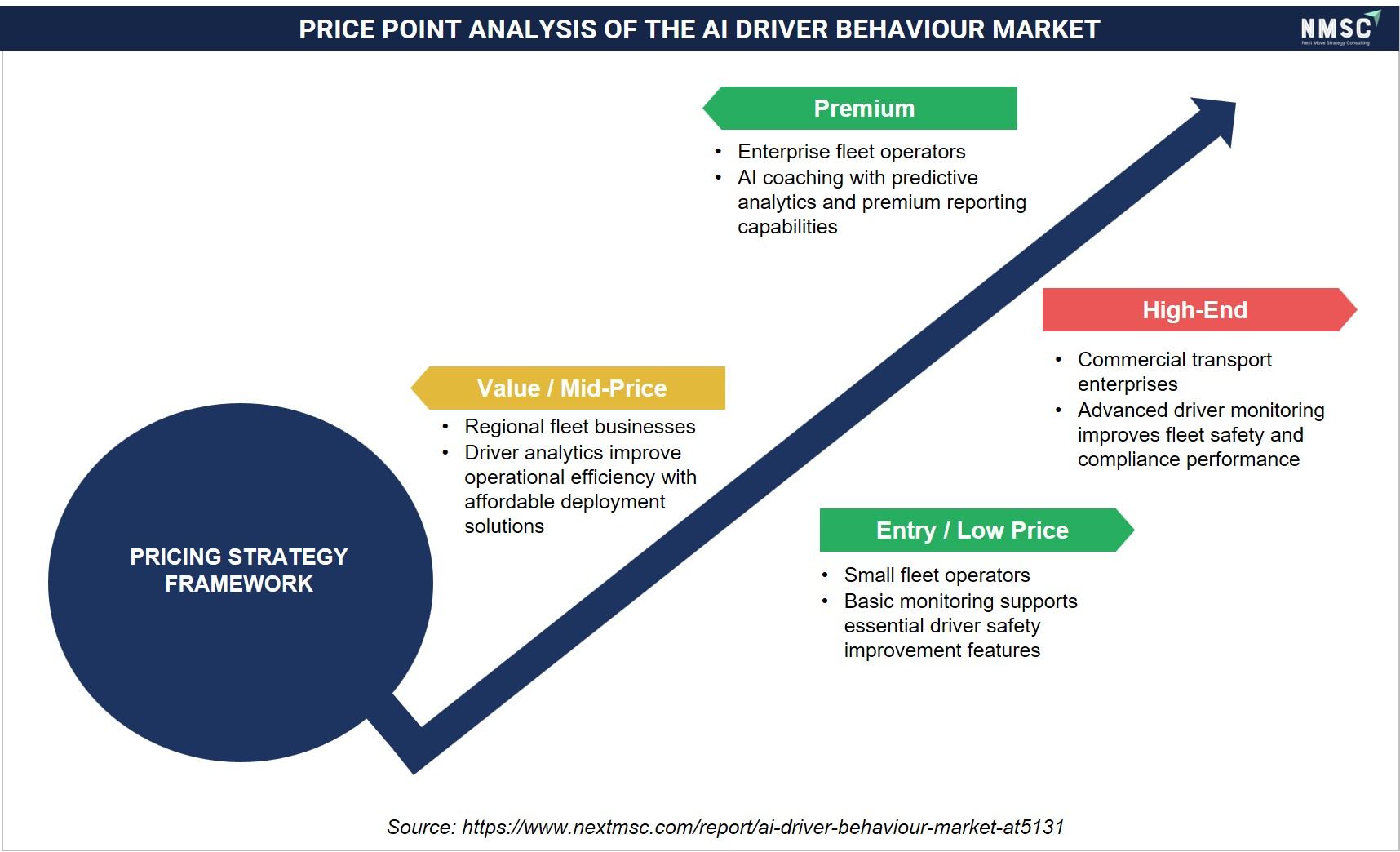
The AI driver behaviour ecosystem offers tiered pricing strategies serving small fleet operators, regional businesses, commercial transport enterprises, and large fleet organizations. Our analysis shows that pricing reflects analytics capabilities, reporting features, deployment scale, and monitoring functionality. Vendors strengthen market competitiveness by delivering affordable entry-level solutions alongside premium platforms featuring predictive analytics, advanced reporting, and enterprise-grade fleet management capabilities.
What Are the Key Market Drivers, Breakthroughs, and Investment Opportunities that will Shape the AI Driver Behaviour Industry in the Next Decade?
|
Drivers / Trends / Restraints |
(+/-) % Impact on CAGR Forecast |
Geographic Relevance |
Impact Timeline |
|
EU GSR-Mandated DDAW/ADDW Fitment |
+2.6% |
Europe |
2024-2029 |
|
NHTSA and FMCSA Fleet Safety Enforcement |
+1.9% |
North America |
2025-2032 |
|
AI-Native Video Telematics Adoption by Fleets |
+2.2% |
Global (led by North America, Europe) |
2025-2035 |
|
Usage-Based Insurance and Telematics Underwriting |
+1.5% |
North America, Europe |
2026-2035 |
|
China and APAC OEM Safety Mandates |
+1.7% |
Asia-Pacific |
2026-2035 |
|
Off-Highway and Industrial Fleet Autonomy Readiness |
+1.1% |
North America, Europe, APAC |
2027-2035 |
|
High Hardware and Integration Costs for Retrofit |
-1.0% |
SMB fleets globally |
2025-2029 |
|
Data Privacy and Biometric Regulation Constraints |
-0.9% |
Europe, North America |
Ongoing |
|
Consumer Aftermarket Dashcam Price Sensitivity |
-0.6% |
Emerging markets |
2025-2030 |
|
Fragmented Aftermarket Retrofit Standards |
-0.5% |
Global |
2025-2028 |
What Are the Growth Drivers of the AI Driver Behaviour Market?
Several structural forces are converging to sustain long-term AI Driver Behaviour Market growth, spanning regulatory fitment mandates, insurer-linked demand, and expanding commercial fleet safety trends. The following drivers, evaluated against verified government and industry sources, explain why demand for embedded and aftermarket driver monitoring offerings is expected to remain resilient through 2035.
How Is the EU General Safety Regulation Accelerating Mandatory Fitment?
Regulation (EU) 2019/2144 is the single most consequential structural driver of the AI Driver Behaviour Market, mandating Driver Drowsiness and Attention Warning systems on all new vehicle registrations since July 2024 and Advanced Driver Distraction Warning systems from July 2026. According to the European Commission's EUR-Lex documentation, driver fatigue contributes to 10 to 25 percent of all road crashes across the European Union, directly justifying this mandatory fitment requirement. This regulation compels every automotive manufacturer selling into the EU to integrate embedded driver monitoring hardware, creating durable, non-discretionary OEM demand.
How Is the Toll of Distracted and Drowsy Driving Fueling Demand in the United States?
The persistent scale of distraction-related road fatalities in the United States is reinforcing demand for AI-based driver monitoring and fleet coaching platforms. The National Highway Traffic Safety Administration reports that 3,208 people were killed in distraction-affected crashes in 2024 alone. Based on NMSC's research, we found that this sustained fatality burden is driving both regulatory attention and voluntary OEM adoption of distraction-warning technology, alongside fleet operator investment in AI video telematics to reduce liability and insurance exposure.
How Is Commercial Fleet Safety Regulation Driving Aftermarket Adoption?
Federal Motor Carrier Safety Administration compliance requirements, including electronic logging and Compliance, Safety, Accountability scoring, are compelling U.S. commercial fleets to adopt AI video telematics as a documented, auditable risk-management tool. Our assessment indicates that fleet operators increasingly treat AI-based driver coaching platforms as a compliance and liability-mitigation investment rather than a discretionary technology purchase, particularly among long-haul trucking and last-mile delivery fleets subject to regulatory safety scrutiny. This shift reflects broader market demand and market trends favoring proactive, data-driven fleet safety management over reactive incident review.
What Are the Growth Inhibitors of the AI Driver Behaviour Market?
How Do High Hardware and Integration Costs Limit Retrofit Adoption?
The capital cost of AI camera hardware, edge processors, and professional installation remains a meaningful adoption barrier for small and mid-size commercial fleets operating on thin margins. Industry-derived estimate (no publicly verifiable dataset available): per-vehicle retrofit hardware and installation costs can represent a multi-year payback period for operators with limited fleet scale, extending sales cycles and constraining near-term penetration among cost-sensitive owner-operator and small logistics segments.
How Do Data Privacy and Biometric Regulation Constrain Market Adoption?
Biometric data collection inherent to facial recognition and eye-tracking driver monitoring raises legitimate privacy concerns that shape deployment architecture and slow adoption in privacy-sensitive markets. The European Commission's own technical requirements under Regulation (EU) 2019/2144 explicitly mandate that driver monitoring data not be continuously recorded or retained beyond closed-loop processing purposes. This regulatory data-minimization requirement, combined with GDPR compliance obligations, requires vendors to engineer privacy-by-design architectures that increase development complexity and cost.
What Are the Growth Opportunities in the AI Driver Behaviour Market?
How Does Usage-Based Insurance Create a Structural Opportunity for Vendors?
The expansion of usage-based and behavior-based commercial auto insurance is creating a structural opportunity for AI driver behavior vendors to position their platforms as core underwriting infrastructure. The National Association of Insurance Commissioners has documented growing insurer interest in telematics-based risk data as a pricing input across commercial and personal auto lines. Vendors that can supply standardized, auditable behavior scores directly to insurance underwriting systems are positioned to capture premium pricing from this expanding buyer category.
How Does Off-Highway and Industrial Fleet Autonomy Readiness Expand the Addressable Market?
The rapid proliferation of automation and autonomy-readiness programs across mining, construction, and agricultural fleets is creating a substantial growth opportunity for ruggedized driver and operator monitoring systems. Off-highway vehicle operators are adopting AI-based fatigue and attention monitoring as a foundational safety layer ahead of higher automation levels, representing the fastest-growing vehicle class in the AI Driver Behaviour Market at a CAGR of 19.6% through 2035, well above the market average.
How Does Rising Global Road Fatality Data Create a Structural Opportunity in Emerging Markets?
The World Health Organization's Global Status Report on Road Safety 2023 estimates that approximately 1.19 million people die annually in road traffic crashes worldwide, with the highest burden concentrated in low- and middle-income countries. Through NMSC's assessment, we found that this sustained global fatality burden is prompting national road-safety agencies across Asia-Pacific, Latin America, and the Middle East to explore driver monitoring mandates, creating a long-term structural expansion opportunity for vendors entering these markets ahead of formal regulation.
How Is the AI Driver Behaviour Industry Segmented in This Report, and What Are the Key Insights from the Segmentation Analysis?
How Do Different Offerings Define the Competitive Boundaries of the AI Driver Behaviour Market?
|
Offering |
2025 (USD Bn) |
2035 (USD Bn) |
CAGR (%) |
|
Embedded Factory-Fit Systems |
3.6 |
16.5 |
18.4% |
|
Aftermarket Retrofit Systems |
4.9 |
20.3 |
17.1% |
|
Others |
0.4 |
1.4 |
14.9% |
Based on our analysis of automotive procurement and fleet technology adoption trends, the AI Driver Behaviour Market is structured across Embedded Factory-Fit Systems, Aftermarket Retrofit Systems, and Others. Aftermarket Retrofit Systems dominates, generating USD 4.9 billion in 2025, led by commercial fleet deployment of AI video telematics, driver scoring, and coaching platforms from vendors including Samsara and Netradyne. Embedded Factory-Fit Systems is the fastest-growing offering at a CAGR of 18.4%, reflecting regulatory-mandated OEM fitment of driver monitoring hardware across passenger, commercial, and off-highway vehicle platforms.
Which Deployment Models Are Reshaping the Architecture of the AI Driver Behaviour Market?
|
Deployment |
2025 (USD Bn) |
2035 (USD Bn) |
CAGR (%) |
|
Factory-Fit |
3.5 |
16.0 |
18.4% |
|
Hardwired Retrofit |
3.2 |
12.5 |
16.4% |
|
Plug-and-Play Retrofit |
1.7 |
7.5 |
17.9% |
|
Mobile Application |
0.5 |
2.2 |
17.9% |
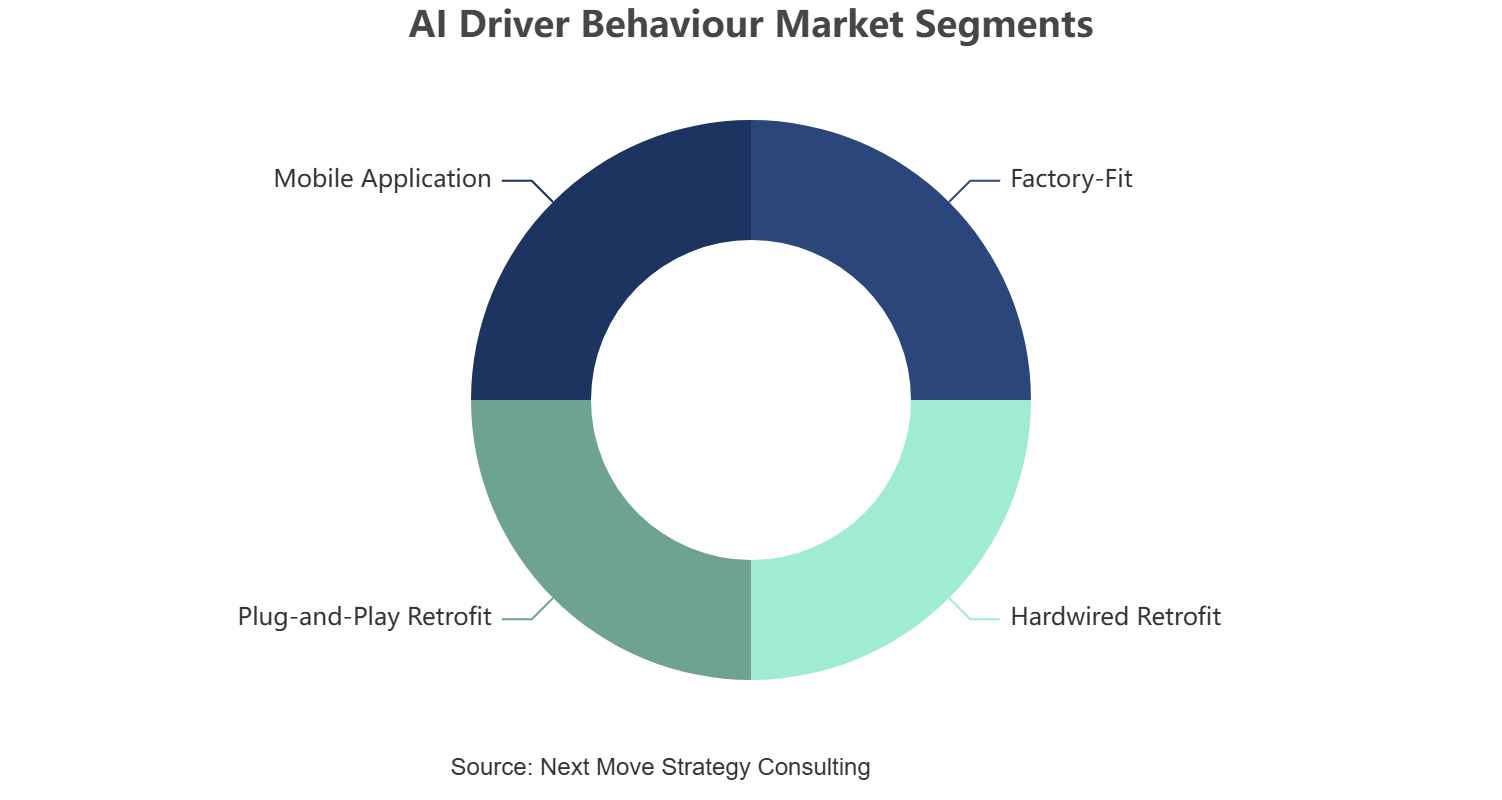
Through our market assessment, we observed that the AI Driver Behaviour Market's deployment landscape spans Factory-Fit, Hardwired Retrofit, Plug-and-Play Retrofit, and Mobile Application configurations. Factory-Fit leads at USD 3.5 billion in 2025 and is also the fastest-growing deployment mode at a CAGR of 18.4%, driven by regulatory type-approval requirements compelling OEM integration. Hardwired Retrofit remains significant at USD 3.2 billion, sustained by long-haul commercial fleets requiring tamper-resistant installations, while Plug-and-Play Retrofit is gaining share among small and mid-size fleets seeking low-friction deployment.
How Does Vehicle Class Shape Demand Patterns Within the AI Driver Behaviour Market?
|
Vehicle Class |
2025 (USD Bn) |
2035 (USD Bn) |
CAGR (%) |
|
Passenger Car |
4.6 |
17.5 |
16.0% |
|
Light Commercial Vehicle |
1.9 |
9.0 |
18.9% |
|
Heavy Commercial Vehicle |
1.6 |
7.8 |
19.2% |
|
Bus and Coach |
0.5 |
2.4 |
19.0% |
|
Off-Highway Vehicle |
0.3 |
1.5 |
19.6% |
Our findings suggest that the AI Driver Behaviour Market is served across Passenger Car, Light Commercial Vehicle, Heavy Commercial Vehicle, Bus and Coach, and Off-Highway Vehicle classes. Passenger Car remains the largest at USD 4.6 billion in 2025, driven by EU regulatory fitment mandates and premium OEM safety differentiation. Off-Highway Vehicle is the fastest-growing vehicle class at a CAGR of 19.6%, propelled by mining and construction fleet operators adopting operator fatigue monitoring ahead of higher automation levels, while Heavy Commercial Vehicle follows closely at 19.2% CAGR on long-haul fleet safety compliance investment.
Which Sales Channels Are Driving Distribution Within the AI Driver Behaviour Market?
|
Sales Channel |
2025 (USD Bn) |
2035 (USD Bn) |
CAGR (%) |
|
OEM Direct |
2.6 |
10.8 |
17.1% |
|
Tier 1 Integration |
2.1 |
8.4 |
16.7% |
|
Direct Enterprise Sales |
2.4 |
11.5 |
19.0% |
|
Reseller and Channel Partner |
1.4 |
5.7 |
16.9% |
|
Online Marketplace |
0.4 |
1.8 |
18.2% |
Based on our evaluation of vendor go-to-market models, the AI Driver Behaviour Market is commercially structured across OEM Direct, Tier 1 Integration, Direct Enterprise Sales, Reseller and Channel Partner, and Online Marketplace channels. OEM Direct leads at USD 2.6 billion in 2025, reflecting automaker procurement of embedded driver monitoring hardware. Direct Enterprise Sales is the fastest-growing channel at a CAGR of 19.0%, as large fleet operators and insurers increasingly negotiate enterprise-wide deployments directly with AI driver behavior vendors rather than through intermediaries.
Which End Users Are Generating the Most Value Within the AI Driver Behaviour Market?
|
End User |
2025 (USD Bn) |
2035 (USD Bn) |
CAGR (%) |
|
Automotive Manufacturer |
3.4 |
13.8 |
16.9% |
|
Fleet Operator |
3.6 |
16.5 |
18.4% |
|
Insurer |
0.9 |
4.2 |
18.7% |
|
Government Agency |
0.6 |
2.4 |
16.7% |
|
Individual Consumer |
0.4 |
1.3 |
14.0% |
Through our analysis of buyer procurement patterns, the AI Driver Behaviour industry is distributed across Automotive Manufacturer, Fleet Operator, Insurer, Government Agency, and Individual Consumer end users. Fleet Operator dominates at USD 3.6 billion in 2025, driven by commercial, public, and industrial fleets deploying AI video telematics for safety compliance and liability management. Insurer is the fastest-growing end user at a CAGR of 18.7%, as usage-based insurance programs increasingly rely on driver behavior data for underwriting, while Automotive Manufacturer remains a substantial buyer through embedded factory-fit procurement.
Regional Outlook
Geographic Performance Snapshot
The following table summarizes regional AI Driver Behaviour industry share and growth patterns across all five covered regions, providing a comparative view of revenue scale and forecast trajectory through 2035.
|
Region |
2025 (USD Bn) |
2035 (USD Bn) |
CAGR (%) |
Key Driver |
|
North America |
3.3 |
12.6 |
16.1% |
Insurance telematics, regulatory enforcement, fleet AI adoption |
|
Europe |
2.4 |
9.8 |
16.9% |
EU GSR mandates, DDAW/ADDW OEM fitment |
|
Asia-Pacific |
2.3 |
12.1 |
20.3% |
China safety mandates, fleet digitization |
|
Middle East and Africa |
0.5 |
2.2 |
17.9% |
Vision-led smart mobility, GCC fleet modernization |
|
Latin America |
0.4 |
1.5 |
15.8% |
Insurance-linked telematics, urban fleet safety |
North America AI Driver Behaviour Market
North America is the dominant region in the global AI Driver Behaviour industry, contributing USD 3.3 billion in 2025 and forecast to reach USD 12.6 billion by 2035 at a CAGR of 16.1%. The region benefits from the headquarters of leading AI video telematics vendors including Samsara, Netradyne, Lytx, and Motive, alongside mature commercial fleet safety and insurance telematics infrastructure. NHTSA distraction-related fatality data and FMCSA compliance frameworks reinforce sustained fleet and OEM investment across the region.
U.S. AI Driver Behaviour Market
Based on our engagements with fleet operators, the United States represents the largest national AI Driver Behaviour industry, anchored by the world's most extensive commercial fleet telematics installed base and headquarters of Samsara, Lytx, Motive, and Netradyne. NHTSA's distraction-related fatality reporting and the Federal Motor Carrier Safety Administration's Compliance, Safety, Accountability program are compelling carriers to adopt AI video coaching platforms as documented compliance and liability-mitigation infrastructure across long-haul, last-mile, and public transit fleets.
Canada AI Driver Behaviour Market
Through our analysis, Canada is a technologically advanced AI Driver Behaviour Market, notably home to Geotab, a leading global fleet telematics provider headquartered in Oakville, Ontario. Canadian commercial fleets operating across long-distance logistics corridors are significant adopters of AI-based fatigue and distraction monitoring. Transport Canada's motor vehicle safety standards and growing insurer interest in telematics-based commercial auto underwriting are supporting steady enterprise and public-sector fleet adoption nationwide.
Mexico AI Driver Behaviour Market
From our assessment, Mexico is the fastest-growing AI Driver Behaviour industry within North America, advancing at a CAGR of 22.0%, driven by nearshoring-led manufacturing and logistics expansion that is rapidly growing the country's commercial vehicle fleet. Mexican logistics operators are adopting AI video telematics to meet insurer and shipper safety requirements tied to cross-border freight contracts. Growing ride-hailing and last-mile delivery fleets are further expanding aftermarket driver behavior platform adoption across major metropolitan corridors.
Europe AI Driver Behaviour Market
Europe is the second-largest region in the AI Driver Behaviour industry, contributing USD 2.4 billion in 2025 and forecast to reach USD 9.8 billion by 2035 at a CAGR of 16.9%. The region's regulatory environment, shaped by Regulation (EU) 2019/2144's mandatory DDAW and ADDW fitment requirements, drives structured OEM investment in embedded driver monitoring. Germany's automotive supplier base, including Bosch, Continental, and ZF, gives the region significant home-market advantage in embedded systems development.
U.K. AI Driver Behaviour Market
Based on our engagements, the United Kingdom is a leading European AI Driver Behaviour industry, distinguished by Transport for London's Direct Vision Standard, which requires camera-based driver and blind-spot monitoring systems on heavy goods vehicles operating within Greater London. This municipal-level mandate has created one of Europe's strongest aftermarket retrofit demand pockets. The Driver and Vehicle Standards Agency oversees national vehicle safety compliance, reinforcing structured commercial fleet adoption.
Germany AI Driver Behaviour Market
According to our evaluation, Germany is Europe's largest AI Driver Behaviour industry, anchored by the headquarters of Robert Bosch GmbH, Continental AG, and ZF Friedrichshafen, three of the world's leading driver monitoring hardware and software suppliers. German automotive manufacturers including Mercedes-Benz and BMW are early adopters of embedded factory-fit driver monitoring ahead of EU regulatory deadlines. The Federal Motor Transport Authority (Kraftfahrt-Bundesamt) oversees type-approval compliance for DDAW and ADDW systems nationally.
France AI Driver Behaviour Market
Through our analysis, France is a significant AI Driver Behaviour industry, home to Valeo SE, a leading global supplier of cabin monitoring and driver sensing technology. French commercial fleet operators and public transit authorities are expanding AI video telematics adoption to meet national road-safety objectives. The Securite Routiere agency's ongoing road-safety campaigns and France's large bus and coach fleet base are reinforcing embedded and aftermarket driver monitoring demand across passenger and commercial vehicle segments.
Italy AI Driver Behaviour Market
Based on our assessment, Italy is a developing but growing AI Driver Behaviour industry within Europe, with adoption concentrated among premium passenger vehicle manufacturers and logistics fleets. Italian automakers are integrating embedded driver monitoring ahead of EU General Safety Regulation deadlines, while national logistics operators are adopting AI video telematics to meet insurer and shipper safety requirements. The Ministero delle Infrastrutture e dei Trasporti oversees national vehicle safety compliance and type-approval enforcement.
Spain AI Driver Behaviour Market
From our assessment, Spain hosts Ficosa International, a Barcelona-headquartered global supplier of driver and cabin monitoring camera systems, giving the country a notable domestic supply-chain presence within the AI Driver Behaviour Market. Spanish commercial fleet operators and public transit authorities are expanding aftermarket video telematics adoption. The Direccion General de Trafico's road-safety enforcement priorities are reinforcing structured demand for embedded and retrofit driver monitoring across the country's passenger and commercial vehicle fleets.
Sweden AI Driver Behaviour Market
Through our analysis, Sweden is a technology-leading AI Driver Behaviour industry, home to Smart Eye AB and Tobii AB, both Swedish suppliers of eye-tracking and driver monitoring camera technology headquartered in Gothenburg and Stockholm respectively. Sweden's Vision Zero road-safety framework, administered by the Swedish Transport Administration, has long prioritized driver attention monitoring, and Swedish OEM Volvo is among the earliest adopters of embedded driver and occupant monitoring systems globally.
Denmark AI Driver Behaviour Market
According to our evaluation, Denmark is a high-per-capita AI Driver Behaviour industry consumer, supported by one of Europe's most digitally advanced logistics and public transit sectors. Danish freight and transit operators are adopting AI video telematics to meet national road-safety targets set by the Danish Road Traffic Authority. The country's compact, well-instrumented commercial fleet base supports efficient aftermarket retrofit deployment across urban delivery and regional haulage segments.
Finland AI Driver Behaviour Market
Based on our market evaluation, Finland's AI Driver Behaviour industry is shaped by extensive forestry, logistics, and winter-road commercial fleet operations that face elevated fatigue-related risk during long-haul routes. Finnish transport authorities under the Finnish Transport and Communications Agency (Traficom) are reinforcing commercial vehicle safety compliance. Finland's advanced telecom infrastructure supports efficient cloud-connected aftermarket video telematics deployment across the country's logistics and public transit fleets.
Netherlands AI Driver Behaviour Market
From our assessment, the Netherlands is a strategically important logistics hub within the European AI Driver Behaviour industry, hosting DAF Trucks and serving as the gateway for European freight distribution through the Port of Rotterdam. Dutch logistics operators are significant adopters of AI video telematics for driver coaching and insurer risk documentation. The Rijkswaterstaat national road authority's safety programs are reinforcing structured commercial fleet adoption across the country's dense freight corridors.
Rest of Europe AI Driver Behaviour Market
The Rest of Europe segment within the AI Driver Behaviour industry encompasses Poland, Switzerland, Austria, Belgium, Czech Republic, Portugal, and other European nations. Poland is emerging as a significant logistics and freight hub within Central and Eastern Europe, driving commercial fleet adoption of AI video telematics. Switzerland's precision manufacturing sector and Belgium's logistics corridors support steady embedded and aftermarket driver monitoring demand across this diverse regional segment.
Asia-Pacific AI Driver Behaviour Market
Asia-Pacific is the fastest-growing major region in the AI Driver Behaviour industry, advancing from USD 2.3 billion in 2025 to an estimated USD 12.1 billion by 2035 at a CAGR of 20.3%. The region's growth is driven by China's expanding new-vehicle safety assessment criteria, India's rapid commercial fleet digitization, and rising government attention to road-safety outcomes across Southeast Asia. Growing EV production platforms across the region are accelerating embedded driver monitoring integration as a standard ADAS component.
China AI Driver Behaviour Market
Based on our engagements, China is the largest individual AI Driver Behaviour industry in Asia-Pacific, driven by the world's largest new-vehicle production volume and rapidly expanding domestic EV manufacturer adoption of embedded driver monitoring as a competitive safety differentiator. China's evolving new-car assessment protocols are increasingly incorporating driver-state monitoring criteria into vehicle safety scoring. Chinese logistics and ride-hailing fleets are also significant adopters of AI video telematics for driver coaching and claims documentation.
India AI Driver Behaviour Market
Through our analysis, India is the fastest-growing AI Driver Behaviour industry in Asia-Pacific, advancing at a CAGR of 24.1%, propelled by rapid commercial fleet digitization among logistics and ride-hailing operators and rising government attention to commercial vehicle road-safety outcomes. Indian Tier 1 suppliers and fleet technology vendors are expanding AI dashcam and driver scoring deployments across trucking and last-mile delivery fleets, supported by falling camera-sensor hardware costs that are broadening addressable fleet segments.
Japan AI Driver Behaviour Market
According to our evaluation, Japan is the second-largest Asia-Pacific AI Driver Behaviour industry, supported by DENSO Corporation, a Kariya-headquartered global leader in driver monitoring sensor and camera technology. Japanese automakers Toyota and Honda are early integrators of embedded driver attention monitoring across passenger vehicle lineups. Japan's aging driver population and national road-safety policy priorities are reinforcing sustained embedded and aftermarket driver monitoring demand across the country's commercial and passenger fleets.
South Korea AI Driver Behaviour Market
From our assessment, South Korea demonstrates high AI Driver Behaviour industry maturity, supported by Hyundai Mobis's expanding driver monitoring hardware portfolio and one of the world's most advanced connected-vehicle telecom infrastructures. Korean logistics and ride-hailing fleets are adopting AI video telematics to reduce insurance premiums and meet corporate safety governance standards. National new-car assessment programs are increasingly incorporating driver-state monitoring performance into vehicle safety ratings.
Taiwan AI Driver Behaviour Market
Based on our engagements, Taiwan's AI Driver Behaviour industry is concentrated in electronics supply-chain manufacturing logistics and growing commercial fleet safety compliance. Taiwanese electronics contract manufacturers and logistics operators are adopting AI video telematics to manage fleet risk across dense urban delivery networks. The government's digital economy acceleration programs are supporting technology-sector adoption of connected fleet safety platforms across the country's freight and logistics operators.
Indonesia AI Driver Behaviour Market
Through our analysis, Indonesia is among the fastest-growing AI Driver Behaviour industry in Southeast Asia, driven by rapidly expanding ride-hailing platforms and a large, growing commercial logistics sector serving the country's e-commerce boom. Indonesian fleet operators are adopting AI dashcam and driver scoring platforms to manage road-safety risk across dense urban and inter-island logistics networks. Government road-safety modernization programs are reinforcing structured commercial fleet adoption nationally.
Vietnam AI Driver Behaviour Market
Based on our assessment, Vietnam is an emerging but high-growth AI Driver Behaviour industry in Southeast Asia, driven by manufacturing sector expansion through supply-chain diversification strategies and a rapidly growing logistics sector. Vietnamese commercial fleet operators are early-stage adopters of AI video telematics for driver safety and claims documentation. The electronics manufacturing sector's expanding logistics footprint is creating structured demand for fleet safety monitoring platforms.
Australia AI Driver Behaviour Market
From our assessment, Australia is the most mature AI Driver Behaviour industry in Asia-Pacific outside Northeast Asia, with strong adoption in mining, logistics, and public transit fleets. Australian mining operators including major iron ore and coal producers are significant adopters of AI-based operator fatigue monitoring across off-highway haul truck fleets. The National Heavy Vehicle Regulator's safety compliance framework is reinforcing structured commercial trucking fleet adoption nationally.
Philippines AI Driver Behaviour Market
According to our evaluation, the Philippines is a developing but growing AI Driver Behaviour industry in Southeast Asia, supported by a large ride-hailing and public transport modernization program that is introducing AI-based driver monitoring into newly formalized public utility vehicle fleets. The Land Transportation Franchising and Regulatory Board's fleet modernization initiative is compelling structured adoption of driver safety monitoring across the country's public transport sector.
Malaysia AI Driver Behaviour Market
Based on our engagements, Malaysia is a mid-tier and growing AI Driver Behaviour industry within Southeast Asia, characterized by expanding logistics operations serving palm oil and manufacturing supply chains alongside growing ride-hailing fleet safety adoption. Malaysian national road-safety programs administered by the Road Safety Department are reinforcing commercial fleet adoption of AI video telematics across the country's freight and passenger transport operators.
Rest of APAC AI Driver Behaviour Market
The Rest of Asia-Pacific segment within the AI Driver Behaviour industry encompasses Singapore, Thailand, Bangladesh, New Zealand, and smaller Pacific nations. Singapore serves as a major regional technology and logistics hub supporting AI driver behavior vendor operations. Thailand's expanding logistics sector and New Zealand's structured commercial fleet safety compliance framework are driving steady embedded and aftermarket driver monitoring adoption across this diverse regional segment.
Middle East and Africa (MEA) AI Driver Behaviour Market
The Middle East and Africa region represents a growing segment of the AI Driver Behaviour industry, advancing from USD 0.5 billion in 2025 to USD 2.2 billion by 2035 at a CAGR of 17.9%. Vision-driven national digital transformation programs in Saudi Arabia and the UAE are the primary growth engines, supplemented by Israel's advanced computer-vision technology base and South Africa's mature mining and logistics sectors. Regional smart-city and fleet-modernization initiatives are compelling structured demand for driver monitoring platforms.
Saudi Arabia AI Driver Behaviour Market
Based on our engagements, Saudi Arabia is the largest AI Driver Behaviour industry within MEA, driven by Vision 2030's road-safety and smart-mobility agenda, ARAMCO's industrial fleet safety modernization, and NEOM's smart-city transportation infrastructure requirements. Saudi commercial logistics operators are expanding AI video telematics adoption to meet national road-safety targets. BFSI-linked insurance telematics programs and large-scale industrial fleet operations are the dominant demand drivers within the Saudi market.
UAE AI Driver Behaviour Market
Through our analysis, the UAE is the second-largest AI Driver Behaviour industry in MEA, powered by Dubai and Abu Dhabi's ambitions as global smart-mobility hubs. The Roads and Transport Authority's fleet safety compliance requirements and growing ride-hailing platform adoption are driving structured demand for embedded and aftermarket driver monitoring. Etisalat and du's connected-vehicle infrastructure investments are supporting cloud-native AI video telematics deployment across the UAE's commercial fleet base.
Egypt AI Driver Behaviour Market
From our assessment, Egypt is an emerging AI Driver Behaviour industry within Africa, driven by a rapidly growing e-commerce logistics sector and government road-safety modernization under Egypt Vision 2030. The National Traffic Authority's enforcement priorities are reinforcing commercial fleet adoption of AI video telematics. Egyptian logistics operators serving the country's expanding e-commerce and last-mile delivery sector are primary buyers of driver behavior monitoring platforms.
Israel AI Driver Behaviour Market
According to our evaluation, Israel occupies a unique position within the MEA AI Driver Behaviour industry as home to Mobileye, a globally leading computer-vision and ADAS technology company headquartered in Jerusalem. Israel's dense technology innovation ecosystem creates significant domestic development of driver monitoring algorithms and sensor systems. Israeli defense and commercial fleet operators are sophisticated early adopters of advanced driver behavior monitoring technology relative to regional peers.
Turkey AI Driver Behaviour Market
Based on our market assessment, Turkey is a growing AI Driver Behaviour industry within the broader MEA region, supported by Ford Otosan's commercial vehicle manufacturing base and a large domestic logistics sector. Turkish fleet operators are increasingly adopting AI video telematics to meet insurer and shipper safety requirements tied to European freight corridors. The Ministry of Transport and Infrastructure's road-safety enforcement priorities are reinforcing structured commercial fleet adoption nationally.
Nigeria AI Driver Behaviour Market
Through our analysis, Nigeria is Sub-Saharan Africa's largest AI Driver Behaviour industry, powered by its large population and a rapidly growing fintech-linked ride-hailing and logistics ecosystem. Lagos-based commercial fleet operators are early adopters of AI dashcam and driver scoring platforms to manage insurance and liability risk. The Federal Road Safety Corps' enforcement priorities are reinforcing structured commercial fleet adoption of driver monitoring technology across Nigeria's major logistics corridors.
South Africa AI Driver Behaviour Market
Based on our engagements, South Africa is the most mature AI Driver Behaviour industry in Sub-Saharan Africa, driven by Johannesburg's mining and logistics sector concentration and structured commercial fleet safety compliance requirements. South African mining operators are sophisticated adopters of AI-based operator fatigue monitoring across off-highway haul truck fleets. The Road Traffic Management Corporation's enforcement priorities are expanding demand for aftermarket driver behavior monitoring across the country's freight and public transport fleets.
Rest of MEA AI Driver Behaviour Market
The Rest of MEA segment within the AI Driver Behaviour industry encompasses Kuwait, Qatar, Bahrain, Oman, Morocco, Kenya, and other African and Middle Eastern nations. GCC nations including Kuwait and Qatar are advancing smart-mobility and fleet safety modernization under national vision programs. Kenya's growing ride-hailing and logistics ecosystem is creating early-stage demand for AI dashcam and driver scoring platforms across this diverse regional segment.
Latin America AI Driver Behaviour Market
Latin America represents a steadily expanding segment of the AI Driver Behaviour industry, advancing from USD 0.4 billion in 2025 to USD 1.5 billion by 2035 at a CAGR of 15.8%. Brazil's large logistics and insurance telematics sector anchors regional demand, supplemented by growing ride-hailing and last-mile delivery fleet adoption across Argentina, Chile, and Colombia. Rising insurer interest in behavior-linked underwriting is reinforcing structured commercial fleet adoption regionally.
Brazil AI Driver Behaviour Market
Based on our engagements, Brazil is the largest AI Driver Behaviour industry in Latin America, driven by a large commercial logistics sector serving the country's expanding e-commerce economy and growing insurer adoption of telematics-based commercial auto underwriting. Sao Paulo-based logistics operators are significant buyers of AI video telematics for driver coaching and claims documentation. Brazil's large bus and coach fleet base further supports embedded and aftermarket driver monitoring demand.
Argentina AI Driver Behaviour Market
Through our analysis, Argentina is the second-largest AI Driver Behaviour industry in Latin America, characterized by a significant agricultural and long-haul freight sector alongside a growing technology talent hub in Buenos Aires. Argentine commercial fleet operators are adopting AI video telematics to manage fatigue risk across long-distance agricultural logistics routes. Despite economic volatility, Argentina's logistics technology sector maintains steady adoption momentum for fleet safety platforms.
Chile AI Driver Behaviour Market
From our assessment, Chile is a growing AI Driver Behaviour industry in Latin America, supported by one of the world's largest copper mining sectors requiring extensive off-highway operator fatigue monitoring across haul truck fleets. Chilean mining operators are sophisticated adopters of AI-based driver and operator behavior monitoring. Santiago's emergence as a regional technology hub is further supporting cloud-native aftermarket video telematics adoption among logistics fleets.
Colombia AI Driver Behaviour Market
According to our evaluation, Colombia is an emerging AI Driver Behaviour industry in Latin America, driven by Bogota's growing ride-hailing and last-mile logistics ecosystem and rising insurer adoption of telematics-based risk pricing. Colombian commercial fleet operators are expanding aftermarket AI dashcam adoption to manage road-safety risk across dense urban delivery networks. Colombia is the fastest-growing individual country market within Latin America at a CAGR of 17.3%.
Rest of LATAM AI Driver Behaviour Market
The Rest of Latin America segment within the AI Driver Behaviour industry includes Peru, Uruguay, Ecuador, Paraguay, and other nations. Peru's mining sector and Uruguay's advanced digital government infrastructure are creating structured demand for embedded and aftermarket driver monitoring platforms. Central American nations are in earlier adoption stages, primarily driven by logistics operators serving regional freight and last-mile delivery networks.
Pain Point Analysis of the AI Driver Behaviour Industry
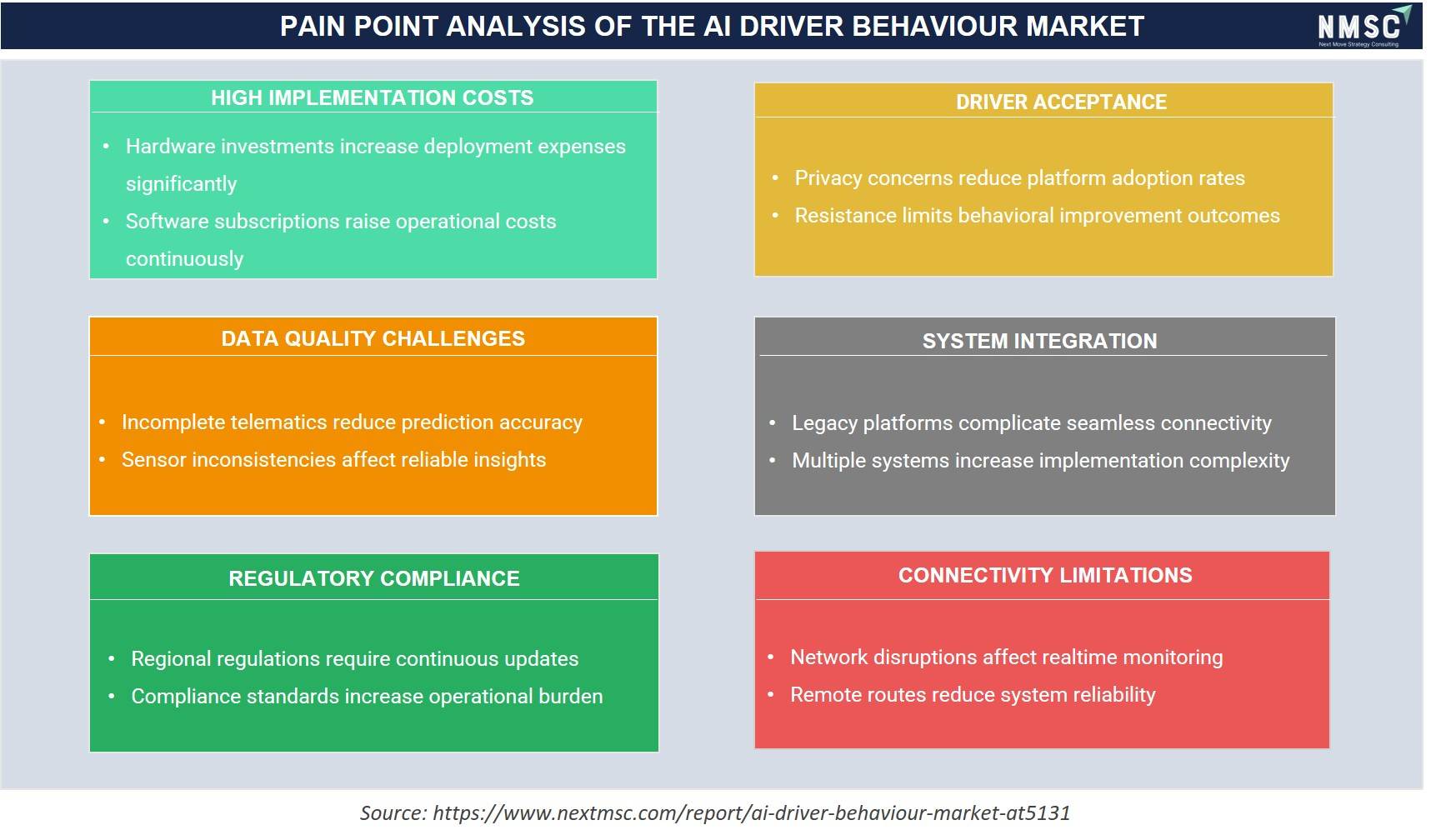
The AI driver behaviour industry encounters implementation challenges associated with deployment costs, data quality, system integration, regulatory compliance, connectivity reliability, and driver acceptance. Our assessment indicates that organizations prioritize scalable platforms delivering accurate analytics, seamless integration, and secure data management. Addressing these operational barriers strengthens adoption, improves solution performance, and supports long-term fleet safety and operational efficiency.
Competitive Landscape
Competitive Dynamics and M&A Landscape
|
Key Takeaways |
Details |
|
Market Structure |
The AI Driver Behaviour Market is moderately concentrated, with Robert Bosch GmbH, Continental AG, and DENSO Corporation holding dominant positions in embedded factory-fit systems, while Samsara, Netradyne, and Lytx lead aftermarket fleet video telematics. The market supports numerous specialized vendors across driver scoring, cabin monitoring, and consumer dashcam sub-categories. |
|
Innovation Focus |
Vendors are prioritizing edge AI processing, multi-function cabin sensor consolidation, and insurer-integrated behavior scoring APIs. Off-highway and autonomy-readiness driver monitoring represents the most active new product development frontier among industrial fleet technology suppliers. |
|
M&A Activity |
The Market has seen strategic consolidation activity including Powerfleet's business combination with MiX Telematics, and continued private equity investment in specialist fleet video telematics vendors. Hyperscaler and semiconductor company acquisitions of computer-vision startups remain a structural market risk for independent vendors. |
How Do Companies Compete in the AI Driver Behaviour Market?
The AI Driver Behaviour Market is characterized by multi-dimensional competition across detection accuracy, cloud analytics depth, insurer integration, and enterprise fleet support quality. Bosch and Continental
compete on OEM integration breadth and regulatory type-approval reliability, while Samsara and Netradyne compete on AI video coaching workflow completeness and fleet management platform ecosystem size. NMSC's analysis indicates that market structure is evolving from discrete hardware sales toward platform ecosystem competition spanning driver monitoring, occupant monitoring, claims evidence, and insurer data services within a unified offering.
Which Kind of Companies Dominate the AI Driver Behaviour Market?
The AI Driver Behaviour Market is dominated by two structural archetypes: large automotive Tier 1 suppliers with integrated driver monitoring capabilities embedded within broader ADAS platforms, and specialized pure-play fleet video telematics vendors optimized for commercial fleet safety workflows. Bosch, Continental, and DENSO represent the first archetype, leveraging existing OEM relationships and type-approval certifications. Samsara, Netradyne, Lytx, and Motive represent specialized vendors competing on fleet coaching workflow depth, cloud analytics sophistication, and insurer data integration.
AI-Native Differentiation and Open Standards Drive Market Success in the AI Driver Behaviour Market
Our assessment indicates that AI-native differentiation has become the primary competitive frontier in the AI Driver Behaviour Market, with vendors racing to embed on-device neural processing, multi-modal fatigue detection, and automated coaching workflows within their core platforms. Open API integration with insurer underwriting systems and fleet management platforms is becoming a key competitive strategy enabling data portability and enterprise adoption at scale among large commercial and public-sector fleet operators.
Market Players to Opt for Merger and Acquisition Strategies to Expand Their Presence in the AI Driver Behaviour Market
Merger and acquisition activity is expected to intensify within the AI Driver Behaviour Market through 2035, driven by automotive Tier 1 suppliers seeking to acquire computer-vision and AI software capabilities, private equity firms consolidating specialist fleet telematics vendors, and insurers acquiring direct data-access capabilities. Embedded driver monitoring vendors serving off-highway and industrial fleet markets are attractive acquisition targets for automation and autonomy technology suppliers seeking vertical integration of sensing and safety software.
Key Market Players in the AI Driver Behaviour Market
-
Robert Bosch GmbH
-
DENSO Corporation
-
Valeo SE
-
Magna International Inc.
-
Aptiv PLC
-
HARMAN International Industries, Incorporated
-
Visteon Corporation
-
Samsara Inc.
-
Geotab Inc.
-
Lytx, Inc.
-
Motive Technologies, Inc.
-
Powerfleet, Inc.
-
Sensata Technologies, Inc.
-
Netradyne, Inc.
-
Seeing Machines Limited
-
Smart Eye AB
-
Tobii AB
-
Ficosa International, S.A.
What Are the Latest Developments in the AI Driver Behaviour Industry?
|
Date |
Event |
|
January 2026 |
Aptiv PLC was showcased its next-generation end-to-end (E2E) AI-powered ADAS platform at CES 2026. The platform utilizes advanced machine learning to provide human-like behavioral planning and features a new Cabin Monitoring System (CMS) that replaces traditional seat sensors with vision-based sensing to improve safety-critical decisions. |
|
January 2026 |
HARMAN International was announced major enhancements to its "Ready Care" and "Ready Aware" products. The update introduces precise, single-heartbeat vital-sign detection and improved occupant-position monitoring to optimize airbag deployment and driver well-being, focusing on "holistic awareness" both inside and outside the vehicle. |
Expert Insights
 “The use of AI by fleets is expanding from, primarily, fleet planning to fleet operations. There are clear safety advantages in harnessing AI with vehicle and dashcam data including preventing accidents by reducing distracted driving.”
— Alain Samaha, CEO, Teletrac Navman
Statement made during the release of Teletrac Navman's 2025 AI & Driver Safety Survey, highlighting the expanding role of artificial intelligence in fleet operations and its ability to improve driver safety through real-time analysis of vehicle and dashcam data.
Market Interpretation
The statement highlights the growing transition of the AI Driver Behaviour Market from traditional fleet management applications toward real-time operational intelligence and proactive safety management. Fleet operators are increasingly deploying AI-powered driver behaviour monitoring solutions that combine telematics, in-vehicle sensors, and dashcam analytics to detect distracted driving, assess driving patterns, predict safety risks, and deliver timely coaching interventions. As organizations prioritize accident prevention, regulatory compliance, and fleet safety, demand for AI-enabled driver behaviour analytics platforms capable of supporting predictive risk assessment and operational decision-making is expected to strengthen across commercial transportation and logistics industries.
What Are the Investment Opportunities in the AI Driver Behaviour Market?
Capital Inflows and Venture Investment in the AI Driver Behaviour Market
The AI Driver Behaviour Market is attracting sustained venture capital and private equity investment, concentrated in AI-native fleet video telematics, embedded cabin-sensing hardware, and insurer-integrated behavior scoring platforms. Vendors with native edge AI processing, multi-modal fatigue detection, and insurer API integration are capturing disproportionate funding attention as usage-based insurance expands. Our assessment indicates that the USD 38.2 billion market opportunity by 2035 creates compelling long-term return profiles for investors entering through early growth-stage positions in specialist vendors.
Infrastructure Investment Driving the AI Driver Behaviour Market Expansion
Automotive semiconductor and edge-computing infrastructure investment is creating a structural tailwind for the AI Driver Behaviour Market as camera-sensor and neural-processing hardware costs decline. Falling edge AI chipset pricing is broadening the addressable base of vehicles and fleets that can economically support embedded and aftermarket driver monitoring. Regional data-center and connected-vehicle infrastructure expansion across North America, Europe, and Asia-Pacific is further supporting cloud-native fleet video telematics service delivery across previously underserved geographic markets.
ESG Considerations in the AI Driver Behaviour Market
ESG considerations are increasingly influencing enterprise fleet technology procurement decisions within the AI Driver Behaviour Market, as organizations seek to demonstrate measurable worker safety and social-responsibility outcomes. The World Health Organization's Global Status Report on Road Safety 2023 documents approximately 1.19 million annual global road traffic deaths, providing a clear social-impact rationale for fleet operators to adopt AI-based safety monitoring as part of corporate ESG reporting and workforce protection commitments.
Digital Transformation Investment Creating AI Driver Behaviour Market Opportunities
Enterprise digital transformation programs across logistics, public transit, and insurance are creating structured multi-year investment cycles for AI driver behavior technology. Organizations modernizing legacy fleet management systems toward real-time, data-driven safety operations require driver monitoring infrastructure as a foundational component, creating both greenfield and displacement opportunities. Our findings suggest that digital transformation investment cycles in Asia-Pacific, MEA, and Latin America will generate a substantial share of AI Driver Behaviour Market revenue growth between 2025 and 2035.
Private Equity and M&A Activity in the AI Driver Behaviour Market
Private equity activity within the AI Driver Behaviour Market reflects growing recognition of the sector's durable revenue model characteristics, including high switching costs within enterprise fleet deployments, recurring subscription revenue, and expanding insurer data-partnership opportunities. Powerfleet's combination with MiX Telematics represents a significant consolidation commitment within the sector. NMSC's analysis indicates that consolidation plays combining complementary embedded and aftermarket driver monitoring capabilities represent the highest-conviction private equity strategy within this market.
Key Benefits for Stakeholders
Benefits for Automotive OEMs and Tier 1 Suppliers
The AI Driver Behaviour Market report equips automotive manufacturers and Tier 1 suppliers with detailed market sizing, regulatory timelines, and adoption forecasts from 2025 to 2035, supporting long-term product roadmap and compliance investment planning. The analysis covers offering-specific deployment across embedded and aftermarket systems, enabling organizations to align engineering investment with regulatory fitment deadlines. Competitive benchmarking of major vendors and country-level market intelligence across 33 countries supports supplier selection and geographic expansion planning.
Benefits for Fleet Operators and Insurers
Fleet operators and insurers can leverage the report to better understand vendor positioning, technology adoption trends, and total cost of ownership patterns within the AI Driver Behaviour Market. The analysis highlights the fastest-growing deployment models and end-user categories, helping organizations benchmark procurement decisions and anticipate insurer-linked underwriting requirements. Geographic insights across 33 countries provide intelligence on regulatory environments and competitive intensity relevant to fleet expansion and risk management strategy.
Benefits for Investors and Financial Analysts
The report provides investors and financial analysts with reliable market estimates and growth projections through 2035, enabling informed investment evaluation and portfolio planning. Detailed analysis of high-growth segments, including embedded factory-fit systems and insurer end-user adoption, helps identify attractive opportunities within the AI Driver Behaviour Market ecosystem. The study also examines competitive dynamics, acquisition activity, and regional expansion trends, allowing stakeholders to benchmark growth assumptions and evaluate strategic investment opportunities.
Key Market Segments
By Offering
-
Embedded Factory-Fit Systems
-
Passenger Car
-
Driver Monitoring
-
Occupant Monitoring
-
Cabin Monitoring
-
-
Commercial Vehicle
-
Driver Monitoring
-
Occupant Monitoring
-
Cabin Monitoring
-
-
Off-Highway Vehicle
-
Driver Monitoring
-
Cabin Monitoring
-
-
-
Aftermarket Retrofit Systems
-
Commercial Fleet
-
Video Telematics
-
Driver Scoring
-
Driver Coaching
-
Claims Evidence
-
-
Public Fleet
-
Video Telematics
-
Driver Scoring
-
Driver Coaching
-
Claims Evidence
-
-
Industrial Fleet
-
Video Telematics
-
Driver Scoring
-
Driver Coaching
-
Claims Evidence
-
-
Consumer
-
Dashcam Analytics
-
Family Monitoring
-
New Driver Monitoring
-
-
-
Others
By Deployment
-
Factory-Fit
-
Hardwired Retrofit
-
Plug-and-Play Retrofit
-
Mobile Application
By Vehicle Class
-
Passenger Car
-
Light Commercial Vehicle
-
Heavy Commercial Vehicle
-
Bus and Coach
-
Off-Highway Vehicle
By Sales Channel
-
OEM Direct
-
Tier 1 Integration
-
Direct Enterprise Sales
-
Reseller and Channel Partner
-
Online Marketplace
By End User
-
Automotive Manufacturer
-
Fleet Operator
-
Insurer
-
Government Agency
-
Individual Consumer
By Region
-
North America: U.S., Canada, and Mexico
-
Europe: U.K., Germany, France, Italy, Spain, Sweden, Denmark, Finland, Netherlands, and Rest of Europe
-
Asia-Pacific: China, India, Japan, South Korea, Taiwan, Indonesia, Vietnam, Australia, Philippines, Malaysia, and Rest of APAC
-
Middle East and Africa: Saudi Arabia, UAE, Egypt, Israel, Turkey, Nigeria, South Africa, and Rest of MEA
-
Latin America: Brazil, Argentina, Chile, Colombia, and Rest of LATAM
Conclusion and Recommendations
Long-Term Outlook
The AI Driver Behaviour Market is positioned for sustained high-growth expansion through 2035, driven by structural secular forces including EU regulatory fitment mandates, rising commercial fleet safety compliance requirements, and expanding insurer demand for behavior-linked underwriting data. The market is forecast to grow from USD 10.2 billion in 2026 to USD 38.2 billion by 2035 at a CAGR of 15.8%, reflecting both the expanding addressable vehicle and fleet base and the premium pricing commanded by AI-native safety platforms. Embedded Factory-Fit Systems and Insurer end-user adoption represent the highest-growth frontiers within this expanding market landscape.
Strategic Positioning Recommendations
AI driver behavior vendors should prioritize native edge AI processing and multi-function cabin sensor consolidation as the foundational competitive differentiator through 2030. Insurer-integrated behavior scoring APIs are increasingly non-negotiable for vendors targeting the fastest-growing Insurer end-user segment. Off-highway and industrial fleet autonomy-readiness monitoring, supporting mining, construction, and agricultural operators, represents the highest-priority vertical expansion opportunity. Geographic expansion into APAC markets ahead of formal regulatory mandates represents the highest-priority internationalization investment.
Investment Attractiveness
The AI Driver Behaviour Market represents a structurally attractive investment environment characterized by regulatory-mandated non-discretionary OEM demand in Europe, expanding recurring revenue from commercial fleet subscription models, and multi-decade secular demand growth driven by road-safety regulation and insurance telematics expansion. The highest-conviction investment themes within this market are Embedded Factory-Fit Systems at a CAGR of 18.4%, Off-Highway Vehicle at 19.6% CAGR, and Insurer end-user adoption at 18.7% CAGR. Investors should monitor consolidation activity among mid-tier specialist vendors as a primary value realization pathway.
Market Shifts and Key Risks
The most significant structural shift underway in the AI Driver Behaviour Market is the migration from standalone hardware sales toward integrated, insurer-connected safety platform subscriptions, favoring full-stack vendors over narrowly specialized hardware-only suppliers. Key risks include high retrofit hardware costs constraining small-fleet adoption, evolving biometric data-privacy regulation increasing development complexity, fragmented aftermarket retrofit standards across regions, and potential hyperscaler or semiconductor-company acquisitions of computer-vision startups compressing margins for independent specialist vendors.
Growth Pathways
Organizations seeking to maximize value from the AI Driver Behaviour Market should pursue a three-horizon strategy. In the near term (2025-2027), prioritize EU regulatory compliance and commercial fleet video telematics deployment to establish the safety-data foundation required for insurer integration. In the mid-term (2027-2031), invest in edge AI processing and multi-function cabin sensing to capture the highest-growth embedded systems category. In the long term (2031-2035), position for off-highway and autonomy-readiness driver monitoring standardization as automation levels increase across industrial and commercial fleet segments.
About the Author
 Saista Faiyaz
— Saista Faiyaz is Research Associate at Next Move Strategy Consulting, where she has covered consumer markets and healthcare technologies for 3 years. Her work includes primary interview review, secondary-source validation, market sizing, and structured analysis of company and industry data. She supports research by comparing evidence across sources, organizing findings into market narratives, and documenting assumptions used in analysis. Her scope includes cross-market benchmarking, and reports.
Saista Faiyaz
— Saista Faiyaz is Research Associate at Next Move Strategy Consulting, where she has covered consumer markets and healthcare technologies for 3 years. Her work includes primary interview review, secondary-source validation, market sizing, and structured analysis of company and industry data. She supports research by comparing evidence across sources, organizing findings into market narratives, and documenting assumptions used in analysis. Her scope includes cross-market benchmarking, and reports.
About the Reviewer
 Supradip Baul
— Supradip Baul is an accomplished business consultant and strategist with over a decade of rich experience in market intelligence, strategy, technology, and business transformation. His work has included rigorous qualitative and quantitative analysis across multiple industries, helping clients shape investment decisions and long-term roadmaps. Earlier in his career, he was associated with Gartner, where he contributed to industry-leading reports and market share analyses. He has worked with leading global companies and holds an MBA with a dual specialization in Marketing and Finance.
Supradip Baul
— Supradip Baul is an accomplished business consultant and strategist with over a decade of rich experience in market intelligence, strategy, technology, and business transformation. His work has included rigorous qualitative and quantitative analysis across multiple industries, helping clients shape investment decisions and long-term roadmaps. Earlier in his career, he was associated with Gartner, where he contributed to industry-leading reports and market share analyses. He has worked with leading global companies and holds an MBA with a dual specialization in Marketing and Finance.
At Next Move Strategy Consulting, we understand that insightful market research is the cornerstone of successful business decisions. That's why we employ a robust and multifaceted approach, combining various methodologies to deliver the most accurate and actionable data for our clients.

Research Landscape
We navigate the world of research with two primary approaches:
Qualitative Approach
Our qualitative research methodologies involve immersive techniques such as in-depth interviews, focus groups, and observational studies. By engaging directly with individuals and stakeholders, we uncover valuable insights that quantitative data alone may overlook.

Quantitative Research
In tandem with qualitative methodologies, NMSC leverages the power of Quantitative Research to provide a robust foundation of numerical insights. Through systematic data collection and analysis, we quantify patterns, preferences, and market trends, offering a comprehensive view of the business landscape.
Our quantitative research approach employs diverse tools, including surveys, experiments, and statistical modelling. These methodologies enable us to gather data from a large and representative sample, ensuring the statistical significance of our findings. By employing structured questionnaires and standardized data collection methods, we guarantee the reliability and validity of the information we present to our clients.
Quantitative research is particularly effective in measuring the prevalence of trends, assessing market size, and gauging the impact of various factors on consumer behavior. The numerical precision attained through this approach equips our clients with actionable insights, facilitating data-driven decision-making and strategy formulation.


Our Specialized Toolbox for Industry-Specific Market Research
We deploy a specialized arsenal of techniques tailored to meet your unique requirements. Here's a glimpse into our comprehensive toolbox:

Information Procurement
The stage entails acquiring market data or relevant information through various sources and methodologies.


Market Research Approach
We utilize both top-down and bottom-up approaches in market research analysis to achieve a comprehensive understanding of the market dynamics, leveraging the broad perspective of industry trends and macroeconomic factors alongside detailed insights from specific segments and individual companies.

Porters Five Forces Analysis
We conduct Porter's Five Forces analysis to evaluate the competitive landscape of an industry, providing us with insights into factors that affect profitability and strategic positioning.

SWOT Analysis

Forecasting
We utilize a forecasting model to predict future consumption by considering parameters like population, economics, regulations, market competition, drivers, constraints, technology, and pricing. We also employ statistical techniques such as multilinear regression, exponential smoothing, moving average, ARIMA, and Monte Carlo simulations for accurate predictions. In econometric forecasting, we analyzed short-term and long-term event impacts, attributing values based on regulatory frameworks, economic factors, and market events.





 Speak to Our Analyst