Building Envelope and Architectural Solutions Market Global Industry Analysis and Forecast (2026-2035)

Building Envelope and Architectural Solutions Market size was USD 130.4 billion in 2026, projected to reach USD 211.3 billion by 2035, growing at a CAGR of 5.5% from 2026 to 2035. Key drivers include expanding mega and giga-project construction activity, rising building energy code and green building certification requirements, and growing infrastructure and public sector investment, with Asia-Pacific leading the market.

Download Free Sample PDF
Base Year (2025)
$123.60 Billion
Forecast (2035)
$211.30 Billion
CAGR (2026-2035)
5.5%
Top Region
Asia-Pacific

What Is the Building Envelope and Architectural Solutions Market Size?

The global building envelope and architectural solutions market size was valued at USD 123.6 billion in 2025 and is estimated at USD 130.4 billion in 2026, forecast to reach USD 211.3 billion by 2035, expanding at a 5.5% CAGR between 2026 and 2035. Asia-Pacific leads with approximately 38% share, while Facade Systems dominate all other solution segments with approximately 34% share.

We observed that growth is broad-based across every segmentation axis, with mega project activity and infrastructure sector adoption driving the dominant structural shifts through 2035.

Building Envelope and Architectural Solutions Market Global Industry Analysis and Forecast (2026-2035) Revenue Forecast

Values in USD Billion

2025 $123.60 Billion
2025
2026 $130.40 Billion
2026
2027 $137.57 Billion
2027
2028 $145.14 Billion
2028
2029 $153.12 Billion
2029
2030 $161.54 Billion
2030
2031 $170.43 Billion
2031
2032 $179.80 Billion
2032
2033 $189.69 Billion
2033
2034 $200.12 Billion
2034
2035 $211.30 Billion
2035

Key Takeaways

By Solution: Facade Systems held the largest share of approximately 34% (USD 42.1 billion) in 2025; Specialty Systems is the fastest-growing sub-segment at 10.4% CAGR from 2026–2035.

By End Use Industries: Commercial and Retail held the largest share of approximately 40% (USD 49.5 billion) in 2025; Infrastructure and Public Sector is the fastest-growing sub-segment at 10.9% CAGR from 2026–2035.

By Project Scale: Large Projects held the largest share of approximately 46% (USD 56.9 billion) in 2025; Mega Projects is the fastest-growing sub-segment at 9.5% CAGR from 2026–2035.

By Procurement Model: Turnkey Packages held the largest share of the procurement model category in 2025; Turnkey Packages is also the fastest-growing sub-segment through 2035 on rising demand for single-source project accountability.

Dominant Region: Asia-Pacific dominated with approximately 38% revenue share (USD 47.0 billion) in 2025.

Fastest-Growing Region: Middle East & Africa is expected to register the highest CAGR of 9.7% during 2026–2035.

Dominant Country: U.S. led with approximately USD 23.7 billion in 2025.

Fastest-Growing Country: UAE is the fastest-growing country at approximately 10.3% CAGR from 2026–2035.

Market Opportunity: The building envelope and architectural solutions market is expected to create an absolute dollar opportunity of USD 80.9 billion between 2026 and 2035, presenting significant investment potential across the facade, glazing, and mega project construction value chain.

According to Next Move Strategy Consulting analysis, facade specialists are increasingly integrating structural glazing, shading, and building-integrated photovoltaic capabilities into single turnkey packages rather than supplying discrete components, a shift that favors vertically integrated system providers over component-only suppliers as architects and developers consolidate procurement through 2035.

What Does the Building Envelope and Architectural Solutions Market Encompass?

The building envelope and architectural solutions market encompasses facade, window and door, glazing and shading, interior architectural, and specialty systems that form the exterior enclosure and interior architectural fit-out of commercial, residential, and infrastructure buildings, forming a system-integration layer of the broader construction material market. Our assessment indicates that the scope spans mega, large, and small and medium project scales delivered through turnkey and systems-supply-only procurement models. The category has evolved from component-level aluminum and glass supply into integrated, engineered facade systems designed for energy performance and rapid installation.
Regulatory frameworks such as building energy code requirements and green building certification standards shape facade specification and procurement timelines across regulated markets. We observed that technology adoption is shifting toward unitized curtain wall systems and building-integrated photovoltaic facades that combine structural, thermal, and energy-generation functions. Next Move Strategy Consulting's analysis indicates that this structural shift, combined with rising mega project and infrastructure sector activity, is redefining procurement criteria across the market.

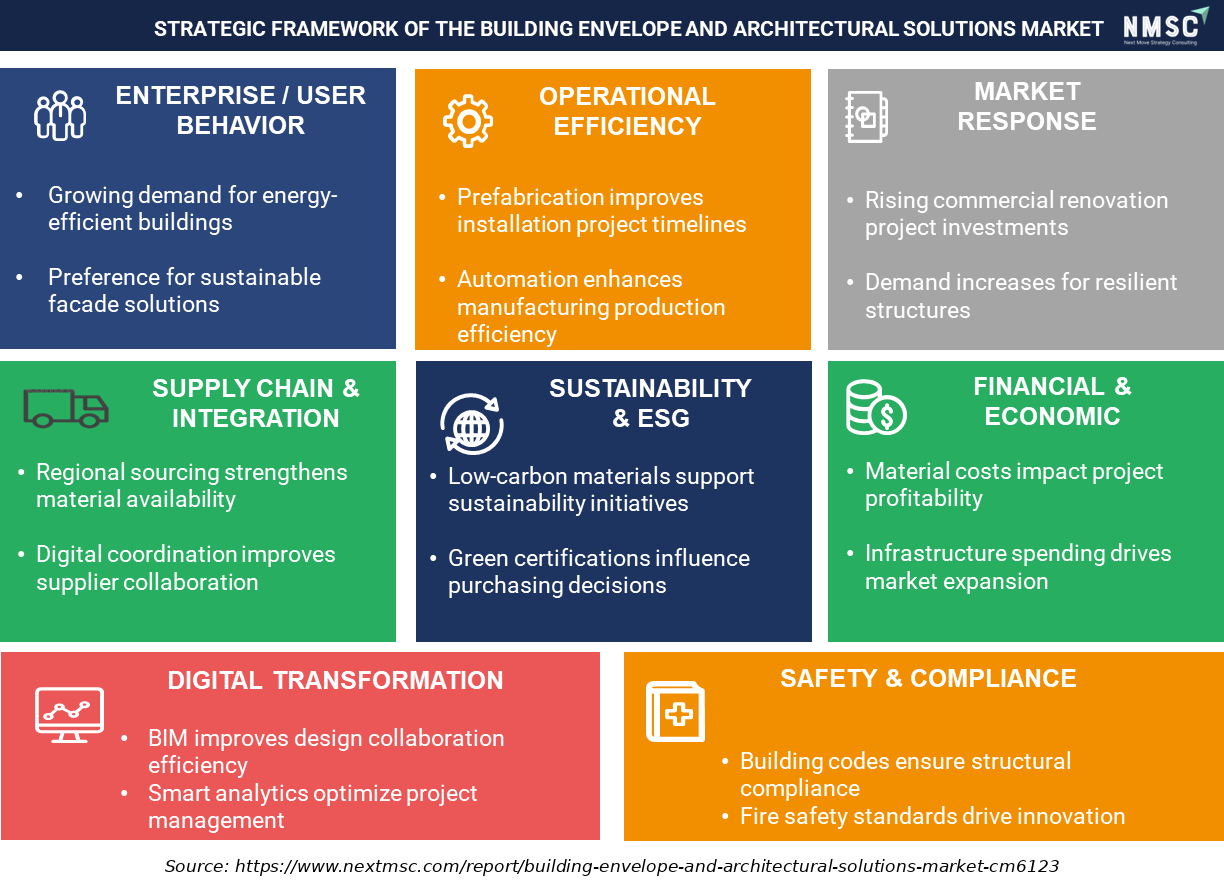
STRATEGIC FRAMEWORK OF THE BUILDING ENVELOPE AND ARCHITECTURAL SOLUTIONS MARKET

STRATEGIC FRAMEWORK OF THE BUILDING ENVELOPE AND ARCHITECTURAL SOLUTIONS MARKET
The strategic framework illustrates the major factors shaping the Building Envelope and Architectural Solutions Market. Growing demand for energy-efficient and sustainable buildings is driving innovation in façade systems and advanced construction materials. Prefabrication, automation, and BIM enhance operational efficiency and project execution, while regional sourcing strengthens supply chains. Sustainability initiatives, green building certifications, infrastructure investments, and stringent safety regulations collectively accelerate market growth, technological advancement, and adoption of resilient, low-carbon architectural solutions.

Market Drivers & Dynamics

Interactive Dataset
Expanding mega project and giga-project construction activity driver +1.8% Middle East & Africa, Asia-Pacific 2026–2035
Rising building energy code and green building certification requirements driver +1.4% North America, Europe 2026–2035
Growing infrastructure and public sector construction investment driver +1.2% Global 2026–2035
Expanding commercial and retail construction in Asia-Pacific driver +1.1% Asia-Pacific 2026–2033
Rising building-integrated photovoltaic facade adoption driver +0.9% Europe, North America 2027–2035
Increasing architectural glass and substrate portfolio consolidation driver +0.7% North America 2026–2033
Aluminum and glass raw material price volatility restraint −1.1% Global 2026–2035
High capital intensity of unitized curtain wall manufacturing restraint −0.6% Global 2026–2032
Construction sector cyclicality and delayed project financing restraint −0.5% North America, Europe 2026–2035
Source: Next Move Strategy Consulting

Growth Drivers

What Is the Primary Growth Driver of the Building Envelope and Architectural Solutions Market?

Expanding mega project and giga-project construction activity is the primary driver of the market. Large-scale developments across Saudi Arabia and the broader Middle East continue to specify facade and architectural systems at unprecedented scale, directly supporting Mega Projects segment growth. We observed that this structural demand, reinforced by rising infrastructure and public sector construction investment globally, continues to anchor baseline demand across facade systems and turnkey procurement models.

How Is Green Building Certification Driving Building Envelope and Architectural Solutions Market Growth?

Building energy code and green building certification requirements are accelerating market growth toward higher-performance, thermally engineered facade systems. YKK AP's expanded thermally broken curtain wall offering illustrates the scale of product innovation entering the market to meet tightening energy performance standards. Our assessment indicates that this shift, combined with Apogee Enterprises' 2026 Kalwall acquisition to broaden its high-performance substrate portfolio, is compressing the gap between component-level and integrated system offerings.

Growth Inhibitors

What Is Restraining Building Envelope and Architectural Solutions Market Expansion?

Aluminum and glass raw material price volatility restrains margin stability across facade and window system manufacturers exposed to commodity input costs. High capital intensity of unitized curtain wall manufacturing further limits new entrant participation in premium facade segments. We found that this cost pressure is concentrating competitive advantage among established manufacturers with scaled procurement leverage, while construction sector cyclicality continues to introduce project timing risk across large-scale commercial developments.

Segmentation Analysis

2025 (USD Billion)
2035 (USD Billion)
Facade Systems 2025: $42.10 Billion | 2035: $67.60 Billion
Facade Syste
Window and Door Systems 2025: $32.10 Billion | 2035: $50.70 Billion
Window and D
Glazing and Shading Systems 2025: $22.20 Billion | 2035: $38.00 Billion
Glazing and
Interior Architectural Systems 2025: $17.30 Billion | 2035: $29.60 Billion
Interior Arc
Specialty Systems 2025: $9.90 Billion | 2035: $25.40 Billion
Specialty Sy
Facade Systems $42.10 Billion $67.60 Billion 4.8%
Window and Door Systems $32.10 Billion $50.70 Billion 4.6%
Glazing and Shading Systems $22.20 Billion $38.00 Billion 5.5%
Interior Architectural Systems $17.30 Billion $29.60 Billion 5.5%
Specialty Systems $9.90 Billion $25.40 Billion 10.4%

Which Solution Segment Dominates the Building Envelope and Architectural Solutions Market?

Facade Systems led the market with USD 42.1 billion in 2025, supported by entrenched demand for unitized and stick-built curtain walls across commercial and institutional construction. We observed that Specialty Systems is the fastest-growing solution segment, expanding at a 10.4% CAGR from 2026 to 2035, as building-integrated photovoltaic facades and architectural railings gain specification traction among developers pursuing combined structural and energy-generation functionality.

2025 (USD Billion)
2035 (USD Billion)
Commercial a
Residential
Hospitality
Industrial a
Infrastructu
Segment Item 2025 (USD Billion) 2035 (USD Billion) CAGR
Commercial and Retail $10.0 USD Billion $40.0 USD Billion 25.0%
Residential $17.1 USD Billion $51.1 USD Billion 11.0%
Hospitality $24.2 USD Billion $62.2 USD Billion 25.0%
Industrial and Logistics $31.3 USD Billion $73.3 USD Billion 11.0%
Infrastructure and Public Sector $38.4 USD Billion $84.4 USD Billion 16.0%

Segment-wise data is locked

Unlock complete segment-wise numbers for By End Use Industries.

Unlock Full Data

Which End Use Industry Leads Building Envelope and Architectural Solutions Demand?

Commercial and Retail remained the leading end use industry within the market, valued at USD 49.5 billion in 2025 given sustained office, retail, and mixed-use construction activity globally. Our findings suggest that Infrastructure and Public Sector is the fastest-growing end use industry, registering a 10.9% CAGR from 2026 to 2035, as government-funded transportation, healthcare, and civic building programs increasingly specify architectural facade and glazing systems for public infrastructure projects.

2025 (USD Billion)
2035 (USD Billion)
Mega Project
Large Projec
Small and Me
Segment Item 2025 (USD Billion) 2035 (USD Billion) CAGR
Mega Projects $10.0 USD Billion $40.0 USD Billion 27.0%
Large Projects $17.1 USD Billion $51.1 USD Billion 9.0%
Small and Medium Projects $24.2 USD Billion $62.2 USD Billion 19.0%

Segment-wise data is locked

Unlock complete segment-wise numbers for By Project Scale.

Unlock Full Data

Which Project Scale Leads Building Envelope and Architectural Solutions Consumption?

Large Projects remained the leading project scale within the market, valued at USD 56.9 billion in 2025 given their prevalence across mainstream commercial and institutional construction. Our analysis shows that Mega Projects is the fastest-growing project scale, registering a 9.5% CAGR from 2026 to 2035, as giga-scale developments across the Middle East and Asia-Pacific specify facade and architectural systems at unprecedented volume and complexity.

2025 (USD Billion)
2035 (USD Billion)
Turnkey Pack
Systems Supp
Other Procur
Segment Item 2025 (USD Billion) 2035 (USD Billion) CAGR
Turnkey Packages $10.0 USD Billion $40.0 USD Billion 14.0%
Systems Supply Only $17.1 USD Billion $51.1 USD Billion 24.0%
Other Procurement Models $24.2 USD Billion $62.2 USD Billion 22.0%

Segment-wise data is locked

Unlock complete segment-wise numbers for By Procurement Model.

Unlock Full Data

Growth Opportunities

Our analysis shows that three forward-looking opportunities stand out for stakeholders positioning within the market over the 2026–2035 forecast period.

How Can Building-Integrated Photovoltaic Facades Unlock Value for Specialty System Providers?

Building-integrated photovoltaic facade integration presents a whitespace opportunity for specialty system providers serving developers pursuing net-zero energy building certification. Providers that commercialize structurally validated BIPV curtain wall modules stand to capture premium pricing as commercial and institutional developers seek facades that combine structural enclosure with on-site energy generation capability.

Where Does Turnkey Mega Project Delivery Create New Revenue for Vertically Integrated Providers?

Mega project developers represent an underpenetrated opportunity for vertically integrated facade providers offering single-source turnkey delivery. Providers that replicate Permasteelisa Group's model of managing design, engineering, manufacturing, and installation as an integrated package can secure long-term contracts with giga-project developers pursuing reduced coordination risk across complex, multi-phase construction programs.

How Can Substrate Portfolio Expansion Benefit Architectural Glass Manufacturers?

Architectural glass manufacturers represent an underpenetrated opportunity through complementary substrate portfolio expansion, following Apogee Enterprises' 2026 approach to acquiring Kalwall's translucent panel technology. Manufacturers that broaden their high-performance substrate offering can differentiate with architects seeking single-supplier facade solutions rather than coordinating multiple specialty component vendors across a single project.

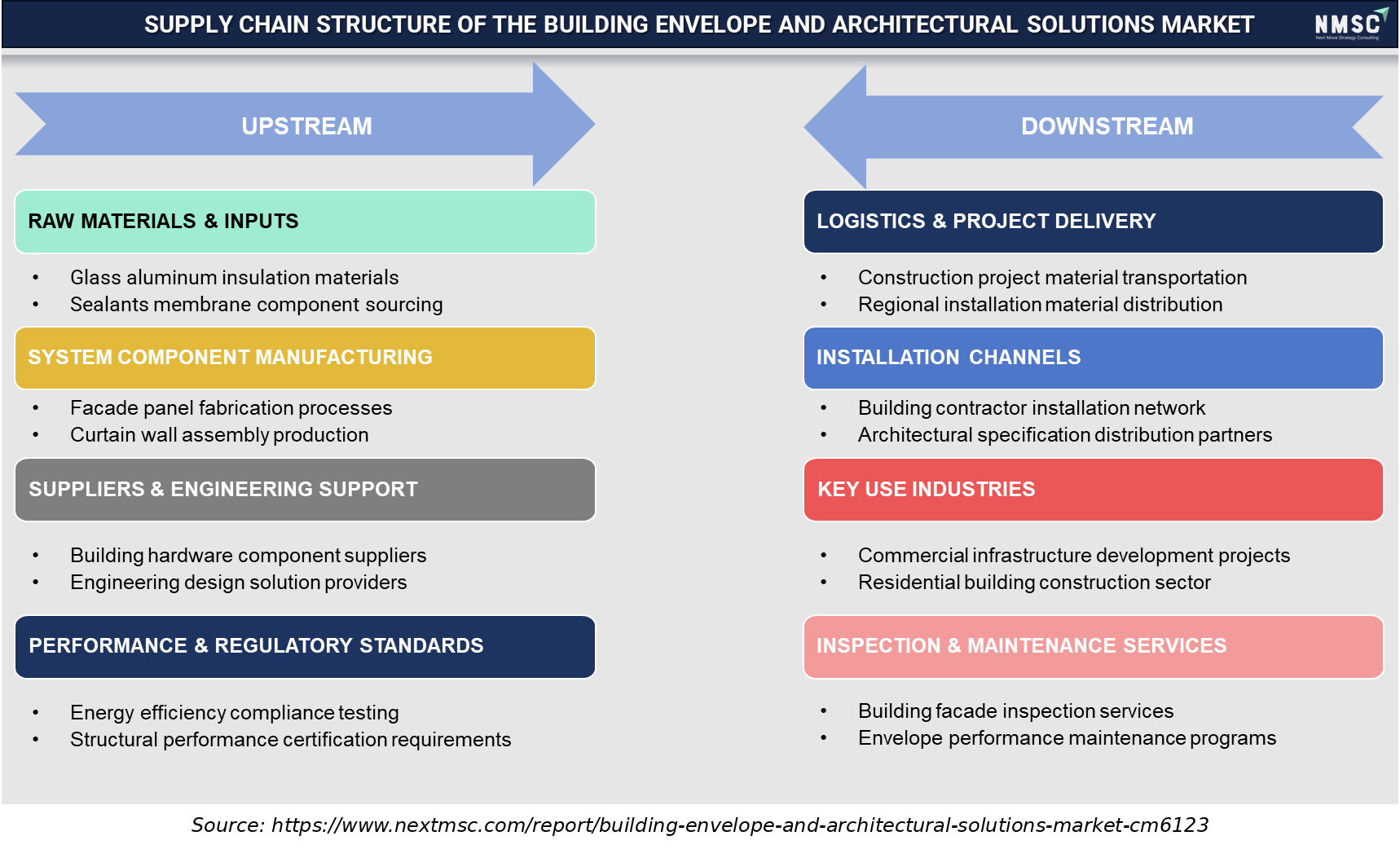
SUPPLY CHAIN STRUCTURE OF THE BUILDING ENVELOPE AND ARCHITECTURAL SOLUTIONS MARKET

SUPPLY CHAIN STRUCTURE OF THE BUILDING ENVELOPE AND ARCHITECTURAL SOLUTIONS MARKET
The supply chain structure of the market spans from raw material sourcing to long-term building maintenance. Upstream activities include procurement of glass, aluminum, insulation, sealants, component manufacturing, engineering support, and compliance testing. Downstream operations focus on logistics, contractor-led installation, commercial and residential construction applications, and ongoing façade inspection and maintenance services. Efficient coordination across the value chain ensures product quality, regulatory compliance, timely project delivery, and enhanced building performance.

Regional Outlook

2025 (USD Billion)
2035 (USD Billion)
Asia-Pacific
North Americ
Europe
Middle East
Latin Americ
Region 2025 (USD Billion) 2035 (USD Billion) CAGR (%)
Asia-Pacific $10.0 USD Billion $40.0 USD Billion 9.0%
North America $17.1 USD Billion $51.1 USD Billion 27.0%
Europe $24.2 USD Billion $62.2 USD Billion 25.0%
Middle East & Africa $31.3 USD Billion $73.3 USD Billion 23.0%
Latin America $38.4 USD Billion $84.4 USD Billion 12.0%

Regional data is locked

Unlock complete regional numbers for this market.

Unlock Full Data

Competitive Landscape

We observed that the building envelope and architectural solutions market features a moderately consolidated competitive landscape, with diversified facade and fenestration majors competing alongside regional aluminum fabricators on engineering depth and turnkey delivery capability. Key Takeaways

Dimension Description
Market Structure Moderately consolidated; the top companies profiled in this report collectively account for a majority of global building envelope and architectural solutions market revenue, while numerous regional fabricators serve niche small and medium project demand.
Innovation Focus Thermally broken framing, building-integrated photovoltaic facades, and parametric unitized curtain wall engineering dominate current innovation pipelines across leading manufacturers.
M&A Activity Selective portfolio expansion, exemplified by Apogee Enterprises' 2026 agreement to acquire Kalwall Companies, broadening its Architectural Glass segment substrate offering.

How Do Companies Compete in the Building Envelope and Architectural Solutions Market?

Companies compete primarily on engineering depth, turnkey delivery capability, and thermal performance certification across the industry. Diversified manufacturers such as Schuco and YKK AP leverage broad facade, window, and door portfolios to serve multinational developers, while specialized facade engineering firms such as Permasteelisa and seele compete on bespoke, parametrically engineered systems for complex, architecturally distinctive projects.

Which Competitive Archetypes Dominate the Building Envelope and Architectural Solutions Market?

Two archetypes dominate the market: diversified global manufacturers offering broad, multi-system product portfolios, and specialized facade engineering firms focused on bespoke, high-complexity project delivery. Schuco and YKK AP exemplify the diversified archetype through combined facade, window, and door manufacturing capability, while Permasteelisa and seele exemplify the specialist archetype through advanced parametric design and turnkey installation expertise for architecturally significant buildings.

How Are Companies Differentiating Through Innovation in Building Envelope and Architectural Solutions?

Innovation and differentiation strategy increasingly center on thermal performance and integrated project delivery. YKK AP's expanded thermally broken unitized curtain wall offering and Permasteelisa's 2025 parametrically engineered Northeastern University facade both illustrate how leading providers differentiate through measurable energy performance and design sophistication. Our analysis shows that manufacturers unable to demonstrate certified thermal performance risk exclusion from institutional and premium commercial project shortlists.

What M&A and Expansion Activity Is Shaping the Building Envelope and Architectural Solutions Market?

Portfolio expansion and strategic acquisitions continue to shape competitive positioning within the industry. Apogee Enterprises' 2026 agreement to acquire Kalwall Companies, expected to contribute approximately USD 85 million of revenue within the first 12 months, illustrates how manufacturers are broadening substrate portfolios to offer more comprehensive building envelope solutions rather than pursuing organic product development alone.

Key Market Players

Our assessment indicates that the following 15 companies are actively shaping product innovation, engineering capability, and regional manufacturing capacity within the global building envelope and architectural solutions market.

Permasteelisa S.p.A. Schüco International KG Norsk Hydro ASA YKK AP Inc. LIXIL Corporation Reynaers Aluminium NV AluK Group S.p.A. Apogee Enterprises, Inc. Oldcastle BuildingEnvelope, Inc. seele GmbH Alumil S.A. Exlabesa Kawneer Company, Inc. Gulf Extrusions Co. LLC ALUPCO

Latest Developments

We found that recent developments within the building envelope and architectural solutions market are concentrated on portfolio acquisitions and major facade project awards, reflecting the industry's shift toward integrated, high-performance system delivery.

Date Event
May 2026 Apogee Enterprises agreed to acquire Kalwall Companies, planning to integrate the translucent panel manufacturer into its Architectural Glass segment to create a more comprehensive high-performance substrate offering.

Investment Opportunities

What Capital Inflows Are Targeting the Building Envelope and Architectural Solutions Market?

Capital inflows into the building envelope and architectural solutions market are increasingly directed toward substrate portfolio consolidation and mega project manufacturing capacity. Apogee Enterprises' 2026 Kalwall acquisition, expected to be accretive to adjusted diluted earnings per share, illustrates the scale of capital committed to portfolio broadening. We observed that investors favor manufacturers demonstrating turnkey delivery capability, viewing integrated project management as a proxy for long-term mega project contract retention.

How Is Infrastructure Investment Supporting Building Envelope and Architectural Solutions Demand?

Public infrastructure investment is directly supporting building envelope and architectural solutions demand as government-funded transportation, healthcare, and civic building programs specify facade and glazing systems. Our findings suggest that manufacturers are investing in thermally broken and building-integrated photovoltaic production capacity to serve infrastructure and public sector clients pursuing certified energy performance across North America, Europe, and the Middle East.

What ESG Considerations Are Shaping Building Envelope and Architectural Solutions Investment Decisions?

Environmental considerations are increasingly central to investment decisions across the industry, with building energy performance and building-integrated photovoltaic capability as key criteria. YKK AP's thermally broken curtain wall expansion illustrates supplier response to sustainability-focused developer procurement. We found that investors increasingly favor manufacturers with certified low-carbon facade systems, treating energy performance as a governance indicator alongside raw material sourcing compliance.

Key Benefits for Stakeholders

How Does This Report Benefit Enterprise and Industry Leaders?

Enterprise and industry leaders gain access to validated segmentation, competitive benchmarking, and regional demand forecasts that support sourcing and portfolio decisions across the building envelope and architectural solutions industry. Our analysis shows that detailed solution, end-use, and project-scale breakdowns help procurement teams align specifications with regulatory and performance requirements while identifying underserved segments for portfolio expansion.

How Does This Report Benefit Investors and Financial Analysts?

Investors and financial analysts benefit from consistent, single-point market size and CAGR estimates that support valuation and capital-allocation decisions across the building envelope and architectural solutions supply chain. We observed that the report's regional and segment-level growth differentials help identify which manufacturers are best positioned to capture above-market growth in Middle East & Africa and mega project categories through 2035.

How Does This Report Benefit Technology Vendors and Product Teams?

Technology vendors and product teams gain insight into emerging system requirements, including thermally broken framing, building-integrated photovoltaic facades, and parametric engineering, that are reshaping the industry. Our findings suggest that this analysis helps R&D teams prioritize development roadmaps around energy performance certification and turnkey delivery capability increasingly required by developer and institutional client specifications.

Key Market Segments Evaluated

By Solution

  • Facade Systems
  • Window and Door Systems
  • Glazing and Shading Systems
  • Interior Architectural Systems
  • Specialty Systems

By End Use Industries

  • Commercial and Retail
  • Residential
  • Hospitality
  • Industrial and Logistics
  • Infrastructure and Public Sector
  • Other Industries

By Project Scale

  • Large Projects
  • Small and Medium Projects
  • Mega Projects

By Procurement Model

  • Turnkey Packages
  • Systems Supply Only
  • Other Procurement Models

Conclusion & Recommendations

The long-term outlook remains steady, with the market expected to expand from USD 130.4 billion in 2026 to USD 211.3 billion by 2035 at a 5.5% CAGR. We observed that this trajectory rests on sustained mega project activity, tightening building energy performance requirements, and growing infrastructure sector investment that together support demand across the forecast period.

What Strategic Positioning Should Stakeholders Pursue?

Stakeholders should pursue integrated, turnkey delivery strategies combined with expanded substrate and specialty system portfolios to compete for large-scale project awards. Our assessment indicates that manufacturers integrating parametric design capability with broad product breadth, following the pattern of Permasteelisa's institutional project wins and Apogee Enterprises' 2026 Kalwall acquisition, are best positioned to secure long-term mega project and institutional contracts across the building envelope and architectural solutions market.

How Attractive Is the Building Envelope and Architectural Solutions Market for New Investment?

The building envelope and architectural solutions industry presents an attractive investment case, supported by a USD 80.9 billion absolute dollar opportunity between 2026 and 2035 and above-average growth in Middle East & Africa and specialty system categories. We found that investment attractiveness is highest for manufacturers combining turnkey delivery capability with thermally engineered product portfolios, positioning them to serve both mega project and institutional buyer segments simultaneously.

What Market Shifts and Key Risks Should Stakeholders Monitor?

Stakeholders should monitor aluminum and glass raw material price volatility, high capital intensity of unitized manufacturing, and construction sector cyclicality as key risks to the building envelope and architectural solutions market. Our analysis shows that manufacturers unable to demonstrate cost-competitive, thermally certified systems risk losing project awards to competitors with proven turnkey and engineering capability, particularly as mega project procurement increasingly favors single-source accountability.

What Are the Key Growth Pathways for the Building Envelope and Architectural Solutions Market?

Key growth pathways include scaling building-integrated photovoltaic facade adoption, expanding turnkey mega project delivery capability, and deepening infrastructure and public sector penetration. Next Move Strategy Consulting's analysis indicates that manufacturers pursuing these pathways while maintaining core facade engineering depth will be best positioned to capture the building envelope and architectural solutions market's projected growth through 2035.

FAQs

About the Author

Liza Phukan

Liza Phukan

Liza Phukan is Research Associate at Next Move Strategy Consulting, where she has covered emerging industries and market research across sectors for 3.5 years. Her work includes analyzing industry developments, validating market data, and developing structured business content from research findings. She uses secondary research and data-validation practices to turn complex market information into clear decision-useful market analysis for business audiences and support report development and B2B.

About the Reviewer

Supradip Baul

Supradip Baul

Supradip Baul is an accomplished business consultant and strategist with over a decade of rich experience in market intelligence, strategy, technology, and business transformation. His work has included rigorous qualitative and quantitative analysis across multiple industries, helping clients shape investment decisions and long-term roadmaps. Earlier in his career, he was associated with Gartner, where he contributed to industry-leading reports and market share analyses. He has worked with leading global companies and holds an MBA with a dual specialization in Marketing and Finance.

Download Free Sample

Henri Knyphausen

HENRI KNYPHAUSEN

Partner at Singulier [Ex-BCG]
Singulier

I recently engaged NEXTMSC.com for a commercial due diligence project within the intralogistics sector, and I am pleased to provide a reference based on my experience. In utilizing NEXTMSC.com's services, I found their report to offer valuable insights into market dynamics and key industry players. The initial report provided a solid foundation for our analysis. However, as we were investigating a smaller target in the market, and I had specific customization requests requiring additional research. These requests included detailed information on product portfolios of various players and sub-market sizes, both inclusive and exclusive of certain product categories. NEXTMSC.com demonstrated commendable responsiveness and agility in accommodating these customization requests. Within a timeframe of 1-2 weeks, they delivered a revised report that met our specific needs. Furthermore, they were receptive to my follow-up inquiries, ensuring clarity and understanding of the data provided. The final deliverable significantly contributed to our due diligence efforts. One of NEXTMSC.com's notable strengths lies in their qualitative research capabilities. However, for future engagements, I would recommend the inclusion of a quantified market model in Excel format. Such a model would offer the ability to conduct in-depth analyses and explore various market segments, including country-specific data and subcomponent breakdowns. Based on my positive experience, I would not hesitate to work with NEXTMSC.com again. Their responsiveness, willingness to accommodate customization requests, and commitment to delivering actionable insights make them a reliable partner for commercial research projects.


Kishu Kanda

KISHU KANDA

Strategy Analyst

Accenture

We purchased the AI Consumer Market Report from this company. Not only did they customize the report to meet our specific requirements, but they also showed great flexibility in accommodating our budget. The report we received fully met our expectations. Additionally, they provided prompt and thorough responses to both our pre-purchase and follow-up questions. We look forward to working with this company again in the future.

Semih Kavaklioglu

SEMIH KAVAKLIOGLU

Co-Founder & Sales Manager

Decortie

I work a lot in the marketing industry and I know that research is an essential part of any campaign. I have used Market research reports for my own products and I found them to be very informative and well-researched. The team here produces insightful reports for a good price

Amos Chang

AMOS CHANG

Strategy Consultant

Kardex Group

I have bought the intralogistics market reports from NMSC two times so far. Joseph and his team are always very helpful and flexible in responding to any customization requirements on the report. Their expertise in market reports really helps us steer the day-to-day business. I will definitely recommend and come back myself whenever there is a need.

Rishabh Jogani

RISHABH JOGANI

Strategy Analyst

Accenture Japan

We are incredibly impressed with the market report on the real estate market in India provided by Next Move Strategy Consulting. The report was thorough, insightful, and well-structured, offering deep analysis and actionable recommendations. It not only captured the current trends and dynamics but also provided a forward-looking perspective that has been invaluable for our strategic planning. Their team demonstrated exceptional professionalism, attention to detail, and a profound understanding of the industry. The data-driven insights and clarity of presentation exceeded our expectations, making complex market trends easy to understand. We highly recommend Next Move Strategy Consulting to anyone looking for reliable and comprehensive market research services. Their expertise has given us the confidence to navigate the complexities of the Indian real estate market with clarity and foresight.

Custom Market Research Services

We will customize the research for you if the listed report does not fully match your requirements.

Get 30% Free Customization

Select License

This website uses cookies to ensure you get the best experience on our website. Learn more

✖