Architectural Aluminum Market Size, Share, Trends and Growth Analysis, By Product Type (Extrusions, Flat-Rolled, Castings, Forgings, Billets, and Other Products), By Application (Curtain Walls and Facades, Windows and Doors, Roofing and Cladding, Shading Systems and Louvers, and Interior Architectural Systems), By Project Type (Commercial and Retail, Residential, Infrastructure and Public Sector, Industrial, and Hospitality), and Region — Global Industry Report and Forecast, 2026-2035
Industry: Materials and Chemical | Publishing Date: August 25, 2026 | Last Updated: September 30, 2026 | No of Pages: N/A | No. of Tables: N/A | No. of Figures: N/A | Format: PDF | Report Code: MC5836
What Is the Architectural Aluminum Market Size?
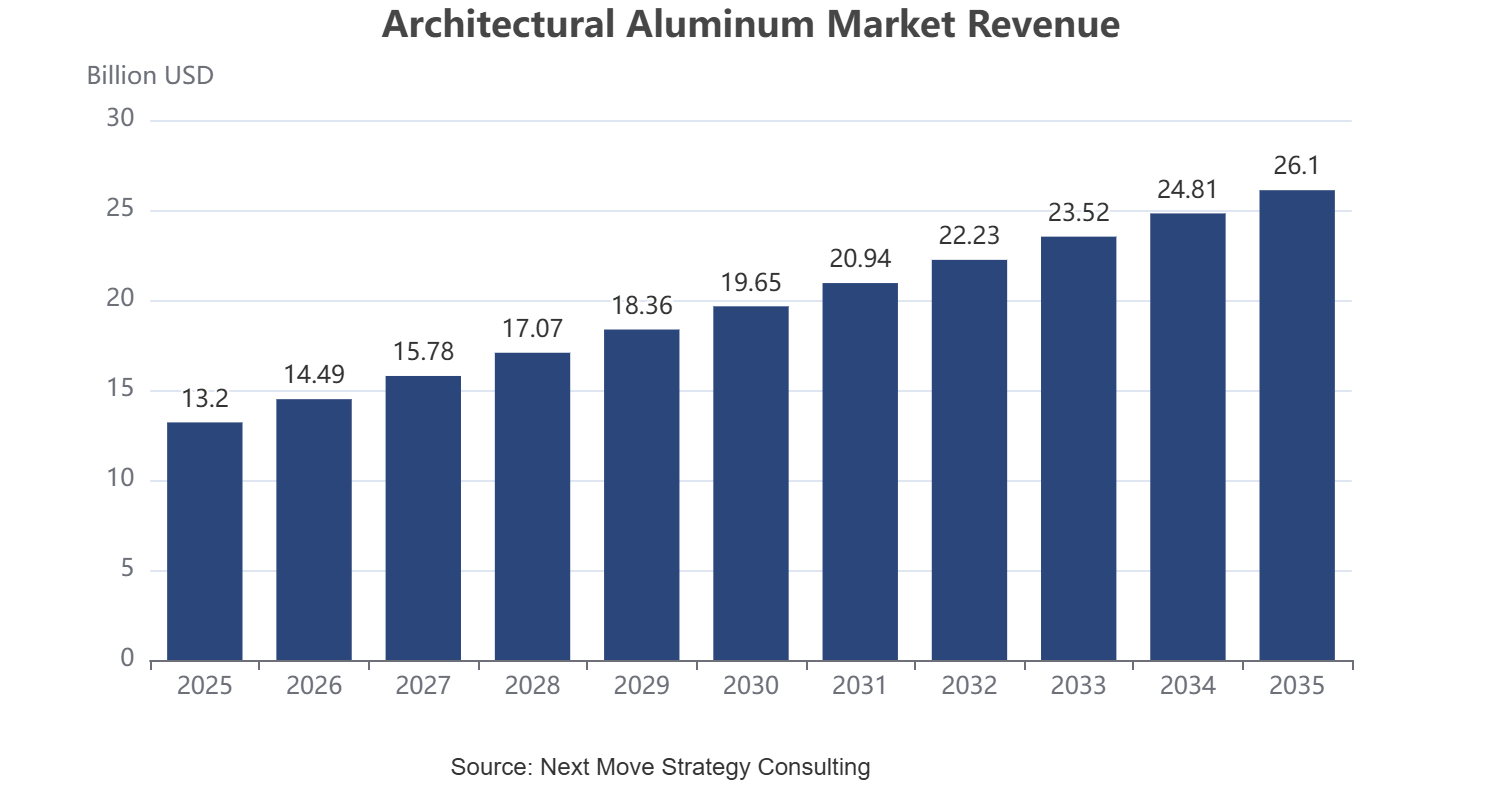
The global architectural aluminum market size was valued at USD 13.2 billion in 2025 and is estimated at USD 14.1 billion in 2026, forecast to reach USD 26.1 billion by 2035, expanding at a 7.1% CAGR between 2026 and 2035. Europe leads with approximately 34% share, while Extrusions dominates all other product types with approximately 52% share.
We observed that the growth is broad-based across every segmentation axis, with curtain wall and facade demand and infrastructure project activity driving the dominant structural shifts through 2035.
|
Key Takeaways |
|
By Product Type: Extrusions held the largest share of approximately 52% (USD 6.86 billion) in 2025; Castings is the fastest-growing sub-segment at 10.2% CAGR from 2026-2035. |
|
By Application: Curtain Walls and Facades held the largest share of approximately 34% (USD 4.49 billion) in 2025; Shading Systems and Louvers is the fastest-growing sub-segment at 9.5% CAGR from 2026-2035. |
|
By Project Type: Commercial and Retail held the largest share of approximately 38% (USD 5.02 billion) in 2025; Infrastructure and Public Sector is the fastest-growing sub-segment at 8.6% CAGR from 2026-2035. |
|
Dominant Region: Europe dominated with approximately 34% revenue share (USD 4.49 billion) in 2025. |
|
Fastest-Growing Region: Asia-Pacific is expected to register the highest CAGR of 8.9% during 2026-2035. |
|
Dominant Country: U.S. led with approximately USD 2.06 billion in 2025. |
|
Fastest-Growing Country: India is the fastest-growing country at approximately 13.9% CAGR from 2026-2035. |
Market Opportunity: The architectural aluminum market is expected to create an absolute dollar opportunity of USD 12.0 billion between 2026 and 2035, presenting significant investment potential across the curtain wall and infrastructure-linked extrusion value chain.
According to Next Move Strategy Consulting analysis, facade fabricators are increasingly specifying low-carbon and recycled-content aluminum systems to meet green building certification requirements, a shift that favors integrated system suppliers with verified environmental product declarations over commodity extruders as developers prioritize embodied-carbon disclosure through 2035.
What Does the Architectural Aluminum Market Encompass?
The architectural aluminum market encompasses primary and secondary aluminum processed into extrusions, flat-rolled products, castings, forgings, and billets for building envelope applications, including curtain walls, windows, doors, roofing, and shading systems. Our assessment indicates that the scope spans commercial, residential, infrastructure, industrial, and hospitality construction projects sourcing aluminum systems from integrated fabricators and system houses. The category has evolved from a commodity building material into an engineered, performance-specified system tied to energy-efficiency and structural glazing requirements, closely intersecting with the broader aluminum in construction materials ecosystem worldwide.
Regulatory frameworks such as the European Union's Energy Performance of Buildings Directive and national green building certification programs shape specification requirements, while embodied-carbon disclosure mandates increasingly influence material selection. We observed that technology adoption is shifting toward thermally broken profile systems and recycled-content alloys that improve building energy performance. Next Move Strategy Consulting's analysis indicates that this structural shift, combined with rising retrofit and facade renovation activity, is redefining sourcing criteria across the market.
|
Field |
Details |
|
Market Size in 2025 |
USD 13.2 Billion |
|
Market Size in 2026 |
USD 14.1 Billion |
|
Revenue Forecast in 2035 |
USD 26.1 Billion |
|
Growth Rate |
CAGR of 7.1% from 2026 to 2035 |
|
Analysis Period |
2025-2035 |
|
Base Year Considered |
2025 |
|
Forecast Period |
2026-2035 |
|
Market Size Estimation |
USD Billion |
|
Companies Profiled |
10 |
|
Countries Covered |
33 |
|
Market Share |
Available for Top 10 Companies |
Key Emerging Trends
Based on research conducted by Next Move Strategy Consulting, we found that four structural trends are reshaping product development, sourcing, and stakeholder engagement across the industry.
How Is Low-Carbon Aluminum Reshaping Facade Specification?
Low-carbon and recycled-content aluminum is reshaping facade specification as developers pursue green building certification. We observed that Reynaers Aluminium has targeted a 50% carbon footprint reduction by 2030 under its Science-Based Targets pathway, extending recycled content across its window, door, and facade systems. Architects and specifiers are adopting environmental product declarations as a standard procurement requirement, while aluminum anodizing finishers retool processes to support lower-embodied-carbon surface treatments.
Why Is Thermally Broken Profile Technology Gaining Traction?
Thermally broken extrusion profiles are gaining share as building codes tighten energy-efficiency requirements for facades and fenestration. Our findings suggest that system houses including Schuco are expanding thermally optimized profile ranges to meet stricter U-value requirements in commercial construction. Fabricators are adopting these profiles to reduce heat transfer, positioning thermal-break technology as a baseline specification requirement within the broader market segmentation structure.
How Is Building Safety Regulation Reshaping Curtain Wall Systems?
Building safety regulation is reshaping curtain wall and cladding system specification following heightened scrutiny of facade fire performance. We observed that Reynaers Aluminium UK introduced continuing professional development guidance in 2025 addressing the Building Safety Act's implications for glazing and facade specification. This trend is elevating demand for certified, fire-tested aluminum systems among architects and fabricators serving high-rise commercial and residential projects.
What Role Does Digital Fabrication Support Play in Architectural Aluminum Innovation?
Digital fabricator support tools are emerging as a differentiator as system houses seek to reduce installation errors and accelerate project delivery. Our analysis shows that Reynaers Aluminium's digital ecosystem for fabricators, spanning early-stage commercial support through after-sales service, exemplifies this direction toward integrated digital-physical service models. This trend is elevating demand for connected design and logistics tools among fabricators managing complex facade projects.
Porter's Five Forces Analysis Of The Architectural Aluminum Market
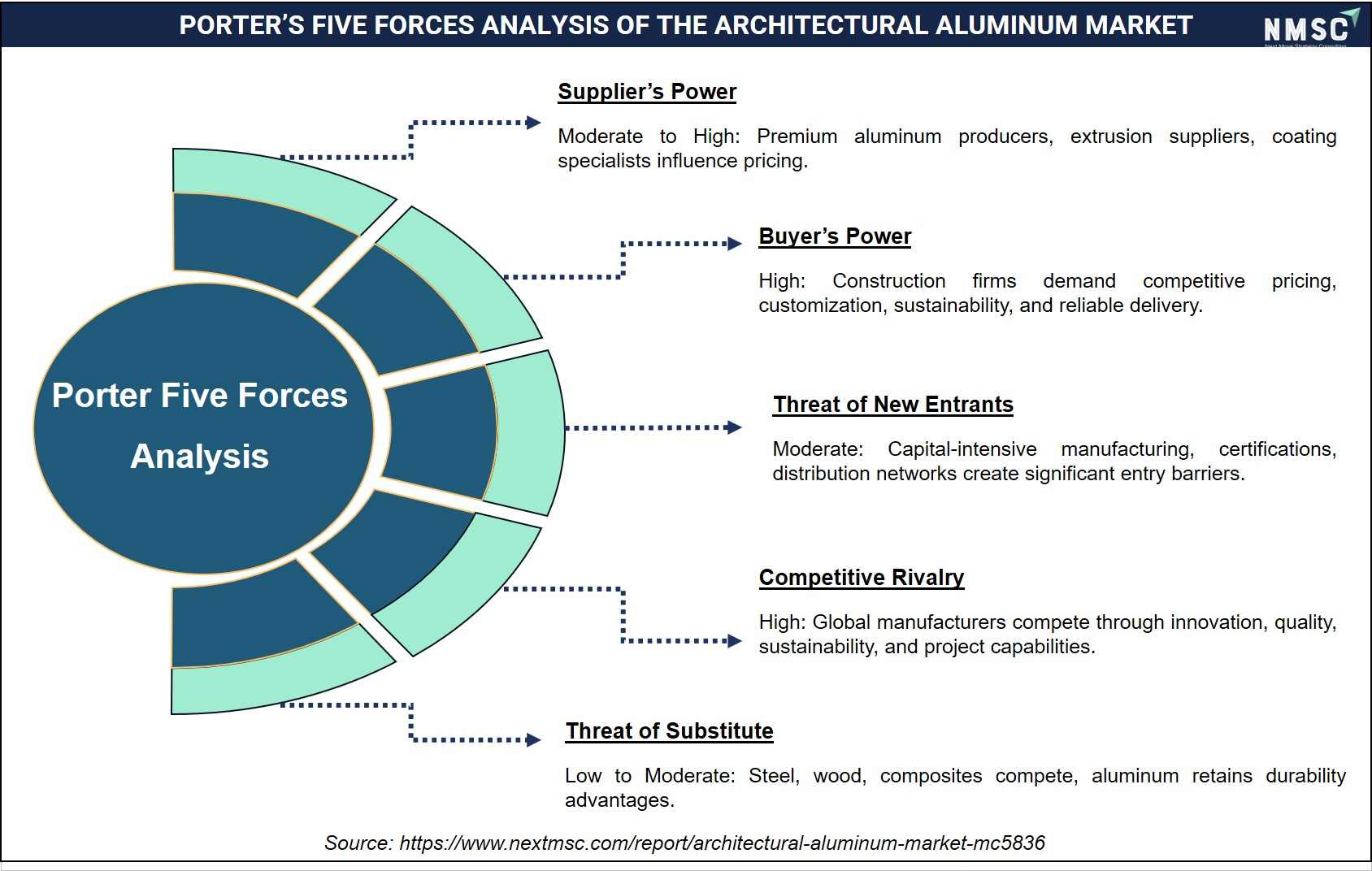
The architectural aluminum market exhibits high competitive rivalry due to the presence of numerous global and regional manufacturers competing through product quality, innovation, and sustainability. Supplier bargaining power is moderate, as aluminum is widely available but subject to raw material price fluctuations. Buyer bargaining power is moderate to high, driven by large construction firms seeking cost-effective, customized solutions. The threat of new entrants is moderate because of high capital requirements, certifications, and technical expertise. The threat of substitutes is moderate, with materials such as steel, uPVC, and composites competing in specific architectural applications.
Growth Drivers and Restraints
Growth Catalyst and Risk Assessment Matrix
|
Factors |
Type |
(+/-) % Impact on CAGR Forecast |
Geographic Relevance |
Impact Timeline |
|
Rising commercial and high-rise construction activity |
Driver |
+2.1% |
Asia-Pacific, MEA |
2026-2035 |
|
Green building certification and energy-efficiency mandates |
Driver |
+1.6% |
Europe, North America |
2026-2035 |
|
Expanding facade renovation and retrofit demand |
Driver |
+1.3% |
Europe, North America |
2026-2035 |
|
Growing infrastructure and public sector project pipelines |
Driver |
+1.1% |
Asia-Pacific, MEA |
2026-2035 |
|
Increasing recycled-content aluminum availability |
Driver |
+0.8% |
Global |
2026-2032 |
|
Volatility in primary aluminum and energy input costs |
Restraint |
-1.2% |
Global |
2026-2032 |
|
Extended construction project approval and permitting timelines |
Restraint |
-0.9% |
Europe, North America |
2026-2030 |
|
Competition from alternative facade materials |
Restraint |
-0.6% |
Global |
2026-2032 |
What Is the Primary Growth Driver of the Architectural Aluminum Market?
Rising commercial and high-rise construction activity is the primary driver of the market. National statistical agencies across Asia-Pacific continue to report expanding commercial building permit issuance tied to urbanization, sustaining demand for extruded and cast aluminum systems in curtain wall and facade applications. We observed that this construction activity, reinforced by expanding infrastructure project pipelines, continues to anchor baseline consumption of architectural aluminum products across developed and emerging economies alike.
How Are Green Building Certification Mandates Driving Market Growth?
Green building certification and energy-efficiency mandates are accelerating market growth toward thermally broken and recycled-content aluminum systems. The European Commission continues to enforce Energy Performance of Buildings Directive requirements mandating stricter building envelope performance standards. Our assessment indicates that this regulatory pressure, combined with rising developer demand for certified low-carbon materials, is compressing adoption timelines for advanced architectural aluminum systems among commercial and residential developers.
What Is Restraining Architectural Aluminum Market Expansion?
Volatility in primary aluminum and energy input costs restrains margin stability across the architectural aluminum supply chain. National statistical agencies continue to track fluctuating industrial energy prices that directly affect primary aluminum smelting costs. We found that smaller regional fabricators face particular exposure, as limited scale reduces their ability to hedge raw-material procurement compared with larger, vertically integrated system houses with long-term supply agreements.
Segmentation Analysis
Segment Sizing: By Product Type
|
Segment |
2025 (USD) |
2035 (USD) |
CAGR% (2026-2035) |
|
Extrusions |
USD 6.86 Billion |
USD 13.83 Billion |
7.3% |
|
Flat-Rolled |
USD 2.90 Billion |
USD 4.96 Billion |
5.4% |
|
Castings |
USD 1.32 Billion |
USD 3.39 Billion |
10.2% |
|
Forgings |
USD 0.66 Billion |
USD 1.31 Billion |
7.1% |
|
Billets |
USD 0.92 Billion |
USD 1.57 Billion |
5.3% |
|
Other Products |
USD 0.53 Billion |
USD 1.04 Billion |
7.1% |
|
Total |
USD 13.2 Billion |
USD 26.1 Billion |
7.1% |
Which Product Type Segment Dominates the Architectural Aluminum Market?
Extrusions led the market with USD 6.86 billion in 2025, supported by near-universal use in profile-based window, door, and curtain wall framing systems. We observed that Castings is the fastest-growing product type, expanding at a 10.2% CAGR from 2026 to 2035, as architectural hardware and connector components increasingly specify cast aluminum for structural and aesthetic performance, complementing aluminum extrusion framing systems.
Segment Sizing: By Application
|
Segment |
2025 (USD) |
2035 (USD) |
CAGR% (2026-2035) |
|
Curtain Walls and Facades |
USD 4.49 Billion |
USD 9.66 Billion |
8.1% |
|
Windows and Doors |
USD 3.70 Billion |
USD 6.53 Billion |
5.7% |
|
Roofing and Cladding |
USD 2.11 Billion |
USD 3.92 Billion |
6.3% |
|
Shading Systems and Louvers |
USD 1.19 Billion |
USD 2.87 Billion |
9.5% |
|
Interior Architectural Systems |
USD 1.06 Billion |
USD 2.09 Billion |
7.1% |
|
Other Architectural Applications |
USD 0.66 Billion |
USD 1.04 Billion |
4.5% |
|
Total |
USD 13.2 Billion |
USD 26.1 Billion |
7.1% |
Which Application Segment Generates the Most Architectural Aluminum Revenue?
Curtain Walls and Facades remained the leading application, valued at USD 4.49 billion in 2025 as commercial developers prioritize structural glazing systems for high-rise construction. Based on research conducted by Next Move Strategy Consulting, we found that Shading Systems and Louvers is the fastest-growing application at a 9.5% CAGR from 2026 to 2035, reflecting rising demand for passive solar control systems that reduce building cooling loads.
Segment Sizing: By Project Type
|
Segment |
2025 (USD) |
2035 (USD) |
CAGR% (2026-2035) |
|
Commercial and Retail |
USD 5.02 Billion |
USD 9.40 Billion |
6.4% |
|
Residential |
USD 3.96 Billion |
USD 7.57 Billion |
6.7% |
|
Infrastructure and Public Sector |
USD 1.98 Billion |
USD 4.44 Billion |
8.6% |
|
Industrial |
USD 1.32 Billion |
USD 2.87 Billion |
8.2% |
|
Hospitality |
USD 0.92 Billion |
USD 1.83 Billion |
7.1% |
|
Total |
USD 13.2 Billion |
USD 26.1 Billion |
7.1% |
Which Project Type Segment Leads Architectural Aluminum Demand?
Commercial and Retail remained the leading project type, valued at USD 5.02 billion in 2025 on sustained office and retail construction activity across urban centers. Our findings suggest that Infrastructure and Public Sector is the fastest-growing project type, registering an 8.6% CAGR from 2026 to 2035, as governments expand transit, airport, and civic building programs specifying architectural aluminum systems.
Growth Opportunities
Our analysis shows that three forward-looking opportunities stand out for stakeholders positioning within the market over the 2026-2035 forecast period.
How Can Low-Carbon Alloy Systems Unlock Value for Fabricators?
Low-carbon and recycled-content alloy systems present a whitespace opportunity for fabricators seeking to differentiate in green building tenders. Suppliers that commercialize verified low-embodied-carbon extrusions stand to capture recurring specification wins as developers pursuing certification increasingly require environmental product declarations for building envelope materials.
Where Does Facade Renovation Retrofit Activity Create New Demand?
Facade renovation and retrofit projects represent an underpenetrated opportunity for system houses engineered to serve aging commercial building stock. Providers that develop validated retrofit-compatible aluminum composite panel and cladding systems can secure long-term contracts with building owners pursuing energy-efficiency upgrades ahead of tightening performance mandates.
How Can Digital Specification Tools Benefit Architects and Fabricators?
Architects and fabricators seeking faster project delivery create an opportunity for system houses offering integrated digital design and logistics platforms. Early movers that secure architect-facing specification tools can differentiate with commercial developers pursuing shorter project timelines, benefiting from stickier specification relationships across repeat commercial construction programs.
Supply Chain Structure Of The Architectural Aluminum Market
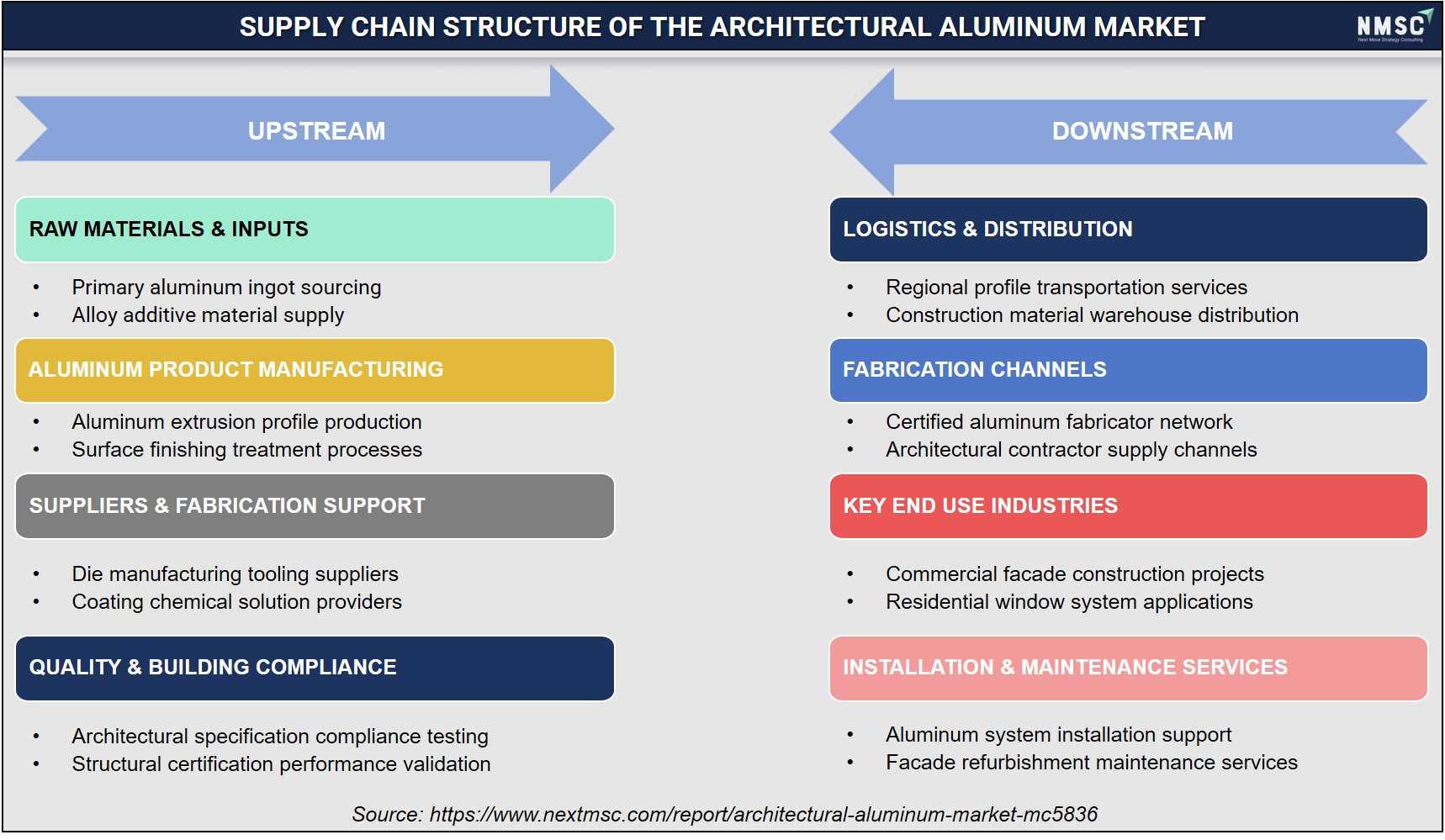
The architectural aluminum market supply chain begins with primary aluminum ingot sourcing and alloy material procurement, followed by extrusion, surface finishing, and fabrication support. Quality assurance and building compliance ensure product reliability and regulatory adherence. The downstream segment includes logistics, certified fabrication networks, commercial and residential construction applications, and installation and maintenance services, enabling efficient delivery, system integration, and long-term performance of architectural aluminum solutions.
Regional Outlook
Geographic Performance Snapshot
|
Region |
2025 (USD) |
2035 (USD) |
CAGR% (2026-2035) |
Key Driver |
|
Europe |
USD 4.49 Billion |
USD 8.09 Billion |
6.0% |
Energy Performance of Buildings Directive compliance |
|
Asia-Pacific |
USD 3.96 Billion |
USD 9.13 Billion |
8.9% |
Rapid commercial and high-rise construction growth |
|
North America |
USD 2.64 Billion |
USD 4.70 Billion |
5.8% |
Facade renovation and green building certification demand |
|
Middle East & Africa |
USD 1.32 Billion |
USD 2.61 Billion |
7.1% |
Vision 2030-linked commercial construction investment |
|
Latin America |
USD 0.79 Billion |
USD 1.57 Billion |
7.1% |
Expanding commercial and infrastructure construction activity |
|
Total |
USD 13.2 Billion |
USD 26.1 Billion |
7.1% |
-- |
North America Architectural Aluminum Market Outlook
North America's market benefits from an established facade renovation ecosystem and growing green building certification adoption. We observed that developers increasingly specify recycled-content extrusions to meet LEED and similar certification requirements, while fabricators expand thermally broken profile offerings. Technology adoption remains concentrated in engineered curtain wall systems, with regulatory attention shifting toward embodied-carbon disclosure as the North America aluminum supply base scales toward 2035.
Europe Architectural Aluminum Market Outlook
Europe leads the market, shaped by the Energy Performance of Buildings Directive's push to tighten building envelope energy standards. We observed that national regulators are strengthening embodied-carbon reporting requirements, favoring system houses with proven low-carbon alloy capability. Technology adoption is shifting toward integrated thermal-break and recycled-content systems, while regulatory scrutiny of facade fire safety shapes specification across the region.
Asia-Pacific Architectural Aluminum Market Outlook
Asia-Pacific is the fastest-growing region, propelled by rapid commercial and high-rise construction activity in China and India's expanding urban infrastructure programs. We observed that regional extruders are scaling capacity to serve growing curtain wall and facade demand. Technology adoption favors cost-competitive extrusion systems, with government infrastructure procurement increasingly specifying domestically produced architectural aluminum across the region.
Middle East & Africa Architectural Aluminum Market Outlook
Middle East & Africa is advancing on the strength of Saudi Arabia's Vision 2030 commercial construction investment and expanding UAE high-rise development. We observed that developers are specifying premium curtain wall systems for landmark commercial and hospitality projects. Technology adoption is concentrated in large-scale institutional and commercial contracts, with regulatory frameworks increasingly requiring energy-efficiency compliance for new building envelope systems.
Latin America Architectural Aluminum Market Outlook
Latin America's market is advancing on the back of Brazil's expanding commercial construction sector and growing infrastructure investment. We observed that regulators are introducing stricter building energy codes that formalize previously informal facade specification practices. Technology adoption favors extrusion-based window and door systems, with regional fabricators increasingly serving retail and hospitality construction demand.
U.S. Architectural Aluminum Market Outlook
The market in the U.S. market benefits from expanding facade renovation activity and growing green building certification adoption among commercial developers. Demand structure is concentrated in curtain wall and window systems, with technology adoption favoring recycled-content extrusions. Regulatory influence from state energy codes and competitive intensity among national fabricators continue to shape strategic sourcing decisions. The country's architectural aluminum market was valued at approximately USD 2.06 billion in 2025 and is projected to reach approximately USD 3.57 billion by 2035, expanding at a 5.5% CAGR from 2026 to 2035.
Canada Architectural Aluminum Market Outlook
Based on our estimates, Canada's market is supported by federal building energy efficiency guidelines and growing commercial retrofit activity. Demand structure favors window and door systems paired with curtain wall projects, while technology penetration of thermally broken profiles continues to rise. Regulatory influence from provincial building codes and moderate competitive intensity shape a steady strategic outlook through 2035. The country's architectural aluminum market was valued at approximately USD 0.40 billion in 2025 and is projected to reach approximately USD 0.75 billion by 2035, expanding at a 6.6% CAGR from 2026 to 2035.
UK Architectural Aluminum Market Outlook
As per our estimate, the UK market is advancing on the back of Building Safety Act compliance requirements and expanding facade renovation demand. Demand structure is concentrated in curtain wall and cladding applications, with technology adoption favoring certified fire-tested systems. Regulatory influence from Building Safety Act guidance and rising competitive intensity among system houses support a favorable strategic outlook. The country's architectural aluminum market was valued at approximately USD 0.81 billion in 2025 and is projected to reach approximately USD 1.38 billion by 2035, expanding at a 5.3% CAGR from 2026 to 2035.
Germany Architectural Aluminum Market Outlook
According to our analysis, Germany's market benefits from stringent federal energy efficiency building standards. Demand structure spans commercial and residential segments, with technology adoption favoring low-carbon alloy systems. Regulatory influence from national building energy regulation and high competitive intensity among European system houses shape a technology-forward strategic outlook. The country's architectural aluminum market was valued at approximately USD 1.17 billion in 2025 and is projected to reach approximately USD 2.02 billion by 2035, expanding at a 5.5% CAGR from 2026 to 2035.
France Architectural Aluminum Market Outlook
The market in France's architectural aluminum market is expanding alongside national thermal regulation requirements for new commercial construction. Demand structure favors curtain wall systems integrated with commercial development, with technology penetration of thermally broken profiles rising steadily. Regulatory influence from RE2020 building energy guidelines and moderate competitive intensity support continued strategic expansion. The country's market was valued at approximately USD 0.72 billion in 2025 and is projected to reach approximately USD 1.29 billion by 2035, expanding at a 6.0% CAGR from 2026 to 2035.
China Architectural Aluminum Market Outlook
Based on our estimates, China's architectural aluminum market leads Asia-Pacific on the strength of large-scale commercial and high-rise construction and expanding domestic extrusion capacity. Demand structure is dominated by curtain wall and facade applications, with technology penetration of domestically produced extrusion systems near-universal. Regulatory influence from national building energy standards and intense domestic competitive pressure define the strategic outlook. The country's market was valued at approximately USD 1.35 billion in 2025 and is projected to reach approximately USD 3.29 billion by 2035, expanding at a 9.6% CAGR from 2026 to 2035.
India Architectural Aluminum Market Outlook
As per our estimate, India's architectural aluminum market is the fastest-growing country market, propelled by expanding commercial and infrastructure construction under national urban development programs. Demand structure favors window, door, and curtain wall applications tied to commercial real estate growth, with technology penetration rising rapidly from a smaller base. Regulatory influence from national building energy codes and growing competitive intensity underpin an aggressive strategic outlook. The country's market was valued at approximately USD 0.63 billion in 2025 and is projected to reach approximately USD 2.19 billion by 2035, expanding at a 13.9% CAGR from 2026 to 2035.
Japan Architectural Aluminum Market Outlook
According to our analysis, Japan's architectural aluminum market benefits from national building energy conservation standards supporting facade system upgrades. Demand structure spans commercial and infrastructure segments, with technology adoption favoring durable, corrosion-resistant systems. Regulatory influence from national building standards law and moderate competitive intensity support a stable strategic outlook through 2035. The country's market was valued at approximately USD 0.55 billion in 2025 and is projected to reach approximately USD 0.91 billion by 2035, expanding at a 4.9% CAGR from 2026 to 2035.
South Korea Architectural Aluminum Market Outlook
The market in South Korea benefits from national green building certification programs supporting architectural aluminum adoption. Demand structure favors curtain wall applications in urban commercial centers, with technology penetration of domestically developed systems rising. Regulatory influence from evolving national building energy legislation and high competitive intensity among domestic fabricators shape continued strategic growth. The country's market was valued at approximately USD 0.40 billion in 2025 and is projected to reach approximately USD 0.73 billion by 2035, expanding at a 6.3% CAGR from 2026 to 2035.
Australia Architectural Aluminum Market Outlook
Based on our estimates, Australia's architectural aluminum market is advancing on the back of National Construction Code energy efficiency provisions. Demand structure spans commercial and residential segments, with technology adoption favoring thermally broken window and door systems. Regulatory influence from national building code guidelines and rising competitive intensity among fabricators support sustained strategic expansion. The country's market was valued at approximately USD 0.32 billion in 2025 and is projected to reach approximately USD 0.64 billion by 2035, expanding at a 7.3% CAGR from 2026 to 2035.
UAE Architectural Aluminum Market Outlook
As per our estimate, the UAE architectural aluminum market benefits from expanding high-rise commercial and hospitality construction activity. Demand structure favors premium curtain wall systems for landmark projects, with technology penetration of advanced facade systems rising. Regulatory influence from national building energy strategy targets and moderate competitive intensity support a favorable strategic outlook. The country's market was valued at approximately USD 0.29 billion in 2025 and is projected to reach approximately USD 0.60 billion by 2035, expanding at a 7.6% CAGR from 2026 to 2035.
Saudi Arabia Architectural Aluminum Market Outlook
According to our analysis, Saudi Arabia's architectural aluminum market is propelled by Vision 2030's commercial and giga-project construction targets. Demand structure is concentrated in curtain wall and cladding deployment for large-scale developments, with technology penetration of systems accelerating from a small base. Regulatory influence from national building code mandates underpins an aggressive strategic outlook. The country's market was valued at approximately USD 0.40 billion in 2025 and is projected to reach approximately USD 0.84 billion by 2035, expanding at a 7.9% CAGR from 2026 to 2035.
South Africa Architectural Aluminum Market Outlook
The market in South Africa benefits from expanding commercial construction activity in major metropolitan centers. Demand structure favors window and door applications, with technology penetration rising steadily. Regulatory influence from national building regulations and growing competitive intensity among regional fabricators support continued strategic expansion. The country's market was valued at approximately USD 0.16 billion in 2025 and is projected to reach approximately USD 0.31 billion by 2035, expanding at a 7.1% CAGR from 2026 to 2035.
Brazil Architectural Aluminum Market Outlook
Based on our estimates, Brazil's architectural aluminum market is advancing on the back of expanding commercial and retail construction activity in major cities. Demand structure spans commercial and residential segments, with technology adoption of extrusion-based window systems rising. Regulatory influence from national building energy guidelines and moderate competitive intensity support a positive strategic outlook. The country's market was valued at approximately USD 0.36 billion in 2025 and is projected to reach approximately USD 0.72 billion by 2035, expanding at a 7.4% CAGR from 2026 to 2035.
Argentina Architectural Aluminum Market Outlook
As per our estimate, Argentina's market benefits from expanding commercial construction activity addressing urban development needs. Demand structure favors window and door applications, with technology penetration of systems rising from a modest base. Regulatory influence from national building code guidelines and moderate competitive intensity shape continued strategic development. The country's architectural aluminum market was valued at approximately USD 0.13 billion in 2025 and is projected to reach approximately USD 0.27 billion by 2035, expanding at a 7.9% CAGR from 2026 to 2035.
Competitive Landscape
We observed that the market remains moderately concentrated, with global system houses, regional extruders, and specialty fabricators competing across overlapping segments of the value chain.
|
Field |
Details |
|
Market Structure |
Moderately concentrated among leading European and global system houses, with a long tail of regional extruders and fabricators |
|
Innovation Focus |
Low-carbon alloy development, thermally broken profile design, and digital fabricator support platforms |
|
M&A Activity |
Consolidation of regional fabricators by larger system houses expanding geographic coverage |
How Do Companies Compete in the Architectural Aluminum Market?
Companies compete primarily on system engineering depth, fabricator network breadth, and sustainability credentials within the market. We observed that integrated system houses combining profile design with fabricator support services can offer more competitive project bids than commodity extruders. Environmental product declaration availability and thermal performance certification increasingly differentiate proposals in commercial procurement, alongside multi-country delivery capability for buyers with cross-border projects.
Which Competitive Archetypes Dominate the Architectural Aluminum Industry?
Two archetypes dominate the architectural aluminum industry: large European system houses with global fabricator networks and engineered product portfolios, and regional extruders concentrated in single-country commodity supply. We found that the first group competes primarily on system engineering and sustainability differentiation, while the second competes on price and delivery speed for standard extrusion products, securing recurring business from smaller regional fabricators and contractors.
What Innovation and Differentiation Strategies Define Market Leaders?
Market leaders differentiate through low-carbon alloy sourcing, thermal-break engineering, and digital fabricator support tools. Our analysis shows that companies investing in recycled-content aluminum casting and extrusion capability are positioning to capture premium green building tenders, while integrated design-to-installation service models increasingly form a core part of competitive bids across commercial curtain wall contracts.
How Active Is M&A in the Architectural Aluminum Market?
M&A activity remains moderate as system houses pursue selective consolidation of regional fabricators to expand geographic coverage and local delivery capability. We found that leading European system houses continue to acquire or partner with distribution networks in Asia-Pacific and the Middle East to serve growing commercial construction demand, while regional extruders pursue capacity expansion to meet rising infrastructure project volumes.
Key Market Players
We observed that the following 10 companies represent the leading participants shaping the competitive structure of the architectural aluminum market.
-
Reynaers Aluminium NV
-
Norsk Hydro ASA (Hydro Building Systems)
-
Alumil S.A.
-
ALUK Group S.p.A.
-
Aluminios Cortizo, S.A.
-
Exlabesa
-
METRA S.p.A.
-
Mifa Aluminium B.V.
-
Bayards Aluminium Constructies B.V.
Latest Developments
Our assessment indicates that recent corporate activity reflects continued sustainability investment and regulatory adaptation across the architectural aluminum market.
|
Date |
Event |
|
January 2026 |
Exlabesa launched its Exlabesa Coimbra 2030 investment plan, committing USD 43,500,000 (EUR 40 million) to expand its aluminium extrusion and profile plant in Soure, Portugal. The project triples the facility's surface area, increases production capacity to 45,000 tonnes, and adds three new extrusion presses. |
|
May 2025 |
Exlabesa officially inaugurated its third aluminium profile production line (PR-3) at its industrial complex in Asilah, Morocco. The addition expands operational capacity at the facility to serve rising architectural and industrial aluminium demand across North African and international markets. |
Investment Opportunities
Where Are Capital Inflows Concentrated in the Architectural Aluminum Market?
Capital inflows are concentrated in low-carbon extrusion capacity and recycled-content alloy production. We observed that system houses and strategic investors are increasingly funding secondary aluminum processing capacity to reduce reliance on primary smelting, reflecting growing investor confidence in recycled-content architectural aluminum as a durable, certification-linked product category.
How Significant Is Infrastructure Investment in Architectural Aluminum Manufacturing?
Infrastructure investment in extrusion press capacity and finishing lines is accelerating as fabricators respond to rising commercial and infrastructure project volumes. Our findings suggest that government-backed infrastructure programs in Asia-Pacific and the Middle East are emerging as a significant investment theme, with several governments funding domestic extrusion capacity expansion to reduce dependence on imported architectural aluminum systems.
What ESG Considerations Shape Architectural Aluminum Investment?
Environmental, social, and governance considerations increasingly shape investment decisions, with investors favoring suppliers that demonstrate verified low-embodied-carbon production. We observed that aluminum scrap recycling capacity is drawing heightened investor attention as a lever for reducing the carbon intensity of architectural aluminum supply chains, reflecting growing attention to circularity across the building materials value chain.
Key Benefits for Stakeholders
How Does This Report Benefit Fabricator and Industry Leaders?
Fabricator and industry leaders gain access to segment-level revenue forecasts and application-adoption trends that inform product portfolio planning. Our analysis shows that the report's regional breakdowns support market-entry and capacity-expansion decisions, helping stakeholders align investment with the fastest-growing product types and project types through 2035.
How Does This Report Benefit Investors and Financial Analysts?
Investors and financial analysts benefit from consolidated market-sizing data, competitive-landscape mapping, and CAGR-level growth drivers that support valuation and due-diligence work. We found that the report's country-level forecasts help identify markets with the strongest risk-adjusted return profiles, particularly across the fastest-growing Asia-Pacific and Middle East & Africa regions.
How Does This Report Benefit Architects and Specification Professionals?
Architects and specification professionals gain segmentation-level insight into product type, application, and project type preferences that inform material selection. Our assessment indicates that the report's trend analysis highlights low-carbon alloy systems as a high-growth adjacency, helping specifiers align material choices with the fastest-growing sub-segments identified in this market report.
Key Market Segments
By Type
-
Primary
-
Secondary
-
Industrial Scrap
-
Post-Consumer Scrap
-
Remelted Secondary Production
-
By Product Type
-
Flat-Rolled
-
Extrusions
-
Profiles
-
Tubes and Pipes
-
-
Castings
-
Forgings
-
Billets
-
Other Products
By Alloy Series
-
1xxx Series
-
2xxx Series
-
3xxx Series
-
4xxx Series
-
5xxx Series
-
6xxx Series
-
7xxx Series
By Application
-
Curtain Walls and Facades
-
Windows and Doors
-
Roofing and Cladding
-
Shading Systems and Louvers
-
Interior Architectural Systems
-
Other Architectural Applications
By Project Type
-
Commercial and Retail
-
Residential
-
Infrastructure and Public Sector
-
Industrial
-
Hospitality
By Region
-
North America: U.S., Canada, Mexico
-
Europe: UK, Germany, France, Italy, Spain, Sweden, Denmark, Finland, Netherlands, Rest of Europe
-
Asia-Pacific: China, India, Japan, South Korea, Taiwan, Indonesia, Vietnam, Australia, Philippines, Malaysia, Rest of APAC
-
Middle East & Africa: Saudi Arabia, UAE, Egypt, Israel, Turkey, Nigeria, South Africa, Rest of MEA
-
Latin America: Brazil, Argentina, Chile, Colombia, Rest of LATAM
Conclusion and Recommendations
What Is the Long-Term Outlook for the Architectural Aluminum Market?
The long-term outlook remains positive, with the market projected to grow from USD 14.1 billion in 2026 to USD 26.1 billion by 2035. We observed that this trajectory is underpinned by structural green building certification requirements and infrastructure investment rather than short-term construction cycles alone, positioning architectural aluminum as durable building envelope infrastructure through 2035 and beyond.
What Strategic Positioning Should Stakeholders Pursue?
Stakeholders should pursue engineered system positioning that combines low-carbon alloy sourcing, thermal performance engineering, and digital fabricator support. Our analysis shows that suppliers investing early in recycled-content capability and certified environmental product declarations, spanning curtain wall, window, and shading applications, will be best positioned to capture premium commercial and infrastructure contract awards within the market.
How Attractive Is the Architectural Aluminum Market for New Investment?
The architectural aluminum industry presents an attractive investment case, supported by a USD 12.0 billion absolute dollar opportunity between 2026 and 2035 and above-average growth in Asia-Pacific and Middle East & Africa. We found that investment attractiveness is highest for system houses combining engineering depth with sustainability differentiation, positioning them to serve both cost-sensitive regional markets and premium green building segments simultaneously.
What Market Shifts and Key Risks Should Stakeholders Monitor?
Stakeholders should monitor primary aluminum price volatility, extended construction permitting timelines, and competition from alternative facade materials as key risks to the market. Our analysis shows that suppliers unable to hedge raw-material costs risk losing project bids to competitors with stronger long-term supply agreements, particularly as demand accelerates across regulated green building channels through 2035.
What Are the Key Growth Pathways for the Architectural Aluminum Market?
Key growth pathways include expanding low-carbon and recycled-content alloy portfolios, scaling digital fabricator support capability, and deepening penetration into infrastructure and public sector project segments. Next Move Strategy Consulting's analysis indicates that suppliers pursuing these pathways while maintaining cost competitiveness in core extrusion categories will be best positioned to capture the market's projected growth through 2035.
About the Author
 Liza Phukan
— Liza Phukan is Research Associate at Next Move Strategy Consulting, where she has covered emerging industries and market research across sectors for 3.5 years. Her work includes analyzing industry developments, validating market data, and developing structured business content from research findings. She uses secondary research and data-validation practices to turn complex market information into clear decision-useful market analysis for business audiences and support report development and B2B.
Liza Phukan
— Liza Phukan is Research Associate at Next Move Strategy Consulting, where she has covered emerging industries and market research across sectors for 3.5 years. Her work includes analyzing industry developments, validating market data, and developing structured business content from research findings. She uses secondary research and data-validation practices to turn complex market information into clear decision-useful market analysis for business audiences and support report development and B2B.
About the Reviewer
 Supradip Baul
— Supradip Baul is an accomplished business consultant and strategist with over a decade of rich experience in market intelligence, strategy, technology, and business transformation. His work has included rigorous qualitative and quantitative analysis across multiple industries, helping clients shape investment decisions and long-term roadmaps. Earlier in his career, he was associated with Gartner, where he contributed to industry-leading reports and market share analyses. He has worked with leading global companies and holds an MBA with a dual specialization in Marketing and Finance.
Supradip Baul
— Supradip Baul is an accomplished business consultant and strategist with over a decade of rich experience in market intelligence, strategy, technology, and business transformation. His work has included rigorous qualitative and quantitative analysis across multiple industries, helping clients shape investment decisions and long-term roadmaps. Earlier in his career, he was associated with Gartner, where he contributed to industry-leading reports and market share analyses. He has worked with leading global companies and holds an MBA with a dual specialization in Marketing and Finance.
At Next Move Strategy Consulting, we understand that insightful market research is the cornerstone of successful business decisions. That's why we employ a robust and multifaceted approach, combining various methodologies to deliver the most accurate and actionable data for our clients.

Research Landscape
We navigate the world of research with two primary approaches:
Qualitative Approach
Our qualitative research methodologies involve immersive techniques such as in-depth interviews, focus groups, and observational studies. By engaging directly with individuals and stakeholders, we uncover valuable insights that quantitative data alone may overlook.

Quantitative Research
In tandem with qualitative methodologies, NMSC leverages the power of Quantitative Research to provide a robust foundation of numerical insights. Through systematic data collection and analysis, we quantify patterns, preferences, and market trends, offering a comprehensive view of the business landscape.
Our quantitative research approach employs diverse tools, including surveys, experiments, and statistical modelling. These methodologies enable us to gather data from a large and representative sample, ensuring the statistical significance of our findings. By employing structured questionnaires and standardized data collection methods, we guarantee the reliability and validity of the information we present to our clients.
Quantitative research is particularly effective in measuring the prevalence of trends, assessing market size, and gauging the impact of various factors on consumer behavior. The numerical precision attained through this approach equips our clients with actionable insights, facilitating data-driven decision-making and strategy formulation.


Our Specialized Toolbox for Industry-Specific Market Research
We deploy a specialized arsenal of techniques tailored to meet your unique requirements. Here's a glimpse into our comprehensive toolbox:

Information Procurement
The stage entails acquiring market data or relevant information through various sources and methodologies.


Market Research Approach
We utilize both top-down and bottom-up approaches in market research analysis to achieve a comprehensive understanding of the market dynamics, leveraging the broad perspective of industry trends and macroeconomic factors alongside detailed insights from specific segments and individual companies.

Porters Five Forces Analysis
We conduct Porter's Five Forces analysis to evaluate the competitive landscape of an industry, providing us with insights into factors that affect profitability and strategic positioning.

SWOT Analysis

Forecasting
We utilize a forecasting model to predict future consumption by considering parameters like population, economics, regulations, market competition, drivers, constraints, technology, and pricing. We also employ statistical techniques such as multilinear regression, exponential smoothing, moving average, ARIMA, and Monte Carlo simulations for accurate predictions. In econometric forecasting, we analyzed short-term and long-term event impacts, attributing values based on regulatory frameworks, economic factors, and market events.





 Speak to Our Analyst