Cloud Gaming Market Size, Share, Growth & Forecast by Service Type (Consumer Service: Catalog Streaming, Owned Game Streaming, Cloud PC, Retro Gaming, Party Gaming), Monetization Model (Subscription, Bundle Included, Usage Based), Access Device (Smartphone and Tablet, PC and Mac, TV and Set Top Box, Console, Handheld Device, VR Headset), Buyer Type (Consumer, Telecom and OEM, Publisher, Enterprise), and Distribution Channel (Direct, App Store, Telco Bundle) — Global Analysis 2025–2035
What Is the Cloud Gaming Market Size?
The global Cloud Gaming Market was valued at USD 5.8 billion in 2025 and is expected to reach USD 7.1 billion in 2026. Accelerating 5G deployment, rising demand for device-agnostic gameplay, and rapid expansion of subscription-based entertainment platforms are collectively projected to propel the market to USD 42.6 billion by 2035, advancing at a CAGR of 22.2% from 2026 to 2035. Key growth drivers include the proliferation of low-latency cloud infrastructure, expanding telco partnerships bundling game streaming with broadband plans, growing publisher interest in reducing piracy through streamed delivery, and surging consumer appetite for high-fidelity gaming experiences on smartphones and smart TVs without hardware investment.
|
Parameters |
Details |
|
Market Size in 2025 |
USD 5.8 Billion |
|
Market Size in 2026 |
USD 7.1 Billion |
|
Revenue Forecast in 2035 |
USD 42.6 Billion |
|
Growth Rate |
CAGR of 22.2% from 2026 to 2035 |
|
Analysis Period |
2025–2035 |
|
Base Year Considered |
2025 |
|
Forecast Period |
2026–2035 |
|
Market Size Estimation |
Billion USD |
|
Companies Profiled |
20 |
|
Countries Covered |
33 |
|
Market Share |
Top 10 |
Cloud Gaming Market Overview
What Is the Cloud Gaming Market?
The Cloud Gaming Market encompasses services and platforms that enable users to play video games streamed in real time from remote servers without requiring high-performance local hardware. Rather than running game logic on a consumer device, cloud gaming platforms process all rendering and computation on data center infrastructure, delivering encoded video streams to players through stable internet connections. The market spans consumer-facing game streaming services, enterprise white label platforms, and game streaming infrastructure provided to publishers, telecom operators, and OEM device manufacturers worldwide.
How Has the Cloud Gaming Market Evolved?
The Cloud Gaming Market has progressed through three distinct phases of technological and commercial maturity. The first phase involved early experimental services such as OnLive and Gaikai that validated the concept of server-side game rendering but suffered from infrastructure cost constraints and latency challenges. The second phase saw hyperscalers and gaming giants launch commercial platforms including NVIDIA GeForce NOW, Microsoft xCloud, and PlayStation Now, establishing viable consumer business models. NMSC's analysis indicates that the current phase centers on 5G-native low-latency architectures, AI-driven adaptive streaming, edge computing integration, and telco operator-led distribution that collectively expand the addressable audience to billions of mobile-first consumers globally.
How Do Regulations Influence the Cloud Gaming Market?
Regulatory factors exert increasing influence on the Cloud Gaming Market across multiple dimensions. Data localization requirements, consumer protection mandates, and competition authority investigations into platform bundling practices are shaping the operating environment for cloud gaming vendors. The European Commission has scrutinized Microsoft's acquisition of Activision Blizzard and its implications for cloud gaming distribution, resulting in behavioral commitments around streaming rights licensing. Age verification regulations in South Korea, China's online gaming time restrictions for minors, and content classification regimes in the European Union create country-specific compliance obligations that influence market entry strategies for service providers.
How Is Technology Adoption Expanding Across the Cloud Gaming Market?
Technology adoption across the Cloud Gaming Market is accelerating as network infrastructure, codec technology, and cloud computing economics align in favor of scalable streaming delivery. Adoption is expanding from PC-centric broadband users toward mobile-first consumers in emerging markets, enabled by 5G millimeter-wave and sub-6 GHz deployments. H.265 and AV1 codec adoption is reducing bandwidth requirements for 4K streaming while GPU virtualization advances allow more concurrent game sessions per server unit. Our findings suggest that enterprise adoption through white label platforms and managed services is growing rapidly as telecom operators and OEM device manufacturers integrate cloud gaming as a value-added differentiator within existing subscriber and device portfolios.
|
Key Takeaways |
|
By service type, Consumer Service held the largest share of the Cloud Gaming Market at USD 4.4 billion in 2025, driven by widespread subscription-based catalog streaming and owned game streaming adoption across PC, Mac, and smart TV platforms. Catalog Streaming is the dominant sub-segment within Consumer Service, accounting for approximately 38% of market revenue in 2025, underpinned by the Netflix-style flat-fee access model pioneered by Microsoft Xbox Game Pass Ultimate and NVIDIA GeForce NOW. |
|
Cloud PC is the fastest-growing sub-segment within Consumer Service in the Cloud Gaming Market, projected to expand from USD 0.6 billion in 2025 to USD 6.8 billion by 2035 at a CAGR of 27.3%, as remote work culture and thin-client device adoption accelerate enterprise and consumer demand for persistent cloud-hosted Windows desktop environments capable of running AAA game titles. |
|
By monetization model, Subscription accounted for the largest share of the Cloud Gaming Market at USD 2.8 billion in 2025, reflecting the industry's alignment with platform-economy business models that prioritize recurring revenue and subscriber lifetime value over transactional software sales. |
|
Bundle Included is the fastest-growing monetization model in the Cloud Gaming Market at a CAGR of 25.8% from 2026 to 2035, driven by telecom operators embedding cloud gaming within fixed broadband and 5G mobile subscription bundles, with Reliance Jio, KT Corporation, and major European telcos leading commercial bundle launches. |
|
By access device, Smartphone and Tablet is the largest access device segment in the Cloud Gaming Market at USD 2.1 billion in 2025, reflecting the dominant share of mobile-first gaming consumption across Asia-Pacific and Latin America markets with strong 4G and 5G infrastructure. |
|
VR Headset is the fastest-growing access device segment in the Cloud Gaming Market at a CAGR of 38.5% from 2026 to 2035, as cloud rendering eliminates the compute bottleneck that previously constrained standalone VR headset graphical fidelity, with Meta, Sony, and emerging Chinese OEMs investing in cloud-rendered VR game libraries. |
|
By buyer type, Consumer held the largest revenue share of the Cloud Gaming Market at USD 3.4 billion in 2025, reflecting direct-to-consumer subscription and usage-based revenue generated by platforms including Microsoft xCloud, NVIDIA GeForce NOW, Sony PlayStation Now, and Boosteroid. |
|
Telecom and OEM is the fastest-growing buyer segment in the Cloud Gaming Market at a CAGR of 24.6% from 2026 to 2035, as mobile operators globally integrate cloud gaming into 5G monetization strategies to differentiate premium tier subscriptions and reduce churn among high-value subscribers. |
|
By distribution channel, Direct was the largest channel in the Cloud Gaming Market at USD 2.7 billion in 2025, as leading platforms such as Microsoft xCloud, GeForce NOW, and PlayStation Now generate the majority of revenue through their own digital storefronts and subscription management portals. |
|
Telco Bundle is the fastest-growing distribution channel in the Cloud Gaming Market at a CAGR of 26.3% from 2026 to 2035, driven by operator-led commercial launches of cloud gaming-inclusive broadband and mobile packages that lower the barrier to first-time user acquisition at scale. |
|
North America held the largest regional share of the Cloud Gaming Market at USD 2.2 billion in 2025, projected to reach USD 14.8 billion by 2035 at a CAGR of 20.8%, supported by the headquarters of leading platforms, highest per-capita gaming expenditure, and advanced broadband and 5G infrastructure availability. |
|
Asia-Pacific is the fastest-growing major region in the Cloud Gaming Market at a CAGR of 23.4% from 2026 to 2035, driven by massive mobile gaming populations in China, India, and Southeast Asia, with telco-bundled cloud gaming emerging as the primary user acquisition channel in price-sensitive markets. |
|
The United States is the single largest national Cloud Gaming Market, accounting for over 75% of North American revenue in 2025, underpinned by the highest concentration of cloud gaming platform headquarters, the world's largest console gaming install base, and rapidly expanding fiber and 5G broadband penetration. |
|
China is the fastest-growing national market in Asia-Pacific within the Cloud Gaming Market at a CAGR of 26.2%, propelled by Tencent Holdings and NetEase' domestic platforms, government-mandated content compliance infrastructure investment, and the world's largest 5G subscriber base exceeding 900 million active connections. |
Key Emerging Trends in the Cloud Gaming Market
How Is 5G Network Infrastructure Transforming Cloud Gaming Delivery Economics?
5G deployment is the most structurally significant enabler of the Cloud Gaming Market's next growth phase, reducing round-trip latency to sub-20 millisecond thresholds that eliminate the perceptible input lag constraining mobile cloud gaming quality. Our analysis shows that operators including KT Corporation, Deutsche Telekom, and Reliance Jio have demonstrated playable cloud gaming experiences on 5G millimeter-wave networks in commercial pilots. NVIDIA and Ericsson's joint development of 5G-native cloud gaming infrastructure integrates GPU rendering pools directly at telecom edge nodes, reducing backhaul distance and dramatically improving concurrent user scalability for operator-bundled cloud gaming deployments.
How Is AI-Driven Adaptive Streaming Redefining Quality of Experience in the Cloud Gaming Market?
Artificial intelligence is transforming streaming quality management within the Cloud Gaming Market by enabling real-time adaptive bitrate control, predictive frame generation, and AI-upscaling that compensates for bandwidth variability. NVIDIA's DLSS 3 Frame Generation technology uses AI to synthesize intermediate frames, effectively doubling perceived frame rates without additional GPU compute cost. From our research, we found that Microsoft Xbox cloud gaming employs machine learning models to predict network congestion and proactively adjust stream parameters, maintaining playable experiences at lower average bitrates. These AI-driven quality improvements expand the viable user base to millions of consumers on bandwidth-constrained mobile and fixed-line connections.
What Role Is Edge Computing Playing in Reducing Latency for the Cloud Gaming Market?
Edge computing deployment by hyperscalers and telecom operators is reshaping the geographic distribution of cloud gaming infrastructure, moving GPU rendering capacity progressively closer to end-user locations. Amazon Web Services Wavelength zones and Microsoft Azure Edge Zones enable cloud gaming platforms to process game workloads at telecom network edges, reducing propagation delay by eliminating the round-trip to centralized cloud regions. Through our market assessment, we observed that Ubitus K.K. operates a distributed edge GPU network across Japan, South Korea, and Taiwan specifically architected for low-latency cloud gaming delivery, demonstrating the commercial viability of telco-edge game rendering at national scale.
How Is the Emergence of Cloud PC Gaming Expanding the Cloud Gaming Market Beyond Console and Mobile?
Cloud PC services represent a rapidly expanding frontier within the Cloud Gaming Market, extending server-side rendering beyond dedicated game streaming toward fully virtualized Windows PC environments capable of running any PC application including AAA game titles. NVIDIA GeForce NOW Ultimate, Microsoft Xbox Cloud Gaming integrated with Windows, and SHADOW SAS's dedicated cloud PC service are pioneering this category. Our assessment indicates that Cloud PC adoption is being driven by enterprise buyers seeking to provide gaming-capable endpoint experiences to employees using thin-client devices, and by consumers in emerging markets seeking affordable access to PC gaming without USD 800-plus hardware investment requirements.
Strategic Framework of the Cloud Gaming Market
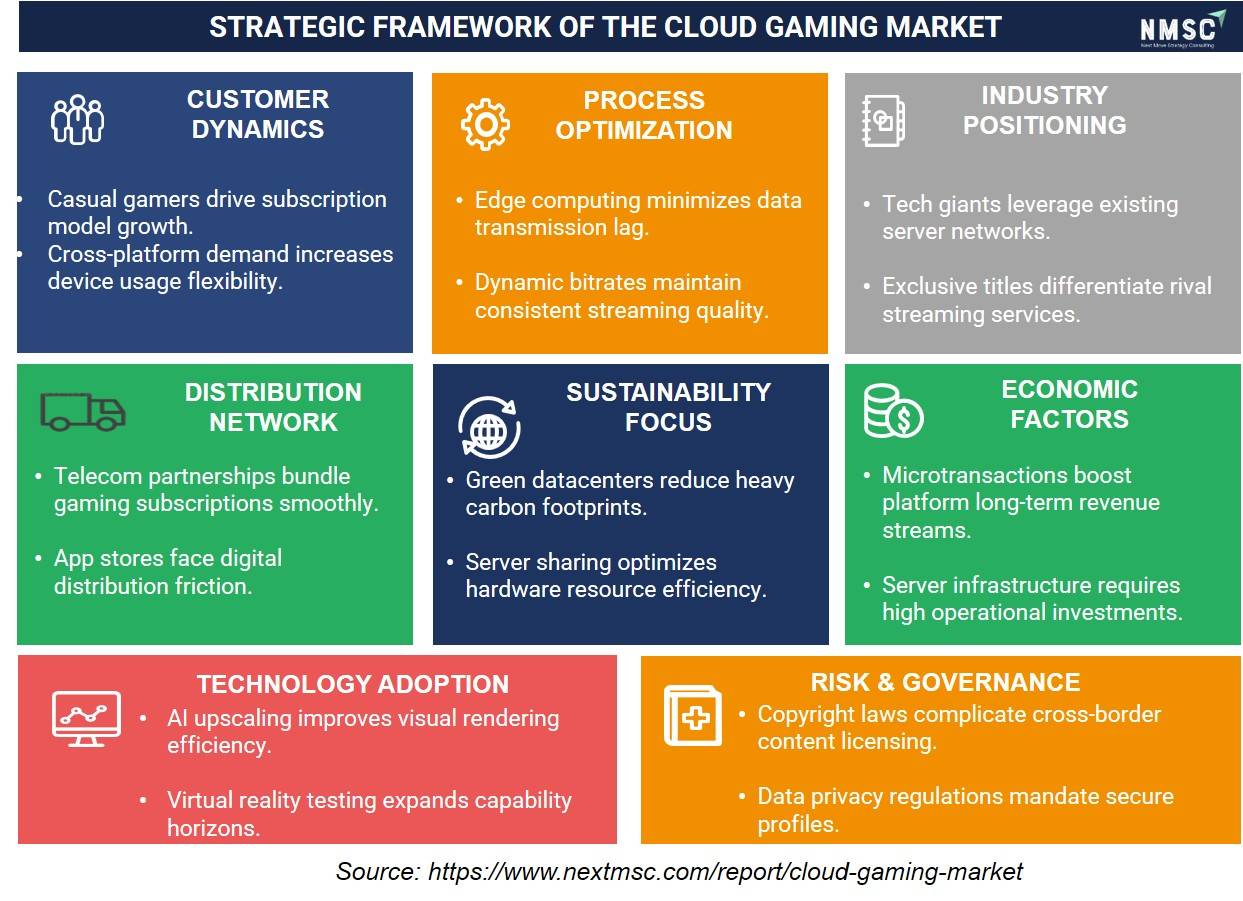
The strategic framework of the Cloud Gaming Market highlights the key factors shaping industry growth and competitiveness. Rising demand from casual gamers and cross-platform accessibility is driving customer adoption, while advancements in edge computing, AI upscaling, and dynamic bitrate streaming enhance user experience. Telecom partnerships and digital distribution channels strengthen market reach, whereas sustainability initiatives focus on energy-efficient datacenters. Economic opportunities from subscription models and microtransactions support revenue growth, while data privacy regulations and content licensing challenges remain critical governance considerations.
What Are the Key Market Drivers, Breakthroughs, and Investment Opportunities that Will Shape the Cloud Gaming Market in the Next Decade?
|
Drivers / Trends / Restraints |
(+/-) % Impact on CAGR Forecast |
Geographic Relevance |
Impact Timeline |
|
Global 5G Network Expansion |
+3.2% |
Global (led by APAC, Europe) |
2025–2032 |
|
Telco Bundle Distribution Growth |
+2.6% |
APAC, Europe, LATAM |
2025–2031 |
|
AI-Driven Streaming Quality Optimization |
+1.8% |
North America, Europe, APAC |
2025–2030 |
|
Edge Computing Infrastructure Deployment |
+1.6% |
North America, Europe, APAC |
2026–2035 |
|
Cloud PC Segment Expansion |
+1.4% |
Global |
2026–2035 |
|
Publisher Catalog Expansion and Licensing |
+1.2% |
North America, Europe |
2025–2030 |
|
Latency Sensitivity of Competitive Gaming |
-1.8% |
North America, Europe |
Ongoing |
|
Content Licensing Cost and Negotiation Complexity |
-1.1% |
Global |
Ongoing |
|
Regulatory Restrictions in China and South Korea |
-0.8% |
APAC |
2025–2028 |
|
VR Headset Cloud Gaming Opportunity |
+2.4% |
North America, Europe, APAC |
2027–2035 |
|
Emerging Market Mobile Monetization |
+1.9% |
India, SEA, LATAM, MEA |
2026–2035 |
What Are the Growth Drivers of the Cloud Gaming Market?
How Is Global 5G Deployment Driving Structural Growth in the Cloud Gaming Market?
The global expansion of 5G network infrastructure is the foremost structural driver of the Cloud Gaming Market, fundamentally improving the wireless connectivity conditions required for sub-20 millisecond latency game streaming to mobile devices. According to the International Telecommunication Union (ITU), 5G networks are projected to cover one-third of the world's population by 2025, with deployment accelerating across APAC, Europe, and North America. The ITU's IMT-2020 specifications define a peak data rate of 20 Gbps and 1 millisecond latency targets for 5G, parameters that directly enable real-time cloud rendering delivery to smartphones and tablets. NMSC's analysis indicates that telco operators are actively monetizing 5G network investment through cloud gaming bundle differentiation, creating a virtuous cycle that simultaneously expands subscriber acquisition for operators and user acquisition for cloud gaming platforms.
How Is the Proliferation of Subscription-Based Game Catalogs Expanding the Cloud Gaming Market Addressable Audience?
The rapid expansion of subscription-based game catalogs available via cloud streaming is significantly lowering the barrier to entry for consumers who previously found individual game purchases prohibitively expensive. Microsoft Xbox Game Pass Ultimate, which includes xCloud streaming access to over 300 titles as of 2024, demonstrated that catalog depth is a critical driver of subscriber conversion and retention. The U.S. Federal Trade Commission's (FTC) review of gaming market dynamics acknowledged the subscription model's growing role in shaping consumer access to video game content. Based on NMSC's research, we found that catalog breadth, updated monthly with new first-party and third-party titles, functions as the primary value proposition for consumer-facing cloud gaming subscriptions, driving continuous subscriber acquisition momentum across North America and Europe.
How Is Enterprise Demand for White Label Cloud Gaming Platforms Creating a High-Value Segment in the Cloud Gaming Market?
Enterprise platform demand represents a rapidly growing revenue stream within the Cloud Gaming Market as telecommunications operators, OEM device manufacturers, and independent software vendors seek turnkey cloud gaming infrastructure without building proprietary server-side rendering capabilities from scratch. White label cloud gaming platforms from vendors including Ubitus K.K., Boosteroid Inc., and now.gg Inc. enable telecom operators to launch branded game streaming services within six to twelve months, bypassing the multi-year infrastructure build cycle. Our analysis shows that the Korea Communications Commission (KCC) in South Korea has actively supported KT Corporation's cloud gaming investments as part of the national 5G commercialization strategy, validating the enterprise platform model as commercially and strategically viable for regulated telecommunications operators globally.
What Are the Growth Inhibitors of the Cloud Gaming Market?
How Does Latency Sensitivity in Competitive and Action Gaming Constrain the Cloud Gaming Market?
Latency remains the most persistent technical constraint limiting the Cloud Gaming Market's penetration among competitive and fast-reaction game genres, including first-person shooters, fighting games, and real-time strategy titles where millisecond-level input responsiveness determines competitive outcome. Despite 5G and edge computing advances, fiber-connected console hardware still delivers input latency of 4 to 8 milliseconds, whereas cloud gaming over broadband connections typically produces 30 to 80 milliseconds of end-to-end latency depending on geographic proximity to data center infrastructure. The Internet Society's documentation on network latency confirms that geographic distance between users and processing nodes is a fundamental physical constraint on latency reduction. This performance gap limits the competitive gaming segment's migration to cloud delivery and sustains local hardware demand among high-engagement players.
How Do Content Licensing Costs and Publisher Negotiation Complexity Restrain the Cloud Gaming Market?
Content licensing represents a structurally complex and cost-intensive challenge for cloud gaming platform operators seeking to offer broad game catalogs to subscribers. Publishers retain substantial negotiating leverage over streaming rights, and many major titles including those from Take-Two Interactive and From Software have historically been withheld from cloud streaming platforms or subject to delayed availability windows. The U.S. Copyright Office's analysis of digital distribution frameworks confirms that existing copyright licensing structures were designed for traditional software distribution and do not straightforwardly accommodate the streaming model. From our assessment, we noticed that licensing complexity extends delivery timelines, elevates operational costs, and creates catalog gaps that reduce subscriber satisfaction and increase churn within cloud gaming subscription services.
What Are the Growth Opportunities in the Cloud Gaming Market?
How Does the Emerging Market Mobile Gaming Population Represent a Multi-Billion Dollar Opportunity for the Cloud Gaming Market?
Emerging markets across South and Southeast Asia, Latin America, and Sub-Saharan Africa represent the most significant untapped growth opportunity for the Cloud Gaming Market. These regions collectively host over 1.5 billion mobile gamers who currently play predominantly on mid-range Android smartphones incapable of running graphically demanding PC or console game titles. Cloud gaming resolves this hardware constraint by delivering GPU-rendered game experiences to sub-USD 200 smartphones over 4G or 5G connections. India's Telecom Regulatory Authority (TRAI) has reported mobile data consumption growth of over 30% annually, reflecting the expanding connectivity infrastructure supporting cloud gaming adoption. Based on NMSC's research, we found that Reliance Jio Infocomm has launched cloud gaming as a value-added service on its JioFiber and 5G platforms, demonstrating the operator-led distribution model that can reach hundreds of millions of cost-sensitive consumers.
How Does the Integration of Cloud Gaming with VR and AR Headsets Create a Transformative Opportunity in the Cloud Gaming Market?
The convergence of cloud rendering and virtual reality headsets represents a transformative growth opportunity for the Cloud Gaming Market, as offloading graphics processing to cloud servers eliminates the thermal, weight, and battery constraints that have historically limited standalone VR headset visual fidelity. Meta Platforms' roadmap for Quest devices includes cloud rendering capability as a means to deliver higher-fidelity experiences without increasing headset production cost. Our findings suggest that cloud-rendered VR gaming eliminates the USD 2,500-plus tethered PC-VR setup requirement, democratizing access to high-fidelity immersive gaming experiences for consumers who own only mid-range standalone headsets. The U.S. Consumer Technology Association (CTA) has projected continued VR headset shipment growth through 2026, creating an expanding installed base that cloud gaming platforms can serve without incremental hardware investment from consumers.
How Does the Telco Bundle Distribution Model Create a Structural Revenue Opportunity in the Cloud Gaming Market?
Telecommunications operator bundling of cloud gaming services within broadband and 5G mobile subscriptions represents a highly scalable, low-cost user acquisition channel that fundamentally improves unit economics for cloud gaming platform operators. Telco-bundled distribution eliminates customer acquisition cost by reaching subscribers within existing billing relationships while simultaneously increasing perceived value of higher-tier connectivity packages. The International Telecommunication Union's Broadband Commission has documented the accelerating global rollout of bundled digital content services by telecom operators as a universal 5G monetization strategy. NMSC's analysis indicates that KT Corporation in South Korea, Deutsche Telekom in Europe, and Reliance Jio in India have all validated the telco bundle model commercially, confirming that operator-mediated distribution can achieve subscriber acquisition volumes unattainable through direct digital marketing within comparable timeframes.
Swot Analysis of the Cloud Gaming Market
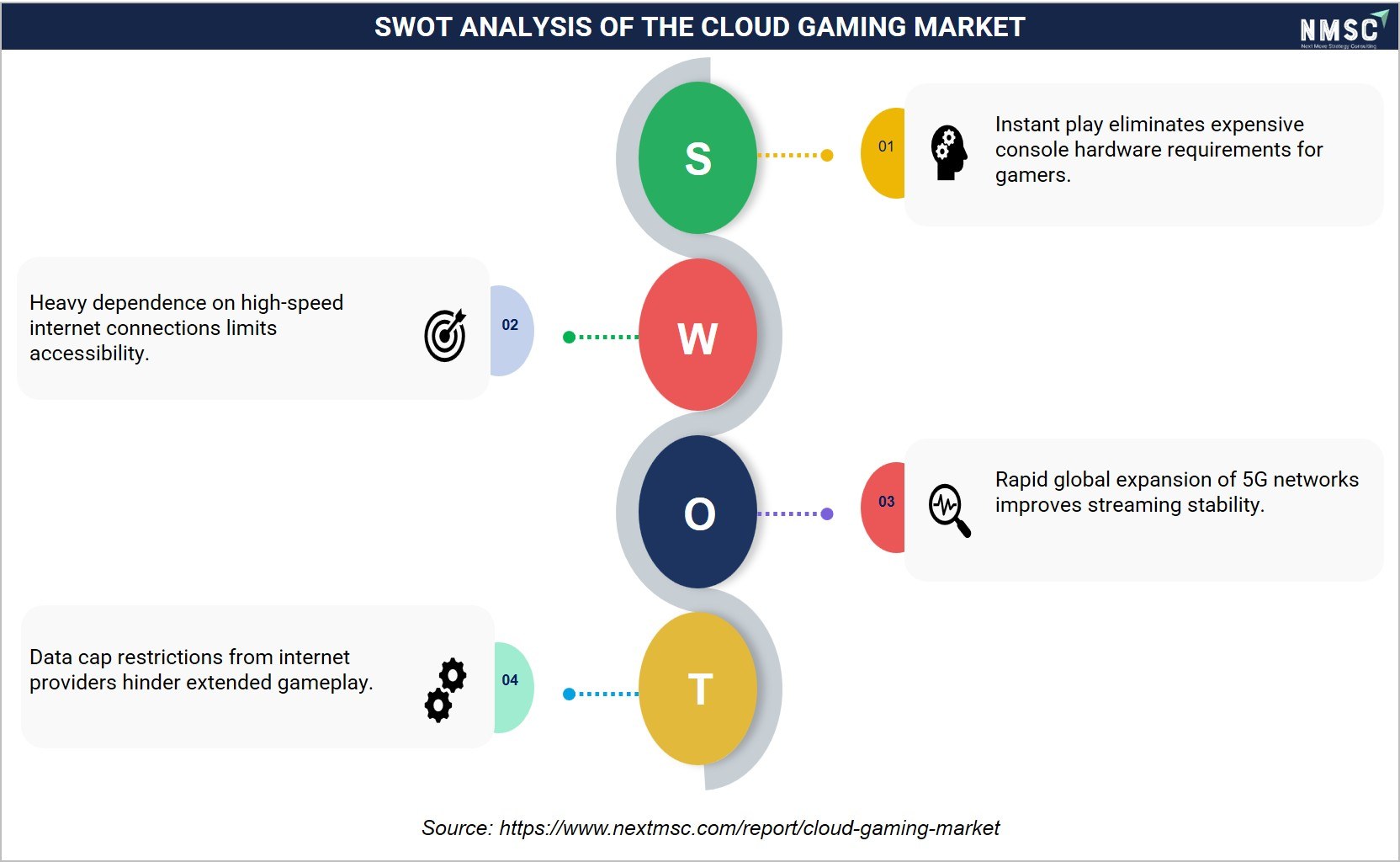
The SWOT analysis of the Cloud Gaming Market highlights its key strengths, weaknesses, opportunities, and threats. A major strength is the ability to provide instant access to high-quality games without requiring expensive gaming hardware. However, the market remains highly dependent on stable, high-speed internet connectivity. The rapid expansion of 5G networks presents significant growth opportunities by improving streaming performance and reducing latency. Meanwhile, data usage restrictions and bandwidth limitations imposed by internet service providers continue to pose challenges to widespread adoption and user engagement.
How Is the Cloud Gaming Market Segmented in This Report, and What Are the Key Insights from the Segmentation Analysis?
How Does Service Type Segmentation Reveal the Structural Composition of the Cloud Gaming Market?
|
Service Type Segment |
2025 (USD Bn) |
2035 (USD Bn) |
CAGR (%) |
|
Consumer Service |
4.4 |
32.1 |
21.9% |
|
Catalog Streaming |
1.7 |
11.4 |
20.8% |
|
Owned Game Streaming |
1.2 |
8.2 |
21.1% |
|
Cloud PC |
0.6 |
6.8 |
27.3% |
|
Retro Gaming |
0.4 |
2.4 |
19.6% |
|
Party Gaming |
0.3 |
2.2 |
22.0% |
|
Other Consumer Service |
0.2 |
1.1 |
18.5% |
|
Enterprise Platform |
1.4 |
10.5 |
22.4% |
|
White Label Platform |
0.6 |
4.8 |
23.1% |
|
Game Streaming Infrastructure |
0.5 |
3.8 |
22.5% |
|
Managed Service |
0.2 |
1.6 |
23.0% |
|
Other Enterprise Platform |
0.1 |
0.3 |
11.6% |
Based on our analysis of platform revenue structures and enterprise procurement trends, we observed that the Cloud Gaming Market is segmented into Consumer Service and Enterprise Platform service types, each encompassing distinct delivery models and buyer profiles. The Consumer Service segment dominates overall market revenue at USD 4.4 billion in 2025, driven by Catalog Streaming and Owned Game Streaming, which represent the majority of subscription-based direct-to-consumer revenue generated by platforms including NVIDIA GeForce NOW, Microsoft xCloud, PlayStation Now, and Boosteroid. Cloud PC is the fastest-growing sub-segment within Consumer Service, as virtualized Windows environments expand the cloud gaming value proposition beyond dedicated streaming to full PC replacement use cases. Meanwhile, the Enterprise Platform segment is growing at a CAGR of 22.4%, with White Label Platform services representing the largest and fastest-growing enterprise sub-segment as telecom operators across APAC, Europe, and LATAM license white label infrastructure from vendors including Ubitus, now.gg, and Boosteroid to launch operator-branded game streaming services at scale.
Which Monetization Models Are Driving Revenue Diversification in the Cloud Gaming Market?
|
Monetization Model |
2025 (USD Bn) |
2035 (USD Bn) |
CAGR (%) |
|
Subscription |
2.8 |
19.2 |
21.2% |
|
Bundle Included |
1.1 |
10.6 |
25.8% |
|
Usage Based |
0.7 |
5.8 |
23.6% |
|
Freemium |
0.5 |
3.8 |
22.4% |
|
Advertising |
0.3 |
1.8 |
19.6% |
|
Licensing |
0.2 |
1.0 |
17.5% |
|
Other Monetization Model |
0.2 |
0.4 |
7.2% |
Through our market assessment, we observed that the Cloud Gaming Market is segmented across six primary monetization models, each serving distinct consumer and enterprise buyer preferences. The Subscription model commands the largest share at USD 2.8 billion in 2025, reflecting the proven commercial success of flat-fee recurring access to game catalogs as demonstrated by Microsoft Xbox Game Pass Ultimate and NVIDIA GeForce NOW. Bundle Included is the fastest-growing model at a CAGR of 25.8%, driven by telecom operators embedding cloud gaming as a complementary value-add within broadband and 5G packages, leveraging existing billing infrastructure to acquire users at near-zero incremental cost. Usage-Based and Freemium models are expanding rapidly as platforms experiment with hour-based access and free-tier offerings designed to convert casual players into paying subscribers. Advertising-supported and Licensing-based models remain smaller but provide important revenue diversification for platforms serving ad-tolerant and developer-market segments respectively.
How Do Access Devices Shape User Experience and Market Penetration in the Cloud Gaming Market?
|
Access Device |
2025 (USD Bn) |
2035 (USD Bn) |
CAGR (%) |
|
Smartphone and Tablet |
2.1 |
14.8 |
21.5% |
|
PC and Mac |
1.6 |
10.4 |
20.5% |
|
TV and Set Top Box |
1.0 |
7.2 |
21.8% |
|
Console |
0.6 |
4.2 |
21.4% |
|
Handheld Device |
0.3 |
2.8 |
24.9% |
|
VR Headset |
0.1 |
2.6 |
38.5% |
|
Other Access Device |
0.1 |
0.6 |
19.6% |
Based on NMSC's research, we found that the Cloud Gaming Market is segmented by access device into Smartphone and Tablet, PC and Mac, TV and Set Top Box, Console, Handheld Device, VR Headset, and Other Access Device categories, each reflecting distinct user behavior patterns and infrastructure requirements. Smartphone and Tablet is the dominant access device segment at USD 2.1 billion in 2025, reflecting mobile gaming's dominant share of total gaming time globally, particularly across Asia-Pacific and Latin America where mobile-first consumers lack access to console or high-specification PC hardware. PC and Mac follows as the second-largest segment, supported by browser and application-based access to cloud gaming platforms among existing PC gaming populations seeking to avoid hardware upgrade cycles. TV and Set Top Box access is growing steadily as smart TV manufacturers preinstall cloud gaming apps and streaming sticks enable TV-based gameplay. VR Headset is the fastest-growing access device at a CAGR of 38.5%, representing the intersection of cloud rendering and immersive computing that will define the next generation of cloud gaming experience.
Which Buyer Types Are Shaping Purchasing Patterns Across the Cloud Gaming Market?
|
Buyer Type |
2025 (USD Bn) |
2035 (USD Bn) |
CAGR (%) |
|
Consumer |
3.4 |
23.6 |
21.2% |
|
Telecom and OEM |
1.2 |
10.8 |
24.6% |
|
Publisher |
0.6 |
4.8 |
23.1% |
|
Enterprise |
0.4 |
2.8 |
21.5% |
|
Other Buyer Type |
0.2 |
0.6 |
11.6% |
Our analysis shows that the Cloud Gaming Market is segmented by buyer type into Consumer, Telecom and OEM, Publisher, Enterprise, and Other Buyer Type categories, each representing a distinct procurement motivation and spend profile. The Consumer segment dominates at USD 3.4 billion in 2025, driven by direct subscription revenue from millions of individual gamers worldwide who access cloud gaming as a standalone or bundled subscription product. Telecom and OEM buyers are the fastest-growing segment at a CAGR of 24.6%, as mobile network operators and device manufacturers increasingly license white label cloud gaming platforms or infrastructure services to differentiate their product portfolios in highly competitive telecommunications and consumer electronics markets. Publisher buyers represent a growing segment as game developers license cloud streaming delivery rights and managed service infrastructure to reduce piracy and expand their games' reach to hardware-limited audiences. Enterprise buyers procure cloud gaming infrastructure for employee benefits, training simulations, and cloud PC productivity deployments.
How Are Distribution Channels Reshaping Go-to-Market Strategies in the Cloud Gaming Market?
|
Distribution Channel |
2025 (USD Bn) |
2035 (USD Bn) |
CAGR (%) |
|
Direct |
2.7 |
17.6 |
20.6% |
|
App Store |
1.2 |
8.6 |
21.7% |
|
Telco Bundle |
0.9 |
9.2 |
26.3% |
|
OEM Portal |
0.5 |
4.2 |
23.8% |
|
Marketplace |
0.3 |
2.4 |
23.2% |
|
Other Distribution Channel |
0.2 |
0.6 |
11.6% |
From our assessment, we observed that the Cloud Gaming Market is distributed across Direct, App Store, Telco Bundle, OEM Portal, Marketplace, and Other Distribution Channel categories, each serving different segments of the platform's commercial ecosystem. The Direct channel dominates at USD 2.7 billion in 2025, as leading platforms including Microsoft, NVIDIA, Sony, and Amazon generate the majority of cloud gaming revenue through their own digital storefronts and subscription management portals with favorable margin structures. App Store distribution through Apple App Store and Google Play Store represents the second-largest channel, providing access to the mobile consumer base while subjecting platform revenue to 15 to 30 percent commission obligations. Telco Bundle is the fastest-growing distribution channel at a CAGR of 26.3%, as operators in South Korea, India, Europe, and Latin America integrate cloud gaming into their subscriber offerings, enabling mass-market acquisition at scale without incremental marketing spend by platform operators.
Regional Outlook
Geographic Performance Snapshot
|
Region |
2025 (USD Bn) |
2035 (USD Bn) |
CAGR (%) |
Key Driver |
|
North America |
2.2 |
14.8 |
20.8% |
Platform HQ concentration, highest ARPU gaming market |
|
Europe |
1.4 |
9.8 |
21.5% |
5G telco bundles, GDPR-compliant infrastructure |
|
Asia-Pacific |
1.5 |
12.4 |
23.4% |
Mobile-first gaming, 5G deployment, telco distribution |
|
Middle East & Africa |
0.4 |
3.2 |
23.0% |
Vision 2030 digital programs, youth gaming demographics |
|
Latin America |
0.3 |
2.4 |
23.1% |
5G rollout, mobile gaming growth, telco partnerships |
North America Cloud Gaming Market
North America is the global epicenter of the Cloud Gaming Market, accounting for USD 2.2 billion in 2025 and forecast to reach USD 14.8 billion by 2035 at a CAGR of 20.8%. The region hosts the headquarters of the world's three largest cloud gaming platforms Microsoft (xCloud), NVIDIA (GeForce NOW), and Amazon (Luna) and benefits from the highest per-capita gaming expenditure globally. Advanced fiber and 5G broadband infrastructure supports low-latency streaming quality that enables competitive gaming use cases. Regulatory oversight from the U.S. Federal Trade Commission on platform bundling and content licensing practices is shaping commercial terms across the ecosystem.
U.S. Cloud Gaming Market
Based on our market evaluation, we noticed that the United States represents over 75% of North American Cloud Gaming Market revenue and is the world's single largest national market, valued at approximately USD 1.65 billion in 2025. The U.S. benefits from the highest concentration of cloud gaming platform operators, the largest console gaming install base, and rapidly expanding fixed-line and 5G broadband coverage. Microsoft Xbox Game Pass Ultimate's cloud gaming component and NVIDIA GeForce NOW's subscription tiers are the dominant platforms. The FTC's Microsoft-Activision merger review established important precedents for cloud gaming content access rights that will shape licensing terms and competitive dynamics throughout the forecast period.
Canada Cloud Gaming Market
Through our analysis, Canada represents approximately 16% of North American Cloud Gaming Market revenue, supported by high broadband penetration exceeding 92%, a large console gaming population, and advanced 5G deployment by Rogers, Bell, and Telus. The Canadian Radio-television and Telecommunications Commission (CRTC) has mandated open internet access policies that support cloud gaming traffic prioritization. Microsoft xCloud and NVIDIA GeForce NOW are the leading platforms. Canada's multicultural gaming demographics and French-language content requirements represent distinct localization considerations for platform operators expanding northward from the U.S. market.
Mexico Cloud Gaming Market
According to our evaluation, Mexico is the fastest-growing Cloud Gaming Market within North America, advancing at a CAGR of 27.4%, driven by a young population median age of 29 years, rapidly expanding mobile gaming adoption, and Telcel and AT&T Mexico's 5G deployment programs. Mexico's Federal Telecommunications Institute (IFT) oversees spectrum policy that supports 5G rollout. The Tencent-backed gaming platform market and growing middle-class disposable income for entertainment subscriptions are creating a commercially viable consumer cloud gaming market. Low-cost freemium and telco-bundled distribution models are best suited to Mexican consumer price sensitivity in the cloud gaming space.
Europe Cloud Gaming Market
Europe is the second-largest region in the Cloud Gaming Market, contributing USD 1.4 billion in 2025 and forecast to reach USD 9.8 billion by 2035 at a CAGR of 21.5%. Europe's regulatory environment, characterized by the Digital Markets Act, GDPR, and the European Commission's review of platform market power in gaming, is shaping competitive dynamics. Telecom operators including Deutsche Telekom, Orange, and Vodafone are active cloud gaming bundle partners. SHADOW SAS, a French cloud PC provider, and Boosteroid Inc., of Ukrainian origin, represent notable European-headquartered platform operators contributing to regional platform diversity.
UK Cloud Gaming Market
Based on our engagements, the United Kingdom is the largest individual country market for cloud gaming in Europe, representing approximately 24% of European revenue in 2025. The Competition and Markets Authority (CMA) conducted an in-depth review of Microsoft's Activision Blizzard acquisition specifically focusing on cloud gaming content access implications. The UK's Ofcom-regulated broadband market features high ultrafast broadband penetration supporting low-latency streaming. Xbox Game Pass Ultimate with cloud gaming access and PlayStation Now are the dominant platform offerings, with BT and Sky One actively testing cloud gaming bundle propositions for broadband subscriber retention.
Germany Cloud Gaming Market
From our assessment, Germany is the second-largest cloud gaming market in Europe, driven by one of Europe's largest gaming communities, advanced fiber broadband penetration, and Deutsche Telekom's active cloud gaming partnership strategy. The Bundesnetzagentur regulates telecommunications infrastructure and net neutrality policies relevant to streaming traffic management. German consumer protection considerations around subscription transparency and cancellation rights influence platform terms of service design. Gaming industry organization game Verband der deutschen Games-Branche represents sector interests in regulatory engagement with federal authorities on digital service legislation.
France Cloud Gaming Market
Through our analysis, France is the third-largest European cloud gaming market and the home market of SHADOW SAS, Europe's leading dedicated cloud PC gaming provider. The French government's France 2030 program supports digital infrastructure investment that benefits cloud gaming data center expansion. The Autorité de régulation des communications électroniques (ARCEP) oversees broadband quality requirements. Orange is an active cloud gaming distribution partner in France. The French market's strong PC gaming culture and high disposable income for entertainment subscriptions create favorable conditions for premium cloud PC services priced at EUR 14 to 30 per month.
Italy Cloud Gaming Market
According to evaluation, Italy is a growing cloud gaming market supported by expanding fiber broadband investment under the Piano Nazionale di Ripresa e Resilienza (PNRR), which allocates EUR 3.8 billion toward national broadband coverage expansion. AGCOM, Italy's communications authority, oversees net neutrality enforcement protecting cloud gaming traffic quality. Italian gaming consumption is predominantly mobile, creating favorable conditions for mobile-first cloud gaming adoption. TIM and Vodafone Italia are investigating cloud gaming bundle propositions for consumer broadband and mobile subscribers as 5G coverage expands across major metropolitan areas.
Spain Cloud Gaming Market
Based on our market evaluation, Spain demonstrates growing momentum in the Cloud Gaming Market, supported by one of Europe's highest 5G penetration rates, a young gaming demographic, and Telefónica's active digital entertainment strategy. Spain's Agenda España Digital 2026 supports connectivity infrastructure investment that benefits cloud gaming latency performance. The Comisión Nacional de los Mercados y la Competencia (CNMC) oversees telecommunications and digital market competition. Movistar Plus, Telefónica's content platform, represents a natural distribution partner for cloud gaming bundle integration within premium broadband packages targeting Spain's 16-to-34 demographic.
Sweden Cloud Gaming Market
Through our analysis, Sweden is among the most advanced cloud gaming markets in Northern Europe, supported by world-class fixed-line broadband infrastructure, one of Europe's highest gaming engagement rates per capita, and a thriving domestic games development industry. The Post and Telecom Authority (PTS) regulates Sweden's telecommunications sector, maintaining net neutrality standards protective of cloud gaming traffic. Paradox Interactive, Mojang (part of Microsoft), and King exemplify the depth of Sweden's gaming industry, creating domestic publisher content relevant to cloud streaming catalog development. Tele2 and Telia are active in assessing cloud gaming bundle propositions for Swedish subscribers.
Denmark Cloud Gaming Market
From our assessment, Denmark is a highly digitized cloud gaming market within Northern Europe, supported by consistently high rankings in the EU's Digital Economy and Society Index (DESI) and near-universal broadband availability. The Danish Business Authority and Danish Safety Technology Authority jointly oversee digital service compliance including consumer protection for subscription-based gaming services. Denmark's gaming culture is predominantly PC and mobile-centric, with cloud gaming adoption concentrated among PC gamers seeking hardware upgrade avoidance and mobile gamers accessing AAA titles. TDC Net and Norlys are the primary telecommunications operators with potential cloud gaming bundle partnership capacity.
Finland Cloud Gaming Market
Based on our engagements, Finland's Cloud Gaming Market is characterized by advanced digital infrastructure, the world's highest per-capita broadband speed performance, and a domestic technology ecosystem featuring Nokia's ongoing investments in 5G network infrastructure. The Finnish Transport and Communications Agency (Traficom) regulates spectrum allocation and net neutrality. Finland's gaming industry, led by Rovio (makers of Angry Birds) and Supercell, reflects mobile gaming dominance that aligns with cloud gaming's mobile-first growth trajectory. Elisa and Telia Finland are exploring cloud gaming bundle integration within their premium 5G mobile subscription portfolios.
Netherlands Cloud Gaming Market
Through our analysis, the Netherlands is a strategically important Cloud Gaming Market, serving as the primary Western European data center hub for multiple hyperscalers and hosting the Amsterdam Internet Exchange (AMS-IX), one of the world's largest internet exchange points. The Authority for Consumers and Markets (ACM) enforces net neutrality and consumer protection regulations affecting cloud gaming service delivery. KPN and T-Mobile Netherlands are active in cloud gaming distribution assessments. The Netherlands' high gaming engagement rates and strong disposable income levels support premium cloud gaming subscription adoption. Amsterdam's data center density provides the lowest-latency cloud gaming infrastructure access for consumers across the Benelux region.
Rest of Europe Cloud Gaming Market
From our assessment, the Rest of Europe, comprising Poland, Belgium, Switzerland, Austria, Portugal, Czech Republic, and other European nations, collectively represents a growing and commercially important segment of the European Cloud Gaming Market. Poland is the largest gaming market in Central and Eastern Europe by population, with a strong PC gaming culture and expanding fiber broadband coverage under EU-supported digital infrastructure programs. Switzerland's high per-capita income and proximity to major European data centers support premium cloud gaming subscription adoption. Belgium and the Netherlands together form a dense Benelux gaming market served by shared data center infrastructure and multinational telecommunications operators.
Asia-Pacific Cloud Gaming Market
Asia-Pacific is the fastest-growing major region in the Cloud Gaming Market, advancing from USD 1.5 billion in 2025 to USD 12.4 billion by 2035 at a CAGR of 23.4%. The region's growth is propelled by rapid 5G deployment in China, South Korea, and India, massive mobile gaming populations across Southeast Asia, and telecom operator-led distribution strategies that lower consumer acquisition costs. China, Japan, South Korea, and India collectively represent approximately 80% of regional cloud gaming revenue in 2025, with Southeast Asian markets delivering the highest incremental growth rates driven by mobile-first gaming demographics.
China Cloud Gaming Market
Based on our engagements, China is the largest single cloud gaming market in Asia-Pacific at approximately USD 0.52 billion in 2025, driven by the world's largest 5G subscriber base, dominant domestic platforms from Tencent Holdings and NetEase, and government-mandated content compliance infrastructure investment. China's Ministry of Industry and Information Technology (MIIT) oversees telecommunications and online gaming platform regulation, including the national online game approval process administered by the National Press and Publication Administration (NPPA). Tencent's START cloud gaming platform and NetEase's cloud gaming infrastructure serve hundreds of millions of domestic users. Regulatory restrictions on gaming time for minors, implemented in 2021, have shifted platform investment toward adult subscription monetization models.
India Cloud Gaming Market
Through our analysis, India is the fastest-growing national cloud gaming market in Asia-Pacific at a CAGR of 27.8%, propelled by the world's largest 5G subscriber growth trajectory, Reliance Jio's cloud gaming platform launch, and a mobile gaming audience exceeding 500 million active players. The Telecom Regulatory Authority of India (TRAI) has published quality of service regulations for broadband that support cloud gaming latency requirements. India's Digital Personal Data Protection Act 2023 (DPDPA), administered by MeitY, shapes data handling requirements for cloud gaming platforms operating in India. The sub-USD 200 smartphone price segment dominates Indian consumer hardware, making cloud gaming the primary pathway to AAA gaming experience for the majority of the gaming population.
Japan Cloud Gaming Market
From our assessment, Japan is the second-largest Asia-Pacific cloud gaming market, supported by one of the world's most mature gaming cultures, advanced fiber broadband coverage, and strong console gaming heritage from Nintendo and Sony. The Ministry of Internal Affairs and Communications (MIC) oversees Japan's telecommunications and digital service regulatory framework. Sony PlayStation Now, Microsoft xCloud, and Ubitus K.K.'s cloud gaming platform serve the Japanese market. Japan's demographic aging trend and preference for handheld gaming devices, exemplified by Nintendo Switch's continued popularity, create favorable conditions for cloud gaming adoption as a supplement to handheld hardware. NTT Docomo and SoftBank are evaluating cloud gaming bundle integration within their 5G premium tier offerings.
South Korea Cloud Gaming Market
Based on our market evaluation, South Korea is the most mature cloud gaming market in Asia-Pacific in terms of infrastructure readiness, supporting the world's highest average fixed-line broadband speed and among the highest 5G penetration rates globally. KT Corporation's KT game streaming service, supported by the Korea Communications Commission (KCC) and the Ministry of Science and ICT (MSIT), is a leading domestic cloud gaming platform. South Korea's 2021 regulations limiting online gaming for minors under 18 influenced platform audience composition but drove innovation in adult subscription tier differentiation. Samsung and LG's OEM portal distribution of cloud gaming represents a significant hardware-bundled acquisition channel in the Korean market.
Taiwan Cloud Gaming Market
Through our analysis, Taiwan's Cloud Gaming Market is concentrated in the PC gaming segment, reflecting the island's dominant semiconductor and PC gaming hardware manufacturing ecosystem. Ubitus K.K. operates significant cloud gaming infrastructure in Taiwan, serving both domestic consumers and providing managed platform services to telecom operators in the broader Asia-Pacific region. Taiwan's National Communications Commission (NCC) regulates telecommunications and digital service delivery. TSMC's manufacturing scale creates an industrial awareness of GPU and cloud computing economics that supports enterprise understanding of cloud gaming infrastructure value. Chunghwa Telecom and Taiwan Mobile are the primary telecommunications operators with cloud gaming partnership potential.
Indonesia Cloud Gaming Market
Based on our engagements, Indonesia is among the most rapidly growing cloud gaming markets in Southeast Asia, supported by a gaming audience of over 170 million players, rapidly expanding 5G infrastructure in Jakarta and Surabaya, and government digital economy ambitions under the Making Indonesia 4.0 roadmap. The Ministry of Communication and Information Technology (Kominfo) regulates online gaming platform registration and content compliance requirements applicable to cloud gaming operators. Telkom Indonesia and XL Axiata are active in cloud gaming distribution assessment for mobile and fixed broadband bundles. Mobile-first cloud gaming on mid-range smartphones represents the primary growth vector for the Indonesian market through 2030.
Vietnam Cloud Gaming Market
From our assessment, Vietnam is an emerging cloud gaming market in Southeast Asia, characterized by a young gaming population with a median age of 30, rapidly expanding 4G coverage approaching near-universal mobile connectivity, and government support for digital economy development under the National Digital Transformation Program 2025-2030. The Authority of Broadcasting and Electronic Information (ABEI) under the Ministry of Information and Communications regulates online gaming platform operations. VNG Corporation, a leading Vietnamese gaming publisher, is evaluating cloud gaming delivery as a distribution model for its mobile game portfolio. NETBOOM PTE. LTD. serves Southeast Asian markets including Vietnam through its mobile cloud gaming platform targeting the mid-range Android device segment.
Australia Cloud Gaming Market
According to evaluation, Australia is the most mature cloud gaming market in Asia-Pacific outside of Northeast Asia, with strong adoption across PC and console gaming segments and expanding mobile cloud gaming interest. The Australian Competition and Consumer Commission (ACCC) reviewed Microsoft's Activision Blizzard acquisition with specific attention to cloud gaming market competition implications. The Australian Communications and Media Authority (ACMA) oversees online service regulatory compliance. Microsoft xCloud, NVIDIA GeForce NOW, and PlayStation Now are the primary platforms. Telstra and Optus are the leading telecommunications operators with 5G infrastructure supporting potential cloud gaming bundle development for premium broadband subscribers.
Philippines Cloud Gaming Market
Based on our market evaluation, the Philippines is a developing but high-growth cloud gaming market supported by a 115 million population with a young gaming demographic, a mobile-first internet access profile, and a rapidly expanding esports culture. The National Telecommunications Commission (NTC) regulates telecommunications service quality relevant to cloud gaming streaming performance standards. Globe Telecom and PLDT are the primary mobile operators with 5G deployment programs supporting cloud gaming viability in metro Manila. NETBOOM PTE. LTD. and now.gg Inc. serve Philippine mobile gamers with cloud streaming solutions targeting AAA gaming access on budget Android smartphones, addressing the hardware affordability constraint that limits local hardware-based gaming adoption.
Malaysia Cloud Gaming Market
Through our analysis, Malaysia is a mid-tier and growing cloud gaming market in Southeast Asia, supported by the government's MyDigital strategy targeting digital economy expansion and Kuala Lumpur's emergence as a regional technology and data center hub. The Malaysian Communications and Multimedia Commission (MCMC) oversees telecommunications regulation and broadband quality standards. Celcom Axiata and Maxis are the primary 5G operators with cloud gaming bundle partnership potential. Malaysia's gaming community of approximately 20 million active players skews strongly toward mobile platforms, with cloud gaming representing the most accessible pathway to PC and console-quality gaming experiences for the cost-sensitive majority of the Malaysian gaming audience.
Rest of Asia-Pacific Cloud Gaming Market
From our assessment, the Rest of Asia-Pacific, comprising Thailand, Singapore, Bangladesh, Sri Lanka, Pakistan, New Zealand, and smaller Pacific markets, collectively represents a growing segment of the regional Cloud Gaming Market. Singapore punches above its geographic weight as a cloud gaming hub, hosting regional headquarters of major platform operators and benefiting from the Infocomm Media Development Authority (IMDA)'s Digital Connectivity Blueprint, which targets fiber connectivity to 99% of Singapore premises. Thailand's Personal Data Protection Act (PDPA) and national 5G auction outcomes are shaping cloud gaming platform regulatory compliance requirements. New Zealand's broadband market is growing steadily, with Spark and One New Zealand assessing cloud gaming bundle opportunities.
Middle East and Africa Cloud Gaming Market
The Middle East and Africa Cloud Gaming Market is advancing from USD 0.4 billion in 2025 to USD 3.2 billion by 2035 at a CAGR of 23.0%. Vision-driven national digital transformation programs in Saudi Arabia and the UAE are the primary growth engines, supplemented by South Africa's advanced telecommunications infrastructure and Nigeria's large and young digital gaming population. Sovereign cloud infrastructure investment across the Gulf Cooperation Council (GCC) is creating durable demand for low-latency cloud gaming delivery infrastructure, while the MEA region's youth demographic, with over 60% of the population under 30 years in many markets, represents a structurally favorable long-term gaming audience profile.
Saudi Arabia Cloud Gaming Market
Based on our engagements, Saudi Arabia is the largest cloud gaming market in the Middle East and Africa region, driven by Vision 2030's digital economy and entertainment diversification agenda, Saudi Telecom Company's (STC) 5G network leadership, and a young population with high smartphone gaming adoption. The Communications, Space & Technology Commission (CST) oversees telecommunications regulation and content platform compliance requirements. Saudi Arabia hosts the Gamers8 esports festival, the world's largest gaming and esports event by prize pool, demonstrating the kingdom's strategic commitment to gaming as a cultural and economic priority. STC Gaming and Zain KSA are active cloud gaming service development partners with national distribution potential.
UAE Cloud Gaming Market
Through our analysis, the UAE is the second-largest cloud gaming market in MEA, powered by Dubai and Abu Dhabi's technology hub ambitions, Etisalat (e&) and du's advanced 5G network coverage, and a young and high-income gaming population. The Telecommunications and Digital Government Regulatory Authority (TDRA) oversees digital service regulation in the UAE. The UAE's Games24x7 and regional esports ecosystem reflect deep gaming culture. Microsoft's UAE Azure region and Amazon's UAE AWS region provide the cloud gaming infrastructure foundation for low-latency streaming deployment. e& (Etisalat) has launched cloud gaming bundle pilots within its premium mobile subscription portfolio targeting the UAE's high ARPU subscriber base.
Egypt Cloud Gaming Market
According to evaluation, Egypt is an emerging cloud gaming market with significant population scale at 106 million people, a rapidly growing mobile gaming audience, and government digital transformation investment under Egypt Vision 2030. The National Telecom Regulatory Authority (NTRA) oversees telecommunications service quality and online platform registration requirements. Telecom Egypt, Vodafone Egypt, and Orange Egypt are the primary telecommunications operators with 5G expansion programs underway. Egypt's cloud gaming market is at an early stage, with mobile-based freemium and advertising-supported models best suited to the price-sensitive Egyptian consumer market profile during the initial adoption phase.
Israel Cloud Gaming Market
Based on our market evaluation, Israel occupies a unique position in the Cloud Gaming Market as both a significant technology development hub hosting cloud gaming startup activity and a mature enterprise buyer of gaming infrastructure services. The Ministry of Communications regulates Israel's advanced fiber and 5G telecommunications infrastructure. Israel's per-capita video game engagement is among the highest in the Middle East region. The country's technology startup ecosystem and military-derived engineering talent base contribute to cloud gaming infrastructure innovation, with several Israeli startups active in codec optimization and edge rendering technology development relevant to the global cloud gaming supply chain.
Turkey Cloud Gaming Market
From our assessment, Turkey is a mid-sized and growing cloud gaming market within the MEA region, supported by a large and young gaming population of approximately 38 million active gamers, rapid 5G deployment by Türk Telekom, Vodafone Turkey, and Turkcell, and a domestic gaming industry producing globally recognized mobile games. The Information Technologies and Communication Authority (BTK) regulates telecommunications and online platform operations. Turkey's cloud gaming market is concentrated in mobile platforms, with Turkcell's gaming content strategy including cloud gaming service assessment as part of broader 5G monetization development for premium mobile subscriber segments.
Nigeria Cloud Gaming Market
Based on our engagements, Nigeria is Sub-Saharan Africa's largest cloud gaming market opportunity, powered by a population of 220 million with the continent's youngest demographic profile, a rapidly growing mobile gaming community, and MTN Nigeria and Airtel Africa's expanding 4G and early 5G network coverage. The Nigerian Communications Commission (NCC) regulates telecommunications quality of service standards. Nigeria's cloud gaming market remains at an early commercial stage, with mobile-based freemium and advertising-supported models providing the most viable entry point given median consumer income constraints. Growing Nigerian esports events and mobile gaming tournaments are creating audience awareness of competitive gaming culture that supports future cloud gaming adoption.
South Africa Cloud Gaming Market
Through our analysis, South Africa is the most mature cloud gaming market in Sub-Saharan Africa, with Johannesburg's telecommunications infrastructure, high ARPU mobile subscriber base, and PC gaming culture forming the foundation. The Independent Communications Authority of South Africa (ICASA) oversees spectrum allocation and telecommunications service standards. Vodacom and MTN South Africa are the primary operators with 5G deployment programs supporting low-latency cloud gaming potential in metropolitan areas. Microsoft xCloud availability in South Africa, confirmed in 2023, established the market as a commercially viable deployment destination for North American platform operators expanding their sub-Saharan African distribution footprint.
Rest of MEA Cloud Gaming Market
From our assessment, the Rest of the Middle East and Africa, encompassing Kuwait, Qatar, Bahrain, Oman, Jordan, Morocco, Kenya, Ghana, Ethiopia, and other nations, collectively represents a growing segment of the Cloud Gaming Market. GCC countries including Qatar and Kuwait benefit from high per-capita income, advanced fiber infrastructure, and 5G rollout programs aligned with national digital transformation strategies. Kenya is Africa's fastest-growing digital economy after Nigeria, with Safaricom's mobile money and connectivity ecosystem creating a favorable distribution infrastructure for mobile cloud gaming services. Morocco serves as a nearshore technology and gaming hub for European markets with expanding 5G deployment.
Latin America Cloud Gaming Market
Latin America's Cloud Gaming Market is advancing from USD 0.3 billion in 2025 to USD 2.4 billion by 2035 at a CAGR of 23.1%. Brazil and Mexico collectively account for approximately 68% of regional cloud gaming revenue. Expanding 5G deployment, a young and mobile-first gaming population, and telco operator interest in cloud gaming bundle differentiation are the primary growth drivers. The freemium and telco bundle distribution models are best suited to Latin America's consumer price sensitivity and operator-mediated digital content adoption patterns throughout the forecast period.
Brazil Cloud Gaming Market
Based on our engagements, Brazil is the largest cloud gaming market in Latin America, accounting for approximately 40% of regional revenue in 2025, driven by a gaming population exceeding 90 million active players, accelerating 5G deployment in Sao Paulo, Rio de Janeiro, and Brasilia, and Claro, TIM, and Vivo's broadband subscriber scale enabling bundle distribution. The Agência Nacional de Telecomunicações (ANATEL) regulates Brazil's telecommunications market and broadband quality standards applicable to cloud gaming streaming performance. Microsoft Xbox Game Pass Ultimate's cloud gaming availability in Brazil established the subscription model commercially. Brazil's Lei Geral de Proteção de Dados (LGPD) shapes user data handling requirements for cloud gaming platform operators.
Argentina Cloud Gaming Market
Through our analysis, Argentina is the second-largest cloud gaming market in Latin America, with a gaming community of approximately 20 million active players and a strong PC gaming culture sustained by a high technology talent concentration relative to per-capita income. The Ente Nacional de Comunicaciones (ENACOM) regulates Argentina's telecommunications and digital services market. Argentina's economic volatility has paradoxically accelerated cloud gaming adoption as consumers seek cost-effective alternatives to expensive imported gaming hardware. The peso-denominated pricing of streaming subscriptions and telco bundle options provides inflation-resilient affordability compared to dollar-priced console and GPU hardware at current exchange rates.
Chile Cloud Gaming Market
From our assessment, Chile represents a small but high-growth cloud gaming market, benefiting from Latin America's highest fixed broadband penetration rate, a stable economic environment, and advanced telecommunications infrastructure investment. The Subsecretaría de Telecomunicaciones (Subtel) oversees Chile's broadband quality and universal connectivity programs that expand the geographic addressable market for cloud gaming. Entel and Claro Chile are the primary operators with 5G deployment programs. Chile's per-capita income is among Latin America's highest, supporting premium cloud gaming subscription adoption at price points comparable to European markets, making Chile an attractive early commercial deployment market for North American and European cloud gaming platform operators.
Colombia Cloud Gaming Market
Based on our market evaluation, Colombia is among the fastest-growing cloud gaming markets in Latin America, supported by Bogotá's emergence as a regional technology hub, a gaming community of approximately 18 million active players, and Claro Colombia and Movistar Colombia's expanding 5G networks. The Ministerio de Tecnologías de la Información y las Comunicaciones (MinTIC) supports Colombia's digital economy transformation under the Digital Colombia program. The Autoridad Nacional de Televisión (ANTV) and MinTIC jointly oversee digital content service regulations applicable to cloud gaming platforms. Colombia's growing middle class and increasing smartphone ownership rates among younger demographics create a favorable consumer profile for mobile-first cloud gaming subscription adoption.
Rest of LATAM Cloud Gaming Market
From our assessment, the Rest of Latin America, including Peru, Ecuador, Uruguay, Bolivia, Paraguay, Costa Rica, Panama, and Caribbean nations, collectively represents an early-stage but growing component of the Cloud Gaming Market. Peru and Ecuador are experiencing accelerating mobile gaming adoption driven by expanding 4G coverage and declining mid-range smartphone prices. Uruguay has one of Latin America's highest broadband penetration rates and a technology-forward regulatory environment. Costa Rica serves as a nearshore technology services hub for North American enterprises and hosts a growing gaming development community. Panama's role as a regional financial and logistics hub supports higher-than-average disposable income for digital entertainment subscriptions relative to its regional peers.
Competitive Landscape
Competitive Dynamics and M&A Landscape
|
Key Takeaways |
Details |
|
Market Structure |
The Cloud Gaming Market features multi-tiered competition among global platform operators (Microsoft, Sony, NVIDIA, Amazon), telecom-integrated cloud gaming providers (Reliance Jio, KT Corporation), infrastructure specialists (Ubitus, now.gg, Boosteroid), and regional champions (Tencent, NetEase, VK LLC), each competing on distinct platform capabilities, content catalog depth, and distribution reach. |
|
Innovation Focus |
Innovation in the Cloud Gaming Market centers on AI-driven adaptive streaming and frame generation, edge computing integration for latency reduction, 5G-native architecture optimization, VR cloud rendering capability, white label platform scalability for telco operators, and mobile-first game streaming UX design for emerging market consumers. |
|
M&A Activity |
Microsoft's USD 68.7 billion acquisition of Activision Blizzard, completed in October 2023, fundamentally expanded the Xbox cloud gaming content catalog with the Call of Duty, World of Warcraft, and King mobile gaming franchises. Tencent's ongoing minority stake investment strategy across global gaming publishers continues to expand the content ecosystem available for cloud streaming on its domestic START platform and potential future international deployments. |
How Do Companies Compete in the Cloud Gaming Market?
The Cloud Gaming Market is characterized by multi-tiered competitive dynamics across platform operators, infrastructure providers, and distribution channel partners. Microsoft competes on content depth through Xbox Game Pass Ultimate's catalog of over 300 titles, cross-device availability, and deep integration with Windows PC and console ecosystems. NVIDIA GeForce NOW differentiates on game library compatibility, supporting over 1,800 PC game titles including user-owned library titles from Steam and Epic Games Store, positioning it as the most PC-game-compatible cloud streaming service. Sony PlayStation Now competes on PlayStation exclusive content and console ecosystem loyalty. Amazon Luna competes on prime membership integration and dedicated channel subscription pricing.
Which Kind of Companies Dominate the Cloud Gaming Market?
Three categories of companies dominate the Cloud Gaming Market. First, global platform operators including Microsoft Corporation (xCloud), Sony Interactive Entertainment (PlayStation Now), NVIDIA Corporation (GeForce NOW), and Amazon.com (Luna) leverage massive content libraries, established gaming ecosystem relationships, and hyperscale cloud infrastructure to serve tens of millions of subscribers across North America, Europe, and Asia-Pacific. Second, regional cloud gaming champions including Tencent Holdings, NetEase, and VK LLC dominate their respective domestic markets in China and Russia through proprietary platforms with locally relevant content and regulatory compliance infrastructure. Third, infrastructure specialists and white label platform providers including Ubitus K.K., now.gg, Boosteroid, SHADOW SAS, and Blacknut SAS serve enterprise telecom and publisher clients as well as direct consumers, occupying distinct positions within the cloud gaming value chain as platform enablers.
AI-Native Differentiation and Open Standards Drive Market Success in the Cloud Gaming Market
Innovation focus across the Cloud Gaming Market is concentrated in AI-driven streaming quality enhancement, edge computing deployment for geographic latency reduction, and 5G-native platform architecture optimization. NVIDIA's DLSS 3 and RTX AI technologies embedded within GeForce NOW represent the clearest example of AI-native differentiation driving quality leadership within the cloud gaming streaming experience. Vendors investing in open streaming protocols and cross-platform compatibility standards are differentiating their platforms from proprietary walled-garden alternatives. NMSC's analysis indicates that platforms supporting the broadest range of access devices, including browsers, smart TVs, smartphones, and VR headsets without requiring dedicated hardware, achieve superior subscriber acquisition economics across diverse global consumer demographics.
Market Players to Opt for Merger and Acquisition Strategies to Expand Their Presence in the Cloud Gaming Market
Mergers and acquisitions are reshaping the competitive map of the Cloud Gaming Market as platform operators seek to expand content libraries, distribution reach, and infrastructure capabilities. Microsoft's USD 68.7 billion acquisition of Activision Blizzard, the largest gaming industry acquisition in history, dramatically expanded the Xbox cloud gaming content portfolio. Tencent's global gaming investment portfolio, encompassing minority stakes in Epic Games, Ubisoft, Riot Games, and Supercell, reflects a content-ecosystem accumulation strategy that supports future cloud gaming catalog development. Our assessment indicates that consolidation activity will accelerate among white label platform providers and regional cloud gaming champions as enterprise telecom operator demand for managed cloud gaming services intensifies through 2028.
Who Are the Key Market Players in the Cloud Gaming Market?
-
Microsoft Corporation
-
Sony Interactive Entertainment LLC
-
NVIDIA Corporation
-
Amazon.com, Inc.
-
Tencent Holdings Limited
-
NetEase, Inc.
-
Boosteroid Inc.
-
Blacknut SAS
-
SHADOW SAS
-
now.gg, Inc.
-
Reliance Jio Infocomm Limited
-
KT Corporation
-
Ubitus K.K.
-
Antstream Limited
-
VK LLC
-
Loudplay AM LLC
-
RainBox Media Pvt Ltd
-
NETBOOM PTE. LTD.
-
Broadmedia Corporation
-
Ludium Lab S.L.
What Are the Latest Developments in the Cloud Gaming Industry?
|
Date |
Event |
|
January 2025 |
Boosteroid announced a partnership with Atari to bring classic Atari titles to the Boosteroid cloud gaming platform. The collaboration expands Boosteroid's content portfolio and strengthens its position as one of the largest independent cloud gaming providers globally. |
What Are the Investment Opportunities in the Cloud Gaming Market?
Capital Inflows and Venture Activity
The Cloud Gaming Market continues to attract substantial private and institutional capital as investors recognize cloud gaming's alignment with dominant platform economy trends including subscription model scaling, mobile-first content delivery, and 5G monetization infrastructure. SHADOW SAS has raised significant European venture funding for cloud PC infrastructure expansion. now.gg secured growth equity investment to scale its mobile cloud gaming platform across Asia-Pacific. Our assessment indicates that the National Venture Capital Association (NVCA) has documented increasing gaming and interactive entertainment investments as a subset of broader digital media and cloud infrastructure categories. The alignment of cloud gaming with 5G operator monetization strategies is attracting telecommunications-focused infrastructure investors who view cloud gaming data center capacity as a strategic telco-adjacent asset.
Infrastructure Investment
Data center and GPU infrastructure investment is a foundational enabler of Cloud Gaming Market growth, with hyperscalers committing hundreds of billions of dollars to global cloud infrastructure expansion that directly benefits cloud gaming rendering capacity. Microsoft announced plans to invest USD 80 billion in AI-optimized data center infrastructure in FY2025, with Azure gaming services benefiting from shared GPU capacity expansion. Our findings suggest that dedicated edge GPU node deployment by telecom operators, co-investing with cloud gaming platform providers, represents an emerging infrastructure investment category that reduces per-user latency and improves concurrent session economics. The U.S. Department of Energy's data center energy consumption tracking confirms the scale of infrastructure investment flowing into GPU-intensive cloud computing environments.
ESG and Sustainable Cloud Gaming Infrastructure
Environmental, Social, and Governance (ESG) considerations are increasingly influencing cloud gaming infrastructure investment decisions as data center energy consumption attracts regulatory scrutiny and institutional investor attention. Cloud gaming GPU clusters are among the most energy-intensive compute workloads per unit time, requiring compelling renewable energy commitments from platform operators to satisfy ESG investment mandates. Microsoft's commitment to carbon negativity by 2030 and NVIDIA's data center energy efficiency programs represent direct responses to sustainability requirements from institutional investors and enterprise procurement teams. Our analysis shows that the EU's Energy Efficiency Directive imposes data center power usage effectiveness (PUE) standards that influence cloud gaming infrastructure deployment decisions across European markets and will shape operational cost structures for platform operators through the forecast period.
Digital Transformation Enablement
Cloud gaming platforms serve as a pathway for consumer electronics and telecommunications ecosystem digital transformation, creating structural demand that is embedded within multi-year operator and OEM investment cycles. OEM manufacturers integrating cloud gaming into smart TVs, set-top boxes, and thin-client devices are making cloud gaming capability a standard product specification that drives recurring platform partnership revenue. We further assessed that the deployment of cloud gaming as a corporate employee benefit and cloud PC productivity tool is creating an enterprise digital transformation use case that broadens the total addressable market beyond pure consumer entertainment. The European Commission's Industry 5.0 initiative and the U.S. Department of Labor's remote work adoption data both reflect structural shifts toward digital delivery of computing experiences that align with cloud gaming's underlying technology architecture.
Private Equity and Strategic M&A Activity
Private equity firms are deploying capital into cloud gaming infrastructure and platform assets, targeting white label platform providers, GPU cluster operators, and regional cloud gaming champions. The cloud gaming market's recurring subscription revenue characteristics, high switching costs, and infrastructure asset base make it an attractive category for infrastructure-oriented private equity strategies. Our assessment indicates that strategic M&A activity is expected to accelerate among white label platform vendors as enterprise telecom operator demand intensifies, creating consolidation opportunities among Ubitus, now.gg, Boosteroid, and regional infrastructure operators. Publishers seeking controlled streaming distribution channels for catalog management and piracy reduction are potential strategic acquirers of cloud gaming infrastructure businesses capable of supporting owned-game streaming at managed cost per stream economics.
Key Benefits for Stakeholders
For Enterprise Buyers
Enterprise buyers including telecom operators, OEM manufacturers, and corporate technology procurement teams gain comprehensive, vendor-neutral insights into the Cloud Gaming Market's service type landscape, white label platform pricing models, and managed service provider capabilities. This intelligence supports vendor evaluation, platform build-versus-buy decision analysis, and multi-year technology investment planning for cloud gaming capability integration within existing broadband, 5G, and device portfolio strategies. Our competitive landscape analysis enables procurement teams to benchmark white label platform vendors, assess telecom bundle distribution economics, and evaluate cloud PC deployment feasibility for enterprise employee benefit programs with analytical rigor.
For Investors and Financial Analysts
Investors and financial analysts access a structured, data-rich assessment of the Cloud Gaming Market's growth trajectory, competitive dynamics, M&A pipeline, and segment-level revenue forecasts through 2035. The CAGR analysis by service type, access device, monetization model, and distribution channel enables precise portfolio construction and valuation modeling for cloud gaming platform investments. Detailed coverage of all 20 profiled companies, combined with latest development tracking and geographic expansion analysis, provides an early-signal framework for identifying acquisition targets, emerging platform leaders, and at-risk incumbents within the global cloud gaming landscape throughout the 2025 to 2035 forecast period.
For Cloud Gaming Platform Vendors and Infrastructure Providers
Cloud gaming platform vendors and infrastructure providers gain actionable intelligence on white-space market opportunities, competitive positioning gaps, and the fastest-growing segments within the Cloud Gaming Market. Access device analysis reveals that VR Headset and Handheld Device segments offer the highest untapped growth potential at CAGRs of 38.5% and 24.9% respectively. Our regional outlook sections identify geographic expansion priorities with regulatory compliance context and infrastructure readiness assessments across 36 countries. The buyer type and distribution channel analysis enables vendors to refine go-to-market strategies between direct, app store, telco bundle, and OEM portal channels based on revenue yield, acquisition cost, and subscriber retention performance benchmarks.
For Government and Regulatory Bodies
Government agencies and regulatory bodies gain a structured analysis of how national 5G deployment programs, online gaming regulations, content age restriction frameworks, and data localization requirements are shaping the Cloud Gaming Market's competitive structure and geographic distribution. Country-level insights provide policymakers with evidence-based perspectives on how regulatory design choices affect gaming industry investment attraction, telecom operator cloud gaming bundle competition, and consumer welfare outcomes in the streaming entertainment market. The regional analysis provides direct relevance to national digital economy strategy development and cross-border data flow policy considerations for cloud gaming content delivery infrastructure.
Key Market Segments
By Service Type
-
Consumer Service
-
Catalog Streaming
-
Owned Game Streaming
-
Cloud PC
-
Retro Gaming
-
Party Gaming
-
Other Consumer Service
-
-
Enterprise Platform
-
White Label Platform
-
Game Streaming Infrastructure
-
Managed Service
-
Other Enterprise Platform
-
By Monetization Model
-
Subscription
-
Bundle Included
-
Usage Based
-
Freemium
-
Advertising
-
Licensing
-
Other Monetization Model
By Access Device
-
Smartphone and Tablet
-
PC and Mac
-
TV and Set Top Box
-
Console
-
Handheld Device
-
VR Headset
-
Other Access Device
By Buyer Type
-
Consumer
-
Telecom and OEM
-
Publisher
-
Enterprise
-
Other Buyer Type
By Distribution Channel
-
Direct
-
App Store
-
Telco Bundle
-
OEM Portal
-
Marketplace
-
Other Distribution Channel
By Region
-
North America: U.S., Canada, and Mexico.
-
Europe: UK, Germany, France, Italy, Spain, Sweden, Denmark, Finland, the Netherlands, and the rest of Europe.
-
Asia Pacific: China, India, Japan, South Korea, Taiwan, Indonesia, Vietnam, Australia, Philippines, Malaysia and the rest of APAC.
-
Middle East & Africa (MEA): Saudi Arabia, UAE, Egypt, Israel, Turkey, Nigeria, South Africa, and the rest of MEA.
-
Latin America: Brazil, Argentina, Chile, Colombia, and the rest of LATAM.
Conclusion and Recommendations
Long-Term Outlook
The Cloud Gaming Market is entering the most consequential growth decade in its history, driven by 5G network commercialization, AI-enhanced streaming quality, edge computing deployment, and telco operator distribution at scale. The market is forecast to grow from USD 7.1 billion in 2026 to USD 42.6 billion by 2035 at a CAGR of 22.2%. Our analysis further indicates that this growth reflects both the hardware democratization thesis, enabling billions of mobile-first consumers to access AAA gaming without hardware investment, and the platform economy consolidation thesis, as major technology and media companies integrate cloud gaming within broader digital subscription ecosystems.
Strategic Positioning Recommendations
Platform operators should prioritize telco bundle distribution partnerships as the highest-leverage user acquisition channel, targeting operators in APAC, Europe, and LATAM with turnkey white label infrastructure offerings. Investment in edge computing node deployment within 5 to 10 milliseconds of major metropolitan population centers is non-negotiable for operators targeting competitive gaming segments. VR headset cloud rendering capability should be prioritized as a product roadmap commitment for the 2026 to 2029 window to capture the immersive gaming audience without requiring premium standalone headset hardware manufacturing relationships. Vendors without emerging market freemium and advertising-supported monetization tiers will face structural disadvantage in price-sensitive APAC and LATAM consumer markets.
Investment Attractiveness
The Cloud Gaming Market represents an exceptionally attractive investment environment given durable secular drivers including 5G monetization, hardware cost democratization, and global gaming audience expansion into previously hardware-excluded demographics. Our assessed highest-conviction investment themes include Cloud PC services (27.3% CAGR), Telco Bundle distribution (26.3% CAGR), VR Headset access device growth (38.5% CAGR), and Telecom and OEM buyer segment expansion (24.6% CAGR). Investors should monitor white label platform consolidation activity among Ubitus, now.gg, Boosteroid, and regional infrastructure operators as enterprise telecom demand intensifies, creating M&A opportunities with recurring managed service revenue characteristics and long-term operator contract visibility.
Market Shifts and Key Risks
The most significant market shift underway is the migration of cloud gaming user acquisition from direct digital marketing toward operator-mediated telco bundle distribution, which benefits infrastructure specialists and white label platform vendors at the expense of direct-to-consumer platform marketing investments. Key risks for the Cloud Gaming Market include content licensing cost escalation constraining catalog depth, regulatory gaming time restrictions in China and other Asian markets limiting addressable audience, latency performance gaps in competitive gaming segments sustaining local hardware demand, and broadband infrastructure inequality in emerging markets limiting rural cloud gaming addressable audience expansion during the early forecast period.
Growth Pathways
Organizations seeking to maximize value from the Cloud Gaming Market should pursue a three-horizon strategy. In the near term (2025–2027), prioritize telco bundle distribution partnership establishment and mobile-first platform optimization for APAC and LATAM markets while building edge computing node density in North America and Europe. In the mid-term (2027–2031), invest in VR cloud rendering capability, AI-driven streaming quality differentiation, and Cloud PC service expansion to capture the enterprise and productivity-oriented gaming audience. In the long term (2031–2035), position for cross-reality platform delivery combining cloud gaming, AR, and VR rendering within unified subscription ecosystems as immersive computing platforms achieve consumer mass-market adoption globally.
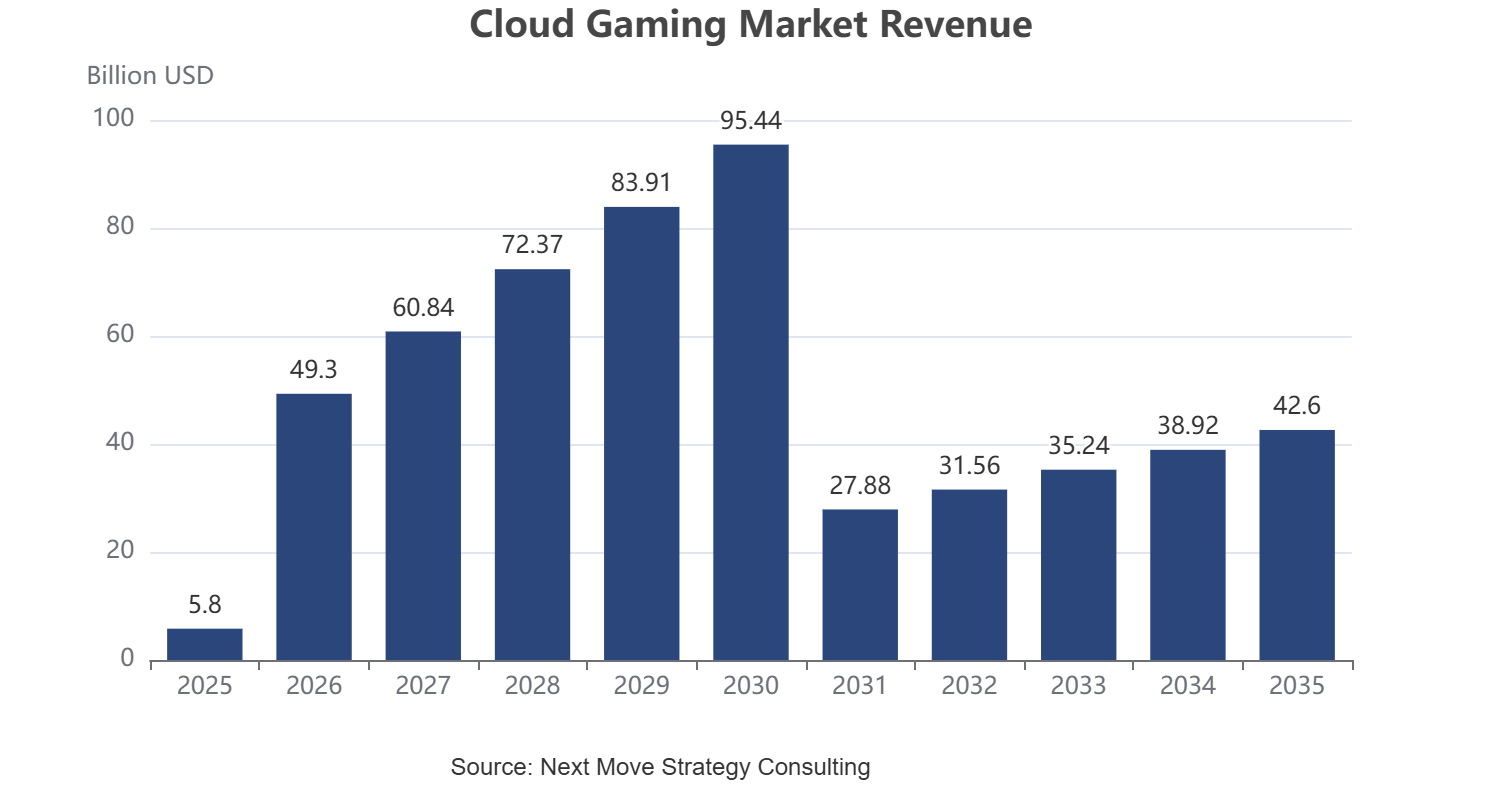
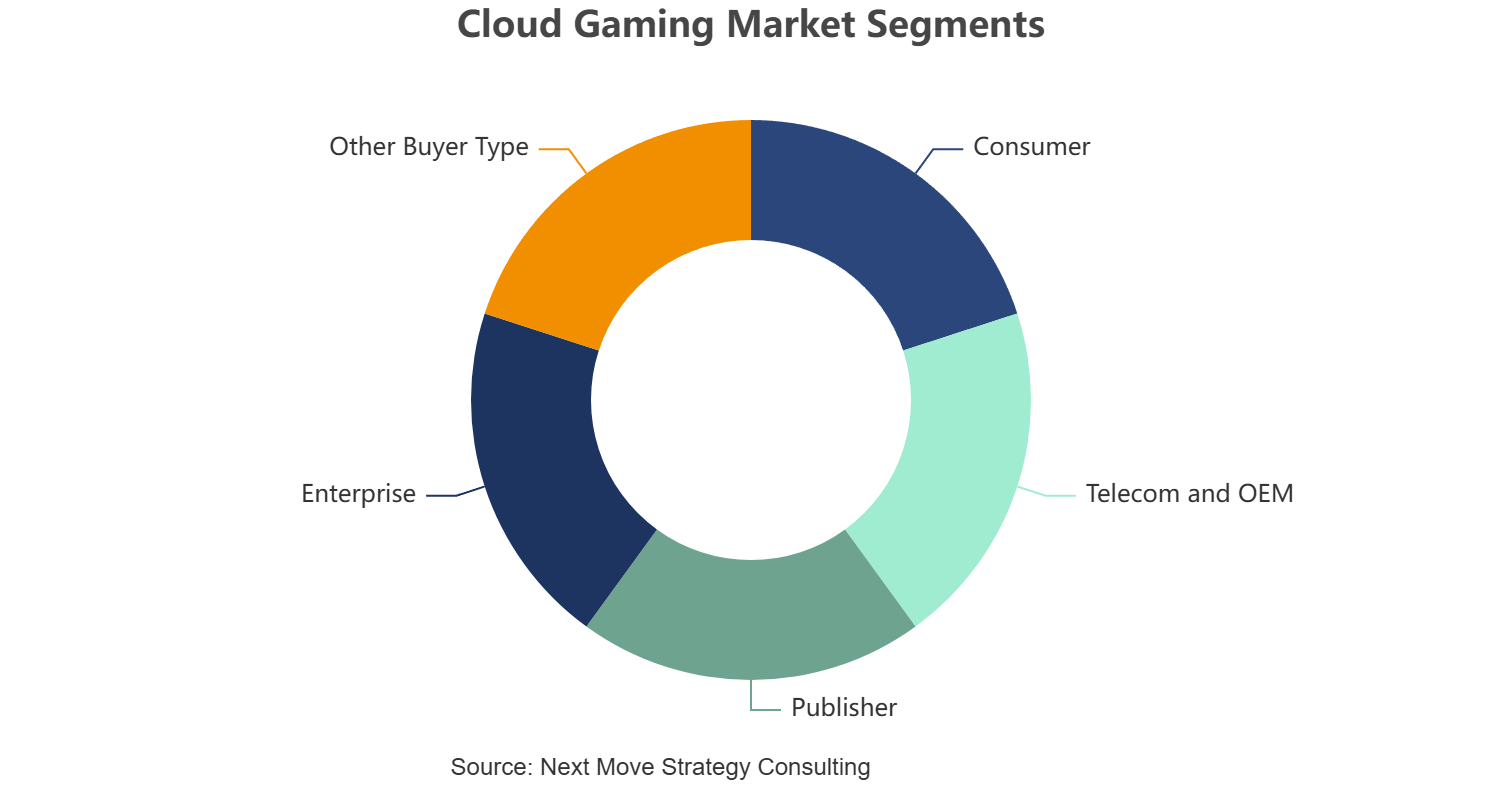
About the Author
 Liza Phukan is Research Associate at Next Move Strategy Consulting, where she has covered emerging industries and market research across sectors for 3.5 years. Her work includes analyzing industry developments, validating market data, and developing structured business content from research findings. She uses secondary research and data-validation practices to turn complex market information into clear decision-useful market analysis for business audiences and support report development and B2B.
About the Reviewer
 Supradip Baul is an accomplished business consultant and strategist with over a decade of rich experience in market intelligence, strategy, technology, and business transformation. His work has included rigorous qualitative and quantitative analysis across multiple industries, helping clients shape investment decisions and long-term roadmaps. Earlier in his career, he was associated with Gartner, where he contributed to industry-leading reports and market share analyses. He has worked with leading global companies and holds an MBA with a dual specialization in Marketing and Finance.
At Next Move Strategy Consulting, we understand that insightful market research is the cornerstone of successful business decisions. That's why we employ a robust and multifaceted approach, combining various methodologies to deliver the most accurate and actionable data for our clients.

Research Landscape
We navigate the world of research with two primary approaches:
Qualitative Approach
Our qualitative research methodologies involve immersive techniques such as in-depth interviews, focus groups, and observational studies. By engaging directly with individuals and stakeholders, we uncover valuable insights that quantitative data alone may overlook.

Quantitative Research
In tandem with qualitative methodologies, NMSC leverages the power of Quantitative Research to provide a robust foundation of numerical insights. Through systematic data collection and analysis, we quantify patterns, preferences, and market trends, offering a comprehensive view of the business landscape.
Our quantitative research approach employs diverse tools, including surveys, experiments, and statistical modelling. These methodologies enable us to gather data from a large and representative sample, ensuring the statistical significance of our findings. By employing structured questionnaires and standardized data collection methods, we guarantee the reliability and validity of the information we present to our clients.
Quantitative research is particularly effective in measuring the prevalence of trends, assessing market size, and gauging the impact of various factors on consumer behavior. The numerical precision attained through this approach equips our clients with actionable insights, facilitating data-driven decision-making and strategy formulation.


Our Specialized Toolbox for Industry-Specific Market Research
We deploy a specialized arsenal of techniques tailored to meet your unique requirements. Here's a glimpse into our comprehensive toolbox:

Information Procurement
The stage entails acquiring market data or relevant information through various sources and methodologies.


Market Research Approach
We utilize both top-down and bottom-up approaches in market research analysis to achieve a comprehensive understanding of the market dynamics, leveraging the broad perspective of industry trends and macroeconomic factors alongside detailed insights from specific segments and individual companies.

Porters Five Forces Analysis
We conduct Porter's Five Forces analysis to evaluate the competitive landscape of an industry, providing us with insights into factors that affect profitability and strategic positioning.

SWOT Analysis

Forecasting
We utilize a forecasting model to predict future consumption by considering parameters like population, economics, regulations, market competition, drivers, constraints, technology, and pricing. We also employ statistical techniques such as multilinear regression, exponential smoothing, moving average, ARIMA, and Monte Carlo simulations for accurate predictions. In econometric forecasting, we analyzed short-term and long-term event impacts, attributing values based on regulatory frameworks, economic factors, and market events.





 Speak to Our Analyst