Commercial Cooking Equipment Market Size, Share, Growth & Forecast by Equipment Type (Ovens, Cooking Equipment), Heat Source (Gas, Electric Resistance), Form Factor (Countertop, Floorstanding, Modular Line, Roll-In, Mobile), End User (Quick Service Restaurants, Full-Service Restaurants, Hotels and Resorts, Catering and Banquets, Institutional Kitchens, Bakeries and Pizzerias, Cloud Kitchens, Central Kitchens, Other Foodservice), Route to Market (Direct Sales) — Global Analysis 2025–2035
Industry: Construction & Manufacturing | Latest Edition: September 30, 2026 | No of Pages: 654 | No. of Tables: 783 | No. of Figures: 777 | Format: PDF | Report Code: CM549
What Is the Commercial Cooking Equipment Market Size?
The global Commercial Cooking Equipment Market size was valued at USD 39.5 billion in 2025 and is expected to reach USD 41.5 billion in 2026. Sustained global foodservice expansion, accelerating adoption of energy-efficient cooking systems, and the proliferation of cloud kitchens are projected to drive the market to USD 67 billion by 2035, advancing at a CAGR of 5.5% from 2026 to 2035. Key growth drivers include the global expansion of quick-service restaurant chains, growing institutional kitchen investments in healthcare and education, government mandates promoting clean cooking and energy-efficient equipment, and the rapid growth of digital-first cloud kitchen and delivery-only foodservice operations across North America and Asia-Pacific.
|
Parameters |
Details |
|
Market Size in 2025 |
USD 39.5 Billion |
|
Market Size in 2026 |
USD 41.5 Billion |
|
Revenue Forecast in 2035 |
USD 67.0 Billion |
|
Growth Rate |
CAGR of 5.5% from 2026 to 2035 |
|
Analysis Period |
2025–2035 |
|
Base Year Considered |
2025 |
|
Forecast Period |
2026–2035 |
|
Market Size Estimation |
Billion USD |
|
Companies Profiled |
20 |
|
Countries Covered |
33 |
|
Market Share |
Top 10 |
Commercial Cooking Equipment Market Overview
What Is the Commercial Cooking Equipment Market?
The Commercial Cooking Equipment Market encompasses professional-grade foodservice appliances used in restaurants, hotels, institutional kitchens, catering facilities, cloud kitchens, and related foodservice operations. From our research, we found that the market includes a comprehensive portfolio of thermal cooking platforms such as ovens, fryers, ranges, griddles, steamers, and broilers, as well as holding, warming, and high-speed automated cooking systems. These appliances are engineered for continuous high-volume production, sanitation compliance, and energy optimization in demanding commercial kitchen environments serving millions of meals globally each day.
How Has the Commercial Cooking Equipment Market Evolved?
The Commercial Cooking Equipment Market has undergone three distinct transformation phases. The first phase was defined by gas-fired open burner ranges and deck ovens serving the global restaurant industry expansion of the mid-twentieth century. The second phase introduced electrification, programmable controls, and energy-efficient technologies such as combi ovens and induction cooktops. Through our market assessment, we observed that the current phase is centered on smart kitchen automation, internet-of-things connectivity, robotic cooking systems, and rapid-cook technologies that support the high-throughput demands of quick-service restaurant networks and cloud kitchen operators globally.
How Do Regulations Influence the Commercial Cooking Equipment Market?
Regulatory frameworks exert significant influence over the Commercial Cooking Equipment Market. The U.S. Environmental Protection Agency and the California Air Resources Board have introduced increasingly stringent nitrogen oxide emission standards accelerating the transition from gas to electric and induction-based equipment. The U.S. Department of Energy's commercial appliance efficiency standards mandate specific energy consumption thresholds for commercial ovens, fryers, and steamers. In Europe, the EU's Ecodesign Regulation and Energy Efficiency Directive are compelling equipment manufacturers to redesign product lines for lower energy consumption and reduced carbon footprint across all commercial kitchen segments.
How Is Technology Adoption Expanding Across the Commercial Cooking Equipment Market?
Technology adoption across the Commercial Cooking Equipment Market is accelerating as foodservice operators seek to reduce labor costs, improve food quality consistency, and meet energy efficiency mandates. NMSC's analysis indicates that connected cooking equipment with IoT diagnostics, remote monitoring, and predictive maintenance capabilities is increasingly specified in new restaurant builds and institutional kitchen refurbishments. High-speed ovens, combi ovens with programmable recipe management, and robotic frying and grilling systems are achieving mainstream adoption within quick-service restaurant chains and centralized production kitchens, fundamentally changing kitchen staffing models and throughput economics.
|
Key Insight |
|
Ovens represent the dominant equipment type segment in the Commercial Cooking Equipment Market, generating approximately USD 11.6 billion in 2025, driven by universal deployment across quick-service and full-service restaurant categories. Combi Ovens constitute the fastest-growing sub-segment within the Ovens category, advancing at a CAGR of 5.8% from 2026 to 2035, as operators consolidate multiple cooking functions into a single versatile platform. |
|
Gas remains the dominant heat source in the Commercial Cooking Equipment Market, accounting for approximately 42% of revenue in 2025, owing to its established infrastructure across legacy commercial kitchen estates globally. Induction is the fastest-growing heat source at a CAGR of 10.9% from 2026 to 2035, driven by regulatory pressure to decarbonize kitchens, superior thermal efficiency, and improved safety in high-volume foodservice environments. |
|
Floorstanding equipment commands the dominant share of the Commercial Cooking Equipment Market in 2025, reflecting full-service restaurant and institutional kitchen procurement patterns for high-capacity cooking platforms. Countertop form factor is the fastest-growing segment at a CAGR of 7.4% from 2026 to 2035, driven by cloud kitchen, convenience store, and fast-casual restaurant demand for space-efficient, high-speed cooking units. |
|
Quick Service Restaurants represent the dominant end user segment in the Commercial Cooking Equipment Market, accounting for approximately 29% of total revenue in 2025. Cloud Kitchens are the fastest-growing end user segment at a CAGR of 12.2% from 2026 to 2035, fueled by digital food delivery platform growth and the proliferation of delivery-only restaurant brands globally. |
|
Dealer and Distributor channels constitute the dominant route to market in the Commercial Cooking Equipment Market, accounting for approximately 38% of revenue in 2025. E-Commerce is the fastest-growing route to market at a CAGR of 11.0% from 2026 to 2035, as small foodservice operators increasingly procure countertop equipment through digital marketplaces. |
|
North America is the dominant region in the Commercial Cooking Equipment Market, accounting for approximately USD 14.1 billion in 2025, underpinned by the world's largest quick-service restaurant industry and the highest concentration of commercial kitchen equipment manufacturers. |
|
Asia-Pacific is the fastest-growing region in the Commercial Cooking Equipment Market at a CAGR of 7.8% from 2026 to 2035, propelled by rapid urbanization, rising middle-class foodservice spending, and aggressive expansion of international QSR chains across China, India, and Southeast Asia. |
|
The United States is the single largest country market in the Commercial Cooking Equipment Market, generating approximately USD 11.3 billion in 2025, underpinned by the world's highest density of quick-service restaurant locations and a well-developed commercial kitchen equipment distribution infrastructure. |
|
India is the fastest-growing national market in the Commercial Cooking Equipment Market at a CAGR of 7.4% from 2026 to 2035, propelled by rapid expansion of organized foodservice chains, government hospitality infrastructure investments, and emergence of a large urban cloud kitchen ecosystem. |
Key Emerging Trends in the Commercial Cooking Equipment Market
How Is the Rise of Combi Oven Technology Reshaping the Commercial Cooking Equipment Market?
Combi ovens are redefining kitchen productivity in the Commercial Cooking Equipment Market by combining convection heat, steam, and combination cooking modes in a single platform. Our findings suggest that operators such as major global hotel chains are deploying RATIONAL SelfCookingCenter units as central production workhorses, replacing multiple dedicated cooking platforms. This consolidation reduces kitchen footprint, labor requirements, and energy consumption while improving food quality consistency. The result is a fundamental shift in kitchen design philosophy, from specialized single-function stations toward multipurpose intelligent cooking systems across foodservice categories and geographies.
How Is the Electrification and Decarbonization Movement Transforming the Commercial Cooking Equipment Market?
Electrification of commercial kitchens represents a structural transformation trend in the Commercial Cooking Equipment Market, driven by municipal gas bans, ESG commitments, and tightening nitrogen oxide emission standards. Our analysis shows that cities including New York City and jurisdictions across California have enacted regulations phasing out natural gas connections in new commercial buildings. Equipment manufacturers including Middleby and Electrolux Professional have accelerated launches of all-electric product lines encompassing induction ranges, electric steam kettles, and heat-pump-powered convection ovens, enabling operators to meet decarbonization commitments without sacrificing cooking performance in high-volume commercial kitchens.
How Is the Rapid Expansion of Cloud Kitchens Driving New Demand Patterns in the Commercial Cooking Equipment Market?
Cloud kitchens represent the most disruptive end-user growth channel within the Commercial Cooking Equipment Market, creating demand for compact, high-throughput, and multi-cuisine cooking platforms within constrained footprint environments. NMSC's analysis indicates that major cloud kitchen platforms are deploying standardized equipment packages including rapid-cook ovens, modular induction lines, and automated frying systems to support simultaneous multi-brand operations. This model compresses equipment specification cycles, favors modular and countertop form factors, and accelerates adoption of connected kitchen management platforms with real-time performance monitoring across distributed kitchen networks globally.
How Are Smart Kitchen and IoT Technologies Influencing the Commercial Cooking Equipment Market?
Smart kitchen technology integration is emerging as a competitive differentiator in the Commercial Cooking Equipment Market, with manufacturers embedding IoT connectivity, remote diagnostics, and AI-assisted recipe management into commercial cooking platforms. Our assessment indicates that RATIONAL's Connected Cooking platform and Middleby's Infinity software enable operators to remotely monitor equipment performance, push recipe updates, and schedule predictive maintenance across multi-site restaurant networks. These capabilities reduce equipment downtime, improve food consistency across franchise locations, and provide operators with actionable data to optimize energy consumption and reduce kitchen labor costs throughout the equipment lifecycle.
What Are the Key Market Drivers, Breakthroughs, and Investment Opportunities that Will Shape the Commercial Cooking Equipment Market in the Next Decade?
|
Drivers / Trends / Restraints |
(+/-) % Impact on CAGR Forecast |
Geographic Relevance |
Impact Timeline |
|
Global QSR Chain Expansion |
+0.8% |
Global (Asia-Pacific, MENA, LATAM) |
2025–2035 |
|
Cloud Kitchen Proliferation |
+0.6% |
Global (all regions) |
2025–2032 |
|
Electrification and Gas Phase-Out Mandates |
+0.5% |
North America, Europe |
2026–2035 |
|
IoT and Smart Kitchen Adoption |
+0.4% |
North America, Europe, APAC |
2025–2030 |
|
Rising Institutional Foodservice Spending |
+0.3% |
North America, Europe, APAC |
2025–2035 |
|
High Capital Cost of Advanced Equipment |
-0.5% |
SMB Globally, LATAM, MEA |
Ongoing |
|
Supply Chain Disruptions and Cost Inflation |
-0.3% |
All regions |
2025–2028 |
|
Energy Transition Complexity for Small Operators |
-0.2% |
Europe, North America |
2026–2030 |
|
Automation and Robotic Cooking Systems |
+0.4% |
North America, Japan, Europe |
2027–2035 |
|
Emerging Market Urbanization and Foodservice Formalization |
+0.5% |
India, Southeast Asia, Africa |
2026–2035 |
What Are the Growth Drivers of the Commercial Cooking Equipment Market?
How Is the Global Expansion of Quick-Service Restaurant Chains Fueling Commercial Cooking Equipment Market Growth?
The sustained global expansion of quick-service restaurant networks is the primary structural growth driver for the Commercial Cooking Equipment Market. Based on our market evaluation, we noticed that major QSR chains including McDonald's, Yum! Brands, and Restaurant Brands International continue to add thousands of locations annually across Asia-Pacific, Middle East, and Latin America, each requiring a full complement of commercial cooking equipment including fryers, griddles, convection ovens, and holding systems. The U.S. Census Bureau's County Business Patterns data confirms the foodservice sector's structural growth trajectory, with limited-service restaurants representing the fastest-expanding foodservice category in the United States over the past decade.
How Are Government Energy Efficiency Standards and Kitchen Electrification Mandates Driving Equipment Replacement in the Commercial Cooking Equipment Market?
Government energy efficiency regulations and kitchen electrification mandates are creating a durable equipment replacement cycle within the Commercial Cooking Equipment Market. The U.S. Department of Energy has established prescriptive energy consumption standards for commercial fryers, ovens, and steamers under the Energy Conservation Standards for Commercial and Industrial Equipment program, compelling foodservice operators to retire non-compliant legacy equipment. Based on NMSC's research, we found that California's move to prohibit gas appliances in new commercial buildings is accelerating all-electric kitchen adoption, stimulating premium equipment sales as operators invest in compliant, high-efficiency platforms with lower lifecycle operating costs.
How Is the Growth of Institutional Foodservice Creating Sustained Commercial Cooking Equipment Market Demand?
Institutional foodservice investment in healthcare, education, military, and corrections sectors represents a stable and growing demand pillar within the Commercial Cooking Equipment Market. Through NMSC's assessment, we found that the U.S. Department of Defense operates one of the world's largest institutional foodservice networks, procuring commercial cooking equipment through structured acquisition programs. The U.S. Department of Agriculture's National School Lunch Program supports over 30 million meals daily, driving continuous equipment procurement and replacement in school foodservice kitchens. Global healthcare sector investment in patient meal quality and nutritional standards is similarly driving commercial kitchen equipment purchases in hospitals and long-term care facilities.
Supply Chain Structure Of The Commercial Cooking Equipment Market
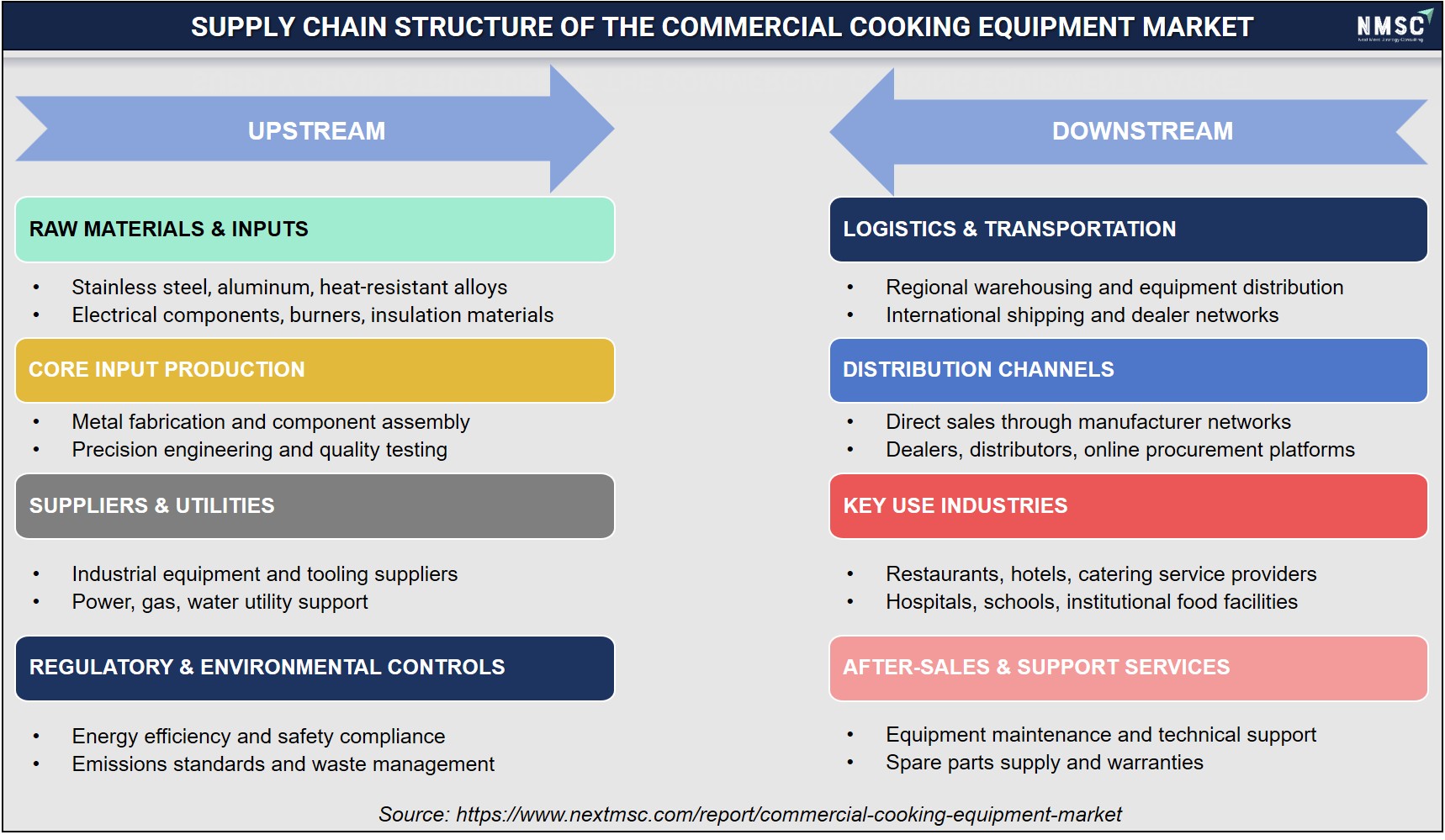
The supply chain structure of the Commercial Cooking Equipment Market highlights the interconnected ecosystem that supports equipment manufacturing, distribution, and end-user adoption. Upstream activities involve sourcing raw materials, component production, supplier networks, and compliance with regulatory standards. Downstream operations encompass logistics, distribution channels, foodservice end users, and after-sales support services. Understanding this value chain enables manufacturers, distributors, and investors to identify operational efficiencies, manage supply risks, optimize channel strategies, and enhance customer service across the commercial foodservice industry.
What Are the Growth Inhibitors of the Commercial Cooking Equipment Market?
How Do High Upfront Capital Costs Constrain Commercial Cooking Equipment Market Penetration Among Independent Operators?
The high purchase price of commercial-grade cooking equipment represents a meaningful constraint on market growth, particularly among independent restaurants, small catering businesses, and emerging market foodservice operators. Premium combi ovens, induction cooking suites, and robotic cooking systems command price points that are economically inaccessible to many small and mid-sized operators without equipment financing access. From our assessment, the U.S. Small Business Administration reports that foodservice businesses face among the highest equipment capital expenditure requirements of any small business category, and that equipment financing constraints are a leading cause of business formation barriers in the hospitality sector, creating a structural demand ceiling in lower-income market segments.
How Are Supply Chain Disruptions and Component Cost Inflation Affecting the Commercial Cooking Equipment Market?
Global supply chain disruptions and persistent inflation in steel, electronics, and semiconductor components have introduced margin pressure and order fulfillment delays across the Commercial Cooking Equipment Market. Our analysis shows that stainless steel, which accounts for a significant portion of commercial cooking equipment raw material content, experienced significant price volatility following the pandemic-era supply chain dislocation. The U.S. Bureau of Labor Statistics Producer Price Index for Fabricated Metal Products indicates continued cost pressure for equipment manufacturers. Extended lead times for electronic control components embedded in smart kitchen equipment have constrained manufacturing output and challenged equipment delivery timelines in the post-2022 supply environment.
Pestel Analysis Of The Commercial Cooking Equipment Market
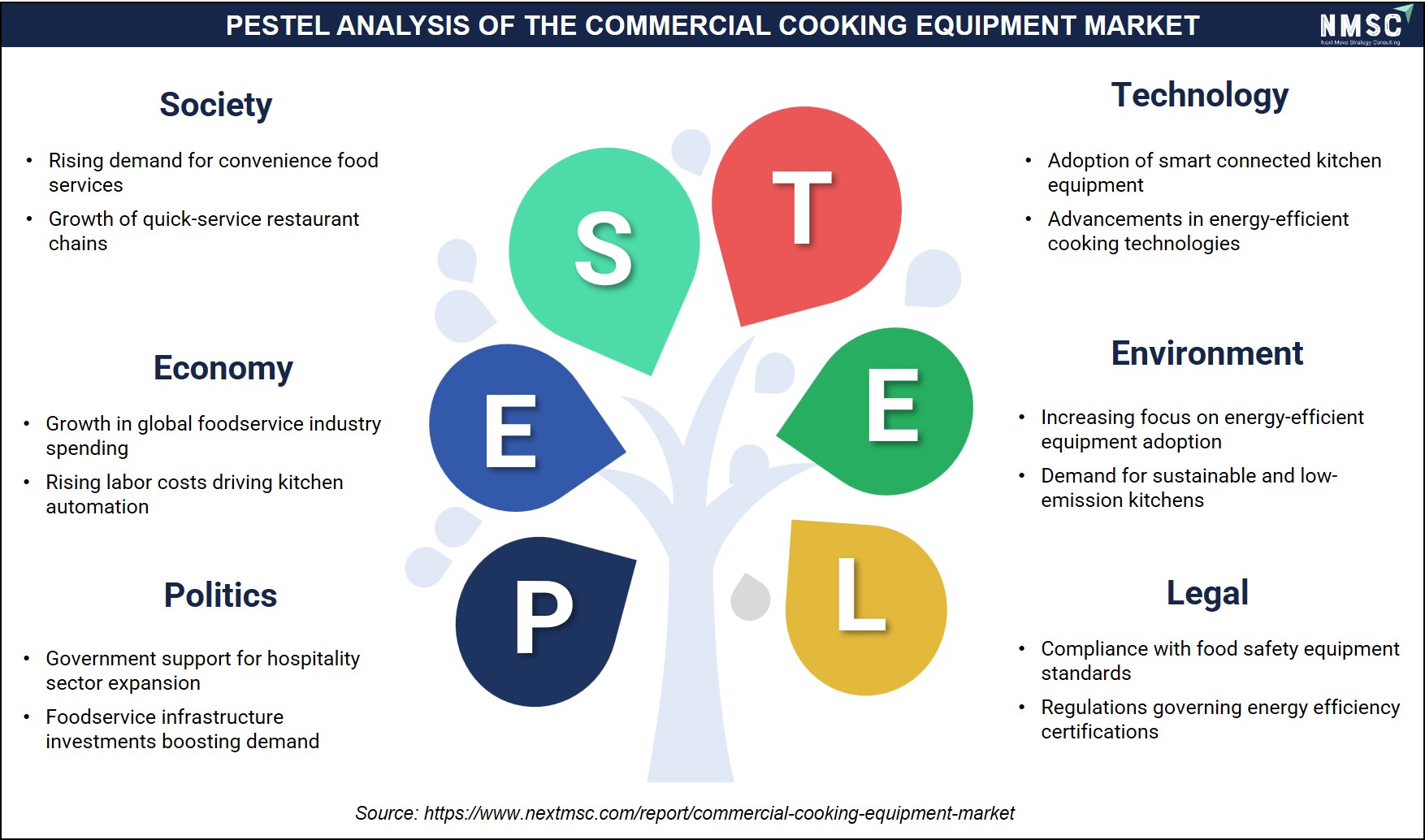
The PESTEL analysis of the Commercial Cooking Equipment Market evaluates the external macroeconomic factors influencing industry growth and competitive dynamics. It examines political regulations, economic conditions, social dining trends, technological advancements, environmental sustainability initiatives, and legal compliance requirements that shape market development. This framework helps stakeholders understand opportunities, risks, and strategic priorities impacting equipment manufacturers, foodservice operators, investors, and policymakers across global and regional markets.
What Are the Growth Opportunities in the Commercial Cooking Equipment Market?
How Does the Rapid Expansion of Cloud Kitchens and Delivery-Only Foodservice Models Create a Multi-Billion Dollar Opportunity in the Commercial Cooking Equipment Market?
The proliferation of cloud kitchens globally is creating a structurally new and rapidly scaling demand channel within the Commercial Cooking Equipment Market. Through our market evaluation, we assessed that cloud kitchen operators require compact, multi-function, high-throughput cooking platforms supporting multiple cuisine concepts simultaneously within a limited floor area. The U.S. Food and Drug Administration's Food Safety Modernization Act requirements for commercial kitchen sanitation and temperature control compel cloud kitchen operators to invest in commercial-grade equipment. This regulatory baseline creates a durable demand floor and positions premium countertop and compact commercial equipment categories for above-market growth throughout the forecast period globally.
How Does the Automation and Robotics Trend Represent a Strategic Investment Opportunity in the Commercial Cooking Equipment Market?
Automation and robotic cooking systems represent a high-growth adjacency within the Commercial Cooking Equipment Market, creating opportunities for both incumbent equipment manufacturers and technology entrants. Based on our market evaluation, we noticed that robotic frying, grilling, and assembly systems are being deployed by major QSR chains to address labor cost inflation and staffing shortages. The U.S. Bureau of Labor Statistics confirms that foodservice occupations face among the highest turnover rates of any employment category, creating a structural economic incentive for kitchen automation investment. Equipment manufacturers integrating robotic handling with conventional cooking platforms will capture premium contract values and long-term service revenue from enterprise clients.
How Does Emerging Market Urbanization Present a Structural Growth in the Commercial Cooking Equipment Market Opportunity?
Rapid urbanization and the formalization of foodservice industries across India, Southeast Asia, sub-Saharan Africa, and Latin America represent a long-duration structural opportunity for the Commercial Cooking Equipment Market. Our analysis shows that the United Nations projects 2.5 billion additional urban residents globally by 2050, the majority in regions with underpenetrated commercial foodservice infrastructure. The Indian government's Pradhan Mantri Kaushal Vikas Yojana skill development program creates a trained commercial kitchen workforce, reducing a key barrier to institutional and restaurant foodservice expansion. These demographic and urbanization trends create durable multi-decade demand for entry-level to mid-tier commercial cooking equipment categories across emerging market geographies.
How Is the Commercial Cooking Equipment Market Segmented in This Report, and What Are the Key Insights from the Segmentation Analysis?
Which Equipment Type Segments Are Driving the Most Revenue and Growth Across the Commercial Cooking Equipment Market?
|
Equipment Type Segment |
2025 (USD Bn) |
2035 (USD Bn) |
CAGR (%) |
|
Ovens (All types) |
11.6 |
20.2 |
6.4% |
|
Ranges and Cooktops |
6.6 |
10.9 |
5.7% |
|
Fryers |
5.6 |
9.4 |
5.9% |
|
Griddles and Grills |
3.8 |
6.4 |
6.0% |
|
Broilers |
1.6 |
2.6 |
5.5% |
|
Steamers |
1.9 |
3.4 |
6.7% |
|
Kettles and Pans |
1.6 |
2.6 |
5.5% |
|
Holding and Warming Equipment |
2.5 |
4.1 |
5.7% |
|
High-Speed and Automated Cooking |
2.2 |
4.9 |
9.3% |
|
Other Cooking Equipment |
2.1 |
2.5 |
1.9% |
Based on NMSC's research, we found that the Commercial Cooking Equipment Market is segmented by equipment type into Ovens, Ranges and Cooktops, Fryers, Griddles and Grills, Broilers, Steamers, Kettles and Pans, Holding and Warming Equipment, High-Speed and Automated Cooking, and Other Cooking Equipment. The Ovens segment holds the dominant revenue position across the market, with combi ovens, convection ovens, and conveyor ovens driving broad adoption in quick-service restaurants, hotels, and institutional kitchens. High-Speed and Automated Cooking is the fastest-growing segment, led by rapid cook ovens, speed ovens, and robotic cooking systems addressing labor shortages and throughput demands in cloud kitchens and QSR networks globally.
How Is the Shift in Heat Source Preference Reshaping the Commercial Cooking Equipment Market Landscape?
|
Heat Source Segment |
2025 (USD Bn) |
2035 (USD Bn) |
CAGR (%) |
|
Gas |
16.6 |
25.1 |
4.7% |
|
Electric Resistance |
11.3 |
18.3 |
5.5% |
|
Induction |
4.4 |
11.2 |
10.9% |
|
Microwave |
2.2 |
3.7 |
5.9% |
|
Steam |
1.9 |
3.0 |
5.2% |
|
Dual Fuel |
1.6 |
2.6 |
5.5% |
|
Solid Fuel |
0.9 |
1.5 |
5.8% |
|
Other |
0.6 |
1.6 |
11.5% |
Through our analysis, we observed that the Commercial Cooking Equipment Market is segmented by heat source into Gas, Electric Resistance, Induction, Microwave, Steam, Dual Fuel, Solid Fuel, and Other. Gas equipment retains the dominant revenue position owing to its widespread infrastructure across legacy commercial kitchen estates in North America, Europe, and Asia-Pacific. Induction represents the fastest-growing heat source at a CAGR of 10.9%, driven by regulatory mandates to phase out gas in commercial buildings, superior energy efficiency of induction technology, and improving price competitiveness as manufacturing volumes scale across the forecast period.
How Does Form Factor Segmentation Reflect the Evolving Needs of Commercial Kitchen Operators?
|
Form Factor Segment |
2025 (USD Bn) |
2035 (USD Bn) |
CAGR (%) |
|
Floorstanding |
16.9 |
28.1 |
5.8% |
|
Countertop |
11.6 |
22.1 |
7.4% |
|
Built-In |
4.7 |
7.5 |
5.3% |
|
Modular Line |
3.8 |
6.4 |
6.0% |
|
Roll-In |
1.6 |
1.9 |
1.9% |
|
Mobile |
0.9 |
1.0 |
1.2% |
Our findings suggest that the Commercial Cooking Equipment Market is segmented by form factor into Floorstanding, Countertop, Built-In, Modular Line, Roll-In, and Mobile configurations. Floorstanding equipment dominates the market, reflecting the capital investment patterns of full-service restaurants, institutional kitchens, and hotel foodservice operations prioritizing high-capacity, dedicated cooking platforms. Countertop equipment is the fastest-growing form factor at a CAGR of 7.4%, driven by cloud kitchen demand for space-efficient cooking platforms, convenience store hot food programs, and the rapid proliferation of fast-casual and specialty food concepts with limited kitchen footprints globally.
Which End User Segments Are Driving the Strongest Demand Across the Commercial Cooking Equipment Market?
|
End User Segment |
2025 (USD Bn) |
2035 (USD Bn) |
CAGR (%) |
|
Quick Service Restaurants |
11.3 |
19.1 |
6.0% |
|
Full-Service Restaurants |
6.9 |
11.2 |
5.5% |
|
Hotels and Resorts |
4.7 |
7.9 |
5.9% |
|
Catering and Banquets |
2.8 |
4.5 |
5.4% |
|
Institutional Kitchens (Education, Healthcare, B&I, Military) |
5.6 |
9.4 |
5.9% |
|
Bakeries and Pizzerias |
2.2 |
3.4 |
5.0% |
|
Convenience Stores and Grocery |
1.6 |
3.0 |
7.2% |
|
Cloud Kitchens |
1.6 |
4.5 |
12.2% |
|
Central Kitchens |
1.6 |
2.6 |
5.5% |
|
Other Foodservice |
1.2 |
1.4 |
1.7% |
Based on our analysis of global foodservice sector investment patterns, we observed that the Commercial Cooking Equipment Market is segmented by end user into Quick Service Restaurants, Full-Service Restaurants, Hotels and Resorts, Catering and Banquets, Institutional Kitchens, Bakeries and Pizzerias, Convenience Stores and Grocery, Cloud Kitchens, Central Kitchens, and Other Foodservice. Quick Service Restaurants constitute the dominant end user segment, driven by continuous global expansion of major QSR chains. Cloud Kitchens represent the fastest-growing segment at a CAGR of 12.2%, fueled by the explosive growth of digital food delivery platforms and delivery-only restaurant brands across North America, Europe, and Asia-Pacific.
How Do Distribution Channel Dynamics Shape Revenue Flows in the Commercial Cooking Equipment Market?
|
Route to Market Segment |
2025 (USD Bn) |
2035 (USD Bn) |
CAGR (%) |
|
Dealer and Distributor |
15.0 |
24.3 |
5.5% |
|
Direct Sales |
11.0 |
18.3 |
5.8% |
|
Project Sales |
6.9 |
11.6 |
5.9% |
|
E-Commerce |
4.1 |
10.5 |
11.0% |
|
OEM and Private Label |
2.5 |
2.3 |
-0.9% |
Our assessment indicates that the Commercial Cooking Equipment Market is segmented by route to market into Dealer and Distributor, Direct Sales, Project Sales, E-Commerce, and OEM and Private Label channels. The Dealer and Distributor channel retains the largest revenue share, reflecting the established role of independent foodservice equipment dealers in serving the fragmented independent restaurant and institutional kitchen buyer base. E-Commerce is the fastest-growing distribution channel at a CAGR of 11.0%, driven by small foodservice operators and cloud kitchen businesses increasingly sourcing countertop and mid-tier cooking equipment through digital marketplaces and manufacturer direct-to-consumer platforms globally.
Regional Outlook
Geographic Performance Snapshot
|
Region |
2025 (USD Bn) |
2035 (USD Bn) |
CAGR (%) |
Key Driver |
|
North America |
14.1 |
22.9 |
5.5% |
QSR expansion, equipment upgrade cycles, electrification mandates |
|
Europe |
10.0 |
16.1 |
5.4% |
Ecodesign regulation, energy-efficient replacement cycles |
|
Asia-Pacific |
9.7 |
19.1 |
7.8% |
Urbanization, QSR chain growth, cloud kitchens |
|
Middle East & Africa |
2.8 |
5.2 |
7.1% |
Hospitality investment, Vision 2030 |
|
Latin America |
2.9 |
3.7 |
3.1% |
Budget QSR growth, hotel sector expansion |
North America Commercial Cooking Equipment Market
North America is the dominant region in the Commercial Cooking Equipment Market, generating USD 14.1 billion in 2025 and projected to reach USD 22.9 billion by 2035 at a CAGR of 5.5%. The region benefits from the world's highest concentration of quick-service restaurant locations, a well-developed foodservice equipment distribution infrastructure, and rigorous federal energy efficiency standards that drive regular equipment replacement cycles. Electrification regulations in California and other progressive states are stimulating demand for premium induction and electric equipment. The region's mature market dynamics favor innovation in connected kitchen technology and energy-efficient cooking platforms across all foodservice segments.
U.S. Commercial Cooking Equipment Market
Based on our engagements with industry stakeholders, the United States is the world's largest Commercial Cooking Equipment Market, contributing approximately USD 11.3 billion in 2025. The U.S. market is characterized by extensive QSR chain operations, a large institutional foodservice sector served by the U.S. Department of Defense and federal school nutrition programs, and a well-capitalized hotel and resort foodservice industry. The U.S. Department of Energy's commercial kitchen appliance efficiency standards mandate compliance timelines that drive regular equipment fleet renewal. A thriving foodservice equipment dealer and distributor network supports efficient market access across the country's diverse regional foodservice landscape nationwide.
Canada Commercial Cooking Equipment Market
Through our analysis, Canada represents approximately 8% of the North American Commercial Cooking Equipment Market, generating around USD 1.1 billion in 2025. The Canadian market is supported by a growing foodservice sector, federal institutional kitchen programs, and increasing adoption of energy-efficient cooking technology driven by provincial carbon reduction targets. The Canadian Food Inspection Agency's commercial kitchen hygiene standards create consistent demand for professional-grade equipment across restaurant and institutional segments. Major QSR chains operate extensive Canadian networks, and the country's large hotel and convention sector provides a stable demand base for commercial cooking equipment upgrades and replacements.
Mexico Commercial Cooking Equipment Market
From our assessment, Mexico is the fastest-growing market within North America for commercial cooking equipment, supported by rapid expansion of domestic and international QSR chains, a growing middle-class consumer base, and significant tourism sector investment in hotel and resort foodservice infrastructure. The Mexican government's industrial development programs and COFEPRIS food safety standards create a commercial kitchen compliance baseline. International QSR operators entering Mexico typically require standardized commercial cooking equipment packages consistent with global specifications. The country's growing manufacturing and export sector also supports institutional and corporate cafeteria foodservice expansion across major industrial cities throughout the forecast period.
Europe Commercial Cooking Equipment Market
Europe is the second-largest region in the Commercial Cooking Equipment Market, contributing USD 10.0 billion in 2025 and projected to reach USD 16.1 billion by 2035 at a CAGR of 5.4%. The European market is shaped by the EU's Ecodesign Regulation and Energy Efficiency Directive, compelling systematic replacement of gas-fired and low-efficiency commercial cooking equipment with energy-certified alternatives. The region's diverse foodservice culture, from Nordic institutional catering to Southern European full-service dining, creates a broad demand base. European manufacturers including RATIONAL AG, Electrolux Professional, and MKN hold strong market positions supported by well-established regional distribution networks.
U.K. Commercial Cooking Equipment Market
Based on our engagements with European foodservice stakeholders, the United Kingdom represents the largest individual country market in Europe for commercial cooking equipment, generating approximately USD 2.2 billion in 2025. The U.K. market is supported by a large and dynamic hospitality sector, extensive QSR chain operations, and a significant institutional foodservice industry serving the National Health Service, educational institutions, and defence catering. The U.K. government's carbon net-zero commitments under the Climate Change Act are accelerating electrification of commercial kitchens, driving demand for induction equipment and heat-pump-based combi ovens across new restaurant builds and major kitchen refurbishment projects.
Germany Commercial Cooking Equipment Market
Through our analysis, Germany is the second-largest European market for commercial cooking equipment and the home market of RATIONAL AG, one of the world's leading combi oven manufacturers. German foodservice operations prioritize engineering quality, energy efficiency, and HACCP compliance in equipment procurement. The German federal government's climate action program and state-level Klimaschutzgesetze are driving electrification of commercial kitchens in the hospitality and institutional sectors. The country's large hotel and meeting industry, dense institutional foodservice network, and sophisticated food manufacturing sector collectively support stable and growing demand for premium commercial cooking equipment throughout the forecast period.
France Commercial Cooking Equipment Market
From our assessment, France represents the third-largest European Commercial Cooking Equipment Market, supported by the world's most developed fine dining culture, a large hotel and resort sector, and extensive institutional foodservice operations serving schools and public administration. The French government's RE2020 building energy regulation mandates increasingly stringent energy performance standards for commercial kitchen equipment in new construction. French foodservice operators are significant buyers of combi ovens, tilting skillets, and steam kettles for large-scale catering production. The country's strong culinary training tradition supports sustained professional kitchen equipment investment throughout the forecast period.
Italy Commercial Cooking Equipment Market
According to our evaluation, Italy is an important European market for commercial cooking equipment, distinguished by a high density of independent restaurants, pizzerias, and bakeries that represent core buyers of deck ovens, pizza ovens, and specialty cooking equipment. Italian equipment manufacturers and regional distributors serve a deeply fragmented foodservice operator base. Italy's National Recovery and Resilience Plan (PNRR) is directing investment toward hospitality sector modernization, supporting equipment upgrade cycles. The country's growing hotel sector and expanding international tourism are driving investment in hotel kitchen and catering equipment across major destination cities and resort regions throughout Italy.
Spain Commercial Cooking Equipment Market
Based on our market evaluation, Spain demonstrates solid momentum in the Commercial Cooking Equipment Market, supported by a large tourism and hospitality sector, a growing QSR chain industry, and increasing institutional foodservice investment. The ONNERA Group, headquartered in Spain, is a significant domestic and international commercial cooking equipment manufacturer serving hotel, restaurant, and institutional kitchen segments. Spanish hotel and resort development continues to generate equipment procurement activity. The Spanish government's PERTE programs are directing industrial investment toward food manufacturing and hospitality sector infrastructure modernization across mainland Spain and the island territories.
Sweden Commercial Cooking Equipment Market
Through our analysis, Sweden is a high-per-capita commercial cooking equipment market within Northern Europe, characterized by advanced energy efficiency standards, strong public sector foodservice investment, and early adoption of electrification technologies. Swedish municipal and county foodservice operations, which serve school and healthcare meals at scale, are significant institutional buyers prioritizing energy-certified combi ovens, induction steamers, and automated production equipment. Sweden's climate legislation and carbon pricing mechanisms create strong economic incentives for operators to invest in energy-efficient commercial cooking platforms that reduce operating costs alongside meeting environmental compliance requirements.
Denmark Commercial Cooking Equipment Market
From our assessment, Denmark is among Europe's most advanced commercial cooking equipment markets on a per-capita basis, driven by high foodservice quality standards, an active hotel and restaurant sector, and a government committed to decarbonization under the Climate Act 2020. Danish municipal foodservice programs for schools and care homes are sophisticated institutional buyers of energy-efficient cooking equipment. The country's organic food movement and emphasis on locally sourced ingredients have driven investment in versatile combi ovens and steam cooking platforms. Danish procurement standards increasingly favor energy-labeled equipment from certified EU suppliers throughout the forecast period.
Finland Commercial Cooking Equipment Market
According to our evaluation, Finland's commercial cooking equipment market is supported by extensive public sector foodservice operations, a large hotel and tourism sector, and a manufacturing industry with significant corporate cafeteria and canteen foodservice requirements. The Finnish government's carbon neutrality commitment by 2035 under the Climate Change Act is among the most ambitious in Europe and is creating direct impetus for electrification of public sector and municipal commercial kitchens. Finnish public procurement guidelines prioritize energy-certified equipment, creating a structural market advantage for manufacturers offering EU Ecodesign-compliant product lines across the full commercial cooking equipment portfolio.
Netherlands Commercial Cooking Equipment Market
Based on our engagements, the Netherlands commercial cooking equipment market benefits from a strong foodservice sector, a large institutional catering industry serving Dutch government agencies and universities, and a growing tourism and hotel sector anchored by Amsterdam. Dutch foodservice operators demonstrate high awareness of sustainability and energy efficiency, reflecting the Netherlands' progressive climate policy environment under the Dutch Climate Agreement. The country's dense retail food sector and growing convenience foodservice segment are driving demand for countertop and high-speed cooking solutions. The Netherlands also serves as an important regional equipment distribution hub for Northern European foodservice markets.
Rest of Europe Commercial Cooking Equipment Market
The Rest of Europe encompasses Poland, Belgium, Switzerland, Austria, Portugal, Czech Republic, and other European nations, collectively representing a meaningful and growing portion of the European Commercial Cooking Equipment Market. Poland and the Czech Republic are experiencing rapid QSR chain expansion and institutional kitchen modernization, generating strong demand for entry-level to mid-tier commercial cooking equipment. Switzerland's premium hospitality sector and extensive institutional catering infrastructure create demand for high-specification equipment. Belgium's large institutional and government foodservice sector, alongside its significant restaurant industry, provides a stable and growing equipment procurement base throughout the forecast period.
Asia-Pacific Commercial Cooking Equipment Market
Asia-Pacific is the fastest-growing major region in the Commercial Cooking Equipment Market, advancing from USD 9.7 billion in 2025 to an estimated USD 19.1 billion by 2035 at a CAGR of 7.8%. The region's growth is propelled by rapid urbanization, rising middle-class foodservice consumption, and aggressive QSR chain expansion across China, India, and Southeast Asia. Government hospitality sector investments in tourism infrastructure, growing institutional foodservice spending in healthcare and education, and the emergence of cloud kitchen platforms are driving sustained equipment demand. Asia-Pacific is also a major manufacturing hub for commercial cooking equipment exported globally throughout the forecast period.
China Commercial Cooking Equipment Market
Based on our engagements with regional foodservice stakeholders, China is the largest commercial cooking equipment market in Asia-Pacific, generating approximately USD 1.1 billion in 2025. China's massive foodservice industry encompasses an estimated 9 million restaurants and a rapidly growing QSR chain sector. The government's urban development programs and expansion of high-speed rail hospitality infrastructure are driving institutional kitchen investment. Domestic manufacturers including Yindu Kitchen Equipment Co. serve the large mid-market operator base, while international brands compete in the premium hotel and chain restaurant segment. China's cloud kitchen sector is among the world's largest, creating demand for high-throughput countertop cooking platforms.
India Commercial Cooking Equipment Market
Through our analysis, India is the fastest-growing national commercial cooking equipment market in Asia-Pacific, advancing at a CAGR of 7.4% from 2026 to 2035. The rapid expansion of organized foodservice chains including Jubilant FoodWorks (Domino's India), Devyani International (KFC India), and Westlife Foodworld (McDonald's India) is generating substantial equipment procurement demand. The Indian government's tourism infrastructure investment under Swadesh Darshan and Pilgrimage Rejuvenation schemes is driving hotel kitchen equipment purchases. India's large and rapidly growing cloud kitchen sector, supported by delivery platforms, is creating incremental demand for compact commercial cooking equipment throughout the forecast period.
Japan Commercial Cooking Equipment Market
From our assessment, Japan is the second-largest commercial cooking equipment market in Asia-Pacific, supported by an advanced foodservice sector, a premium hotel industry, and high technology standards in institutional and industrial catering. Japanese equipment manufacturers including Maruzen, Fujimak, and AIHO Corporation hold significant domestic market positions through established distribution networks. Japan's Ministry of Agriculture, Forestry and Fisheries oversees food safety standards underpinning commercial kitchen equipment compliance requirements. The country's aging population is driving investment in healthcare institutional foodservice with automated and energy-efficient cooking equipment that reduces labor requirements in hospital and long-term care kitchen operations.
South Korea Commercial Cooking Equipment Market
According to our evaluation, South Korea is a dynamic commercial cooking equipment market within Asia-Pacific, characterized by a sophisticated foodservice sector, high QSR chain density, and a well-developed Korean food culture creating demand for specialized cooking platforms including wok ranges, steamers, and griddles. South Korea's Ministry of Food and Drug Safety enforces commercial kitchen hygiene standards that mandate professional-grade equipment. The country's premium hotel sector in Seoul and Jeju, combined with a large institutional foodservice industry, generates stable equipment procurement demand. The Korean government's digital economy strategy is supporting growth of cloud kitchen platforms across major urban centers.
Taiwan Commercial Cooking Equipment Market
Based on our engagements, Taiwan's commercial cooking equipment market is centered on its vibrant night market and restaurant culture, a growing hotel and tourism sector, and expanding institutional foodservice operations in education and corporate settings. The government's National Tourism Development Plan is supporting hotel and resort kitchen investment. Taiwan's dense urban foodservice environment and high consumer spending on dining out create consistent demand for energy-efficient range, fryer, and oven equipment. Domestic equipment distributors serve the independent restaurant market, while international brands compete in the premium hotel and QSR chain segments across major Taiwanese cities.
Indonesia Commercial Cooking Equipment Market
Through our analysis, Indonesia represents one of the most rapidly growing commercial cooking equipment markets in Southeast Asia, supported by a population of over 280 million people, rapid urbanization, and aggressive expansion of international and domestic QSR chains. The Indonesian government's National Food Security Program is driving investment in institutional kitchen infrastructure. International QSR brands including McDonald's, KFC, and Pizza Hut, alongside domestic chains, are generating substantial equipment procurement activity. Indonesia's growing hotel sector, supported by government tourism investment, is also contributing to demand for commercial kitchen equipment upgrades and new installations across the archipelago.
Vietnam Commercial Cooking Equipment Market
From our assessment, Vietnam is an emerging and high-growth commercial cooking equipment market in Southeast Asia, supported by rapid economic development, increasing urbanization, and swift expansion of international and domestic foodservice chains. The Vietnamese government's industrial zone development and tourism promotion programs are creating demand for institutional and hotel foodservice equipment. International QSR brands are expanding aggressively in Ho Chi Minh City and Hanoi, while a growing domestic café and quick-service restaurant sector is driving demand for countertop cooking equipment. Vietnam's manufacturing sector expansion is also creating corporate cafeteria foodservice investment across industrial zones and economic development areas.
Australia Commercial Cooking Equipment Market
According to our evaluation, Australia is the most mature commercial cooking equipment market in the Asia-Pacific region outside Northeast Asia, with strong adoption across quick-service restaurants, hotels, healthcare, and educational institutional foodservice. The Australian Government's Clean Energy Finance Corporation supports investment in energy-efficient commercial kitchen equipment as part of broader decarbonization programs. Australia's well-established foodservice equipment dealer network and the presence of major international equipment brands provide a competitive and well-serviced market environment. Queensland and New South Wales food safety legislation enforces commercial kitchen equipment hygiene standards that drive compliance-driven procurement across all foodservice segments.
Philippines Commercial Cooking Equipment Market
Based on our engagements, the Philippines is an emerging commercial cooking equipment market in Southeast Asia, driven by a large and growing foodservice sector, rapid QSR chain expansion, and a significant hotel and resort industry in Cebu, Boracay, and Metro Manila. The Philippine Food and Drug Administration's food establishment regulations require commercial-grade kitchen equipment in licensed foodservice operations. International QSR brands including Jollibee, McDonald's, and KFC operate extensive Philippine networks, generating standardized equipment procurement demand. The country's growing business process outsourcing sector is also creating corporate cafeteria foodservice investment across major cities throughout the forecast period.
Malaysia Commercial Cooking Equipment Market
Through our analysis, Malaysia is a mid-tier and growing commercial cooking equipment market in Southeast Asia, supported by a thriving hospitality sector, rapid QSR chain growth, and institutional foodservice investment in education and healthcare. The Malaysian government's Visit Malaysia tourism programs and hotel development incentives are driving hotel kitchen equipment investment. Malaysia's Muslim majority population creates specific demand for halal-certified commercial cooking equipment compliant with JAKIM halal standards. International and domestic QSR chains including McDonald's Malaysia, KFC Malaysia, and Marrybrown are significant commercial cooking equipment buyers driving recurring equipment replacement and expansion procurement across the country.
Rest of Asia-Pacific Commercial Cooking Equipment Market
The Rest of Asia-Pacific encompasses Thailand, Singapore, Bangladesh, Sri Lanka, New Zealand, and smaller Pacific markets, collectively representing a growing segment of the regional Commercial Cooking Equipment Market. Singapore serves as a regional headquarters base for major foodservice chains and international equipment distributors, creating demand for premium commercial kitchen equipment. Thailand's large tourism and hospitality sector and Bangkok's vibrant foodservice industry generate consistent equipment demand. New Zealand's commercial cooking equipment market closely mirrors Australia in market maturity and regulatory environment. Bangladesh and Sri Lanka are early-stage markets experiencing growing QSR chain entry and institutional foodservice formalization.
Middle East and Africa (MEA) Commercial Cooking Equipment Market
The Middle East and Africa are advancing at a CAGR of 7.1% in the Commercial Cooking Equipment Market, growing from USD 2.8 billion in 2025 to USD 5.2 billion by 2035. Vision-driven national transformation programs in Saudi Arabia and the UAE, combined with significant hospitality infrastructure investment across the Gulf Cooperation Council, are the primary growth drivers. Africa's large and rapidly urbanizing population, expanding formal foodservice sector, and growing hotel industry represent a long-duration structural opportunity. Commercial kitchen equipment demand in the region is concentrated in premium hotel and resort installations, large-scale institutional catering facilities, and the rapid expansion of international QSR chain networks across Gulf Cooperation Council markets and selected African urban centers.
Saudi Arabia Commercial Cooking Equipment Market
Based on our engagements, Saudi Arabia is the largest commercial cooking equipment market in the Middle East and Africa, driven by Vision 2030's massive hospitality and entertainment sector investment programs. NEOM's smart city development, the expansion of the Red Sea Tourism Project, and the construction of hundreds of new hotels are generating large-scale commercial kitchen equipment procurement. The Saudi Food and Drug Authority enforces commercial kitchen hygiene and equipment safety standards. International QSR chains including McDonald's, KFC, and Burger King are expanding rapidly across Saudi cities, generating recurring equipment demand across the commercial cooking equipment product portfolio throughout the forecast period.
UAE Commercial Cooking Equipment Market
Through our analysis, the UAE is the second-largest commercial cooking equipment market in the MEA region, powered by Dubai and Abu Dhabi's positions as global hospitality and tourism hubs. The UAE's large five-star hotel sector, extensive convention and exhibition industry, and dense QSR chain network create robust and sustained commercial kitchen equipment demand. Dubai's ambition to attract 25 million annual visitors is driving hotel kitchen investment at scale. The UAE Ministry of Economy's food safety and commercial kitchen standards require professional-grade equipment across licensed foodservice establishments, creating a compliance-driven procurement baseline throughout the seven emirates globally.
Egypt Commercial Cooking Equipment Market
From our assessment, Egypt is an emerging commercial cooking equipment market in North Africa and the broader MEA region, supported by a large population of over 106 million people, a growing tourism sector centered on Red Sea and Nile Valley destinations, and rapid urban foodservice expansion in Cairo and Alexandria. The Egyptian Tourism Development Authority's hotel development programs are generating hotel kitchen equipment investment. International QSR chains are expanding in Egypt's urban centers, and a growing domestic casual dining sector is upgrading from informal to commercial-grade kitchen equipment. Egypt's large institutional catering sector serving government facilities and universities provides an additional demand pillar.
Israel Commercial Cooking Equipment Market
According to our evaluation, Israel is a specialized commercial cooking equipment market within the MEA region, characterized by advanced foodservice technology adoption, a large and diversified hospitality sector, and kashrut (kosher) compliance requirements that influence commercial kitchen equipment configuration and supplier selection. The Israeli Standards Institution's food equipment standards govern commercial kitchen equipment safety requirements. Israel's thriving hotel sector, large QSR chain industry, and extensive institutional foodservice operations serving hospitals and military facilities create consistent demand for both domestic and imported commercial cooking equipment across all major product categories.
Turkey Commercial Cooking Equipment Market
Based on our market evaluation, Turkey is a mid-sized and growing commercial cooking equipment market, combining Western European foodservice sophistication with emerging market growth dynamics. Turkey's large tourism sector, extensive hotel industry, and diverse restaurant culture create consistent equipment demand. Istanbul's position as a major international business and tourism hub drives premium hotel kitchen investment. Turkish food safety regulations under the Turkish Food Codex require commercial-grade equipment in licensed foodservice establishments. The country's growing QSR chain sector and expanding institutional foodservice operations in education and healthcare are generating increasing demand for mid-tier to premium commercial cooking equipment.
Nigeria Commercial Cooking Equipment Market
Through our analysis, Nigeria is sub-Saharan Africa's largest commercial cooking equipment market, driven by a population of over 220 million people, rapid urbanization in Lagos and Abuja, and the fast-growing formal foodservice sector. The National Agency for Food and Drug Administration and Control (NAFDAC) oversees food establishment standards that create commercial kitchen equipment compliance requirements. Nigeria's growing hotel sector, supported by business tourism and energy sector investment, is generating commercial kitchen equipment procurement. The country's large institutional catering sector, serving corporate offices and government facilities, provides additional demand alongside the expanding urban restaurant industry.
South Africa Commercial Cooking Equipment Market
From our assessment, South Africa is the most mature and developed commercial cooking equipment market in sub-Saharan Africa, with a well-established hospitality sector in Cape Town, Johannesburg, and Durban, an extensive QSR chain industry, and a significant institutional catering sector. The South African Department of Health's regulations governing food premises require professional-grade commercial kitchen equipment in licensed foodservice operations. The country's tourism sector, hotel investment, and growing urban middle-class foodservice spending create consistent demand. South Africa also serves as a regional distribution hub for commercial cooking equipment supplied to other sub-Saharan African markets across the continent.
Rest of MEA Commercial Cooking Equipment Market
The Rest of Middle East and Africa encompasses Kuwait, Qatar, Bahrain, Oman, Jordan, Morocco, Kenya, Ghana, and other nations, collectively representing a growing portion of the MEA Commercial Cooking Equipment Market. GCC countries including Kuwait, Qatar, and Bahrain are experiencing hotel and commercial kitchen investment driven by sovereign wealth fund tourism strategies. Morocco is a growing tourism destination generating hotel kitchen equipment demand. Kenya's formal foodservice sector in Nairobi is expanding rapidly, driven by middle-class growth and international hotel chain investment. Morocco and Kenya serve as regional gateway markets for commercial cooking equipment distribution across North and East Africa respectively.
Latin America Commercial Cooking Equipment Market
Latin America is advancing in the Commercial Cooking Equipment Market at a CAGR of 3.1% from 2026 to 2035, growing from USD 2.9 billion in 2025 to USD 3.7 billion by 2035. Brazil and Mexico collectively account for approximately 68% of regional revenue. The region's growth is driven by QSR chain expansion, hotel sector development, and growing middle-class foodservice spending. However, macroeconomic volatility, currency depreciation risks, and import cost pressures on internationally sourced equipment moderate the overall regional growth rate. Foodservice operators favor cost-efficient and durable equipment with strong local service and parts availability throughout the Latin American region.
Brazil Commercial Cooking Equipment Market
Based on our engagements, Brazil is the largest commercial cooking equipment market in Latin America, accounting for approximately 40% of regional revenue in 2025. Major QSR chains including McDonald's Brazil, Bob's, and Habib's, alongside a large casual dining sector, generate consistent equipment demand. Brazil's ANVISA food establishment regulations require commercial-grade kitchen equipment in licensed foodservice operations. The country's large hotel and resort sector, supported by business and leisure tourism, provides an institutional procurement pillar. Brazilian foodservice equipment importers face import tariff pressures creating demand for domestically assembled or locally serviced commercial cooking equipment throughout the forecast period.
Argentina Commercial Cooking Equipment Market
Through our analysis, Argentina is the second-largest commercial cooking equipment market in Latin America, supported by a sophisticated food culture, a large restaurant sector, and a growing QSR chain industry. Economic volatility presents a consistent challenge for capital equipment investment, but foodservice operators maintain equipment investment to comply with ANMAT food establishment standards. Buenos Aires's dense restaurant and café culture creates demand for specialty cooking equipment including deck ovens, grills, and specialty parrilla systems. The Argentine government's hospitality sector development programs support hotel kitchen investment in Buenos Aires and major tourism destinations including Bariloche and Mendoza.
Chile Commercial Cooking Equipment Market
From our assessment, Chile represents a small but stable commercial cooking equipment market, benefiting from one of Latin America's most stable economies, a growing tourism sector, and a well-established foodservice industry. Chile's food safety regulations under the RESAT (Reglamento Sanitario de los Alimentos) require professional kitchen equipment standards for commercial food establishments. Chile's Servicio Nacional de Turismo programs support hotel and resort kitchen investment. Major QSR chains including McDonald's and Burger King operate established Chilean networks. The country's growing mining sector creates corporate cafeteria institutional foodservice demand in northern Chile mining regions across the forecast period.
Colombia Commercial Cooking Equipment Market
According to our evaluation, Colombia is among the most dynamic commercial cooking equipment markets in Latin America, supported by Bogota and Medellin's emergence as regional business and tourism hubs, a fast-growing QSR chain sector, and the government's tourism promotion programs under ProColombia. Colombia's INVIMA food safety regulations govern commercial kitchen equipment standards. International QSR brands are expanding rapidly in Colombian cities, generating equipment procurement demand. The country's growing hotel sector and increasing corporate foodservice investment are contributing to commercial cooking equipment market growth. Colombia's improving macroeconomic environment and growing middle-class population are positive structural demand drivers throughout the forecast period.
Rest of LATAM Commercial Cooking Equipment Market
The Rest of Latin America encompasses Peru, Ecuador, Uruguay, Bolivia, Paraguay, Costa Rica, Panama, and Caribbean nations, collectively representing a smaller but emerging segment of the regional Commercial Cooking Equipment Market. Peru's growing tourism sector and Lima's vibrant restaurant scene create commercial kitchen equipment demand. Uruguay has a stable economy and a well-developed foodservice sector. Costa Rica's eco-tourism industry generates hotel kitchen equipment investment. Panama's role as a regional business and logistics hub drives commercial kitchen investment in hotels and institutional facilities. Caribbean tourism markets generate hotel kitchen equipment demand concentrated in resort developments across Jamaica, the Dominican Republic, and other destinations.
Competitive Landscape
Competitive Dynamics and M&A Landscape
|
Key Takeaways |
Details |
|
Market Structure |
The Commercial Cooking Equipment Market features multi-tiered competition among global diversified manufacturers (Middleby, Ali Group, ITW Food Equipment), specialized technology leaders (RATIONAL AG, UNOX), regional champions (Fujimak, Maruzen, Yindu), and niche innovators in automation and smart cooking, competing across equipment type, end user, and regional dimensions. |
|
Innovation Focus |
Innovation in the Commercial Cooking Equipment Market centers on connected kitchen IoT platforms, combi oven programmability, induction and electric technology advancement, robotic cooking systems, and energy-efficient equipment redesign to meet evolving global regulatory standards and operator sustainability commitments. |
|
M&A Activity |
The Middleby Corporation and Ali Group have pursued aggressive acquisition strategies to expand equipment type breadth and geographic reach. Ali Group's acquisition of Welbilt in 2022 created one of the world's largest foodservice equipment companies. Middleby's portfolio includes over 100 brands acquired across cooking, warming, refrigeration, and automation categories. |
How Do Companies Compete in the Commercial Cooking Equipment Market?
The Commercial Cooking Equipment Market exhibits multi-tiered competition driven by product innovation, brand reputation, distribution network depth, and service capability. Global diversified manufacturers such as The Middleby Corporation, Ali Group, and ITW Food Equipment Group compete on portfolio breadth, global manufacturing scale, and comprehensive aftermarket service networks. Specialized technology leaders including RATIONAL AG and UNOX differentiate on programmable cooking intelligence, connectivity, and energy efficiency. Regional manufacturers in Japan including Fujimak, Maruzen, and AIHO leverage domestic market relationships, cost competitiveness, and foodservice-specific culinary expertise to compete effectively in their home markets and adjacent Asian geographies.
Which Kind of Companies Dominate the Commercial Cooking Equipment Market?
Three distinct categories of companies dominate the Commercial Cooking Equipment Market. First, global diversified equipment manufacturers including The Middleby Corporation, Ali Group, and ITW Food Equipment Group leverage broad product portfolios, multi-geography manufacturing, and comprehensive dealer networks to serve QSR chains, hotel groups, and institutional clients at scale. Second, specialist cooking technology companies such as RATIONAL AG, Electrolux Professional, and UNOX dominate the premium combi oven and intelligent cooking segment through deep R&D investment and chef partnership programs. Third, regional manufacturers including Fujimak, Maruzen, AIHO (Japan), Yindu (China), and The Montague Company serve domestic and regional markets with locally adapted product lines.
AI-Native Differentiation and Open Standards Drive Market Success in the Commercial Cooking Equipment Market
Innovation focus across the Commercial Cooking Equipment Market is concentrated in connected kitchen platforms, AI-assisted cooking programs, and electrification technology. RATIONAL's ConnectedCooking platform and Middleby's Infinity software represent the leading connected kitchen ecosystems, enabling remote recipe management, performance monitoring, and predictive maintenance across multi-site restaurant networks. Manufacturers investing in open application programming interfaces for kitchen management system integration are gaining preference among large QSR chain operators pursuing digital kitchen transformation. Energy-efficient product redesign aligned with EU Ecodesign standards and U.S. DOE efficiency benchmarks is a non-negotiable competitive requirement for international market participation.
Market Players to Opt for Merger and Acquisition Strategies to Expand Their Presence in the Commercial Cooking Equipment Market
Mergers and acquisitions continue to reshape the competitive structure of the Commercial Cooking Equipment Market. Ali Group's acquisition of Welbilt in 2022 for USD 4.8 billion was the sector's most significant transaction, creating a combined entity spanning combi ovens, fryers, beverage equipment, and refrigeration. The Middleby Corporation has maintained an active acquisition program, adding specialty cooking technology and foodservice automation businesses to its portfolio. Private equity ownership structures across mid-market equipment brands are creating consolidation opportunities. Strategic acquisitions targeting robotic cooking, connected kitchen software, and energy-efficient electrification technology represent anticipated M&A themes for 2025 to 2030 within the commercial cooking equipment industry.
Who Are the Key Market Players in the Commercial Cooking Equipment Market?
-
The Middleby Corporation
-
Ali Group S.r.l. a Socio Unico
-
ITW Food Equipment Group LLC
-
HOSHIZAKI CORPORATION
-
Electrolux Professional AB
-
RATIONAL AG
-
Marmon Foodservice Technologies, Inc.
-
ONNERA Group S.COOP
-
UNOX S.p.A
-
Henny Penny Corporation
-
Alto-Shaam, Inc.
-
Duke Manufacturing Co.
-
Hatco Corporation
-
The Vollrath Company, LLC
-
Fujimak Corporation
-
MKN Maschinenfabrik Kurt Neubauer GmbH & Co. KG
-
Yindu Kitchen Equipment Co., Ltd.
-
AIHO Corporation
-
Maruzen Co., Ltd.
-
The Montague Company
What Are the Latest Developments in the Commercial Cooking Equipment Market?
|
Date |
Event |
|
May 2026 |
Alto-Shaam launched its new Origin Multi-Cook Convection Ovens. The equipment is designed to deliver consistent cooking results while reducing operator intervention, supporting foodservice operators seeking greater kitchen efficiency, productivity, and cooking versatility. This is a direct commercial cooking equipment product launch. |
|
March 2026 |
Ali Group completed the acquisition of BUNN Commercial LP, expanding its global foodservice equipment portfolio and strengthening its position in beverage and commercial kitchen equipment solutions. This acquisition broadens Ali Group's offering to restaurants, hotels, institutional kitchens, and other foodservice operators. |
|
June 2025 |
Hoshizaki announced the acquisition of Structural Concepts Corporation, a major U.S. manufacturer of food display cases. The transaction significantly expands Hoshizaki's commercial foodservice equipment portfolio and strengthens its presence in refrigerated and heated food merchandising solutions. |
What Are the Investment Opportunities in the Commercial Cooking Equipment Market?
Capital Inflows and Infrastructure Investment
The Commercial Cooking Equipment Market is attracting increasing private equity and strategic capital inflows directed at manufacturing consolidation, technology-enabled cooking platform development, and geographic expansion into high-growth emerging markets. Our analysis shows that PE firms have historically invested in foodservice equipment manufacturers. The U.S. Department of Agriculture's Business and Industry Loan Guarantee Program provides debt financing support for foodservice equipment businesses in rural markets. Infrastructure investment in cloud kitchen networks, hotel development, and institutional kitchen modernization across Asia-Pacific and the Middle East is generating large-ticket equipment procurement opportunities for established manufacturers with regional service capabilities.
ESG Considerations and Sustainable Kitchen Investment
ESG-aligned investment within the Commercial Cooking Equipment Market is accelerating as foodservice operators, hotel groups, and institutional kitchen operators incorporate Scope 1 and Scope 2 emission reduction commitments into capital planning. Our assessment indicates that equipment manufacturers offering verified energy consumption data, Ecodesign certifications, and lifecycle carbon assessments are gaining preference in European public procurement and among global hotel chains with published net-zero targets. The U.S. Environmental Protection Agency's ENERGY STAR certification program for commercial kitchen equipment provides a recognized benchmark for procurement officers and facilities managers making ESG-aligned equipment investment decisions across North American institutional and corporate foodservice operations.
Digital Transformation and Connected Kitchen Investment
Digital transformation investment within the Commercial Cooking Equipment Market represents a high-return opportunity for equipment manufacturers and technology investors, as connected kitchen platforms are transitioning from a premium differentiation feature to a standard specification requirement in enterprise foodservice procurement. Our findings suggest that QSR chains specifying connected cooking equipment with open API integration, remote diagnostics, and fleet management dashboards are achieving measurable reductions in food waste, energy consumption, and equipment downtime. Companies offering software-as-a-service kitchen management platforms layered on commercial cooking equipment are capturing recurring revenue streams that improve customer retention and lifetime value beyond the initial equipment sale.
Private Equity and Venture Capital Activity
Private equity activity within the Commercial Cooking Equipment Market is concentrated on acquisition-led consolidation of mid-market equipment brands and strategic investment in robotics and automation start-ups targeting commercial kitchen applications. Based on NMSC's research, we found that robotic cooking system developers have attracted venture capital investment from food technology-focused funds, reflecting investor conviction in the long-term labor cost reduction thesis driving kitchen automation adoption. The National Venture Capital Association reports continued strong VC interest in food technology infrastructure, a category that includes smart kitchen hardware and connected cooking software platforms serving the commercial foodservice sector across North America and Europe.
Key Benefits for Stakeholders
For Foodservice Equipment Manufacturers
Foodservice equipment manufacturers gain access to comprehensive market intelligence covering equipment type, heat source, form factor, end-user industries, and distribution channels across the global Foodservice Equipment Market. The report provides detailed quantitative forecasts through 2035, enabling manufacturers to identify high-growth product categories, optimize product development roadmaps, refine pricing strategies, and prioritize geographic expansion initiatives. Competitive benchmarking and regional demand analysis further support strategic decision-making in an increasingly technology-driven and sustainability-focused market environment.
For QSR Chain Operators and Hotel Groups
Quick-service restaurant operators, hotel chains, and commercial foodservice enterprises benefit from in-depth analysis of emerging kitchen technologies, including connected cooking platforms, induction-based electrification, smart energy management systems, and robotic food preparation solutions. The report provides actionable insights into equipment adoption trends, operational efficiency improvements, and technology investment priorities, helping organizations make informed capital expenditure decisions, optimize kitchen performance, and enhance customer service capabilities over the long term.
For Private Equity Firms and Investors
Private equity firms, venture capital investors, and financial institutions gain a structured assessment of growth opportunities within the Foodservice Equipment Market, supported by segment-level forecasts, regional growth projections, and competitive landscape analysis. The study highlights attractive investment themes such as cloud kitchen infrastructure, kitchen automation technologies, energy-efficient cooking equipment, and smart commercial kitchen solutions. Detailed market sizing and CAGR analysis provide a strong foundation for investment screening, valuation modeling, acquisition targeting, and portfolio expansion strategies.
For Foodservice Equipment Dealers and Distributors
Dealers, distributors, and channel partners gain valuable visibility into evolving route-to-market dynamics, manufacturer-distributor relationships, and the growing influence of digital and e-commerce sales channels. The report enables stakeholders to optimize inventory planning, strengthen supplier partnerships, identify emerging demand patterns, and develop more effective market coverage strategies. Insights into regional demand trends and equipment replacement cycles further support revenue growth and operational efficiency initiatives.
For Government and Regulatory Bodies
Government agencies, regulatory authorities, and industry organizations benefit from detailed analysis of regulatory developments influencing commercial kitchen equipment adoption, including energy-efficiency standards, food safety regulations, emissions requirements, and electrification initiatives. The report provides evidence-based insights that support policy formulation, sustainability program development, and compliance framework design aimed at improving operational efficiency, reducing environmental impact, and enhancing foodservice infrastructure across commercial and institutional sectors.
For Institutional Kitchen Operators (Healthcare, Education, and Public Facilities)
Institutional foodservice operators gain strategic insights into equipment demand trends, automation adoption, energy-efficiency requirements, and regulatory compliance considerations affecting healthcare facilities, educational institutions, government cafeterias, and other large-scale foodservice environments. The analysis supports long-term capital budgeting, facility modernization planning, and procurement decisions while helping organizations improve operational productivity, food quality, and sustainability performance.
For Commercial Kitchen Consultants and Designers
Commercial kitchen consultants, architects, and design professionals gain access to comprehensive technology adoption trends, equipment configuration analysis, and regional regulatory considerations that influence modern kitchen design requirements. The report supports the development of optimized kitchen layouts, equipment specifications, and operational workflows that align with client objectives related to efficiency, sustainability, automation, safety, and regulatory compliance, thereby enhancing project outcomes and long-term facility performance.
Key Market Segments
By Equipment Type
-
Ovens
-
Combi Ovens
-
Convection Ovens
-
Conveyor Ovens
-
Deck Ovens
-
Rack Ovens
-
Pizza Ovens
-
Speed Ovens
-
Cook and Hold Ovens
-
Other Ovens
-
-
Ranges and Cooktops
-
Open Burner Ranges
-
Solid Top Ranges
-
Induction Cooktops
-
Wok Ranges
-
Hot Tops
-
Other Cooktops
-
-
Fryers
-
Open Fryers
-
Pressure Fryers
-
Specialty Fryers
-
-
Griddles and Grills
-
Griddles
-
Charbroilers
-
Contact Grills
-
-
Broilers
-
Upright Broilers
-
Salamander Broilers
-
Cheese Melters
-
-
Steamers
-
Atmospheric Steamers
-
Pressure Steamers
-
-
Kettles and Pans
-
Steam Kettles
-
Boiling Pans
-
Braising Pans
-
Tilting Skillets
-
-
Holding and Warming Equipment
-
Holding Cabinets
-
Warming Drawers
-
Heat Lamps
-
Heated Display Cases
-
-
High-Speed and Automated Cooking
-
High-Speed Ovens
-
Rapid Cook Ovens
-
Microwave Ovens
-
Multi-Cook Systems
-
Robotic Cooking Systems
-
-
Other Cooking Equipment
-
Rotisseries
-
Pasta Cookers
-
Rice Cookers
-
Smokers
-
Toasters
-
Other
-
By Heat Source
-
Gas
-
Electric Resistance
-
Induction
-
Microwave
-
Steam
-
Dual Fuel
-
Solid Fuel
-
Other
By Form Factor
-
Countertop
-
Floorstanding
-
Built-In
-
Modular Line
-
Roll-In
-
Mobile
By End User
-
Quick Service Restaurants
-
Full-Service Restaurants
-
Hotels and Resorts
-
Catering and Banquets
-
Institutional Kitchens
-
Education
-
Healthcare
-
Business and Industry
-
Military and Corrections
-
-
Bakeries and Pizzerias
-
Convenience Stores and Grocery
-
Cloud Kitchens
-
Central Kitchens
-
Other Foodservice
By Route to Market
-
Direct Sales
-
Dealer and Distributor
-
Project Sales
-
E-Commerce
-
OEM and Private Label
By Region
-
North America: U.S., Canada, and Mexico.
-
Europe: UK, Germany, France, Italy, Spain, Sweden, Denmark, Finland, the Netherlands, and the rest of Europe.
-
Asia Pacific: China, India, Japan, South Korea, Taiwan, Indonesia, Vietnam, Australia, Philippines, Malaysia and the rest of APAC.
-
Middle East & Africa (MEA): Saudi Arabia, UAE, Egypt, Israel, Turkey, Nigeria, South Africa, and the rest of MEA.
-
Latin America: Brazil, Argentina, Chile, Colombia, and the rest of LATAM.
Conclusion and Recommendations
Long-Term Outlook
The Commercial Cooking Equipment Market is entering a decade of structural transition driven by kitchen electrification, digital connectivity, and the proliferation of new foodservice business models. The market is forecast to grow from USD 41.5 billion in 2026 to USD 67.0 billion by 2035 at a CAGR of 5.5%. Our further analysis indicates that this growth reflects both continued global foodservice sector expansion and accelerating equipment replacement cycles driven by energy efficiency regulation, labor cost pressures, and the adoption of connected kitchen management platforms across all major foodservice segments. The long-term outlook is supported by durable demographic, urbanization, and regulatory drivers across developed and emerging market geographies globally.
Strategic Positioning Recommendations
Equipment manufacturers should prioritize all-electric product portfolio development and energy certification across combi oven, range, fryer, and steamer categories to remain competitive in European and North American procurement processes through the forecast period. Investing in open-platform connected kitchen software with API integration compatibility for major kitchen management systems represents a critical strategic priority for capturing enterprise QSR and hotel chain accounts. Manufacturers without in-country distribution and service infrastructure in Asia-Pacific risk structural disadvantage in the region's fastest-growing markets for Commercial Cooking Equipment, particularly India and Southeast Asia, where proximity-based service response is a key procurement criterion in equipment vendor selection decisions.
Investment Attractiveness
The Commercial Cooking Equipment Market offers attractive investment characteristics driven by recurring replacement cycle demand, stable institutional end-user procurement, and high-conviction growth themes in cloud kitchen equipment, kitchen automation, and electrification technology. Our assessment indicates that the highest-conviction investment themes include High-Speed and Automated Cooking at a CAGR of 9.3%, Cloud Kitchen end user growth at a CAGR of 12.2%, Induction heat source adoption at a CAGR of 10.9%, and E-Commerce route to market at a CAGR of 11.0%. Investors should monitor consolidation activity in the robotic cooking systems sub-segment and the premium combi oven segment for near-term M&A opportunities within the Commercial Cooking Equipment Market.
Market Shifts and Key Risks
The most significant market shift underway in the Commercial Cooking Equipment Market is the transition from gas-powered to electric and induction-based cooking platforms, driven by a regulatory wave that began in California and is spreading across North America and Europe. This transition benefits manufacturers with established electric and induction product lines and creates a risk of market share erosion for those dependent on gas equipment revenues. Key risks include macroeconomic pressures delaying foodservice capital investment cycles, supply chain cost inflation constraining equipment manufacturer margins, and the possibility that kitchen automation technology disintermediates demand for conventional cooking equipment in high-volume QSR environments over the latter portion of the forecast period.
Growth Pathways
Stakeholders seeking to maximize value from the Commercial Cooking Equipment Market should pursue a three-horizon strategy. In the near term from 2025 to 2027, prioritize connected kitchen platform deployment and energy-efficient equipment fleet renewal to capture the initial wave of electrification-driven replacement demand across institutional and commercial segments. In the mid-term from 2027 to 2031, invest in robotics and automation integration, cloud kitchen equipment optimization, and emerging market distribution infrastructure to capture the highest-growth demand channels identified in this report. In the long term from 2031 to 2035, position for smart kitchen ecosystem leadership as AI-assisted cooking, predictive maintenance, and fully automated kitchen operations become standard expectations across enterprise foodservice operations globally.


About the Author
 Liza Phukan
— Liza Phukan is Research Associate at Next Move Strategy Consulting, where she has covered emerging industries and market research across sectors for 3.5 years. Her work includes analyzing industry developments, validating market data, and developing structured business content from research findings. She uses secondary research and data-validation practices to turn complex market information into clear decision-useful market analysis for business audiences and support report development and B2B.
Liza Phukan
— Liza Phukan is Research Associate at Next Move Strategy Consulting, where she has covered emerging industries and market research across sectors for 3.5 years. Her work includes analyzing industry developments, validating market data, and developing structured business content from research findings. She uses secondary research and data-validation practices to turn complex market information into clear decision-useful market analysis for business audiences and support report development and B2B.
About the Reviewer
 Supradip Baul
— Supradip Baul is an accomplished business consultant and strategist with over a decade of rich experience in market intelligence, strategy, technology, and business transformation. His work has included rigorous qualitative and quantitative analysis across multiple industries, helping clients shape investment decisions and long-term roadmaps. Earlier in his career, he was associated with Gartner, where he contributed to industry-leading reports and market share analyses. He has worked with leading global companies and holds an MBA with a dual specialization in Marketing and Finance.
Supradip Baul
— Supradip Baul is an accomplished business consultant and strategist with over a decade of rich experience in market intelligence, strategy, technology, and business transformation. His work has included rigorous qualitative and quantitative analysis across multiple industries, helping clients shape investment decisions and long-term roadmaps. Earlier in his career, he was associated with Gartner, where he contributed to industry-leading reports and market share analyses. He has worked with leading global companies and holds an MBA with a dual specialization in Marketing and Finance.
At Next Move Strategy Consulting, we understand that insightful market research is the cornerstone of successful business decisions. That's why we employ a robust and multifaceted approach, combining various methodologies to deliver the most accurate and actionable data for our clients.

Research Landscape
We navigate the world of research with two primary approaches:
Qualitative Approach
Our qualitative research methodologies involve immersive techniques such as in-depth interviews, focus groups, and observational studies. By engaging directly with individuals and stakeholders, we uncover valuable insights that quantitative data alone may overlook.

Quantitative Research
In tandem with qualitative methodologies, NMSC leverages the power of Quantitative Research to provide a robust foundation of numerical insights. Through systematic data collection and analysis, we quantify patterns, preferences, and market trends, offering a comprehensive view of the business landscape.
Our quantitative research approach employs diverse tools, including surveys, experiments, and statistical modelling. These methodologies enable us to gather data from a large and representative sample, ensuring the statistical significance of our findings. By employing structured questionnaires and standardized data collection methods, we guarantee the reliability and validity of the information we present to our clients.
Quantitative research is particularly effective in measuring the prevalence of trends, assessing market size, and gauging the impact of various factors on consumer behavior. The numerical precision attained through this approach equips our clients with actionable insights, facilitating data-driven decision-making and strategy formulation.


Our Specialized Toolbox for Industry-Specific Market Research
We deploy a specialized arsenal of techniques tailored to meet your unique requirements. Here's a glimpse into our comprehensive toolbox:

Information Procurement
The stage entails acquiring market data or relevant information through various sources and methodologies.


Market Research Approach
We utilize both top-down and bottom-up approaches in market research analysis to achieve a comprehensive understanding of the market dynamics, leveraging the broad perspective of industry trends and macroeconomic factors alongside detailed insights from specific segments and individual companies.

Porters Five Forces Analysis
We conduct Porter's Five Forces analysis to evaluate the competitive landscape of an industry, providing us with insights into factors that affect profitability and strategic positioning.

SWOT Analysis

Forecasting
We utilize a forecasting model to predict future consumption by considering parameters like population, economics, regulations, market competition, drivers, constraints, technology, and pricing. We also employ statistical techniques such as multilinear regression, exponential smoothing, moving average, ARIMA, and Monte Carlo simulations for accurate predictions. In econometric forecasting, we analyzed short-term and long-term event impacts, attributing values based on regulatory frameworks, economic factors, and market events.





 Speak to Our Analyst