Compliance Carbon Market Size, Share, Trends and Growth Analysis, By Compliance Regime (California Cap-and-Trade Offsets, RGGI Offsets, CORSIA Eligible Units, Australia ACCU Scheme, China CCER, Swiss Offset Credits, Korea ETS Credits, Article 6 Units, and Other Compliance Regimes), By Channel (Direct Sale, Brokered OTC, Exchange, Auction, Marketplace, Registry Transfer), By Vintage, By Buyer Type, and Region — Global Industry Report and Forecast, 2026–2035
Industry: Energy & Power | Publishing Date: July 24, 2026 | Last Updated: September 30, 2026 | No of Pages: N/A | No. of Tables: N/A | No. of Figures: N/A | Format: PDF | Report Code: EP5375
What Is the Compliance Carbon Credit Market Size?
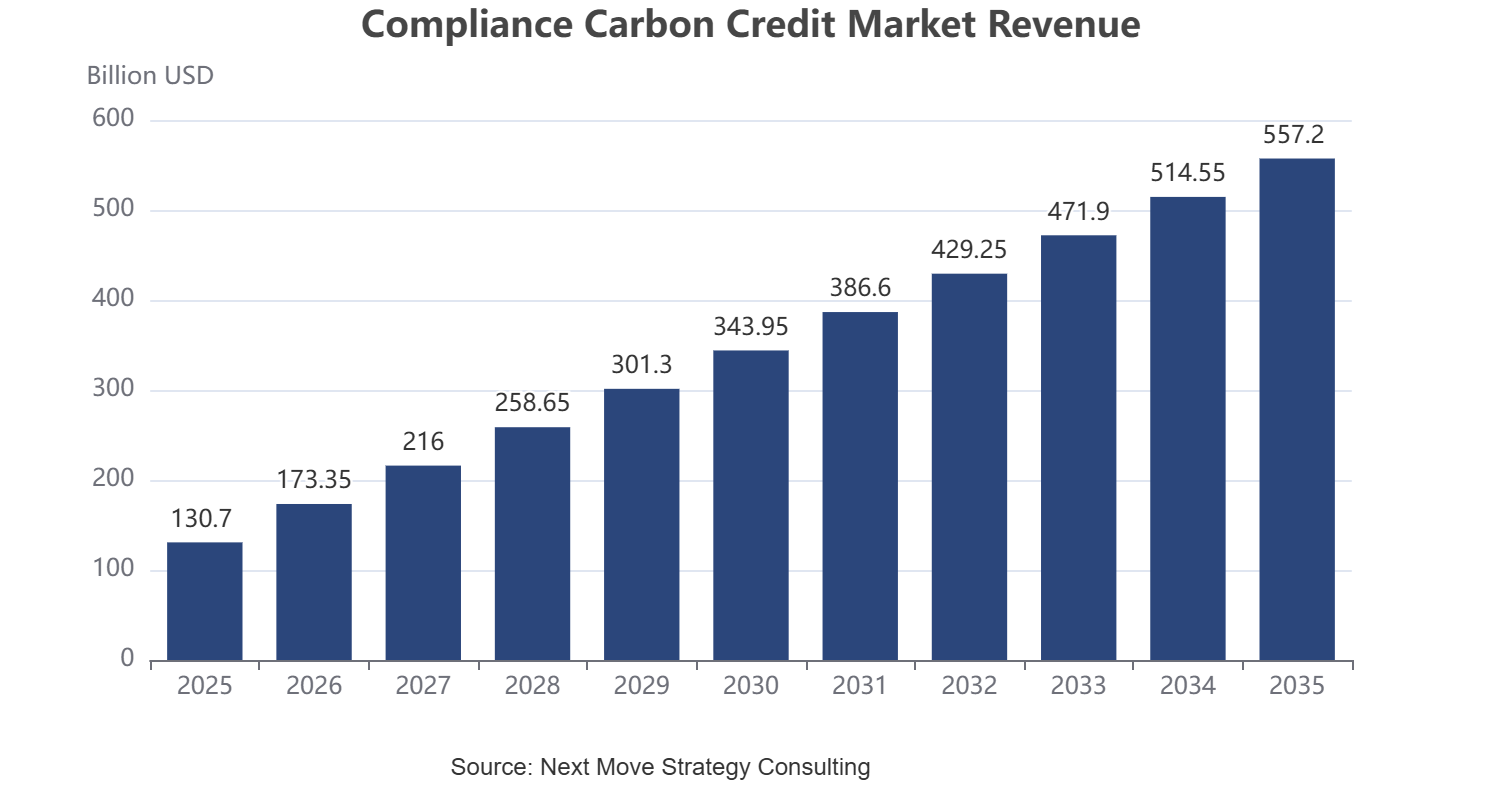
The global compliance carbon credit market size was valued at USD 130.7 billion in 2025 and is estimated at USD 151.1 billion in 2026, forecast to reach USD 557.2 billion by 2035, expanding at a 15.6% CAGR between 2026 and 2035. North America leads with approximately 34% share, while California Cap and Trade Offsets dominate all compliance regimes with approximately 22% share.
We observed that growth is broad-based across every segmentation axis, with Article 6 units and exchange-traded channels driving the sharpest structural shifts through 2035.
|
Key Takeaways |
|
By Compliance Regime: California Cap and Trade Offsets held the largest share of approximately 22% (USD 28.75 billion) in 2025; Article 6 Units is the fastest-growing sub-segment at 22.3% CAGR from 2026-2035. |
|
By Channel: Brokered OTC held the largest share of approximately 38% (USD 49.67 billion) in 2025; Exchange is the fastest-growing sub-segment at 22.0% CAGR from 2026-2035. |
|
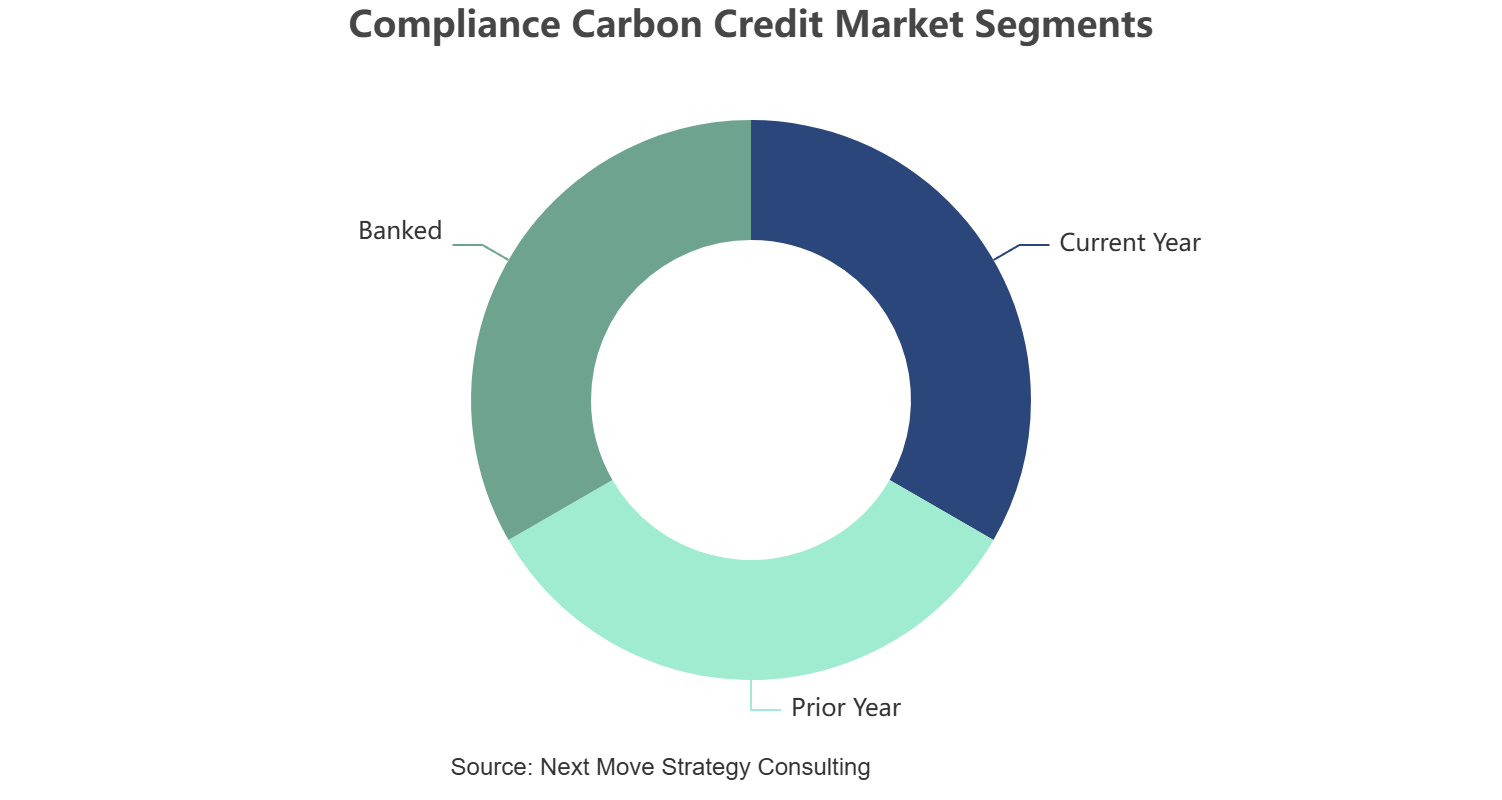
By Vintage: Current Year held the largest share of approximately 54% (USD 70.58 billion) in 2025; Banked is the fastest-growing sub-segment at 19.9% CAGR from 2026-2035. |
|
By Buyer Type: Regulated Emitter held the largest share of approximately 52% (USD 67.96 billion) in 2025; Airline is the fastest-growing sub-segment at 21.7% CAGR from 2026-2035. |
|
Dominant Region: North America dominated with approximately 34% revenue share (USD 44.44 billion) in 2025. |
|
Fastest-Growing Region: Asia-Pacific is expected to register the highest CAGR of 18.3% during 2026-2035. |
|
Dominant Country: U.S. led with approximately USD 32.00 billion in 2025. |
|
Fastest-Growing Country: India is the fastest-growing country at approximately 23.2% CAGR from 2026-2035. |
Market Opportunity: The compliance carbon credit market is expected to create an absolute dollar opportunity of USD 406.1 billion between 2026 and 2035, presenting significant investment potential across CORSIA-eligible project development, Article 6 cooperative mechanisms, and exchange-traded compliance instruments.
According to Next Move Strategy Consulting analysis, project developers and brokers are increasingly structuring multi-year forward purchase agreements with regulated buyers, a shift that favors vendors able to guarantee long-term credit supply over spot-market sellers as compliance obligations under CORSIA Phase 2 and expanding national schemes tighten credit availability through 2035.
What Does the Compliance Carbon Credit Market Encompass?
The market encompasses the generation, verification, and trading of carbon offsets and allowances that regulated entities use to meet legally binding emissions targets under government or intergovernmental compliance schemes. Our assessment indicates that the scope spans project-based offsets from California Cap and Trade, RGGI, CORSIA, Australia's ACCU Scheme, China's CCER program, and Article 6 cooperative mechanisms, transacted through direct sales, brokered over-the-counter deals, exchanges, auctions, and registries. This compliance-driven market sits distinct from voluntary carbon markets, though both draw on overlapping project categories such as forestry, methane recovery, and Renewable Energy generation.
The category has evolved from a patchwork of regional cap-and-trade programs into an increasingly interconnected system of compliance instruments. We observed that California's Air Resources Board proposed amendments in January 2026 under AB 1207 to tighten allowance budgets from 2027 onward, while China relaunched its national CCER program in January 2024 after an eight-year suspension, expanding eligible project categories to ten fields including afforestation and offshore wind. Next Move Strategy Consulting's analysis indicates that this regulatory tightening, combined with the International Civil Aviation Organization's move to mandatory CORSIA participation in Phase 2 starting 2027, is compressing available compliance credit supply and reshaping procurement strategy for regulated buyers.
Regulatory frameworks directly define market scope and eligibility across the industry. The U.S. California Air Resources Board sets auction reserve prices and offset protocols for the California-Quebec joint market, while the International Civil Aviation Organization governs CORSIA eligibility criteria that tighten between phases. We observed that technology adoption is shifting toward digital registries and blockchain-verified retirement tracking, reducing double-counting risk as Article 6.2 corresponding adjustments become a standard requirement for internationally transferred mitigation outcomes.
|
Field |
Details |
|
Market Size in 2025 |
USD 130.7 Billion |
|
Market Size in 2026 |
USD 151.1 Billion |
|
Revenue Forecast in 2035 |
USD 557.2 Billion |
|
Growth Rate |
CAGR of 15.6% from 2026 to 2035 |
|
Analysis Period |
2025-2035 |
|
Base Year Considered |
2025 |
|
Forecast Period |
2026-2035 |
|
Market Size Estimation |
USD Billion |
|
Companies Profiled |
20 |
|
Countries Covered |
33 |
|
Market Share |
Available for Top 10 Companies |
Key Emerging Trends
Based on research conducted by Next Move Strategy Consulting, we found that four structural trends are reshaping credit supply, buyer behavior, and market infrastructure across the industry.
How Is CORSIA's Transition to Mandatory Participation Reshaping Demand?
The International Civil Aviation Organization's CORSIA program is shifting from a voluntary Phase 1, covering 130 of 193 member states between 2024 and 2026, to mandatory participation in Phase 2 from 2027, adding nations including China, India, and Brazil. We observed that Climate Impact Partners facilitated the retirement of 180,000 Gold Standard credits by Shell on behalf of Japan Airlines in March 2026, an early signal of CORSIA moving from policy design into real-world compliance activity ahead of the mandatory phase.
Why Are Forward Purchase Agreements Becoming Standard Practice?
Buyers are increasingly locking in multi-year forward purchase agreements to secure credit supply as quality expectations tighten. South Pole's 2026 Carbon Market Buyer's Guide, presented by Executive Director of Certificates Marco Magini, identified securing long-term supply through multi-year agreements as a core recommendation for 2026, alongside aligning procurement with emerging integrity standards. This trend connects directly to the growing share of banked vintage credits within buyer portfolios.
How Is China's Relaunched CCER Program Transforming Regional Supply?
China's Certified Emission Reduction program, relaunched in January 2024 after an eight-year suspension, is rapidly becoming a significant source of compliance offset supply. We observed that covered entities can use CCERs from projects outside the National Carbon Market for up to 5% of verified emissions, while the 2024 expansion of China's national ETS to cement, steel, and aluminum smelting added approximately 1,500 new entities and 3 billion tons of CO2e in covered emissions, expanding downstream demand for CCER offsets.
Why Is Article 6 Implementation Accelerating International Credit Transfers?
Article 6 of the Paris Agreement is moving from framework design into operational transactions as countries complete corresponding adjustment procedures for internationally transferred mitigation outcomes. South Pole, which facilitated the world's first Article 6 transaction, continues supporting host country governments and buyers through readiness activities and pilot projects. Our findings suggest that this operationalization is unlocking a previously dormant compliance instrument category as governments and CORSIA-obligated airlines seek ITMOs to meet mitigation targets.
Regulatory Framework Impacting The Compliance Carbon Credit Market
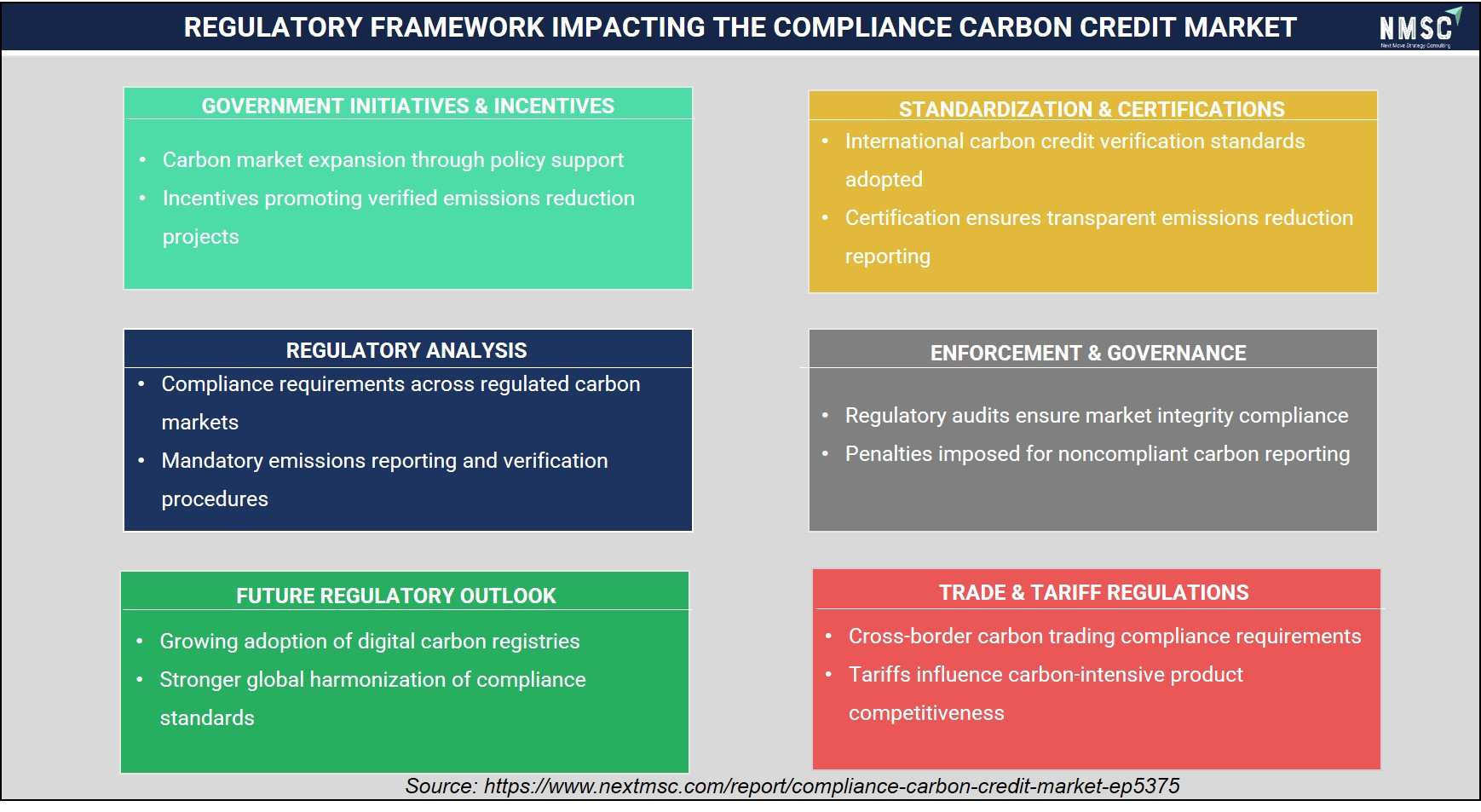
The infographic highlights the regulatory framework shaping the Market through government incentives, standardized certification, regulatory oversight, and international trade policies. Government initiatives encourage emissions reduction projects, while standardized verification frameworks enhance market transparency and credibility. Mandatory reporting, audits, and enforcement measures strengthen compliance across regulated sectors. Looking ahead, expanding digital carbon registries and greater harmonization of global compliance standards are expected to improve market efficiency, facilitate cross-border carbon trading, and support long-term market growth.
Growth Drivers and Restraints
Growth Catalyst and Risk Assessment Matrix
|
Factors |
Type |
(+/-) % Impact on CAGR |
Geographic Relevance |
Impact Timeline |
|
CORSIA transition to mandatory participation from 2027 |
Driver |
+2.4% |
Global |
2027-2035 |
|
Operationalization of Article 6 cooperative mechanisms |
Driver |
+2.0% |
Global |
2026-2035 |
|
Expansion of China's national ETS and CCER program |
Driver |
+1.7% |
Asia-Pacific |
2026-2035 |
|
Tightening allowance budgets under California AB 1207 |
Driver |
+1.1% |
North America |
2027-2032 |
|
Growth of exchange-traded compliance instrument volumes |
Driver |
+1.0% |
North America, Europe |
2026-2032 |
|
Rising forward purchase agreement adoption among buyers |
Driver |
+0.8% |
Global |
2026-2032 |
|
Credit price volatility during regime transitions |
Restraint |
-0.9% |
Asia-Pacific |
2026-2029 |
|
Tightening eligibility criteria reducing usable credit supply |
Restraint |
-0.7% |
Global |
2027-2032 |
|
Integrity and additionality scrutiny on project-based offsets |
Restraint |
-0.5% |
Global |
2026-2030 |
What Is the Primary Growth Driver of the Compliance Carbon Credit Market?
CORSIA's transition to mandatory participation from 2027 is the primary driver of the market. The International Civil Aviation Organization's framework requires 150 to 200 million credits to offset sector growth during Phase 1 alone, with eligibility criteria tightening as Phase 2 adds major aviation markets including China, India, and Brazil. We observed that this scheduled expansion, confirmed through ICAO's published phase structure, continues to anchor forward demand planning among airlines and credit suppliers alike.
How Is Article 6 Operationalization Driving Market Growth?
The operationalization of Article 6 cooperative mechanisms under the Paris Agreement is unlocking a new category of internationally transferred mitigation outcomes for compliance use. South Pole's role in facilitating the world's first Article 6 transaction demonstrates growing institutional readiness among host country governments. Our assessment indicates that this activation, combined with corresponding adjustment procedures now standard for ITMO transfers, is compressing the timeline for governments and CORSIA-obligated airlines to access this compliance instrument category.
What Is Restraining Compliance Carbon Credit Market Expansion?
Credit price volatility during regime transitions restrains predictable market growth, particularly in newly reopened or expanded schemes. China's relaunched CCER program saw credit prices rise to 107.36 yuan per ton before falling 17% to 72.81 yuan within its first trading days, according to national exchange data, reflecting the price discovery challenges typical of early-stage compliance markets. We found that this volatility, alongside tightening eligibility rules affecting project categories tied to CCUS and industrial process credits, complicates near-term procurement planning for regulated buyers.
Segmentation Analysis
Segment Sizing: By Compliance Regime
|
Segment |
2025 (USD) |
2035 (USD) |
CAGR% (2026-2035) |
|
California Cap and Trade Offsets |
USD 28.75 Billion |
USD 83.58 Billion |
11.3% |
|
RGGI Offsets |
USD 11.76 Billion |
USD 33.43 Billion |
11.0% |
|
CORSIA Eligible Units |
USD 18.30 Billion |
USD 122.58 Billion |
20.9% |
|
Australia ACCU Scheme |
USD 14.38 Billion |
USD 50.15 Billion |
13.3% |
|
China CCER |
USD 20.91 Billion |
USD 105.87 Billion |
17.6% |
|
Swiss Offset Credits |
USD 5.23 Billion |
USD 16.72 Billion |
12.3% |
|
Korea ETS Credits |
USD 6.54 Billion |
USD 27.86 Billion |
15.6% |
|
Article 6 Units |
USD 10.46 Billion |
USD 78.01 Billion |
22.3% |
|
Other Compliance Regimes |
USD 14.37 Billion |
USD 39.00 Billion |
10.5% |
|
Total |
USD 130.7 Billion |
USD 557.2 Billion |
15.6% |
Which Compliance Regime Dominates the Compliance Carbon Credit Market?
California Cap and Trade Offsets led the market with USD 28.75 billion in 2025, reflecting the maturity of the California-Quebec joint auction system and its established secondary trading infrastructure on exchanges including ICE and CME. We observed that Article 6 Units is the fastest-growing compliance regime, expanding at a 22.3% CAGR from 2026 to 2035, as governments complete corresponding adjustment procedures and international mitigation outcome transfers move from framework design into operational transactions.
Segment Sizing: By Channel
|
Segment |
2025 (USD) |
2035 (USD) |
CAGR% (2026-2035) |
|
Direct Sale |
USD 20.91 Billion |
USD 78.01 Billion |
14.1% |
|
Brokered OTC |
USD 49.67 Billion |
USD 172.73 Billion |
13.3% |
|
Exchange |
USD 18.30 Billion |
USD 133.73 Billion |
22.0% |
|
Auction |
USD 23.53 Billion |
USD 94.72 Billion |
14.9% |
|
Marketplace |
USD 11.76 Billion |
USD 55.72 Billion |
16.8% |
|
Registry Transfer |
USD 6.53 Billion |
USD 22.29 Billion |
13.1% |
|
Total |
USD 130.7 Billion |
USD 557.2 Billion |
15.6% |
Which Channel Leads Compliance Carbon Credit Market Transactions?
Brokered OTC transactions remained the leading channel, valued at USD 49.67 billion in 2025, reflecting the customized, relationship-driven nature of large-volume compliance credit deals between project developers and regulated buyers. Our findings suggest that Exchange is the fastest-growing channel, registering a 22.0% CAGR from 2026 to 2035, as compliance instruments increasingly trade on formalized platforms including ICE, CME, and Nodal Exchange, improving price transparency and settlement efficiency for market participants.
Segment Sizing: By Buyer Type
|
Segment |
2025 (USD) |
2035 (USD) |
CAGR% (2026-2035) |
|
Regulated Emitter |
USD 67.96 Billion |
USD 245.17 Billion |
13.7% |
|
Airline |
USD 11.76 Billion |
USD 83.58 Billion |
21.7% |
|
Trader |
USD 24.83 Billion |
USD 117.01 Billion |
16.8% |
|
Government |
USD 10.46 Billion |
USD 44.58 Billion |
15.6% |
|
Corporate Buyer |
USD 15.69 Billion |
USD 66.86 Billion |
15.6% |
|
Total |
USD 130.7 Billion |
USD 557.2 Billion |
15.6% |
Which Buyer Type Is Growing Fastest in the Compliance Carbon Credit Market?
Regulated Emitter remained the leading buyer type, valued at USD 67.96 billion in 2025, driven by sustained compliance obligations under California Cap and Trade, RGGI, and China's national ETS. Based on research conducted by Next Move Strategy Consulting, we found that Airline is the fastest-growing buyer type, expanding at a 21.7% CAGR from 2026 to 2035, as CORSIA's mandatory Phase 2 participation from 2027 brings a substantially larger set of carriers into compliance obligations.
Growth Opportunities
Our analysis shows that three forward-looking opportunities stand out for stakeholders positioning within the market over the 2026-2035 forecast period.
How Can Article 6 Readiness Unlock Value for Project Developers?
Article 6 cooperative mechanism readiness presents a whitespace opportunity for project developers and host country governments as corresponding adjustment infrastructure matures. Firms that build early technical capability in ITMO structuring and host country negotiation stand to capture first-mover advantage as governments and CORSIA-obligated airlines increasingly seek internationally transferred mitigation outcomes to meet compliance targets through 2035.
Where Does CORSIA Phase 2 Preparation Create New Demand?
Airlines preparing for CORSIA's mandatory Phase 2 participation from 2027 represent an underpenetrated opportunity as newly obligated carriers in China, India, and Brazil enter the compliance system. Brokers and project developers that secure early forward purchase agreements with these carriers can lock in long-term offtake relationships, benefiting from recurring transaction revenue tied to aviation sector compliance growth.
How Can Digital Registry Infrastructure Benefit Market Participants?
Digital registry and verification infrastructure that reduces double-counting risk creates an opportunity for technology vendors serving compliance markets. Early movers that integrate blockchain-verified retirement tracking with national registries, including China's Beijing Green Exchange and California's CITSS system, can differentiate with brokers and corporate buyers pursuing transparent, audit-ready compliance portfolios, particularly as Sustainable Agriculture and forestry project categories scale under expanding national schemes.
Strategic Framework Of The Compliance Carbon Credit Market
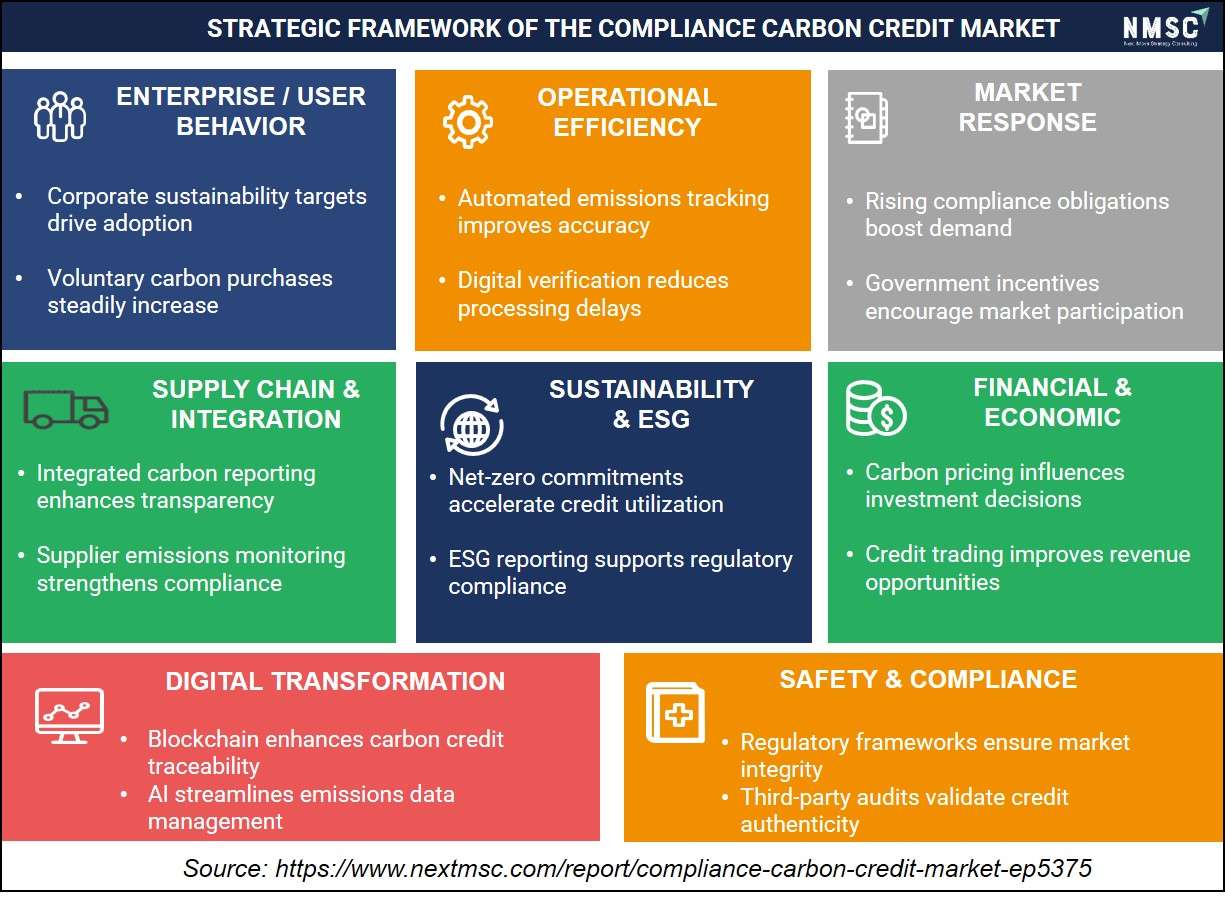
The infographic presents the strategic framework of the Market by illustrating the key factors influencing market growth and adoption. Corporate sustainability goals, ESG commitments, and increasing compliance obligations are driving demand for carbon credits, while digital technologies such as AI and blockchain improve emissions tracking, verification, and traceability. Integrated supply chain reporting, supportive government policies, and evolving carbon pricing mechanisms further strengthen market participation, enhance regulatory compliance, and create long-term financial opportunities for businesses operating in regulated carbon markets.
Regional Outlook
Geographic Performance Snapshot
|
Region |
2025 (USD) |
2035 (USD) |
CAGR% (2026-2035) |
Key Driver |
|
North America |
USD 44.44 Billion |
USD 156.02 Billion |
13.4% |
Mature California-Quebec and RGGI compliance offset infrastructure |
|
Europe |
USD 31.37 Billion |
USD 117.01 Billion |
14.1% |
Swiss offset linkage and CORSIA compliance obligations for carriers |
|
Asia-Pacific |
USD 35.29 Billion |
USD 189.45 Billion |
18.3% |
China CCER relaunch and expanding Korea ETS and Australia ACCU schemes |
|
Middle East & Africa |
USD 11.76 Billion |
USD 61.29 Billion |
18.0% |
Growing CORSIA participation and national carbon pricing pilot programs |
|
Latin America |
USD 7.84 Billion |
USD 33.43 Billion |
15.6% |
Expanding project development for CORSIA-eligible offset categories |
|
Total |
USD 130.7 Billion |
USD 557.2 Billion |
15.6% |
-- |
North America Compliance Carbon Credit Market Outlook
North America leads the market with the most mature offset infrastructure globally, anchored by the California-Quebec joint auction system and the Regional Greenhouse Gas Initiative. We observed that the California Air Resources Board's January 2026 proposed amendments under AB 1207 signal continued regulatory tightening from 2027 onward. Technology adoption remains concentrated among large regulated emitters and traders, while strategic outlook favors project developers that can navigate evolving offset protocol eligibility criteria.
Europe Compliance Carbon Credit Market Outlook
Europe's market is shaped by Swiss offset linkage arrangements and CORSIA compliance obligations affecting European carriers, even as the EU Emissions Trading System itself excludes international offsets. Our assessment indicates that European buyers increasingly source CORSIA-eligible units and Article 6 units for aviation compliance rather than domestic ETS obligations. Strategic outlook favors brokers offering integrated CORSIA and Article 6 sourcing capability for European carriers and multinational corporate buyers.
Asia-Pacific Compliance Carbon Credit Market Outlook
Asia-Pacific is the fastest-growing region in the market, propelled by China's relaunched CCER program and expanding national ETS coverage across cement, steel, and aluminum sectors. We found that Korea's ETS credits and Australia's ACCU Scheme are simultaneously scaling to serve growing regional compliance demand. Technology adoption is accelerating fastest among regulated emitters newly brought into national schemes, with strategic outlook favoring vendors that can navigate diverse national registry and verification requirements across the region.
Middle East & Africa Compliance Carbon Credit Market Outlook
The Middle East and Africa market is expanding on the back of growing CORSIA participation and early-stage national carbon pricing pilot programs across the Gulf states and broader Africa. Our findings suggest that government-led climate policy development is creating first-generation compliance demand alongside established voluntary market project development. Regulatory influence remains developing, with strategic outlook favoring project developers partnering with regional governments to build CORSIA-eligible project pipelines.
Latin America Compliance Carbon Credit Market Outlook
Latin America's market is growing alongside expanding project development for CORSIA-eligible offset categories across Brazil and Argentina. We observed that the region's substantial forestry and land use project pipeline positions it as a significant supplier to international compliance schemes. Technology adoption remains concentrated among project developers and traders given limited domestic compliance schemes, with strategic outlook favoring vendors offering strong export-oriented project origination capability.
United States Compliance Carbon Credit Market Outlook
Based on our estimates, the United States compliance carbon credit market was valued at approximately USD 32.00 billion in 2025 and is projected to reach USD 106.09 billion by 2035, expanding at a 12.7% CAGR. Demand structure is concentrated among regulated emitters under California Cap and Trade and RGGI, with adoption level the highest globally given established auction and secondary trading infrastructure. Competitive intensity is elevated, with the U.S. hosting a majority of the market's leading brokers and project developers.
Canada Compliance Carbon Credit Market Outlook
The market in Canada was valued at approximately USD 9.78 billion in 2025 and is projected to reach USD 37.44 billion by 2035, expanding at a 14.4% CAGR. Demand structure is anchored by Quebec's joint participation in the California-Quebec compliance market alongside federal carbon pricing mechanisms. Regulatory influence remains closely coordinated with California, and strategic outlook favors brokers extending U.S. compliance relationships into Canadian regulated emitter portfolios.
United Kingdom Compliance Carbon Credit Market Outlook
As per our estimate, the United Kingdom compliance carbon credit market was valued at approximately USD 7.53 billion in 2025 and is projected to reach USD 25.74 billion by 2035, expanding at a 13.1% CAGR. Demand structure is led by carriers with CORSIA compliance obligations and corporate buyers pursuing Article 6 units. Technology penetration remains strong given London's role as a global carbon trading and brokerage hub, and strategic outlook favors vendors with established local exchange connectivity.
Germany Compliance Carbon Credit Market Outlook
According to our analysis, the German compliance carbon credit market was valued at approximately USD 6.27 billion in 2025 and is projected to reach USD 22.23 billion by 2035, expanding at a 13.5% CAGR. Demand structure is concentrated among CORSIA-obligated carriers and multinational corporate buyers pursuing Article 6 units. Regulatory influence from EU climate policy shapes vendor selection, and strategic outlook favors platforms supporting integrated CORSIA and Article 6 sourcing.
France Compliance Carbon Credit Market Outlook
Based on our estimates, the French compliance carbon credit market was valued at approximately USD 4.39 billion in 2025 and is projected to reach USD 16.38 billion by 2035, expanding at a 14.1% CAGR. Demand structure spans CORSIA-obligated carriers and government buyers navigating national climate commitments. Technology adoption is growing steadily among corporate buyers, and strategic outlook favors brokers partnering with regional project developers for Article 6 sourcing.
China Compliance Carbon Credit Market Outlook
The market in China was valued at approximately USD 14.82 billion in 2025 and is projected to reach USD 75.78 billion by 2035, expanding at a 17.7% CAGR. Demand structure is dominated by regulated emitters newly covered under the expanded national ETS, including cement, steel, and aluminum smelting entities. Competitive intensity features strong domestic CCER project development, and strategic outlook favors vendors capable of navigating China's distinct registry and verification environment.
India Compliance Carbon Credit Market Outlook
As per our estimate, the Indian compliance carbon credit market was valued at approximately USD 3.53 billion in 2025 and is projected to reach USD 28.42 billion by 2035, the fastest-growing country in this report at a 23.2% CAGR. Demand structure is led by regulated emitters entering compliance obligations as India's national carbon market framework matures and CORSIA Phase 2 brings Indian carriers into mandatory participation. Technology adoption is accelerating rapidly as domestic registry infrastructure scales.
Japan Compliance Carbon Credit Market Outlook
According to our analysis, the Japanese compliance carbon credit market was valued at approximately USD 5.65 billion in 2025 and is projected to reach USD 26.52 billion by 2035, expanding at a 16.7% CAGR. Demand structure is concentrated among CORSIA-obligated carriers, exemplified by Japan Airlines' March 2026 retirement of 180,000 Gold Standard credits facilitated by Climate Impact Partners. Regulatory influence remains moderate, and strategic outlook favors brokers offering established CORSIA-eligible project sourcing.
South Korea Compliance Carbon Credit Market Outlook
Based on our estimates, the South Korean compliance carbon credit market was valued at approximately USD 4.94 billion in 2025 and is projected to reach USD 24.63 billion by 2035, expanding at a 17.4% CAGR. Demand structure is led by regulated emitters under Korea's ETS scaling compliance offset procurement. Competitive intensity is rising as domestic and international brokers expand presence, and strategic outlook favors platforms supporting both KCU and KOC credit categories.
Australia Compliance Carbon Credit Market Outlook
The market in Australia was valued at approximately USD 4.23 billion in 2025 and is projected to reach USD 18.95 billion by 2035, expanding at a 16.2% CAGR. Demand structure spans regulated emitters and corporate buyers sourcing Australian Carbon Credit Units across vegetation, soil carbon, and savanna fire management categories. Technology penetration is high relative to other Asia-Pacific markets, and strategic outlook favors vendors with established ACCU registry integration.
UAE Compliance Carbon Credit Market Outlook
As per our estimate, the UAE compliance carbon credit market was valued at approximately USD 3.53 billion in 2025 and is projected to reach USD 17.16 billion by 2035, expanding at a 17.1% CAGR. Demand structure is concentrated among CORSIA-obligated carriers and government buyers driving national climate commitments. Competitive intensity is rising as global brokers establish regional partnerships, and strategic outlook favors platforms supporting Arabic-language interfaces and regional compliance requirements.
Saudi Arabia Compliance Carbon Credit Market Outlook
According to our analysis, the Saudi Arabian compliance carbon credit market was valued at approximately USD 3.06 billion in 2025 and is projected to reach USD 16.55 billion by 2035, expanding at an 18.4% CAGR. Demand structure is driven by Vision 2030-linked climate commitments across government and industrial sectors. Technology adoption is accelerating as national carbon market infrastructure develops, and strategic outlook favors vendors partnering with domestic institutions for large-scale project origination.
South Africa Compliance Carbon Credit Market Outlook
Based on our estimates, the South African compliance carbon credit market was valued at approximately USD 1.53 billion in 2025 and is projected to reach USD 7.97 billion by 2035, expanding at an 18.0% CAGR. Demand structure is led by regulated emitters under the national carbon tax offset allowance provisions. Regulatory influence remains developing, and strategic outlook favors vendors extending European delivery teams to support South African project developers.
Brazil Compliance Carbon Credit Market Outlook
The market in Brazil was valued at approximately USD 3.76 billion in 2025 and is projected to reach USD 15.38 billion by 2035, expanding at a 15.1% CAGR. Demand structure is concentrated among project developers supplying forestry and land use offsets to international compliance schemes. Technology penetration continues to rise as national carbon market legislation advances, and strategic outlook favors vendors offering Portuguese-language support and strong forestry project origination capability.
Argentina Compliance Carbon Credit Market Outlook
As per our estimate, the Argentine compliance carbon credit market was valued at approximately USD 1.41 billion in 2025 and is projected to reach USD 6.35 billion by 2035, expanding at a 16.2% CAGR. Demand structure spans project developers and traders supplying offset categories to international buyers amid limited domestic compliance schemes. Competitive intensity remains modest relative to Brazil, and strategic outlook favors vendors entering through regional partnerships and multi-country Latin American origination strategies.
Competitive Landscape
We observed that the compliance carbon credit market features a diverse competitive landscape, with global project developers and brokers, regional specialists, and state-owned asset managers competing across distinct compliance regimes and geographies.
|
Dimension |
Description |
|
Market Structure |
Fragmented across regime specialists; the top companies profiled in this report collectively account for a significant share of global project development and brokerage activity, while numerous regional and country-specific firms serve local compliance needs. |
|
Innovation Focus |
Digital registry integration, Article 6 readiness advisory, and integrity-focused project verification dominate current innovation pipelines across leading vendors. |
|
M&A Activity |
Continued consolidation among project developers and brokers as firms build multi-regime capability spanning California, RGGI, CORSIA, and Article 6 mechanisms to serve multinational corporate and airline buyers. |
How Do Companies Compete in the Compliance Carbon Credit Market?
Companies compete primarily on multi-regime project origination breadth, registry integration depth, and buyer advisory capability across the industry. Global consultancies such as South Pole and Climate Impact Partners leverage broad regulatory expertise spanning CORSIA, Article 6, and national schemes to serve multinational corporate and airline buyers, while state-owned asset managers such as Huaneng Carbon Asset Management and China Datang compete on scale within China's national ETS and CCER program.
Which Competitive Archetypes Dominate the Compliance Carbon Credit Market?
Two archetypes dominate the market: global carbon market consultancies offering integrated advisory, project development, and trading capability, and regional specialists focused on a single compliance regime or geography. South Pole, Climate Impact Partners, and Anew Climate exemplify the diversified archetype through multi-regime project portfolios, while GreenCollar, Carbon Tanzania, and BioCarbon Partners exemplify the specialized archetype serving specific national schemes or project geographies.
How Are Companies Differentiating Through Innovation in Compliance Carbon Credits?
Innovation and differentiation strategy increasingly center on Article 6 readiness and integrity-focused verification. South Pole's role in facilitating the world's first Article 6 transaction and ClimeCo's Digital Carbon Solutions offering, which won the Sustainable Innovation Award at the 2026 SEAL Business Sustainability Awards, both extend beyond traditional project brokerage. Our analysis shows that vendors unable to demonstrate credible corresponding adjustment and registry integration capability risk exclusion from multinational buyer shortlists as integrity scrutiny intensifies.
What M&A and Expansion Activity Is Shaping the Compliance Carbon Credit Market?
Mergers, acquisitions, and platform expansion continue to consolidate capabilities within the industry as firms build multi-regime coverage. ClimeCo's strategic collaboration with Greenly and its partnership with Offset AI to help organizations measure and offset AI-related environmental footprints exemplify how established brokers are expanding service scope. Our findings suggest that this expansion activity reflects growing customer demand for unified advisory across an increasingly complex set of overlapping compliance regimes.
Key Market Players
Our assessment indicates that the following 20 companies are actively shaping project origination, brokerage, and compliance advisory strategy within the global compliance carbon credit market.
-
Climate Impact Partners
-
GreenCollar
-
Anew Climate, LLC
-
ClimeCo, LLC
-
First Climate AG
-
Finite Carbon
-
EcoSecurities
-
Huaneng Carbon Asset Management Co., Ltd.
-
China Datang Green and Low Carbon Development Co., Ltd.
-
CECEP Assets Management Co., Ltd.
-
ALLCOT Group
-
Respira International Ltd
-
Tasman Environmental Markets Pty Ltd
-
Native, A Public Benefit Corporation
-
EcoAct
-
Carbon Tanzania
-
BioCarbon Partners
-
ClimatePartner
-
myclimate foundation
Latest Developments
We found that recent regulatory and market developments within the compliance carbon credit market are concentrated on CORSIA implementation and national scheme expansion, reflecting the industry's broader shift toward mandatory compliance activity.
|
Date |
Event |
|
December 2025 |
The California Air Resources Board posted the 2026 Annual Auction Reserve Price Notice, setting the auction floor at USD 27.94 per allowance for the California-Quebec joint market. |
Investment Opportunities
What Capital Inflows Are Targeting the Compliance Carbon Credit Market?
Capital inflows into the compliance carbon credit market are increasingly directed toward Article 6 readiness and multi-regime project origination platforms. Strategic buyers and advisory firms continue to fund project pipeline expansion, as seen in ClimeCo's partnerships extending its Digital Carbon Solutions and Offset AI offerings. We observed that investors favor project developers demonstrating credible corresponding adjustment capability and multi-regime eligibility, viewing these attributes as a proxy for durable long-term offtake agreements.
How Is Infrastructure Investment Supporting Compliance Market Scaling?
Infrastructure investment is expanding registry, verification, and auction platform capacity to support growing compliance transaction volumes. The California Air Resources Board's CITSS registry and China's Beijing Green Exchange both continue to scale technical infrastructure to accommodate rising participant counts following national scheme expansions. Our findings suggest that similar registry investment is underway across Article 6 host countries as corresponding adjustment infrastructure becomes a prerequisite for internationally transferred mitigation outcome transactions.
What ESG Considerations Are Shaping Compliance Carbon Credit Investment Decisions?
Environmental, social, and governance considerations are central to the compliance carbon credit market by definition, as integrity and additionality scrutiny directly determine credit eligibility and value. We found that South Pole's 2026 guidance highlighted alignment with emerging integrity standards as essential to buyer strategy, an approach consistent with the broader Green Technology and Sustainability push toward verified co-benefit reporting, as project categories spanning forestry, methane recovery, and agriculture increasingly require documented emissions reduction claims to satisfy both regulatory eligibility and corporate ESG disclosure requirements.
Key Benefits for Stakeholders
How Does This Report Benefit Enterprise and Industry Leaders?
Enterprise and industry leaders gain access to validated segmentation, competitive benchmarking, and regional demand forecasts that support compliance procurement decisions across the carbon credit industry. Our analysis shows that detailed compliance regime, channel, and buyer type breakdowns help procurement and sustainability leaders align sourcing strategy with regulatory exposure while identifying underserved regime categories, such as Article 6 units, for near-term portfolio diversification.
How Does This Report Benefit Investors and Financial Analysts?
Investors and financial analysts benefit from consistent, single-point market size and CAGR estimates that support valuation and capital-allocation decisions across the compliance carbon credit market's project developer and broker landscape. We observed that the report's regional and segment-level growth differentials help identify which compliance regime categories, including CORSIA eligible units and Article 6 units, are best positioned to capture above-market growth through 2035.
How Does This Report Benefit Technology Vendors and Product Teams?
Technology vendors and product teams gain insight into emerging buyer requirements, including digital registry integration, corresponding adjustment tracking, and multi-regime eligibility verification, that are reshaping the industry. Our findings suggest that this analysis helps product teams prioritize development roadmaps around Article 6 and CORSIA compliance tooling that are increasingly decisive in broker and corporate buyer procurement processes.
Key Market Segments
By Compliance Regime
-
California Cap and Trade Offsets
-
Forest
-
U.S. Forest
-
Urban Forest
-
-
Livestock Methane
-
Ozone Depleting Substances
-
Mine Methane
-
Rice
-
Other
-
-
RGGI Offsets
-
Landfill Methane
-
SF6
-
Energy Efficiency
-
Forestry
-
Manure Management
-
Other
-
-
CORSIA Eligible Units
-
Forestry and Land Use
-
Renewable Energy
-
Waste
-
Household Devices
-
Industrial Processes
-
Other
-
-
Australia ACCU Scheme
-
Vegetation
-
Soil Carbon
-
Savanna Fire Management
-
Agriculture and Waste
-
Industrial Fugitive
-
Other
-
-
China CCER
-
Renewable Energy
-
Forestry
-
Methane Recovery
-
Energy Efficiency
-
Other
-
-
Swiss Offset Credits
-
Domestic
-
International
-
Other
-
-
Korea ETS Credits
-
KCU
-
KOC
-
Other
-
-
Article 6 Units
-
ITMOs
-
Paris Agreement Credits
-
Other
-
-
Other Compliance Regimes
By Channel
-
Direct Sale
-
Brokered OTC
-
Exchange
-
Auction
-
Marketplace
-
Registry Transfer
By Vintage
-
Current Year
-
Prior Year
-
Banked
By Buyer Type
-
Regulated Emitter
-
Airline
-
Trader
-
Government
-
Corporate Buyer
By Region
-
North America: U.S., Canada, Mexico.
-
Europe: UK, Germany, France, Italy, Spain, Sweden, Denmark, Finland, Netherlands, Rest of Europe.
-
Asia-Pacific: China, India, Japan, South Korea, Taiwan, Indonesia, Vietnam, Australia,, Philippines, Malaysia, Rest of APAC.
-
Middle East & Africa: Saudi Arabia, UAE, Egypt, Israel, Turkey, Nigeria, South Africa, Rest of MEA.
-
Latin America: Brazil, Argentina, Chile, Colombia, Rest of LATAM.
Conclusion & Recommendations
What Is the Long-Term Outlook for the Compliance Carbon Credit Market?
The long-term outlook for the compliance carbon credit market is strongly positive, with the industry forecast to more than triple from USD 151.1 billion in 2026 to USD 557.2 billion by 2035. Our assessment indicates that this growth will be driven by CORSIA's transition to mandatory participation and the operationalization of Article 6 cooperative mechanisms. Vendors that build multi-regime origination and advisory capability are best positioned to capture the market's long-term trajectory.
What Strategic Positioning Should Vendors Pursue?
Vendors should pursue strategic positioning around Article 6 readiness and integrity-focused verification rather than single-regime brokerage alone. Next Move Strategy Consulting's analysis indicates that firms combining corresponding adjustment expertise, digital registry integration, and multi-regime eligibility verification will differentiate most clearly as buyers consolidate advisory relationships. Strategic partnerships with host country governments and national registries will further strengthen origination reach.
How Attractive Is the Compliance Carbon Credit Market for New Investment?
The compliance carbon credit industry presents an attractive investment case, supported by a USD 406.1 billion absolute dollar opportunity between 2026 and 2035 and above-average growth in Asia-Pacific and Article 6 unit categories. We found that investment attractiveness is highest for vendors combining multi-regime project origination with Article 6 and CORSIA advisory capability, positioning them to serve both established regulated emitters and newly obligated CORSIA Phase 2 airlines simultaneously.
What Market Shifts and Key Risks Should Stakeholders Monitor?
Stakeholders should monitor credit price volatility during regime transitions, tightening eligibility criteria, and integrity scrutiny on project-based offsets as key risks to the compliance carbon credit market. Our analysis shows that vendors unable to demonstrate clear additionality and verification rigor risk losing buyer confidence, particularly as corporate and government buyers increasingly align procurement with emerging integrity standards.
What Are the Key Growth Pathways for the Compliance Carbon Credit Market?
Key growth pathways include scaling Article 6 readiness advisory, deepening CORSIA Phase 2 preparation for newly obligated carriers, and expanding digital registry integration across national schemes. Next Move Strategy Consulting's analysis indicates that vendors pursuing these pathways while maintaining integrity-focused verification standards will be best positioned to capture the compliance carbon credit market's projected growth through 2035.
About the Author
 Liza Phukan
— Liza Phukan is Research Associate at Next Move Strategy Consulting, where she has covered emerging industries and market research across sectors for 3.5 years. Her work includes analyzing industry developments, validating market data, and developing structured business content from research findings. She uses secondary research and data-validation practices to turn complex market information into clear decision-useful market analysis for business audiences and support report development and B2B.
Liza Phukan
— Liza Phukan is Research Associate at Next Move Strategy Consulting, where she has covered emerging industries and market research across sectors for 3.5 years. Her work includes analyzing industry developments, validating market data, and developing structured business content from research findings. She uses secondary research and data-validation practices to turn complex market information into clear decision-useful market analysis for business audiences and support report development and B2B.
About the Reviewer
 Supradip Baul
— Supradip Baul is an accomplished business consultant and strategist with over a decade of rich experience in market intelligence, strategy, technology, and business transformation. His work has included rigorous qualitative and quantitative analysis across multiple industries, helping clients shape investment decisions and long-term roadmaps. Earlier in his career, he was associated with Gartner, where he contributed to industry-leading reports and market share analyses. He has worked with leading global companies and holds an MBA with a dual specialization in Marketing and Finance.
Supradip Baul
— Supradip Baul is an accomplished business consultant and strategist with over a decade of rich experience in market intelligence, strategy, technology, and business transformation. His work has included rigorous qualitative and quantitative analysis across multiple industries, helping clients shape investment decisions and long-term roadmaps. Earlier in his career, he was associated with Gartner, where he contributed to industry-leading reports and market share analyses. He has worked with leading global companies and holds an MBA with a dual specialization in Marketing and Finance.
At Next Move Strategy Consulting, we understand that insightful market research is the cornerstone of successful business decisions. That's why we employ a robust and multifaceted approach, combining various methodologies to deliver the most accurate and actionable data for our clients.

Research Landscape
We navigate the world of research with two primary approaches:
Qualitative Approach
Our qualitative research methodologies involve immersive techniques such as in-depth interviews, focus groups, and observational studies. By engaging directly with individuals and stakeholders, we uncover valuable insights that quantitative data alone may overlook.

Quantitative Research
In tandem with qualitative methodologies, NMSC leverages the power of Quantitative Research to provide a robust foundation of numerical insights. Through systematic data collection and analysis, we quantify patterns, preferences, and market trends, offering a comprehensive view of the business landscape.
Our quantitative research approach employs diverse tools, including surveys, experiments, and statistical modelling. These methodologies enable us to gather data from a large and representative sample, ensuring the statistical significance of our findings. By employing structured questionnaires and standardized data collection methods, we guarantee the reliability and validity of the information we present to our clients.
Quantitative research is particularly effective in measuring the prevalence of trends, assessing market size, and gauging the impact of various factors on consumer behavior. The numerical precision attained through this approach equips our clients with actionable insights, facilitating data-driven decision-making and strategy formulation.


Our Specialized Toolbox for Industry-Specific Market Research
We deploy a specialized arsenal of techniques tailored to meet your unique requirements. Here's a glimpse into our comprehensive toolbox:

Information Procurement
The stage entails acquiring market data or relevant information through various sources and methodologies.


Market Research Approach
We utilize both top-down and bottom-up approaches in market research analysis to achieve a comprehensive understanding of the market dynamics, leveraging the broad perspective of industry trends and macroeconomic factors alongside detailed insights from specific segments and individual companies.

Porters Five Forces Analysis
We conduct Porter's Five Forces analysis to evaluate the competitive landscape of an industry, providing us with insights into factors that affect profitability and strategic positioning.

SWOT Analysis

Forecasting
We utilize a forecasting model to predict future consumption by considering parameters like population, economics, regulations, market competition, drivers, constraints, technology, and pricing. We also employ statistical techniques such as multilinear regression, exponential smoothing, moving average, ARIMA, and Monte Carlo simulations for accurate predictions. In econometric forecasting, we analyzed short-term and long-term event impacts, attributing values based on regulatory frameworks, economic factors, and market events.





 Speak to Our Analyst