Container Based Network Defense Market Size, Share, Trends and Growth Analysis, By Security Layer (Runtime Protection, Image Scanning and Vulnerability Management, Network Segmentation and Microsegmentation, Kubernetes Admission Control, and Compliance and Configuration Management), By End User Industry (BFSI, IT and Telecom, Healthcare, Retail and E-commerce, Government, and Manufacturing), By Organization Size, and Region — Global Industry Report and Forecast, 2026-2035
Industry: ICT & Media | Publishing Date: August 5, 2026 | Last Updated: August 5, 2026 | No of Pages: N/A | No. of Tables: N/A | No. of Figures: N/A | Format: PDF | Report Code: IC5595
What Is the Container Based Network Defense Market Size?
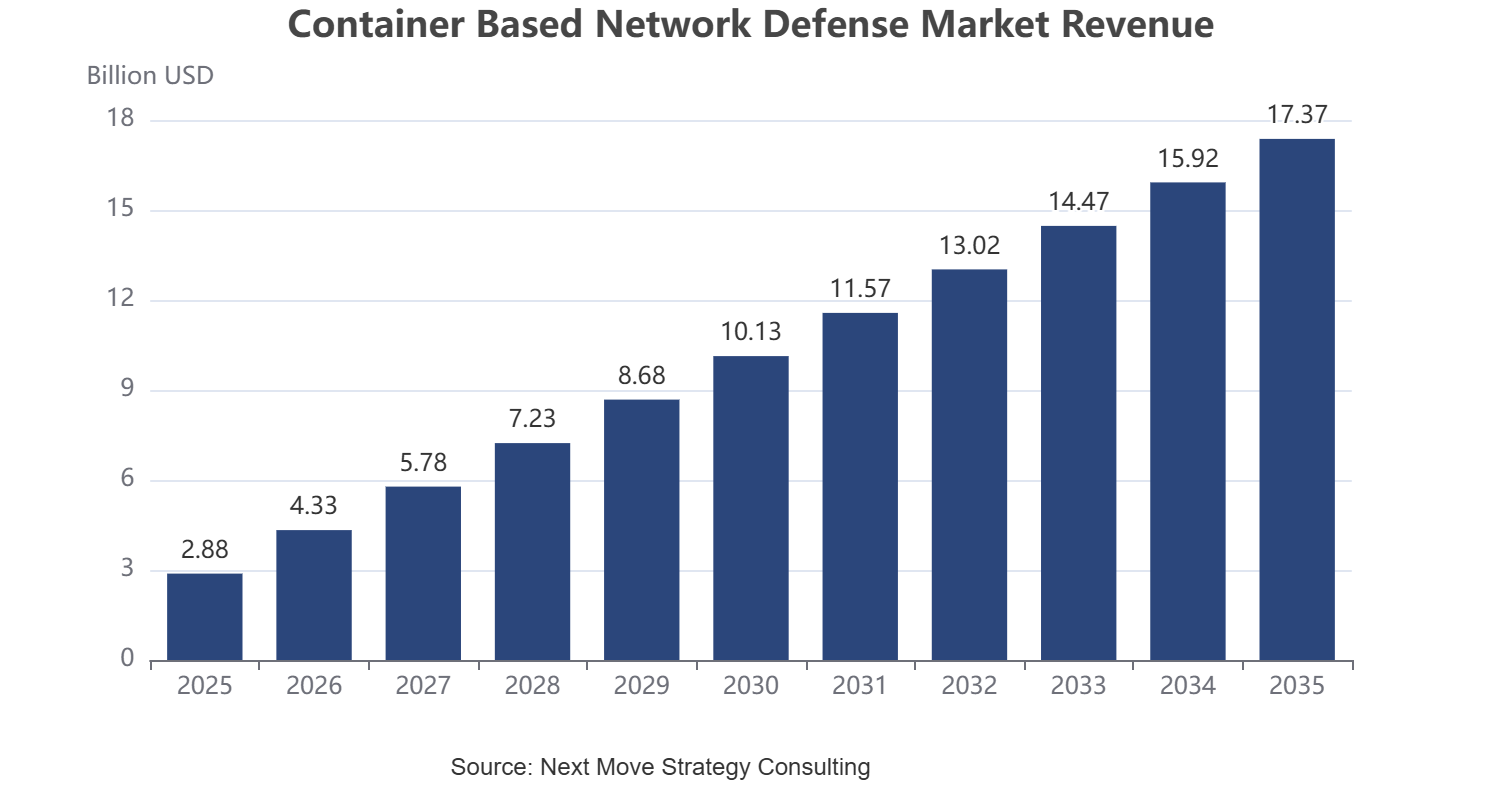
The global container-based network defense market size was valued at USD 2.88 billion in 2025 and is estimated at USD 3.55 billion in 2026, forecast to reach USD 17.37 billion by 2035, expanding at a 19.3% CAGR between 2026 and 2035. North America leads with approximately 44% share, while Runtime Protection dominates all other security layers with approximately 30% share.
We observed that the growth is broad-based across every segmentation axis, with Kubernetes admission control adoption and small and medium enterprise uptake driving the dominant structural shifts through 2035.
|
Key Takeaways |
|
By Security Layer: Runtime Protection held the largest share of approximately 30% (USD 0.86 billion) in 2025; Kubernetes Admission Control is the fastest-growing sub-segment at 23.4% CAGR from 2026-2035. |
|
By End User Industry: BFSI held the largest share of approximately 28% (USD 0.81 billion) in 2025; Retail and E-commerce is the fastest-growing sub-segment at 21.1% CAGR from 2026-2035. |
|
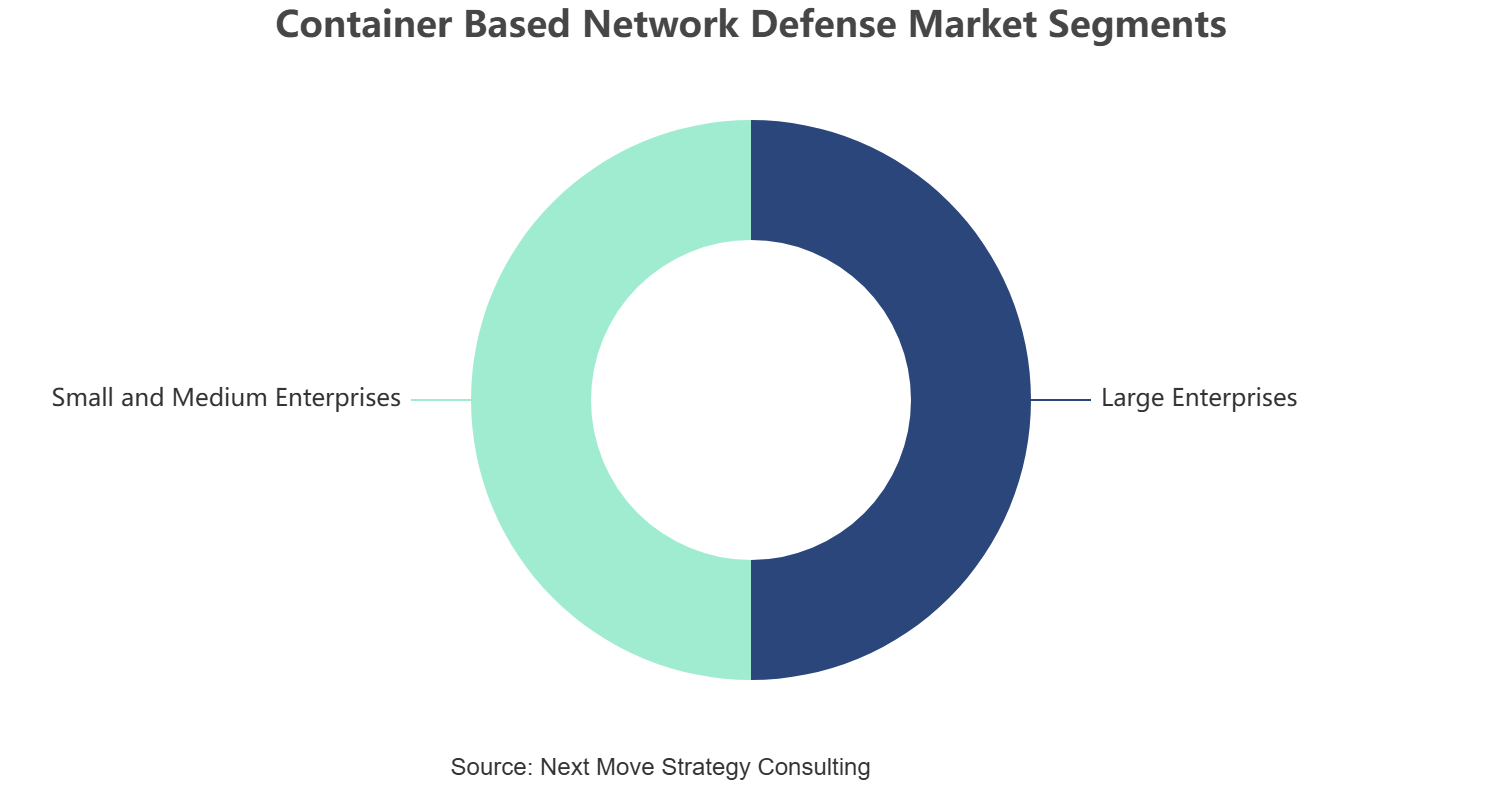
By Organization Size: Large Enterprises held the largest share of approximately 72% (USD 2.07 billion) in 2025; Small and Medium Enterprises is the fastest-growing sub-segment at 23.4% CAGR from 2026-2035. |
|
Dominant Region: North America dominated with approximately 44% revenue share (USD 1.27 billion) in 2025. |
|
Fastest-Growing Region: Asia-Pacific is expected to register the highest CAGR of 23.5% during 2026-2035. |
|
Dominant Country: U.S. led with approximately USD 1.05 billion in 2025. |
|
Fastest-Growing Country: India is the fastest-growing country at approximately 30.3% CAGR from 2026-2035. |
Market Opportunity: The container based network defense market is expected to create an absolute dollar opportunity of USD 13.82 billion between 2026 and 2035, presenting significant investment potential across the Kubernetes-native runtime protection and microsegmentation value chain.
According to Next Move Strategy Consulting analysis, platform vendors are increasingly consolidating image scanning, runtime protection, and network policy enforcement into unified cloud-native application protection platforms, a shift that favors integrated CNAPP providers over single-function point solutions as enterprises seek to reduce tool sprawl across expanding Kubernetes estates through 2035.
What Does the Container Based Network Defense Market Encompass?
The container based network defense market encompasses software platforms and services that secure containerized workloads and Kubernetes clusters against network-based threats, misconfigurations, and runtime attacks across the container lifecycle. Our assessment indicates that the scope spans image scanning, runtime protection, network segmentation, and admission control distributed to BFSI, IT and telecom, healthcare, and retail buyers of varying organization size. The category has evolved from bolt-on vulnerability scanning into integrated, runtime-enforced defense embedded across the DevSecOps pipeline, closely intersecting with the broader cloud workload protection platform software ecosystem worldwide.
Regulatory frameworks such as the U.S. National Institute of Standards and Technology's container security guidelines and the European Union's NIS2 Directive shape enterprise adoption, while sector-specific compliance mandates increasingly influence deployment architecture. We observed that technology adoption is shifting toward eBPF-powered runtime enforcement and identity-aware microsegmentation that reduces reliance on legacy perimeter firewalls. Next Move Strategy Consulting's analysis indicates that this structural shift, combined with expanding Kubernetes production deployment, is redefining sourcing criteria across the container based network defense market.
|
Parameters |
Details |
|
Market Size in 2025 |
USD 2.88 Billion |
|
Market Size in 2026 |
USD 3.55 Billion |
|
Revenue Forecast in 2035 |
USD 17.37 Billion |
|
Growth Rate |
CAGR of 19.3% from 2026 to 2035 |
|
Analysis Period |
2025–2035 |
|
Base Year Considered |
2025 |
|
Forecast Period |
2026–2035 |
|
Market Size Estimation |
USD Billion |
|
Companies Profiled |
20 |
|
Countries Covered |
33 |
|
Market Share |
Available for Top 10 Companies |
Key Emerging Trends
Based on research conducted by Next Move Strategy Consulting, we found that four structural trends are reshaping product development, sourcing, and stakeholder engagement across the industry.
How Is AI-Driven Cloud Security Analysis Transforming Threat Triage?
AI-driven cloud security analysts are transforming how security teams triage container and Kubernetes threats at scale. We observed that Sysdig introduced Sysdig Sage, an AI cloud security analyst capable of multistep reasoning, alongside expanded AI workload security capabilities. Enterprises are adopting these tools to reduce mean-time-to-response for runtime alerts, extending into broader cloud security posture management workflows spanning configuration, identity, and workload risk.
Why Is Agentless Multi-Cloud Visibility Gaining Traction?
Agentless scanning that delivers rapid multi-cloud container visibility without deployment overhead is gaining share as enterprises manage sprawling Kubernetes estates across multiple cloud providers. Our findings suggest that Wiz's agentless approach, which the company positions as delivering thorough visibility within hours of deployment, exemplifies this shift toward low-friction onboarding. Vendors are expanding agentless scanning depth, positioning rapid time-to-value as a core differentiator within the broader market segmentation structure.
How Is Platform Consolidation Reshaping Vendor Selection?
Platform consolidation into unified cloud-native application protection platforms is reshaping enterprise vendor selection away from best-of-breed point tools. We observed that Google's 2026 acquisition of Wiz for approximately USD 32 billion reflects the scale of strategic investment flowing into consolidated cloud-native security platforms. This trend is elevating demand for integrated scanning, runtime, and identity capability among enterprises seeking to reduce vendor sprawl across their container estates.
What Role Does eBPF-Powered Runtime Enforcement Play in Container Defense Innovation?
eBPF-powered runtime enforcement is emerging as a differentiator as vendors seek kernel-level visibility without the performance overhead of traditional agents. Our analysis shows that AccuKnox's eBPF-based runtime defense and dynamic zero-trust policy enforcement exemplifies this direction for compliance-sensitive workloads. This trend is elevating demand for low-overhead, kernel-native enforcement among enterprises running latency-sensitive containerized applications at scale.
Ecosystem Analysis of the Container Based Network Defense Market
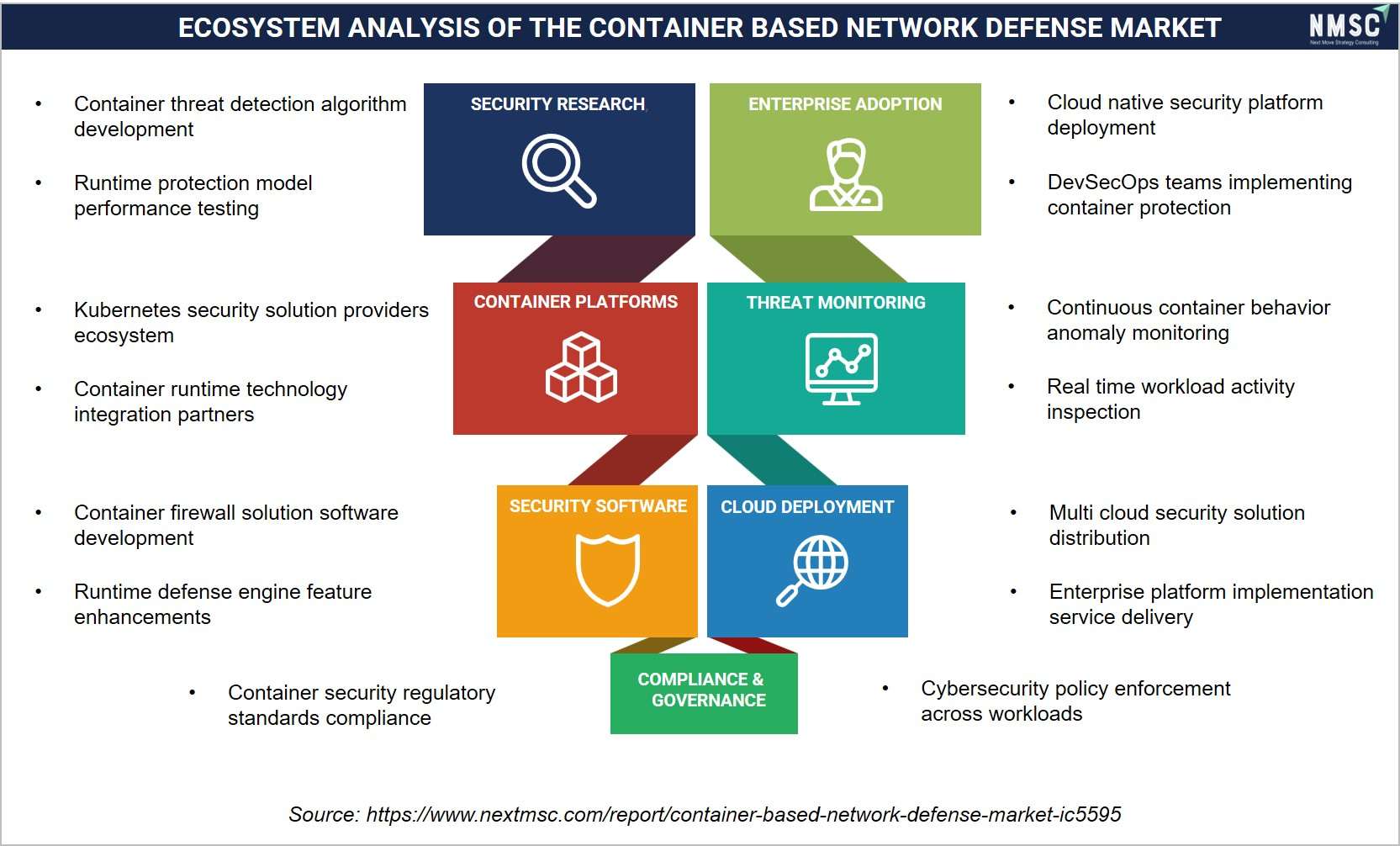
The ecosystem of the container-based network defense market comprises security research organizations, container platform providers, cloud service providers, cybersecurity software vendors, and enterprise adopters. Threat monitoring solutions, cloud-native security technologies, and compliance frameworks work together to strengthen containerized environments. Collaboration among technology providers, managed security service providers, and regulatory bodies fosters continuous innovation, improves threat detection capabilities, and accelerates secure adoption of containerized applications across diverse industries.
Growth Drivers and Restraints
Growth Catalyst and Risk Assessment Matrix
|
Factors |
Type |
(+/-) % Impact on CAGR |
Geographic Relevance |
Impact Timeline |
|
Expanding Kubernetes production deployment across enterprises |
Driver |
+4.1% |
Global |
2026–2035 |
|
Rising container-related security incident frequency |
Driver |
+3.0% |
North America, Europe |
2026–2035 |
|
Regulatory compliance mandates for cloud workload security |
Driver |
+2.2% |
North America, Europe |
2026–2032 |
|
Growing multi-cloud and hybrid cloud infrastructure adoption |
Driver |
+1.7% |
Global |
2026–2035 |
|
Expanding DevSecOps integration in software delivery pipelines |
Driver |
+1.3% |
Global |
2026–2035 |
|
Platform consolidation reducing point-solution vendor demand |
Restraint |
-1.2% |
Global |
2026–2032 |
|
Skills shortage in Kubernetes-native security expertise |
Restraint |
-0.9% |
Global |
2026–2032 |
|
Performance overhead concerns limiting agent-based deployment |
Restraint |
-0.6% |
Global |
2026–2030 |
What Is the Primary Growth Driver of the Container Based Network Defense Market?
Expanding Kubernetes production deployment across enterprises is the primary driver of the market. Industry surveys and the Cloud Native Computing Foundation's own project telemetry continue to show sustained growth in production Kubernetes usage across regulated and unregulated industries alike. We observed that this deployment expansion, reinforced by rising container-related security incident frequency, continues to anchor baseline consumption of runtime protection and network segmentation platforms across developed and emerging economies alike.
How Are Container Security Incidents Driving Market Growth?
Rising container-related security incident frequency is accelerating market growth toward runtime detection and admission control platforms. The U.S. National Institute of Standards and Technology continues to publish updated container security guidance addressing misconfigured workloads and vulnerable base images as leading incident root causes. Our assessment indicates that this guidance, combined with rising enterprise risk awareness, is compressing adoption timelines for runtime-enforced defense among organizations running production Kubernetes clusters.
What Is Restraining Container Based Network Defense Market Expansion?
Platform consolidation into broader cloud-native application protection platforms restrains standalone point-solution demand across the container defense supply chain. Industry disclosures continue to show enterprises reducing vendor count as unified platforms absorb previously separate scanning, runtime, and network capabilities. We found that smaller specialized vendors face particular exposure, as limited platform breadth reduces their ability to compete against larger, well-capitalized CNAPP providers offering integrated coverage.
Segmentation Analysis
Segment Sizing: By Security Layer
|
Segment |
2025 (USD) |
2035 (USD) |
CAGR% (2026–2035) |
|
Runtime Protection |
USD 0.86 Billion |
USD 4.86 Billion |
18.4% |
|
Image Scanning and Vulnerability Management |
USD 0.69 Billion |
USD 2.95 Billion |
14.8% |
|
Network Segmentation and Microsegmentation |
USD 0.58 Billion |
USD 4.17 Billion |
21.7% |
|
Kubernetes Admission Control |
USD 0.40 Billion |
USD 3.30 Billion |
23.4% |
|
Compliance and Configuration Management |
USD 0.35 Billion |
USD 2.08 Billion |
19.3% |
|
Total |
USD 2.88 Billion |
USD 17.37 Billion |
19.3% |
Which Security Layer Segment Dominates the Container Based Network Defense Market?
Runtime Protection led the market with USD 0.86 billion in 2025, supported by near-universal enterprise requirement for real-time detection of anomalous container behavior. We observed that Kubernetes Admission Control is the fastest-growing security layer, expanding at a 23.4% CAGR from 2026 to 2035, as enterprises increasingly enforce policy validation at deployment time to prevent misconfigured workloads from reaching production, extending demand for zero trust security enforcement into the container orchestration layer.
Segment Sizing: By End User Industry
|
Segment |
2025 (USD) |
2035 (USD) |
CAGR% (2026–2035) |
|
BFSI |
USD 0.81 Billion |
USD 4.34 Billion |
17.8% |
|
IT and Telecom |
USD 0.75 Billion |
USD 4.00 Billion |
17.7% |
|
Healthcare |
USD 0.46 Billion |
USD 3.13 Billion |
20.9% |
|
Retail and E-commerce |
USD 0.40 Billion |
USD 2.78 Billion |
21.1% |
|
Government |
USD 0.29 Billion |
USD 1.91 Billion |
20.6% |
|
Manufacturing |
USD 0.17 Billion |
USD 1.22 Billion |
21.4% |
|
Total |
USD 2.88 Billion |
USD 17.37 Billion |
19.3% |
Which End User Industry Generates the Most Container Based Network Defense Revenue?
BFSI remained the leading end user industry, valued at USD 0.81 billion in 2025 as financial institutions maintain sustained investment tied to regulatory data-protection obligations for containerized core banking workloads. Based on research conducted by Next Move Strategy Consulting, we found that Retail and E-commerce is the fastest-growing end user industry at a 21.1% CAGR from 2026 to 2035, reflecting expanding containerized microservices adoption for online transaction platforms.
Segment Sizing: By Organization Size
|
Segment |
2025 (USD) |
2035 (USD) |
CAGR% (2026–2035) |
|
Large Enterprises |
USD 2.07 Billion |
USD 10.77 Billion |
17.3% |
|
Small and Medium Enterprises |
USD 0.81 Billion |
USD 6.60 Billion |
23.4% |
|
Total |
USD 2.88 Billion |
USD 17.37 Billion |
19.3% |
Which Organization Size Segment Leads Container Based Network Defense Adoption?
Large Enterprises remained the leading organization size segment, valued at USD 2.07 billion in 2025 on sustained platform procurement tied to complex multi-cluster Kubernetes deployments. Our findings suggest that Small and Medium Enterprises is the fastest-growing segment, registering a 23.4% CAGR from 2026 to 2035, as lower-cost, agentless cloud-native platforms expand access to smaller organizations previously unable to justify dedicated container security investment.
Growth Opportunities
Our analysis shows that three forward-looking opportunities stand out for stakeholders positioning within the market over the 2026-2035 forecast period.
How Can Unified CNAPP Platforms Unlock Value for Enterprises?
Unified cloud-native application protection platforms present a whitespace opportunity for vendors seeking to capture consolidated security budgets. Vendors that commercialize validated, integrated scanning-to-runtime coverage stand to capture recurring platform-license revenue as enterprises across BFSI and healthcare sectors shift away from fragmented point-solution deployments toward single-vendor consolidation.
Where Does DevSecOps Pipeline Integration Create New Demand?
DevSecOps pipeline integration represents an underpenetrated opportunity for vendors engineered to embed security checks directly into CI/CD workflows. Providers that develop validated, developer-friendly mobile application security testing and container scanning integrations can secure long-term enterprise contracts, benefiting from recurring licensing revenue tied to expanding shift-left security adoption.
How Can Small and Medium Enterprise-Tailored Platforms Benefit Underserved Buyers?
Small and medium enterprise buyers underserved by premium-priced enterprise platforms create an opportunity for vendors offering streamlined, agentless container security tools. Early movers that secure managed-service-provider distribution partnerships can differentiate with smaller organizations pursuing affordable, low-maintenance Kubernetes security coverage.
Regulatory Framework Impacting the Container Based Network Defense Market
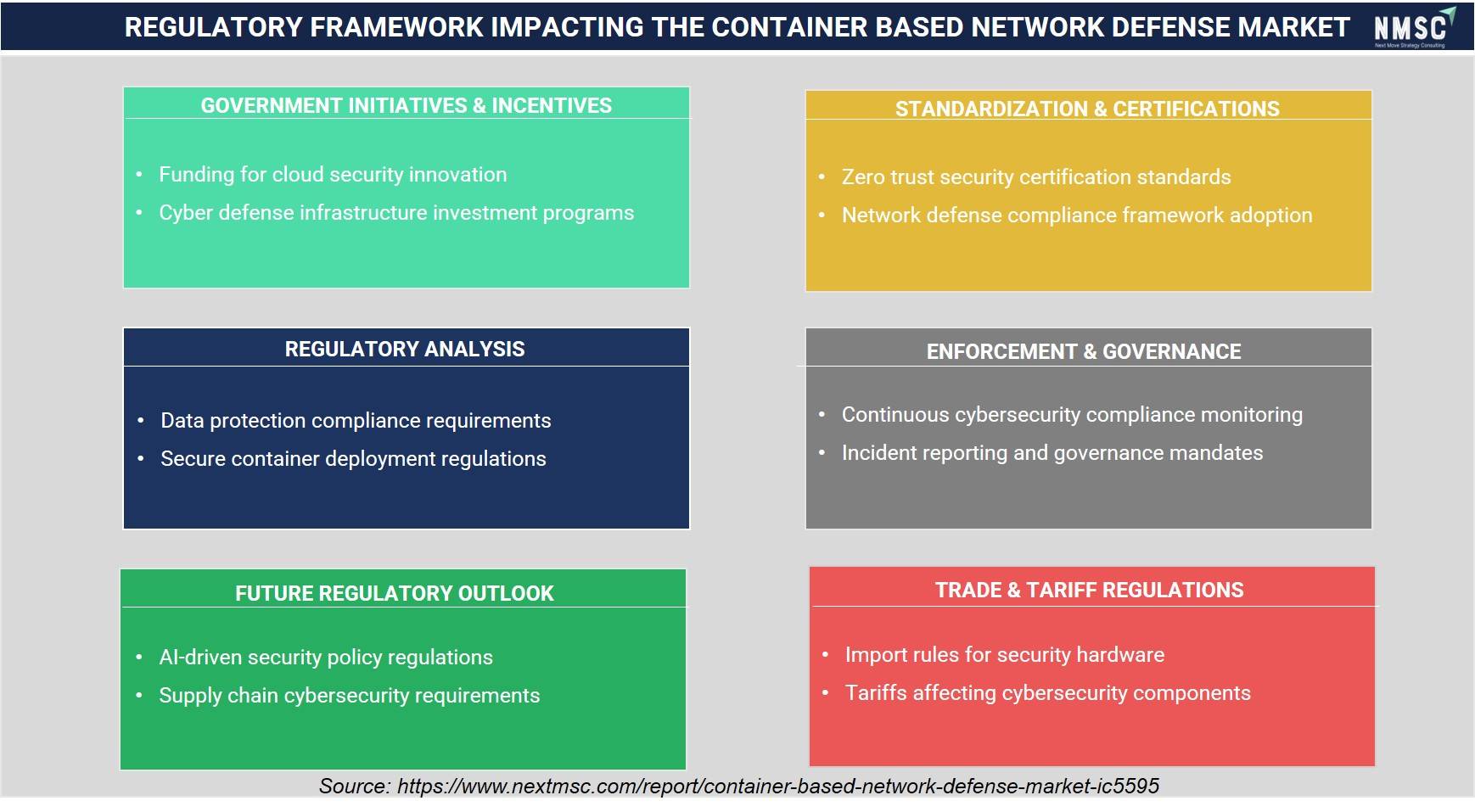
The regulatory framework for the container-based network defense market is shaped by evolving cybersecurity, data protection, and cloud security regulations. Government initiatives support cyber defense innovation and secure infrastructure development, while industry standards promote zero-trust architectures and compliance. Continuous monitoring, incident reporting, and governance requirements strengthen organizational resilience. Emerging AI security policies, software supply chain regulations, and trade measures affecting cybersecurity technologies are expected to drive secure container adoption and regulatory compliance across industries.
Regional Outlook
Geographic Performance Snapshot
|
Region |
2025 (USD) |
2035 (USD) |
CAGR% (2026–2035) |
Key Driver |
|
North America |
USD 1.27 Billion |
USD 6.43 Billion |
17.0% |
Enterprise Kubernetes production deployment and CNAPP consolidation |
|
Europe |
USD 0.69 Billion |
USD 3.65 Billion |
17.5% |
NIS2 Directive compliance requirements |
|
Asia-Pacific |
USD 0.63 Billion |
USD 5.21 Billion |
23.5% |
Expanding cloud-native infrastructure investment |
|
Middle East & Africa |
USD 0.17 Billion |
USD 1.22 Billion |
21.4% |
Government digital infrastructure protection investment |
|
Latin America |
USD 0.12 Billion |
USD 0.87 Billion |
22.3% |
Expanding financial sector cloud-native adoption |
|
Total |
USD 2.88 Billion |
USD 17.37 Billion |
19.3% |
-- |
North America Container Based Network Defense Market Outlook
North America leads the market with an established Kubernetes production ecosystem and mature CNAPP vendor landscape. We observed that NIST container security guidance sustains demand for runtime and admission control platforms, while enterprises increasingly consolidate toward integrated platform vendors. Technology adoption remains concentrated in agentless, cloud-native platforms, with regulatory attention shifting toward sector-specific compliance mandates as deployment scales toward 2035.
Europe Container Based Network Defense Market Outlook
Europe's market is shaped by the NIS2 Directive's push to standardize incident reporting and risk-management obligations for digital infrastructure operators. We observed that national regulators are tightening critical-infrastructure protection enforcement, favoring vendors with proven multi-country compliance capability. Technology adoption is shifting toward integrated runtime and network segmentation platforms, while regulatory scrutiny of cross-border data flows shapes vendor architecture across the region.
Asia-Pacific Container Based Network Defense Market Outlook
Asia-Pacific is the fastest-growing region, propelled by expanding cloud-native infrastructure investment in China and India's rapidly scaling technology sector. We observed that regional enterprises are accelerating Kubernetes adoption to support digital transformation initiatives. Technology adoption favors cloud-based platforms, with government procurement increasingly requiring domestic data-hosting compliance for container security infrastructure across the region.
Middle East & Africa Container Based Network Defense Market Outlook
Middle East & Africa is advancing on the strength of government digital infrastructure protection investment and expanding UAE cloud-native government service deployment. We observed that governments are procuring container security platforms to protect expanding containerized digital public services. Technology adoption is concentrated in government and BFSI contracts, with regulatory frameworks increasingly requiring data residency compliance for new platform deployments.
Latin America Container Based Network Defense Market Outlook
Latin America's market is advancing on the back of Brazil's expanding financial sector cloud-native adoption and growing digital banking infrastructure investment. We observed that regulators are introducing stricter data-protection enforcement that formalize previously informal container security practices. Technology adoption favors cloud-hosted platforms, with regional banks increasingly specifying container security requirements for new digital banking infrastructure.
U.S. Container Based Network Defense Market Outlook
The market in the U.S. market benefits from NIST container security guidance and expanding enterprise Kubernetes production deployment. Demand structure is concentrated in runtime protection and network segmentation, with technology adoption favoring integrated CNAPP platforms. Regulatory influence from federal cybersecurity frameworks and competitive intensity among national platform operators continue to shape strategic sourcing decisions. The country's container based network defense market was valued at approximately USD 1.05 billion in 2025 and is projected to reach approximately USD 5.21 billion by 2035, expanding at a 16.7% CAGR from 2026 to 2035.
Canada Container Based Network Defense Market Outlook
Based on our estimates, Canada's market is supported by federal digital infrastructure guidelines and growing financial sector Kubernetes adoption. Demand structure favors runtime protection paired with compliance management, while technology penetration of cloud-based platforms continues to rise. Regulatory influence from national cybersecurity strategy initiatives and moderate competitive intensity shape a steady strategic outlook through 2035. The country's container based network defense market was valued at approximately USD 0.15 billion in 2025 and is projected to reach approximately USD 0.84 billion by 2035, expanding at a 18.1% CAGR from 2026 to 2035.
UK Container Based Network Defense Market Outlook
As per our estimate, the UK market is advancing on the back of National Cyber Security Centre guidance and expanding financial sector Kubernetes adoption. Demand structure is concentrated in BFSI applications, with technology adoption favoring agentless scanning platforms. Regulatory influence from NCSC cloud security standards and rising competitive intensity among platform vendors support a favorable strategic outlook. The country's container based network defense market was valued at approximately USD 0.17 billion in 2025 and is projected to reach approximately USD 0.88 billion by 2035, expanding at a 17.0% CAGR from 2026 to 2035.
Germany Container Based Network Defense Market Outlook
According to our analysis, Germany's market benefits from Federal Office for Information Security guidance supporting cloud-native critical-infrastructure protection. Demand structure spans manufacturing and BFSI segments, with technology adoption favoring integrated detection platforms. Regulatory influence from the BSI and high competitive intensity among European vendors shape a technology-forward strategic outlook. The country's container based network defense market was valued at approximately USD 0.16 billion in 2025 and is projected to reach approximately USD 0.80 billion by 2035, expanding at a 17.0% CAGR from 2026 to 2035.
France Container Based Network Defense Market Outlook
The market in France's market is expanding alongside ANSSI critical-infrastructure protection requirements. Demand structure favors runtime protection integrated with BFSI risk programs, with technology penetration of cloud platforms rising steadily. Regulatory influence from national cybersecurity strategy guidelines and moderate competitive intensity support continued strategic expansion. The country's container based network defense market was valued at approximately USD 0.10 billion in 2025 and is projected to reach approximately USD 0.55 billion by 2035, expanding at a 17.5% CAGR from 2026 to 2035.
China Container Based Network Defense Market Outlook
Based on our estimates, China's market leads Asia-Pacific on the strength of expanding cloud-native infrastructure investment and government digital protection programs. Demand structure is dominated by government and IT and telecom applications, with technology penetration of domestically developed platforms near-universal. Regulatory influence from Cyberspace Administration of China guidelines and intense domestic competitive pressure define the strategic outlook. The country's container based network defense market was valued at approximately USD 0.18 billion in 2025 and is projected to reach approximately USD 1.62 billion by 2035, expanding at a 24.9% CAGR from 2026 to 2035.
India Container Based Network Defense Market Outlook
As per our estimate, India's market is the fastest-growing country market, propelled by rapidly scaling technology sector Kubernetes adoption and national digital infrastructure mandates. Demand structure favors IT and telecom and BFSI applications tied to digital banking expansion, with technology penetration rising rapidly from a smaller base. Regulatory influence from CERT-In cybersecurity guidelines and growing competitive intensity underpin an aggressive strategic outlook. The country's container based network defense market was valued at approximately USD 0.10 billion in 2025 and is projected to reach approximately USD 1.36 billion by 2035, expanding at a 30.3% CAGR from 2026 to 2035.
Japan Container Based Network Defense Market Outlook
According to our analysis, Japan's market benefits from national cybersecurity strategy guidance supporting cloud-native infrastructure protection. Demand structure spans manufacturing and BFSI segments, with technology adoption favoring secure agentless platforms. Regulatory influence from national cybersecurity strategy guidelines and moderate competitive intensity support a stable strategic outlook through 2035. The country's container based network defense market was valued at approximately USD 0.11 billion in 2025 and is projected to reach approximately USD 0.63 billion by 2035, expanding at a 18.0% CAGR from 2026 to 2035.
South Korea Container Based Network Defense Market Outlook
The market in South Korea benefits from Korea Internet & Security Agency guidance supporting cloud-native threat detection adoption. Demand structure favors BFSI and IT and telecom applications in urban centers, with technology penetration of domestically developed platforms rising. Regulatory influence from evolving national cybersecurity legislation and high competitive intensity among domestic vendors shape continued strategic growth. The country's market was valued at approximately USD 0.06 billion in 2025 and is projected to reach approximately USD 0.47 billion by 2035, expanding at a 22.0% CAGR from 2026 to 2035.
Australia Container Based Network Defense Market Outlook
Based on our estimates, Australia's market is advancing on the back of Australian Signals Directorate critical-infrastructure protection guidance. Demand structure spans government and BFSI segments, with technology adoption favoring cloud-based platforms. Regulatory influence from national cybersecurity strategy guidelines and rising competitive intensity among integrators support sustained strategic expansion. The country's container based network defense market was valued at approximately USD 0.06 billion in 2025 and is projected to reach approximately USD 0.42 billion by 2035, expanding at a 21.9% CAGR from 2026 to 2035.
UAE Container Based Network Defense Market Outlook
As per our estimate, the UAE market benefits from national cybersecurity strategy programs and expanding government cloud-native service deployment. Demand structure favors government and BFSI applications, with technology penetration of cloud-based platforms rising. Regulatory influence from national digital economy strategy targets and moderate competitive intensity support a favorable strategic outlook. The country's container based network defense market was valued at approximately USD 0.05 billion in 2025 and is projected to reach approximately USD 0.33 billion by 2035, expanding at a 21.9% CAGR from 2026 to 2035.
Saudi Arabia Container Based Network Defense Market Outlook
According to our analysis, Saudi Arabia's market is propelled by Vision 2030's digital government targets and expanding cloud-native infrastructure investment. Demand structure is concentrated in government and BFSI deployment, with technology penetration of platforms accelerating from a small base. Regulatory influence from National Cybersecurity Authority mandates underpins an aggressive strategic outlook. The country's container based network defense market was valued at approximately USD 0.05 billion in 2025 and is projected to reach approximately USD 0.39 billion by 2035, expanding at a 22.2% CAGR from 2026 to 2035.
South Africa Container Based Network Defense Market Outlook
The market in South Africa benefits from expanding financial sector cybersecurity mandates under national cybersecurity policy frameworks. Demand structure favors BFSI applications, with technology penetration rising steadily. Regulatory influence from national cybersecurity policy guidance and growing competitive intensity among regional vendors support continued strategic expansion. The country's container based network defense market was valued at approximately USD 0.02 billion in 2025 and is projected to reach approximately USD 0.15 billion by 2035, expanding at a 21.3% CAGR from 2026 to 2035.
Brazil Container Based Network Defense Market Outlook
Based on our estimates, Brazil's market is advancing on the back of Banco Central do Brasil's cybersecurity resolution requirements for financial institutions. Demand structure spans BFSI and IT and telecom segments, with technology adoption of cloud-hosted platforms rising. Regulatory influence from national cybersecurity framework guidelines and moderate competitive intensity support a positive strategic outlook. The country's container based network defense market was valued at approximately USD 0.05 billion in 2025 and is projected to reach approximately USD 0.40 billion by 2035, expanding at a 22.6% CAGR from 2026 to 2035.
Argentina Container Based Network Defense Market Outlook
As per our estimate, Argentina's market benefits from expanding financial sector cybersecurity requirements addressing rising digital fraud exposure. Demand structure favors BFSI-linked applications, with technology penetration of platforms rising from a modest base. Regulatory influence from national cybersecurity framework guidelines and moderate competitive intensity shape continued strategic development. The country's container based network defense market was valued at approximately USD 0.02 billion in 2025 and is projected to reach approximately USD 0.14 billion by 2035, expanding at a 23.2% CAGR from 2026 to 2035.
Competitive Landscape
We observed that the market remains moderately concentrated, with cloud-native security specialists, cloud hyperscalers, and diversified cybersecurity platform vendors competing across overlapping segments of the value chain.
|
Key Takeaways |
Details |
|
Market Structure |
Moderately concentrated among top 10 CNAPP-capable platform providers, with a long tail of specialized runtime and open-source-adjacent vendors |
|
Innovation Focus |
Agentless multi-cloud visibility, AI-driven threat analysis, and eBPF-powered runtime enforcement |
|
M&A Activity |
Large-scale acquisitions consolidating cloud-native security specialists into hyperscaler and platform vendor portfolios |
How Do Companies Compete in the Container Based Network Defense Market?
Companies compete primarily on platform breadth, agentless deployment speed, and runtime detection accuracy within the market. We observed that vendors with unified CNAPP portfolios can offer more competitive enterprise bids than single-function point solutions. False-positive rates and Kubernetes-native policy enforcement depth increasingly differentiate bids in enterprise procurement, alongside multi-cloud coverage for buyers managing hybrid infrastructure.
Which Competitive Archetypes Dominate the Container Based Network Defense Industry?
Two archetypes dominate the container based network defense industry: large platform vendors with unified cloud-native application protection coverage, and specialized runtime security providers concentrated in Kubernetes-native detection. We found that the first group competes primarily on platform breadth and consolidated procurement appeal, while the second differentiates through deep technical specialization in eBPF-based runtime enforcement that generalist platforms integrate through acquisition, securing recurring licensing revenue from enterprises seeking best-of-breed detection depth.
What Innovation and Differentiation Strategies Define Market Leaders?
Market leaders differentiate through agentless scanning speed, AI-assisted threat triage, and integration with adjacent consumer identity and access management platforms for buyers managing converging identity and workload risk. Our analysis shows that companies investing in kernel-level runtime enforcement are positioning to capture premium enterprise accounts, while low-overhead agentless deployment increasingly forms a core part of competitive bids across large-scale Kubernetes tenders.
How Active Is M&A in the Container Based Network Defense Market?
M&A activity remains highly active as hyperscalers and platform vendors pursue large-scale consolidation of cloud-native security specialists. We found that Google's 2026 acquisition of Wiz for approximately USD 32 billion and Fortinet's acquisition of Lacework reflect this trend toward hyperscaler and platform consolidation, while regional providers pursue distribution partnerships to enter new government and institutional procurement markets across Asia-Pacific and the Middle East.
Key Market Players
We observed that the following companies represent the leading participants shaping the competitive structure of the container based network defense market.
-
Palo Alto Networks, Inc.
-
Wiz, Inc. (Alphabet Inc.)
-
Aqua Security Software Ltd.
-
Sysdig, Inc.
-
CrowdStrike Holdings, Inc. (Falcon Cloud Security)
-
Microsoft Corporation (Defender for Cloud)
-
Snyk Ltd.
-
Orca Security Ltd.
-
Check Point Software Technologies Ltd. (CloudGuard)
-
Tenable Holdings, Inc.
-
Fortinet, Inc. (Lacework/FortiCNAPP)
-
International Business Machines Corporation (IBM) (Red Hat Advanced Cluster Security)
-
Sophos Ltd.
-
Qualys, Inc.
-
Anchore, Inc.
-
Cisco Systems, Inc.
-
Bitdefender SRL
-
AccuKnox, Inc.
-
Datadog, Inc.
-
SentinelOne, Inc.
Latest Developments
Our assessment indicates that recent corporate activity reflects continued platform consolidation and AI-driven innovation across the container based network defense market.
|
Date |
Event |
|
August 2024 |
Fortinet completed the acquisition of Lacework, integrating its Cloud-Native Application Protection Platform (CNAPP), including Kubernetes security, container workload protection, cloud posture management, and runtime security into the Fortinet Security Fabric. This strengthens Fortinet's container-based network defense portfolio. |
Investment Opportunities
Where Are Capital Inflows Concentrated in the Container Based Network Defense Market?
Capital inflows are concentrated in unified CNAPP platform development and AI-driven threat analysis capability. We observed that hyperscalers and strategic investors are increasingly funding cloud-native security specialists to strengthen integrated platform coverage, reflecting growing investor confidence in container based network defense as a durable, high-growth software category evidenced by recent multibillion-dollar acquisitions.
How Significant Is Infrastructure Investment in Container Based Network Defense Platforms?
Infrastructure investment in cloud-native detection platforms and large-scale AI training infrastructure is accelerating as vendors compete on runtime detection accuracy and multi-cloud coverage depth. Our findings suggest that government-backed national cybersecurity infrastructure programs are emerging as a significant investment theme, with several governments funding domestic container security platform development to reduce reliance on foreign technology vendors for critical infrastructure protection.
What ESG Considerations Shape Container Based Network Defense Investment?
Environmental, social, and governance considerations increasingly shape investment decisions, with investors favoring vendors that demonstrate responsible data governance and transparent AI model behavior. We observed that cybersecurity insurance underwriters are increasingly requiring evidence of container-native security capability as a condition for favorable policy terms, reflecting growing attention to demonstrable cloud-native security posture across the enterprise risk-transfer value chain.
Key Benefits for Stakeholders
How Does This Report Benefit Enterprise and Industry Leaders?
Enterprise and industry leaders gain access to segment-level revenue forecasts and security-layer adoption trends that inform platform procurement strategy. Our analysis shows that the report's regional breakdowns support market-entry and vendor-selection decisions, helping stakeholders align investment with the fastest-growing security layers and end-user industries through 2035.
How Does This Report Benefit Investors and Financial Analysts?
Investors and financial analysts benefit from consolidated market-sizing data, competitive-landscape mapping, and CAGR-level growth drivers that support valuation and due-diligence work. We found that the report's country-level forecasts help identify markets with the strongest risk-adjusted return profiles, particularly across the fastest-growing Asia-Pacific and Middle East & Africa regions.
How Does This Report Benefit Technology Vendors and Product Teams?
Technology vendors and product teams gain segmentation-level insight into security layer, end-user industry, and organization size preferences that inform roadmap prioritization. Our assessment indicates that the report's trend analysis highlights AI-driven threat analysis as a high-growth adjacency, helping product teams align development resources with the fastest-growing sub-segments identified in this market report.
Key Market Segments
By Security Layer
-
Runtime Protection
-
Image Scanning and Vulnerability Management
-
Network Segmentation and Microsegmentation
-
Kubernetes Admission Control
-
Compliance and Configuration Management
By End User Industry
-
BFSI
-
IT and Telecom
-
Healthcare
-
Retail and E-commerce
-
Government
-
Manufacturing
By Organization Size
-
Large Enterprises
-
Small and Medium Enterprises
By Region
-
North America: U.S., Canada, Mexico
-
Europe: UK, Germany, France, Italy, Spain, Sweden, Denmark, Finland, Netherlands, Rest of Europe
-
Asia-Pacific: China, India, Japan, South Korea, Taiwan, Indonesia, Vietnam, Australia,Philippines, Malaysia, Rest of APAC
-
Middle East & Africa: Saudi Arabia, UAE, Egypt, Israel, Turkey, Nigeria, South Africa, Rest of MEA
-
Latin America: Brazil, Argentina, Chile, Colombia, Rest of LATAM
Conclusion and Recommendations
What Is the Long-Term Outlook for the Container Based Network Defense Market?
The long-term outlook remains strongly positive, with the market projected to grow nearly fivefold from USD 3.55 billion in 2026 to USD 17.37 billion by 2035. We observed that this trajectory is underpinned by structural Kubernetes production deployment growth rather than cyclical enterprise IT spending alone, positioning container based network defense as durable, mission-critical infrastructure through 2035 and beyond.
What Strategic Positioning Should Stakeholders Pursue?
Stakeholders should pursue platform-consolidated positioning that combines runtime protection, network segmentation, and admission control within a single agentless deployment model. Our analysis shows that vendors investing early in AI-driven threat analysis and multi-cloud coverage breadth, spanning BFSI, healthcare, and government applications, will be best positioned to capture premium enterprise and institutional contract awards within the market.
How Attractive Is the Container Based Network Defense Market for New Investment?
The container based network defense industry presents a highly attractive investment case, supported by a USD 13.82 billion absolute dollar opportunity between 2026 and 2035 and above-average growth in Asia-Pacific and Middle East & Africa. We found that investment attractiveness is highest for platforms combining detection accuracy with agentless deployment differentiation, positioning them to serve both cost-sensitive small and medium enterprise buyers and premium institutional segments simultaneously.
What Market Shifts and Key Risks Should Stakeholders Monitor?
Stakeholders should monitor platform consolidation pressure on point solutions, persistent Kubernetes-native security skills shortages, and performance overhead concerns limiting agent-based deployment as key risks to the market. Our analysis shows that vendors unable to demonstrate low-overhead, reliable runtime detection risk losing enterprise contracts to competitors with proven production-grade performance, particularly as consolidation accelerates through 2035.
What Are the Key Growth Pathways for the Container Based Network Defense Market?
Key growth pathways include expanding unified CNAPP platform capability, scaling AI-driven threat analysis, and deepening penetration into small and medium enterprise buyer segments. Next Move Strategy Consulting's analysis indicates that vendors pursuing these pathways while maintaining detection accuracy in core runtime and network segmentation categories will be best positioned to capture the container based network defense market's projected growth through 2035.
About the Author
 Liza Phukan
— Liza Phukan is Research Associate at Next Move Strategy Consulting, where she has covered emerging industries and market research across sectors for 3.5 years. Her work includes analyzing industry developments, validating market data, and developing structured business content from research findings. She uses secondary research and data-validation practices to turn complex market information into clear decision-useful market analysis for business audiences and support report development and B2B.
Liza Phukan
— Liza Phukan is Research Associate at Next Move Strategy Consulting, where she has covered emerging industries and market research across sectors for 3.5 years. Her work includes analyzing industry developments, validating market data, and developing structured business content from research findings. She uses secondary research and data-validation practices to turn complex market information into clear decision-useful market analysis for business audiences and support report development and B2B.
About the Reviewer
 Supradip Baul
— Supradip Baul is an accomplished business consultant and strategist with over a decade of rich experience in market intelligence, strategy, technology, and business transformation. His work has included rigorous qualitative and quantitative analysis across multiple industries, helping clients shape investment decisions and long-term roadmaps. Earlier in his career, he was associated with Gartner, where he contributed to industry-leading reports and market share analyses. He has worked with leading global companies and holds an MBA with a dual specialization in Marketing and Finance.
Supradip Baul
— Supradip Baul is an accomplished business consultant and strategist with over a decade of rich experience in market intelligence, strategy, technology, and business transformation. His work has included rigorous qualitative and quantitative analysis across multiple industries, helping clients shape investment decisions and long-term roadmaps. Earlier in his career, he was associated with Gartner, where he contributed to industry-leading reports and market share analyses. He has worked with leading global companies and holds an MBA with a dual specialization in Marketing and Finance.
At Next Move Strategy Consulting, we understand that insightful market research is the cornerstone of successful business decisions. That's why we employ a robust and multifaceted approach, combining various methodologies to deliver the most accurate and actionable data for our clients.

Research Landscape
We navigate the world of research with two primary approaches:
Qualitative Approach
Our qualitative research methodologies involve immersive techniques such as in-depth interviews, focus groups, and observational studies. By engaging directly with individuals and stakeholders, we uncover valuable insights that quantitative data alone may overlook.

Quantitative Research
In tandem with qualitative methodologies, NMSC leverages the power of Quantitative Research to provide a robust foundation of numerical insights. Through systematic data collection and analysis, we quantify patterns, preferences, and market trends, offering a comprehensive view of the business landscape.
Our quantitative research approach employs diverse tools, including surveys, experiments, and statistical modelling. These methodologies enable us to gather data from a large and representative sample, ensuring the statistical significance of our findings. By employing structured questionnaires and standardized data collection methods, we guarantee the reliability and validity of the information we present to our clients.
Quantitative research is particularly effective in measuring the prevalence of trends, assessing market size, and gauging the impact of various factors on consumer behavior. The numerical precision attained through this approach equips our clients with actionable insights, facilitating data-driven decision-making and strategy formulation.


Our Specialized Toolbox for Industry-Specific Market Research
We deploy a specialized arsenal of techniques tailored to meet your unique requirements. Here's a glimpse into our comprehensive toolbox:

Information Procurement
The stage entails acquiring market data or relevant information through various sources and methodologies.


Market Research Approach
We utilize both top-down and bottom-up approaches in market research analysis to achieve a comprehensive understanding of the market dynamics, leveraging the broad perspective of industry trends and macroeconomic factors alongside detailed insights from specific segments and individual companies.

Porters Five Forces Analysis
We conduct Porter's Five Forces analysis to evaluate the competitive landscape of an industry, providing us with insights into factors that affect profitability and strategic positioning.

SWOT Analysis

Forecasting
We utilize a forecasting model to predict future consumption by considering parameters like population, economics, regulations, market competition, drivers, constraints, technology, and pricing. We also employ statistical techniques such as multilinear regression, exponential smoothing, moving average, ARIMA, and Monte Carlo simulations for accurate predictions. In econometric forecasting, we analyzed short-term and long-term event impacts, attributing values based on regulatory frameworks, economic factors, and market events.





 Speak to Our Analyst