AI Soil Health Market Size, Share, Trends and Growth Analysis, By Offering (Hardware, Software and Analytics, and Data and Managed Services), By Deployment Model (Cloud-Based, On-Premise, and Hybrid), By Data Source (In-Field Sensor Data, Satellite Data, Aerial Imagery Data, Lab Assay Data and Others), By Technology, By Farm Size, By Distribution Channel, By Application, By Customer Type, and Region — Global Industry Report and Forecast, 2026–2035
Industry: Agriculture | Publishing Date: July 13, 2026 | Last Updated: September 30, 2026 | No of Pages: N/A | No. of Tables: N/A | No. of Figures: N/A | Format: PDF | Report Code: AG5113
What Is the AI Soil Health Market Size?
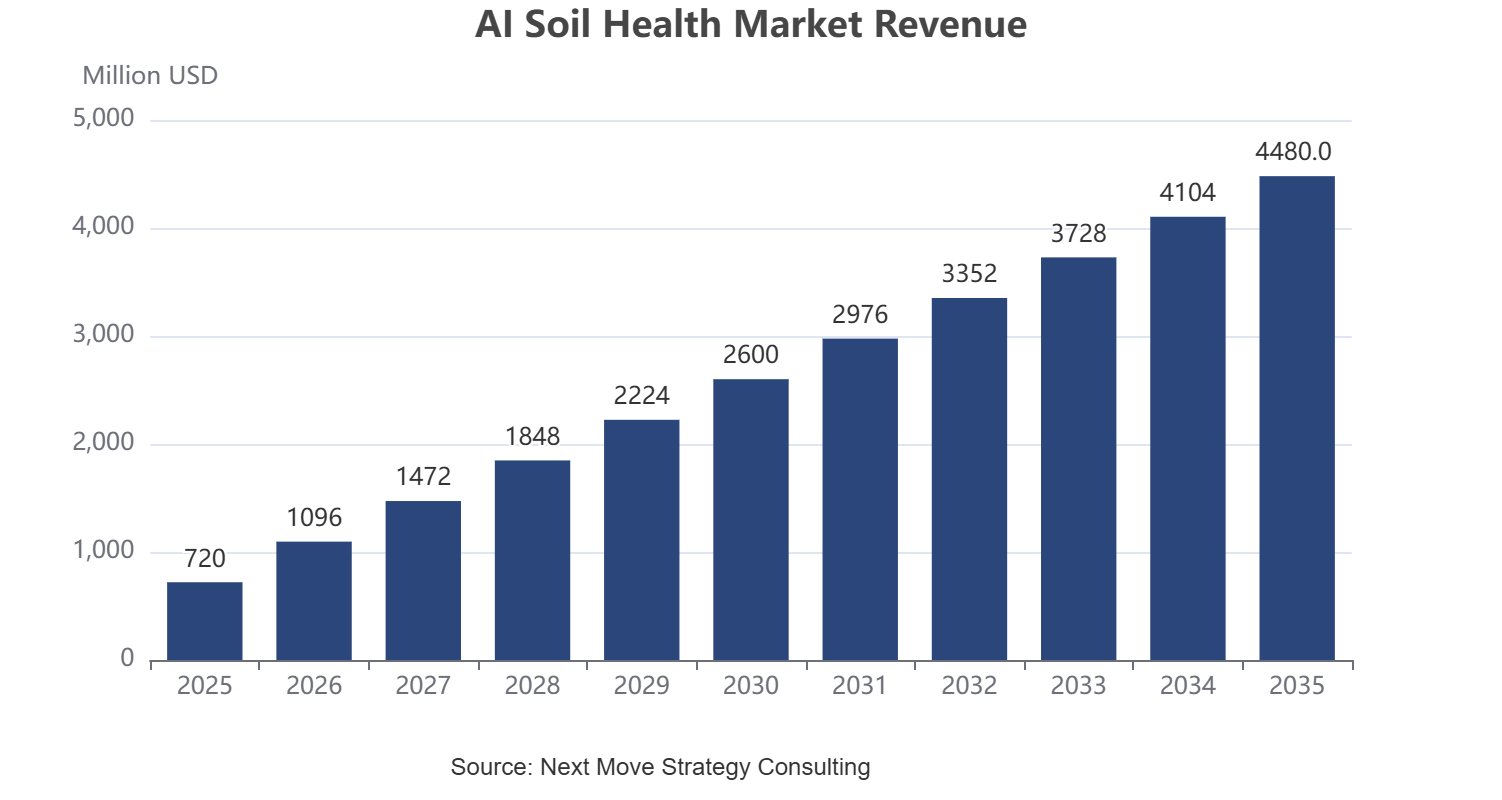
The global AI Soil Health Market size was valued at USD 720 Million in 2025 and is estimated at USD 870 Million in 2026, forecast to reach USD 4.48 Billion by 2035, expanding at a 19.9% CAGR between 2026 and 2035. North America leads with approximately 31% share, while under offering, Software and Analytics dominates with approximately 40% share.
We observed that growth is broad-based across every segmentation axis, with carbon verification applications and generative AI-enabled advisory tools driving the sharpest structural shifts through 2035.
|
Key Takeaways |
|
By Offering: Software and Analytics held the largest share of approximately 40% (USD 288 Million) in 2025; Data and Managed Services is the fastest-growing sub-segment at 25.6% CAGR from 2026–2035. |
|
By Deployment Model: Cloud-Based held the largest share of approximately 62% (USD 446 Million) in 2025; Hybrid is the fastest-growing sub-segment at 25.0% CAGR from 2026–2035. |
|
By Data Source: In-Field Sensor Data held the largest share of approximately 27% (USD 194 Million) in 2025; Multi-Source Fusion Data is the fastest-growing sub-segment at 27.1% CAGR from 2026–2035. |
|
By Technology: Machine Learning held the largest share of approximately 29% (USD 209 Million) in 2025; Generative AI is the fastest-growing sub-segment at 32.2% CAGR from 2026–2035. |
|
By Farm Size: Large Commercial Farms held the largest share of approximately 52% (USD 374 Million) in 2025; Smallholder Farms is the fastest-growing sub-segment at 25.6% CAGR from 2026–2035. |
|
By Distribution Channel: Direct Enterprise Sales held the largest share of approximately 38% (USD 274 Million) in 2025; Digital and Online Platforms is the fastest-growing sub-segment at 25.0% CAGR from 2026–2035. |
|
By Application: Nutrient Management held the largest share of approximately 24% (USD 173 Million) in 2025; Carbon Verification is the fastest-growing sub-segment at 29.2% CAGR from 2026–2035. |
|
By Customer Type: Growers and Land Managers held the largest share of approximately 36% (USD 259 Million) in 2025; Carbon Program Operators is the fastest-growing sub-segment at 26.5% CAGR from 2026–2035. |
|
Dominant Region: North America dominated with approximately 31% revenue share (USD 223 Million) in 2025. |
|
Fastest-Growing Region: Asia-Pacific is expected to register the highest CAGR of 24.4% during 2026–2035. |
|
Dominant Country: U.S. led with approximately USD 167 Million in 2025. |
|
Fastest-Growing Country: India is the fastest-growing country at approximately 29.0% CAGR from 2026–2035. |
Between 2026 and 2035, the AI Soil Health Market is set to generate an absolute dollar opportunity of USD 3.61 Billion, positioning carbon verification and generative AI-enabled advisory platforms as a compelling area for capital allocation.
According to Next Move Strategy Consulting analysis, sustained investment in multi-source data fusion and machine vision sensing is reshaping procurement criteria for large commercial farms, as agribusinesses increasingly prioritize interoperable platforms that combine satellite, sensor, and lab assay data streams.
What Does the AI Soil Health Market Encompass?
The market encompasses hardware sensors, software platforms, and managed services that apply machine learning, computer vision, and predictive analytics to assess and improve soil physical, chemical, and biological properties. Our assessment indicates that the scope spans in-field sensors, satellite and aerial imagery, laboratory assays, and multi-source data fusion platforms supplied to growers, agribusinesses, advisors, food and beverage companies, carbon program operators, and research institutions. The category has evolved from standalone soil testing into an integrated decision-support layer spanning nutrient management, irrigation, carbon verification, and land degradation monitoring across row crop, horticulture, and rangeland operations worldwide.
Regulatory frameworks such as the U.S. Department of Agriculture's Natural Resources Conservation Service soil health guidance and the European Union's Carbon Removals and Carbon Farming Regulation shape data standards for soil carbon measurement, reporting, and verification. We observed that technology adoption is shifting toward generative AI-enabled advisory engines and digital twins that simulate soil response to management practices before farmers commit capital. Next Move Strategy Consulting's analysis indicates that this shift, combined with mounting corporate Scope 3 reporting obligations, is redefining sourcing criteria across the AI Soil Health Market.
|
Parameter |
Details |
|
Market Size in 2025 |
USD 720.0 Million |
|
Market Size in 2026 |
USD 870.0 Million |
|
Revenue Forecast in 2035 |
USD 4480.0 Million |
|
Growth Rate |
CAGR of 19.9% from 2026 to 2035 |
|
Analysis Period |
2025–2035 |
|
Base Year Considered |
2025 |
|
Forecast Period |
2026–2035 |
|
Market Size Estimation |
Revenue (USD Billion) |
|
Companies Profiled |
20 |
|
Countries Covered |
33 |
|
Market Share |
Available for Top 10 Companies |
Key Emerging Trends
Based on research conducted by Next Move Strategy Consulting, we found that four structural trends are reshaping product development, sourcing, and stakeholder engagement across the AI Soil Health Market.
How Is Generative AI Transforming Soil Health Advisory?
Generative AI-enabled advisory engines are replacing static agronomic reports with conversational, farm-specific recommendations generated from sensor, satellite, and lab assay data. We observed that Pattern Ag's AI-driven biological and chemical soil intelligence platform synthesizes multi-source data into planting-season nitrogen and biological product recommendations. Agribusinesses and advisors are adopting these tools to compress interpretation time, while growers gain prescriptive guidance that adapts to real-time field conditions rather than static annual soil test summaries.
Why Is Soil Carbon MRV Adoption Accelerating Among Agribusinesses?
Soil carbon measurement, reporting, and verification services are gaining adoption as food and beverage companies formalize Scope 3 supply chain emissions targets. Our findings suggest that EarthOptics' mid-infrared carbon analysis solution, commercialized in May 2025, delivers registry-quality carbon data at a fraction of traditional laboratory testing cost. Carbon program operators and agribusinesses are integrating these services to generate audit-ready sequestration data, positioning soil carbon MRV as a premium, high-growth category within the broader market structure.
How Is Multi-Source Data Fusion Reshaping Soil Intelligence Platforms?
Platforms combining in-field sensor, satellite, aerial imagery, and equipment data into unified soil intelligence layers are gaining share over single-source point solutions. We observed that CropX's integration with Reinke's ReinCloud platform, extended in March 2026, unifies soil, weather, and pivot-control data within a single interface. This trend is elevating demand for API and data-platform software among agribusinesses and OEM partners seeking interoperable, multi-source agronomic intelligence rather than fragmented single-sensor dashboards.
What Role Does Electromagnetic and Ground-Penetrating Sensing Play in Soil Health Innovation?
Non-invasive electromagnetic and ground-penetrating sensing technologies are emerging as a scalable complement to traditional soil core sampling. Our analysis shows that Grassroots Carbon's GroundOwl platform, launched with EarthOptics in March 2026, scans soil organic carbon up to one meter deep across entire ranches without disturbing the land. This innovation is expanding soil health monitoring into rangeland and grazing operations previously underserved by point-based sampling economics.
ECOSYSTEM ANALYSIS OF THE AI SOIL HEALTH INDUSTRY
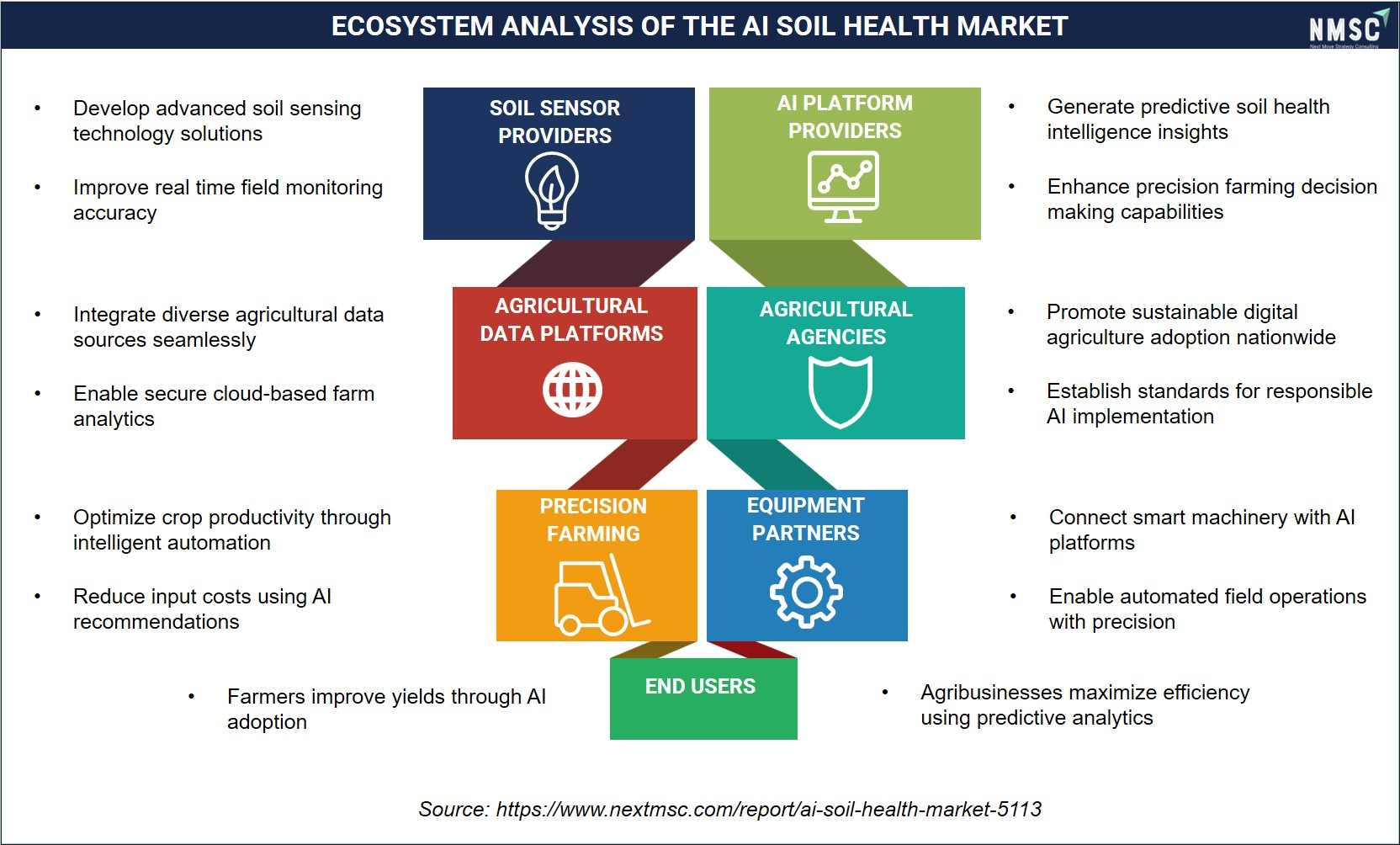
This infographic illustrates the ecosystem of the AI Soil Health Market, highlighting the collaboration among soil sensor providers, AI platform providers, agricultural data platforms, agricultural agencies, precision farming solution providers, equipment partners, and end users. These stakeholders collectively enable real-time soil monitoring, AI-driven analytics, precision agriculture, and data-driven decision-making, helping improve soil health, optimize crop productivity, support sustainable farming practices, and enhance resource efficiency across agricultural operations.
Growth Drivers and Restraints
Growth Catalyst and Risk Assessment Matrix
|
Factors |
Type |
(+/−) % Impact on CAGR |
Geographic Relevance |
Impact Timeline |
|
Rising global emphasis on regenerative agriculture practices |
Driver |
+2.3% |
Global |
2026–2035 |
|
EU Carbon Removals and Carbon Farming Regulation adoption |
Driver |
+1.9% |
Europe |
2026–2035 |
|
Corporate Scope 3 emissions reporting mandates |
Driver |
+1.7% |
North America, Europe |
2026–2035 |
|
Declining cost of satellite and sensor data acquisition |
Driver |
+1.5% |
Global |
2026–2035 |
|
Expansion of voluntary carbon credit markets for soil carbon |
Driver |
+1.4% |
Global |
2026–2032 |
|
Government soil health incentive programs in Asia-Pacific |
Driver |
+1.2% |
Asia-Pacific |
2026–2035 |
|
Data privacy and farm data ownership concerns |
Restraint |
−1.1% |
Global |
2026–2035 |
|
High upfront cost of multi-depth sensor deployment for smallholders |
Restraint |
−0.9% |
Asia-Pacific, Africa |
2026–2032 |
|
Fragmented interoperability standards across soil data platforms |
Restraint |
−0.7% |
Global |
2028–2035 |
What Is the Primary Growth Driver of the AI Soil Health Industry?
Rising global emphasis on regenerative and climate-smart agriculture is the primary driver of the market. The U.S. Department of Agriculture's Natural Resources Conservation Service reports growing enrollment of cropland acres in conservation programs that require soil health practices. We observed that this behavioral shift, reinforced by retailer and processor sustainability scorecards, continues to anchor baseline demand for soil sensing and advisory platforms across developed and emerging agricultural economies alike.
How Is Carbon Regulation Driving AI Soil Health Market Growth?
Carbon measurement and reporting regulation is accelerating market growth toward verifiable, high-integrity monitoring platforms. The European Union's Carbon Removals and Carbon Farming Regulation establishes a certification framework for carbon farming activities, pushing agribusinesses to specify registry-quality soil carbon data. Our assessment indicates that this regulatory pressure, combined with corporate Scope 3 disclosure requirements, is compressing adoption timelines for satellite and sensor-based carbon verification services across Europe and North America.
What Is Restraining AI Soil Health Market Expansion?
Fragmented data ownership rules and inconsistent interoperability standards restrain scaling across the market supply chain. The U.S. Department of Agriculture's conservation program guidance highlights ongoing uncertainty around farm data ownership and third-party sharing rights. We found that smallholder farms face particular exposure, as limited capital access reduces their ability to adopt multi-depth sensor and satellite subscription platforms compared with large commercial operations.
Segmentation Analysis
Segment Sizing: By Offering
|
Segment |
2025 (USD) |
2035 (USD) |
CAGR% (2026–2035) |
|
Hardware |
USD 245 Million |
USD 917 Million |
14.1% |
|
Software and Analytics |
USD 288 Million |
USD 1.73 Billion |
19.6% |
|
Data and Managed Services |
USD 187 Million |
USD 1.83 Billion |
25.6% |
|
Total |
USD 720 Million |
USD 4.48 Billion |
19.9% |
Which Offering Segment Dominates the Market?
Software and Analytics, encompassing field monitoring dashboards, soil mapping visualization, and prescription engines, led the AI Soil Health Market with USD 288 Million in 2025, supported by recurring subscription revenue and low incremental deployment cost. We observed that Data and Managed Services is the fastest-growing offering, expanding at a 25.6% CAGR from 2026 to 2035, as soil testing, agronomy advisory, and carbon MRV services scale alongside corporate sustainability reporting obligations.
Segment Sizing: By Application
|
Segment |
2025 (USD) |
2035 (USD) |
CAGR% (2026–2035) |
|
Nutrient Management |
USD 173 Million |
USD 879 Million |
17.7% |
|
Irrigation Management |
USD 115 Million |
USD 638 Million |
18.7% |
|
Soil Biology |
USD 79 Million |
USD 518 Million |
20.7% |
|
Carbon Verification |
USD 94 Million |
USD 1.21 Billion |
29.2% |
|
Soil Structure |
USD 58 Million |
USD 258 Million |
16.2% |
|
Salinity and pH |
USD 50 Million |
USD 216 Million |
15.7% |
|
Land Degradation |
USD 43 Million |
USD 177 Million |
15.2% |
|
Yield Optimization |
USD 79 Million |
USD 477 Million |
19.7% |
|
Other Applications |
USD 29 Million |
USD 108 Million |
14.2% |
|
Total |
USD 720 Million |
USD 4.48 Billion |
19.9% |
Which Application Segment Leads the Market Demand?
Nutrient Management remained the leading application within the AI Soil Health Market, valued at USD 173 Million in 2025 on sustained fertilizer optimization and prescription mapping demand. Our findings suggest that Carbon Verification is the fastest-growing application, registering a 29.2% CAGR from 2026 to 2035, as food and beverage companies and carbon program operators increasingly specify verified soil organic carbon data to support Scope 3 reporting and voluntary carbon credit generation.
Segment Sizing: By Technology
|
Segment |
2025 (USD) |
2035 (USD) |
CAGR% (2026–2035) |
|
Machine Learning |
USD 209 Million |
USD 1.07 Billion |
17.8% |
|
Computer Vision |
USD 115 Million |
USD 699 Million |
19.8% |
|
Predictive Analytics |
USD 137 Million |
USD 645 Million |
16.8% |
|
Generative AI |
USD 50 Million |
USD 821 Million |
32.2% |
|
Digital Twins |
USD 43 Million |
USD 363 Million |
23.7% |
|
Geospatial Analytics |
USD 86 Million |
USD 391 Million |
16.3% |
|
Spectroscopy Analytics |
USD 43 Million |
USD 231 Million |
18.3% |
|
Metagenomics Analytics |
USD 36 Million |
USD 258 Million |
21.7% |
|
Total |
USD 720 Million |
USD 4.48 Billion |
19.9% |
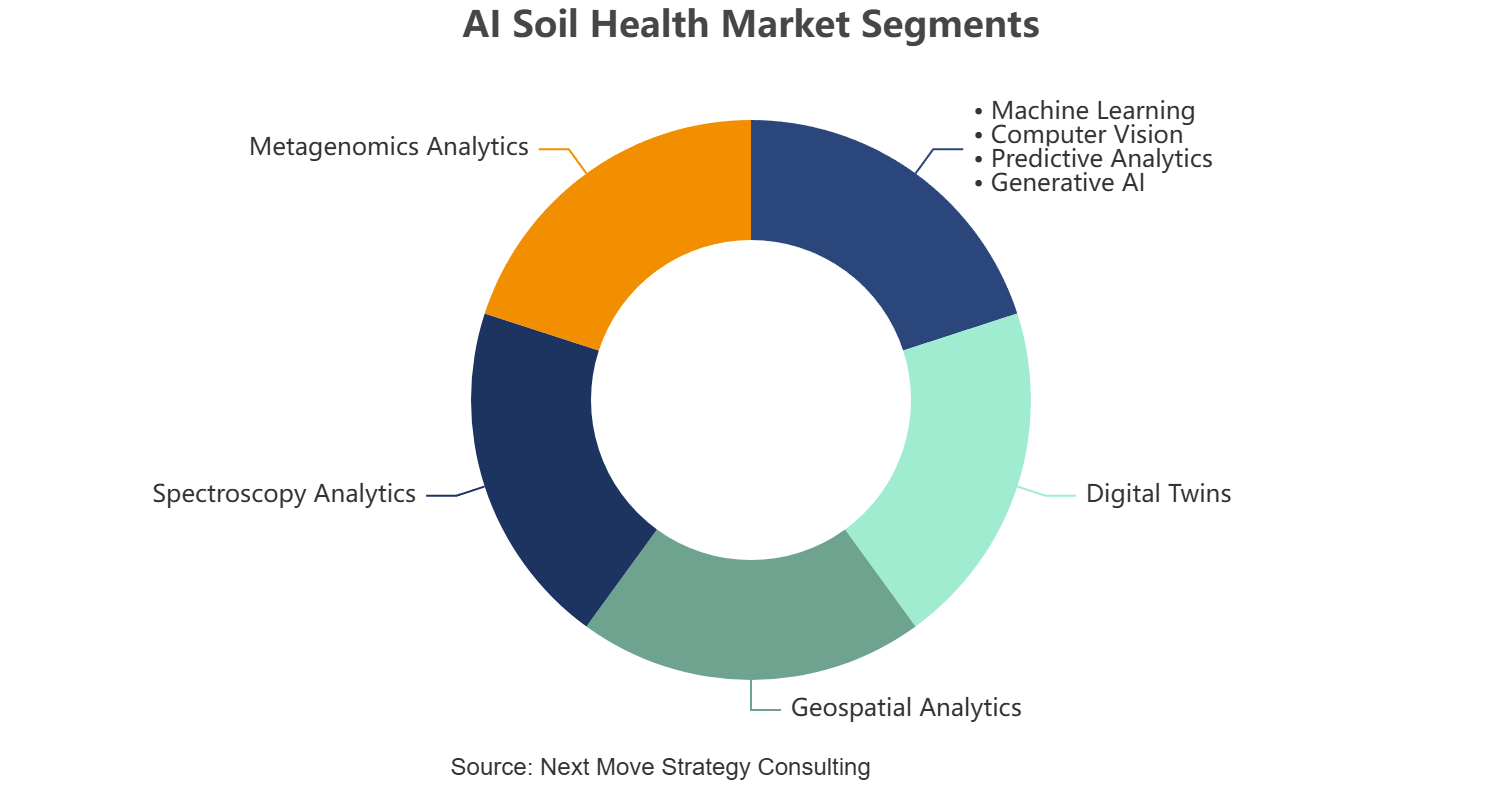
Which Technology Segment Is Most Widely Used in AI Soil Health Platforms?
Machine Learning remained the dominant technology across the AI Soil Health Market, reaching USD 209 Million in 2025 due to its maturity in yield prediction and nutrient optimization models. Based on research conducted by Next Move Strategy Consulting, we found that Generative AI is the fastest-growing technology at a 32.2% CAGR from 2026 to 2035, reflecting rapid adoption of conversational advisory engines that translate complex soil data into actionable, farm-specific recommendations.
Growth Opportunities
Our analysis shows that three forward-looking opportunities stand out for stakeholders positioning within the AI Soil Health Market over the 2026–2035 forecast period.
How Are Generative AI Advisory Platforms Creating Opportunities for Agribusiness Input Providers?
Generative AI-enabled advisory platforms present a whitespace opportunity for agribusiness and input providers seeking to bundle prescriptive recommendations with fertilizer, seed, and biological product sales. Vendors that embed conversational advisory layers into existing dealer and distributor networks stand to capture recurring software attachment revenue, particularly among mid-sized farms seeking agronomic guidance without dedicated in-house data science capability.
Why Are Rangeland and Grazing Applications Emerging as a Growth Opportunity for Carbon Program Operators?
Rangeland and grazing operations represent an underpenetrated opportunity for electromagnetic and ground-penetrating soil carbon sensing technologies. Providers that commercialize landscape-scale, non-invasive scanning tools can secure long-term measurement contracts with carbon program operators and ranchers, benefiting from recurring monitoring revenue tied to voluntary carbon credit issuance across America's grazing lands.
How Is Metagenomics Analytics Unlocking Opportunities for Soil Biology Diagnostics?
Metagenomics analytics create an opportunity for laboratory and diagnostic providers offering DNA-based soil microbiome profiling to growers and advisors. Early movers that validate biological soil health indicators alongside traditional chemical assays can differentiate with agribusinesses pursuing regenerative certification, benefiting from premium pricing tied to soil biology diagnostic accuracy and reproducibility across diverse cropping systems.
CONSUMER BEHAVIOR ANALYSIS OF THE AI SOIL HEALTH INDUSTRY
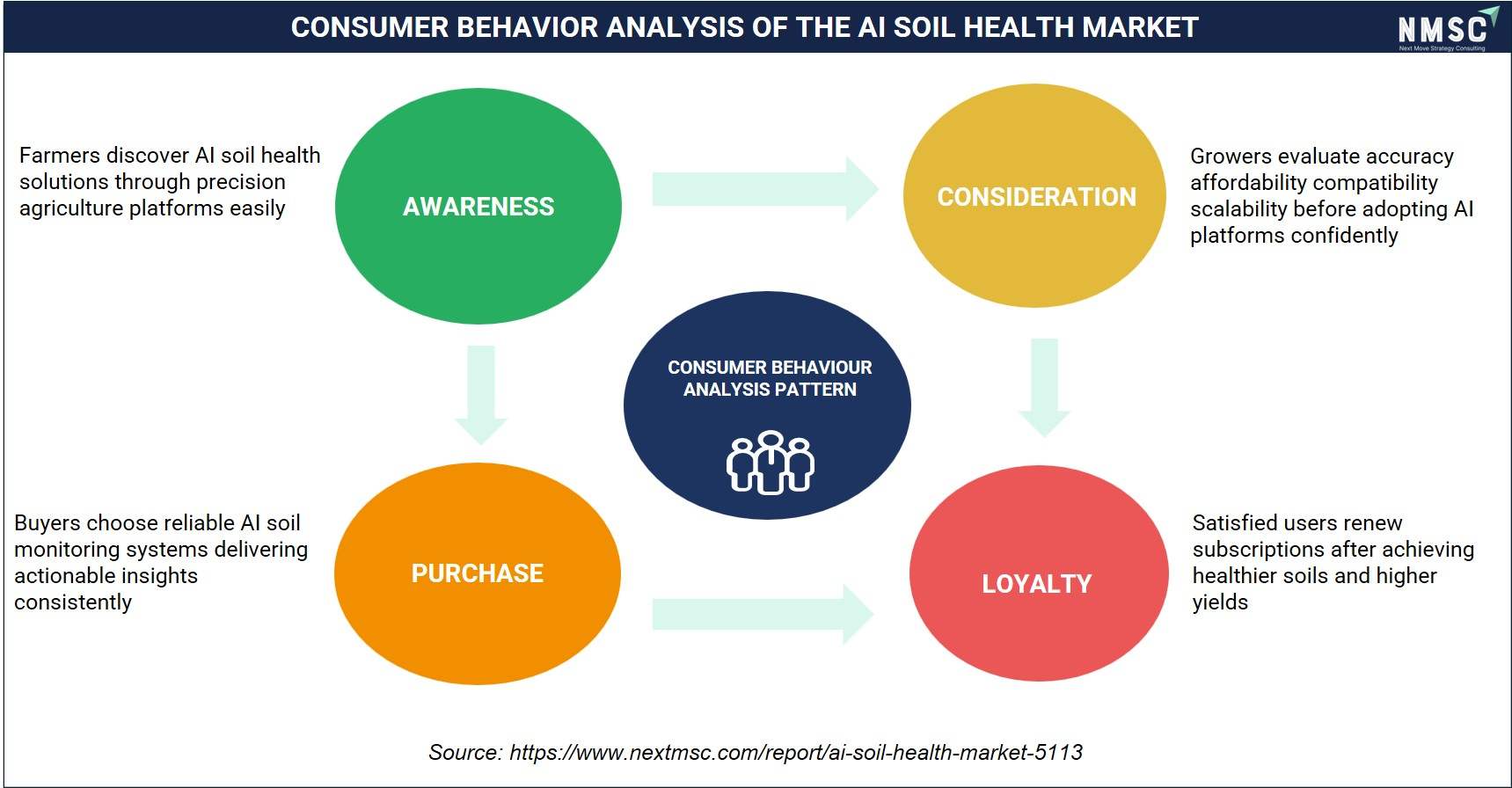
This infographic illustrates the consumer behavior journey in the AI Soil Health Market across four stages: Awareness, Consideration, Purchase, and Loyalty. Farmers first discover AI soil health solutions through precision agriculture platforms. During evaluation, they assess solution accuracy, affordability, compatibility, and scalability. Purchase decisions are driven by reliable soil monitoring and actionable insights, while improved soil health, higher crop yields, and consistent platform performance encourage subscription renewals and long-term customer loyalty.
Regional Outlook
Geographic Performance Snapshot
|
Region |
2025 (USD) |
2035 (USD) |
CAGR% (2026–2035) |
Key Driver |
|
North America |
USD 223 Million |
USD 1.02 Billion |
16.4% |
Mature ag-tech adoption and USDA conservation program incentives |
|
Europe |
USD 173 Million |
USD 822 Million |
16.9% |
EU Carbon Removals and Carbon Farming Regulation compliance |
|
Asia-Pacific |
USD 202 Million |
USD 1.78 Billion |
24.4% |
Expanding precision agriculture investment and government soil health programs |
|
Middle East & Africa |
USD 65 Million |
USD 488 Million |
22.4% |
Vision 2030-linked agri-tech diversification and water scarcity management |
|
Latin America |
USD 58 Million |
USD 368 Million |
20.4% |
Growing row-crop carbon program enrollment and export-driven sustainability demand |
|
Total |
USD 720 Million |
USD 4.48 Billion |
19.9% |
— |
North America AI Soil Health Market Outlook
North America leads the AI Soil Health Market with an established precision agriculture base and mature carbon MRV service ecosystem. We observed that U.S. Department of Agriculture conservation program incentives sustain demand for soil sensing and advisory platforms, while agribusinesses increasingly specify multi-source data fusion tools to satisfy retailer sustainability commitments. Technology adoption remains advanced, with generative AI advisory engines gaining traction across the region's large commercial farm base.
Europe AI Soil Health Market Outlook
Europe's AI Soil Health Market reflects a regulation-intensive landscape shaped by the European Union's Carbon Removals and Carbon Farming Regulation and Common Agricultural Policy conditionality requirements. Our findings suggest that agribusinesses across Germany, France, and the UK are accelerating adoption of registry-quality carbon verification services to satisfy supply-chain emissions disclosure obligations. Technology adoption favors satellite and spectroscopy analytics, supported by regional carbon program operators investing in certified MRV infrastructure.
Asia-Pacific AI Soil Health Market Outlook
Asia-Pacific is the fastest-growing AI Soil Health Market region, propelled by expanding precision agriculture investment in China and India and government-backed soil health programs. We found that regulatory frameworks remain less harmonized than in Europe, giving technology vendors flexibility to scale sensor and mobile advisory platforms rapidly. Technology adoption is accelerating as regional providers, including several India-based analytics firms, expand smallholder-focused soil testing and advisory services.
Middle East & Africa AI Soil Health Market Outlook
The Middle East & Africa AI Soil Health Market is expanding as Gulf Cooperation Council economies diversify into agri-tech investment amid water scarcity pressures. Our analysis shows that Saudi Arabia and the UAE are attracting soil sensing and irrigation management investment tied to food security strategies. Regulatory influence remains moderate, while technology adoption is gradually shifting toward imported multi-source data platforms as regional distributors align with global sustainability standards.
Latin America AI Soil Health Market Outlook
Latin America's AI Soil Health Market is supported by growing row-crop carbon program enrollment in Brazil and Argentina and expanding export-driven sustainability requirements. We observed that regulatory frameworks are less stringent than in North America or Europe, though multinational agribusinesses operating locally are introducing verified soil carbon measurement specifications. Technology adoption remains centered on satellite and in-field sensor data, with competitive intensity increasing as global platforms expand regional partnerships.
U.S. AI Soil Health Market
Based on our engagements, the U.S. AI Soil Health Market was valued at approximately USD 167 Million in 2025 and is projected to reach USD 706 Million by 2035, growing at a 15.5% CAGR. Demand is anchored by mature precision agriculture adoption, high carbon program enrollment, and Department of Agriculture conservation incentives. Technology penetration favors machine learning and generative AI advisory platforms, and competitive intensity remains high among established sensor and MRV providers serving large commercial farms.
Canada AI Soil Health Market
Through our analysis, Canada's Market reached roughly USD 29 Million in 2025 and is forecast to hit USD 146 Million by 2035 at a 17.5% CAGR. Demand structure mirrors U.S. large commercial farm consumption patterns, while federal sustainable agriculture guidance shapes carbon verification specifications. Technology penetration is rising as national agribusinesses request multi-source data fusion platforms, with competitive intensity moderate given reliance on cross-border sensor supply from U.S.-based providers.
UK AI Soil Health Market
From our assessment, the UK market stood at about USD 33 Million in 2025, advancing toward USD 143 Million by 2035 at a 15.8% CAGR. Demand is driven by established agribusinesses navigating post-Brexit environmental land management scheme requirements. Regulatory influence is significant, technology penetration favors satellite and geospatial analytics adoption, and competitive intensity remains steady among domestic and European providers serving UK arable farms.
Germany AI Soil Health Market
According to evaluation, Germany's market was valued near USD 41 Million in 2025 and is set to reach USD 184 Million by 2035, expanding at a 16.2% CAGR. Demand structure benefits from a strong domestic precision agriculture manufacturing base. Germany's implementation of EU Common Agricultural Policy conditionality rules drives regulatory influence, while technology penetration favors spectroscopy and predictive analytics adoption among leading agribusinesses.
France AI Soil Health Market
Based on our engagements, France's market reached approximately USD 26 Million in 2025, projected to climb to USD 110 Million by 2035 at a 15.5% CAGR. Demand is supported by France's prominent wine and horticulture sector, which shapes salinity, pH, and soil structure monitoring adoption. Regulatory influence from France's carbon farming label is notable, and competitive intensity remains high given the concentration of premium agronomy advisory providers headquartered domestically.
China AI Soil Health Market
Through our analysis, China's Market stood at roughly USD 56 Million in 2025 and is forecast to reach USD 522 Million by 2035, registering a 25% CAGR. Demand is fueled by expanding domestic precision agriculture manufacturing and a dense base of regional sensor providers. Regulatory influence is increasing gradually, technology penetration is accelerating through government-backed soil health mapping programs, and competitive intensity remains elevated among numerous China-based analytics firms.
India AI Soil Health Market
From our assessment, India's Market was valued at about USD 38 Million in 2025, projected to reach USD 485 Million by 2035 at a 29% CAGR, the fastest among covered countries. Demand structure reflects rising smallholder soil testing adoption and expanding government soil health card programs. Regulatory influence remains developing, while technology penetration is rising quickly as agribusinesses localize sourcing to serve India's large smallholder farm base.
Japan AI Soil Health Market
According to evaluation, Japan's market reached close to USD 24 Million in 2025 and is expected to hit USD 137 Million by 2035, growing at a 19% CAGR. Demand is supported by Japan's precision-engineered agricultural technology heritage, led by domestic sensor and analytics developers. Regulatory influence is well established, technology penetration is advanced, and competitive intensity remains high among long-standing domestic providers.
South Korea AI Soil Health Market
Based on our engagements, South Korea's market stood at approximately USD 14 Million in 2025, forecast to reach USD 94 Million by 2035 at a 21% CAGR. Demand structure benefits from the country's compact, technology-intensive greenhouse and open-field farming sector. Technology penetration is high, with domestic providers supplying premium sensor and analytics platforms, and competitive intensity remains pronounced amid rapid product innovation cycles.
Australia AI Soil Health Market
Through our analysis, Australia's market reached about USD 18 Million in 2025 and is projected to reach USD 112 Million by 2035, expanding at a 20% CAGR. Demand is supported by a well-established broadacre farming sector and growing consumer preference for verified regenerative practices. Regulatory influence stems from Australia's Carbon Farming Initiative, while technology penetration favors satellite and geospatial analytics amid moderate competitive intensity.
UAE AI Soil Health Market
From our assessment, the UAE market was valued near USD 9 Million in 2025, projected to reach USD 71 Million by 2035 at a 23% CAGR. Demand structure is shaped by the UAE's food security strategy and controlled-environment agriculture investment. Regulatory influence remains moderate, technology penetration is improving through imported sensor and irrigation management platforms, and competitive intensity is rising as distributors expand product portfolios.
Saudi Arabia AI Soil Health Market
According to evaluation, Saudi Arabia's market reached roughly USD 12 Million in 2025 and is expected to hit USD 103 Million by 2035, growing at a 24% CAGR. Demand is driven by Vision 2030-linked agricultural diversification and water-efficient irrigation management priorities. Regulatory influence is developing under Saudi food security guidelines, and technology penetration is advancing as domestic agribusinesses scale adoption.
South Africa AI Soil Health Market
Based on our engagements, South Africa's market stood at about USD 7 Million in 2025, forecast to reach USD 40 Million by 2035 at a 19% CAGR. Demand structure reflects a developing precision agriculture base serving regional Southern African markets. Regulatory influence remains moderate, technology penetration is gradually improving, and competitive intensity is limited given reliance on imported sensor components from Europe and North America.
Brazil AI Soil Health Market
Through our analysis, Brazil's Market reached approximately USD 28 Million in 2025 and is projected to reach USD 160 Million by 2035, registering a 19% CAGR. Demand is underpinned by Brazil's large soybean and row-crop carbon program enrollment and expanding export sustainability requirements. Regulatory influence stems from Brazil's ABC+ low-carbon agriculture plan, technology penetration favors satellite data adoption, and competitive intensity remains moderate among regional providers.
Argentina AI Soil Health Market
From our assessment, Argentina's Market was valued near USD 11 Million in 2025, projected to reach USD 68 Million by 2035 at a 20% CAGR. Demand structure is supported by steady row-crop and cattle-ranching carbon program interest despite macroeconomic volatility. Regulatory influence remains limited, technology penetration is modest, and competitive intensity is centered on a small number of regional distributors serving domestic agribusinesses.
Competitive Landscape
We observed that the AI Soil Health Market features a moderately fragmented competitive landscape, with venture-backed soil intelligence specialists competing alongside diversified precision agriculture platforms on data breadth, model accuracy, and carbon verification credentials.
|
Key Takeaways |
|
Market Structure Moderately fragmented; the top companies profiled in this report collectively account for a meaningful share of global AI Soil Health Market revenue, while numerous regional and application-specific providers serve smallholder and carbon MRV niches. |
|
Innovation Focus Generative AI advisory engines, multi-source data fusion, and non-invasive electromagnetic soil carbon sensing dominate current innovation pipelines across leading providers. |
|
M&A Activity Selective consolidation through platform mergers and asset acquisitions, exemplified by Regrow Ag's merger with PUMA (Plataforma Única de Monitoreo Ambiental) and Miraterra's 2025 acquisition of Trace Genomics' soil DNA sequencing assets. |
How Do Companies Compete in the AI Soil Health Industry?
Companies compete primarily on data breadth, model accuracy, and carbon verification credentials across the AI Soil Health Market. Global platforms such as Regrow Ag and CropX Technologies leverage broad sensor, satellite, and advisory portfolios to serve multinational agribusinesses, while specialized providers such as Biome Makers compete on proprietary soil biology and metagenomics diagnostics supplied to advisors and research institutions.
Which Competitive Archetypes Dominate the Market?
Two archetypes dominate the AI Soil Health Market: diversified agriculture resilience platforms offering integrated sensing, analytics, and MRV services, and specialized diagnostic providers focused on a single data modality. Regrow Ag and CIBO Technologies exemplify the diversified archetype through end-to-end carbon and sustainability platforms, while Biome Makers and Yard Stick PBC exemplify the specialized archetype serving soil biology and rapid carbon measurement niches respectively.
How Are Companies Differentiating Through Innovation in AI Soil Health Platforms?
Innovation and differentiation strategy increasingly center on generative AI advisory layers and non-invasive sensing validated against registry carbon standards. EarthOptics' mid-infrared carbon analysis solution and Grassroots Carbon's GroundOwl platform both reduce reliance on manual soil core sampling to secure registry-quality data. Our analysis shows that providers unable to demonstrate credible measurement accuracy risk exclusion from corporate carbon procurement shortlists in Europe and North America.
What M&A and Expansion Activity Is Shaping the Market?
Mergers, acquisitions, and geographic expansion continue to consolidate soil intelligence capabilities within the market. Regrow Ag's merger with PUMA broadened its agriculture resilience platform into Latin American sourcing regions, while Miraterra's 2025 acquisition of Trace Genomics' DNA sequencing assets illustrates how spectroscopy-based providers are absorbing genomics capability to offer combined biological, chemical, and mineralogical soil insight.
Key Market Players
Our assessment indicates that the following 20 companies represent the validated competitive set actively shaping product innovation, data platform expansion, and carbon verification strategy within the global AI Soil Health Market.
-
CropX Technologies Ltd.
-
EarthOptics, Inc.
-
Regrow Ag, Inc.
-
Trace Genomics, Inc.
-
Biome Makers, Inc.
-
Arable Labs, Inc.
-
METER Group, Inc.
-
Sentek Technologies Pty Ltd.
-
Stenon GmbH
-
SoilOptix Inc.
-
AgroCares B.V.
-
OneSoil AG
-
Teralytic, Inc.
-
ChrysaLabs Inc.
-
Pattern Ag, Inc.
-
CIBO Technologies, Inc.
-
Yard Stick PBC
-
Perennial Climate Inc.
-
Satyukt Analytics Pvt. Ltd.
-
Solena Ag, Inc.
Latest Developments
We found that recent product launches and consolidation within the AI Soil Health Market are concentrated on generative AI advisory tools and non-invasive carbon sensing, reflecting the industry's broader shift toward scalable, registry-quality measurement.
|
Date |
Event |
|
August 2024 |
EarthOptics merged with Pattern Ag to create a leading AI-driven soil intelligence platform. The combined company integrates geophysical soil sensing, metagenomics, and predictive AI analytics to provide digital soil health assessments, nutrient insights, pest prediction, and carbon measurement for precision agriculture. |
Investment Opportunities
What Capital Inflows Are Targeting the AI Soil Health Market?
Capital inflows into the AI Soil Health Market are increasingly directed toward generative AI advisory software and carbon verification infrastructure. Strategic acquirers and venture investors continue to fund platform consolidation, as seen in Regrow Ag's merger with PUMA and Miraterra's acquisition of Trace Genomics. We observed that investors favor providers demonstrating validated carbon measurement accuracy, viewing registry compliance as a proxy for long-term contract retention with multinational food and beverage companies.
How Is Infrastructure Investment Supporting AI Soil Health Deployment?
Infrastructure investment is expanding sensor manufacturing and cloud analytics capacity across Asia-Pacific, particularly in India and China, to serve rising smallholder and mid-sized farm demand. Our findings suggest that regional providers are investing in mobile-first advisory platforms to improve accessibility for growers with limited connectivity, supporting the precision required for nutrient management and irrigation optimization across fragmented smallholder landholdings.
What ESG Considerations Are Shaping AI Soil Health Investment Decisions?
Environmental, social, and governance considerations are central to investment decisions across the AI Soil Health Market, with verified soil carbon sequestration and reduced input overuse as key criteria. The U.S. Department of Agriculture's Natural Resources Conservation Service continues to inform corporate sustainability disclosures tied to soil health outcomes. We found that investors increasingly favor providers with third-party registry validation, treating it as a governance indicator alongside data privacy and farmer consent practices.
Key Benefits for Stakeholders
How Does This Report Benefit Enterprise and Industry Leaders?
Enterprise and industry leaders gain access to validated segmentation, competitive benchmarking, and regional demand forecasts that support sourcing and product-portfolio decisions across the AI Soil Health Market. Our analysis shows that detailed technology, application, and customer-type breakdowns help procurement teams align specifications with sustainability and regulatory requirements while identifying underserved segments for portfolio expansion.
How Does This Report Benefit Investors and Financial Analysts?
Investors and financial analysts benefit from consistent, single-point market size and CAGR estimates that support valuation and capital-allocation decisions across the AI Soil Health Market supply chain. We observed that the report's regional and segment-level growth differentials help identify which providers are best positioned to capture above-market growth in carbon verification and generative AI categories through 2035.
How Does This Report Benefit Technology Vendors and Product Teams?
Technology vendors and product teams gain insight into emerging design requirements, including generative AI advisory layers, multi-source data fusion, and non-invasive carbon sensing, that are reshaping the AI Soil Health Market. Our findings suggest that this analysis helps R&D teams prioritize development roadmaps around registry-quality measurement and interoperability standards increasingly required by agribusiness procurement processes.
Key Market Segments
By Offering
-
Hardware
-
In-Field Soil Sensors
-
Portable Soil Scanners
-
Telemetry and Data Loggers
-
Soil Sampling Devices
-
Edge Computing Gateways
-
Other Hardware
-
-
Software and Analytics
-
Field Monitoring Dashboards
-
Soil Mapping and Visualization
-
Prescription and Recommendation Engines
-
Diagnostic and Forecast Models
-
API and Data Platforms
-
Other Software
-
-
Data and Managed Services
-
Soil Testing and Lab Analysis
-
Soil Mapping and Sampling Services
-
Agronomy Advisory Services
-
Soil Carbon MRV Services
-
Implementation and Integration Services
-
Managed Monitoring Services
-
Other Services
-
By Deployment Model
-
Cloud-Based
-
On-Premise
-
Hybrid
By Data Source
-
In-Field Sensor Data
-
Satellite Data
-
Aerial Imagery Data
-
Lab Assay Data
-
Machine Vision Data
-
Weather Data
-
Equipment Data
-
Multi-Source Fusion Data
By Technology
-
Machine Learning
-
Computer Vision
-
Predictive Analytics
-
Generative AI
-
Digital Twins
-
Geospatial Analytics
-
Spectroscopy Analytics
-
Metagenomics Analytics
By Farm Size
-
Smallholder Farms
-
Mid-Sized Farms
-
Large Commercial Farms
By Distribution Channel
-
Direct Enterprise Sales
-
Dealer and Distributor Networks
-
Digital and Online Platforms
-
OEM and Embedded Partnerships
-
Partner-Led Channels
By Application
-
Nutrient Management
-
Irrigation Management
-
Soil BiologyCarbon Verification
-
Soil Structure
-
Salinity and pH
-
Land Degradation
-
Yield Optimization
-
Other Applications
By Customer Type
-
Growers and Land Managers
-
Agribusiness and Input Providers
-
Advisors and Dealers
-
Food and Beverage Companies
-
Carbon Program Operators
-
Government and Research Institutions
By Region
-
North America: U.S., Canada, Mexico
-
Europe: UK, Germany, France, Italy, Spain, Sweden, Denmark, Finland, Netherlands, Rest of Europe
-
Asia-Pacific: China, India, Japan, South Korea, Taiwan, Indonesia, Vietnam
-
Middle East & Africa: Saudi Arabia, UAE, Egypt, Israel, Turkey, Nigeria, South Africa, Rest of MEA
-
Latin America: Brazil, Argentina, Chile, Colombia, Rest of LATAM
Conclusion and Recommendations
What Is the Long-Term Outlook for the AI Soil Health Market?
The long-term outlook for the AI Soil Health Market remains strongly positive, with global revenue projected to grow more than sixfold from USD 720 Million in 2025 to USD 4.48 Billion by 2035 at a 19.9% CAGR. We observed that sustained regenerative agriculture adoption, carbon regulation, and generative AI-enabled advisory expansion will continue underpinning demand across nutrient management, carbon verification, and irrigation applications through the forecast period.
What Strategic Positioning Should AI Soil Health Suppliers Pursue?
Suppliers should prioritize multi-source data fusion and generative AI advisory capabilities while pursuing registry-recognized carbon measurement validation to secure long-term agribusiness contracts. Our assessment indicates that providers investing early in non-invasive sensing and interoperable API platforms will be best positioned to capture premium pricing within the AI Soil Health Market.
How Attractive Is the AI Soil Health Market for New Investment?
The AI Soil Health Market presents an attractive investment case, supported by a USD 3.61 Billion absolute dollar opportunity between 2026 and 2035 and above-average growth in Asia-Pacific and carbon verification categories. We found that investment attractiveness is highest for providers combining registry-grade measurement credentials with scaled cloud analytics capacity, positioning them to serve both cost-sensitive smallholder and premium large commercial farm segments simultaneously.
What Market Shifts and Key Risks Should Stakeholders Monitor?
Stakeholders should monitor data ownership disputes, tightening interoperability standards, and competitive pressure from bundled precision agriculture suites as key risks to the AI Soil Health Market. Our analysis shows that providers unable to adapt to open data-sharing specifications risk losing agribusiness contracts to competitors with certified, interoperable platforms, particularly within Europe's increasingly regulated carbon farming environment.
What Are the Key Growth Pathways for the AI Soil Health Market?
Key growth pathways include expanding generative AI advisory portfolios, scaling non-invasive carbon sensing capacity, and deepening penetration into smallholder and rangeland segments. Next Move Strategy Consulting's analysis indicates that providers pursuing these pathways while maintaining affordability in smallholder-facing offerings will be best positioned to capture the AI Soil Health Market's projected growth through 2035.
About the Author
 Liza Phukan
— Liza Phukan is Research Associate at Next Move Strategy Consulting, where she has covered emerging industries and market research across sectors for 3.5 years. Her work includes analyzing industry developments, validating market data, and developing structured business content from research findings. She uses secondary research and data-validation practices to turn complex market information into clear decision-useful market analysis for business audiences and support report development and B2B.
Liza Phukan
— Liza Phukan is Research Associate at Next Move Strategy Consulting, where she has covered emerging industries and market research across sectors for 3.5 years. Her work includes analyzing industry developments, validating market data, and developing structured business content from research findings. She uses secondary research and data-validation practices to turn complex market information into clear decision-useful market analysis for business audiences and support report development and B2B.
About the Reviewer
 Supradip Baul
— Supradip Baul is an accomplished business consultant and strategist with over a decade of rich experience in market intelligence, strategy, technology, and business transformation. His work has included rigorous qualitative and quantitative analysis across multiple industries, helping clients shape investment decisions and long-term roadmaps. Earlier in his career, he was associated with Gartner, where he contributed to industry-leading reports and market share analyses. He has worked with leading global companies and holds an MBA with a dual specialization in Marketing and Finance.
Supradip Baul
— Supradip Baul is an accomplished business consultant and strategist with over a decade of rich experience in market intelligence, strategy, technology, and business transformation. His work has included rigorous qualitative and quantitative analysis across multiple industries, helping clients shape investment decisions and long-term roadmaps. Earlier in his career, he was associated with Gartner, where he contributed to industry-leading reports and market share analyses. He has worked with leading global companies and holds an MBA with a dual specialization in Marketing and Finance.
At Next Move Strategy Consulting, we understand that insightful market research is the cornerstone of successful business decisions. That's why we employ a robust and multifaceted approach, combining various methodologies to deliver the most accurate and actionable data for our clients.

Research Landscape
We navigate the world of research with two primary approaches:
Qualitative Approach
Our qualitative research methodologies involve immersive techniques such as in-depth interviews, focus groups, and observational studies. By engaging directly with individuals and stakeholders, we uncover valuable insights that quantitative data alone may overlook.

Quantitative Research
In tandem with qualitative methodologies, NMSC leverages the power of Quantitative Research to provide a robust foundation of numerical insights. Through systematic data collection and analysis, we quantify patterns, preferences, and market trends, offering a comprehensive view of the business landscape.
Our quantitative research approach employs diverse tools, including surveys, experiments, and statistical modelling. These methodologies enable us to gather data from a large and representative sample, ensuring the statistical significance of our findings. By employing structured questionnaires and standardized data collection methods, we guarantee the reliability and validity of the information we present to our clients.
Quantitative research is particularly effective in measuring the prevalence of trends, assessing market size, and gauging the impact of various factors on consumer behavior. The numerical precision attained through this approach equips our clients with actionable insights, facilitating data-driven decision-making and strategy formulation.


Our Specialized Toolbox for Industry-Specific Market Research
We deploy a specialized arsenal of techniques tailored to meet your unique requirements. Here's a glimpse into our comprehensive toolbox:

Information Procurement
The stage entails acquiring market data or relevant information through various sources and methodologies.


Market Research Approach
We utilize both top-down and bottom-up approaches in market research analysis to achieve a comprehensive understanding of the market dynamics, leveraging the broad perspective of industry trends and macroeconomic factors alongside detailed insights from specific segments and individual companies.

Porters Five Forces Analysis
We conduct Porter's Five Forces analysis to evaluate the competitive landscape of an industry, providing us with insights into factors that affect profitability and strategic positioning.

SWOT Analysis

Forecasting
We utilize a forecasting model to predict future consumption by considering parameters like population, economics, regulations, market competition, drivers, constraints, technology, and pricing. We also employ statistical techniques such as multilinear regression, exponential smoothing, moving average, ARIMA, and Monte Carlo simulations for accurate predictions. In econometric forecasting, we analyzed short-term and long-term event impacts, attributing values based on regulatory frameworks, economic factors, and market events.





 Speak to Our Analyst