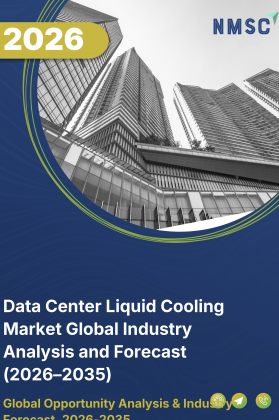
Data Center Liquid Cooling Market Global Industry Analysis and Forecast (2026–2035)

Data Center Liquid Cooling Market size was USD 6.83 Billion in 2025, projected to reach USD 49.25 Billion by 2035, growing at a CAGR of 18.03% from 2026 to 2035. Key drivers include rising accelerator power density, hyperscale artificial intelligence campus buildouts, and mandatory energy efficiency rules for new facilities, with North America leading the market.

Download Free Sample PDF
Base Year (2025)
$11.08 Billion
Forecast (2035)
$49.25 Billion
CAGR (2026-2035)
18.0%
Top Region
North America

What Is the Data Center Liquid Cooling Market Size?

The global Data Center Liquid Cooling Market size reached USD 6.83 Billion in 2025, is estimated at USD 11.08 Billion in 2026, and is forecast to reach USD 49.25 Billion by 2035 at an 18.03% CAGR from 2026 to 2035. North America leads with roughly 44% share, while Direct to chip cooling holds roughly 60% of 2025 revenue.

Based on our market analysis, we observed that accelerator power density is pulling liquid cooling revenue ahead of the broader data center cooling base, driven by standardizing commissioning, leak detection, and fluid management across new campuses.

Data Center Liquid Cooling Market Global Industry Analysis and Forecast (2026–2035) Revenue Forecast

Values in USD Billion

2025 $11.08 Billion
2025
2026 $13.08 Billion
2026
2027 $15.44 Billion
2027
2028 $18.22 Billion
2028
2029 $21.50 Billion
2029
2030 $25.38 Billion
2030
2031 $29.96 Billion
2031
2032 $35.36 Billion
2032
2033 $41.73 Billion
2033
2034 $49.26 Billion
2034
2035 $49.25 Billion
2035

Key Takeaways

By Cooling Technology: Direct to chip cooling held the largest share, expanding from USD 4.10 Billion in 2025 to USD 26.60 Billion by 2035; Immersion cooling is the fastest growing sub segment at 20.93% CAGR from 2026–2035.

By Component: Hardware held the largest share, expanding from USD 5.60 Billion in 2025 to USD 37.60 Billion by 2035; Software and controls is the fastest growing sub segment at 21.40% CAGR from 2026–2035.

By Data Center Type: Hyperscale data centers held the largest share, expanding from USD 3.55 Billion in 2025 to USD 24.50 Billion by 2035; Edge data centers are the fastest growing sub segment at 22.68% CAGR from 2026–2035.

Dominant Region: North America dominated with approximately 44% revenue share in 2025, or USD 3.00 Billion.

Fastest-Growing Region: Asia-Pacific is expected to register the highest CAGR of 20.55% during 2026–2035.

Dominant Country: The U.S. led the market with approximately USD 2.62 Billion in 2025, anchored by hyperscale campus buildouts.

Fastest-Growing Country: India is the fastest growing country at approximately 25.6% CAGR during 2026–2035, rising from USD 0.22 Billion in 2025 to USD 2.95 Billion by 2035.

The market presents an absolute dollar opportunity of approximately USD 38.17 Billion between 2026 and 2035, calculated as the difference between the 2035 forecast of USD 49.25 Billion and the 2026 base of USD 11.08 Billion, positioning direct to chip and immersion platforms as high conviction categories for thermal equipment makers and infrastructure investors.

According to NMSC analysis, revenue momentum stems from the convergence of accelerator thermal limits with power and building technology groups that now sell integrated grid to chip packages, which expands spend per megawatt well beyond standalone cooling hardware and Favors suppliers with manufacturing scale, service reach, and the ability to commission liquid cooled halls on hyperscale timelines.

What does the Data Center Liquid Cooling Market Encompass?

This market report defines the Data Center Liquid Cooling Market as systems that remove heat from servers, accelerators and racks by circulating liquid coolants, including direct to chip cold plates, immersion tanks with dielectric fluids, rear door heat exchangers coolant distribution units, manifolds, controls software and installation and maintenance services. We observed that the market has moved from a supercomputing niche into mainstream artificial intelligence infrastructure as accelerator power crossed the practical limit of air cooling.

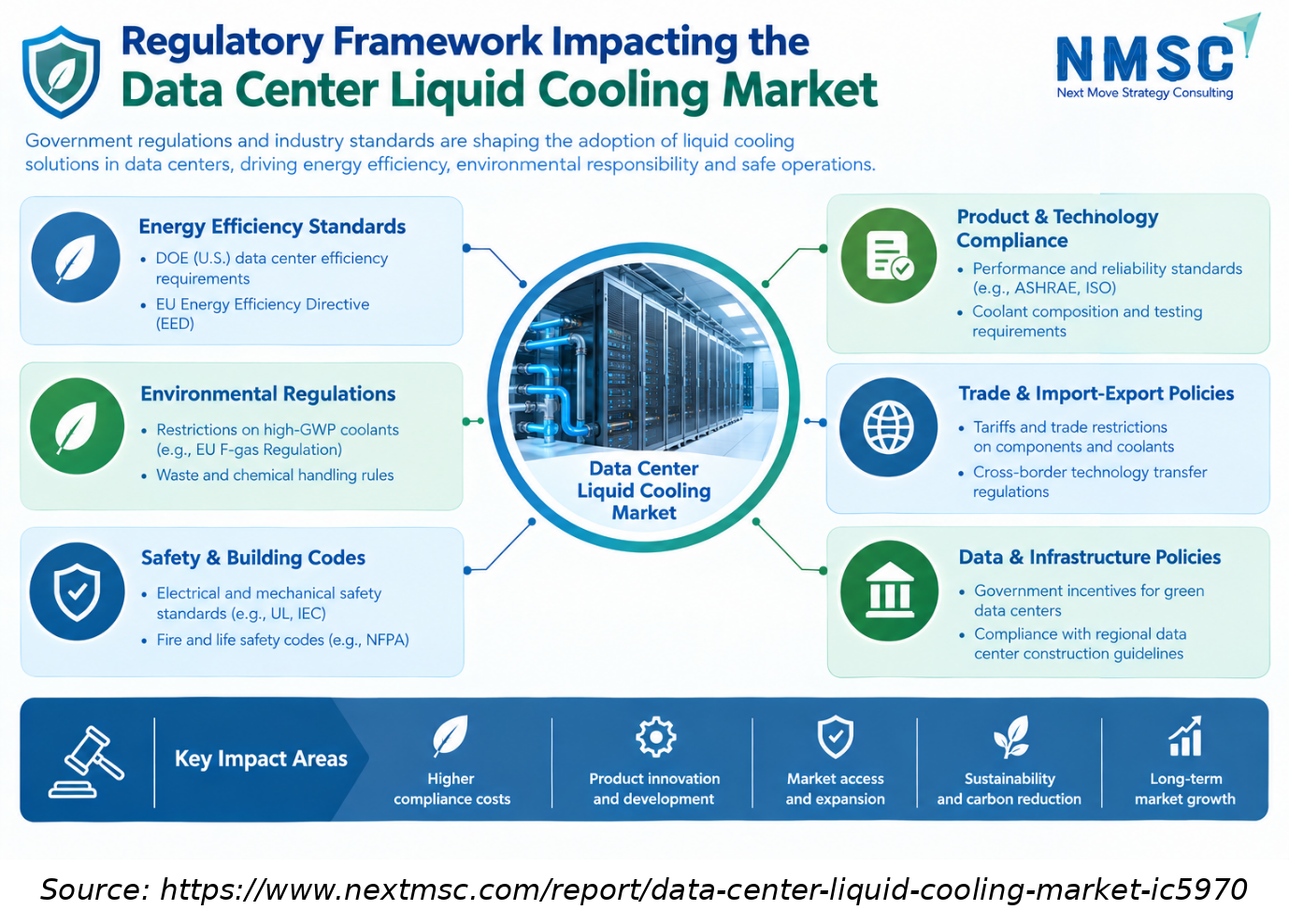
Our findings suggest that efficiency rules are shaping procurement with Germany requiring a power usage effectiveness of 1.2 or better for new data centers starting operations from July 2026 and heat reuse minimums rising from 10% to 20% by 2028. Technology adoption is shifting toward warm water loops, multi megawatt coolant distribution units, and hybrid designs that pair liquid cooling with residual air handling.

Market Drivers & Dynamics

Interactive Dataset
Accelerator power density above air cooling limits driver +5.2% North America, Asia-Pacific 2026–2035
Hyperscale and neocloud AI campus capital expenditure driver +3.6% North America, Asia-Pacific, Middle East 2026–2032
Mandatory efficiency and heat reuse rules for new data centers driver +2.1% Europe, Asia-Pacific 2026–2031
Warm water cooling that lowers chiller and power costs driver +1.6% Global 2026–2033
Retrofit demand in colocation and enterprise halls driver +1.2% North America, Europe 2026–2030
Higher upfront capital cost and integration complexity restraint −2.3% Global 2026–2030
Leak risk, fluid compatibility, and warranty uncertainty restraint −1.5% Global 2026–2029
Cold plate, manifold, and CDU supply constraints restraint −1.2% North America, Asia-Pacific 2026–2028
Regulatory scrutiny of fluorinated coolants restraint −0.9% Europe, North America 2026–2032
Shortage of trained thermal and commissioning engineers restraint −0.7% Middle East & Africa, Latin America 2026–2031
Source: Next Move Strategy Consulting

Growth Drivers

What Is the Primary Growth Driver in the Data Center Liquid Cooling Market?

The primary growth driver in the Data Center Liquid Cooling Market is accelerator power density that exceeds the practical limit of air cooling, which lifts demand for direct to chip and immersion systems. Global data center electricity consumption reached about 415 TWh in 2024 and is projected to reach about 945 TWh by 2030, while Vertiv reported second quarter 2026 net sales of USD 3.27 Billion, up 24% from a year earlier, reflecting strong thermal and power infrastructure demand.

How Is Hyperscale Capacity Expansion Driving the Data Center Liquid Cooling Market Growth?

Our analysis shows that hyperscale and neocloud buildouts are driving growth by converting design standards to liquid cooled halls. Data centers consumed about 4.4% of U.S. electricity in 2023 and could consume as much as 12% by 2028. nVent leased a further 160,000 square foot manufacturing site in July 2026, its third liquid cooling capacity expansion in three years, and reports more than 2 GW of liquid cooling deployed.

Growth Inhibitors

What is Restraining the Data Center Liquid Cooling Market?

We found that the primary restraint on the Data Center Liquid Cooling Market is the higher upfront capital cost and integration complexity of liquid cooling relative to air cooled halls, especially in retrofits. Leak risk, fluid compatibility questions, and warranty uncertainty slow purchasing among enterprise operators, and Cold plate, manifold, and coolant distribution unit supply can remain constrained in some projects as vendors continue to expand production capacity.

Segmentation Analysis

2025 (USD Billion)
2035 (USD Billion)
Direct to chip cooling 2025: $4.10 Billion | 2035: $26.60 Billion
Direct to ch
Immersion cooling 2025: $1.71 Billion | 2035: $17.15 Billion
Immersion co
Rear door heat exchanger cooling 2025: $1.02 Billion | 2035: $5.50 Billion
Rear door he
Direct to chip cooling $4.10 Billion $26.60 Billion 16.56%
Immersion cooling $1.71 Billion $17.15 Billion 20.93%
Rear door heat exchanger cooling $1.02 Billion $5.50 Billion 17.58%

Which Cooling Technology Dominates the Data Center Liquid Cooling Market?

Cooling technology segmentation separates how heat is captured from the processor or rack. Direct to chip cooling leads with USD 4.10 Billion in 2025, expanding to USD 26.60 Billion by 2035, because cold plates fit standard server designs and ship as factory integrated options. Immersion cooling is the fastest growing technology at a 20.93% CAGR from 2026 to 2035, as single-phase tanks and two-phase systems gain acceptance at densities that cold plates alone cannot capture.

2025 (USD Billion)
2035 (USD Billion)
Hardware
Coolant dist
Cold plates
Immersion ta
Heat rejecti
Segment Item 2025 (USD Billion) 2035 (USD Billion) CAGR
Hardware $10.0 USD Billion $40.0 USD Billion 25.0%
Coolant distribution units $17.1 USD Billion $51.1 USD Billion 11.0%
Cold plates and manifolds $24.2 USD Billion $62.2 USD Billion 25.0%
Immersion tanks and dielectric fluids $31.3 USD Billion $73.3 USD Billion 11.0%
Heat rejection and pumping equipment $38.4 USD Billion $84.4 USD Billion 16.0%

Segment-wise data is locked

Unlock complete segment-wise numbers for By Component.

Unlock Full Data

Which Component Leads and Which Grows Fastest?

Component segmentation splits revenue into equipment, control software, and lifecycle services. Hardware dominates at USD 5.60 Billion in 2025, covering coolant distribution units, cold plates, manifolds, immersion tanks, and heat rejection equipment. Software and controls is the fastest growing component at a 21.40% CAGR from 2026 to 2035, as operators adopt monitoring, leak detection, and flow control, while Services follows at 20.97% as commissioning and fluid maintenance scale.

2025 (USD Billion)
2035 (USD Billion)
Hyperscale d
Colocation d
Enterprise d
Edge data ce
Segment Item 2025 (USD Billion) 2035 (USD Billion) CAGR
Hyperscale data centers $10.0 USD Billion $40.0 USD Billion 27.0%
Colocation data centers $17.1 USD Billion $51.1 USD Billion 9.0%
Enterprise data centers $24.2 USD Billion $62.2 USD Billion 19.0%
Edge data centers $31.3 USD Billion $73.3 USD Billion 17.0%

Segment-wise data is locked

Unlock complete segment-wise numbers for By Data Center Type.

Unlock Full Data

Which Data Center Type Dominates and Which Is Fastest Growing?

Data center type segmentation reflects who buys and operates the cooling loop. Hyperscale data centers dominate at USD 3.55 Billion in 2025, growing to USD 24.50 Billion by 2035, because large operators standardize liquid cooled designs across campuses. Edge data centers are the fastest growing type at a 22.68% CAGR from 2026 to 2035, as compact liquid cooled units support inference workloads in space constrained sites.

2025 (USD Billion)
2035 (USD Billion)
North Americ
Canada
Mexico.
Europe: UK
Germany
Segment Item 2025 (USD Billion) 2035 (USD Billion) CAGR
North America: U.S. $10.0 USD Billion $40.0 USD Billion 14.0%
Canada $17.1 USD Billion $51.1 USD Billion 24.0%
Mexico. $24.2 USD Billion $62.2 USD Billion 22.0%
Europe: UK $31.3 USD Billion $73.3 USD Billion 12.0%
Germany $38.4 USD Billion $84.4 USD Billion 27.0%

Segment-wise data is locked

Unlock complete segment-wise numbers for By Region.

Unlock Full Data

Growth Opportunities

Our analysis shows that three whitespace opportunities stand out for equipment makers and service providers positioning ahead of 2035 demand.

Can Retrofit Programs Unlock Air Cooled Colocation Halls?

Vendors in the Data Center Liquid Cooling Market that offer rear door heat exchangers and liquid to air coolant units can retrofit existing colocation halls without rebuilding chilled water plants, benefiting Rear door heat exchanger cooling and Colocation data centers as tenants request higher rack densities inside legacy floor space. These upgrades support steady hardware revenue through 2032 while fully liquid cooled designs mature.

Does Heat Reuse Integration Create Value for European Campuses?

Suppliers in the Data Center Liquid Cooling Market that pair heat exchangers and warm water loops with district heating connections can meet heat reuse minimums such as Germany's 10% requirement for facilities starting operations from July 2026, rising to 20% in 2028. This mechanism benefits Hardware suppliers of heat rejection and pumping equipment, and it Favors operators that site campuses near heat networks.

Can Cooling as a Service Models Lower Adoption Barriers for Enterprises?

Providers in the Data Center Liquid Cooling Market that bundle coolant distribution units, fluid management, and monitoring into subscription contracts can reduce upfront cost for operators without in house thermal expertise. Ecolab has positioned its Cooling as a Service offering alongside its CoolIT Systems acquisition, benefiting the Services segment and Enterprise data centers, where capital budgets and specialist staff are most limited.

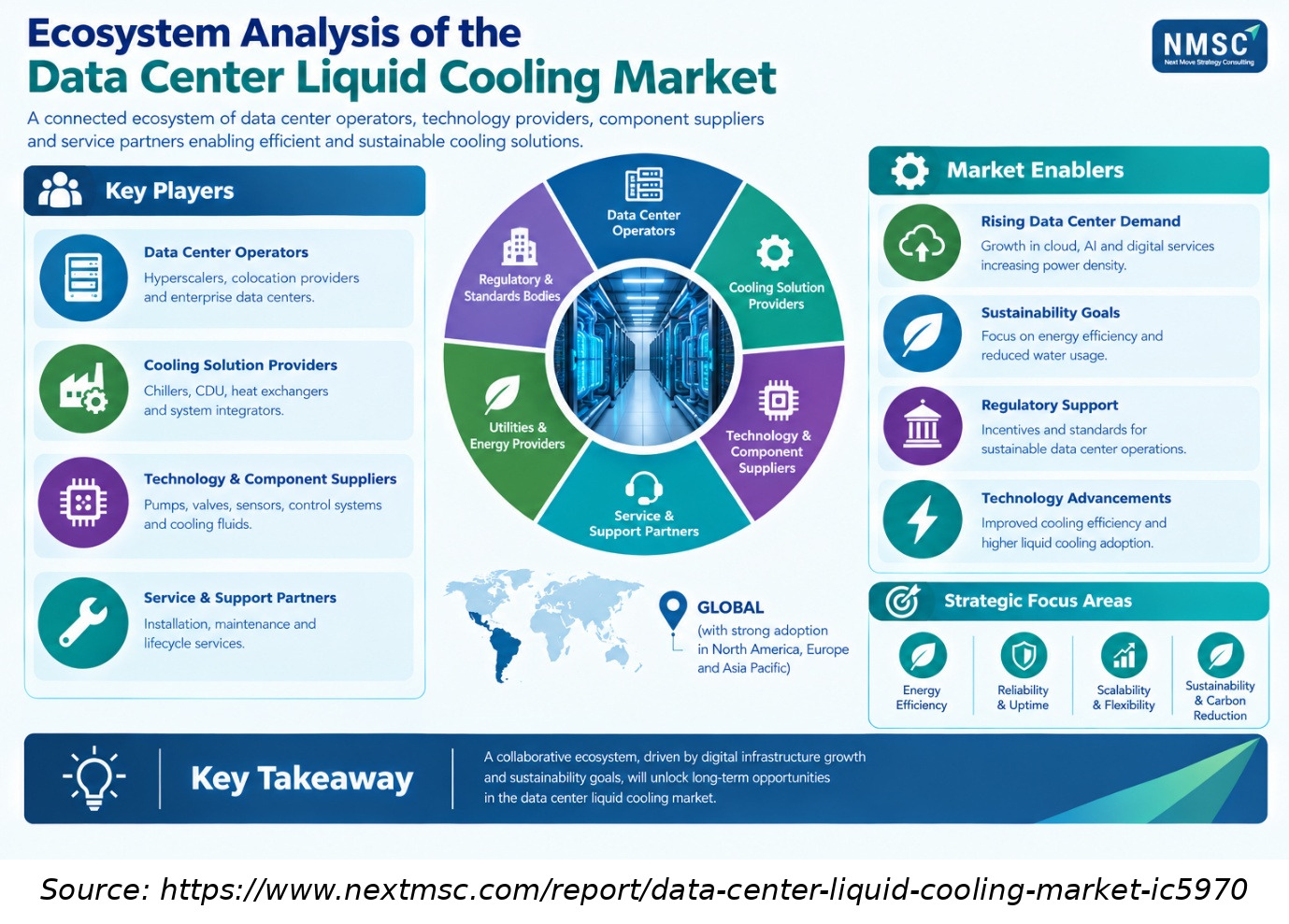
Ecosystem Analysis

Regional Outlook

2025 (USD Billion)
2035 (USD Billion)
North Americ
Asia-Pacific
Europe
Middle East
Latin Americ
Region 2025 (USD Billion) 2035 (USD Billion) CAGR (%)
North America $10.0 USD Billion $40.0 USD Billion 9.0%
Asia-Pacific $17.1 USD Billion $51.1 USD Billion 27.0%
Europe $24.2 USD Billion $62.2 USD Billion 25.0%
Middle East & Africa $31.3 USD Billion $73.3 USD Billion 23.0%
Latin America $38.4 USD Billion $84.4 USD Billion 12.0%

Regional data is locked

Unlock complete regional numbers for this market.

Unlock Full Data

Competitive Landscape

Our assessment indicates that the competitive landscape combines power and building technology groups, thermal specialists, and IT hardware makers, each competing on capacity scale, chip level engineering, and service coverage.

Dimension Description
Dimension Assessment
Market Structure Moderately consolidated; top 10 companies hold the majority of Market Share, led by integrated power and thermal groups alongside cold plate and heat exchanger manufacturers
Innovation Focus Multi megawatt coolant distribution units, immersion and two-phase systems, warm water loops, heat reuse integration, and software for leak detection and flow control
M&A Activity Frequent capacity driven acquisitions and minority investments as power, HVAC, and water technology groups buy liquid cooling specialists

How Do Companies Compete in the Data Center Liquid Cooling Market?

Companies in this Market compete on manufacturing capacity, chip level co engineering with accelerator and server makers, and global service coverage. Our findings suggest that suppliers with integrated power and cooling portfolios hold a structural advantage in large tenders. Pricing follows total cost of ownership arguments and multi-year capacity agreements, and geographic expansion follows hyperscale campuses, with new plants in North America and Asia-Pacific.

Which Competitive Archetypes Dominate the Data Center Liquid Cooling Market?

In the Data Center Liquid Cooling Market, integrated power and thermal groups such as Vertiv, Schneider Electric, and Eaton dominate through grid to chip portfolios, while cold plate and component specialists including CoolIT Systems, Asia Vital Components, Auras Technology, and Envicool differentiate through chip level engineering and volume. HVAC groups such as Trane Technologies, Carrier, and Johnson Controls compete from chiller to chip and immersion specialists such as Summer and Isotope compete on fluid and tank design.

What Innovation and Differentiation Strategies Are Companies Pursuing?

We observed that leading Data Center Liquid Cooling Market companies differentiate through larger coolant distribution units, warmer supply temperatures, and unified controls. Supermicro's DLC-2 stack uses an in-rack coolant distribution unit rated at 250 kW per rack and supports inlet water up to 45°C, which reduces chiller dependence. Differentiation increasingly rests on delivering tested, factory integrated systems rather than individual components.

What M&A and Partnership Activity Is Shaping the Data Center Liquid Cooling Market?

Recent Data Center Liquid Cooling Market activity Favors acquisitions and minority stakes that add liquid cooling capability to power and HVAC portfolios. Vertiv acquired Strategic Thermal Labs on April 27, 2026, Carrier Ventures expanded its investment in ZutaCore on April 29, 2026, and Johnson Controls led Accelsius’s USD 65 million Series B round in January 2026, with Legrand participating. Our analysis shows that buyers prioritize cold plate engineering and two-phase technology.

Key Market Players

Based on research conducted by NMSC, the following companies represent the validated set of leading participants across direct to chip, immersion, and heat rejection liquid cooling offerings for data centers.

Vertiv Holdings Co Schneider Electric SE Eaton Corporation plc Delta Electronics, Inc. Asia Vital Components Co., Ltd. nVent Electric plc Ecolab Inc. Trane Technologies plc Johnson Controls International plc Carrier Global Corporation Daikin Industries, Ltd. Auras Technology Co., Ltd. Shenzhen Envicool Technology Co., Ltd. Super Micro Computer, Inc. Modine Manufacturing Company Alfa Laval AB Submer Technologies, S.L. Iceotope Technologies Limited ZutaCore Ltd.

Latest Developments

We found that recent corporate activity reflects capacity expansion, portfolio consolidation, and larger coolant distribution units as the competitive landscape shifts toward integrated suppliers.

Date Event
May 2026 Daikin Holdings Singapore and Delta Electronics signed an MOU to collaborate on next-generation coolant distribution unit solutions for AI and HPC data centers across ASEAN and Oceania.
March 2026 ZutaCore announced OmniTherm, a cold-plate solution providing waterless two-phase cooling for servers using NVIDIA RTX PRO 6000 Blackwell Server Edition GPUs

Key Benefits for Stakeholders

How Does This Report Benefit Industry Leaders?

Industry leaders gain segment level revenue forecasts and CAGR benchmarks across the cooling technology, component, and data center type axes of the Data Center Liquid Cooling Market, enabling capacity and product roadmap decisions grounded in the same 2025–2035 figures used throughout this analysis. Our regional analysis and country level insights further support plant location, capacity timing, and partnership strategy decisions.

How Does This Report Benefit Investors and Financial Analysts?

Investors and financial analysts gain a reconciled Data Center Liquid Cooling Market sizing model, a competitive landscape assessment, and named company development tracking that supports valuation and capital allocation decisions. The Growth Catalyst & Risk Assessment Matrix quantifies driver and restraint impact on CAGR, aiding scenario analysis for portfolio positioning across acquisitions and growth rounds.

How Does This Report Benefit Technology Vendors and Product Teams?

Technology vendors and product teams gain visibility into which Data Center Liquid Cooling Market segments, such as Immersion cooling, Software and controls, and Edge data centers, are growing fastest, informing where to prioritize engineering investment and go to market focus through 2035, with emerging trends, innovations, and opportunities mapped to each segment.

Key Market Segments Evaluated

By Cooling Technology

  • Direct to chip cooling 
    • Single phase cold plate
    • Two phase cold plate
  • Immersion cooling 
    • Single phase immersion
    • Two phase immersion
  • Rear door heat exchanger cooling 
    • Passive rear door
    • Active rear door

By Component

  • Hardware 
    • Coolant distribution units
    • Cold plates and manifolds
    • Immersion tanks and dielectric fluids
    • Heat rejection and pumping equipment
  • Software and controls 
    • Monitoring and control software
  • Services 
    • Installation and commissioning
    • Maintenance and support

By Data Center Type

  • Hyperscale data centers
  • Colocation data centers
  • Enterprise data centers
  • Edge data centers

By Region

  • North America 
    • U.S.
    • Canada
    • Mexico.
  • Europe 
    • UK
    • Germany
    • France
    • Italy
    • Spain
    • Sweden
    • Denmark
    • Finland
    • Netherlands
    • Rest of Europe.
  • Asia-Pacific 
    • China
    • India
    • Japan
    • South Korea
    • Taiwan
    • Indonesia
    • Vietnam
    • Australia
    • Philippines
    • Malaysia
    • Rest of APAC.
  • Middle East & Africa 
    • Saudi Arabia
    • UAE
    • Egypt
    • Israel
    • Turkey
    • Nigeria
    • South Africa
    • Rest of MEA.
  • Latin America 
    • Brazil
    • Argentina
    • Chile
    • Colombia
    • Rest of LATAM.

Conclusion & Recommendations

Our findings suggest that the Data Center Liquid Cooling Market will expand from USD 6.83 Billion in 2025 to USD 49.25 Billion by 2035, with USD 11.08 Billion estimated for 2026 and an 18.03% CAGR from 2026 to 2035. Direct to chip cooling remains the largest technology, while Immersion cooling and Software and controls gain share as densities rise.

Strategic Positioning Recommendations: How Should Vendors Position?

Vendors in the Data Center Liquid Cooling Market should prioritize multi megawatt coolant distribution capacity, chip level co engineering with accelerator makers, and service networks that support commissioning and fluid maintenance. Our assessment indicates that suppliers should pursue integrated power and cooling packages for hyperscale buyers while offering rear door and hybrid retrofit options for colocation and enterprise operators.

Investment Attractiveness: Where Is Value Concentrated?

Investment attractiveness in the Data Center Liquid Cooling Market is highest in Asia-Pacific, which is projected to grow at a 20.55% CAGR from 2026 to 2035, and in Software and controls and Services, which grow faster than Hardware. We found that acquirers pay premium valuations for proven cold plate and coolant distribution capability, so entry through partnerships or minority stakes may offer better risk adjusted returns.

Market Shifts and Key Risks: What Could Change the Trajectory?

Key risks to the Data Center Liquid Cooling Market include capital cost premiums over air cooling, leak and warranty concerns, supply chain limits for cold plates and manifolds, and possible moderation in artificial intelligence capital spending. Our analysis shows that the 2026 step up from USD 6.83 Billion to USD 11.08 Billion depends on continued hyperscale deployments, so tracking order backlogs and capacity additions is essential.

Growth Pathways: How Can Participants Capture the Opportunity?

Growth pathways in the Data Center Liquid Cooling Market include retrofit programs for colocation halls, heat reuse integration in European campuses, and Cooling as a Service models for enterprises, together supporting the USD 38.17 Billion opportunity between 2026 and 2035. Based on research conducted by NMSC, participants that combine manufacturing scale with service reach are best placed to capture it.

FAQs

Where Are Capital Inflows Concentrating in this Industry?

Where Are Capital Inflows Concentrating in this Industry?

Capital in the Data Center Liquid Cooling Market is concentrating in acquisitions and growth rounds for cold plate, coolant distribution, and two-phase specialists. Ecolab agreed to pay about USD 4.75 Billion in cash for CoolIT Systems in March 2026, and Johnson Controls led an Acilius Series B round in January 2026. This pattern signals durable capital allocation toward suppliers with proven chip level engineering and manufacturing scale.

How Is Infrastructure Investment Shaping Long-Term Capacity?

Our findings suggest that infrastructure investment in the Data Center Liquid Cooling Market is shifting toward dedicated liquid cooling manufacturing capacity. nVent has added more than 400,000 square feet of production space across three expansions in three years, and Vertiv reported net sales of USD 3.27 Billion in the second quarter of 2026. These commitments Favor vendors able to scale coolant distribution units, manifolds, and cold plates alongside hyperscale campus timelines.

What ESG Considerations Are Influencing Investment Decisions?

Environmental, Social, and Governance considerations in the Data Center Liquid Cooling Market center on energy efficiency, water use, and heat reuse. Germany requires renewable electricity coverage of 100% from 2027 for larger data centers and heat reuse minimums from July 2026, and Alfa Laval positions Free Water Loop as a way to lower net water consumption. We found that investors increasingly Favor suppliers that document efficiency gains and closed loop water performance.

About the Author

Mihul Sharma

Mihul Sharma

Mihul Sharma is Research Associate at Next Move Strategy Consulting, where he has covered technology, industrial, and healthcare markets for 3 years. His work applies structured business research, market analysis, and secondary-source review to assess market trends, competitive developments, and growth opportunities. He supports report development by fully synthesizing industry data, company information, and market signals into concise findings for strategy and investment-focused research teams.

About the Reviewer

Supradip Baul

Supradip Baul

Supradip Baul is an accomplished business consultant and strategist with over a decade of rich experience in market intelligence, strategy, technology, and business transformation. His work has included rigorous qualitative and quantitative analysis across multiple industries, helping clients shape investment decisions and long-term roadmaps. Earlier in his career, he was associated with Gartner, where he contributed to industry-leading reports and market share analyses. He has worked with leading global companies and holds an MBA with a dual specialization in Marketing and Finance.

Download Free Sample

Mohit Agarwal

MOHIT AGARWAL

Chief Manager

DryChem India Pvt. Ltd.

Next Move Strategy Consulting is an amazing team of consultants. We required a market study report for our investors on top priority and the team went above and beyond our expectations to deliver the same with ample supporting data within a short time span enabling us to secure the investments and keep our project timeline maintained. Their professionalism, attention to detail, and timely delivery of actionable recommendations have left a lasting impression on our organization.
Semih Kavaklioglu

SEMIH KAVAKLIOGLU

Co-Founder & Sales Manager

Decortie

I work a lot in the marketing industry and I know that research is an essential part of any campaign. I have used Market research reports for my own products and I found them to be very informative and well-researched. The team here produces insightful reports for a good price

Rishabh Jogani

RISHABH JOGANI

Strategy Analyst

Accenture Japan

We are incredibly impressed with the market report on the real estate market in India provided by Next Move Strategy Consulting. The report was thorough, insightful, and well-structured, offering deep analysis and actionable recommendations. It not only captured the current trends and dynamics but also provided a forward-looking perspective that has been invaluable for our strategic planning. Their team demonstrated exceptional professionalism, attention to detail, and a profound understanding of the industry. The data-driven insights and clarity of presentation exceeded our expectations, making complex market trends easy to understand. We highly recommend Next Move Strategy Consulting to anyone looking for reliable and comprehensive market research services. Their expertise has given us the confidence to navigate the complexities of the Indian real estate market with clarity and foresight.

Ross J Mckenzie

ROSS J MCKENZIE

Business Insight Manager

Staysure Group

“Next MSC have been incredibly helpful in providing detailed & robust information on our market, alongside quantifying growth by different segments. The process to procure was simple and easy, with sample reports and regular contact to ensure we had what we needed. Succinct detail on their sources & methodologies is also greatly received, allowing transparency in this respect helps build trust in the detail you pay for. Joseph in particular was fantastic, and helped ensure efficient provision of the insight pack – thank you NMSC!”.

Diana Trejo

DIANA TREJO

Assistant Manager

Sumitomo Corporation de Mexico, S.A. de C.V.

Recently, we purchased a report on the Mexico Data Center Market from Next Move Strategy Consulting. The service has been excellent, with support that is always timely and thoroughly professional. The information provided is interesting, highly useful, and delivered with clarity. I would highly recommend NextMSC for anyone seeking insightful and dependable analysis.

Custom Market Research Services

We will customize the research for you if the listed report does not fully match your requirements.

Get 30% Free Customization

Select License

This website uses cookies to ensure you get the best experience on our website. Learn more

✖