Data Center Server Market Global Industry Analysis and Forecast (2026-2035)

Data Center Server Market size was USD 236.83 Billion in 2025, projected to reach USD 501.40 Billion by 2035, growing at a CAGR of 7.42% from 2026 to 2035. Key drivers include surging AI training and inference server demand, accelerating hyperscale cloud capacity expansion, and rapid adoption of GPU and accelerated computing server architectures, with North America leading the market.
Download Free Sample PDF
Base Year (2025)
$236.83 Billion
Forecast (2035)
$501.40 Billion
CAGR (2026-2035)
7.4%
Top Country
North America

What Is the Data Center Server Market Size?
The global Data Center Server Market size reached USD 236.83 Billion in 2025 and is estimated at USD 263.29 Billion in 2026, forecast to reach USD 501.40 Billion by 2035 at a CAGR of 7.42% between 2026 and 2035. North America holds an approximate 40% revenue share in 2025, while High-Density and Accelerated Servers dominate the fastest growing server type segment and Rack Servers dominate by volume at approximately 46% share.
We observed that the shift from general-purpose CPU servers toward GPU accelerated and custom AI silicon servers is the single most significant structural transformation in the Data Center Server Market since the transition from proprietary RISC to x86 architecture reshaping bill of materials composition, average selling price trajectories, and competitive positioning across every server vendor in the market.
Data Center Server Market Global Industry Analysis and Forecast (2026-2035) Revenue Forecast
Values in USD Billion

2025 $236.83 Billion
2025
2026 $254.40 Billion
2026
2027 $273.28 Billion
2027
2028 $293.56 Billion
2028
2029 $315.34 Billion
2029
2030 $338.74 Billion
2030
2031 $363.87 Billion
2031
2032 $390.87 Billion
2032
2033 $419.87 Billion
2033
2034 $451.03 Billion
2034
2035 $501.40 Billion
2035

Key Takeaways

By Server Type: Rack Servers held the largest share at approximately 46% (USD 109.01 billion) in 2025, rising to USD 200.56 billion by 2035; High-Density and Accelerated Servers are the fastest-growing server type at 17.8% CAGR from 2026–2035.

By Component: Processors held the largest share at USD 85.26 billion in 2025, projected to reach USD 175.49 billion by 2035; Power and Cooling is the fastest-growing component at 10.9% CAGR from 2026–2035.

By Deployment: Cloud and Hyperscale held the largest share at USD 113.68 billion in 2025, projected to reach USD 255.71 billion by 2035; Colocation is the fastest-growing deployment at 9.8% CAGR from 2026–2035.

Dominant Region: North America dominated with approximately 40% revenue share (USD 94.73 billion) in 2025.

Fastest-Growing Region: Asia-Pacific is expected to register the highest CAGR of 9.1% during 2026–2035.

Dominant Country: The U.S. led the market in 2025, supported by its high concentration of hyperscale and AI infrastructure investment.

Fastest-Growing Country: India is the fastest-growing country, driven by data center investment and expanding domestic cloud infrastructure capacity.

The market presents an absolute investment opportunity of approximately USD 238.11 Billion between 2026 and 2035, calculated as the difference between the 2035 forecast of USD 501.40 Billion and the 2026 estimate of USD 263.29 Billion, making the Data Center Server Market one of the largest absolute-dollar technology infrastructure investment opportunities over the next decade.

According to NMSC analysis, the average server unit revenue is undergoing a structural inflation cycle independent of unit volume growth as AI accelerated servers carrying GPU content valued at USD 30,000 to USD 200,000 per system progressively displace CPU servers priced at USD 5,000 to USD 20,000 per unit, compressing traditional unit volume metrics as a proxy for market value and requiring revenue based analysis to accurately size the market’s growth trajectory.

What does the Data Center Server Market Encompass?

The Data Center Server Market covers purpose designed computing systems deployed within data center facilities to process, store, and serve enterprise, cloud, AI, and communication workloads at scale. Product categories span rack-mounted general-purpose servers, blade server systems, tower servers for edge and branch deployments, and high-density accelerated computing servers integrating GPU, FPGA, and custom AI silicon accelerator components. These systems serve cloud and hyperscale operators, colocation facilities, and enterprise on premises data centers across cloud service provider, BFSI, telecom, healthcare, government, and defense end user verticals globally.

Structurally, the market evolved from a commodity x86 server business defined by CPU generation cycles into a multi-tier discipline where high value accelerated computing systems are redefining revenue distribution, vendor rankings, and competitive dynamics. Technology adoption toward liquid cooling for high thermal density GPU server racks, direct liquid cooling integration from vendors including Super Micro and HPE, and the emergence of custom AI silicon from hyperscale operators are accelerating design differentiation. Regulatory developments including the U.S. CHIPS and Science Act’s server supply chain localization provisions and data sovereignty requirements for sovereign cloud infrastructure are reshaping geographic manufacturing and deployment decisions across global server operators.

Market Drivers & Dynamics

Interactive Dataset
Surging AI training and inference server demand from hyperscale cloud operators and enterprise AI adoption driver +3.2% North America, Asia-Pacific 2026–2035
Hyperscale cloud capital expenditure growth sustaining recurring general-purpose and accelerated server refresh cycles driver +2.1% North America, Europe, Asia-Pacific 2026–2033
Expanding colocation data center capacity investment driven by enterprise cloud migration and AI outsourcing driver +1.4% Global 2026–2035
Government digital infrastructure investment programs in India, EU, Japan, and Gulf states expanding data center server demand driver +1.0% Asia-Pacific, Europe, MEA 2026–2035
Replacement demand from enterprise server installed base refresh aligned with 3– 5 year hardware lifecycle driver +0.8% Global 2026–2032
Supply chain constraints on GPU and advanced server processor availability creating procurement lead-time risk restraint −1.3% Global 2026–2030
Hyperscale operator in-house custom silicon displacing external OEM server revenue at the premium AI compute tier restraint −0.9% North America, Asia-Pacific 2026–2033
Energy and power constraint at legacy data centers limiting high-density AI server deployment pace restraint −0.6% Europe, North America 2026–2031
U.S. export controls on advanced server processors and AI chips limiting addressable market in restricted geographies restraint −0.4% China, MEA 2026–2035
Source: Next Move Strategy Consulting

Growth Drivers

What Is the Primary Growth Driver in the Data Center Server Market?

The primary growth driver is surging AI training and inference server demand from hyperscale cloud operators and enterprise AI adoption programs. According to Microsoft Corporation’s FY2025 Annual Report, the company committed over USD 80 billion in data center capital expenditure for fiscal year 2025, with AI infrastructure cited as the primary allocation. This level of committed capex from a single hyperscale operator sustains multi-year procurement contracts for AI-accelerated servers that ripple through GPU suppliers, ODM contract manufacturers, and branded OEM server vendors simultaneously.

How Is Hyperscale Cloud Capital Expenditure Driving Data Center Server Market Growth?

Our analysis shows that the four largest hyperscale operators Alphabet Inc., Amazon.com, Inc., Microsoft Corporation, and Meta Platforms, Inc. collectively committed capital expenditure programs exceeding USD 300 billion annually as of 2025, with data center server hardware representing the single largest infrastructure component by spend. Meta Platforms confirmed a 2025 capital expenditure guidance of USD 60 to USD 65 billion in its Q4 2024 earnings release, specifically identifying AI data center infrastructure as the primary allocation and directly sustaining multi-year server procurement backlogs at both GPU-accelerated and general purpose server tiers.

Growth Inhibitors

What Is Restraining the Data Center Server Market?

We found that GPU and advanced processor supply constraints are the primary near-term restraint, creating procurement lead times of six to twelve months for AI accelerated servers that defer revenue recognition for both server vendors and data center operators. The U.S. Bureau of Industry and Security export control regulations also restrict the sale of H100 and B200 class GPU-based server systems to certain geographies, compressing the addressable market for U.S.-headquartered OEM vendors and creating substitution demand for domestic alternatives in affected markets, particularly China.

What Are the Growth Opportunities?

Can AI Inference Server Platforms at the Edge Create a New Revenue Category Beyond Hyperscale?

Enterprise AI inference server deployment at the edge in factory, hospital, retail, and financial services on premises environments represents a rapidly growing market segment that is structurally distinct from hyperscale training cluster procurement, benefiting the Enterprise On-Premises deployment model and High Density and Accelerated Servers type as AI inference workloads require purpose-designed GPU or NPU server form factors not served by general-purpose rack servers alone.

Does Liquid Cooling Server Integration Enable Premium Pricing and Margin Capture for OEMs?

Server vendors that deliver factory integrated direct liquid cooling solutions certified for customer-specific rack and facility configurations can command 15 to 30 percent gross margin premiums relative to air cooled equivalents, benefiting the Power and Cooling component segment and High Density and Accelerated Servers type as hyperscale operators increasingly specify liquid cooled AI server systems as a procurement prerequisite rather than an optional upgrade for GPU rack densities above 40 kilowatts per rack.

Can Government Sovereign Cloud and National AI Infrastructure Programs Expand Addressable Markets Outside Core Hyperscale?

Government-backed national AI and sovereign cloud server procurement programs in Saudi Arabia, UAE, India, and Japan are creating first generation hyperscale-class server demand outside the established North American and Asia-Pacific hyperscale markets, benefiting Cloud and Hyperscale and Colocation deployment models and Rack Servers and High-Density and Accelerated Servers types as these programs specify modern AI server configurations aligned with international cloud operator standards.

Segmentation Analysis

2025 (USD Billion)
2035 (USD Billion)
Rack Servers
High-Density
Blade Server
Tower Server
Segment Item 2025 (USD Billion) 2035 (USD Billion) CAGR
Rack Servers $10.0 USD Billion $40.0 USD Billion 14.0%
High-Density and Accelerated Servers $17.1 USD Billion $51.1 USD Billion 8.0%
Blade Servers $24.2 USD Billion $62.2 USD Billion 14.0%
Tower Servers $31.3 USD Billion $73.3 USD Billion 20.0%

Segment-wise data is locked

Unlock complete segment-wise numbers for By Server Type.

Unlock Full Data

Which Server Type Dominates the Data Center Server Market?

Rack Servers lead with USD 109.01 Billion in 2025, expanding to USD 200.56 Billion by 2035, reflecting their foundational role as the primary general-purpose compute form factor across cloud, colocation, and enterprise data center deployments. High-Density and Accelerated Servers is the fastest-growing server type at a 13.9% CAGR, driven by the structural shift toward GPU-based AI training and inference systems where per-unit revenue and per-rack computing density are multiples of traditional CPU rack server equivalents.

2025 (USD Billion)
2035 (USD Billion)
Processors
Memory
Storage
Power and Co
Others
Segment Item 2025 (USD Billion) 2035 (USD Billion) CAGR
Processors $10.0 USD Billion $40.0 USD Billion 25.0%
Memory $17.1 USD Billion $51.1 USD Billion 11.0%
Storage $24.2 USD Billion $62.2 USD Billion 25.0%
Power and Cooling $31.3 USD Billion $73.3 USD Billion 11.0%
Others $38.4 USD Billion $84.4 USD Billion 16.0%

Segment-wise data is locked

Unlock complete segment-wise numbers for By Component.

Unlock Full Data

Which Component Leads and Which Grows Fastest?

Processors lead component demand at USD 85.26 Billion in 2025, growing to USD 175.49 Billion by 2035, reflecting the combined value of CPUs, GPUs, and custom AI accelerator silicon within each server system across all deployment tiers. Power and Cooling is the fastest-growing component at a 10.9% CAGR, driven by the thermal density requirements of GPU-accelerated AI server racks that necessitate direct liquid cooling, immersion cooling, and rear-door heat exchanger systems now included in the server bill-of-materials cost base of AI-optimized data center infrastructure deployments across hyperscale and colocation operators.

2025 (USD Billion)
2035 (USD Billion)
Cloud and Hy
Colocation
Enterprise O
Segment Item 2025 (USD Billion) 2035 (USD Billion) CAGR
Cloud and Hyperscale $10.0 USD Billion $40.0 USD Billion 27.0%
Colocation $17.1 USD Billion $51.1 USD Billion 9.0%
Enterprise On-Premises $24.2 USD Billion $62.2 USD Billion 19.0%

Segment-wise data is locked

Unlock complete segment-wise numbers for By Deployment.

Unlock Full Data

Which Deployment Model Dominates and Which Grows Fastest?

Cloud and Hyperscale dominates at USD 113.68 Billion in 2025, growing to USD 255.71 Billion by 2035, reflecting the concentration of highest-value AI accelerated server procurement within hyperscale AI infrastructure programs at the top five cloud operators. Colocation is the fastest-growing deployment at a 9.8% CAGR, as enterprises outsource increasingly dense AI and cloud-native workloads to third-party colocation facilities where power and cooling infrastructure required for GPU server deployments is available without enterprise capital expenditure commitment for facility buildout.

2025 (USD Billion)
2035 (USD Billion)
Cloud Servic
BFSI
Telecom
Healthcare a
Government a
Segment Item 2025 (USD Billion) 2035 (USD Billion) CAGR
Cloud Service Providers $10.0 USD Billion $40.0 USD Billion 14.0%
BFSI $17.1 USD Billion $51.1 USD Billion 24.0%
Telecom $24.2 USD Billion $62.2 USD Billion 22.0%
Healthcare and Life Sciences $31.3 USD Billion $73.3 USD Billion 12.0%
Government and Defense $38.4 USD Billion $84.4 USD Billion 27.0%

Segment-wise data is locked

Unlock complete segment-wise numbers for By End User Industry.

Unlock Full Data

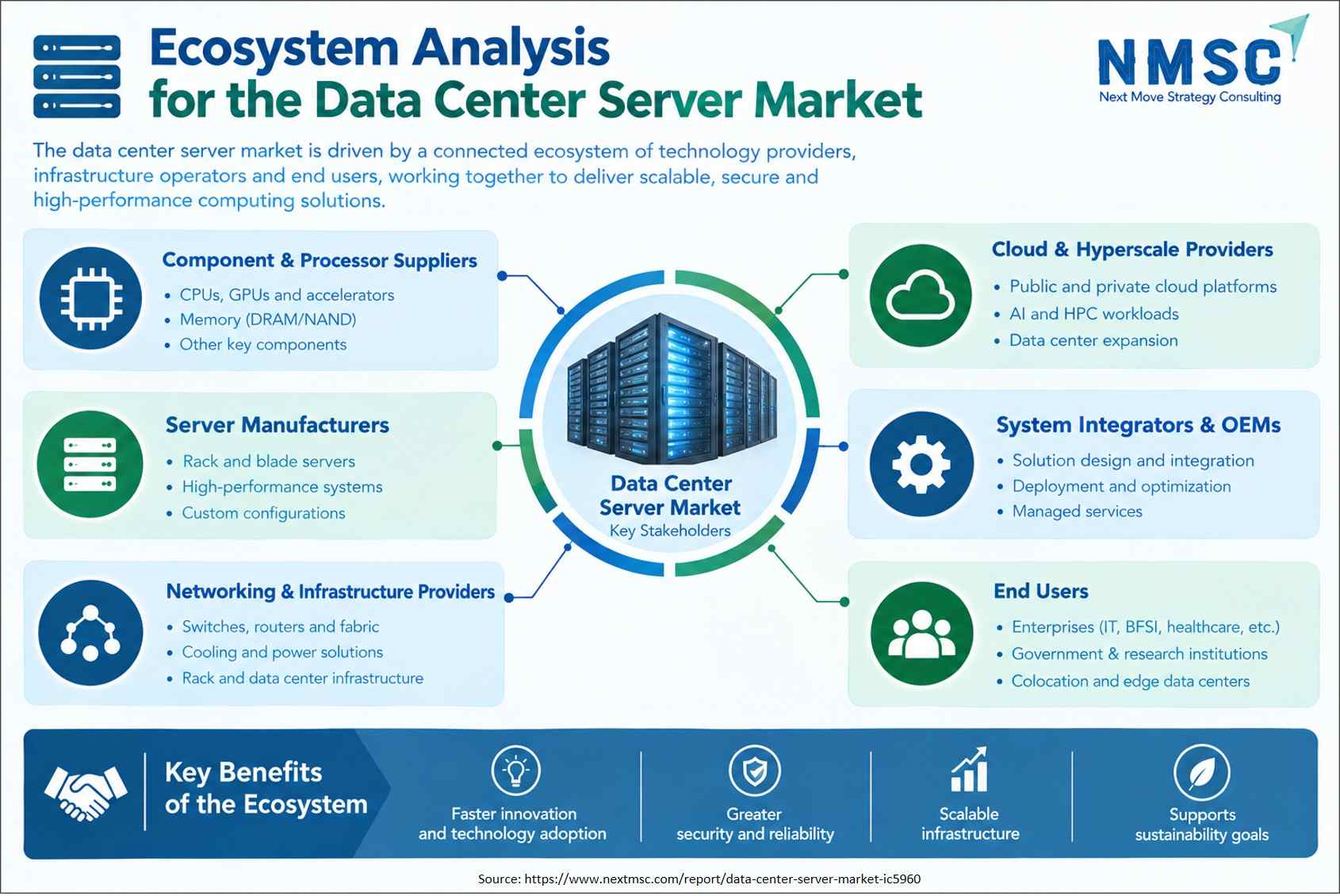
Ecosystem Analysis

Regional Outlook

2025 (USD Billion)
2035 (USD Billion)
North Americ
Asia-Pacific
Europe
Middle East
Latin Americ
Region 2025 (USD Billion) 2035 (USD Billion) CAGR (%)
North America $10.0 USD Billion $40.0 USD Billion 9.0%
Asia-Pacific $17.1 USD Billion $51.1 USD Billion 27.0%
Europe $24.2 USD Billion $62.2 USD Billion 25.0%
Middle East & Africa $31.3 USD Billion $73.3 USD Billion 23.0%
Latin America $38.4 USD Billion $84.4 USD Billion 12.0%

Regional data is locked

Unlock complete regional numbers for this market.

Unlock Full Data

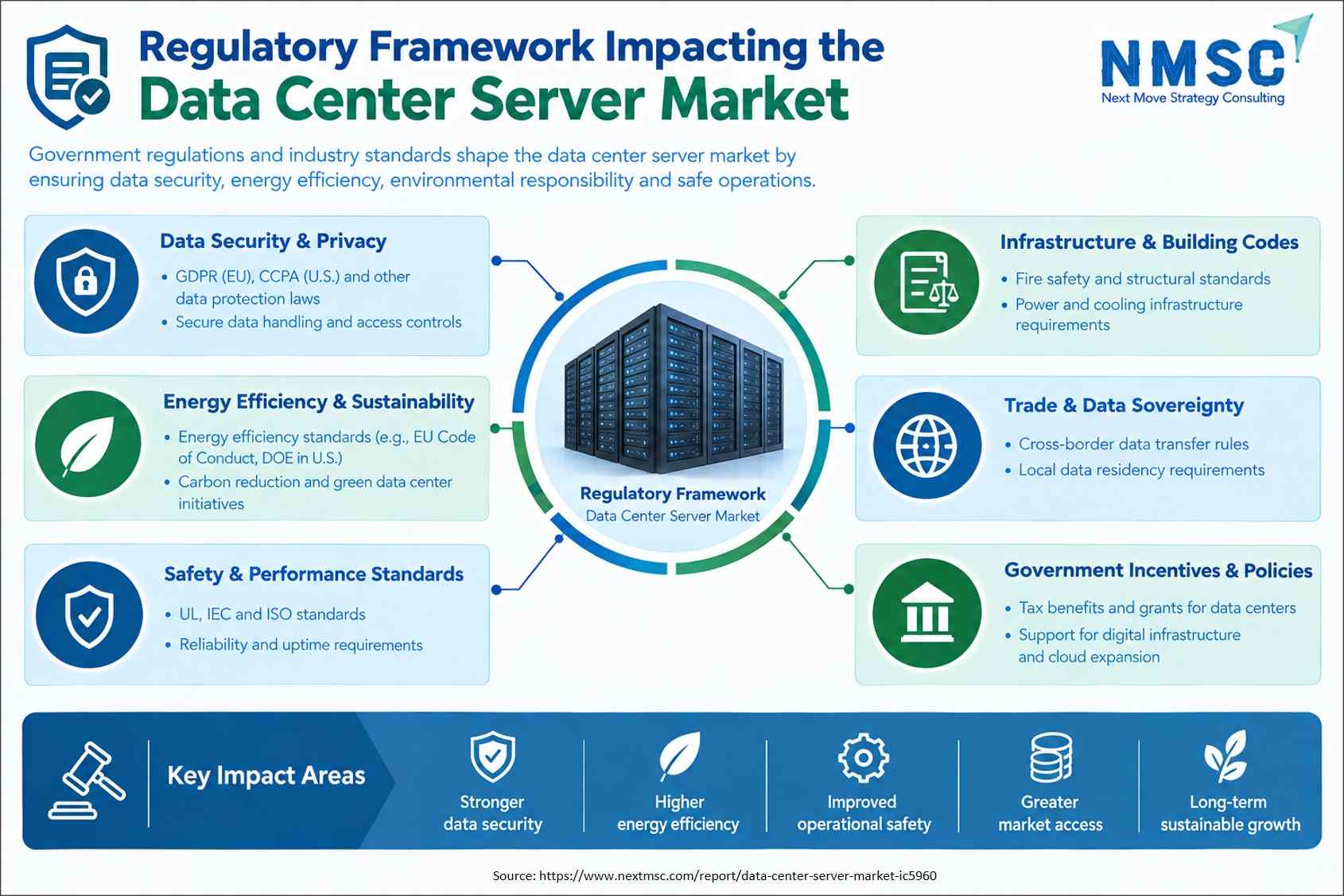
The infographic highlights key regulations and standards affecting the Data Center Server Market, covering energy efficiency, data security, environmental requirements, electrical safety, and equipment standards. It shows how regulatory frameworks influence server design, energy consumption, compliance, and data center operations.

Competitive Landscape

Our assessment indicates that the Data Center Server Market Industry is moderately consolidated at the branded OEM tier, with four to five vendors controlling the majority of branded server revenue across general purpose and accelerated computing categories, while a broader ecosystem of ODM contract manufacturers competes intensely at the hyperscale white-box tier. Key Takeaways

Dimension Description
Market Structure Moderately consolidated; Dell Technologies, HPE, Lenovo, Super Micro, and Inspur collectively hold an estimated 55–60% of market share; ODM manufacturers including Foxconn, Quanta, and Wiwynn hold significant white-box hyperscale volume
Innovation Focus Liquid cooling integration for GPU server racks, AI-accelerated server platform development, open computer hardware design, CXL memory interconnect adoption, and server management AI platform integration
M&A Activity Super Micro Computer expansion of liquid-cooling manufacturing capacity; Dell Technologies’ AI server portfolio expansion including Project Helix and PowerEdge XE9680; targeted ODM capacity acquisitions to serve hyperscale AI build programs

How Do Companies Compete in the Data Center Server Market?

Companies compete primarily on GPU and CPU allocation relationships securing processor supply priority, liquid-cooling integration capability for high-density AI server racks, system-level AI software management platform breadth, and total cost of ownership modelling for multi-year server fleet deployments. We found that vendors with established GPU allocation relationships with NVIDIA and AMD hold a structural procurement advantage during periods of accelerator supply constraint, directly determining which server vendors can fulfil hyperscale AI server orders within competitive delivery timeframes.

Which Competitive Archetypes Dominate the Data Center Server Market?

Diversified IT infrastructure companies including Dell Technologies, Inc. and Hewlett Packard Enterprise Company dominate enterprise and colocation server sales through integrated hardware, software, and services portfolio approaches. AI server specialists including Super Micro Computer, Inc. differentiate through rapid product cycles aligned with NVIDIA GPU generation launches. ODM hyperscale partners including Quanta Computer Inc. and Foxconn Industrial Internet capture white-box volume at the hyperscale tier. Regional vendors including Inspur Group and Huawei Technologies compete on domestic data center infrastructure relationships in Asia-Pacific markets where U.S. OEM access is constrained by export controls.

What Innovation and Differentiation Strategies Are Companies Pursuing?

We observed that leading companies are investing in factory-integrated direct liquid cooling solutions, CXL memory interconnect-enabled server architectures for AI inference workloads, and AI-integrated server management platforms that reduce operational overhead for fleet-scale deployments. Differentiation increasingly rests on the ability to deliver validated liquid-cooled AI server systems at hyperscale volumes within compressed delivery timelines aligned with GPU supply chain availability a capability requiring advance manufacturing investment rather than on-order production scaling.

What M&A Activity Is Shaping the Data Center Server Market?

Recent M&A and investment activity has concentrated on expanding liquid-cooling manufacturing capacity and GPU server production scale rather than large-scale company acquisitions, reflecting the capital intensity of scaling AI server production infrastructure. Super Micro Computer’s confirmed fiscal 2025 investment in expanded liquid-cooling manufacturing capacity exemplifies how server vendors are using capital deployment to differentiate through production capacity assurance rather than product technology acquisition in the current AI server demand cycle.

Key Market Players

Dell Technologies, Inc. Hewlett Packard Enterprise Company Lenovo Group Limited Super Micro Computer, Inc. Inspur Group Co., Ltd. Quanta Computer Inc. Wiwynn Corporation Foxconn Industrial Internet Co., Ltd. Huawei Technologies Co., Ltd. IBM Corporation Fujitsu Limited Sugon H3C Technologies Co., Limited Cisco Systems, Inc. Nettrix Information Industry Co., Ltd. Arm Holdings plc ASUS Gigabyte Technology Co., Ltd. Penguin Computing Cray

Latest Developments

We found that recent corporate announcements and capital commitments across the Data Center Server Market reflect unprecedented AI-driven demand creating record server revenue, new product launches, and expanded manufacturing investment from leading vendors.

Date Event
September 2026 Huawei launched the Atlas 960E SuperPoD , described as the industry's first NPO-based SuperPoD , designed to accelerate training and inference for 10-trillion-parameter models. Huawei also fully upgraded the TaiShan 950 SuperPoD , applying SuperPoD architecture to general-purpose computing; the system supports up to 4,096 nodes with a unified memory pool of up to 256 TB.
July 2026 ASUS introduced its RS700A/RS720A dual-socket and RS500A/RS520A single-socket server families powered by AMD EPYC 9006 processors. The systems add PCIe 6.0, high-density memory and storage, advanced cooling, and modular designs targeting enterprise AI, cloud, virtualization, and compute-intensive workloads.
May 2026 Supermicro launched 12 new server platforms across its Hyper, SuperBlade , FlexTwin , and GrandTwin families using Intel Xeon 6+ processors. The systems offer high core density and improved performance-per-watt, targeting large-scale cloud, enterprise, analytics, and throughput-intensive data- center workloads.
January 2026 Giga Computing launched the XN24-VC0-LA61, an AI and HPC server based on NVIDIA GB200 NVL4. The 2U platform combines Grace CPUs and Blackwell GPUs with direct liquid cooling and high-bandwidth networking, targeting scalable accelerated-computing deployments without requiring a complete rack-scale architecture.
January 2026 Lenovo introduced new ThinkSystem and ThinkEdge servers purpose-built for real-time AI inference. The portfolio includes enterprise and edge systems with pre-validated AI stacks and services, supporting deployments across industries where organizations require scalable inference close to users, devices, and operational data.

Investment Opportunities

Where Are Capital Inflows Concentrating in the Data Center Server Market?

Capital is concentrating in AI-accelerated server manufacturing capacity, liquid-cooling system integration capability, and GPU supply chain relationship development that enables server vendors to fulfill accelerated server orders during periods of processor allocation constraint. We found that private equity and institutional investment is also targeting ODM contract manufacturers with established hyperscale customer relationships and liquid-cooling production infrastructure, as these assets represent the most capital-efficient path to AI server revenue exposure without branded OEM competitive risk.

How Is Infrastructure Investment Shaping Long-Term Data Center Server Market Capacity ?

Our findings suggest that hyperscale operator multi-year capital expenditure commitments exceeding USD 300 billion annually from the top four operators as of 2025 are creating predictable server procurement pipelines that extend 18 to 36 months beyond current order books, enabling server vendors to justify manufacturing capacity investment with above-average demand visibility relative to traditional enterprise server procurement cycles. This pipeline visibility is sustaining ODM and contract manufacturing facility expansion at levels not seen since the 2015–2018 cloud buildout acceleration cycle.

What ESG Considerations Are Influencing Data Center Server Market Investment Decisions?
Environmental, Social, and Governance considerations center on server energy efficiency, liquid cooling water consumption, end of life hardware disposition, and supply chain responsible sourcing. The International Energy Agency confirms that data centers account for approximately 1 to 1.5% of global electricity consumption, with AI server thermal density significantly accelerating per-rack energy intensity. Investors are favouring server vendors demonstrating measurable power usage effectiveness improvements and certified circular economy hardware disposition programs as enterprise customers increasingly incorporate data center infrastructure sustainability benchmarks into procurement specification evaluation criteria.

Key Benefits for Stakeholders

How Does This Report Benefit Data Center Server Market Vendors and ODM Manufacturers?

Data center server vendors and ODM manufacturers gain segment-level revenue forecasts and CAGR benchmarks across server type, component, deployment model, and end user industry axes, enabling product roadmap investment and geographic market prioritization decisions grounded in the same 2025–2035 figures applied consistently throughout this market report. The competitive landscape analysis identifies which differentiation archetypes liquid cooling integration, GPU supply prioritization, and open compute ODM positioning are capturing above-market growth.

How Does This Report Benefit Investors and Financial Analysts?

Investors and financial analysts gain a reconciled market-sizing model anchored by official hyperscale operator capital expenditure disclosures and server company earnings results, plus a quantified Growth Catalyst & Risk Assessment Matrix supporting semiconductor and server sector valuation and capital-allocation decisions. The 7.42% CAGR thesis is grounded in publicly disclosed hyperscale infrastructure investment programs and confirmed AI server demand backlogs, providing an evidence-based foundation for investment modeling beyond GPU adoption cycle speculation.

How Does This Report Benefit Enterprise IT Leaders and Data Center Operators?

Enterprise IT leaders and data center operators gain visibility into the fastest growing server type, component, and deployment model categories defining hyperscale infrastructure roadmap direction, enabling enterprise server refresh and data center modernization planning that aligns capital expenditure cycles with the AI-accelerated server and liquid-cooling adoption timelines being established by cloud operator procurement programs that drive vendor product investment priorities globally.

Key Market Segments Evaluated

By Server Type

  • Rack Servers
  • High-Density and Accelerated Servers
  • Blade Servers
  • Tower Servers

By Component

  • Processors
  • Memory
  • Storage
  • Power and Cooling
  • Others

By Deployment

  • Cloud and Hyperscale
  • Colocation
  • Enterprise On-Premises

By End User Industry

  • Cloud Service Providers
  • BFSI
  • Telecom
  • Healthcare and Life Sciences
  • Government and Defense
  • Others

By Region

  • North America 
    • U.S.
    • Canada
    • Mexico.
  • Europe 
    • UK
    • Germany
    • France
    • Italy
    • Spain
    • Sweden
    • Denmark
    • Finland
    • Netherlands
    • Rest of Europe.
  • Asia-Pacific 
    • China
    • India
    • Japan
    • South Korea
    • Taiwan
    • Indonesia
    • Vietnam
    • Australia
    • Philippines
    • Malaysia
    • Rest of APAC.
  • Middle East & Africa 
    • Saudi Arabia
    • UAE
    • Egypt
    • Israel
    • Turkey
    • Nigeria
    • South Africa
    • Rest of MEA.
  • Latin America 
    • Brazil
    • Argentina
    • Chile
    • Colombia
    • Rest of LATAM.

Conclusion & Recommendations

The long-term outlook is structurally positive, with the Data Center Server market expanding from USD 263.29 Billion in 2026 to USD 501.40 Billion by 2035 at a 7.42% CAGR, underpinned by hyperscale AI infrastructure investment, enterprise AI server adoption, and government sovereign cloud programs across all major geographies. We observed that the market’s CAGR understates the per-unit revenue intensity of the AI transition, as accelerated server average selling prices three to ten times higher than general-purpose rack servers are inflating market value at a rate above physical unit volume growth.

What Strategic Positioning Do We Recommend?

Our assessment indicates that server vendors should prioritize GPU allocation relationship development with NVIDIA and AMD to ensure AI server fulfilment capability during processor supply constraint periods, and invest in factory-integrated liquid cooling certification programs that satisfy the mandatory thermal specifications of 40+ kilowatt GPU rack deployments. Companies without established hyperscale ODM manufacturing relationships should pursue colocation and enterprise market positioning focused on AI inference server form factors where differentiation on liquid cooling integration and software management can sustain branded premium pricing.

How Attractive Is the Data Center Server Market for Investment?

Investment attractiveness is highest in the High-Density and Accelerated Servers type at 13.9% CAGR, Colocation deployment model at 9.8% CAGR, and Middle East & Africa region at 9.5% CAGR. We found that the USD 238.11 Billion absolute revenue opportunity between 2026 and 2035 is anchored by committed hyperscale capital expenditure pipelines rather than speculative adoption projections, providing above-average investment return predictability relative to early-stage technology markets.

What Are the Key Market Shifts and Risks?

Key risks include accelerating hyperscale in-house custom silicon adoption displacing OEM server revenue at the premium AI compute tier, GPU supply concentration creating procurement lead-time risk during demand surges, and energy and power constraints at legacy data center sites limiting AI server deployment density in established markets. Our analysis shows that server vendors with greater than 40% revenue concentration at a single hyperscale customer face above market demand cycle risk warranting active customer diversification investment.

What Are the Primary Growth Pathways Through 2035?

Primary growth pathways include AI-accelerated server platform expansion, factory-integrated liquid cooling system commercialization, and government sovereign cloud program participation across India, Saudi Arabia, UAE, and Japan. We observed that companies combining GPU supply priority relationships with liquid cooling manufacturing scale and validated AI server management software platforms are best positioned to capture disproportionate share of the USD 238.11 Billion absolute revenue opportunity created between 2026 and 2035.

FAQs

Regulatory Framework Impacting the Data Center Server Market

The infographic highlights key regulations and standards affecting the Data Center Server Market, covering energy efficiency, data security, environmental requirements, electrical safety, and equipment standards. It shows how regulatory frameworks influence server design, energy consumption, compliance, and data center operations.

About the Author

Mihul Sharma

Mihul Sharma

Mihul Sharma is Research Associate at Next Move Strategy Consulting, where he has covered technology, industrial, and healthcare markets for 3 years. His work applies structured business research, market analysis, and secondary-source review to assess market trends, competitive developments, and growth opportunities. He supports report development by fully synthesizing industry data, company information, and market signals into concise findings for strategy and investment-focused research teams.

About the Reviewer

Supradip Baul

Supradip Baul

Supradip Baul is an accomplished business consultant and strategist with over a decade of rich experience in market intelligence, strategy, technology, and business transformation. His work has included rigorous qualitative and quantitative analysis across multiple industries, helping clients shape investment decisions and long-term roadmaps. Earlier in his career, he was associated with Gartner, where he contributed to industry-leading reports and market share analyses. He has worked with leading global companies and holds an MBA with a dual specialization in Marketing and Finance.

Download Free Sample

Gustaf Hummel Burstrom

GUSTAF HUMMEL BURSTROM

Founder

Revline Tools AB

Joseph and the team at Next Move Strategy Consulting have been excellent to work with, in supplying us with relevant market data and forecasts for our specific category. We had some special requirements and they were able to do a custom package to suit our needs. We would definitely recommend them to any other company needing market data and forecasts

Pratyush Kumar Das

PRATYUSH KUMAR DAS

Assistant Manager

Polycab India Limited

We would like to express our appreciation for the data and insights provided by nextmsc. We are very pleased with the quality and depth of the information, which has proven to be highly valuable and beneficial for our business decision-making.

Semih Kavaklioglu

SEMIH KAVAKLIOGLU

Co-Founder & Sales Manager

Decortie

I work a lot in the marketing industry and I know that research is an essential part of any campaign. I have used Market research reports for my own products and I found them to be very informative and well-researched. The team here produces insightful reports for a good price

Rishabh Jogani

RISHABH JOGANI

Strategy Analyst

Accenture Japan

We are incredibly impressed with the market report on the real estate market in India provided by Next Move Strategy Consulting. The report was thorough, insightful, and well-structured, offering deep analysis and actionable recommendations. It not only captured the current trends and dynamics but also provided a forward-looking perspective that has been invaluable for our strategic planning. Their team demonstrated exceptional professionalism, attention to detail, and a profound understanding of the industry. The data-driven insights and clarity of presentation exceeded our expectations, making complex market trends easy to understand. We highly recommend Next Move Strategy Consulting to anyone looking for reliable and comprehensive market research services. Their expertise has given us the confidence to navigate the complexities of the Indian real estate market with clarity and foresight.

Diana Trejo

DIANA TREJO

Assistant Manager

Sumitomo Corporation de Mexico, S.A. de C.V.

Recently, we purchased a report on the Mexico Data Center Market from Next Move Strategy Consulting. The service has been excellent, with support that is always timely and thoroughly professional. The information provided is interesting, highly useful, and delivered with clarity. I would highly recommend NextMSC for anyone seeking insightful and dependable analysis.

Custom Market Research Services

We will customize the research for you if the listed report does not fully match your requirements.

Get 30% Free Customization

Select License

This website uses cookies to ensure you get the best experience on our website. Learn more

✖