Denmark Healthcare Cybersecurity Market By Component (Software, Hardware, and Services), By Deployment Model (Cloud, On-Premises, and Hybrid), By Organization Size (Small, Medium, and Large), By Commercial Model (Subscription, Perpetual License, Consumption Based, Appliance Sale, Project-Based, Managed Service Contract, and Support Contract), By Customer Type, By Buyer Type, and By Sales Channel – Opportunity Analysis & Forecast, 2025-2035
Industry: Healthcare | Latest Edition: August 17, 2026 | No of Pages: 314 | No. of Tables: 164 | No. of Figures: 157 | Format: PDF | Report Code: HC4066
What Is the Denmark Healthcare Cybersecurity Market Size?
The Denmark Healthcare Cybersecurity Market was valued at USD 331.56 million in 2025, reached USD 427.88 million in 2026, and is projected to climb to USD 1,241.14 million by 2035 at a CAGR of 12.56% from 2026 to 2035. Software leads current spending because hospitals, shared care platforms, and digital health portals need layered identity, endpoint, and network protection.
We observed that Denmark’s healthcare security demand is shaped by national interoperability, stricter incident reporting, and fast-moving digital health adoption across public providers.
|
Key Takeaways |
|
By Component: Software is the dominant segment, while Services is the fastest-growing segment. |
|
By Deployment Model: On-Premises is the dominant segment, while Cloud is the fastest-growing segment. |
|
By Organization Size: Large is the dominant segment, while Small is the fastest-growing segment. |
|
By Commercial Model: Subscription is the dominant segment, while Consumption Based is the fastest-growing segment. |
|
By Customer Type: Healthcare Providers is the dominant segment, while Medical Technology is the fastest-growing segment. |
|
By Buyer Type: Chief Information Security Officer is the dominant segment, while Clinical Engineering is the fastest-growing segment. |
|
By Sales Channel: Direct Sales is the dominant segment, while Managed Security Service Providers is the fastest-growing segment. |
Market Opportunity: The Denmark Healthcare Cybersecurity Market is expected to create an absolute dollar opportunity of USD 813.26 million between 2026 and 2035, underscoring a strong runway for compliance-led security modernization and recurring managed service contracts.
According to NMSC’s analysis, Denmark’s concentrated public health infrastructure and national digital coordination make identity security, medical device protection, and managed detection services especially attractive across the forecast period.
What does the Denmark Healthcare Cybersecurity Market Encompass?
The Denmark Healthcare Cybersecurity Market encompasses software, hardware, and services that protect health data, clinical workflows, connected devices, and digital care platforms across public and private providers. We found that the market now extends beyond perimeter defense and includes identity controls, secure remote access, endpoint monitoring, cloud workload protection, and incident response. This broader scope reflects the country’s shift toward connected care, shared records, and higher operational dependence on digital infrastructure.
NIS 2 implementation, national standards for healthcare IT, and the continued expansion of eHealth services are reshaping purchasing decisions in Denmark. The Danish Health Data Authority coordinates cyber and information security across the health sector, while Digital Health Denmark is being created to improve coherence across the ecosystem. During our market evaluation, we noticed that this governance model pushes providers toward standardized controls, stronger reporting discipline, and more repeatable security architectures.
|
Parameter |
Details |
|
Market Size in 2025 |
USD 331.56 Million |
|
Market Size in 2026 |
USD 427.88 Million |
|
Revenue Forecast in 2035 |
USD 1,241.14 Million |
|
Growth Rate |
CAGR of 12.56% from 2026 to 2035 |
|
Analysis Period |
2025–2035 |
|
Base Year Considered |
2025 |
|
Forecast Period |
2026–2035 |
|
Market Size Estimation |
USD (Million) |
|
Companies Profiled |
15 |
|
Market Share |
Available for Top 10 Companies |
Key Emerging Trends
Based on research conducted by NMSC, we found that four structural trends are shaping security buying behavior across the Denmark Healthcare Cybersecurity Market.
Why Is NIS 2 Turning Compliance Into a Procurement Driver?
NIS 2 is moving cybersecurity from an IT preference to an operational requirement for covered entities. The law entered into force on 1 July 2025, and covered companies must register before 1 October 2025, which accelerates demand for governance, reporting, and control implementation. We observed that this shift benefits vendors offering compliance-ready bundles, recurring monitoring, and audit support for hospitals, laboratories, and digital health suppliers.
How Is National Health Data Consolidation Changing Security Priorities?
Digital Health Denmark is being established to bring together sundhed.dk, the Danish Health Data Authority, MedCom, the National Genome Centre, and selected regional IT solutions. That consolidation increases the value of consistent architectures, centralized identity control, and stronger logging across the healthcare stack. Our assessment indicates that buyers now prefer solutions that can scale across multiple institutions without fragmenting governance or duplicating operational work.
Why Are Managed Detection and Response Services Expanding?
As clinical environments adopt more connected services, many healthcare buyers are shifting toward managed security operations rather than building large in-house teams. The result is growing demand for security operations centers, incident response, and continuous threat hunting. We found that smaller institutions and specialized clinics especially benefit from managed delivery because it reduces staffing pressure while improving visibility across cloud, endpoint, and identity environments.
How Are Identity and Device Security Converging?
Denmark’s healthcare market increasingly treats identity, medical device security, and remote access as a single risk surface. Secure authentication is required for patient portals, telemedicine, and cross-organization data exchange, while connected devices add new attack paths inside hospitals. NMSC’s analysis indicates that vendors combining multi-factor authentication, privileged access control, and device monitoring can address several buyer priorities in one procurement cycle, as shown by deployments around sundhed.dk and hospital access workflows.
Regulatory Framework Impacting the Denmark Healthcare Cybersecurity Market
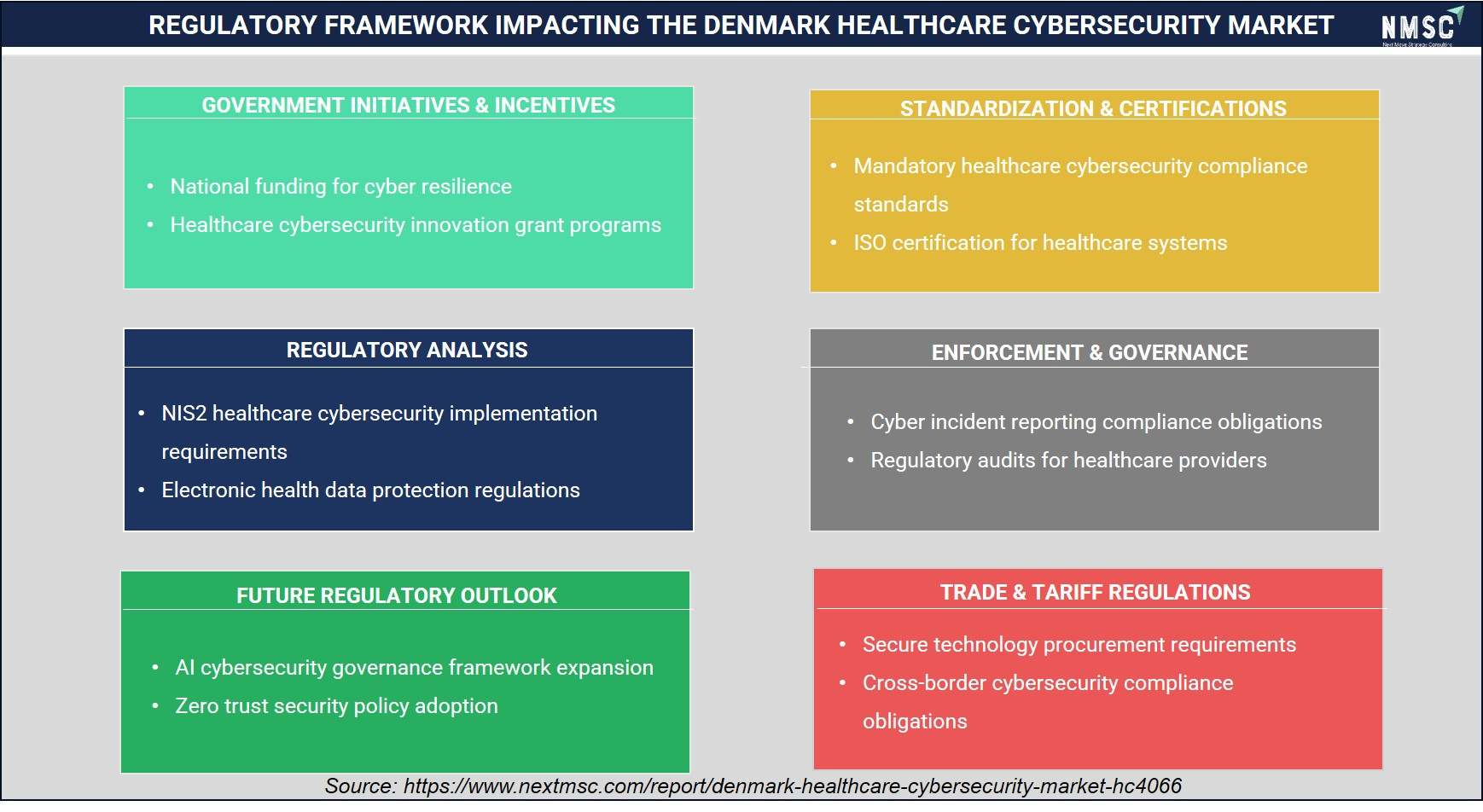
The above regulatory framework analysis maps the key regulatory components, such as government initiatives and incentives, regulatory analysis, future regulatory outlook, standardization and certifications, enforcement and governance, and trade and tariff regulations, shaping the Denmark healthcare cybersecurity market. From our analysis, we observed that national funding supports cyber resilience and NIS2 requirements mandate healthcare compliance, while AI governance and zero-trust policies are expanding. ISO certifications guide security standards, whereas cyber incident reporting and regulatory audits enforce compliance across healthcare providers.
Growth Drivers & Restraints
Growth Catalyst & Risk Assessment Matrix
|
Factors |
Type |
+/− % Impact on CAGR |
Geographic Relevance |
Impact Timeline |
|
NIS 2 compliance and incident reporting |
Driver |
+2.1% |
Nationwide public healthcare and regulated vendors |
2026–2029 |
|
Expansion of Digital Health Denmark and shared national IT |
Driver |
+1.8% |
National healthcare system |
2026–2030 |
|
Growth in eHealth records and cross-sector data exchange |
Driver |
+1.6% |
Hospitals, regions, and care networks |
2026–2035 |
|
Migration to cloud and hybrid care platforms |
Driver |
+1.4% |
Urban hospitals and integrated providers |
2026–2032 |
|
Legacy medical devices and OT exposure |
Restraint |
−1.2% |
Hospitals, imaging centers, and long-term care |
2026–2031 |
|
Budget pressure and cybersecurity skills shortages |
Restraint |
−1.0% |
Public providers and smaller clinics |
2026–2030 |
What Is the Primary Growth Driver of Denmark Healthcare Cybersecurity Market?
The primary growth driver is regulatory enforcement combined with formal incident reporting obligations. Denmark’s NIS 2 law entered into force on 1 July 2025, and covered entities must register before 1 October 2025. We observed that this creates near-term spending on policy, logging, identity controls, and managed oversight, especially for public healthcare organizations that must prove readiness rather than simply buy tools.
How Is Digital Health Modernization Driving the Denmark Healthcare Cybersecurity Market Growth?
Health system digitization is the second major growth engine. Digital Health Denmark will bring together key institutions and national IT assets, which should raise demand for common security architectures, central access management, and continuous monitoring. The European Commission’s 2024 eHealth Indicator Study placed Denmark at 98% access to electronic health records, showing that digital care is already deeply embedded and now requires stronger protection.
What Is Restraining the Denmark Healthcare Cybersecurity Market?
The main restraint is the cost and complexity of securing legacy clinical environments while maintaining care continuity. CFCS raised the threat from destructive cyber attacks against Denmark to MIDDEL in 2024, which underscores the operational risk facing hospitals and suppliers. We found that many organizations must upgrade older systems, protect connected devices, and fund security expertise at the same time, which can slow procurement cycles.
Segmentation Analysis
By Component Insights
How Is the Component Landscape Structured in the Denmark Healthcare Cybersecurity Market?
Based on component, the Denmark Healthcare Cybersecurity Market is segmented into software, hardware, and services. Software remains the backbone because buyers need layered protection for identity, endpoints, networks, cloud workloads, data, email, and security operations. Hardware is still required for firewalls, secure remote access appliances, and monitoring sensors, while services support deployment, response, and compliance work. The mix reflects a market that must protect both enterprise IT and operational clinical environments.
We observed that software is the dominant component because it scales across hospitals, payers, and digital health platforms with less friction than appliance-heavy deployments. Services are the fastest-growing component because many buyers prefer managed detection, incident response, and advisory support rather than building large internal teams. This shift is especially visible among public healthcare organizations that need faster implementation and more predictable operating costs.
By Customer Type Insights
How Is Customer Demand Structured Across the Denmark Healthcare Cybersecurity Market?
Based on customer type, the Denmark Healthcare Cybersecurity market is shaped by healthcare providers, healthcare payers, life sciences, medical technology, and the healthcare public sector. Healthcare providers account for the most persistent demand because hospitals, ambulatory centers, and long-term care facilities manage large volumes of sensitive data and connected devices. The public sector also plays a central role because digital health governance, shared platforms, and national reporting requirements influence procurement across the system.
We found that healthcare providers remain the dominant customer group, while the healthcare public sector is the fastest-growing because national coordination and shared infrastructure are tightening security expectations across Denmark. Life sciences and medical technology buyers are also becoming more important as connected research, device software, and remote workflows expand. The result is a procurement environment where vendors must tailor controls for both direct patient care and broader public health data handling.
Growth Opportunities
Our analysis shows that three forward-looking whitespace opportunities stand out for stakeholders operating in the Denmark Healthcare Cybersecurity Market over the 2026–2035 forecast period.
How Can NIS 2 Compliance Packages Unlock New Demand?
Vendors that package registration support, policy mapping, incident reporting workflows, and evidence collection into a single offer can reduce the burden on healthcare buyers. The most immediate beneficiaries are public hospitals, regional health operators, and software suppliers that must demonstrate readiness. This opportunity favors recurring service contracts and creates a practical entry point for vendors that combine governance expertise with technical monitoring.
Where Is Medical Device Security Underpenetrated?
Hospitals and imaging networks still need better monitoring for connected equipment, passive network visibility, and segmentation around clinical devices. A package that links OT monitoring, asset discovery, and secure remote access can help providers reduce operational risk without replacing equipment. The beneficiary segment is large healthcare providers, especially those managing mixed legacy and modern device estates across multiple sites.
How Can Identity-Centric Platforms Expand Share Across Digital Care?
Identity security offers whitespace because secure access, privileged credentials, and session control now touch every digital workflow. Vendors that unify multi-factor authentication, single sign-on, and privileged access management can support clinicians, administrators, and external partners in one architecture. This favors healthcare providers and public sector bodies that need simple user experiences without sacrificing auditability or access control.
Competitive Landscape
We observed that the Denmark Healthcare Cybersecurity Market is highly competitive, with global platform vendors, specialist security firms, and local managed service providers competing for public and private healthcare budgets.
|
Dimension |
Description |
|
Market Structure |
Highly competitive, with large global vendors competing alongside niche healthcare specialists and managed security providers. |
|
Innovation Focus |
Identity security, endpoint detection, cloud control, medical device monitoring, and compliance automation dominate product roadmaps. |
|
M&A Activity |
Activity is moderate and often channel-led, with vendors using partnerships, regional expansion, and selective acquisitions to widen healthcare reach. |
How Do Companies Compete in the Denmark Healthcare Cybersecurity Market?
Companies compete by combining compliance alignment, healthcare workflow knowledge, and service depth. Large vendors win through breadth, integrated platforms, and trusted procurement channels, while specialists win by delivering medical device visibility, identity controls, or managed detection tailored to clinical operations. We found that pricing is often shaped by recurring subscriptions and service contracts, which appeal to buyers that want predictable spending and faster deployment.
Which Competitive Archetypes Dominate the Denmark Healthcare Cybersecurity Market?
Two archetypes stand out. The first is the broad platform vendor that bundles endpoint, cloud, and identity controls for large healthcare estates. The second is the specialist provider that focuses on OT security, managed services, or identity governance. NMSC’s analysis indicates that the second archetype is gaining share in Denmark because buyers want solutions that fit public-sector constraints, interoperability requirements, and lean security teams.
How Are Vendors Differentiating Through Innovation?
Innovation is increasingly centered on cloud-native monitoring, automated response, continuous compliance evidence, and simplified access governance. Vendors that integrate AI-assisted detection and patient-safe access controls can shorten investigation times and reduce operational disruption. We observed that differentiation also depends on local support, language-ready documentation, and architecture that integrates cleanly with national digital health platforms and hospital workflows.
What M&A and Expansion Activity Is Shaping the Industry?
M&A is not the only path to scale in Denmark, because many vendors expand through partner ecosystems, distributor relationships, and Nordic coverage from regional hubs. Still, larger security groups continue to acquire niche capabilities in managed services, identity governance, and OT monitoring. Our findings suggest that the most credible growth play is targeted expansion into healthcare-specific use cases rather than broad, undifferentiated consolidation.
Key Market Players
We observed that the following companies are shaping procurement, innovation, and channel competition across the Denmark Healthcare Cybersecurity Market.
-
Fortinet Denmark ApS
-
CrowdStrike Denmark ApS
-
Check Point Software Technologies Denmark ApS
-
Microsoft Danmark ApS
-
IBM Danmark ApS
-
Trend Micro Denmark ApS
-
Akamai Technologies Denmark ApS
-
CyberArk Denmark ApS
-
Kaspersky Lab Nordic ApS
-
Heimdal Security A/S
-
Sophos Denmark ApS
-
Zscaler Denmark ApS
-
Nozomi Networks Denmark ApS
Investment Opportunities
Where Are Capital Inflows Concentrating?
Capital inflows are moving toward vendors that can prove healthcare specialization, regulatory fit, and recurring revenue quality. Investors prefer platforms that combine software subscriptions with managed services because those models support long-term retention and clearer cash flow. The most attractive beneficiaries are identity security, MDR, and compliance automation providers that can serve hospitals, payers, and public health agencies through one operating model.
How Is Infrastructure Investment Reshaping the Market?
Infrastructure investment is concentrated in interoperable architectures, centralized logging, secure access, and monitoring for connected clinical devices. Digital Health Denmark and the broader shift toward shared health data create a strong rationale for national-grade platforms rather than isolated point tools. The biggest beneficiaries are large providers and public sector bodies that need scalable visibility across many sites, users, and third-party connections.
What ESG Factors Influence Security Spending?
ESG considerations increasingly favor cybersecurity that protects patient privacy, maintains service continuity, and supports responsible digital governance. Vendors that help reduce downtime, data loss, and wasteful duplication can strengthen their sustainability case. We found that cloud-first security, efficient resource use, and strong control over sensitive health data matter to boards and procurement teams because they connect resilience with social trust and governance quality.
Key Benefits for Stakeholders
How Does This Report Help Enterprise and Industry Leaders?
Enterprise and Denmark Healthcare Cybersecurity market leaders gain a detailed view of market size, growth drivers, segmentation, and competitive positioning that supports vendor selection and budget planning. The report shows where compliance pressure, cloud migration, and identity modernization are creating the strongest buying signals. That helps healthcare operators prioritize controls that improve resilience without adding unnecessary operational complexity.
How Does This Report Help Investors and Financial Analysts?
Investors and financial analysts benefit from a consistent forecast framework that highlights recurring revenue opportunities, operating leverage, and adoption drivers through 2035. We observed that the Denmark Healthcare Cybersecurity market’s 12.56% CAGR and USD 813.26 million absolute opportunity point to a durable investment case in managed services, identity security, and healthcare-specific compliance tooling.
How Does This Report Help Technology Vendors and Product Teams?
Technology vendors and product teams can use the report to align roadmaps with buyer priorities such as NIS 2 readiness, secure access, medical device visibility, and cloud-based monitoring. The segmentation analysis clarifies which offerings belong in core packages, which should be delivered as services, and which can be positioned as premium modules. That helps teams target development spending more precisely.
Ecosystem Analysis of the Denmark Healthcare Cybersecurity Market
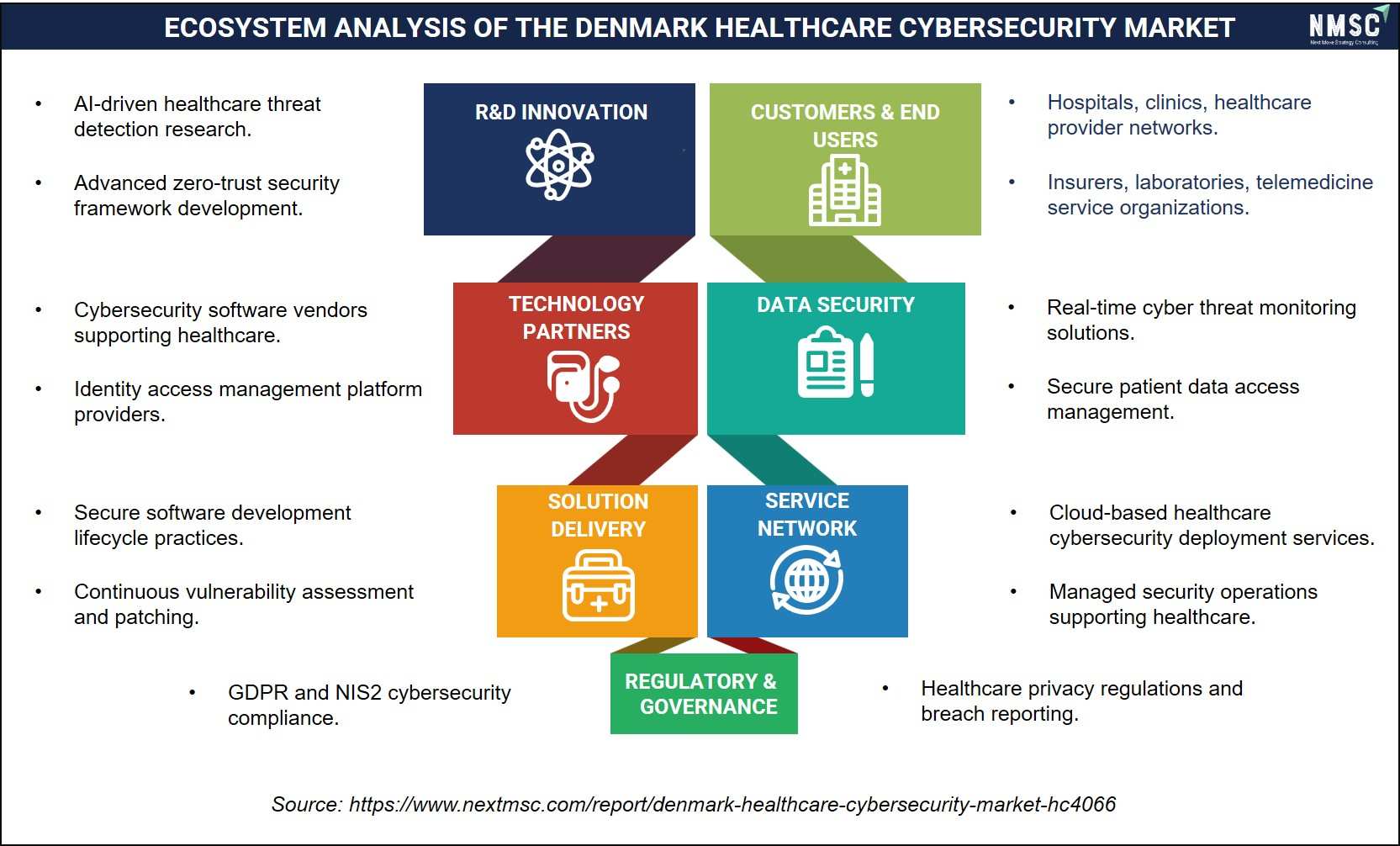
The above ecosystem analysis maps the key operational components, such as R&D innovation, technology partners, data security, solution delivery, service network, regulatory and governance, and customers and end users, shaping the Denmark healthcare cybersecurity market. From our analysis, we observed that R&D innovation and technology partners drive cybersecurity advancements, while data security and solution delivery ensure robust protection. Service networks and regulatory frameworks support compliance, whereas hospitals, clinics, insurers, laboratories, and telemedicine organizations represent key customer segments across the market ecosystem.
Key Market Segments
By Component
-
Software
-
Identity Security
-
Identity Governance and Administration
-
Privileged Access Management
-
Multi-Factor Authentication
-
Single Sign-On
-
Identity Threat Detection and Response
-
-
Endpoint Security
-
Endpoint Protection
-
Endpoint Detection and Response
-
Extended Detection and Response
-
Mobile Threat Defense
-
-
Network Security
-
Network Firewall
-
Network Detection and Response
-
Network Access Control
-
Secure Remote Access
-
Network Segmentation
-
-
Cloud Security
-
Cloud Security Posture Management
-
Cloud Workload Protection
-
Cloud Access Security Broker
-
Container Security
-
Kubernetes Security
-
-
Application Security
-
Web Application Firewall
-
API Security
-
Runtime Application Protection
-
Application Security Testing
-
-
Data Security
-
Data Loss Prevention
-
Encryption
-
Database Security
-
File Security
-
Tokenization
-
-
Email Security
-
Secure Email Gateway
-
Anti-Phishing
-
Business Email Protection
-
Email Encryption
-
-
Security Operations
-
Security Information and Event Management
-
Automation and Response
-
Threat Intelligence
-
Log Management
-
Threat Hunting
-
-
Exposure Management
-
Vulnerability Management
-
Attack Surface Management
-
Configuration Compliance
-
Security Validation
-
-
Operational Technology Security
-
Medical Device Security
-
Clinical Internet of Things Security
-
Network Monitoring
-
Biomedical Asset Protection
-
-
Other Security Software
-
-
Hardware
-
Network Security Appliances
-
Firewall Appliances
-
Secure Web Gateways
-
Secure Remote Access Appliances
-
-
Identity Security Appliances
-
Hardware Security Modules
-
Authentication Appliances
-
-
OT Security Appliances
-
Passive Network Sensors
-
Dedicated Monitoring Appliances
-
-
Other Security Hardware
-
-
Services
-
Managed Security Services
-
Detection and Response
-
Security Operations Center
-
Firewall
-
Endpoint Security
-
Cloud Security
-
Exposure Management
-
Other Managed Security Services
-
-
Professional Services
-
Security Consulting
-
Risk Assessment
-
Compliance Advisory
-
Security Architecture
-
Deployment
-
System Integration
-
Incident Response
-
Digital Forensics
-
Security Awareness Training
-
Other Professional Services
-
-
Support and Maintenance
-
Technical Support
-
Software Maintenance
-
Hardware Maintenance
-
Premium Support
-
-
By Deployment Model
-
Cloud
-
On-Premises
-
Hybrid
By Organization Size
-
Small
-
Medium
-
Large
By Commercial Model
-
Subscription
-
Perpetual License
-
Consumption Based
-
Appliance Sale
-
Project-Based
-
Managed Service Contract
-
Support Contract
By Customer Type
-
Healthcare Providers
-
Integrated Delivery Networks
-
General Hospitals
-
Specialty Hospitals
-
Physician Practices
-
Ambulatory Surgery Centers
-
Diagnostic Imaging Centers
-
Long-Term Care Facilities
-
Home Healthcare Providers
-
-
Healthcare Payers
-
Commercial Health Insurers
-
Government Health Payers
-
-
Life Sciences
-
Pharmaceutical Companies
-
Biotechnology Companies
-
Contract Research Organizations
-
-
Medical Technology
-
Medical Device Manufacturers
-
Digital Health Companies
-
-
Healthcare Public Sector
-
Public Health Agencies
-
Academic Medical Centers
-
Research Institutes
-
By Buyer Type
-
Chief Information Officer
-
Chief Information Security Officer
-
Information Technology Infrastructure
-
Security Operations Center
-
Clinical Engineering
-
Biomedical Engineering
-
Risk and Compliance
-
Procurement
By Sales Channel
-
Direct Sales
-
Value-Added Resellers
-
Systems Integrators
-
Managed Security Service Providers
-
Cloud Marketplaces
-
Original Equipment Manufacturer Partners
Conclusion & Recommendations
Long-Term Outlook
The long-term outlook for the Denmark Healthcare Cybersecurity Market remains constructive because the country is deepening digital health dependence while formalizing cybersecurity obligations. We observed that public healthcare coordination, national interoperability, and stronger incident reporting should keep demand rising through 2035. The strongest prospects sit in software-led control layers and managed services that can scale across institutions without creating heavy internal staffing requirements.
Strategic Positioning Recommendations
Vendors should position around compliance readiness, identity security, and healthcare workflow integration rather than generic cybersecurity claims. Our assessment indicates that offers combining implementation support, monitoring, and audit evidence will resonate most with public healthcare buyers. Companies that localize support, simplify procurement, and integrate with national health infrastructure can create stronger switching costs and better renewal dynamics.
Investment Attractiveness
The Denmark Healthcare Cybersecurity market is attractive because it combines regulation-driven demand with recurring service opportunities and a large installed digital health base. We found that the forecast to USD 1,241.14 million by 2035 creates room for both platform vendors and specialists. Investors should focus on providers with healthcare credibility, strong partner ecosystems, and the ability to monetize compliance, monitoring, and access governance repeatedly.
Market Shifts and Key Risks
The key risks are legacy system complexity, budget pressure, and the persistent threat of destructive cyber attacks. During our Denmark Healthcare Cybersecurity market evaluation, we noticed that buyers often need to replace or secure old environments while keeping clinical services uninterrupted, which can delay decision cycles. Vendors that fail to show clear interoperability and measurable operational value may struggle even when demand remains strong.
Growth Pathways
Growth pathways include managed security services, medical device protection, identity-centric access management, and cloud-native compliance tooling. NMSC’s analysis indicates that vendors capable of bundling these capabilities into healthcare-specific packages will be best placed to win long-term contracts. The most effective path is to connect national regulatory requirements with practical operational outcomes, especially for large providers and public sector buyers.


About the Author
 Liza Phukan
— Liza Phukan is Research Associate at Next Move Strategy Consulting, where she has covered emerging industries and market research across sectors for 3.5 years. Her work includes analyzing industry developments, validating market data, and developing structured business content from research findings. She uses secondary research and data-validation practices to turn complex market information into clear decision-useful market analysis for business audiences and support report development and B2B.
Liza Phukan
— Liza Phukan is Research Associate at Next Move Strategy Consulting, where she has covered emerging industries and market research across sectors for 3.5 years. Her work includes analyzing industry developments, validating market data, and developing structured business content from research findings. She uses secondary research and data-validation practices to turn complex market information into clear decision-useful market analysis for business audiences and support report development and B2B.
About the Reviewer
 Supradip Baul
— Supradip Baul is an accomplished business consultant and strategist with over a decade of rich experience in market intelligence, strategy, technology, and business transformation. His work has included rigorous qualitative and quantitative analysis across multiple industries, helping clients shape investment decisions and long-term roadmaps. Earlier in his career, he was associated with Gartner, where he contributed to industry-leading reports and market share analyses. He has worked with leading global companies and holds an MBA with a dual specialization in Marketing and Finance.
Supradip Baul
— Supradip Baul is an accomplished business consultant and strategist with over a decade of rich experience in market intelligence, strategy, technology, and business transformation. His work has included rigorous qualitative and quantitative analysis across multiple industries, helping clients shape investment decisions and long-term roadmaps. Earlier in his career, he was associated with Gartner, where he contributed to industry-leading reports and market share analyses. He has worked with leading global companies and holds an MBA with a dual specialization in Marketing and Finance.
At Next Move Strategy Consulting, we understand that insightful market research is the cornerstone of successful business decisions. That's why we employ a robust and multifaceted approach, combining various methodologies to deliver the most accurate and actionable data for our clients.

Research Landscape
We navigate the world of research with two primary approaches:
Qualitative Approach
Our qualitative research methodologies involve immersive techniques such as in-depth interviews, focus groups, and observational studies. By engaging directly with individuals and stakeholders, we uncover valuable insights that quantitative data alone may overlook.

Quantitative Research
In tandem with qualitative methodologies, NMSC leverages the power of Quantitative Research to provide a robust foundation of numerical insights. Through systematic data collection and analysis, we quantify patterns, preferences, and market trends, offering a comprehensive view of the business landscape.
Our quantitative research approach employs diverse tools, including surveys, experiments, and statistical modelling. These methodologies enable us to gather data from a large and representative sample, ensuring the statistical significance of our findings. By employing structured questionnaires and standardized data collection methods, we guarantee the reliability and validity of the information we present to our clients.
Quantitative research is particularly effective in measuring the prevalence of trends, assessing market size, and gauging the impact of various factors on consumer behavior. The numerical precision attained through this approach equips our clients with actionable insights, facilitating data-driven decision-making and strategy formulation.


Our Specialized Toolbox for Industry-Specific Market Research
We deploy a specialized arsenal of techniques tailored to meet your unique requirements. Here's a glimpse into our comprehensive toolbox:

Information Procurement
The stage entails acquiring market data or relevant information through various sources and methodologies.


Market Research Approach
We utilize both top-down and bottom-up approaches in market research analysis to achieve a comprehensive understanding of the market dynamics, leveraging the broad perspective of industry trends and macroeconomic factors alongside detailed insights from specific segments and individual companies.

Porters Five Forces Analysis
We conduct Porter's Five Forces analysis to evaluate the competitive landscape of an industry, providing us with insights into factors that affect profitability and strategic positioning.

SWOT Analysis

Forecasting
We utilize a forecasting model to predict future consumption by considering parameters like population, economics, regulations, market competition, drivers, constraints, technology, and pricing. We also employ statistical techniques such as multilinear regression, exponential smoothing, moving average, ARIMA, and Monte Carlo simulations for accurate predictions. In econometric forecasting, we analyzed short-term and long-term event impacts, attributing values based on regulatory frameworks, economic factors, and market events.





 Speak to Our Analyst