Digital Identity Verification Solutions Market Size, Share, and Trends 2026–2035: Segmentation by Offering (Software Solutions and Services), Verification Technology (Document, Biometric, Database Verification, & Others), Verification Application (Individual, Business, & Credential Verification), Deployment Model (Cloud, On-Premises, & Hybrid Deployment), Pricing Model, End User (BFSI, Government and Public Sector, Healthcare, & Others) — Global Industry Report and Forecast, 2026–2035
Industry: BFSI | Publishing Date: July 28, 2026 | Last Updated: September 30, 2026 | No of Pages: N/A | No. of Tables: N/A | No. of Figures: N/A | Format: PDF | Report Code: BF5437
What Is the Digital Identity Verification Solutions Market Size?
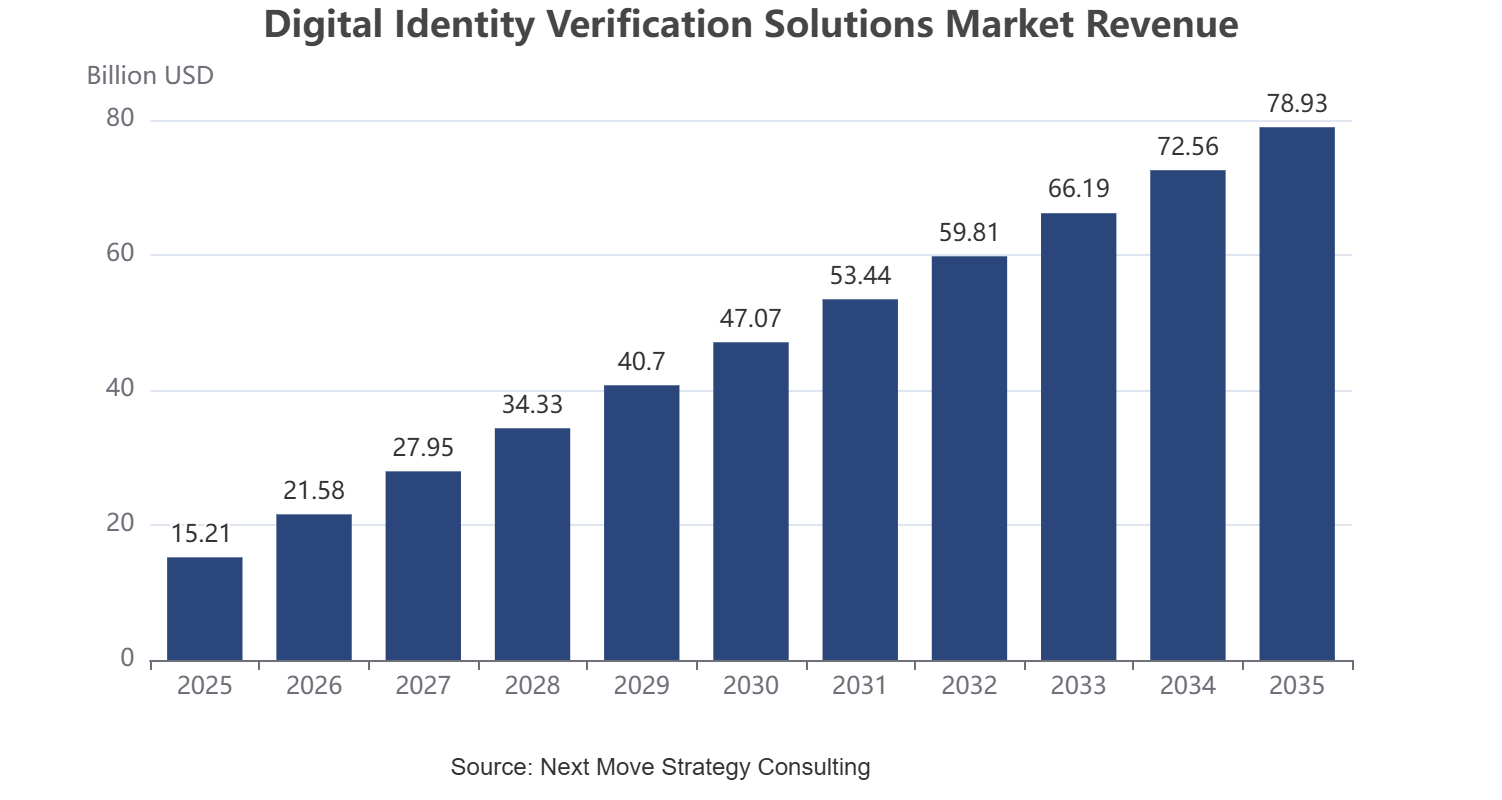
The global digital identity verification solutions market size was valued at USD 15.21 billion in 2025 and is estimated at USD 17.93 billion in 2026, projected to reach USD 78.93 billion by 2035, growing at a CAGR of 17.9% from 2026 to 2035. North America led the market with an approximate 36% revenue share in 2025, while the Software Solutions offering segment dominated at roughly 68% share.
Our findings suggest that the following key takeaways summarize the digital identity verification solutions market's segment-level and geographic dynamics as of 2025.
|
Key Takeaways |
|
By Offering: Software Solutions held the largest share, expanding from USD 10.34 billion in 2025 to USD 49.73 billion by 2035, representing approximately a 68% share; Services is the fastest-growing sub-segment at 19.6% CAGR from 2026–2035. |
|
By Verification Technology: Biometric Verification held the largest share, accounting for approximately 34% of the market with USD 5.17 billion in 2025; Multi-Modal Verification is the fastest-growing sub-segment at 24.3% CAGR from 2026–2035. |
|
By Verification Application: Individual Identity Verification held the largest share, accounting for approximately 66% of the market with USD 10.04 billion in 2025; Credential Verification is the fastest-growing sub-segment at 23.6% CAGR from 2026–2035. |
|
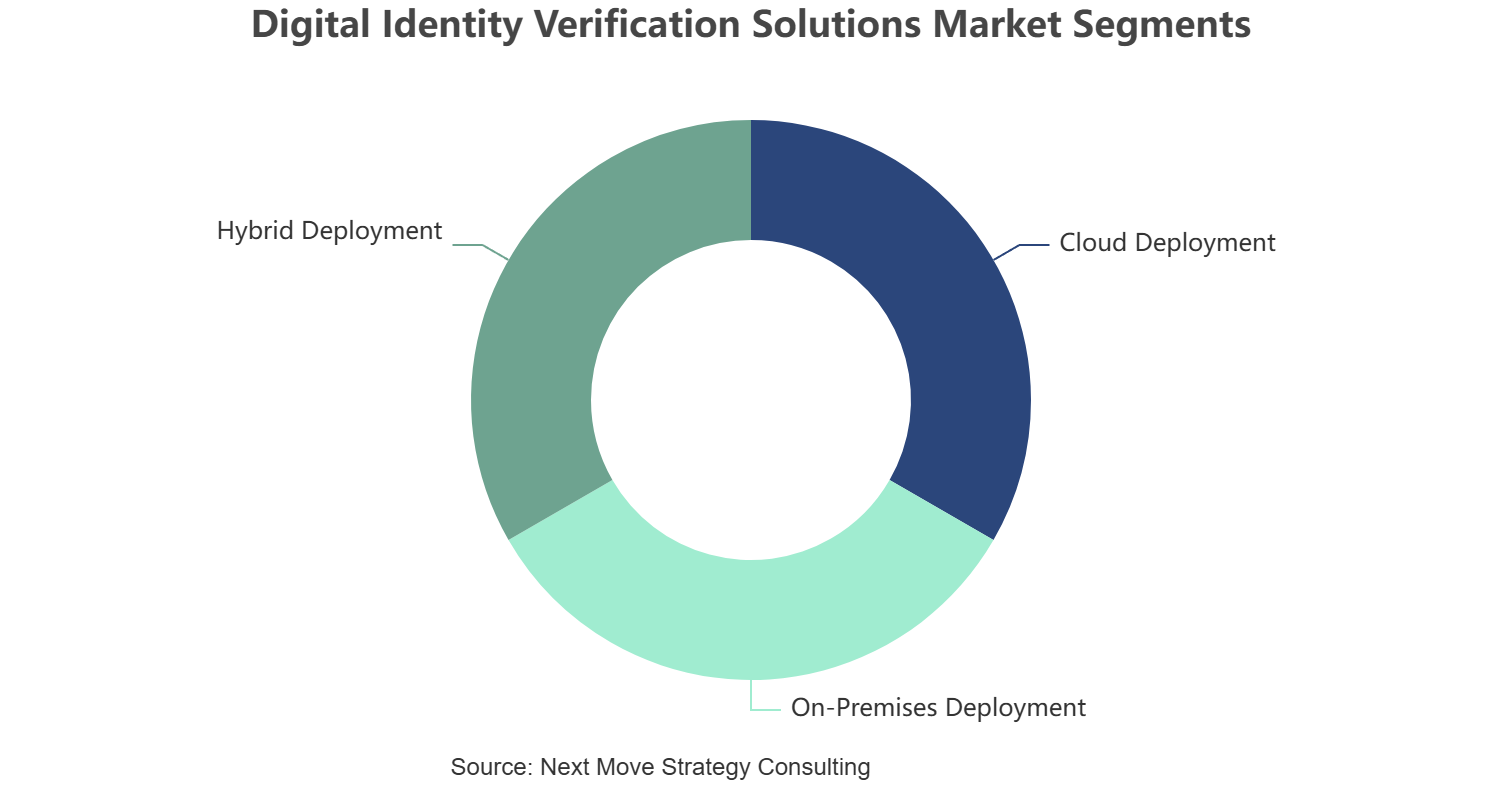
By Deployment Model: Cloud Deployment held the largest share, accounting for approximately 72% of the market with USD 10.95 billion in 2025; Cloud Deployment is also the fastest-growing sub-segment at 18.8% CAGR from 2026–2035. |
|
By Pricing Model: Transaction-Based Pricing held the largest share, accounting for approximately 52% of the market with USD 7.91 billion in 2025; Enterprise Contract Pricing is the fastest-growing sub-segment at 19.4% CAGR from 2026–2035. |
|
By End User: BFSI held the largest share, accounting for approximately 38% of the market with USD 5.78 billion in 2025; Healthcare is the fastest-growing sub-segment at 22.8% CAGR from 2026–2035. |
|
Dominant Region: North America dominated with approximately 36% revenue share in 2025. |
|
Fastest-Growing Region: Middle East & Africa is expected to register the highest CAGR of 20.9% during 2026–2035. |
|
Dominant Country: The U.S. led the market with USD 4.16 billion in 2025. |
|
Fastest-Growing Country: India is the fastest-growing country at a CAGR of 23.1% during 2026–2035. |
Market Opportunity: The digital identity verification solutions market presents an absolute dollar opportunity of approximately USD 61.00 billion between 2026 and 2035, calculated as the difference between the 2035 forecast value and the 2026 base value, an investment window favouring vendors scaling AI-driven fraud detection and orchestration platforms.
According to NMSC analysis, we found that the gap between growing synthetic-identity and deepfake fraud sophistication and current biometric liveness-detection deployment is widening the addressable market for multi-modal verification, even as enterprise identity-proofing budgets face increasing regulatory compliance pressure.
What does the Digital Identity Verification Solutions Market Encompass?
The digital identity verification solutions industry encompasses software and services that confirm an individual's or business's claimed identity through document authentication, biometric matching, database cross-referencing, and knowledge-based checks, spanning customer onboarding, account recovery, age verification, and digital credential validation. We observed that the market has structurally evolved from manual document review toward AI-driven, orchestrated verification workflows that combine multiple technologies, as demonstrated by Socure's Remote Verifier feature layering live-agent manual review atop automated biometric checks.
Regulatory frameworks such as NIST Special Publication 800-63-4, finalized in July 2025, now formally integrate subscriber-controlled digital wallets and verifiable credentials into federal identity-assurance standards, while similar frameworks across Europe and Asia-Pacific shape enterprise compliance requirements. During our market evaluation, we noticed that technology adoption is most advanced in biometric verification deployment across BFSI and government sectors, while healthcare and telehealth platforms are accelerating adoption fastest as remote care expands.
|
Parameters |
Details |
|
Market Size in 2025 |
USD 15.21 Billion |
|
Market Size in 2026 |
USD 17.93 Billion |
|
Revenue Forecast in 2035 |
USD 78.93 Billion |
|
Growth Rate |
CAGR of 17.9% from 2026 to 2035 |
|
Analysis Period |
2025–2035 |
|
Base Year Considered |
2025 |
|
Forecast Period |
2026–2035 |
|
Market Size Estimation |
USD Billion |
|
Companies Profiled |
17 |
|
Countries Covered |
37 |
|
Market Share |
Available for Top 10 Companies |
Key Emerging Trends
Our analysis shows that four structural trends are reshaping verification workflow design, fraud defense, and deployment strategy across the global digital identity verification solutions market heading into 2035.
How Is AI-Driven Deepfake Detection Transforming Biometric Verification?
AI-driven deepfake and injection-attack detection is transforming biometric verification as fraud actors increasingly use synthetic media to defeat liveness checks. NIST's SP 800-63-4 guidelines, finalized in July 2025, now explicitly add controls addressing injection attacks and forged media, formally recognizing deepfakes as a distinct identity-proofing threat category. Stakeholder impact is greatest for vendors whose liveness-detection technology must now meet independently tested, standards-aligned performance benchmarks.
Why Is Manual Fallback Adoption Accelerating Alongside Automation?
Manual fallback verification is accelerating alongside automation as enterprises recognize that fully automated systems cannot resolve every edge case without introducing friction or false rejections. Socure's Remote Verifier, launched within its RiskOS platform in 2026, gives live agents access to uploaded documents, fraud intelligence, and risk indicators for the small share of users who fail automated biometric checks. We found that this hybrid approach is becoming standard practice among vendors competing for large enterprise and government contracts.
How Is Government Adoption of Commercial Identity Platforms Reshaping the Market?
Government adoption of commercial identity-verification platforms is reshaping vendor go-to-market strategy, as agencies increasingly favor FedRAMP-authorized commercial technology over homegrown systems. Socure's five-year, USD 163 million call order to support Login.gov's next-generation identity proofing, awarded under a General Services Administration blanket purchase agreement in 2026, exemplifies this shift toward public-private verification infrastructure. Our assessment indicates that similar public-sector contracts are becoming a meaningful revenue category for enterprise-grade vendors.
Why Is Verification Orchestration Software Gaining Enterprise Adoption?
Verification orchestration software that dynamically routes users across document, biometric, and database checks based on real-time risk scoring is gaining enterprise adoption as organizations seek to balance fraud prevention against conversion-rate pressure. Vendors increasingly market orchestration layers that combine multiple underlying verification technologies rather than single-method checks. Based on research conducted by NMSC, we found that this shift is compressing average verification decision times while improving fraud-catch accuracy across high-volume onboarding use cases.
Growth Drivers & Restraints
Growth Catalyst & Risk Assessment Matrix
|
Factors |
Type |
(+/−) % Impact on CAGR |
Geographic Relevance |
|
Rising synthetic identity and AI-driven deepfake fraud |
Driver |
+4.2% |
North America, Europe |
|
Expanding KYC and AML regulatory compliance mandates |
Driver |
+3.5% |
Global |
|
Government adoption of commercial identity verification platforms |
Driver |
+2.6% |
North America, Asia-Pacific |
|
Growth of digital-first onboarding across fintech and e-commerce |
Driver |
+2.4% |
Asia-Pacific, Latin America |
|
Adoption of digital identity wallets and verifiable credentials |
Driver |
+1.8% |
Europe, North America |
|
Telehealth and remote healthcare platform expansion |
Driver |
+1.2% |
North America, Europe |
|
Data privacy regulation limiting cross-border identity data sharing |
Restraint |
−1.8% |
Europe, Asia-Pacific |
|
User friction and false-rejection rates in automated verification |
Restraint |
−1.3% |
Global |
|
Fragmented regional identity-document standards complicating global coverage |
Restraint |
−0.9% |
Middle East & Africa, Latin America |
What Is the Primary Growth Driver of the Digital Identity Verification Solutions Market?
Rising synthetic identity and AI-driven deepfake fraud is the single largest driver of market demand, compelling enterprises to adopt more sophisticated, standards-aligned verification technology. NIST's SP 800-63-4 guidelines, approved in April 2025 and finalized in July 2025 after nearly 6,000 public comments, now add specific controls for injection attacks and forged media alongside mandatory phishing-resistant authentication. We observed that this regulatory formalization is accelerating enterprise procurement of independently validated liveness-detection technology.
How Is Government Contracting Driving Market Growth?
Government agencies increasingly favor commercial, FedRAMP-authorized identity verification platforms over homegrown systems, driving substantial public-sector revenue for established vendors. Socure's five-year, USD 163 million Login.gov call order, awarded under the General Services Administration's Next Generation Identity Proofing blanket purchase agreement in 2026, illustrates the scale of this government-contracting opportunity. Our analysis shows that similar public-sector modernization programs are emerging across other national digital-identity initiatives, creating a durable demand channel beyond commercial enterprise sales.
What Is Restraining Digital Identity Verification Solutions Market Growth?
Data privacy regulation limiting cross-border identity data sharing restrains vendors seeking to offer consistent global verification coverage, as regional frameworks impose differing consent, storage, and processing requirements. User friction and false-rejection rates in fully automated systems also restrain adoption among enterprises prioritizing conversion rates, prompting renewed investment in manual fallback options such as Socure's Remote Verifier. We found that these pressures weigh most heavily on vendors lacking dedicated regional compliance infrastructure.
Pain Point Analysis of the Digital Identity Verification Solutions Industry

The above infographic presents a pain point analysis of the digital identity verification solutions market, highlighting key challenges across compliance, competition, user experience, technology, and privacy. Evolving regulations and cross-border requirements are increasing compliance burdens, while intense competition is compressing margins and demanding continuous innovation. At the same time, lengthy onboarding and authentication failures are frustrating users and reducing conversions, while legacy systems and biometric inaccuracies are creating integration and verification challenges. Sensitive data protection and cybersecurity threats further compound privacy concerns. Looking ahead, we observed that these pain points are driving demand for more secure, seamless, and scalable verification solutions across the market.
Segmentation Analysis
Segment Sizing: By Offering
|
Segment |
2025 (USD) |
2035 (USD) |
CAGR% (2026–2035) |
|
Software Solutions |
10.34 Billion |
49.73 Billion |
17.0% |
|
Services |
4.87 Billion |
29.20 Billion |
19.6% |
|
Total |
15.21 Billion |
78.93 Billion |
17.9% |
Which Offering Segment Dominates the Digital Identity Verification Solutions Market?
Software Solutions dominate the market with approximately 68% share in 2025, valued at USD 10.34 billion, reflecting enterprise preference for scalable, API-integrated verification platforms over standalone services. Services is the fastest-growing offering segment at a 19.6% CAGR from 2026 to 2035, driven by rising demand for managed verification and manual review services as enterprises such as Socure expand hybrid automated-plus-human verification models to reduce false rejections.
Segment Sizing: By Verification Technology
|
Segment |
2025 (USD) |
2035 (USD) |
CAGR% (2026–2035) |
|
Biometric Verification |
5.17 Billion |
25.26 Billion |
17.2% |
|
Document Verification |
4.56 Billion |
18.94 Billion |
15.3% |
|
Database Verification |
2.74 Billion |
12.63 Billion |
16.5% |
|
Multi-Modal Verification |
1.98 Billion |
17.37 Billion |
24.3% |
|
Knowledge-Based Verification |
0.76 Billion |
4.74 Billion |
20.1% |
|
Total |
15.21 Billion |
78.93 Billion |
17.9% |
Which Verification Technology Segment Is Growing Fastest?
Biometric Verification leads the technology segmentation with approximately 34% share in 2025 at USD 5.17 billion, reflecting widespread adoption of facial recognition and liveness detection across BFSI and government onboarding workflows. Multi-Modal Verification is the fastest-growing segment at a 24.3% CAGR, as enterprises combine biometric, document, and database checks into unified orchestration workflows to counter increasingly sophisticated synthetic identity and deepfake fraud techniques identified in NIST's 2025 guidance.
Segment Sizing: By End User
|
Segment |
2025 (USD) |
2035 (USD) |
CAGR% (2026–2035) |
|
BFSI |
5.78 Billion |
25.26 Billion |
15.9% |
|
Government and Public Sector |
2.43 Billion |
14.21 Billion |
19.3% |
|
Retail and E-Commerce |
2.28 Billion |
12.63 Billion |
18.7% |
|
Gaming and Entertainment |
1.52 Billion |
8.68 Billion |
19.0% |
|
Telecommunications |
1.22 Billion |
5.53 Billion |
16.3% |
|
Healthcare |
0.91 Billion |
7.10 Billion |
22.8% |
|
Travel and Hospitality |
0.61 Billion |
3.16 Billion |
17.9% |
|
Education |
0.30 Billion |
1.58 Billion |
17.9% |
|
Other Industries |
0.15 Billion |
0.79 Billion |
17.9% |
|
Total |
15.21 Billion |
78.93 Billion |
17.9% |
Which End User Segment Leads the Digital Identity Verification Solutions Market?
BFSI leads the end-user segmentation with approximately 38% share in 2025 at USD 5.78 billion, anchored by regulatory KYC and AML obligations across retail banking, fintech, and payment providers. Healthcare is the fastest-growing end-user segment at a 22.8% CAGR, propelled by expanding telehealth platform adoption requiring identity verification to prevent prescription fraud and ensure patients accessing remote care are correctly identified.
Growth Opportunities
Beyond the core drivers shaping overall demand, three whitespace opportunities stand out for vendors positioning portfolios toward 2035.
How Can Vendors Capture Value from Verifiable Digital Credentials?
The formal integration of subscriber-controlled wallets and verifiable credentials into NIST's 2025 digital identity guidelines creates a mechanism for vendors to capture new revenue by verifying mobile driver's licenses and other digital credentials rather than solely physical documents. Vendors with early digital-credential verification capability stand to benefit most from this emerging, standards-backed opportunity.
What Opportunity Exists in Government Identity-Proofing Modernization?
Government agencies replacing homegrown identity systems with commercial, FedRAMP-authorized platforms create a mechanism for vendors to capture large, multi-year public-sector contracts, illustrated by Socure's USD 163 million Login.gov award. Vendors with established government security authorizations are best positioned to capture this expanding public-sector modernization opportunity.
How Can Suppliers Benefit from Hybrid Automated-Manual Verification Models?
Hybrid verification models that pair automated biometric checks with live-agent manual review create a mechanism for vendors to reduce false rejections while maintaining fraud-detection accuracy for edge-case users. Managed verification services providers offering scalable human-in-the-loop review are best positioned to capture this fastest-growing services opportunity as enterprises prioritize both security and user experience.
Regional Outlook
|
Region |
2025 (USD) |
2035 (USD) |
CAGR% (2026–2035) |
Key Driver |
|
North America |
5.48 Billion |
23.68 Billion |
15.8% |
KYC/AML compliance and government identity modernization |
|
Europe |
3.96 Billion |
18.15 Billion |
16.5% |
Digital identity wallet regulation and data privacy frameworks |
|
Asia-Pacific |
3.96 Billion |
26.05 Billion |
20.7% |
Digital-first onboarding and national identity programs |
|
Middle East & Africa |
1.06 Billion |
7.10 Billion |
20.9% |
National identity programs and fintech expansion |
|
Latin America |
0.76 Billion |
3.95 Billion |
17.9% |
E-commerce growth and financial inclusion initiatives |
|
Total |
15.21 Billion |
78.93 Billion |
17.9% |
— |
North America
North America's digital identity verification solutions market leads globally, anchored by stringent KYC and AML compliance requirements across BFSI and accelerating government adoption of commercial identity platforms. Regulatory influence is substantial following NIST's finalized SP 800-63-4 guidelines, while Socure's USD 163 million Login.gov contract illustrates deepening public-sector technology adoption. We observed that strategic outlook favors vendors with FedRAMP authorization and proven enterprise fraud-detection accuracy.
Europe
Europe's market is shaped by evolving digital identity wallet regulation and strict data privacy frameworks governing cross-border identity data processing. Technology adoption favors document and database verification methods compliant with regional consent requirements, while national digital identity wallet initiatives continue to advance across multiple member states. Strategic outlook favors vendors combining strong privacy-compliance credentials with proven cross-border document coverage.
Asia-Pacific
Asia-Pacific is the fastest-scaling major regional market by absolute dollar growth, propelled by digital-first financial services onboarding in China and expanding national identity programs across India and Southeast Asia. Technology adoption spans both biometric verification tied to national identity infrastructure and rapidly growing e-commerce and fintech onboarding volume. Strategic outlook favors vendors able to localize document coverage and biometric matching across the region's diverse identity-document standards.
Middle East & Africa
The Middle East & Africa digital identity verification solutions market is the fastest-growing region globally at a 20.9% CAGR, driven by national identity program investment tied to Gulf economic diversification initiatives and expanding fintech adoption across Sub-Saharan Africa. Regulatory frameworks remain in earlier development relative to North America and Europe, giving vendors flexibility in deployment models. Strategic outlook favors vendors with strong regional government and fintech partnerships.
Latin America
Latin America's market is expanding steadily as e-commerce growth and financial inclusion initiatives in Brazil and Argentina drive demand for accessible, mobile-first verification. Technology adoption remains concentrated in document and biometric verification for banking and e-commerce onboarding. Strategic outlook favors vendors building distributor and fintech partnerships ahead of anticipated regulatory framework maturation across the region.
U.S.
Based on our estimates, the U.S. market was valued at approximately USD 4.16 billion in 2025 and is projected to reach USD 17.05 billion by 2035, growing at a 15.1% CAGR. Demand is anchored in BFSI compliance and expanding government adoption, with strong competitive activity among Jumio, Mitek Systems, Socure, and Persona supporting a mature but rapidly scaling strategic outlook shaped by NIST guidance and federal procurement.
Canada
The market in Canada was valued at approximately USD 821.3 million in 2025 and is forecast to reach USD 3.79 billion by 2035, expanding at a 16.5% CAGR. Demand structure mirrors the U.S. with strong BFSI compliance drivers, growing fintech onboarding volume, and provincial privacy regulation shaping data-handling requirements for verification vendors.
UK
As per our estimate, the UK digital identity verification solutions market stood at approximately USD 711.8 million in 2025 and is projected to reach USD 3.09 billion by 2035, growing at a 15.8% CAGR. Demand structure favors document and biometric verification for financial services and age-restricted commerce, with data protection regulation shaping cross-border verification-data handling requirements.
Germany
According to our analysis, Germany's market was valued at approximately USD 672.3 million in 2025 and is expected to reach USD 2.90 billion by 2035, at a 15.8% CAGR. Demand is driven by strict BFSI compliance requirements and growing government interest in digital identity infrastructure, with strong regulatory alignment to European data protection and identity-wallet frameworks shaping vendor specifications.
France
Based on our estimates, France's market was valued at approximately USD 514.1 million in 2025 and is projected to reach USD 2.36 billion by 2035, growing at a 16.5% CAGR. Demand structure is led by financial services compliance and expanding e-commerce onboarding, with competitive intensity concentrated among European identity-verification vendors serving regulated industries.
China
The market in China was valued at approximately USD 1.11 billion in 2025 and is projected to reach USD 6.25 billion by 2035, growing at a 18.9% CAGR, the largest country-level market in Asia-Pacific. Demand structure spans large-scale fintech and e-commerce onboarding alongside government-linked digital identity infrastructure, supported by domestic technology providers and continued digital payment penetration.
India
According to our analysis, India's digital identity verification solutions market was valued at approximately USD 751.4 million in 2025 and is projected to reach USD 5.99 billion by 2035, expanding at a 23.1% CAGR, the fastest growth rate among major economies covered in this report. Demand is driven by rapid fintech and digital-payment adoption alongside expanding national identity program infrastructure, creating substantial volume for both individual and business identity verification.
Japan
As per our estimate, Japan's digital identity verification solutions market was valued at approximately USD 474.6 million in 2025 and is projected to reach USD 2.34 billion by 2035, growing at a 17.3% CAGR. Demand structure is technology-mature, with strong biometric verification adoption across banking and telecommunications, and domestic financial institutions driving steady compliance-linked demand within a stable regulatory environment.
South Korea
Based on our estimates, South Korea's digital identity verification solutions market was valued at approximately USD 355.9 million in 2025 and is projected to reach USD 2.08 billion by 2035, at a 19.3% CAGR. Demand structure closely resembles Japan's with strong fintech-driven biometric adoption, growing gaming-platform age verification requirements, and domestic vendors scaling verification orchestration capabilities.
Australia
The market in Australia was valued at approximately USD 276.8 million in 2025 and is projected to reach USD 1.56 billion by 2035, growing at a 18.9% CAGR. Demand structure is led by financial services compliance and growing age-verification requirements for online gaming and gambling platforms, supported by a regulatory environment increasingly focused on age-restricted digital commerce.
UAE
According to our analysis, the UAE digital identity verification solutions market was valued at approximately USD 276.8 million in 2025 and is projected to reach USD 1.70 billion by 2035, growing at a 19.9% CAGR. Demand structure is dominated by national identity program investment and fintech expansion tied to Dubai and Abu Dhabi's digital economy initiatives, alongside growing travel and hospitality sector verification adoption.
Saudi Arabia
Based on our estimates, Saudi Arabia's digital identity verification solutions market was valued at approximately USD 255.5 million in 2025 and is projected to reach USD 1.63 billion by 2035, growing at a 20.4% CAGR. Demand is driven by Vision 2030-linked digital government services and fintech sector expansion, with strong regulatory support for national identity infrastructure supporting both public and private sector adoption.
South Africa
As per our estimate, South Africa's digital identity verification solutions market was valued at approximately USD 63.9 million in 2025 and is projected to reach USD 497.3 million by 2035, growing at a 22.8% CAGR. Demand structure combines financial inclusion-driven fintech adoption with growing e-commerce verification needs concentrated in major urban and industrial centers.
Brazil
The market in Brazil was valued at approximately USD 319.4 million in 2025 and is projected to reach USD 1.58 billion by 2035, growing at a 17.3% CAGR, the largest market in Latin America. Demand structure is led by fintech and e-commerce onboarding volume, with financial institutions and digital platforms expanding verification adoption to serve a rapidly growing digitally banked population.
Argentina
According to our analysis, Argentina's digital identity verification solutions market was valued at approximately USD 136.9 million in 2025 and is projected to reach USD 710.4 million by 2035, growing at a 17.9% CAGR. Demand structure reflects growing fintech adoption and e-commerce expansion, with regional distributors and platform integrators serving as primary channels for verification-technology deployment.
Porter's Five Forces Analysis of the Digital Identity Verification Solutions Industry

The above infographic presents a Porter's Five Forces analysis of the digital identity verification solutions market, where supplier power remains moderate due to reliance on specialized biometric technology providers. At the same time, buyer power is high as enterprises demand accurate, scalable, and compliant solutions at competitive prices. The threat of new entrants is moderate, constrained by stringent compliance requirements, though competitive rivalry is intense among vendors driving innovation and platform differentiation. Looking ahead, we observed that the threat of substitutes stays low, as traditional verification methods cannot match the accuracy and fraud detection capabilities of AI-driven solutions.
Competitive Landscape
Our assessment indicates that competitive intensity in the digital identity verification solutions market is shaped by a mix of document-centric global platform leaders and data-centric fraud-detection specialists competing across BFSI, government, and e-commerce verticals within the broader identity and access management industry.
|
Key Takeaways |
|
|
Market Structure |
Moderately consolidated among global platform leaders serving large enterprise and government accounts, fragmented among regional specialists serving mid-market and localized verticals. |
|
Innovation Focus |
AI-driven deepfake and injection-attack detection, verification orchestration, and hybrid automated-manual review workflows. |
|
M&A Activity |
Selective acquisitions expanding fraud-intelligence capability, alongside strategic partnerships for government and cross-border expansion. |
How Do Companies Compete in the Digital Identity Verification Solutions Market?
Companies compete primarily on document coverage breadth, biometric matching accuracy, fraud-catch rate, and regulatory certification depth across jurisdictions. Our analysis shows that document-centric vendors including Jumio and Mitek Systems compete on global identity-document coverage and liveness-detection accuracy, while data-centric vendors including Socure compete on synthetic-identity and first-party fraud detection using data-driven risk scoring ahead of document capture.
Which Competitive Archetypes Dominate the Digital Identity Verification Solutions Market?
Two archetypes dominate the market: document-centric platforms offering global identity-document authentication and biometric liveness detection, and data-centric platforms offering fraud-focused identity resolution using behavioral and device intelligence. Jumio exemplifies the document-centric archetype through its coverage of over 5,000 identity document types across more than 200 countries, while Socure exemplifies the data-centric archetype through its FedRAMP-authorized RiskOS fraud-intelligence platform.
How Are Companies Differentiating Through Innovation?
Innovation and differentiation increasingly center on hybrid orchestration that combines automated and manual verification alongside standards-aligned deepfake defense. Socure's Remote Verifier, layering live-agent review atop automated biometric checks within its RiskOS platform, and government-grade FedRAMP authorization both illustrate how vendors are building differentiated trust credentials to win large enterprise and public-sector contracts.
What M&A and Expansion Activity Is Shaping the Digital Identity Verification Solutions Market?
Expansion activity is concentrated in government contracting partnerships and fraud-intelligence capability acquisitions rather than large-format consolidation. Socure's acquisitions of Effectiv and Berbix, alongside its subcontractor partnership with Xcelerate Solutions to win the USD 163 million Login.gov contract, illustrate how vendors are combining organic product development with targeted acquisitions and public-sector partnerships to expand the addressable market.
Key Market Players
Our assessment indicates that the following companies are actively shaping verification technology innovation, fraud-detection capability, and enterprise and government adoption within the global digital identity verification solutions market.
-
Mitek Systems Inc.
-
Thales Digital Identity and Security
-
Entrust Corporation
-
GBG Plc
-
Socure, Inc.
-
Veriff OU
-
Trulioo Information Services Inc.
-
IDnow GmbH
-
Persona Identities, Inc.
-
AU10TIX Limited
-
Signicat AS
-
OneSpan Inc.
-
Shufti Pro Limited
-
iDenfy UAB
-
Facephi Biometria S.A.
-
Company 18
-
Company 19
-
Company 20
Latest Developments
We found that recent contract awards and product launches within the digital identity verification solutions market are concentrated on government adoption, fraud-detection capability, and standards compliance across 2025 and 2026.
|
Date |
Event |
|
June 2026 |
Jumio announced expanded support for digital IDs across more than 60 countries and territories through a single integration. The development reflects the shift from traditional physical identity documents toward digital credentials, driven by initiatives such as mobile driver's licenses, Europe's eIDAS 2.0 framework, Singapore's Singpass ecosystem, and digital identity wallets. |
|
April 2026 |
Jumio launched Jumio Watch, positioning identity verification as a continuous process rather than a one-time onboarding check. The company cited early studies indicating that 25% more risk can be detected after onboarding, highlighting the growing market shift toward continuous identity monitoring and risk assessment. |
Expert Insights
 “The identity verification and fraud prevention approach that was fit yesterday, ain't fit tomorrow. Fraudsters are fast, and they’re scaling up with access to powerful tools like AI.”
— Kaarel Kotkas, CEO, Veriff
Statement made during Web Summit Rio 2025 while discussing the rapidly evolving digital fraud landscape.
Market Interpretation
The insight highlights the accelerating evolution of digital identity fraud and the growing need for adaptive identity verification solutions. NMSC's analysis indicates that the emergence of AI-enabled fraud is increasing pressure on businesses to move beyond static, one-time verification toward more dynamic and multi-layered approaches incorporating AI, liveness detection, behavioral analysis, and device intelligence. As fraud techniques become increasingly sophisticated, demand is expected to grow for identity verification platforms capable of continuously adapting to new attack patterns while maintaining a frictionless customer experience.
Investment Opportunities
What Capital Inflows Are Targeting the Digital Identity Verification Solutions Market?
Capital inflows are increasingly directed toward AI-driven fraud detection and government-authorized platforms, with Socure having raised substantial venture funding across multiple rounds to scale its identity and fraud-intelligence capabilities. We observed that investors favor vendors demonstrating regulatory authorization such as FedRAMP status, viewing government-grade security certification as a proxy for enterprise-readiness and durable contract revenue.
How Is Infrastructure Investment Supporting Market Growth?
Infrastructure investment in cloud-based, FedRAMP-authorized verification environments continues to underwrite the scalability required for high-volume government and enterprise deployment. Socure's operation within a FedRAMP Moderate-authorized environment for its Login.gov contract illustrates the compliance infrastructure investment now expected of vendors pursuing large public-sector opportunities. Our findings suggest that this infrastructure investment is becoming a competitive prerequisite rather than a differentiator.
What ESG Considerations Are Shaping Investment Decisions?
Financial inclusion and privacy-preserving design are central governance considerations shaping investment decisions, as identity verification directly determines who can access formal financial and government services. NIST's SP 800-63-4 guidelines explicitly emphasize equity and accessibility alongside security and privacy in digital identity solution design. We found that investors increasingly treat demonstrated low false-rejection rates across diverse populations as a governance indicator alongside conventional data-security compliance.
Key Benefits for Stakeholders
How Does This Report Benefit Enterprise and Industry Leaders?
Enterprise and industry leaders gain access to validated segmentation, competitive benchmarking, and regional demand forecasts that support vendor-selection and technology-investment decisions across the digital identity verification solutions industry. Our analysis shows that detailed offering, technology, and end-user breakdowns help compliance and product teams align verification strategy with the fastest-growing segments, including Multi-Modal Verification and Healthcare.
How Does This Report Benefit Investors and Financial Analysts?
Investors and financial analysts benefit from consistent, single-point market size and CAGR estimates that support valuation and capital-allocation decisions across the digital identity verification solutions supply chain. We observed that the report's regional and segment-level growth differentials help identify which vendors are best positioned to capture above-market growth in government contracting and multi-modal verification technology through 2035.
How Does This Report Benefit Technology Vendors and Product Teams?
Technology vendors and product teams gain insight into emerging design requirements, including deepfake defense, verification orchestration, and hybrid automated-manual workflows, that are reshaping the industry. Our findings suggest that this analysis helps R&D teams prioritize development roadmaps around the Multi-Modal Verification and Credential Verification segments showing the strongest above-market growth trajectories.
Key Market Segments
By Offering
-
Software Solutions
-
Document Verification Software
-
Biometric Verification Software
-
Database Verification Software
-
Identity Proofing Software
-
Verification Orchestration Software
-
Digital Credential Verification Software
-
-
Services
-
Implementation Services
-
Integration Services
-
Managed Verification Services
-
Manual Review Services
-
By Verification Technology
-
Document Verification
-
ID Document Authentication
-
OCR Verification
-
NFC Verification
-
Document Fraud Detection
-
-
Biometric Verification
-
Facial Recognition
-
Fingerprint Recognition
-
Iris Recognition
-
Voice Recognition
-
Behavioral Biometrics
-
-
Database Verification
-
Government Database Verification
-
Credit Database Verification
-
Commercial Database Verification
-
-
Knowledge-Based Verification
-
Knowledge-Based Authentication
-
Security Question Verification
-
-
Multi-Modal Verification
-
Biometric Document Verification
-
Biometric Database Verification
-
Document Database Verification
-
By Verification Application
-
Individual Identity Verification
-
Customer Onboarding Verification
-
Account Recovery Verification
-
Age Verification
-
Identity Reverification
-
-
Business Identity Verification
-
Business Registration Verification
-
Merchant Verification
-
Supplier Verification
-
-
Credential Verification
-
Digital Credential Verification
-
Verifiable Credential Verification
-
By Deployment Model
-
Cloud Deployment
-
On-Premises Deployment
-
Hybrid Deployment
By Pricing Model
-
Transaction-Based Pricing
-
Verification Check Pricing
-
Document Check Pricing
-
Biometric Check Pricing
-
-
Subscription-Based Pricing
-
Monthly Subscription
-
Annual Subscription
-
-
Enterprise Contract Pricing
-
Volume-Based Contracts
-
Custom Enterprise Agreements
-
By End User
-
BFSI
-
Retail Banking
-
Fintech
-
Insurance
-
Payment Providers
-
-
Government and Public Sector
-
National Identity Programs
-
Immigration Services
-
Public Digital Services
-
-
Healthcare
-
Telehealth Providers
-
Healthcare Platforms
-
Pharmaceutical Companies
-
-
Retail and E-Commerce
-
Online Marketplaces
-
Retail Platforms
-
Age-Restricted Commerce
-
-
Telecommunications
-
Mobile Network Operators
-
Digital Service Providers
-
-
Travel and Hospitality
-
Airlines
-
Hotels
-
Travel Platforms
-
-
Gaming and Entertainment
-
Online Gaming Platforms
-
Gambling Platforms
-
Media Platforms
-
-
Education
-
Online Education Platforms
-
Examination Providers
-
-
Other Industries
-
Real Estate
-
Energy and Utilities
-
Professional Services
-
By Region
-
North America: U.S., Canada, Mexico
-
Europe: UK, Germany, France, Italy, Spain, Sweden, Denmark, Finland, Netherlands, Rest of Europe
-
Asia-Pacific: China, India, Japan, South Korea, Taiwan, Indonesia, Vietnam, Australia, Philippines, Malaysia, Rest of APAC
-
Middle East & Africa: Saudi Arabia, UAE, Egypt, Israel, Turkey, Nigeria, South Africa, Rest of MEA
-
Latin America: Brazil, Argentina, Chile, Colombia, Rest of LATAM
Conclusion and Recommendations
What Is the Long-Term Outlook for the Digital Identity Verification Solutions Market?
The long-term outlook for the digital identity verification solutions market remains strongly positive, with global revenue projected to grow more than fivefold from USD 15.21 billion in 2025 to USD 78.93 billion by 2035 at a 17.9% CAGR. We observed that escalating fraud sophistication, expanding regulatory compliance mandates, and government platform modernization will continue underpinning demand across BFSI, government, and healthcare applications through the forecast period.
What Strategic Positioning Should Verification Vendors Pursue?
Vendors should prioritize multi-modal orchestration capability and standards-aligned deepfake defense while maintaining government-grade security authorizations to access both enterprise and public-sector contracts. Our assessment indicates that vendors investing early in hybrid automated-manual verification models will be best positioned to capture premium pricing while reducing the false-rejection risk that increasingly concerns enterprise buyers.
How Attractive Is the Digital Identity Verification Solutions Market for New Investment?
The digital identity verification solutions market presents a highly attractive investment case, supported by a USD 61.00 billion absolute dollar opportunity between 2026 and 2035 and above-average growth in Healthcare end users and Multi-Modal Verification technology. We found that investment attractiveness is highest for vendors combining proven fraud-detection accuracy with government security authorizations, positioning them to serve both commercial and public-sector buyer segments simultaneously.
What Market Shifts and Key Risks Should Stakeholders Monitor?
Stakeholders should monitor tightening cross-border data privacy regulation, rising deepfake sophistication outpacing detection technology, and user-experience friction risk as key factors shaping the digital identity verification solutions market. Our analysis shows that vendors unable to demonstrate standards-aligned, independently validated liveness detection risk losing enterprise and government contracts to better-certified competitors following NIST's 2025 guidance update.
What Are the Key Growth Pathways for the Digital Identity Verification Solutions Market?
Key growth pathways include scaling multi-modal verification orchestration, deepening government contracting relationships following precedents such as the Login.gov award, and expanding hybrid automated-manual review capacity for healthcare and other emerging verticals. Next Move Strategy Consulting's analysis indicates that vendors pursuing these pathways while maintaining rigorous fraud-detection accuracy will be best positioned to capture the market's projected growth through 2035.
About the Author
 Mayurima Roy
— Mayurima Roy is Research Analyst at Next Move Strategy Consulting, where she has spent 4 years working across the firm's full industry coverage rather than a single fixed vertical. Her work centers on structured research, ongoing trend tracking, competitive assessment, and insight-led content development, translating complex market data into clear, decision-ready narratives that support informed client decision-making across diverse global industries, market sectors, and world regions every day.
Mayurima Roy
— Mayurima Roy is Research Analyst at Next Move Strategy Consulting, where she has spent 4 years working across the firm's full industry coverage rather than a single fixed vertical. Her work centers on structured research, ongoing trend tracking, competitive assessment, and insight-led content development, translating complex market data into clear, decision-ready narratives that support informed client decision-making across diverse global industries, market sectors, and world regions every day.
About the Reviewer
 Supradip Baul
— Supradip Baul is an accomplished business consultant and strategist with over a decade of rich experience in market intelligence, strategy, technology, and business transformation. His work has included rigorous qualitative and quantitative analysis across multiple industries, helping clients shape investment decisions and long-term roadmaps. Earlier in his career, he was associated with Gartner, where he contributed to industry-leading reports and market share analyses. He has worked with leading global companies and holds an MBA with a dual specialization in Marketing and Finance.
Supradip Baul
— Supradip Baul is an accomplished business consultant and strategist with over a decade of rich experience in market intelligence, strategy, technology, and business transformation. His work has included rigorous qualitative and quantitative analysis across multiple industries, helping clients shape investment decisions and long-term roadmaps. Earlier in his career, he was associated with Gartner, where he contributed to industry-leading reports and market share analyses. He has worked with leading global companies and holds an MBA with a dual specialization in Marketing and Finance.
At Next Move Strategy Consulting, we understand that insightful market research is the cornerstone of successful business decisions. That's why we employ a robust and multifaceted approach, combining various methodologies to deliver the most accurate and actionable data for our clients.

Research Landscape
We navigate the world of research with two primary approaches:
Qualitative Approach
Our qualitative research methodologies involve immersive techniques such as in-depth interviews, focus groups, and observational studies. By engaging directly with individuals and stakeholders, we uncover valuable insights that quantitative data alone may overlook.

Quantitative Research
In tandem with qualitative methodologies, NMSC leverages the power of Quantitative Research to provide a robust foundation of numerical insights. Through systematic data collection and analysis, we quantify patterns, preferences, and market trends, offering a comprehensive view of the business landscape.
Our quantitative research approach employs diverse tools, including surveys, experiments, and statistical modelling. These methodologies enable us to gather data from a large and representative sample, ensuring the statistical significance of our findings. By employing structured questionnaires and standardized data collection methods, we guarantee the reliability and validity of the information we present to our clients.
Quantitative research is particularly effective in measuring the prevalence of trends, assessing market size, and gauging the impact of various factors on consumer behavior. The numerical precision attained through this approach equips our clients with actionable insights, facilitating data-driven decision-making and strategy formulation.


Our Specialized Toolbox for Industry-Specific Market Research
We deploy a specialized arsenal of techniques tailored to meet your unique requirements. Here's a glimpse into our comprehensive toolbox:

Information Procurement
The stage entails acquiring market data or relevant information through various sources and methodologies.


Market Research Approach
We utilize both top-down and bottom-up approaches in market research analysis to achieve a comprehensive understanding of the market dynamics, leveraging the broad perspective of industry trends and macroeconomic factors alongside detailed insights from specific segments and individual companies.

Porters Five Forces Analysis
We conduct Porter's Five Forces analysis to evaluate the competitive landscape of an industry, providing us with insights into factors that affect profitability and strategic positioning.

SWOT Analysis

Forecasting
We utilize a forecasting model to predict future consumption by considering parameters like population, economics, regulations, market competition, drivers, constraints, technology, and pricing. We also employ statistical techniques such as multilinear regression, exponential smoothing, moving average, ARIMA, and Monte Carlo simulations for accurate predictions. In econometric forecasting, we analyzed short-term and long-term event impacts, attributing values based on regulatory frameworks, economic factors, and market events.





 Speak to Our Analyst