Double-Deck Elevator Market By Product Type (Passenger Double-Deck Elevators, Service & Utility Double-Deck Elevators), By Deck Operation Mode (Fixed Deck Operation, Adaptive Deck Operation), By System Load Capacity ( Less than 3000 kg, 3000 kg to 5000 kg, Others), By Rated Speed (Upto 4 m/s, 4-8 m/s, Above 8 m/s), and By Application (Commercial, Institutional, Institutional, Others) – Global Analysis & Forecast, 2025–2035
Industry: Construction & Manufacturing | Publishing Date: March 20, 2026 | Last Updated: September 15, 2026 | No of Pages: N/A | No. of Tables: N/A | No. of Figures: N/A | Format: PDF | Report Code: CM4308
Industry Outlook
The global Double-Deck Elevator Market size was valued at USD 35.31 billion in 2025, and is expected to be valued at USD 38.59 billion by the end of 2026. The industry is projected to grow, hitting USD 75.47 billion by 2035, with a CAGR of 7.89% between 2026 and 2035.
Double-Deck Elevator Industry Size & Forecast
|
Parameters |
Details |
|
Market Size in 2026 |
USD 38.59 Billion |
|
Revenue Forecast in 2035 |
USD 75.47 Billion |
|
Growth Rate |
CAGR of 7.89% from 2026 to 2035 |
|
Analysis Period |
2025–2035 |
|
Base Year Considered |
2025 |
|
Forecast Period |
2026–2035 |
|
Market Size Estimation |
Billion (USD) |
|
Companies Profiled |
20 |
|
Countries Covered |
33 |
|
Market Share |
Available for 10 companies |
Based on NMSC’s primary research, the global double-deck elevator market reflects selective, design-led adoption driven by increasing high-rise density, constrained building cores, and rising pressure to optimise passenger handling efficiency in premium commercial and mixed-use developments. Double-deck systems are specified where traffic studies and core-efficiency assessments confirm measurable gains in peak-hour throughput and relative to conventional single-deck configurations. Planning-stage evaluations conducted across supertall office towers, mixed-use complexes, and transit-integrated developments show that adoption is anchored in performance validation, structural feasibility, and long-term operational discipline rather than cost-led procurement.
Moreover, through direct assessment of traffic simulation outputs, shaft configuration reviews, and post-handover operational audits across North America, Europe, and Asia-Pacific, we observed that market deployment is shaped by building height, occupancy density, and tenant flow synchronization requirements. Mature high-rise markets emphasise double-deck lift system as a core optimisation tool where land values and leasable-area efficiency dictate vertical transportation strategy, while fast-growing urban centres deploy these systems in landmark projects that prioritise capacity concentration and architectural differentiation. Across regions, system selection is increasingly tied to validated traffic modelling, regulatory approval pathways, and service continuity expectations, reinforcing the position of double-deck elevators as engineered solutions for structurally constrained, high-intensity vertical environments rather than volume-driven installations.
What Are the Key Double-Deck Elevator Industry Trends?
How is Design-Stage Evaluation Reshaping System Adoption?
Based on NMSC’s primary research, we observed that a clear shift has emerged across planning-stage evaluations in how high-rise elevator capacity are considered within high-rise developments. System selection is increasingly anchored in validated design-stage analysis rather than post-design optimisation. Double-deck elevators are specified where early traffic modelling and core planning confirm alignment between floor layouts, passenger flow patterns, and shaft efficiency requirements.
Moreover, system suitability is assessed holistically, combining traffic performance, architectural feasibility, and regulatory acceptance rather than capacity metrics alone. As a result, double-deck elevators are positioned as design-integrated solutions, reinforcing the importance of early-stage evaluation in determining viable adoption.
How Is Core Efficiency Influencing Investment Decisions?
In the double-deck elevator market, high-rise and mixed-use developments continue to operate under increasing pressure to maximise usable floor area while maintaining predictable vertical circulation performance. Our design reviews and feasibility assessments show that double-deck elevators are deployed where they support measurable reductions in shaft count without compromising service quality or compliance requirements.
From our observations, core efficiency is treated as a structural input into project economics rather than a secondary optimisation lever. Double-deck elevators are therefore evaluated in the context of long-term asset value, where space recovery, tenant circulation discipline, and service continuity collectively determine adoption viability.
How are Operational Requirements Shaping Long-Term Positioning?
Operational reviews and post-handover evaluations indicate that double-deck elevators demand higher coordination discipline across commissioning, control logic, and ongoing service management. As a result, market positioning increasingly emphasises operational stability, service transparency, and performance consistency over system scale or complexity.
Moreover, double-deck elevators are assessed based on their ability to sustain synchronized operation, maintain service predictability, and integrate into structured maintenance frameworks. This has reinforced a positioning that aligns double-deck systems with projects prepared for disciplined operational management, rather than universal deployment across all project types.
Ecosystem Analysis of Double-Deck Elevator Market
The image illustrates the key components and workflow of the double-deck elevator ecosystem, highlighting their interconnections and operational roles.
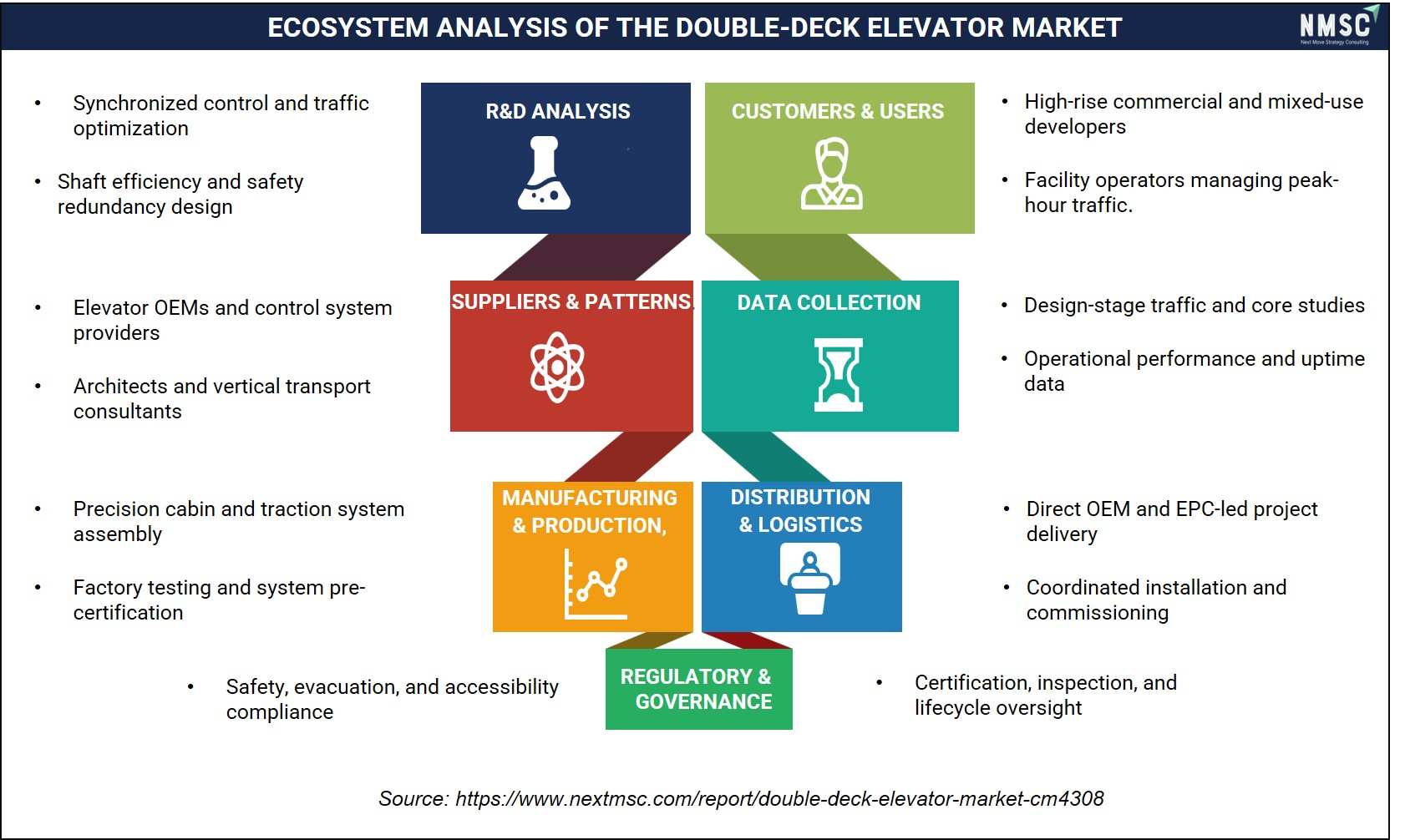
This infographic outlines the double-deck elevator market ecosystem, highlighting how design-led R&D, specialised suppliers, and precision manufacturing support deployment in high-rise environments. Demand is driven by developers and operators focused on core efficiency and peak-hour performance, while data-led traffic analysis, structured distribution, and strict regulatory compliance ensure reliable, long-term system operation.
What are the Key Market Drivers, Breakthroughs, and Investment Opportunities that will Shape the Double-Deck Elevator Industry in the Next Decade?
Growth Catalyst & Risk Assessment Matrix
|
DRIVERS/TRENDS/RESTRAINTS |
(+/–) % IMPACT ON CAGR FORECAST |
GEOGRAPHIC RELEVANCE |
IMPACT TIMELINE |
|
Increasing development of high-rise and supertall commercial & mixed-use buildings requiring high peak-hour handling efficiency |
+0.9% |
Asia-Pacific core; selective adoption in North America, Middle East & Europe |
Medium term (2–4 years) |
|
Design-stage prioritisation of core optimisation and shaft efficiency in land-constrained, high-value urban developments |
+0.8% |
Asia-Pacific megacities; North America CBDs; Middle East landmark projects |
Medium term (2–4 years) |
|
Adoption of advanced destination dispatch and traffic management systems enabling synchronized double-deck operation |
+0.6% |
Europe, Japan, South Korea, North America |
Short to medium term (1–3 years) |
|
Concentration of investment in premium office towers, transit-integrated developments, and landmark mixed-use assets |
+0.5% |
Asia-Pacific, Middle East; selective in Europe & North America |
Short to medium term (1–3 years) |
|
Higher system complexity, stringent regulatory approvals, and limited retrofit feasibility constraining deployment scope |
-0.7% |
Global; strongest constraint in Europe & retrofit-heavy North America |
Medium term (2–4 years) |
Based on NMSC’s comprehensive evaluation of global vertical transportation trends, we observed that the double-deck elevator market demonstrates selective but structurally grounded growth, shaped by increasing concentration of high-rise commercial and mixed-use developments in land-constrained urban cores. Across planning, installation, and operational phases, double-deck elevators are consistently treated as core design infrastructure, specified early in the building lifecycle where shaft efficiency, peak-hour passenger handling, and long-term service discipline directly influence project feasibility and asset economics.
Insights gathered from traffic simulation reviews, core-layout assessments, and post-handover operational audits indicate that adoption is determined less by construction volume and more by design alignment and traffic discipline. In projects where floor-to-floor consistency, tenant flow synchronisation, and regulatory feasibility are established at the planning stage, double-deck systems enable measurable reductions in shaft count while sustaining required service performance. At the same time, advances in destination dispatch, synchronised control logic, connected monitoring, and energy-efficient traction technologies support predictable operation and clearer lifecycle cost visibility. However, our assessment also shows that higher system complexity, elevated upfront costs, and limited retrofit suitability continue to restrict deployment to projects with strong planning maturity and long-term operational readiness. In parallel, the growing adoption of service-led operating models and long-term maintenance agreements is strengthening cost predictability and operational transparency, creating durable value beyond initial installation.
Growth Drivers:
How are High-Rise Building Development Patterns Accelerating Double-Deck Elevator Market Demand?
Based on our interactions with building owners and vertical transportation consultants during early design stages, we observed that sustained development of high-rise and supertall commercial and mixed-use buildings continues to underpin demand for double-deck elevator systems. Within these projects, specifications prioritise core efficiency, concentrated peak-hour throughput, and regulatory compliance, aligning directly with double-deck configurations where architectural layouts and passenger flow logic are defined upfront.
Our assessment of active project pipelines, informed by contractor bid activity, OEM order visibility, and integrator deployment planning, shows that demand is concentrated in developments where shaft consolidation delivers tangible gains in net leasable area and circulation efficiency. Feedback gathered during commissioning and early operational stabilisation further indicates that building owners and facility managers place greater emphasis on predictable traffic behaviour, service continuity, and long-term risk management than on system simplicity. As a result, double-deck elevators are positioned as structural elements of core design strategy, reinforcing their role in high-intensity vertical environments rather than being treated solely as discretionary capacity enhancements.
How are Advanced Control Systems Supporting Adoption Viability?
Based on our evaluation of installed double-deck elevator systems and completed high-rise projects, supported by commissioning records and post-handover performance validation, we observed that advanced destination dispatch and synchronised control architectures play a supporting but essential role in sustaining system performance. Discussions with specification consultants, service teams, and facility operators during control calibration and operational optimisation indicate that precise coordination between cabins is critical to maintaining throughput consistency and passenger distribution discipline.
Operational comparisons across stabilised assets show that integrated control logic and connected monitoring frameworks improve wait-time predictability, energy utilisation, and service reliability. These technologies do not drive adoption independently; instead, they enable disciplined operation in projects already aligned with double-deck design requirements, reinforcing long-term system viability.
Growth Inhibitor:
How are System Complexity And Retrofit Constraints Limiting Double-Deck Elevator Market Expansion?
Based on procurement feasibility reviews, we observed that system complexity and limited retrofit feasibility remain the primary constraints on broader market expansion. Our review of design documentation and site conditions show that existing buildings frequently lack the structural alignment, floor-to-floor consistency, and shaft configuration necessary to support double-deck operation without disproportionate engineering intervention.
These constraints are amplified in dense urban settings, where construction disruption, regulatory sequencing, and installation tolerances increase execution risk. Our analysis of postponed and cancelled initiatives, informed by contractor bids and owner capital planning cycles, indicates that projects without early integration of vertical transportation strategy rarely progress beyond feasibility. While lifecycle analysis supports double-deck deployment under appropriate conditions, technical rigidity and capital intensity continue to narrow the addressable market.
Growth Opportunity:
How are Service-Led And Long-Term Maintenance Models Creating New Opportunities?
Based on our assessment of long-term service agreements for double-deck elevator installations, we observed that service-led operating models are becoming increasingly central to value creation in the double-deck elevator market. Interactions with building owners, asset managers, and OEM service teams during contract renewals indicate growing preference for multi-year, performance-based maintenance structures tailored to synchronised system operation.
Comparative operational evaluations show that condition-informed and predictive maintenance frameworks improve uptime stability, fault isolation accuracy, and lifecycle cost control relative to reactive servicing models. The integration of remote diagnostics, performance analytics, and structured parts lifecycle planning enhances service transparency and operational confidence, enabling manufacturers and service providers to extend value capture while supporting long-term reliability in complex vertical transportation environments.
How is the Double-Deck Elevator Market Segmented in this Report, and What are the Key Insights from the Segmentation Analysis?
Market Highlights & Strategic Insights – Double-Deck Elevator Market:
|
Segment |
Key Takeaway |
|
Product Type |
Passenger double-deck elevators account for the majority of demand driven by commercial and mixed-use high-rise developments, while service and utility double-deck elevators are deployed selectively in infrastructure, airport, and institutional environments with defined service separation needs. |
|
Deck Operation Mode |
Fixed deck operation remains the prevailing configuration for its operational stability and control simplicity, while adaptive deck operation is implemented in projects requiring dynamic traffic optimisation and higher passenger flow flexibility. |
|
Technology |
Traction elevator systems account for the dominant share of double-deck deployments due to energy efficiency, ride quality, and suitability for high-rise applications, while other elevator technologies are applied selectively in low-rise, specialised, or cost-sensitive environments where structural flexibility or simplified configurations are prioritised. |
|
Service Lifecycle |
New installations dominate deployment in greenfield and comprehensively planned developments, while maintenance and modernization generate stable, recurring value through long-term performance assurance, digital service models, and lifecycle extension. |
|
System Load Capacity |
Mid-range load capacities form the core of installations aligned with office, mixed-use, and institutional demand, while higher-capacity systems are concentrated in transportation hubs, public infrastructure, and specialised high-throughput environments. |
|
Rated Speed |
Speeds up to 8 meters per second represent the market core, balancing efficiency and ride comfort in high-rise buildings, while ultra-high-speed systems are deployed selectively in supertall and landmark developments. |
By Product Type Insights
Which Product Types Anchor Demand in the Double-Deck Elevator Market?
Based on our analysis, the market is segmented by product type into passenger double-deck elevators and service and utility double-deck elevators, each aligned with distinct movement intensity, load characteristics, and operational priorities across building environments.
From our evaluation of deployment patterns, passenger double-deck elevators account for the dominant share of demand, driven by high-rise commercial, mixed-use, and landmark developments where passenger throughput, core efficiency, and peak-hour handling capacity are central design considerations. Service and utility double-deck elevators hold a structurally important but more selective role, primarily supporting airports, institutional complexes, and infrastructure assets where service segregation, material movement, and operational zoning requirements justify their integration.
By Deck Operation Insights
How do Fixed and Adaptive Deck Operation Models Influence Market Value Creation?
Based on our operational assessment, the market is segmented into Fixed Deck Operation and Adaptive Deck Operation, with each model reflecting distinct traffic philosophies, system intelligence levels, and building design integration requirements.
From our evaluation of installed systems and current high-rise development pipelines, we observed that Fixed Deck Operation accounts for a significant share of deployed volume, particularly in buildings with standardized floor pairings and predictable traffic flows. In this configuration, the relative position between the upper and lower cars remains constant, supporting simplified control architecture, cost discipline, and operational reliability. This model is often favored in commercial towers and mixed-use assets where vertical zoning strategies are defined early in the architectural phase. In contrast, Adaptive Deck Operation represents a more advanced and strategically differentiated segment, designed to dynamically adjust deck positioning or operational logic based on real-time traffic demand and occupancy patterns. While more technologically complex, adaptive systems enhance passenger throughput efficiency, improve handling capacity during peak intervals, and optimize floor accessibility in supertall or transit-integrated structures. As digital control systems, predictive analytics, and intelligent dispatch technologies mature, adaptive deck operation increasingly contributes to premium asset positioning, performance optimization, and long-term service value within sophisticated urban high-rise environments. Overall, the choice between fixed and adaptive deck operation significantly influences system design complexity, lifecycle service intensity, and buyer investment rationale, reinforcing its importance as a structural differentiator across the global double-deck elevator ecosystem.

By Service Lifecycle Insights
How do Installation, Maintenance, and Modernization Influence Market Value Creation?
Building on system architecture considerations, lifecycle structure plays a central role in shaping long-term value within the double-deck elevator market. Based on our lifecycle analysis, the market is segmented into new installations, maintenance, and modernization, with modernization comprising both partial upgrades and full system replacement depending on asset condition, regulatory requirements, and performance thresholds.
From our review of operating assets and project pipelines, we found that new installations account for the majority of volume demand, supported by greenfield developments and comprehensively planned high-rise projects where double-deck systems are integrated at the design stage. Maintenance services represent the most stable and recurring value segment, reflecting the operational complexity and synchronisation requirements inherent to double-deck systems. Modernization activity is concentrated in ageing assets where performance optimisation, compliance alignment, and lifecycle extension can be achieved through targeted upgrades without necessitating full replacement.

Regional Outlook:
Geographic Performance Snapshot:
|
Geography |
Key Takeaways |
|
North America |
Adoption is concentrated in premium commercial towers and mixed-use developments where core optimisation, peak-hour traffic performance, and lifecycle reliability justify system complexity. Deployment is driven by early-stage traffic modelling, rigorous code compliance, and investor scrutiny, resulting in selective, project-specific adoption rather than broad-based rollout. |
|
Europe |
The market reflects regulation-led and engineering-intensive adoption, with double-deck elevators specified primarily in landmark office towers, transport-integrated developments, and dense urban centres. Strong emphasis on safety certification, energy efficiency, traffic validation, and operational discipline shapes deployment decisions and limits adoption to technically mature projects. |
|
Asia Pacific |
Asia Pacific represents the leading region by deployment volume, supported by dense urban cores, sustained high-rise and supertall construction, and acute land constraints across major metropolitan areas. Double-deck elevators are integrated into large-scale commercial and mixed-use projects where shaft efficiency, passenger throughput, and core economics directly influence feasibility. |
|
Latin America |
Adoption remains limited and highly selective, focused on flagship commercial and mixed-use developments in major metropolitan markets. Capital intensity, financing discipline, and execution complexity concentrate deployment within projects demonstrating strong planning maturity, anchor tenancy, and long-term investment horizons. |
|
Middle East & Africa |
The Middle East drives regional demand through landmark, design-led developments where vertical capacity concentration, architectural scale, and premium positioning support double-deck deployment. In Africa, adoption remains nascent, shaped by lower high-rise penetration, cost sensitivity, and prioritisation of conventional vertical transportation systems. |
The double-deck elevator market is geographically studied across North America, Europe, Asia Pacific, and Rest of the World, and each region is further studied across countries.
Double-Deck Elevator Market in North America
North America represents a selective, design-driven double-deck elevator market, where adoption is shaped less by volume expansion and more by early feasibility discipline and long-term operational certainty. Based on our assessment, demand is concentrated in premium commercial towers and large mixed-use developments, where core optimisation and peak-hour traffic performance are embedded into early planning decisions. As projects move through traffic studies and design coordination, double-deck elevators are considered only when architectural alignment, floor-to-floor consistency, and shaft consolidation objectives align clearly. From our review of commissioned assets, owners approach these systems as long-term infrastructure, placing emphasis on service predictability, lifecycle cost transparency, and coordinated maintenance frameworks. Consequently, deployment remains project-specific, yet this disciplined approach supports stable performance outcomes and sustained service-led value across the regional market.
Double-Deck Elevator Market in the United States
Rather than being driven by broad construction volumes, the U.S. double-deck elevator market is shaped by how developers and owners balance core efficiency with operational risk in high-intensity assets. Adoption is concentrated in premium commercial towers and large mixed-use developments, where shaft optimisation and peak-hour traffic performance materially influence project economics. As projects progress through design coordination and traffic validation, double-deck systems are considered only when floor uniformity and circulation discipline are clearly established. Meanwhile, heightened regulatory oversight around safety, accessibility, and evacuation planning reinforces cautious specification behaviour. Through our review of stabilised assets, owners increasingly treat these systems as long-term infrastructure, prioritising predictable service performance and lifecycle cost transparency. Consequently, vendor differentiation in the U.S. market is increasingly tied to integrated controls, structured maintenance frameworks, and long-term performance assurance rather than equipment scale alone.
Double-Deck Elevator Market in Canada
Canada’s double-deck elevator market reflects measured, structurally selective adoption, aligned closely with urban densification and high-specification commercial development rather than volume-led expansion. Demand is centred in major metropolitan corridors where mixed-use towers and transit-adjacent developments place a premium on vertical capacity concentration and core efficiency. As planning advances, double-deck systems are evaluated within tightly governed feasibility frameworks, particularly where floorplate consistency and service zoning support disciplined operation. At the same time, conservative capital planning and compliance-driven design standards influence system selection. From our observation of commissioned projects, Canadian owners place strong emphasis on reliability, service continuity, and long-term maintainability, often pairing fewer installations with extended service commitments. As a result, adoption progresses steadily, favouring pragmatic deployment where operational readiness and regulatory alignment outweigh aggressive capacity expansion.
Double-Deck Elevator Market in Europe
Europe’s double-deck elevator market reflects a regulation-intensive and engineering-led adoption profile, shaped by stringent building codes, safety certification regimes, and sustainability mandates. Rather than broad uptake, deployment is concentrated in landmark office towers, transport-integrated developments, and dense urban cores where shaft efficiency and vertical throughput justify system complexity. As projects move through planning and approval stages, double-deck elevators are evaluated alongside detailed traffic simulations and compliance documentation, reinforcing disciplined specification behaviour. Through our engagement with project stakeholders, we observed that operational predictability and long-term service alignment carry as much weight as spatial optimisation. Meanwhile, sustainability objectives under the European Green Deal continue to influence system design choices, favouring energy-efficient traction solutions and advanced controls. From our review of commissioned projects, this regulatory rigour ultimately positions double-deck systems as carefully integrated infrastructure within Europe’s modernization-driven high-rise landscape.
Double-Deck Elevator Market in the United Kingdom
The United Kingdom’s double-deck elevator market is shaped by urban regeneration, complex retrofit environments, and heightened scrutiny around compliance and lifecycle accountability. Adoption remains selective, largely confined to high-density commercial and mixed-use developments where vertical capacity concentration supports regeneration economics. As design coordination progresses, double-deck systems are considered in parallel with traffic validation and evacuation planning, reflecting cautious risk management. Through our interaction with consultants and developers, it becomes evident that buyers prioritise clarity around operational responsibility and long-term service support. At the same time, digital transparency and performance reporting are gaining importance, particularly across large metropolitan portfolios. From our observation of deployed assets, integrator capability and service governance increasingly influence procurement decisions, allowing the UK market to balance innovation with controlled execution despite ongoing economic and labour constraints.
Double-Deck Elevator Market in Germany
In Germany, the double-deck elevator market is defined less by expansion pace and more by technical discipline and engineering certainty. Adoption is concentrated in projects where system performance, redundancy, and documentation standards can be validated well in advance. As developments progress through feasibility and design approval, double-deck elevators are assessed as safety-critical infrastructure rather than optional capacity solutions. Through our review of planning outcomes, buyers consistently favour proven traction systems, conservative control logic, and robust service frameworks. Digital features are incorporated selectively, primarily where they demonstrably enhance uptime or regulatory compliance. From our engagement with operating environments, this approach results in fewer but higher-value installations, reinforcing Germany’s preference for precision-led deployment and premium positioning within the market.
Double-Deck Elevator Market in France
France’s double-deck elevator market reflects selective but steadily advancing adoption, shaped by dense urban development, regulated building environments, and growing pressure on core efficiency in high-traffic assets. Deployment is concentrated in large commercial complexes, transport-adjacent developments, and mixed-use towers where vertical capacity optimisation supports circulation efficiency. As projects move through planning and compliance review, double-deck systems are evaluated alongside safety certification, accessibility requirements, and energy-performance objectives. At the same time, urban logistics growth and public infrastructure investment reinforce demand for certified, interoperable vertical systems. Through ongoing market observation, buyers increasingly favour vendors with strong local integration capabilities and service readiness, particularly where uptime assurance and operational transparency are essential. Consequently, France’s adoption trajectory remains disciplined, aligning double-deck deployment with projects capable of sustaining both regulatory rigor and long-term operational performance.
Double-Deck Elevator Market in Italy
Italy’s double-deck elevator market is shaped primarily by retrofit-led modernization and selective new development within dense urban cores. Rather than widespread adoption, deployment is concentrated in commercial and mixed-use projects where vertical circulation constraints and space optimisation justify system integration. Government-led incentives focused on energy efficiency, seismic safety, and infrastructure renewal continue to influence upgrade decisions, particularly within ageing building stock. As project planning advances, double-deck elevators are considered where modular design flexibility and turnkey execution reduce site complexity. Meanwhile, fragmented commercial infrastructure elevates the role of local integrators and coordinated service support. From observed deployment patterns, buyers balance affordability with reliability, resulting in pragmatic adoption where performance gains and compliance alignment can be achieved without excessive capital exposure.
Double-Deck Elevator Market in Spain
Spain’s double-deck elevator market shows gradual but strengthening momentum, supported by urban densification, mixed-use development, and rising circulation demands in high-occupancy assets. Adoption is focused on commercial hubs and residential towers where vertical throughput and shaft efficiency contribute directly to operational performance. As energy cost awareness intensifies, developers increasingly assess double-deck systems alongside modernization strategies aimed at reducing long-term operating expenses. At the same time, price sensitivity among mid-tier projects encourages careful evaluation of deployment feasibility and lifecycle economics. Through continued market engagement, vendors offering balanced performance, integration simplicity, and dependable after-sales support are gaining traction. As a result, Spain’s market evolution reflects growing maturity, with double-deck elevators positioned as targeted solutions within carefully planned vertical environments.
Double-Deck Elevator Market in the Nordics
The Nordic region, including Sweden, Finland, and Norway, reflects a precision-led and quality-driven double-deck elevator market shaped by strong safety culture, environmental priorities, and long-term reliability expectations. Based on our discussions with developers and vertical transportation consultants, adoption remains selective and is primarily concentrated in dense urban redevelopment projects and premium commercial buildings where circulation efficiency and space optimisation are addressed early in design. As projects progress through planning and compliance review, sustainability targets and lifecycle transparency increasingly influence system selection, particularly in cities pursuing compact, low-carbon development models. From our interaction with building owners and facility operators, high trust in automation supports adoption of coordinated control logic and predictive maintenance. Consequently, buyers favour vendors offering durable systems, open architectures, and dependable local service support, reinforcing high-value deployments over volume-led expansion.
Double-Deck Elevator Market in the Asia-Pacific
Asia-Pacific represents the most dynamic region for Double-Deck Elevator adoption, driven by rapid urbanisation, sustained high-rise construction, and acute land constraints across major metropolitan areas. Based on our engagement with project planners and OEM teams, deployment is concentrated in supertall commercial towers, large mixed-use developments, and transit-oriented projects where shaft efficiency and passenger throughput directly influence feasibility. As urban density intensifies, double-deck systems are increasingly evaluated during early core planning and traffic validation stages. However, adoption patterns vary across countries, reflecting differences in regulatory maturity and cost sensitivity. From our interaction with developers and operators, some markets prioritise affordability and construction flexibility, while others emphasise operational reliability and long-term service continuity, resulting in a region defined by both scale and selective sophistication.
Double-Deck Elevator Market in China
China represents the global scale leader in the double-deck elevator market, supported by extensive high-rise development, large infrastructure programs, and complex urban density challenges. Based on our assessment through engagement with developers and system integrators, adoption is most visible in commercial skyscrapers, mixed-use megaprojects, and transport-integrated developments where vertical capacity concentration supports project economics. As projects advance through design validation, double-deck systems are assessed alongside detailed traffic simulation and smart-building integration requirements. From our interaction with OEM service teams and building operators, strong domestic supply chains support cost efficiency, while national priorities around energy performance and intelligent infrastructure shape specification decisions. As a result, China’s market evolution combines scale with increasing technical maturity, positioning double-deck elevators as integral components of high-intensity vertical environments.
Double-Deck Elevator Market in Japan
Japan’s double-deck elevator market reflects measured, reliability-led adoption shaped by labour constraints, ageing demographics, and a strong emphasis on safety-critical performance. Based on our discussions with developers and building owners, adoption is concentrated in dense urban centres such as Tokyo and Osaka, where premium commercial towers and mixed-use assets prioritise vertical throughput, ride quality, and operational continuity. As projects progress through planning and seismic validation, stringent local codes and resilience requirements strongly influence system specification and service expectations. From our interaction with facility operators, extended service coverage, predictive maintenance, and proven brand reliability are central to procurement decisions. Consequently, double-deck deployment remains selective, supporting steady modernization investment and gradual integration of advanced dispatch and connectivity features within Japan’s high-discipline building environment.
Double-Deck Elevator Market in India
India’s double-deck elevator market is best characterised as an emerging, design-led opportunity shaped by rapid urbanisation, rising building heights, and increasing pressure on core efficiency in dense cities. Based on our engagement with developers and vertical transportation consultants, adoption is concentrated in premium commercial towers and large mixed-use developments where land constraints and circulation intensity justify early system integration. As projects move through feasibility and traffic analysis, cost sensitivity remains a defining factor, encouraging phased deployment and careful capacity planning. From our interaction with asset owners and EPC firms, flexibility in design, localisation of manufacturing, and scalable service models strongly influence supplier selection. As a result, adoption progresses selectively, favouring projects that balance performance ambition with long-term operational and cost discipline.
Double-Deck Elevator Market in South Korea
South Korea’s double-deck elevator market reflects advanced technical readiness, supported by dense urban development, sophisticated building infrastructure, and strong acceptance of automation. Based on our discussions with developers and system integrators, adoption is most visible in high-rise commercial districts and transit-oriented developments where vertical capacity concentration and traffic predictability are critical. As projects advance through integrated design and commissioning, double-deck systems are evaluated alongside smart control platforms and building management systems. From our interaction with OEM service teams and operators, coordinated maintenance, analytics-enabled monitoring, and rapid fault response are key performance expectations. Consequently, South Korea continues to position double-deck elevators as high-performance components within digitally integrated vertical environments.
Double-Deck Elevator Market in Taiwan
Taiwan’s double-deck elevator market reflects strong technology alignment and selective early adoption, shaped by dense urban redevelopment, high-value commercial assets, and advanced industrial ecosystems. Based on our interactions with facility managers and system integrators, adoption is concentrated in premium office towers and mixed-use developments where vertical throughput, system synchronisation, and integration with building management platforms are prioritised. As projects progress through design coordination, double-deck systems are evaluated alongside interoperability requirements and traffic efficiency targets. At the same time, pilot deployments involving remote diagnostics and analytics-supported monitoring are increasingly used to validate operational benefits. From our engagement with OEM service teams, local technical support and rapid customisation remain decisive factors, positioning Taiwan for incremental expansion as digitally enabled double-deck solutions gain broader acceptance.
Double-Deck Elevator Market in Indonesia
Indonesia’s double-deck elevator market remains at an early but emerging stage, shaped by rapid urbanisation, expanding city centres, and rising pressure on space utilisation in large developments. Based on our discussions with developers and project planners, adoption is largely limited to flagship commercial towers and mixed-use complexes in major metropolitan areas where circulation density and core efficiency justify system consideration. As projects move through feasibility assessment, affordability and phased deployment flexibility strongly influence decision-making. Meanwhile, reliance on local integrators and EPC partners plays a central role in execution viability. From our interaction with asset owners, scalable service models and simplified maintenance structures are essential to sustaining adoption, resulting in cautious but steadily advancing deployment within Indonesia’s high-growth urban corridors.
Double-Deck Elevator Market in Australia
Australia’s double-deck elevator market is defined by high-specification deployment and a strong emphasis on operational resilience, driven by premium commercial developments and dense urban projects. Based on our engagement with developers and vertical transportation consultants, adoption is concentrated in landmark office towers, mixed-use precincts, and transit-adjacent assets where vertical capacity concentration supports long-term asset performance. As planning advances, high labour costs and geographic dispersion reinforce the importance of reliable systems supported by structured service frameworks. From our interaction with facility operators, predictable uptime, remote performance monitoring, and lifecycle transparency strongly influence procurement decisions. Consequently, double-deck elevators in Australia are positioned as premium, design-integrated solutions, enabling vendors to build long-term, service-led partnerships in a value-focused market.
Double-Deck Elevator Market in Latin America
Latin America’s double-deck elevator market remains selective but increasingly visible, shaped by flagship commercial development, urban densification, and growing pressure on space efficiency in major cities. Based on our discussions with developers and local system integrators, adoption is concentrated in premium office towers and mixed-use projects in markets such as Brazil and Chile, where vertical capacity optimisation supports project economics. As developments progress through feasibility and capital planning, cost sensitivity continues to influence system selection, reinforcing phased deployment and tightly scoped specifications. At the same time, modernization of legacy high-rise assets creates interest in core reconfiguration where structural conditions allow. From our interaction with building owners, local service availability and long-term maintenance certainty are decisive factors, resulting in disciplined adoption that aligns double-deck deployment with projects capable of sustaining both operational and financial complexity.
Double-Deck Elevator Market in the Middle East & Africa
The double-deck elevator market in the Middle East & Africa follows a distinctly bifurcated trajectory shaped by contrasting development profiles. In the Gulf states, adoption is driven by landmark, design-led projects where vertical capacity concentration, architectural scale, and traffic performance are treated as baseline requirements. Based on our engagement with developers and project consultants, double-deck systems are specified early in planning for high-rise hospitality, commercial, and transit-oriented developments. Meanwhile, across much of Africa, adoption remains nascent and highly selective, influenced by cost sensitivity and limited high-rise penetration. From our interaction with operators and integrators, robustness and service simplicity dominate procurement priorities. Consequently, region-specific strategies, rather than uniform offerings, define successful participation across this diverse market landscape.
Competitive Landscape
Competitive Dynamics & M&A Landscape:
|
Key Takeaways |
|
The double-deck elevator market is defined by a dual structure of global OEMs and strong regional manufacturers. Global players such as Otis Elevator Company, KONE Corporation, Schindler, TK Elevator, and Mitsubishi Electric US, Inc. lead complex high-rise projects through scale and service reach, while regional players such as Hitachi Elevator, Toshiba Elevator and Building Systems Corporation, FUJITEC CO., LTD., HYUNDAI ELEVATOR CO., LTD., and CANNY ELEVATOR CO., LTD. compete on cost efficiency, local compliance, and customisation. |
|
Competitive differentiation is shifting toward lifecycle capabilities, with vendors prioritising energy-efficient traction systems, machine-room-less designs, and modular architectures. Digital services such as remote monitoring, predictive maintenance, and compliance support are increasingly central to buyer decisions, particularly in commercial and institutional high-rise developments. |
Which Companies Dominate the Double-Deck Elevator Industry and How do They Compete?
Based on our analysis, we found that the double-deck elevator market is shaped by a combination of global elevator OEMs and strong regional manufacturers, each competing across distinct high-rise and mixed-use deployment contexts. Large multinational players such as Otis Elevator Company, KONE Corporation, Schindler, TK Elevator, and Mitsubishi Electric US, Inc. are most frequently selected for projects where regulatory approval, traffic performance validation, and long-term service continuity are critical. From our review of high-rise commercial and mixed-use developments, these vendors are typically engaged in supertall towers, landmark office complexes, and transit-integrated projects that require proven double-deck expertise and dense service coverage. Competition at this tier is driven less by elevator hardware differentiation and more by installed-base scale, lifecycle service capability, and global execution reliability.
Market Dominated by Double-Deck Elevator Giants and Specialists
Alongside global leaders, the double-deck elevator market is strongly influenced by regional manufacturers such as Hitachi Elevator, Toshiba Elevator and Building Systems Corporation, FUJITEC CO., LTD., HYUNDAI ELEVATOR CO., LTD., and CANNY ELEVATOR CO., LTD. These players gain traction by offering cost-efficient configurations, faster delivery cycles, and localised system customisation for regionally concentrated high-rise and institutional projects. From our interactions with developers and EPC contractors, we found that regional OEMs are often preferred where familiarity with domestic codes, flexible design adaptation, and close on-site service support outweigh the advantages of global scale.
Innovation and Adaptability Drive Market Success
Innovation in the double-deck elevator market is increasingly centred on lifecycle optimisation and service intelligence rather than fundamental lifting technology. From our assessment of recent installations, we observed that vendors are prioritising energy-efficient traction systems, machine-room-less configurations, modular component architectures, and advanced traffic control to simplify commissioning and future upgrades. Digital service capabilities including remote diagnostics, condition-based maintenance, and compliance documentation are becoming central to procurement decisions, particularly among commercial and institutional buyers seeking predictable uptime and operating cost control. Vendors that integrate double-deck systems seamlessly with building management platforms and offer transparent, long-term service frameworks are best positioned to secure sustained maintenance and modernization contracts.
Market Players to Opt for Merger & Acquisition Strategies to Expand their Presence
From our review of industry developments in 2025 reveal a strategic pivot in the double-deck elevator market, where leading firms are prioritizing service reach and lifecycle resilience over new manufacturing capacity. A landmark move occurred in October 2025, when Otis Worldwide Corporation acquired Schindler’s South Korean operations, significantly expanding its high-rise service footprint and modernization depth.
Concurrently, KONE Corporation expanded its Microsoft partnership, integrating Azure AI to scale cloud-based predictive maintenance. Since double-deckers are the vital "high-capacity arteries" of skyscrapers, these digital tools are essential for preventing downtime. Collectively, these shifts establish service-centric ecosystems and installed-base monetization as the primary competitive levers for 2026.
Strategic Framework Impacting the Double-Deck Elevator Industry:
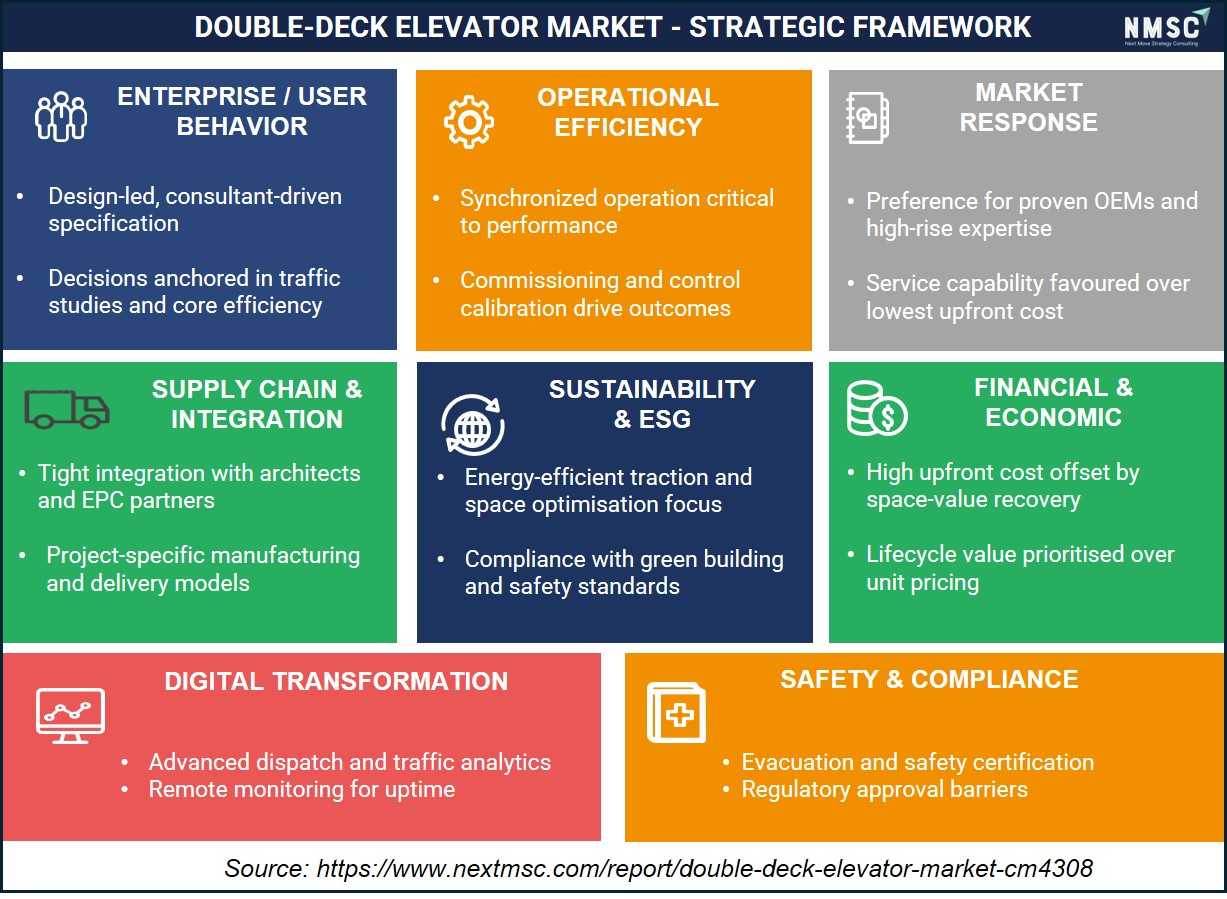
This strategic framework highlights the design-led and service-centric nature of the double-deck elevator market. Adoption is driven by consultant-led specification and traffic validation, with synchronized operation and precise commissioning critical to performance. Market preference favours proven OEMs with strong service capability, while tight integration with architects and EPC partners supports project execution. Sustainability, digital control, and regulatory compliance further shape system selection, positioning double-deck elevators as high-value, lifecycle-oriented solutions for dense, high-rise environments.
List of Key Double-Deck Elevator Companies
-
Hitachi Elevator
-
FUJITEC CO., LTD.
-
HYUNDAIELEVATOR CO.,LTD
-
CANNY ELEVATOR CO.,LTD.
-
Toshiba Elevator and Building Systems Corporation
-
Otis Elevator Company
-
Mitsubishi Electric US,Inc .
-
Schindler
What are the Latest Key Industry Developments?
-
September 2025 - Mitsubishi Electric Building Solutions (MEBS) launched KEGMIL, a cloud-based digital maintenance platform, starting in Singapore with plans for a rapid Southeast Asian rollout. The platform integrates with Mitsubishi's "M's BRIDGE" remote monitoring system to digitize field service workflows, reducing maintenance report preparation time by 50% and worker assignment planning by 90% for Double-deck and escalator portfolios.
-
July 2025 - Schindler Group entered a major regional service agreement with Accor in Asia. This partnership emphasizes the "servitization" trend, where elevator manufacturers act as long-term facility partners rather than just equipment providers, focusing on hospitality-specific uptime requirements.
What are the Key Factors Influencing Investment Analysis & Opportunities in the Double-Deck Elevator Market?
Investment analysis in the double-deck elevator market is increasingly shaped by disciplined capital allocation toward projects and platforms that combine early-stage design integration with long-term service and operational certainty, rather than volume-driven installation growth. Based on our evaluation of recent strategic investments, selective acquisitions, and capital deployment patterns, we observed that investors and strategic buyers prioritise companies with proven expertise in complex system deployment, strong installed bases within premium assets, and long-duration maintenance and service contracts. Moreover, businesses demonstrating validated traffic engineering capabilities, standardized control architectures, and scalable service operations tend to attract greater strategic interest than those exposed primarily to cyclical high-rise construction activity. Digital service capabilities including remote diagnostics, synchronised system monitoring, and performance analytics are increasingly viewed as value enhancers, supporting uptime reliability and extending revenue visibility across long operating lifecycles.
We also identified growing investment focus on platforms that pair operational maturity with service extensibility, particularly in markets characterised by dense urban development, strict regulatory oversight, and high expectations for service continuity. Strategic capital from OEMs, infrastructure-linked investors, and real-estate–aligned stakeholders increasingly outweighs purely financial investment, as control over installed-base economics and lifecycle service ecosystems becomes central to value creation. For investors, the most attractive opportunities lie in companies that combine double-deck system engineering expertise with disciplined commissioning, modernization capability, and digitally enabled service delivery. This combination supports resilient cash flows, mitigates construction-cycle exposure, and positions suppliers to capture long-term value as double-deck elevators function as tightly managed vertical infrastructure within high-intensity developments.
Key Benefits for Stakeholders:
Next Move Strategy Consulting (NMSC) presents a comprehensive analysis of the market, covering historical developments from 2020 to 2025 and providing forward-looking forecasts through 2035. The study evaluates the double-deck elevator market trends at global, regional, and country levels, delivering quantitative outlooks alongside qualitative insights into key growth drivers, adoption constraints, technology evolution, and investment dynamics across all major double-deck system segments.
From our observations, the double-deck elevator market delivers concentrated, long-term value by aligning high-intensity vertical infrastructure with disciplined service-led economics. Investors benefit from predictable cash flows anchored in premium installed bases, long-duration maintenance agreements, and selective modernization activity rather than broad, volume-driven installation cycles. Building owners and facility operators gain space efficiency, traffic predictability, and operational continuity through systems designed for synchronized performance and supported by structured service frameworks and digital monitoring tools. OEMs, system integrators, and service partners benefit from extended asset lifecycles, high-value service contracts, and recurring aftermarket revenues tied to commissioning support, performance optimization, and compliance management. By positioning double-deck elevators as design-integrated, continuously managed infrastructure rather than standalone mobility solutions, the market creates durable value across stakeholders while supporting long-term asset performance, safety assurance, and efficiency in dense vertical environments.
Key Market Segments
By Product Type
-
Passenger Double Deck Elevator
-
Service and Utility Double Deck Elevator
By Deck Operation Mode
-
Fixed Deck Operation
-
Adaptive Deck Operation
By Technology
-
Traction Elevator
-
Machine Room Traction
-
Machine Roomless Traction
-
-
Magnetic Levitation
-
Other Technologies
By Service Lifecycle
-
New Installation
-
Maintenance
-
Modernization
-
Partial Modernization
-
Controller Replacement
-
Door System Upgrade
-
Drive System Upgrade
-
Safety Component Upgrade
-
Full Elevator Replacement
-
By System Load Capacity
-
Less than 3000 kg
-
3000 kg to 5000 kg
-
5001 kg to 8000 kg
-
More than 8000 kg
By Rated Speed
-
Upto 4 m/s
-
4-8 m/s
-
Above 8 m/s
By Door Configuration
-
Dual Front Opening
-
Front and Rear Opening Configuration
-
Asymmetric Deck Door Configuration
By Application
-
Commercial
-
Grade a Office Towers
-
Mixed-Use Skyscrapers
-
Luxury Hotels
-
-
Transportation Infrastructure
-
Major Airports
-
Rail Transit Hubs
-
-
Institutional
-
Government Complexes
-
Convention & Exhibition Centers
-
By Sales Channel
-
Direct Sales from OEM
-
EPC & Developer-Led Procurement
-
Strategic Partnership Contracts
Geographical Breakdown
-
North America: U.S., Canada, and Mexico.
-
Europe: UK, Germany, France, Italy, Spain, Sweden, Denmark, Finland, the Netherlands, and the Rest of Europe.
-
Asia Pacific: China, India, Japan, South Korea, Taiwan, Indonesia, Vietnam, Australia, Philippines, Malaysia and the rest of APAC.
-
Middle East & Africa (MEA): Saudi Arabia, UAE, Egypt, Israel, Turkey, Nigeria, South Africa, and the rest of MEA.
-
Latin America: Brazil, Argentina, Chile, Colombia, and the rest of LATAM.
Conclusion & Recommendations
This report provides stakeholders, industry participants, investors, and consultants with actionable intelligence to capture opportunities emerging from the structural evolution of the market. By integrating robust data analysis with established strategic assessment frameworks, NMSC’s double-deck elevator market report functions as a comprehensive decision-support tool for navigating the increasingly sophisticated vertical transportation landscape.
The double-deck elevator market is poised for steady and structurally resilient growth, driven by sustained global high-rise construction, intensified pressure on core space optimization, and stricter safety, accessibility, and performance standards in dense urban environments. Strategic findings highlight the critical role of early-stage architectural coordination, advanced traffic simulation and engineering, and integrated system planning to ensure synchronized dual-car operation, optimal passenger flow, and long-term building efficiency. Digital technologies, including intelligent dispatch algorithms, predictive maintenance platforms, remote monitoring, and performance analytics, further strengthen system uptime, compliance management, and lifecycle transparency in complex multi-deck configurations.
For executives and investors, sustainable value creation increasingly depends on securing premium high-rise installed bases, long-term maintenance and service contracts, and targeted modernization of aging vertical transport systems. Emphasis on landmark commercial towers, mixed-use megastructures, transit-linked developments, and supertall assets enhances demand quality and margin resilience. Continuous investment in specialized installation expertise, commissioning precision, traffic optimization capabilities, and regional service infrastructure remains essential to maintaining competitive advantage. Ultimately, reliability, operational precision, and transparent lifecycle performance form the foundation of buyer confidence and enduring value across the global double-deck elevator ecosystem.


About the Author

About the Reviewer

At Next Move Strategy Consulting, we understand that insightful market research is the cornerstone of successful business decisions. That's why we employ a robust and multifaceted approach, combining various methodologies to deliver the most accurate and actionable data for our clients.

Research Landscape
We navigate the world of research with two primary approaches:
Qualitative Approach
Our qualitative research methodologies involve immersive techniques such as in-depth interviews, focus groups, and observational studies. By engaging directly with individuals and stakeholders, we uncover valuable insights that quantitative data alone may overlook.

Quantitative Research
In tandem with qualitative methodologies, NMSC leverages the power of Quantitative Research to provide a robust foundation of numerical insights. Through systematic data collection and analysis, we quantify patterns, preferences, and market trends, offering a comprehensive view of the business landscape.
Our quantitative research approach employs diverse tools, including surveys, experiments, and statistical modelling. These methodologies enable us to gather data from a large and representative sample, ensuring the statistical significance of our findings. By employing structured questionnaires and standardized data collection methods, we guarantee the reliability and validity of the information we present to our clients.
Quantitative research is particularly effective in measuring the prevalence of trends, assessing market size, and gauging the impact of various factors on consumer behavior. The numerical precision attained through this approach equips our clients with actionable insights, facilitating data-driven decision-making and strategy formulation.


Our Specialized Toolbox for Industry-Specific Market Research
We deploy a specialized arsenal of techniques tailored to meet your unique requirements. Here's a glimpse into our comprehensive toolbox:

Information Procurement
The stage entails acquiring market data or relevant information through various sources and methodologies.


Market Research Approach
We utilize both top-down and bottom-up approaches in market research analysis to achieve a comprehensive understanding of the market dynamics, leveraging the broad perspective of industry trends and macroeconomic factors alongside detailed insights from specific segments and individual companies.

Porters Five Forces Analysis
We conduct Porter's Five Forces analysis to evaluate the competitive landscape of an industry, providing us with insights into factors that affect profitability and strategic positioning.

SWOT Analysis

Forecasting
We utilize a forecasting model to predict future consumption by considering parameters like population, economics, regulations, market competition, drivers, constraints, technology, and pricing. We also employ statistical techniques such as multilinear regression, exponential smoothing, moving average, ARIMA, and Monte Carlo simulations for accurate predictions. In econometric forecasting, we analyzed short-term and long-term event impacts, attributing values based on regulatory frameworks, economic factors, and market events.





 Speak to Our Analyst