Dynamic Pricing Software Market Global Industry Analysis and Forecast (2026-2035)

Dynamic Pricing Software Market size was USD 4.0 billion in 2026, projected to reach USD 13.8 billion by 2035, growing at a CAGR of 14.7% from 2026 to 2035. Key drivers include expanding e-commerce activity, rising adoption of AI-driven pricing engines, and growing demand for real-time price optimization, with North America leading the market.

Download Free Sample PDF
Base Year (2025)
$3.50 Billion
Forecast (2035)
$13.80 Billion
CAGR (2026-2035)
14.7%
Top Region
North America

What Is the Dynamic Pricing Software Market Size?

The global dynamic pricing software market size was valued at USD 3.5 billion in 2025 and is estimated at USD 4.0 billion in 2026, forecast to reach USD 13.8 billion by 2035, expanding at a 14.7% CAGR between 2026 and 2035. North America leads with approximately 41% share, while software dominates all other components with approximately 71% share.

We observed that growth is broad-based across every segmentation axis, with AI-driven pricing engines and cloud deployment models driving the dominant structural shifts through 2035.

Dynamic Pricing Software Market Global Industry Analysis and Forecast (2026-2035) Revenue Forecast

Values in USD Billion

2025 $3.50 Billion
2025
2026 $4.01 Billion
2026
2027 $4.60 Billion
2027
2028 $5.28 Billion
2028
2029 $6.06 Billion
2029
2030 $6.95 Billion
2030
2031 $7.97 Billion
2031
2032 $9.14 Billion
2032
2033 $10.49 Billion
2033
2034 $12.03 Billion
2034
2035 $13.80 Billion
2035

Key Takeaways

By Component: Software held the largest share of approximately 71% (USD 2.48 Billion) in 2025; Services is the fastest-growing sub-segment at 17.1% CAGR from 2026–2035.

By Deployment Mode: Cloud held the largest share of approximately 68% (USD 2.38 Billion) in 2025; Cloud is the fastest-growing sub-segment at 15.3% CAGR from 2026–2035.

By Pricing Model: AI and Machine Learning-Based Pricing held the largest share of approximately 38% (USD 1.33 Billion) in 2025; Demand-Based Pricing is the fastest-growing sub-segment at 19.1% CAGR from 2026–2035.

By Organization Size: Large Enterprises held the largest share of approximately 64% (USD 2.24 Billion) in 2025; Small and Medium Enterprises is the fastest-growing sub-segment at 17.8% CAGR from 2026–2035.

By End-Use Industry: Retail and E-commerce held the largest share of approximately 39% (USD 1.36 Billion) in 2025; Real Estate is the fastest-growing sub-segment at 17.1% CAGR from 2026–2035.

Dominant Region: North America dominated with approximately 41% revenue share (USD 1.44 billion) in 2025.

Fastest-Growing Region: Asia-Pacific is expected to register the highest CAGR of 17.8% during 2026–2035.

Dominant Country: U.S. led with approximately USD 1.15 billion in 2025.

Fastest-Growing Country: India is the fastest-growing country at approximately 21.1% CAGR from 2026–2035.

Market Opportunity: The dynamic pricing software market is expected to create an absolute dollar opportunity of USD 9.8 billion between 2026 and 2035, presenting significant investment potential across the revenue management and pricing optimization value chain.

According to Next Move Strategy Consulting analysis, retailers and travel operators are increasingly consolidating rule-based repricing tools into unified AI-driven pricing engines to reduce manual pricing team workload, a shift that favors vendors with proven machine learning-based demand forecasting over legacy competitor-tracking tools as pricing complexity accelerates through 2035.

What Does the Dynamic Pricing Software Market Encompass?

The dynamic pricing software market encompasses software and services that adjust product and service prices in real time based on demand, competitor pricing, inventory levels, and other market signals. Our assessment indicates that the scope spans cloud and on-premises pricing platforms using rule-based, competitor-based, demand-based, and artificial intelligence and machine learning-based pricing techniques, supplied to large enterprises and small and medium enterprises across retail, travel, transportation, and real estate end markets seeking to optimize revenue and margin in real time.
Regulatory frameworks such as consumer protection authority guidance on algorithmic pricing transparency and data privacy rules increasingly shape how vendors disclose pricing logic to buyers. We observed that technology adoption is shifting from static, rule-based repricing toward machine learning-driven demand forecasting that continuously recalibrates prices without manual intervention. Next Move Strategy Consulting's analysis indicates that this structural shift, combined with rising e-commerce price transparency, is redefining procurement criteria across the dynamic pricing software market.

CONSUMER BEHAVIOR ANALYSIS OF THE DYNAMIC PRICING SOFTWARE MARKET

The infographic illustrates the consumer behaviour journey in the dynamic pricing software market across four stages: Awareness, Consideration, Purchase, and Loyalty. Businesses first become aware of dynamic pricing through AI, retail, e-commerce, and automation trends. They then evaluate pricing algorithms, integration capabilities, scalability, and analytics before purchasing SaaS-based solutions. Long-term loyalty is driven by pricing accuracy, measurable business outcomes, continuous innovation, and reliable platform performance that support sustainable revenue growth and competitive advantage.

Market Drivers & Dynamics

Interactive Dataset
Expansion of online retail and e-commerce transaction volume driver +2.9% Global 2026–2035
Rising adoption of AI and machine learning-based pricing engines driver +2.4% Global 2026–2035
Growing price transparency and competitive intensity online driver +1.9% North America, Europe 2026–2035
Expanding adoption in travel, hospitality, and transportation sectors driver +1.4% Global 2026–2032
Rising small and medium enterprise access to cloud-based pricing tools driver +1.1% Asia-Pacific, Latin America 2026–2035
Growing enterprise resource planning and e-commerce platform integration driver +0.8% Global 2026–2035
Regulatory scrutiny of algorithmic pricing transparency practices restraint −1.1% North America, Europe 2026–2032
Data quality and integration complexity across legacy systems restraint −0.8% Global 2026–2035
Consumer distrust of perceived unfair or surge pricing practices restraint −0.6% Global 2028–2035
Source: Next Move Strategy Consulting

Growth Drivers

What Is the Primary Growth Driver of the Dynamic Pricing Software Market?

Expansion of online retail and e-commerce transaction volume is the primary driver of the market. U.S. Census Bureau retail trade data continues to track sustained growth in e-commerce sales as a share of total retail activity, reinforcing demand for automated pricing tools that can react to volume and competition in real time. We observed that this e-commerce growth pace, combined with expanding product catalogue sizes, continues to anchor baseline demand for dynamic pricing software across developed and emerging economies alike.

How Is AI Adoption Driving Dynamic Pricing Software Market Growth?

Rising adoption of AI and machine learning-based pricing engines is accelerating market growth toward predictive, demand-responsive platforms. Government digital economy strategy publications in several developed markets continue to cite artificial intelligence adoption as a stated priority for enterprise software modernisation. Our assessment indicates that this AI adoption pace, combined with expanding computational infrastructure availability, is compressing adoption timelines for demand-based and AI-driven pricing models across North America and Europe.

Growth Inhibitors

What Is Restraining Dynamic Pricing Software Market Expansion?

Regulatory scrutiny of algorithmic pricing transparency restrains adoption among enterprises concerned about compliance exposure in jurisdictions considering pricing algorithm disclosure requirements. Consumer protection authority guidance in several markets continues to examine algorithmic pricing practices for potential unfair pricing concerns. We found that vendors offering explainable, auditable pricing logic are beginning to offset this restraint, though full adoption among compliance-sensitive enterprises remains gradual.

Segmentation Analysis

2025 (USD Billion)
2035 (USD Billion)
Software 2025: $2.48 Billion | 2035: $9.00 Billion
Software
Services 2025: $1.01 Billion | 2035: $4.80 Billion
Services
Software $2.48 Billion $9.00 Billion 13.7%
Services $1.01 Billion $4.80 Billion 17.1%

Which Component Segment Dominates the Dynamic Pricing Software Market?

Software led the market with USD 2.48 billion in 2025, supported by enterprises' preference for licensed or subscription-based pricing platforms over standalone consulting engagements. We observed that Services is the fastest-growing component, expanding at a 17.1% CAGR from 2026 to 2035, as enterprises increasingly contract implementation, integration, and managed pricing services to accelerate platform deployment and reduce internal resourcing burden.

2025 (USD Billion)
2035 (USD Billion)
Cloud
On-Premises
Segment Item 2025 (USD Billion) 2035 (USD Billion) CAGR
Cloud $10.0 USD Billion $40.0 USD Billion 25.0%
On-Premises $17.1 USD Billion $51.1 USD Billion 11.0%

Segment-wise data is locked

Unlock complete segment-wise numbers for By Deployment Mode.

Unlock Full Data
2025 (USD Billion)
2035 (USD Billion)
AI and Machi
Rule-Based P
Competitor-B
Demand-Based
Segment Item 2025 (USD Billion) 2035 (USD Billion) CAGR
AI and Machine Learning-Based Pricing $10.0 USD Billion $40.0 USD Billion 27.0%
Rule-Based Pricing $17.1 USD Billion $51.1 USD Billion 9.0%
Competitor-Based Pricing $24.2 USD Billion $62.2 USD Billion 19.0%
Demand-Based Pricing $31.3 USD Billion $73.3 USD Billion 17.0%

Segment-wise data is locked

Unlock complete segment-wise numbers for By Pricing Model.

Unlock Full Data

Which Pricing Model Leads Dynamic Pricing Software Adoption?

AI and Machine Learning-Based Pricing remained the dominant pricing model, reaching USD 1.33 billion in 2025 due to its superior accuracy in forecasting demand elasticity relative to static rule-based approaches. Our findings suggest that Demand-Based Pricing is the fastest-growing pricing model at a 19.1% CAGR from 2026 to 2035, reflecting rising adoption among travel, transportation, and real estate buyers seeking real-time responsiveness to fluctuating demand conditions.

2025 (USD Billion)
2035 (USD Billion)
Large Enterp
Small and Me
Segment Item 2025 (USD Billion) 2035 (USD Billion) CAGR
Large Enterprises $10.0 USD Billion $40.0 USD Billion 14.0%
Small and Medium Enterprises $17.1 USD Billion $51.1 USD Billion 24.0%

Segment-wise data is locked

Unlock complete segment-wise numbers for By Organization Size.

Unlock Full Data
2025 (USD Billion)
2035 (USD Billion)
Retail and E
Travel and H
Transportati
Media and En
Real Estate
Segment Item 2025 (USD Billion) 2035 (USD Billion) CAGR
Retail and E-commerce $10.0 USD Billion $40.0 USD Billion 24.0%
Travel and Hospitality $17.1 USD Billion $51.1 USD Billion 22.0%
Transportation and Logistics $24.2 USD Billion $62.2 USD Billion 20.0%
Media and Entertainment $31.3 USD Billion $73.3 USD Billion 22.0%
Real Estate $38.4 USD Billion $84.4 USD Billion 13.0%

Segment-wise data is locked

Unlock complete segment-wise numbers for By End-Use Industry.

Unlock Full Data

Which End-Use Industry Leads Dynamic Pricing Software Market Demand?

Retail and E-commerce remained the leading end-use industry, valued at USD 1.36 billion in 2025 as the sector with the highest transaction volume and competitive pricing pressure. Based on research conducted by Next Move Strategy Consulting, we found that Real Estate is the fastest-growing end-use industry at a 17.1% CAGR from 2026 to 2035, reflecting rising adoption of dynamic pricing for rental and short-term accommodation listings.

Growth Opportunities

Our analysis shows that three forward-looking opportunities stand out for stakeholders positioning within the dynamic pricing software market over the 2026–2035 forecast period.

How Can Usage-Based Pricing Infrastructure Unlock Value for SaaS Vendors?

Usage-based and hybrid monetization infrastructure presents a whitespace opportunity for vendors targeting SaaS and technology companies moving beyond fixed subscription tiers. Suppliers that embed consumption-based pricing logic directly into product and billing systems stand to capture recurring platform revenue as technology companies adopt hybrid subscription and usage-based models spanning credits, overages, and tiered access.

Where Does Mobile-First Retail Pricing Create New Demand?

Mobile-first retail buyers represent an underpenetrated opportunity for vendors integrating dynamic pricing directly into mobile commerce storefronts and checkout flows. Suppliers that offer lightweight, mobile-optimised pricing engines can secure new small and medium enterprise customers seeking real-time price adjustment without complex desktop-based pricing management systems.

How Can Explainable Pricing Logic Benefit Compliance-Sensitive Enterprises?

Enterprises in regulated or compliance-sensitive sectors create an opportunity for vendors offering explainable, auditable pricing algorithm documentation. Early movers that build transparent, regulator-ready pricing logic disclosure into their platforms can differentiate with large enterprises pursuing dynamic pricing adoption while managing algorithmic pricing transparency requirements emerging across multiple jurisdictions.

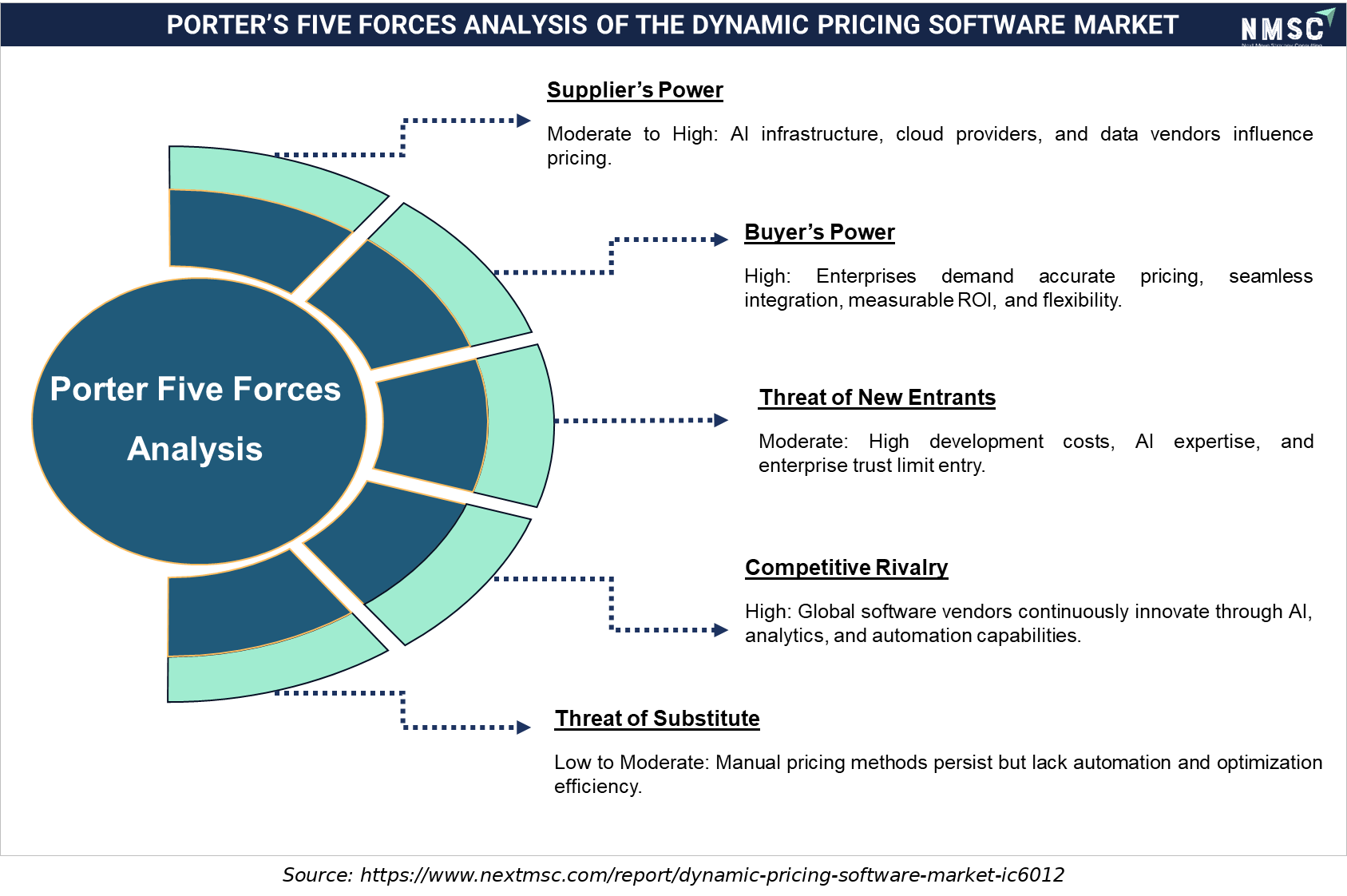
PORTER’S FIVE FORCES ANALYSIS OF THE DYNAMIC PRICING SOFTWARE MARKET

The infographic presents Porter’s Five Forces Analysis for the dynamic pricing software market, illustrating the competitive factors shaping industry growth. It evaluates the threat of new entrants, bargaining power of buyers, bargaining power of suppliers, threat of substitutes, and competitive rivalry. The analysis highlights how AI innovation, SaaS adoption, integration capabilities, pricing transparency, and increasing competition among software vendors influence market dynamics, profitability, and long-term strategic positioning within the dynamic pricing software industry.

Regional Outlook

2025 (USD Billion)
2035 (USD Billion)
North Americ
Europe
Asia-Pacific
Middle East
Latin Americ
Region 2025 (USD Billion) 2035 (USD Billion) CAGR (%)
North America $10.0 USD Billion $40.0 USD Billion 9.0%
Europe $17.1 USD Billion $51.1 USD Billion 27.0%
Asia-Pacific $24.2 USD Billion $62.2 USD Billion 25.0%
Middle East & Africa $31.3 USD Billion $73.3 USD Billion 23.0%
Latin America $38.4 USD Billion $84.4 USD Billion 12.0%

Regional data is locked

Unlock complete regional numbers for this market.

Unlock Full Data

Competitive Landscape

We observed that the dynamic pricing software market remains moderately fragmented among diversified enterprise software groups and specialized B2B pricing platforms competing for enterprise and mid-market pricing team accounts.

Dimension Description
Market Structure Moderately fragmented, led by diversified enterprise software groups and specialized B2B pricing platforms
Innovation Focus AI-embedded pricing assistants, pre-built ERP and CRM connectors, and explainable pricing logic
M&A Activity Active, concentrated in private equity acquisitions and payment infrastructure integration

How Do Companies Compete in the Dynamic Pricing Software Market?

Companies compete primarily on AI pricing accuracy, ERP and CRM integration depth, and implementation speed across the industry. Diversified enterprise software groups such as SAP SE and Oracle Corporation leverage broad ERP installed bases to cross-sell pricing modules, while specialized platforms such as Pricefx AG and Vendavo, Inc. compete on B2B pricing optimization depth and industry-specific configuration for manufacturing and distribution buyers.

Which Competitive Archetypes Dominate the Dynamic Pricing Software Market?

Two archetypes dominate the market: diversified enterprise software groups offering pricing modules within broader ERP suites, and specialized B2B pricing platforms focused on dedicated margin and deal optimization. SAP SE and Oracle Corporation exemplify the diversified archetype through pricing capability embedded in enterprise resource planning systems, while Vendavo, Inc. and PROS Holdings, Inc. exemplify the specialized archetype through purpose-built pricing and revenue management platforms.

How Are Companies Differentiating Through Innovation in Dynamic Pricing?

Innovation and differentiation strategy increasingly center on embedding AI directly into pricing workflows with faster deployment timelines. Pricefx's Copilot, integrating with SAP, Salesforce, and Microsoft Dynamics through pre-built APIs to cut deployment time to eight to twelve weeks, and Vendavo's AI Pricing Assistant built on SAP Business Technology Platform both target reduced implementation friction. Our analysis shows that vendors unable to demonstrate rapid, low-friction AI deployment risk losing enterprise accounts to faster-integrating competitors.

What M&A and Expansion Activity Is Shaping the Dynamic Pricing Software Market?

Private equity consolidation and platform integration continue to reshape the industry. Thoma Bravo's USD 1.4 billion acquisition of PROS Holdings in September 2025, followed by the divestiture of its B2B arm to Conga in February 2026, illustrates a private equity strategy focused on building comprehensive deal-execution platforms. This transaction pattern, combined with continued platform expansion from Vendavo and Pricefx, demonstrates how capital is concentrating around AI-embedded pricing capability.

Key Market Players

Our assessment indicates that the following 15 companies are actively shaping platform innovation, AI capability, and commercial strategy within the global dynamic pricing software market.

PROS Holdings, Inc. SAP SE Oracle Corporation International Business Machines Corporation Epicor Software Corporation Blue Yonder Group, Inc. RELEX Solutions Oy Vendavo, Inc. Pricefx AG Zilliant, Inc. Omnia Retail B.V. Competera Ltd. Wiser Solutions, Inc. Prisync Intelligence Node Inc.

Latest Developments

We found that recent activity within the dynamic pricing software market is concentrated on AI product launches and private equity-driven consolidation, reflecting the industry's rapid technology and ownership transition.

Date Event
May 2024 Zilliant announced major AI innovations across its pricing lifecycle solutions, including GenAI Pricing Analytics, AI-driven Pricing Guidance in Zilliant CPQ, and a planned self-service AI assistant. The enhancements were designed to provide AI-generated pricing insights, support pricing decisions during quoting, improve productivity, and help businesses respond faster to cost and pricing changes.

Expert Insights

Scott Zucker

Scott Zucker

General Manager | Revionics

"“While pre-built workflows are important to improve operational efficiency and ensure consistent processes, we have a vision that our customers should be able to interact within the workflows of our solution — and also bypass those workflows entirely by interacting directly with their data and with our AI pricing agents.”"

Analyst Interpretation

Scott Zucker's statement reflects the ongoing evolution of the dynamic pricing software market from traditional rule-based pricing engines to AI-powered autonomous pricing platforms. The emergence of multi-agent AI enables businesses to analyse market conditions, customer demand, competitor pricing, and inventory data in real time, allowing organisations to automate pricing decisions with greater speed and accuracy. This trend is accelerating the adoption of intelligent dynamic pricing solutions across retail and other industries seeking improved pricing agility and margin optimisation.

Investment Opportunities

What Capital Inflows Are Targeting the Dynamic Pricing Software Market?

Capital inflows into the dynamic pricing software market are increasingly directed toward companies combining AI capability with rapid enterprise deployment. Thoma Bravo's USD 1.4 billion acquisition of PROS Holdings illustrates how private equity continues to fund consolidation and platform specialization within the sector. We observed that investors favor vendors demonstrating validated deployment speed and integration breadth, viewing pre-built ERP and CRM connectors as a proxy for enterprise sales cycle efficiency.

How Is Infrastructure Investment Supporting Dynamic Pricing Software Scaling?

Infrastructure investment is expanding cloud hosting and API connectivity to support real-time pricing recalculation across large enterprise catalogs. Our findings suggest that vendors are increasingly building on established cloud computing platforms, including SAP Business Technology Platform, to ensure upgrade-safe connectivity and scalable computational capacity for AI-driven pricing workloads across expanding customer bases.

What ESG Considerations Are Shaping Dynamic Pricing Software Investment Decisions?

Environmental, social, and governance considerations are increasingly relevant to investment decisions across the industry, with pricing fairness transparency and algorithmic accountability as key criteria. Consumer protection authority guidance in several markets continues to inform governance disclosures around automated pricing practices. We found that investors increasingly favor vendors with explainable pricing logic, treating algorithmic transparency as a governance indicator alongside data security practices.

Key Benefits for Stakeholders

How Does This Report Benefit Enterprise and Industry Leaders?

Enterprise and industry leaders gain access to validated segmentation, competitive benchmarking, and regional demand forecasts that support sourcing and technology investment decisions across the dynamic pricing software industry. Our analysis shows that detailed component, pricing model, and end-use industry breakdowns help procurement teams align platform investment with pricing complexity requirements while identifying underserved segments for expansion.

How Does This Report Benefit Investors and Financial Analysts?

Investors and financial analysts benefit from consistent, single-point market size and CAGR estimates that support valuation and capital-allocation decisions across the dynamic pricing software market supply chain. We observed that the report's regional and segment-level growth differentials help identify which vendors are best positioned to capture above-market growth in services and AI-driven pricing categories through 2035.

How Does This Report Benefit Technology Vendors and Product Teams?

Technology vendors and product teams gain insight into emerging design requirements, including embedded AI assistants, pre-built ERP connectors, and explainable pricing logic, that are reshaping the industry. Our findings suggest that this analysis helps R&D teams prioritize development roadmaps around deployment speed and margin analytics that are increasingly required by enterprise and small and medium enterprise procurement processes.

Key Market Segments Evaluated

By Component

  • Software
  • Services

By Deployment Mode

  • Cloud
  • On-Premises

By Pricing Model

  • AI and Machine Learning-Based Pricing
  • Rule-Based Pricing
  • Competitor-Based Pricing
  • Demand-Based Pricing

By Organization Size

  • Large Enterprises
  • Small and Medium Enterprises

By End-Use Industry

  • Retail and E-commerce
  • Travel and Hospitality
  • Transportation and Logistics
  • Media and Entertainment
  • Real Estate
  • Utilities and Energy
  • Other Industries

Conclusion & Recommendations

The long-term outlook for the market remains strongly positive, with global revenue projected to nearly quadruple from USD 3.5 billion in 2025 to USD 13.8 billion by 2035 at a 14.7% CAGR. We observed that sustained e-commerce growth, expanding AI adoption, and rising price transparency will continue underpinning demand across retail, travel, and transportation applications through the forecast period.

What Strategic Positioning Should Dynamic Pricing Software Suppliers Pursue?

Suppliers should prioritize embedded AI capability and rapid deployment infrastructure while pursuing explainable pricing logic to secure long-term enterprise contracts. Our assessment indicates that vendors investing early in pre-built ERP and CRM connectors and demand-based pricing models will be best positioned to capture premium pricing within the dynamic pricing software market.

How Attractive Is the Dynamic Pricing Software Market for New Investment?

The dynamic pricing software industry presents an attractive investment case, supported by a USD 9.8 billion absolute dollar opportunity between 2026 and 2035 and above-average growth in Asia-Pacific and services categories. We found that investment attractiveness is highest for vendors combining AI pricing accuracy with rapid enterprise deployment capability, positioning them to serve both large enterprise and small and medium enterprise customers simultaneously.

What Market Shifts and Key Risks Should Stakeholders Monitor?

Stakeholders should monitor algorithmic pricing transparency regulation, data integration complexity, and consumer distrust of perceived unfair pricing as key risks to the dynamic pricing software market. Our analysis shows that vendors unable to demonstrate explainable, auditable pricing logic risk losing enterprise contracts to competitors with validated transparency practices, particularly within Europe's increasingly compliance-driven procurement environment.

What Are the Key Growth Pathways for the Dynamic Pricing Software Market?

Key growth pathways include expanding AI-embedded pricing assistants, scaling usage-based and hybrid monetization infrastructure, and deepening penetration into real estate and transportation end-use industries. Next Move Strategy Consulting's analysis indicates that suppliers pursuing these pathways while maintaining deployment speed advantages will be best positioned to capture the dynamic pricing software market's projected growth through 2035.

FAQs

About the Author

Liza Phukan

Liza Phukan

Liza Phukan is Research Associate at Next Move Strategy Consulting, where she has covered emerging industries and market research across sectors for 3.5 years. Her work includes analyzing industry developments, validating market data, and developing structured business content from research findings. She uses secondary research and data-validation practices to turn complex market information into clear decision-useful market analysis for business audiences and support report development and B2B.

About the Reviewer

Supradip Baul

Supradip Baul

Supradip Baul is an accomplished business consultant and strategist with over a decade of rich experience in market intelligence, strategy, technology, and business transformation. His work has included rigorous qualitative and quantitative analysis across multiple industries, helping clients shape investment decisions and long-term roadmaps. Earlier in his career, he was associated with Gartner, where he contributed to industry-leading reports and market share analyses. He has worked with leading global companies and holds an MBA with a dual specialization in Marketing and Finance.

Download Free Sample

Kishu Kanda

KISHU KANDA

Strategy Analyst

Accenture

We purchased the AI Consumer Market Report from this company. Not only did they customize the report to meet our specific requirements, but they also showed great flexibility in accommodating our budget. The report we received fully met our expectations. Additionally, they provided prompt and thorough responses to both our pre-purchase and follow-up questions. We look forward to working with this company again in the future.

Pratyush Kumar Das

PRATYUSH KUMAR DAS

Assistant Manager

Polycab India Limited

We would like to express our appreciation for the data and insights provided by nextmsc. We are very pleased with the quality and depth of the information, which has proven to be highly valuable and beneficial for our business decision-making.

Diana Trejo

DIANA TREJO

Assistant Manager

Sumitomo Corporation de Mexico, S.A. de C.V.

Recently, we purchased a report on the Mexico Data Center Market from Next Move Strategy Consulting. The service has been excellent, with support that is always timely and thoroughly professional. The information provided is interesting, highly useful, and delivered with clarity. I would highly recommend NextMSC for anyone seeking insightful and dependable analysis.

Kevin Coker

KEVIN COKER

Founder, CEO and Board Diector

Proxima Clinical Research

I have been using Next MSC reports for product positioning in a new geography for a long time. They have by far the best reports I have found and the price is reasonable too!

Robert Sean Trevino

ROBERT SEAN TREVINO

Sr. Director, Head of Strategic Insights & Analytics

Foundation Medicine

I realized that it was a reliable source of information. These days, there are many people who are looking for authentic data, and this is one of the only sources that can offer them with what they need;

Custom Market Research Services

We will customize the research for you if the listed report does not fully match your requirements.

Get 30% Free Customization

Select License

This website uses cookies to ensure you get the best experience on our website. Learn more

✖