Service-as-a-Software (SaS) Market Size, Share, Growth, and Forecast Analysis, by Solution Type (Business Applications, Technology Platforms, IT & Security Applications), Deployment Model (Public, Private, Sovereign, and Hybrid Cloud), Revenue Model, Customer Type, Buyer Function, Industry Vertical, Sales Channel, and Organization Size – Global Opportunity Analysis and Industry Outlook from 2026–2035
Industry: ICT & Media | Publishing Date: July 13, 2026 | Last Updated: September 30, 2026 | No of Pages: N/A | No. of Tables: N/A | No. of Figures: N/A | Format: PDF | Report Code: IC5107
What Is the Service-as-a-Software (SaS) Market Size?
The global Service-as-a-Software (SaS) Market was valued at USD 381.2 billion in 2025 and is expected to reach USD 432.1 billion in 2026. Accelerating enterprise digital transformation, the pervasive adoption of cloud-native architectures, and the rapid integration of artificial intelligence across business applications are projected to propel the Market to USD 1,342.6 billion by 2035, advancing at a CAGR of 13.4% from 2026 to 2035. Key growth drivers include the global shift toward subscription-based software consumption, expanding AI-powered SaS platforms, increasing adoption by small and mid-market enterprises, and regulatory-driven compliance software investments across every major industry vertical.
|
Parameters |
Details |
|
Market Size in 2025 |
USD 381.2 Billion |
|
Market Size in 2026 |
USD 432.1 Billion |
|
Revenue Forecast in 2035 |
USD 1,342.6 Billion |
|
Growth Rate |
CAGR of 13.4% from 2026 to 2035 |
|
Analysis Period |
2025–2035 |
|
Base Year Considered |
2025 |
|
Forecast Period |
2026–2035 |
|
Market Size Estimation |
Billion USD |
|
Companies Profiled |
20 |
|
Countries Covered |
33 |
|
Market Share |
Top 10 |
Service-as-a-Software (SaS) Market Overview
What Is the Service-as-a-Software (SaS) Market?
The Service-as-a-Software (SaS) Market encompasses cloud-delivered software applications and technology platforms that organizations access via subscription over the internet, eliminating the need for on-premises installation, hardware procurement, or manual software maintenance. SaS solutions span business applications such as CRM, ERP, and HCM; technology platforms covering data, analytics, and AI; and IT and security applications. Based on NMSC's research, we found that SaS represents the dominant cloud service delivery layer, enabling organizations of all sizes to consume enterprise-grade software capabilities with predictable costs, automatic updates, and global accessibility.
How Has the Service-as-a-Software (SaS) Market Evolved?
The Service-as-a-Software (SaS) Market has passed through several major structural transformation phases since the early 2000s. The initial wave centered on CRM and email productivity tools delivered over the web, displacing on-premises applications. The second phase expanded SaS into ERP, HCM, and collaboration platforms, with vendors such as Workday and ServiceNow disrupting entrenched on-premises incumbents. NMSC's analysis indicates that the current third phase is defined by AI-native SaS, in which generative AI, autonomous agents, and machine learning are embedded directly into business application workflows, transforming SaS from a delivery model into a decision intelligence layer.
How Do Regulations Influence the Service-as-a-Software (SaS) Market?
Regulatory dynamics play a dual role as both growth catalysts and operational constraints within the Service-as-a-Software (SaS) Market. The EU's General Data Protection Regulation (GDPR), the California Consumer Privacy Act (CCPA), and India's Digital Personal Data Protection Act (DPDPA) are compelling enterprises to procure SaS platforms with built-in data residency, privacy engineering, and access governance capabilities. In heavily regulated sectors such as healthcare and financial services, compliance mandates directly drive adoption of specialized vertical SaS applications. Simultaneously, sovereign cloud requirements across Europe, the Middle East, and Asia Pacific are compelling vendors to offer localized deployment options within the Market.
How Is Technology Adoption Expanding Across the Service-as-a-Software (SaS) Market?
Technology adoption within the Service-as-a-Software (SaS) Market is expanding through multiple concurrent innovation vectors. The integration of large language models into business applications, the emergence of AI agents capable of executing multi-step workflows autonomously, and the standardization of low-code and no-code development platforms are collectively expanding the total addressable market. Our assessment indicates that API-first architecture and cloud marketplace distribution models are reducing time-to-value for enterprise SaS deployments, while usage-based pricing models are lowering adoption barriers for smaller organizations across all geographies within the global Market.
|
Key Takeaways |
|
By solution type, Business Applications held the largest share of the Service-as-a-Software (SaS) Market at USD 195.4 billion in 2025. CRM remains the single largest sub-category at USD 58.7 billion in 2025, driven by enterprise demand for sales automation, customer service platforms, and marketing automation tools. The AI Platform sub-category within Technology Platforms is the fastest-growing segment at a CAGR of 22.8% from 2026 to 2035, fueled by enterprise adoption of generative AI platforms, AI agents, and model operations infrastructure. |
|
By deployment model, Public Cloud SaS commanded the largest share at USD 265.8 billion in 2025, representing approximately 69.7% of total market revenue. Sovereign Cloud SaS is the fastest-growing deployment mode at a CAGR of 18.6% from 2026 to 2035, driven by national data residency regulations across the EU, Saudi Arabia, India, and Southeast Asia. |
|
By revenue model, Subscription Revenue led the Service-as-a-Software (SaS) Market at USD 248.8 billion in 2025. Usage-Based Revenue is the fastest-growing revenue model at a CAGR of 17.9% from 2026 to 2035, as AI-powered and consumption-driven SaS products gain enterprise preference for workload-aligned cost structures. |
|
By customer type, Large Enterprise accounted for USD 171.5 billion in 2025, the largest customer segment of the Service-as-a-Software (SaS) Market. Small Business is the fastest-growing customer segment at a CAGR of 15.8%15.2% from 2026 to 2035, as self-service SaS models and digital marketplace distribution remove traditional procurement barriers. |
|
By buyer function, the Information Technology function held the largest share at USD 91.5 billion in 2025. The Security function is the fastest-growing buyer segment at a CAGR of 16.2% from 2026 to 2035, driven by rising enterprise cybersecurity investments, cloud security adoption, and identity and access management platform procurement. |
|
By industry vertical, Banking and Financial Services is the largest vertical in the Service-as-a-Software (SaS) Market at USD 57.2 billion in 2025. Healthcare and Life Sciences is the fastest-growing industry vertical at a CAGR of 16.4% from 2026 to 2035, advancing from USD 34.6 billion in 2025 to USD 168.5 billion by 2035, driven by electronic health records modernization, clinical analytics, and AI-enabled patient engagement. |
|
By sales channel, Direct Sales held the largest revenue share at USD 190.6 billion in 2025 across the Service-as-a-Software (SaS) Market. Digital Marketplace, including vendor and public cloud marketplace channels, is the fastest-growing distribution channel at a CAGR of 17.5% from 2026 to 2035. |
|
By organization size, Large Enterprise held USD 171.5 billion in 2025. Strategic Enterprise is the highest revenue concentration segment, while Micro Business and Small Business are the fastest-growing size categories at a CAGR above 15.0% through 2035. |
|
North America held the largest regional share at USD 178.2 billion in 2025, projected to reach USD 547.6 billion by 2035 at a CAGR of 13.2%, anchored by the world's highest enterprise SaS spending, the headquarters of leading vendors, and the most mature cloud software adoption globally. |
|
Asia-Pacific is the fastest-growing major region in the Service-as-a-Software (SaS) Market at a CAGR of 16.2%16.0% from 2026 to 2035, propelled by India's SaS ecosystem expansion, China's enterprise digitization, and Southeast Asia's rapidly growing digital economy. |
|
The United States is the single largest country market in the Service-as-a-Software (SaS) Market, representing approximately 83% of North American revenue in 2025, underpinned by the world's highest concentration of SaS vendors, enterprise technology budgets, and mature cloud infrastructure. |
|
India is the fastest-growing national market in Asia-Pacific within the Service-as-a-Software (SaS) Market at a CAGR of 19.6%, propelled by the India Stack digital infrastructure, government digitization initiatives, and the country's rapidly expanding SaS product ecosystem. |
Key Emerging Trends in the Service-as-a-Software (SaS) Market
How Is AI-Native SaS Transforming the Entire Service-as-a-Software (SaS) Market?
AI-native SaS is the most consequential structural transformation underway in the Service-as-a-Software (SaS) Market. Leading vendors are embedding generative AI, autonomous agents, and predictive intelligence directly into core application workflows, moving beyond bolt-on AI features to architecturally integrated intelligence layers. Salesforce's Agentforce platform enables autonomous AI agents to execute sales, service, and marketing workflows without human intervention. Our analysis shows that enterprises that adopt AI-native SaS platforms report measurable improvements in workflow automation, decision velocity, and customer engagement metrics, compelling vendors across every SaS category to accelerate AI product roadmaps.
How Is the Shift to Usage-Based Pricing Reshaping Revenue Models in the Service-as-a-Software (SaS) Market?
Usage-based and consumption-driven pricing models are displacing traditional per-seat subscriptions as the dominant commercial structure across the Service-as-a-Software (SaS) Market. Snowflake's consumption model, Twilio's API-based pricing, and Datadog's infrastructure-metered billing have demonstrated that aligning costs with value delivered improves net revenue retention and reduces churn. Based on our market assessment, we observed that enterprises increasingly prefer usage-based SaS structures as they allow tighter alignment between software costs and business outcomes, particularly for AI-powered products where workload volumes are variable and difficult to pre-commit under fixed-seat licensing arrangements.
What Role Are Low-Code and No-Code Platforms Playing in Expanding the Service-as-a-Software (SaS) Market?
Low-code and no-code development platforms represent one of the most significant democratization trends within the Service-as-a-Software (SaS) Market, enabling business users without software engineering backgrounds to build, configure, and automate enterprise applications. Microsoft's Power Platform, Salesforce Flow, and ServiceNow's App Engine collectively support millions of citizen developer deployments globally. NMSC's assessment indicates that low-code SaS platforms are expanding the effective addressable market for enterprise software by enabling line-of-business teams to build and customize applications independently, reducing reliance on IT departments and dramatically shortening deployment cycles across process-intensive industries.
How Is Vertical SaS Disrupting Horizontal Platform Leaders in the Service-as-a-Software (SaS) Market?
Vertical SaS providers are gaining market share against horizontal platform incumbents by delivering deeply industry-specific workflows, regulatory compliance templates, and pre-built integrations purpose-built for single sectors. In healthcare, Veeva Systems dominates life sciences CRM and clinical data management. In construction, Procore has displaced generic project management SaS across major contractors. Through NMSC's assessment, we found that vertical SaS vendors achieve higher net revenue retention rates, lower customer acquisition costs through domain-specific referral networks, and stronger competitive moats than horizontal generalists, making vertical SaS one of the highest-growth and highest-margin sub-categories within the Service-as-a-Software (SaS) Market.
What Are the Key Market Drivers, Breakthroughs, and Investment Opportunities that Will Shape the Service-as-a-Software (SaS) Industry in the Next Decade?
|
Drivers / Trends / Restraints |
(+/-) % Impact on CAGR Forecast |
Geographic Relevance |
Impact Timeline |
|
AI-Native SaS Platform Adoption |
+2.4% |
Global (led by North America, Europe) |
2025–2030 |
|
Enterprise Digital Transformation Spending |
+1.8% |
North America, Europe, APAC |
2025–2035 |
|
SMB Cloud Adoption via Digital Marketplaces |
+1.2% |
Global (all regions) |
2026–2035 |
|
Vertical SaS Expansion in Regulated Industries |
+1.1% |
North America, Europe |
2025–2030 |
|
Usage-Based Revenue Model Adoption |
+0.9% |
Global |
2026–2035 |
|
Sovereign Cloud SaS Requirements |
+0.8% |
Europe, MEA, Southeast Asia |
2026–2035 |
|
Data Privacy Regulatory Complexity |
-1.1% |
Europe, APAC, North America |
Ongoing |
|
SaS Sprawl and Vendor Consolidation Pressure |
-0.7% |
Large Enterprise, Global |
2025–2028 |
|
Macro-Economic Spend Optimization Cycles |
-0.6% |
All regions |
2025–2027 |
|
AI-Powered SaS Monetization Opportunities |
+2.1% |
Global |
2026–2035 |
|
Cloud Marketplace Distribution Growth |
+1.4% |
North America, Europe, APAC |
2025–2032 |
What Are the Growth Drivers of the Service-as-a-Software (SaS) Market?
How Is the Acceleration of Enterprise Digital Transformation Driving the Service-as-a-Software (SaS) Market?
Enterprise digital transformation programs represent the foundational demand driver for the Service-as-a-Software (SaS) Market. Organizations across every major industry vertical are replacing legacy on-premises software systems with cloud-delivered SaS applications to improve agility, reduce infrastructure costs, and enable distributed workforce productivity. Based on NMSC's research, we found that the U.S. federal government's Cloud Smart Strategy, managed through the General Services Administration, has expanded public sector SaS adoption across civilian and defense agencies, demonstrating that digital transformation is a demand driver at both private and public sector levels globally.
How Is the Proliferation of Artificial Intelligence Powering Service-as-a-Software (SaS) Market Expansion?
The integration of artificial intelligence into SaS platforms is creating an entirely new product generation that commands premium pricing, higher retention, and accelerated adoption across the Service-as-a-Software (SaS) Market. Generative AI features embedded in CRM, ERP, HR, and security platforms are expanding the value proposition of existing subscriptions. Our findings suggest that the U.S. National Institute of Standards and Technology's AI Risk Management Framework has elevated enterprise governance requirements for AI-embedded SaS, creating compliance-driven purchasing cycles for AI governance and audit tooling that further expand total addressable market across the SaS ecosystem.
How Is the Expansion of Cloud Marketplaces Creating New Growth Channels in the Service-as-a-Software (SaS) Market?
Cloud hyperscaler marketplaces — AWS Marketplace, Azure Marketplace, and Google Cloud Marketplace — are emerging as high-velocity distribution channels that are structurally expanding the Service-as-a-Software (SaS) Market's total addressable customer base. These marketplaces enable SaS vendors to reach enterprise buyers through existing cloud committed-spend agreements, eliminating traditional procurement cycles. The U.S. General Services Administration's FedRAMP program has extended cloud marketplace procurement to federal agencies, creating a direct channel to the U.S. federal IT budget. Our analysis shows that marketplace-transacted SaS revenue is growing at rates significantly above overall market average, driven by both commercial and public sector buyers.
What Are the Growth Inhibitors of the Service-as-a-Software (SaS) Market?
How Is SaS Sprawl and Consolidation Pressure Constraining Service-as-a-Software (SaS) Market Growth?
SaS sprawl, defined as the uncontrolled proliferation of redundant or underutilized SaS subscriptions across enterprise IT estates, has emerged as a structural inhibitor within the Service-as-a-Software (SaS) Market. Chief Information Officers are under increasing pressure to rationalize vendor portfolios, eliminate duplicate applications, and optimize SaS spend amid macroeconomic uncertainty. According to data published by the U.S. Government Accountability Office documenting analogous IT redundancy challenges across federal agencies, software portfolio rationalization initiatives directly reduce near-term SaS procurement activity, extending sales cycles and pressuring net new logo growth for SaS vendors in mature enterprise accounts.
How Does Regulatory Complexity Create Barriers to Service-as-a-Software (SaS) Market Adoption?
Regulatory fragmentation across jurisdictions creates meaningful operational and compliance overhead that constrains Service-as-a-Software (SaS) Market expansion, particularly for global platform vendors and multi-national enterprise buyers. The EU's GDPR, the EU AI Act, the California CPRA, India's DPDPA, and equivalent frameworks across 140+ jurisdictions impose conflicting requirements around data localization, consent management, AI explainability, and security certification. Through our analysis, we observed that the EU AI Act's high-risk AI system classification creates direct compliance obligations for SaS platforms embedding AI in HR, credit scoring, or healthcare decision workflows, extending certification timelines and increasing product development costs for affected vendors.
What Are the Growth Opportunities in the Service-as-a-Software (SaS) Market?
How Does the Rise of AI Agents Create a Multi-Billion Dollar Opportunity Within the Service-as-a-Software (SaS) Market?
AI agents, capable of autonomously executing complex, multi-step business processes across integrated SaS platforms, represent the most transformative commercial opportunity in the Service-as-a-Software (SaS) Market for the 2026–2035 forecast period. Enterprises across sales, customer service, finance, and IT operations are beginning to deploy AI agents as digital workers that operate within existing SaS environments. The NIST AI Risk Management Framework provides governance structures that enterprises require before deploying autonomous AI agents, creating a compliance-driven adoption pathway. Our assessment indicates that SaS vendors that successfully deliver trusted, governed, and auditable AI agent platforms will capture disproportionate revenue and valuation premium in this emerging market segment.
What Opportunity Does the Global SMB Digital Transformation Wave Present for the Service-as-a-Software (SaS) Market?
Small and medium businesses globally represent a structurally underpenetrated and rapidly growing customer segment within the Service-as-a-Software (SaS) Market. Digital marketplace distribution, freemium adoption models, and self-service onboarding have eliminated traditional barriers to SMB SaS adoption, enabling global vendors to acquire customers in emerging markets without local sales infrastructure. The World Bank's Digital Economy for Africa initiative and similar programs across South and Southeast Asia are accelerating SMB digital adoption. Our findings suggest that SMB-focused SaS platforms that embed payments, accounting, and commerce into unified applications are achieving the highest growth rates and strongest net revenue retention within the small business segment globally.
How Is Healthcare SaS Digitization Creating a Structural Growth Opportunity in the Service-as-a-Software (SaS) Market?
Healthcare and life sciences represent the fastest-growing industry vertical within the Service-as-a-Software (SaS) Market, driven by regulatory-mandated electronic health record adoption, AI-enabled clinical decision support, and population health analytics. The U.S. Office of the National Coordinator for Health Information Technology, operating under the 21st Century Cures Act, mandates interoperability standards that compel healthcare organizations to adopt certified SaS platforms for clinical data exchange. NMSC's analysis indicates that the global shift toward value-based care models is compelling payers, providers, and pharmaceutical companies to invest in SaS-delivered analytics, care coordination, and patient engagement platforms at historically high rates.
Ecosystem Analysis of the Service-as-a-Software (SaS) Market
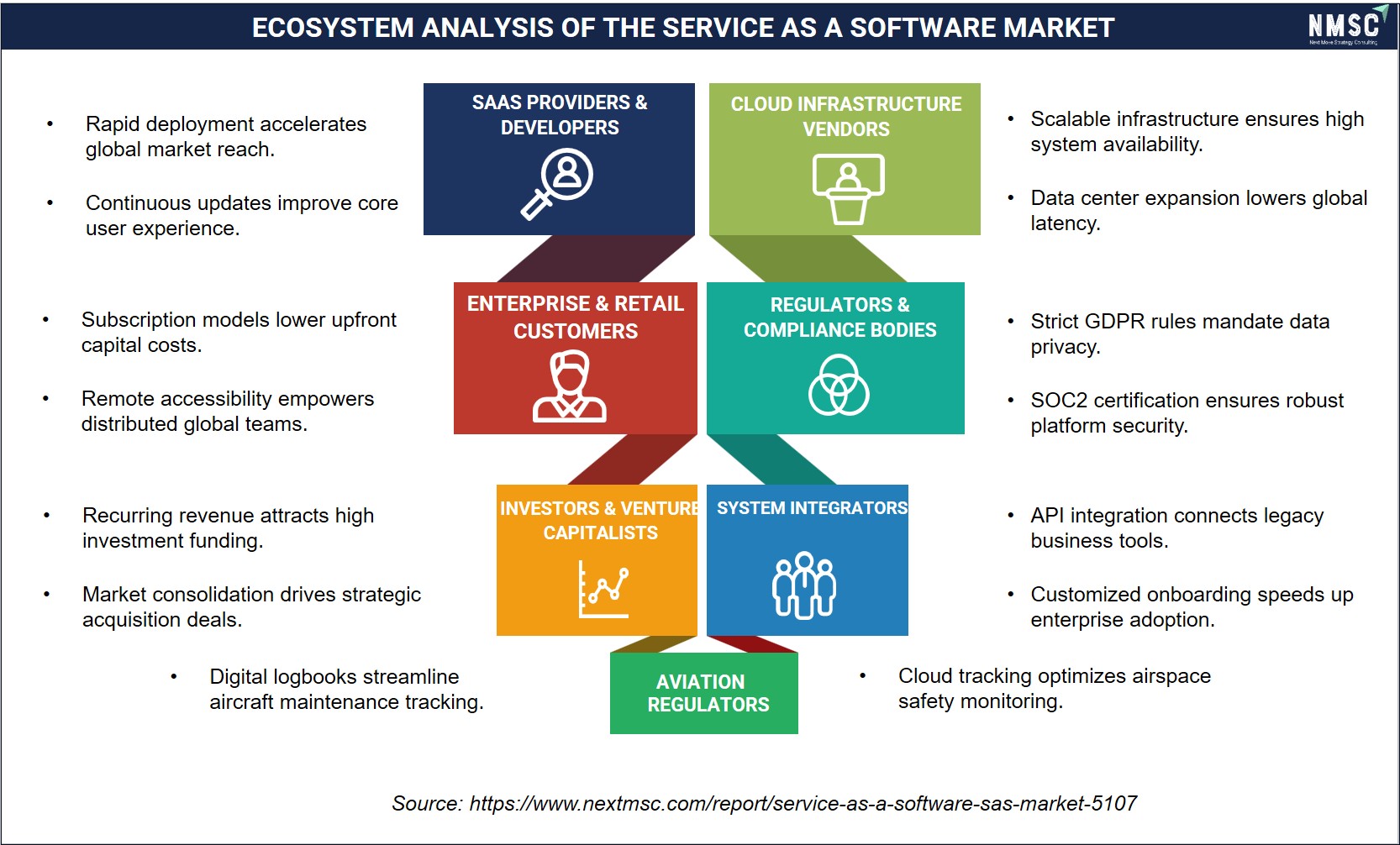
The Service-as-a-Software (SaS) market ecosystem is built on the collaboration of multiple stakeholders that drive innovation, adoption, and compliance. SaaSSaS providers develop cloud-based applications, while cloud infrastructure vendors supply the underlying computing resources. Enterprise and retail customers generate demand and influence product evolution. Regulators and compliance bodies ensure data security and regulatory adherence, while system integrators facilitate deployment and customization. Investors and venture capitalists provide funding for innovation and expansion, collectively supporting the growth, scalability, and long-term sustainability of the SaaSSaS market.
How Is the Service-as-a-Software (SaS) Market Segmented in This Report, and What Are the Key Insights from the Segmentation Analysis?
How Do Business Applications Define the Core of the Service-as-a-Software (SaS) Market?
|
Business Applications Segment |
2025 (USD Bn) |
2035 (USD Bn) |
CAGR (%) |
|
CRM |
58.7 |
189.4 |
12.5% |
|
ERP |
42.3 |
138.6 |
12.6% |
|
Human Capital Management |
28.6 |
94.8 |
12.7% |
|
Collaboration and Productivity |
35.8 |
118.4 |
12.7% |
|
Commerce Applications |
14.2 |
52.6 |
13.9% |
|
Industry Applications |
15.8 |
62.4 |
14.7% |
Based on our analysis of enterprise software adoption patterns, the Business Applications segment remains the largest revenue category in the Service-as-a-Software (SaS) Market, collectively representing USD 195.4 billion in 2025. CRM dominates due to widespread adoption of sales automation, customer service platforms, and marketing automation tools across enterprise and mid-market buyers. ERP is experiencing renewed growth driven by cloud migration of legacy SAP and Oracle on-premises systems. HCM adoption is expanding as organizations standardize HR, payroll, and talent management on unified cloud platforms. Industry Applications, spanning healthcare, financial services, retail, and manufacturing, represent the fastest-growing sub-category within Business Applications at 14.7% CAGR, driven by vertical-specific compliance, operational, and digital transformation requirements.
How Are Technology Platforms Reshaping the Infrastructure Layer of the Service-as-a-Software (SaS) Market?
|
Technology Platforms Segment |
2025 (USD Bn) |
2035 (USD Bn) |
CAGR (%) |
|
Application Platform (Low/No-Code, Workflow) |
18.4 |
64.2 |
13.3% |
|
Data Platform |
16.2 |
58.8 |
13.7% |
|
Analytics Platform |
12.8 |
44.6 |
13.3% |
|
Artificial Intelligence Platform |
9.8 |
58.4 |
22.8% |
Through NMSC's assessment, we found that Technology Platforms collectively contributed USD 57.2 billion to the Service-as-a-Software (SaS) Market in 2025, with the AI Platform sub-segment emerging as the highest-growth category at a CAGR of 22.8% through 2035. Low-code and no-code application platforms are democratizing enterprise software development, while Data Platforms including warehousing and lakehouse services are foundational to AI-driven SaS adoption. Analytics platforms continue to grow steadily as embedded analytics and decision intelligence capabilities become standard requirements within enterprise SaS applications. The Generative AI Platforms and AI Agents categories within the AI Platform segment are the primary revenue growth engines through the forecast horizon.
How Is the IT and Security Applications Segment Becoming a Strategic Priority Within the Service-as-a-Software (SaS) Market?
|
IT & Security Applications Segment |
2025 (USD Bn) |
2035 (USD Bn) |
CAGR (%) |
|
IT Service Management |
12.4 |
40.8 |
12.6% |
|
IT Operations Management & Observability |
8.6 |
29.4 |
13.0% |
|
DevOps Platforms |
6.4 |
22.6 |
13.5% |
|
Identity and Access Management |
8.8 |
32.6 |
13.9% |
|
Endpoint Security |
7.2 |
26.4 |
13.8% |
|
Cloud Security |
9.4 |
15.2% |
|
|
Security Operations |
6.8 |
26.8 |
14.7% |
Our analysis shows that IT and Security Applications collectively generated USD 75.4 billion in the Service-as-a-Software (SaS) Market in 2025, representing the second-largest solution type category. Identity and Access Management and Cloud Security are the fastest-growing sub-segments, driven by the proliferation of cloud workloads, zero-trust security architecture adoption, and expanding regulatory requirements for privileged access governance. ServiceNow dominates IT Service Management, while CrowdStrike and Okta lead their respective security and identity categories. Security Operations is emerging as a high-growth area as AI-powered threat detection and automated incident response capabilities create new SaS product categories.
How Are Other SaS Applications Contributing to the Breadth of the Service-as-a-Software (SaS) Market?
|
Other SaS Applications Segment |
2025 (USD Bn) |
2035 (USD Bn) |
CAGR (%) |
|
Document Management & Electronic Signature |
8.4 |
26.8 |
12.3% |
|
Project Management |
6.8 |
22.4 |
12.6% |
|
Knowledge Management |
5.2 |
18.6 |
13.6% |
|
Other Horizontal Applications |
7.4 |
26.2 |
13.5% |
Based on our market evaluation, we noticed that Other SaS Applications generated USD 27.8 billion in the Service-as-a-Software (SaS) Market in 2025, representing foundational horizontal tools that support knowledge work, compliance, and project delivery across enterprise and SMB customers. Document management and electronic signature applications, led by DocuSign, represent mature but steadily growing categories with expansion opportunities in AI-powered contract intelligence. Project management tools including Atlassian's Jira and Monday.com are evolving into work management platforms with AI-assisted prioritization and resource allocation capabilities. Knowledge management is one of the fastest-growing sub-categories driven by enterprise demand for AI-ready knowledge bases.
How Does Deployment Model Shape Revenue Distribution Across the Service-as-a-Software (SaS) Market?
|
Deployment Model |
2025 (USD Bn) |
2035 (USD Bn) |
CAGR (%) |
|
Public Cloud SaS |
265.8 |
898.6 |
13.0% |
|
Private Cloud SaS |
52.4 |
156.8 |
11.6% |
|
Sovereign Cloud SaS |
14.6 |
88.4 |
18.6% |
|
Hybrid SaS |
48.4 |
198.8 |
15.3% |
From our research, we found that Public Cloud SaS commands approximately 69.7% of the Service-as-a-Software (SaS) Market in 2025, reflecting the default deployment choice for the majority of enterprise and mid-market SaS buyers. Hybrid SaS, combining public and private cloud components, is the second-fastest-growing model at a CAGR of 15.3%, driven by enterprise requirements to integrate cloud SaS with on-premises data and legacy applications. Sovereign Cloud SaS is the fastest-growing deployment mode at 18.6% CAGR, as national data residency regulations in the EU, Saudi Arabia, India, and Southeast Asia create structural demand for jurisdiction-specific SaS deployments that cannot be fulfilled through standard public cloud configurations.
How Do Revenue Models Reflect the Commercial Evolution of the Service-as-a-Software (SaS) Market?
|
Revenue Model |
2025 (USD Bn) |
2035 (USD Bn) |
CAGR (%) |
|
Subscription Revenue |
248.8 |
762.4 |
11.8% |
|
Usage-Based Revenue |
62.4 |
316.8 |
17.9% |
|
Hybrid Revenue |
48.6 |
186.4 |
14.4% |
|
Support Revenue |
21.4 |
77.0 |
13.7% |
In our observation, Subscription Revenue remains the dominant revenue model in the Service-as-a-Software (SaS) Market at USD 248.8 billion in 2025, with User-Based and Tier-Based Pricing constituting the largest sub-categories. Usage-Based Revenue is the fastest-growing revenue model at a CAGR of 17.9% through 2035, driven by AI-powered SaS products, API platforms, and consumption-metered analytics services where workload volumes vary significantly across customers and deployment cycles. Hybrid Revenue models combining subscription and usage-based components are gaining adoption as enterprises seek cost structures that scale with value delivered rather than fixed commitments tied to licensed seat counts.
How Does Customer Type Influence Adoption Patterns in the Service-as-a-Software (SaS) Market?
|
Customer Type |
2025 (USD Bn) |
2035 (USD Bn) |
CAGR (%) |
|
Large Enterprise |
171.5 |
518.4 |
11.6% |
|
Mid-Market Enterprise |
96.4 |
312.6 |
12.5% |
|
Small Business |
62.8 |
256.4 |
15.2% |
|
Government Organizations |
28.4 |
148.5 |
18.0% |
|
Educational Institutions |
14.6 |
72.8 |
17.4% |
|
Nonprofit Organizations |
7.5 |
33.9 |
16.3% |
Based on our market evaluation, we noticed that Large Enterprise continues to dominate the Service-as-a-Software (SaS) Market at USD 171.5 billion in 2025, driven by large-scale multi-year enterprise license agreements and platform consolidation investments in ERP, CRM, and security software. Mid-Market Enterprise represents the most structurally competitive customer segment, as vendors compete aggressively on price, feature completeness, and implementation support. Small Business is the fastest-growing customer type at a CAGR of 15.2% from 2026 to 2035, enabled by self-service SaS products, freemium conversion models, and digital marketplace distribution. Government and Educational institution adoption is expanding rapidly through digital transformation mandates and cloud-first procurement policies.
Which Buyer Functions Are Driving Purchasing Decisions in the Service-as-a-Software (SaS) Market?
|
Buyer Function |
2025 (USD Bn) |
2035 (USD Bn) |
CAGR (%) |
|
Information Technology |
91.5 |
278.4 |
11.8% |
|
Finance |
46.8 |
148.6 |
12.3% |
|
Human Resources |
38.4 |
124.8 |
12.5% |
|
Sales |
42.6 |
134.2 |
12.1% |
|
Marketing |
34.8 |
114.6 |
12.6% |
|
Operations |
32.4 |
106.8 |
12.7% |
|
Security |
28.8 |
128.6 |
16.2% |
|
Procurement |
22.6 |
74.8 |
12.7% |
|
Executive Management |
42.3 |
231.8 |
18.5% |
NMSC's analysis indicates that the Information Technology buyer function holds the largest share at USD 91.5 billion in 2025, reflecting IT departments' role as the primary procurement authority for infrastructure, security, and platform SaS. Security is the fastest-growing buyer function at 16.2% CAGR, reflecting escalating enterprise cybersecurity investments. Executive Management is also a high-growth buyer segment as AI-powered business intelligence and decision intelligence SaS tools move purchasing authority toward C-suite buyers seeking strategic operational insights. Marketing and Sales functions collectively drive significant SaS investment in CRM, marketing automation, and revenue intelligence platforms across the Service-as-a-Software (SaS) Market.
Which Industry Verticals Generate the Most Value in the Service-as-a-Software (SaS) Market?
|
Industry Vertical |
2025 (USD Bn) |
2035 (USD Bn) |
CAGR (%) |
|
Banking and Financial Services |
57.2 |
188.4 |
12.7% |
|
Insurance |
24.8 |
82.4 |
12.8% |
|
Healthcare and Life Sciences |
34.6 |
168.5 |
16.4% |
|
Government and Public Sector |
28.4 |
97.6 |
13.2% |
|
Retail and E-Commerce |
38.6 |
128.4 |
12.8% |
|
Manufacturing |
32.4 |
108.6 |
12.8% |
|
Energy and Utilities |
18.6 |
62.4 |
12.8% |
|
Telecommunications |
22.4 |
74.8 |
12.8% |
|
Media and Entertainment |
14.8 |
48.6 |
12.6% |
|
Transportation and Logistics |
16.4 |
55.6 |
13.0% |
|
Education |
12.8 |
58.6 |
16.4% |
|
Professional Services |
24.6 |
84.8 |
13.2% |
|
Hospitality |
8.4 |
28.6 |
13.0% |
|
Real Estate |
7.2 |
24.6 |
13.0% |
|
Other Industries |
19.0 |
89.3 |
16.7% |
Based on our analysis of industry SaS adoption trends, Banking and Financial Services is the largest vertical in the Service-as-a-Software (SaS) Market at USD 57.2 billion in 2025, driven by digital banking transformation, regulatory compliance investments, fraud detection, and customer analytics. Healthcare and Life Sciences, alongside Education, are the fastest-growing verticals at 16.4% CAGR each, propelled by electronic health record modernization, clinical AI adoption, and the digitization of educational delivery models. Retail and E-Commerce remain a high-volume SaS consumption sector through commerce platform adoption, customer analytics, and omnichannel order management systems. Manufacturing SaS is expanding through IoT integration and operational technology digitization programs.
How Are Sales Channels Reshaping Go-to-Market Strategies in the Service-as-a-Software (SaS) Market?
|
Sales Channel |
2025 (USD Bn) |
2035 (USD Bn) |
CAGR (%) |
|
Direct Sales (Enterprise, Inside, Self-Service) |
190.6 |
568.4 |
11.5% |
|
Partner Sales (VARs, SIs, MSPs, Cloud Partners) |
128.4 |
412.6 |
12.4% |
|
Digital Marketplace |
62.2 |
361.6 |
17.5% |
Our findings suggest that Direct Sales remains the dominant channel in the Service-as-a-Software (SaS) Market at USD 190.6 billion in 2025, driven by large enterprise relationships, multi-year contract negotiations, and strategic account management programs. Partner Sales through value-added resellers, systems integrators, managed service providers, and cloud marketplace partners is the second-largest channel at USD 128.4 billion. Digital Marketplace is the fastest-growing channel at a CAGR of 17.5%, reflecting the rapid adoption of AWS, Azure, and Google Cloud marketplace procurement by enterprise and government buyers. The shift toward marketplace-transacted SaS is structurally compressing traditional channel intermediary margins while expanding overall market velocity.
How Does Organization Size Shape SaS Adoption Across the Service-as-a-Software (SaS) Market?
|
Organization Size |
2025 (USD Bn) |
2035 (USD Bn) |
CAGR (%) |
|
Micro Business |
18.6 |
92.4 |
17.4% |
|
Small Business |
44.2 |
196.8 |
16.1% |
|
Medium Business |
86.4 |
278.6 |
12.4% |
|
Large Enterprise |
171.5 |
518.4 |
11.6% |
|
Strategic Enterprise |
60.5 |
256.4 |
15.5% |
From our assessment, Large Enterprise remains the largest single revenue category by organization size in the Service-as-a-Software (SaS) Market, representing USD 171.5 billion in 2025. However, Micro Business and Small Business are the fastest-growing size segments at CAGRs of 17.4% and 16.1% respectively, driven by mobile-first SaS adoption, freemium-to-paid conversion models, and digital marketplace accessibility. Strategic Enterprise accounts, which include global Fortune 500 organizations, represent a distinct high-value segment at USD 60.5 billion in 2025 growing at 15.5% CAGR, as AI-powered enterprise SaS commands premium contract values and multi-year expansion motions.
Regional Outlook
Geographic Performance Snapshot
|
Region |
2025 (USD Bn) |
2035 (USD Bn) |
CAGR (%) |
Key Driver |
|
North America |
178.2 |
547.6 |
13.2% |
Enterprise SaS leadership, AI platform adoption |
|
Europe |
96.4 |
284.6 |
11.4% |
GDPR compliance SaS, digital transformation |
|
Asia-Pacific |
72.6 |
318.4 |
16.0% |
India SaS ecosystem, China digitization |
|
Middle East & Africa |
18.4 |
86.6 |
16.7% |
Vision 2030, GCC cloud investment |
|
Latin America |
15.6 |
105.4 |
21.0% |
Digital economy expansion, cloud adoption |
North America Service-as-a-Software (SaS) Market
North America is the global epicenter of the Service-as-a-Software (SaS) Market, accounting for USD 178.2 billion in 2025 and forecast to reach USD 547.6 billion by 2035 at a CAGR of 13.2%. The region benefits from the headquarters of all major SaS vendors including Microsoft, Salesforce, Oracle, ServiceNow, Workday, HubSpot, and Shopify, the deepest enterprise technology budgets globally, and the most mature cloud infrastructure ecosystem. Regulatory frameworks including CCPA, HIPAA, and sector-specific compliance mandates continue to drive specialized SaS adoption across healthcare, financial services, and government verticals throughout the forecast period.
United States Service-as-a-Software (SaS) Market
Based on our engagements with enterprise technology decision-makers, the United States represents approximately 83% of North American Service-as-a-Software (SaS) revenue and is the world's single largest national SaS market at USD 147.8 billion in 2025. The U.S. hosts the global headquarters of nearly all major SaS platform vendors, the highest concentration of Fortune 500 enterprise buyers, and the most active venture capital ecosystem for SaS product development. The U.S. Federal Cloud Strategy and FedRAMP marketplace have significantly expanded public sector SaS adoption. Industry adoption is broadest in financial services, healthcare, technology, and federal government verticals, with AI-native SaS platforms gaining rapid enterprise procurement momentum.
Canada Service-as-a-Software (SaS) Market
Through our analysis, Canada accounts for approximately 10% of North American Service-as-a-Software (SaS) revenue, representing a mature and sophisticated SaS buyer market. Canadian financial institutions, insurance companies, and retail organizations are among the most advanced enterprise SaS adopters globally, investing heavily in CRM, ERP, and analytics platforms. The Canadian government's Digital Ambition strategy and cloud-first procurement policies have accelerated public sector SaS adoption. Data sovereignty considerations around cross-border flows to U.S. cloud regions are driving adoption of Canada-based sovereign cloud deployments offered by AWS, Azure, and Google Cloud within the Service-as-a-Software (SaS) Market.
Mexico Service-as-a-Software (SaS) Market
According to our evaluation, Mexico is the fastest-growing market within North America in the Service-as-a-Software (SaS) Market, advancing at a CAGR of 18.4% from 2026 to 2035. Mexico's growing fintech ecosystem, manufacturing sector digitization driven by nearshoring investment, and government digital modernization programs are expanding enterprise SaS demand across CRM, ERP, and HR platforms. The Ley Federal de Protección de Datos Personales (LFPDPPP) is driving compliance SaS investment. Cloud hyperscalers AWS, Google Cloud, and Microsoft Azure have expanded Mexican cloud region capacity, improving SaS platform latency and enabling data residency for local enterprise and government buyers.
Europe Service-as-a-Software (SaS) Market
Europe is the second-largest region in the Service-as-a-Software (SaS) Market, contributing USD 96.4 billion in 2025 and forecast to reach USD 284.6 billion by 2035 at a CAGR of 11.4%. Europe's regulatory environment, dominated by GDPR, the EU AI Act, the Digital Markets Act, and sector-specific directives for financial services and healthcare, is simultaneously a growth catalyst for compliance-driven SaS and a complexity factor for U.S.-headquartered vendors requiring European data residency infrastructure. Western Europe leads regional adoption, while Central and Eastern Europe represent faster-growing markets driven by digitization investment and EU structural funding.
United Kingdom Service-as-a-Software (SaS) Market
Based on our engagements, the United Kingdom is Europe's largest individual Service-as-a-Software (SaS) market, representing approximately 23% of European revenue in 2025. Post-Brexit, the UK maintains GDPR-equivalent standards through UK GDPR while developing a more innovation-friendly AI regulatory framework. The Financial Conduct Authority's Open Finance and Open Banking initiatives drive financial services SaS adoption. London's concentration of global financial institutions, professional services firms, and technology companies creates one of the world's most competitive SaS demand environments, with security, fintech, and HR SaS platforms registering particularly strong growth across the UK Service-as-a-Software (SaS) Market.
Germany Service-as-a-Software (SaS) Market
Through our analysis, Germany is the second-largest European Service-as-a-Software (SaS) market, driven by its world-class manufacturing sector's rapid digitization and a large concentration of Mittelstand companies investing in ERP, HCM, and supply chain SaS platforms. German enterprises are among the most stringent data privacy buyers globally, demanding GDPR-compliant deployments and sovereign cloud options. SAP, headquartered in Walldorf, enjoys a strong home market advantage in ERP and analytics SaS. The Federal Office for Information Security (BSI) cloud security certification framework shapes enterprise procurement requirements for the German Service-as-a-Software (SaS) Market, creating compliance-driven evaluation cycles.
France Service-as-a-Software (SaS) Market
From our assessment, France is the third-largest European Service-as-a-Software (SaS) market, distinguished by significant public sector digital transformation investments funded through the France 2030 plan and strong national AI strategy commitments. The CNIL is among Europe's most active GDPR enforcement bodies, creating compliance-driven demand for privacy-engineered SaS platforms. French enterprises demonstrate a preference for EU-controlled cloud infrastructure, benefiting OVHcloud and other European SaS providers. Financial services, government, retail, and manufacturing verticals are the largest SaS buyers within the France market throughout the forecast period.
Italy Service-as-a-Software (SaS) Market
Based on our engagements, Italy is a mid-tier European Service-as-a-Software (SaS) market experiencing accelerating cloud adoption driven by the Piano Nazionale di Ripresa e Resilienza (PNRR) recovery fund investments. Public sector cloud migration, manufacturing ERP modernization, and financial services CRM adoption are the primary SaS demand drivers. The Garante data protection authority enforces GDPR actively, compelling SaS vendors to maintain Italian data residency options. Italy's Polo Strategico Nazionale (PSN) sovereign cloud program provides a structured pathway for public sector SaS procurement within the Italian Market.
Spain Service-as-a-Software (SaS) Market
According to our evaluation, Spain demonstrates growing momentum in the Market, driven by a dynamic financial sector, retail expansion, and government digital transformation under the Agenda España Digital 2026 program. Spanish banks including BBVA and Santander are sophisticated SaS buyers for CRM, analytics, and cybersecurity platforms. The Agencia Española de Protección de Datos (AEPD) actively enforces GDPR, compelling investment in compliance SaS. AWS, Google Cloud, and Microsoft Azure operate Spanish cloud regions supporting enterprise data residency requirements across financial services, retail, and public sector SaS buyers.
Sweden Service-as-a-Software (SaS) Market
Through our analysis, Sweden is one of the most advanced SaS adoption markets per capita in Europe, reflecting the country's high digital literacy, strong technology sector, and Scandinavian enterprise culture of technology-forward operations. Swedish enterprises across financial services, manufacturing, and retail are sophisticated SaS adopters. The Swedish Data Protection Authority (IMY) enforces GDPR rigorously. Stockholm's vibrant SaS startup ecosystem, including Spotify, Klarna, and numerous B2B SaS vendors, contributes both demand-side adoption and supply-side vendor development to the Nordic Market.
Denmark Service-as-a-Software (SaS) Market
Based on our market evaluation, Denmark maintains one of the highest cloud adoption rates among EU member states, supported by the government's Digital Denmark strategy and robust national digital infrastructure. Danish public sector organizations are leaders in SaS-delivered citizen services, particularly in health records, tax administration, and social services. The Danish Data Protection Agency actively enforces GDPR. Financial services, logistics, and professional services are the largest private sector SaS buyers within the Denmark Market, with HR and collaboration SaS platforms recording particularly strong adoption across mid-market enterprises.
Finland Service-as-a-Software (SaS) Market
From our assessment, Finland has a mature and technology-forward Service-as-a-Software (SaS) Market supported by a strong national digital infrastructure, high enterprise technology literacy, and government support for cloud adoption through the national cloud strategy. Nokia, Kone, and Wärtsilä represent sophisticated enterprise SaS buyers for operational, HR, and supply chain platforms. The Finnish Data Protection Ombudsman enforces GDPR. Finland's strategic position in cross-border Nordic and Baltic enterprise operations supports demand for multi-jurisdiction SaS platforms with strong data residency and compliance capabilities.
Netherlands Service-as-a-Software (SaS) Market
According to our evaluation, the Netherlands is a significant European Service-as-a-Software (SaS) hub, serving both as a large domestic market and as a European headquarters location for major global SaS vendors. Amsterdam hosts major cloud data center infrastructure for AWS, Microsoft Azure, and Google Cloud, making the Netherlands a natural SaS deployment hub for pan-European operations. The Autoriteit Persoonsgegevens actively enforces GDPR. Financial services, logistics, and agriculture technology verticals drive significant SaS adoption. Dutch enterprises are among Europe's most advanced adopters of ERP, analytics, and supply chain SaS platforms.
Rest of Europe Service-as-a-Software (SaS) Market
Through our analysis, the Rest of Europe, encompassing Belgium, Switzerland, Austria, Poland, Czech Republic, Romania, Hungary, Portugal, Greece, and Baltic and Balkan nations, represents a growing but structurally diverse segment of the Service-as-a-Software (SaS) Market. Central European markets including Poland and Czech Republic are among the fastest-growing in the region, driven by EU structural fund investments, a growing technology services sector, and increasing mid-market SaS adoption. Switzerland represents a premium-tier market with strong demand for compliance and financial services SaS, while Eastern European markets are at earlier adoption stages with high growth potential.
Asia Pacific Service-as-a-Software (SaS) Market
Asia Pacific is the fastest-growing major region in the Service-as-a-Software (SaS) Market at a CAGR of 16.0% from 2026 to 2035, advancing from USD 72.6 billion in 2025 to USD 318.4 billion by 2035. The region's growth is powered by India's rapidly expanding SaS product ecosystem, China's enterprise digitization programs, Japan's corporate modernization wave, and Southeast Asia's rapidly digitalizing economies. Diverse regulatory frameworks across the region, from Australia's Privacy Act to China's PIPL, require SaS vendors to maintain localized data residency options while supporting multi-country enterprise deployments.
China Service-as-a-Software (SaS) Market
Based on our engagements, China represents the largest single Service-as-a-Software (SaS) market in Asia Pacific, driven by a massive enterprise digitization wave across manufacturing, retail, financial services, and government sectors. The Personal Information Protection Law (PIPL) and Data Security Law impose strict data localization requirements, creating a domestic SaS ecosystem centered on Alibaba Cloud, Tencent Cloud, and Huawei Cloud as the primary platform layers. Foreign SaS vendors face regulatory barriers, compelling localization through joint ventures. China's enterprise SaS market is characterized by intense domestic competition and government-driven industrial digitization programs.
Japan Service-as-a-Software (SaS) Market
Through our analysis, Japan is the second-largest Asia Pacific Service-as-a-Software (SaS) market, characterized by significant enterprise ERP, HR, and productivity platform modernization. Japanese corporations are replacing legacy on-premises systems, including traditional mainframe-era ERP, with cloud SaS equivalents at an accelerating rate under government-backed DX (Digital Transformation) promotion programs. The Act on the Protection of Personal Information (APPI), overseen by the Personal Information Protection Commission (PPC), governs SaS data handling. Microsoft, SAP, Salesforce, and ServiceNow hold strong positions within Japan's Market.
India Service-as-a-Software (SaS) Market
According to our evaluation, India is the fastest-growing national Service-as-a-Software (SaS) market in Asia Pacific at a CAGR of 19.6%, driven by the country's extraordinary domestic SaS product ecosystem, government-led digital infrastructure investments, and a rapidly expanding enterprise technology buyer base. India-headquartered SaS vendors including Freshworks, Zoho, Chargebee, and Razorpay serve both domestic and global markets. The Digital Personal Data Protection Act (DPDPA), administered through the Ministry of Electronics and Information Technology (MeitY), is driving compliance SaS adoption. India's large English-speaking technology talent pool and competitive SaS product costs position it as both a major consumer and producer within the global Market.
Australia and New Zealand Service-as-a-Software (SaS) Market
Based on our engagements, Australia and New Zealand collectively represent a mature and sophisticated Service-as-a-Software (SaS) market within Asia Pacific. Australian enterprises in financial services, healthcare, and government are among the most advanced SaS adopters in the region. The Office of the Australian Information Commissioner (OAIC) enforces the Privacy Act, and the Consumer Data Right (CDR) framework managed by the ACCC creates structured demand for financial and energy data SaS platforms. New Zealand's Digital Government Partnership and cybersecurity strategy align with SaS procurement for public services. Microsoft, SAP, Salesforce, and ServiceNow hold leading market positions.
Southeast Asia Service-as-a-Software (SaS) Market
Through our analysis, Southeast Asia represents one of the fastest-growing sub-regional markets in the Service-as-a-Software (SaS) Market, driven by rapid digital economy expansion across Singapore, Indonesia, Thailand, Vietnam, Malaysia, and the Philippines. Singapore serves as the regional SaS headquarters hub for major global vendors. Indonesia's large enterprise digitization market and Vietnam's manufacturing digitization wave are driving significant SaS demand. The Monetary Authority of Singapore and other national regulators are establishing data governance frameworks that influence SaS deployment and data residency requirements across the sub-region.
Rest of Asia Pacific Service-as-a-Software (SaS) Market
From our assessment, the Rest of Asia Pacific including South Korea, Taiwan, Hong Kong, Bangladesh, Sri Lanka, Pakistan, and Pacific Island nations represents a growing and diverse segment of the Service-as-a-Software (SaS) Market. South Korea is a sophisticated SaS buyer market with strong adoption in manufacturing ERP, financial services CRM, and government digitization. Taiwan's semiconductor and electronics manufacturing sector drives demand for supply chain and operational SaS. Hong Kong serves as a financial hub with strong SaS demand in financial services and professional services verticals. These markets collectively contribute to Asia Pacific's status as the fastest-growing SaS region globally.
Latin America Service-as-a-Software (SaS) Market
Latin America is the fastest-growing region in the Service-as-a-Software (SaS) Market at a CAGR of 21.0% from 2026 to 2035, advancing from USD 15.6 billion in 2025 to USD 105.4 billion by 2035. Brazil and Mexico collectively account for approximately 68% of regional SaS revenue. Hyperscaler investment in regional data center infrastructure, evolving data protection legislation, and a rapidly growing digital economy across fintech, e-commerce, and retail sectors are primary growth drivers. The region represents a structurally underpenetrated SaS market with significant expansion potential across mid-market and SMB customer segments.
Brazil Service-as-a-Software (SaS) Market
Based on our engagements, Brazil is the largest Service-as-a-Software (SaS) market in Latin America, representing approximately 42% of regional revenue in 2025. Brazil's Lei Geral de Proteção de Dados (LGPD), enforced by the Autoridade Nacional de Proteção de Dados (ANPD), aligns with GDPR standards and drives enterprise investment in compliance SaS. Nubank, Itaú Unibanco, Mercado Libre, and major Brazilian telecoms are significant SaS buyers. The Pix instant payment infrastructure is generating demand for real-time analytics SaS. AWS, Microsoft Azure, and Google Cloud operate São Paulo cloud regions enabling data residency for the Brazil Market.
Mexico Service-as-a-Software (SaS) Market
Through our analysis, Mexico is the second-largest Latin America Service-as-a-Software (SaS) market, advancing at a CAGR of 18.4% driven by manufacturing digitization, fintech expansion, and nearshoring-driven corporate investment in enterprise SaS platforms. The LFPDPPP data protection law drives compliance SaS adoption. Mexico City's growing technology and financial services sector represents a concentrated enterprise SaS demand cluster. Manufacturing companies benefiting from automotive and electronics industry nearshoring are adopting ERP, supply chain, and operational SaS platforms at accelerating rates within the Mexico Market.
Rest of Latin America Service-as-a-Software (SaS) Market
According to our evaluation, the Rest of Latin America including Argentina, Chile, Colombia, Peru, Ecuador, Costa Rica, and Caribbean nations collectively represents a growing component of the Service-as-a-Software (SaS) Market. Argentina has a strong technology talent concentration and a growing SaS startup ecosystem, with financial services and professional services as primary demand verticals. Chile leads the Andean sub-region in SaS adoption with high cloud penetration per capita. Colombia is emerging as a regional technology hub with expanding fintech and government SaS adoption. Each country is developing data protection frameworks aligned with international standards, supporting enterprise SaS procurement growth.
Middle East and Africa Service-as-a-Software (SaS) Market
The Middle East and Africa (MEA) is a high-growth region within the Service-as-a-Software (SaS) Market, advancing from USD 18.4 billion in 2025 to USD 86.6 billion by 2035 at a CAGR of 16.7%. The GCC countries, particularly Saudi Arabia and the UAE, are leading regional SaS adoption through national Vision programs, sovereign cloud investments, and government digitization mandates. Sub-Saharan Africa represents an earlier-stage but rapidly growing SaS market driven by mobile-first enterprise technology adoption and fintech digitization. Turkey and Israel are significant SaS technology hubs within the broader MEA region.
Gulf Cooperation Council Service-as-a-Software (SaS) Market
Based on our engagements, the Gulf Cooperation Council (GCC) represents the largest and most advanced SaS market in the MEA region, with Saudi Arabia and the UAE collectively accounting for approximately 65% of GCC SaS revenue. Saudi Arabia's Vision 2030 digital transformation program and the Saudi Authority for Data and Artificial Intelligence (SDAIA) are driving significant government and private sector SaS adoption. The UAE's Smart Dubai initiative and Abu Dhabi Digital Authority cloud-first policies have created structured demand for government SaS platforms. Both Saudi Arabia and UAE operate local cloud regions from AWS, Microsoft Azure, and Google Cloud, enabling sovereign SaS deployments.
South Africa Service-as-a-Software (SaS) Market
Through our analysis, South Africa is the most mature SaS market in Sub-Saharan Africa, driven by Johannesburg's concentration of financial services, mining, retail, and professional services organizations. The Protection of Personal Information Act (POPIA), enforced by the Information Regulator since 2021, creates compliance SaS demand across financial institutions, healthcare, and retail sectors. Standard Bank, FirstRand, Nedbank, and Shoprite are significant enterprise SaS buyers. The Presidential Commission on the Fourth Industrial Revolution (PC4IR) provides policy frameworks supporting SaS adoption. Microsoft Azure, Amazon Web Services, and Google Cloud operate South African cloud regions.
Rest of Middle East and Africa Service-as-a-Software (SaS) Market
According to our evaluation, the Rest of Middle East and Africa, encompassing Turkey, Israel, Egypt, Nigeria, Kenya, Morocco, Ghana, Ethiopia, and other nations, collectively represents a growing segment of the Service-as-a-Software (SaS) Market. Israel is a significant SaS technology innovation hub with a high concentration of cybersecurity and enterprise software vendors. Turkey's large manufacturing and financial services sector drives SaS demand. Kenya leads East African digital adoption with mobile-first enterprise SaS usage. Nigeria's large financial services and telecoms sectors are the primary SaS buyers in West Africa, with cloud adoption accelerating through hyperscaler regional expansion.
Competitive Landscape
Competitive Dynamics and M&A Landscape
|
Key Takeaways |
Details |
|
Market Structure |
The Service-as-a-Software (SaS) Market features multi-tiered competition among mega-platform vendors (Microsoft, Salesforce, SAP, Oracle), category leaders in functional domains (ServiceNow for IT, Workday for HCM, Shopify for commerce), security specialists (CrowdStrike, Okta), and AI-native challengers, each competing on distinct platform depth, integration breadth, and AI capability. |
|
Innovation Focus |
Innovation in the Service-as-a-Software (SaS) Market is concentrated in AI agent platforms, generative AI embedded within core business applications, low-code application development, usage-based monetization models, and sovereign cloud deployment capabilities that meet national data residency requirements across Europe, the Middle East, and Asia Pacific. |
|
M&A Activity |
Consolidation across the Service-as-a-Software (SaS) Market is accelerating, with strategic acquisitions targeting AI platform capabilities, vertical SaS specialists, and cybersecurity tools. Adobe's proposed acquisition of Figma, Salesforce's prior acquisition of Slack, and ongoing platform consolidation reflect the strategy of building comprehensive, AI-powered SaS suites to compete against horizontal mega-vendors. |
How Do Companies Compete in the Service-as-a-Software (SaS) Market?
The Service-as-a-Software (SaS) Market is characterized by multi-layered competition that spans platform breadth, vertical depth, AI capability, and pricing model innovation. Mega-platform vendors including Microsoft, Salesforce, SAP, Oracle, and ServiceNow compete on the comprehensiveness of their application suites, integration ecosystems, and AI embedding depth. Category specialists such as Workday, HubSpot, Shopify, and Atlassian differentiate through purpose-built functionality, domain expertise, and superior user experience within their respective market niches. Security SaS vendors including CrowdStrike, Okta, and Datadog compete on threat intelligence data breadth, detection accuracy, and zero-trust architecture alignment across enterprise deployments.
Which Kind of Companies Dominate the Service-as-a-Software (SaS) Market?
Three distinct categories of companies dominate the Service-as-a-Software (SaS) Market. First, mega-platform vendors including Microsoft Corporation (Microsoft 365, Dynamics 365, Azure), Salesforce (Sales Cloud, Service Cloud, Agentforce), SAP SE (S/4HANA Cloud, SuccessFactors), and Oracle Corporation (Fusion Cloud ERP, NetSuite) leverage comprehensive application suites and deep integration ecosystems to serve the full enterprise software stack. Second, category leaders including ServiceNow, Workday, Shopify, Atlassian, Snowflake, and HubSpot deliver market-leading products in specific functional domains with high net revenue retention. Third, AI-native specialists including Datadog, CrowdStrike, and Okta compete on next-generation platform capabilities across security and observability.
AI-Native Differentiation and Open Standards Drive Market Success in the Service-as-a-Software (SaS) Market
Innovation across the Service-as-a-Software (SaS) Market is concentrated in three structural themes. The first is AI-native platform architecture, in which generative AI, autonomous agents, and machine learning are embedded within core application workflows rather than added as separate modules. Salesforce's Agentforce, Microsoft Copilot for Microsoft 365, and ServiceNow's Now Assist represent this direction. The second theme is platform extensibility through low-code and API-first architecture, enabling partner ecosystems and customer developers to extend SaS platforms. The third theme is pricing model innovation, particularly the shift to usage-based and outcome-based models that align SaS costs with delivered business value and improve net revenue retention across enterprise accounts.
Market Players to Opt for Merger and Acquisition Strategies to Expand Their Presence in the Service-as-a-Software (SaS) Market
Mergers and acquisitions are reshaping the competitive map of the Service-as-a-Software (SaS) Market as platform vendors seek to acquire AI capabilities, vertical SaS depth, and cybersecurity tooling. Salesforce's acquisition of Slack and Tableau, ServiceNow's acquisition of AI startups to accelerate Agentforce, and Intuit's acquisition of Mailchimp illustrate the strategy of building comprehensive, AI-enriched SaS platforms through M&A. Private equity firms including Vista Equity Partners, Thoma Bravo, and Francisco Partners have historically been active acquirers of enterprise SaS companies, and continued consolidation around vertical SaS specialists, compliance tools, and AI-native applications is expected across the forecast period.
Who Are the Key Market Players in the Service-as-a-Software (SaS) Market?
-
Microsoft Corporation
-
Salesforce, Inc.
-
SAP SE
-
Oracle Corporation
-
Adobe Inc.
-
ServiceNow, Inc.
-
Intuit Inc.
-
Workday, Inc.
-
Shopify Inc.
-
Atlassian Corporation
-
Snowflake Inc.
-
Zoom CommunicationsVideo Communications, Inc.
-
Datadog, Inc.
-
CrowdStrike Holdings, Inc.
-
HubSpot, Inc.
-
Okta, Inc.
-
Autodesk, Inc.
-
DocuSign, Inc.
-
Zendesk, Inc.
-
Freshworks Inc.
What Are the Latest Developments in the Service-as-a-Software (SaS) Industry?
|
Date |
Event |
|
May 2026 |
Microsoft introduced a redesigned Microsoft 365 Copilot experience focused on AI agents and workflow automation across Microsoft's SaS productivity suite. |
|
Nov 2025 |
Salesforce completed the acquisition of Informatica to strengthen its AI CRM, Data Cloud, and Agentforce SaS ecosystem with enterprise data governance and management capabilities. This enhances Salesforce's SaS platform for autonomous AI agents. |
|
Nov 2025 |
ServiceNow expanded its strategic partnership with NTT DATA to deploy AI-powered workflow automation and enterprise SaS solutions globally using the ServiceNow AI Platform. |
|
Jan 2025 |
ServiceNow expanded its partnership with Google Cloud, making ServiceNow SaS applications available through Google Cloud Marketplace and integrating Google AI capabilities. |
Expert Insights

“ServiceNow is igniting a new era of enterprise transformation with the ServiceNow AI Platform. We're unleashing the full power of AI, across any industry, any agent, any workflow, For decades, CEOs have wanted technology to accelerate the speed of business transformation. With this next generation architecture, we finally have the foundation to run the integrated enterprise in real time. We are the only ones who can orchestrate AI, data, and workflows on a single platform. Now is the moment to unlock tomorrow's opportunities with ServiceNow as the AI operating system of the 21st century.”
— Bill McDermott, Chairman and CEO, ServiceNow
Statement made during ServiceNow's announcement of its next-generation AI Platform at Knowledge 2025, discussing the role of AI, data, and workflow orchestration in transforming enterprise operations.
Market Interpretation
The comment highlights a major development within the Service-as-a-Software market, where enterprises are increasingly adopting AI-driven platforms that integrate data, workflows, and autonomous agents into a unified operating environment. As organizations seek faster business transformation and real-time decision-making capabilities, demand is growing for platforms capable of orchestrating services rather than merely providing software tools. This shift supports the evolution from traditional SaaS models toward Service-as-a-Software architectures that automate and execute business outcomes at scale.
What Are the Investment Opportunities in the Service-as-a-Software (SaS) Market?
Capital Inflows and Venture Activity
The Service-as-a-Software (SaS) Market continues to attract substantial institutional and private capital, reflecting investor confidence in durable subscription revenue models and AI-driven product expansion. SaS-focused venture capital deployment has remained elevated through 2024–2025 despite macro-economic tightening, with AI-native SaS startups commanding premium valuations. The National Venture Capital Association (NVCA) documented that AI-related software investment, the majority of which is SaS-delivered, represented over 30% of total U.S. venture capital deployment in recent years. Vertical SaS, AI agent platforms, cybersecurity SaS, and healthcare SaS sub-sectors are attracting the highest concentration of growth equity and early-stage venture investment within the broader Market.
Infrastructure Investment
Hyperscaler infrastructure investment is a foundational enabler of Service-as-a-Software (SaS) Market growth, as cloud data center expansion directly increases capacity available for SaS platform delivery and reduces per-unit compute costs. Microsoft announced plans to invest USD 80 billion in AI-optimized data centers in FY2025, with the majority supporting Azure cloud services. Google parent Alphabet committed USD 75 billion in 2025 capital expenditure directed primarily at cloud and AI infrastructure. Our findings suggest that these capital programs expand global SaS delivery capacity, improve regional latency for sovereign cloud deployments, and lower the infrastructure cost base for consumption-priced SaS platforms in every major geographic market.
ESG and Sustainable SaS Infrastructure
Environmental, Social, and Governance considerations are increasingly influencing enterprise SaS procurement and institutional investment in the Service-as-a-Software (SaS) Market. Data center energy consumption is a growing regulatory focus under the EU Energy Efficiency Directive and U.S. Executive Order 14057 on federal sustainability. Microsoft aims to achieve carbon negativity by 2030, and Google has maintained carbon neutrality since 2007. SaS vendors demonstrating energy-efficient cloud architectures, serverless compute models, and verified renewable energy consumption are gaining preference in enterprise procurement evaluations with embedded ESG scoring criteria. ESG data and reporting SaS platforms themselves represent one of the fastest-growing vertical application categories.
Digital Transformation Enablement
SaS platforms serve as the software foundation for enterprise digital transformation programs, making them structurally integral to multi-year IT investment cycles across every major industry. Organizations undergoing ERP cloud migrations, CRM modernizations, cybersecurity platform consolidations, and HR system standardizations require SaS platforms as the delivery layer for transformation program outcomes. The NIST Digital Transformation Framework and the European Commission's Industry 5.0 initiative both explicitly reference cloud software adoption as a prerequisite for next-generation enterprise competitiveness. Our assessment indicates that this structural integration of SaS into multi-year transformation programs creates durable, contracted, and expanding revenue streams throughout the 2025–2035 forecast period.
Private Equity and Strategic M&A Activity
Private equity firms are deploying significant capital across the Service-as-a-Software (SaS) Market, targeting mid-market SaS vendors, vertical specialists, and cybersecurity tools. Vista Equity Partners, Thoma Bravo, and Francisco Partners have been the most active SaS-focused PE acquirers historically. Strategic M&A is accelerating as platform vendors acquire AI capabilities, vertical SaS depth, and compliance tooling. Our assessment indicates that investors should monitor consolidation activity around AI agent platform vendors, healthcare SaS specialists, education technology providers, and governance and compliance SaS as structurally attractive acquisition targets across the 2025–2028 near-term investment horizon within the Market.
Key Benefits for Stakeholders
For Enterprise Buyers
Enterprise buyers gain comprehensive, vendor-neutral intelligence on the Service-as-a-Software (SaS) Market, including quantitative sizing across all solution types, deployment models, revenue models, buyer functions, and industry verticals for the 2025–2035 forecast period. This intelligence supports SaS vendor evaluation, portfolio rationalization, procurement negotiation, and multi-year technology investment roadmaps. The competitive landscape analysis enables procurement teams to benchmark vendor AI roadmaps, pricing models, and strategic positioning, supporting build-versus-buy decisions and platform consolidation strategies with analytical rigor.
For Investors and Financial Analysts
Investors and financial analysts access a structured, data-rich assessment of the Service-as-a-Software (SaS) Market's growth trajectory, competitive dynamics, M&A pipeline, and segment-level revenue forecasts through 2035. The CAGR analysis by segment, region, customer type, and deployment model enables precise portfolio construction, valuation modeling, and sector rotation decisions. Detailed coverage of all 20 leading SaS companies combined with the latest development tracking provides an early-signal framework for identifying acquisition targets, emerging platform leaders, and at-risk incumbents within the global Market.
For SaS Vendors and Platform Providers
SaS vendors and platform providers gain actionable intelligence on white-space opportunities, competitive positioning gaps, and the fastest-growing subsegments in the Service-as-a-Software (SaS) Market. Solution type analysis reveals underserved areas in AI Platforms, Sovereign Cloud SaS, and Vertical Industry Applications. Regional outlook sections identify geographic expansion priorities with regulatory context and technology adoption stage assessments. Buyer function and customer type analysis enables vendors to refine go-to-market strategies, optimize pricing models, and prioritize channel investment between direct enterprise sales, partner ecosystems, and digital marketplace distribution.
For Government and Regulatory Bodies
Government agencies and regulatory bodies gain structured analysis of how national data governance frameworks — including GDPR, CCPA, India's DPDPA, Saudi Arabia's PDPL, and equivalent regulations — are influencing the Service-as-a-Software (SaS) Market's structure and competitive dynamics. Country-level insights provide policymakers with evidence-based perspectives on how regulatory design choices affect enterprise SaS adoption, cloud investment attraction, and digital economy competitiveness. The sovereign cloud deployment analysis offers direct relevance to national cloud infrastructure strategy formulation and public sector SaS procurement policy development.
Porter's Five Forces Analysis of the Service-as-a-Software (SaS) Market
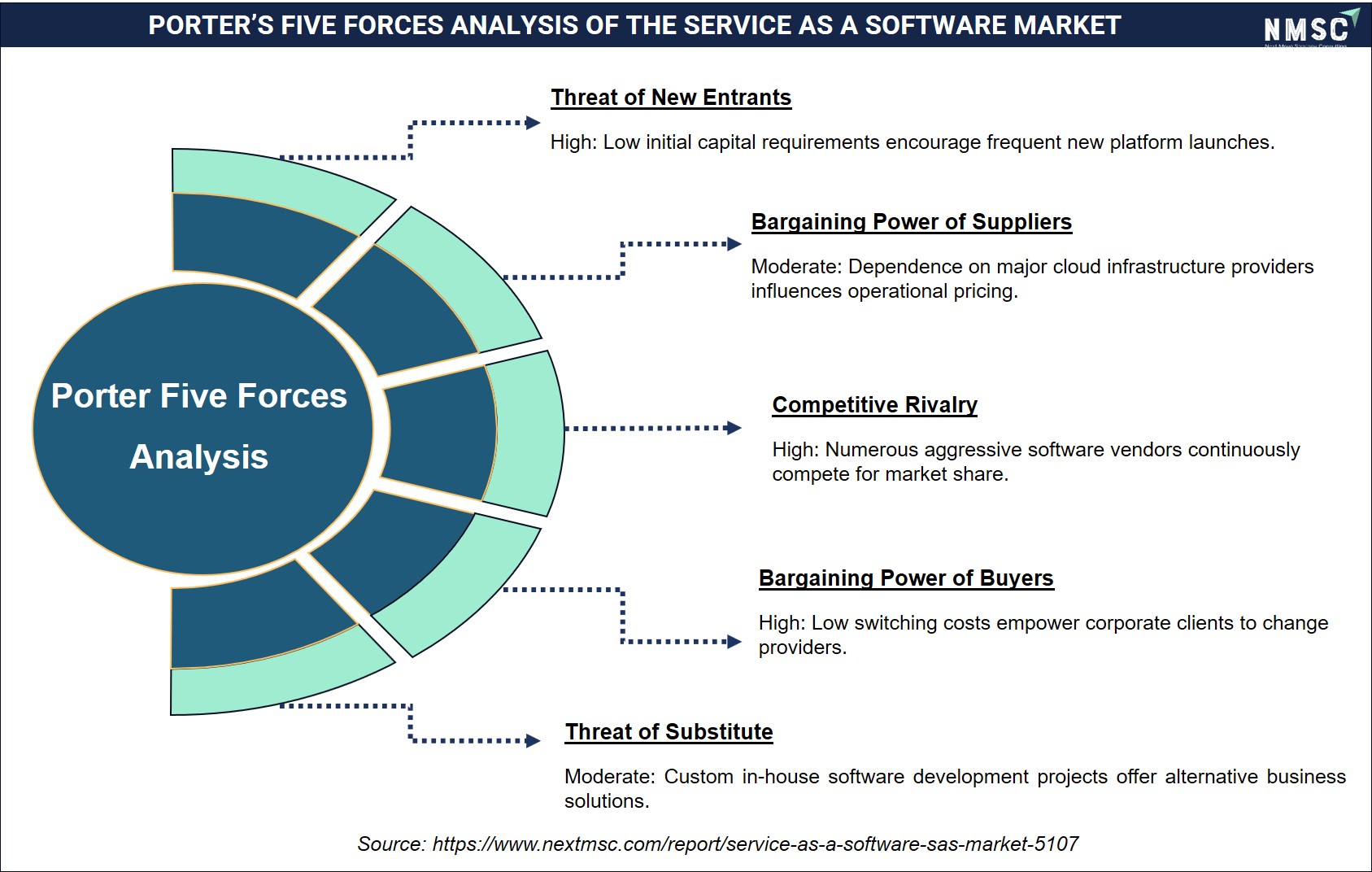
Porter's Five Forces analysis indicates that the SaaSSaS market is characterized by intense competitive rivalry driven by a large number of vendors and continuous innovation. The threat of new entrants remains moderate due to relatively low development barriers, although scaling and customer acquisition require significant investment. Buyer bargaining power is high as customers can easily compare solutions and switch providers. Supplier power is moderate, influenced by dependence on cloud infrastructure providers. Meanwhile, the threat of substitutes is growing with the emergence of AI-driven platforms and alternative software delivery models, encouraging SaaSSaS vendors to continuously enhance value and differentiation.
Key Market Segments
By SaS Solution Type
-
Business Applications
-
Customer Relationship Management
-
Sales Automation
-
Customer Service
-
Marketing Automation
-
Partner Relationship Management
-
-
Enterprise Resource Planning
-
Finance
-
Procurement
-
Supply Chain
-
Manufacturing Operations
-
-
Human Capital Management
-
Core HR
-
Payroll
-
Talent Management
-
Workforce Planning
-
-
Collaboration and Productivity
-
Unified Communications
-
Video Collaboration
-
Content Collaboration
-
Workplace Productivity
-
-
Commerce Applications
-
Digital Commerce
-
Marketplace Management
-
Subscription Commerce
-
-
Industry Applications
-
Healthcare Applications
-
Financial Services Applications
-
Retail Applications
-
Manufacturing Applications
-
Government Applications
-
Education Applications
-
Other Industry Applications
-
-
-
Technology Platforms
-
Application Platform
-
Low-Code Platforms
-
No-Code Platforms
-
Workflow Platforms
-
-
Data Platform
-
Data Warehousing
-
Data Lakehouse
-
Data Integration
-
Data Governance
-
-
Analytics Platform
-
Business Intelligence
-
Embedded Analytics
-
Decision Intelligence
-
-
Artificial Intelligence Platform
-
Generative AI Platforms
-
AI Agents
-
Machine Learning Platforms
-
Model Operations
-
-
-
IT and Security Applications
-
IT Service Management
-
IT Operations Management
-
Observability
-
DevOps Platforms
-
Identity and Access Management
-
Endpoint Security
-
Cloud Security
-
Security Operations
-
-
Other SaS Applications
-
Document Management
-
Electronic Signature
-
Project Management
-
Knowledge Management
-
Other Horizontal Applications
-
By Deployment Model
-
Public Cloud SaS
-
Private Cloud SaS
-
Sovereign Cloud SaS
-
Hybrid SaS
By Revenue Model
-
Subscription Revenue
-
User-Based Pricing
-
Tier-Based Pricing
-
Enterprise License Subscription
-
-
Usage-Based Revenue
-
Consumption-Based Pricing
-
Transaction-Based Pricing
-
API-Based Pricing
-
-
Hybrid Revenue
-
Subscription Plus Usage
-
Platform Plus Application Bundles
-
-
Support Revenue
-
Premium Support
-
Customer Success Programs
-
Training Subscriptions
-
By Customer Type
-
Large Enterprise
-
Mid-Market Enterprise
-
Small Business
-
Government Organizations
-
Educational Institutions
-
Nonprofit Organizations
By Buyer Function
-
Information Technology
-
Finance
-
Human Resources
-
Sales
-
Marketing
-
Operations
-
Security
-
Procurement
-
Executive Management
By Industry Vertical
-
Banking and Financial Services
-
Insurance
-
Healthcare and Life Sciences
-
Government and Public Sector
-
Retail and E-Commerce
-
Manufacturing
-
Energy and Utilities
-
Telecommunications
-
Media and Entertainment
-
Transportation and Logistics
-
Education
-
Professional Services
-
Hospitality
-
Real Estate
-
Other Industries
By Sales Channel
-
Direct Sales
-
Enterprise Sales
-
Inside Sales
-
Self-Service
-
-
Partner Sales
-
Value-Added Resellers
-
Systems Integrators
-
Managed Service Providers
-
Cloud Marketplace Partners
-
-
Digital Marketplace
-
Vendor Marketplace
-
Public Cloud Marketplace
-
By Organization Size
-
Micro Business
-
Small Business
-
Medium Business
-
Large Enterprise
-
Strategic Enterprise
By Region
-
North America: U.S., Canada, and Mexico.
-
Europe: UK, Germany, France, Italy, Spain, Sweden, Denmark, Finland, the Netherlands, and the rest of Europe.
-
Asia Pacific: China, India, Japan, South Korea, Taiwan, Indonesia, Vietnam, Australia, Philippines, Malaysia and the rest of APAC.
-
Middle East & Africa (MEA): Saudi Arabia, UAE, Egypt, Israel, Turkey, Nigeria, South Africa, and the rest of MEA.
-
Latin America: Brazil, Argentina, Chile, Colombia, and the rest of LATAM.
Conclusion and Recommendations
Long-Term Outlook
The Service-as-a-Software (SaS) Market is entering the most consequential growth decade of its history, transitioning from a software delivery model into an intelligence delivery layer embedded across every enterprise business process. The market is forecast to grow from USD 432.1 billion in 2026 to USD 1,342.6 billion by 2035, advancing at a CAGR of 13.4%. NMSC's analysis indicates that this growth reflects both structural expansion of enterprise software spend and the accelerating displacement of on-premises software by cloud-delivered SaS platforms across large enterprise, mid-market, small business, and government customer segments globally throughout the forecast horizon.
Strategic Positioning Recommendations
SaS vendors should prioritize AI agent platform development, embedding autonomous workflow execution within core applications rather than treating AI as an auxiliary product tier. Vendors without native AI agent capabilities face structural competitive disadvantage in enterprise procurement evaluations as Salesforce Agentforce, Microsoft Copilot, and ServiceNow Now Assist establish AI-native benchmarks. Sovereign cloud SaS investment is non-negotiable for vendors targeting European, Middle Eastern, and South and Southeast Asian enterprise buyers. Usage-based pricing model adoption should be accelerated to align with enterprise preference for consumption-metered SaS costs tied directly to business outcomes rather than fixed seat commitments.
Investment Attractiveness
The Service-as-a-Software (SaS) Market represents a highly attractive long-term investment environment, characterized by durable recurring subscription and usage-based revenue models, structural displacement of legacy on-premises software, and AI-driven product expansion that commands premium pricing and higher net revenue retention. Our assessment identifies the highest-conviction investment themes as AI Platform SaS at 22.8% CAGR, Sovereign Cloud SaS at 18.6% CAGR, Healthcare and Life Sciences vertical SaS at 16.4% CAGR, Security SaS at 16.2% CAGR buyer growth, and Digital Marketplace distribution channel expansion at 17.5% CAGR within the Market through 2035.
Market Shifts and Key Risks
The most significant market shift underway is the consolidation of enterprise SaS portfolios toward mega-platform vendors that deliver comprehensive, AI-integrated application suites, at the expense of single-function point solution providers. Microsoft, Salesforce, SAP, and ServiceNow are the primary beneficiaries of this consolidation dynamic. Key risks within the Service-as-a-Software (SaS) Market include regulatory escalation under the EU AI Act creating compliance cost burdens for AI-embedded SaS, macroeconomic-driven SaS spend optimization compressing growth in mature segments, open-source application platforms pressuring commercial SaS licensing margins, and potential data privacy regulation changes that restrict cross-border SaS data flows.
Growth Pathways
Organizations seeking to maximize value from the Service-as-a-Software (SaS) Market should pursue a three-horizon strategy. In the near term from 2025 to 2027, prioritize AI-native SaS platform adoption for core business processes including CRM, ERP, and IT service management to establish the AI-ready workflow foundation required for competitive digital operations. In the mid-term from 2027 to 2031, invest in AI agent platform deployment, usage-based SaS governance, and sovereign cloud readiness to capture the next wave of AI-driven enterprise productivity gains. In the long term from 2031 to 2035, position for AI-autonomous enterprise operations in which SaS platforms execute the majority of routine business decisions with human oversight and governance frameworks.
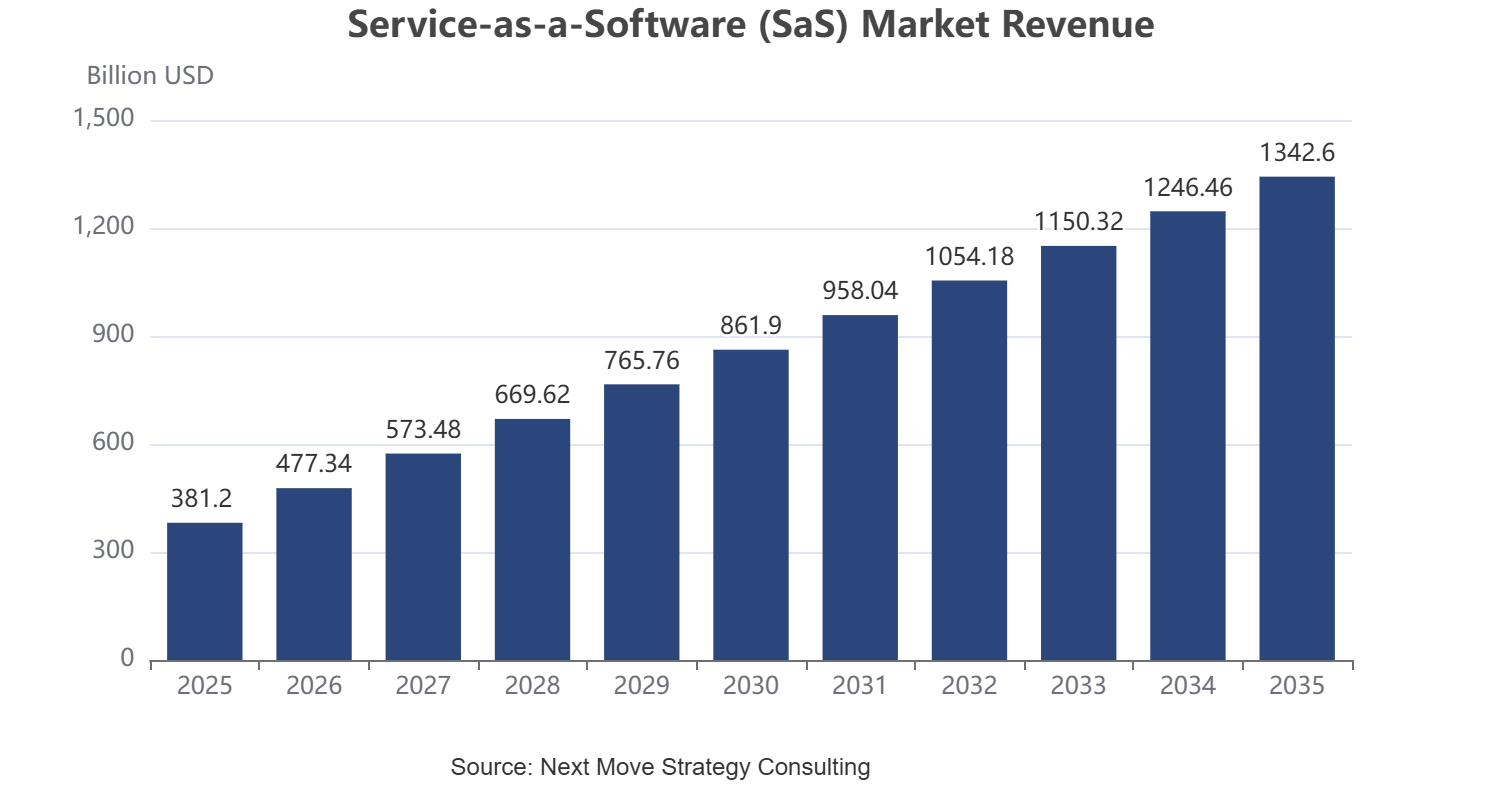
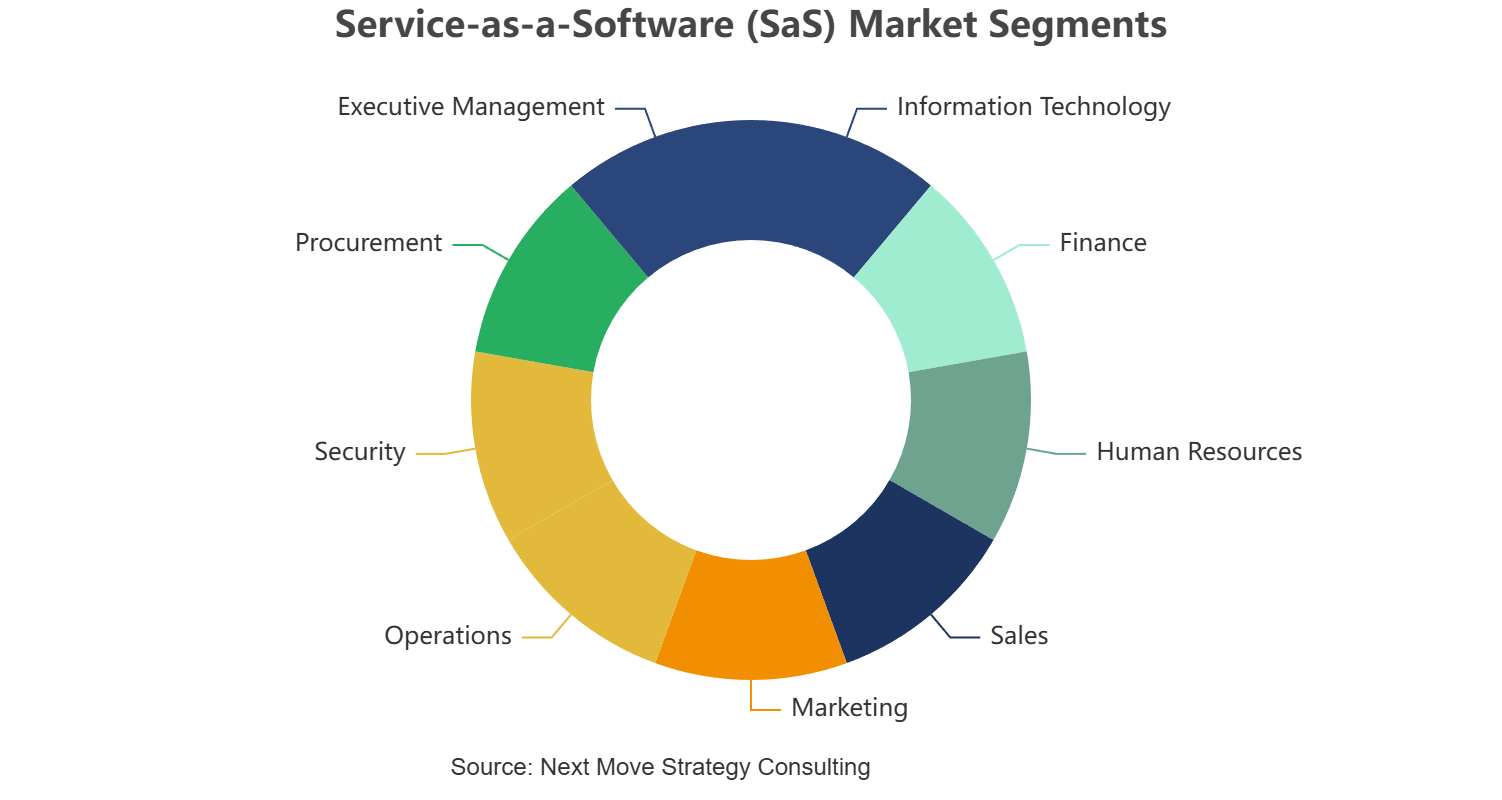
About the Author
 Mihul Sharma
— Mihul Sharma is Research Associate at Next Move Strategy Consulting, where he has covered technology, industrial, and healthcare markets for 3 years. His work applies structured business research, market analysis, and secondary-source review to assess market trends, competitive developments, and growth opportunities. He supports report development by fully synthesizing industry data, company information, and market signals into concise findings for strategy and investment-focused research teams.
Mihul Sharma
— Mihul Sharma is Research Associate at Next Move Strategy Consulting, where he has covered technology, industrial, and healthcare markets for 3 years. His work applies structured business research, market analysis, and secondary-source review to assess market trends, competitive developments, and growth opportunities. He supports report development by fully synthesizing industry data, company information, and market signals into concise findings for strategy and investment-focused research teams.
About the Reviewer
 Supradip Baul
— Supradip Baul is an accomplished business consultant and strategist with over a decade of rich experience in market intelligence, strategy, technology, and business transformation. His work has included rigorous qualitative and quantitative analysis across multiple industries, helping clients shape investment decisions and long-term roadmaps. Earlier in his career, he was associated with Gartner, where he contributed to industry-leading reports and market share analyses. He has worked with leading global companies and holds an MBA with a dual specialization in Marketing and Finance.
Supradip Baul
— Supradip Baul is an accomplished business consultant and strategist with over a decade of rich experience in market intelligence, strategy, technology, and business transformation. His work has included rigorous qualitative and quantitative analysis across multiple industries, helping clients shape investment decisions and long-term roadmaps. Earlier in his career, he was associated with Gartner, where he contributed to industry-leading reports and market share analyses. He has worked with leading global companies and holds an MBA with a dual specialization in Marketing and Finance.
At Next Move Strategy Consulting, we understand that insightful market research is the cornerstone of successful business decisions. That's why we employ a robust and multifaceted approach, combining various methodologies to deliver the most accurate and actionable data for our clients.

Research Landscape
We navigate the world of research with two primary approaches:
Qualitative Approach
Our qualitative research methodologies involve immersive techniques such as in-depth interviews, focus groups, and observational studies. By engaging directly with individuals and stakeholders, we uncover valuable insights that quantitative data alone may overlook.

Quantitative Research
In tandem with qualitative methodologies, NMSC leverages the power of Quantitative Research to provide a robust foundation of numerical insights. Through systematic data collection and analysis, we quantify patterns, preferences, and market trends, offering a comprehensive view of the business landscape.
Our quantitative research approach employs diverse tools, including surveys, experiments, and statistical modelling. These methodologies enable us to gather data from a large and representative sample, ensuring the statistical significance of our findings. By employing structured questionnaires and standardized data collection methods, we guarantee the reliability and validity of the information we present to our clients.
Quantitative research is particularly effective in measuring the prevalence of trends, assessing market size, and gauging the impact of various factors on consumer behavior. The numerical precision attained through this approach equips our clients with actionable insights, facilitating data-driven decision-making and strategy formulation.


Our Specialized Toolbox for Industry-Specific Market Research
We deploy a specialized arsenal of techniques tailored to meet your unique requirements. Here's a glimpse into our comprehensive toolbox:

Information Procurement
The stage entails acquiring market data or relevant information through various sources and methodologies.


Market Research Approach
We utilize both top-down and bottom-up approaches in market research analysis to achieve a comprehensive understanding of the market dynamics, leveraging the broad perspective of industry trends and macroeconomic factors alongside detailed insights from specific segments and individual companies.

Porters Five Forces Analysis
We conduct Porter's Five Forces analysis to evaluate the competitive landscape of an industry, providing us with insights into factors that affect profitability and strategic positioning.

SWOT Analysis

Forecasting
We utilize a forecasting model to predict future consumption by considering parameters like population, economics, regulations, market competition, drivers, constraints, technology, and pricing. We also employ statistical techniques such as multilinear regression, exponential smoothing, moving average, ARIMA, and Monte Carlo simulations for accurate predictions. In econometric forecasting, we analyzed short-term and long-term event impacts, attributing values based on regulatory frameworks, economic factors, and market events.





 Speak to Our Analyst