Loan Origination Software Market Size, Share, Trends and Growth Analysis, By Domain Type (Mortgage Lending, Consumer Lending, Commercial Lending, Small Business Lending, Vehicle and Equipment Lending, and Specialty Lending), By Component (Software, and Services), By Organization Size, By Deployment Model, By Revenue Model, By Sales Channel, By End User (Commercial Banks,Retail Banks and Others), and Region — Global Industry Report and Forecast, 2026–2035
Industry: ICT & Media | Publishing Date: July 23, 2026 | Last Updated: September 30, 2026 | No of Pages: N/A | No. of Tables: N/A | No. of Figures: N/A | Format: PDF | Report Code: IC5362
What Is the Loan Origination Software Market Size?
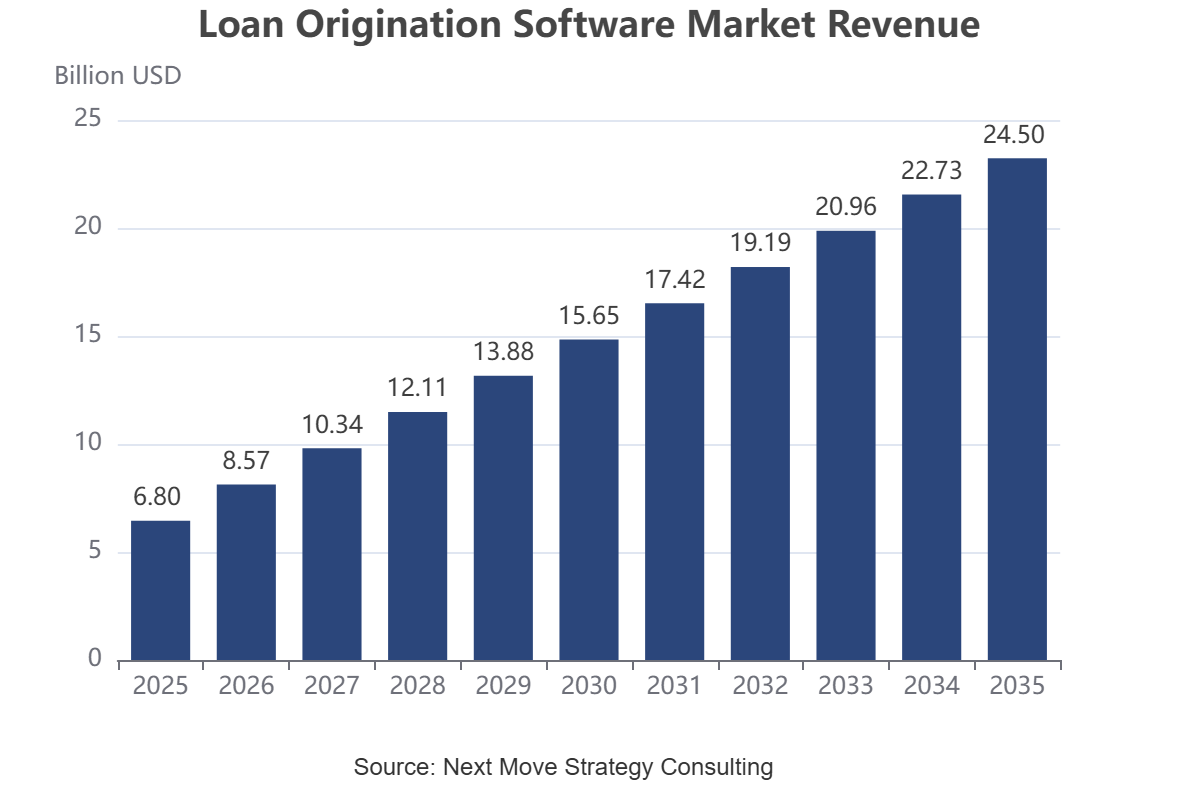
The global loan origination software market size was valued at USD 6.80 billion in 2025 and is estimated at USD 7.60 billion in 2026, forecast to reach USD 24.50 billion by 2035, expanding at a 13.9% CAGR between 2026 and 2035. North America leads with approximately 38% share, while mortgage lending dominates all other domain types with approximately 32% share.
We observed that the growth is broad-based across every segmentation axis, with cloud-native architecture and AI-driven decisioning engines driving the dominant structural shifts through 2035.
|
Key Takeaways |
|
By Domain Type: Mortgage Lending held the largest share of approximately 32% (USD 2.18 Billion) in 2025; Specialty Lending is the fastest-growing sub-segment at 18.2% CAGR from 2026–2035. |
|
By Component: Software held the largest share of approximately 55% (USD 3.74 Billion) in 2025; Software is the fastest-growing sub-segment at 14.6% CAGR from 2026–2035. |
|
By Organization Size: Large Enterprise held the largest share of approximately 47% (USD 3.20 Billion) in 2025; Small Enterprise is the fastest-growing sub-segment at 20.5% CAGR from 2026–2035. |
|
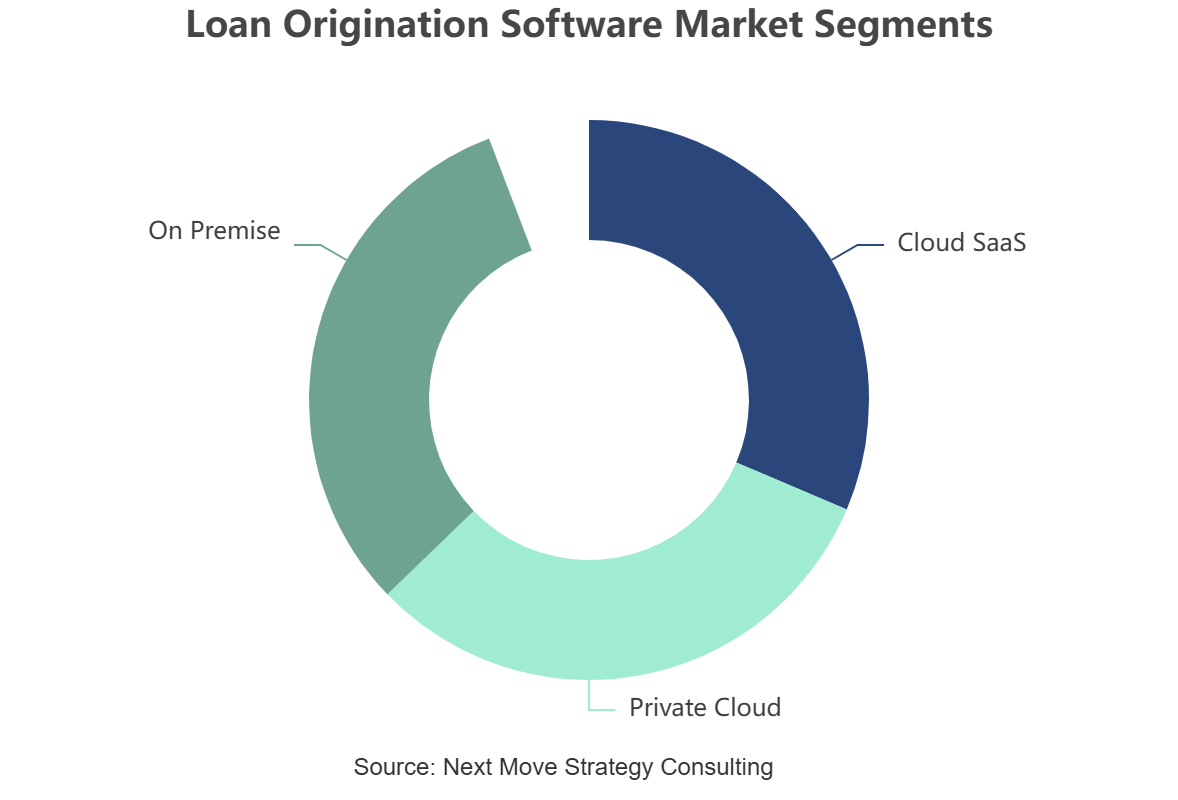
By Deployment Model: Cloud SaaS held the largest share of approximately 61% (USD 4.14 Billion) in 2025; Cloud SaaS is the fastest-growing sub-segment at 15.3% CAGR from 2026–2035. |
|
By Revenue Model: Subscription held the largest share of approximately 58% (USD 3.94 Billion) in 2025; Transaction-Based is the fastest-growing sub-segment at 22.3% CAGR from 2026–2035. |
|
By End User: Commercial Banks held the largest share of approximately 24% (USD 1.63 Billion) in 2025; Fintech Lenders is the fastest-growing sub-segment at 24.6% CAGR from 2026–2035. |
|
Dominant Region: North America dominated with approximately 38% revenue share (USD 2.58 Billion) in 2025. |
|
Fastest-Growing Region: Asia-Pacific is expected to register the highest CAGR of 17.4% during 2026–2035. |
|
Dominant Country: U.S. led with approximately USD 2.15 Billion in 2025. |
|
Fastest-Growing Country: India is the fastest-growing country at approximately 21.4% CAGR from 2026–2035. |
Market Opportunity: The loan origination software market is expected to create an absolute dollar opportunity of USD 16.90 billion between 2026 and 2035, presenting significant investment potential across the retail banking, mortgage, fintech lending, and small business credit value chain.
According to Next Move Strategy Consulting analysis, lenders are increasingly consolidating origination technology onto unified, API-first platforms that span mortgage, consumer, and commercial lines, a shift that favors vendors with broad configurability over single-product specialists as omnichannel origination demand accelerates through 2035.
What Does the Loan Origination Software Market Encompass?
The loan origination software market encompasses digital platforms that automate application intake, credit decisioning, underwriting, documentation, and closing across mortgage, consumer, commercial, small business, vehicle, and specialty lending lines. Our assessment indicates that the scope spans core origination platforms, workflow automation, decisioning engines, and document management modules deployed by commercial banks, credit unions, mortgage lenders, and fintech lenders. The category has evolved from siloed, paper-intensive workflows into API-connected, cloud-native ecosystems that integrate credit bureaus, digital signature tools, and core banking systems to compress origination cycle times.
Regulatory frameworks such as the U.S. Truth in Lending Act and Dodd-Frank Act's Ability-to-Repay rules, alongside the European Union's Consumer Credit Directive, shape disclosure and underwriting requirements embedded within origination workflows, while open banking mandates increasingly influence data-sharing architecture. We observed that technology adoption is shifting toward AI-assisted decisioning and embedded intelligent document processing that reduce manual review. Next Move Strategy Consulting's analysis indicates that this structural shift, combined with rising borrower expectations for instant approvals, is redefining vendor selection criteria across the loan origination software market.
|
Parameter |
Details |
|
Market Size in 2025 |
USD 6.80 Billion |
|
Market Size in 2026 |
USD 7.60 Billion |
|
Revenue Forecast in 2035 |
USD 24.50 Billion |
|
Growth Rate |
CAGR of 13.9% from 2026 to 2035 |
|
Analysis Period |
2025–2035 |
|
Base Year Considered |
2025 |
|
Forecast Period |
2026–2035 |
|
Market Size Estimation |
Revenue (USD Billion) |
|
Companies Profiled |
20 |
|
Countries Covered |
33 |
|
Market Share |
Available for Top 10 Companies |
Key Emerging Trends
Our findings suggest that origination technology is undergoing rapid architectural and functional transformation as lenders pursue faster cycle times and lower cost-to-originate.
Are AI-Driven Decisioning Engines Replacing Manual Underwriting?
We found that AI-driven decisioning engines are increasingly replacing rules-only underwriting, enabling lenders to process alternative data alongside traditional credit files. This transformation reduces manual touchpoints and accelerates approval timelines across consumer and small business lending. Underwriting teams now shift toward exception handling rather than full-file review, while borrowers benefit from faster decisions. nCino, Inc. has embedded AI-assisted underwriting workflows into its commercial and small business origination suite.
How Is Embedded Lending Reshaping Origination Workflows?
Embedded lending is reshaping origination workflows by placing point-of-sale and point-of-service credit decisions directly within e-commerce and vertical software platforms. This adoption pattern extends origination software beyond traditional banks to retailers and marketplaces offering financing. Stakeholders across merchant ecosystems gain new revenue channels through embedded credit. Blend Labs, Inc. has extended its origination APIs to support embedded consumer lending use cases beyond direct-to-bank channels.
What Role Does Open Banking Play in Loan Origination?
Open banking is enabling real-time verification of income, assets, and cash flow directly from applicant bank accounts, reducing reliance on manual document uploads. This adoption trend accelerates underwriting accuracy while lowering fraud exposure for lenders. Stakeholders including mortgage lenders and NBFCs increasingly favor platforms with native open banking connectivity. MeridianLink, Inc. has integrated open banking data feeds into its consumer and mortgage origination modules.
Why Are Cloud-Native, API-First Platforms Becoming Standard?
Cloud-native, API-first platforms are becoming the standard architecture as lenders prioritize modular deployment over monolithic legacy systems. This shift lets institutions integrate best-of-breed decisioning, document, and compliance tools without full platform replacement. Technology teams gain faster configuration cycles and lower total cost of ownership. Temenos AG has advanced its cloud-native origination architecture to support composable banking deployments across multiple lending lines.
Porter's Five Forces Analysis of the Loan Origination Software Market
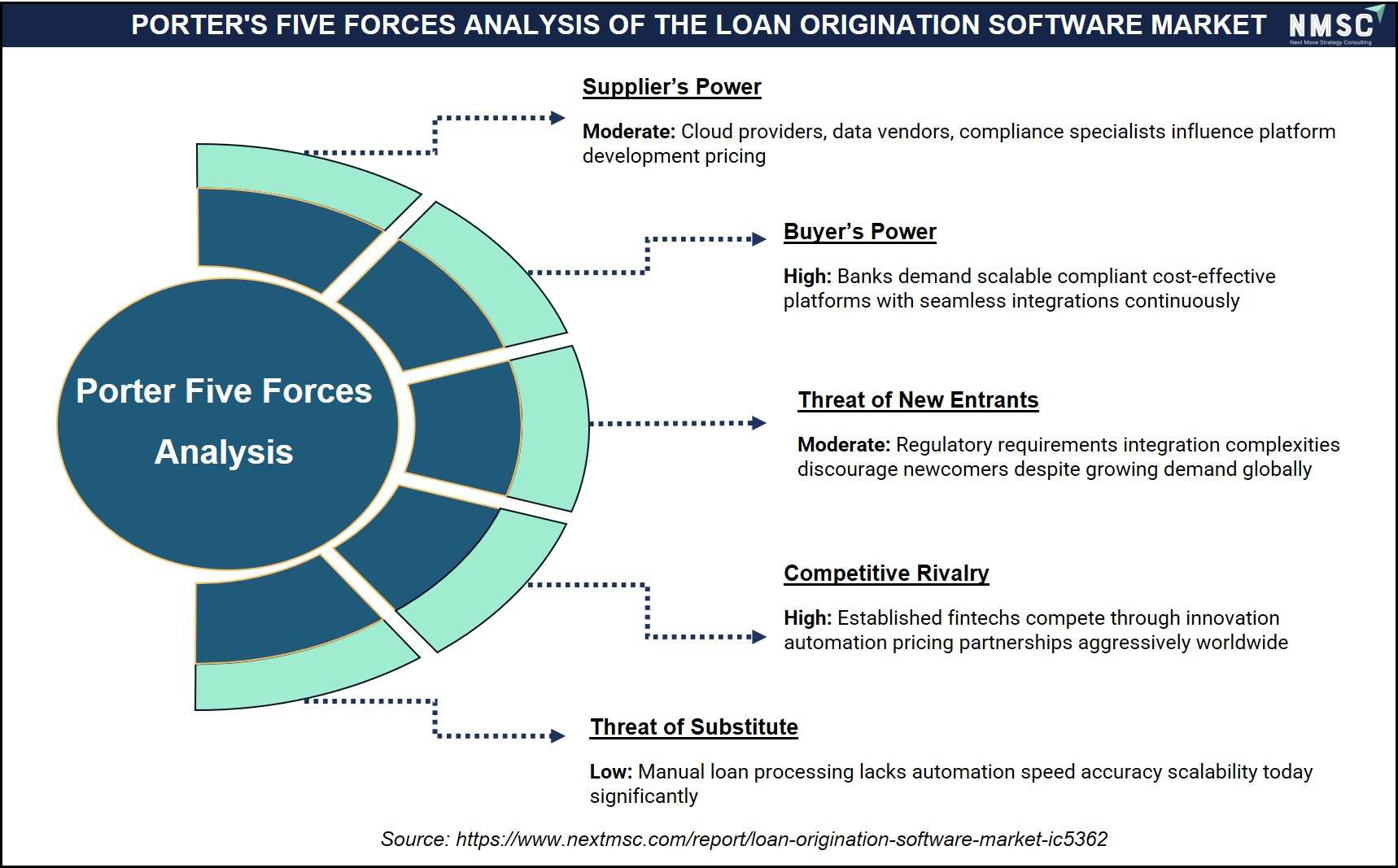
Our findings suggest that competitive rivalry remains high due to numerous established vendors and fintech providers. Buyer bargaining power is moderate to high as institutions compare functionality and pricing, while supplier power remains moderate because of multiple technology providers. The threat of new entrants is moderate owing to regulatory and development requirements, whereas substitute solutions remain limited because specialized loan automation platforms deliver greater operational efficiency.
Growth Drivers & Restraints
|
Factors |
Type |
(+/−) % Impact on CAGR |
Geographic Relevance |
Impact Timeline |
|
Rising digital mortgage and consumer credit adoption |
Driver |
+2.8% |
Global |
2026–2035 |
|
Growth of embedded and point-of-sale lending |
Driver |
+2.1% |
North America, Europe |
2026–2035 |
|
Expansion of fintech and NBFC lending volumes |
Driver |
+2.4% |
Asia-Pacific, LATAM |
2026–2035 |
|
Adoption of AI-based credit decisioning |
Driver |
+1.9% |
Global |
2026–2035 |
|
Open banking and API-driven data connectivity |
Driver |
+1.6% |
Europe, APAC |
2026–2035 |
|
Regulatory complexity and compliance costs |
Restraint |
-1.4% |
North America, Europe |
2026–2035 |
|
High implementation and legacy migration costs |
Restraint |
-1.1% |
Global |
2026–2035 |
|
Data privacy and cybersecurity concerns |
Restraint |
-0.9% |
Global |
2026–2032 |
|
Fragmented core banking integration standards |
Restraint |
-0.7% |
MEA, LATAM |
2026–2033 |
What Is the Primary Growth Driver?
The primary growth driver is the rapid shift toward digital mortgage and consumer credit origination as borrowers demand faster, paperless approvals. The Consumer Financial Protection Bureau has reported sustained growth in digitally originated mortgage applications, reflecting structural demand for automated underwriting. Our analysis shows that lenders adopting end-to-end digital origination report materially shorter cycle times, reinforcing platform investment across the general banking and financial services ecosystem.
How Is Fintech Expansion Driving the Market Growth?
Fintech expansion is driving market growth as non-bank lenders scale consumer and small business origination volumes without legacy infrastructure constraints. Based on research conducted by Next Move Strategy Consulting, we found that fintech lenders are the fastest-growing end-user segment at approximately 24.6% CAGR through 2035. This expansion pressures traditional banks to modernize origination stacks to remain competitive on speed and borrower experience.
What Is Restraining Loan Origination Software Adoption?
Regulatory complexity is restraining adoption as lenders operating across multiple jurisdictions must configure origination workflows to satisfy varying disclosure, fair-lending, and data-residency requirements. The Federal Deposit Insurance Corporation continues to enforce evolving compliance expectations that raise implementation timelines. We observed that mid-market lenders often delay platform migration until compliance mapping is fully validated, moderating near-term deployment velocity.
Segmentation Analysis
Segment Sizing: By Domain Type
|
Segment |
2025 (USD) |
2035 (USD) |
CAGR% (2026–2035) |
|
Mortgage Lending |
USD 2.18 Billion |
USD 6.84 Billion |
12.2% |
|
Consumer Lending |
USD 1.63 Billion |
USD 6.37 Billion |
14.9% |
|
Commercial Lending |
USD 1.22 Billion |
USD 4.17 Billion |
13.2% |
|
Small Business Lending |
USD 0.82 Billion |
USD 3.19 Billion |
14.9% |
|
Vehicle and Equipment Lending |
USD 0.61 Billion |
USD 2.21 Billion |
13.9% |
|
Specialty Lending |
USD 0.34 Billion |
USD 1.72 Billion |
18.2% |
|
Total |
USD 6.80 Billion |
USD 24.50 Billion |
13.9% |
Which Domain Type Leads the Loan Origination Software Market?
Mortgage Lending leads the domain type segmentation with approximately 32% share in 2025, supported by sustained refinancing and purchase-mortgage volumes across mature banking systems. Our analysis shows that Specialty Lending is the fastest-growing domain at 18.2% CAGR from 2026 to 2035, driven by agricultural, student, and healthcare lending digitization. We observed that lenders are prioritizing configurable workflows that serve multiple domain types on a single origination backbone.
Segment Sizing: By Component
|
Segment |
2025 (USD) |
2035 (USD) |
CAGR% (2026–2035) |
|
Software |
USD 3.74 Billion |
USD 14.21 Billion |
14.6% |
|
Services |
USD 3.06 Billion |
USD 10.29 Billion |
13.0% |
|
Total |
USD 6.80 Billion |
USD 24.50 Billion |
13.9% |
Why Does Software Dominate the Component Segment?
Software dominates the component segmentation with approximately 55% share in 2025, reflecting lender preference for owned decisioning and workflow engines over outsourced processing. Our findings suggest that Software also remains the faster-growing component at 14.6% CAGR through 2035 as platforms embed native analytics and reporting. Services, spanning implementation, integration, and support, retains steady demand as institutions require ongoing configuration expertise during core system upgrades.
Segment Sizing: By Deployment Model
|
Segment |
2025 (USD) |
2035 (USD) |
CAGR% (2026–2035) |
|
Cloud SaaS |
USD 4.14 Billion |
USD 16.65 Billion |
15.3% |
|
Private Cloud |
USD 1.50 Billion |
USD 4.66 Billion |
12.1% |
|
On Premise |
USD 1.16 Billion |
USD 3.19 Billion |
10.5% |
|
Total |
USD 6.80 Billion |
USD 24.50 Billion |
13.9% |
Why Is Cloud SaaS the Preferred Deployment Model?
Cloud SaaS leads deployment model segmentation with approximately 61% share in 2025 and remains the fastest-growing model at 15.3% CAGR through 2035, as lenders favor subscription pricing and continuous updates over on-premise maintenance. Our assessment indicates that Private Cloud retains relevance among large banks with strict data-residency mandates, while On Premise deployment continues to decline as institutions migrate toward public cloud in BFSI infrastructure for elastic scalability.
Growth Opportunities
Several forward-looking whitespace opportunities are emerging as origination platforms extend into adjacent lending and data ecosystems.
Can Embedded Small Business Lending Unlock New Revenue Channels?
Embedding small business credit decisioning within accounting and e-commerce software creates a concrete mechanism for platform vendors to capture origination volume outside traditional banking channels. Small Enterprise borrowers, currently underserved by conventional underwriting, stand to benefit most from this whitespace as vendors extend low-friction application flows.
Does AI-Based Alternative Data Underwriting Expand Addressable Borrowers?
Integrating alternative data sources such as cash-flow and utility payment history into decisioning engines expands the addressable borrower base for thin-file applicants. Fintech Lenders are best positioned to capture this opportunity, given their existing infrastructure for non-traditional data ingestion and rapid underwriting iteration.
Can Regional Modernization Programs Accelerate NBFC Platform Adoption?
Government-backed digital lending and financial inclusion programs across emerging Asia-Pacific and Latin American markets create a concrete mechanism for accelerated NBFC platform adoption. NBFCs and Independent Mortgage Banks in these regions benefit directly as modernization funding lowers the cost barrier to origination technology upgrades.
Regional Outlook
|
Region |
2025 (USD) |
2035 (USD) |
CAGR% (2026–2035) |
Key Driver |
|
North America |
USD 2.58 Billion |
USD 7.83 Billion |
11.7% |
Mature bank IT modernization and QM/ATR compliance demand |
|
Europe |
USD 1.63 Billion |
USD 5.39 Billion |
12.8% |
Open banking mandates and PSD2-driven origination modernization |
|
Asia-Pacific |
USD 1.50 Billion |
USD 7.11 Billion |
17.4% |
Digital lending expansion and fintech-bank partnerships |
|
Middle East & Africa |
USD 0.61 Billion |
USD 2.21 Billion |
13.9% |
Sovereign digital banking initiatives and NBFC expansion |
|
Latin America |
USD 0.48 Billion |
USD 1.96 Billion |
15.6% |
Financial inclusion programs and rising fintech lending penetration |
|
Total |
USD 6.80 Billion |
USD 24.50 Billion |
13.9% |
— |
North America Loan Origination Software Market
North America remains the most mature loan origination software market, anchored by extensive core banking modernization across the U.S. and Canada. We observed that regulatory frameworks including the CFPB's Ability-to-Repay rule shape underwriting workflow design, while technology adoption favors AI-assisted decisioning among large commercial banks. Strategic outlook remains steady as institutions prioritize omnichannel origination and legacy platform replacement through 2035.
Europe Loan Origination Software Market
Europe's market reflects a mature but evolving landscape shaped by PSD2 open banking mandates that standardize data-sharing across lenders. Our assessment indicates that adoption is concentrated among UK and German banks pursuing cloud migration, while regulatory harmonization under the Consumer Credit Directive supports cross-border platform standardization. Strategic outlook favors vendors offering multi-jurisdictional compliance configurability.
Asia-Pacific Loan Origination Software Market
Asia-Pacific demonstrates the fastest adoption trajectory, driven by expanding digital lending penetration across China, India, and Southeast Asia. We found that regulatory support for financial inclusion, combined with rising smartphone-based credit applications, accelerates technology uptake among NBFCs and fintech lenders. Strategic outlook favors cloud-native platforms suited to high-volume, low-ticket consumer lending.
Middle East & Africa Loan Origination Software Market
The Middle East & Africa market is shaped by sovereign digital banking initiatives across UAE and Saudi Arabia alongside gradual NBFC formalization in Africa. Our analysis shows that regulatory modernization under central bank digital transformation programs is accelerating platform adoption among commercial banks. Strategic outlook remains positive as regional players seek to close the origination technology gap with global peers.
Latin America Loan Origination Software Market
Latin America's market growth is underpinned by financial inclusion programs and rising fintech lending penetration across Brazil and Argentina. We observed that regulatory bodies are increasingly encouraging open finance frameworks that support alternative data underwriting. Strategic outlook favors vendors with localized compliance and Portuguese/Spanish-language origination workflows suited to regional lending practices.
U.S. Loan Origination Software Market
Based on our estimates, the U.S. market was valued at approximately USD 2.15 billion in 2025 and is projected to reach USD 6.35 billion by 2035, growing at a 12.8% CAGR. Demand is anchored by mature mortgage refinancing activity, high e-commerce and digital banking penetration, and Dodd-Frank Ability-to-Repay compliance requirements. Technology penetration favors AI-assisted decisioning, and competitive intensity remains high among established vendors serving national bank and NBFC clients.
Canada Loan Origination Software Market
The market in Canada reached roughly USD 0.29 billion in 2025 and is forecast to hit USD 0.95 billion by 2035 at a 14.1% CAGR. Demand structure mirrors U.S. mortgage and consumer lending consumption patterns, while OSFI capital and underwriting guidance shapes platform configuration. Technology penetration is rising as regional banks pursue cloud migration, with competitive intensity moderate given reliance on cross-border vendor relationships.
UK Loan Origination Software Market
As per our estimate, the UK market stood at approximately USD 0.42 billion in 2025 and is projected to reach USD 1.28 billion by 2035 at a 13.2% CAGR. Demand is driven by open banking-enabled consumer lending innovation among challenger banks, while FCA conduct and disclosure rules shape underwriting workflow design. Technology penetration is high, with competitive intensity elevated among API-first platform vendors.
Germany Loan Origination Software Market
According to our analysis, the Germany market was valued at approximately USD 0.38 billion in 2025 and is forecast to reach USD 1.19 billion by 2035 at a 13.6% CAGR. Demand structure centers on commercial and mortgage lending modernization among regional banks, while BaFin compliance requirements shape workflow configuration. Technology penetration remains moderate, with competitive intensity steady among core banking-aligned vendors.
France Loan Origination Software Market
Based on our estimates, the France market was valued at approximately USD 0.29 billion in 2025 and is projected to reach USD 0.88 billion by 2035 at a 13.1% CAGR. Demand is anchored in consumer and mortgage lending digitization, while ACPR underwriting disclosure standards shape platform compliance features. Technology penetration is moderate, with competitive intensity steady among vendors serving national retail banks.
China Loan Origination Software Market
The market in China reached approximately USD 0.48 billion in 2025 and is forecast to hit USD 2.35 billion by 2035 at a 19.3% CAGR. Demand is dominated by high-volume consumer and small business lending through digital channels, while People's Bank of China data governance rules shape platform architecture. Technology penetration is elevated among fintech lenders, with competitive intensity intense across mobile-first origination vendors.
India Loan Origination Software Market
As per our estimate, the India market was valued at approximately USD 0.27 billion in 2025 and is projected to reach USD 1.55 billion by 2035 at a 21.4% CAGR, the fastest pace among covered countries. Demand is driven by financial inclusion-focused consumer and small business lending among NBFCs, while Reserve Bank of India digital lending guidelines shape platform compliance. Technology penetration is rising rapidly, with competitive intensity high among alternative-data underwriting vendors.
Japan Loan Origination Software Market
According to our analysis, the Japan market stood at approximately USD 0.31 billion in 2025 and is forecast to reach USD 1.02 billion by 2035 at a 14.2% CAGR. Demand structure reflects mortgage and commercial lending digitization among regional banks, while Financial Services Agency disclosure requirements shape underwriting workflows. Technology penetration remains moderate, with competitive intensity steady among established vendors.
South Korea Loan Origination Software Market
Based on our estimates, the South Korea market was valued at approximately USD 0.18 billion in 2025 and is projected to reach USD 0.68 billion by 2035 at a 15.9% CAGR. Demand is driven by consumer lending and point-of-sale finance origination technology, while Financial Supervisory Service consumer protection rules shape disclosure design. Technology penetration is high, with competitive intensity elevated among mobile-native platform vendors.
Australia Loan Origination Software Market
The market in Australia reached approximately USD 0.14 billion in 2025 and is forecast to hit USD 0.46 billion by 2035 at a 14.1% CAGR. Demand structure centers on mortgage lending modernization among major banks, while APRA responsible lending obligations shape underwriting configuration. Technology penetration is moderate to high, with competitive intensity moderate among open banking-aligned vendors.
UAE Loan Origination Software Market
As per our estimate, the UAE market was valued at approximately USD 0.13 billion in 2025 and is projected to reach USD 0.46 billion by 2035 at a 15.1% CAGR. Demand is driven by sovereign digital banking initiatives spanning commercial and consumer lending, while Central Bank of the UAE digital lending frameworks shape platform requirements. Technology penetration is rising, with competitive intensity moderate among cloud-first vendors.
Saudi Arabia Loan Origination Software Market
According to our analysis, the Saudi Arabia market stood at approximately USD 0.15 billion in 2025 and is forecast to reach USD 0.53 billion by 2035 at a 15.0% CAGR. Demand is anchored in Vision 2030-aligned banking digitization across mortgage and commercial lending, while Saudi Central Bank fintech licensing rules shape vendor entry. Technology penetration is rising, with competitive intensity moderate among NBFC-focused vendors.
South Africa Loan Origination Software Market
Based on our estimates, the South Africa market was valued at approximately USD 0.07 billion in 2025 and is projected to reach USD 0.21 billion by 2035 at a 13.1% CAGR. Demand structure centers on consumer and small business lending digitization among commercial banks, while South African Reserve Bank credit disclosure standards shape platform compliance. Technology penetration remains moderate, with competitive intensity moderate among regional vendors.
Brazil Loan Origination Software Market
The market in Brazil reached approximately USD 0.21 billion in 2025 and is forecast to hit USD 0.87 billion by 2035 at a 17.1% CAGR, the strongest pace in Latin America. Demand is driven by fintech-led consumer and small business lending expansion, while Central Bank of Brazil open finance rules shape data-sharing architecture. Technology penetration is rising rapidly, with competitive intensity high among alternative-data decisioning vendors.
Argentina Loan Origination Software Market
As per our estimate, the Argentina market was valued at approximately USD 0.06 billion in 2025 and is projected to reach USD 0.22 billion by 2035 at a 15.7% CAGR. Demand structure reflects consumer lending digitization amid macroeconomic volatility, while Central Bank of Argentina consumer credit rules shape platform configuration. Technology penetration is gradually rising, with competitive intensity moderate among cost-efficient cloud vendors.
Consumer Behavior Analysis of the Loan Origination Software Market
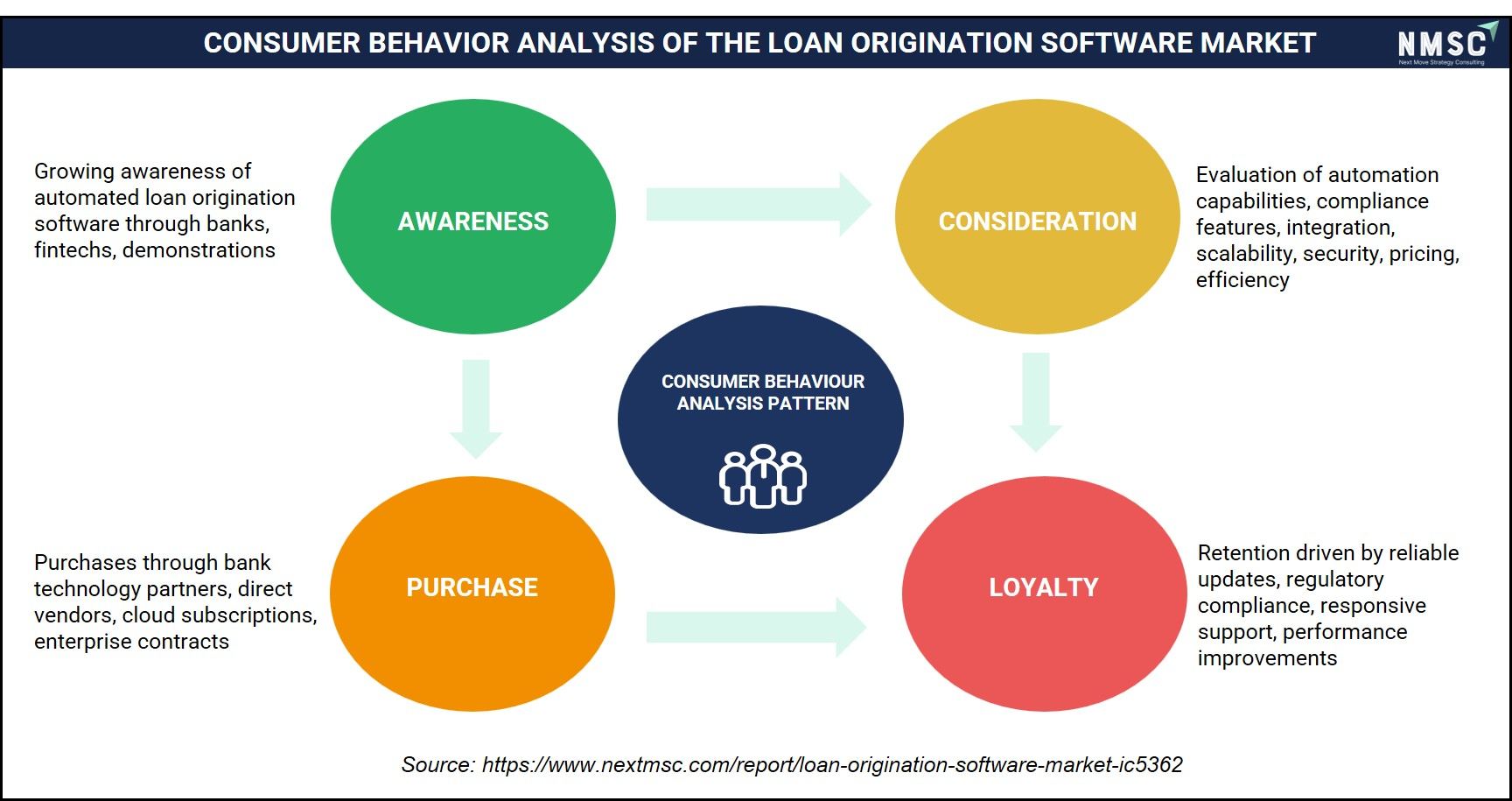
Our analysis indicates that buyers become aware of loan origination software through banks, fintech companies, technology demonstrations, and digital channels before assessing automation capabilities, regulatory compliance, integration, scalability, security, pricing, and operational efficiency. Enterprise purchasing is typically subscription- or contract-based, while ongoing software updates, responsive support, and regulatory compliance strengthen long-term customer retention.
Competitive Landscape
We observed that the loan origination software market is moderately consolidated, with established core banking vendors competing alongside specialized fintech challengers across mortgage, consumer, and commercial lending lines.
|
Dimension |
Assessment |
|
Market Structure |
Moderately consolidated with 20 profiled vendors serving distinct mortgage, consumer, and commercial lending niches |
|
Innovation Focus |
AI-assisted decisioning, embedded lending APIs, and cloud-native modular architecture |
|
M&A Activity |
Selective acquisitions targeting decisioning analytics, document automation, and regional distribution |
How Do Companies Compete in the Loan Origination Software Market?
Companies compete primarily on integration breadth, decisioning accuracy, and deployment speed rather than price alone. Our analysis shows that vendors differentiate through pre-built connectors to credit bureaus, core banking systems, and compliance databases. Geographic expansion into underpenetrated Asia-Pacific and Latin American markets, combined with tiered pricing strategies, further shapes competitive positioning across enterprise and mid-market lender segments.
Which Archetypes Dominate the Competitive Landscape?
Two archetypes dominate: diversified core banking vendors offering origination as part of broader platforms, and specialized origination-only vendors focused on a single lending line such as mortgage or small business credit. Diversified vendors including Fiserv, Inc. and Finastra Group Holdings Limited leverage existing bank relationships, while specialists such as MeridianLink, Inc. compete on deep domain configurability.
What Innovation and Differentiation Strategies Are Emerging?
Innovation strategies increasingly center on embedding generative and predictive AI within underwriting workflows to reduce manual review. Our findings suggest that vendors are also differentiating through low-code configuration tools that let lenders adjust workflows without vendor-dependent development cycles, shortening implementation timelines for mid-market and NBFC clients.
How Active Is M&A in the Loan Origination Software Market?
M&A activity remains selective but steady, with larger platform vendors acquiring point solutions in document automation, alternative-data analytics, and regional distribution to broaden origination coverage. We observed that recent transactions have prioritized capability consolidation over pure market-share acquisition, reflecting a maturing competitive landscape focused on end-to-end platform completeness.
Key Market Players
Our assessment indicates that the following companies represent the leading vendors shaping the competitive dynamics of the loan origination software market.
-
ICE Mortgage Technology
-
Finastra Group Holdings Limited
-
nCino, Inc.
-
Temenos AG
-
MeridianLink, Inc.
-
Blend Labs, Inc.
-
Pegasystems Inc.
-
Newgen Software Technologies Limited
-
Automated Financial Systems, Inc.
-
Tavant Technologies Inc.
-
TurnKey Lender, Inc.
-
LoanPro, LLC
-
Byte Software
-
Pennant Technologies Private Limited
-
HES FinTech
-
Calyx Software
-
LendingPad Corp
Latest Developments
We observed several notable platform and partnership developments across the loan origination software market over the past two years.
|
Date |
Event |
|
June 2026 |
nCino, Inc. announced the launch of Loan PreCheck, an AI-powered underwriting tool built directly into its Mortgage Point of Sale solution that automatically evaluates borrower eligibility against Fannie Mae, Freddie Mac, FHA, VA, and USDA guidelines upon credit report submission. |
|
June 2026 |
Finastra launched Data Insights 2.0 for its Originate Mortgagebot solution, a cloud analytics platform featuring peer benchmarking across more than 1,000 mortgage originators to help banks and credit unions pinpoint conversion gaps and drop-off points in the lending pipeline. |
|
February 2026 |
Finastra announced the launch of LaserPro Evaluate, a modern, cloud-native commercial loan origination and evaluation platform designed to help banks and credit unions move away from manual spreadsheets and streamline digital-first lending workflows. |
Expert Insights
 “For many organisations the commercial loan origination process is plagued with various issues: high cost of acquisition, complexity, labour-intensiveness, critical customer data, legacy systems, rising risk scenario and an ever-changing regulatory framework, not to mention the need for speed and efficiency by demanding customers.”
— Ramanan S V, CEO – Strategic Monetisation, Intellect Design Arena Limited
Statement made in the context of launching a digital loan origination platform aimed at addressing inefficiencies in commercial lending processes.
Market Interpretation
This quote directly highlights the core pain points driving the Loan Origination Software (LOS) market. Traditional loan origination processes remain highly fragmented, manual, and burdened by legacy systems, resulting in increased operational costs and inefficiencies. The emphasis on complexity, regulatory pressure, and the demand for speed underscores why financial institutions are rapidly adopting digital LOS platforms. These solutions streamline workflows, automate credit assessment, and improve data integration, enabling lenders to enhance decision-making, reduce turnaround time, and deliver a superior customer experience.
Investment Opportunities
Where Are Capital Inflows Concentrated in Loan Origination Software?
Capital inflows are concentrated in AI decisioning, embedded lending infrastructure, and cloud migration tooling. We observed that venture and growth-equity funding has favored platforms serving underserved small business and NBFC segments, reflecting investor confidence in financial inclusion-driven origination demand across emerging markets.
How Significant Is Infrastructure Investment in This Market?
Infrastructure investment remains significant as lenders allocate technology budgets toward API gateways, data pipelines, and integration middleware supporting origination modernization. Our findings suggest that infrastructure spending correlates closely with cloud SaaS deployment growth, projected at 15.3% CAGR through 2035, as institutions prioritize scalable, elastic origination environments.
What ESG Considerations Influence Investment Decisions?
ESG considerations increasingly influence investment decisions as lenders seek platforms supporting fair-lending analytics and financial inclusion metrics. We observed growing interest in green banking initiatives that pair sustainable lending disclosures with origination workflows, reflecting institutional investor demand for measurable governance and transparency in credit decisioning.
Key Benefits for Stakeholders
How Does This Report Benefit Enterprise and Industry Leaders?
Enterprise and industry leaders gain access to detailed segmentation, competitive benchmarking, and regional demand forecasts that inform platform procurement and modernization roadmaps. Our analysis shows that this report's data-driven insights help banking and lending executives prioritize investment across domain types and deployment models aligned with institutional growth strategies.
How Does This Report Benefit Investors and Financial Analysts?
Investors and financial analysts benefit from validated market sizing, CAGR forecasts, and vendor positioning that support capital allocation decisions across the loan origination software value chain. Next Move Strategy Consulting's analysis indicates that the report's regional and segmental granularity enables more precise evaluation of growth trajectories and competitive risk factors.
How Does This Report Benefit Technology Vendors and Product Teams?
Technology vendors and product teams gain strategic insight into emerging trends, whitespace opportunities, and competitive differentiation strategies shaping roadmap prioritization. Our assessment indicates that this analysis supports product teams in aligning feature development with the fastest-growing domain types, deployment models, and end-user segments identified across the forecast period.
Key Market Segments
By Domain Type
-
Mortgage Lending
-
Retail Mortgage
-
Wholesale Mortgage
-
Correspondent Mortgage
-
Home Equity Lending
-
Reverse Mortgage
-
Other Mortgage Lending
-
-
Consumer Lending
-
Personal Loans
-
Credit Card Origination
-
Secured Consumer Loans
-
Point of Sale Finance
-
Buy Now Pay Later
-
Other Consumer Lending
-
-
Commercial Lending
-
Corporate Lending
-
Commercial Real Estate Lending
-
Asset-Based Lending
-
Syndicated Lending
-
Trade Finance Lending
-
Other Commercial Lending
-
-
Small Business Lending
-
Conventional Small Business Loans
-
SBA Lending
-
Working Capital Lending
-
Merchant Cash Advance
-
Other Small Business Lending
-
-
Vehicle and Equipment Lending
-
Auto Lending
-
Equipment Finance
-
Fleet Finance
-
Other Vehicle and Equipment Lending
-
-
Specialty Lending
-
Agricultural Lending
-
Student Lending
-
Healthcare Lending
-
Public Sector Lending
-
Microfinance Lending
-
Other Specialty Lending
-
By Component
-
Software
-
Core Origination Platform
-
Workflow Automation
-
Decisioning and Rules Engine
-
Document Management
-
Integration Framework
-
Analytics and Reporting
-
-
Services
-
Consulting
-
Implementation
-
Integration
-
Customization
-
Training
-
Support and Maintenance
-
Managed Services
-
By Organization Size
-
Large Enterprise
-
Mid-Market
-
Small Enterprise
By Deployment Model
-
Cloud SaaS
-
Private Cloud
-
On Premise
By Revenue Model
-
Subscription
-
Perpetual License
-
Transaction-Based
-
Implementation Fees
-
Professional Services
-
Support and Maintenance
By Sales Channel
-
Direct Sales
-
Channel Partners
-
System Integrators
-
OEM and Embedded Partners
By End User
-
Commercial Banks
-
Retail Banks
-
Credit Unions
-
Mortgage Lenders
-
Independent Mortgage Banks
-
Mortgage Brokers
-
NBFCs
-
Fintech Lenders
-
Captive Finance Companies
-
Equipment Finance Companies
-
Government Lending Institutions
-
Other Financial Institutions
By Region
-
North America: U.S., Canada, Mexico.
-
Europe: UK, Germany, France, Italy, Spain, Sweden, Denmark, Finland, Netherlands, Rest of Europe.
-
Asia-Pacific: China, India, Japan, South Korea, Taiwan, Indonesia, Vietnam, Australia, Philippines, Malaysia, Rest of APAC.
-
Middle East & Africa: Saudi Arabia, UAE, Egypt, Israel, Turkey, Nigeria, South Africa, Rest of MEA.
-
Latin America: Brazil, Argentina, Chile, Colombia, Rest of LATAM.
Conclusion & Recommendations
What Is the Long-Term Outlook for the Loan Origination Software Market?
The long-term outlook remains strongly positive, with the market forecast to expand from USD 7.60 billion in 2026 to USD 24.50 billion by 2035 at a 13.9% CAGR. Our analysis shows that sustained digital lending adoption across mortgage, consumer, and commercial lines, combined with AI-enabled decisioning, will continue to underpin structural demand through the forecast horizon.
What Strategic Positioning Should Vendors Pursue?
Vendors should pursue strategic positioning around modular, API-first architecture that supports multi-domain lending on a single platform. We observed that lenders increasingly favor vendors capable of serving mortgage, consumer, and small business origination simultaneously, reducing the total number of technology relationships required across the institution.
How Attractive Is This Market for Investment?
Investment attractiveness remains high given the market's double-digit CAGR and expanding addressable base across fintech lenders and NBFCs. Our assessment indicates that platforms offering AI decisioning and embedded lending capabilities present the most compelling risk-adjusted opportunity within the broader lending technology value chain.
What Market Shifts and Key Risks Should Stakeholders Monitor?
Stakeholders should monitor regulatory tightening around AI-based credit decisioning and data privacy, which could raise compliance costs for vendors and lenders alike. We found that fragmented core banking integration standards across regions also pose ongoing implementation risk, particularly for vendors expanding into new geographies.
What Are the Primary Growth Pathways Through 2035?
Primary growth pathways include embedded lending expansion, alternative-data underwriting, and continued cloud migration among mid-market and regional institutions. Next Move Strategy Consulting's analysis indicates that vendors capturing early positioning in Asia-Pacific and Latin American digital lending expansion are best positioned to sustain above-market growth through 2035.
About the Author
 Saista Faiyaz
— Saista Faiyaz is Research Associate at Next Move Strategy Consulting, where she has covered consumer markets and healthcare technologies for 3 years. Her work includes primary interview review, secondary-source validation, market sizing, and structured analysis of company and industry data. She supports research by comparing evidence across sources, organizing findings into market narratives, and documenting assumptions used in analysis. Her scope includes cross-market benchmarking, and reports.
Saista Faiyaz
— Saista Faiyaz is Research Associate at Next Move Strategy Consulting, where she has covered consumer markets and healthcare technologies for 3 years. Her work includes primary interview review, secondary-source validation, market sizing, and structured analysis of company and industry data. She supports research by comparing evidence across sources, organizing findings into market narratives, and documenting assumptions used in analysis. Her scope includes cross-market benchmarking, and reports.
About the Reviewer
 Supradip Baul
— Supradip Baul is an accomplished business consultant and strategist with over a decade of rich experience in market intelligence, strategy, technology, and business transformation. His work has included rigorous qualitative and quantitative analysis across multiple industries, helping clients shape investment decisions and long-term roadmaps. Earlier in his career, he was associated with Gartner, where he contributed to industry-leading reports and market share analyses. He has worked with leading global companies and holds an MBA with a dual specialization in Marketing and Finance.
Supradip Baul
— Supradip Baul is an accomplished business consultant and strategist with over a decade of rich experience in market intelligence, strategy, technology, and business transformation. His work has included rigorous qualitative and quantitative analysis across multiple industries, helping clients shape investment decisions and long-term roadmaps. Earlier in his career, he was associated with Gartner, where he contributed to industry-leading reports and market share analyses. He has worked with leading global companies and holds an MBA with a dual specialization in Marketing and Finance.
At Next Move Strategy Consulting, we understand that insightful market research is the cornerstone of successful business decisions. That's why we employ a robust and multifaceted approach, combining various methodologies to deliver the most accurate and actionable data for our clients.

Research Landscape
We navigate the world of research with two primary approaches:
Qualitative Approach
Our qualitative research methodologies involve immersive techniques such as in-depth interviews, focus groups, and observational studies. By engaging directly with individuals and stakeholders, we uncover valuable insights that quantitative data alone may overlook.

Quantitative Research
In tandem with qualitative methodologies, NMSC leverages the power of Quantitative Research to provide a robust foundation of numerical insights. Through systematic data collection and analysis, we quantify patterns, preferences, and market trends, offering a comprehensive view of the business landscape.
Our quantitative research approach employs diverse tools, including surveys, experiments, and statistical modelling. These methodologies enable us to gather data from a large and representative sample, ensuring the statistical significance of our findings. By employing structured questionnaires and standardized data collection methods, we guarantee the reliability and validity of the information we present to our clients.
Quantitative research is particularly effective in measuring the prevalence of trends, assessing market size, and gauging the impact of various factors on consumer behavior. The numerical precision attained through this approach equips our clients with actionable insights, facilitating data-driven decision-making and strategy formulation.


Our Specialized Toolbox for Industry-Specific Market Research
We deploy a specialized arsenal of techniques tailored to meet your unique requirements. Here's a glimpse into our comprehensive toolbox:

Information Procurement
The stage entails acquiring market data or relevant information through various sources and methodologies.


Market Research Approach
We utilize both top-down and bottom-up approaches in market research analysis to achieve a comprehensive understanding of the market dynamics, leveraging the broad perspective of industry trends and macroeconomic factors alongside detailed insights from specific segments and individual companies.

Porters Five Forces Analysis
We conduct Porter's Five Forces analysis to evaluate the competitive landscape of an industry, providing us with insights into factors that affect profitability and strategic positioning.

SWOT Analysis

Forecasting
We utilize a forecasting model to predict future consumption by considering parameters like population, economics, regulations, market competition, drivers, constraints, technology, and pricing. We also employ statistical techniques such as multilinear regression, exponential smoothing, moving average, ARIMA, and Monte Carlo simulations for accurate predictions. In econometric forecasting, we analyzed short-term and long-term event impacts, attributing values based on regulatory frameworks, economic factors, and market events.





 Speak to Our Analyst