E-Mobility Insulation Battery Market By Material Type (Thermal, Electrical, Flame & Fire Barrier, Acoustic and Others), By Form Type (Sheets & Panels, Films & Foils, Papers & Fabrics, and Others), By Application (Battery Insulation, Battery Management System & Connector Insulation, and Others), By Vehicle Type (Passenger, Commercial, and Others), and By End User (OEMs, Battery Pack Manufacturers, Tier One Integrators, and Others) – Global Analysis & Forecast, 2025–2035
Industry: Automotive & Transportation | Publishing Date: January 9, 2026 | Last Updated: September 30, 2026 | No of Pages: N/A | No. of Tables: N/A | No. of Figures: N/A | Format: PDF | Report Code: AT3930
Industry Outlook
The E-Mobility Insulation Battery Market size was valued at USD 1.96 billion in 2025 and is expected to reach USD 2.08 billion by 2026. Looking ahead, the industry is projected to expand significantly, reaching USD 3.46 billion by 2035, registering a CAGR of 5.84% from 2026 to 2035.
The E-mobility insulation battery industry is expanding rapidly, driven by the accelerating adoption of electric vehicles and the growing need for thermal, electrical, and mechanical insulation solutions that enhance battery safety and performance. As EV manufacturers focus on improving energy density and reducing weight, advanced insulation materials, such as mica, aerogels, ceramic composites, and high-performance polymers, are being integrated to prevent thermal runaway, ensure dielectric strength, and optimise battery pack design.
The rise in fast-charging technologies and high-voltage architectures is further intensifying the demand for superior insulation systems that withstand extreme temperatures and electrical stress. Manufacturers are innovating with recyclable, lightweight, and flame-retardant materials to meet evolving regulatory and sustainability standards. By combining safety, efficiency, and sustainability, the E-mobility insulation battery market is playing a pivotal role in advancing next-generation electric mobility and supporting the global transition toward cleaner transportation solutions.
What Are the key E-mobility Insulation Battery Industry Trends?
How is Growing Battery Energy Density Changing E-mobility Insulation Battery Requirements?
Rising battery energy density is intensifying thermal and electrical insulation demands, as higher Wh/kg and Wh/L metrics translate to increased heat generation and reduced spacing between cells. This necessitates insulation materials that combine low thermal conductivity, thin profiles, and high dielectric strength, maintaining safety and reliability under tighter packaging constraints. Suppliers are shifting toward aerogel composites, aramid, and polyimide-based barriers, striking a balance between lightweight performance and heat resistance. OEMs seek validated materials that withstand elevated temperature gradients and prevent thermal propagation. Manufacturers are accelerating correlative testing between conductivity, thickness, and flammability metrics to secure qualification in next-generation EV platforms.
How are Safety and Regulatory Emphasis Shaping the Adoption of Fire Barrier and Thermal Runaway Mitigation Materials?
Safety regulations are now central to insulation design, with global agencies tightening standards to prevent thermal runaway and pack-level ignition. The U.S. DOE’s energy storage safety roadmap identifies fire containment as a critical challenge, prompting widespread integration of ceramic, mica, and intumescent-based flame barriers. OEMs increasingly demand multilayer insulation systems pre-certified to international test standards, reducing validation timelines. Insurers and regulators are requiring demonstrable containment capability, pushing suppliers to deliver tested and traceable safety data. The near-term priority is developing certified, drop-in insulation kits that align with regulatory and insurance safety protocols.
How is Manufacturing Localisation and Battery Gigafactory Expansion Creating a Near-Term Supply Opportunity for Insulation Suppliers?
The global surge in gigafactory construction and battery localisation policies is generating dense, regionalised demand for insulation materials. Governments in North America, Europe, and Asia are incentivising local battery ecosystems, shortening supply chains and heightening the need for local converting, lamination, and kitting capabilities. Insulation suppliers that invest early in regional production hubs and OEM partnerships secure preferred-vendor status and reduce logistics complexity. Local manufacturing also enables rapid prototyping and material tailoring to OEM assembly conditions, supporting faster qualification cycles and supply assurance for large-scale pack production.
What Are the Key Market Drivers, Breakthroughs, and Investment Opportunities That Shape the E-Mobility Insulation Battery Industry in the Next Decade?
Global EV diffusion and the safety imperative together create the principal demand base for insulation materials. The proliferation of EVs across passenger and commercial segments multiplies battery pack units and cumulative pack energy, requiring insulation per pack. Simultaneous emphasis on thermal management and fire containment from government safety plans and insurers increases the effective insulation content and value per pack. However, the absence of a single canonical industry dataset for insulation spend means that sizing is built from battery GWh demand and per kWh insulation value assumptions.
Growth Drivers:
Will Rising EV Battery Volumes be the Principal Long-Term Growth Driver?
As global EV battery production scales exponentially toward 2030, insulation material demand grows proportionally, since every incremental kilowatt-hour of energy storage requires precise thermal and electrical isolation. Global installed battery capacity is expected to expand several-fold this decade, intensifying the need for high-performance insulation across cell, module, and pack levels. The correlation between battery volume and insulation consumption is direct, where each pack requires multiple layers of insulation, adhesives, and barrier films. For suppliers, the key priority lies in scaling production capacity and accelerating qualification cycles to align with gigafactory ramp-up schedules.
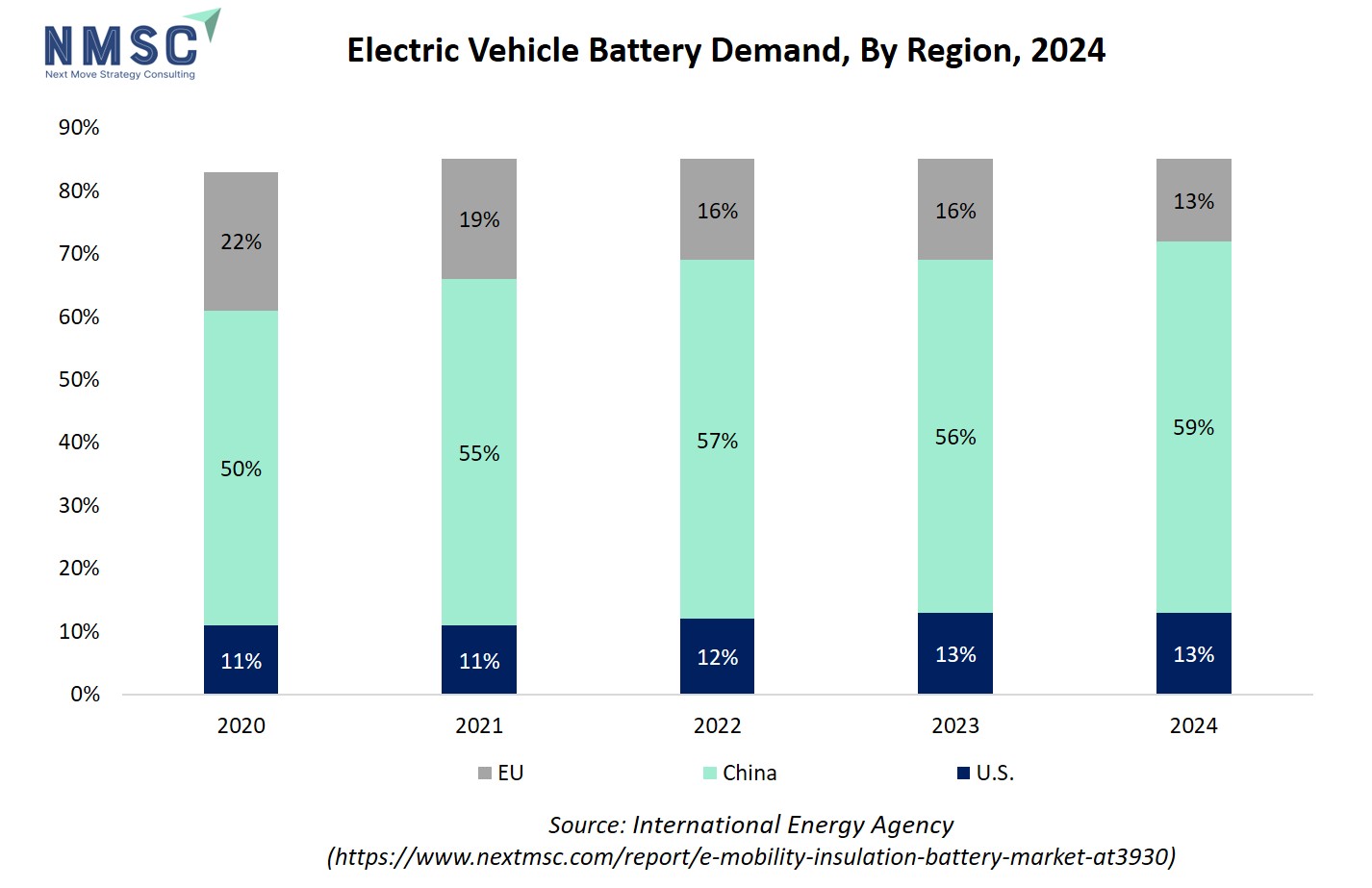
The chart illustrates regional electric vehicle battery demand from 2020 to 2024. The overwhelming concentration of battery demand in China highlights the pace and scale of electrification in its transportation sector. For the E-mobility insulation battery market, these dynamic drives innovation and capacity growth, especially in high-performance thermal and electrical insulation materials that ensure safe, efficient, and long-lasting battery operation for EVs. As regions accelerate EV adoption, robust insulation solutions become integral to battery performance and safety, positioning the battery thermal insulation segment for substantial growth led by demand in China and emerging global markets.
Will Stricter Safety and Lifecycle Standards Increase Insulation Adoption and Content?
Evolving safety and performance regulations are elevating insulation’s role in EV battery design. Stricter standards on thermal runaway containment, fire propagation, and lifecycle durability are pushing OEMs toward certified multilayer and flame-retardant systems. The U.S. Department of Energy and international insurers now require proven containment performance and long-term reliability testing. This regulatory tightening increases insulation layer counts and total material content per battery pack. Suppliers offering certified, traceable, and performance-tested insulation systems gain a competitive edge and command premium pricing as safety becomes a differentiating factor in EV platform approval.
Growth Inhibitors:
Could Material Cost and Raw Material Supply Volatility Impede Widespread Adoption of Premium Insulation Materials?
Advanced insulation materials such as aerogels, aramids, and high-performance polymer films remain cost-intensive due to complex processing and limited precursor supply chains. Volatility in key raw materials disrupts pricing stability, making it difficult for OEMs targeting affordable EV segments to justify higher insulation costs. In price-sensitive markets, OEMs down-spec insulation to balance cost per kWh. To mitigate this, suppliers pursue process efficiency, vertical integration, and modular product design that reduces waste and assembly time, offsetting premium material costs through total system savings.
Is Investing in Pre-Qualified Modular Insulation Assembly Lines a High ROI Opportunity?
As gigafactories multiply globally, establishing regional insulation module assembly and converting lines offers a strategic opportunity for high ROI. Localised, pre-qualified insulation modules shorten OEM validation cycles, minimise shipping costs, and secure long-term supply contracts. Early investors that combine automation, in-line testing, and regional partnerships capture preferred-supplier status and recurring revenue through multi-year framework agreements. With OEMs prioritising speed-to-market and local content compliance, such investments align with structural shifts in the EV supply chain and offer attractive, durable returns.
How Is the E-Mobility Insulation Battery Market Segmented in This Report, and What Are the Key Insights From the Segmentation Analysis?
By Material Type Insights
Is Thermal Insulation the Dominant Material Category in 2025?
Based on material type, the E-mobility insulation battery market is segmented into thermal insulation materials, electrical insulation materials, flame and fire barrier materials, acoustic and vibration damping materials, and structural and sealing materials.
Thermal insulation is the largest and most rapidly growing subsegment because thermal management directly affects range, life and safety. Government and OEMs focus on preventing thermal runaway, which elevates thermal materials such as foams, aerogels and phase change materials. DOE safety guidance highlights thermal runaway mitigation as a central R&D and regulation area, which pushes pack designers to increase thermal layers in module and pack designs. Suppliers prioritise thin high-performance thermal materials and validate them across abuse cases to capture share.
By Form Type Insights
Are Sheets and Panels Preferred by OEMs in 2025?
Based on form type, the E-mobility insulation battery market includes sheets and panels, films and foils, papers and fabrics, tapes and pads, and moulded and composite parts.
Sheets and panels remain dominant for pack-level insulation because they are easy to install at scale and compatible with automated assembly. Films and foils are commonly used for electrical isolation at the cell level, while moulded parts are gaining traction for module integration. Local converting capacity near gigafactories accelerates the adoption of precut panels and laminated modules. Suppliers offer assembly-ready formats and automation-friendly tolerances to lower OEM qualification friction.
By Vehicle Type Insights
Are Passenger Electric Vehicles Still the Principal End Market in 2025?
Based on vehicle type, the E-mobility insulation battery market is segmented into passenger electric vehicles, commercial electric vehicles, electric two-wheelers, electric industrial vehicles, electric aerospace platforms, and others.
Passenger electric vehicles remain the principal volume driver in 2025, accounting for the majority of battery GWh demand globally. IEA data shows cars continue as the primary driver of EV battery demand, though commercial vehicles and two-wheelers are gaining share rapidly. For insulation suppliers, this means passenger EV specifications set the baseline while commercial and heavy-duty segments create uplift opportunities for higher durability materials. Suppliers maintain passenger car qualification while developing higher-performance systems for heavy-duty and bus markets.
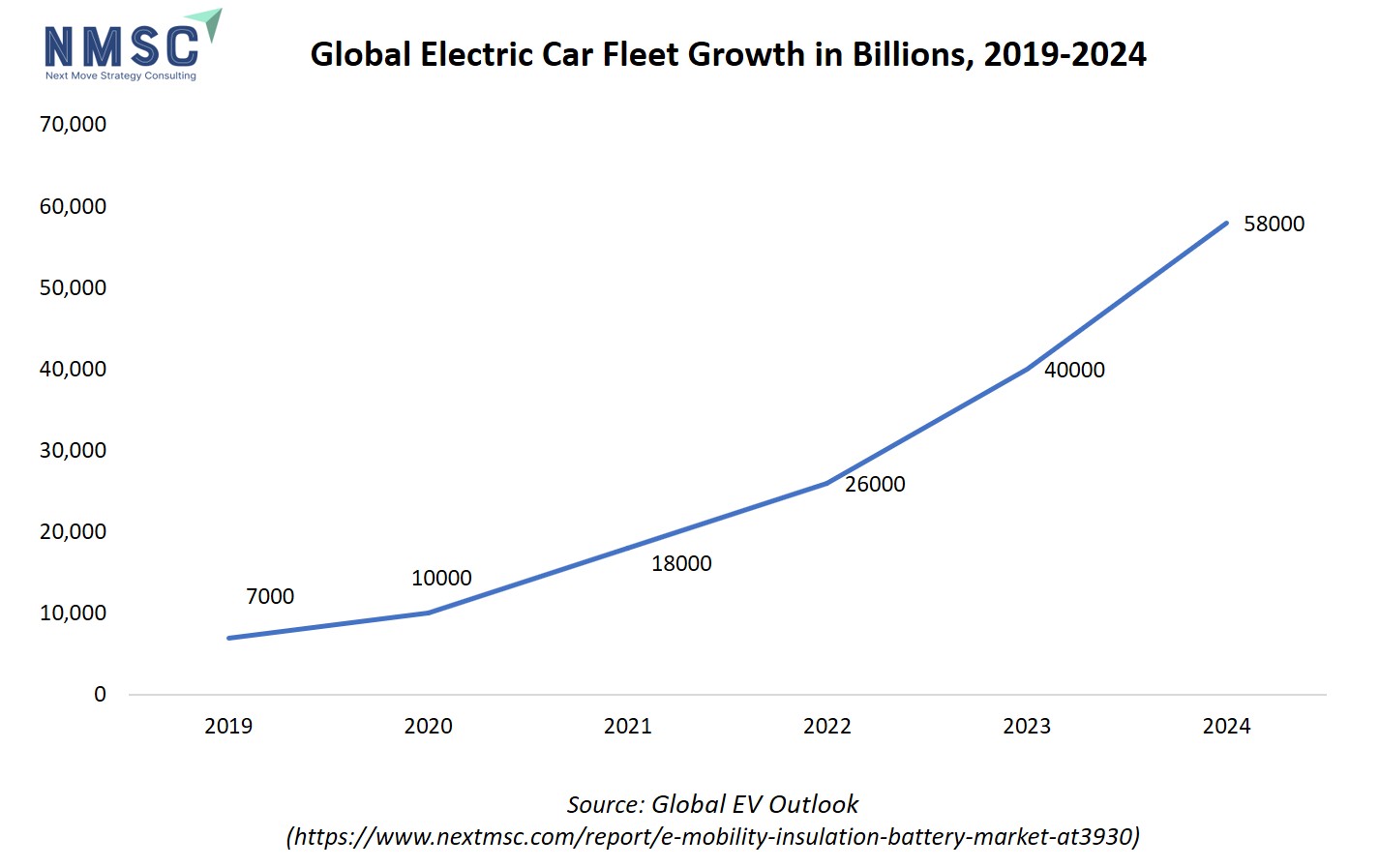
The chart shows an exponential rise in the global electric car fleet from 7,000 units in 2019 to 58,000 units in 2024, highlighting unprecedented EV adoption. This rapid growth demands advanced battery technologies that meet higher safety, performance, and longevity standards. For the E-mobility insulation battery market, this trend acts as a direct catalyst, where each new EV requires robust insulation materials to prevent thermal runaway, ensure safe operation, and optimise battery efficiency. As automakers and regulators intensify their focus on battery safety and reliability, the need for high-performance insulation solutions surges, making this segment integral to the sustainable scaling of electric mobility worldwide.
By Application Insights
Is Battery Insulation Driving the Largest Share of Spend?
Based on application, the E-mobility insulation battery market is categorised into battery insulation, power electronics insulation, electric motor insulation, high-voltage cable and busbar insulation, thermal runaway protection zones, and battery management system & connector insulation.
Battery Insulation typically captures the largest share of material spend through pack level insulation, because it combines thermal, electrical and mechanical protection across a larger area and meets fire containment tests. Module and cell-level insulation are critical but smaller in area. BMS and connector insulation are niche but high-value per unit area. As battery pack sizes and energy increase, absolute pack level insulation spend rises accordingly. Delivering validated pack-level systems with certification data accelerates OEM acceptance.
By End User Insights
Are OEMs the Primary Buyers of Insulation Solutions?
Based on end user, the E-mobility insulation battery market includes original equipment manufacturers, battery pack manufacturers, tier one integrators, and aftermarket service providers.
OEMs and battery pack manufacturers are primary buyers because they specify pack architecture and approve supplier credits. Tier one integrators and converters act as channel partners; aftermarket demand is currently smaller but will grow with used EV volumes. Suppliers that secure early OEM approvals or long-term supply agreements with pack integrators gain predictable volumes and lower customer acquisition costs. Source IEA and company investor communications.
Regional Outlook
The E-mobility insulation battery market is geographically studied across North America, Europe, Asia Pacific, the Middle East & Africa, and Latin America, and each region is further studied across countries.
E-mobility Insulation Battery Market in North America
North America is witnessing strong momentum in the E-mobility insulation battery market, driven by gigafactory expansion and federal initiatives promoting localised EV and energy storage supply chains. The U.S. Department of Energy’s safety and domestic sourcing mandates have created demand for qualified insulation suppliers near manufacturing hubs. Local content rules and EV tax incentives encourage converters to establish regional facilities offering tested, certified insulation materials. As OEMs scale production, proximity and compliance with U.S. standards are becoming decisive factors. Suppliers that align with DOE certification protocols and develop North American converting capacity are positioned to capture high-value contracts.
E-mobility Insulation Battery Market in the United States
The U.S. is leading North American growth through federal policy emphasis on advanced battery manufacturing, grid resilience, and EV safety R&D. Rising demand for thermal and flame barrier materials is driven by OEM qualification requirements and stricter energy safety standards. Manufacturers with rapid scale-up capability and validated product data are favoured by Tier 1 and Tier 2 integrators. The Department of Energy’s programs incentivise domestic innovation and material certification, pushing suppliers toward modular, safety-tested insulation systems. This regulatory-driven ecosystem fosters a competitive yet collaborative market focused on localised production and end-to-end supply security.
E-mobility Insulation Battery Market in Canada
Canada’s E-mobility insulation battery market is emerging alongside the country’s growing battery cell and pack manufacturing initiatives. Investments in Ontario and Quebec are strengthening regional production, while export linkages with U.S. assembly lines ensure steady insulation demand. Though smaller in scale, Canada benefits from stable industrial policy and cross-border logistics integration. For insulation suppliers, proximity to OEMs and material converters offers opportunities for collaboration. Setting up local converting or laminating units near battery facilities reduces lead times and enhances North American supply continuity.
E-mobility Insulation Battery Market in Europe
Europe remains a leader in EV and battery safety regulation, fostering demand for certified and recyclable insulation materials. The European Commission’s stringent recycling and safety directives require suppliers to ensure traceability and circularity in insulation systems. OEMs increasingly partner with regional converters to secure compliance-ready materials and shorten validation cycles. Localised production, adherence to EN standards, and material sustainability credentials are key competitive differentiators. As Europe scales its gigafactory base, insulation suppliers offering eco-designed and certified multilayer barriers are positioned to benefit from policy-backed growth.
E-mobility Insulation Battery Market in the United Kingdom
The UK E-mobility insulation battery market is maturing, supported by growing EV adoption and domestic battery pack integration. Insulation demand is concentrated around local integrators serving both domestic OEMs and export markets across Europe. Safety certification and flame-barrier validation are top priorities in the UK, which tightens its regulatory framework for EV manufacturing. Local converters capable of producing tested insulation modules gain a competitive advantage. Price premiums are evident for suppliers providing certified material data compatible with evolving UK automotive standards and insurer-driven safety requirements.
E-mobility Insulation Battery Market in Germany
Germany remains Europe’s technological and industrial hub for EV batteries, with high-quality standards driving premium insulation demand. Major OEMs and pack assemblers require extensively validated flame and thermal barriers for next-generation EVs. Germany’s engineering-intensive ecosystem emphasizes safety verification and multi-material testing, setting global benchmarks. For suppliers, securing qualification with leading OEMs offers access to high-volume, long-term contracts. Advanced composites, aramid barriers, and thin-film dielectrics are witnessing increased adoption, particularly in high-performance EV platforms.
E-mobility Insulation Battery Market in France
France’s growing EV production and electrification initiatives are accelerating demand for tested insulation systems. Supported by national investment programs and OEM demonstration projects, French suppliers and global partners are scaling capacity for flame-resistant, lightweight materials. Partnerships between automotive assemblers and material innovators are key to developing validated solutions for battery safety. France’s focus on manufacturing localisation and pack testing strengthens regional supply autonomy, making it an attractive hub for R&D and pilot manufacturing.
E-mobility Insulation Battery Market in Italy
Italy’s E-mobility insulation battery market is closely linked to its expanding tier-supplier ecosystem serving European automotive OEMs. Growth in EV component and sub-assembly production has driven up demand for specialised insulating materials and converter services. Local clusters in Lombardy and Piedmont host several battery component manufacturers, encouraging suppliers to localise production. Demand trends favour thin, high-dielectric materials that streamline pack assembly while meeting European safety standards.
E-mobility Insulation Battery Market in Spain
Spain’s increasing EV assembly capacity and growing adoption of consumer EVs are driving sustained demand for insulation at the pack level. Government support for EV incentives and renewable integration projects supports the E-mobility insulation battery market growth. Local converters are responding by offering pre-qualified thermal and electrical insulation systems that reduce OEM testing requirements. Spain’s geographic position enables suppliers to serve both Iberian and broader European manufacturing networks efficiently.
E-mobility Insulation Battery Market in the Nordics
Nordic nations, Sweden, Finland, Denmark, and Norway, stand out for their high EV penetration and strong safety culture. Their sustainability-driven regulations encourage early adoption of circular and recycled insulation materials. OEMs operating in the region seek certified, low-carbon materials that align with environmental goals. For suppliers, the Nordics provide pilot markets for eco-innovations such as bio-based laminates and recyclable thermal barriers, setting precedents for future EU-wide implementation.
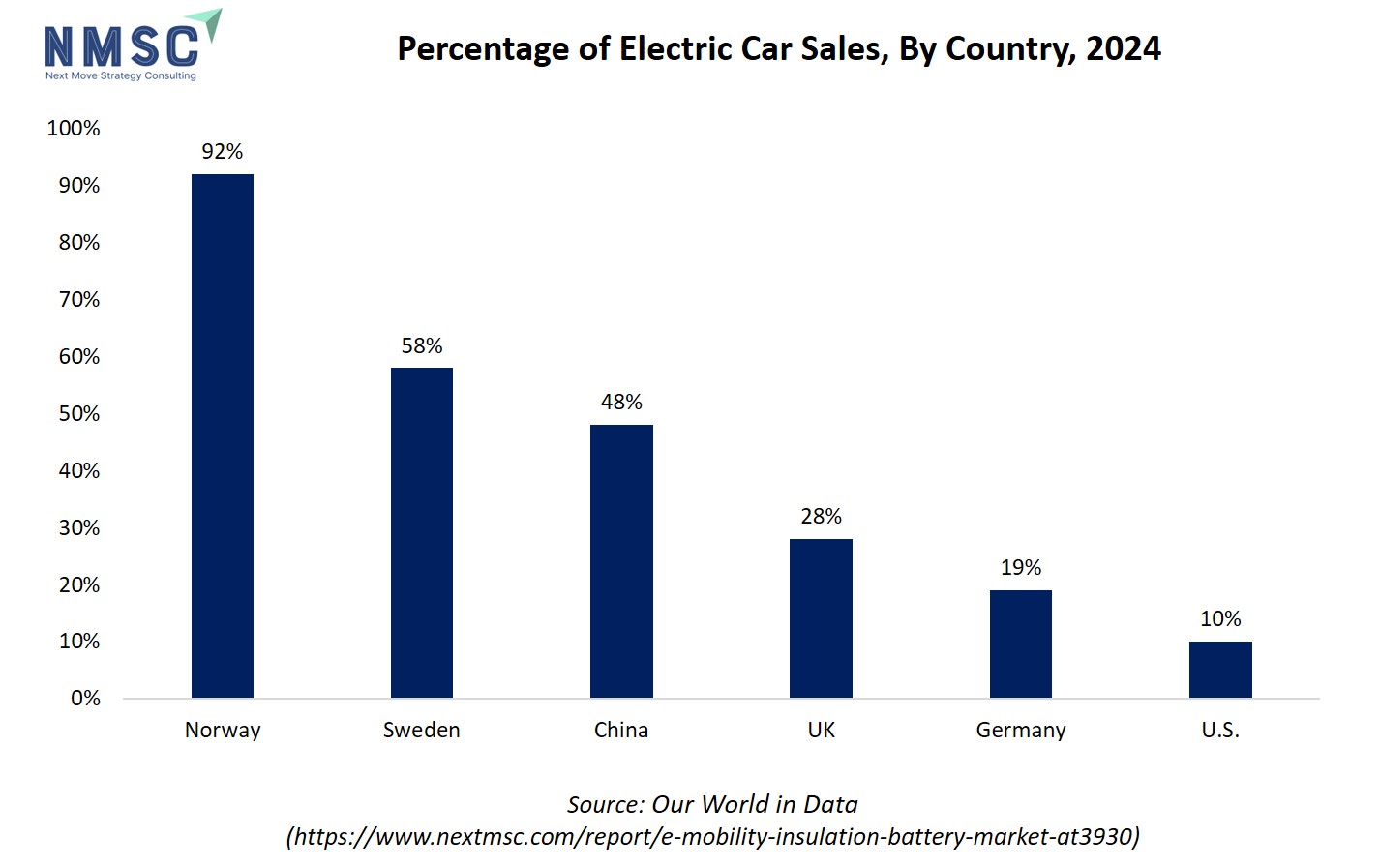
In 2024, Norway and Sweden showcase exceptional electric car market penetration, with electric vehicles accounting for 92% and 58% of total car sales, respectively. This high adoption rate reflects aggressive national policies, supportive infrastructure, and strong consumer acceptance of E-mobility. For the E-mobility insulation battery market, Norway and Sweden represent advanced lead markets where the demand for cutting-edge thermal and electrical insulation materials, critical for battery safety, longevity, and efficiency, is especially strong. As fleet electrification intensifies in these countries, automakers and battery suppliers accelerate the integration of innovative insulation solutions to ensure high performance and regulatory compliance, setting quality benchmarks for global E-mobility battery safety.
E-mobility Insulation Battery Market in the Asia-Pacific
Asia-Pacific dominates global E-mobility thermal runaway protection consumption due to its massive EV production capacity and strong manufacturing ecosystem. China and India drive volume, while Japan and South Korea contribute advanced material technology. With numerous gigafactories under construction, insulation demand spans from high-performance composites to cost-efficient foams. Suppliers in this region face intense price competition but benefit from high overall volume and integration into global supply chains.
E-mobility Insulation Battery Market in China
China commands the world’s largest EV battery production capacity, making it the leading consumer of insulation materials. State-backed initiatives for domestic innovation have encouraged partnerships between global insulation leaders and local converters. The market prioritizes cost efficiency and scale, with an increasing shift toward certified and thin insulation materials compatible with high-energy-density packs. China’s integration of insulation production into cell and pack manufacturing lines exemplifies vertical efficiency.
E-mobility Insulation Battery Market in Japan
Japan’s deep expertise in advanced polymers, ceramics, and aramid fibres drives the development of next-generation insulation solutions for premium EVs. Domestic OEMs specify highly validated materials for thermal management and dielectric integrity. The country’s strong R&D orientation positions it as a key innovator in multilayer laminates and hybrid barrier systems. Japan’s insulation market serves both local automotive leaders and export customers seeking top-tier quality and reliability.
E-mobility Insulation Battery Market in India
India’s surging EV adoption, especially in two-wheelers and passenger vehicles, is generating vast unit-based demand for insulation materials. While per-vehicle insulation volume is lower than in larger EVs, the aggregate need is significant. Localisation policies and PLI incentives for component manufacturing are encouraging insulation suppliers to establish domestic converting capacity. The market favours cost-effective materials that balance performance with affordability.
E-mobility Insulation Battery Market in South Korea
South Korea’s major battery manufacturers and automotive OEMs sustain strong demand for advanced insulation systems designed for high-density, fast-charging batteries. R&D programs focus on improving heat resistance, dielectric stability, and flame suppression in compact EV packs. LS Cable & System and other firms are investing in materials innovation for both domestic and export applications. Korea’s integration of materials R&D with cell design makes it a vital node in global supply chains.
E-mobility Insulation Battery Market in Taiwan
Taiwan plays a specialised role in the global E-mobility insulation battery market value chain through its advanced electronics and precision materials expertise. The country’s strong semiconductor and polymer processing ecosystem enables the production of ultra-thin, high-tolerance insulation films and thermal barriers for compact EV battery modules. Taiwanese converters serve as key suppliers to regional OEMs and battery pack manufacturers across East Asia, ensuring consistency and reliability for high-performance applications. Its ability to combine precision, thermal management, and electrical insulation within miniaturised designs makes it vital for advanced battery systems used in electric vehicles and energy storage solutions.
E-mobility Insulation Battery Market in Indonesia
Indonesia’s rapidly expanding E-mobility insulation battery market, underpinned by abundant nickel resources and national industrialisation programs, is driving rising insulation demand. As the country invests heavily in local cell and pack production, supporting materials such as flame barriers, thermal foils, and electrical insulators are becoming critical supply chain components. Domestic and regional converters are establishing operations near new manufacturing hubs to serve localised requirements efficiently. Government-backed initiatives promoting EV adoption and upstream battery value chain integration further stimulate material innovation and supplier entry. Over the next few years, Indonesia’s insulation market is expected to expand sharply in tandem with cell production and EV assembly growth.
E-mobility Insulation Battery Market in Australia
Australia’s E-mobility insulation battery market remains modest but is gaining relevance through the electrification of mining, defence, and industrial vehicles. The nation’s focus on sustainable energy and vehicle decarbonization supports the integration of high-performance thermal and electrical insulation in heavy-duty battery systems. Its proximity to Asia’s major battery manufacturing hubs enables cost-effective sourcing and regional collaboration. Niche opportunities exist for converters and suppliers catering to energy storage units, electric haul trucks, and off-road equipment. As domestic renewable infrastructure expands, demand for advanced insulation materials used in stationary storage and transport applications steadily increases, providing steady growth potential for local players.
E-mobility Insulation Battery Market in Latin America
Latin America’s emerging electrification wave is creating strong potential for E-mobility battery heat management materials, particularly in public transport and fleet electrification. Countries such as Brazil, Mexico, and Chile are investing in electric buses, two-wheelers, and localised EV assembly programs, which require certified insulation and fire-barrier components. Suppliers are entering through strategic partnerships with regional pack integrators and component assemblers to ensure compliance with evolving safety standards. The region’s high ambient temperatures drive the need for materials with superior thermal resistance and durability. As government incentives expand EV production, Latin America is poised to become a growing regional hub for insulation solutions.
E-mobility Insulation Battery Market in the Middle East & Africa
The Middle East and Africa are at an early but promising stage of developing E-mobility insulation battery market demand, led by industrial electrification and fleet modernisation. Emerging energy-transition projects, such as solar-powered transport, electric mining vehicles, and localised energy storage, are introducing the need for high-performance insulation systems. While large-scale EV adoption remains limited, regional governments are increasingly incorporating EV targets and renewable energy goals into national policies. This is expected to stimulate investment in thermal and flame-resistant insulation solutions. Suppliers that form early partnerships with local manufacturers and integrators secure first-mover advantages as the regional market matures.
Competitive Landscape
Which Companies Dominate the E-mobility Insulation Battery Industry and How do They Compete?
The competitive landscape includes large diversified materials manufacturers, specialist insulation and high-performance polymer suppliers, converters that offer precut and assembly-ready modules, and tier one integrators that combine insulation with thermal management systems. Public company earnings and annual reports show increased R&D and product launches targeting electric mobility applications, indicating competition on innovation, qualification speed and supply chain proximity. Market participants increasingly pursue vertical integration and partnership with pack integrators to secure long-term offtake.
Market Dominated by E-mobility Insulation Battery Giants and Specialists
The E-mobility insulation battery market is characterised by a dual structure where global material conglomerates and niche specialists operate side by side. Large diversified companies with extensive polymer, adhesive, and composite portfolios compete directly with smaller players specialising in mica sheets, aramid fibres, or aerogel-based insulation systems. The key competitive differentiators include validated system-level performance, compliance with OEM qualification standards, and the ability to offer local converting and logistics support. Firms that provide certified safety testing, consistent regional delivery, and proven integration experience are better positioned to secure long-term contracts with Tier 1 suppliers and major EV OEMs.
Innovation and Adaptability Drive Market Success
Market success increasingly depends on innovation speed, adaptability to evolving safety standards, and delivery of assembly-ready insulation products. Manufacturers are investing heavily in R&D and accelerated validation programs that align with emerging fire safety and dielectric testing protocols. Disclosures show leading players launching new insulation composites and prefabricated modules tailored for high-performance EV applications. Rapid qualification cycles, embedded test data, and automation in converting to OEM tolerances are becoming decisive for supplier selection. Companies that combine material innovation with manufacturing flexibility and end-to-end testing capture a larger share of the expanding EV insulation value chain.
Market Players to Opt for Merger & Acquisition Strategies to Expand their Presence
Mergers and acquisitions are emerging as a key strategy among insulation material suppliers to expand geographic reach, enhance technological capabilities, and acquire local converting capacity. Recent consolidation trends, such as corporate movements around Von Roll in 2024, illustrate strategic repositioning across the electrical insulation landscape. Firms are increasingly using M&A to diversify material portfolios, especially in thermal, electrical, and flame-barrier segments, and to integrate downstream capabilities like module assembly. These strategic acquisitions accelerate market entry, shorten OEM qualification timelines, and strengthen competitiveness in delivering turnkey insulation systems for battery packs and E-mobility applications.
List of Key E-mobility Insulation Battery Companies
-
3M
-
Autoneum
-
BASF
-
DUPont
-
ITW Formex
-
Morgan Advanced Materials
-
Marian
-
Alkegen
-
Von Roll
-
Rogers Corporation.
-
The Gund Company,
-
Wacker Chemie AG
-
OC Oerlikon Management AG
What Are the Latest Key Industry Developments?
-
November 2025- Henkel AG & Co. launched dual thermal potting solutions, Loctite SI 5643 and SI 5637, to address the need for improved protection and thermal management in on-board chargers and inverters for EVs.
-
September 2025- 3M showcased their latest EV battery protection solutions and insulation materials at IAA Mobility 2025, including 3M VHB Extrudable Tape and stretch release technology for efficient and safe battery pack assembly and disassembly.
-
May 2025- Zotefoams plc. debuted innovative high-purity, lightweight supercritical foams for battery insulation at The Battery Show Europe, including ECOZOTE PP and ZOTEK T series, which offer improved temperature regulation, impact protection, and recyclability for EV batteries.
What Are the Key Factors Influencing Investment Analysis & Opportunities in the E-mobility Insulation Battery Market?
Investment decisions centre on battery GWh growth trajectories, product qualification lead times, and capital intensity for regional converting or module assembly. Funding trends in 2024 2025 show capital flowing into battery cell and pack manufacturing, and adjacent suppliers of insulation materials benefit from follow-on private equity and strategic corporate investment as OEMs secure local supply chains. Valuations for speciality materials firms reflect differentiation via proprietary chemistries, testing capabilities, and regional footprint. Investment hotspots include local converting capacity near gigafactories, test laboratories that support OEM qualification, and composite module makers that reduce OEM assembly complexity.
Key Benefits for Stakeholders:
Next Move Strategy Consulting (NMSC) presents a comprehensive analysis of the E-mobility insulation battery market, covering historical trends from 2020 through 2025 and offering detailed forecasts through 2035. Our study examines the market at regional and country levels, providing quantitative projections and insights into key growth drivers, challenges, and investment opportunities across all major E-mobility Insulation Battery segments.
Investors gain exposure to secular EV battery demand growth with relatively lower product cycle risk than cell makers when backing insulation suppliers that secure long-term OEM qualifications and regional converting contracts. Customers, including OEMs and pack integrators, benefit from reduced assembly complexity, improved safety and predictable supply when sourcing pre-qualified insulation modules. Regulators and insurers benefit from standardised, tested materials that lower system-level risk. Suppliers that capture preferred supplier status benefit from repeatable volumes and pricing power. The net stakeholder benefit is a more resilient battery supply chain with modular, certified insulation solutions that reduce integration risk and speed time to production.
Report Scope
|
Parameters |
Details |
|
Market Size in 2026 |
USD 2.08 Billion |
|
Revenue Forecast in 2035 |
USD 3.46 Billion |
|
Growth Rate |
CAGR of 5.84% from 2026 to 2035 |
|
Analysis Period |
2025–2035 |
|
Base Year Considered |
2025 |
|
Forecast Period |
2026–2035 |
|
Market Size Estimation |
Billion (USD) |
|
Growth Factors |
|
|
Companies Profiled |
15 |
|
Countries Covered |
33 |
|
Market Share |
Available for 10 companies |
|
Customization Scope |
Free customization (equivalent to up to 80 analyst-working hours) after purchase. Addition or alteration to country, regional, & segment scope. |
|
Pricing and Purchase Options |
Avail customized purchase options to meet your exact research needs. |
|
Approach |
In-depth primary and secondary research; proprietary databases; rigorous quality control and validation measures. |
|
Analytical Tools |
Porter's Five Forces, SWOT, value chain, and Harvey ball analysis to assess competitive intensity, stakeholder roles, and relative impact of key factors. |
Key Market Segments
By Material Type
-
Thermal Insulation Materials
-
Electrical Insulation Materials
-
Flame and Fire Barrier Materials
-
Acoustic and Vibration Damping Materials
-
Structural and Sealing Materials
By Form Type
-
Sheets and Panels
-
Films and Foils
-
Papers and Fabrics
-
Tapes and Pads
-
Molded and Composite Parts
By Material Chemistry
-
Polymer-based insulation materials
-
Ceramic-based insulation materials
-
Fiber-based insulation materials
-
Elastomeric insulation materials
-
Microporous and aerogel-based insulation materials
-
Hybrid and multilayer composite materials
By Vehicle Type
-
Passenger Electric Vehicles
-
Commercial Electric Vehicles
-
Light commercial vehicles
-
Medium and heavy commercial vehicles
-
-
Electric Two Wheelers
-
Electric Industrial Vehicles
-
Electric Aerospace Platforms
-
Others
By Application
-
Battery insulation
-
Cell level
-
Module level
-
Pack level
-
-
Power electronics insulation
-
Inverters and converters
-
Onboard chargers
-
DC converters
-
-
Electric motor insulation
-
High-voltage cable and busbar insulation
-
Thermal runaway protection zones
-
Battery management system and connector insulation
By End User
-
Original Equipment Manufacturers (OEMs)
-
Battery Pack Manufacturers
-
Tier One Integrators
-
Aftermarket Service Providers
Geographical Breakdown
-
North America: U.S., Canada, and Mexico.
-
Europe: UK, Germany, France, Italy, Spain, Sweden, Denmark, Finland, the Netherlands, and rest of Europe.
-
Asia Pacific: China, India, Japan, South Korea, Taiwan, Indonesia, Vietnam, Australia, Philippines, Malaysia and rest of APAC.
-
Middle East & Africa (MEA): Saudi Arabia, UAE, Egypt, Israel, Turkey, Nigeria, South Africa, and rest of MEA.
-
Latin America: Brazil, Argentina, Chile, Colombia, and rest of LATAM
Conclusion & Recommendations
Our report equips stakeholders, industry participants, investors, and consultants with actionable intelligence to capitalise on E-mobility Insulation Battery’s transformative potential. By combining robust data-driven analysis with strategic frameworks, NMSC’s E-mobility insulation battery market report serves as an indispensable resource for navigating the evolving landscape.
The E Mobility insulation battery market is positioned for sustained growth driven by multi-fold increases in EV battery GWh demand and stronger safety and regulatory emphasis that raise per-pack insulation requirements. Suppliers that combine rapid qualification, regional converting capacity and multifunctional module-level offerings capture premium contracts as OEMs prioritise safety-certified, assembly-ready components. Investors evaluate firms on the qualification pipeline, proximity to gigafactories and ability to produce verifiable fire and thermal performance datasets. Executives accelerate partnerships with tier one integrators and invest in laboratories that short-circuit the OEM test cycle.
For executives and investors, the key to capitalising on these trends lies in identifying high-potential segments, investing in R&D for innovative E-mobility insulation battery solutions, and fostering strategic partnerships to expand market reach. Prioritising establishing regional converting capacity near major gigafactories to shorten lead times and win volume contracts. Investing in certified testing and providing OEM-ready qualification kits to reduce approval time.


About the Author
 Ridip Gogoi
— Ridip Gogoi is a Research Associate at Next Move Strategy Consulting, where he supports cross-vertical market research and analysis across multiple industry sectors, with four years of experience. His work includes market analysis, data validation, secondary research, and insight development, helping structure evidence into clear findings for business and strategy decisions. He contributes to research quality checks and reporting, with a focus on consistency, source review, and clarity accuracy.
Ridip Gogoi
— Ridip Gogoi is a Research Associate at Next Move Strategy Consulting, where he supports cross-vertical market research and analysis across multiple industry sectors, with four years of experience. His work includes market analysis, data validation, secondary research, and insight development, helping structure evidence into clear findings for business and strategy decisions. He contributes to research quality checks and reporting, with a focus on consistency, source review, and clarity accuracy.
About the Reviewer
 Supradip Baul
— Supradip Baul is an accomplished business consultant and strategist with over a decade of rich experience in market intelligence, strategy, technology, and business transformation. His work has included rigorous qualitative and quantitative analysis across multiple industries, helping clients shape investment decisions and long-term roadmaps. Earlier in his career, he was associated with Gartner, where he contributed to industry-leading reports and market share analyses. He has worked with leading global companies and holds an MBA with a dual specialization in Marketing and Finance.
Supradip Baul
— Supradip Baul is an accomplished business consultant and strategist with over a decade of rich experience in market intelligence, strategy, technology, and business transformation. His work has included rigorous qualitative and quantitative analysis across multiple industries, helping clients shape investment decisions and long-term roadmaps. Earlier in his career, he was associated with Gartner, where he contributed to industry-leading reports and market share analyses. He has worked with leading global companies and holds an MBA with a dual specialization in Marketing and Finance.
At Next Move Strategy Consulting, we understand that insightful market research is the cornerstone of successful business decisions. That's why we employ a robust and multifaceted approach, combining various methodologies to deliver the most accurate and actionable data for our clients.

Research Landscape
We navigate the world of research with two primary approaches:
Qualitative Approach
Our qualitative research methodologies involve immersive techniques such as in-depth interviews, focus groups, and observational studies. By engaging directly with individuals and stakeholders, we uncover valuable insights that quantitative data alone may overlook.

Quantitative Research
In tandem with qualitative methodologies, NMSC leverages the power of Quantitative Research to provide a robust foundation of numerical insights. Through systematic data collection and analysis, we quantify patterns, preferences, and market trends, offering a comprehensive view of the business landscape.
Our quantitative research approach employs diverse tools, including surveys, experiments, and statistical modelling. These methodologies enable us to gather data from a large and representative sample, ensuring the statistical significance of our findings. By employing structured questionnaires and standardized data collection methods, we guarantee the reliability and validity of the information we present to our clients.
Quantitative research is particularly effective in measuring the prevalence of trends, assessing market size, and gauging the impact of various factors on consumer behavior. The numerical precision attained through this approach equips our clients with actionable insights, facilitating data-driven decision-making and strategy formulation.


Our Specialized Toolbox for Industry-Specific Market Research
We deploy a specialized arsenal of techniques tailored to meet your unique requirements. Here's a glimpse into our comprehensive toolbox:

Information Procurement
The stage entails acquiring market data or relevant information through various sources and methodologies.


Market Research Approach
We utilize both top-down and bottom-up approaches in market research analysis to achieve a comprehensive understanding of the market dynamics, leveraging the broad perspective of industry trends and macroeconomic factors alongside detailed insights from specific segments and individual companies.

Porters Five Forces Analysis
We conduct Porter's Five Forces analysis to evaluate the competitive landscape of an industry, providing us with insights into factors that affect profitability and strategic positioning.

SWOT Analysis

Forecasting
We utilize a forecasting model to predict future consumption by considering parameters like population, economics, regulations, market competition, drivers, constraints, technology, and pricing. We also employ statistical techniques such as multilinear regression, exponential smoothing, moving average, ARIMA, and Monte Carlo simulations for accurate predictions. In econometric forecasting, we analyzed short-term and long-term event impacts, attributing values based on regulatory frameworks, economic factors, and market events.





 Speak to Our Analyst