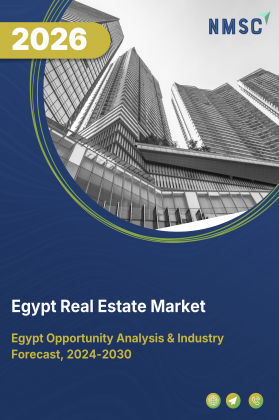
Egypt Real Estate Market By Property Size (Small, Medium, and Large), By Property Type (Residential, Commercial, Land, and Industrial), By Business Type (Buying, Selling, Leasing, and Real Estate Investment), By Ownership (Owner-Occupied Properties, Rental Properties and Co-ownership), By Property Value (Affordable Housing, Luxury Housing, and Ultra-Luxury Housing), and By End-User (Individual Buyers, Government, and Others) – Opportunity Analysis and Industry Forecast, 2025–2030
Industry: Construction & Manufacturing | Lastest Edition: June 4, 2026 | No of Pages: 184 | No. of Tables: 144 | No. of Figures: 89 | Format: PDF | Report Code : CM4275
Industry Outlook
The Egypt Real Estate Market size was valued at USD 122.7 billion in 2024 and is expected to reach USD 136.8 billion by 2025. Looking ahead, the market is projected to expand significantly, reaching USD 180.9 billion by 2030, at a CAGR of 5.7% from 2025 to 2030.
Egypt’s real estate market is experiencing strong growth, driven by rapid urbanization, population expansion, and large-scale government-led development projects. The construction of new cities such as the New Administrative Capital and New Alamein is reshaping the country’s urban landscape and attracting both domestic and foreign investment. Residential and commercial segments continue to perform well, supported by rising middle-class demand and infrastructure improvements. The government’s focus on affordable housing and sustainable urban planning further supports market expansion. While inflation and financing challenges persist, Egypt’s long-term real estate outlook remains positive, anchored by demographic growth, modernization, and robust public sector initiatives.
Economic Reforms and Urban Development Drive Egypt Real Estate Market Expansion
The real estate market in Egypt is expanding rapidly, supported by ongoing economic reforms, population growth, and massive urban development initiatives. The government’s New Administrative Capital and new city projects such as New Alamein and New Mansoura are reshaping the country’s urban landscape. Improved infrastructure, better governance, and strong investor confidence are fueling demand for residential, commercial, and mixed-use properties. These large-scale initiatives are not only reducing congestion in Cairo but also diversifying investment opportunities and strengthening Egypt’s position as one of North Africa’s most dynamic real estate markets.
Growing Middle Class and Infrastructure Investments Accelerate Egypt Real Estate Market Growth
Egypt’s expanding middle class and significant infrastructure investments are fueling sustained real estate demand. Rising household incomes, combined with improved access to mortgage financing, are boosting residential sales in both urban and suburban areas. Infrastructure projects such as high-speed rail lines, smart cities, and industrial zones are increasing land value and attracting private developers. The government’s public-private partnership (PPP) model encourages domestic and foreign participation, while continuous improvements in transportation and utilities underpin the long-term growth potential of Egypt’s real estate sector.
Currency Fluctuations and Rising Construction Costs are Restricting Market Growth
Egypt’s real estate market faces challenges from high construction costs, inflation, and currency volatility. The depreciation of the Egyptian pound has increased the price of imported materials, leading to higher project expenses and reduced developer margins. Additionally, limited access to affordable financing and fluctuating interest rates hinder housing affordability for many buyers. These financial pressures slow project completion and market absorption. Maintaining economic stability, incentivizing local material production, and enhancing credit access will be key to mitigating these challenges and sustaining growth momentum.
Affordable Housing and Smart City Projects Create New Growth Opportunities in the Egypt Real Estate Market
The government’s focus on affordable housing and smart city development is opening new opportunities across Egypt’s real estate landscape. Initiatives such as the Housing for All Egyptians program aim to address the housing shortage and improve affordability for low- and middle-income families. Simultaneously, smart city projects like the New Administrative Capital integrate advanced technologies, sustainable energy, and digital infrastructure. These developments attract investors seeking long-term returns and align with Egypt’s broader vision for inclusive, connected, and environmentally responsible urban growth.
Competitive Landscape
Several key players operating in the Egypt real estate industry include EMAAR Properties; Talaat Moustafa Group Holding; Palm Hills Developments; SODIC; Saudi Egyptian Developers (SED); Orascom Development; BETA Developments; Wadi Degla Developments; Al Ahly Sabbour; Egyptian Developers; Al Marasem Development; Karnak Real Estate Developments; Hyde Park Developments, and others.
Egypt Real Estate Market Key Segments
By Property Size
-
Small (<500 sq. ft.)
-
Medium (500–2000 sq. ft.)
-
Large (2000+ sq. ft.)
By Property Type
-
Residential
-
Apartments/Flats
-
Single-Family Homes
-
Multi-Family Homes
-
Condominiums
-
Townhouses
-
Vacation Homes
-
-
Commercial
-
Office Spaces
-
Retail Spaces
-
Co-working Spaces
-
Warehouses
-
-
Land
-
Urban Plots
-
Suburban/Rural Plots
-
-
Industrial
-
Manufacturing Plants
-
Distribution Centers
-
Data Centers
-
By Business Type
-
Buying
-
Selling
-
Leasing
-
Renting
-
Real Estate Investment
-
Direct Property Investment
-
Real Estate Investment Trusts (REITs)
-
By Ownership
-
Owner-Occupied Properties
-
Rental Properties
-
Co-ownership
By Property Value
-
Affordable Housing
-
Luxury Housing
-
Ultra-Luxury Housing
By End User
-
Individual Buyers
-
First-time Homebuyers
-
Repeat Buyers
-
Luxury Buyers
-
Seniors/Retirees
-
-
Business Entities
-
Startups
-
SMEs
-
Large Corporations
-
-
Government
-
Civic Projects
-
Affordable Housing Initiatives
-
-
Institutional Investors
Key Players
-
EMAAR Properties
-
Talaat Moustafa Group Holding
-
Palm Hills Developments
-
SODIC
-
Saudi Egyptian Developers (SED)
-
Orascom Development
-
BETA Developments
-
Wadi Degla Developments
-
Al Ahly Sabbour
-
Egyptian Developers
-
Al Marasem Development
-
Karnak Real Estate Developments
-
Hyde Park Developments
-
Madinet Masr
-
HMD Group
Report Scope and Segmentation
|
Parameters |
Details |
|
Market Size in 2025 |
USD 136.8 Billion |
|
Revenue Forecast in 2030 |
USD 180.9 Billion |
|
Growth Rate |
CAGR of 5.7% from 2025 to 2030 |
|
Base Year Considered |
2024 |
|
Forecast Period |
2025–2030 |
|
Market Size Estimation |
Billion (USD) |
|
Growth Factors |
|
|
Companies Profiled |
15 |
|
Market Share |
Available for 10 companies |
|
Customization Scope |
Free customization (equivalent up to 80 working hours of analysts) after purchase. Addition or alteration to country, regional, and segment scope. |
|
Pricing and Purchase Options |
Avail customized purchase options to meet your exact research needs. |


About the Author
 Mayurima Roy is a research analyst delivering data-driven insights that support strategic planning and market understanding. She combines analytical rigor with strong content development skills, translating complex information into clear, actionable narratives for diverse audiences. Her work includes structured research, trend tracking, competitive assessment, and insight-led content creation that supports informed decision-making. Curious and detail-oriented by nature, she continually deepens her understanding of evolving markets while pursuing creative interests such as crafting and video creation.
About the Reviewer
 Supradip Baul is an accomplished business consultant and strategist with over a decade of rich experience in market intelligence, strategy, technology, and business transformation. His work has included rigorous qualitative and quantitative analysis across multiple industries, helping clients shape investment decisions and long-term roadmaps. Earlier in his career, he was associated with Gartner, where he contributed to industry-leading reports and market share analyses. He has worked with leading global companies and holds an MBA with a dual specialization in Marketing and Finance.
At Next Move Strategy Consulting, we understand that insightful market research is the cornerstone of successful business decisions. That's why we employ a robust and multifaceted approach, combining various methodologies to deliver the most accurate and actionable data for our clients.

Research Landscape
We navigate the world of research with two primary approaches:
Qualitative Approach
Our qualitative research methodologies involve immersive techniques such as in-depth interviews, focus groups, and observational studies. By engaging directly with individuals and stakeholders, we uncover valuable insights that quantitative data alone may overlook.

Quantitative Research
In tandem with qualitative methodologies, NMSC leverages the power of Quantitative Research to provide a robust foundation of numerical insights. Through systematic data collection and analysis, we quantify patterns, preferences, and market trends, offering a comprehensive view of the business landscape.
Our quantitative research approach employs diverse tools, including surveys, experiments, and statistical modelling. These methodologies enable us to gather data from a large and representative sample, ensuring the statistical significance of our findings. By employing structured questionnaires and standardized data collection methods, we guarantee the reliability and validity of the information we present to our clients.
Quantitative research is particularly effective in measuring the prevalence of trends, assessing market size, and gauging the impact of various factors on consumer behavior. The numerical precision attained through this approach equips our clients with actionable insights, facilitating data-driven decision-making and strategy formulation.


Our Specialized Toolbox for Industry-Specific Market Research
We deploy a specialized arsenal of techniques tailored to meet your unique requirements. Here's a glimpse into our comprehensive toolbox:

Information Procurement
The stage entails acquiring market data or relevant information through various sources and methodologies.


Market Research Approach
We utilize both top-down and bottom-up approaches in market research analysis to achieve a comprehensive understanding of the market dynamics, leveraging the broad perspective of industry trends and macroeconomic factors alongside detailed insights from specific segments and individual companies.

Porters Five Forces Analysis
We conduct Porter's Five Forces analysis to evaluate the competitive landscape of an industry, providing us with insights into factors that affect profitability and strategic positioning.

SWOT Analysis

Forecasting
We utilize a forecasting model to predict future consumption by considering parameters like population, economics, regulations, market competition, drivers, constraints, technology, and pricing. We also employ statistical techniques such as multilinear regression, exponential smoothing, moving average, ARIMA, and Monte Carlo simulations for accurate predictions. In econometric forecasting, we analyzed short-term and long-term event impacts, attributing values based on regulatory frameworks, economic factors, and market events.





 Speak to Our Analyst