EMG Biosensors Market Global Industry Analysis and Forecast (2026-2035)

EMG Biosensors Market size was USD 845.0 million in 2026, projected to reach USD 2,179.0 million by 2035, growing at a CAGR of 11.1% from 2026 to 2035. Key drivers include rising prevalence of musculoskeletal and neuromuscular disorders, expanding wireless sensor adoption, and growing human-machine interface and prosthetics control applications, with North America leading the market.

Download Free Sample PDF
Base Year (2025)
$762.0 Million
Forecast (2035)
$2,179.0 Million
CAGR (2026-2035)
11.1%
Top Region
North America

What Is the EMG Biosensors Market Size?

The global EMG biosensors market size was valued at USD 762.0 million in 2025 and is estimated at USD 845.0 million in 2026, forecast to reach USD 2,179.0 million by 2035, expanding at an 11.1% CAGR between 2026 and 2035. North America leads with approximately a 39% share, while Surface EMG Biosensors dominate the Intramuscular EMG Biosensors type with approximately a 71% share.

We observed that growth is broad-based across every segmentation axis, with wireless connectivity and human-machine interface applications driving the dominant structural shifts through 2035.

EMG Biosensors Market Global Industry Analysis and Forecast (2026-2035) Revenue Forecast

Values in USD Million

2025 $762.0 Million
2025
2026 $846.6 Million
2026
2027 $940.6 Million
2027
2028 $1,045.0 Million
2028
2029 $1,160.9 Million
2029
2030 $1,289.8 Million
2030
2031 $1,433.0 Million
2031
2032 $1,592.0 Million
2032
2033 $1,768.8 Million
2033
2034 $1,965.1 Million
2034
2035 $2,179.0 Million
2035

Key Takeaways

By Type: Surface EMG Biosensors held the largest share of approximately 71% (USD 541.0 million) in 2025; Surface EMG Biosensors is also the fastest-growing sub-segment at 11.9% CAGR from 2026–2035.

By Connectivity: Wireless held the largest share of approximately 58% (USD 442.0 million) in 2025; Wireless is also the fastest-growing sub-segment at 13.6% CAGR from 2026–2035.

By Offering: Hardware held the largest share of approximately 64% (USD 487.7 million) in 2025; Software is the fastest-growing sub-segment at 15.0% CAGR from 2026–2035.

By Application: Neuromuscular Disease Diagnosis held the largest share of approximately 27% (USD 205.7 million) in 2025; Human-Machine Interface and Prosthetics Control is the fastest-growing sub-segment at 16.8% CAGR from 2026–2035.

By End User: Hospitals and Clinics held the largest share of approximately 34% (USD 259.1 million) in 2025; Home Care Settings is the fastest-growing sub-segment at 18.4% CAGR from 2026–2035.

Dominant Region: North America dominated with approximately 39% revenue share (USD 297.2 million) in 2025.

Fastest-Growing Region: Asia-Pacific is expected to register the highest CAGR of 14.6% during 2026–2035.

Dominant Country: U.S. led with approximately USD 243.7 million in 2025.

Fastest-Growing Country: India is the fastest-growing country at approximately 17.6% CAGR from 2026–2035.

Ecosystem Analysis of the EMG Biosensors Industry

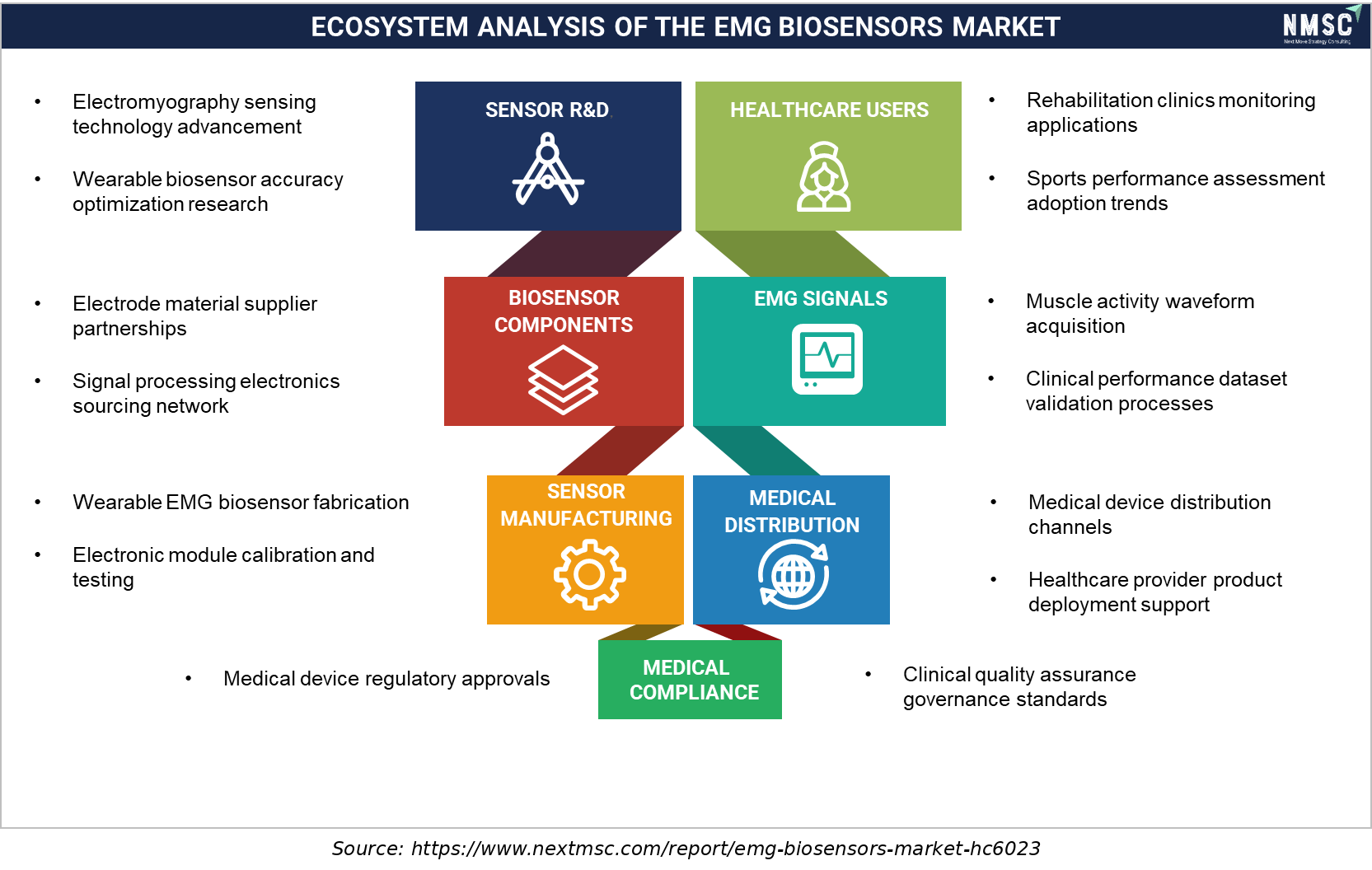
The above infographic presents an ecosystem analysis of the EMG biosensors market, covering sensor R&D, manufacturing, distribution, healthcare users, and regulatory governance. Advancements in electromyography sensing and wearable biosensor accuracy are supported by electrode material suppliers and signal processing electronics. Fabrication and calibration processes ensure device reliability, while medical device approvals govern market entry. Healthcare providers and sports professionals are adopting these sensors for muscle activity monitoring and performance assessment. Looking ahead, we observed that clinical validation and quality assurance remain essential for sustaining trust and expanding applications across medical and sports sectors.

What Does the EMG Biosensors Market Encompass?

The EMG biosensors market encompasses surface and intramuscular electromyography sensors, amplifiers, and associated software that detect and analyze electrical signals generated by muscle activity for clinical, research, and consumer applications. Our assessment indicates that the scope spans wired and wireless sensor hardware, signal processing software, and related services supplied to hospitals, rehabilitation centers, academic institutions, and sports organizations for neuromuscular diagnosis, physical therapy, biomechanics research, and prosthetics control.

Regulatory frameworks such as the U.S. Food and Drug Administration's medical device clearance pathways shape clinical-grade sensor approval timelines, while data privacy regulations increasingly influence cloud-based signal storage architecture. We observed that technology adoption is shifting toward AI-enabled human machine interface applications that translate muscle signals into device control commands, a structural change that NMSC's analysis indicates is redefining sensor design priorities across the EMG biosensors market.

Market Drivers & Dynamics

Interactive Dataset
Rising prevalence of musculoskeletal and neuromuscular disorders driver +2.1% Global 2026–2035
Expanding wireless sensor adoption across clinical and research settings driver +1.8% North America, Europe 2026–2033
Growing human-machine interface and prosthetics control applications driver +1.6% Global 2026–2034
Rising sports science and biomechanics research investment driver +1.2% North America, Europe, Asia-Pacific 2026–2035
Expanding telehealth and remote rehabilitation monitoring adoption driver +1.0% Global 2026–2032
Growing academic and research institute funding for biosignal research driver +0.8% Asia-Pacific 2026–2035
High costs of clinical-grade wireless EMG systems restraint −1.2% Global 2026–2035
Signal variability and inconsistent electrode placement standardization restraint −0.9% Global 2026–2032
Regulatory hurdles for clinical-grade sensor approval restraint −0.6% North America, Europe 2026–2033
Data privacy concerns limiting cloud-based signal storage adoption restraint −0.4% Europe, North America 2028–2035
Source: Next Move Strategy Consulting

Growth Drivers

What Is the Primary Growth Driver of the Market?

Rising prevalence of musculoskeletal and neuromuscular disorders is the primary driver of the market. According to the World Health Organization, musculoskeletal conditions affect approximately 1.71 billion people globally, sustaining baseline demand for diagnostic and rehabilitation-focused EMG sensor systems across hospitals and clinics. We observed that this disease burden, reinforced by aging populations in developed markets, continues to anchor consistent procurement of both surface and intramuscular EMG biosensors across clinical and research settings.

How Is Wireless Sensor Adoption Driving Market Growth?

Growing adoption of wireless, untethered EMG sensor systems is accelerating platform upgrades as clinical and research users prioritize unrestricted movement during data collection. Noraxon USA's continued expansion of its Ultium EMG wireless sensor line, featuring real-time data synchronization, reflects sustained vendor investment in eliminating cable-related motion artifacts. Our assessment indicates that this wireless transition is compressing legacy wired system replacement cycles across research institutions and sports science laboratories.

Growth Inhibitors

What Is Restraining EMG Biosensors Market Expansion?

High costs of clinical-grade wireless EMG systems restrain broader adoption, particularly among smaller rehabilitation clinics and academic institutions with constrained equipment budgets. Signal variability caused by inconsistent electrode placement across different practitioners further complicates standardized data interpretation, a challenge documented across biomechanics research literature. We found that regulatory approval hurdles for new clinical-grade sensor designs further slow product launch timelines for smaller specialized manufacturers.

What Are the Growth Opportunities?

How Can Vendors Capture Home Care Rehabilitation Monitoring Demand?

Home care settings represent a whitespace opportunity as telehealth-compatible EMG systems extend rehabilitation monitoring beyond clinical facilities into patient homes. Vendors that commercialize simplified-setup, wireless EMG sensors bundled with remote monitoring software stand to capture recurring subscription revenue as rehabilitation providers scale telehealth programs through 2035.

Where Does Prosthetics Control Create New Sensor Demand?

Prosthetics and assistive device control represents an underpenetrated opportunity for sensor manufacturers developing high-precision, low-latency EMG signal processing for real-time device control. Companies that qualify sensor accuracy for patient monitoring-grade prosthetics applications can secure long-term supply relationships with assistive technology manufacturers scaling gesture-controlled device production.

How Can AI-Enabled Analytics Expand Recurring Software Revenue?

AI-enabled signal processing software creates a sustained opportunity for vendors seeking recurring subscription revenue beyond one-time hardware sales. Early movers that bundle intelligent muscle fatigue detection and movement classification algorithms with sensor hardware can differentiate with rehabilitation and sports science customers pursuing data-driven treatment and training optimization programs.

Segmentation Analysis

2025 (USD Million)
2035 (USD Million)
Surface EMG Biosensors 2025: $541.0 Million | 2035: $1,656.0 Million
Surface EMG
Intramuscular EMG Biosensors 2025: $221.0 Million | 2035: $523.0 Million
Intramuscula
Surface EMG Biosensors $541.0 Million $1,656.0 Million 11.9%
Intramuscular EMG Biosensors $221.0 Million $523.0 Million 8.8%

Which Type Segment Dominates the Market?

Surface EMG Biosensors led the market with USD 541.0 million in 2025, supported by their non-invasive application across rehabilitation, sports science, and human-machine interface use cases that do not require needle insertion. Our findings suggest that Surface EMG Biosensors also remain the fastest-growing segment, registering an 11.9% CAGR from 2026 to 2035, as wireless, wearable form factors expand adoption beyond clinical settings into consumer-adjacent research and home care applications.

2025 (USD Million)
2035 (USD Million)
Wireless
Wired
Segment Item 2025 (USD Million) 2035 (USD Million) CAGR
Wireless $10.0 USD Million $40.0 USD Million 25.0%
Wired $17.1 USD Million $51.1 USD Million 11.0%

Segment-wise data is locked

Unlock complete segment-wise numbers for By Connectivity.

Unlock Full Data
2025 (USD Million)
2035 (USD Million)
Hardware
Software
Services
Segment Item 2025 (USD Million) 2035 (USD Million) CAGR
Hardware $10.0 USD Million $40.0 USD Million 15.0%
Software $17.1 USD Million $51.1 USD Million 9.0%
Services $24.2 USD Million $62.2 USD Million 19.0%

Segment-wise data is locked

Unlock complete segment-wise numbers for By Offering.

Unlock Full Data
2025 (USD Million)
2035 (USD Million)
Neuromuscula
Rehabilitati
Sports scien
Human-machin
Biofeedback
Segment Item 2025 (USD Million) 2035 (USD Million) CAGR
Neuromuscular disease diagnosis $10.0 USD Million $40.0 USD Million 18.0%
Rehabilitation and physical therapy $17.1 USD Million $51.1 USD Million 16.0%
Sports science and biomechanics $24.2 USD Million $62.2 USD Million 22.0%
Human-machine interface and prosthetics control $31.3 USD Million $73.3 USD Million 12.0%
Biofeedback therapy $38.4 USD Million $84.4 USD Million 19.0%

Segment-wise data is locked

Unlock complete segment-wise numbers for By Application.

Unlock Full Data

Which Application Segment Leads the Market Demand?

Neuromuscular Disease Diagnosis remained the leading application within the market, valued at USD 205.7 million in 2025 on sustained clinical demand for diagnosing conditions such as amyotrophic lateral sclerosis and peripheral neuropathies. Based on research conducted by NMSC, we found that Human-Machine Interface and Prosthetics Control is the fastest-growing application, registering a 16.8% CAGR from 2026 to 2035, as electromyography wearables enable increasingly precise gesture-based device control for assistive technology.

2025 (USD Million)
2035 (USD Million)
Hospitals an
Rehabilitati
Academic and
Sports and f
Home care se
Segment Item 2025 (USD Million) 2035 (USD Million) CAGR
Hospitals and clinics $10.0 USD Million $40.0 USD Million 26.0%
Rehabilitation centers $17.1 USD Million $51.1 USD Million 16.0%
Academic and research institutes $24.2 USD Million $62.2 USD Million 18.0%
Sports and fitness organizations $31.3 USD Million $73.3 USD Million 8.0%
Home care settings $38.4 USD Million $84.4 USD Million 23.0%

Segment-wise data is locked

Unlock complete segment-wise numbers for By End User.

Unlock Full Data

Which End User Segment Is Most Significant in the Market?

Hospitals and Clinics remained the dominant end user across the market, reaching USD 259.1 million in 2025 given their established infrastructure and expertise in handling complex neuromuscular diagnostic procedures. Our analysis shows that Home Care Settings is the fastest-growing end user at an 18.4% CAGR from 2026 to 2035, reflecting expanding telehealth-compatible EMG systems that enable remote rehabilitation monitoring outside traditional clinical facilities.

Growth Opportunities

Our analysis shows that three forward-looking opportunities stand out for stakeholders positioning within the EMG biosensors market over the 2026–2035 forecast period.

How Can Vendors Capture Home Care Rehabilitation Monitoring Demand?

Home care settings represent a whitespace opportunity as telehealth-compatible EMG systems extend rehabilitation monitoring beyond clinical facilities into patient homes. Vendors that commercialize simplified-setup, wireless EMG sensors bundled with remote monitoring software stand to capture recurring subscription revenue as rehabilitation providers scale telehealth programs through 2035.

Where Does Prosthetics Control Create New Sensor Demand?

Prosthetics and assistive device control represents an underpenetrated opportunity for sensor manufacturers developing high-precision, low-latency EMG signal processing for real-time device control. Companies that qualify sensor accuracy for patient monitoring-grade prosthetics applications can secure long-term supply relationships with assistive technology manufacturers scaling gesture-controlled device production.

How Can AI-Enabled Analytics Expand Recurring Software Revenue?

AI-enabled signal processing software creates a sustained opportunity for vendors seeking recurring subscription revenue beyond one-time hardware sales. Early movers that bundle intelligent muscle fatigue detection and movement classification algorithms with sensor hardware can differentiate with rehabilitation and sports science customers pursuing data-driven treatment and training optimization programs.

Regional Outlook

2025 (USD Million)
2035 (USD Million)
North Americ
Europe
Asia-Pacific
Middle East
Latin Americ
Region 2025 (USD Million) 2035 (USD Million) CAGR (%)
North America $10.0 USD Million $40.0 USD Million 9.0%
Europe $17.1 USD Million $51.1 USD Million 27.0%
Asia-Pacific $24.2 USD Million $62.2 USD Million 25.0%
Middle East & Africa $31.3 USD Million $73.3 USD Million 23.0%
Latin America $38.4 USD Million $84.4 USD Million 12.0%

Regional data is locked

Unlock complete regional numbers for this market.

Unlock Full Data

Regulatory Framework Impacting the EMG Biosensors Industry

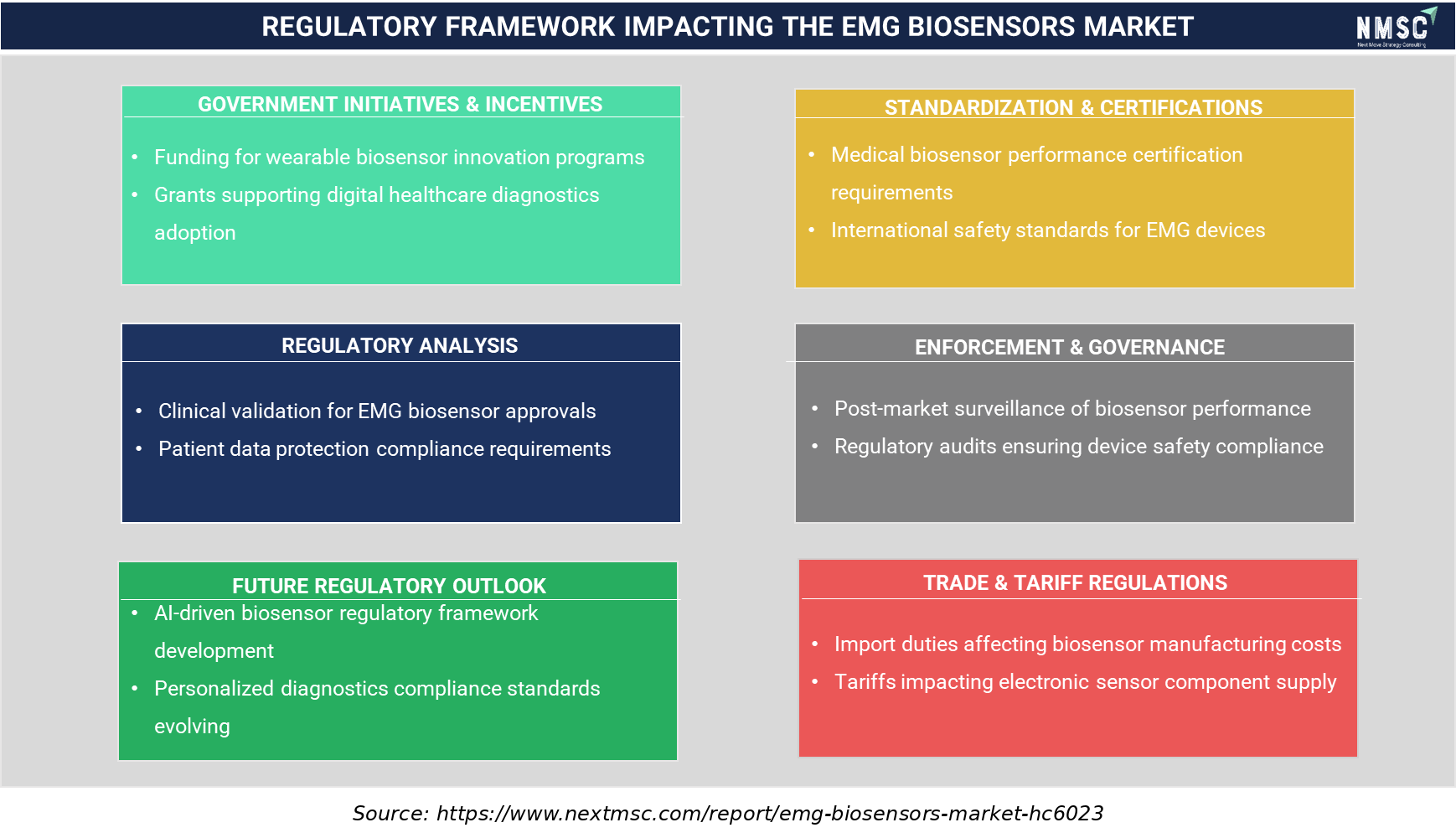
The above infographic presents a regulatory framework impacting the EMG biosensors market, wherein government funding and grants are supporting wearable biosensor innovation and digital diagnostics adoption. Clinical validation and patient data protection requirements are shaping product approvals, while certification and international safety standards ensure device reliability. Post-market surveillance and regulatory audits strengthen ongoing compliance, and future regulations are focusing on AI-driven biosensor frameworks and personalized diagnostics. Looking ahead, we observed that import duties and tariffs on electronic components continue to influence manufacturing costs and supply chain dynamics across the global market.

Competitive Landscape

We observed that the EMG biosensors market features a highly fragmented competitive landscape, with specialized North American and European sensor manufacturers competing alongside diversified neurodiagnostic device companies on signal quality, software integration depth, and research institution relationships.

Dimension Description
Market Structure Highly fragmented; the top companies profiled in this report collectively account for a meaningful share of global market revenue, while numerous small specialized manufacturers serve niche research and clinical segments.
Innovation Focus Wireless sensor miniaturization, AI-enabled signal processing software, and human-machine interface applications dominate current innovation pipelines across leading suppliers.
M&A Activity Limited publicly disclosed M&A activity; the market remains dominated by independently owned specialized manufacturers with organic product development strategies.

How Do Companies Compete in the EMG Biosensors Market?

Companies compete primarily on signal quality, software integration depth, and research institution relationships across the industry. Specialized manufacturers such as Delsys, Inc. and Noraxon USA, Inc. leverage decades of electromyography-specific expertise to serve clinical and research customers, while diversified neurodiagnostic companies such as Nihon Kohden Corporation compete by bundling EMG capability within broader neurological and critical care device portfolios.

Which Competitive Archetypes Dominate the Market?

Two archetypes dominate the market: EMG-focused specialist manufacturers offering deep signal processing expertise, and diversified neurodiagnostic device companies extending established clinical relationships into electromyography. Delsys, Inc. and Noraxon USA, Inc. exemplify the specialist archetype through electromyography-exclusive product lines, while Nihon Kohden Corporation and Natus Medical Incorporated exemplify the diversified archetype through broader neurodiagnostic and critical care device portfolios that include EMG systems.

How Are Companies Differentiating Through Innovation in EMG Biosensors?

Innovation and differentiation strategy increasingly center on wireless sensor miniaturization and AI-enabled signal interpretation software. Noraxon USA's Ultium EMG sensor line, featuring real-time synchronization and extended battery life, illustrates how manufacturers extend platform relevance through hardware refinement rather than software alone. Our analysis shows that suppliers unable to demonstrate credible wireless reliability and software usability risk losing research institution and clinical procurement decisions.

What M&A and Expansion Activity Is Shaping the Market?

The EMG biosensors market has seen limited publicly disclosed merger and acquisition activity, with most specialized manufacturers remaining independently owned and pursuing organic product development rather than consolidation. We found that this fragmented ownership structure, combined with steady distributor network expansion by manufacturers such as Biometrics Ltd. and EB Neuro S.p.A., reflects a market still maturing toward the consolidation seen in adjacent medical device categories.

Key Market Players

Our assessment indicates that the following 20 companies are actively shaping sensor innovation, software development, and distribution strategy within the global EMG biosensors market.

Nihon Kohden Corporation Natus Medical Incorporated Ambu A/S Delsys, Inc. Noraxon USA, Inc. BIOPAC Systems, Inc. Biometrics Ltd. Compumedics Limited Thought Technology Ltd. EB Neuro S.p.A. Cometa S.r.l. OT Bioelettronica S.r.l. Motion Lab Systems, Inc. MEGA Electronics Ltd. PLUX Wireless Biosignals S.A. Shimmer Research Ltd. iMotions A/S KINVENT Biomecanique SAS Advancer Technologies, Inc. Wearable Sensing, Inc.

Investment Opportunities

What Capital Inflows Are Fuelling EMG Biosensors Market Development?

Capital investment within the EMG biosensors market remains predominantly self-funded among independently owned specialized manufacturers rather than driven by large-scale external financing rounds. Our findings suggest that this bootstrap-oriented capital structure reflects a market still maturing toward the institutional investment patterns seen in adjacent digital health and wearable sensor categories, with growth funded primarily through reinvested product revenue.

How Is Infrastructure Investment Shaping EMG Biosensors Market Expansion?

Distributor network and research partnership investment, such as Biometrics Ltd.'s and EB Neuro S.p.A.'s continued international distribution expansion, is shaping how specialized manufacturers scale market reach without large manufacturing capacity investment. We observed that this asset-light distribution model reflects sustained commitment to expanding geographic coverage while limiting fixed capital exposure across the fragmented specialized manufacturer landscape.

What ESG Considerations Influence EMG Biosensors Market Investment?

Environmental, social, and governance considerations increasingly influence EMG biosensor investment as manufacturers prioritize accessible, telehealth-compatible systems that expand rehabilitation access for underserved and home-bound patient populations. Our analysis shows that home care-compatible wireless EMG systems align with healthcare access and inclusion goals, strengthening the investment case for manufacturers with demonstrated telehealth integration capability.

Key Benefits for Stakeholders

How Does This Report Benefit Industry Leaders?

This report equips medical device and healthcare industry leaders with segmented revenue forecasts, application adoption trends, and competitive benchmarking needed to prioritize EMG sensor investment across clinical and research segments. Our findings suggest that leaders can use the segmentation analysis and regional outlook to align product roadmaps with the fastest-growing type, application, and end-user segments identified in this report.

How Does This Report Benefit Investors and Financial Analysts?

Investors and financial analysts gain a data-driven view of market sizing, CAGR trajectories, and company-level competitive positioning to evaluate capital allocation across the EMG biosensors value chain. We found that the investment opportunities and competitive landscape sections provide the forecast granularity needed to assess specialized manufacturer growth potential within this fragmented industry structure.

How Does This Report Benefit Technology Vendors and Product Teams?

Technology vendors and product teams benefit from detailed segmentation across type, connectivity, and application axes that clarify where product development investment will generate the strongest returns. Our assessment indicates that the growth opportunities and emerging trends sections help product teams prioritize wireless sensor and human-machine interface roadmaps ahead of competitors.

Key Market Segments Evaluated

By Type

  • Surface EMG Biosensors
  • Intramuscular EMG Biosensors

By Connectivity

  • Wireless
  • Wired

By Offering

  • Hardware
  • Software
  • Services

By Application

  • Neuromuscular Disease Diagnosis
  • Rehabilitation and Physical Therapy
  • Sports Science and Biomechanics
  • Human-Machine Interface and Prosthetics Control
  • Biofeedback Therapy
  • Research Applications

By End User

  • Hospitals and Clinics
  • Rehabilitation Centers
  • Academic and Research Institutes
  • Sports and Fitness Organizations
  • Home Care Settings

Conclusion & Recommendations

The long-term outlook remains positive, with the market projected to expand from USD 845.0 million in 2026 to USD 2,179.0 million by 2035 at an 11.1% CAGR. We observed that sustained musculoskeletal disorder prevalence and expanding human-machine interface applications provide durable, structural tailwinds that extend well beyond the current forecast window, supporting continued manufacturer investment across hardware, software, and services segments.

What Strategic Positioning Should Suppliers Pursue?

Suppliers should prioritize wireless, software-integrated sensor platforms that reduce customer setup complexity across clinical, research, and home care settings. Our assessment indicates that manufacturers combining proven signal quality with intuitive AI-enabled analytics will be best positioned to win recurring institutional procurement, particularly as rehabilitation providers consolidate vendor relationships to simplify long-term equipment management.

How Attractive Is the EMG Biosensors Industry for New Investment?

The EMG biosensors industry presents a moderately attractive investment case, supported by a USD 1,334.0 million absolute dollar opportunity between 2026 and 2035 and above-average growth in Asia-Pacific and human-machine interface application categories. We found that investment attractiveness is highest for manufacturers combining wireless sensor reliability with software analytics depth, positioning them to serve both established clinical customers and emerging home care and prosthetics control programs simultaneously.

What Market Shifts and Key Risks Should Stakeholders Monitor?

Stakeholders should monitor high system costs, signal placement variability, and regulatory approval timelines as key risks to the EMG biosensors market. Our analysis shows that manufacturers unable to demonstrate consistent signal quality and streamlined regulatory compliance risk losing institutional procurement decisions, particularly as clinical customers increasingly demand standardized, reproducible diagnostic data across multi-site research programs.

What Are the Key Growth Pathways for the Market?

Key growth pathways include expanding home care and telehealth-compatible sensor systems, scaling human-machine interface and prosthetics control applications, and deepening AI-enabled signal processing software capability. NMSC's analysis indicates that manufacturers pursuing these pathways while maintaining cost competitiveness in core surface EMG hardware will be best positioned to capture the EMG biosensors market's projected growth through 2035.

FAQs

About the Author

Mayurima Roy

Mayurima Roy

Mayurima Roy is Research Analyst at Next Move Strategy Consulting, where she has spent 4 years working across the firm's full industry coverage rather than a single fixed vertical. Her work centers on structured research, ongoing trend tracking, competitive assessment, and insight-led content development, translating complex market data into clear, decision-ready narratives that support informed client decision-making across diverse global industries, market sectors, and world regions every day.

About the Reviewer

Supradip Baul

Supradip Baul

Supradip Baul is an accomplished business consultant and strategist with over a decade of rich experience in market intelligence, strategy, technology, and business transformation. His work has included rigorous qualitative and quantitative analysis across multiple industries, helping clients shape investment decisions and long-term roadmaps. Earlier in his career, he was associated with Gartner, where he contributed to industry-leading reports and market share analyses. He has worked with leading global companies and holds an MBA with a dual specialization in Marketing and Finance.

Download Free Sample

Kishu Kanda

KISHU KANDA

Strategy Analyst

Accenture

We purchased the AI Consumer Market Report from this company. Not only did they customize the report to meet our specific requirements, but they also showed great flexibility in accommodating our budget. The report we received fully met our expectations. Additionally, they provided prompt and thorough responses to both our pre-purchase and follow-up questions. We look forward to working with this company again in the future.

Amos Chang

AMOS CHANG

Strategy Consultant

Kardex Group

I have bought the intralogistics market reports from NMSC two times so far. Joseph and his team are always very helpful and flexible in responding to any customization requirements on the report. Their expertise in market reports really helps us steer the day-to-day business. I will definitely recommend and come back myself whenever there is a need.

Pratyush Kumar Das

PRATYUSH KUMAR DAS

Assistant Manager

Polycab India Limited

We would like to express our appreciation for the data and insights provided by nextmsc. We are very pleased with the quality and depth of the information, which has proven to be highly valuable and beneficial for our business decision-making.

Kevin Coker

KEVIN COKER

Founder, CEO and Board Diector

Proxima Clinical Research

I have been using Next MSC reports for product positioning in a new geography for a long time. They have by far the best reports I have found and the price is reasonable too!

Robert Sean Trevino

ROBERT SEAN TREVINO

Sr. Director, Head of Strategic Insights & Analytics

Foundation Medicine

I realized that it was a reliable source of information. These days, there are many people who are looking for authentic data, and this is one of the only sources that can offer them with what they need;

Custom Market Research Services

We will customize the research for you if the listed report does not fully match your requirements.

Get 30% Free Customization

Select License

This website uses cookies to ensure you get the best experience on our website. Learn more

✖