Encryption Metadata Analytics Market Global Industry Analysis and Forecast (2026–2035)

Encryption Metadata Analytics Market size was USD 1.31 billion in 2026, projected to reach USD 5.20 billion by 2035, growing at a CAGR of 16.6% from 2026 to 2035. Key drivers include post-quantum cryptography migration mandates, increasing encrypted traffic visibility requirements, and automated cryptographic inventory adoption, with North America leading the market.

Download Free Sample PDF
Base Year (2025)
$1.31 Billion
Forecast (2035)
$5.20 Billion
CAGR (2026-2035)
16.6%
Top Region
North America

What Is the Encryption Metadata Analytics Market Size?

The global Encryption Metadata Analytics Market was valued at USD 1.12 Billion in 2025 and is estimated at USD 1.31 Billion in 2026, forecast to reach USD 5.20 Billion by 2035 at a CAGR of 16.6% from 2026 to 2035. North America led with approximately 45% share, while network flow and TLS handshake metadata held about 62%.

We observed that buyers still fund network telemetry first, while cryptographic inventory workloads expand fastest as mandates arrive.

Encryption Metadata Analytics Market Global Industry Analysis and Forecast (2026–2035) Revenue Forecast

Values in USD Billion

2025 $1.12 Billion
2025
2026 $1.31 Billion
2026
2027 $1.53 Billion
2027
2028 $1.78 Billion
2028
2029 $2.08 Billion
2029
2030 $2.42 Billion
2030
2031 $2.82 Billion
2031
2032 $3.29 Billion
2032
2033 $3.84 Billion
2033
2034 $4.48 Billion
2034
2035 $5.20 Billion
2035

Key Takeaways

By Metadata Source: Network flow and TLS handshake metadata held the largest share, expanding from USD 0.69 Billion in 2025 to USD 2.45 Billion by 2035. Cryptographic bill of materials metadata is the fastest-growing source, expanding at a 25.5% CAGR from 2026 to 2035.

By Application: Threat detection and response held the largest share, expanding from USD 0.64 Billion in 2025 to USD 2.05 Billion by 2035; Post quantum migration planning is the fastest growing at 24.7% CAGR from 2026–2035.

By Deployment Mode: On premises held the largest share, expanding from USD 0.50 Billion in 2025 to USD 1.40 Billion by 2035; Cloud is the fastest growing at 19.9% CAGR from 2026–2035.

Dominant Region: North America dominated with approximately 45% revenue share in 2025, anchored by federal cryptographic inventory mandates and large network detection estates.

Fastest-Growing Region: Middle East & Africa is expected to register the highest CAGR of 21.4% during 2026–2035, driven by national cybersecurity programs and financial sector modernization.

Dominant Country: The U.S. led the market with an estimated USD 0.43 Billion in 2025, supported by Executive Order 14412 and the largest base of deployed network detection platforms.

Fastest-Growing Country: Brazil is projected to expand from USD 0.03 Billion in 2025 at a CAGR of approximately 21.8% from 2026–2035, driven by banking digitization and data protection rules.

Our assessment indicates an absolute investment opportunity of approximately USD 3.89 Billion between 2026 and 2035, calculated as the 2035 forecast of USD 5.20 Billion less the 2026 base of USD 1.31 Billion. Capital efficiency is highest in cryptographic bill of materials platforms and cloud delivered analytics, where recurring subscription revenue scales without proportional hardware outlays or large professional services teams.

According to NMSC analysis, the decisive shift is that deprecation mandates require proof of which algorithms live traffic actually negotiates, not only which algorithms are configured on paper. This pushes buyers to merge TLS handshake telemetry with certificate and key inventories in one risk register, which explains why vendors spanning both data sources gain share in renewals. Passive sensors supply that evidence without touching payloads, so privacy teams approve deployments faster.

What Does the Encryption Metadata Analytics Market Encompass?

The Encryption Metadata Analytics Market covers software, sensors, and services that collect and analyze metadata about encrypted communications and cryptographic assets without inspecting payloads. Inputs include TLS and SSH handshake fields, JA3 and JA4 fingerprints, certificate attributes, flow statistics, and cryptographic inventories expressed as a bill of materials. Outputs support threat detection, compliance evidence, policy enforcement, and post quantum migration planning across enterprise, cloud, and government environments.

Structural evolution is moving the category from standalone encrypted traffic detection toward unified cryptographic observability. NIST SP 800-207 states that enterprises can collect metadata about encrypted traffic to detect attackers, and recent mandates now extend that logic to cryptographic inventory. We found that adoption accelerates when sensors, certificate scanners, and code analyzers feed a single analytics layer that reports negotiated algorithms by system and owner.

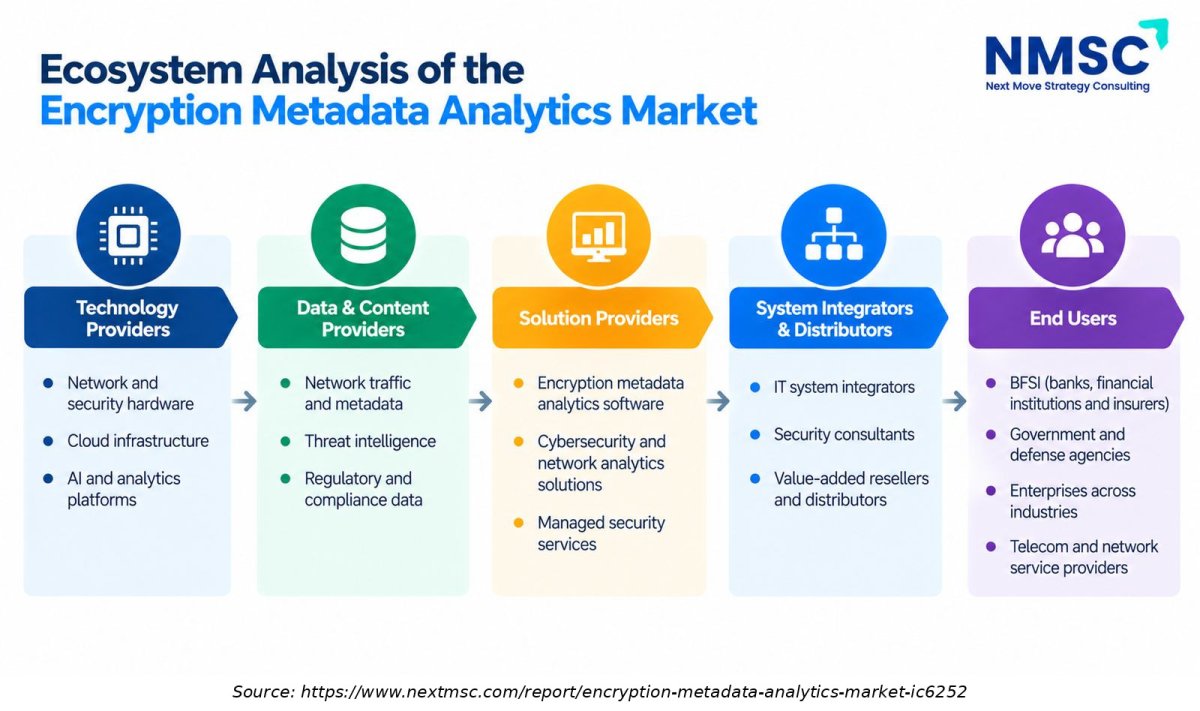
Ecosystem Analysis of the Encryption Metadata Analytics Market

The encryption metadata analytics market ecosystem comprises technology suppliers, data providers, analytics software vendors, system integrators, and end users. Hardware, cloud infrastructure, and cybersecurity technologies support data processing, while network metadata and threat intelligence provide analytical inputs. Software vendors develop solutions to identify traffic patterns, detect threats, and improve network visibility without necessarily decrypting content. System integrators and managed security providers support deployment, serving banks, government agencies, enterprises, telecommunications providers, and critical infrastructure operators.

Market Drivers & Dynamics

Interactive Dataset
Post quantum migration mandates (Executive Order 14412, EU roadmap) driver +3.4% North America, Europe 2026–2031
Encrypted traffic dominance in enterprise networks driver +2.2% Global 2026–2035
Cryptographic bill of materials standardization and automated inventory driver +1.9% North America, Europe, Asia-Pacific 2026–2032
Cloud and hybrid workload telemetry growth driver +1.5% Global 2026–2035
Encrypted Client Hello and QUIC reducing handshake visibility restraint −1.6% Global 2027–2035
Shortage of cryptographic engineering skills restraint −1.1% Global 2026–2030
Privacy rules limiting metadata retention restraint −0.8% Europe, Asia-Pacific 2026–2035
Source: Next Move Strategy Consulting

Growth Drivers

What Is the Primary Growth Driver?

Government mandates are the primary growth driver because they convert a best practice into a dated obligation. Executive Order 14412, signed June 22, 2026, requires federal agencies to move high value assets to post quantum key establishment by December 31, 2030. The EU roadmap adopted June 23, 2025 sets an end of 2026 milestone for national plans and inventories. We found that both timelines start with discovery, which favors metadata analytics.

How Is Encrypted Traffic Dominance Driving Encryption Metadata Analytics Market Growth?

NIST SP 800-207 notes that enterprises can analyze encrypted traffic by collecting metadata and applying machine learning, a position that legitimizes metadata first strategies in zero trust programs. Cisco Encrypted Traffic Analytics extracts enhanced telemetry from routers and switches for Secure Network Analytics, and Corelight has shipped certificate and JA3 insights since November 2019. Demand compounds as TLS adoption expands, since each encrypted flow adds metadata that vendors can monetize.

Growth Inhibitors

What Is Restraining the Encryption Metadata Analytics Market?

Visibility erosion is the primary restraint because Encrypted Client Hello conceals the server name that inspection tools relied on, and QUIC moves handshake details into an encrypted envelope. NIST IR 8547, released as an initial public draft on November 12, 2024, proposes transition dates that cautious buyers track before committing budgets. We estimate these effects reduce the CAGR by about 1.6 percentage points through 2035, an industry derived figure rather than a published statistic.

What Are the Growth Opportunities?

How Can Vendors Monetize Unified Network and Cryptographic Posture Analytics?

Vendors that join TLS handshake telemetry with certificate and key inventories can sell one risk register to security and compliance buyers. The mechanism is cross selling certificate metadata subscriptions into existing network detection accounts, which benefits the certificate and key metadata segment projected to grow from USD 0.33 Billion in 2026 to USD 1.20 Billion by 2035.

What Role Will Cloud Delivered Analytics Play in Midmarket Adoption?

Cloud delivered analytics lowers entry cost for midmarket firms that cannot staff dedicated cryptography engineers. Subscription pricing, managed detection bundles, and cloud traffic mirroring let providers reach buyers below the enterprise tier. The cloud deployment segment benefits most, projected to expand from USD 0.42 Billion in 2026 to USD 2.15 Billion by 2035 at 19.9% CAGR.

What Opportunity Does Post Quantum Migration Planning Create for CBOM Platforms?

Federal and EU timelines turn migration planning into funded programs that require continuous inventory, risk scoring, and algorithm tracking. Platforms that generate cryptographic bills of materials and track negotiated algorithms in live traffic can monetize through annual subscriptions. Post quantum migration planning is the main beneficiary, rising from USD 0.24 Billion in 2026 to USD 1.75 Billion by 2035.

Segmentation Analysis

2025 (USD Billion)
2035 (USD Billion)
Network flow and TLS handshake metadata 2025: $0.69 Billion | 2035: $2.45 Billion
Network flow
Certificate and key metadata 2025: $0.28 Billion | 2035: $1.20 Billion
Certificate
Cryptographic bill of materials metadata 2025: $0.15 Billion | 2035: $1.55 Billion
Cryptographi
Network flow and TLS handshake metadata $0.69 Billion $2.45 Billion 13.6%
Certificate and key metadata $0.28 Billion $1.20 Billion 15.4%
Cryptographic bill of materials metadata $0.15 Billion $1.55 Billion 25.5%

Which Metadata Source Leads the Market and Which Grows Fastest?

Network flow and TLS handshake metadata is the dominant source, holding about 62% of 2025 revenue at USD 0.69 Billion, because network detection platforms from Cisco, Vectra AI, ExtraHop, Darktrace, and Corelight already ingest this telemetry at scale. Cryptographic bill of materials metadata is the fastest growing source at 25.5% CAGR from 2026 to 2035, rising from USD 0.20 Billion in 2026 to USD 1.55 Billion by 2035 as inventories become mandatory.

2025 (USD Billion)
2035 (USD Billion)
Threat detec
Compliance a
Post quantum
Segment Item 2025 (USD Billion) 2035 (USD Billion) CAGR
Threat detection and response $10.0 USD Billion $40.0 USD Billion 25.0%
Compliance and policy assurance $17.1 USD Billion $51.1 USD Billion 11.0%
Post quantum migration planning $24.2 USD Billion $62.2 USD Billion 25.0%

Segment-wise data is locked

Unlock complete segment-wise numbers for By Application.

Unlock Full Data
2025 (USD Billion)
2035 (USD Billion)
On premises
Cloud
Hybrid
Segment Item 2025 (USD Billion) 2035 (USD Billion) CAGR
On premises $10.0 USD Billion $40.0 USD Billion 27.0%
Cloud $17.1 USD Billion $51.1 USD Billion 9.0%
Hybrid $24.2 USD Billion $62.2 USD Billion 19.0%

Segment-wise data is locked

Unlock complete segment-wise numbers for By Deployment Mode.

Unlock Full Data

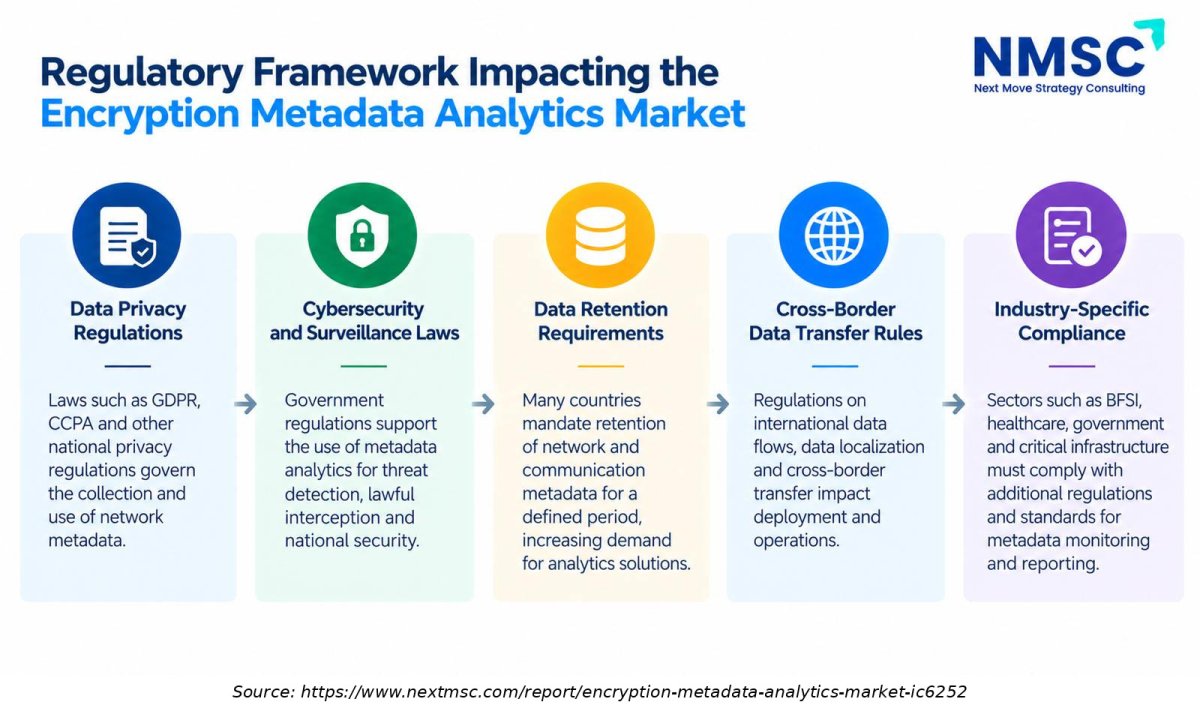
Regulatory Framework Impacting the Encryption Metadata Analytics Market

The encryption metadata analytics market is influenced by data privacy laws, cybersecurity regulations, data retention requirements, cross-border transfer restrictions, and sector-specific compliance standards. Regulations such as GDPR and CCPA govern the handling of personal information, including identifiable metadata. National security and lawful interception requirements may shape monitoring practices, while data localisation rules affect storage and processing. Financial services, healthcare, and critical infrastructure organisations must also address applicable security, audit, and reporting obligations when deploying analytics solutions.

Growth Opportunities

NMSC's analysis indicates three opportunities with the clearest revenue mechanisms through 2035.

How Can Vendors Monetize Unified Network and Cryptographic Posture Analytics?

Vendors that join TLS handshake telemetry with certificate and key inventories can sell one risk register to security and compliance buyers. The mechanism is cross selling certificate metadata subscriptions into existing network detection accounts, which benefits the certificate and key metadata segment projected to grow from USD 0.33 Billion in 2026 to USD 1.20 Billion by 2035.

What Role Will Cloud Delivered Analytics Play in Midmarket Adoption?

Cloud delivered analytics lowers entry cost for midmarket firms that cannot staff dedicated cryptography engineers. Subscription pricing, managed detection bundles, and cloud traffic mirroring let providers reach buyers below the enterprise tier. The cloud deployment segment benefits most, projected to expand from USD 0.42 Billion in 2026 to USD 2.15 Billion by 2035 at 19.9% CAGR.

What Opportunity Does Post Quantum Migration Planning Create for CBOM Platforms?

Federal and EU timelines turn migration planning into funded programs that require continuous inventory, risk scoring, and algorithm tracking. Platforms that generate cryptographic bills of materials and track negotiated algorithms in live traffic can monetize through annual subscriptions. Post quantum migration planning is the main beneficiary, rising from USD 0.24 Billion in 2026 to USD 1.75 Billion by 2035.

Regional Outlook

2025 (USD Billion)
2035 (USD Billion)
North Americ
Europe
Asia-Pacific
Middle East
Latin Americ
Region 2025 (USD Billion) 2035 (USD Billion) CAGR (%)
North America $10.0 USD Billion $40.0 USD Billion 9.0%
Europe $17.1 USD Billion $51.1 USD Billion 27.0%
Asia-Pacific $24.2 USD Billion $62.2 USD Billion 25.0%
Middle East & Africa $31.3 USD Billion $73.3 USD Billion 23.0%
Latin America $38.4 USD Billion $84.4 USD Billion 12.0%

Regional data is locked

Unlock complete regional numbers for this market.

Unlock Full Data

Competitive Landscape

Based on research conducted by NMSC, we found that competition spans network detection incumbents, cryptographic trust specialists, and enterprise platform vendors.

Dimension Description
Market Structure Fragmented across three archetypes, with leadership concentrated inside separate segments rather than across the whole market.
Innovation Focus JA4 fingerprinting, cryptographic bill of materials export, passive sensors, and post quantum readiness reporting.
M&A Activity Cryptographic discovery is consolidating into certificate platforms, including the May 2025 Keyfactor acquisitions of InfoSec Global and CipherInsights.

How Do Companies Compete in the Encryption Metadata Analytics Market?

Companies compete on telemetry breadth, detection accuracy, and the ability to translate metadata into compliance evidence. Network specialists such as Vectra AI, ExtraHop, Darktrace, and Corelight emphasize behavioral detection, while Cisco and Gigamon leverage infrastructure positions. Certificate specialists such as DigiCert and Keyfactor compete on inventory completeness and automated remediation. Pricing ranges from perpetual sensor licenses to subscription tiers, and geographic expansion follows federal and EU mandates.

Which Archetypes Dominate and What Differentiation Themes Matter?

Three archetypes dominate: infrastructure incumbents that embed metadata analytics in networks and firewalls, dedicated network detection specialists, and cryptographic trust platforms extending from certificate management. Differentiation themes include fingerprint coverage, federal authorization, CBOM export, and integration with SIEM tools. We observed that buyers increasingly request evidence that vendors can span network and cryptographic data.

What Innovation and Differentiation Strategies Are Companies Pursuing?

Vendors invest in JA4 fingerprint support, post quantum cipher visibility, and passive sensors that run inference locally. Gigamon added post quantum support in GigaVUE 6.12 in November 2025, while IBM links discovery with posture analysis through its Quantum Safe tooling. Our findings suggest that open formats such as CycloneDX CBOM reduce lock in and shift competition toward analytics quality and workflow automation.

Key Market Players

Our assessment indicates that the following 14 companies, ranked qualitatively on verified product scope and operational scale, shape competition in the market.

Cisco Systems, Inc. International Business Machines Corporation Darktrace Vectra AI, Inc. Keyfactor DigiCert, Inc. ExtraHop Networks, Inc. Gigamon Inc. Corelight, Inc. Trellix OPSWAT, Inc. LiveAction, Inc. AppViewX, Inc. Encryption Consulting LLC

Latest Developments

NMSC's analysis indicates that regulation and product launches dominated recent activity across the market.

Date Event
September 2026 DigiCert made Quantum Central generally available, combining cryptographic records from network scans, certificate-lifecycle platforms, key vaults, CSV files, and software or cryptographic bills of materials. The platform normalizes inventory, flags policy violations, links findings to remediation workflows, tracks progress, and exports cryptographic bills of materials for audits.
August 2026 ExtraHop introduced a 400 Gbps RevealX sensor designed to ingest and analyze enterprise data-center traffic at line rate. The company said this avoids sampling-related blind spots as AI workloads generate dense encrypted east-west traffic, providing high-fidelity network evidence for threat detection and incident investigation at modern data-center speeds.

Expert Insights

Daniel Ashby

Senior Vice President of Global Business Development | NetSTAR Inc.

"Using cutting-edge AI models and next-gen traffic analysis, we're helping our OEM partners stay ahead of threats, policy enforcement gaps, and visibility challenges."

Analyst Interpretation

The statement highlights the growing role of AI-driven traffic intelligence in analysing encrypted network communications. Advanced metadata analytics can help classify web applications, identify suspicious traffic patterns, and support policy enforcement without relying solely on full traffic decryption. These capabilities create opportunities for vendors offering scalable, real-time, and privacy-conscious analytics solutions to enterprise security providers, network operators, and telecommunications companies.

Investment Opportunities

Where Are Capital Inflows Concentrating?

Capital is flowing toward cryptographic discovery and posture management, where recurring revenue is tied to mandates. DigiCert reported on October 6, 2026 that annual recurring revenue for Trust Lifecycle Manager grew 38% year over year, and Keyfactor acquired two discovery businesses in May 2025. Investors should watch cryptographic bill of materials platforms and cloud delivered analytics, which show the steepest forecast growth at 25.5% and 19.9% CAGR.

How Will Infrastructure Investment Shape Adoption?

Sensor coverage depends on network taps, cloud traffic mirroring, and packet brokers, so infrastructure budgets influence deployment pace. Gigamon extracts TLS version, cipher suite, and server name metadata from packets, and Cisco extends telemetry from routers and switches. Enterprises that upgrade to TLS 1.3 and plan for post quantum ciphers create immediate requirements for visibility into negotiated algorithms, which benefits vendors with strong infrastructure integration.

What ESG Considerations Influence Purchasing?

Metadata analytics supports privacy by detecting threats without decrypting payloads, which aligns with data minimization expectations in European and Asian regulation. Governance teams also value auditable cryptographic inventories that evidence compliance with algorithm deprecation timelines. Energy use is a secondary factor, since avoiding decryption reduces compute overhead, though we classify that benefit as an industry derived estimate rather than a measured statistic.

Key Benefits for Stakeholders

How Do Enterprise and Industry Leaders Benefit?

Enterprise security leaders gain a segmented view of which encrypted flows, certificates, and libraries carry quantum vulnerable algorithms. The segment forecasts help them size budgets between network analytics, certificate metadata, and CBOM platforms. Regional tables and country analysis support sourcing decisions, while the competitive review clarifies vendor archetypes and integration risks.

How Do Investors and Financial Analysts Benefit?

Investors receive reconciled forecasts from USD 1.31 Billion in 2026 to USD 5.20 Billion by 2035, with segment CAGRs that identify where growth concentrates. The analysis separates mandate driven demand from discretionary spending, highlights consolidation patterns, and flags restraints such as Encrypted Client Hello. Country level insights help analysts compare regulatory timing and adoption maturity across 15 priority markets.

How Do Technology Vendors and Product Teams Benefit?

Vendors and product teams can map roadmaps to the fastest growing segments, including cryptographic bill of materials metadata at 25.5% CAGR and cloud deployment at 19.9% CAGR. The assessment shows which fingerprint, inventory, and reporting capabilities buyers request, and where partnerships with managed providers extend reach in emerging regions such as the Middle East & Africa and Latin America.

Key Market Segments Evaluated

By Metadata Source

  • Network flow and TLS handshake metadata
  • Certificate and key metadata
  • Cryptographic bill of materials metadata

By Application

  • Threat detection and response
  • Compliance and policy assurance
  • Post quantum migration planning

By Deployment Mode

  • On premises
  • Cloud
  • Hybrid

By Region

  • North America 
    • U.S.
    • Canada
    • Mexico.
  • Europe 
    • UK
    • Germany
    • France
    • Italy
    • Spain
    • Sweden
    • Denmark
    • Finland
    • Netherlands
    • Rest of Europe.
  • Asia-Pacific 
    • China
    • India
    • Japan
    • South Korea
    • Taiwan
    • Indonesia
    • Vietnam
    • Australia
    • Philippines
    • Malaysia
    • Rest of APAC.
  • Middle East & Africa 
    • Saudi Arabia
    • UAE
    • Egypt
    • Israel
    • Turkey
    • Nigeria
    • South Africa
    • Rest of MEA.
  • Latin America 
    • Brazil
    • Argentina
    • Chile
    • Colombia
    • Rest of LATAM.

Conclusion & Recommendations

NMSC expects the Encryption Metadata Analytics market to grow from USD 1.31 Billion in 2026 to USD 5.20 Billion by 2035 as mandates convert voluntary inventories into audited programs. The category will broaden from encrypted traffic detection toward unified cryptographic observability. Growth moderates after 2031, once the first federal and EU milestones pass and replacement cycles stabilize, though cloud and hybrid delivery sustain double digit expansion.

What Strategic Positioning Recommendations Does NMSC Offer?

Vendors should position metadata analytics as evidence generation for compliance and migration, not only as threat detection. Network specialists should add certificate and CBOM ingestion, while certificate platforms should add passive sensors. Buyers should require support for JA4, TLS 1.3, QUIC, and post quantum ciphers, and should prefer open inventory formats that avoid lock in as vendors consolidate.

What Does the Investment Attractiveness Profile Look Like?

Attractiveness is high for platforms tied to mandates and recurring subscriptions, and moderate for hardware heavy network offerings. The 16.6% CAGR exceeds typical rates for mature security categories, and the USD 3.89 Billion opportunity between 2026 and 2035 supports consolidation. Investors should weigh concentration risk in federal demand and the early stage of vendor revenue disclosure, which limits benchmarking.

What Are the Market Shifts and Key Risks?

Key shifts include fingerprint migration from JA3 to JA4, expansion of QUIC and Encrypted Client Hello, and the rise of CBOM exports. Risks include reduced handshake visibility, evolving transition dates, skills shortages, and privacy rules on metadata retention. We observed that vendors mitigating these risks combine behavioral models with inventory data rather than relying on any single metadata source.

What Are the Growth Pathways Through 2035?

Three pathways stand out: federal and EU compliance programs through 2031, cloud delivered analytics for midmarket buyers, and cryptographic bill of materials platforms embedded in software development pipelines. Regional expansion in the Middle East & Africa and Latin America adds the highest percentage growth from small bases. Partnerships with managed providers and infrastructure vendors accelerate reach in all three pathways.

Delivered Customizations

We have successfully delivered the following deep-dive customizations:

Client Request Customization Delivered Value Adds
Historical Encryption Metadata Analytics Revenue Analysis
  • Historical revenue analysis of encryption metadata analytics by metadata source, application, and deployment mode, 2020 onward, from public vendor filings and disclosures.
  • Identifies which metadata sources and deployment modes have grown fastest, guiding product and go-to-market prioritization.
Market Sizing: TAM, SAM and VAM Assessment
  • Total, serviceable, and value-added market sizing for encryption metadata analytics across the three segmentation dimensions, 2026-2035.
  • Shows where addressable demand is largest and which segments are realistically serviceable, supporting investment and market-entry sizing.
Vendor Technology Revenue Split Benchmarking
  • Company-level revenue split by technology offering, metadata source, and deployment mode, where publicly disclosed in filings and earnings materials.
  • Benchmarks how leading vendors monetize cloud versus on-premises and metadata-focused offerings, informing portfolio and pricing decisions.
Cryptographic Metadata Source Adoption Mapping
  • Adoption mapping of encryption metadata sources such as certificates, keys, secrets, and audit logs across major application areas.
  • Pinpoints the metadata sources with the widest unmet visibility gaps, supporting product roadmap and partnership priorities.
Post-Quantum Migration Demand Assessment
  • Application-level demand outlook for metadata analytics tied to post-quantum cryptography migration timelines set by NIST, NSA CNSA 2.0, and EU roadmaps.
  • Times capability investments to mandated migration milestones and highlights sectors where compliance-driven spend will concentrate.
Hyperscaler vs Independent Deployment Benchmarking
  • Benchmarking of cloud-native key and certificate metadata services against independent and on-premises analytics offerings, using public product documentation and published pricing.
  • Clarifies competitive positioning and pricing gaps between hyperscaler-native and third-party deployments to inform partnership and pricing strategy.

FAQs

Sources & References

1.

Cisco Systems, Inc. – Encrypted Traffic Analytics At-a-Glance

cisco.com
2.

Cisco Systems, Inc. – Secure Network Analytics Data Sheet

cisco.com
3.

Cisco Systems, Inc. – Encrypted Visibility Engine documentation

docs.manage.security.cisco.com
4.

Cisco Blogs – Overview of Zero Trust Architecture According to NIST (quotes NIST SP 800-207)

blogs.cisco.com
5.

Vectra AI – Network detection platform

vectra.ai/products/network
6.

Vectra AI – Threat detection without decryption

vectra.ai
7.

ExtraHop Networks – Reveal(x) datasheet

assets.extrahop.com
8.

Corelight – Encrypted Traffic Collection press release, November 19, 2019

corelight.com
9.

Darktrace – Beyond the hash: unsupervised machine learning and JA3

darktrace.com
10.

Keyfactor – Acquisition of InfoSec Global and CipherInsights (Business Wire press release)

businesswire.com
11.

IBM – Quantum Safe Explorer and CBOM highlights

ibm.com
12.

IBM Research – Quantum safe migration and CBOM

research.ibm.com
13.

Gigamon – GigaVUE 6.12 post quantum announcement (company press release, republished by iTWire)

itwire.com
14.

Gigamon – TLS decryption feature brief

gigamon.com
15.

DigiCert – Trust Lifecycle Manager growth press release, October 6, 2026

digicert.com
16.

DigiCert – Crypto Discovery datasheet

digicert.com
17.

Trellix – Encrypted traffic analysis in NDR

trellix.com
18.

OPSWAT – MetaDefender NDR encrypted traffic visibility

opswat.com
19.

LiveAction – Encrypted traffic analysis

liveaction.com
20.

AppViewX – EU post quantum cryptography roadmap overview

appviewx.com
21.

Encryption Consulting – CBOM Secure cryptographic discovery and inventory

encryptionconsulting.com
22.

ManageEngine – Encrypted traffic analysis overview

manageengine.com
23.

NIST – IR 8547 Transition to Post-Quantum Cryptography Standards (initial public draft)

csrc.nist.gov/pubs/ir/8547/ipd
24.

Federal Register – Executive Order 14412, 91 FR 38483

federalregister.gov
25.

The White House – Executive Order 14412 (PDF)

whitehouse.gov
26.

European Commission – Coordinated Implementation Roadmap for the Transition to Post-Quantum Cryptography

digital-strategy.ec.europa.eu

About the Author

Liza Phukan

Liza Phukan

Liza Phukan is Research Associate at Next Move Strategy Consulting, where she has covered emerging industries and market research across sectors for 3.5 years. Her work includes analyzing industry developments, validating market data, and developing structured business content from research findings. She uses secondary research and data-validation practices to turn complex market information into clear decision-useful market analysis for business audiences and support report development and B2B.

About the Reviewer

Supradip Baul

Supradip Baul

Supradip Baul is an accomplished business consultant and strategist with over a decade of rich experience in market intelligence, strategy, technology, and business transformation. His work has included rigorous qualitative and quantitative analysis across multiple industries, helping clients shape investment decisions and long-term roadmaps. Earlier in his career, he was associated with Gartner, where he contributed to industry-leading reports and market share analyses. He has worked with leading global companies and holds an MBA with a dual specialization in Marketing and Finance.

Download Free Sample

Gustaf Hummel Burstrom

GUSTAF HUMMEL BURSTROM

Founder

Revline Tools AB

Joseph and the team at Next Move Strategy Consulting have been excellent to work with, in supplying us with relevant market data and forecasts for our specific category. We had some special requirements and they were able to do a custom package to suit our needs. We would definitely recommend them to any other company needing market data and forecasts

Nishant Awate

NISHANT AWATE

Business Development Global Sales

Zehnder Group Deutschland GmbH

Our experience working with Next Move Strategy Consulting was positive. The team was responsive, professional, and open to incorporating our specific requirements throughout the project. The India AHU market study was comprehensive and well structured, covering market value and volume forecasts, product and application segments, and key industry trends. The inclusion of both AHU and residential MVHR market insights made the study particularly relevant for our strategic market assessment. Overall, the report provides a solid foundation for evaluating market potential, identifying priority segments, and supporting business-development decisions in India.

Robert Sean Trevino

ROBERT SEAN TREVINO

Sr. Director, Head of Strategic Insights & Analytics

Foundation Medicine

I realized that it was a reliable source of information. These days, there are many people who are looking for authentic data, and this is one of the only sources that can offer them with what they need;

Mohit Agarwal

MOHIT AGARWAL

Chief Manager

DryChem India Pvt. Ltd.

Next Move Strategy Consulting is an amazing team of consultants. We required a market study report for our investors on top priority and the team went above and beyond our expectations to deliver the same with ample supporting data within a short time span enabling us to secure the investments and keep our project timeline maintained. Their professionalism, attention to detail, and timely delivery of actionable recommendations have left a lasting impression on our organization.

Semih Kavaklioglu

SEMIH KAVAKLIOGLU

Co-Founder & Sales Manager

Decortie

I work a lot in the marketing industry and I know that research is an essential part of any campaign. I have used Market research reports for my own products and I found them to be very informative and well-researched. The team here produces insightful reports for a good price

Custom Market Research Services

We will customize the research for you if the listed report does not fully match your requirements.

Get 30% Free Customization

Select License

This website uses cookies to ensure you get the best experience on our website. Learn more

✖