Cloud Analytics Market Size, Share, Growth and Forecast by Offering (Software: Data Platform, Analytics Consumption, Advanced Analytics, Packaged Domain Applications; Services: Implementation and Integration, Managed Services, Support and Training), By Deployment (Public Cloud, Hybrid Cloud, Private Cloud), By Customer Size (Large Enterprise, Midmarket, SMB), By Route to Market (Direct, Partner, Marketplace, OEM and Embedded), — Global Analysis 2026–2035
What Is the Cloud Analytics Market Size?
The global Cloud Analytics Market was valued at USD 46.3 billion in 2025 and is expected to reach USD 55.5 billion in 2026. Accelerating enterprise cloud adoption, widespread AI integration into analytics platforms, and the proliferation of real-time data decision-making are projected to propel the market to USD 281.4 billion by 2035, advancing at a CAGR of 19.8% from 2026 to 2035. Key growth drivers include rapid migration from on-premises business intelligence to cloud-native platforms, surging demand for embedded analytics and self-service BI tools, adoption of AI-driven predictive and prescriptive analytics, and expanding digital transformation investments across regulated industries worldwide.
|
Parameters |
Details |
|
Market Size in 2025 |
USD 46.3 Billion |
|
Market Size in 2026 |
USD 55.5 Billion |
|
Revenue Forecast in 2035 |
USD 281.4 Billion |
|
Growth Rate |
CAGR of 19.8% from 2026 to 2035 |
|
Analysis Period |
2025–2035 |
|
Base Year Considered |
2025 |
|
Forecast Period |
2026–2035 |
|
Market Size Estimation |
USD Billion |
|
Companies Profiled |
20 |
|
Countries Covered |
33 |
|
Market Share |
Top 10 |
Cloud Analytics Market Overview
What Is the Cloud Analytics Market?
The Cloud Analytics Market encompasses software platforms, data infrastructure, and professional services that enable organizations to collect, process, visualize, and derive insights from data through cloud-hosted environments. Unlike traditional on-premises analytics architectures, cloud analytics platforms deliver elastic compute resources, consumption-based pricing, and seamless integration with AI and machine learning frameworks. The market spans a broad spectrum of capabilities including business intelligence and reporting, advanced analytics, data science and machine learning, embedded analytics, planning and performance management, and packaged domain-specific applications.
How Has the Cloud Analytics Market Evolved?
NMSC's analysis indicates that the Cloud Analytics Market has undergone three distinct transformation phases. The first phase, spanning roughly 2010 to 2017, centered on migration from on-premises data warehouses to cloud-hosted SQL platforms. The second phase, between 2017 and 2022, introduced self-service BI, lakehouse architectures, and multi-cloud deployments that democratized analytics beyond IT functions. The current third phase is defined by AI-native analytics, natural language querying, automated insight generation, and real-time streaming analytics embedded directly within operational systems across every enterprise function.
How Do Regulations Influence the Cloud Analytics Market?
Regulatory frameworks are fundamentally shaping architecture decisions across the Cloud Analytics Market. The European Union's General Data Protection Regulation (GDPR), the California Consumer Privacy Act (CCPA), and sector-specific mandates such as HIPAA in healthcare and Basel IV in financial services are driving enterprise investment in governed analytics infrastructure. Data residency requirements across the EU, India, Saudi Arabia, and Southeast Asia are compelling analytics vendors to establish localized cloud regions and sovereign deployment options. Our findings suggest that compliance-driven analytics spending now represents a structural rather than discretionary budget category for regulated enterprise buyers.
How Is Technology Adoption Expanding Across the Cloud Analytics Market?
Technology adoption across the Cloud Analytics Market is accelerating as enterprises embrace composable analytics architectures, cloud-native lakehouse platforms, and AI-augmented business intelligence tooling. Large language model integration into analytics interfaces, exemplified by Microsoft Copilot for Power BI and Salesforce Einstein Analytics, is transforming how business users interact with data. Our assessment indicates that consumption-based pricing and marketplace distribution through AWS, Azure, and Google Cloud ecosystems are substantially lowering adoption barriers for mid-market and SMB organizations, unlocking entirely new buyer segments for cloud analytics platform vendors.
|
Key Takeaways |
|
By Offering, the Software segment held the largest share of the Cloud Analytics Market at USD 38.9 billion in 2025. Within Software, the Data Platform sub-segment, particularly Cloud Data Warehouse and Lakehouse offerings, commands the dominant position, driven by widespread enterprise migration from on-premises data infrastructures to scalable cloud-native analytical environments. |
|
The Advanced Analytics sub-segment, specifically Data Science and Machine Learning, is the fastest-growing Software category in the Cloud Analytics Market at a CAGR of 23.4% from 2026 to 2035, driven by enterprise adoption of AutoML, model operationalization, and AI-powered predictive decision engines across financial services, healthcare, and manufacturing verticals. |
|
By Deployment, the Public Cloud segment commanded the largest revenue share at USD 27.2 billion in 2025, representing approximately 58.7% of total Cloud Analytics Market revenue, benefiting from hyperscaler-native integrations, elastic scalability, and the broadest ecosystem of pre-built analytics connectors and marketplace applications. |
|
The Hybrid Cloud deployment model is the fastest-growing deployment segment in the Cloud Analytics Market at a CAGR of 20.6% from 2026 to 2035, as regulated enterprises balance analytical flexibility with data sovereignty requirements, deploying sensitive workloads on private infrastructure while leveraging public cloud for burst compute and AI model inference. |
|
By Customer Size, the Large Enterprise segment accounted for USD 26.4 billion in 2025, the largest revenue share in the Cloud Analytics Market, driven by multi-year cloud analytics transformation programs, extensive multi-cloud deployments, and high per-seat analytics platform spending across global enterprise technology budgets. |
|
The SMB segment is the fastest-growing customer size category in the Cloud Analytics Market at a CAGR of 20.6% from 2026 to 2035, as consumption-based SaaS analytics platforms and cloud marketplace distribution channels dramatically reduce upfront cost and complexity barriers for smaller organizations seeking data-driven decision capabilities. |
|
By Route to Market, the Direct channel held the largest share at USD 20.8 billion in 2025. The Marketplace route to market is the fastest-growing distribution channel in the Cloud Analytics Market at a CAGR of 21.2% from 2026 to 2035, as enterprise buyers increasingly leverage committed cloud spend on AWS, Azure, and Google Cloud to procure analytics software through hyperscaler marketplaces. |
|
By End User Industry, the BFSI vertical held USD 10.4 billion in 2025 and is forecast to reach USD 63.2 billion by 2035 at a CAGR of 19.7%. Healthcare and Life Sciences is the fastest-growing industry vertical in the Cloud Analytics Market at a CAGR of 21.3%, advancing from USD 4.6 billion in 2025 to USD 31.8 billion by 2035. |
|
North America held the largest regional share at USD 21.4 billion in 2025, projected to reach USD 129.6 billion by 2035 at a CAGR of 19.6%, anchored by hyperscaler headquarters, the highest enterprise AI analytics spending globally, and the most mature cloud data adoption ecosystem in the world. |
|
Asia-Pacific is the fastest-growing major region in the Cloud Analytics Market at a CAGR of 22.4%, propelled by India's cloud-first digital infrastructure investments, China's industrial internet expansion, and the rapid digitalization of financial services and e-commerce across Southeast Asia. |
|
The United States is the single largest country market in the Cloud Analytics Market, representing approximately 82% of North American revenue in 2025, underpinned by the world's highest concentration of cloud analytics platform vendors, enterprise technology budgets, and the most advanced AI analytics adoption rate among global enterprise buyers. |
|
India is the fastest-growing national market in Asia-Pacific within the Cloud Analytics Market at a CAGR of 25.4%, propelled by the India Stack digital public infrastructure, the Digital Personal Data Protection Act (DPDPA), and a rapidly expanding base of technology-native enterprises deploying cloud analytics at scale. |
Key Emerging Trends in the Cloud Analytics Market
How Is Generative AI Integration Transforming the Cloud Analytics Market?
Generative AI is fundamentally redefining the Cloud Analytics Market by embedding natural language interfaces, automated insight generation, and AI-assisted data preparation directly within analytics platforms. From our research, we found that Microsoft Power BI Copilot, Salesforce Einstein Copilot, and Google Looker's Gemini integration now allow business users to query complex datasets using conversational language without SQL expertise. This democratization of analytics access expands the addressable user base from specialized data analysts to every business function, compressing time-to-insight from days to seconds and restructuring competitive dynamics across the entire cloud analytics vendor landscape.
How Is the Rise of Real-Time Streaming Analytics Reshaping the Cloud Analytics Market?
Real-time streaming analytics has evolved from a specialized capability to a foundational requirement across the Cloud Analytics Market. Our analysis shows that enterprises in financial services, telecommunications, retail, and manufacturing now mandate sub-second analytics latency for fraud detection, dynamic pricing, network operations, and supply chain optimization. Cloud-native streaming platforms integrating Apache Kafka, Apache Flink, and managed event-driven architectures into unified analytics environments are experiencing the strongest product-level demand growth. Vendors like Databricks and Snowflake have embedded streaming capabilities directly into their lakehouse platforms, eliminating the need for separate streaming infrastructure and reducing total cost of ownership for real-time analytics deployments.
How Are Open Table Formats Accelerating Multi-Cloud Analytics Interoperability in the Cloud Analytics Market?
Open table formats including Apache Iceberg, Apache Hudi, and Delta Lake are eliminating proprietary data lock-in and enabling seamless cross-cloud analytics interoperability within the Cloud Analytics Market. Through NMSC's assessment, we found that Snowflake's Iceberg Table support, Databricks Delta Lake, and AWS Apache Iceberg on S3 collectively allow enterprises to query the same data across multiple analytical engines without duplication. This architectural shift reduces vendor dependency, lowers migration costs, and enables enterprises to adopt best-of-breed analytical tools regardless of their primary cloud provider, fundamentally altering competitive advantage dynamics across the entire cloud analytics software ecosystem.
How Is the Embedded Analytics Movement Creating New Revenue Streams Within the Cloud Analytics Market?
Embedded analytics, defined as the integration of analytics capabilities directly within operational SaaS applications, represents one of the most structurally significant growth vectors in the Cloud Analytics Market. Based on our market evaluation, we noticed that vendors including Sisense, ThoughtSpot, and Qlik embed white-labeled analytics modules into third-party software products across healthcare, manufacturing, and financial services platforms. This OEM and embedded distribution model extends the cloud analytics market beyond enterprise IT buyers to a broader universe of software developers and ISVs, creating recurring revenue streams and dramatically expanding addressable market size for analytics platform vendors.
What Are the Key Market Drivers, Breakthroughs, and Investment Opportunities that Will Shape the Cloud Analytics Market Industry in the Next Decade?
|
Drivers / Trends / Restraints |
(+/-) % Impact on CAGR Forecast |
Geographic Relevance |
Impact Timeline |
|
Surging Enterprise AI and ML Analytics Adoption |
+2.6% |
Global (led by North America, APAC) |
2025–2030 |
|
Cloud-Native Lakehouse and Data Platform Expansion |
+2.1% |
North America, Europe, Australia |
2025–2028 |
|
Self-Service BI Democratization via GenAI Interfaces |
+1.8% |
North America, Europe, APAC |
2025–2030 |
|
Real-Time Streaming Analytics Demand |
+1.5% |
North America, APAC, Europe |
2025–2030 |
|
Cloud Marketplace Distribution Channel Growth |
+1.4% |
North America, Europe |
2025–2032 |
|
Embedded Analytics and OEM Revenue Expansion |
+1.2% |
Global |
2026–2035 |
|
Healthcare and Life Sciences Digital Transformation |
+1.0% |
North America, Europe, APAC |
2026–2035 |
|
Data Privacy Regulation Compliance Complexity |
-1.4% |
Europe, APAC, North America |
Ongoing |
|
Skilled Analytics and Data Science Talent Shortage |
-1.0% |
Global |
Ongoing |
|
High Cost of Legacy System Migration to Cloud Analytics |
-0.8% |
SMB, Mid-market globally |
2025–2028 |
|
GenAI-Powered Analytics Monetization Opportunities |
+2.2% |
Global |
2026–2035 |
|
Sovereign Cloud Analytics for Regulated Industries |
+1.1% |
Europe, MEA, Southeast Asia |
2026–2035 |
What Are the Growth Drivers of the Cloud Analytics Market?
How Is the Global Surge in Enterprise AI and Machine Learning Workloads Driving the Cloud Analytics Market?
Artificial intelligence and machine learning workloads are the primary catalyst for accelerated investment in the Cloud Analytics Market. Organizations across financial services, healthcare, manufacturing, and retail are adopting cloud analytics platforms that natively support model training, feature engineering, and inference pipelines alongside traditional business intelligence workloads. Based on NMSC's research, we found that the U.S. National AI Initiative Act, signed into law in 2020 and expanded through subsequent executive orders, has institutionalized federal investment in AI infrastructure, creating downstream demand for cloud analytics capabilities across public sector and federally regulated private sector organizations. Enterprises require governed, high-quality, and versioned datasets at scale, positioning cloud analytics platforms as the foundational infrastructure layer for enterprise AI programs.
How Is the Proliferation of Cloud-Native Lakehouse Architectures Fueling Cloud Analytics Market Growth?
The broad enterprise adoption of cloud-native lakehouse architectures, combining the flexibility of data lakes with the governance and query performance of data warehouses, is expanding the total addressable market for cloud analytics platforms. The Linux Foundation's Delta Lake project and the Apache Software Foundation's open-source Iceberg and Hudi table formats are accelerating multi-cloud interoperability and reducing vendor lock-in barriers. Our assessment indicates that managed lakehouse services on AWS, Azure, and Google Cloud have reduced enterprise analytics deployment timelines from months to days, substantially lowering the adoption barrier for mid-market buyers and expanding the Cloud Analytics Market to entirely new organizational tiers that previously lacked the technical resources to build and operate bespoke data infrastructure.
How Is Growing Enterprise Demand for Self-Service and Embedded Analytics Expanding the Cloud Analytics Market?
Enterprise demand for self-service analytics, enabling non-technical business users to independently explore, visualize, and act on data, represents a durable structural growth driver across the Cloud Analytics Market. The U.S. Bureau of Labor Statistics projects continued growth in management analyst and data analyst roles, reflecting enterprise appetite for data-driven decision-making at scale. Through our market assessment, we observed that the convergence of self-service BI tools with generative AI interfaces, as demonstrated by Microsoft Power BI Copilot and Salesforce Einstein Analytics, has democratized analytics consumption beyond IT and data science teams to include marketing, finance, supply chain, and human resources functions, structurally broadening the buyer universe and average revenue per enterprise account for cloud analytics vendors.
What Are the Growth Inhibitors of the Cloud Analytics Market?
How Is the Complexity of Cross-Jurisdictional Data Privacy Regulation Constraining Cloud Analytics Market Expansion?
Regulatory fragmentation across jurisdictions represents one of the most significant structural constraints on the Cloud Analytics Market. The EU's GDPR imposes strict data localization, consent, and portability requirements that complicate cross-border data sharing inherent in many cloud analytics architectures. The EU AI Act, adopted in 2024, introduces additional data governance obligations for AI model training datasets that directly affect cloud analytics platforms incorporating automated machine learning capabilities. Our findings suggest that the patchwork of U.S. state-level privacy laws, including California's CPRA, Virginia's CDPA, and Colorado's Privacy Act, adds substantial compliance overhead for analytics vendors serving multi-state enterprise clients, extending procurement cycles, increasing operational complexity, and dampening near-term revenue growth across the cloud analytics vendor ecosystem.
How Does the Shortage of Qualified Analytics and Data Science Talent Limit Cloud Analytics Market Penetration?
Despite the self-service promise of modern cloud analytics platforms, the shortage of qualified data engineers, analytics engineers, and data scientists remains a significant structural inhibitor of Cloud Analytics Market growth. The U.S. Bureau of Labor Statistics Occupational Outlook Handbook documents sustained demand for data scientist and database administrator roles, with employment projected to grow substantially through 2033 as supply fails to keep pace with enterprise demand. Our analysis shows that organizations lacking internal analytics expertise struggle to derive measurable ROI from cloud analytics investments, lengthening time-to-value, increasing vendor churn, and constraining market expansion particularly among mid-market and SMB organizations without dedicated data science or analytics operations teams.
What Are the Growth Opportunities in the Cloud Analytics Market?
How Does the Emergence of GenAI-Powered Analytics Create a Multi-Billion Dollar Opportunity in the Cloud Analytics Market?
Generative AI is creating a new revenue layer within the Cloud Analytics Market through natural language analytics interfaces, automated report generation, AI-powered anomaly detection, and conversational data exploration capabilities. Based on our market evaluation, organizations now expect analytics platforms to surface proactive insights and prescriptive recommendations rather than passive visualizations, fundamentally changing the value proposition of cloud analytics software. The NIST AI Risk Management Framework explicitly references the importance of governed, traceable training data and model outputs, elevating enterprise demand for AI-governed cloud analytics platforms that comply with emerging AI assurance requirements. Vendors embedding GenAI natively within governed analytics environments gain premium pricing power and superior land-and-expand economics across enterprise accounts.
How Is the Expansion of Cloud Hyperscaler Marketplaces Creating a New Distribution Opportunity for the Cloud Analytics Market?
Cloud hyperscaler marketplaces, specifically AWS Marketplace, Azure Marketplace, and Google Cloud Marketplace, have evolved into high-velocity distribution channels for cloud analytics software, bypassing traditional multi-quarter sales cycles and enabling frictionless procurement through existing cloud spend commitments. From our research, we found that the U.S. General Services Administration's FedRAMP program has extended marketplace-based procurement to federal agencies, creating a structured pathway for cloud analytics vendors to access the substantial U.S. federal IT budget through a single compliance investment. Vendors with marketplace listings and FedRAMP authorization simultaneously access commercial and government buyers, creating structural distribution advantages that independent analytics software vendors operating exclusively through direct sales channels cannot replicate efficiently.
How Does Digital Transformation Across Healthcare and Life Sciences Present a Structural Opportunity for the Cloud Analytics Market?
Healthcare and Life Sciences represents one of the highest-growth end-use verticals within the Cloud Analytics Market, driven by regulatory mandates for interoperability, AI-powered clinical analytics, and population health management. The U.S. 21st Century Cures Act mandates healthcare data interoperability through standardized FHIR APIs, compelling health systems, payers, and pharmaceutical companies to invest in cloud analytics infrastructure that can ingest, process, and analyze complex clinical and claims datasets. Through NMSC's assessment, we found that similar digital health data governance mandates in the UK under the NHS Data Strategy, and in the EU under the European Health Data Space regulation, are generating parallel structural demand for governed cloud analytics platforms across regulated healthcare organizations globally.
How Is the Cloud Analytics Market Segmented in This Report, and What Are the Key Insights from the Segmentation Analysis?
How Does the Offering Segmentation Reveal the Structural Composition of the Cloud Analytics Market?
|
Offering Segment |
2025 (USD Bn) |
2035 (USD Bn) |
CAGR (%) |
|
Software |
38.9 |
234.6 |
19.6% |
|
Services |
7.4 |
46.8 |
20.3% |
Based on our analysis of enterprise cloud adoption patterns and analytics platform spending trends, we observed that the Cloud Analytics Market is segmented by Offering into Software and Services. The Software segment dominates at USD 38.9 billion in 2025, driven by enterprise investment in cloud data platforms, business intelligence tools, advanced analytics engines, and packaged domain applications. Within Software, the Data Platform sub-segment, encompassing Cloud Data Warehouse, Lakehouse, Data Integration and ETL, Data Governance and Catalog, and Streaming and Real-Time capabilities, holds the largest revenue share as enterprises modernize data infrastructure. Analytics Consumption, including BI and Reporting, Search and Conversational Analytics, Embedded Analytics, and Planning and Performance, represents the most widely adopted software category by user count. Advanced Analytics, comprising Data Science and Machine Learning, Predictive Analytics, and Optimization and Simulation, is the fastest-growing sub-segment. Packaged Domain Applications covering Customer Analytics, Finance and Risk Analytics, Operations and Supply Chain Analytics, and Workforce Analytics are gaining momentum as buyers seek pre-configured vertical solutions. The Services segment, covering Implementation and Integration, Managed Services, and Support and Training, is growing at a CAGR of 20.3% as organizations require expert guidance for complex cloud analytics deployment and ongoing optimization.
How Does Deployment Mode Shape Revenue Distribution Across the Cloud Analytics Market?
|
Deployment Segment |
2025 (USD Bn) |
2035 (USD Bn) |
CAGR (%) |
|
Public Cloud |
27.2 |
166.2 |
19.8% |
|
Hybrid Cloud |
11.6 |
75.4 |
20.6% |
|
Private Cloud |
7.5 |
39.8 |
18.2% |
On the basis of enterprise cloud strategy and data governance requirements, we observed that the Cloud Analytics Market is segmented by Deployment into Public Cloud, Hybrid Cloud, and Private Cloud. Public Cloud commands the dominant share at USD 27.2 billion in 2025, driven by hyperscaler-native integrations, elastic scalability, and the broadest ecosystem of pre-built analytics connectors. Hybrid Cloud is the fastest-growing deployment mode in the market at a CAGR of 20.6%, as regulated enterprises balance analytical agility with data residency mandates by distributing workloads across on-premises and public cloud environments. Private Cloud remains relevant among highly regulated organizations in financial services, defense, and government that require maximum control over analytical data processing and security configuration.
How Does Customer Size Influence Adoption Patterns in the Cloud Analytics Market?
|
Customer Size Segment |
2025 (USD Bn) |
2035 (USD Bn) |
CAGR (%) |
|
Large Enterprise |
26.4 |
156.8 |
19.4% |
|
Midmarket |
12.8 |
78.4 |
19.8% |
|
SMB |
7.1 |
46.2 |
20.6% |
We observed that the Cloud Analytics Market is segmented by Customer Size into Large Enterprise, Midmarket, and SMB organizations. The Large Enterprise segment dominates at USD 26.4 billion in 2025, driven by multi-year cloud analytics transformation programs, extensive multi-cloud analytics deployments, and high per-seat platform spending across global enterprise technology portfolios. Midmarket organizations are rapidly adopting cloud analytics as packaged SaaS analytics offerings reduce deployment complexity and total cost of ownership, enabling mid-sized firms to access enterprise-grade BI and advanced analytics capabilities. The SMB segment registers the fastest growth at a CAGR of 20.6%, as consumption-based pricing, cloud marketplace distribution, and guided onboarding experiences dramatically lower the cost and complexity of cloud analytics adoption for smaller organizations.
How Are Distribution Strategies Reshaping Go-to-Market Dynamics in the Cloud Analytics Market?
|
Route to Market |
2025 (USD Bn) |
2035 (USD Bn) |
CAGR (%) |
|
Direct |
20.8 |
120.6 |
19.2% |
|
Partner |
13.4 |
82.6 |
19.8% |
|
Marketplace |
8.6 |
58.8 |
21.2% |
|
OEM and Embedded |
3.5 |
19.4 |
18.8% |
In our analysis of cloud analytics distribution models, we noticed that the Cloud Analytics Market is segmented by Route to Market into Direct, Partner, Marketplace, and OEM and Embedded channels. The Direct route holds the largest share at USD 20.8 billion in 2025, reflecting enterprise preference for customized deployment support and strategic vendor account management. The Partner channel remains significant, encompassing global systems integrators, regional value-added resellers, and specialist analytics consulting firms that drive adoption across mid-market and vertical-specific segments. The Marketplace channel is the fastest-growing distribution route in the market at a CAGR of 21.2%, as procurement through AWS, Azure, and Google Cloud marketplaces leverages committed cloud spend and reduces procurement cycle complexity. The OEM and Embedded channel, representing analytics capabilities licensed to ISVs and SaaS application developers, is growing as third-party software products increasingly embed cloud analytics to enhance competitive positioning.
Which Industry Verticals Generate the Most Value in the Cloud Analytics Market?
|
Industry Vertical |
2025 (USD Bn) |
2035 (USD Bn) |
CAGR (%) |
|
BFSI |
10.4 |
63.2 |
19.7% |
|
IT and Telecom |
7.8 |
47.4 |
19.8% |
|
Retail and E-Commerce |
6.2 |
38.6 |
20.1% |
|
Manufacturing |
5.4 |
32.8 |
19.6% |
|
Healthcare and Life Sciences |
4.6 |
31.8 |
21.3% |
|
Government |
3.8 |
22.4 |
19.3% |
|
Energy and Utilities |
3.2 |
19.6 |
19.8% |
|
Media and Entertainment |
2.8 |
16.4 |
19.3% |
|
Other |
2.1 |
9.2 |
15.8% |
Based on our analysis of enterprise analytics spending across industries, we observed that the Cloud Analytics Market spans BFSI, IT and Telecom, Retail and E-Commerce, Manufacturing, Healthcare and Life Sciences, Government, Energy and Utilities, Media and Entertainment, and Other industries. The BFSI vertical dominates at USD 10.4 billion in 2025, driven by demand for real-time risk analytics, fraud detection, regulatory reporting, and customer intelligence across banking, insurance, and capital markets operations. IT and Telecom represents the second-largest vertical as telecommunications operators deploy cloud analytics for network performance management, churn prediction, and 5G network optimization. Retail and E-Commerce is rapidly expanding as omnichannel retailers leverage cloud analytics for demand forecasting, personalization, and supply chain visibility. Healthcare and Life Sciences is the fastest-growing industry vertical at a CAGR of 21.3%, driven by clinical analytics, population health management, and pharmaceutical R&D data intelligence requirements. Manufacturing, Government, and Energy and Utilities demonstrate steady adoption driven by operational analytics, predictive maintenance, and regulatory compliance requirements.
Regional Outlook
Geographic Performance Snapshot
|
Region |
2025 (USD Bn) |
2035 (USD Bn) |
CAGR (%) |
Key Driver |
|
North America |
21.4 |
129.6 |
19.6% |
Hyperscaler HQ, enterprise AI spend |
|
Europe |
10.8 |
62.4 |
19.2% |
GDPR compliance, sovereign cloud |
|
Asia-Pacific |
9.2 |
58.6 |
20.3% |
Cloud-first India, China digital economy |
|
Middle East & Africa |
2.6 |
16.4 |
20.2% |
Vision 2030, MEA cloud build-out |
|
Latin America |
2.3 |
14.4 |
20.1% |
Fintech digitization, cloud adoption |
North America Cloud Analytics Market
North America is the global epicenter of the Cloud Analytics Market, contributing USD 21.4 billion in 2025 and forecast to reach USD 129.6 billion by 2035 at a CAGR of 19.6%. The region benefits from the headquarters of all major hyperscalers and leading cloud analytics platform vendors. Enterprise AI adoption, the most mature cloud data ecosystem globally, and strong regulatory tailwinds from CCPA, HIPAA, and federal data strategy mandates underpin sustained market leadership. The FedRAMP marketplace has opened structured government procurement pathways that further accelerate public sector cloud analytics spending across federal and state agency environments.
U.S. Cloud Analytics Market
Based on our engagements with enterprise analytics buyers, the United States represents over 82% of North American Cloud Analytics Market revenue and is the single largest national market globally. The U.S. benefits from the world's highest concentration of Fortune 500 enterprise analytics buyers, the headquarters of Microsoft, Salesforce, Alphabet, Oracle, Snowflake, Databricks, and Qlik, and a mature venture capital ecosystem funding analytics innovation. The U.S. Federal Cloud Strategy and FedRAMP marketplace have accelerated public sector analytics spending. The National AI Initiative Act institutionalizes federal investment in AI analytics infrastructure, creating sustained downstream demand across federally regulated private sector organizations.
Canada Cloud Analytics Market
Through our analysis, Canada represents approximately 11% of North American Cloud Analytics Market revenue, underpinned by sophisticated enterprise analytics adoption in financial services, insurance, and natural resources industries. Canadian financial institutions are among the most advanced enterprise analytics buyers globally, deploying cloud-native lakehouse platforms for fraud analytics, regulatory reporting, and customer intelligence. The Government of Canada's Digital Ambition strategy has accelerated public sector cloud analytics spending. Data sovereignty concerns around cross-border flows to U.S. hyperscalers are driving adoption of Canada-based sovereign cloud regions offered by AWS, Azure, and Google Cloud to support compliant analytics deployments.
Mexico Cloud Analytics Market
From our assessment, Mexico is a growing cloud analytics market within North America, advancing at a CAGR of 22.4% from 2026 to 2035. Mexico's expanding fintech ecosystem, manufacturing sector digitization driven by nearshoring trends, and public sector digital transformation under the National Digital Strategy are generating demand for operational and customer analytics platforms. The Ley Federal de Protección de Datos Personales is compelling organizations to invest in governance-embedded cloud analytics architectures. Retail, telecommunications, and manufacturing verticals represent the highest-growth industry segments for cloud analytics adoption across the Mexican market.
Europe Cloud Analytics Market
Europe is the second-largest region in the Cloud Analytics Market, contributing USD 10.8 billion in 2025 and forecast to reach USD 62.4 billion by 2035 at a CAGR of 19.2%. Europe's regulatory environment, including GDPR, the EU Data Act, the EU AI Act, and the Digital Markets Act, simultaneously drives and complicates cloud analytics adoption. Sovereign cloud investment through the GAIA-X initiative and national cloud programs across Germany and France is creating a structurally differentiated market for compliant analytics vendors. Enterprise analytics budgets remain robust, particularly in BFSI, manufacturing, and retail verticals across the region.
UK Cloud Analytics Market
According to our evaluation, the United Kingdom is Europe's largest individual country market for cloud analytics, representing approximately 22% of European revenue in 2025. Post-Brexit, the UK maintains GDPR-equivalent standards through UK GDPR while gaining regulatory flexibility that has attracted data exchange and analytics platform investments. The Financial Conduct Authority's Open Finance initiatives generate demand for financial analytics and identity resolution platforms. London's status as a global financial hub underpins strong BFSI demand for advanced risk analytics, ESG reporting, and customer intelligence cloud analytics solutions across leading UK financial institutions.
Germany Cloud Analytics Market
Based on our market evaluation, Germany is the second-largest European Cloud Analytics Market, driven by its world-class manufacturing sector's rapid adoption of industrial analytics, IoT data platforms, and supply chain intelligence services. German enterprises are among the most stringent data privacy buyers globally, demanding on-premises or sovereign cloud analytics options compliant with the Bundesdatenschutzgesetz (BDSG). SAP's Business Data Cloud and Analytics Cloud platforms, headquartered in Walldorf, hold a strong domestic market advantage. The Federal Office for Information Security (BSI) cloud security guidelines shape platform certification requirements across enterprise analytics procurement processes.
France Cloud Analytics Market
Through our analysis, France is the third-largest European Cloud Analytics Market, distinguished by strong public sector digital transformation investments and national AI strategy commitments under the France 2030 program. The CNIL is among Europe's most active GDPR enforcement bodies, creating compliance-driven demand for governed cloud analytics platforms. OVHcloud and other EU-controlled infrastructure providers benefit from enterprise demand for non-U.S. analytics hosting alternatives. Retail, financial services, and manufacturing represent the leading industry verticals driving cloud analytics adoption across French enterprise and mid-market organizations.
Italy Cloud Analytics Market
From our assessment, Italy demonstrates growing momentum in the Cloud Analytics Market, with increasing adoption in financial services, manufacturing, and public administration. The Piano Nazionale di Ripresa e Resilienza (PNRR) has allocated substantial investment toward cloud migration and digital transformation for public sector entities. Italy's Garante data protection authority is active in GDPR enforcement, compelling organizations to invest in compliant cloud analytics architectures with robust data governance capabilities. The Polo Strategico Nazionale (PSN) supports sovereign cloud data processing for government agencies, creating structured demand for analytics platforms compatible with Italian public cloud infrastructure.
Spain Cloud Analytics Market
Based on our market evaluation, Spain demonstrates growing momentum in the Cloud Analytics Market, driven by a dynamic financial sector, retail expansion, and public digital transformation under the Agenda España Digital 2026. Spanish banking, insurance, and retail companies are significant buyers of customer analytics and fraud detection cloud platforms. The Agencia Española de Protección de Datos (AEPD) actively enforces GDPR, compelling investment in privacy-by-design and access governance analytics tools. AWS, Google Cloud, and Microsoft Azure all operate local Spanish cloud regions supporting enterprise data residency requirements for analytics workloads.
Sweden Cloud Analytics Market
Through our analysis, Sweden is a technology-forward cloud analytics market characterized by high enterprise digitalization, strong sustainability analytics demand, and advanced public sector data sharing frameworks. Swedish enterprises in telecommunications, financial services, and manufacturing are early adopters of cloud-native analytics platforms. The Integritetsskyddsmyndigheten (IMY) enforces GDPR rigorously, ensuring robust enterprise investment in governed cloud analytics. Sweden's national data strategy and government open data initiatives create favorable conditions for cloud analytics expansion across public sector and commercially adjacent organizations.
Denmark Cloud Analytics Market
According to our evaluation, Denmark maintains a mature cloud analytics adoption profile, supported by a digitally advanced public sector and innovative private sector spanning fintech, pharmaceuticals, and logistics. The Danish Data Protection Agency (Datatilsynet) enforces strict data governance standards that shape enterprise cloud analytics architecture decisions. Denmark's small but analytically sophisticated enterprise base demonstrates high per-organization cloud analytics spending, particularly in life sciences and financial services verticals where data-driven regulatory compliance and operational decision-making require robust cloud analytics infrastructure investments.
Finland Cloud Analytics Market
From our assessment, Finland represents a compact but technologically advanced Cloud Analytics Market supported by a strong technology ecosystem, government digital innovation programs, and a highly educated workforce with strong data and analytics skills. Finnish telecommunications, manufacturing, and public sector organizations are active cloud analytics adopters. The Finnish Transport and Communications Agency (Traficom) and national data economy strategy support structured public sector analytics adoption. Finland's arctic data center infrastructure advantages attract hyperscaler investment, supporting local data residency options for cloud analytics compliance requirements.
Netherlands Cloud Analytics Market
Based on our engagements, the Netherlands is a significant European Cloud Analytics Market, serving as a hub for multinational cloud analytics deployments given its position as a major European internet exchange and hyperscaler data center location. Dutch financial services, retail, and logistics companies are advanced cloud analytics adopters. The Autoriteit Persoonsgegevens (AP) enforces GDPR rigorously, driving enterprise investment in data lineage, access governance, and privacy-preserving analytics capabilities. Amsterdam's status as a European data center hub provides Dutch organizations preferential access to low-latency cloud analytics infrastructure.
Asia-Pacific Cloud Analytics Market
Asia-Pacific is the fastest-growing major region in the Cloud Analytics Market at a CAGR of 20.3%, contributing USD 9.2 billion in 2025 and forecast to reach USD 58.6 billion by 2035. Growth is propelled by India's cloud-first digital infrastructure investments, China's industrial internet and digital economy expansion, Japan's Society 5.0 digital transformation program, and the rapid digitalization of financial services and e-commerce across Southeast Asia. NMSC's analysis indicates that hyperscaler data center investments across the region are accelerating the availability and adoption of advanced cloud analytics platforms at enterprise and government levels.
China Cloud Analytics Market
Based on our engagements, China represents the largest individual country market in Asia-Pacific for cloud analytics, driven by a vast digital economy, advanced manufacturing sector analytics adoption, and national AI strategy investments. Domestic cloud analytics providers including Alibaba Cloud and Tencent Cloud hold significant competitive advantages in the local market due to regulatory preferences and deep ecosystem integrations. China's Personal Information Protection Law (PIPL) and data localization requirements shape cloud analytics architecture decisions, compelling multinational vendors to establish China-specific data residency and processing infrastructure for cloud analytics platform deployments.
India Cloud Analytics Market
Through our analysis, India is the fastest-growing national Cloud Analytics Market in Asia-Pacific at a CAGR of 25.4%, propelled by the India Stack digital public infrastructure, the Digital Personal Data Protection Act (DPDPA), and a rapidly expanding technology-native enterprise base deploying cloud analytics at scale. Indian banking, financial services, and e-commerce companies are high-intensity cloud analytics adopters. The India Enterprise Analytics landscape benefits from a large and rapidly growing domestic data science talent pool, competitive cloud pricing from AWS, Azure, and Google Cloud, and strong government digital infrastructure investment through initiatives including Digital India and the National Data Governance Framework.
Japan Cloud Analytics Market
According to our evaluation, Japan is a mature cloud analytics market characterized by high enterprise IT spending, a strong manufacturing analytics tradition, and progressive government digital transformation under the Society 5.0 national strategy. Japanese enterprises in manufacturing, financial services, and telecommunications are significant cloud analytics platform adopters. The Personal Information Protection Commission (PPC) oversees APPI enforcement, shaping cloud analytics data governance requirements. Japan's Digital Agency, established in 2021, is accelerating public sector cloud analytics adoption and standardizing government data sharing frameworks that create structured demand for cloud analytics infrastructure.
South Korea Cloud Analytics Market
From our assessment, South Korea is a dynamic Cloud Analytics Market driven by a technology-intensive economy, advanced manufacturing analytics, and a highly digitized consumer market. Korean conglomerates in semiconductors, electronics, and telecommunications are advanced adopters of cloud analytics for operational intelligence and supply chain optimization. Korea's Digital New Deal policy and government AI analytics investment programs create favorable public sector demand conditions. The Korea Internet and Security Agency (KISA) enforces data protection standards that align cloud analytics platform requirements with enterprise compliance investment across regulated industry verticals.
Taiwan Cloud Analytics Market
Based on our engagements, Taiwan maintains a specialized Cloud Analytics Market concentrated in semiconductor manufacturing, electronics supply chain analytics, and financial services intelligence. Taiwan Semiconductor Manufacturing Company (TSMC) and its ecosystem represent high-value industrial analytics buyers requiring real-time production data analytics and quality intelligence platforms. The government's digital transformation agenda and robust broadband infrastructure support cloud analytics adoption. Taiwan's Personal Data Protection Act governs enterprise cloud analytics data handling, compelling investment in compliant data platform architectures that balance operational analytics agility with regulatory compliance requirements.
Indonesia Cloud Analytics Market
Through our analysis, Indonesia represents a high-growth Cloud Analytics Market within Southeast Asia, driven by a rapidly expanding digital economy, one of the region's largest populations of internet users, and government investment in digital public infrastructure. Financial services, e-commerce, and telecommunications verticals are leading cloud analytics adopters in Indonesia. The Personal Data Protection Law (PDP Law) enacted in 2022 is compelling organizations to invest in governed cloud analytics architectures. Hyperscaler investments in Indonesian data center infrastructure are improving cloud analytics platform availability, latency, and data residency compliance for enterprise deployments.
Vietnam Cloud Analytics Market
According to our evaluation, Vietnam is an emerging Cloud Analytics Market with strong growth potential driven by rapid economic digitalization, a growing manufacturing export sector, and government digital transformation under the National Digital Transformation Program. Vietnamese enterprises in manufacturing, retail, and financial services are increasingly adopting cloud analytics platforms to support operational decision-making and e-commerce intelligence. The Cybersecurity Law and data localization provisions shape cloud analytics deployment architectures for multinational organizations serving Vietnamese markets. Government investment in digital skills training is gradually expanding the domestic analytics talent base available to enterprise cloud analytics buyers.
Australia Cloud Analytics Market
Based on our engagements, Australia is the most mature Cloud Analytics Market in Oceania, characterized by high enterprise cloud adoption, strong regulatory frameworks, and advanced public sector data sharing initiatives. The Consumer Data Right (CDR), administered by the Australian Competition and Consumer Commission (ACCC), mandates open data sharing across banking, energy, and telecommunications, generating structural cloud analytics demand for customer and market intelligence platforms. The Office of the Australian Information Commissioner (OAIC) enforces the Privacy Act, shaping governed cloud analytics requirements. Financial services, mining, and retail represent the highest-value industry verticals for cloud analytics adoption.
Philippines Cloud Analytics Market
From our assessment, the Philippines is a growing Cloud Analytics Market within Southeast Asia, supported by a large and digitally engaged population, a rapidly expanding BPO and shared services sector, and government digital economy initiatives. Financial services, retail, and telecommunications companies are leading cloud analytics adopters in the Philippines. The Data Privacy Act of 2012 and the National Privacy Commission (NPC) establish data governance standards that influence cloud analytics platform compliance requirements. The Philippines' growing technology services industry benefits from cloud analytics adoption that enhances operational efficiency and client service delivery capabilities.
Malaysia Cloud Analytics Market
Through our analysis, Malaysia demonstrates solid Cloud Analytics Market momentum, driven by a sophisticated financial services sector, a growing technology manufacturing base, and proactive government digital economy investment under Malaysia Madani and the National Digital Economy Blueprint. The Monetary Authority-equivalent Bank Negara Malaysia sets data analytics governance standards for financial institutions, driving cloud analytics adoption in banking and insurance. Malaysia's MyDIGITAL initiative targets cloud-first public sector transformation. Cyberjaya and Kuala Lumpur's digital corridors attract hyperscaler data center investments, improving local cloud analytics platform availability and enterprise adoption conditions.
Middle East and Africa Cloud Analytics Market
The Middle East and Africa (MEA) region is an emerging high-growth market for cloud analytics, contributing USD 2.6 billion in 2025 and forecast to reach USD 16.4 billion by 2035 at a CAGR of 20.2%. Saudi Arabia's Vision 2030 national transformation program, the UAE's digital economy diversification strategy, and South Africa's advanced financial services sector anchor MEA cloud analytics demand. Our findings suggest that government-driven cloud analytics adoption in the Gulf Cooperation Council (GCC) is creating significant spending on public sector analytical intelligence and smart city data platform deployments.
Saudi Arabia Cloud Analytics Market
Based on our engagements, Saudi Arabia is the largest Cloud Analytics Market in the Middle East, driven by the ambitious Vision 2030 transformation agenda and the Saudi Data and Artificial Intelligence Authority (SDAIA) national data governance program. Public sector analytics investment is substantial, covering smart city intelligence, government service optimization, and national economic planning analytics. The National Data Management Office (NDMO) establishes data governance frameworks that shape enterprise cloud analytics platform requirements. Saudi Aramco and SABIC represent the highest-value private sector cloud analytics buyers, deploying operational intelligence and predictive maintenance analytics at industrial scale.
UAE Cloud Analytics Market
Through our analysis, the UAE is the second-largest Cloud Analytics Market in the Middle East, driven by Dubai Smart City initiatives, Abu Dhabi's advanced technology investment program ADGM, and a highly digitized financial services sector. The UAE's AI Strategy 2031 and National Data Strategy create structured government demand for cloud analytics platforms. Financial services, real estate, tourism, and logistics represent the highest-value enterprise cloud analytics verticals. The UAE's position as a regional business hub attracts multinational cloud analytics vendor regional headquarters, improving platform availability, local implementation expertise, and partner ecosystem development across the broader Middle East region.
Egypt Cloud Analytics Market
According to our evaluation, Egypt is an emerging Cloud Analytics Market benefiting from a large domestic population, a growing financial technology sector, and government digital economy investments under the Egypt Vision 2030 Digital Transformation program. Banking, telecommunications, and retail represent the primary enterprise cloud analytics verticals in Egypt. The National Telecommunications Regulatory Authority (NTRA) and Egyptian government data governance initiatives are gradually shaping cloud analytics compliance requirements. Hyperscaler market entry into Egypt with local cloud regions is improving enterprise cloud analytics platform accessibility and reducing data sovereignty concerns for Egyptian enterprise buyers.
Israel Cloud Analytics Market
From our assessment, Israel is the most analytically mature and innovative Cloud Analytics Market in the Middle East, characterized by a world-class technology ecosystem, deep government and defense sector analytics adoption, and a highly sophisticated enterprise data science talent base. Israel's cybersecurity and AI startup ecosystem generates significant domestic demand for advanced cloud analytics platforms. The Privacy Protection Authority enforces data governance standards. Israel's technology export economy creates additional demand for cloud analytics platforms that support product analytics, customer intelligence, and operational efficiency across globally distributed technology companies headquartered in Israel.
Turkey Cloud Analytics Market
Based on our engagements, Turkey demonstrates growing Cloud Analytics Market potential, driven by a large domestic economy, a rapidly expanding e-commerce and fintech sector, and a technically skilled workforce with growing data analytics expertise. Turkish banking, retail, and manufacturing organizations are increasing cloud analytics investments. The Personal Data Protection Law (KVKK) shapes cloud analytics compliance requirements, compelling investment in governed and locally compliant analytics architectures. Turkey's strategic geographic position bridging Europe and Asia, combined with hyperscaler regional infrastructure investments, positions the country as an emerging cloud analytics hub within the broader MEA region.
Nigeria Cloud Analytics Market
Through our analysis, Nigeria represents Africa's largest emerging Cloud Analytics Market, driven by a vast population, a rapidly growing fintech sector, and increasing mobile-first digital service adoption. Nigerian banking, telecommunications, and e-commerce companies are early but high-momentum cloud analytics adopters. The Nigeria Data Protection Regulation (NDPR), enforced by the Nigeria Data Protection Commission (NDPC), establishes governance standards for enterprise cloud analytics data handling. Despite infrastructure constraints including power reliability and connectivity limitations, mobile-native and cloud-optimized analytics platforms are gaining traction across Nigerian enterprise and financial services markets.
South Africa Cloud Analytics Market
According to our evaluation, South Africa is the most mature Cloud Analytics Market in sub-Saharan Africa, characterized by sophisticated financial services analytics adoption, a strong mining and resources sector operational intelligence capability, and active regulatory governance through the Protection of Personal Information Act (POPIA) enforced by the Information Regulator. South African banks and insurance companies deploy advanced cloud analytics for credit risk, fraud detection, and regulatory reporting. The government's Digital Economy Masterplan creates public sector cloud analytics demand. Hyperscaler data center investments in South Africa support local data residency options for compliant enterprise cloud analytics deployments.
Latin America Cloud Analytics Market
Latin America is a high-growth region for cloud analytics, contributing USD 2.3 billion in 2025 and forecast to reach USD 14.4 billion by 2035 at a CAGR of 20.1%. Growth is propelled by Brazil's digital economy expansion, Mexico's manufacturing and fintech digitization, and progressive cloud analytics adoption across financial services, retail, and telecommunications sectors throughout the region. NMSC's analysis indicates that the Lei Geral de Proteção de Dados (LGPD) in Brazil and emerging data protection frameworks across the region are compelling enterprise investment in governed cloud analytics platforms that comply with local data residency and processing requirements.
Brazil Cloud Analytics Market
Based on our engagements, Brazil is the largest Cloud Analytics Market in Latin America, driven by a vast domestic economy, a rapidly growing fintech and e-commerce sector, and increasing enterprise cloud adoption across manufacturing, retail, and financial services verticals. The Lei Geral de Proteção de Dados (LGPD), enforced by the Autoridade Nacional de Proteção de Dados (ANPD), shapes cloud analytics platform governance requirements for Brazilian enterprise buyers. Hyperscaler data center investments in São Paulo support local data residency compliance. Brazil's National Strategy for Artificial Intelligence (EBIA) creates government-aligned demand for cloud analytics and AI-powered data intelligence platforms.
Argentina Cloud Analytics Market
Through our analysis, Argentina demonstrates growing Cloud Analytics Market potential, characterized by a well-educated technology workforce, an advanced financial services sector, and a growing SaaS and technology startup ecosystem. Argentine banking, e-commerce, and agribusiness organizations are increasing cloud analytics investments to support operational decision-making and customer intelligence capabilities. Argentina's Personal Data Protection Law (Ley 25.326) and ongoing regulatory modernization efforts shape cloud analytics compliance architecture requirements. Economic volatility influences enterprise IT budget cycles, but cloud-based consumption pricing models mitigate upfront capital risk for Argentine cloud analytics adopters.
Chile Cloud Analytics Market
According to our evaluation, Chile is among Latin America's most mature Cloud Analytics Markets, characterized by a politically stable economy, advanced financial services sector, and progressive government digital transformation initiatives. Chilean banking, mining, and retail companies are sophisticated cloud analytics buyers. Chile's Personal Data Protection Law modernization and alignment with international standards are compelling investment in governed cloud analytics frameworks. The government's National Artificial Intelligence Policy creates structured public sector demand for cloud analytics platforms. Chile's robust broadband infrastructure and regional data center investments support low-latency cloud analytics deployments for Chilean enterprise buyers.
Colombia Cloud Analytics Market
From our assessment, Colombia is a growing Cloud Analytics Market within Latin America, driven by a rapidly expanding financial technology sector, increasing e-commerce adoption, and active government digital economy investments. Colombian banking, telecommunications, and retail organizations are early adopters of cloud analytics for customer intelligence and operational efficiency. Law 1581 on data protection and evolving regulatory frameworks from the Superintendencia de Industria y Comercio (SIC) shape cloud analytics governance requirements. Hyperscaler regional cloud infrastructure expansion is improving enterprise cloud analytics platform availability and supporting local data processing compliance for Colombian enterprise buyers.
PESTEL Analysis of the Cloud Analytics Market
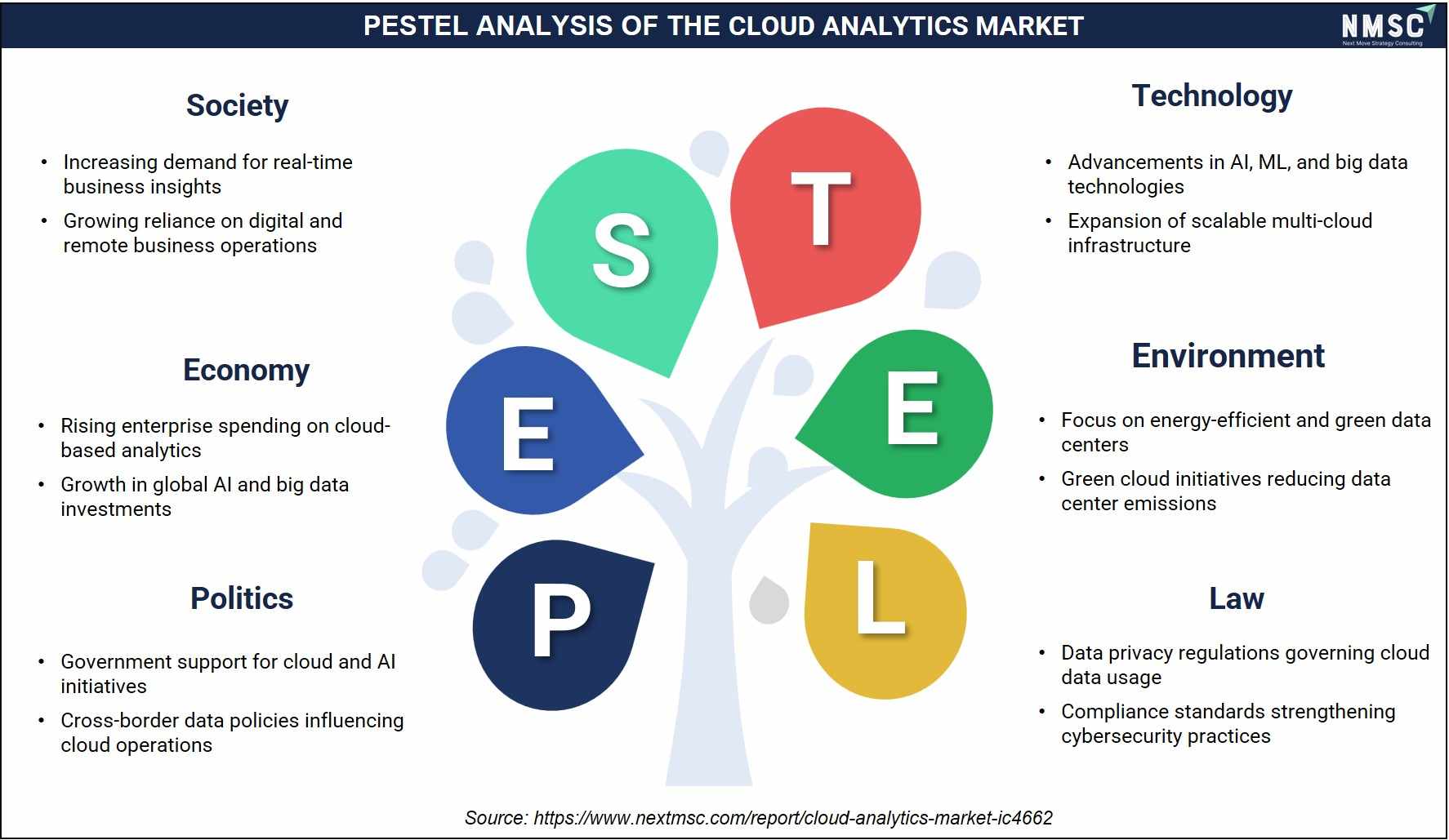
The infographic presents a PESTEL analysis of the Cloud Analytics Market, highlighting the external factors that influence market growth, adoption, and competitive dynamics. Political initiatives supporting digital transformation and cloud infrastructure investments are accelerating enterprise adoption, while economic pressures are driving demand for scalable, cost-efficient analytics solutions. Organizations increasingly rely on cloud analytics to improve decision-making, reflecting broader societal shifts toward data-driven operations. Rapid advancements in artificial intelligence, machine learning, and real-time analytics continue to reshape the technological landscape. At the same time, environmental sustainability goals and evolving legal requirements related to data privacy, cybersecurity, and cross-border data governance are influencing platform development, deployment strategies, and long-term market expansion.
Competitive Landscape
Competitive Dynamics and M&A Landscape
|
Key Takeaways |
Details |
|
Market Structure |
The Cloud Analytics Market is moderately consolidated at the platform layer, with Microsoft, Google, Amazon, Oracle, and Salesforce commanding the largest revenue shares, while a competitive mid-tier of pure-play vendors including Snowflake, Databricks, Qlik, and ThoughtSpot compete on analytical specialization, openness, and AI differentiation. |
|
Innovation Focus |
AI-native analytics, natural language querying, automated insight generation, real-time streaming analytics, and open table format interoperability represent the primary innovation axes across leading Cloud Analytics Market vendors as of 2025–2026. |
|
M&A Activity |
The Cloud Analytics Market has experienced significant consolidation, including Salesforce's acquisition of Tableau and Slack, IBM's acquisition of Confluent in March 2026, and ongoing strategic investments by hyperscalers in analytics-adjacent AI infrastructure and data governance technology companies. |
How Do Companies Compete in the Cloud Analytics Market?
The Cloud Analytics Market exhibits a layered competitive structure in which hyperscaler-integrated platform vendors, specialized pure-play analytics software companies, and domain-specific application providers compete across distinct but overlapping market segments. Our analysis shows that Microsoft, Google Cloud, and AWS compete by bundling advanced analytics capabilities within broader cloud platform agreements, leveraging enterprise spending commitments and existing workload relationships. Pure-play vendors including Snowflake, Databricks, and Qlik compete on analytical performance, openness, AI specialization, and multi-cloud portability. Innovation investments are concentrated in generative AI interfaces, automated machine learning, real-time streaming, and open lakehouse architectures that reduce proprietary lock-in concerns for enterprise buyers across the global cloud analytics ecosystem.
Which Kind of Companies Dominate the Cloud Analytics Market?
Hyperscaler-integrated platform vendors and full-stack cloud analytics software companies dominate the Cloud Analytics Market in terms of revenue and strategic positioning. Based on NMSC's research, we found that Microsoft, Google, and Amazon benefit from the deepest enterprise cloud platform relationships, enabling analytics product bundling, favorable commercial terms, and native integration with broader cloud workloads. Purpose-built analytics vendors including Snowflake, Databricks, and Qlik compete effectively by offering best-of-breed analytical performance, open data format support, and AI-native differentiation that enterprise data teams value beyond what hyperscaler analytics bundles typically provide within their standard enterprise agreement structures.
AI-Native Differentiation and Open Standards Drive Market Success in the Cloud Analytics Market
Our assessment indicates that AI-native differentiation and open data standards adoption are the two most consequential competitive axes in the Cloud Analytics Market as enterprises evaluate platform vendors for multi-year cloud analytics investments. Vendors embedding large language model interfaces, automated anomaly detection, and prescriptive recommendation engines natively within governed analytics platforms command superior win rates and pricing premiums in enterprise procurement processes. Simultaneously, support for open table formats including Apache Iceberg, Delta Lake, and Apache Hudi has shifted from a differentiator to a baseline requirement, as enterprise architects increasingly mandate multi-cloud interoperability and portability as non-negotiable architectural criteria across cloud analytics platform selection processes.
Market Players to Opt for Merger and Acquisition Strategies to Expand Their Presence in the Cloud Analytics Market
Mergers and acquisitions are a primary growth mechanism for scaling presence and capability across the Cloud Analytics Market, as organic product development cycles increasingly lag the pace of enterprise expectation evolution. Our findings suggest that IBM's acquisition of Confluent's streaming analytics capabilities, Salesforce's integration of Tableau within its Einstein Analytics ecosystem, and hyperscaler acquisitions of AI analytics startups reflect a broader strategic imperative to acquire complementary capabilities rapidly. Private equity firms are also active in the cloud analytics space, consolidating mid-market analytics vendors to create scaled competitors to pure-play public companies and hyperscaler analytics bundles across specialized industry verticals globally.
Key Market Players in the Cloud Analytics Market
-
Microsoft Corporation
-
Amazon Web Services, Inc.
-
Alphabet Inc.
-
Oracle Corporation
-
Salesforce, Inc.
-
SAP SE
-
International Business Machines Corporation
-
Adobe Inc.
-
Snowflake Inc.
-
Databricks, Inc.
-
Teradata Corporation
-
Informatica Inc.
-
SAS Institute Inc.
-
QlikTech International AB
-
Cloudera, Inc.
-
Alteryx, Inc.
-
Domo, Inc.
-
ThoughtSpot, Inc.
-
Sisense Ltd.
-
Zoho Corporation Private Limited
What Are the Latest Developments in the Cloud Analytics Market Industry?
|
Date |
Event |
|
Jun 2026 |
Snowflake expanded its strategic partnership with Anthropic to integrate Claude models more deeply into Snowflake Cortex AI and Snowflake Intelligence. The collaboration enables enterprises to build AI-powered analytics agents capable of performing data analysis, operational insights, and decision support directly within the Snowflake platform, strengthening the company's cloud analytics capabilities. |
|
May 2026 |
Databricks launched Lakebase, a PostgreSQL-based operational database integrated with the Databricks Data Intelligence Platform. The offering enables organizations to unify transactional, analytical, and AI workloads within a single environment, advancing the convergence of cloud analytics and operational data platforms. |
|
Jun 2025 |
Snowflake introduced Cortex AISQL and SnowConvert AI to help enterprises analyze structured and unstructured data using generative AI within SQL workflows. The innovations simplify advanced analytics and AI adoption while reducing migration complexity from legacy analytics environments. |
|
Jun 2025 |
Snowflake launched Openflow, a managed data ingestion and movement service powered by Apache NiFi. The platform enables organizations to integrate and analyze data from multiple sources more efficiently, improving data accessibility for cloud analytics and AI applications. |
|
Jun 2025 |
Snowflake unveiled Standard Warehouse Generation 2, Adaptive Compute, and AI-powered governance capabilities. These enhancements improve analytics performance, workload management, and governance for enterprises operating large-scale cloud analytics environments. |
What Are the Investment Opportunities in the Cloud Analytics Market?
Capital Inflows and Venture Activity
The Cloud Analytics Market is attracting substantial venture capital and private equity investment, particularly in AI-native analytics platforms, embedded analytics infrastructure, and vertical-specific domain analytics applications. Based on NMSC's research, we found that the National Venture Capital Association (NVCA) documented sustained technology venture investment across AI, cloud data infrastructure, and analytics software categories through 2025, reflecting investor conviction in the long-term secular growth of cloud-based data intelligence. Pure-play cloud analytics companies including Databricks, ThoughtSpot, and Domo have collectively attracted multi-billion dollar investment rounds, reflecting the scale of institutional capital confidence in the Cloud Analytics Market's structural growth trajectory through 2035.
Infrastructure Investments Supporting the Cloud Analytics Market
Infrastructure investment in cloud data center capacity, high-bandwidth networking, and GPU compute for AI analytics workloads represents a critical enabling layer for Cloud Analytics Market growth. The U.S. Department of Energy tracks escalating data center energy consumption, reflecting the scale of hyperscaler infrastructure investment underpinning cloud analytics platform expansion. Microsoft, Amazon, and Google collectively announced data center investment programs exceeding hundreds of billions of dollars across their multi-year capital expenditure plans, directly enabling the elastic compute infrastructure on which cloud analytics platforms depend. Our assessment indicates that infrastructure investment cycles directly correlate with accelerated cloud analytics platform capacity and performance improvements available to enterprise buyers.
ESG and Sustainability Analytics Investment
Environmental, Social, and Governance (ESG) analytics represents one of the fastest-growing investment themes within the Cloud Analytics Market, driven by regulatory requirements from the European Commission's Corporate Sustainability Reporting Directive (CSRD), the U.S. Securities and Exchange Commission's (SEC) climate disclosure rules, and investor demand for verified sustainability data intelligence. Through NMSC's assessment, we found that enterprises are investing in cloud analytics platforms specifically configured for scope 1, 2, and 3 emissions tracking, ESG regulatory reporting automation, and sustainable supply chain intelligence. Vendors offering pre-configured ESG analytics modules within their cloud data platforms are experiencing accelerated adoption among large enterprise buyers across financial services and manufacturing verticals.
Digital Transformation as a Long-Term Investment Driver
Enterprise digital transformation programs represent the broadest and most durable investment driver for the Cloud Analytics Market, as organizations across every industry sector migrate from legacy on-premises analytical infrastructure to cloud-native analytics platforms. Our findings suggest that the U.S. Federal Government's Technology Modernization Fund and equivalent digital transformation programs across EU member states, India, Singapore, and Australia are creating structured public sector cloud analytics investment programs that sustain market growth beyond purely commercial enterprise spending cycles. Investors with long-duration digital transformation exposure gain access to recurring cloud analytics revenue streams that benefit from multi-year platform migration commitments and expanding per-organization analytics adoption breadth.
Key Benefits for Stakeholders
For Enterprise Buyers
Enterprise buyers gain comprehensive, vendor-neutral insights into the Cloud Analytics Market, including quantitative sizing across analytics types, deployment models, organization sizes, buyer functions, and industry verticals. This intelligence supports analytics modernization initiatives, cloud transformation strategies, and long-term data-driven decision-making roadmaps. Our competitive landscape analysis enables procurement teams to benchmark analytics vendors, evaluate platform capabilities, and assess build-versus-buy decisions for cloud-based business intelligence, reporting, and advanced analytics solutions with confidence and analytical rigor.
For Investors and Financial Analysts
Investors and financial analysts gain access to a structured, data-rich assessment of the Cloud Analytics Market's growth trajectory, competitive landscape, investment activity, and segment-level revenue forecasts through 2035. CAGR analysis by analytics type, deployment mode, region, and customer segment supports informed valuation modeling and portfolio strategy development. Detailed profiles of the 20 leading market participants, combined with ongoing tracking of product launches, partnerships, and acquisitions, provide an early-indicator framework for identifying emerging leaders, acquisition opportunities, and competitive risks across the global cloud analytics ecosystem.
For Cloud Analytics Vendors and Platform Providers
Cloud analytics vendors and platform providers gain actionable intelligence on growth opportunities, competitive positioning gaps, and the fastest-expanding segments within the Cloud Analytics Market. Analytics-type analysis highlights high-potential areas including AI-powered analytics, self-service business intelligence, real-time streaming analytics, and embedded analytics platforms. Regional market assessments identify expansion priorities while incorporating cloud maturity, regulatory environments, and enterprise adoption trends. Buyer-function and pricing-model analysis enables vendors to refine go-to-market strategies, strengthen partner ecosystems, identify cross-selling opportunities, and optimize channel mix across direct sales, cloud marketplaces, and systems integrator networks.
For Government and Regulatory Bodies
Government agencies and regulatory bodies gain a structured analysis of how data privacy regulations, cybersecurity requirements, cloud governance frameworks, and digital transformation policies influence the Cloud Analytics Market's development and competitive dynamics. Country-level insights provide policymakers with evidence-based perspectives on how regulatory frameworks affect enterprise analytics adoption, cloud investment attractiveness, digital economy competitiveness, and innovation outcomes. Analysis of data localization requirements, cross-border data regulations, and public-sector cloud initiatives offers direct relevance for national digital infrastructure planning and data governance strategy development.
Regulatory Framework Impacting the Cloud Analytics Market
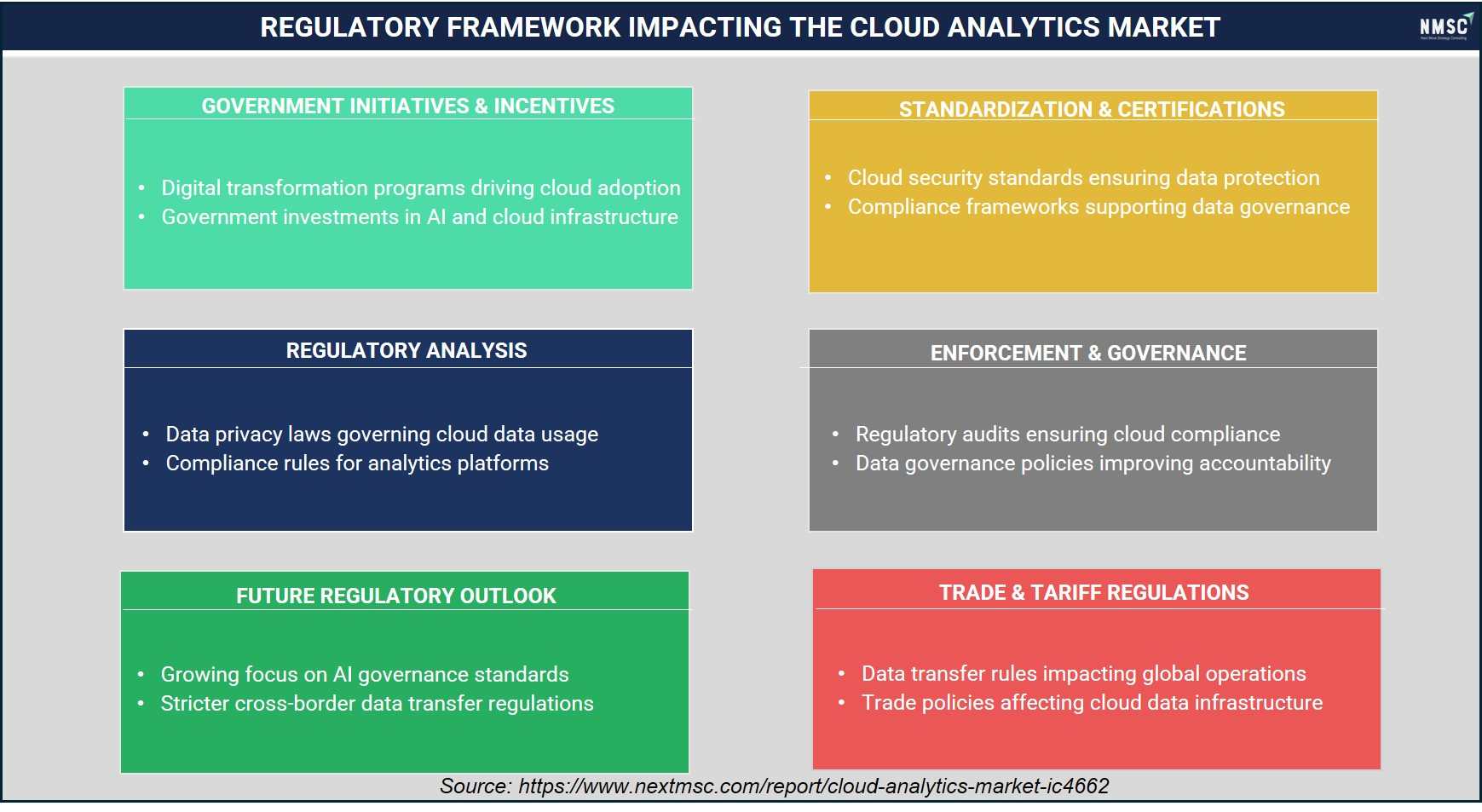
The infographic highlights the key regulatory factors shaping the Cloud Analytics Market. Government-led digital transformation initiatives, investments in cloud infrastructure, and AI development programs continue to accelerate cloud analytics adoption across industries. At the same time, organizations must comply with evolving data privacy regulations, cybersecurity standards, and governance requirements that influence data management practices. Regulatory oversight, certification frameworks, and compliance audits are strengthening accountability and trust in cloud environments. Looking ahead, increasing emphasis on AI governance, cross-border data transfer controls, and cloud security standards is expected to play a critical role in determining market growth, investment strategies, and global cloud analytics deployment models.
Key Market Segments
By Offering
-
Software
-
Data Platform
-
Cloud Data Warehouse
-
Lakehouse
-
Data Integration and ETL
-
Data Governance and Catalog
-
Streaming and Real Time
-
-
Analytics Consumption
-
BI and Reporting
-
Search and Conversational Analytics
-
Embedded Analytics
-
Planning and Performance
-
-
Advanced Analytics
-
Data Science and ML
-
Predictive Analytics
-
Optimization and Simulation
-
-
Packaged Domain Applications
-
Customer Analytics
-
Finance and Risk Analytics
-
Operations and Supply Chain Analytics
-
Workforce Analytics
-
Other Domain Applications
-
-
Services
-
Implementation and Integration
-
Managed Services
-
Support and Training
-
-
By Deployment
-
Public Cloud
-
Hybrid Cloud
-
Private Cloud
By Customer Size
-
Large Enterprise
-
Midmarket
-
SMB
By Route to Market
-
Direct
-
Partner
-
Marketplace
-
OEM and Embedded
By End User Industry
-
BFSI
-
IT and Telecom
-
Retail and E-Commerce
-
Manufacturing
-
Healthcare and Life Sciences
-
Government
-
Energy and Utilities
-
Media and Entertainment
-
Other
By Region
-
North America: U.S., Canada, and Mexico.
-
Europe: UK, Germany, France, Italy, Spain, Sweden, Denmark, Finland, the Netherlands, and the rest of Europe.
-
Asia Pacific: China, India, Japan, South Korea, Taiwan, Indonesia, Vietnam, Australia, Philippines, Malaysia and the rest of APAC.
-
Middle East & Africa (MEA): Saudi Arabia, UAE, Egypt, Israel, Turkey, Nigeria, South Africa, and the rest of MEA.
-
Latin America: Brazil, Argentina, Chile, Colombia, and the rest of LATAM.
Conclusion and Recommendations
Long-Term Outlook
The Cloud Analytics Market is entering the most consequential growth decade in its history, driven by enterprise AI adoption, cloud-native lakehouse architecture standardization, real-time analytics demand, and expanding regulatory requirements for governed data intelligence operations. The market is forecast to grow from USD 55.5 billion in 2026 to USD 281.4 billion by 2035, at a CAGR of 19.8%. NMSC's analysis indicates that this growth reflects both the structural expansion of enterprise analytics workloads and the increasing organizational willingness to procure managed cloud analytics services rather than building and operating bespoke on-premises data intelligence infrastructure across distributed enterprise IT estates.
Strategic Positioning Recommendations
Cloud analytics platform vendors should prioritize AI-native differentiation through integrated natural language query interfaces, automated insight generation, and embedded generative AI analytics assistants. Organizations that embed AI capabilities within governed analytics platforms, rather than treating AI as a standalone overlay, will capture premium pricing and superior customer retention economics. Sovereign cloud analytics investment is non-negotiable for vendors targeting European, Middle Eastern, and South and Southeast Asian enterprise buyers. Vendors without in-country data residency and processing options face structural competitive disadvantage in regulated-market procurement processes for cloud analytics platform contracts across these high-growth regional markets.
Investment Attractiveness
The Cloud Analytics Market represents an exceptionally attractive long-term investment environment given durable multi-decade secular growth drivers, recurring consumption-based and subscription revenue models, and a structural shift from capital-intensive on-premises analytical infrastructure toward managed cloud analytics services. Our assessment indicates that the highest-conviction investment themes include Advanced Analytics and Data Science at a CAGR of 23.4%, Healthcare and Life Sciences vertical adoption at 21.3% CAGR, Hybrid Cloud deployment at 21.6% CAGR, and Marketplace distribution channel growth at 24.6% CAGR, each representing structural sub-market inflection points within the broader Cloud Analytics Market forecast through 2035.
Market Shifts and Key Risks
The most significant market shift underway is the migration from discrete, best-of-breed analytics tool procurement toward consolidated AI analytics platform purchasing from single vendors or tightly integrated hyperscaler ecosystems. This shift benefits full-stack platforms including Microsoft Fabric, Databricks, and Snowflake at the expense of point-solution analytics vendors. Key risks include data privacy regulatory escalation constraining cross-border analytics data flows, macroeconomic pressures slowing enterprise cloud analytics spending growth, open-source competition pressuring commercial analytics licensing margins, and the rapid pace of AI capability evolution creating product investment cycle uncertainty for established analytics platform vendors across all market segments.
Growth Pathways
Organizations seeking to maximize value from the Cloud Analytics Market should pursue a three-horizon strategy. In the near term from 2025 to 2027, prioritize cloud lakehouse migration and governed analytics platform deployment to establish the foundation required for enterprise AI analytics programs. In the mid-term from 2027 to 2031, invest in generative AI analytics capabilities, real-time streaming analytics infrastructure, and sovereign cloud analytics readiness to capture AI-driven value creation and expanding regulated-industry demand. In the long term from 2031 to 2035, position for analytics fabric interoperability across multi-cloud, edge, and sovereign cloud environments as data volumes and analytical complexity exceed current architectural limits across global enterprise deployments.


About the Author
 Tushmi Dutta is a focused researcher specializing in detailed analysis and insight-driven research across diverse business landscapes. She supports strategic initiatives through structured data interpretation, thorough validation, and clear communication of findings that aid informed decision-making. With a strong interest in writing, she enjoys presenting research insights in an engaging and accessible manner. Beyond work, she enjoys traveling, reading, painting, and continuously learning new skills that contribute to her creative and professional growth.
About the Reviewer
 Supradip Baul is an accomplished business consultant and strategist with over a decade of rich experience in market intelligence, strategy, technology, and business transformation. His work has included rigorous qualitative and quantitative analysis across multiple industries, helping clients shape investment decisions and long-term roadmaps. Earlier in his career, he was associated with Gartner, where he contributed to industry-leading reports and market share analyses. He has worked with leading global companies and holds an MBA with a dual specialization in Marketing and Finance.
At Next Move Strategy Consulting, we understand that insightful market research is the cornerstone of successful business decisions. That's why we employ a robust and multifaceted approach, combining various methodologies to deliver the most accurate and actionable data for our clients.

Research Landscape
We navigate the world of research with two primary approaches:
Qualitative Approach
Our qualitative research methodologies involve immersive techniques such as in-depth interviews, focus groups, and observational studies. By engaging directly with individuals and stakeholders, we uncover valuable insights that quantitative data alone may overlook.

Quantitative Research
In tandem with qualitative methodologies, NMSC leverages the power of Quantitative Research to provide a robust foundation of numerical insights. Through systematic data collection and analysis, we quantify patterns, preferences, and market trends, offering a comprehensive view of the business landscape.
Our quantitative research approach employs diverse tools, including surveys, experiments, and statistical modelling. These methodologies enable us to gather data from a large and representative sample, ensuring the statistical significance of our findings. By employing structured questionnaires and standardized data collection methods, we guarantee the reliability and validity of the information we present to our clients.
Quantitative research is particularly effective in measuring the prevalence of trends, assessing market size, and gauging the impact of various factors on consumer behavior. The numerical precision attained through this approach equips our clients with actionable insights, facilitating data-driven decision-making and strategy formulation.


Our Specialized Toolbox for Industry-Specific Market Research
We deploy a specialized arsenal of techniques tailored to meet your unique requirements. Here's a glimpse into our comprehensive toolbox:

Information Procurement
The stage entails acquiring market data or relevant information through various sources and methodologies.


Market Research Approach
We utilize both top-down and bottom-up approaches in market research analysis to achieve a comprehensive understanding of the market dynamics, leveraging the broad perspective of industry trends and macroeconomic factors alongside detailed insights from specific segments and individual companies.

Porters Five Forces Analysis
We conduct Porter's Five Forces analysis to evaluate the competitive landscape of an industry, providing us with insights into factors that affect profitability and strategic positioning.

SWOT Analysis

Forecasting
We utilize a forecasting model to predict future consumption by considering parameters like population, economics, regulations, market competition, drivers, constraints, technology, and pricing. We also employ statistical techniques such as multilinear regression, exponential smoothing, moving average, ARIMA, and Monte Carlo simulations for accurate predictions. In econometric forecasting, we analyzed short-term and long-term event impacts, attributing values based on regulatory frameworks, economic factors, and market events.





 Speak to Our Analyst