Environmental, Social, and Governance (ESG) Insurance Market Size, Share, and Trends Analysis By Coverage Type (D&O Liability for ESG Disclosure and Greenwashing, Environmental Liability Insurance, Climate risk and parametric insurance & others), By End User (Corporates, Financial institutions & others), By Distribution Channel (Brokers, Direct sales & MGAs and delegated authority), and By Region (North America, Europe & others) — Global Industry Report and Forecast, 2026–2035
Industry: BFSI | Publishing Date: August 4, 2026 | Last Updated: August 4, 2026 | No of Pages: N/A | No. of Tables: N/A | No. of Figures: N/A | Format: PDF | Report Code: BF5541
Environmental, Social, and Governance (ESG) Insurance Market
What Is the ESG Insurance Market Size?
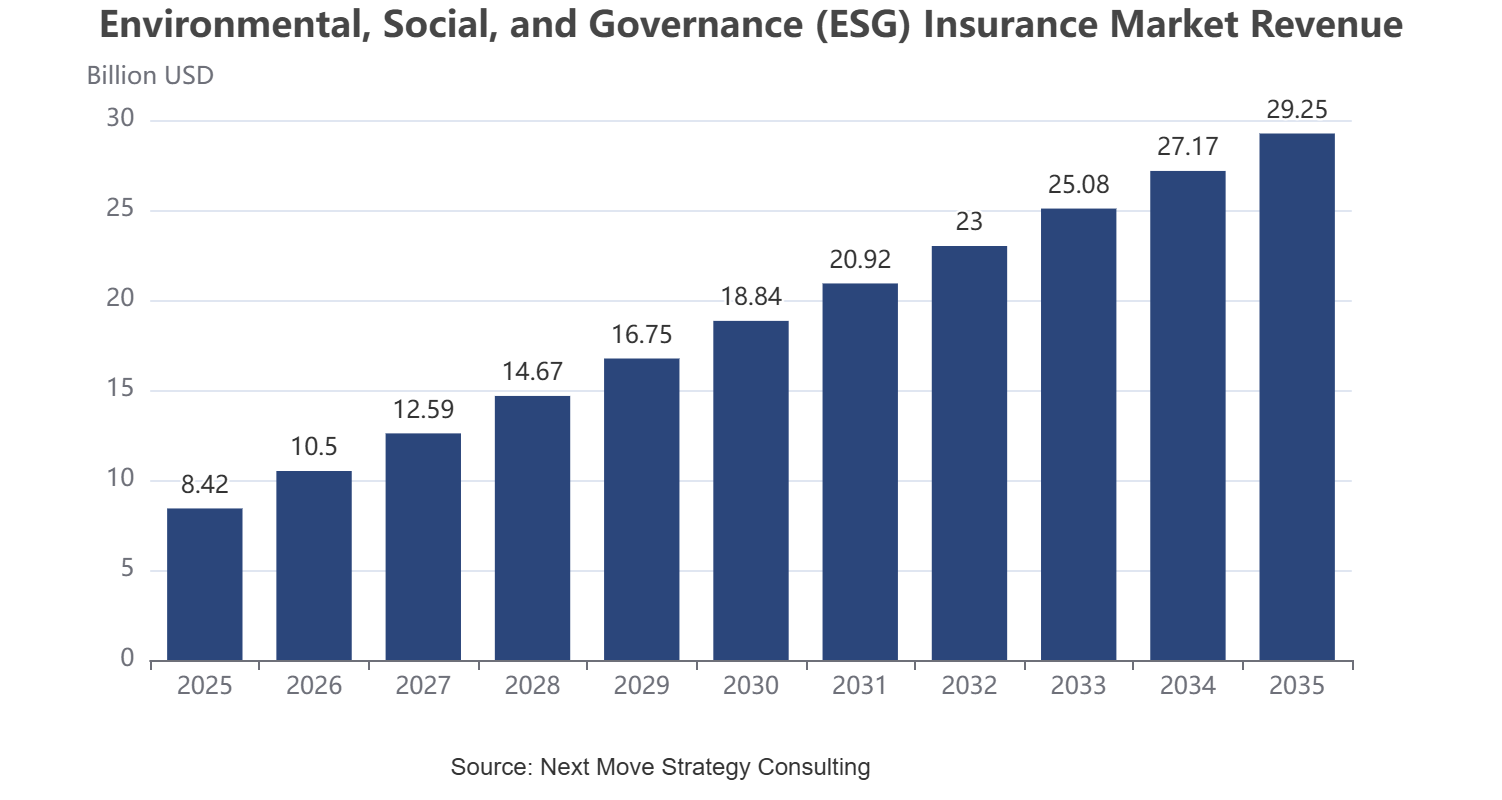
The ESG Insurance Market size was valued at USD 8.42 Billion in 2025 and is estimated at USD 9.58 Billion in 2026, forecast to reach USD 29.25 Billion by 2035, expanding at a 13.2% CAGR between 2026 and 2035. Europe leads with approximately a 38% share, while D&O liability for ESG disclosure and greenwashing dominates all coverage types with approximately a 38% share.
We observed that growth is concentrated in greenwashing-linked directors and officers liability and climate risk parametric products, with underwriters increasingly pricing ESG disclosure quality directly into commercial risk assessment through 2035.
|
Key Takeaways |
|
By Coverage Type: D&O liability for ESG disclosure and greenwashing held the largest share of approximately 38% (USD 3.20 Billion) in 2025; Climate risk and parametric insurance is the fastest-growing sub-segment at 18.44% CAGR from 2026–2035. |
|
By End User: Corporates held the largest share of approximately 52% (USD 4.38 Billion) in 2025; Asset managers is the fastest-growing sub-segment at 14.91% CAGR from 2026–2035. |
|
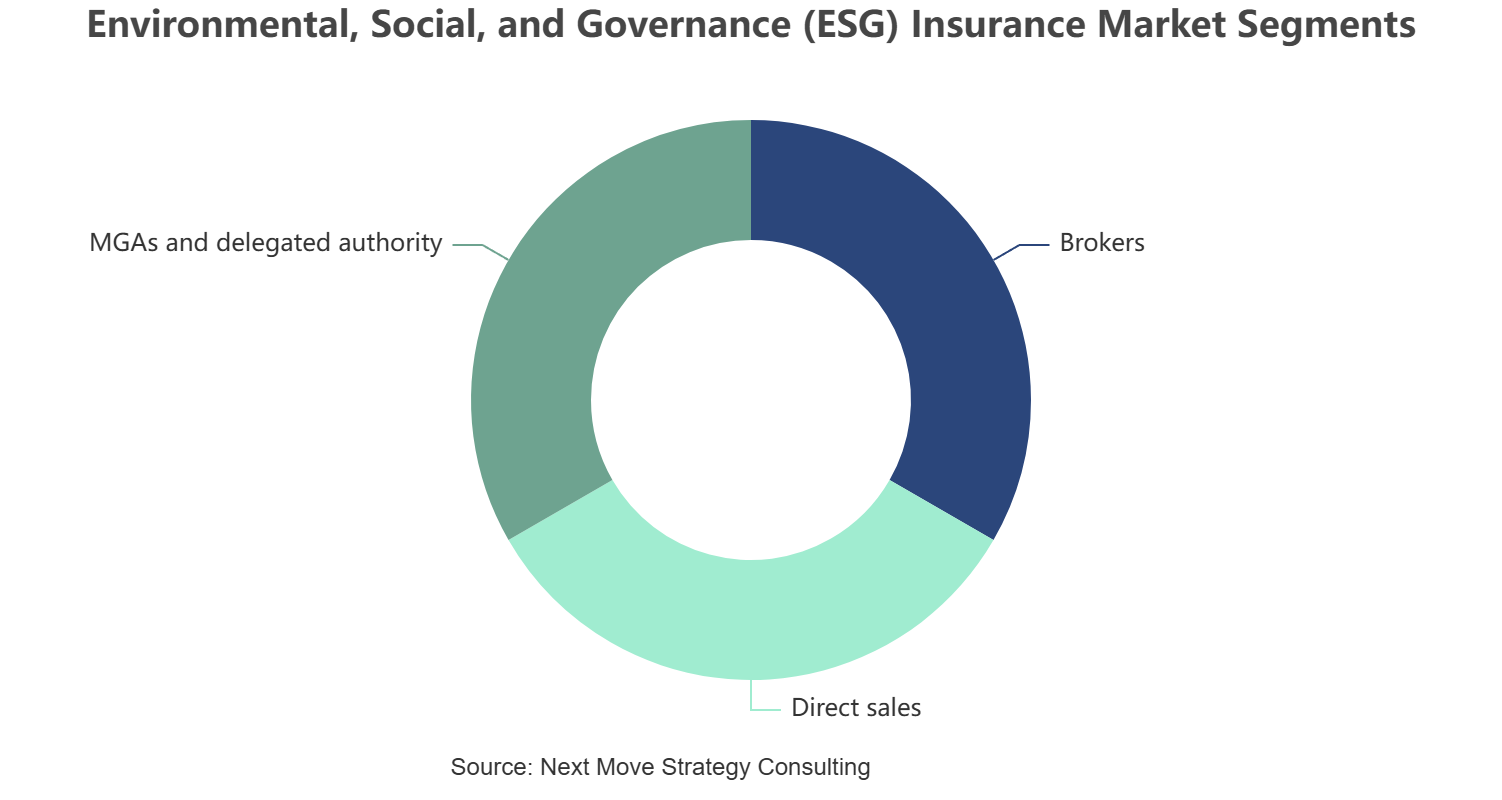
By Distribution Channel: Brokers held the largest share of approximately 63% (USD 5.30 Billion) in 2025; MGAs and delegated authority is the fastest-growing sub-segment at 20.2% CAGR from 2026–2035. |
|
Dominant Region: Europe dominated with approximately 38% revenue share (USD 3.20 Billion) in 2025. |
|
Fastest-Growing Region: Asia-Pacific is expected to register the highest CAGR of 17.72% during 2026–2035. |
|
Dominant Country: The U.S. led the market with approximately USD 2.15 Billion in 2025. |
|
Fastest-Growing Country: India is expected to register the highest CAGR of approximately 20.1% during 2026–2035. |
Market Opportunity: The ESG Insurance market is expected to create an absolute dollar opportunity of USD 19.67 Billion between 2026 and 2035, presenting significant investment potential across climate risk parametric products and greenwashing-linked liability coverage.
According to NMSC analysis, underwriters are increasingly treating ESG disclosure quality as a distinct pricing variable within directors and officers liability programs rather than a peripheral consideration, a shift that favors carriers with dedicated ESG underwriting expertise over generalist commercial insurers as climate-related litigation volume rises through 2035.
What Does the ESG Insurance Market Encompass?
The ESG Insurance Market encompasses specialty insurance products that address environmental, social, and governance-linked risk exposures, including directors and officers liability coverage for greenwashing and sustainability disclosure claims, environmental liability, climate risk parametric products, sustainability-linked insurance, and supply chain ESG risk coverage. Our assessment indicates that the scope covers corporates, financial institutions, asset managers, and government entities distributed through brokers, direct sales, and managing general agents.
Regulatory frameworks including the European Union's Corporate Sustainability Reporting Directive and the U.S. Securities and Exchange Commission's climate disclosure rules increasingly shape underwriting standards and claims exposure for ESG-linked policies. We observed that technology adoption is shifting toward satellite and lidar-based parametric triggers that accelerate claims settlement for climate risk products. NMSC's analysis indicates that this structural shift, combined with rising greenwashing litigation volume, is redefining underwriting criteria across the ESG insurance value chain.
|
Parameter |
Details |
|
Market Size in 2025 |
USD 8.42 Billion |
|
Market Size in 2026 |
USD 9.58 Billion |
|
Revenue Forecast in 2035 |
USD 29.25 Billion |
|
Growth Rate |
CAGR of 13.2% from 2026 to 2035 |
|
Analysis Period |
2025–2035 |
|
Base Year Considered |
2025 |
|
Forecast Period |
2026–2035 |
|
Market Size Estimation |
USD Billion |
|
Companies Profiled |
20 |
|
Countries Covered |
38 |
|
Market Share |
Available for Top 10 Companies |
Key Emerging Trends
Based on research conducted by NMSC, we found that four structural trends are reshaping underwriting practice, product design, and stakeholder engagement across the ESG Insurance market.
How Is Greenwashing Litigation Transforming D&O Underwriting?
Greenwashing litigation is emerging as a distinct source of directors and officers liability exposure across multiple jurisdictions. We observed that Allianz Commercial has flagged sustainability liabilities as a rising item on the D&O watchlist, noting that climate-related litigation cases have been recorded across 55 countries. This trend is transforming underwriting practice as insurers increasingly scrutinize ESG disclosure quality during policy renewal.
Why Is Climate Risk Data Accelerating Parametric Product Adoption?
Satellite and remote-sensing data feeds are enabling insurers to launch parametric products that pay out automatically against defined climate triggers. We observed that analytics-driven underwriters are deploying performance datasets to calibrate weather-linked parametric triggers, cutting claims settlement times significantly. This trend is elevating climate risk and parametric insurance as the fastest-growing coverage category within the broader ESG insurance portfolio.
How Is ESG Disclosure Regulation Reshaping Underwriting Standards?
Expanding ESG disclosure regulation is prompting insurers to incorporate sustainability compliance directly into underwriting decisions. Our findings suggest that Zurich Insurance Group has publicly flagged ESG-related liabilities as a significant emerging exposure for the directors and officers insurance market, encouraging underwriters to engage more closely with insureds on sustainability governance. This trend is elevating the strategic importance of ESG-specific underwriting expertise among specialty carriers.
What Role Does ESG Performance Play in Underwriting Pricing Decisions?
Insurers are increasingly incorporating ESG performance scores as a distinct underwriting and pricing variable alongside traditional risk factors. Our analysis shows that some carriers now treat poor ESG performance as a risk on par with conventional exposures, since weak sustainability practices can precede reputational damage, regulatory scrutiny, and subsequent claims. This trend is reshaping demand across the sustainability-linked insurance coverage segment.
Growth Drivers and Restraints
Growth Catalyst and Risk Assessment Matrix
|
Factors |
Type |
(+/−) % Impact on CAGR |
Geographic Relevance |
Impact Timeline |
|
Rising greenwashing and climate-related litigation volume |
Driver |
+3.2% |
North America, Europe |
2026-2035 |
|
Expanding ESG disclosure regulation |
Driver |
+2.4% |
Europe, North America |
2026-2032 |
|
Growth of climate risk parametric product adoption |
Driver |
+1.8% |
Global |
2026-2035 |
|
Rising investor and shareholder ESG scrutiny |
Driver |
+1.3% |
Global |
2026-2035 |
|
Expanding sustainability-linked financing requiring insurance backing |
Driver |
+0.9% |
Europe, Asia-Pacific |
2028-2035 |
|
Growing regional adoption of ESG risk underwriting frameworks |
Driver |
+0.6% |
Asia-Pacific, Middle East & Africa |
2028-2035 |
|
Persistent soft commercial insurance pricing cycle |
Restraint |
-1.1% |
North America, Europe |
2026-2030 |
|
Coverage ambiguity around intentional versus negligent ESG misrepresentation |
Restraint |
-0.7% |
Global |
2026-2032 |
|
Limited ESG underwriting expertise among regional carriers |
Restraint |
-0.5% |
Latin America, Middle East & Africa |
2026-2032 |
What Is the Primary Growth Driver of the Market?
Rising greenwashing and climate-related litigation volume is the primary driver of the market. Legal research organizations have documented climate-related litigation cases across 55 countries, with ESG-related securities and disclosure litigation continuing to accelerate. We observed that this litigation pressure, reinforced by expanding shareholder and regulatory scrutiny, continues to anchor baseline demand for directors and officers liability coverage addressing ESG disclosure exposure.
How Is ESG Disclosure Regulation Driving Market Growth?
Expanding mandatory sustainability disclosure requirements are accelerating demand for ESG-specific liability coverage. The U.S. Securities and Exchange Commission continues to enforce climate-related disclosure obligations, while the European Union's Corporate Sustainability Reporting Directive expands mandatory reporting scope for large companies. Our assessment indicates that this regulatory pressure is compressing renewal timelines as insureds seek broader risk management support alongside their liability programs.
What Is Restraining ESG Insurance Market Expansion?
A persistent soft commercial insurance pricing cycle restrains premium growth across specialty liability lines, including ESG-linked coverage. Industry commentary continues to describe ample underwriting capacity relative to demand across most commercial liability segments as of 2025. We found that this pricing softness disproportionately affects standalone ESG liability products compared with bundled directors and officers programs offered by large, diversified carriers.
Segmentation Analysis
Segment Sizing: By Coverage Type
|
Segment |
2025 (USD Billion) |
2035 (USD Billion) |
CAGR% (2026-2035) |
|
D&O liability for ESG disclosure and greenwashing |
3.20 |
9.95 |
11.82% |
|
Environmental liability insurance |
1.85 |
5.26 |
10.68% |
|
Climate risk and parametric insurance |
1.35 |
7.02 |
18.44% |
|
Sustainability-linked insurance |
1.01 |
4.39 |
16.05% |
|
Supply chain and third-party ESG risk insurance |
0.76 |
2.05 |
10.13% |
|
Other coverage types |
0.25 |
0.58 |
8.01% |
|
Total |
8.42 |
29.25 |
13.20% |
Which Coverage Type Segment Dominates the ESG Insurance Market?
D&O liability for ESG disclosure and greenwashing led the market with USD 3.20 Billion in 2025, supported by rising litigation volume tied to sustainability misrepresentation claims. We observed that Climate risk and parametric insurance is the fastest-growing coverage type, expanding at an 18.44% CAGR from 2026 to 2035, as insurers increasingly deploy satellite-based data feeds to enable automated, trigger-based climate risk payouts.
Segment Sizing: By End User
|
Segment |
2025 (USD Billion) |
2035 (USD Billion) |
CAGR% (2026-2035) |
|
Corporates |
4.38 |
14.04 |
12.21% |
|
Financial institutions |
2.36 |
8.78 |
14.09% |
|
Asset managers |
1.18 |
4.68 |
14.91% |
|
Government and public entities |
0.50 |
1.75 |
13.17% |
|
Total |
8.42 |
29.25 |
13.20% |
Which End User Segment Leads the ESG Insurance Market?
Corporates led the market with USD 4.38 Billion in 2025, supported by broad-based directors and officers liability demand across listed companies facing sustainability disclosure obligations. Asset managers is the fastest-growing end-user segment, expanding at a 14.91% CAGR from 2026 to 2035, as regulators increasingly scrutinize fund-level ESG claims and greenwashing risk within investment product marketing.
Segment Sizing: By Region
|
Segment |
2025 (USD Billion) |
2035 (USD Billion) |
CAGR% (2026-2035) |
|
North America |
2.86 |
8.78 |
11.64% |
|
Europe |
3.20 |
9.95 |
11.82% |
|
Asia-Pacific |
1.60 |
7.90 |
17.72% |
|
Middle East & Africa |
0.34 |
1.46 |
16.13% |
|
Latin America |
0.42 |
1.16 |
10.33% |
|
Total |
8.42 |
29.25 |
13.20% |
Which Region Leads ESG Insurance Market Demand?
Europe remained the leading region, valued at USD 3.20 Billion in 2025 on sustained mandatory sustainability disclosure regulation. Our findings suggest that Asia-Pacific is the fastest-growing region, registering a 17.72% CAGR from 2026 to 2035, as expanding regional ESG disclosure frameworks and rising corporate governance scrutiny drive accelerating adoption of ESG-linked liability and climate risk coverage.
Beyond the three axes profiled above, the ESG Insurance market is also segmented by Distribution Channel. Brokers hold the largest 2025 share within this axis, while MGAs and delegated authority register the fastest 2026–2035 CAGR, consistent with the Key Takeaways summarized above.
PESTEL Analysis of the Environmental, Social, And Governance (ESG) Insurance Industry
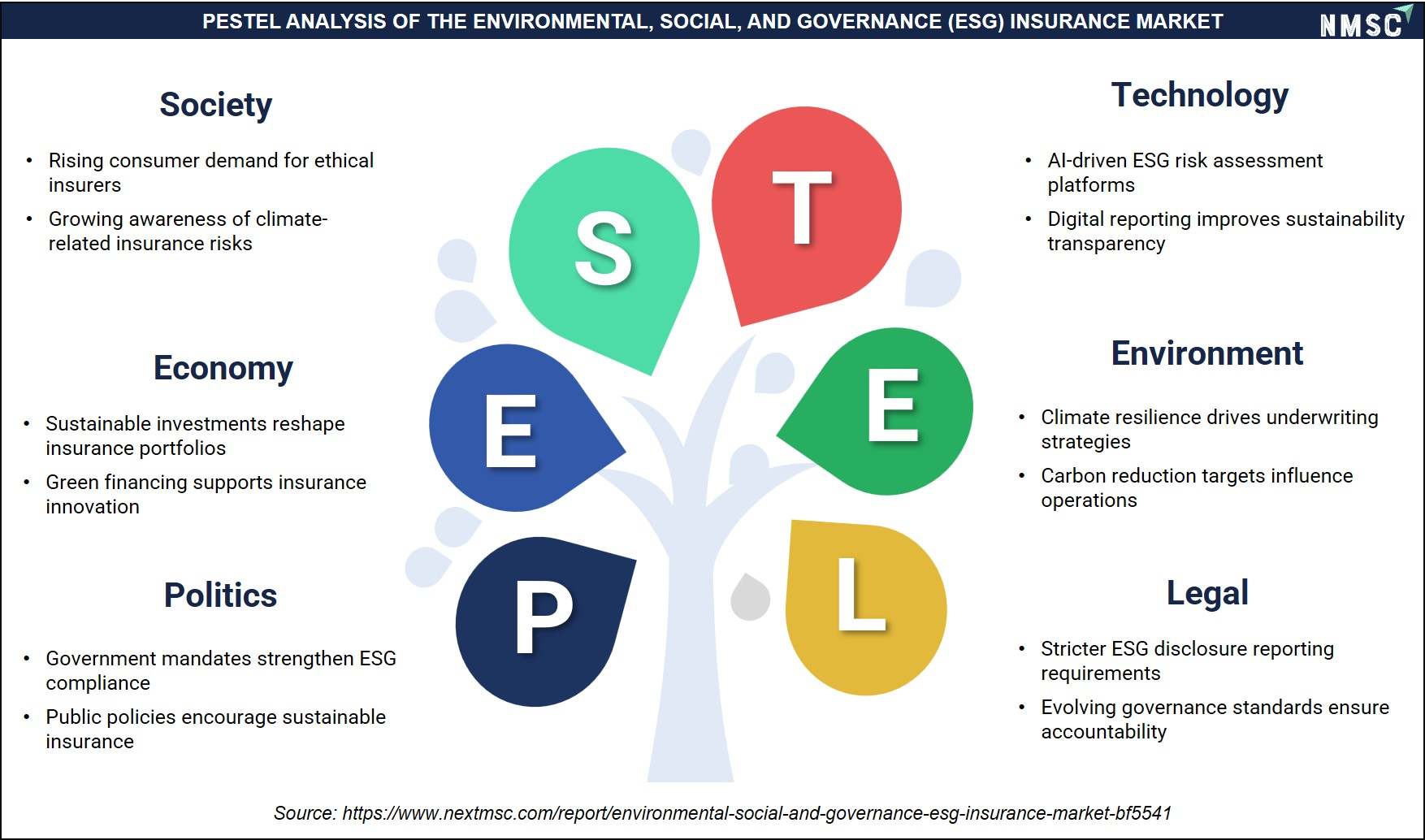
The above PESTEL analysis maps the key macro-environmental factors, such as political, economic, social, technological, environmental, and legal, shaping the ESG insurance market. From our analysis, we observed that political stability and regulatory frameworks support ESG adoption, while economic factors influence investment and premium structures. Social awareness and technological advancements drive innovation, whereas environmental regulations promote sustainable practices. Legal frameworks, including compliance and disclosure requirements, ensure further transparency and accountability, reflecting a comprehensive PESTEL landscape across the market.
Growth Opportunities
We found that three forward-looking whitespace opportunities stand out for stakeholders positioning within the ESG Insurance market over the coming decade.
How Can Insurers Capture Demand From Asset Manager Greenwashing Exposure?
Expanding regulatory scrutiny of fund-level ESG marketing claims creates a mechanism for insurers to develop specialized liability products for asset managers facing greenwashing allegations. Carriers with dedicated financial institutions underwriting teams stand to benefit most, as asset managers increasingly seek coverage tailored to fund disclosure and marketing claim exposures.
What Opportunity Does Parametric Climate Coverage Present for Emerging Markets?
Rising climate exposure across underinsured emerging markets creates a mechanism for insurers to deploy satellite-data-driven parametric products where traditional indemnity coverage remains limited. Insurers building regional data partnerships stand to benefit most, capturing early-mover positioning in Asia-Pacific and Middle East & Africa markets with expanding climate risk awareness.
How Can Providers Unlock Supply Chain ESG Risk Contracts?
Growing corporate scrutiny of supplier ESG compliance creates a mechanism for insurers to offer dedicated supply chain and third-party ESG risk products. Providers integrating cyber liability insurance expertise with ESG risk assessment stand to benefit most, capturing multinational corporates seeking consolidated third-party risk coverage.
Regional Outlook
|
Region |
2025 (USD Billion) |
2035 (USD Billion) |
CAGR% (2026-2035) |
Key Driver |
|
North America |
2.86 |
8.78 |
11.64% |
Greenwashing litigation exposure |
|
Europe |
3.20 |
9.95 |
11.82% |
Corporate Sustainability Reporting Directive |
|
Asia-Pacific |
1.60 |
7.90 |
17.72% |
Expanding regional ESG disclosure frameworks |
|
Middle East & Africa |
0.34 |
1.46 |
16.13% |
Emerging sustainability governance adoption |
|
Latin America |
0.42 |
1.16 |
10.33% |
Growing corporate ESG compliance investment |
|
Total |
8.42 |
29.25 |
13.20% |
— |
North America
North America's market reflects rising greenwashing litigation exposure under Securities and Exchange Commission climate disclosure enforcement. We observed that carriers are prioritizing enhanced ESG-specific policy language within directors and officers renewals. Technology adoption favors satellite-based climate risk monitoring, and the region's strategic outlook remains anchored to sustained litigation-driven liability demand through 2035.
Europe
Europe's market is shaped by the Corporate Sustainability Reporting Directive's expanding mandatory disclosure scope. Our assessment indicates that regional insurers are advancing dedicated ESG underwriting teams to assess sustainability governance quality during policy renewal. The region's strategic outlook favors carriers with strong pan-European regulatory expertise serving multinational corporate and financial institution clients.
Asia-Pacific
Asia-Pacific's ESG insurance market benefits from rapidly expanding regional sustainability disclosure frameworks and rising corporate governance scrutiny. We found that regional insurers are adopting climate risk parametric products faster than other regions, reflecting strong government-backed sustainable finance initiatives. The region's strategic outlook remains the strongest globally, anchored by sustained regulatory and investor-driven ESG adoption.
Middle East & Africa
The market is expanding from a smaller base, supported by emerging national sustainability governance adoption programs. Our analysis shows that regional demand is concentrated among large corporates and government-linked entities pursuing early ESG compliance positioning. The region's strategic outlook depends on continued regulatory formalization and growing insurer underwriting capacity through 2035.
Latin America
Latin America's ESG insurance market is growing steadily, supported by expanding corporate ESG compliance investment and rising regional sustainability reporting adoption. We observed that Brazil's corporate governance reforms are creating incremental demand for ESG-linked liability coverage. The region's strategic outlook favors insurers able to serve multiple national markets with standardized ESG liability and environmental coverage products.
U.S.
Based on our estimates, the U.S. ESG insurance market was valued at approximately USD 2.15 Billion in 2025 and is projected to reach USD 6.58 Billion by 2035 at an 11.6% CAGR. Demand structure favors directors and officers liability coverage tied to greenwashing and climate disclosure litigation, supported by strong regulatory influence from Securities and Exchange Commission enforcement and rising technology penetration of parametric climate risk products.
Canada
The market in Canada was valued at approximately USD 0.51 Billion in 2025 and is projected to reach USD 1.58 Billion by 2035 at an 11.7% CAGR. Demand structure reflects growing corporate sustainability disclosure adoption, moderate regulatory influence from national securities disclosure guidance, and rising competitive intensity as multinational carriers expand dedicated ESG underwriting teams.
UK
As per our estimate, the UK ESG insurance market was valued at approximately USD 0.77 Billion in 2025 and is projected to reach USD 2.39 Billion by 2035 at an 11.9% CAGR. Demand structure centers on directors and officers liability among listed companies, with strong regulatory influence from Financial Conduct Authority scrutiny of ESG and sustainability disclosures and rising technology penetration of climate risk underwriting tools.
Germany
According to our analysis, the Germany ESG insurance market was valued at approximately USD 0.83 Billion in 2025 and is projected to reach USD 2.59 Billion by 2035 at a 12.0% CAGR. Demand structure reflects the country's sustained Corporate Sustainability Reporting Directive compliance activity, high regulatory influence from national and European Union disclosure standards, and strong competitive intensity among established European specialty insurers.
France
Based on our estimates, the France ESG insurance market was valued at approximately USD 0.51 Billion in 2025 and is projected to reach USD 1.59 Billion by 2035 at a 12.0% CAGR. Demand structure favors environmental liability and D&O coverage among large listed corporates, supported by national sustainability reporting requirements and growing technology penetration of ESG-specific underwriting tools.
China
The market in China was valued at approximately USD 0.61 Billion in 2025 and is projected to reach USD 3.16 Billion by 2035 at an 18.0% CAGR. Demand structure benefits from expanding domestic sustainability disclosure guidance for listed companies, strong regulatory influence from national environmental governance standards, and rising technology penetration of climate risk parametric platforms among leading domestic insurers.
India
As per our estimate, the India market was valued at approximately USD 0.14 Billion in 2025 and is projected to reach USD 0.87 Billion by 2035 at a 20.1% CAGR, the fastest among all countries covered. Demand structure reflects rapidly expanding corporate sustainability reporting adoption following national ESG disclosure reforms, growing regulatory influence from securities market regulation, and rising uptake among domestic and multinational insurers.
Japan
According to our analysis, the Japan market was valued at approximately USD 0.29 Billion in 2025 and is projected to reach USD 1.42 Billion by 2035 at a 17.3% CAGR. Demand structure favors D&O liability among established listed corporates, supported by strong domestic underwriting capacity and steady technology penetration of ESG-specific risk assessment tools.
South Korea
Based on our estimates, the South Korea market was valued at approximately USD 0.19 Billion in 2025 and is projected to reach USD 0.95 Billion by 2035 at a 17.5% CAGR. Demand structure benefits from expanding domestic sustainability disclosure standards, high regulatory influence from national corporate governance codes, and rising strategic outlook tied to growing ESG-linked liability demand.
Australia
The market in Australia was valued at approximately USD 0.14 Billion in 2025 and is projected to reach USD 0.63 Billion by 2035 at a 16.3% CAGR. Demand structure reflects growing mandatory climate disclosure requirements, with moderate regulatory influence from national securities regulation and gradually rising technology penetration of climate risk underwriting platforms.
UAE
As per our estimate, the UAE was valued at approximately USD 0.11 Billion in 2025 and is projected to reach USD 0.48 Billion by 2035 at a 15.9% CAGR. Demand structure reflects growing corporate sustainability governance adoption, moderate regulatory influence from national economic diversification strategies, and rising technology penetration as regional ESG compliance investment expands.
Saudi Arabia
According to our analysis, the Saudi Arabia market was valued at approximately USD 0.12 Billion in 2025 and is projected to reach USD 0.51 Billion by 2035 at a 16.0% CAGR. Demand structure benefits from large-scale national sustainability programs supporting Vision 2030 diversification targets, with strong regulatory influence and rising strategic outlook tied to state-backed ESG governance investment.
South Africa
Based on our estimates, the market was valued at approximately USD 0.07 Billion in 2025 and is projected to reach USD 0.29 Billion by 2035 at a 16.5% CAGR. Demand structure remains concentrated among large listed corporates, with moderate regulatory influence from national corporate governance codes and gradually rising competitive intensity among regional insurers.
Brazil
The market in Brazil was valued at approximately USD 0.23 Billion in 2025 and is projected to reach USD 0.64 Billion by 2035 at a 10.5% CAGR. Demand structure reflects the country's expanding corporate governance reform agenda, with growing regulatory influence from national sustainability reporting requirements and rising technology penetration of ESG liability products among domestic insurers.
Argentina
As per our estimate, the Argentina market was valued at approximately USD 0.08 Billion in 2025 and is projected to reach USD 0.20 Billion by 2035 at a 9.6% CAGR. Demand structure remains at a developing stage, supported by gradually expanding corporate sustainability disclosure adoption, limited regulatory influence from national governance reform, and modest but rising competitive intensity among regional insurers.
SWOT Analysis of the Environmental, Social, And Governance (ESG) Insurance Industry
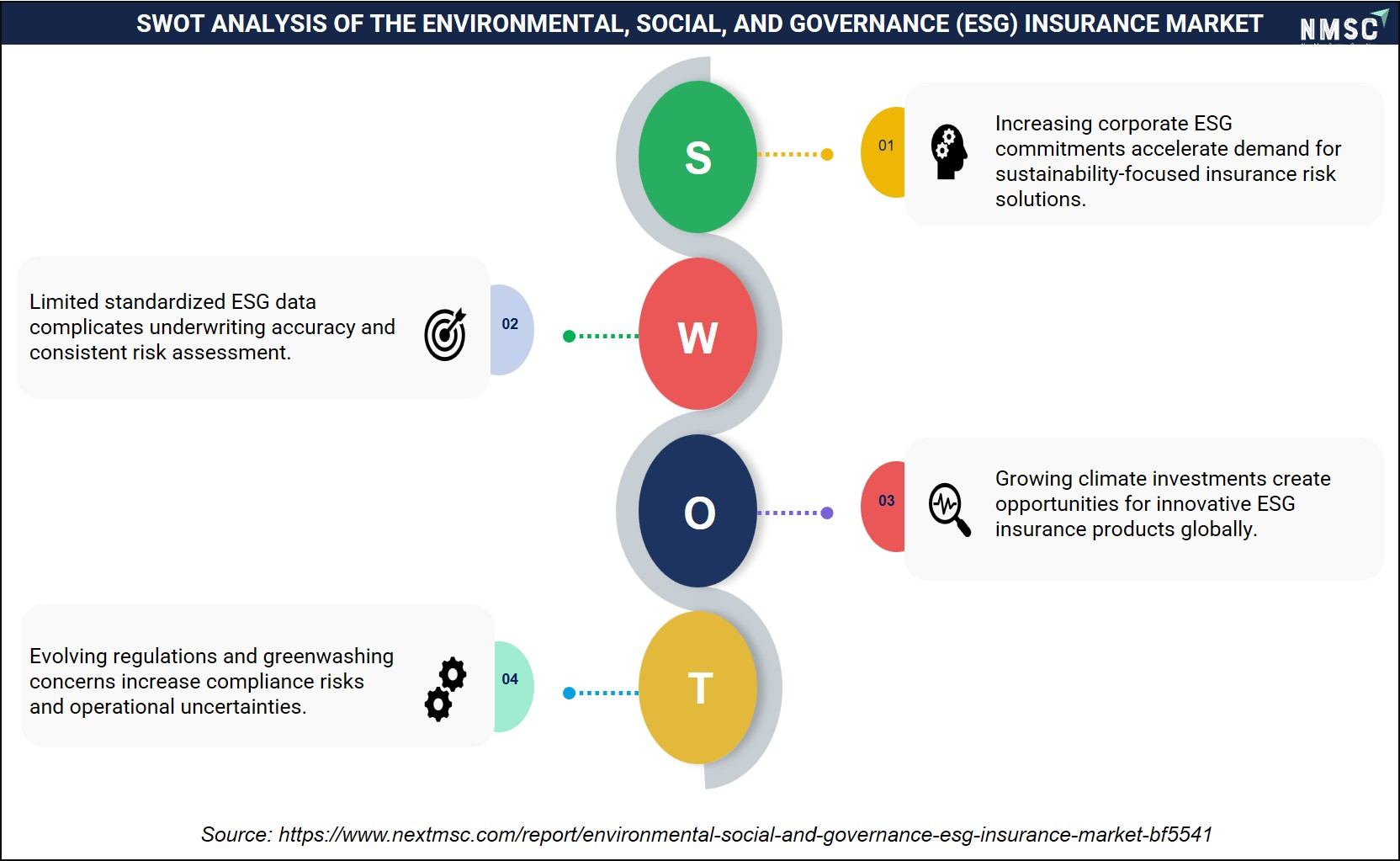
The above SWOT analysis maps the key strategic factors, such as strengths, weaknesses, opportunities, and threats, shaping the ESG insurance market. From our analysis, we observed that increasing corporate ESG commitments accelerating demand for sustainability-focused insurance solutions represent a key strength, while limited standardized ESG data complicating underwriting accuracy remains a critical weakness. Opportunities are driven by growing climate investments creating demand for innovative ESG insurance products, whereas evolving regulations and greenwashing concerns increasing compliance risks pose significant threats across the market.
Competitive Landscape
We observed that the ESG Insurance market features a moderately consolidated competitive landscape, with large diversified global insurers competing alongside specialty carriers on underwriting expertise, regulatory knowledge, and climate risk data capability.
Key Takeaways
|
Dimension |
Description |
|
Market Structure |
Moderately consolidated; leading diversified global insurers profiled in this report collectively account for a significant share of branded ESG-linked liability premiums, while specialty carriers serve niche greenwashing and climate risk demand. |
|
Innovation Focus |
ESG-specific D&O policy wording, satellite-data-driven parametric climate products, and integrated sustainability underwriting scorecards dominate current innovation pipelines across leading carriers. |
|
M&A Activity |
Selective capability building and dedicated underwriting team expansion, exemplified by Allianz Commercial and Zurich Insurance Group's published sustainability liability research and dedicated D&O ESG underwriting guidance. |
How Do Companies Compete in the ESG Insurance Market?
Companies compete primarily on ESG underwriting expertise, regulatory knowledge, and climate risk data capability across the industry. Global diversified insurers such as Allianz SE and Zurich Insurance Group leverage integrated commercial and specialty divisions to serve large multinational corporates, while other carriers such as Chubb Limited and American International Group compete on dedicated directors and officers underwriting depth for greenwashing-linked claims.
Which Competitive Archetypes Dominate the ESG Insurance Market?
Two archetypes dominate the market: diversified global insurers offering integrated commercial and specialty ESG-linked liability portfolios, and focused specialty carriers building deep directors and officers underwriting expertise for sustainability-related claims. Allianz SE and Zurich Insurance Group exemplify the diversified archetype through published sustainability liability research and broad commercial capacity, while Beazley plc and Hiscox Ltd exemplify the focused specialty archetype building niche ESG-linked liability underwriting expertise.
How Are Companies Differentiating Through Innovation in ESG Insurance?
Innovation and differentiation strategy increasingly center on ESG-specific policy wording and climate risk data integration. Allianz Commercial's published sustainability liability guidance and Zurich Insurance Group's dedicated ESG D&O risk commentary both reflect efforts to secure differentiated positioning among corporate and financial institution clients. Our analysis shows that carriers unable to demonstrate dedicated ESG underwriting expertise risk losing sophisticated clients to more specialized competitors.
What M&A and Expansion Activity Is Shaping the ESG Insurance Market?
Dedicated underwriting capability expansion continues to reshape competitive positioning within the industry. Allianz Commercial and Zurich Insurance Group's published research and underwriting guidance on ESG-linked D&O liabilities illustrate how established carriers are building specialized expertise internally rather than pursuing acquisitions, reflecting the market's current emphasis on organic capability development over consolidation.
Key Market Players
Our assessment indicates that the following companies are actively shaping underwriting capacity, regulatory expertise, and product innovation within the ESG Insurance market.
-
Allianz SE
-
Zurich Insurance Group AG
-
AXA S.A.
-
Chubb Limited
-
American International Group, Inc. (AIG)
-
Munich Re
-
Swiss Re Ltd
-
Tokio Marine Holdings, Inc.
-
Sompo Holdings, Inc.
-
MS&AD Insurance Group Holdings, Inc.
-
QBE Insurance Group Limited
-
CNA Financial Corporation
-
Travelers Companies, Inc.
-
Liberty Mutual Holding Company Inc.
-
Beazley plc
-
Hiscox Ltd
-
Assicurazioni Generali S.p.A.
-
W. R. Berkley Corporation
-
Company 19
-
Company 20
Latest Developments
We found that recent published guidance and risk research within the ESG insurance supply chain are concentrated on greenwashing liability awareness and sustainability disclosure underwriting.
|
Date |
Event |
|
March 2025 |
Zurich Insurance (Hong Kong) partnered with Cathay to offer home, motor, personal accident, and domestic helper insurance through Cathay’s digital platform in Hong Kong. |
Expert Insights
 “Insurance is a key enabler to facilitate the net-zero transition, providing protection as well as risk expertise. Clean hydrogen has immense potential as an eco-friendly alternative to fossil fuels and we strongly believe it can play a critical role in the energy transition. We are proud to bring this ground-breaking initiative to the market together with Aon.”
— Sierra Signorelli, CEO Commercial Insurance, Zurich Insurance Group
Statement made following Zurich Insurance Group and Aon's launch of a Clean Hydrogen Insurance Facility, highlighting the role of insurance in supporting sustainable energy investments and the net-zero transition.
Market Interpretation
NMSC's analysis indicates that this published commentary aligns closely with the accelerating integration of sustainability considerations into commercial insurance offerings, reinforcing our assessment that insurers are increasingly positioning ESG risk expertise and climate-transition coverage as core market differentiators rather than niche services. This structural evolution is expected to support sustained growth in ESG insurance demand as investments in clean energy, decarbonization, and sustainable infrastructure continue to expand through 2035.
Investment Opportunities
What Capital Inflows Are Supporting the ESG Insurance Market?
Diversified insurers are directing underwriting capacity and research investment toward dedicated ESG risk assessment capability. Allianz Commercial and Zurich Insurance Group's published sustainability liability research illustrate sustained institutional commitment to building specialized ESG underwriting expertise within existing commercial and specialty insurance divisions.
How Is Regulatory Investment Shaping ESG Insurance Demand?
Government and regulatory investment in mandatory sustainability disclosure frameworks continues to expand the addressable base for ESG-linked liability coverage. Our assessment indicates that the European Union's Corporate Sustainability Reporting Directive and expanding national disclosure regimes are creating multi-year demand pipelines for carriers with established ESG underwriting relationships.
What ESG Considerations Are Influencing ESG Insurance Investment Decisions?
Environmental, social, and governance considerations are, by definition, central to capital allocation decisions within this market itself. Insurers are increasingly incorporating insureds' ESG performance scores directly into underwriting and pricing decisions. We observed that carriers are favoring policyholders with documented sustainability governance credentials as ESG-linked underwriting scrutiny intensifies across commercial liability portfolios.
Key Benefits for Stakeholders
How Does This Report Benefit Industry Leaders and Underwriting Teams?
Industry leaders and underwriting teams gain granular segmentation data across coverage type, end user, and regional axes, enabling informed capacity allocation decisions for new ESG-linked liability and climate risk programs. Our analysis, data, and forecasts help underwriting teams benchmark portfolio strategy against verified 2025–2035 market trajectories and evolving regulatory disclosure trends.
How Does This Report Benefit Investors and Financial Analysts?
Investors and financial analysts gain a validated 2025 base-year market size, a fundamentals-supported 2026–2035 CAGR, and segment-level growth trajectories that support capital allocation and competitive benchmarking decisions. The report's strategic insights into carrier underwriting practice shifts and litigation trends help analysts assess relative positioning across the ESG insurance value chain.
How Does This Report Benefit Technology Vendors and Product Teams?
Technology vendors and product teams gain visibility into the fastest-growing sub-segments, including Climate risk and parametric insurance and Asset managers and end users, informing product roadmap and go-to-market prioritization aligned with documented buyer and coverage demand shifts through 2035.
Key Market Segments
By Coverage Type
-
D&O liability for ESG disclosure and greenwashing
-
Environmental liability insurance
-
Climate risk and parametric insurance
-
Sustainability-linked insurance
-
Supply chain and third-party ESG risk insurance
-
Other coverage types
By Distribution Channel
-
Brokers
-
Direct sales
-
MGAs and delegated authority
By End User
-
Corporates
-
Financial institutions
-
Asset managers
-
Government and public entities
By Region
-
North America: U.S., Canada, Mexico
-
Europe: UK, Germany, France, Italy, Spain, Sweden, Denmark, Finland, Netherlands, Rest of Europe
-
Asia-Pacific: China, India, Japan, South Korea, Taiwan, Indonesia, Vietnam, Australia, Philippines, Malaysia, Rest of APAC
-
Middle East & Africa: Saudi Arabia, UAE, Egypt, Israel, Turkey, Nigeria, South Africa, Rest of MEA
-
Latin America: Brazil, Argentina, Chile, Colombia, Rest of LATAM
Conclusion and Recommendations
What Is the Long-Term Outlook for the ESG Insurance Market?
The ESG Insurance market is positioned for sustained growth through 2035, underpinned by rising greenwashing litigation and expanding sustainability disclosure regulation. We expect Climate risk and parametric insurance and Asset managers' demand to gain structural share as data-driven products mature, while D&O liability for ESG disclosure and greenwashing and Corporates retain their position as the largest revenue contributors across the forecast period.
What Strategic Positioning Should Manufacturers Pursue?
Insurers should prioritize dedicated ESG underwriting expertise and climate risk data capability to align with corporate and financial institution client needs. Our assessment indicates that carriers investing in specialized sustainability liability research, following the pattern established by Allianz Commercial and Zurich Insurance Group, are best positioned to capture greenwashing-linked and parametric climate opportunities through 2035.
How Attractive Is the ESG Insurance Market for Investment?
The market presents an attractive investment case, supported by a validated USD 19.67 Billion absolute dollar opportunity between 2026 and 2035 and a fundamentals-backed 13.2% CAGR. Sustained litigation-driven demand momentum, as documented across multiple 2025 legal and insurer publications, signals sustained carrier and investor confidence in the segment's growth trajectory.
What Market Shifts and Key Risks Should Stakeholders Monitor?
Stakeholders should monitor persistent soft commercial insurance pricing cycles, which restrain premium growth across specialty liability lines including ESG coverage. We found that coverage ambiguity around intentional versus negligent ESG misrepresentation also poses a risk to claims resolution timelines, particularly for carriers with limited dedicated ESG underwriting expertise.
What Are the Key Growth Pathways Through 2035?
Key growth pathways include expanding asset manager-linked greenwashing liability coverage, scaling parametric climate products for underinsured emerging markets, and deepening supply chain ESG risk product offerings for multinational corporates. Our findings suggest that insurers combining underwriting scale with dedicated ESG expertise are best positioned to capture a disproportionate share of the market's projected USD 29.25 Billion 2035 revenue base.
About the Author
 Mayurima Roy
— Mayurima Roy is Research Analyst at Next Move Strategy Consulting, where she has spent 4 years working across the firm's full industry coverage rather than a single fixed vertical. Her work centers on structured research, ongoing trend tracking, competitive assessment, and insight-led content development, translating complex market data into clear, decision-ready narratives that support informed client decision-making across diverse global industries, market sectors, and world regions every day.
Mayurima Roy
— Mayurima Roy is Research Analyst at Next Move Strategy Consulting, where she has spent 4 years working across the firm's full industry coverage rather than a single fixed vertical. Her work centers on structured research, ongoing trend tracking, competitive assessment, and insight-led content development, translating complex market data into clear, decision-ready narratives that support informed client decision-making across diverse global industries, market sectors, and world regions every day.
About the Reviewer
 Supradip Baul
— Supradip Baul is an accomplished business consultant and strategist with over a decade of rich experience in market intelligence, strategy, technology, and business transformation. His work has included rigorous qualitative and quantitative analysis across multiple industries, helping clients shape investment decisions and long-term roadmaps. Earlier in his career, he was associated with Gartner, where he contributed to industry-leading reports and market share analyses. He has worked with leading global companies and holds an MBA with a dual specialization in Marketing and Finance.
Supradip Baul
— Supradip Baul is an accomplished business consultant and strategist with over a decade of rich experience in market intelligence, strategy, technology, and business transformation. His work has included rigorous qualitative and quantitative analysis across multiple industries, helping clients shape investment decisions and long-term roadmaps. Earlier in his career, he was associated with Gartner, where he contributed to industry-leading reports and market share analyses. He has worked with leading global companies and holds an MBA with a dual specialization in Marketing and Finance.
At Next Move Strategy Consulting, we understand that insightful market research is the cornerstone of successful business decisions. That's why we employ a robust and multifaceted approach, combining various methodologies to deliver the most accurate and actionable data for our clients.

Research Landscape
We navigate the world of research with two primary approaches:
Qualitative Approach
Our qualitative research methodologies involve immersive techniques such as in-depth interviews, focus groups, and observational studies. By engaging directly with individuals and stakeholders, we uncover valuable insights that quantitative data alone may overlook.

Quantitative Research
In tandem with qualitative methodologies, NMSC leverages the power of Quantitative Research to provide a robust foundation of numerical insights. Through systematic data collection and analysis, we quantify patterns, preferences, and market trends, offering a comprehensive view of the business landscape.
Our quantitative research approach employs diverse tools, including surveys, experiments, and statistical modelling. These methodologies enable us to gather data from a large and representative sample, ensuring the statistical significance of our findings. By employing structured questionnaires and standardized data collection methods, we guarantee the reliability and validity of the information we present to our clients.
Quantitative research is particularly effective in measuring the prevalence of trends, assessing market size, and gauging the impact of various factors on consumer behavior. The numerical precision attained through this approach equips our clients with actionable insights, facilitating data-driven decision-making and strategy formulation.


Our Specialized Toolbox for Industry-Specific Market Research
We deploy a specialized arsenal of techniques tailored to meet your unique requirements. Here's a glimpse into our comprehensive toolbox:

Information Procurement
The stage entails acquiring market data or relevant information through various sources and methodologies.


Market Research Approach
We utilize both top-down and bottom-up approaches in market research analysis to achieve a comprehensive understanding of the market dynamics, leveraging the broad perspective of industry trends and macroeconomic factors alongside detailed insights from specific segments and individual companies.

Porters Five Forces Analysis
We conduct Porter's Five Forces analysis to evaluate the competitive landscape of an industry, providing us with insights into factors that affect profitability and strategic positioning.

SWOT Analysis

Forecasting
We utilize a forecasting model to predict future consumption by considering parameters like population, economics, regulations, market competition, drivers, constraints, technology, and pricing. We also employ statistical techniques such as multilinear regression, exponential smoothing, moving average, ARIMA, and Monte Carlo simulations for accurate predictions. In econometric forecasting, we analyzed short-term and long-term event impacts, attributing values based on regulatory frameworks, economic factors, and market events.





 Speak to Our Analyst