Financial Institutions Bond Market

Financial institutions bond market size was USD 14.6 billion in 2025, projected to reach USD 32.1 billion by 2035, expanding at an 8.5% CAGR through 2035.

Download Free Sample PDF
Base Year (2025)
$14.60 Billion
Forecast (2035)
$32.10 Billion
CAGR (2026-2035)
8.5%
Top Region
North America

What Is the Financial Institutions Bond Market Size?

The global financial institutions bond market size was valued at USD 14.6 billion in 2025 and is estimated at USD 15.4 billion in 2026, forecast to reach USD 32.1 billion by 2035, expanding at an 8.5% CAGR between 2026 and 2035. North America leads with approximately 43% share, while Underwriting Services dominate all other service types with approximately 56% share.

We observed that the growth is broad-based across every segmentation axis, with Basel III endgame capital requirements and rising bank capital-raising issuance driving the dominant structural shifts through 2035.

Financial Institutions Bond Market Revenue Forecast

Values in USD Billion

2025 $14.60 Billion
2025
2026 $15.84 Billion
2026
2027 $17.19 Billion
2027
2028 $18.65 Billion
2028
2029 $20.23 Billion
2029
2030 $21.95 Billion
2030
2031 $23.82 Billion
2031
2032 $25.84 Billion
2032
2033 $28.04 Billion
2033
2034 $30.42 Billion
2034
2035 $32.10 Billion
2035

Key Takeaways

By Service Type: Underwriting Services held the largest share of approximately 56% (USD 8.20 billion) in 2025; Advisory Services is the fastest-growing sub-segment at 11.4% CAGR from 2026–2035.

By Bond Type: Senior Unsecured Bonds held the largest share of approximately 47% (USD 6.80 billion) in 2025; Green and Sustainable Bonds is the fastest-growing sub-segment at 13.9% CAGR from 2026–2035.

By Issuer Type: Commercial Banks held the largest share of approximately 61% (USD 8.90 billion) in 2025; Insurance Companies is the fastest-growing sub-segment at 11.0% CAGR from 2026–2035.

Dominant Region: North America dominated with approximately 43% revenue share (USD 6.20 billion) in 2025.

Fastest-Growing Region: Asia-Pacific is expected to register the highest CAGR of 11.0% during 2026–2035.

Dominant Country: U.S. led with approximately USD 5.10 billion in 2025.

Fastest-Growing Country: India is the fastest-growing country at approximately 16.1% CAGR from 2026–2035.

Market Opportunity: The financial institutions bond market is expected to create an absolute dollar opportunity of USD 16.7 billion between 2026 and 2035, presenting significant investment potential across underwriting, advisory, and green bond distribution channels.

According to Next Move Strategy Consulting analysis, dealers with established financial institutions group coverage teams are increasingly capturing a growing share of subordinated debt and green bond mandates from repeat bank and insurer issuers, a shift that favors full-service bookrunners over transaction-only participants as regulatory capital-driven issuance accelerates through 2035.

Parameter | Details

Market Size in 2025 | USD 14.6 Billion

Market Size in 2026 | USD 15.4 Billion

Revenue Forecast in 2035 | USD 32.1 Billion

Growth Rate | CAGR of 8.5% from 2026 to 2035

Analysis Period | 2025–2035

Base Year Considered | 2025

Forecast Period | 2026–2035

Market Size Estimation | USD Billion

Companies Profiled | 20

Countries Covered | 33

Market Share | Available for Top 10 Companies

What Does the Financial Institutions Bond Market Encompass?

The financial institutions bond market encompasses the underwriting, dealing, and advisory services provided by dealer banks in connection with bonds issued by commercial banks, insurance companies, investment banks, and other financial institutions. Our assessment indicates that the scope spans senior unsecured bonds, subordinated debt including Additional Tier 1 and Tier 2 instruments, covered bonds, and green and sustainable bonds, distributed to institutional investors globally. The category has evolved from a stable, regulation-driven funding channel into an increasingly complex capital-optimization tool, driven by digital banking-enabled treasury operations and Basel III endgame capital reform.
Regulatory frameworks such as Basel III endgame capital rules, re-proposed by U.S. federal banking agencies in March 2026, and total loss-absorbing capacity and minimum requirement for own funds and eligible liabilities standards shape which instruments financial institutions issue to meet resolution and capital adequacy requirements. We observed that technology adoption is shifting toward electronic secondary-market trading platforms that improve price transparency for institutional investors. Next Move Strategy Consulting's analysis indicates that this regulatory-driven structural shift, combined with growing green bond issuance mandates, is redefining underwriting priorities across the market.

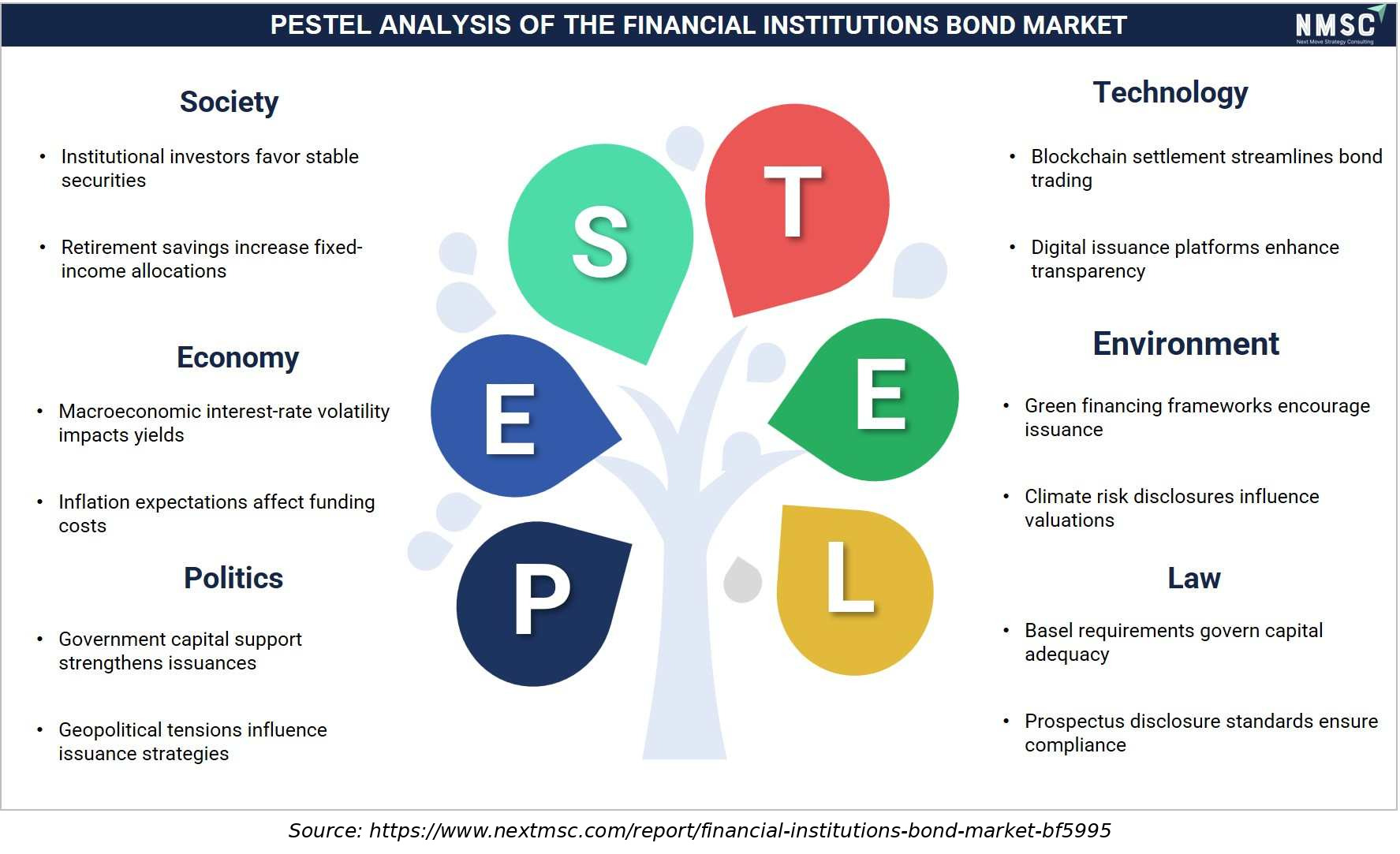
PESTEL ANALYSIS OF THE FINANCIAL INSTITUTIONS BOND MARKET

PESTEL ANALYSIS OF THE FINANCIAL INSTITUTIONS BOND MARKET
The PESTEL analysis highlights the key external factors influencing the Financial Institutions Bond Market. It examines political and economic conditions affecting bond issuance and investment, social trends shaping investor preferences, technological advancements supporting digital bond trading, environmental considerations driving sustainable finance, and legal developments influencing regulatory frameworks, disclosure, and market compliance.

Market Drivers & Dynamics

Interactive Dataset
Basel III endgame capital requirements driving bank issuance driver +1.8% Global 2026-2035
Rising TLAC and MREL eligible senior non-preferred bond issuance driver +1.4% North America, Europe 2026-2035
Growing green and sustainability-linked bond issuance driver +1.1% Europe 2026-2032
Expanding bank funding needs in Asia-Pacific emerging markets driver +0.9% Asia-Pacific 2026-2035
Rising insurer subordinated debt issuance under capital regimes driver +0.7% Europe, Asia-Pacific 2026-2032
Growing secondary market electronic trading of FIG bonds driver +0.5% Global 2026-2032
Interest rate volatility affecting issuance timing and pricing restraint −0.8% Global 2026-2032
Compressed underwriting fee margins amid competitive bookrunner mandates restraint −0.6% Global 2026-2035
Credit spread widening risk during banking sector stress periods restraint −0.4% Global 2026-2030
Source: Next Move Strategy Consulting

Growth Drivers

What Is the Primary Growth Driver of the Financial Institutions Bond Market?

Basel III endgame capital requirements driving bank issuance is the primary driver of the market. U.S. federal banking agencies re-proposed capital rules in March 2026 revising the standardized approach for risk-weighted assets applicable to virtually all banking organizations, following an earlier estimate of an approximately 19% aggregate capital increase for the largest banks. We observed that this regulatory pathway continues to anchor baseline demand for subordinated debt and senior non-preferred bond issuance across covered institutions.

How Is TLAC and MREL Issuance Driving Financial Institutions Bond Market Growth?

Rising total loss-absorbing capacity and minimum requirement for own funds and eligible liabilities eligible senior non-preferred bond issuance is accelerating market growth toward resolution-ready funding structures. Our assessment indicates that global systemically important banks continue to build and maintain loss-absorbing capacity buffers through senior non-preferred debt issuance to satisfy resolution authority requirements. This pathway, combined with the European Union's output floor phase-in beginning January 1, 2025, is compressing issuance timelines for capital-eligible instruments across North America and Europe.

Growth Inhibitors

What Is Restraining Financial Institutions Bond Market Expansion?

Interest rate volatility affecting issuance timing and pricing restrains predictable underwriting revenue across the financial institutions bond supply chain. We found that smaller regional banks face particular exposure, as limited market access flexibility reduces their ability to time issuance windows compared with larger, frequent issuers with established investor relationships, delaying capital-raising execution during periods of rate uncertainty.

Segmentation Analysis

2025 (USD Billion)
2035 (USD Billion)
Underwriting Services 2025: $8.20 Billion | 2035: $16.80 Billion
Underwriting
Dealing and Market-Making Services 2025: $4.90 Billion | 2035: $10.90 Billion
Dealing and
Advisory Services 2025: $1.50 Billion | 2035: $4.40 Billion
Advisory Ser
Underwriting Services $8.20 Billion $16.80 Billion 7.4%
Dealing and Market-Making Services $4.90 Billion $10.90 Billion 8.3%
Advisory Services $1.50 Billion $4.40 Billion 11.4%

Which Service Type Segment Dominates the Financial Institutions Bond Market?

Underwriting Services led the market with USD 8.20 billion in 2025, supported by sustained new-issue activity from banks and insurers raising regulatory capital. We observed that Advisory Services is the fastest-growing service type, expanding at an 11.4% CAGR from 2026 to 2035, as capital-structure optimization advisory tied to Basel III endgame compliance gains share of dealer revenue.

2025 (USD Billion)
2035 (USD Billion)
Senior unsec
Subordinated
Covered bond
Green and su
Other bond t
Segment Item 2025 (USD Billion) 2035 (USD Billion) CAGR
Senior unsecured bonds $10.0 USD Billion $40.0 USD Billion 15.0%
Subordinated debt $17.1 USD Billion $51.1 USD Billion 21.0%
Covered bonds $24.2 USD Billion $62.2 USD Billion 27.0%
Green and sustainable bonds $31.3 USD Billion $73.3 USD Billion 25.0%
Other bond types $38.4 USD Billion $84.4 USD Billion 14.0%

Segment-wise data is locked

Unlock complete segment-wise numbers for By Bond Type.

Unlock Full Data

Which Bond Type Leads Financial Institutions Bond Market Demand?

Senior Unsecured Bonds remained the leading bond type, valued at USD 6.80 billion in 2025 on sustained baseline funding issuance from banks and insurers. Our findings suggest that Green and Sustainable Bonds is the fastest-growing bond type, registering a 13.9% CAGR from 2026 to 2035, as financial institutions expand sustainability-linked funding programs to meet stakeholder and regulatory expectations.

2025 (USD Billion)
2035 (USD Billion)
Commercial b
Insurance co
Investment b
Other financ
Segment Item 2025 (USD Billion) 2035 (USD Billion) CAGR
Commercial banks $10.0 USD Billion $40.0 USD Billion 9.0%
Insurance companies $17.1 USD Billion $51.1 USD Billion 23.0%
Investment banks and broker-dealers $24.2 USD Billion $62.2 USD Billion 9.0%
Other financial institutions $31.3 USD Billion $73.3 USD Billion 15.0%

Segment-wise data is locked

Unlock complete segment-wise numbers for By Issuer Type.

Unlock Full Data

Which Issuer Type Is Most Active in the Financial Institutions Bond Market?

Commercial Banks remained the dominant issuer type, reaching USD 8.90 billion in 2025 due to sustained regulatory capital-driven issuance across systemically important institutions. Based on research conducted by Next Move Strategy Consulting, we found that Insurance Companies is the fastest-growing issuer type at an 11.0% CAGR from 2026 to 2035, reflecting rising subordinated debt issuance as insurers optimize capital structures alongside insurance automation-enabled treasury operations.

Growth Opportunities

Our analysis shows that three forward-looking opportunities stand out for stakeholders positioning within the market over the 2026-2035 forecast period.

How Can Basel III Compliance Advisory Unlock Value for Bank Issuers?

Capital-structure advisory tied to Basel III endgame compliance presents a whitespace opportunity for dealers seeking to deepen issuer relationships beyond transaction execution. Suppliers that commercialize dedicated regulatory capital advisory teams stand to capture recurring advisory and underwriting mandates as banks navigate revised risk-weighted asset calculations.

Where Does Green Bond Structuring Create New Demand?

Financial institutions seeking sustainability-linked funding create an opportunity for dealers offering validated green bond structuring and second-party opinion coordination services. Early movers that secure dedicated sustainable finance coverage can differentiate with bank and insurer issuers pursuing expanded green and sustainable bond programs.

How Can Electronic Trading Platforms Expand Access for Institutional Investors?

Electronic secondary-market trading platforms represent an underpenetrated opportunity for dealers seeking to improve price transparency and execution efficiency for institutional investors. Suppliers that develop validated electronic trading infrastructure for FIG bonds can secure long-term client relationships, benefiting from recurring market-making revenue tied to expanding secondary-market trading volumes.

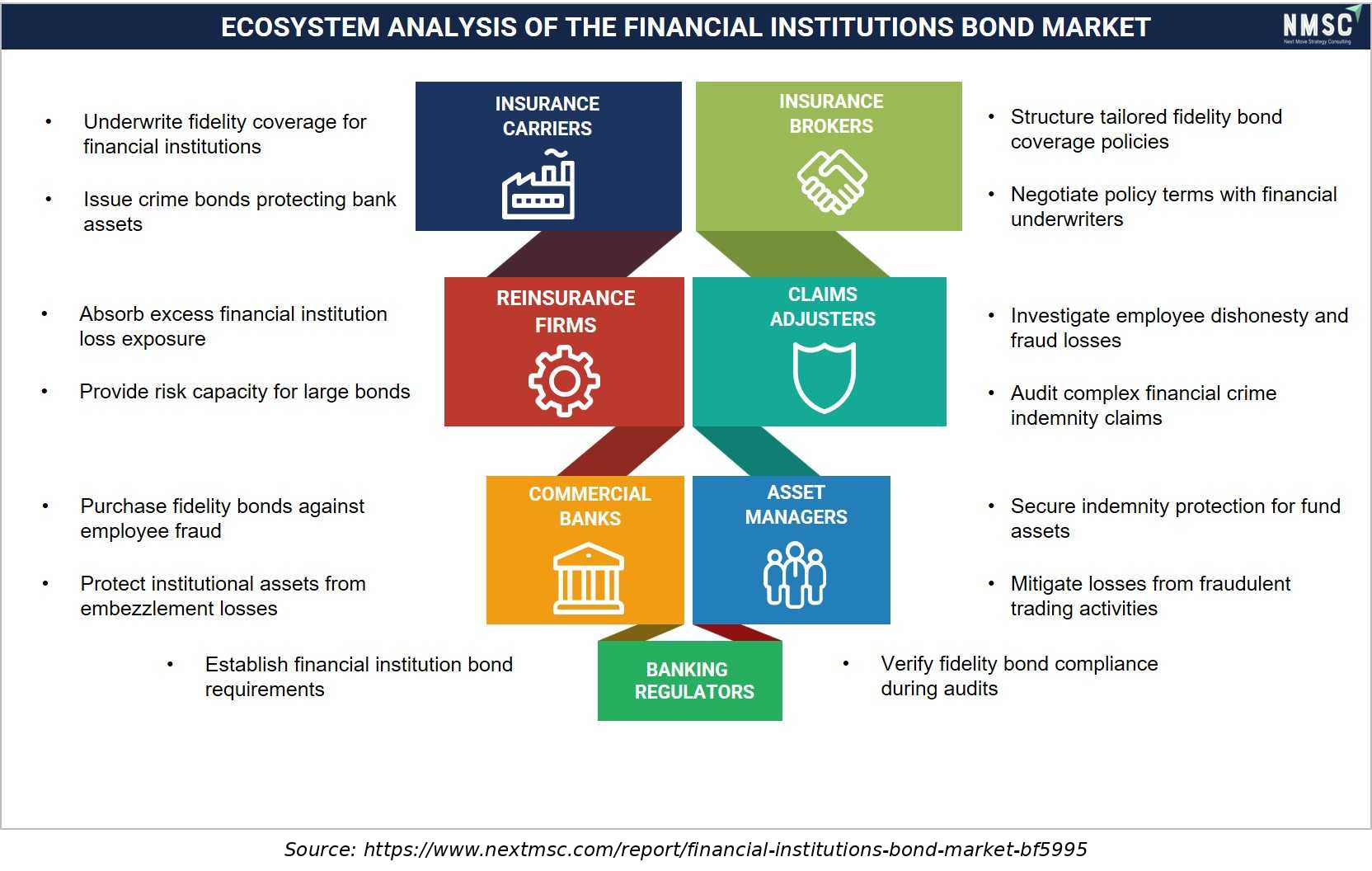
ECOSYSTEM ANALYSIS OF THE FINANCIAL INSTITUTIONS BOND MARKET

The ecosystem analysis illustrates the key participants supporting the Financial Institutions Bond Market. It highlights the roles of commercial banks, asset managers, insurance carriers, insurance brokers, reinsurance firms, claims adjusters, and banking regulators. Together, these stakeholders influence bond issuance, investment, risk management, distribution, market liquidity, and regulatory oversight across the financial institutions bond ecosystem.

Regional Outlook

2025 (USD Billion)
2035 (USD Billion)
North Americ
Europe
Asia-Pacific
Middle East
Latin Americ
Region 2025 (USD Billion) 2035 (USD Billion) CAGR (%)
North America $10.0 USD Billion $40.0 USD Billion 9.0%
Europe $17.1 USD Billion $51.1 USD Billion 27.0%
Asia-Pacific $24.2 USD Billion $62.2 USD Billion 25.0%
Middle East & Africa $31.3 USD Billion $73.3 USD Billion 23.0%
Latin America $38.4 USD Billion $84.4 USD Billion 12.0%

Regional data is locked

Unlock complete regional numbers for this market.

Unlock Full Data

Competitive Landscape

We observed that the market features a moderately consolidated competitive landscape, with globally active dealer banks competing alongside regionally focused underwriters on bookrunner league table position, issuer relationships, and distribution reach.

Dimension Description
Market Structure Moderately consolidated; a small number of global dealer banks with dedicated financial institutions group coverage teams account for a significant share of global underwriting mandates, while regional banks serve domestic issuer relationships.
Innovation Focus Green bond structuring, Basel III endgame capital advisory, and electronic secondary-market trading infrastructure dominate current innovation priorities across leading dealers.
M&A Activity Coverage team expansion and sustainable finance capability build-out rather than large-scale mergers, exemplified by dealer banks expanding dedicated financial institutions group and green bond structuring teams.

How Do Companies Compete in the Financial Institutions Bond Market?

Companies compete primarily on bookrunner league table position, issuer relationships, and distribution reach across the industry. Global dealer banks such as JPMorgan Chase and Bank of America leverage broad institutional investor distribution networks and dedicated financial institutions group coverage to serve multinational bank and insurer issuers, while regional dealers compete on local market knowledge and relationship depth with domestic financial institution issuers.

Which Competitive Archetypes Dominate the Financial Institutions Bond Market?

Two archetypes dominate the market: globally active dealer banks offering full-service underwriting, dealing, and advisory capability across all regions, and regionally focused banks serving domestic financial institution issuer relationships. JPMorgan Chase and Goldman Sachs exemplify the global archetype through broad cross-border distribution and financial institutions group coverage, while regional dealers exemplify the domestic-specialist archetype serving local bank and insurer issuers.

How Are Companies Differentiating Through Innovation in FIG Bond Underwriting?

Innovation and differentiation strategy increasingly center on green bond structuring capability and regulatory capital advisory depth. Dealer banks with dedicated sustainable finance teams and Basel III endgame compliance advisory capability are capturing growing share of green bond and subordinated debt mandates. Our analysis shows that dealers unable to demonstrate credible sustainable finance and regulatory capital expertise risk exclusion from repeat issuer mandates as capital-optimization complexity increases.

What M&A and Expansion Activity Is Shaping the Financial Institutions Bond Market?

Coverage team expansion and sustainable finance capability build-out continue to shape the competitive landscape within the industry. Global dealer banks continue to expand dedicated financial institutions group coverage and green bond structuring teams to capture growing regulatory capital-driven issuance, illustrating how established players pursue geographic expansion and capability depth across bank, insurer, and broker-dealer issuer relationships.

Key Market Players

Our assessment indicates that the following 20 companies are actively shaping underwriting capacity, distribution reach, and advisory strategy within the global financial institutions bond market.

JPMorgan Chase & Co. Bank of America Corporation Citigroup Inc. Goldman Sachs Group, Inc. Morgan Stanley Barclays PLC Deutsche Bank AG BNP Paribas SA HSBC Holdings plc Wells Fargo & Company Société Générale SA UBS Group AG Mizuho Financial Group, Inc. Mitsubishi UFJ Financial Group, Inc. Nomura Holdings, Inc. Royal Bank of Canada The Toronto-Dominion Bank Standard Chartered PLC ING Groep N.V. Crédit Agricole S.A.

Latest Developments

We found that recent developments within the financial institutions bond market are concentrated on regulatory capital reform and issuance recovery, reflecting the industry's broader Basel III endgame transition.

Date Event
July 2026 Société Générale launched a dual-tranche, euro benchmark-size Senior Preferred bond with maturities in July 2028 and July 2031. The transaction forms part of its 2026 vanilla long-term funding programme, adding fresh benchmark supply to the European financial-institution bond market
May 2026 Standard Chartered issued an inaugural HKD2 billion Green Wonton Bond, described by the bank as the first public HKD-denominated green bond from a financial-institutions group. Orders peaked above HKD3.8 billion, demonstrating strong demand for sustainable bank debt in Hong Kong’s local-currency market.

Investment Opportunities

What Capital Inflows Are Targeting the Financial Institutions Bond Market?

Capital inflows into the market are increasingly directed toward subordinated debt and green bond structuring capability. Dealer banks continue to fund coverage-team expansion, as seen in the growing build-out of dedicated financial institutions group and sustainable finance teams across major underwriters. We observed that institutional investors favor issuers demonstrating validated capital-optimization strategies, viewing regulatory compliance clarity as a proxy for long-term credit stability.

How Is Infrastructure Investment Supporting Financial Institutions Bond Market Distribution?

Infrastructure investment is expanding electronic trading and settlement capacity to serve rising secondary-market institutional investor demand. Dealers are scaling electronic distribution platforms to support both new-issue underwriting and secondary-market dealing across senior unsecured, subordinated, and covered bond categories. Our findings suggest that regional dealers are investing in improved market-making infrastructure to serve growing institutional investor participation in emerging market FIG bonds.

What ESG Considerations Are Shaping Financial Institutions Bond Investment Decisions?

Environmental, social, and governance considerations are increasingly central to investment decisions across the industry, with green bond use-of-proceeds transparency and issuer sustainability disclosures as leading criteria. The International Capital Market Association's Green Bond Principles continue to shape disclosure standards adopted by bank and insurer issuers. We found that institutional investors increasingly favor issuers with transparent sustainability reporting, treating it as a governance indicator alongside capital adequacy metrics.

Key Benefits for Stakeholders

How Does This Report Benefit Enterprise and Industry Leaders?

Enterprise and industry leaders gain access to validated segmentation, competitive benchmarking, and regional demand forecasts that support underwriting-strategy decisions across the financial institutions bond industry. Our analysis shows that detailed service-type, bond-type, and issuer-type breakdowns help dealer banks align coverage priorities with regulatory capital and sustainability requirements while identifying underserved segments for capability expansion.

How Does This Report Benefit Investors and Financial Analysts?

Investors and financial analysts benefit from consistent, single-point market size and CAGR estimates that support valuation and capital-allocation decisions across the market. We observed that the report's regional and segment-level growth differentials help identify which dealer banks and issuer categories are best positioned to capture above-market growth in green bond and advisory service categories through 2035.

How Does This Report Benefit Technology Vendors and Product Teams?

Technology vendors and product teams gain insight into emerging design requirements, including electronic trading infrastructure, green bond structuring tools, and regulatory capital advisory platforms, that are reshaping the industry. Our findings suggest that this analysis helps product teams prioritize development roadmaps around sustainability reporting integration and capital-optimization analytics increasingly required by dealer bank and issuer workflows.

Key Market Segments Evaluated

By Service Type

  • Underwriting services
  • Dealing and market-making services
  • Advisory services

By Bond Type

  • Senior unsecured bonds
  • Subordinated debt
  • Covered bonds
  • Green and sustainable bonds
  • Other bond types

By Issuer Type

  • Commercial banks
  • Insurance companies
  • Investment banks and broker-dealers
  • Other financial institutions

By Region

  • North America 
    • U.S.
    • Canada
    • Mexico
  • Europe 
    • UK
    • Germany
    • France
    • Italy
    • Spain
    • Sweden
    • Denmark
    • Finland
    • Netherlands
    • Rest of Europe
  • Asia-Pacific 
    • China
    • India
    • Japan
    • South Korea
    • Taiwan
    • Indonesia
    • Vietnam
    • Australia
    • Philippines
    • Malaysia
    • Rest of APAC
  • Middle East & Africa 
    • Saudi Arabia
    • UAE
    • Egypt
    • Israel
    • Turkey
    • Nigeria
    • South Africa
    • Rest of MEA
  • Latin America 
    • Brazil
    • Argentina
    • Chile
    • Colombia
    • Rest of LATAM

Conclusion & Recommendations

The long-term outlook for the market remains positive, with global revenue projected to expand from USD 14.6 billion in 2025 to USD 32.1 billion by 2035 at an 8.5% CAGR. We observed that Basel III endgame implementation, subordinated debt issuance recovery, and green bond program expansion will continue underpinning demand across commercial bank, insurer, and investment bank issuer categories through the forecast period.

What Strategic Positioning Should Financial Institutions Bond Dealers Pursue?

Dealers should prioritize dedicated financial institutions group coverage while pursuing green bond structuring capability to secure long-term issuer mandates. Our assessment indicates that underwriters investing early in Basel III endgame compliance advisory and sustainable finance expertise will be best positioned to capture premium mandates within the market.

How Attractive Is the Financial Institutions Bond Market for New Investment?

The financial institutions bond industry presents an attractive investment case, supported by a USD 16.7 billion absolute dollar opportunity between 2026 and 2035 and above-average growth in Asia-Pacific and Green and Sustainable Bond categories. We found that investment attractiveness is highest for dealers combining regulatory capital advisory depth with scaled distribution networks, positioning them to serve both established and emerging market issuer segments simultaneously.

What Market Shifts and Key Risks Should Stakeholders Monitor?

Stakeholders should monitor interest rate volatility, compressed underwriting fee margins, and credit spread widening risk during banking sector stress as key risks to the market. Our analysis shows that dealers unable to differentiate beyond fee competition risk losing mandates to competitors with deeper regulatory advisory and sustainable finance capability, particularly as issuers scrutinize capital-optimization expertise more closely.

What Are the Key Growth Pathways for the Financial Institutions Bond Market?

Key growth pathways include expanding regulatory capital advisory capability, scaling green bond structuring capacity, and deepening penetration into Asia-Pacific and insurer issuer segments. Next Move Strategy Consulting's analysis indicates that dealers pursuing these pathways while maintaining competitive execution in senior unsecured underwriting will be best positioned to capture the financial institutions bond market's projected growth through 2035.

FAQs

About the Author

Liza Phukan

Liza Phukan

Liza Phukan is Research Associate at Next Move Strategy Consulting, where she has covered emerging industries and market research across sectors for 3.5 years. Her work includes analyzing industry developments, validating market data, and developing structured business content from research findings. She uses secondary research and data-validation practices to turn complex market information into clear decision-useful market analysis for business audiences and support report development and B2B.

About the Reviewer

Supradip Baul

Supradip Baul

Supradip Baul is an accomplished business consultant and strategist with over a decade of rich experience in market intelligence, strategy, technology, and business transformation. His work has included rigorous qualitative and quantitative analysis across multiple industries, helping clients shape investment decisions and long-term roadmaps. Earlier in his career, he was associated with Gartner, where he contributed to industry-leading reports and market share analyses. He has worked with leading global companies and holds an MBA with a dual specialization in Marketing and Finance.

Download Free Sample

Diana Trejo

DIANA TREJO

Assistant Manager

Sumitomo Corporation de Mexico, S.A. de C.V.

Recently, we purchased a report on the Mexico Data Center Market from Next Move Strategy Consulting. The service has been excellent, with support that is always timely and thoroughly professional. The information provided is interesting, highly useful, and delivered with clarity. I would highly recommend NextMSC for anyone seeking insightful and dependable analysis.

Kevin Coker

KEVIN COKER

Founder, CEO and Board Diector

Proxima Clinical Research

I have been using Next MSC reports for product positioning in a new geography for a long time. They have by far the best reports I have found and the price is reasonable too!

Amos Chang

AMOS CHANG

Strategy Consultant

Kardex Group

I have bought the intralogistics market reports from NMSC two times so far. Joseph and his team are always very helpful and flexible in responding to any customization requirements on the report. Their expertise in market reports really helps us steer the day-to-day business. I will definitely recommend and come back myself whenever there is a need.

Semih Kavaklioglu

SEMIH KAVAKLIOGLU

Co-Founder & Sales Manager

Decortie

I work a lot in the marketing industry and I know that research is an essential part of any campaign. I have used Market research reports for my own products and I found them to be very informative and well-researched. The team here produces insightful reports for a good price

Henri Knyphausen

HENRI KNYPHAUSEN

Partner at Singulier [Ex-BCG]

Singulier

I recently engaged NEXTMSC.com for a commercial due diligence project within the intralogistics sector, and I am pleased to provide a reference based on my experience. In utilizing NEXTMSC.com's services, I found their report to offer valuable insights into market dynamics and key industry players. The initial report provided a solid foundation for our analysis. However, as we were investigating a smaller target in the market, and I had specific customization requests requiring additional research. These requests included detailed information on product portfolios of various players and sub-market sizes, both inclusive and exclusive of certain product categories. NEXTMSC.com demonstrated commendable responsiveness and agility in accommodating these customization requests. Within a timeframe of 1-2 weeks, they delivered a revised report that met our specific needs. Furthermore, they were receptive to my follow-up inquiries, ensuring clarity and understanding of the data provided. The final deliverable significantly contributed to our due diligence efforts. One of NEXTMSC.com's notable strengths lies in their qualitative research capabilities. However, for future engagements, I would recommend the inclusion of a quantified market model in Excel format. Such a model would offer the ability to conduct in-depth analyses and explore various market segments, including country-specific data and subcomponent breakdowns. Based on my positive experience, I would not hesitate to work with NEXTMSC.com again. Their responsiveness, willingness to accommodate customization requests, and commitment to delivering actionable insights make them a reliable partner for commercial research projects.

Custom Market Research Services

We will customize the research for you if the listed report does not fully match your requirements.

Get 30% Free Customization

Select License

This website uses cookies to ensure you get the best experience on our website. Learn more

✖