Green Banking Market Size, Share, Growth & Forecast by Product Type (Credit & Financing, Investment Products, Depository Products, Insurance & Risk Management), Financial Institution (Public Sector Banks, Private Commercial Banks, Specialized Green Banks, NBFCs, Cooperative Banks, Microfinance Institutions), Customer Segment (Retail/Individual Banking, Business Banking), Distribution Channel (Branch Banking, Online Banking, and Others) — Global Analysis 2026–2035
Industry: BFSI | Publishing Date: July 11, 2026 | Last Updated: July 11, 2026 | No of Pages: N/A | No. of Tables: N/A | No. of Figures: N/A | Format: PDF | Report Code: BF3099
What Is the Green Banking Market Size?
The global Green Banking Market was valued at USD 20.4 billion in 2025 and is expected to reach USD 24.03 billion in 2026. Accelerating regulatory mandates for sustainable finance, the mainstreaming of environmental, social, and governance (ESG) frameworks, growing climate-conscious consumer demand, and rapid digitalization of green financial products are projected to propel the market to USD 104.8 billion by 2035, advancing at a CAGR of 17.8% from 2026 to 2035. Key growth catalysts include the global expansion of green bond issuances, government-backed renewable energy financing programs, net-zero commitments by leading financial institutions, and rising investor appetite for impact-driven financial instruments worldwide.
|
Parameters |
Details |
|
Market Size in 2025 |
USD 20.4 Billion |
|
Market Size in 2026 |
USD 24.03 Billion |
|
Revenue Forecast in 2035 |
USD 104.8 Billion |
|
Growth Rate |
CAGR of 17.8% from 2026 to 2035 |
|
Analysis Period |
2025–2035 |
|
Base Year Considered |
2025 |
|
Forecast Period |
2026–2035 |
|
Market Size Estimation |
USD Billion |
|
Companies Profiled |
20 |
|
Countries Covered |
33 |
|
Market Share |
Top 10 |
Green Banking Market Overview
What Is the Green Banking Market?
Green banking refers to the integration of environmental sustainability principles into the core operations, products, and strategies of financial institutions. It encompasses the design and delivery of financial products that channel capital toward climate-positive activities, including renewable energy financing, energy-efficient mortgages, sustainable investment funds, eco-insurance solutions, and green bond issuances. NMSC's analysis indicates that green banking has evolved beyond corporate responsibility into a commercially strategic imperative for banks seeking long-term competitiveness, regulatory compliance, and stakeholder trust.
How Has the Green Banking Market Evolved?
The Green Banking Market has progressed through distinct developmental phases. The early phase focused on basic environmental policies, paperless banking, and energy-efficient branch operations. The second phase introduced dedicated green loan products and sovereign green bond issuances, most notably following the Paris Agreement of 2015. From our research, we found that the current phase is characterized by institution-wide ESG integration, science-based targets, digital green product distribution, and the emergence of specialized green banks dedicated exclusively to climate finance and sustainable development across both developed and emerging economies.
How Do Regulations Influence the Green Banking Market?
Regulatory developments are among the most powerful structural forces shaping the Green Banking Market trends. The European Union's Sustainable Finance Disclosure Regulation (SFDR) and the EU Taxonomy Regulation have established binding disclosure frameworks for green financial products. The Basel Committee on Banking Supervision has issued guidance on climate-related financial risks, compelling banks to integrate climate scenario analysis into their risk management frameworks. Through our market assessment, we observed that national central banks and financial regulators across Asia, North America, and the Middle East are progressively aligning supervisory expectations with international sustainability standards, reinforcing compliance-driven demand for green banking capabilities.
How Is Technology Adoption Expanding Across the Green Banking Market?
Technology adoption is fundamentally reshaping the delivery and scalability of green banking products. Mobile and online banking platforms are enabling banks to distribute green savings accounts, eco-friendly certificates of deposit, and ESG investment funds to mass-market retail customers at negligible marginal cost. Artificial intelligence tools are supporting carbon footprint assessment for loan applications, while blockchain technology is improving transparency and traceability in green bond issuances. Our findings suggest that digital distribution channels are critical to unlocking the SME and retail customer segments for green banking growth through 2035.
|
Key Takeaways |
|
By product type, Credit & Financing held the largest Green Banking Market share at USD 8.8 billion in 2025. Green Project Loans, including solar energy, wind energy, and electric vehicle loans, represent the dominant sub-segment, driven by government-backed renewable energy mandates and rising corporate sustainability financing commitments across developed and emerging markets. |
|
Investment Products is the fastest-growing product type segment in the Green Banking Market, projected to expand from USD 5.1 billion in 2025 to USD 28.9 billion by 2035 at a CAGR of 18.3%, fueled by surging demand for ESG equity funds, green bond funds, and socially responsible investment (SRI) funds from both institutional and retail investors. |
|
By financial institution, Private Commercial Banks commanded the largest share at USD 8.5 billion in 2025, representing approximately 42% of total Green Banking Market revenue, anchored by their large customer bases, extensive digital infrastructure, and growing ESG product portfolios driven by regulatory and investor pressure. |
|
Specialized Green Banks and Development Banks are the fastest-growing financial institution segment in the Green Banking Market at a CAGR of 19.2% from 2026 to 2035, as governments establish purpose-built climate finance institutions to channel concessional capital into renewable energy, green infrastructure, and sustainable agriculture projects. |
|
By customer segment, Business Banking accounted for USD 11.6 billion in 2025, the largest revenue share of the Green Banking Market, driven by demand from large corporations and SMEs for green corporate loans, sustainability-linked credit facilities, and ESG-aligned investment products to meet supply chain and investor ESG requirements. |
|
The Retail/Individual Banking segment is the fastest-growing customer segment in the Green Banking Market at a CAGR of 17.8% from 2026 to 2035, as mass market and affluent consumers increasingly seek green savings accounts, energy-efficient mortgages, and ESG investment funds aligned with personal environmental values. |
|
By distribution channel, Mobile Banking is the fastest-growing channel in the Green Banking Market at a CAGR of 21.4% from 2026 to 2035, as digital-first customers increasingly access green financial products through banking apps, enabling banks to scale sustainable product offerings with low incremental distribution cost. |
|
Branch Banking held the largest distribution channel share at USD 8.2 billion in 2025, supported by the preference of business banking clients and HNWIs for relationship-driven green financing advisory and structured sustainability-linked lending engagements. |
|
North America held the largest regional share at USD 7.1 billion in 2025, projected to reach USD 33.7 billion by 2035 at a CAGR of 16.2%, anchored by the world's deepest capital markets, strong ESG disclosure requirements, and the highest concentration of green bond issuers and sustainability-linked loan arrangers globally. |
|
Asia-Pacific is the fastest-growing major region in the Green Banking Market at a CAGR of 19.8%, driven by China's Green Finance Guidelines, India's sovereign green bond program, and the rapid expansion of sustainable finance frameworks across South Korea, Japan, and Southeast Asian economies through 2035. |
|
The United States is the single largest country market in the Green Banking Market, representing over 75% of North American revenue in 2025, underpinned by the world's largest green bond market, robust ESG investment fund industry, and strong institutional demand for climate-aligned financial products. |
|
China is the fastest-growing national market in Asia-Pacific within the Green Banking Market, propelled by the People's Bank of China's green finance taxonomy, mandatory green finance disclosure requirements for listed companies, and the national carbon market established under China's 14th Five-Year Plan for ecological civilization. |
Key Emerging Trends in the Green Banking Market
How Is the Mainstreaming of ESG Disclosure Frameworks Transforming the Green Banking Market?
The adoption of mandatory ESG disclosure frameworks such as the EU SFDR, the International Sustainability Standards Board (ISSB) standards, and the Task Force on Climate-related Financial Disclosures (TCFD) recommendations is fundamentally reshaping the Green Banking Market. Our findings suggest that banks are investing heavily in data infrastructure to measure, report, and verify the environmental impact of their loan portfolios and investment products. For example, BNP Paribas publishes a detailed climate analytics report disclosing the financed emissions across its corporate lending book, setting a disclosure benchmark that is progressively becoming an industry expectation across institutional green banking globally.
How Is the Rise of Sovereign Green Bonds Creating Structural Demand Across the Green Banking Market?
Government issuances of sovereign green bonds are becoming a defining structural driver of the Green Banking Market. Through our market assessment, we observed that sovereign green bonds provide financial institutions with high-quality, liquid green assets that facilitate regulatory capital optimization and green product development at scale. India's inaugural sovereign green bond program, launched in 2023, raised INR 16,000 crore for renewable energy and sustainable urban infrastructure projects. These issuances generate a ripple effect, encouraging private commercial banks to develop complementary green loan products, ESG funds, and climate-linked savings instruments aligned with national sustainability goals.
How Is Digital Banking Infrastructure Accelerating Green Product Distribution in the Green Banking Market?
The proliferation of mobile and online banking platforms is enabling financial institutions to distribute green banking products at scale and lower cost across all customer segments. Our assessment indicates that digital onboarding tools, AI-powered carbon footprint calculators, and real-time green impact dashboards embedded within banking apps are enhancing customer engagement with green savings accounts, eco-friendly term deposits, and ESG investment funds. DBS Bank's digital sustainability tracker, for example, allows retail customers to monitor the environmental impact of their spending and seamlessly switch to green financial products, demonstrating a commercially viable model for sustainable banking at scale.
How Are Net-Zero Commitments by Financial Institutions Reshaping the Green Banking Market Landscape?
Net-zero commitments made by leading financial institutions under the Net-Zero Banking Alliance (NZBA), established under the United Nations Environment Programme Finance Initiative (UNEP FI), are fundamentally redirecting capital allocation within the Green Banking Market. Based on NMSC's research, we found that signatory banks representing over USD 70 trillion in assets have pledged to align their lending and investment portfolios with the 1.5°C pathway by 2050, catalyzing the rapid development of green corporate loans, sustainability-linked bonds, and climate risk insurance products. This commitment is forcing the exit of fossil fuel financing and accelerating the transition of traditional banking portfolios toward sustainable asset classes.
Ecosystem Analysis of the Green Banking Market
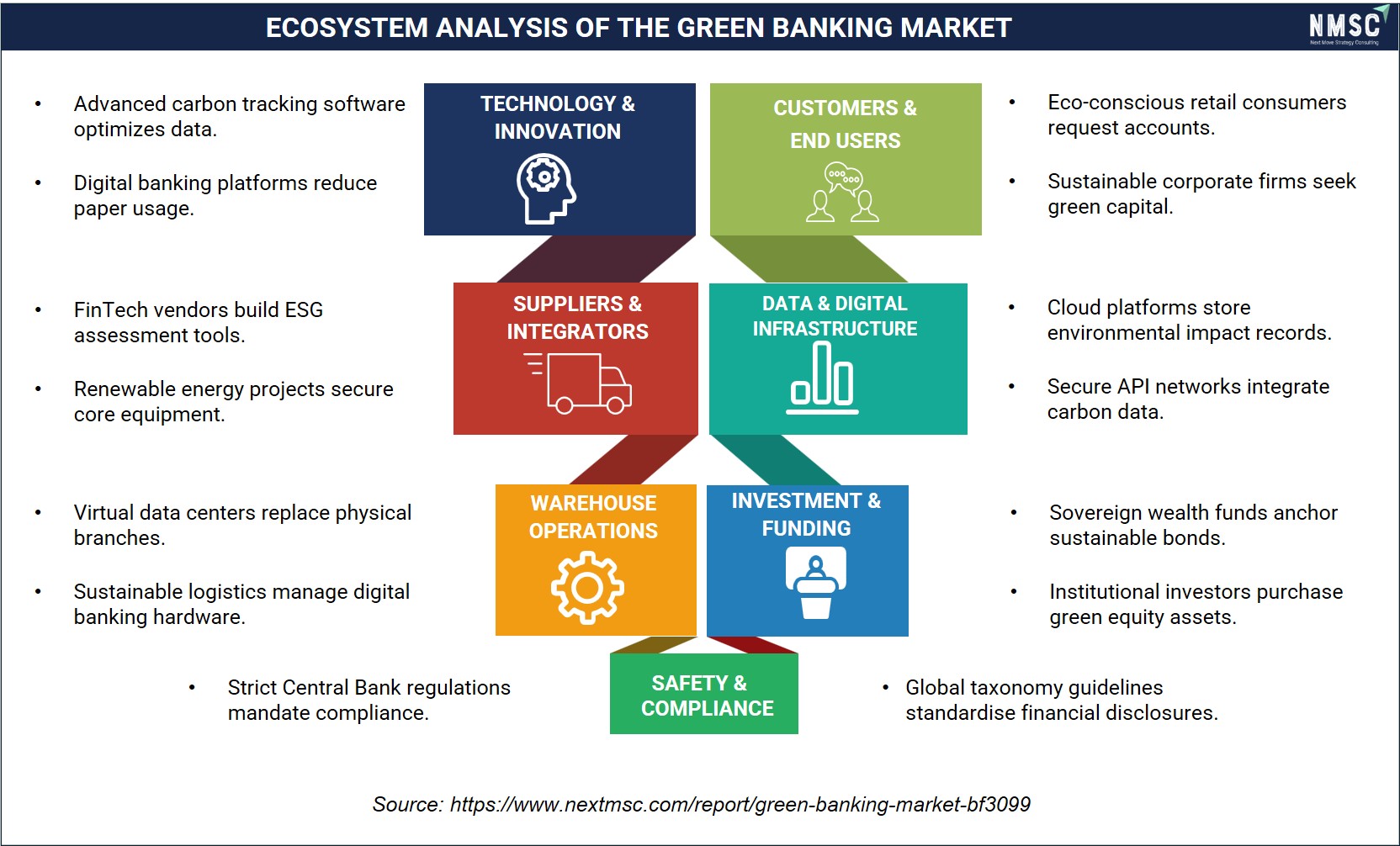
The Green Banking Market ecosystem is supported by a network of stakeholders that facilitate sustainable financial services and environmentally responsible investments. Technology and innovation providers enable digital banking platforms, ESG analytics, and green financing solutions, while data and digital infrastructure support risk assessment, reporting, and regulatory compliance. Suppliers and integrators deliver financial technology systems, and investment and funding institutions provide capital for green projects and sustainable development initiatives. Safety and compliance frameworks ensure adherence to environmental regulations and ESG standards, while customers and end users—including individuals, businesses, and institutional investors—drive demand for green banking products, sustainable loans, and climate-focused investment opportunities.
What Are the Key Market Drivers, Breakthroughs, and Investment Opportunities that Will Shape the Green Banking Industry in the Next Decade?
|
Drivers / Trends / Restraints |
(+/-) % Impact on CAGR Forecast |
Geographic Relevance |
Impact Timeline |
|
Regulatory ESG Disclosure Mandates |
+2.4% |
Global (led by Europe, APAC) |
2025–2035 |
|
Sovereign & Corporate Green Bond Expansion |
+2.1% |
Global (all regions) |
2025–2032 |
|
Net-Zero Banking Alliance Commitments |
+1.8% |
North America, Europe, APAC |
2025–2035 |
|
Digital Banking Platform Adoption |
+1.6% |
Global (led by APAC) |
2025–2030 |
|
Renewable Energy Financing Demand |
+1.5% |
APAC, LATAM, MEA |
2026–2035 |
|
Lack of Standardized Green Taxonomy |
-1.3% |
MEA, LATAM, Developing Economies |
Ongoing |
|
Greenwashing Risk and Regulatory Penalties |
-1.0% |
Europe, North America |
Ongoing |
|
High Cost of ESG Data Infrastructure |
-0.7% |
SMEs, Emerging Markets |
2025–2028 |
|
Climate Risk Insurance Market Growth |
+1.4% |
Global |
2026–2035 |
|
Impact Investment Fund Expansion |
+1.2% |
North America, Europe |
2025–2032 |
What Are the Growth Drivers of the Green Banking Market?
How Are Regulatory ESG Mandates and Climate Disclosure Requirements Driving Green Banking Market Demand?
Regulatory frameworks requiring financial institutions to disclose climate-related financial risks and integrate ESG considerations into credit risk assessment are the primary structural driver of the Green Banking Market. The European Central Bank's (ECB) supervisory expectations on climate-related and environmental risks, published in November 2020 and progressively strengthened, require eurozone banks to embed climate risk into their governance, strategy, and risk management frameworks. The SEC's climate disclosure rule in the United States is expanding the compliance imperative for American banks and listed corporations, compelling the development of green financial products to align disclosed strategies with investment portfolios.
How Is the Global Expansion of Renewable Energy Financing Creating Demand Across the Green Banking Market?
The global energy transition from fossil fuels to renewable sources is generating unprecedented demand for green project financing, a core product category of the Green Banking Market. The International Energy Agency (IEA) projects that annual clean energy investment must reach USD 4.5 trillion by 2030 to meet net-zero targets, with a substantial portion requiring bank-intermediated financing in the form of solar energy loans, wind energy loans, and green corporate credit facilities. Based on NMSC's research, we found that government-backed renewable energy auctions across India, Brazil, Germany, and the United States are generating bankable project pipelines that are directly stimulating green lending portfolios at commercial banks.
How Is Growing Investor Demand for ESG and Sustainable Investment Products Fueling Green Banking Market Expansion?
Rising demand from institutional and retail investors for ESG-aligned investment products is a powerful commercial driver of the Green Banking Market. The Principles for Responsible Investment (PRI), supported by the United Nations, counts over 5,000 signatory organizations representing USD 120 trillion in assets under management, all committed to integrating ESG factors into investment decisions. Our analysis shows that this investor demand is compelling banks to expand their green bond funds, ESG equity funds, SRI funds, and impact investment fund offerings, generating a structural and growing revenue stream for financial institutions with credible sustainable finance capabilities and verified green product portfolios.
What Are the Growth Inhibitors of the Green Banking Market?
How Does the Absence of Globally Standardized Green Taxonomy Constrain the Green Banking Market?
The lack of a universally adopted green finance taxonomy represents one of the most significant structural barriers to Green Banking Market expansion, particularly in emerging economies and cross-border financing. While the EU Taxonomy Regulation establishes a detailed classification system for environmentally sustainable economic activities, analogous frameworks in the United States, Southeast Asia, and sub-Saharan Africa remain fragmented or nascent. Through NMSC's assessment, we found that this taxonomic inconsistency increases compliance complexity for multinational banks, limits the cross-border fungibility of green financial products, and creates uncertainty for institutional investors seeking to compare and verify the sustainability credentials of green banking products across jurisdictions.
How Does Greenwashing Risk and Regulatory Scrutiny Limit Growth in the Green Banking Market?
Greenwashing risk, the misrepresentation of financial products as environmentally sustainable, has emerged as a reputational and regulatory constraint on the Green Banking Market. The European Securities and Markets Authority (ESMA) and national financial regulators in France, Germany, and the UK have published guidance and initiated enforcement actions targeting misleading ESG claims in investment products and banking services. Our market assessment found that regulatory scrutiny is compelling financial institutions to invest substantially in third-party ESG verification, impact reporting infrastructure, and legal review processes, increasing the operational cost of green product development and extending time-to-market for new sustainable banking offerings globally.
What Are the Growth Opportunities in the Green Banking Market?
How Does the Rapid Growth of Climate Risk Insurance Create a Multi-Billion Dollar Opportunity in the Green Banking Market?
Climate risk insurance, encompassing renewable energy project insurance, green building insurance, agricultural crop insurance, and natural catastrophe coverage, represents one of the most underserved and high-growth product categories in the Green Banking Market. The United Nations Environment Programme Finance Initiative (UNEP FI) has documented significant and growing protection gaps for climate-related risks globally, particularly in emerging economies. From our assessment, we evaluated that financial institutions that develop integrated green banking and insurance products, bundling green mortgages with green building insurance or solar energy loans with renewable energy project insurance, can generate differentiated revenue streams while expanding sustainable finance penetration across underserved customer segments.
How Is the Rise of Microfinance and Community Green Banking Creating Opportunities in Emerging Markets?
Microfinance institutions (MFIs) and cooperative banks represent a structurally significant and underexplored opportunity within the Green Banking Market, particularly across South Asia, Sub-Saharan Africa, and Latin America. The World Bank's International Finance Corporation (IFC) has documented growing demand for small-scale green loans to support solar home systems, clean cooking solutions, and sustainable agriculture financing among low-income rural populations. Our analysis shows that MFIs with digital lending capabilities are uniquely positioned to channel climate finance to underbanked communities, generating new impact-driven revenue while fulfilling international financial inclusion and sustainable development objectives aligned with the UN Sustainable Development Goals (SDGs).
How Does the Expansion of Sustainable Construction Financing Represent a Structural Growth Pathway in the Green Banking Market?
The global green building sector presents a substantial and structurally durable growth pathway for the Green Banking Market, driven by regulatory building codes, energy efficiency standards, and green certification programs. The U.S. Green Building Council's LEED certification program and equivalent frameworks such as BREEAM in the UK and Green Star in Australia are generating consistent demand for energy-efficient home mortgages and green building certification mortgages. Through NMSC's assessment, we found that banks offering preferential interest rates for LEED-certified or energy-efficient properties are capturing higher-quality mortgage assets with lower long-term default risk, while simultaneously expanding their green asset portfolios to meet regulatory and investor ESG expectations.
How Is the Green Banking Market Segmented in This Report, and What Are the Key Insights from the Segmentation Analysis?
How Does Product Type Segmentation Reveal the Structural Composition of the Green Banking Market?
|
Product Type Segment |
2025 (USD Bn) |
2035 (USD Bn) |
CAGR (%) |
|
Credit & Financing |
8.8 |
42.8 |
16.4% |
|
Investment Products |
5.1 |
28.9 |
18.3% |
|
Depository Products |
2.8 |
13.9 |
16.6% |
|
Insurance & Risk Management |
3.7 |
19.3 |
17.3% |
Based on our analysis of green finance adoption trends and sustainable product development strategies, the Green Banking Market is segmented into Credit & Financing, Investment Products, Depository Products, and Insurance & Risk Management. Credit & Financing remains the dominant product type, encompassing Green Project Loans (solar, wind, EV, and energy efficiency loans), Green Corporate Loans for SMEs and large corporations, and Green Mortgages for energy-efficient and green building-certified properties. Investment Products represent the fastest-growing segment, with ESG equity funds, green bond funds, SRI funds, and impact investment funds attracting accelerating capital inflows from institutional and retail investors globally. Depository Products, including green savings accounts, eco-friendly certificates of deposit, and sustainable term deposits, are gaining traction as banks use preferential rates to attract ESG-conscious retail depositors.
How Do Different Financial Institution Types Drive Green Banking Market Revenue and Growth?
|
Financial Institution Segment |
2025 (USD Bn) |
2035 (USD Bn) |
CAGR (%) |
|
Public Sector Banks |
4.8 |
21.7 |
15.5% |
|
Private Commercial Banks |
8.5 |
41.6 |
16.5% |
|
Specialized Green Banks/Development Banks |
2.3 |
14.8 |
19.2% |
|
Non-Banking Financial Companies (NBFCs) |
2.0 |
11.4 |
18.5% |
|
Cooperative Banks/Credit Unions |
1.7 |
8.7 |
17.0% |
|
Microfinance Institutions |
1.1 |
6.6 |
18.6% |
From our market assessment, the Green Banking Market is segmented by financial institution into Public Sector Banks, Private Commercial Banks, Specialized Green Banks and Development Banks, NBFCs, Cooperative Banks and Credit Unions, and Microfinance Institutions. Private Commercial Banks dominate due to their extensive customer bases, sophisticated digital infrastructure, and growing commitment to ESG product portfolios under investor and regulatory pressure. Public Sector Banks play a critical role in channeling government-backed green financing to strategic sectors such as renewable energy, affordable green housing, and sustainable agriculture. Specialized Green Banks and Development Banks represent the fastest-growing institution segment, as governments establish purpose-built climate finance vehicles. NBFCs and Microfinance Institutions are gaining relevance by reaching underserved SMEs and rural populations with targeted green lending products across emerging economies.
How Does Customer Segmentation Shape Revenue Distribution in the Green Banking Market?
|
Customer Segment |
2025 (USD Bn) |
2035 (USD Bn) |
CAGR (%) |
|
Retail/Individual Banking |
8.8 |
44.6 |
17.8% |
|
Business Banking |
11.6 |
60.2 |
17.0% |
Our analysis of green banking adoption patterns reveals that the market is segmented into Retail/Individual Banking and Business Banking customer segments. Business Banking dominates, supported by demand from Large Corporations (national and multinational) for green corporate loans, sustainability-linked credit facilities, and ESG-aligned investment products to meet supply chain sustainability requirements and investor mandates. SMEs, including small enterprises with 10 to 50 employees and medium enterprises with 51 to 250 employees, represent a high-growth sub-segment as green finance programs specifically designed for SMEs proliferate across the EU, India, and Southeast Asia. Retail/Individual Banking is the fastest-growing customer segment, with mass market retail, affluent customers, and HNWIs driving demand for green mortgages, eco-friendly savings products, and ESG investment funds through digital and branch banking channels.
How Are Distribution Channels Reshaping Access to Green Banking Products?
|
Distribution Channel |
2025 (USD Bn) |
2035 (USD Bn) |
CAGR (%) |
|
Branch Banking |
8.2 |
35.5 |
15.1% |
|
Online Banking (Desktop) |
4.2 |
21.7 |
17.0% |
|
Mobile Banking |
3.4 |
23.5 |
21.4% |
|
Relationship Managers |
2.8 |
13.9 |
16.5% |
|
Third-Party Distributors |
1.7 |
10.2 |
18.9% |
Based on NMSC's research, the Green Banking Market is segmented into Branch Banking, Online Banking (Desktop), Mobile Banking, Relationship Managers, and Third-Party Distributors. Branch Banking retains the largest channel share, supported by corporate and HNWI clients who require in-person advisory for complex green financing structures, sustainability-linked loans, and ESG wealth management solutions. Mobile Banking is the fastest-growing distribution channel, driven by digital-first consumer preferences for accessing green savings accounts, eco-friendly CDs, and ESG investment fund subscriptions through banking apps with integrated carbon impact tracking. Online Banking and Third-Party Distributors are playing an increasingly important role in broadening green product reach to SMEs and retail customers who discover sustainable banking options through fintech platforms, comparison portals, and insurance aggregators.
Regional Outlook
Geographic Performance Snapshot
|
Region |
2025 (USD Bn) |
2035 (USD Bn) |
CAGR (%)
|
Key Driver |
|
North America |
7.1 |
33.7 |
16.2% |
ESG capital markets, SEC disclosure rules |
|
Europe |
7.4 |
37.3 |
17.0% |
EU Taxonomy, SFDR, sovereign green bonds |
|
Asia-Pacific |
4.0 |
23.5 |
19.8% |
China PBOC green taxonomy, India sovereign green bonds |
|
Middle East & Africa (MEA) |
1.1 |
6.6 |
18.5% |
Vision 2030, climate finance mandates |
|
Latin America |
0.8 |
3.6 |
15.0% |
LATAM green bond market, COP-driven commitments |
North America Green Banking Market
North America is a leading regional market for green banking, contributing USD 7.1 billion in 2025 and forecast to reach USD 33.7 billion by 2035 at a CAGR of 16.2%. The region benefits from the world's deepest capital markets, the largest green bond market by issuance volume, and a growing regulatory framework anchored by SEC climate disclosure requirements. NMSC's analysis indicates that U.S. and Canadian banks are rapidly expanding green mortgage portfolios, ESG fund offerings, and sustainability-linked corporate lending in response to institutional investor mandates and corporate net-zero commitments.
U.S. Green Banking Market
Based on our engagements, the United States represents the single largest national market in the Green Banking Market, accounting for over 75% of North American revenue in 2025. The U.S. green bond market has grown substantially, with federal agencies such as Fannie Mae and Freddie Mac issuing green mortgage-backed securities to support energy-efficient housing. The SEC's climate disclosure rule and the Inflation Reduction Act's clean energy tax incentives are generating sustained demand for solar energy loans, EV financing, and ESG equity funds across retail and institutional customer segments nationwide.
Canada Green Banking Market
Through our analysis, Canada represents approximately 18% of North American Green Banking Market revenue. Canadian banks, led by RBC, TD Bank, and Scotiabank, have made substantial net-zero commitments under the NZBA. The federal government's Sustainable Finance Action Council and the Canada Infrastructure Bank's green financing programs are expanding the bankable pipeline for renewable energy loans and green infrastructure financing. Canadian regulatory engagement through the Office of the Superintendent of Financial Institutions (OSFI) is progressively embedding climate risk requirements into bank supervision, stimulating governance-driven green product development.
Mexico Green Banking Market
From our assessment, Mexico represents the fastest-growing Green Banking Market within North America. Mexico's National Development Bank (NAFINSA) has established green credit lines for renewable energy and energy efficiency projects, supporting small enterprise and agricultural green financing. The Mexican Stock Exchange's green bond framework and growing interest from international development finance institutions are expanding the local green capital market ecosystem. Regulatory developments under the Comisión Nacional Bancaria y de Valores (CNBV) are aligning Mexico's banking supervision with international sustainability disclosure standards, supporting market maturation.
Europe Green Banking Market
Europe is the most advanced and regulatory-driven regional Green Banking Market, contributing USD 7.4 billion in 2025 and forecast to reach USD 37.3 billion by 2035 at a CAGR of 17.0%. The EU Taxonomy Regulation, SFDR, and the European Green Deal provide the most comprehensive sustainable finance regulatory architecture globally, compelling financial institutions to rigorously classify, disclose, and verify the sustainability credentials of green banking products. Our assessment indicates that European banks are leading global peers in green bond issuance volumes, ESG fund product development, and climate risk integration into credit underwriting processes.
UK Green Banking Market
Based on our engagements, the United Kingdom is Europe's largest national Green Banking Market, supported by the Financial Conduct Authority's (FCA) Sustainability Disclosure Requirements and the Bank of England's climate-related financial risk supervision. UK banks have been pioneering issuers of green bonds and sustainability-linked loans in the global wholesale market. The UK's green mortgage market is growing rapidly, with lenders offering preferential rates for energy-efficient properties. Post-Brexit regulatory flexibility is enabling targeted green finance policy innovation, including the UK's Green Taxonomy consultation.
Germany Green Banking Market
According to our evaluation, Germany is the second-largest European Green Banking Market, driven by its globally significant renewable energy sector, the Energiewende transition program, and a sophisticated institutional investment community with deep ESG integration. KfW, Germany's state development bank, has been a global pioneer in green bond issuance and concessional renewable energy financing. German commercial banks face stringent BaFin ESG disclosure requirements and are expanding sustainable finance product suites, including energy efficiency mortgages under the Energy Efficiency in Buildings program.
France Green Banking Market
Through our analysis, France has established itself as a global leader in sovereign green bond issuance, with the Agence France Trésor issuing OAT Verte bonds to finance public expenditure on renewable energy, biodiversity, and sustainable transport. French banks including Crédit Agricole and BNP Paribas are among the world's most active green bond underwriters and sustainable finance advisors. The ACPR, France's banking supervisor, conducts annual climate stress tests requiring banks to assess portfolio exposure to physical and transition climate risks, directly stimulating demand for green lending and ESG risk management products within the French banking sector.
Italy Green Banking Market
From our assessment, Italy's Green Banking Market is expanding on the back of the National Recovery and Resilience Plan (PNRR), which channels European funds into renewable energy, green building renovation, and sustainable mobility. Italian banks are developing green mortgage products aligned with the Superbonus energy renovation scheme. The Italian Banking Association (ABI) has published guidelines for green lending practices, supporting market standardization. Supervisory expectations from the Bank of Italy and IVASS are progressively incorporating climate risk, driving adoption of climate risk insurance products and ESG-integrated lending frameworks across the Italian banking sector.
Spain Green Banking Market
Based on our engagements, Spain is demonstrating accelerating momentum in the Green Banking Market, driven by the national Energy Transition Law, ambitious renewable energy targets, and CaixaBank's and Banco Santander's active sustainable finance programs. Spain's green bond framework has enabled regional governments and corporations to access international capital markets for clean energy financing. The CNMV (Comisión Nacional del Mercado de Valores) and Bank of Spain are strengthening ESG supervision, creating compliance-driven demand for green banking products across retail and corporate segments.
Sweden Green Banking Market
Through our analysis, Sweden is a regional leader in green banking innovation, benefiting from one of the highest carbon taxes globally and a domestic capital market that has pioneered green bond standards. Skandinaviska Enskilda Banken (SEB) played a foundational role in structuring the world's first green bond in 2007. Swedish banks face strong ESG expectations from pension funds and institutional investors, driving continuous innovation in ESG equity funds, impact investment funds, and green corporate lending. The Swedish Financial Supervisory Authority (Finansinspektionen) actively embeds sustainability into bank supervision.
Denmark Green Banking Market
From our assessment, Denmark is a high-maturity Green Banking Market anchored by its world-class wind energy sector and leading national sustainability commitments. Danish banks, including Danske Bank, are active participants in the Nordic green bond market and have developed comprehensive sustainable mortgage offerings aligned with Denmark's energy renovation strategy. The Danish Financial Supervisory Authority (Finanstilsynet) has issued guidance on sustainable finance integration, and Denmark's cooperative banking sector (Andelskasser) is increasingly channeling capital into organic farming and rural renewable energy projects through community-oriented green lending programs.
Finland Green Banking Market
According to our evaluation, Finland's Market benefits from a strong public commitment to carbon neutrality by 2035 and a financial sector deeply engaged with sustainability-linked lending and responsible investment. Nordea, headquartered in Helsinki, is one of Europe's leading sustainable finance banks by volume of sustainability-linked bonds arranged. Finnish pension funds exert significant ESG pressure on domestic banks, driving product innovation in green bond funds and impact investing. The Financial Supervisory Authority (Finanssivalvonta) is integrating EU sustainability requirements into Finnish bank oversight, supporting continued Green Banking Market growth.
Netherlands Green Banking Market
Based on our engagements, the Netherlands is among Europe's most sophisticated Green Banking Markets, anchored by ING Groep and Coöperatieve Rabobank, both of which are globally recognized sustainable finance leaders. ING's Terra approach aligns its loan book with the Paris Agreement across high-emitting sectors. Rabobank provides extensive green agricultural finance supporting sustainable food systems. The Dutch Central Bank (DNB) has published climate risk supervision frameworks and conducts climate stress tests, making the Netherlands a regulatory bellwether for sustainable banking supervision across Europe.
Rest of Europe Green Banking Market
Through our analysis, the rest of Europe, including Switzerland, Austria, Norway, Belgium, Portugal, Poland, and Central and Eastern European markets, represents a growing and differentiated opportunity within the Green Banking Market. Swiss private banks are developing sophisticated ESG wealth management products for HNWI clients. Norwegian banks are expanding electric vehicle and clean maritime financing. Poland and Czech Republic are benefiting from EU Just Transition Fund financing to support their coal-to-clean energy economic transitions, creating demand for purpose-built green lending programs from both domestic and international development finance institutions operating in these markets.
Asia-Pacific Green Banking Market
Asia-Pacific is the fastest-growing major region in the Green Banking Market, contributing USD 4.0 billion in 2025 and forecast to reach USD 23.5 billion by 2035 at a CAGR of 19.8%. The region is characterized by rapidly evolving green finance regulatory frameworks, massive renewable energy investment pipelines, and the growing role of multilateral development banks in catalyzing private green capital. NMSC's analysis indicates that China, India, Japan, South Korea, and Southeast Asian economies are the primary growth engines, each driven by distinct regulatory and economic sustainability imperatives.
China Green Banking Market
Based on our engagements, China is the largest Green Banking Market in Asia-Pacific and the fastest-growing nationally. The People's Bank of China (PBOC) has established a comprehensive green finance taxonomy and mandatory environmental disclosure requirements for banks operating in pilot zones. China's national carbon emissions trading market, launched in 2021, is generating demand for carbon risk management products within Chinese banking. The China Development Bank and Agricultural Development Bank are channeling trillions of RMB into renewable energy, green urbanization, and sustainable agriculture lending, setting global benchmarks for public-sector green banking scale.
India Green Banking Market
Through our analysis, India's Green Banking Market is among the most rapidly developing globally, driven by the Securities and Exchange Board of India's (SEBI) green bond framework, India's inaugural sovereign green bond program, and the Reserve Bank of India's (RBI) priority sector lending norms which increasingly incorporate renewable energy. The National Bank for Agriculture and Rural Development (NABARD) is a critical channeling institution for climate finance in rural India. Our assessment indicates that India's ambitious renewable energy targets, including 500 GW of non-fossil fuel capacity by 2030, are generating one of the world's largest pipelines of bankable green project loans.
Japan Green Banking Market
From our assessment, Japan's Green Banking Market is maturing rapidly following the government's 2050 carbon neutrality pledge and the Financial Services Agency's (FSA) integration of climate risk into bank supervision. Japan's green bond market is well-developed, with the Japan Bank for International Cooperation (JBIC) and major commercial banks including MUFG actively arranging green and transition bonds for domestic and international issuers. The introduction of Japan's transition finance taxonomy is expanding the investable universe for sustainable banking products in carbon-intensive sectors undergoing long-term decarbonization, including steel, cement, and maritime shipping.
South Korea Green Banking Market
According to our evaluation, South Korea has made substantial progress in building its Green Banking Market through the Green New Deal initiative and the Korea Development Bank's green finance programs. The Financial Services Commission (FSC) has implemented ESG disclosure requirements for listed companies, indirectly stimulating bank demand for green lending and sustainability-linked financing. South Korea's green bond market is growing, supported by KEPCO and other state-owned enterprises issuing internationally listed green bonds. Korean commercial banks are expanding ESG fund offerings to meet growing retail investor demand for responsible investment products.
Taiwan Green Banking Market
Based on our engagements, Taiwan's Green Banking Market is gaining momentum, underpinned by the Financial Supervisory Commission's sustainable finance roadmap and growing corporate ESG commitments from Taiwan's globally significant semiconductor and electronics manufacturing sectors. Taiwanese banks are developing green corporate lending products tailored to manufacturers seeking to decarbonize their supply chains and achieve RE100 renewable energy procurement goals. Taiwan's green bond market is expanding, with the government issuing sovereign sustainability bonds and encouraging corporate issuers to access international green bond markets through dedicated regulatory facilitation.
Indonesia Green Banking Market
Through our analysis, Indonesia's Green Banking Market is in an early-to-mid growth phase, supported by the Financial Services Authority (OJK's) Sustainable Finance Roadmap, which establishes binding requirements for banks to integrate sustainability risk assessment into credit decisions. Indonesia's green bond market is growing, driven by government issuances of green sukuk (Islamic green bonds) attracting international capital for renewable energy and sustainable infrastructure. The country's vast renewable energy resources and agriculture sector create a large pipeline of eligible green banking assets requiring patient capital from both domestic and international financial institutions.
Vietnam Green Banking Market
From our assessment, Vietnam's Green Banking Market is at an early development stage but experiencing rapid momentum, driven by the State Bank of Vietnam's green credit guidelines requiring commercial banks to track and report environmental risk in their lending portfolios. Vietnam's ambitious renewable energy targets, coupled with growing foreign direct investment in manufacturing, are generating demand for energy efficiency and clean energy project financing. Development finance institutions and multilateral banks are actively partnering with Vietnamese commercial banks to develop green credit programs for SMEs and renewable energy developers across the country.
Australia Green Banking Market
According to our evaluation, Australia's Green Banking Market is among the most developed in the Asia-Pacific region, supported by the Australian Prudential Regulation Authority's (APRA) climate vulnerability assessment framework and the Australian Securities and Investments Commission's (ASIC) growing focus on greenwashing enforcement. Major Australian banks have made net-zero commitments and are actively expanding green mortgage, green home loan, and ESG fund product suites. The Clean Energy Finance Corporation (CEFC) plays a catalytic role in co-financing renewable energy and energy efficiency projects alongside commercial banks across Australia.
Philippines Green Banking Market
Based on our engagements, the Philippines is developing its Green Banking Market through the Bangko Sentral ng Pilipinas's (BSP) Sustainable Finance Framework, which encourages banks to adopt ESG risk management and develop green financial products. The Philippine government has set ambitious renewable energy targets, creating demand for solar, wind, and geothermal project financing. Filipino microfinance institutions are also integrating green lending into their programs, targeting small farmers and micro-entrepreneurs seeking to adopt climate-resilient agricultural and energy practices through accessible green credit facilities.
Malaysia Green Banking Market
Through our analysis, Malaysia's Green Banking Market benefits from the Securities Commission's Sustainable and Responsible Investment Roadmap and Bank Negara Malaysia's Climate Change and Principle-based Taxonomy (CCPT), which provides comprehensive guidance for classifying climate-supportive economic activities. Malaysia is the world's leading issuer of sustainable sukuk (Islamic green bonds), giving its banks a unique competitive advantage in the global Islamic sustainable finance market. Malaysian development financial institutions, including EXIM Bank and SME Bank, are channeling green financing to small enterprises and export-oriented manufacturers seeking to improve environmental performance.
Rest of APAC Green Banking Market
From our assessment, the rest of Asia-Pacific, including Singapore, Thailand, New Zealand, Sri Lanka, Bangladesh, and Pakistan, collectively represents a growing segment of the regional Green Banking Market. Singapore's Monetary Authority has established a comprehensive Green Finance Action Plan, attracting regional green bond issuances to its well-regulated financial center. Thailand's SEC has implemented sustainable finance standards for investment products, stimulating bank ESG fund development. New Zealand's mandatory climate-related disclosure regime for financial institutions is among the world's most advanced, driving comprehensive integration of sustainability into banking strategies across this high-income market.
Middle East & Africa Green Banking Market
The Middle East and Africa represent an emerging but high-potential Green Banking Market, contributing USD 1.1 billion in 2025 and forecast to reach USD 6.6 billion by 2035 at a CAGR of 18.5%. The region is characterized by growing sovereign wealth fund engagement with ESG investment, national decarbonization visions such as Saudi Arabia's Vision 2030 and the UAE's Net Zero 2050 strategy, and increasing climate finance mobilization through development finance institutions. Our analysis shows that green bond market development, Islamic sustainable finance, and agricultural climate financing represent the primary growth vectors across the MEA Market.
Saudi Arabia Green Banking Market
Based on our engagements, Saudi Arabia's Green Banking Market is developing rapidly under Vision 2030 and the Saudi Green Initiative, which targets 50% of electricity generation from renewable sources by 2030. The Saudi Central Bank (SAMA) is developing a sustainable finance framework for the banking sector. Saudi Aramco and SABIC's green bond issuances are establishing corporate precedent for sustainable capital markets. Saudi banks including Al Rajhi Bank and Saudi National Bank are expanding green corporate lending to support Vision 2030's economic diversification and clean energy transition objectives nationally.
UAE Green Banking Market
Through our analysis, the UAE is positioning itself as the Middle East's hub for sustainable finance. The Abu Dhabi Global Market (ADGM) and Dubai International Financial Centre (DIFC) have established comprehensive sustainable finance frameworks. The UAE's Net Zero by 2050 strategic initiative and hosting of COP28 in 2023 have catalyzed substantial ESG product development by Emirates NBD, First Abu Dhabi Bank, and Abu Dhabi Commercial Bank. The UAE's regulatory environment, including the UAE Central Bank's sustainable finance agenda, is progressively mainstreaming green lending and ESG investment products within Emirati financial institutions.
Egypt Green Banking Market
From our assessment, Egypt's Green Banking Market is nascent but gaining momentum, supported by the Central Bank of Egypt's sustainable finance initiative and the Egyptian Financial Regulatory Authority's green bond guidelines. Egypt issued Africa's first sovereign green bond in 2020, signaling state commitment to accessing international green capital markets. IFC and multilateral development banks are providing technical assistance and co-financing to Egyptian commercial banks to develop green SME lending programs, renewable energy project finance products, and sustainable agriculture credit lines targeting the country's large rural population and growing agricultural sector.
Israel Green Banking Market
According to our evaluation, Israel's Green Banking Market is driven by a highly innovative technology economy and a growing domestic renewable energy sector anchored by solar power expansion. The Bank of Israel and the Israel Securities Authority are developing climate risk supervision guidance for financial institutions. Israeli fintech and cleantech sectors are partnering with banks to develop novel green lending products and ESG investment platforms. Major Israeli banks including Bank Hapoalim and Leumi are expanding sustainability-linked lending and green bond underwriting to support corporate decarbonization and renewable energy investment across both domestic and international client bases.
Turkey Green Banking Market
Based on our engagements, Turkey's Green Banking Market is expanding against a backdrop of strong renewable energy growth and increasing engagement with international sustainable finance standards. The Banking Regulation and Supervision Agency (BDDK) and the Capital Markets Board (CMB) are developing sustainable finance frameworks aligning with EU standards as part of Turkey's EU accession-oriented policy alignment. Turkish development bank TSKB is a pioneer in green bonds and sustainable finance in the region. International development finance institutions including the EBRD are actively supporting Turkish commercial banks in developing green lending products for SMEs and industrial energy efficiency projects.
Nigeria Green Banking Market
Through our analysis, Nigeria's Green Banking Market is developing through the Central Bank of Nigeria's Sustainable Banking Principles, which require commercial banks to integrate environmental and social risk assessment into credit decisions. Access Bank and First Bank of Nigeria have established sustainability units and developed initial green product offerings. Nigeria's vast solar energy resources and growing climate finance interest from international development partners represent a significant but largely untapped green banking opportunity in Africa's largest economy.
South Africa Green Banking Market
From our assessment, South Africa is Sub-Saharan Africa's most developed Green Banking Market, anchored by the Johannesburg Stock Exchange's (JSE) green bond listing framework and the South African Reserve Bank's progressive climate risk supervision. Major South African banks including Standard Bank, Nedbank, and Absa have made substantial net-zero commitments and are expanding green mortgage, renewable energy finance, and ESG investment product portfolios. South Africa's Just Energy Transition Partnership with international donors is channeling significant climate finance, creating opportunities for commercial banks to co-finance clean energy projects across the coal-heavy electricity sector.
Rest of MEA Green Banking Market
According to our evaluation, the rest of MEA, including Kuwait, Qatar, Bahrain, Oman, Morocco, Kenya, and Ghana, collectively represents an early-stage but opportunity-rich segment of the Green Banking Market. GCC sovereign wealth funds including Mubadala and ADQ are increasingly directing capital toward ESG-aligned assets, influencing domestic bank strategies. Morocco's renewable energy leadership in North Africa, Kenya's world-class M-Pesa fintech ecosystem, and Ghana's growing green bond market are creating distinct green banking opportunities across diverse MEA sub-regional markets with differentiated regulatory maturity levels and investment drivers.
Latin America Green Banking Market
Latin America represents a developing Green Banking Market, contributing USD 0.8 billion in 2025 and forecast to reach USD 3.6 billion by 2035 at a CAGR of 15.0%. The region is characterized by abundant renewable energy resources, growing sovereign and corporate green bond markets, and increasing engagement with international sustainable finance standards under COP commitments. Our findings suggest that Brazil, Chile, Colombia, and Argentina are the primary growth markets, while multilateral development banks including the Inter-American Development Bank (IDB) and CAF are catalyzing green finance ecosystem development across the region.
Brazil Green Banking Market
Based on our engagements, Brazil is Latin America's largest and most developed Green Banking Market, supported by the Central Bank of Brazil's (Banco Central do Brasil) Resolution No. 4,945 on Social, Environmental, and Climate Responsibility Policy (PRSAC), which mandates ESG risk management across the banking sector. Brazil's Amazon Fund, supported by international donors, and the National Development Bank (BNDES) are major channeling institutions for green finance. Brazil's agribusiness sector, the world's largest soy and beef exporter, is a significant target for sustainable agricultural lending and deforestation-linked credit risk assessment frameworks developed by Brazilian commercial banks.
Argentina Green Banking Market
Through our analysis, Argentina's Green Banking Market faces macroeconomic headwinds but is developing through regulatory frameworks including the National Commission of Securities (CNV's) sustainable finance guidelines. Argentina's abundant renewable energy resources, including world-class wind in Patagonia and solar in the Northwest, create a large pipeline for green energy financing once economic stability improves. The IDB and CAF provide technical assistance and co-financing to Argentine banks developing renewable energy lending products. Provincial green bonds for clean energy and sustainable infrastructure represent an emerging market segment within the Argentine green capital markets, attracting growing interest from international ESG investors.
Chile Green Banking Market
From our assessment, Chile is the most sophisticated Green Banking Market in South America relative to its size, anchored by a strong institutional investor base, ambitious carbon neutrality targets by 2050, and the world's largest copper mining sector undergoing decarbonization. Chile's Financial Market Commission (CMF) has implemented sustainability disclosure requirements for listed companies and financial institutions. Chilean banks are expanding green corporate lending for hydrogen production, renewable energy, and sustainable mining operations. Chile's sovereign green bond issuances have attracted international investor interest and established a credible domestic green capital market benchmark for private issuers.
Colombia Green Banking Market
According to our evaluation, Colombia's Green Banking Market is gaining momentum, supported by the financial regulator Superintendencia Financiera de Colombia's sustainable finance taxonomy and the national Sustainable Finance Strategy. Colombia's biodiversity, water resources, and growing clean energy sector create significant opportunities for green lending. Bancolombia is a regional leader in sustainable finance, having issued multiple green bonds and developed comprehensive ESG product portfolios. The IDB Invest and IFC are active partners in co-financing green SME lending and renewable energy projects through Colombian commercial banks, supporting accelerating market development.
Rest of LATAM Green Banking Market
Based on our engagements, the rest of Latin America, including Peru, Ecuador, Costa Rica, Panama, Uruguay, and smaller Caribbean markets, collectively represents a developing segment of the Green Banking Market. Costa Rica's 100% renewable electricity system and biodiversity commitments make it a model for regional green finance. Peru's growing mining sector is a target for sustainability-linked lending, while Uruguay's advanced renewable energy infrastructure creates opportunities for green mortgage and energy efficiency lending. Regional development finance institutions are progressively expanding green finance technical assistance programs across smaller LATAM markets, supporting gradual ecosystem development and capacity building in local banking sectors.
Competitive Dynamics and M&A Landscape
|
Key Takeaways |
Details |
|
Market Structure |
Fragmented with global universal banks, specialized green banks, and development finance institutions competing alongside fintech-enabled sustainable finance platforms across retail, SME, and institutional segments. |
|
Innovation Focus |
Digital green product distribution, AI-powered ESG scoring, green bond structuring, impact measurement and reporting platforms, and carbon footprint banking tools embedded in mobile banking applications. |
|
M&A Activity |
Strategic acquisitions of ESG data providers, sustainable fintech platforms, green mortgage originators, and impact investment managers by global banks seeking to accelerate green product portfolio expansion and ESG capability building. |
How Do Companies Compete in the Green Banking Market?
The Green Banking Market is characterized by competition across multiple strategic dimensions including ESG product breadth, regulatory compliance capability, digital delivery infrastructure, and verified environmental impact credentials. Leading institutions compete by establishing science-based net-zero targets, securing third-party verification for green products, and publishing detailed climate analytics reports to differentiate their sustainable finance credentials to institutional investors and regulators. NMSC's analysis indicates that banks with the most credible ESG governance frameworks and the widest green product portfolios are attracting higher volumes of ESG-aligned deposits, sustainable bond subscriptions, and institutional mandates globally.
Which Kind of Companies Dominate the Green Banking Market?
Large universal banks with global sustainable finance platforms dominate the Green Banking Market by revenue and product breadth. European banks, particularly those subject to the EU Taxonomy and SFDR, have achieved the deepest ESG product integration and longest track records in green bond issuance, sustainability-linked lending, and ESG wealth management. Specialized green banks such as Triodos Bank and DC Green Bank compete through mission-driven positioning and deep expertise in community and environmental impact lending. Asian development banks and policy lenders are emerging as dominant forces in channeling concessional green capital at scale across renewable energy and sustainable infrastructure in high-growth emerging markets.
AI-Native Differentiation and Open Standards Drive Market Success in the Green Banking Market
Financial institutions deploying artificial intelligence for carbon footprint assessment, ESG credit scoring, and green product recommendation are achieving stronger customer engagement and higher green loan conversion rates compared to non-AI-enabled competitors. Our findings suggest that open data standards for green bond reporting, aligned with the International Capital Market Association's (ICMA) Green Bond Principles, are becoming a competitive prerequisite rather than a differentiator, compelling all market participants to invest in standardized impact reporting infrastructure. Banks that integrate climate scenario analysis into underwriting decisions, per the Network for Greening the Financial System (NGFS) frameworks, are better positioned to price climate risk accurately and attract risk-averse institutional capital seeking verified green banking product integrity.
Market Players to Opt for Merger and Acquisition Strategies to Expand Their Presence in the Green Banking Market
Mergers and acquisitions are a key strategic lever for Green Banking Market expansion, particularly in ESG data and analytics, sustainable fintech, and green insurance. Global banks are acquiring specialized ESG intelligence firms to enhance their green product development and regulatory reporting capabilities. Insurance arms of universal banks are merging with climate risk modeling firms to develop proprietary natural catastrophe coverage and renewable energy project insurance products. Our assessment indicates that M&A activity in the Market is expected to intensify through 2030 as institutions compete to acquire differentiated ESG capabilities, verified green asset origination platforms, and specialist green bank charters to accelerate their sustainable finance market positioning globally.
PESTEL Analysis of the Green Banking Market
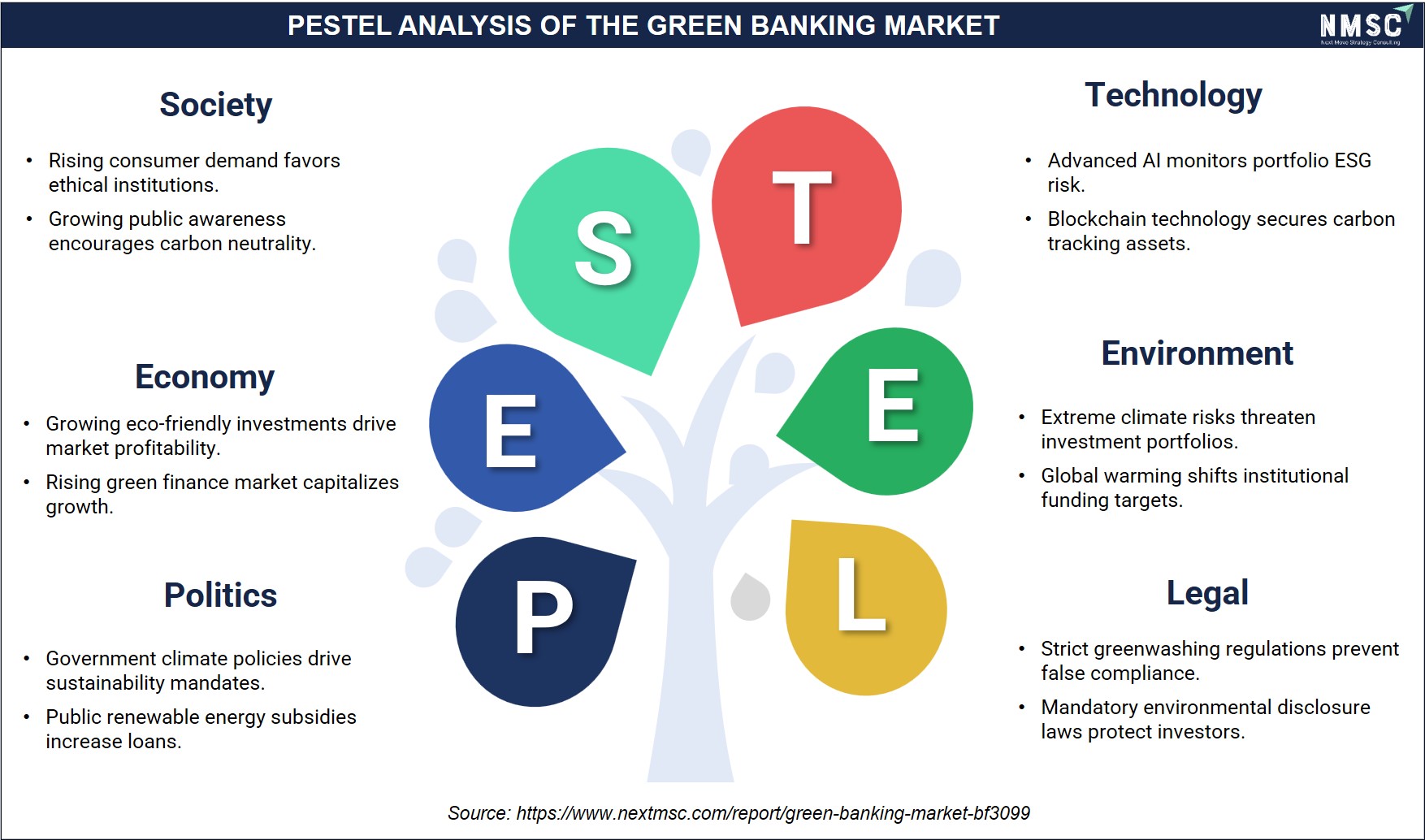
The Green Banking Market is influenced by a combination of political, economic, social, technological, environmental, and legal factors that shape its growth and adoption. Government sustainability policies and ESG regulations encourage banks to finance green projects, while rising environmental awareness among consumers drives demand for sustainable financial products. Technological advancements such as digital banking and AI-enabled risk assessment support efficient green financing. Additionally, climate-related regulations, environmental commitments, and evolving legal frameworks continue to strengthen the market's long-term development and investment potential.
Who Are the Key Market Players in the Green Banking Market?
-
Triodos Bank N.V.
-
BNP Paribas S.A.
-
Standard Chartered PLC
-
HSBC Holdings plc
-
Banco Santander, S.A.
-
Nordea Bank Abp
-
Coöperatieve Rabobank U.A.
-
ING Groep N.V.
-
Deutsche Bank Aktiengesellschaft
-
Barclays PLC
-
rédit Agricole S.A.
-
Société Générale S.A.
-
United Overseas Bank Limited
-
DBS Bank Ltd.
-
Oversea-Chinese Banking Corporation Limited
-
China Development Bank
-
Industrial and Commercial Bank of China Limited
-
Bank of China Limited
-
Mufin Green Finance Limited
-
DC Green Bank
What Are the Latest Developments in the Green Banking Market?
|
Date |
Event |
|
April 2026 |
Triodos launched a renewed energy-transition financing vision, prioritizing funding for energy storage, local electricity grids, energy-efficiency solutions and circular supply chains. |
|
Feb 2025 |
Standard Chartered published its Transition Plan detailing how it will integrate climate considerations across financing activities and expand sustainable and transition-finance solutions globally. |
|
Jan 2025 |
BNP Paribas announced a strategic refocus of its sustainable-finance business around adaptation, transition, conservation and societal resilience, emphasizing profitable sustainable-finance opportunities.BNP Paribas announced a strategic refocus of its sustainable-finance business around adaptation, transition, conservation and societal resilience, emphasizing profitable sustainable-finance opportunities. |
What Are the Investment Opportunities in the Green Banking Market?
Capital Inflows and Green Bond Market Expansion
The Green Banking Market is attracting substantial capital inflows from institutional investors, sovereign wealth funds, and multilateral development banks seeking verified climate-positive financial returns. Global green bond issuance has exceeded USD 500 billion annually, creating a high-quality and growing investable universe for green banking investors. NMSC's analysis indicates that banks with established green bond issuance programs benefit from a dual capital advantage, accessing lower-cost funding from ESG-dedicated investors while simultaneously growing their green asset portfolios for regulatory capital optimization and ESG performance metric improvement. Investment in green bond origination platforms and impact verification infrastructure represents a high-return capability build for financial institutions seeking to capture this capital inflow opportunity through 2035.
ESG Infrastructure and Digital Green Banking Platform Investments
Investment in ESG data infrastructure, digital green product distribution platforms, and AI-powered carbon assessment tools represents a high-priority technology investment theme within the Green Banking Market. Financial institutions that establish proprietary ESG scoring models, carbon portfolio analytics, and real-time impact reporting dashboards are building sustainable competitive advantages in green product underwriting and customer engagement. Private equity and venture capital investors are increasingly backing green fintech firms developing specialized tools for green loan origination, ESG compliance automation, and carbon offset management, recognizing the structural demand for technology-enabled sustainable banking capabilities globally.
PE/VC Activity and Emerging Market Green Finance Opportunities
Private equity and venture capital activity in the Green Banking Market is accelerating, focused on sustainable fintech platforms, green insurance technology, impact measurement SaaS providers, and specialist green lending institutions. Emerging markets in APAC, MEA, and LATAM offer high-growth investment opportunities in microfinance-linked green credit platforms, digital green savings products, and sustainable agriculture financing vehicles. Our assessment indicates that blended finance structures, combining concessional development finance with commercial private capital, are unlocking green banking investment opportunities in frontier markets that would otherwise be inaccessible to purely commercial institutional investors seeking risk-adjusted returns aligned with UN SDG investment frameworks.
Key Benefits for Stakeholders
For Financial Institutions and Banks
Financial institutions and banks gain comprehensive, vendor-neutral insights into the Green Banking Market, including quantitative analysis across green lending products, sustainable investment offerings, renewable energy financing, green mortgages, and ESG-linked banking services. This intelligence supports strategic planning, product portfolio development, and long-term sustainability initiatives. The competitive landscape analysis enables banking executives to benchmark peers, evaluate emerging green finance opportunities, and optimize capital allocation toward environmentally sustainable projects while aligning with evolving regulatory expectations and net-zero commitments.
For Investors and Financial Analysts
Investors and financial analysts access a structured, data-driven assessment of the Green Banking Market's growth trajectory, competitive dynamics, sustainable finance trends, green bond activity, and segment-level forecasts through 2035. Detailed analysis across regions, financial products, and institution types supports investment decision-making, portfolio diversification, and valuation modeling. Comprehensive profiles of leading market participants, combined with tracking of partnerships, sustainability initiatives, and financing programs, provide an early-indicator framework for identifying growth opportunities, emerging leaders, and evolving competitive risks within the global green finance ecosystem.
For Green Banking Providers and Financial Service Organizations
Green banking providers, commercial banks, development finance institutions, and financial service organizations gain actionable intelligence on high-growth market segments, emerging sustainability financing models, and competitive positioning opportunities within the Green Banking Market. Product-level analysis highlights growth areas such as green loans, sustainable deposits, carbon-neutral banking services, climate-risk financing, and renewable energy project funding. Regional outlook assessments identify expansion opportunities based on policy support, ESG adoption maturity, sustainable investment flows, and green infrastructure development. The analysis also supports refinement of customer acquisition strategies, sustainable product innovation, and partnership development across public and private sector stakeholders.
For Government and Regulatory Bodies
Government agencies, central banks, financial regulators, and policy institutions gain a structured analysis of how sustainable finance frameworks, climate disclosure requirements, green taxonomy regulations, and ESG reporting standards are shaping the Green Banking Market. Country-level insights provide policymakers with evidence-based perspectives on the effectiveness of regulatory measures in accelerating sustainable investment, supporting decarbonization objectives, and enhancing financial sector resilience. The report's assessment of green financing mechanisms, climate-risk management practices, and sustainable capital mobilization initiatives offers valuable guidance for developing national green finance strategies and achieving long-term environmental and economic development goals.
Key Market Segments
By Product Type
-
Credit & Financing
-
Green Project Loans
-
Solar Energy Loans
-
Wind Energy Loans
-
Electric Vehicle Loans
-
Energy Efficiency Loans
-
-
Green Corporate Loans
-
SME's Green Loans
-
Large Corporate Sustainability Loans
-
-
Green Mortgages
-
Energy-Efficient Home Mortgages
-
Green Building Certification Mortgages
-
Sustainable Construction Loans
-
-
-
Investment Products
-
Green Bonds
-
Sovereign Green Bonds
-
Corporate Green Bonds
-
Municipal Green Bonds
-
-
Sustainable Funds
-
ESG Equity Funds
-
Green Bond Funds
-
Socially Responsible Investment (SRI) Funds
-
Impact Investment Funds
-
-
-
Depository Products
-
Green Savings Accounts
-
Eco-Friendly Certificates of Deposit (CDs)
-
Sustainable Term Deposits
-
-
Insurance & Risk Management
-
Eco-Insurance
-
Renewable Energy Project Insurance
-
Green Building Insurance
-
-
Climate Risk Insurance
-
Agricultural/Crop Insurance
-
Natural Catastrophe Coverage
-
-
By Financial Institution
-
Public Sector Banks
-
Private Commercial Banks
-
Specialized Green Banks/Development Banks
-
Non-Banking Financial Companies (NBFCs)
-
Cooperative Banks/Credit Unions
-
Microfinance Institutions
By Customer Segment
-
Retail/Individual Banking
-
Mass Market Retail
-
Affluent Customers
-
High Net-Worth Individuals (HNWI)
-
-
Business Banking
-
Small & Medium Enterprises (SMEs)
-
Small Enterprises (10-50 employees)
-
Medium Enterprises (51-250 employees)
-
-
Large Corporations
-
National Corporations
-
Multinational Corporations
-
-
Institutional Clients
-
Government Entities
-
Educational Institutions
-
Non-Profit Organizations
-
-
By Distribution Channel
-
Branch Banking
-
Online Banking (Desktop)
-
Mobile Banking
-
Relationship Managers
-
Third-Party Distributors
By Region
-
North America: U.S., Canada, Mexico
-
Europe: UK, Germany, France, Italy, Spain, Sweden, Denmark, Finland, Netherlands, Rest of Europe
-
Asia-Pacific: China, India, Japan, South Korea, Taiwan, Indonesia, Vietnam, Australia, Philippines, Philippines, Malaysia, Rest of APAC
-
Middle East & Africa: Saudi Arabia, UAE, Egypt, Israel, Turkey, Nigeria, South Africa, Rest of MEA
-
Latin America: Brazil, Argentina, Chile, Colombia, Rest of LATAM
Conclusion and Recommendations
Long-Term Outlook
The Green Banking Market is entering a decade of structurally driven and commercially transformative growth, propelled by regulatory ESG mandates, accelerating net-zero commitments by financial institutions, the global renewable energy investment supercycle, and the mainstreaming of sustainable investment across retail and institutional customer segments. The market is forecast to grow from USD 24.03 billion in 2026 to USD 104.8 billion by 2035 at a CAGR of 17.8%, reflecting both the deepening penetration of green products within existing banking customer bases and the entry of new customer cohorts attracted by digitally accessible, mission-aligned sustainable financial products globally.
Strategic Positioning Recommendations
Financial institutions should prioritize digital mobile banking infrastructure as the primary distribution channel for green retail products, where a CAGR of 21.4% signals the strongest customer adoption momentum through 2035. Specialized Green Bank and Development Bank positioning offers differentiated credibility for institutions targeting institutional ESG mandates and public sector financing contracts. Our assessment indicates that taxonomy-aligned product certification, third-party ESG verification, and annual impact reporting are non-negotiable market entry requirements for credible participation in the Green Banking Market across all major developed and emerging regional markets globally.
Investment Attractiveness
The Green Banking Market represents a compelling long-term investment environment characterized by durable regulatory tailwinds, growing institutional capital allocation mandates, and high-switching-cost customer relationships built on ESG brand trust. The highest-conviction investment themes within the market include Specialized Green Banks and Development Banks (19.2% CAGR), Mobile Banking distribution (21.4% CAGR), Investment Products, specifically ESG equity and green bond funds (18.3% CAGR), and the Asia-Pacific regional market led by China and India. PE and VC activity in green fintech supporting the Market ecosystem is expected to accelerate through 2030.
Market Shifts and Key Risks
The most consequential market shift underway is the transition from voluntary ESG commitments to mandatory regulatory compliance across all major banking jurisdictions, fundamentally changing the commercial calculus for green product investment. Key risks for the Green Banking Market include greenwashing regulatory enforcement escalating compliance costs, inconsistent global taxonomies limiting cross-border product fungibility, macroeconomic pressures constraining SME green lending demand, and physical climate risk events creating asset quality challenges within green mortgage and agricultural loan portfolios in regions exposed to rising sea levels, extreme weather events, and prolonged droughts through the forecast period.
Growth Pathways
Organizations seeking to maximize value from the Green Banking Market should pursue a phased strategy across three horizons. In the near term through 2027, prioritize regulatory taxonomy alignment, green product certification, and digital distribution platform development to establish the foundational capability stack for scalable sustainable banking. In the mid-term from 2027 to 2031, invest in AI-powered ESG scoring, carbon portfolio analytics, and mobile green product ecosystems to capture the high-growth retail and SME customer segments. In the long term from 2031 to 2035, position for integrated green banking and insurance bundling, climate risk co-underwriting with development finance institutions, and cross-border green product distribution to capture the full addressable market opportunity.


About the Author
 Mihul Sharma
— Mihul Sharma is Research Associate at Next Move Strategy Consulting, where he has covered technology, industrial, and healthcare markets for 3 years. His work applies structured business research, market analysis, and secondary-source review to assess market trends, competitive developments, and growth opportunities. He supports report development by fully synthesizing industry data, company information, and market signals into concise findings for strategy and investment-focused research teams.
Mihul Sharma
— Mihul Sharma is Research Associate at Next Move Strategy Consulting, where he has covered technology, industrial, and healthcare markets for 3 years. His work applies structured business research, market analysis, and secondary-source review to assess market trends, competitive developments, and growth opportunities. He supports report development by fully synthesizing industry data, company information, and market signals into concise findings for strategy and investment-focused research teams.
About the Reviewer
 Supradip Baul
— Supradip Baul is an accomplished business consultant and strategist with over a decade of rich experience in market intelligence, strategy, technology, and business transformation. His work has included rigorous qualitative and quantitative analysis across multiple industries, helping clients shape investment decisions and long-term roadmaps. Earlier in his career, he was associated with Gartner, where he contributed to industry-leading reports and market share analyses. He has worked with leading global companies and holds an MBA with a dual specialization in Marketing and Finance.
Supradip Baul
— Supradip Baul is an accomplished business consultant and strategist with over a decade of rich experience in market intelligence, strategy, technology, and business transformation. His work has included rigorous qualitative and quantitative analysis across multiple industries, helping clients shape investment decisions and long-term roadmaps. Earlier in his career, he was associated with Gartner, where he contributed to industry-leading reports and market share analyses. He has worked with leading global companies and holds an MBA with a dual specialization in Marketing and Finance.
At Next Move Strategy Consulting, we understand that insightful market research is the cornerstone of successful business decisions. That's why we employ a robust and multifaceted approach, combining various methodologies to deliver the most accurate and actionable data for our clients.

Research Landscape
We navigate the world of research with two primary approaches:
Qualitative Approach
Our qualitative research methodologies involve immersive techniques such as in-depth interviews, focus groups, and observational studies. By engaging directly with individuals and stakeholders, we uncover valuable insights that quantitative data alone may overlook.

Quantitative Research
In tandem with qualitative methodologies, NMSC leverages the power of Quantitative Research to provide a robust foundation of numerical insights. Through systematic data collection and analysis, we quantify patterns, preferences, and market trends, offering a comprehensive view of the business landscape.
Our quantitative research approach employs diverse tools, including surveys, experiments, and statistical modelling. These methodologies enable us to gather data from a large and representative sample, ensuring the statistical significance of our findings. By employing structured questionnaires and standardized data collection methods, we guarantee the reliability and validity of the information we present to our clients.
Quantitative research is particularly effective in measuring the prevalence of trends, assessing market size, and gauging the impact of various factors on consumer behavior. The numerical precision attained through this approach equips our clients with actionable insights, facilitating data-driven decision-making and strategy formulation.


Our Specialized Toolbox for Industry-Specific Market Research
We deploy a specialized arsenal of techniques tailored to meet your unique requirements. Here's a glimpse into our comprehensive toolbox:

Information Procurement
The stage entails acquiring market data or relevant information through various sources and methodologies.


Market Research Approach
We utilize both top-down and bottom-up approaches in market research analysis to achieve a comprehensive understanding of the market dynamics, leveraging the broad perspective of industry trends and macroeconomic factors alongside detailed insights from specific segments and individual companies.

Porters Five Forces Analysis
We conduct Porter's Five Forces analysis to evaluate the competitive landscape of an industry, providing us with insights into factors that affect profitability and strategic positioning.

SWOT Analysis

Forecasting
We utilize a forecasting model to predict future consumption by considering parameters like population, economics, regulations, market competition, drivers, constraints, technology, and pricing. We also employ statistical techniques such as multilinear regression, exponential smoothing, moving average, ARIMA, and Monte Carlo simulations for accurate predictions. In econometric forecasting, we analyzed short-term and long-term event impacts, attributing values based on regulatory frameworks, economic factors, and market events.





 Speak to Our Analyst