Flower Seeds Market Size, Share, Trends and Growth Analysis, By Type (Annual Flower Seeds, Perennial Flower Seeds, and Biennial Flower Seeds), By Flower Type (Marigold, Petunia, Zinnia, Sunflower, Rose, and Other Flower Types), By Distribution Channel (Online Retail, Garden Centers and Nurseries, and Others), By End User (Commercial Growers, Home Gardeners, and Landscaping and Horticulture Services), and Region — Global Industry Report and Forecast, 2026–2035
Industry: Agriculture | Publishing Date: August 3, 2026 | Last Updated: September 3, 2026 | No of Pages: N/A | No. of Tables: N/A | No. of Figures: N/A | Format: PDF | Report Code: AG5529
What Is the Flower Seeds Market Size?
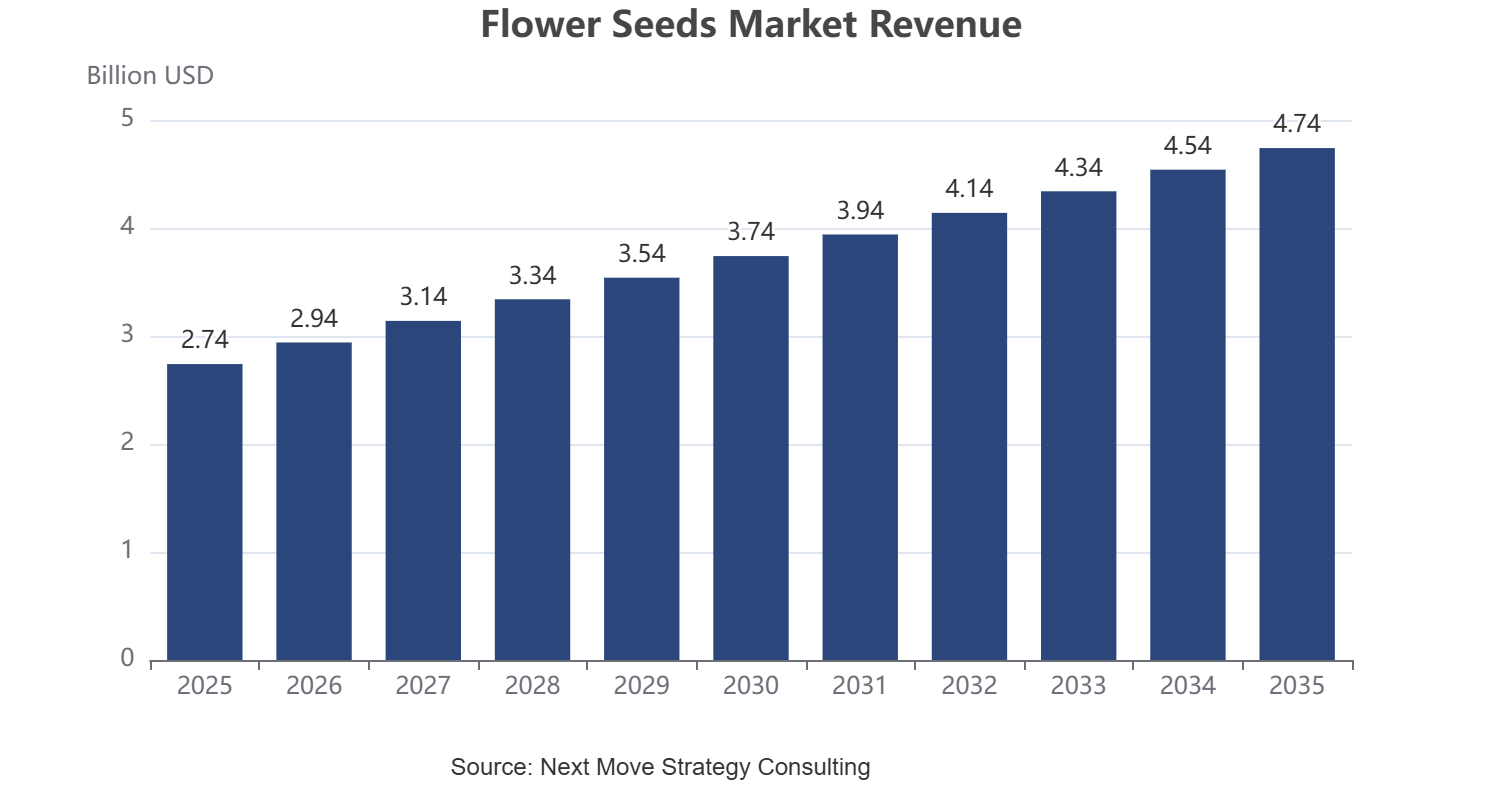
The global flower seeds market size was valued at USD 2.74 Billion in 2025 and is estimated at USD 2.89 Billion in 2026, forecast to reach USD 4.74 Billion by 2035, expanding at a 5.65% CAGR between 2026 and 2035. North America leads with approximately 30% share, while Marigold dominates all other flower types with approximately 22% share.
We observed that growth is broad-based across every segmentation axis, with rising home gardening participation and expanding commercial ornamental cultivation driving the dominant structural shifts through 2035.
|
Key Takeaways |
|
By Type: Annual Flower Seeds held the largest share of approximately 52% (USD 1.42 Billion) in 2025; Perennial Flower Seeds is the fastest-growing sub-segment at 6.23% CAGR from 2026–2035. |
|
By Flower Type: Marigold held the largest share of approximately 22% (USD 0.60 Billion) in 2025; Sunflower is the fastest-growing sub-segment at 6.37% CAGR from 2026–2035. |
|
By Distribution Channel: Garden Centers and Nurseries held the largest share of approximately 38% (USD 1.04 Billion) in 2025; Online Retail is the fastest-growing sub-segment at 7.96% CAGR from 2026–2035. |
|
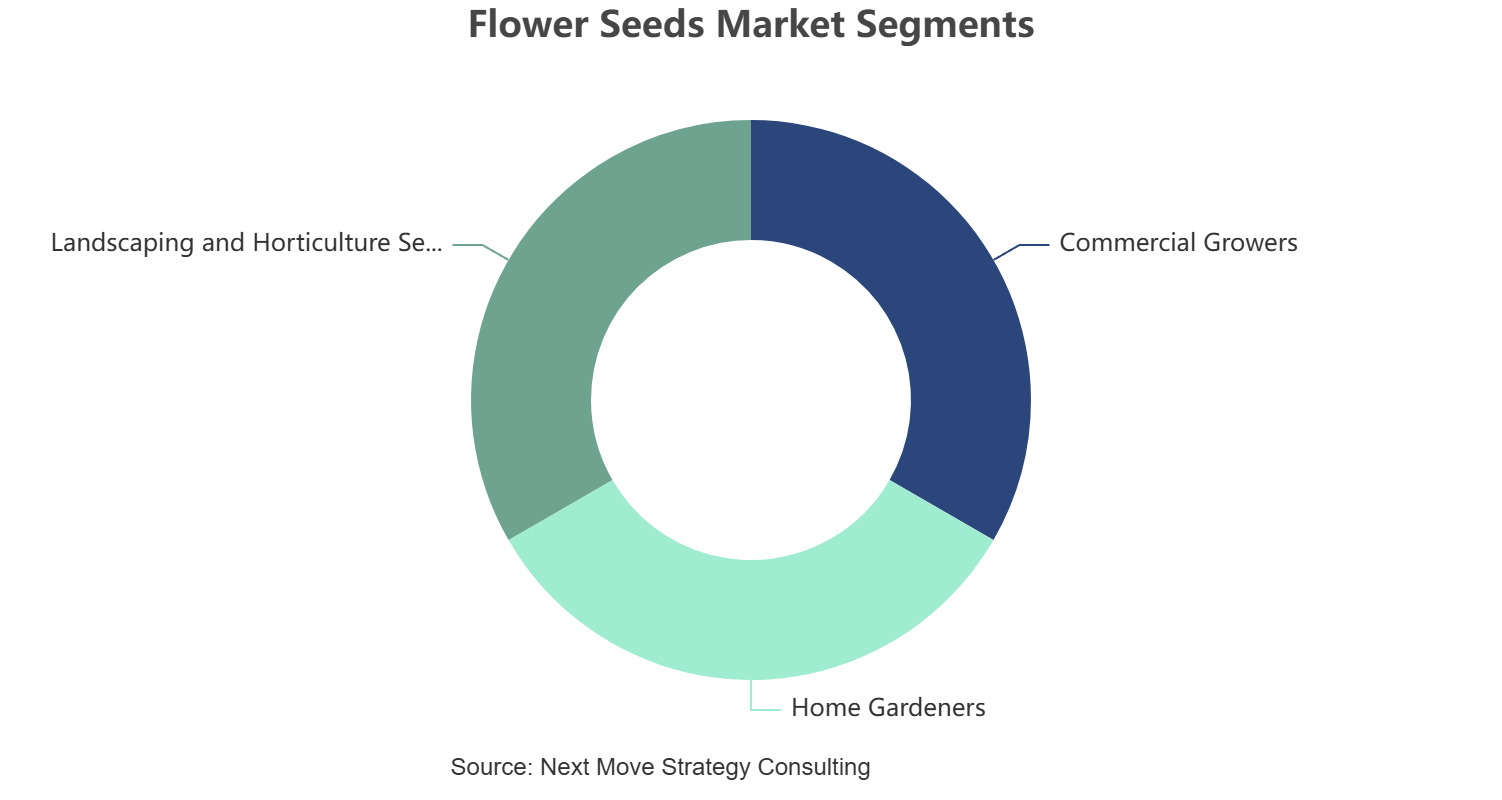
By End User: Commercial Growers held the largest share of approximately 45% (USD 1.23 Billion) in 2025; Landscaping and Horticulture Services is the fastest-growing sub-segment at 7.13% CAGR from 2026–2035. |
|
Dominant Region: North America dominated with approximately 30% revenue share (USD 0.82 Billion) in 2025. |
|
Fastest-Growing Region: Asia-Pacific is expected to register the highest CAGR of 7.60% during 2026–2035. |
|
Dominant Country: U.S. led with approximately USD 0.51 Billion in 2025. |
|
Fastest-Growing Country: Rest of Europe is the fastest-growing country at approximately 10.83% CAGR from 2026–2035. |
Market Opportunity: The flower seeds market is expected to create an absolute dollar opportunity of USD 1.85 billion between 2026 and 2035, presenting significant investment potential across the commercial cultivation, retail nursery, and home gardening value chain.
According to Next Move Strategy Consulting analysis, seed breeders are increasingly prioritizing pelleted and disease-resistant flower seed varieties to shorten germination cycles for commercial growers, a shift that favors diversified breeding houses over regional-only suppliers as retail and landscaping demand intensifies through 2035.
What Does the Flower Seeds Market Encompass?
The flower seeds market encompasses the breeding, production, processing, and commercial distribution of annual, perennial, and biennial ornamental flower seed varieties supplied to commercial growers, landscaping firms, and home gardeners. Our assessment indicates that the scope spans open-pollinated, hybrid, and pelleted seed formats sold through online retail, garden centers, supermarkets, and specialty nursery outlets across residential, commercial landscaping, and greenhouse cultivation end uses worldwide.
Regulatory frameworks such as the International Seed Testing Association's seed certification protocols and national plant variety protection statutes shape germination-quality and labeling standards, while lawn and garden consumables demand patterns increasingly influence packaging and retail-ready formats. We observed that technology adoption is shifting toward precision-coated and pelleted seed formats that improve sowing accuracy, a structural change that is redefining sourcing criteria across the flower seeds market.
|
Parameters |
Details |
|
Market Size in 2025 |
USD 2.74 Billion |
|
Market Size in 2026 |
USD 2.89 Billion |
|
Revenue Forecast in 2035 |
USD 4.74 Billion |
|
Growth Rate |
CAGR of 5.65% from 2026 to 2035 |
|
Analysis Period |
2025–2035 |
|
Base Year Considered |
2025 |
|
Forecast Period |
2026–2035 |
|
Market Size Estimation |
Revenue (USD Billion) |
|
Companies Profiled |
20 |
|
Countries Covered |
38 |
|
Market Share |
Available for Top 10 Companies |
Key Emerging Trends
Based on research conducted by Next Move Strategy Consulting, we found that four structural trends are reshaping product development, sourcing, and stakeholder engagement across the flower seeds market.
How Is Pelleted Seed Technology Transforming Sowing Precision?
Pelleted and primed seed coatings are replacing raw seed formats to improve germination consistency and mechanical sowing accuracy for commercial growers. We observed that Sakata Seed Corporation's expanded pelleted petunia and marigold lines, disclosed through its official product catalog, target greenhouse operators seeking uniform plug-tray emergence. Commercial growers are adopting these formats to reduce thinning labor, while breeders retool processing lines to accommodate coated formats across bedding-plant and cut-flower applications.
Why Are Pollinator-Friendly Native Varieties Gaining Adoption?
Pollinator-friendly and native wildflower seed varieties are gaining share as home gardeners and municipal landscaping programs respond to biodiversity awareness campaigns. Our findings suggest that state-level pollinator habitat initiatives in the United States, documented by the U.S. Department of Agriculture, increasingly favor native flower seed mixes in public landscaping tenders. Breeders such as American Seed Company are expanding native-variety portfolios, positioning these formats as a differentiated, higher-margin category within the broader segmentation structure.
How Is Digital Retailing Reshaping Flower Seed Purchasing Behavior?
Direct-to-consumer e-commerce platforms and mobile gardening applications are pushing seed suppliers toward digitally cataloged, subscription-based offerings for home gardeners. We observed that online retail penetration is rising fastest among younger gardening consumers who rely on digital agriculture tools and mobile planting calendars to plan seasonal sowing. This trend is elevating demand for QR-coded packaging and variety-specific growing guides among online sales channels, while retailers redesign catalogs to support search-driven variety discovery.
What Role Does Breeding Innovation Play in Disease-Resistant Varieties?
Breeding programs targeting disease-resistant and heat-tolerant flower varieties are emerging as a response to shifting climate conditions across cultivation regions. Our analysis shows that PanAmerican Seed's ongoing breeding disclosures highlight expanded downy-mildew-resistant impatiens and heat-tolerant petunia lines developed for warmer growing zones. This direction exemplifies how breeding investment is extending viable cultivation windows for commercial growers and landscaping firms operating across variable regional climates.
Supply Chain Structure of the Flower Seeds Market
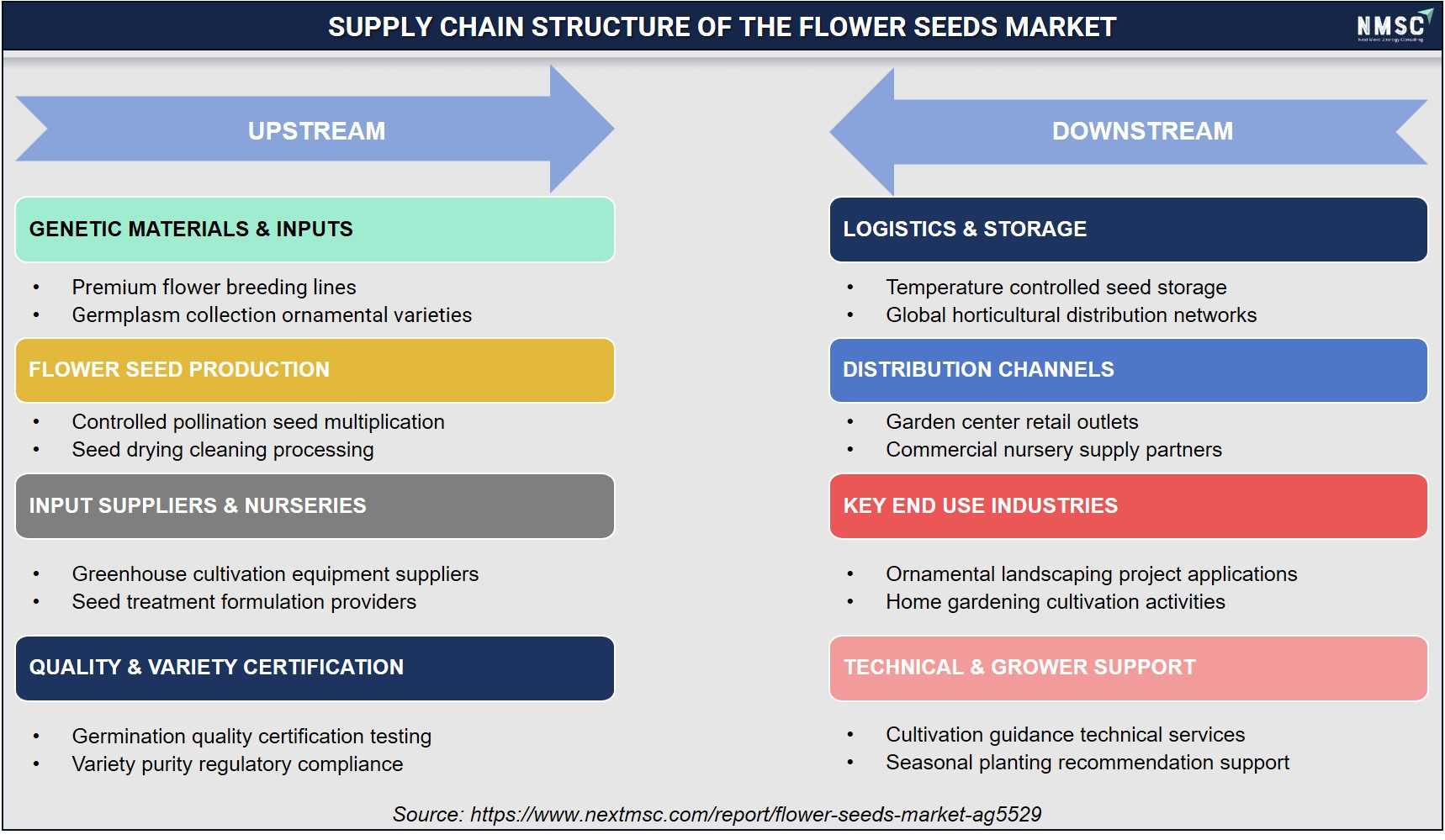
Based on our supply chain assessment, we identified that the flower seeds market value chain begins with premium breeding lines, germplasm resources, greenhouse input suppliers, and seed treatment providers, followed by controlled pollination, seed multiplication, drying, cleaning, and quality certification processes. Furthermore, our analysis indicates that temperature-controlled storage, horticultural distribution networks, garden centers, commercial nurseries, ornamental landscaping projects, home gardening activities, and technical cultivation support ensure efficient product distribution, seed quality preservation, and successful grower adoption.
Growth Drivers and Restraints
Growth Catalyst and Risk Assessment Matrix
|
Factors |
Type |
(+/−) % Impact on CAGR |
Geographic Relevance |
Impact Timeline |
|
Rising home gardening participation post-pandemic |
Driver |
+1.4% |
Global |
2026–2035 |
|
Expansion of organized garden retail chains |
Driver |
+1.1% |
North America, Europe |
2026–2035 |
|
Growth in commercial landscaping and greenhouse cultivation |
Driver |
+1.0% |
Asia-Pacific, North America |
2026–2035 |
|
Rising e-commerce and subscription seed retail |
Driver |
+0.9% |
Global |
2026–2032 |
|
Municipal and pollinator-habitat landscaping programs |
Driver |
+0.6% |
North America, Europe |
2026–2035 |
|
Breeding innovation in disease-resistant varieties |
Driver |
+0.5% |
Global |
2026–2035 |
|
Climate variability affecting germination and yield |
Restraint |
-0.9% |
Global |
2026–2035 |
|
Competition from vegetative propagation and plug plants |
Restraint |
-0.6% |
North America, Europe |
2026–2032 |
|
Seasonal and weather-dependent demand volatility |
Restraint |
-0.4% |
Global |
2026–2035 |
What Is the Primary Growth Driver of the Flower Seeds Market?
Rising home gardening participation following pandemic-era lifestyle shifts is the primary driver of the market. The U.S. Department of Agriculture continues to report sustained growth in direct-to-consumer horticultural spending, reinforcing household demand for annual and perennial flower seed varieties. We observed that this behavioral shift, combined with expanding balcony and small-space gardening trends, continues to anchor baseline consumption of flower seeds across developed and emerging economies alike.
How Is Commercial Landscaping Demand Driving Market Growth?
Expansion of commercial landscaping, greenhouse cultivation, and municipal beautification programs is accelerating bulk flower seed procurement. Government-backed urban greening initiatives, documented by national environmental agencies, are pushing public landscaping tenders toward flowering ornamental varieties supported by organic fertilizers and integrated soil-management inputs. Our assessment indicates that this institutional demand, combined with private greenhouse expansion, is compressing procurement cycles for commercial growers across Asia-Pacific and North America.
What Is Restraining Flower Seeds Market Expansion?
Climate variability affecting germination rates and seasonal yield restrains supply consistency across the flower seeds market. The U.S. Environmental Protection Agency tracks recurring regional temperature and precipitation anomalies that disrupt planting windows and reduce seed viability rates during storage and transit. We found that smaller regional breeders face particular exposure, as limited climate-controlled storage capacity reduces their ability to hedge against yield variability compared with larger, vertically integrated seed houses.
Segmentation Analysis
Segment Sizing: By Type
|
Segment |
2025 (USD) |
2035 (USD) |
CAGR% (2026–2035) |
|
Annual Flower Seeds |
USD 1.42 Billion |
USD 2.37 Billion |
5.19% |
|
Perennial Flower Seeds |
USD 1.10 Billion |
USD 1.99 Billion |
6.23% |
|
Biennial Flower Seeds |
USD 0.22 Billion |
USD 0.38 Billion |
5.65% |
|
Total |
USD 2.74 Billion |
USD 4.74 Billion |
5.65% |
Which Type Segment Dominates the Flower Seeds Market?
Annual Flower Seeds led the market with USD 1.42 Billion in 2025, supported by their single-season bloom cycle and widespread use in bedding, container, and landscaping applications. We observed that Perennial Flower Seeds are the fastest-growing type, expanding at 6.23% CAGR from 2026 to 2035, as gardeners increasingly favor multi-year blooming varieties that reduce repeat purchase requirements while sustaining garden aesthetics.
Segment Sizing: By Flower Type
|
Segment |
2025 (USD) |
2035 (USD) |
CAGR% (2026–2035) |
|
Marigold |
USD 0.60 Billion |
USD 1.00 Billion |
5.11% |
|
Petunia |
USD 0.49 Billion |
USD 0.90 Billion |
6.29% |
|
Zinnia |
USD 0.38 Billion |
USD 0.66 Billion |
5.65% |
|
Sunflower |
USD 0.44 Billion |
USD 0.81 Billion |
6.37% |
|
Rose |
USD 0.33 Billion |
USD 0.57 Billion |
5.65% |
|
Other Flower Types |
USD 0.49 Billion |
USD 0.81 Billion |
4.98% |
|
Total |
USD 2.74 Billion |
USD 4.74 Billion |
5.65% |
Which Flower Type Leads Flower Seeds Market Demand?
Marigold remained the leading flower type within the market, valued at USD 0.60 Billion in 2025 on sustained demand for its low-maintenance cultivation and pest-deterrent properties in home and commercial gardens. Our findings suggest that Sunflower is among the fastest-growing flower types, registering 6.37% CAGR from 2026 to 2035, as ornamental and dual-purpose sunflower varieties gain traction across landscaping and cut-flower applications.
Segment Sizing: By Distribution Channel
|
Segment |
2025 (USD) |
2035 (USD) |
CAGR% (2026–2035)
|
|
Online Retail |
USD 0.77 Billion |
USD 1.61 Billion |
7.96% |
|
Garden Centers and Nurseries |
USD 1.04 Billion |
USD 1.66 Billion |
4.69% |
|
Supermarkets and Hypermarkets |
USD 0.55 Billion |
USD 0.85 Billion |
4.42% |
|
Specialty Stores |
USD 0.38 Billion |
USD 0.62 Billion |
4.79% |
|
Total |
USD 2.74 Billion |
USD 4.74 Billion |
5.65% |
Which Distribution Channel Is Growing Fastest in the Flower Seeds Market?
Garden Centers and Nurseries remained the dominant distribution channel, reaching USD 1.04 Billion in 2025 due to in-person variety selection and expert planting guidance. Based on research conducted by Next Move Strategy Consulting, we found that Online Retail is the fastest-growing channel, expanding at 7.96% CAGR from 2026 to 2035, as subscription seed boxes and mobile commerce platforms broaden access for home gardening consumers.
Segment Sizing: By End User
|
Segment |
2025 (USD) |
2035 (USD) |
CAGR% (2026–2035) |
|
Commercial Growers |
USD 1.23 Billion |
USD 2.09 Billion |
5.39% |
|
Home Gardeners |
USD 1.10 Billion |
USD 1.85 Billion |
5.35% |
|
Landscaping and Horticulture Services |
USD 0.41 Billion |
USD 0.81 Billion |
7.13% |
|
Total |
USD 2.74 Billion |
USD 4.74 Billion |
5.65% |
Which End User Segment Anchors Flower Seeds Market Revenue?
Commercial Growers accounted for the largest end-user share, valued at USD 1.23 Billion in 2025, reflecting bulk procurement for greenhouse and landscaping-scale cultivation. Our analysis shows that Landscaping and Horticulture Services is growing steadily at 7.13% CAGR from 2026 to 2035, as municipal and commercial beautification contracts expand demand for bulk flowering seed procurement.
Growth Opportunities
We identified three forward-looking whitespace opportunities that stakeholders across the flower seeds market can pursue through 2035.
How Can Subscription-Based Seed Curation Unlock New Revenue?
Subscription-based seasonal seed curation, bundling variety selection with planting guides, offers online retailers a mechanism to build recurring home-gardener revenue and reduce single-purchase churn. This mechanism benefits digital-native seed retailers positioned to capture repeat engagement from small-space and balcony gardening consumers.
How Can Municipal Pollinator Programs Expand Commercial Demand?
Expanding municipal pollinator-habitat and roadside beautification contracts create a bulk-procurement mechanism for native and wildflower seed mixes, often paired with biofertilizers for establishment support. This mechanism benefits breeders with certified native-variety portfolios positioned to win public landscaping and horticulture services tenders.
How Can Greenhouse Automation Expand Commercial Grower Yields?
Integration of automated seeding and climate-controlled propagation systems offers commercial growers a mechanism to raise plug-tray germination consistency and cut labor costs. This mechanism benefits large-scale greenhouse operators and pelleted-seed suppliers positioned to serve mechanized sowing lines across bedding-plant production.
Regional Outlook
Geographic Performance Snapshot
|
Region |
2025 (USD) |
2035 (USD) |
CAGR% (2026–2035) |
Key Driver |
|
North America |
USD 0.82 Billion |
USD 1.33 Billion |
4.84% |
Organized garden retail expansion |
|
Europe |
USD 0.71 Billion |
USD 1.14 Billion |
4.72% |
Municipal pollinator programs |
|
Asia-Pacific |
USD 0.77 Billion |
USD 1.56 Billion |
7.60% |
Commercial greenhouse expansion |
|
Middle East and Africa |
USD 0.22 Billion |
USD 0.38 Billion |
5.65% |
Urban landscaping investment |
|
Latin America |
USD 0.22 Billion |
USD 0.33 Billion |
4.10% |
Rising home gardening adoption |
|
Total |
USD 2.74 Billion |
USD 4.74 Billion |
5.65% |
— |
North America Flower Seeds Market
North America's flower seeds market benefits from a mature organized garden retail infrastructure and high per-household horticultural spending. We observed that regulatory oversight from the U.S. Department of Agriculture's seed certification programs supports consistent germination-quality standards. Technology adoption is advancing through pelleted and precision-coated formats, while the region's strategic outlook favors continued expansion of subscription and e-commerce seed retail channels alongside traditional nursery distribution.
Europe Flower Seeds Market
Europe's flower seeds market reflects a mature cultivation base supported by strong municipal pollinator-habitat and biodiversity policy frameworks under the European Union's Biodiversity Strategy. Our assessment indicates that regulatory emphasis on native and pollinator-friendly varieties is reshaping breeding priorities across the region. Technology adoption in precision sowing is steady, and the region's strategic outlook favors continued growth in specialty and heirloom variety demand across established gardening cultures.
Asia-Pacific Flower Seeds Market
Asia-Pacific's flower seeds market is expanding fastest among covered regions, driven by rising commercial greenhouse cultivation and urban landscaping investment. We found that expanding organized retail infrastructure across China and India is broadening home gardening access. Technology adoption is accelerating through mechanized greenhouse seeding, and the region's strategic outlook favors sustained double-digit growth in select emerging markets through 2035.
Middle East and Africa Flower Seeds Market
The Middle East and Africa flower seeds market reflects growing urban landscaping investment tied to national greening and tourism-infrastructure initiatives. Our analysis shows that government-backed urban beautification programs are supporting bulk flowering seed procurement in Gulf economies. Technology adoption remains selective given arid-climate cultivation constraints, and the region's strategic outlook favors continued growth concentrated in Gulf Cooperation Council landscaping and hospitality-sector demand.
Latin America Flower Seeds Market
Latin America's flower seeds market reflects rising home gardening adoption alongside expanding commercial ornamental cultivation in Brazil and Argentina. We observed that organized retail penetration remains comparatively lower than in developed regions, supporting continued informal-channel distribution. Technology adoption in pelleted seed formats is gradual, and the region's strategic outlook favors steady growth anchored by Brazil's expanding domestic horticulture sector.
U.S. Flower Seeds Market
Based on our estimates, the U.S. flower seeds market was valued at approximately USD 0.51 Billion in 2025 and is projected to reach USD 0.80 Billion by 2035, expanding at a 4.46% CAGR from 2026 to 2035. Demand is anchored by extensive organized garden retail, high home gardening participation, and strong regulatory oversight through USDA seed certification, with technology adoption led by pelleted and precision-sown varieties amid intense competitive activity among national breeders.
Canada Flower Seeds Market
The market in Canada was valued at approximately USD 0.20 Billion in 2025 and is projected to reach USD 0.33 Billion by 2035, expanding at a 5.32% CAGR from 2026 to 2035. Growth is supported by expanding suburban home gardening and cold-climate perennial variety demand, with the Canadian Food Inspection Agency's seed regulations shaping labeling standards and moderate competitive intensity among regional and national seed suppliers.
UK Flower Seeds Market
As per our estimate, the UK flower seeds market was valued at approximately USD 0.12 Billion in 2025 and is projected to reach USD 0.18 Billion by 2035, expanding at a 4.01% CAGR from 2026 to 2035. Demand structure favors heirloom and cottage-garden varieties, supported by strong home gardening culture and Royal Horticultural Society engagement, with steady technology penetration in online seed retail and moderate competitive intensity among specialty breeders.
Germany Flower Seeds Market
According to our analysis, the Germany flower seeds market was valued at approximately USD 0.14 Billion in 2025 and is projected to reach USD 0.22 Billion by 2035, expanding at a 4.12% CAGR from 2026 to 2035. Demand is driven by organized garden center penetration and strong municipal pollinator-habitat programs under national biodiversity policy, with technology adoption advancing through precision-coated seed formats and high competitive intensity among European breeding houses.
France Flower Seeds Market
Based on our estimates, the France flower seeds market was valued at approximately USD 0.11 Billion in 2025 and is projected to reach USD 0.17 Billion by 2035, expanding at a 4.72% CAGR from 2026 to 2035. Growth reflects steady home gardening demand and expanding commercial landscaping contracts, with regulatory oversight from national plant variety protection statutes shaping breeder registration, and moderate technology adoption in online seed retail channels.
China Flower Seeds Market
The market in China was valued at approximately USD 0.23 Billion in 2025 and is projected to reach USD 0.45 Billion by 2035, expanding at a 7.19% CAGR from 2026 to 2035. Demand is driven by rapidly expanding commercial greenhouse cultivation and urban landscaping investment under national ecological greening initiatives, with technology adoption accelerating through mechanized seeding and high competitive intensity among domestic and international breeders.
India Flower Seeds Market
As per our estimate, the India flower seeds market was valued at approximately USD 0.14 Billion in 2025 and is projected to reach USD 0.31 Billion by 2035, expanding at a 8.86% CAGR from 2026 to 2035. Growth is supported by expanding floriculture cultivation and government-backed horticulture mission programs, with the Ministry of Agriculture and Farmers Welfare shaping seed certification standards, and technology adoption gradually advancing through organized retail expansion.
Japan Flower Seeds Market
According to our analysis, the Japan flower seeds market was valued at approximately USD 0.11 Billion in 2025 and is projected to reach USD 0.19 Billion by 2035, expanding at a 5.77% CAGR from 2026 to 2035. Demand structure favors premium and specialty ornamental varieties supported by strong home gardening culture, with the Ministry of Agriculture, Forestry and Fisheries overseeing seed quality standards, and moderate competitive intensity among established domestic breeders.
South Korea Flower Seeds Market
Based on our estimates, the South Korea flower seeds market was valued at approximately USD 0.06 Billion in 2025 and is projected to reach USD 0.13 Billion by 2035, expanding at a 7.60% CAGR from 2026 to 2035. Growth is driven by expanding urban balcony gardening and municipal landscaping beautification programs, with steady technology adoption in online retail and moderate competitive intensity among regional seed distributors.
Australia Flower Seeds Market
The market in Australia was valued at approximately USD 0.05 Billion in 2025 and is projected to reach USD 0.09 Billion by 2035, expanding at a 5.77% CAGR from 2026 to 2035. Demand reflects strong home gardening participation and native wildflower variety interest, with biosecurity regulations administered by the Department of Agriculture, Fisheries and Forestry shaping import standards, and moderate competitive intensity among domestic breeders.
UAE Flower Seeds Market
As per our estimate, the UAE flower seeds market was valued at approximately USD 0.03 Billion in 2025 and is projected to reach USD 0.06 Billion by 2035, expanding at a 6.46% CAGR from 2026 to 2035. Growth is anchored by large-scale urban landscaping and hospitality-sector beautification investment, with technology adoption in climate-controlled cultivation advancing steadily, and competitive intensity concentrated among a small group of specialized regional suppliers.
Saudi Arabia Flower Seeds Market
According to our analysis, the Saudi Arabia flower seeds market was valued at approximately USD 0.04 Billion in 2025 and is projected to reach USD 0.07 Billion by 2035, expanding at a 5.65% CAGR from 2026 to 2035. Demand is supported by national greening initiatives under Vision 2030 urban development programs, with government-backed landscaping tenders driving bulk procurement, and moderate technology adoption in arid-climate cultivation techniques.
South Africa Flower Seeds Market
Based on our estimates, the South Africa flower seeds market was valued at approximately USD 0.03 Billion in 2025 and is projected to reach USD 0.05 Billion by 2035, expanding at a 5.65% CAGR from 2026 to 2035. Growth reflects steady home gardening demand and commercial landscaping activity in urban centers, with the Department of Agriculture, Land Reform and Rural Development overseeing seed regulation, and moderate competitive intensity among regional suppliers.
Brazil Flower Seeds Market
The market in Brazil was valued at approximately USD 0.09 Billion in 2025 and is projected to reach USD 0.13 Billion by 2035, expanding at a 3.53% CAGR from 2026 to 2035. Demand is driven by expanding domestic floriculture cultivation and rising home gardening interest, with the Ministry of Agriculture and Livestock overseeing seed certification standards, and technology adoption gradually advancing through organized retail expansion.
Argentina Flower Seeds Market
As per our estimate, the Argentina flower seeds market was valued at approximately USD 0.04 Billion in 2025 and is projected to reach USD 0.07 Billion by 2035, expanding at a 4.10% CAGR from 2026 to 2035. Growth reflects steady ornamental horticulture demand and expanding commercial landscaping activity, with moderate regulatory oversight from national agricultural authorities and gradual technology adoption in retail seed distribution.
Consumer Behavior Analysis of the Flower Seeds Market
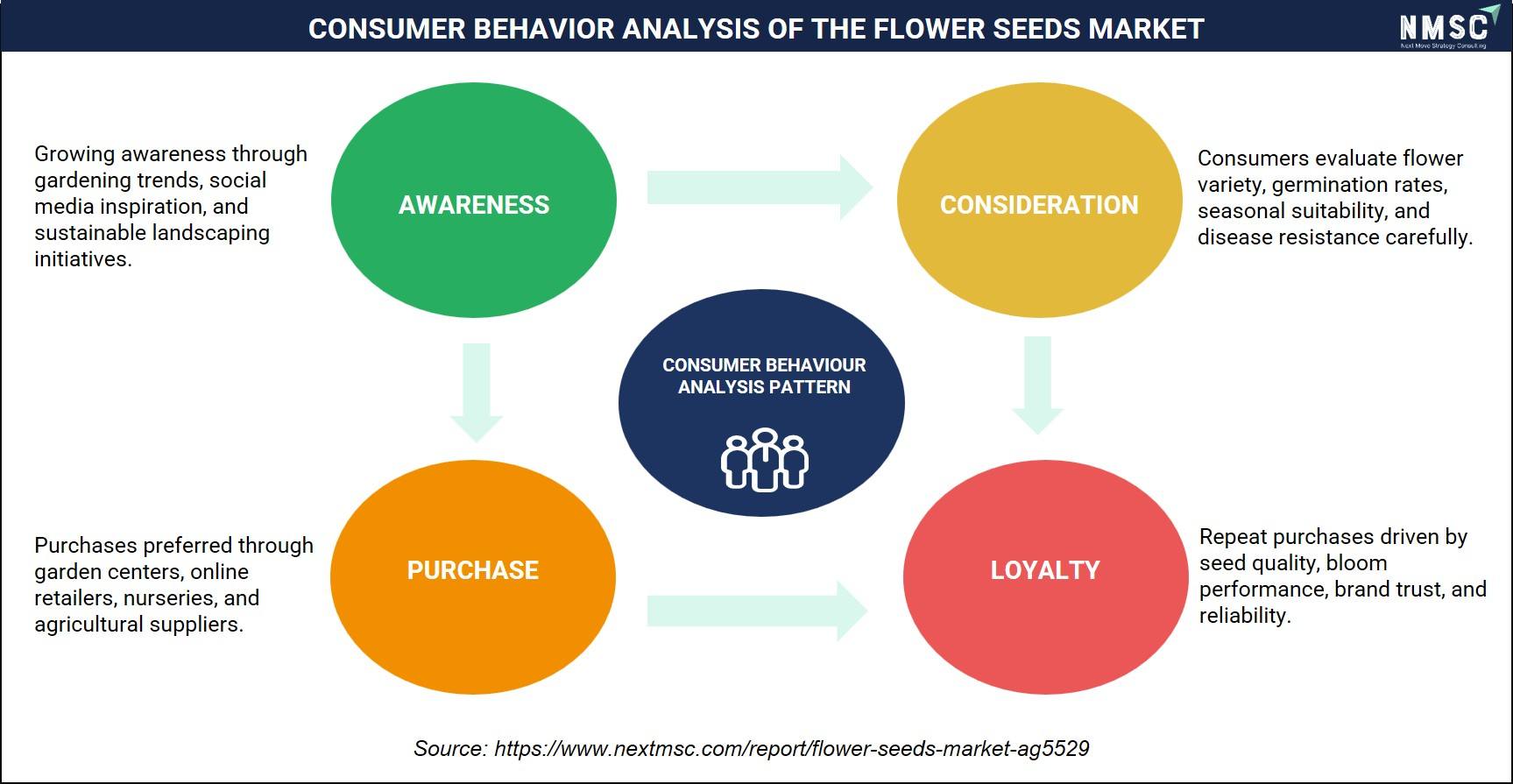
Based on our consumer behavior assessment, we identified that flower seed buyers evaluate products based on flower variety, germination performance, seasonal suitability, disease resistance, and overall cultivation reliability before making purchasing decisions. Furthermore, our analysis indicates that consumers primarily purchase through garden centers, nurseries, agricultural suppliers, and online retail platforms, while repeat purchases are driven by consistent seed quality, successful bloom performance, brand reputation, and dependable product availability.
Competitive Landscape
We observed that the flower seeds market Industry remains moderately fragmented, with global breeding houses competing alongside specialty and regional seed producers across differentiated variety portfolios.
Competitive Landscape Key Takeaways
|
Dimension |
Details |
|
Market Structure |
Moderately fragmented, with the top 10 companies accounting for a meaningful but non-dominant share of global revenue |
|
Innovation Focus |
Disease-resistant, pelleted, and pollinator-friendly native variety development |
|
M&A Activity |
Selective bolt-on acquisitions of regional breeding houses to expand variety portfolios and geographic reach |
How Do Companies Compete in the Flower Seeds Market?
Companies compete primarily on breeding depth, germination reliability, and distribution reach across garden retail and commercial grower channels. We found that global breeding houses leverage proprietary hybrid varieties and multi-region trial networks to sustain premium positioning, while regional producers compete on price and localized variety adaptation suited to specific climate zones.
Which Competitive Archetypes Dominate the Flower Seeds Market?
Two archetypes dominate the flower seeds market: diversified global breeding houses with integrated research pipelines, and specialty regional producers focused on heirloom or native variety niches. Our findings suggest that diversified breeders sustain scale advantages in commercial grower channels, while specialty producers differentiate through curated catalogs that appeal to home gardening and pollinator-focused consumers.
What Innovation and Differentiation Strategies Define the Industry?
Innovation strategy centers on breeding for disease resistance, heat tolerance, and pelleted sowing precision. Our analysis shows that leading breeders are investing in trial-garden networks and digital variety-selection tools to differentiate catalog offerings, while pricing strategies increasingly bundle premium coated seed formats with agronomic guidance for commercial grower accounts.
What M&A and Geographic Expansion Activity Is Shaping the Market?
M&A activity remains selective, concentrated on bolt-on acquisitions of regional breeding houses that expand variety portfolios and geographic distribution reach. We observed that geographic expansion is prioritizing Asia-Pacific commercial greenhouse channels, where diversified breeders are establishing regional trial stations to accelerate market-specific variety adaptation.
Key Market Players
Our assessment indicates that the following companies represent the leading verified participants in the global flower seeds market based on breeding scale, product portfolio, and confirmed geographic presence.
-
Ball Horticultural Company
-
Syngenta Group
-
Sakata Seed Corporation
-
Takii & Co., Ltd.
-
PanAmerican Seed
-
Ernst Benary of America Inc.
-
Floranova Ltd.
-
W. Atlee Burpee & Co.
-
Thompson & Morgan
-
Kieft Seeds Holland B.V.
-
Hem Genetics
-
Golden State Bulb Growers, Inc.
-
Jelitto Perennial Seeds
-
Danziger
-
Dümmen Orange
-
Green Fuse Botanicals, Inc.
-
American Seed Company, Inc.
-
David's Garden Seeds & Products LLC
Latest Developments
|
Date |
Event |
|
July 2026 |
Ball Horticultural Company announced a partnership with the Museum of Ventura County Agriculture Museum in Santa Paula, California, establishing the museum as the new venue for its California Spring Trials (CAST) beginning in 2027. The location will host annual product launches and breeding company displays following the relocation of PanAmerican Seed's research activities. |
|
May 2026 |
Dümmen Orange and Syngenta Flowers announced a strategic joint venture focused on ornamental breeding and propagation, combining their complementary global genetics portfolios, advanced R&D capabilities, production processes, and commercial networks to strengthen innovation and better serve growers worldwide. |
|
May 2025 |
Sakata Seed Corporation announced the establishment of its Global Flower Business Division to integrate the product development functions of its domestic and overseas flower businesses, enhance global product development and technical support capabilities, and strengthen its competitiveness in the evolving global flower seed market. |
Investment Opportunities
Where Are Capital Inflows Concentrated in the Flower Seeds Market?
Capital inflows are concentrating in breeding research infrastructure and trial-garden networks that accelerate disease-resistant variety development. We observed that private investment is favoring breeders with multi-region trial capacity, positioning them to shorten variety-to-market timelines and capture expanding commercial grower demand across Asia-Pacific and North America.
How Is Infrastructure Investment Supporting Market Expansion?
Infrastructure investment is expanding climate-controlled seed storage and processing capacity to improve germination-quality consistency across supply chains. Our assessment indicates that breeders investing in automated seed cleaning and pelleting lines are better positioned to meet rising demand from mechanized commercial greenhouse operations.
What ESG Considerations Are Shaping Flower Seeds Investment?
Environmental, Social, and Governance considerations are increasingly shaping investment decisions, with breeders prioritizing pollinator-friendly variety development and reduced-input cultivation practices aligned with sustainable agriculture principles. We found that ESG-aligned breeding programs are gaining preferential access to municipal and institutional landscaping contracts that increasingly specify biodiversity-supportive procurement criteria.
Key Benefits for Stakeholders
How Does This Report Benefit Industry Leaders and Breeders?
Industry leaders and breeding houses gain access to validated segmentation, competitive benchmarking, and regional demand forecasts that support portfolio and capacity-planning decisions. Our analysis shows that this data enables breeders to prioritize variety development and distribution investment toward the fastest-growing segments and geographies identified through 2035.
How Does This Report Benefit Investors and Financial Analysts?
Investors and financial analysts benefit from independently derived market sizing, CAGR methodology, and company-level competitive positioning that support capital-allocation and due-diligence decisions. We observed that the report's regional and segment-level forecasts help quantify addressable opportunity across commercial, retail, and institutional demand channels.
How Does This Report Benefit Retail and Distribution Partners?
Retail and distribution partners gain insight into channel-level growth patterns, enabling more informed inventory and assortment planning across online, garden center, and specialty store formats. Our findings suggest that this analysis helps distribution partners align catalog strategy with shifting home gardener and commercial grower purchasing behavior.
Key Market Segments
By Type
-
Annual Flower Seeds
-
Perennial Flower Seeds
-
Biennial Flower Seeds
By Flower Type
-
Marigold
-
Petunia
-
Zinnia
-
Sunflower
-
Rose
-
Other Flower Types
By Distribution Channel
-
Online Retail
-
Garden Centers and Nurseries
-
Supermarkets and Hypermarkets
-
Specialty Stores
By End User
-
Commercial Growers
-
Home Gardeners
-
Landscaping and Horticulture Services
By Region
-
North America: U.S., Canada, Mexico
-
Europe: UK, Germany, France, Italy, Spain, Sweden, Denmark, Finland, Netherlands, Rest of Europe
-
Asia-Pacific: China, India, Japan, South Korea, Taiwan, Indonesia, Vietnam, Australia, Philippines, Malaysia, Rest of APAC
-
Middle East and Africa: Saudi Arabia, UAE, Egypt, Israel, Turkey, Nigeria, South Africa, Rest of MEA
-
Latin America: Brazil, Argentina, Chile, Colombia, Rest of LATAM
Conclusion and Recommendations
What Is the Long-Term Outlook for the Flower Seeds Market?
The long-term outlook remains favorable, with the market projected to grow from USD 2.89 Billion in 2026 to USD 4.74 Billion by 2035 at a 5.65% CAGR. We observed that sustained home gardening participation, expanding commercial greenhouse cultivation, and municipal pollinator programs collectively support durable demand across both developed and emerging cultivation regions through the forecast period.
What Strategic Positioning Should Companies Pursue?
Companies should prioritize disease-resistant and pelleted variety development while expanding digital retail and subscription-based distribution channels. Our assessment indicates that breeders combining strong trial-garden research infrastructure with direct-to-consumer retail capability are best positioned to capture share across both commercial grower and home gardener demand segments.
How Attractive Is the Flower Seeds Market for Investment?
The market presents moderate but steady investment attractiveness, anchored by predictable seasonal demand and expanding institutional landscaping procurement. We found that breeding infrastructure and climate-controlled processing capacity represent the most capital-efficient investment avenues, given their direct link to germination-quality consistency and commercial grower retention.
What Market Shifts and Key Risks Should Stakeholders Monitor?
Stakeholders should monitor climate variability, seasonal demand volatility, and competitive pressure from vegetative propagation formats. Our findings suggest that breeders with diversified geographic trial networks are better insulated against regional climate shocks that could otherwise disrupt seed viability and delivery timelines.
What Are the Key Growth Pathways Through 2035?
Key growth pathways include expanding subscription-based online retail, deepening municipal pollinator-program partnerships, and scaling pelleted seed formats for mechanized commercial greenhouse operations. We observed that companies pursuing these pathways simultaneously are best positioned to capture the full breadth of demand across commercial, institutional, and home gardening channels through 2035.
About the Author

About the Reviewer

At Next Move Strategy Consulting, we understand that insightful market research is the cornerstone of successful business decisions. That's why we employ a robust and multifaceted approach, combining various methodologies to deliver the most accurate and actionable data for our clients.

Research Landscape
We navigate the world of research with two primary approaches:
Qualitative Approach
Our qualitative research methodologies involve immersive techniques such as in-depth interviews, focus groups, and observational studies. By engaging directly with individuals and stakeholders, we uncover valuable insights that quantitative data alone may overlook.

Quantitative Research
In tandem with qualitative methodologies, NMSC leverages the power of Quantitative Research to provide a robust foundation of numerical insights. Through systematic data collection and analysis, we quantify patterns, preferences, and market trends, offering a comprehensive view of the business landscape.
Our quantitative research approach employs diverse tools, including surveys, experiments, and statistical modelling. These methodologies enable us to gather data from a large and representative sample, ensuring the statistical significance of our findings. By employing structured questionnaires and standardized data collection methods, we guarantee the reliability and validity of the information we present to our clients.
Quantitative research is particularly effective in measuring the prevalence of trends, assessing market size, and gauging the impact of various factors on consumer behavior. The numerical precision attained through this approach equips our clients with actionable insights, facilitating data-driven decision-making and strategy formulation.


Our Specialized Toolbox for Industry-Specific Market Research
We deploy a specialized arsenal of techniques tailored to meet your unique requirements. Here's a glimpse into our comprehensive toolbox:

Information Procurement
The stage entails acquiring market data or relevant information through various sources and methodologies.


Market Research Approach
We utilize both top-down and bottom-up approaches in market research analysis to achieve a comprehensive understanding of the market dynamics, leveraging the broad perspective of industry trends and macroeconomic factors alongside detailed insights from specific segments and individual companies.

Porters Five Forces Analysis
We conduct Porter's Five Forces analysis to evaluate the competitive landscape of an industry, providing us with insights into factors that affect profitability and strategic positioning.

SWOT Analysis

Forecasting
We utilize a forecasting model to predict future consumption by considering parameters like population, economics, regulations, market competition, drivers, constraints, technology, and pricing. We also employ statistical techniques such as multilinear regression, exponential smoothing, moving average, ARIMA, and Monte Carlo simulations for accurate predictions. In econometric forecasting, we analyzed short-term and long-term event impacts, attributing values based on regulatory frameworks, economic factors, and market events.





 Speak to Our Analyst