Geotextiles Market Global Industry Analysis and Forecast (2026-2035)

Geotextiles Market size was USD 14.62 Billion in 2025, projected to reach USD 27.84 Billion by 2035, growing at a CAGR of 6.7% from 2026 to 2035. Key drivers include rising global infrastructure investments across roads, railways, and hydraulic engineering, increasing use of geotextiles for sub-base separation, drainage, filtration, and erosion control, and stricter environmental regulations for stormwater management, landfill systems, and coastal erosion mitigation, with Asia-Pacific leading the market.

Download Free Sample PDF
Base Year (2025)
$14.62 Billion
Forecast (2035)
$27.84 Billion
CAGR (2026-2035)
6.7%
Top Region
Asia-Pacific

What Is the Geotextiles Market Size?

The global Geotextiles Market size reached USD 14.62 Billion in 2025 and is estimated at USD 15.60 Billion in 2026, forecast to reach USD 27.84 Billion by 2035 at a CAGR of 6.7% between 2026 and 2035. Asia-Pacific leads with an approximate 39% share, while Nonwoven Geotextiles dominate the product-type segment at approximately 51% share in 2025.

We observed that infrastructure-driven demand across road, railway, and hydraulic engineering applications continues to underpin market expansion, with sustainability mandates accelerating the transition toward recycled-content and high-performance geotextile products across both established and emerging economies.

By Product Type: Nonwoven Geotextiles held the largest share, expanding from USD 7.46 billion in 2025 to USD 13.65 billion by 2035; Knitted Geotextiles is the fastest-growing segment at 7.59% CAGR from 2026–2035.

By Function: Separation held the largest share, expanding from USD 4.53 billion in 2025 to USD 8.35 billion by 2035; Filtration is the fastest-growing segment at 7.10% CAGR from 2026–2035.

By Application: Road and Railway Construction held the largest share, expanding from USD 5.55 billion in 2025 to USD 10.33 billion by 2035; Agriculture is the fastest-growing sub-segment at 7.20% CAGR from 2026–2035.

Dominant Region: Asia-Pacific dominated with approximately 39% revenue share in 2025.

Fastest-Growing Region: Latin America is expected to register the highest CAGR of 8.38% during 2026–2035.

Dominant Country: The U.S. led the market, anchored by national highway and high-speed rail construction programs.

Fastest-Growing Country: India is the fastest-growing country, supported by the National Infrastructure Pipeline and expanding irrigation and drainage projects.

The Geotextiles market presents an absolute investment opportunity of approximately USD 12.24 Billion between 2026 and 2035, calculated as the difference between the 2035 forecast of USD 27.84 Billion and the 2026 base of USD 15.60 Billion, positioning nonwoven and knitted geotextile platforms as high-conviction categories for geosynthetics manufacturers and infrastructure material investors.

According to NMSC analysis, the segment's momentum stems from the convergence of escalating global infrastructure investment with tightening environmental and erosion-control regulations that are structurally embedding geotextiles into standard construction specifications across road, drainage, and coastal engineering disciplines.

Geotextiles Market Global Industry Analysis and Forecast (2026-2035) Revenue Forecast

Values in USD Billion

2025 $14.62 Billion
2025
2026 $15.60 Billion
2026
2027 $16.64 Billion
2027
2028 $17.76 Billion
2028
2029 $18.95 Billion
2029
2030 $20.22 Billion
2030
2031 $21.57 Billion
2031
2032 $23.02 Billion
2032
2033 $24.56 Billion
2033
2034 $26.21 Billion
2034
2035 $27.84 Billion
2035

What Does the Geotextiles Market Encompass?

The Geotextiles Market covers permeable synthetic fabrics, nonwoven, woven, and knitted, manufactured primarily from polypropylene, polyester, and polyethylene fibers, applied across road and railway construction, drainage, erosion control, waste containment, agriculture, and coastal hydraulic engineering. The market has evolved from a narrow civil-engineering niche into a mainstream geosynthetics category, driven by the proliferation of national infrastructure programs, green construction codes, and the substitution of conventional materials such as aggregate drainage blankets and stone pitching with technically superior, cost-efficient geotextile alternatives.
Regulatory influence has intensified across North America and Europe, where ASTM, ISO, and EN standard series govern geotextile market testing and specification, making compliance a commercial prerequisite for major civil projects. Technology adoption trends are moving toward recycled-PET nonwovens, biodegradable erosion mats, and multifunctional composite geotextiles that integrate filtration and reinforcement functions within a single layer, compressing installed-cost and labor requirements relative to conventional bilayer design specifications.

Market Drivers & Dynamics

Interactive Dataset
Rising infrastructure investment in roads, railways, and hydraulic works driver +2.1% Asia-Pacific, Latin America, MEA 2026–2035
Accelerating adoption of geosynthetics in erosion control and coastal protection driver +1.4% North America, Europe 2026–2032
Expanding use of geotextiles in waste containment and environmental remediation driver +1.1% Europe, North America 2026–2033
Growth in drainage and filtration applications across agriculture and mining sectors driver +0.9% Asia-Pacific, Latin America 2026–2031
Government mandates on sustainable construction and green infrastructure standards driver +0.7% Europe, North America 2026–2035
Volatility in raw material (polypropylene, polyester) prices constraining margins restraint −1.0% Global 2026–2035
Lack of standardized testing protocols and quality assurance in emerging markets restraint −0.6% MEA, Latin America, Southeast Asia 2026–2030
Competition from alternative geosynthetic products (geomembranes, geocells) restraint −0.4% Global 2026–2032
Limited technical awareness among small contractors in rural regions restraint −0.3% MEA, South and Southeast Asia 2026–2031
Source: Next Move Strategy Consulting

Growth Drivers

What Is the Primary Growth Driver in the Geotextiles Market?

The primary growth driver is the escalating global commitment to infrastructure investment across road, railway, and hydraulic engineering, all of which carry embedded geotextile specifications for sub-base separation, embankment drainage, and erosion control. India's Ministry of Road Transport and Highways reported construction of over 10,500 kilometers of national highway in fiscal year 2024–25, each kilometer requiring substantial geotextile volumes for separation and filtration layers beneath asphalt and aggregate courses. This sustained pipeline, replicated across Southeast Asia and Latin America, creates durable multi-year demand structures that geotextile manufacturers can plan production capacity against.

How Are Environmental Regulations Driving Geotextiles Market Growth?

Our analysis shows that environmental regulations governing stormwater management, landfill liner systems, and coastal erosion mitigation are directly expanding the mandated use of geotextiles in regulated infrastructure categories. The EPA's NPDES Construction General Permit requires operators to implement erosion and sediment controls, including perimeter controls such as silt fences; geotextile and nonwoven filter fabrics are among the materials used in such controls.

Growth Inhibitors

What Is Restraining the Geotextiles Market?

We found that raw-material price volatility represents the most persistent market restraint, as polypropylene and polyester, the dominant fiber inputs, are downstream petrochemical derivatives whose prices fluctuate with crude oil supply cycles and refinery capacity utilization. Industry-derived estimates indicate that fiber costs can account for 55–65% of total manufacturing cost for standard nonwoven geotextiles. Consequently, margin compression during commodity price spikes directly constrains manufacturers' capacity to pass cost savings to contractors, potentially delaying projects in price-sensitive emerging markets.

Segmentation Analysis

2025 (USD Billion)
2035 (USD Billion)
Nonwoven Geotextiles 2025: $7.46 Billion | 2035: $13.65 Billion
Nonwoven Geo
Woven Geotextiles 2025: $4.97 Billion | 2035: $9.45 Billion
Woven Geotex
Knitted Geotextiles 2025: $2.19 Billion | 2035: $4.74 Billion
Knitted Geot
Nonwoven Geotextiles $7.46 Billion $13.65 Billion 6.22%
Woven Geotextiles $4.97 Billion $9.45 Billion 6.54%
Knitted Geotextiles $2.19 Billion $4.74 Billion 7.59%

Which Product Type Dominates the Geotextiles Market?

Nonwoven geotextiles lead the product-type segment at USD 7.46 Billion in 2025, expanding to USD 13.65 Billion by 2035, reflecting their broad applicability across separation, drainage, filtration, and erosion-control functions at competitive cost-per-unit-area metrics relative to woven alternatives. Knitted geotextiles represent the fastest-growing product type at a 7.59% CAGR, as coastal engineering, revetment, and multi-function composite applications increasingly require the superior elongation, conformability, and permeability properties inherent to knitted structures rather than the point-bonded or thermally consolidated structures of standard nonwoven fabrics.

2025 (USD Billion)
2035 (USD Billion)
Separation
Filtration
Drainage
Reinforcemen
Erosion Cont
Segment Item 2025 (USD Billion) 2035 (USD Billion) CAGR
Separation $10.0 USD Billion $40.0 USD Billion 14.0%
Filtration $17.1 USD Billion $51.1 USD Billion 8.0%
Drainage $24.2 USD Billion $62.2 USD Billion 18.0%
Reinforcement $31.3 USD Billion $73.3 USD Billion 12.0%
Erosion Control $38.4 USD Billion $84.4 USD Billion 27.0%

Segment-wise data is locked

Unlock complete segment-wise numbers for By Function.

Unlock Full Data

Which Function Leads and Which Grows Fastest?

Separation functions dominate at USD 4.53 Billion in 2025, reflecting the ubiquitous use of nonwoven geotextiles between aggregate sub-base and natural soil in road and railway construction, where separation prevents intermixing and preserves structural performance over the pavement design life. Filtration is the fastest-growing function at a 7.10% CAGR, driven by expanding drainage system construction in urban stormwater infrastructure, agricultural subsurface tile drainage, and coastal sediment control applications where particle-retentive, permeable geotextile fabrics replace conventional graded-aggregate filter layers.

2025 (USD Billion)
2035 (USD Billion)
Road and Rai
Highway Sub-
Railway Trac
Erosion and
Slope and Em
Segment Item 2025 (USD Billion) 2035 (USD Billion) CAGR
Road and Railway Construction $10.0 USD Billion $40.0 USD Billion 15.0%
Highway Sub-base Separation $17.1 USD Billion $51.1 USD Billion 21.0%
Railway Trackbed Filtration $24.2 USD Billion $62.2 USD Billion 11.0%
Erosion and Sediment Control $31.3 USD Billion $73.3 USD Billion 21.0%
Slope and Embankment Protection $38.4 USD Billion $84.4 USD Billion 14.0%

Segment-wise data is locked

Unlock complete segment-wise numbers for By Application.

Unlock Full Data

Which Application Segment Dominates and Which Is Fastest-Growing?

Road and railway construction dominates application demand at USD 5.55 Billion in 2025, growing to USD 10.33 Billion by 2035, anchored by the largest single-category volume of geotextile specification in both new construction and pavement rehabilitation projects globally. Agriculture is the fastest-growing application at a 7.20% CAGR, as subsurface drainage, greenhouse flooring, and weed-control fabric adoption expands in precision horticulture operations across Asia-Pacific and Latin America, creating a demand layer that is structurally decoupled from civil infrastructure spending cycles and is instead correlated with agricultural productivity investment and rural income growth.

Supply Chain Analysis of the Geotextiles Industry

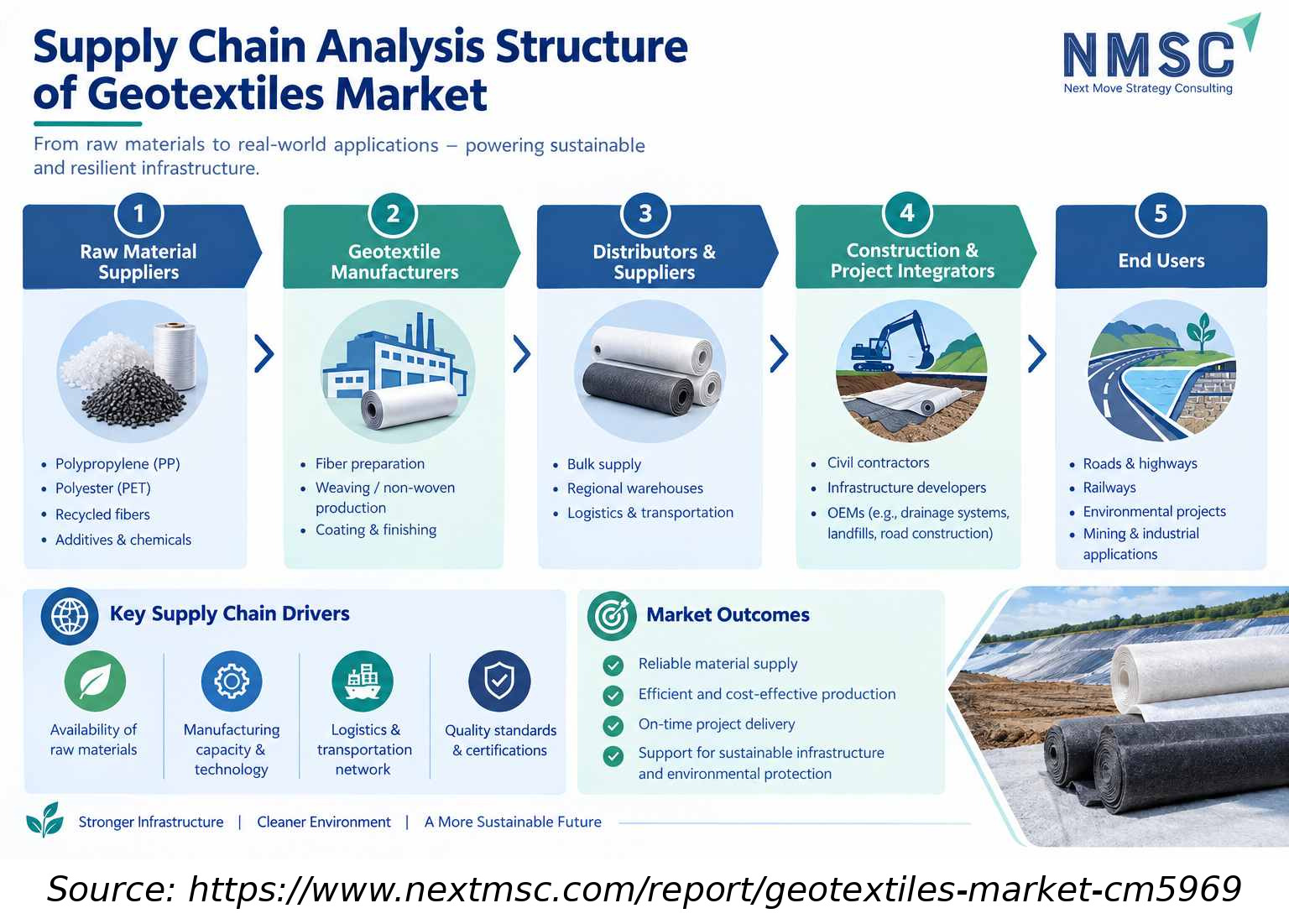
The above infographic provides a detailed supply chain analysis structure of the geotextiles market, outlining a five-step flow from raw material suppliers to end users. It traces the process from sourcing polymers and recycled fibers through manufacturing and distribution to construction and project integration for infrastructure like roads and railways. The analysis further highlights key supply chain drivers, including raw material availability and quality standards, that ensure efficient production. Ultimately, it demonstrates how this interconnected chain supports reliable material supply and contributes to building stronger, more sustainable infrastructure

Growth Opportunities

Our analysis shows that three whitespace opportunities stand out for manufacturers and service providers positioning ahead of 2035 demand.

Can Recycled-Content Geotextiles Capture Premiums in Regulated Public Procurement Markets?

Manufacturers that certify recycled-PET nonwoven geotextile lines to EU Construction Products Regulation and comparable North American EPD standards can capture both specification mandates and pricing premiums in publicly funded infrastructure procurement, benefiting the Nonwoven Geotextiles product-type segment and the Road and Railway Construction application segment as environmental specification requirements tighten progressively through 2030.

Does the Agricultural Drainage Expansion in Asia-Pacific Create a New Volume Channel?

Companies that develop purpose-engineered agricultural nonwoven and woven drainage fabrics, calibrated for subsurface tile installation, greenhouse flooring, and root-barrier applications, can capture rising demand from commercial horticulture and rice paddy drainage projects across China, India, Vietnam, and Indonesia, benefiting the Agriculture application segment and the Filtration function segment as precision farming investment scales across the region through 2035.

Can Smart Geotextile Platforms Enable New Service Revenue Streams for Civil Projects?

Vendors that embed structural health monitoring sensors and strain gauges within high-tenacity woven or knitted geotextile substrates can offer infrastructure owners real-time embankment performance data alongside the geotextile installation itself, converting a one-time product transaction into a recurring sensor-data service, primarily benefiting the Road and Railway Construction and Coastal and Hydraulic Engineering application segments in markets with long-term infrastructure maintenance obligations.

Ecosystem Analysis

Regional Outlook

2025 (USD Billion)
2035 (USD Billion)
Asia-Pacific
North Americ
Europe
Latin Americ
Middle East
Region 2025 (USD Billion) 2035 (USD Billion) CAGR (%)
Asia-Pacific $10.0 USD Billion $40.0 USD Billion 9.0%
North America $17.1 USD Billion $51.1 USD Billion 27.0%
Europe $24.2 USD Billion $62.2 USD Billion 25.0%
Latin America $31.3 USD Billion $73.3 USD Billion 23.0%
Middle East & Africa $38.4 USD Billion $84.4 USD Billion 12.0%

Regional data is locked

Unlock complete regional numbers for this market.

Unlock Full Data

Regulatory Framework Impacting the Geotextiles Industry

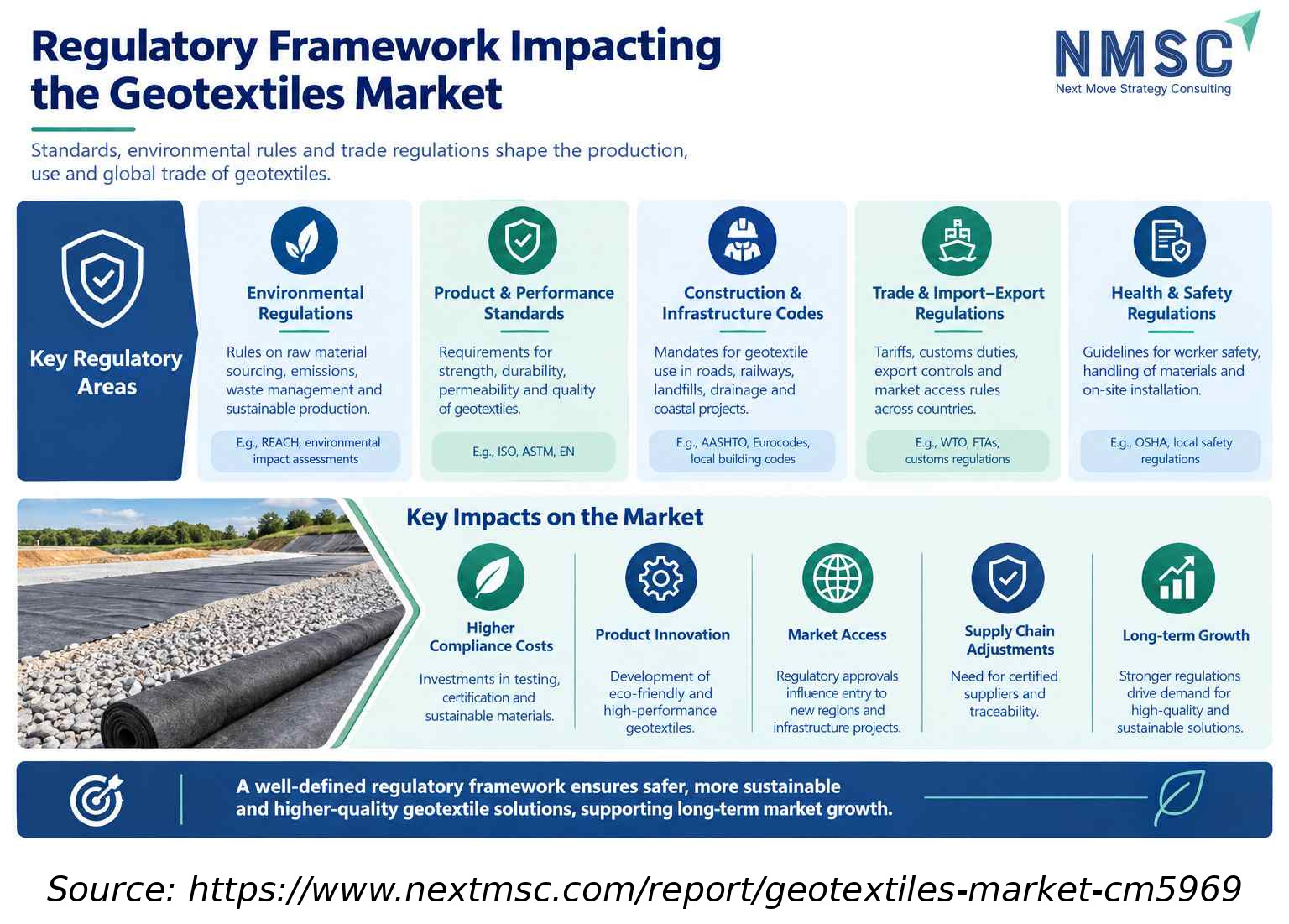
The above infographic outlines the regulatory framework impacting the geotextiles market, highlighting five key areas including environmental rules, product standards, and trade regulations. It illustrates how these mandates shape production and global trade while driving key market impacts, such as increased compliance costs and the need for supply chain adjustments. However, the analysis also notes that these regulations spur product innovation and enhance market access. Ultimately, it concludes that a well-defined regulatory environment ensures safer, more sustainable, and higher-quality geotextile solutions, supporting long-term market growth.
Competitive Landscape

Our assessment indicates that the competitive landscape spans diversified global geosynthetics platform leaders, specialty fiber and fabric producers, and regional civil construction materials manufacturers, each competing on product performance certification, application engineering expertise, and depth of distributor and contractor relationships.

Dimension Description
Market Structure Moderately fragmented; top 10 companies hold approximately 45–50% of global revenue, led by diversified geosynthetics specialists alongside regional fiber and textile manufacturers
Innovation Focus Recycled-content nonwovens, high-tenacity woven fabrics, bio-based geotextiles, and smart geotextile sensors embedded for structural health monitoring
M&A Activity Incremental acquisitions of regional distributors and specialty fiber producers; limited large-scale consolidation as companies prioritize organic capacity expansion

How Do Companies Compete in the Geotextiles Market?

Companies compete primarily on technical specification compliance, product performance certification to ASTM and EN standard series, breadth of application engineering support, and depth of distributor and contractor relationships in targeted infrastructure segments. Our findings suggest that vendors capable of co-engineering geotextile market specifications with civil design engineers at the project inception stage hold a sustained competitive advantage over commodity producers competing on price alone, particularly in road, rail, and coastal engineering markets where long-term performance guarantees are a procurement consideration.

Which Competitive Archetypes Dominate the Geotextiles Industry?

Diversified geosynthetics platform leaders such as TenCate Geosynthetics and Berry Global dominate through broad product portfolios covering nonwoven, woven, and composite geotextile categories alongside complementary geomembrane and geocell lines, enabling full-system supply to major civil infrastructure projects. Specialty manufacturers such as Huesker and NAUE differentiate through focused high-performance engineering fabric lines serving reinforcement, coastal, and waste containment niches that require advanced testing and custom engineering support beyond the capability of commodity producers.


What Innovation and Differentiation Strategies Are Companies Pursuing?

We observed that leading companies are investing in recycled-content nonwoven lines, bio-based erosion-control mats, and smart geotextile platforms incorporating embedded sensor technologies to capture specification mandates from sustainability-oriented procurement programs and to expand revenue beyond the physical product into installation monitoring and performance reporting services. Differentiation increasingly rests on environmental product declarations and third-party life-cycle assessments, since public infrastructure procurement specifications in Europe and North America are incorporating carbon-footprint criteria alongside mechanical performance requirements.

What M&A and Partnership Activity Is Shaping the Geotextiles Market?

Recent competitive activity favors organic capacity expansion and new product line development over large-scale mergers and acquisitions, reflecting the capital-intensive nature of geotextile production capacity investment and the regional specificity of contractor and distributor relationships. We found that partnerships between global geotextile manufacturers and local civil engineering consultancies are gaining traction in fast-growing markets including India and Brazil, where specification adoption requires simultaneous product supply and application training investment to convert design engineers away from conventional materials.

Key Market Players

Based on research conducted by NMSC, the following companies represent the validated set of leading participants across geotextile products, solutions, and services.

TenCate Geosynthetics Berry Global Group Inc. Maccaferri S.p.A. Huesker Synthetic GmbH NAUE GmbH & Co. KG Propex Operating Company, LLC Strata Systems Inc. DuPont de Nemours Inc. Low & Bonar PLC (Freudenberg Performance Materials) Fibertex Nonwovens A/S Carthage Mills Inc. Kaytech Engineered Fabrics Feicheng Lianyi Engineering Plastics Co., Ltd. Taian Modern Plastic Co., Ltd. Officine Maccaferri (India) Pvt. Ltd. Polyfabrics Australasia Pty Ltd GSE Environmental LLC Global Synthetics Pty Ltd Terram Ltd. Hans Geo Components Pvt. Ltd.

Latest Developments

We found that recent corporate activity reflects continued capacity investment, product innovation, and strategic partnership formation in the Geotextiles Market, with leading manufacturers responding to infrastructure demand acceleration and sustainability specification requirements.

Date Event
June 2026 HUESKER officially opened a new 5,000-square-metre production hall at its Dülmen site, increasing the facility’s production area from 7,500 to 12,500 square metres
June 2026 Officine Maccaferri inaugurated its new manufacturing facility in Fort Lawn, South Carolina, at the Synteen Technical Fabrics site.
December 2025 Terram launched its Pond Liner Protection Geotextile, a high-performance nonwoven material designed to protect impermeable pond and attenuation-tank liners against punctures and tears
March 2025 Carthage Mills introduced the FX-160HSE AREMA as a heavy-weight, needle-punched nonwoven geotextile designed for railway track stabilization.

Expert Insights

Prof. David Frost

Prof. David Frost

President | Geosynthetic Institute

"Geosynthetics are a resilience maker. Whether to enhance the strength, alter the hydraulic conductivity, limit the deformation or control various rate processes, geosynthetics inherently augment the engineering properties of natural geomaterials."

Analyst Interpretation

We observed that this expert perspective aligns closely with our analysis of the Geotextiles Market, where the increasing emphasis on infrastructure resilience, ground stabilization, drainage, filtration, and soil reinforcement is strengthening demand for geotextile solutions. Our analysis indicates that geotextiles are increasingly being integrated into civil engineering applications to improve soil performance, manage water movement, control deformation, and reinforce weak ground conditions. Their ability to enhance the functional performance of conventional construction systems is supporting wider adoption across roads, [railways](https://www.nextmsc.com/report/smart-railways-market-at2960), embankments, drainage systems, erosion-control projects, and other infrastructure applications.

Investment Opportunities

Where Are Capital Inflows Concentrating in the Geotextiles Market?

Capital is concentrating in nonwoven geotextile production capacity expansion across Asia-Pacific, where India and Southeast Asian manufacturing hubs are attracting investment to serve both domestic infrastructure demand and export markets. NMSC's analysis indicates that recycled-PET fiber processing capacity is receiving targeted capital allocation from manufacturers seeking to qualify for sustainability-linked public procurement contracts in Europe and North America, reflecting the growing commercial value of environmental certification as a specification enabler.

How Is Infrastructure Investment Shaping Long-Term Capacity?

Our findings suggest that infrastructure investment is shifting production capacity toward high-performance, application-specific geotextile lines rather than commodity nonwoven fabrics, as national infrastructure programs increasingly embed performance-grade specifications rather than minimum-compliance material standards. This shift favors manufacturers with existing testing infrastructure, application engineering capabilities, and established relationships with civil design consultancies that determine material specifications at the project inception stage before procurement begins.

What ESG Considerations Are Influencing Investment Decisions?

Environmental, Social, and Governance considerations in the Geotextiles Market center on raw-material circularity, reduced-carbon manufacturing, and expansion of geotextile adoption in infrastructure that supports climate resilience, particularly coastal protection, urban stormwater management, and erosion control on climate-vulnerable slopes. We found that investors increasingly evaluate geotextile manufacturers on recycled-content intensity, scope-one and scope-two carbon emissions, and evidence of supply chain traceability to responsibly sourced polymer feedstocks, criteria that are becoming embedded in ESG-linked financing covenants for major infrastructure material suppliers.

Key Benefits for Stakeholders

How Does This Report Benefit Industry Leaders?

Industry leaders gain segment-level revenue forecasts and CAGR benchmarks across product-type, function, and application axes, enabling product-roadmap and capacity-investment decisions grounded in the same 2025–2035 figures used consistently throughout this analysis. Our findings on regional growth differentials and sustainability specification trends further support market-entry, capacity-expansion, and product-certification investment decisions by geotextile manufacturers assessing where to prioritize engineering and commercial resources through 2035.

How Does This Report Benefit Investors and Financial Analysts?

Investors and financial analysts gain a reconciled market-sizing model, competitive-landscape assessment, and named-company development tracking that supports valuation and capital-allocation decisions across the geosynthetics sector. The report's Growth Catalyst & Risk Assessment Matrix quantifies driver and restraint impact on the 6.7% CAGR, aiding scenario analysis for portfolio positioning in geotextile manufacturers, civil construction material companies, and infrastructure material supply chain participants with exposure to global geosynthetics demand.

How Does This Report Benefit Technology Vendors and Product Teams?

Technology vendors and product teams gain visibility into which application and function segments, including Agriculture and Filtration, are growing fastest, informing where to prioritize product development, material science investment, and go-to-market focus through 2035. Our analysis of smart geotextile and recycled-content trends provides product development teams with specific differentiation pathways that align with the performance and sustainability criteria increasingly embedded in public infrastructure procurement specifications across North America, Europe, and Asia-Pacific.

Key Market Segments Evaluated

By Product Type

  • Thermally Bonded Nonwovens
  • Needle-Punched Nonwovens
  • Resin-Bonded Nonwovens 
    • Monofilament Woven
    • Multifilament Woven
    • Slit-Film Woven
    • Warp-Knitted Geotextiles
    • Weft-Knitted Geotextiles

By Application

  • Highway Sub-base Separation 
    • Railway Trackbed Filtration
    • Slope and Embankment Protection
    • Silt Fence and Inlet Protection
  • Urban Stormwater Drainage
  • Agricultural Subsurface Drainage
  • Landfill Liner Systems
  • Environmental Remediation
  • Greenhouse Flooring and Ground Cover
  • Weed Barrier and Root Protection
  • Revetment and Seawall Filtration
  • Shoreline Stabilization

By Region

  • • North America 
    • U.S.
    • Canada
    • Mexico
  • • Europe 
    • UK
    • Germany
    • France
    • Italy
    • Spain
    • Sweden
    • Denmark
    • Finland
    • Netherlands
    • Rest of Europe
  • • Asia-Pacific 
    • China
    • India
    • Japan
    • South Korea
    • Taiwan
    • Indonesia
    • Vietnam
    • Australia
    • Philippines
    • Malaysia
    • Rest of APAC
  • • Middle East & Africa 
    • Saudi Arabia
    • UAE
    • Egypt
    • Israel
    • Turkey
    • Nigeria
    • South Africa
    • Rest of MEA
  • • Latin America 
    • Brazil
    • Argentina
    • Chile
    • Colombia
    • Rest of LATAM

Conclusion & Recommendations

The long-term outlook remains structurally positive, with the market expanding from USD 15.60 Billion in 2026 to USD 27.84 Billion by 2035 at a 6.7% CAGR, driven by sustained global infrastructure investment, tightening erosion-control regulation, and the expanding scope of geotextile application into agriculture and coastal engineering. We observed that this growth trajectory is underpinned by durable infrastructure spending programs and regulatory mandates rather than discretionary demand, supporting sustained manufacturer investment in product innovation and production capacity expansion.

What Strategic Positioning Do We Recommend?

Our assessment indicates that manufacturers should prioritize recycled-content certification, application engineering capability, and DSO-equivalent contractor relationship development in fast-growing markets including India, Brazil, and Vietnam to capture the fastest-growing segments. Companies without established sustainability credential programs should pursue third-party environmental product declaration investment ahead of the 2027–2028 window when EU construction procurement sustainability thresholds are expected to tighten significantly, as late qualification risks specification exclusion from major public infrastructure contracts.

How Attractive Is the Geotextiles Market for Investment?

Investment attractiveness is highest in Asia-Pacific and Latin America given superior CAGR profiles of 7.54% and 8.38% respectively, while North America offers the largest absolute revenue base with strong specification-driven recurring demand. Our findings suggest that filtration and knitted geotextile sub-segments offer stronger growth profiles than mature separation and standard nonwoven categories, and agriculture and coastal engineering applications represent the highest incremental volume opportunity beyond traditional road and railway construction channels.

What Are the Key Market Shifts and Risks?

Key risks include polypropylene and polyester raw-material price volatility constraining manufacturer margins, competition from alternative geosynthetic products including geocells and geomembranes in overlapping applications, and the potential for direct-to-contractor import pressure from low-cost Asian producers in commodity nonwoven categories. Our analysis shows that companies unable to differentiate through performance certification, recycled-content credentials, or application engineering support face progressive margin compression in commodity market tiers throughout the forecast period.

What Are the Primary Growth Pathways Through 2035?

Primary growth pathways include expanded recycled-content product certification for public procurement markets, agricultural drainage application development in Asia-Pacific and Latin America, and smart geotextile sensor platform commercialization for infrastructure monitoring applications. We observed that companies combining sustainability credentials with broadened application coverage across infrastructure, agriculture, and coastal engineering segments are best positioned to capture disproportionate share of the USD 12.24 Billion absolute opportunity created between 2026 and 2035.

FAQs

About the Author

Mayurima Roy

Mayurima Roy

Mayurima Roy is Research Analyst at Next Move Strategy Consulting, where she has spent 4 years working across the firm's full industry coverage rather than a single fixed vertical. Her work centers on structured research, ongoing trend tracking, competitive assessment, and insight-led content development, translating complex market data into clear, decision-ready narratives that support informed client decision-making across diverse global industries, market sectors, and world regions every day.

About the Reviewer

Supradip Baul

Supradip Baul

Supradip Baul is an accomplished business consultant and strategist with over a decade of rich experience in market intelligence, strategy, technology, and business transformation. His work has included rigorous qualitative and quantitative analysis across multiple industries, helping clients shape investment decisions and long-term roadmaps. Earlier in his career, he was associated with Gartner, where he contributed to industry-leading reports and market share analyses. He has worked with leading global companies and holds an MBA with a dual specialization in Marketing and Finance.

Download Free Sample

Henri Knyphausen

HENRI KNYPHAUSEN

Partner at Singulier [Ex-BCG]

Singulier

I recently engaged NEXTMSC.com for a commercial due diligence project within the intralogistics sector, and I am pleased to provide a reference based on my experience. In utilizing NEXTMSC.com's services, I found their report to offer valuable insights into market dynamics and key industry players. The initial report provided a solid foundation for our analysis. However, as we were investigating a smaller target in the market, and I had specific customization requests requiring additional research. These requests included detailed information on product portfolios of various players and sub-market sizes, both inclusive and exclusive of certain product categories. NEXTMSC.com demonstrated commendable responsiveness and agility in accommodating these customization requests. Within a timeframe of 1-2 weeks, they delivered a revised report that met our specific needs. Furthermore, they were receptive to my follow-up inquiries, ensuring clarity and understanding of the data provided. The final deliverable significantly contributed to our due diligence efforts. One of NEXTMSC.com's notable strengths lies in their qualitative research capabilities. However, for future engagements, I would recommend the inclusion of a quantified market model in Excel format. Such a model would offer the ability to conduct in-depth analyses and explore various market segments, including country-specific data and subcomponent breakdowns. Based on my positive experience, I would not hesitate to work with NEXTMSC.com again. Their responsiveness, willingness to accommodate customization requests, and commitment to delivering actionable insights make them a reliable partner for commercial research projects.

Semih Kavaklioglu

SEMIH KAVAKLIOGLU

Co-Founder & Sales Manager

Decortie

I work a lot in the marketing industry and I know that research is an essential part of any campaign. I have used Market research reports for my own products and I found them to be very informative and well-researched. The team here produces insightful reports for a good price

Kishu Kanda

KISHU KANDA

Strategy Analyst

Accenture

We purchased the AI Consumer Market Report from this company. Not only did they customize the report to meet our specific requirements, but they also showed great flexibility in accommodating our budget. The report we received fully met our expectations. Additionally, they provided prompt and thorough responses to both our pre-purchase and follow-up questions. We look forward to working with this company again in the future.

Mohit Agarwal

MOHIT AGARWAL

Chief Manager

DryChem India Pvt. Ltd.

Next Move Strategy Consulting is an amazing team of consultants. We required a market study report for our investors on top priority and the team went above and beyond our expectations to deliver the same with ample supporting data within a short time span enabling us to secure the investments and keep our project timeline maintained. Their professionalism, attention to detail, and timely delivery of actionable recommendations have left a lasting impression on our organization.

Pratyush Kumar Das

PRATYUSH KUMAR DAS

Assistant Manager

Polycab India Limited

We would like to express our appreciation for the data and insights provided by nextmsc. We are very pleased with the quality and depth of the information, which has proven to be highly valuable and beneficial for our business decision-making.

Custom Market Research Services

We will customize the research for you if the listed report does not fully match your requirements.

Get 30% Free Customization

Select License

This website uses cookies to ensure you get the best experience on our website. Learn more

✖