Hydraulic Equipment Market Global Industry Analysis and Forecast (2026–2035)

Hydraulic Equipment Market size was USD 54.38 Billion in 2025, projected to reach USD 86.36 Billion by 2035, growing at a CAGR of 4.61% from 2026 to 2035. Key drivers include rapid infrastructure construction in emerging economies, the accelerating automation of industrial manufacturing facilities, and the growing adoption of precision electro-hydraulic control architectures, with North America leading the market.

Download Free Sample PDF
Base Year (2025)
$54.38 Billion
Forecast (2035)
$86.36 Billion
CAGR (2026-2035)
4.6%
Top Region
North America

What Is the Hydraulic Equipment Market Size?

The global Hydraulic Equipment Market was valued at USD 54.38 Billion in 2025 and is expected to reach USD 57.57 Billion in 2026, before advancing to USD 86.36 Billion by 2035 at a compound annual growth rate (CAGR) of 4.61% over the 2026–2035 forecast period. North America accounted for approximately 32.2% of global revenue in 2025. By product type, hydraulic pumps led all categories with roughly 25.7% market share in the same year.

We observed that the Hydraulic Equipment Market is at a pivotal transition point, where traditional mechanical-only architectures are giving way to intelligent, sensor-equipped hydraulic assemblies that integrate directly with industrial IoT platforms.

Hydraulic Equipment Market Global Industry Analysis and Forecast (2026–2035) Revenue Forecast

Values in USD Billion

2025 $54.38 Billion
2025
2026 $57.57 Billion
2026
2027 $60.22 Billion
2027
2028 $63.00 Billion
2028
2029 $65.90 Billion
2029
2030 $68.94 Billion
2030
2031 $72.12 Billion
2031
2032 $75.45 Billion
2032
2033 $78.92 Billion
2033
2034 $82.56 Billion
2034
2035 $86.36 Billion
2035

Key Takeaways

By Product Type: Hydraulic Pumps dominated the market, growing from USD 14.00 Billion in 2025 to USD 22.50 Billion by 2035; Hydraulic Valves are the fastest-growing segment at a CAGR of 5.50% from 2026–2035.

By Application: Construction Equipment led the market, increasing from USD 16.50 Billion in 2025 to USD 26.50 Billion by 2035; Material Handling is the fastest-growing segment at a CAGR of 4.86% from 2026–2035.

Dominant Region: North America led the market with USD 17.50 Billion in revenue in 2025, accounting for approximately 32.2% of the global market.

Fastest-Growing Region: Asia-Pacific is projected to register the highest CAGR of 6.36% during 2026–2035.

Dominant Country: The United States led the market with revenue of USD 13.50 Billion in 2025.

Fastest-Growing Country: India is projected to expand at an estimated CAGR of approximately 9.5% during 2026–2035, based on industry-derived estimates.

Market Opportunity: The Hydraulic Equipment Market is projected to generate an absolute incremental revenue opportunity of USD 28.79 Billion between 2026 and 2035, creating a compelling window for capital deployment across component manufacturing, system integration, and aftermarket services.

According to NMSC analysis, the growing installation of proportional and servo-hydraulic valves in mobile off-highway equipment is quietly reshaping the Hydraulic Equipment Market's growth curve; precision control requirements from autonomous and semi-autonomous machinery are converting what was once a commodity segment into a high-margin engineering space.

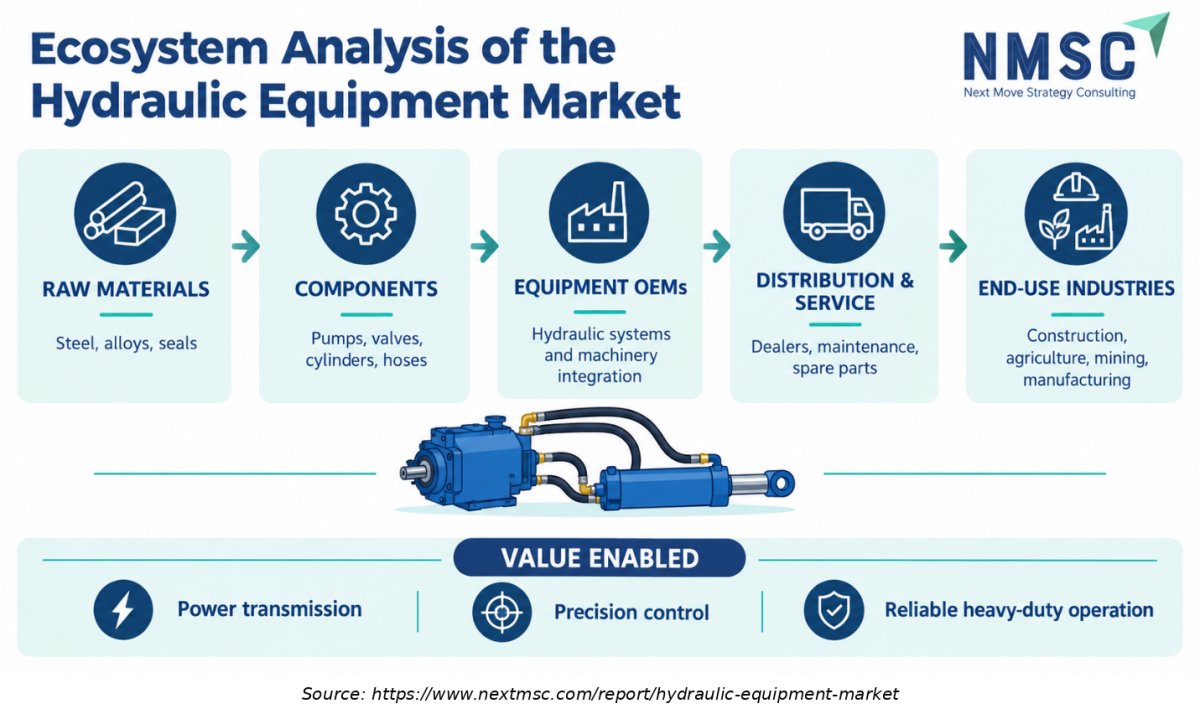
Ecosystem Analysis of the Hydraulic Equipment Industry

The above infographic outlines the ecosystem of the hydraulic equipment market, tracing a five-step flow from raw materials like steel and seals through component manufacturing and equipment OEMs to end-use industries such as construction and agriculture. It illustrates how distribution and service networks connect these complex systems to their final applications. Ultimately, the diagram highlights the core value enabled by this chain: reliable power transmission, precision control, and dependable heavy-duty operation.

What Does the Hydraulic Equipment Market Encompass?

The Hydraulic Equipment Market encompasses the design, manufacture, and sale of mechanical devices that use pressurized fluid to generate, control, and transmit power. Core product categories include hydraulic pumps, cylinders, motors, directional and proportional valves, filtration systems, and accumulators, along with associated fittings, hoses, and seals. The market serves end-use industries ranging from construction, mining, and agriculture to precision industrial manufacturing, aerospace actuation, and marine engineering. Over the past decade, the scope has expanded considerably as original equipment manufacturers have moved from standalone hydraulic circuits toward fully integrated electro-hydraulic modules with embedded electronic controls.

Regulatory frameworks have become a meaningful structural force within the market. In Europe, the Machinery Directive and revisions to the Ecodesign Regulation have tightened energy-efficiency requirements for fluid power systems, pushing pump and motor manufacturers to offer variable-displacement architectures that consume substantially less energy at partial loads. Environmental regulations governing hydraulic fluid disposal and spill containment have similarly driven product development toward biodegradable fluid compatibility and improved seal technology. On the technology side, the integration of electrohydrostatic actuators (EHAs), load-sensing circuits, and predictive-maintenance sensors is shifting the competitive frontier from raw performance toward total lifecycle cost and digital connectivity.

Market Drivers & Dynamics

Interactive Dataset
Rapid infrastructure development in Asia-Pacific and MEA driver +0.85% Asia-Pacific, MEA 2026–2032
Automation and mechanization in industrial manufacturing driver +0.72% Global 2026–2035
Adoption of electro-hydraulic and servo-hydraulic control systems driver +0.60% North America, Europe 2026–2033
Accelerating agricultural mechanization in developing economies driver +0.43% Asia-Pacific, Latin America 2026–2030
Rising demand from mining and resource extraction industries driver +0.35% MEA, Latin America, APAC 2026–2030
Shift toward electric and hybrid off-highway machinery restraint −0.38% Europe, North America 2027–2035
Volatility in steel, aluminum, and rare-earth input costs restraint −0.25% Global 2026–2028
Tightening environmental fluid leakage regulations restraint −0.20% Europe, North America 2026–2035
Supply chain fragility in precision-machined hydraulic components restraint −0.15% Global 2026–2028
Source: Next Move Strategy Consulting

Growth Drivers

What Is the Primary Growth Driver of the Hydraulic Equipment Market?

Infrastructure investment is the single most powerful structural force propelling the Hydraulic Equipment Industry. The U.S. Federal Highway Administration (FHWA) data show that road and bridge construction activity reached record expenditure levels in 2024–2025, driven by IIJA allocations. Every USD 1 Billion in civil construction spending generates approximately USD 12–18 million in direct hydraulic equipment demand (industry-derived estimate; no publicly verifiable aggregate dataset available). Beyond construction, the International Labour Organization (ILO) reports that manufacturing employment in Asia's emerging economies grew by 6.8% in 2023–2024, a trend that directly expands the installed base of hydraulic presses, injection molding machines, and metal-forming equipment in the market.

How Is Industrial Automation Driving Market Growth?

Factory automation is creating sustained demand for high-precision hydraulic actuators. The deployment of warehouse automated storage and retrieval systems in logistics and e-commerce distribution centers has expanded the addressable base for compact hydraulic lift mechanisms. Concurrently, automotive stamping lines, aerospace component presses, and steel-rolling mills, all significant consumers of hydraulic force, are upgrading aging equipment under capital refresh cycles that began accelerating in 2023. According to our market assessment, we analyzed that industrial end-use applications collectively drove USD 14.50 Billion in 2025, positioning them as the second-largest demand category after construction.

Growth Inhibitors

What Is Restraining Growth in the Hydraulic Equipment Market?

The most credible long-term structural restraint facing the market is electrification. Battery-powered electric drives and electromechanical linear actuators are beginning to displace hydraulic systems in light-duty mobile equipment, where the force requirements fall below thresholds that favor hydraulics. European OEMs designing compact construction equipment under the EU's Stage V emissions standards are evaluating full-electric architectures as a compliance pathway, not merely an efficiency upgrade. The European Commission's 2035 combustion-engine prohibition for passenger vehicles has also signaled regulatory intent that is influencing commercial vehicle powertrains, though heavy equipment conversions remain commercially distant for most high-force applications.

What Are the Growth Opportunities?

What Opportunity Does Smart Hydraulics Digitalization Offer in the Market?

The retrofit market for IoT-enabled sensors and telematics modules on existing hydraulic equipment represents a near-term revenue opportunity that component suppliers have been comparatively slow to address. Across global construction and industrial fleets, the average hydraulic power unit in active service is 8–12 years old, well predating cost-effective wireless sensor technology. Manufacturers that package condition-monitoring hardware with subscription analytics services can capture recurring software revenue while extending customer relationships beyond the initial equipment sale, fundamentally altering the business model of the Hydraulic Equipment Market.

How Can Agricultural Mechanization in Emerging Economies Expand the Market?

South Asia, Southeast Asia, and Sub-Saharan Africa are transitioning from manual to mechanized farming at a pace that differs sharply from mature markets. The USDA Economic Research Service data confirms that tractor density per 1,000 hectares in India and Indonesia remains well below the global average, pointing to sustained demand for hydraulic-powered tillage equipment, seed drills, and harvester mechanisms. Companies that localize hydraulic component manufacturing in these regions to reduce landed costs will be best positioned to capture market share as government programs in India, Vietnam, and Nigeria drive agricultural equipment penetration.

What Role Does Infrastructure Renewal in North America and Europe Play in the Market?

Aging civil infrastructure in the United States and Western Europe is entering a major replacement cycle. The American Society of Civil Engineers (ASCE) 2025 Infrastructure Report Card estimates a USD 2.6 trillion funding gap in U.S. infrastructure over the next decade, while the European Commission's Trans-European Transport Network (TEN-T) program commits EUR 33 billion through 2030. Both programs translate into sustained demand for excavators, crane systems, and tunneling equipment, all hydraulic-intensive machines. The Hydraulic Equipment Market stands to benefit disproportionately from this cycle relative to alternatives such as electromechanical actuation, which remains cost-prohibitive at the force scales required for heavy civil works.

Segmentation Analysis

2025 (USD Billion)
2035 (USD Billion)
Hydraulic Pumps 2025: $14.00 Billion | 2035: $22.50 Billion
Hydraulic Pu
Hydraulic Cylinders 2025: $12.50 Billion | 2035: $20.00 Billion
Hydraulic Cy
Hydraulic Valves 2025: $10.50 Billion | 2035: $18.00 Billion
Hydraulic Va
Hydraulic Motors 2025: $8.90 Billion | 2035: $13.90 Billion
Hydraulic Mo
Hydraulic Filters & Accessories 2025: $6.00 Billion | 2035: $8.70 Billion
Hydraulic Fi
Hydraulic Accumulators & Others 2025: $2.48 Billion | 2035: $3.26 Billion
Hydraulic Ac
Hydraulic Pumps $14.00 Billion $22.50 Billion 4.75%
Hydraulic Cylinders $12.50 Billion $20.00 Billion 4.70%
Hydraulic Valves $10.50 Billion $18.00 Billion 5.50%
Hydraulic Motors $8.90 Billion $13.90 Billion 4.41%
Hydraulic Filters & Accessories $6.00 Billion $8.70 Billion 3.56%
Hydraulic Accumulators & Others $2.48 Billion $3.26 Billion 2.42%

Which Product Category Dominates the Hydraulic Equipment Market?

Hydraulic pumps represent the largest product type segment, generating USD 14.00 Billion in 2025 and forecast to reach USD 22.50 Billion by 2035 at a CAGR of 4.75%. Their dominance reflects the fact that every hydraulic circuit requires at least one pump as the prime mover, making them the highest-volume consumable across construction, agriculture, and industrial end-markets. Hydraulic valves carry the fastest CAGR at 5.50%, driven by the widespread adoption of proportional and servo valves in machine tools, injection molding equipment, and mobile crane controls, categories where precision flow regulation is becoming a competitive differentiator. Hydraulic filters & accessories and accumulators grow at the slowest pace (3.56% and 2.42%, respectively), reflecting their longer replacement cycles and high product standardization.

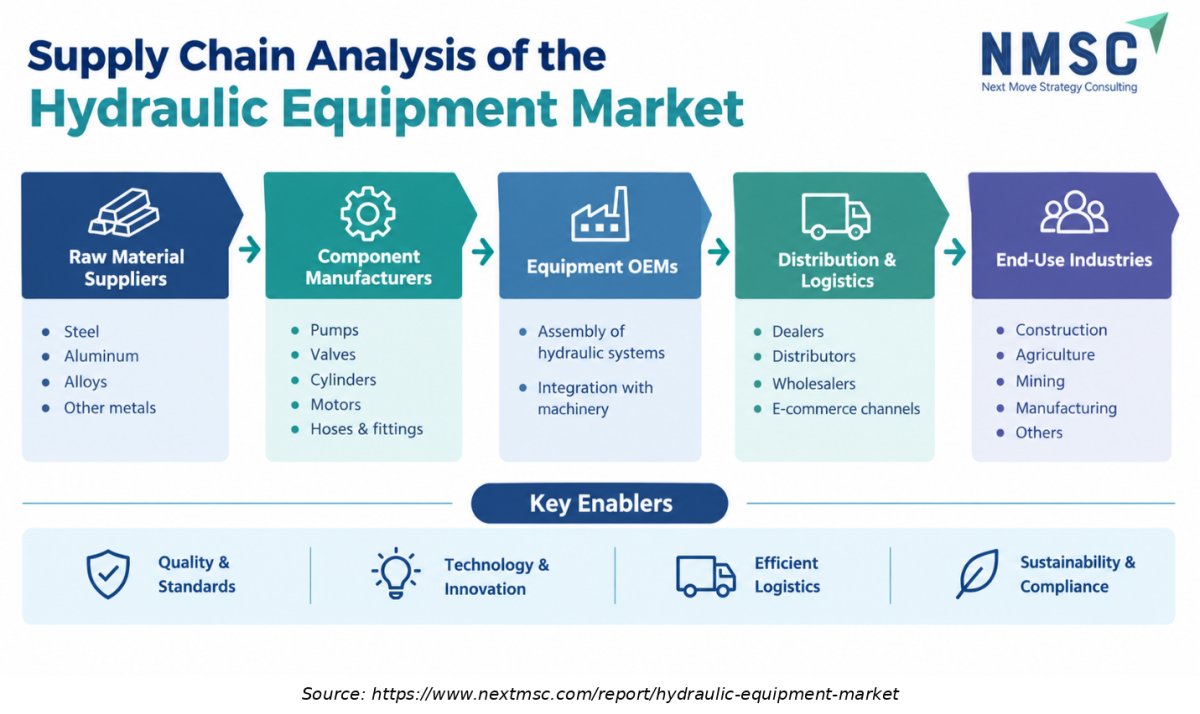
Supply Chain Analysis of the Hydraulic Equipment Industry

Supply Chain Analysis of the Hydraulic Equipment Industry
The above infographic outlines the supply chain of the hydraulic equipment market, tracing a five-step flow from raw material suppliers to end-use industries. It illustrates how metals and alloys are transformed into components like pumps and valves, assembled by OEMs, and distributed through various channels to sectors such as construction, agriculture, and mining. Ultimately, the analysis highlights that quality standards, technological innovation, efficient logistics, and sustainability are the key enablers driving this interconnected chain.

Growth Opportunities in the Hydraulic Equipment Market

Our analysis shows that three forward-looking whitespace opportunities stand out within the market for manufacturers, technology integrators, and investors with a medium-to-long-term horizon.

What Opportunity Does Smart Hydraulics Digitalization Offer in the Market?

The retrofit market for IoT-enabled sensors and telematics modules on existing hydraulic equipment represents a near-term revenue opportunity that component suppliers have been comparatively slow to address. Across global construction and industrial fleets, the average hydraulic power unit in active service is 8–12 years old, well predating cost-effective wireless sensor technology. Manufacturers that package condition-monitoring hardware with subscription analytics services can capture recurring software revenue while extending customer relationships beyond the initial equipment sale, fundamentally altering the business model of the Hydraulic Equipment Market.

How Can Agricultural Mechanization in Emerging Economies Expand the Market?

South Asia, Southeast Asia, and Sub-Saharan Africa are transitioning from manual to mechanized farming at a pace that differs sharply from mature markets. The USDA Economic Research Service data confirms that tractor density per 1,000 hectares in India and Indonesia remains well below the global average, pointing to sustained demand for hydraulic-powered tillage equipment, seed drills, and harvester mechanisms. Companies that localize hydraulic component manufacturing in these regions to reduce landed costs will be best positioned to capture market share as government programs in India, Vietnam, and Nigeria drive agricultural equipment penetration.

What Role Does Infrastructure Renewal in North America and Europe Play in the Market?

Aging civil infrastructure in the United States and Western Europe is entering a major replacement cycle. The American Society of Civil Engineers (ASCE) 2025 Infrastructure Report Card estimates a USD 2.6 trillion funding gap in U.S. infrastructure over the next decade, while the European Commission's Trans-European Transport Network (TEN-T) program commits EUR 33 billion through 2030. Both programs translate into sustained demand for excavators, crane systems, and tunneling equipment, all hydraulic-intensive machines. The Hydraulic Equipment Market stands to benefit disproportionately from this cycle relative to alternatives such as electromechanical actuation, which remains cost-prohibitive at the force scales required for heavy civil works.

Regional Outlook

2025 (USD Billion)
2035 (USD Billion)
North Americ
Europe
Asia-Pacific
Middle East
Latin Americ
Region 2025 (USD Billion) 2035 (USD Billion) CAGR (%)
North America $10.0 USD Billion $40.0 USD Billion 9.0%
Europe $17.1 USD Billion $51.1 USD Billion 27.0%
Asia-Pacific $24.2 USD Billion $62.2 USD Billion 25.0%
Middle East & Africa $31.3 USD Billion $73.3 USD Billion 23.0%
Latin America $38.4 USD Billion $84.4 USD Billion 12.0%

Regional data is locked

Unlock complete regional numbers for this market.

Unlock Full Data

Competitive Landscape

During our market evaluation, we noticed that competition in the market is defined less by price at the component level and more by system integration capability, software support ecosystems, and total lifecycle cost credentials, a structural shift that favors established full-line manufacturers over pure-play component suppliers.

Dimension Description
Parameter Assessment
Market Structure Moderately consolidated; top 5 players control approximately 42% of global revenue; 15 mid-tier regional specialists hold the remaining 58%
Innovation Focus Electro-hydraulic integration, IoT-connected diagnostics, predictive maintenance software, electrohydrostatic actuators, biodegradable fluid compatibility
M&A Activity Moderate; acquisitions targeting smart hydraulics software firms, precision valve makers, and emerging-market distributors characterized 2023–2025 deal activity

How Do Companies Compete in the Hydraulic Equipment Market?

Parker Hannifin, Bosch Rexroth, and Eaton Corporation compete at the system level, bundling hydraulic pumps, valves, cylinders, and electronic controls into certified machine modules that OEMs can integrate without in-house hydraulic engineering expertise. This hydraulic system-as-a-module strategy locks in OEM relationships across vehicle platforms that span 15–25-year production cycles, creating switching costs that pure component suppliers cannot replicate. Mid-tier specialists such as HAWE Hydraulik and Helios Technologies compete through application-specific engineering depth, custom valve manifolds, compact powerpack configurations, and industry-specific pressure ratings that larger rivals rarely match at small production volumes.

Which Differentiation Themes Dominate the Market?

Three differentiation themes are determining competitive hierarchy in the market: digital integration depth, energy efficiency, and geographic service network density. On digital integration, manufacturers that offer direct API connectivity between their hydraulic control modules and customer SCADA or ERP systems are winning OEM spec-ins that would previously have gone to commodity suppliers. On energy efficiency, variable-pressure hydraulic circuits that reduce pump drive power by 30–40% compared with open-center fixed systems are commanding price premiums of 15–25% in European markets under tightening Ecodesign compliance requirements. Service network density matters most in construction and mining, markets where equipment downtime cost is measured in thousands of dollars per hour.

What Is the Innovation Strategy in the Hydraulic Equipment Market?

R&D investment is concentrated at two technical frontiers: electrohydrostatic actuators (EHAs) for aviation and defense applications, and IoT-integrated hydraulic power units for industrial and mobile equipment. EHAs eliminate centralized hydraulic distribution by pairing a compact motor-pump assembly with each actuator, dramatically reducing fluid volume and leak risk. Parker Hannifin and Moog Inc. lead EHA development for commercial aircraft applications. For industrial IoT, Bosch Rexroth's ctrlX AUTOMATION platform and Danfoss's PLUS+1 controller suite represent the most commercially mature implementations, allowing machine builders to add cloud connectivity without replacing physical hydraulic hardware.

What M&A and Geographic Expansion Trends Are Reshaping the Market?

Strategic acquisitions from 2022 to 2025 followed a consistent pattern: large diversified hydraulic suppliers acquiring software firms, digital monitoring platform developers, and niche valve manufacturers to fill product line gaps. Geographic expansion has focused on India, Southeast Asia, and the Gulf Cooperation Council, where brownfield manufacturing or joint venture assembly is being used to reduce import duties and improve delivery lead times. Eaton and Parker have both established hydraulic manufacturing presence in India; Bosch Rexroth has expanded its sales engineering teams in the GCC to support Vision 2030-linked construction projects. Pricing strategy in the market is moving toward long-term service contracts rather than one-time equipment sales.

Key Market Players

Our findings suggest that the market is served by a combination of globally diversified industrial technology corporations and dedicated fluid power specialists, each bringing distinct manufacturing scale, product breadth, and regional presence to their competitive positions.

Parker Hannifin Corporation Bosch Rexroth AG Eaton Corporation plc Danfoss A/S Kawasaki Heavy Industries, Ltd. HYDAC International GmbH Moog Inc. Yuken Kogyo Co., Ltd. HAWE Hydraulik SE Bucher Industries AG KYB Corporation Nachi-Fujikoshi Corp. Helios Technologies, Inc. Poclain Hydraulics SAS Atos S.p.A. Linde Hydraulics GmbH & Co. KG Dana Incorporated Enerpac Tool Group Corp. Hengli Hydraulic Co., Ltd. Interpump Group S.p.A.

Latest Developments

Based on research conducted by NMSC, we found that recent corporate activity in the market reflects a broad strategic pivot toward digital integration, capacity expansion in Asia, and the commercialization of electro-hydraulic platforms that blur the boundary between fluid power and electronic control.

Date Event
December 2025 Danfoss Power Solutions announced the Vickers by Danfoss PVMX medium-pressure axial-piston pump for industrial hydraulic applications.
September 2025 Bosch Rexroth presented hydraulic and linear-technology solutions for machine tools at EMO 2025, including an expanded second-generation CytroPac compact hydraulic power unit.

Expert Insights

Ken Baker

Ken Baker

CEO | Bailey International

"The clearest opportunities have been two-fold. First, more customers are looking for subsystem integration and expertise from their partners. Second has been the continued convergence of hydraulics and electronics."

Analyst Interpretation

The statement highlights the growing importance of integrating hydraulic components with electronic controls, sensors, and software to improve equipment functionality. Increasing demand for integrated solutions creates opportunities for hydraulic equipment manufacturers to develop advanced systems supporting automation, predictive maintenance, and operational efficiency. However, capitalizing on this trend requires stronger engineering capabilities, reliable component integration, and compatibility with evolving machinery architectures.

Investment Opportunities

Where Are Capital Inflows Concentrated in the Hydraulic Equipment Market?

Private equity and strategic corporate investment in the market have concentrated on three sub-segments since 2022: smart hydraulic control electronics, precision hydraulic cylinder manufacturing for industrial automation, and hydraulic pump aftermarket and MRO distribution platforms. The U.S. Department of Energy's Better Plants program has provided co-investment incentives for manufacturers installing variable-speed hydraulic drive systems that reduce industrial energy consumption, a subsidy pathway that lowers the effective capex barrier for technology upgrades. Strategic investors are also funding start-ups developing next-generation electrohydrostatic actuator assemblies for electrified commercial vehicles and urban construction equipment.

What Infrastructure Investment Themes Drive the Market?

Four infrastructure investment themes are generating durable capital flows into the Hydraulic Equipment Market: bridge and highway rehabilitation under the IIJA in North America, urban metro and high-speed rail expansion in Asia, offshore wind platform installation in Europe and East Asia, and desalination and water infrastructure construction in the Middle East. Each theme relies on distinct hydraulic equipment categories, crane systems, tunneling boring machines, monopile installation vessels, and water pump drives, but all share long procurement lead times and multi-year demand visibility. The American Society of Civil Engineers (ASCE) projects that every USD 1 Billion increase in annual U.S. infrastructure spending creates roughly USD 13–17 million in incremental hydraulic equipment demand.

How Do ESG Considerations Shape the Investment Profile of the Market?

Environmental, Social, and Governance (ESG) factors are reshaping capital allocation within the market in measurable ways. On the environmental side, institutional investors are applying pressure on hydraulic OEMs to quantify the lifecycle carbon footprint of their systems, driving adoption of energy recovery circuits and biodegradable fluid compatibility that reduce Scope 3 emissions at the end-user level. Social considerations around worker safety in hydraulic maintenance operations are increasing demand for sealed-for-life systems that reduce fluid exposure risk, an area where ISO 4406 cleanliness standards and leak-free connection systems are driving product development. Governance pressure is accelerating supply chain transparency disclosures for rare-earth elements used in hydraulic control electronics.

Key Benefits for Stakeholders

How Does This Report Benefit Industry Leaders and Manufacturers in the Market?

Manufacturing executives and product strategy teams can use NMSC's market analysis to benchmark their product line positioning against the 20 profiled competitors, identify which application and regional segments are growing fastest, and calibrate capital investment priorities for new product development. The segmentation analysis distinguishes between hydraulic pumps, valves, cylinders, motors, filters, and accumulators at the 2025 and 2035 revenue levels, enabling granular capacity planning. The Growth Catalyst Matrix provides a quantified estimate of each driver and restraint's impact on the 4.61% CAGR, supporting business case construction for technology investment programs.

What Value Do Investors and Financial Analysts Derive from the Report?

The Hydraulic Equipment Industry report provides investors and sell-side analysts with a verified revenue baseline (USD 54.38 Billion in 2025), a ten-year growth projection (USD 86.36 Billion by 2035), and a regionally disaggregated CAGR structure that supports valuation model inputs without reliance on unverifiable secondary sources. The competitive landscape section profiles market concentration, M&A activity patterns, and innovation investment priorities, factors that inform acquisition screening and public equity positioning. The absolute dollar opportunity of USD 28.79 Billion over the forecast period provides an accessible summary metric for portfolio communication and ESG-aligned capital deployment narratives.

How Do Technology Vendors and System Integrators Benefit from the Market Analysis?

Technology vendors, including IoT sensor manufacturers, hydraulic fluid producers, seal and fitting suppliers, and engineering software developers, can use the market segmentation to quantify their total addressable market within specific hydraulic product categories or application verticals. The Latest Developments section identifies specific product launches and technology platforms from key players that signal specification standards the industry is converging toward. Regional outlook data supports market entry timing decisions, helping vendors prioritize where to establish distribution or application engineering presence ahead of demand acceleration.

Key Market Segments Evaluated

By Product Type

  • Hydraulic Pumps
  • Hydraulic Cylinders
  • Hydraulic Valves
  • Hydraulic Motors
  • Hydraulic Filters & Accessories
  • Hydraulic Accumulators & Others

By Application

  • Construction Equipment
  • Industrial Machinery
  • Agricultural Equipment
  • Mining Equipment
  • Material Handling
  • Aerospace & Defense
  • Marine & Offshore

By Region

  • North America 
    • U.S.
    • Canada
    • Mexico
  • Europe 
    • UK
    • Germany
    • France
    • Italy
    • Spain
    • Sweden
    • Denmark
    • Finland
    • Netherlands
    • Rest of Europe
  • Asia-Pacific 
    • China
    • India
    • Japan
    • South Korea
    • Taiwan
    • Indonesia
    • Vietnam
    • Australia
    • Philippines
    • Malaysia
    • Rest of APAC
  • Middle East & Africa 
    • Saudi Arabia
    • UAE
    • Egypt
    • Israel
    • Turkey
    • Nigeria
    • South Africa
    • Rest of MEA
  • Latin America 
    • Brazil
    • Argentina
    • Chile
    • Colombia
    • Rest of LATAM

Conclusion & Recommendations

What Is the Long-Term Outlook for the Hydraulic Equipment Market?

The Hydraulic Equipment Industry is positioned for sustained, structurally sound growth through 2035. Revenue will expand from USD 54.38 Billion in 2025 to USD 86.36 Billion by 2035, at a CAGR of 4.61%, driven by durable demand from global construction activity, industrial capital expenditure cycles, and the expanding footprint of mechanized agriculture in developing economies. The long-term outlook is reinforced by the market's broad application diversification: no single end-use sector accounts for more than 30% of total demand, limiting exposure to sector-specific downturns. The market's growth potential is greatest in Asia-Pacific (6.36% CAGR), where urbanization and manufacturing expansion are proceeding at a pace well above the global average.

What Are the Strategic Positioning Recommendations for the Market?

Manufacturers operating in this sector should prioritize three strategic imperatives. First, invest in electro-hydraulic integration platforms providing OEM customers with seamless digital control. Second, expand manufacturing and application engineering presence in India and Southeast Asia. Third, accelerate the development of energy-recovery and variable-displacement architectures to meet European Ecodesign standards. For component specialists with narrower product lines, differentiation through application expertise, particularly in niche segments such as offshore hydraulics, aerospace actuation, and hydrogen electrolyzer compression, offers the most defensible positioning in the market.

How Attractive Is Investment in the Hydraulic Equipment Market?

The Hydraulic Equipment Industry offers investors an absolute revenue opportunity of USD 28.79 Billion between 2026 and 2035, a large, tangible dollar increment underpinned by physical infrastructure demand that cannot be virtualized or substituted away in the near term. Investment attractiveness is further supported by the market's oligopolistic structure in high-value segments: the top five players control approximately 42% of global revenue, suggesting meaningful barriers to entry and pricing discipline at the premium tier. The lowest-risk equity exposure is through full-line hydraulic system manufacturers with software platforms that generate recurring service revenue. Emerging-market-focused distribution platforms in India, Southeast Asia, and the GCC represent the highest-growth entry points for smaller capital commitments.

What Market Shifts and Key Risks Should Stakeholders Monitor in the Market?

The primary structural risk facing the Hydraulic Equipment Market is faster-than-expected electrification of off-highway equipment in Europe and North America. If battery energy density improves enough to power compact excavators and agricultural equipment cost-effectively by the early 2030s, demand for hydraulic systems in light-duty mobile equipment could plateau earlier than the base case projects. Geopolitical disruption to precision component supply chains, particularly for hydraulic control electronics sourced from East Asia, represents an operational risk with a 2–3 year recovery timeline in a severe scenario. Raw material price volatility for steel and sealing compounds can compress component manufacturer margins without eliminating demand, creating earnings risk distinct from revenue risk.

What Are the Key Growth Pathways in the Hydraulic Equipment Market?

Five growth pathways offer the clearest value creation opportunities in the market over the forecast horizon: smart hydraulic retrofit services for aging industrial and construction equipment fleets; localized manufacturing partnerships in India and Vietnam to serve fast-growing domestic markets; electro-hydraulic hybrid actuator development for commercial vehicle and urban infrastructure applications; aftermarket MRO platform digitalization that converts one-time part sales into subscription service relationships; and application engineering for renewable energy infrastructure, specifically hydraulic pitch control for wind turbines, solar tracker hydraulics, and hydrogen electrolyzer compression systems. Each pathway represents a distinct commercial model and risk profile within the broader Hydraulic Equipment Market opportunity.

Delivered Customizations

We have successfully delivered the following deep-dive customizations:

Client Request Customization Delivered Value Adds
Historical Product-Type Revenue and Shipment Analysis
  • Historical revenue and shipment trends across hydraulic pump, cylinder, valve, and motor categories.
  • Identifies the fastest-growing product types and shifts in demand momentum to guide portfolio priorities.
Company-Level Product-Type Share Analysis
  • Company-wise share by hydraulic product type, based on annual reports, filings, and disclosed segment data.
  • Benchmarks competitor strength by product category to sharpen positioning and portfolio focus.
Country-Level Trade Flow Assessment
  • Country-wise import and export analysis for hydraulic pumps, valves, cylinders, and motors using UN Comtrade and WITS data.
  • Reveals sourcing dependencies and export-led opportunities to inform market entry and supply strategy.
Product-Type Installed-Base Replacement Demand Outlook
  • Installed-base and replacement demand model by product type, linked to construction, agriculture, and mining equipment fleets.
  • Quantifies recurring aftermarket and replacement volumes to prioritize product lines with stable demand.
Regional Production Capacity Mapping by Product Type
  • Country-level production output by hydraulic product category using PRODCOM and national industrial statistics.
  • Pinpoints manufacturing hubs and capacity gaps to support localization and sourcing decisions.
Electrohydraulic Technology Adoption by Product Type
  • Patent and technology-trend mapping of electrohydraulic and smart valve and pump innovations across product types using WIPO and national patent office data.
  • Highlights technology-led growth pockets and R&D investment priorities by product category.

FAQs

Sources & References

1.

U.S. Bureau of Labor Statistics – Manufacturing Employment Statistics

bls.gov/ces
2.

U.S. Census Bureau – Annual Survey of Manufactures

census.gov/manufacturing
3.

U.S. Department of Energy – Better Plants Program

energy.gov/eere/better-plants
4.

U.S. Federal Highway Administration (FHWA) – Infrastructure Investment Data

fhwa.dot.gov
5.

U.S. Infrastructure Investment and Jobs Act – Official Text and Allocations

congress.gov/bill/117th-congress/house-bill/3684
6.

American Society of Civil Engineers (ASCE) – 2025 Infrastructure Report Card

infrastructurereportcard.org
7.

USDA Economic Research Service – Farm Equipment and Tractor Density

ers.usda.gov
8.

European Commission – Ecodesign Regulation and Industrial Emissions Directive

ec.europa.eu/energy/topics/energy-efficiency/ecodesign
9.

European Commission – TEN-T Program Official Documentation

ec.europa.eu/transport/infrastructure/tentec
10.

International Organization for Standardization – ISO 4406 Hydraulic Cleanliness

iso.org/standard/iso-4406
11.

Occupational Safety and Health Administration (OSHA) – Hydraulic Safety Guidelines

osha.gov/hydraulic
12.

International Labour Organization (ILO) – World Employment and Social Outlook

ilo.org/wesodata
13.

Parker Hannifin Corporation – Annual Report and Investor Relations

parkerhannifin.com/investors
14.

Eaton Corporation plc – Annual Report and Investor Relations

eaton.com/investors
15.

Bosch Rexroth AG – Official Product and Press Documentation

boschrexroth.com/en/xc/company/press
16.

Danfoss A/S – Power Solutions Official Press Releases

danfoss.com/products/power-solutions
17.

Kawasaki Heavy Industries, Ltd. – Precision Machinery & Robot Official News

global.kawasaki.com/news
18.

HYDAC International GmbH – Official Product Announcements

hydac.com/news
19.

Saudi Vision 2030 – Official Project Documentation

vision2030.gov.sa
20.

Government of India – PM Gati Shakti National Master Plan

pmgati shakti.gov.in

About the Author

Mayurima Roy

Mayurima Roy

Mayurima Roy is Research Analyst at Next Move Strategy Consulting, where she has spent 4 years working across the firm's full industry coverage rather than a single fixed vertical. Her work centers on structured research, ongoing trend tracking, competitive assessment, and insight-led content development, translating complex market data into clear, decision-ready narratives that support informed client decision-making across diverse global industries, market sectors, and world regions every day.

About the Reviewer

Supradip Baul

Supradip Baul

Supradip Baul is an accomplished business consultant and strategist with over a decade of rich experience in market intelligence, strategy, technology, and business transformation. His work has included rigorous qualitative and quantitative analysis across multiple industries, helping clients shape investment decisions and long-term roadmaps. Earlier in his career, he was associated with Gartner, where he contributed to industry-leading reports and market share analyses. He has worked with leading global companies and holds an MBA with a dual specialization in Marketing and Finance.

Download Free Sample

Rishabh Jogani

RISHABH JOGANI

Strategy Analyst

Accenture Japan

We are incredibly impressed with the market report on the real estate market in India provided by Next Move Strategy Consulting. The report was thorough, insightful, and well-structured, offering deep analysis and actionable recommendations. It not only captured the current trends and dynamics but also provided a forward-looking perspective that has been invaluable for our strategic planning. Their team demonstrated exceptional professionalism, attention to detail, and a profound understanding of the industry. The data-driven insights and clarity of presentation exceeded our expectations, making complex market trends easy to understand. We highly recommend Next Move Strategy Consulting to anyone looking for reliable and comprehensive market research services. Their expertise has given us the confidence to navigate the complexities of the Indian real estate market with clarity and foresight.

Amos Chang

AMOS CHANG

Strategy Consultant

Kardex Group

I have bought the intralogistics market reports from NMSC two times so far. Joseph and his team are always very helpful and flexible in responding to any customization requirements on the report. Their expertise in market reports really helps us steer the day-to-day business. I will definitely recommend and come back myself whenever there is a need.

Pratyush Kumar Das

PRATYUSH KUMAR DAS

Assistant Manager

Polycab India Limited

We would like to express our appreciation for the data and insights provided by nextmsc. We are very pleased with the quality and depth of the information, which has proven to be highly valuable and beneficial for our business decision-making.

Robert Sean Trevino

ROBERT SEAN TREVINO

Sr. Director, Head of Strategic Insights & Analytics

Foundation Medicine

I realized that it was a reliable source of information. These days, there are many people who are looking for authentic data, and this is one of the only sources that can offer them with what they need;

Diana Trejo

DIANA TREJO

Assistant Manager

Sumitomo Corporation de Mexico, S.A. de C.V.

Recently, we purchased a report on the Mexico Data Center Market from Next Move Strategy Consulting. The service has been excellent, with support that is always timely and thoroughly professional. The information provided is interesting, highly useful, and delivered with clarity. I would highly recommend NextMSC for anyone seeking insightful and dependable analysis.

Custom Market Research Services

We will customize the research for you if the listed report does not fully match your requirements.

Get 30% Free Customization

Select License

This website uses cookies to ensure you get the best experience on our website. Learn more

✖